
Life, 1911-08-17 · page 17 of 40
Life — August 17, 1911 — page 17: what you’re looking at
What you’re looking at
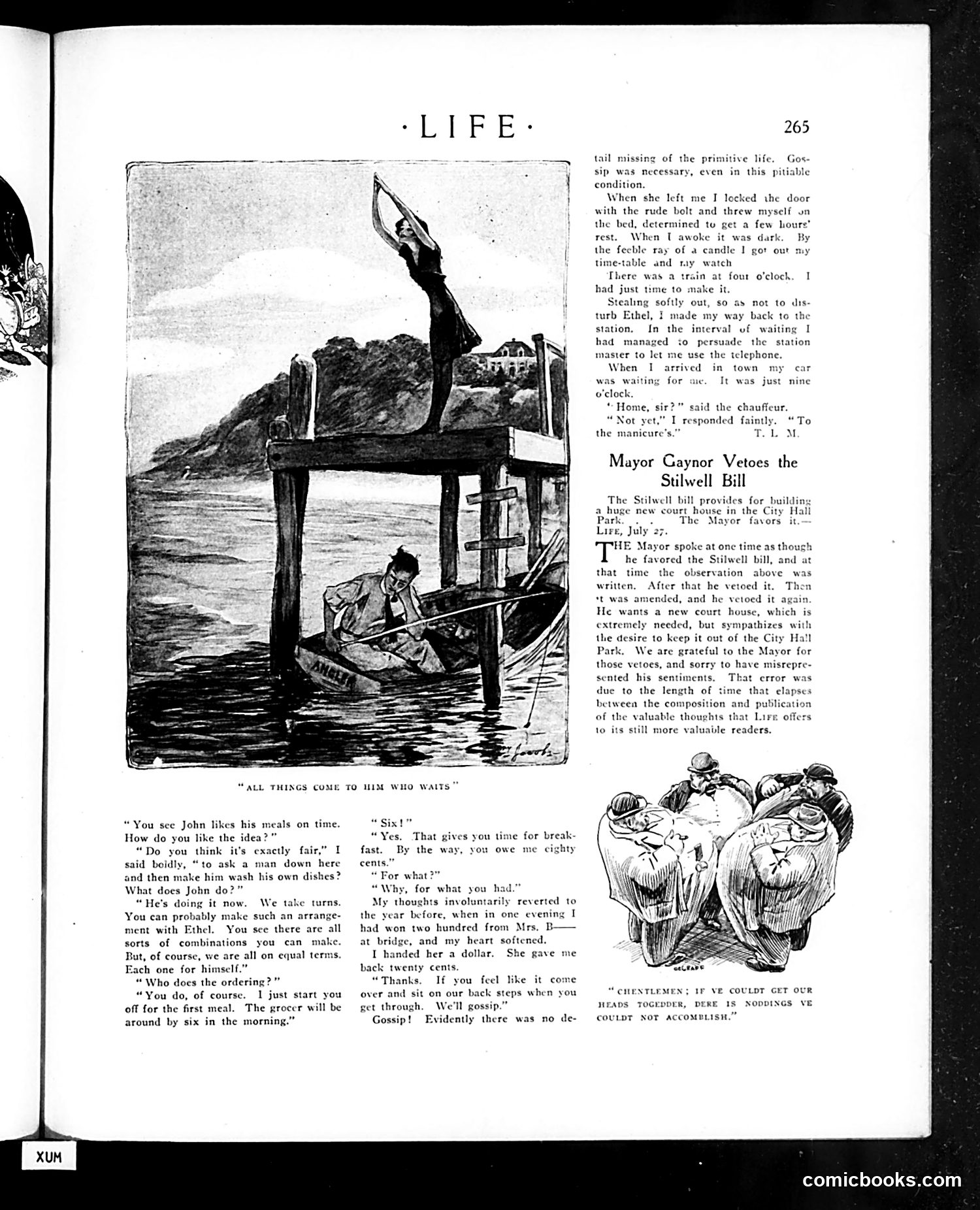
The main illustration, captioned "All Things Come to Him Who Waits," depicts a satirical domestic scene. A woman on a diving board poses elegantly while a man below washes dishes in water—a visual joke about gender role reversal and domestic labor negotiation. The accompanying text describes an arrangement where household chores are shared by turns, suggesting early 20th-century skepticism about such progressive domestic ideas. The dialogue mocks the impracticality of "equal terms" housekeeping: the woman charges the man for meals (demanding eighty cents, later haggling over a dollar tip), undermining the egalitarian premise. The narrator's irritation—he leaves hastily at 4 a.m.—suggests the satire targets both unrealistic domestic experiments and women's penny-pinching pragmatism. Below, a brief note corrects an earlier editorial error regarding Mayor Gaynor's position on the Stilwell Bill (a proposed courthouse), acknowledging publication delays.
📄 Transcribed text from this page (OCR, searchable)
Machine-transcribed from the original scan — historical spelling and the odd misread are preserved.
“ALL THINGS COME TO HIM WHO Wats” “Do you think exactly fai said boldly, “to ask a man down he and then make him wash his own dishe: What does John do?” “He's doing it now. We take turns. You can probably make such an arrange- ment with Ethel. You see there are all sorts of combinations you can make. But, of course, we are all on equal tern Each one for himself “ Who does the ordering?” “You do, of course. I just start you off for the first meal. The grocer will be around by six in the morning.” “Sixt” “Ye fast. By cents.” “ For what “Why, for what you had.” My thoughts involuntarily reverted to the year before, when in one evening I had won two hundred from Mrs. B- at bridge, and my heart softened. I handed her a dollar. She gave me back twenty cents. “Thanks. If you feel like it come over and sit on our back steps when you get through. We'll gossip.” Gossip! Evidently there was no de- That gives you time for break- the way, you owe me cighty 265 tail missing of the primitive I even i Gos- sip was necessary condition. When she left me I locked the door with the rude bolt and threw myself un the bed, determined tu get a few hours’ rest. When awoke it was dark. By the feeble ray of a candle 1 got out time-table and ray watch There was a train at four o'clock. 1 had just time to make it. aling softly out turb Ethel, ! this pitiable So as not to dis- de my way back to the station. {n the interval uf waiting I had managed io persuade the station master to let me use the telephone. When I arrived in was waiting for ac. o'clock. “Home, sir?” said the chauffeur. “Not yet,” I responded faintly. “To the manicure’s.” TL town my car It was just nine Mayor Gaynor Vetoes the Stilwell Bill The Stilwell bill provides for_buildins a huge new court house in the City Hall The Mayor favors it layor spoke at one time as though he favored the Stilwell bill, and at that time the observation above was written. After that he vetoed it. Ther st was amended, and he vetoed it again He wants a new court hous: extremely needed, but sympathizes with the desire to keep it out of the City Hall Park, We are grateful to the Mayor for those vetoes, and sorry to have misrepre- sented his sentiments. That error was due to the length of time that clapses betweea the compo: and publication of the valuable thoy which is ts that Lire offers still more valuable readers. “ CHENTLEMEN ; IF VE COULDT GET OUR MEADS DERE 18 NODDINGS VE COULDT Not accosvLisH.” rocepprr, comicbooks.com