
Life, 1911-08-17 · page 32 of 40
Life — August 17, 1911 — page 32: what you’re looking at
What you’re looking at
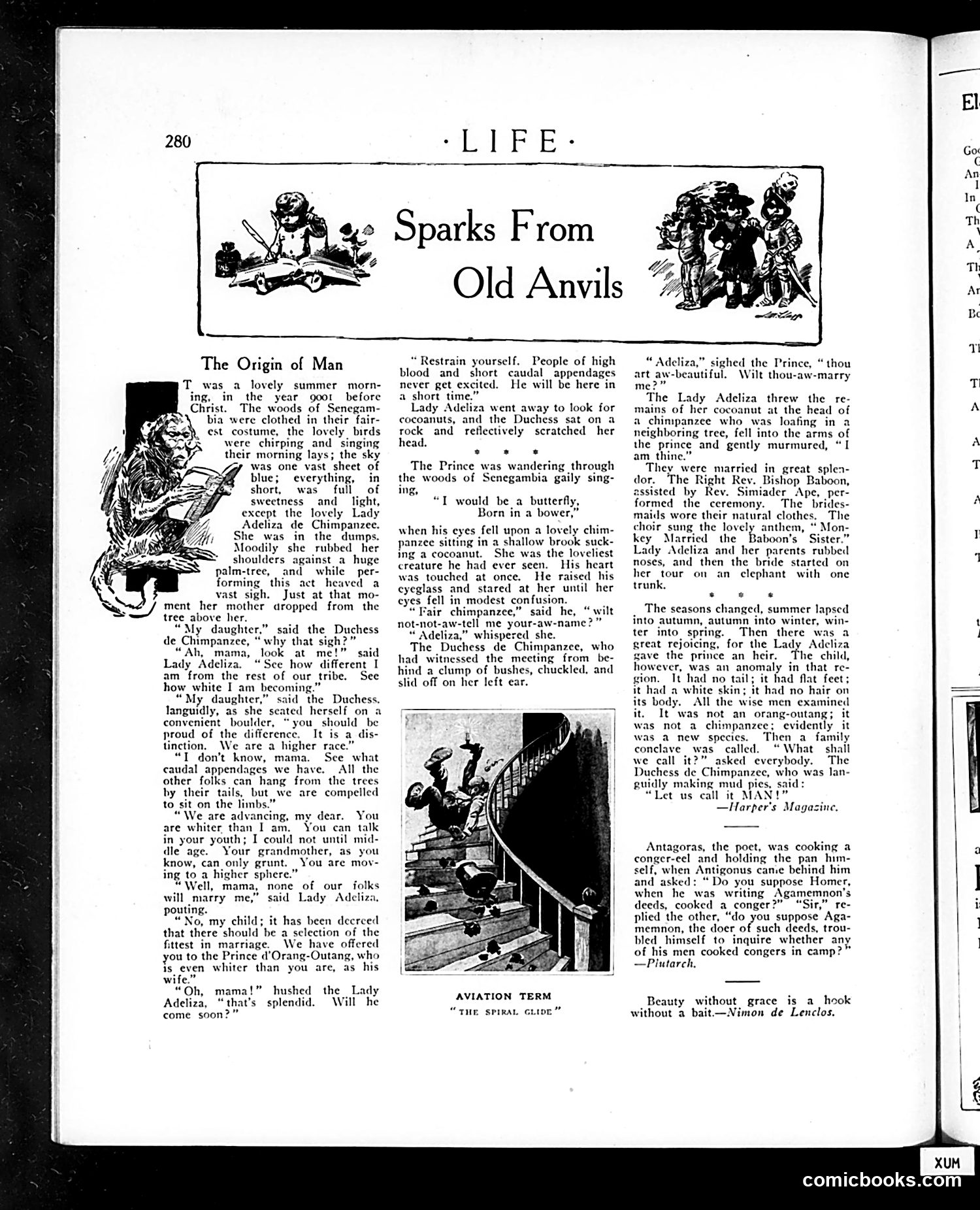
This satirical story mocks 19th-century evolutionary theory and racial pseudoscience. It presents human evolution as originating from apes, specifically depicting a romance between aristocratic chimpanzees who are "advancing" toward whiteness and human characteristics. The satire targets contemporary racial hierarchies: the Duchess celebrates her daughter's "advancement" toward whiteness and reduced tail size as markers of superiority—a direct jab at Victorian-era claims that Europeans represented an evolutionary "higher sphere." The irony deepens when their offspring is born human but represents an "anomaly," suggesting the story questions whether human superiority is genuinely progressing or merely conventional prejudice. The exaggerated dialect ("aw" affectations) and cartoonish names lampoon both ape-human transitions and the pretensions of those claiming racial distinctions. By framing human emergence as accidental and treating it with absurdist humor, Life magazine ridicules both evolutionary discourse misapplied to justify racism and the vanity of those claiming biological superiority. The illustrations show anthropomorphic apes in human situations, reinforcing the satirical point.
📄 Transcribed text from this page (OCR, searchable)
Machine-transcribed from the original scan — historical spelling and the odd misread are preserved.
The Origin of Man Twas a lovely summer morn- ing, in the year goot before Christ. The woods of Senegam- bia were clothed in their fair- est costume, the lovely. birds were chirping and singing their morning lays; the sky Was one vast sheet of blue; everything, in short, was full of sweetness and light, except the lovely Lady Adeliza de Chimpanzee. She was in the dumps. Moodily she rubbed her shoulders against a huge palm-tree, and while per- forming this act heaved a vast sigh. Just at that mo- ment her mother dropped from the tree above her. “My daughter,” said the Duchess de Chimpanzee, “why that sigh?” “Ah, mama, look at me!” said Lady Adeliza. “Sce how different I am from the rest of our tribe. See how white I am becoming.” “My daughter,” said the Duchess. languidly, as she seated herself on a convenient boulder, “you should be proud of the difference. It is a dis- tinction. We are a higher race.” “T don’t know, mama. Sce what caudal appendages we have. All the other folks can hang from the trees by their tails, but we are compelled to sit on the limbs, “We are advancing, my dear. You are whiter than I am. You can talk in your youth; I could not until mid- dle age. Your grandmother, as you know, can only grunt. You are mov- ing to a higher sphere. “Well, mama, none of our folks will marry me,” said Lady Adelizs pouting. No, my child; it has been deerced that there should be a selection of the fittest in marriage. We have offered you to the Prince d’Orang-Outang, who is even whiter than you are, as his wife.” Oh, mama Adeliza, “ that’ come soon?” !” hushed the Lady splendid. Will he Old Anvils “Restrain yourself, People of high blood and short caudal appendages never get excited. He will be here in a short time,” Lady Adeliza went away to look for cocoanuts, and the Duchess sat on a rock and reflectively scratched her head. 2 8 « The Prince was wandering through the woods of Senegambia gaily sing- ing, “TIT would be a butterfly, Born in a bower,” when his eyes fell upon a lovely chim- panzee sitting in a shallow brook suck- ing a cocoanut. She was the loveliest creature he had ever seen. His heart was touched at once. He raised his cyeglass and stared at her until her cyes fell in modest confusion. ; “Fair chimpanzee,” said he, “wilt not-not-aw-tell me your-aw-name?” “ Adeliza,” whispered, she. The Duchess de Chimpanzee, who had witnessed the meeting from be- hind a clump of bushes, chuckled, and slid off on her left ear. AVIATION TERM “THE SPIRAL GLtor” “ Adeliza,” sighed the Prince, “thou art aw-beautiful. Wilt thou-aw-marry me?” The Lady Adeliza threw the re- mains of her cocoanut at the head of a chimpanzee who was loafing in a neighboring tree, fell into the arms of the prince and gently murmured, “I am_thine.” They were married in great splea- dor. The Right Ri Bishop Baboon, assisted by Rev. Simiader Ape, per- formed the ceremony. The. brides- maids wore their natural clothes. The choir sung the lovely anthem, “ Mon- key Married the Baboon’s Sister.” Lady Adeliza and her parents rubbed noses, and then the bride started on her tour on an elephant with one trunk, s 8 « __ The seasons changed, summer lapsed into autumn, autumn into winter, w ter into. spring. Then there was great rejoicing, for the Lady Adcliza gave the prince an heir. The child, however, was an anomaly in that re- gion. It had no tail; it had flat feet; it had a white skin; it had no hair on its body. All the wise men examined it. It was not an orang-outang; it was not a chimpanzee; evidently it was a new species. Then a family conclave was called. “ What shall we call it?” asked everybody. The Duchess de Chimpanzee, who was lan- guidly making mud pies, said: “Let us call it MAN!” —Harper's Magazine, Antagoras, the poct, was cooking a conger-eel and holding the pan him- self, when Antigonus came behind him and “Do you suppose Home when he was writing Agamemnon’ deeds, cooked a conger?” “Sir,” re- plied the other, “do you suppose Aga- memnon, the doer of such deeds, trou- bled himself to inquire whether any of his men cooked congers in camp?” —Piutarch, Beauty without grace is a hook without a bait—Nimon de Lenclos. comicbooks co