
Life, 1911-08-17 · page 24 of 40
Life — August 17, 1911 — page 24: what you’re looking at
What you’re looking at
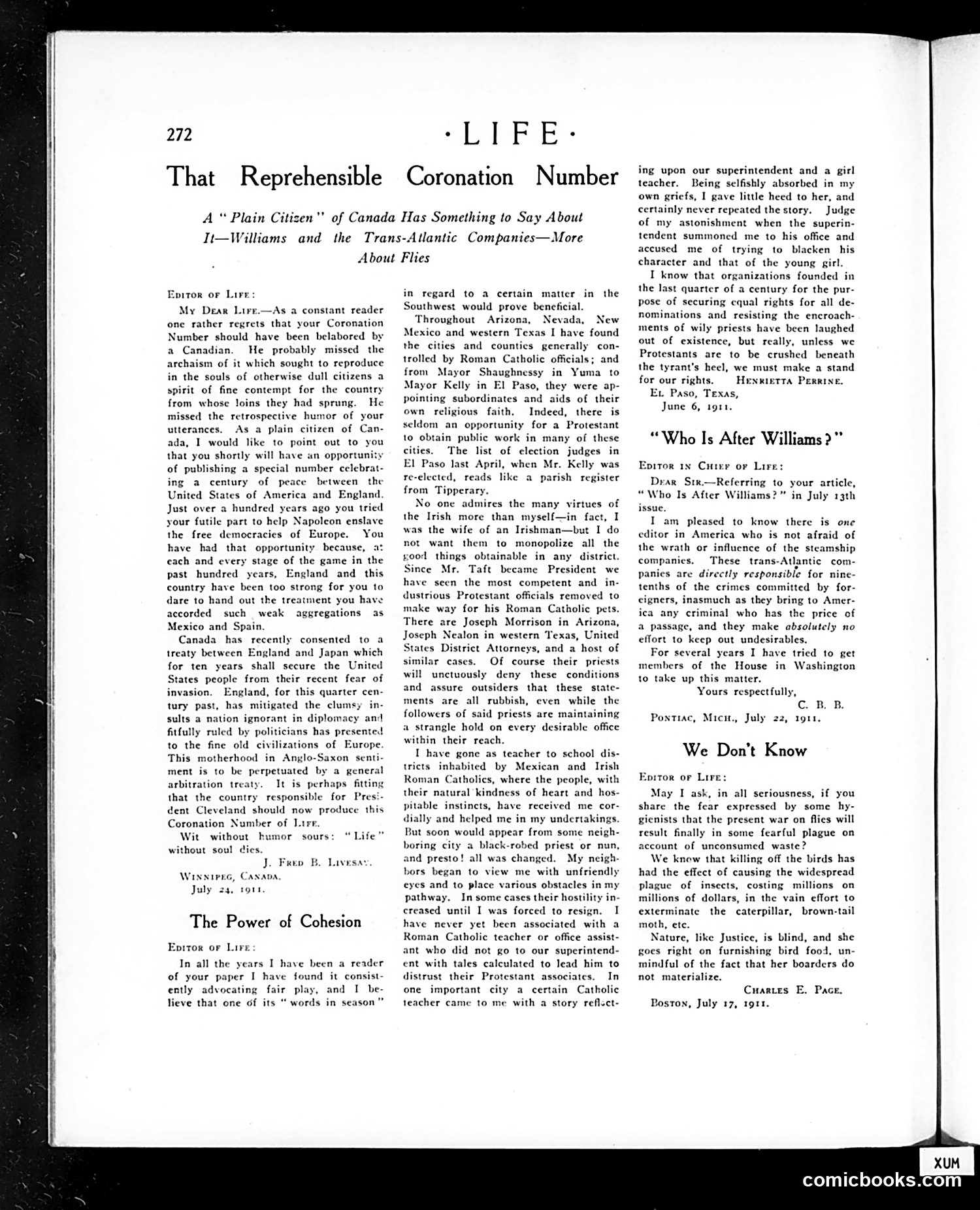
This page contains three separate letters to the editor rather than cartoons. The content reflects early 20th-century American political anxieties: **"That Reprehensible Coronation Number"**: A Canadian reader criticizes Life's coverage of a British coronation, arguing it romanticizes England despite America's historical conflicts with Britain. He notes Canada recently secured peace between the U.S. and England through a Japan treaty, positioning Canada as a mediator between rival powers. **"Who Is After Williams?"**: This letter defends trans-Atlantic steamship companies against criticism, requesting Life investigate their actual practices rather than accept hearsay. **"The Power of Cohesion"**: A lengthy complaint from the Southwest alleging that Roman Catholic officials (particularly Irish-American mayors like Kelly in El Paso) monopolize public employment and discriminate against Protestants. The writer claims this represents religious favoritism under President Taft's administration. These letters reflect period tensions: Anglo-American relations, corporate regulation, and Protestant-Catholic employment discrimination in the American Southwest.
📄 Transcribed text from this page (OCR, searchable)
Machine-transcribed from the original scan — historical spelling and the odd misread are preserved.
272 That Reprehensible Litre: Coronation Number A“ Plain Citizen" of Canada Has Something to Say About It—Williams and the Trans-Allantic Companies—More About Flies Epitor oF Liv My Dear Lire.—As a constant reader one rather regrets that your Coronation Number should have been belabored by a Canadian. He probably missed the archaism of it which sought to reproduce in the souls of otherwise dull citizens a spirit of fine contempt for the country from whose loins they had sprung. He missed the retrospective humor of your utterances. As a plain citizen of Can- ada, I would like to point out to you that you shortly will have an opportunity of publishing a special number celebrat- ing a century of peace between the United States of America and England. Just over a hundred years ago you tried your futile part to help Napoleon enslave the free democracies of Europe. You have had that opportunity because, cach and every stage of the game in the past hundred years, England and this country have been too strong for you to dare to hand out the treatment you have accorded such weak aggregations as Mexico and Spain. Canada has recently consented to a treaty between England and Japan which for ten years shall secure the United States people from their recent fear of invasion. England, for this quarter cen- tury past, has mitigated the clumsy in- sults a nation ignorant in diplomacy and fitfully ruled by p ns has presented to the fine old civilizations of Europe. This motherhood in Anglo-Saxon senti- ment is to be perpetuated by a general arbitration treaty. It is perhaps fitting that the country responsible for Pres'- dent Cleveland should now produce this Coronation Number of Ltrr. Wit without humor without soul dics. sours: “Life™ J. Freep B. Livesa: Wissirec, Caxaoa, July 24, 1911 The Power of Cohesion Eprror or Lire In all the years I have been a reader of your paper I have found it consist- ently advocating fair play, and Ib lieve that one of its “words in season” in regard to a certain matter in the Southwest would prove beneficial. Throughout Arizona, Nevada, New Mexico and western Texas I have found the cities and countics generally con- trolled by Roman Catholic officials; and from Mayor Shaughnessy in Yuma to Mayor Kelly in El Paso, they were ap- pointing subordinates and aids of their own religious faith, Indeed, there is seldom an opportunity for a Protestant to obtain public work in many of these cities. The list of election judges in El Paso last April, when Mr. Kelly was re-elected, reads like a parish register from Tipperary. No one admires the many virtues of the Irish more than myself—in fact, I was the wife of an Irishman—but I do not want them to monopolize all the good things obtainable in any district. Since Mr. Taft became President we have seen the most competent and in- dustrious Protestant officials removed to make way for his Roman Catholic pets. There are Joseph Morrison in Arizon: Joseph Nealon in western Texas, United States District Attorneys, and a host of similar cases. Of course their priests will unctuously deny these conditions and assure outsiders that these state- ments are all rubbish, even while the followers of said priests are maintaining a strangle hold on every desirable office within their reach. I have gone as teacher to school dis- tricts inhabited by Mexican and Irish Roman Catholics, where the people, with their natural kindness of heart and hos- pitable instincts, have received me cor- dially and helped me in my undertakings. But soon would appear from some neigh- boring city a black-robed priest or nun, and presto! all was changed. My nei bors began to view me with unfriendly cyes and to place various obstacles in my pathway, In some cases their hostility i creased until I was forced to resign have never yet been associated with a Roman Catholic teacher or office assist- ant who did not go to our superintend- ent with tales calculated to lead him to distrust their Protestant associates, In one important city a certain Catholic teacher came to me with a story reflect- ing upon our superintendent and a girl teacher. Being selfishly absorbed in my own griefs, I gave little heed to her, and certainly never repeated the story. Judge of my astonishment when the superin- tendent summoned me to his office and accused me of trying to blacken his character and that of the young girl. I know that organizations founded in the last quarter of a century for the pur- pose of securing equal rights for all de- nominations and resisting the encroach- ments of wily priests have been laughed out of existence, but really, unless we Protestants are to be crushed beneath the tyrant's heel, we must make a stand for our rights. Hewxtetra Perrine. EL Paso, Texas, June 6, grt. “Who Is After Williams >?” Epitor 1x Cuter ov Lire: Dear Stx.—Referring to your article, “Who Is After Williams?” in July 13th issue. I am pleased to know there is one editor in America who is not afraid of the wrath or influence of the steamship companies, These trans-Atlantic com- panies are directly responsible for nine- tenths of the crimes committed by for- cigners, inasmuch as they bring to Amer- ica any criminal who has the price of a passage, and they make absolutely no effort to keep out undesirables. For several years I have tried to get members of the House in Washington to take up this matter. Yours respectfully, Cc BB. Poxtiac, Micit,, July 22, 1911. We Don’t Know Eprtor oF Lire: May I ask, in all seriousness, if you share the fear expressed by some hy- gicnists that the present war on flies will result finally in some fearful plague on account of unconsumed waste? We know that killing off the birds has had the effcet of causing the widespread plague of insects, costing millions on millions of dollars, in the vain effort to exterminate the caterpillar, brown-tail moth, ete. Nature, like Justice, is blind, and she goes right on furnishing bird food, un- mindful of the fact that her boarders do not materialize. Cutartes E. Pace. Boston, July 17, 1911. comicbooks.com