
Life, 1911-08-17 · page 8 of 40
Life — August 17, 1911 — page 8: what you’re looking at
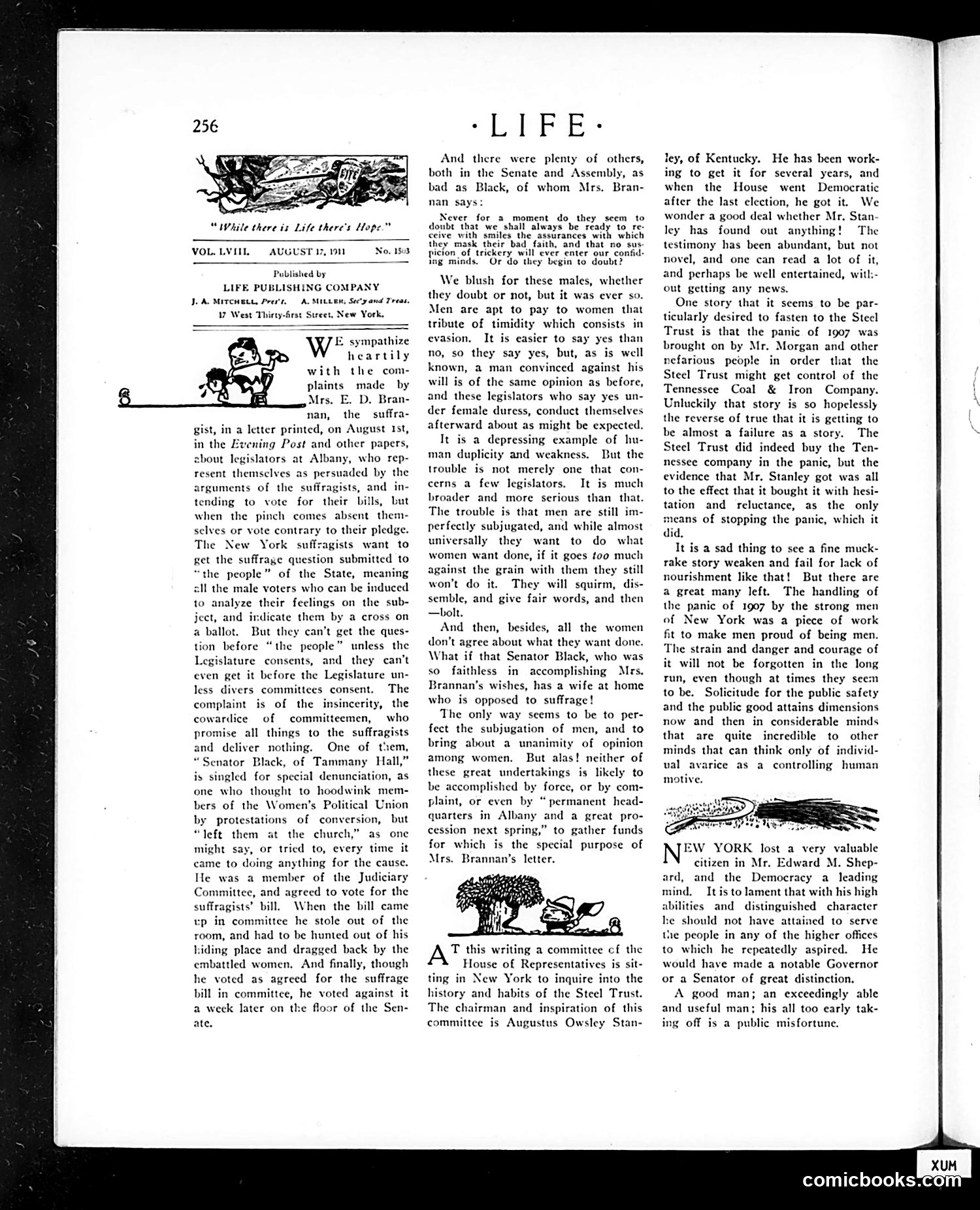
What you’re looking at
This *Life* magazine page critiques male legislators' hypocrisy regarding women's suffrage. The text attacks Senator Black of Tammany Hall and other New York politicians who claim to support women's rights but oppose the suffrage bill. The satire highlights the contradiction: these men want women's votes on individual issues but deny them actual voting power. The piece mocks their "permanent headquarters in Albany" scheming and their casual broken promises to suffragists. The editorial also mourns Edward M. Shepard, a prominent Democrat who died, noting he would have been a better advocate for women's equality than the self-serving politicians who merely exploit the issue for political advantage. The cartoons (visible but small) likely reinforce these themes of male political cowardice on suffrage.
📄 Transcribed text from this page (OCR, searchable)
Machine-transcribed from the original scan — historical spelling and the odd misread are preserved.
“While there iz Life there's Hope.” VOL. LVIIL AUGUST 17,1911 No. 1503 lished by LIFE PUBLISHING COMPANY JA. MITCHELL, Press, A. MILLEM, See’y and Treas, W West Thirty-first Street, New York, E. sympathize heartily with the com- plaints made by Mrs. E. D. Bran- nan, the suffra- gist, in a letter printed, on August Ist, in the Evening Post and other papers, about legislators at Albany, who rep- resent themselves as persuaded by the arguments of the suffragists, and in- tending to vote for their bills, but when the pinch comes absent them- selves or vote contrary to their pledge. The New York suffragists want to get the suffrage question submitted to “the people” of the State, meaning all the male voters who can be induced to analyze their feelings on the sub- ject, and indicate them by a cross on a ballot. But they can’t get the ques- tion before “the people” unless the Legislature consents, and they can’t even get it before the Legislature un- less divers committees consent. The complaint is of the insincerity, the cowardice of committeemen, who promise all things to the suffragists and deliver nothing. One of them, “Senator Black, of Tammany Hall,” is singled for special denunciation, as one who thought to hoodwink mem- bers of the Women’s Political Union by protestations of conversion, but “left them at the church,” as one might say, or tricd to, every time it came to doing anything for the cause. He was a member of the Judiciary Committee, and agreed to vote for the suffragists’ bill. When the bill came up in committce he stole out of the room, and had to be hunted out of his hiding place and dragged back by the embattled women, And finally, though he voted as agreed for the suffrage bill in committce, he voted against it a week later on the floor of the Sen- ate. *LIPE* And there were plenty of others, both in the Senate and Assembly, as bad as Black, of whom Mrs. Bran- nan says: Never for a moment do they seem to doubt that we shall always be ready to re- ceive with smiles the assurances with which they mask their bad faith, and that no si picion of trickery will ever enter our confid- ing minds. Or do they begin to doubt? We blush for these males, whether they doubt or not, but it was ever so. Men are apt to pay to women that tribute of timidity which consists in evasion. It is easier to say yes than no, so they say yes, but, as is well known, a man convinced against his will is of the same opinion as before, and these legislators who say yes un- der female duress, conduct themselves afterward about as might be expected. It is a depressing example of hu- man duplicity and weakness. But the trouble is not merely one that con- cerns a few legislators. It is much broader and more serious than that. The trouble is that men are still im- perfectly subjugated, and while almost universally they want to do what women want done, if it goes too much against the grain with them they still won't do it. They will squirm, dis- semble, and give fair words, and then —bolt. And then, besides, all the women don’t agree about what they want done. What if that Senator Black, who was so faithless in accomplishing Mrs. Brannan’s wishes, has a wife at home who is opposed to suffrage! The only way seems to be to per- fect the subjugation of men, and to bring about a unanimity of opinion among women. But alas! neither of these great undertakings is likely to be accomplished by force, or by com- plaint, or even by “permanent head- quarters in Albany and a great pro- cession next spring,” to gather funds for which is the special purpose of Mrs. Brannan’s letter. T this writing a committce cf the House of Representatives ting in New York to inquire into the history and habits of the Stcel Trust. The chairman and inspiration of this committce is Augustus Owsley Stan- ley, of Kentucky. He has been work- ing to get it for several years, and when the House went Democratic after the last election, he got it. We wonder a good deal whether Mr, Stan: ley has found out anything! The testimony has been abundant, but not novel, and one can read a lot of it, and perhaps be well entertained, with- out getting any news. One story that it seems to be par- ticularly desired to fasten to the Steel Trust is that the panic of 1907 was brought on by Mr. Morgan and other nefarious people in order that the Steel Trust might get control of the Tennessee Coal & Iron Company. Unluckily that story is so hopelessly the reverse of true that it is getting to be almost a failure as a story. The Steel Trust did indeed buy the Ten- nessee company in the panic, but the evidence that Mr, Stanley got was all to the effect that it bought it with hesi- tation and reluctance, as the only means of stopping the panic, which it did. It is a sad thing to see a fine muck- rake story weaken and fail for lack of nourishment like that! But there are a great many left. The handling of the panic of 1907 by the strong men of New York was a piece of work fit to make men proud of being men. The strain and danger and courage of it will not be forgotten in the long run, even though at times they seem to be. Solicitude for the public safety and the public good attains dimensions now and then in considerable minds that are quite incredible to other minds that can think only of individ- ual avarice as a controlling human motive. EW YORK lost a very valuable citizen in Mr. Edward M. Shep- ard, and the Democracy a leading mind. It is to lament that with his high abilities and distinguished character should not have attained to serve the people in any of the higher offices to which he repeatedly aspired. He would have made a notable Governor or a Senator of great distinction. A good man; an exceedingly able and useful man; his all too early tak- ing off is a public misfortune. comicbooks -cCO