
A complete issue · 44 pages · 1911
Life — July 6, 1911
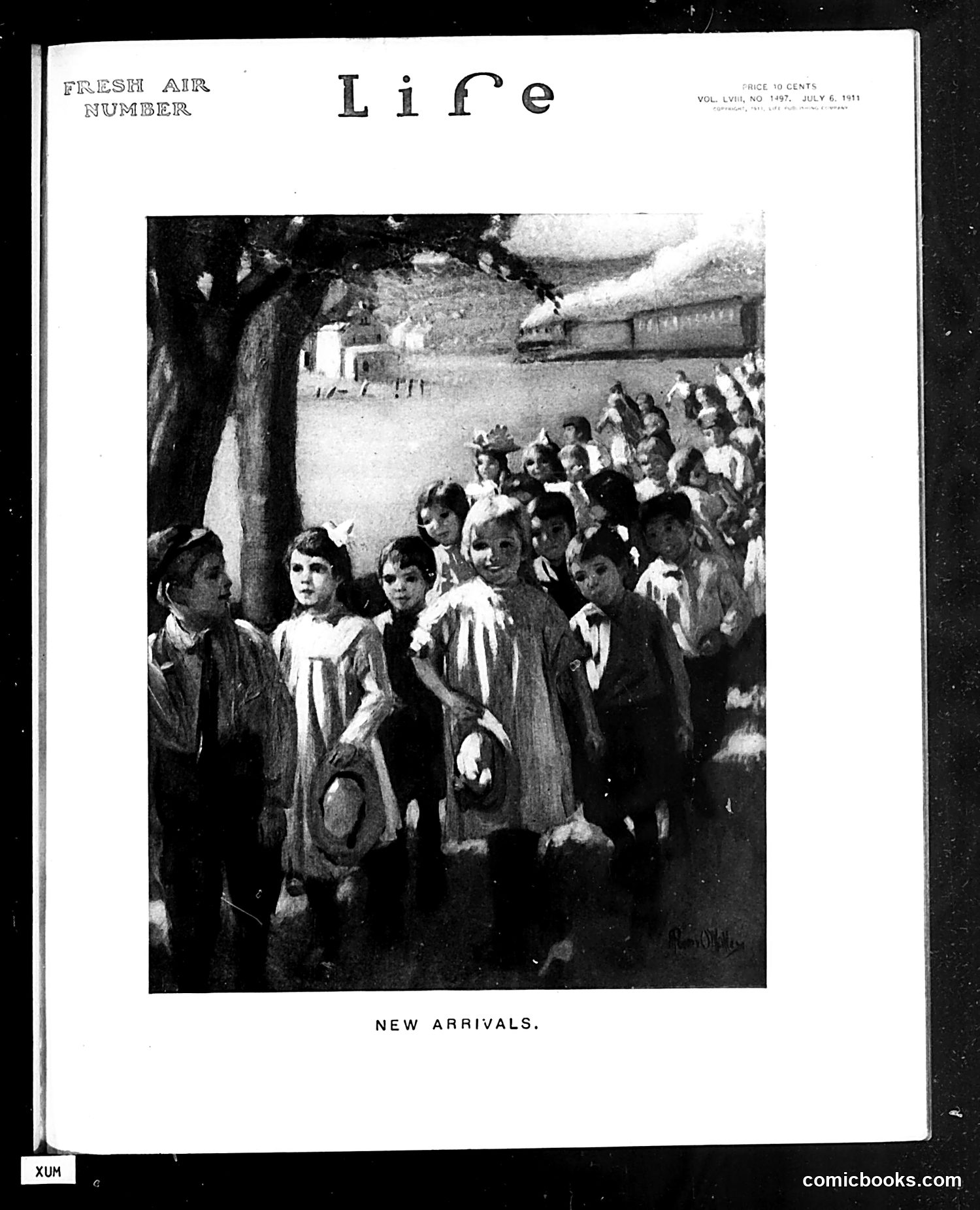
This page depicts immigration to America, showing newly arrived immigrants—adults and children in modest clothing—gathered beneath a large tree, with a train visible in the background. The caption "NEW ARRIVALS" identifies them as fresh off the boat or train. The satirical point likely critiques early 20th-century immigration anxieties. Life magazine frequently mocked both the conditions immigrants faced and American attitudes toward newcomers. The juxtaposition of the "Fresh Air Number" header with this image of arrivals suggests the piece addresses debates about assimilation, living conditions, or the strain on American resources—common satirical targets during the Progressive Era's peak immigration period. The specific immigrant group or origin is unclear from the image alone.
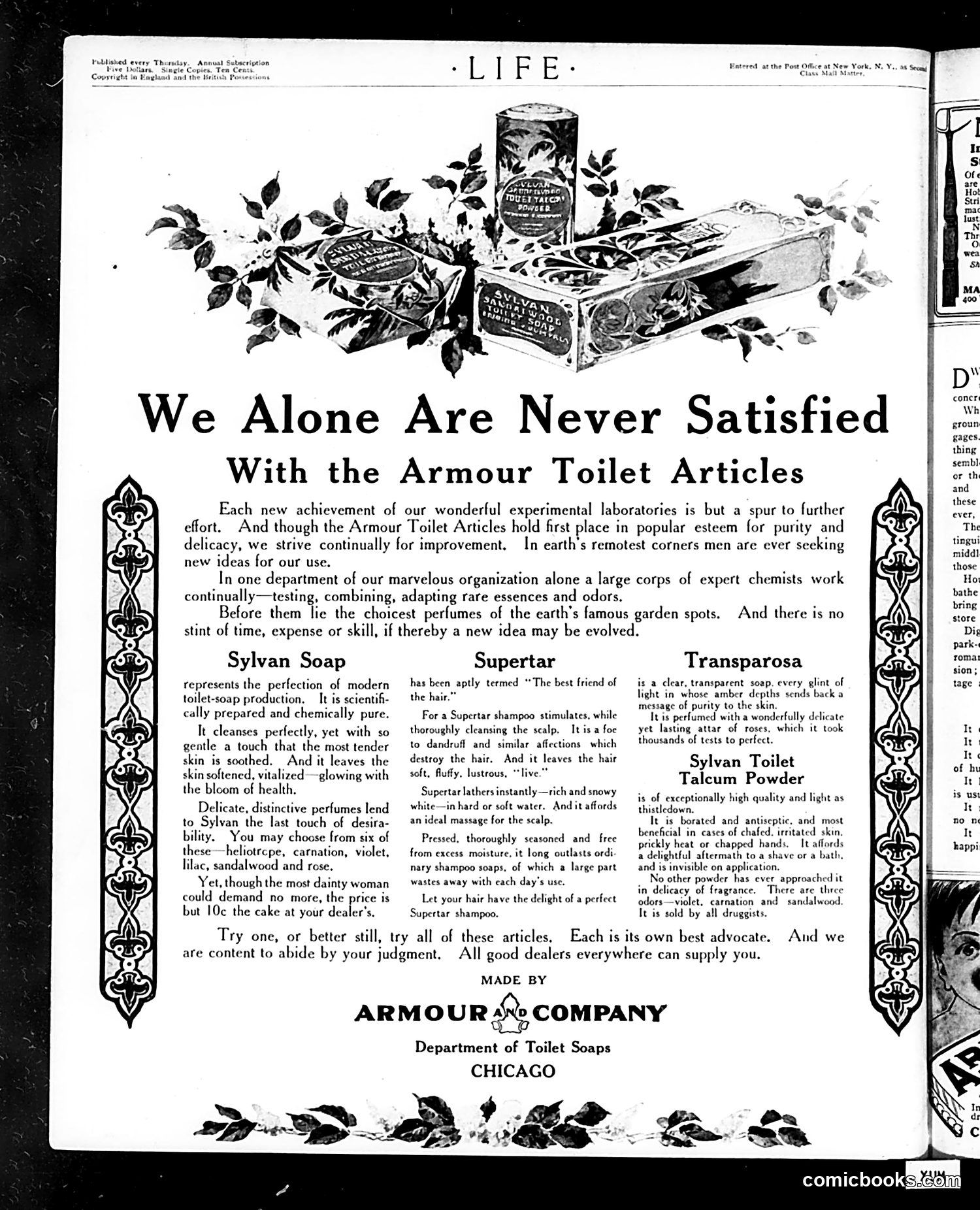
This is **not a cartoon or satire page** — it's a full-page advertisement for Armour and Company's toilet soap products (Sylvan Soap, Supertar shampoo, Transparosa soap, and Sylvan Toilet Talcum Powder). The headline "We Alone Are Never Satisfied With the Armour Toilet Articles" is marketing copy claiming the company constantly improves its products through laboratory testing and rare essences. The decorative border and illustrated product boxes are standard early-20th-century advertising design. The page appears in *Life* magazine, which accepted commercial advertisements alongside satirical content. There is no political or social satire present — this is straightforward commercial promotion from Chicago's Armour Company.
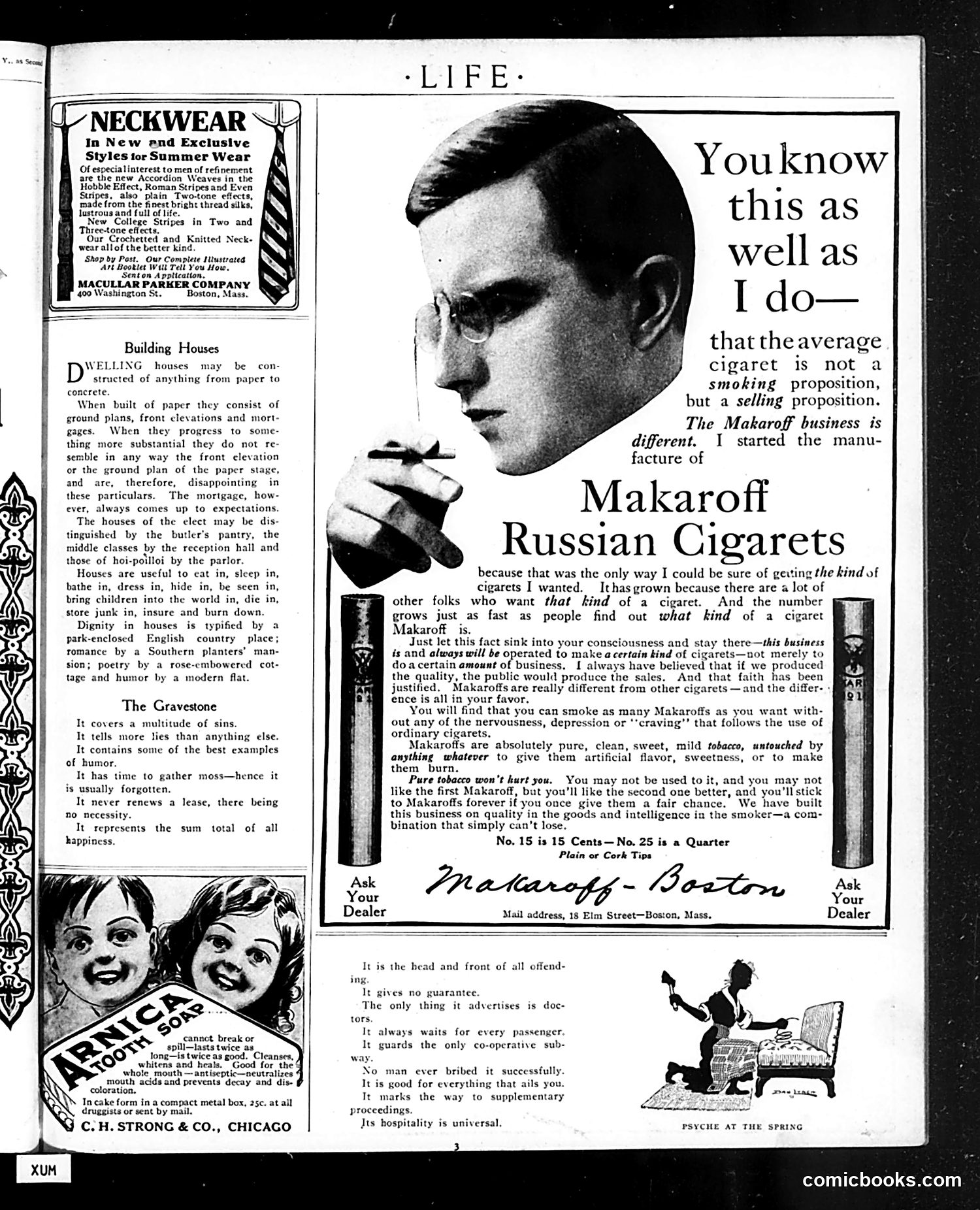
This page is **primarily advertising**, not political satire. The dominant content is a full-page Makaroff Russian Cigarettes advertisement featuring a man's profile smoking a cigarette. The ad uses a testimonial format, with the speaker claiming he started manufacturing these cigarettes to ensure quality and purity—emphasizing they contain no artificial additives. The smaller items are unrelated advertisements: neckwear from Macullar Parker Company, Aricin toothpaste from C.H. Strong & Co., and articles on building houses and gravestones. There's a small cartoon titled "Psyche at the Spring" at bottom right, but it's unclear without additional context. The page reflects early 20th-century advertising practices emphasizing product purity and quality as selling points.
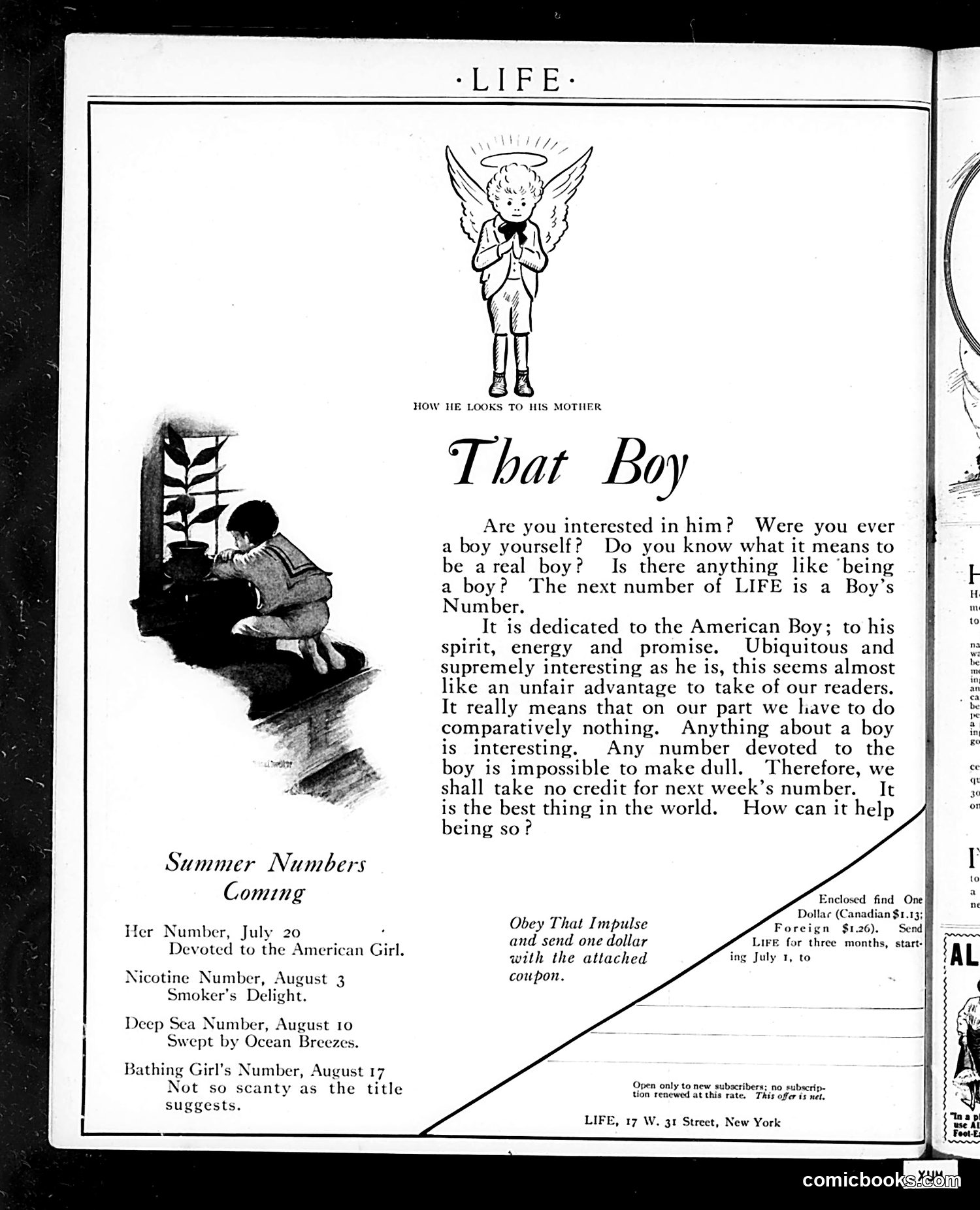
This page from *Life* magazine announces an upcoming "Boy's Number" issue. The main content is an editorial celebration of American boyhood, declaring that any issue devoted to boys "is impossible to make dull." The left illustration shows a boy playing with toys—likely representing the innocence and universal appeal of childhood. The angel figure at top ("How He Looks to His Mother") depicts the idealized, almost sacred way mothers perceive their sons. The "Summer Numbers Coming" list previews upcoming themed issues celebrating distinctly American subjects: the American Girl, smoking culture ("Smoker's Delight"), ocean leisure, and bathing culture. The tone is lighthearted and promotional, reflecting early 20th-century *Life* magazine's satirical yet sentimental approach to American culture and gender roles.
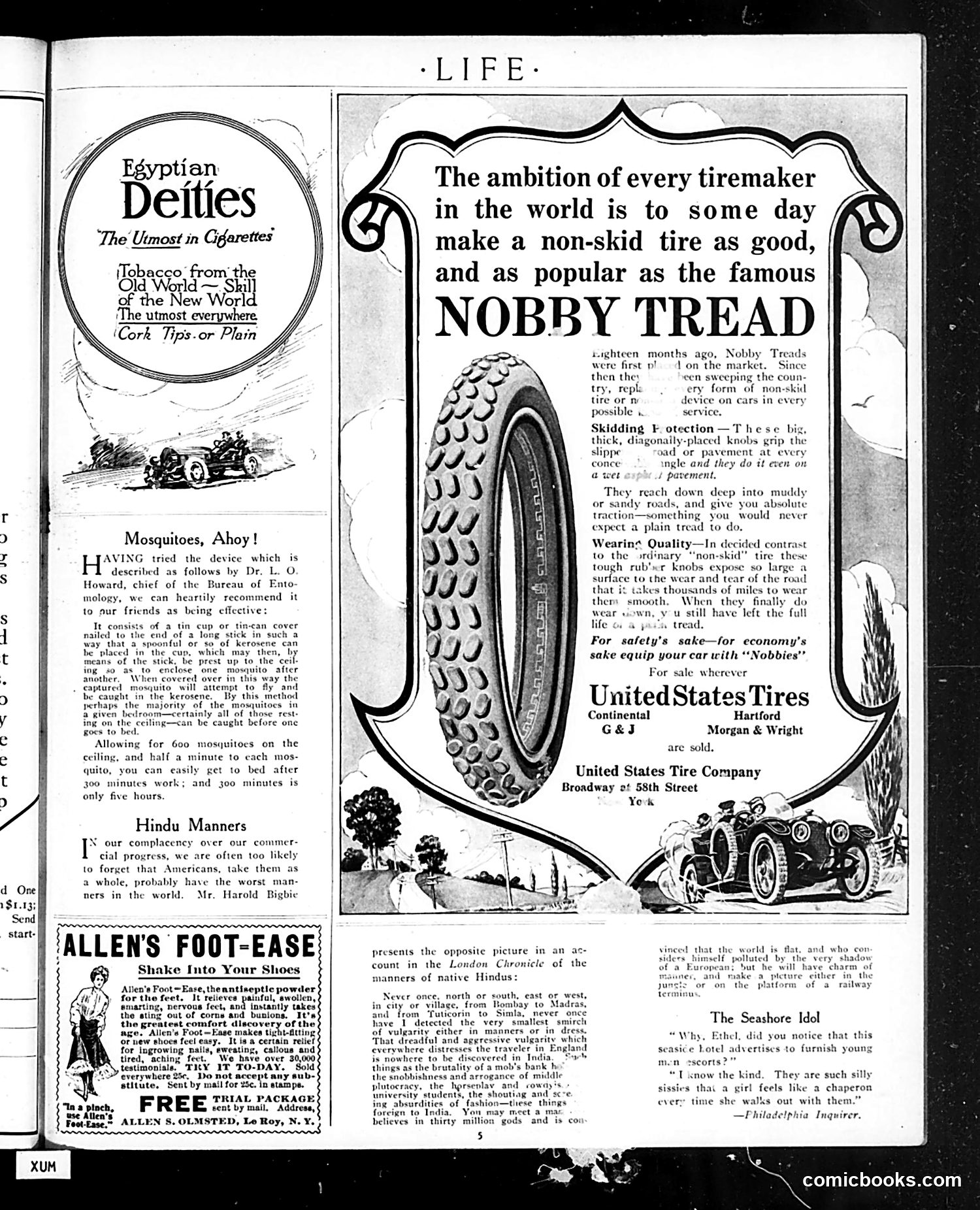
This Life magazine page is primarily **advertising**, not satire or political commentary. The content includes: 1. **Egyptian Delites cigarettes** ad (left): A straightforward product advertisement highlighting tobacco quality and availability. 2. **Nobby Tread tire** ad (center/right): The main feature promoting a new non-skid automobile tire. The text emphasizes practical benefits—traction, durability, and skid prevention—rather than making satirical points. The accompanying illustrations show the tire's tread pattern and racing cars. 3. **Allen's Foot-Ease** ad (bottom left): Another product advertisement for a foot powder. 4. **"The Seashore Idol"** (bottom right): A brief humorous piece about hotel advertising, appearing to be light satirical commentary on hospitality marketing rather than political satire. The page reflects early 20th-century consumer culture and automobiles, with no apparent political messaging.
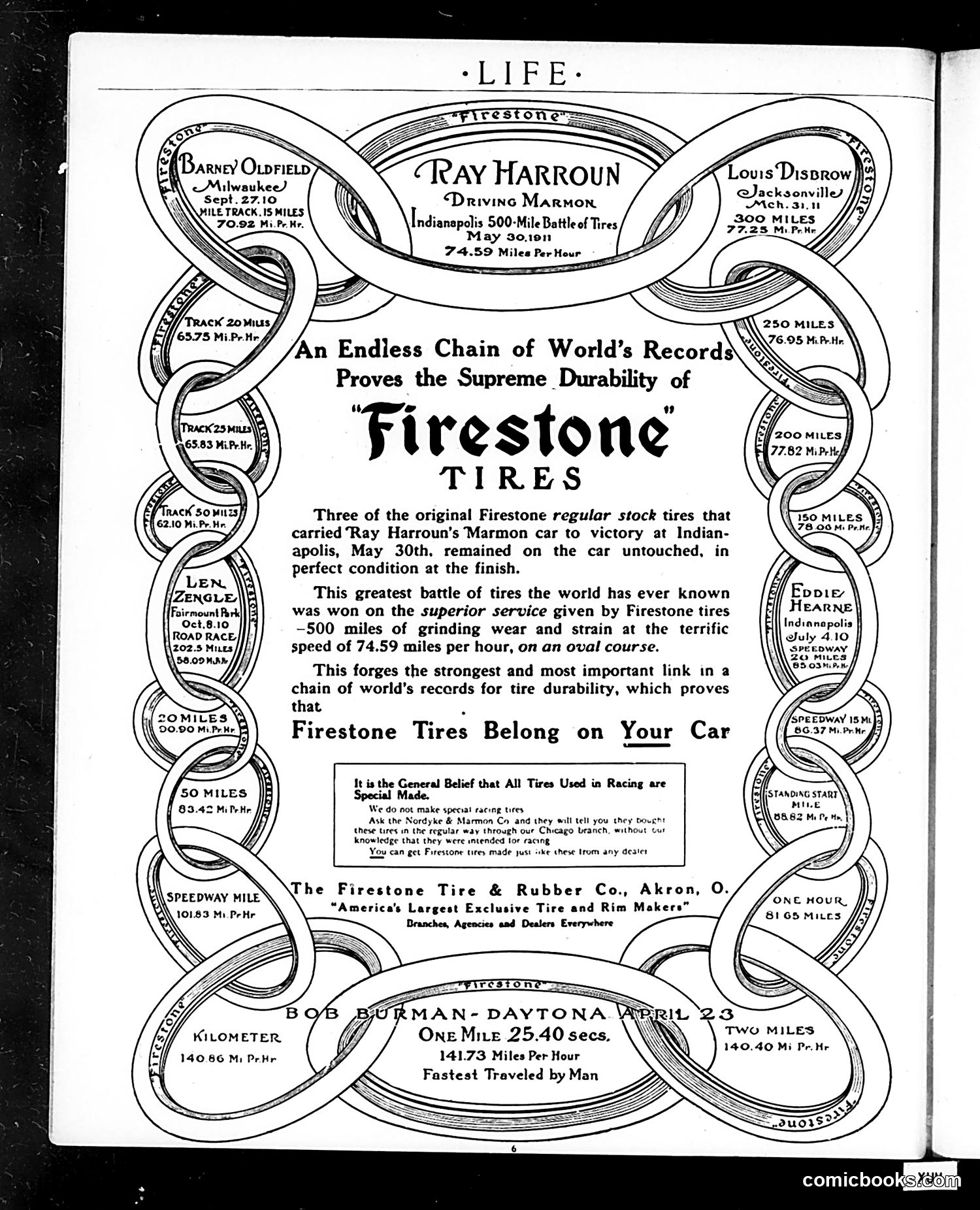
This is **not a political cartoon or satire**—it's a straightforward **Firestone Tires advertisement** from Life magazine. The page celebrates Firestone's durability by documenting racing records. It features Ray Harroun's victory in the Indianapolis 500 (May 30, 1911) at 74.59 mph, where three Firestone tires remained undamaged. The surrounding chain of ovals documents other speed records—various track distances, the Daytona speed record (Bob Burman, April 23), and other racing achievements. The central message advertises Firestone as "regular stock tires" proven superior through racing performance, promoting the brand to consumers. The copy explicitly addresses a misconception: racing tires aren't special—they're standard Firestone products available to the public through dealers. This represents early automotive advertising leveraging racing success as proof of product quality.
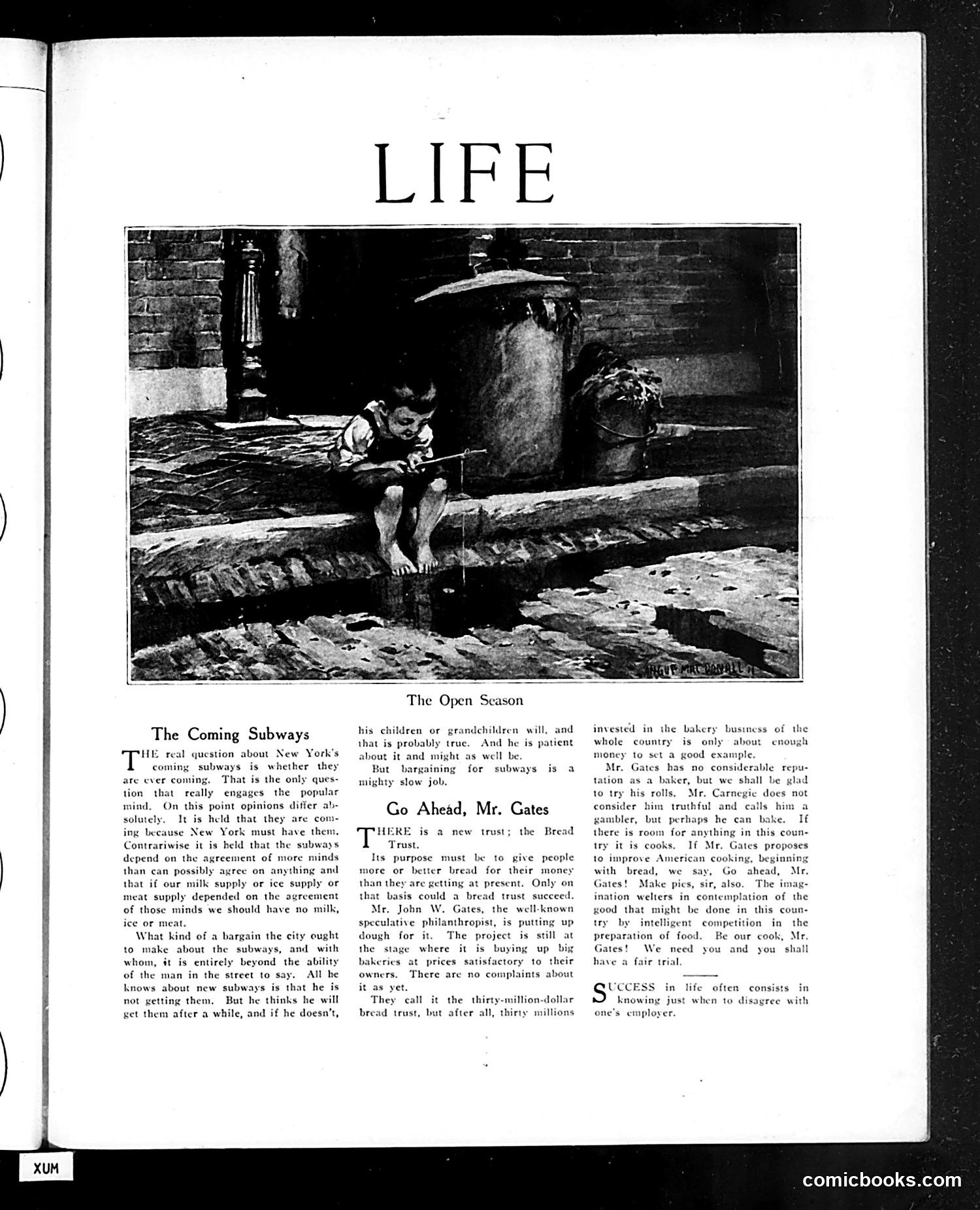
This page contains three opinion pieces under the heading "LIFE," featuring a photograph titled "The Open Season" showing a child fishing. The articles discuss: 1. **"The Coming Subways"** — argues that New York's proposed subway system is debated but ultimately necessary, noting disagreement about construction details. 2. **"Go Ahead, Mr. Cates"** — supports John W. Gates's bread trust initiative, arguing it could improve bread prices and quality for consumers. Gates is described as a "well-known speculative philanthropist" attempting to address high bakery costs. 3. A brief statement about success in professional life. The content reflects early 20th-century concerns about urban infrastructure, food prices, and corporate monopolies presented as potential solutions to consumer problems.
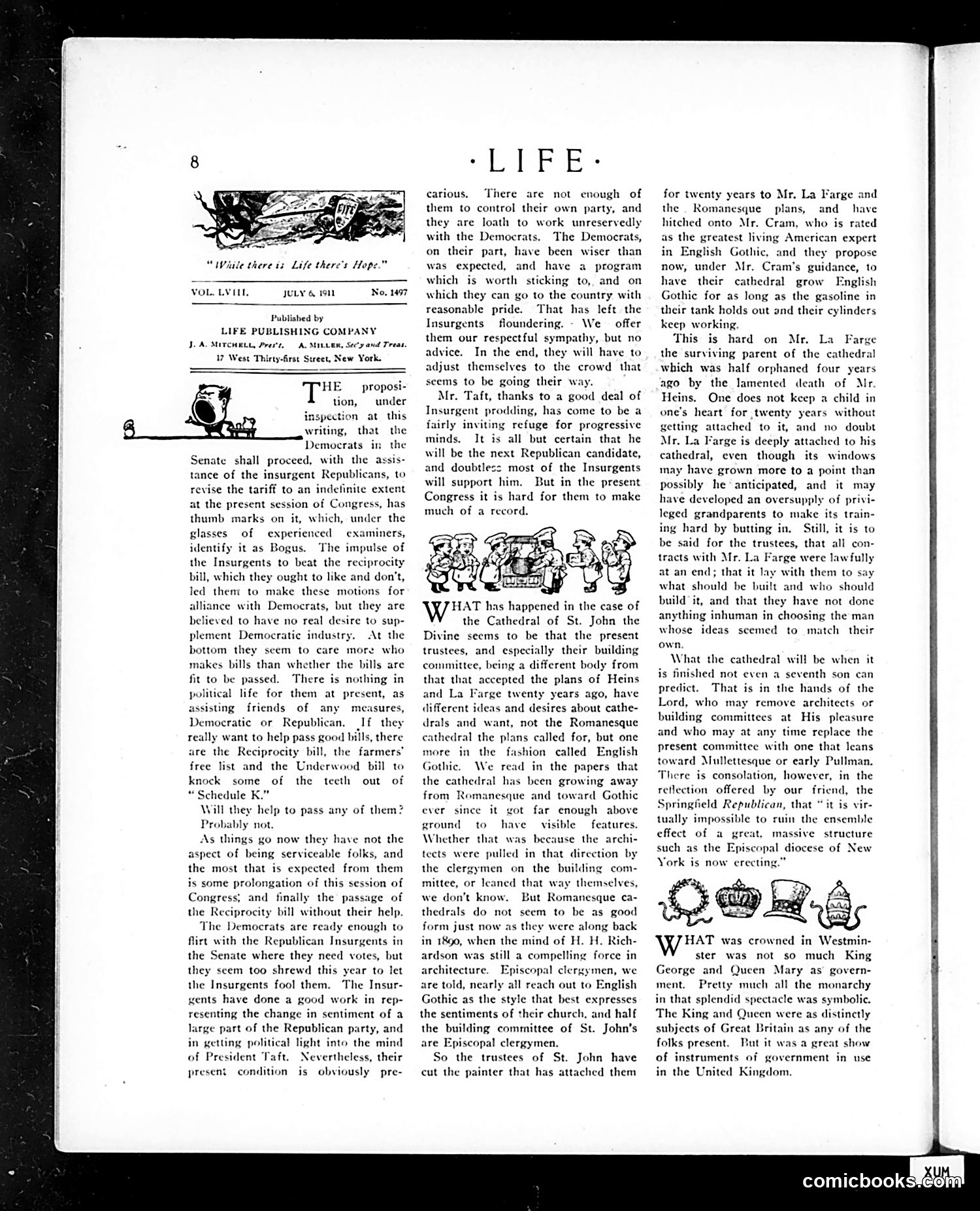
This *Life* magazine page (July 5, 1911) contains editorial commentary on two topics: 1. **Cathedral of St. John the Divine**: The text discusses tensions between trustees and architects over whether to continue Romanesque or switch to English Gothic style. The text notes trustees are pulling the cathedral in different directions architecturally—a metaphor for institutional indecision. 2. **Republican Party Division**: The main editorial criticizes insurgent Republicans challenging party leadership. It compares their internal conflict to the cathedral's architectural disputes, suggesting both groups lack unified direction and that Democrats are exploiting this Republican disarray. The piece's political point: the Republican Party, like the cathedral committee, suffers from conflicting visions that weaken institutional authority and invite external competitors (Democrats) to capitalize on internal weakness.
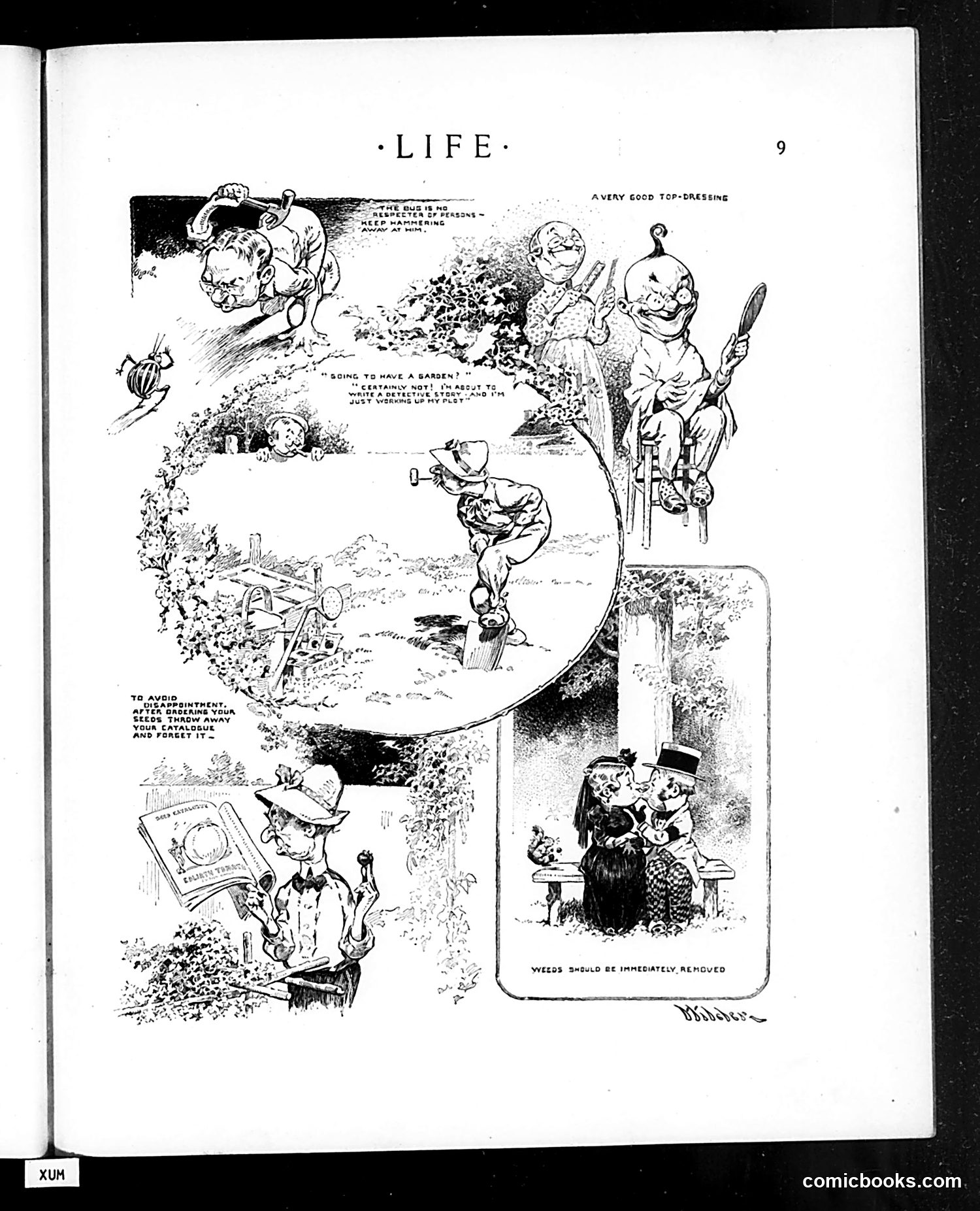
This page presents gardening humor through multiple cartoon vignettes. The top panel, titled "A Very Good Top-Dressing," shows three figures discussing garden preparation, with one stating "Going to have a garden" and mentioning writing a "detective story" while "working up my plot"—a pun on plot as both garden bed and narrative structure. Other panels depict various gardening mishaps and absurdities: a man struggling with gardening tools, someone consulting a seed catalog, and figures engaged in garden labor. The bottom panel, "Weeds Should Be Immediately Removed," shows formally-dressed figures in what appears to be social commentary about removing undesirable elements. The humor relies on visual gags and wordplay about gardening, popular among Life's early 20th-century audience.
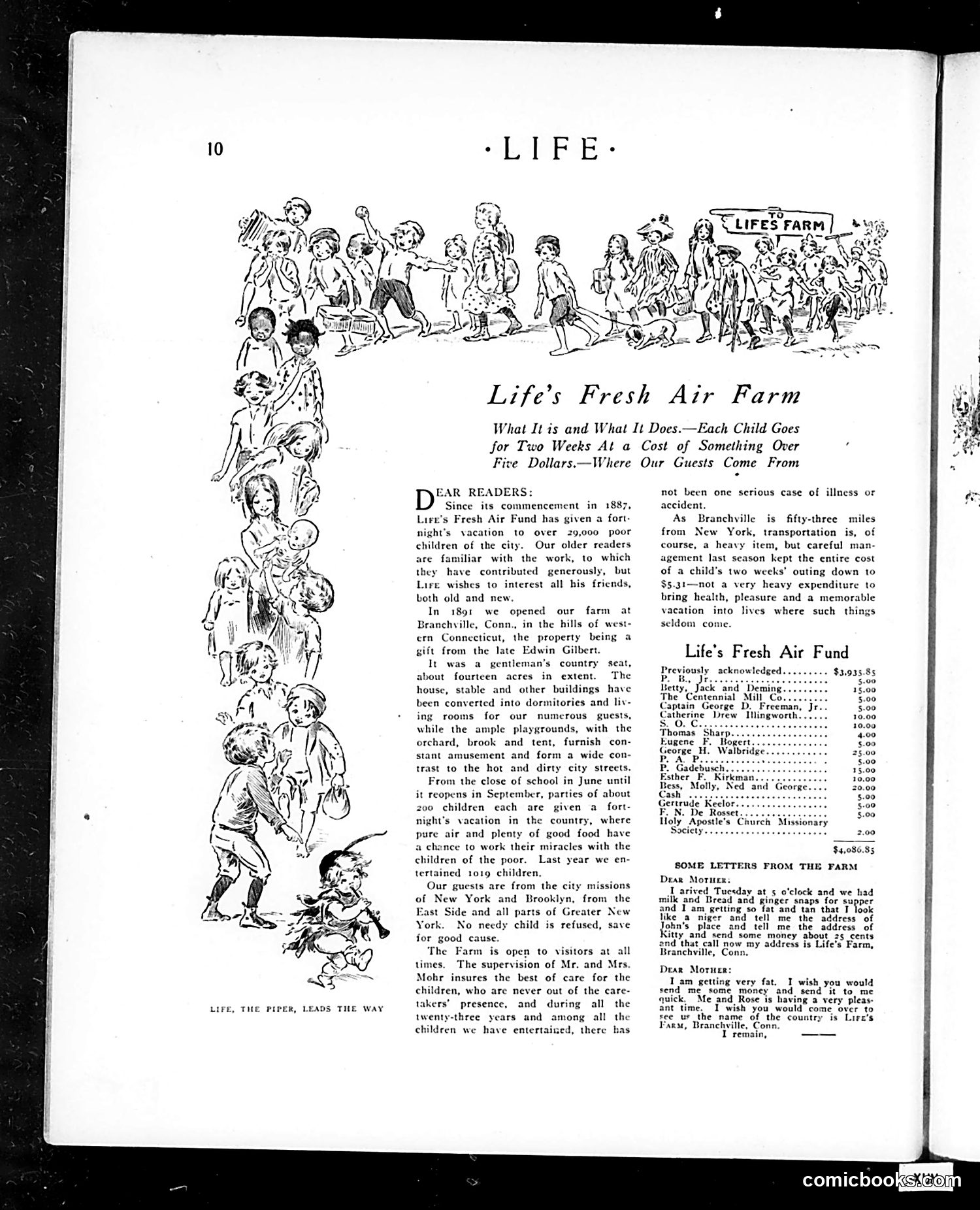
This page describes Life magazine's charitable initiative rather than containing political satire. The large illustration on the left shows children of various ages in a vertical arrangement—a visual metaphor for the program's scope. The text explains that since 1885, Life's Fresh Air Farm has provided two-week summer vacations to over 29,000 poor children from New York City. Located in Branchville, Connecticut, the farm offers rural recreation—playgrounds, orchards, and tents—as an alternative to hot city streets. The farm operates seasonally, entertaining approximately 1,019 children annually. The page includes a "Life's Fresh Air Fund" listing donations and letters from visiting children expressing gratitude for the experience. This represents philanthropic journalism typical of the era.
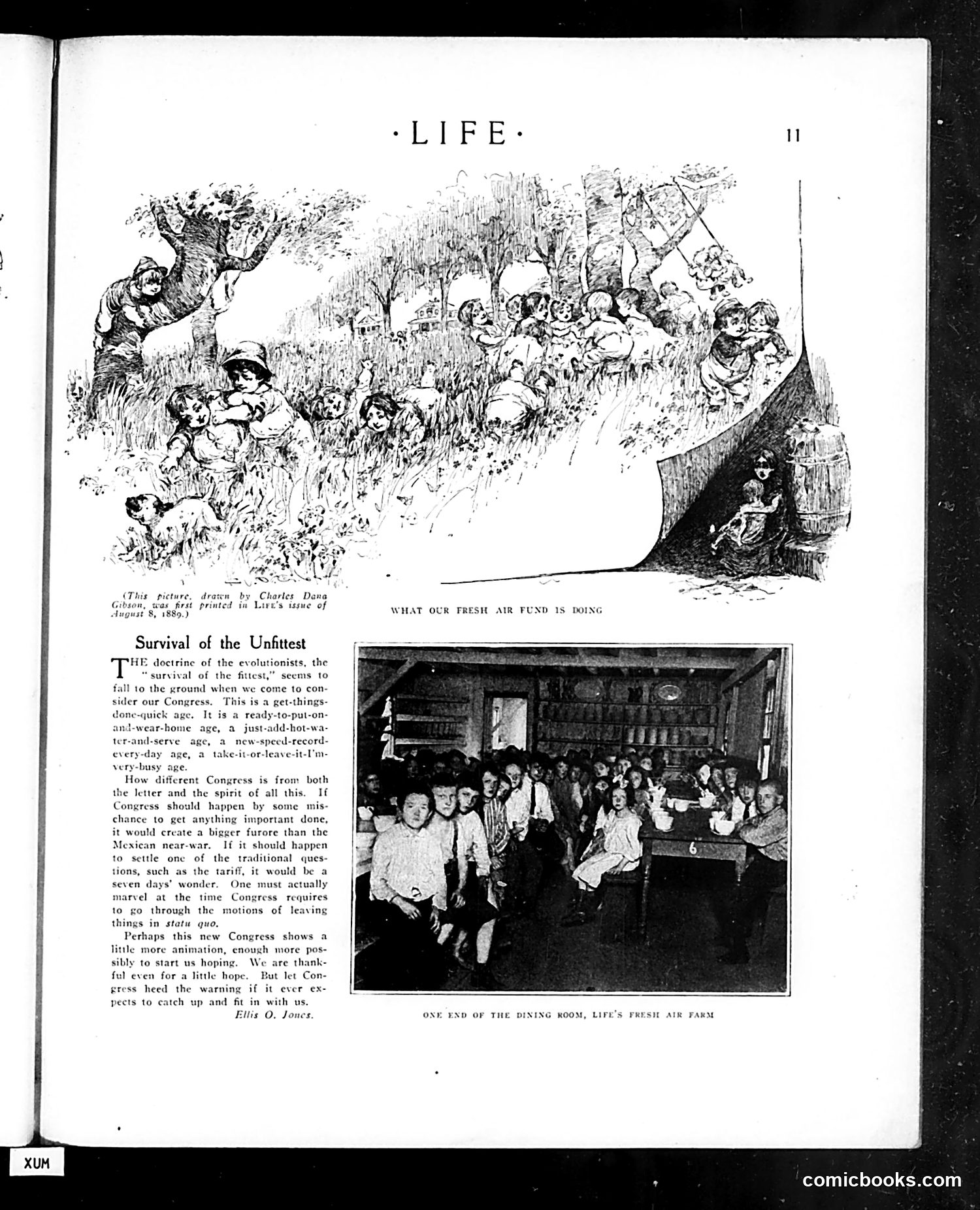
This page contains satirical commentary on Congress's ineffectiveness. The top illustration, credited to Charles Dana Gibson, depicts wealthy citizens enjoying leisure activities while labeled "WHAT OUR FRESH AIR FUND IS DOING"—sarcastically contrasting privileged recreation with public welfare. The article "Survival of the Unfittest" criticizes Congress's inability to accomplish meaningful legislation, using Darwinian language to mock lawmakers. Author Ella O. Jones argues Congress moves slowly on important matters (tariffs, traditional questions) while America needs urgent action. The photograph below shows "ONE END OF THE DINING ROOM, LIFE'S FRESH AIR FARM"—likely documenting an actual charitable initiative that Life magazine supported, contrasting with the satirical critique of governmental inaction on social welfare above.
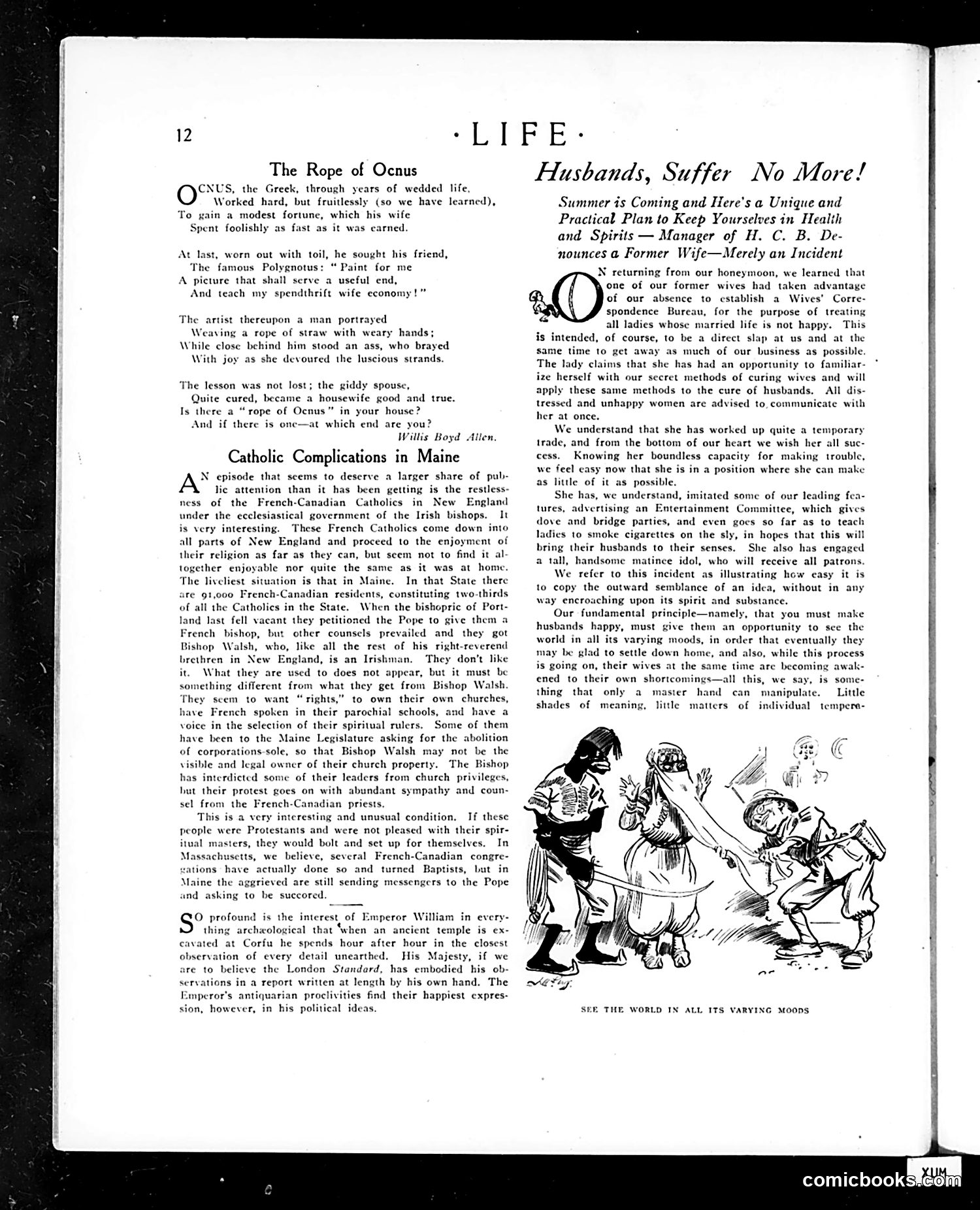
This page contains three distinct pieces: 1. **"The Rope of Ocnus"** - A poem about a man working fruitlessly to gain fortune while his wife spends it, illustrated with a moral lesson about marital discord. 2. **"Catholic Complications in Maine"** - A serious article discussing tensions between French-Canadian Catholic residents (about 91,000 people, two-thirds of Maine's Catholics) and Irish bishops, involving disputes over church property ownership and ecclesiastical authority. The Bishop of Portland appears to be a key figure in this conflict. 3. **"Husbands, Suffer No More!"** - A satirical piece mocking an "Entertainment Committee" supposedly advising husbands to let wives smoke, attend matinees, and enjoy leisure activities to improve domestic happiness. The accompanying cartoon illustrates this domestic management scheme, satirizing both marital discord solutions and emerging women's social freedoms.
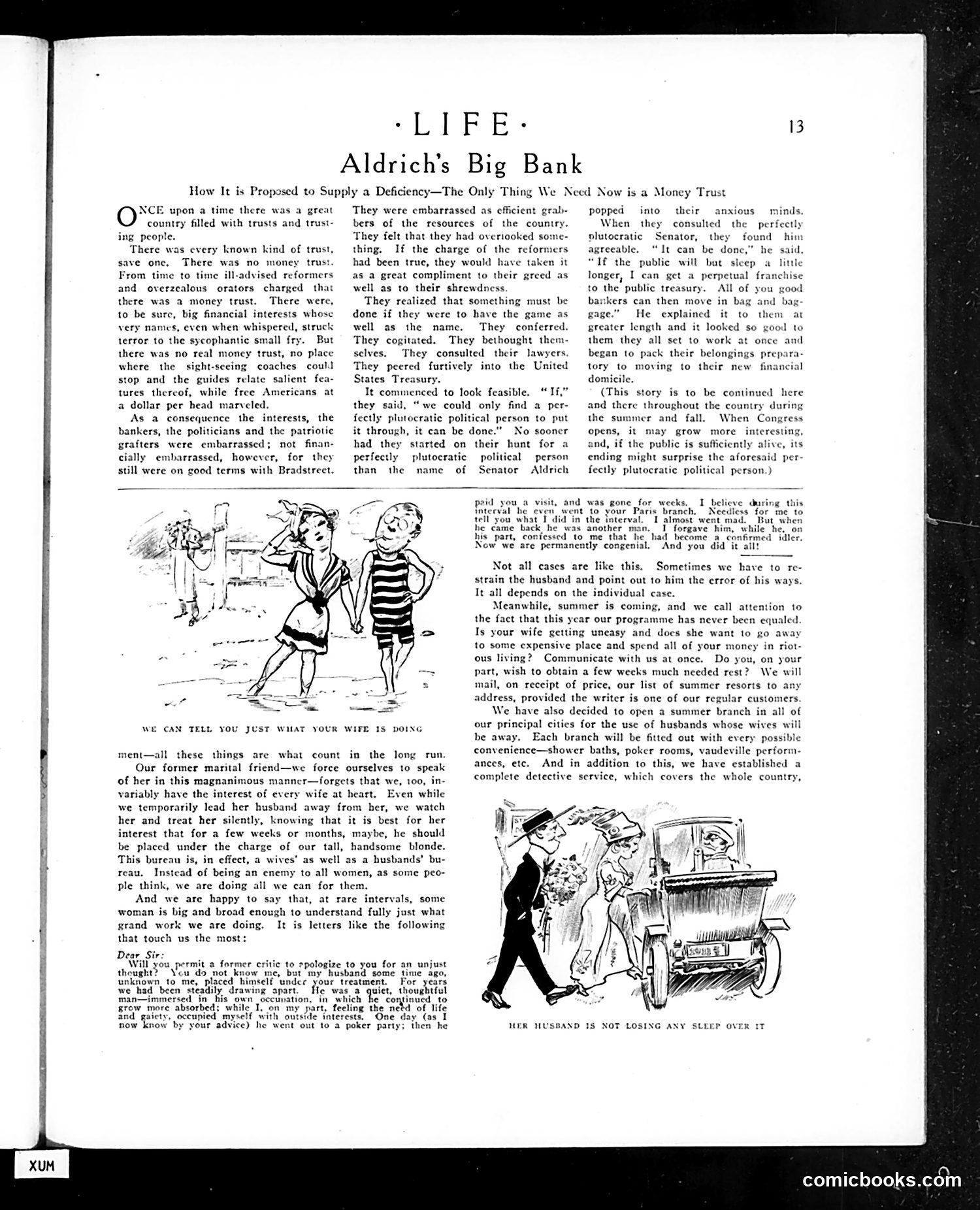
This page satirizes banking and financial institutions during a period of widespread public distrust. The headline "Aldrich's Big Bank" references Senator Aldrich's proposed banking reform (likely the Aldrich Plan of the early 1900s). The article criticizes bankers and politicians for their secretive financial dealings, using sarcasm to mock their claim that a centralized "big bank" would solve the country's money trust problem. The text suggests these institutions are actually self-serving rather than public-minded. The two cartoons illustrate domestic satire: one shows a woman at the beach (about wives spending money), and another depicts a man with an overflowing car labeled "her husband is not losing any sleep over it"—mocking husbands' indifference to wives' extravagant spending, perhaps as a contrast to their anxiety about the banking crisis.
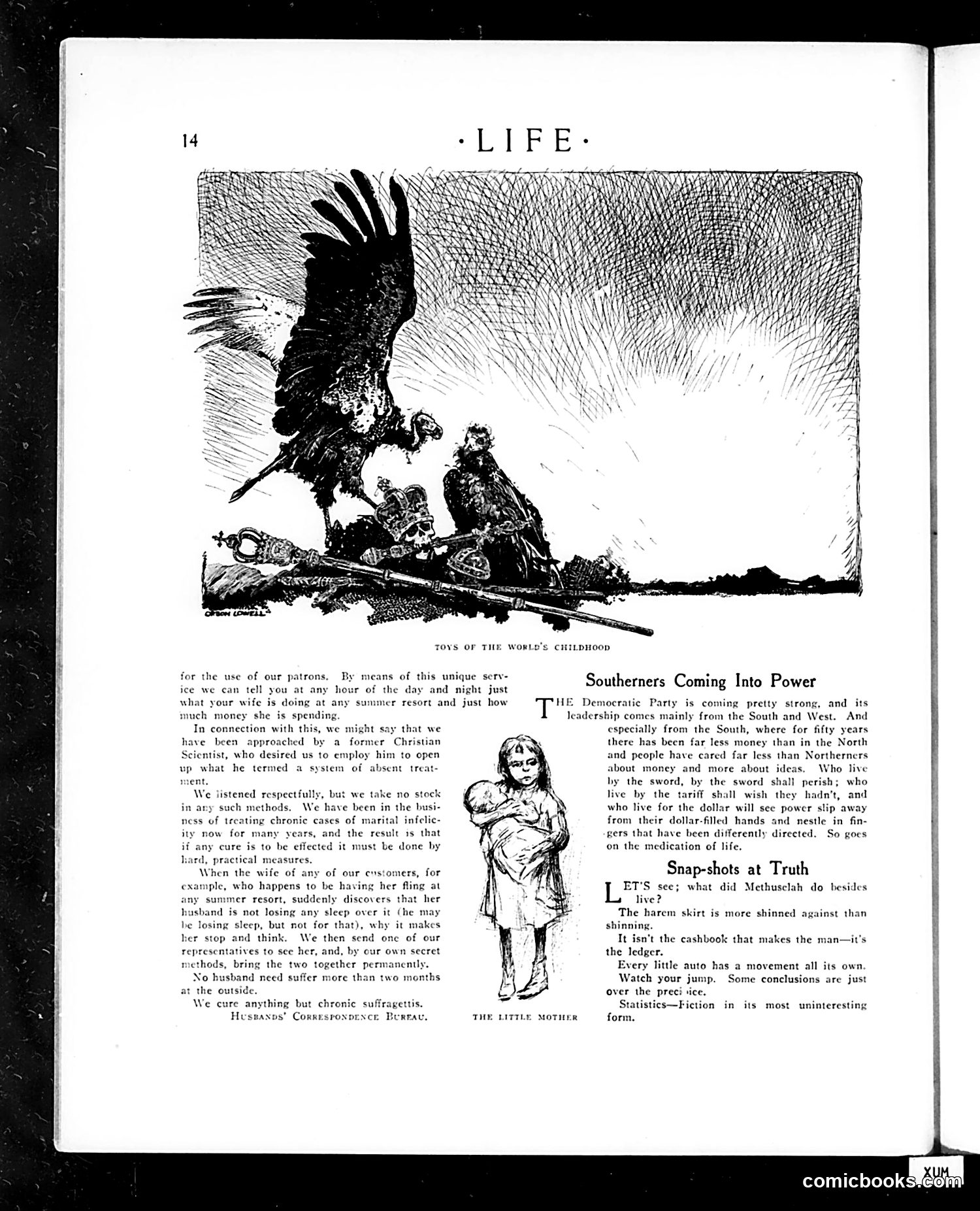
The top illustration, titled "Toys of the World's Childhood," depicts birds (likely eagles or vultures) perched on what appears to be military weaponry or cannons. This is satirical commentary on militarism and warfare as humanity's childish preoccupations. Below, the article "Southerners Coming Into Power" discusses Democratic Party leadership shifting toward Southern control, expressing concern that Southerners prioritize tariff policies over broader national interests. The accompanying sketch of "The Little Mother" illustrates a woman cradling an infant—likely symbolic of nurturing or domestic concerns. The "Snap-shots at Truth" section contains aphoristic observations about human nature and behavior, presented as brief philosophical quips. The overall page reflects early 20th-century American political debate regarding regional power dynamics and satirical social commentary typical of Life magazine's editorial approach.
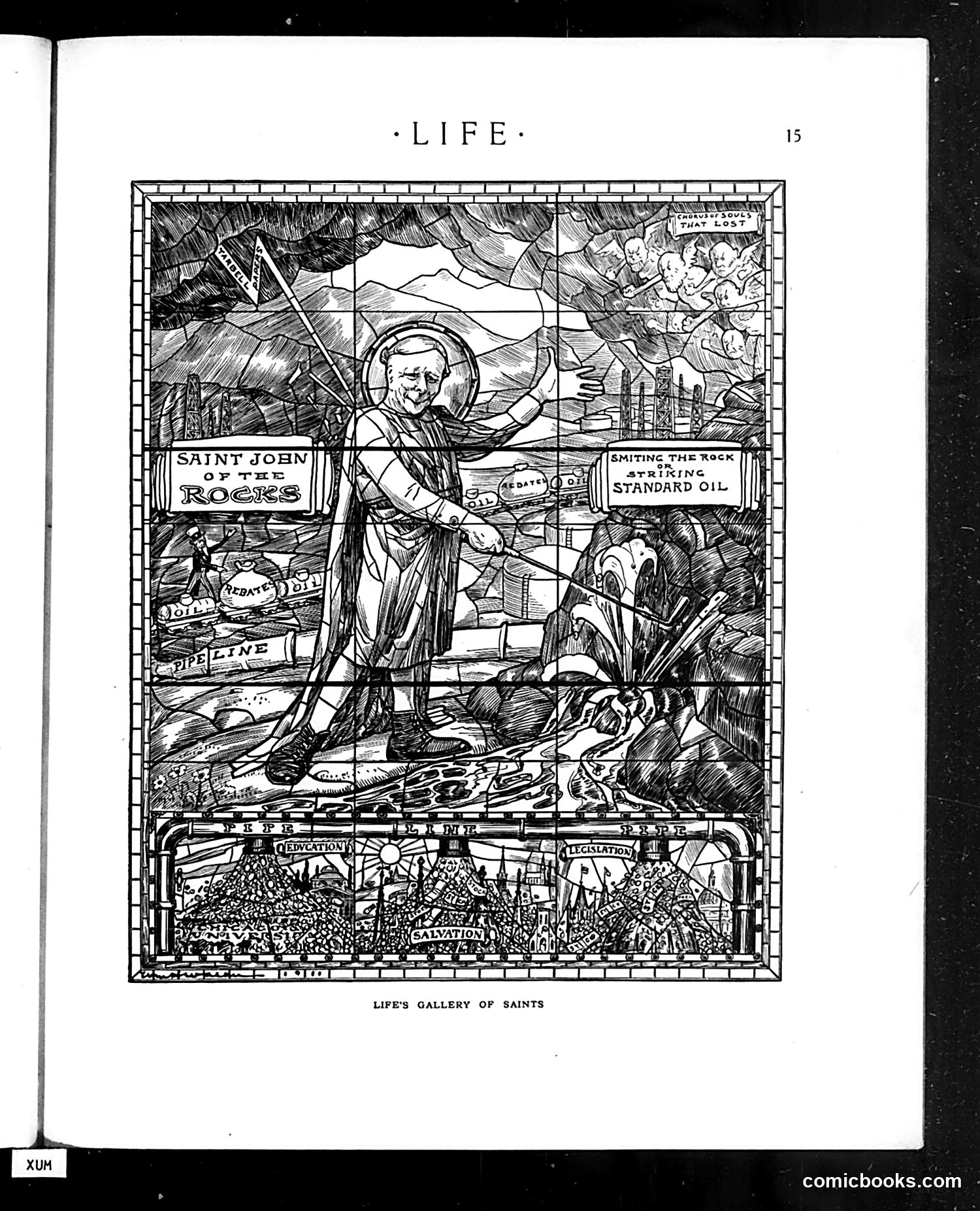
This is a satirical religious illustration from *Life* magazine depicting "Saint John of the Rocks" in the style of medieval stained glass. The figure is shown with a halo, smiting (striking) what appears to be the Standard Oil Company—represented as a demonic "rock" creature. The satire equates Standard Oil with evil, positioning its critic as a saint-like hero. This reflects early 20th-century American antitrust sentiment, when Standard Oil under John D. Rockefeller was viewed as a monopolistic villain threatening competition and fair markets. The ornate religious framing (with "Dedication," "Salvation," and "Legislation" labels at the base) mocks both hagiography and corporate power, suggesting that defeating Standard Oil required quasi-religious fervor. This appears part of *Life*'s "Gallery of Saints"—likely a series mocking contemporary business practices through faux-devotional imagery.
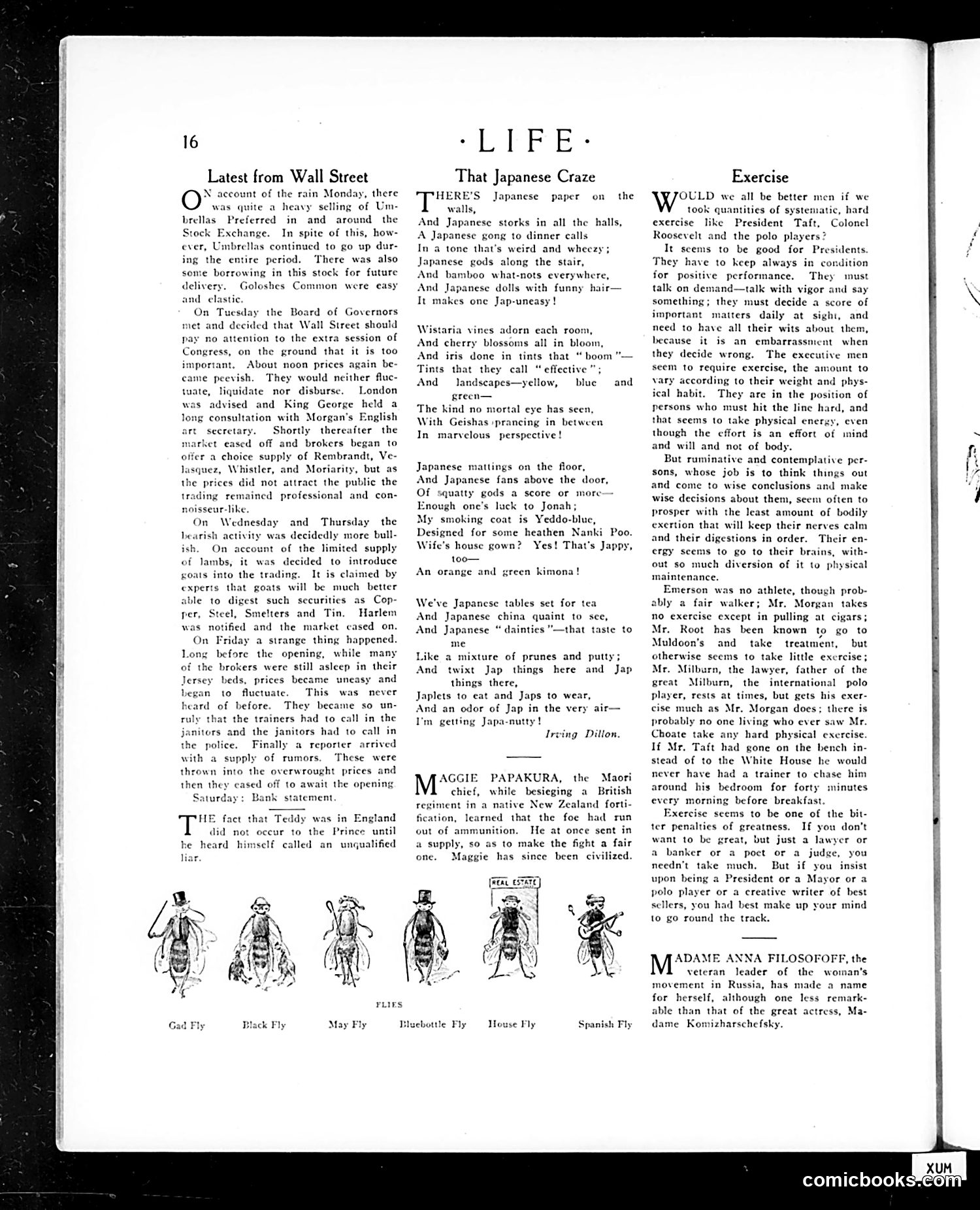
This page from *Life* magazine features three distinct satirical pieces: 1. **"Latest from Wall Street"**: A mock financial report treating absurd items (umbrellas, goloshes, goats) as stock commodities. The satire mocks Wall Street's volatility and the herd mentality of traders during the early 1900s financial markets. 2. **"That Japanese Craze"**: A humorous poem by Irving Dillon lamenting the Japanese aesthetic fad sweeping America. The speaker complains his entire home is filled with Japanese objects—from mattings to fans to "Jappy" clothing—making him "Japa-nutty." This reflects the Japonisme craze popular among wealthy Americans in this era. 3. **Small illustrated section on flies**: Six detailed drawings of different fly species (Gad Fly, Black Fly, May Fly, Bluebuttle Fly, Horse Fly, Spanish Fly), likely continuing from earlier content. 4. **Brief mention of Maggie Papakura**: A Maori chief who honorably supplied ammunition to besieged enemies for fair combat, now "civilized." The page exemplifies *Life*'s satirical approach to contemporary American trends and follies.
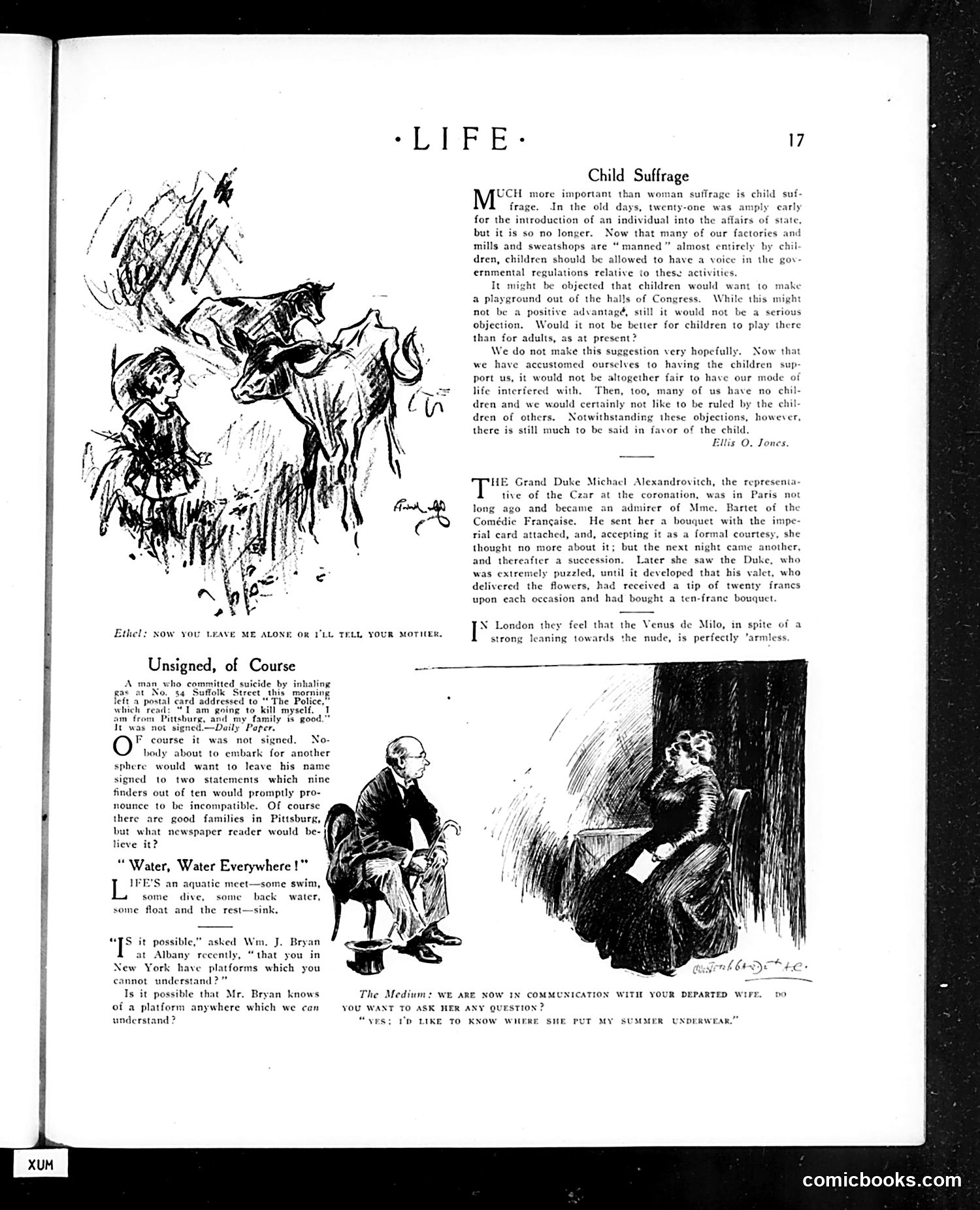
This page contains three separate satirical pieces: **"Child Suffrage"** argues ironically for giving children voting rights, since factories now employ them heavily. The satire mocks adult hypocrisy: we've made children economic contributors but won't grant them political voice. The closing joke undercuts the argument—adults admit they benefit from child labor and wouldn't want child voters anyway, revealing the real obstacle is selfish adult interest. **The Grand Duke anecdote** satirizes romantic presumption: a Russian noble believes his bouquet tips are winning a French actress's affection, when actually his valet is profiting by sending cheap flowers using the Duke's name and money. **"Water, Water Everywhere"** mocks William Jennings Bryan's 1912 Albany speech criticizing incomprehensible political platforms. Life's riposte: no one understands any political platform anywhere—this isn't unique to New York. The spiritualist cartoon at bottom jokes about séances asking trivial domestic questions rather than profound afterlife mysteries.
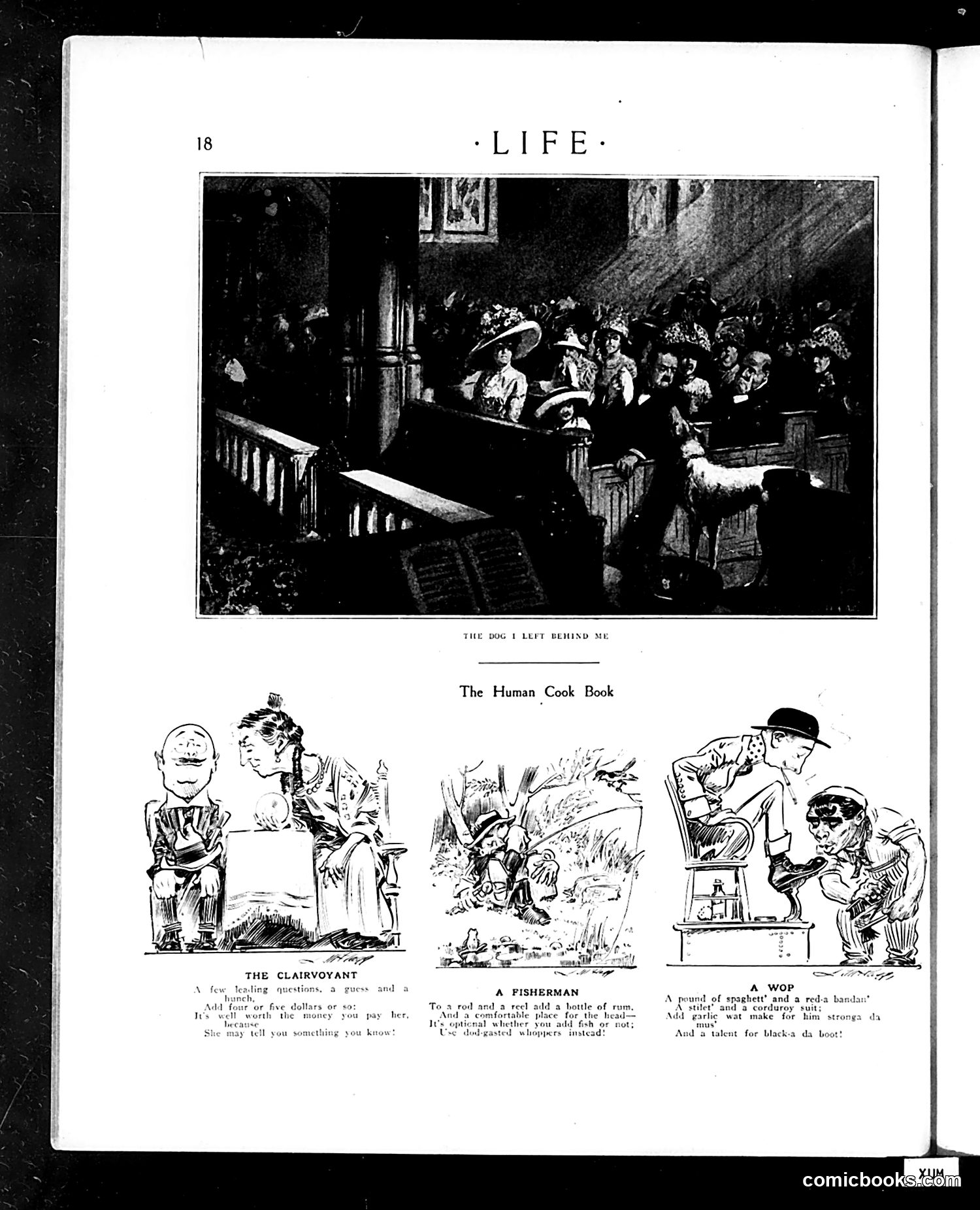
This page presents three caricatured vignettes mocking different social types as if they were recipes or subjects for "cooking": 1. **"The Clairvoyant"** - depicts a fortune teller and gullible client, satirizing fraudulent spiritualism and people's willingness to pay for dubious services. 2. **"A Fisherman"** - shows a man fishing, likely mocking the leisure activities and self-deception of anglers. 3. **"A Wop"** - an offensive caricature with ethnic stereotyping typical of early 20th-century American humor, depicting Italian immigrants with crude physical exaggeration. The overhead image titled "The Dog I Left Behind Me" appears unrelated, showing a social gathering scene. The satire's point: presenting various human "types" as if they were cookbook subjects, reducing people to stereotypes and caricatures for comedic purposes—reflecting period attitudes toward class, ethnicity, and social pretense.
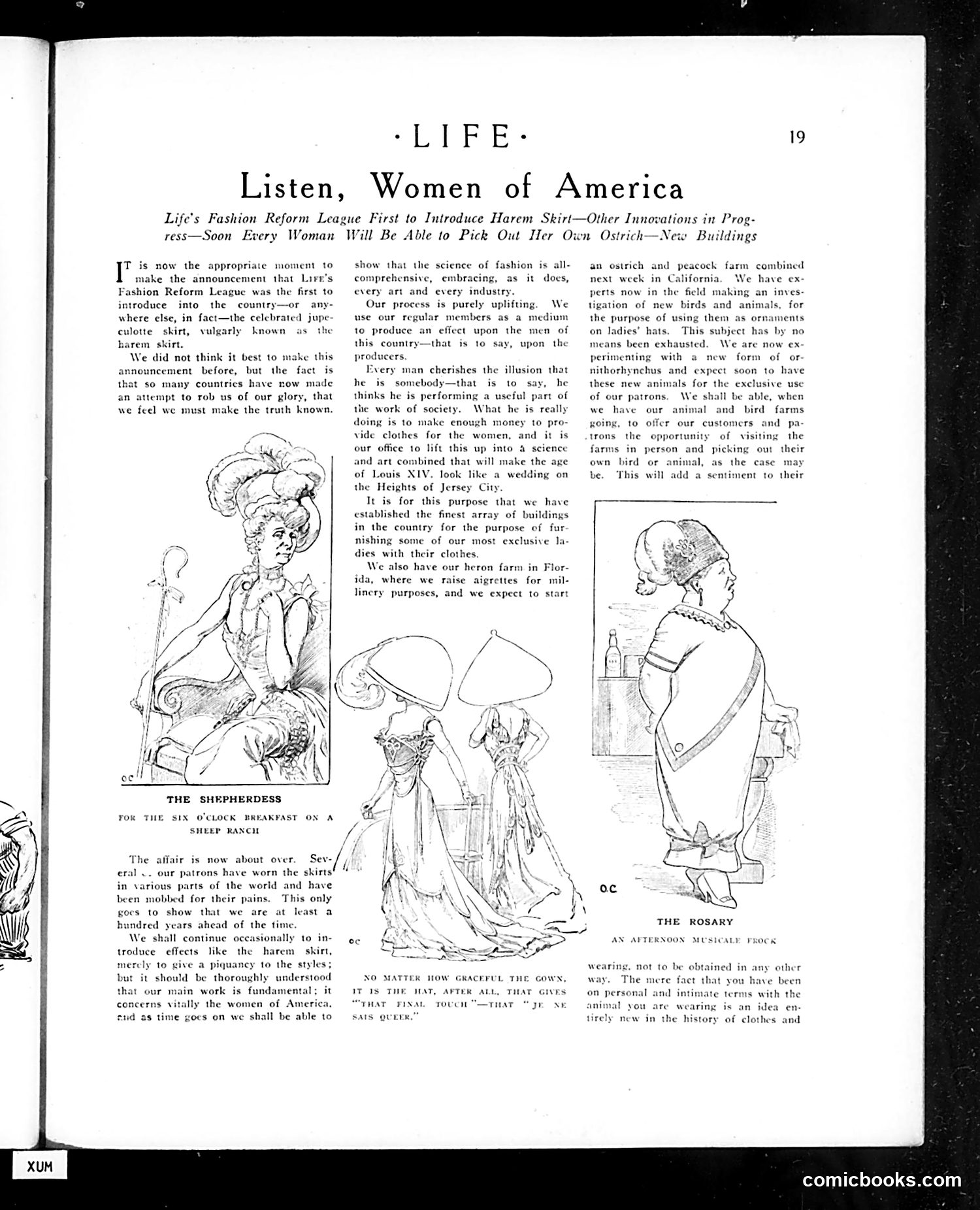
This is satirical social commentary disguised as a fashion announcement. Life's "Fashion Reform League" mock-seriously claims to have pioneered the "harem skirt" and announces absurd innovations: farms breeding ostriches, peacocks, and even platypuses (ornithornynchus) so wealthy women can personally select creatures for hat ornaments. The satire targets multiple things: the pretentiousness of fashion industry claims to "uplift" society; the era's obsession with exotic animal feathers in millinery (a real environmental concern); and the absurdity of wealthy women's consumption. The illustrated figures—"The Shepherdess" and "The Rosary"—model ridiculous outfits embodying these excesses. The joke is that Life presents nonsense with utmost seriousness, as if breeding farms for hat decorations represents genuine social progress. It's early 20th-century environmental and consumer satire wrapped in fashion commentary.
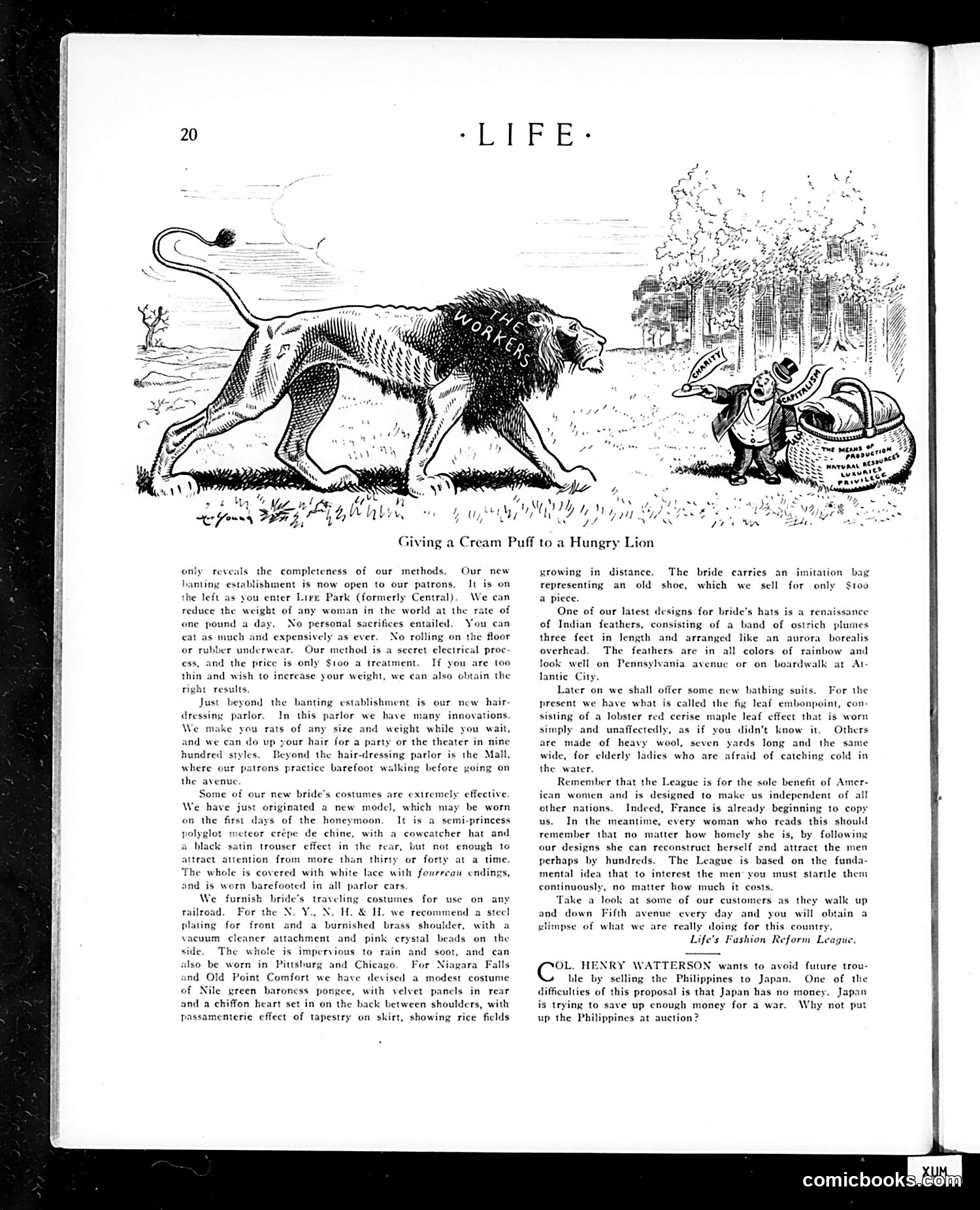
This satirical piece mocks the "Life's Fashion Reform League," a fictional women's organization promoting absurdly impractical fashion designs. The cartoon shows a lion labeled "THE WORKER" being fed a cream puff—a visual metaphor for how these frivolous fashions distract working-class concerns. The text satirizes upper-class women's fashion obsessions through mock-serious descriptions of ridiculous outfits: a "semi-princess polyglot meteor crépe de chine" wedding dress, bathing suits made of seven-yard-long wool, and elaborate hats with three-foot ostrich plumes. The League claims to make American women "independent of all other nations" while actually making them dependent on expensive, impractical designs. The satire targets both wealthy women's vanity and nationalist pretensions. A final note mocks Col. Henry Watterson's proposal to sell the Philippines to Japan, suggesting even serious political matters are reduced to triviality in this society obsessed with fashion.
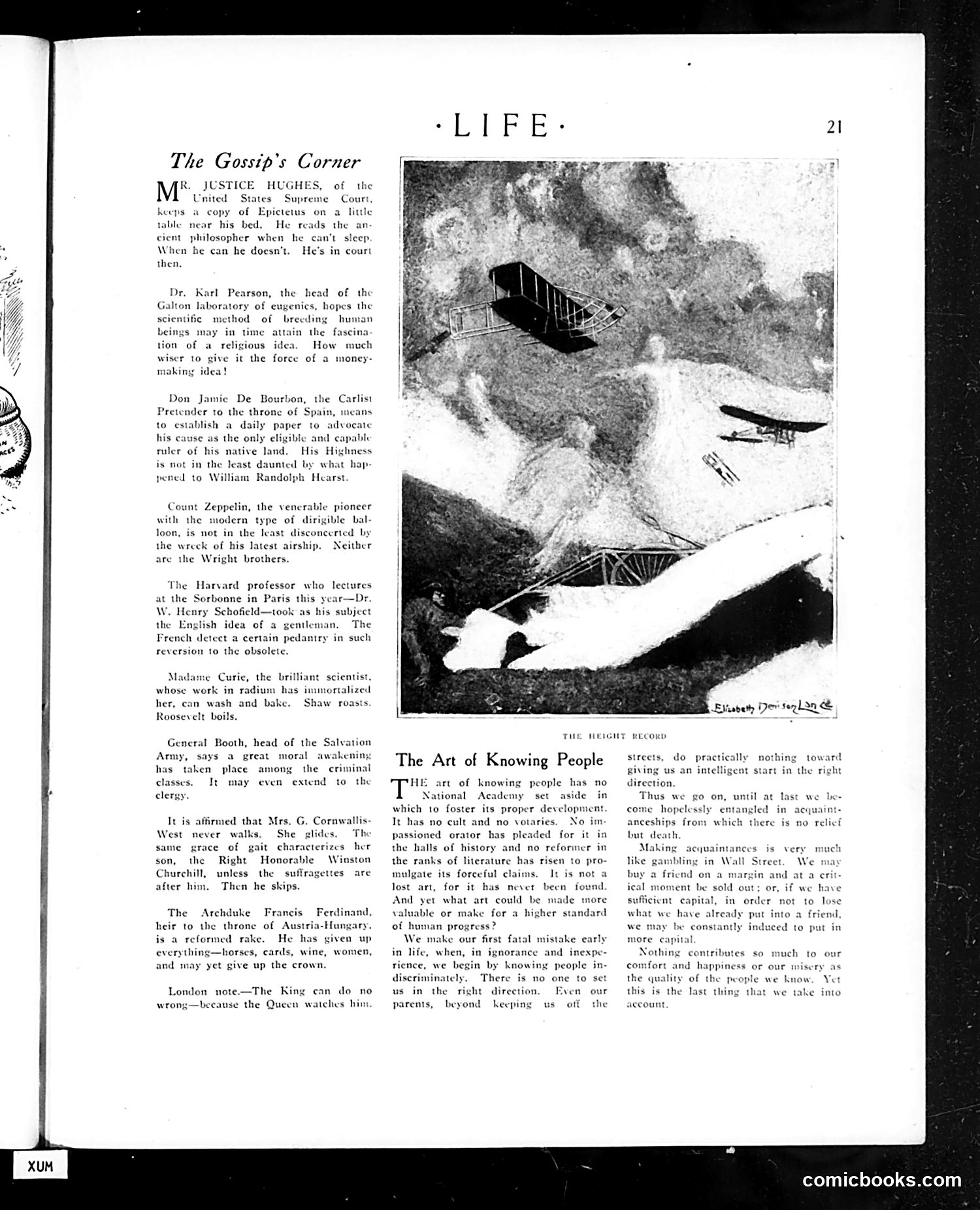
This page contains "The Gossip's Corner," a satirical column about notable figures, and an article titled "The Art of Knowing People." **The Gossip's Corner** includes brief, witty observations about public figures including Justice Hughes, Dr. Karl Pearson, Don Jamie De Bourlon, Count Zeppelin, Dr. W. Henry Schofield, Madame Curie, General Booth, Francis Ferdinand, and references to the King and Queen. **The main image** shows an early airplane in flight over landscape with bridges—labeled "THE HEIGHT RECORD." This appears to reference aviation progress, likely the Wright brothers' innovations mentioned in the text. **"The Art of Knowing People"** is an essay discussing how acquaintance-making is undervalued as a skill for human progress, arguing people should invest more effort in understanding one another rather than remaining ignorant of their social circles. The page reflects early 20th-century concerns with science, social progress, and human relationships.
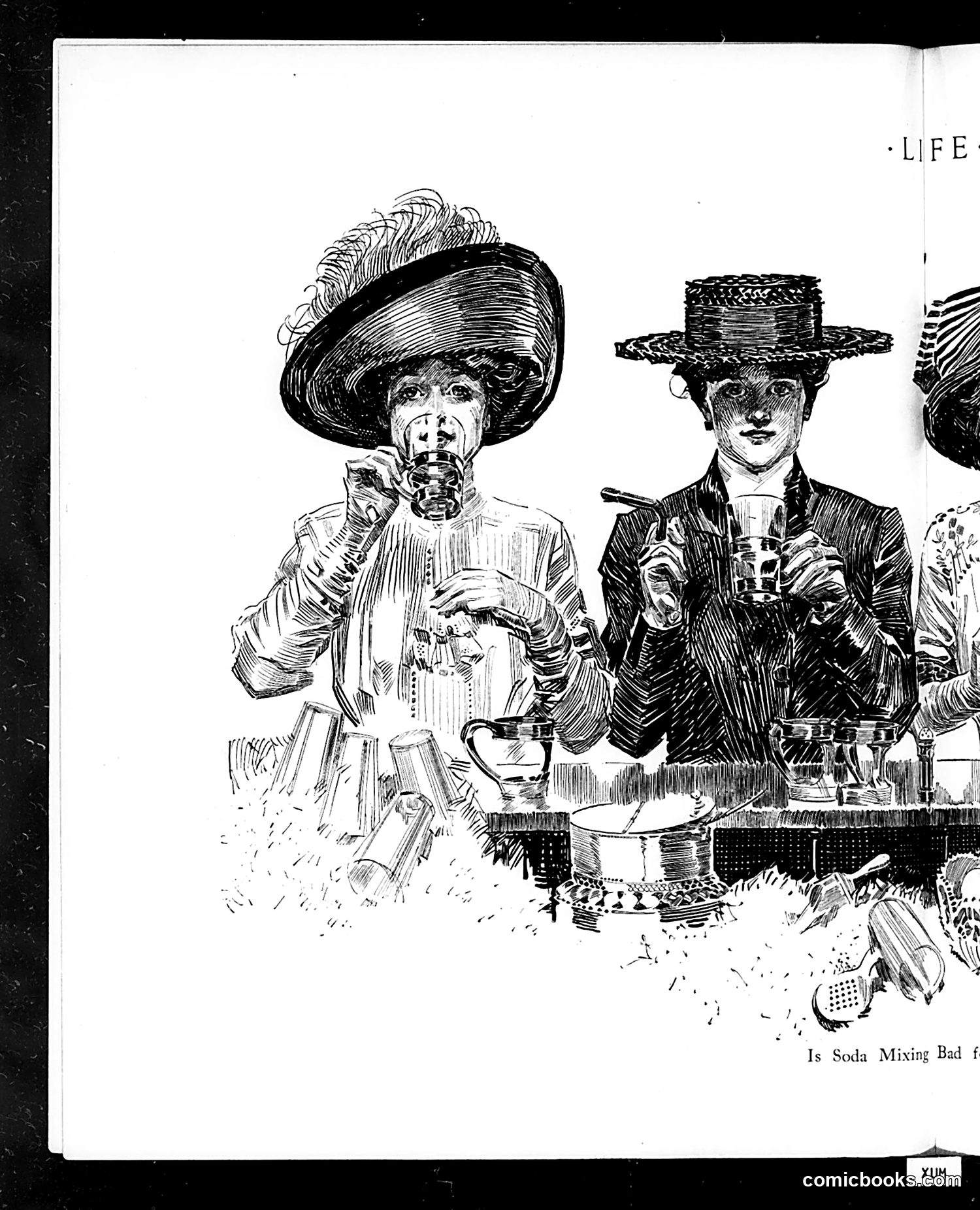
This appears to be a satirical illustration from *Life* magazine depicting two fashionably dressed figures at what seems to be a social gathering or meal. Both wear elaborate hats typical of early 20th-century fashion. The figure on the left holds a glass to their mouth, while the one on the right also holds a drinking glass. Various dining implements and what appear to be food items are scattered on the table before them. The partial caption reads "Is Soda Mixing Bad f[or...]" suggesting the cartoon addresses mixing soda with alcohol—likely commenting on social drinking practices or Prohibition-era concerns. The satirical tone appears to mock fashionable society's consumption habits or hypocrisy regarding temperance issues. Without the complete caption, the specific satirical target remains unclear, though the artwork's style and subject matter suggest commentary on upper-class social behavior during the Prohibition era.
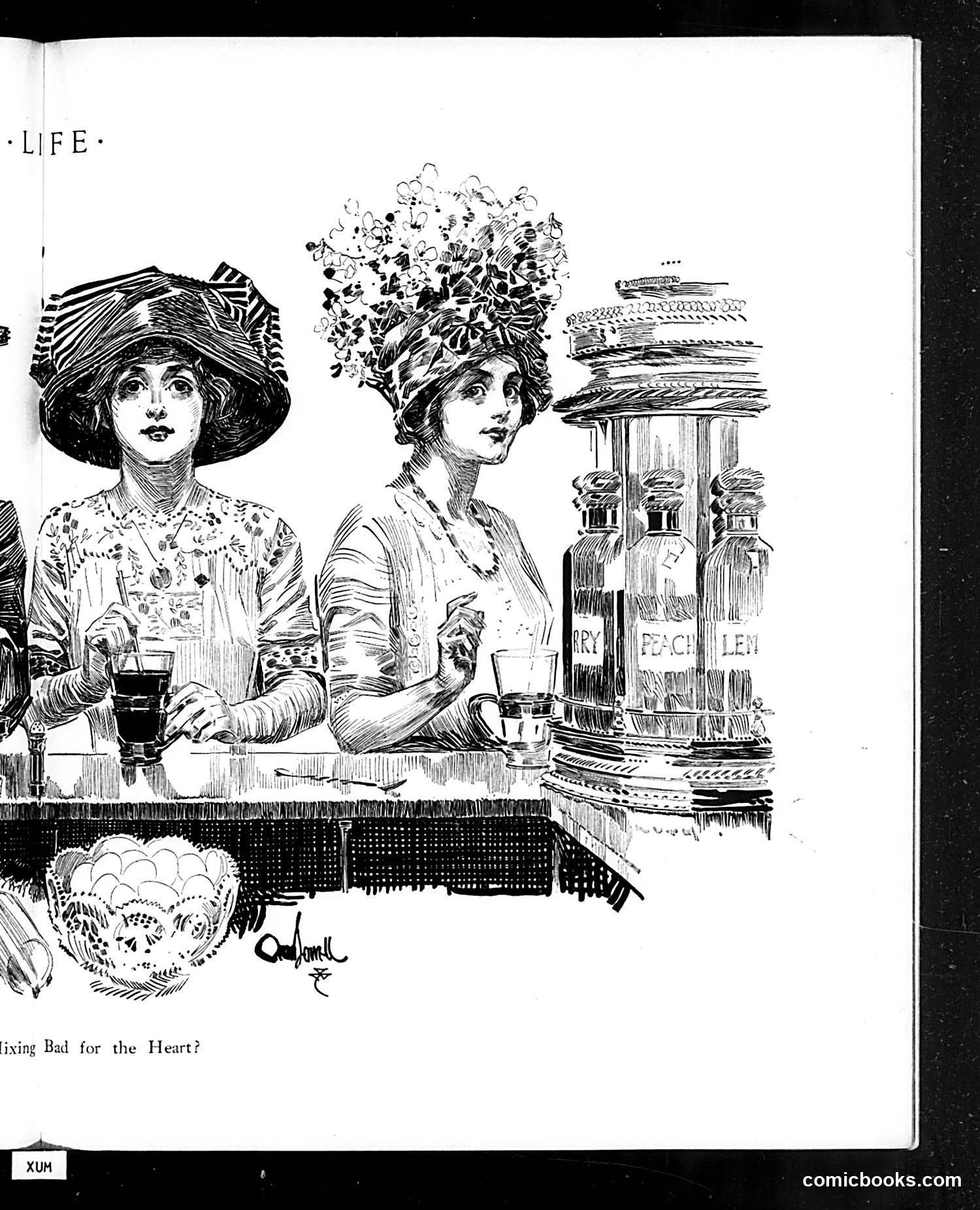
This is a satirical illustration from *Life* magazine titled "Is Fixing Bad for the Heart?" The cartoon depicts two elegantly dressed women at what appears to be a bar or counter with bottles labeled (partially visible text suggests alcohol). Both women wear fashionable hats typical of the early 20th century. The satire likely references the temperance movement and Prohibition-era debates about alcohol consumption and health. The title's wordplay on "fixing" (obtaining drinks, particularly during Prohibition when alcohol was illegal) suggests the cartoon mocks medical or moral arguments against drinking by showing refined, respectable women engaging in the very behavior being condemned. The illustration's elegant style and the women's sophisticated appearance add ironic commentary on social hypocrisy regarding alcohol consumption.
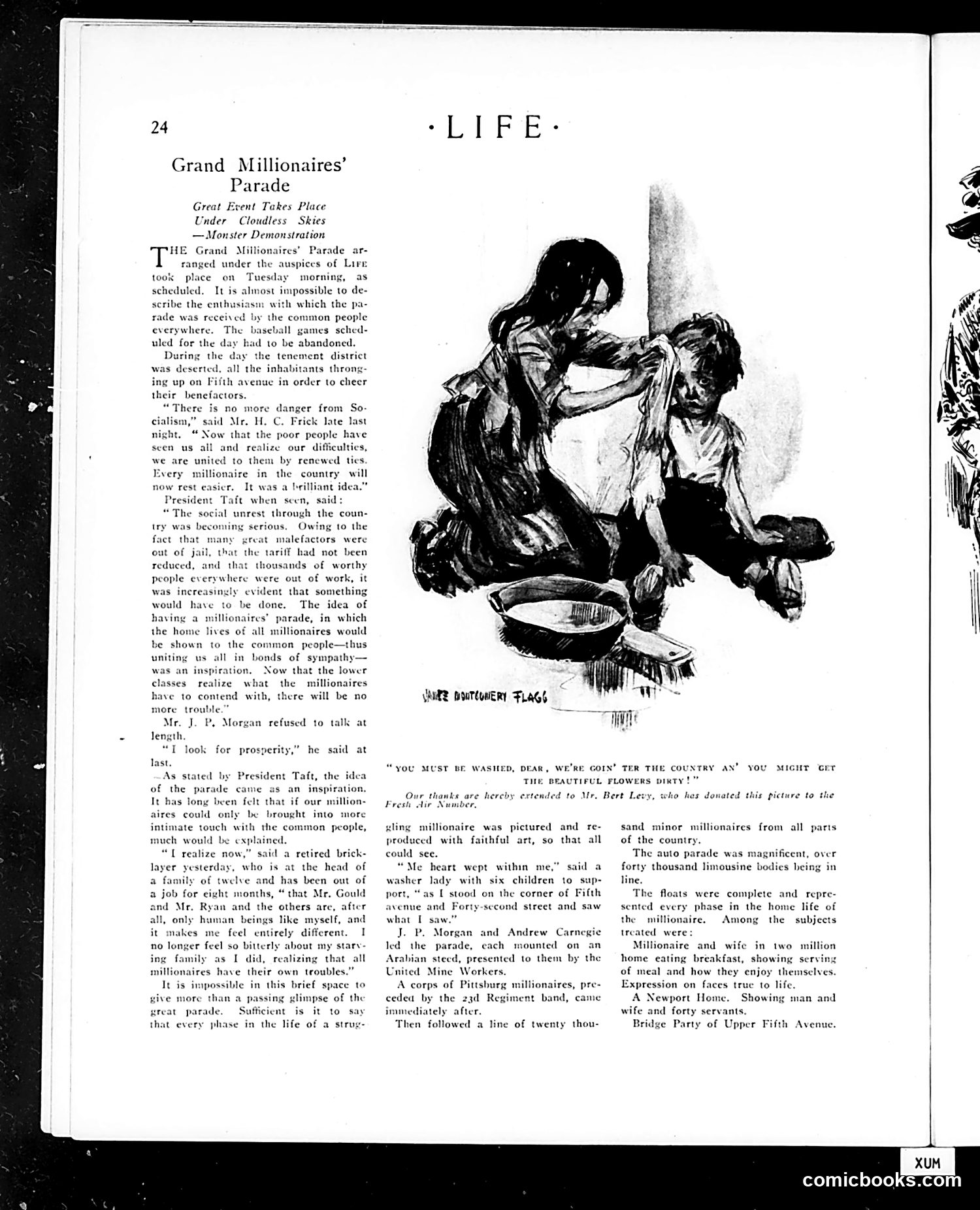
This is a satirical piece mocking the idea that displaying wealthy millionaires' lifestyles to poor Americans would reduce class conflict and socialism. The text presents fake quotes from real figures—J.P. Morgan, Andrew Carnegie, President Taft, and H.C. Frick—endorsing this absurd "parade" concept as a solution to labor unrest and poverty. The cartoon illustration shows a working-class mother cleaning her child, with the caption about going to see the parade so the child won't get the flowers dirty—highlighting the absurdity of poor families' lives versus millionaire excess. The satire's point: Life magazine ridicules the wealthy's delusional belief that merely *showing* their privilege to struggling workers (many unemployed, starving) would resolve genuine economic grievances. The parade features millionaires on Arabian horses and elaborate automobile displays of their homes, servants, and leisure—presented as tone-deaf performance art.
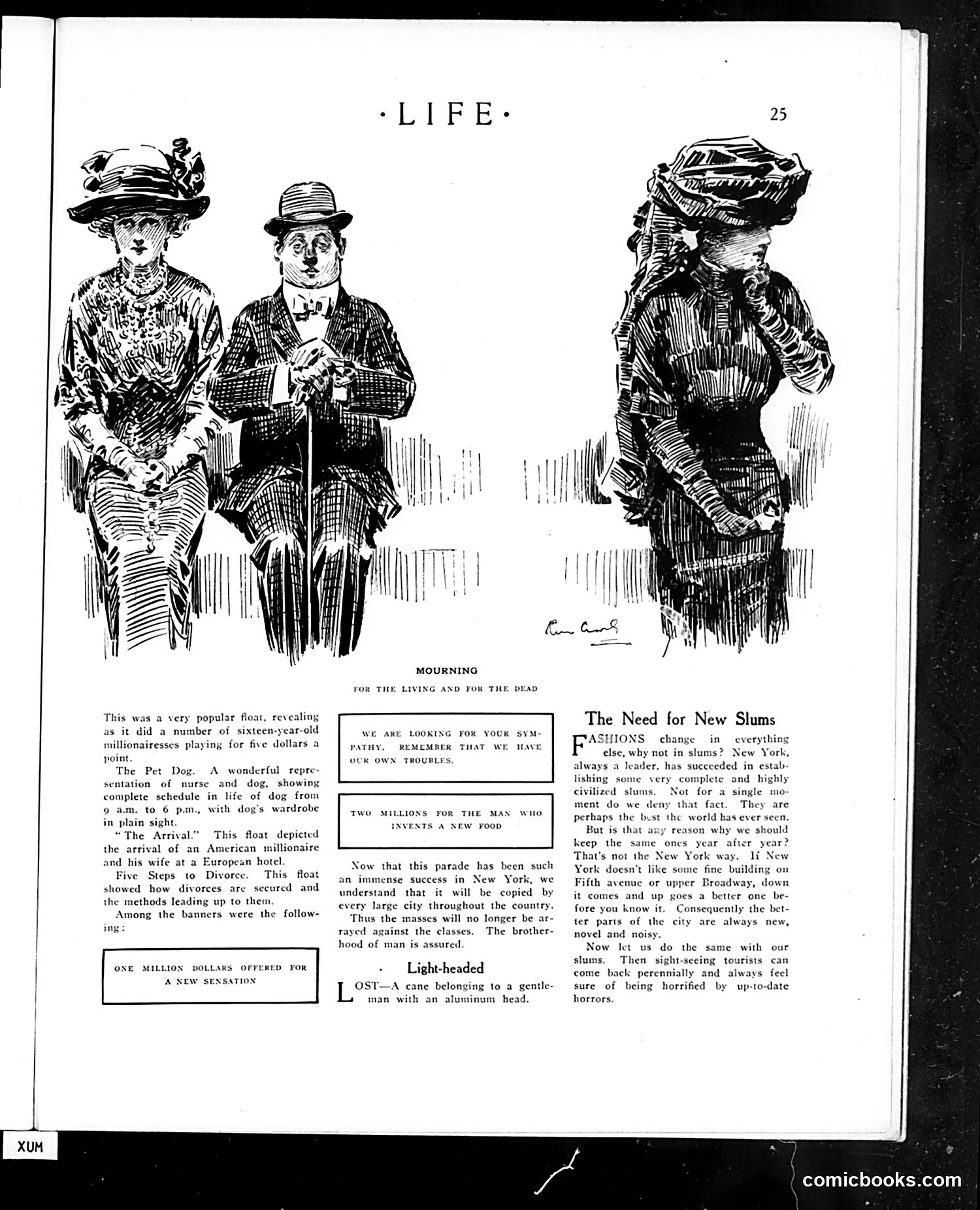
This *Life* magazine page critiques early 20th-century American wealth inequality and urban planning through multiple overlapping satirical pieces. The top illustration depicts a "Mourning" parade float—likely referencing an actual NYC parade—showing wealthy society women and men in elaborate dress. The accompanying text reveals the satire: these "mourners" are actually sixteen-year-old heiresses gambling for stakes, and wealthy arrivals are celebrated with floats depicting divorces and frivolous spectacles. The boxed banners mock the wealthy's detachment: "We are looking for your sympathy... we have our own troubles" and offering millions for "new sensations" and "new foods"—suggesting the rich's endless, superficial desires. The essay "The Need for New Slums" delivers biting sarcasm: it argues New York should demolish and rebuild slums annually to stay fashionable, just as the wealthy constantly renovate Fifth Avenue. This mocks the city's willingness to constantly redevelop wealthy neighborhoods while treating urban poverty as static or inevitable. The "Light-headed" lost-and-found joke plays on an aluminum-headed cane owner—likely satirizing shallow, empty-headed wealthy individuals.
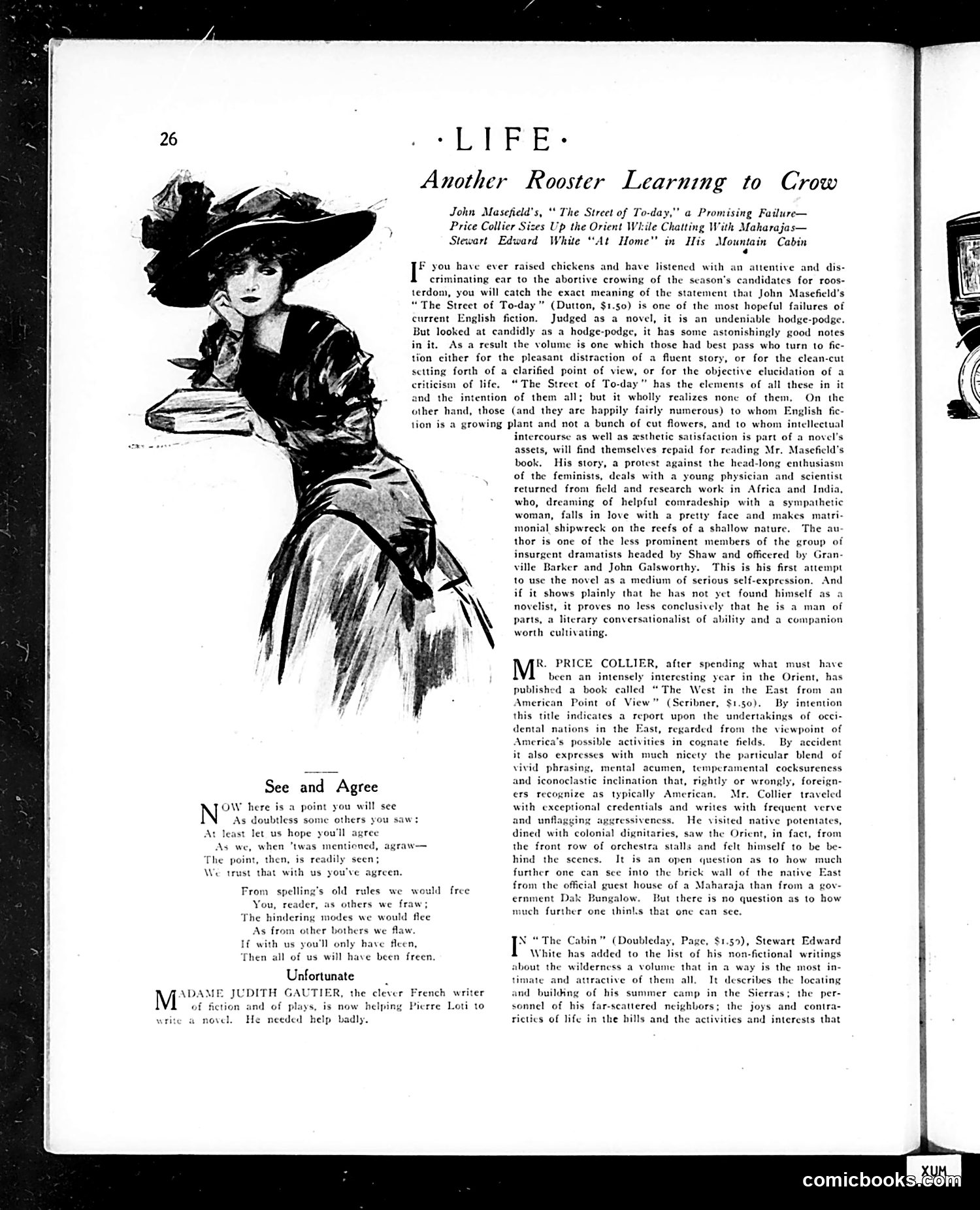
This page reviews three new books. The main illustration shows a fashionably dressed woman in an elegant hat—likely a visual reference to one of the discussed authors or their work, though the specific identity isn't labeled. The reviews discuss: 1. **John Masefield's "The Street of To-day"**: The critic uses the metaphor of a young rooster "learning to crow" (the page's title) to describe Masefield's novel as ambitious but unsuccessful—it attempts serious artistic expression but fails to fully achieve its goals. The reviewer notes it's a "hodge-podge" lacking coherent plot or philosophy, yet praises Masefield's intellectual capacity and literary conversation skills. 2. **Price Collier's "The West in the East"**: A travel/political report on Western activities in the Orient. The review satirizes Collier's American confidence and presumed authority, suggesting his privileged access (touring with maharajas, staying in official guest houses) may actually limit genuine understanding of Eastern cultures. The page exemplifies *Life*'s literary criticism style: witty, somewhat condescending, but intellectually engaged with contemporary authors.
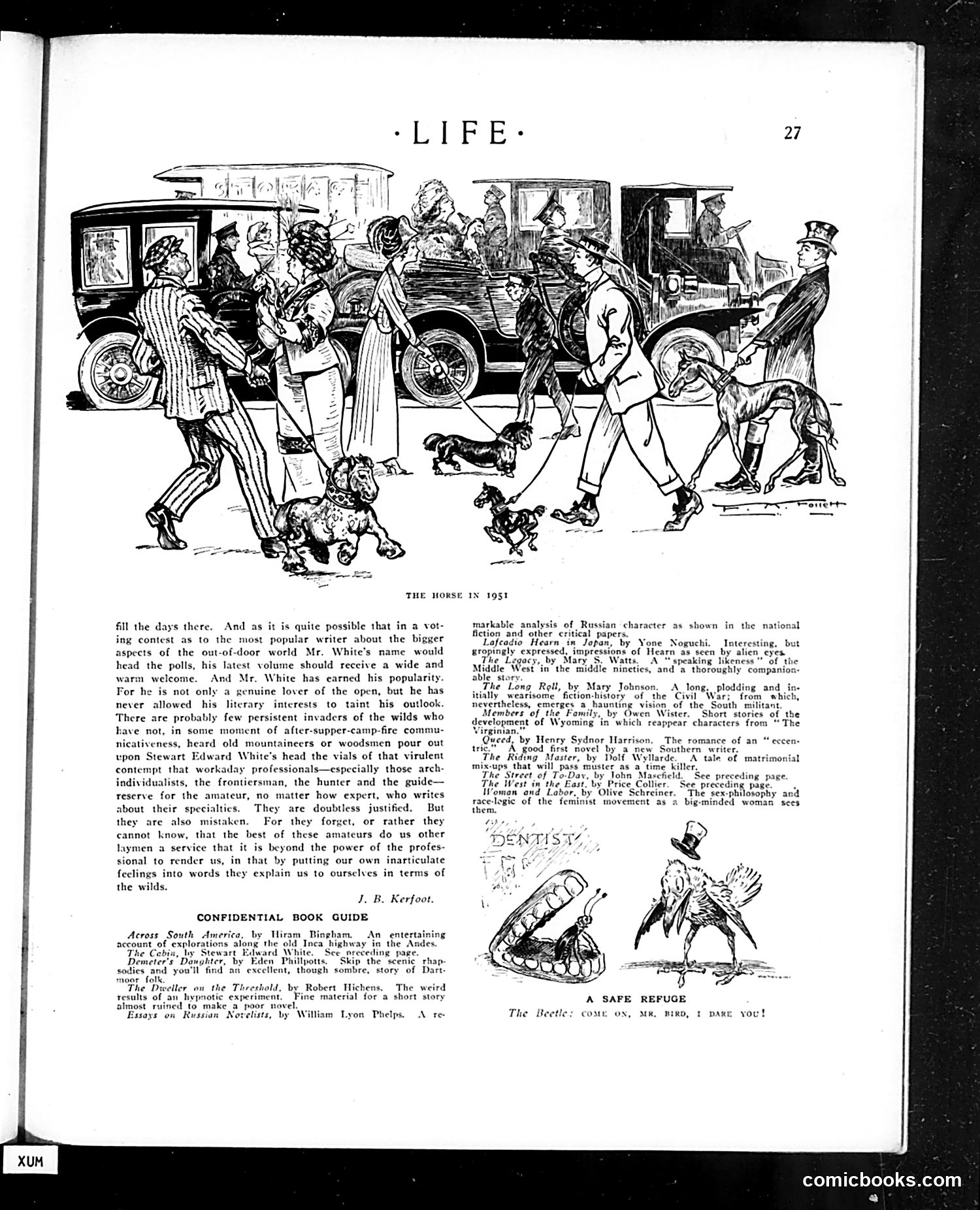
This Life magazine page (p. 27) consists primarily of a **book review section**, not political satire. The main content discusses Stewart Edward White, a popular outdoor/wilderness writer whom the reviewer defends against professional frontiersmen and guides who dismiss amateur nature writers as inauthentic. The **two small cartoons** at bottom appear unrelated to the text: 1. **"A Safe Refuge"** (left): Shows a beetle or insect—appears to be a humorous illustration about insects seeking shelter, though context is unclear. 2. **"The Beetle: Come On, Mr. Bird, I Dare You!"** (right): Depicts confrontation between a beetle and bird, likely a simple joke about predator-prey dynamics or animal bravado. The page's satire is gentle literary criticism rather than political commentary. The title "The Worse in 1951" likely refers to recently published books being reviewed, though the exact reference remains unclear from visible text.
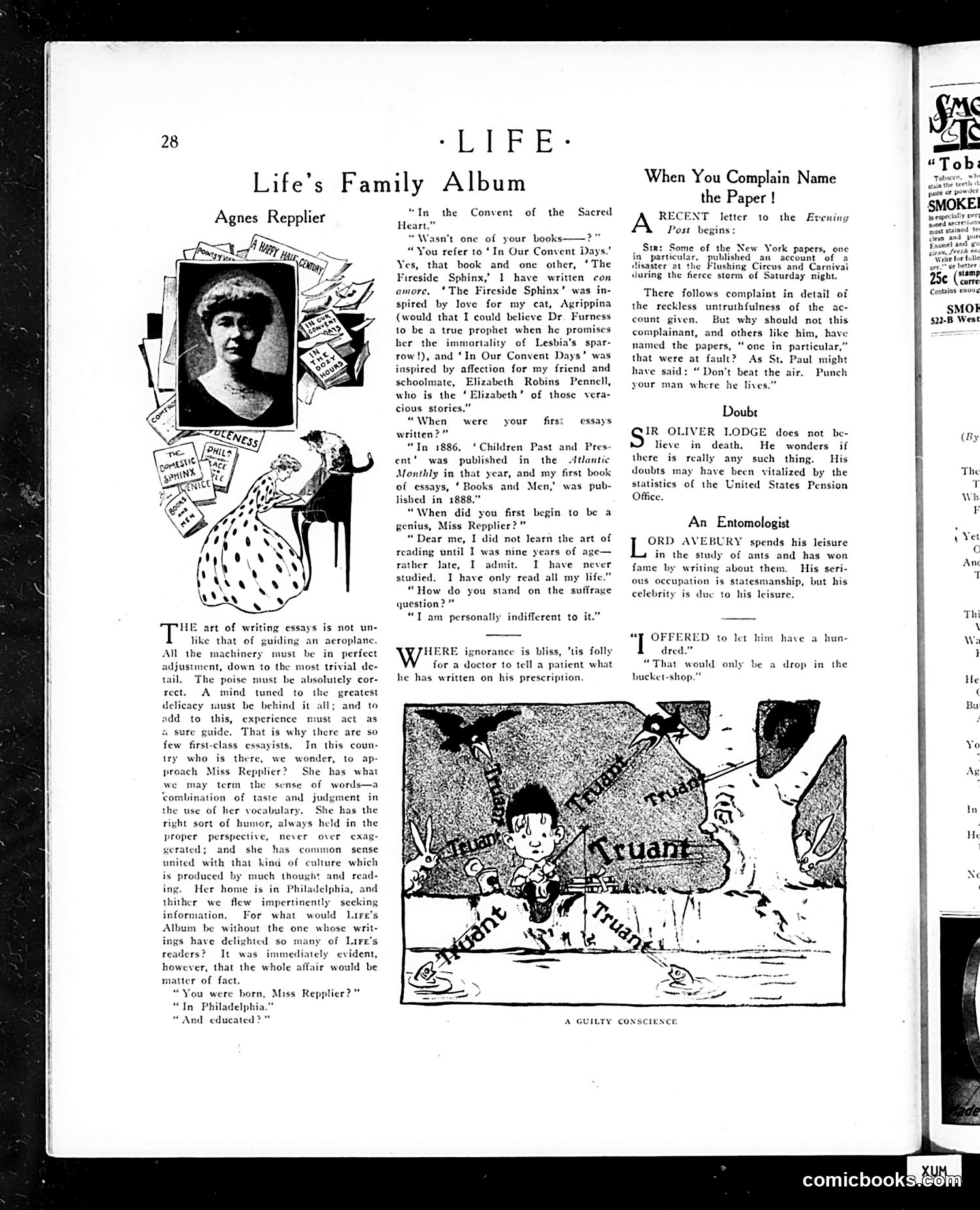
This page from *Life* magazine (undated but likely early 1900s based on style) features an interview with **Agnes Repplier**, a prominent American essayist. The accompanying illustration shows her with books and a cat, referencing her work *The Fireside Sphinx* about her cat Agrippina. The page also contains three brief satirical items: 1. **"When You Complain Name the Paper"** — mocks readers who complain about newspaper inaccuracy without identifying which paper, making their complaints ineffective. 2. **"Doubt"** — a quip about Sir Oliver Lodge's skepticism regarding death, satirically suggesting U.S. pension statistics might explain his doubts about mortality. 3. **"An Entomologist"** — notes Lord Avebury gained fame studying ants (leisure activity) rather than his actual profession in statesmanship. The cartoon "A Guilty Conscience" (bottom) appears to show a child caught misbehaving. The page is primarily biographical content with light satirical commentary typical of *Life's* tone—urbane, witty observations on public figures and social pretensions.
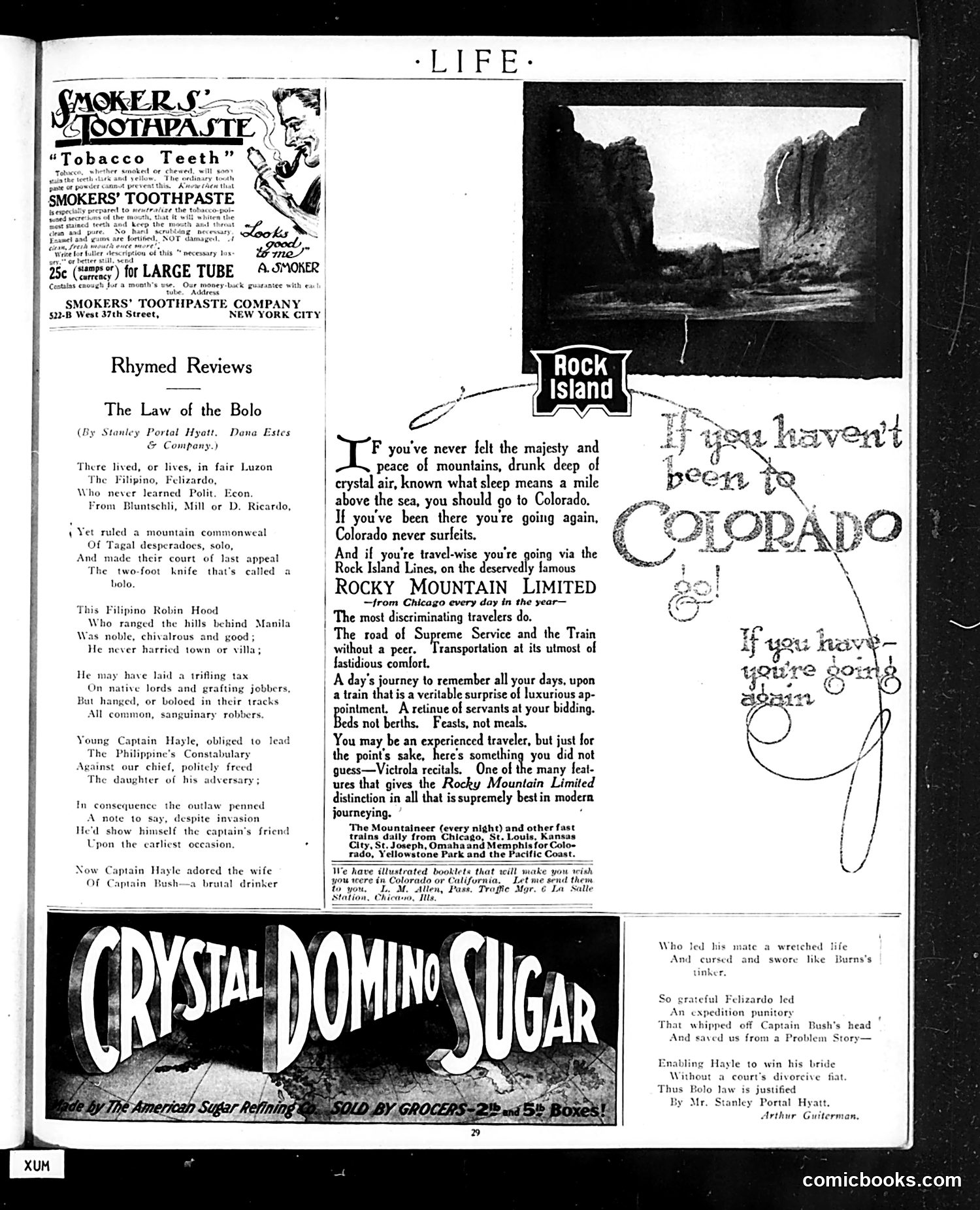
This page is primarily **advertising and literary content** rather than political satire. The main elements are: 1. **Smokers' Toothpaste ad** (top left): A straightforward commercial addressing tobacco staining—a genuine product concern for smokers of that era. 2. **"Rhymed Reviews" poem** (center-left): A narrative verse about a Filipino outlaw ("the Bolo") named Felizardo who operates honorably in the mountains, sparing common people but executing corrupt officials. When a constabulary captain shows mercy to the outlaw's daughter, Felizardo reciprocates by killing the captain's abusive wife, conveniently allowing the captain to remarry. The poem presents this as justified by "Bolo law"—a romantic, Robin Hood-style narrative common to early 20th-century adventure literature. 3. **Rock Island Lines advertisement** (right): Promotes luxury train travel to Colorado, emphasizing comfort and exclusive service. 4. **Crystal Domino Sugar ad** (bottom): Simple product advertisement. The page reflects period attitudes toward colonial Philippines and adventure narratives rather than contemporary political commentary.
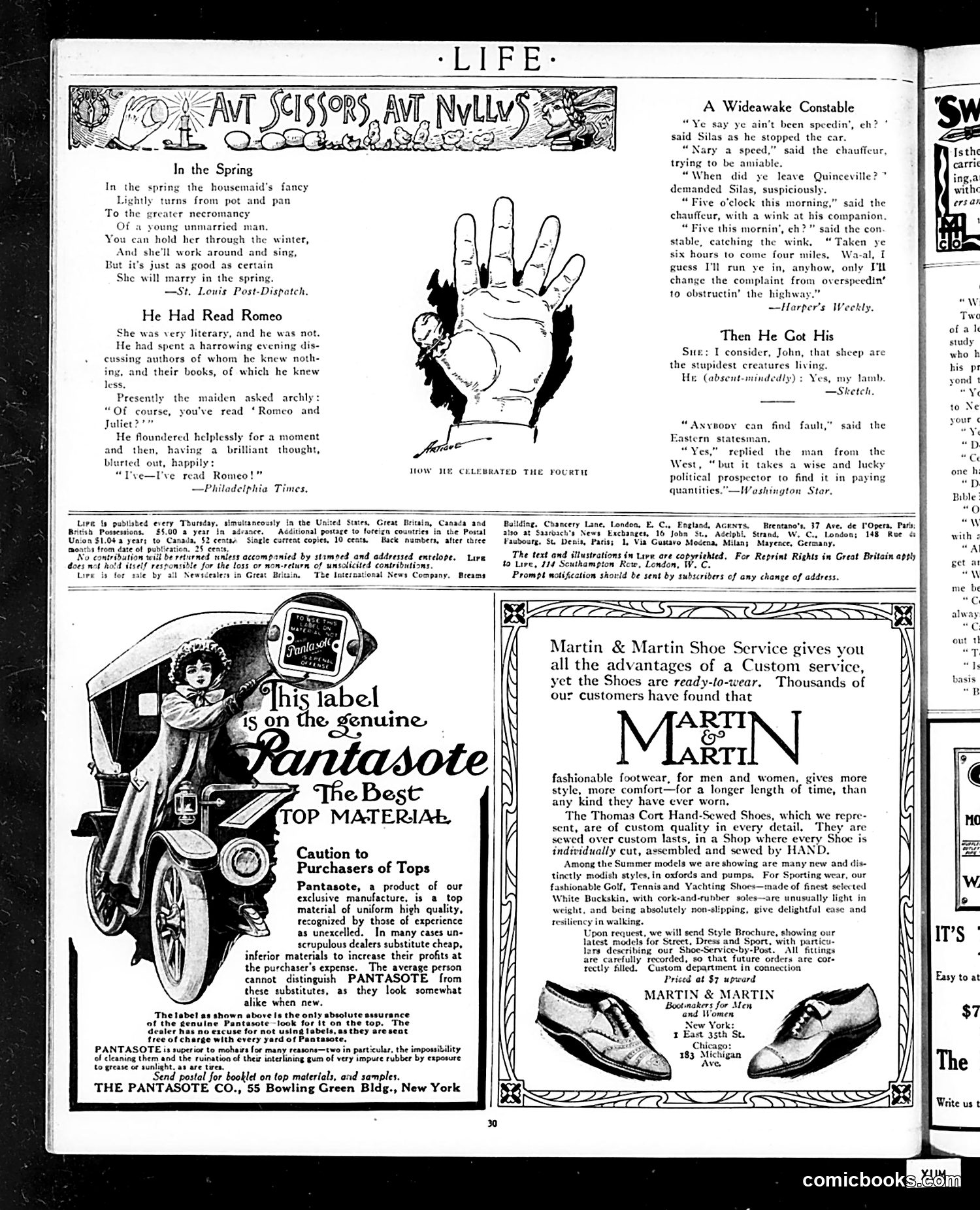
This page from *Life* magazine contains three brief humorous pieces typical of early 20th-century American satire: 1. **"In the Spring"** — A poem about housemaids becoming romantically distracted from their duties in spring, mocking sentimental Victorian attitudes toward domestic servants and romance. 2. **"He Had Read Romeo"** — A joke about a culturally illiterate man trying to impress an intellectual woman by claiming he's "read Romeo" (the play), when he's merely seen the character's name. It satirizes pretension and gender dynamics around literary knowledge. 3. **"A Wideawake Constable"** — A brief anecdote where a traffic officer outsmarts a speeding chauffeur by catching him on a technicality (obstructing traffic by driving too slowly), turning the driver's deception back on him. The remaining content consists primarily of **advertisements** for Pantasote (automobile top material) and Martin & Martin shoes, with warnings about counterfeit products.
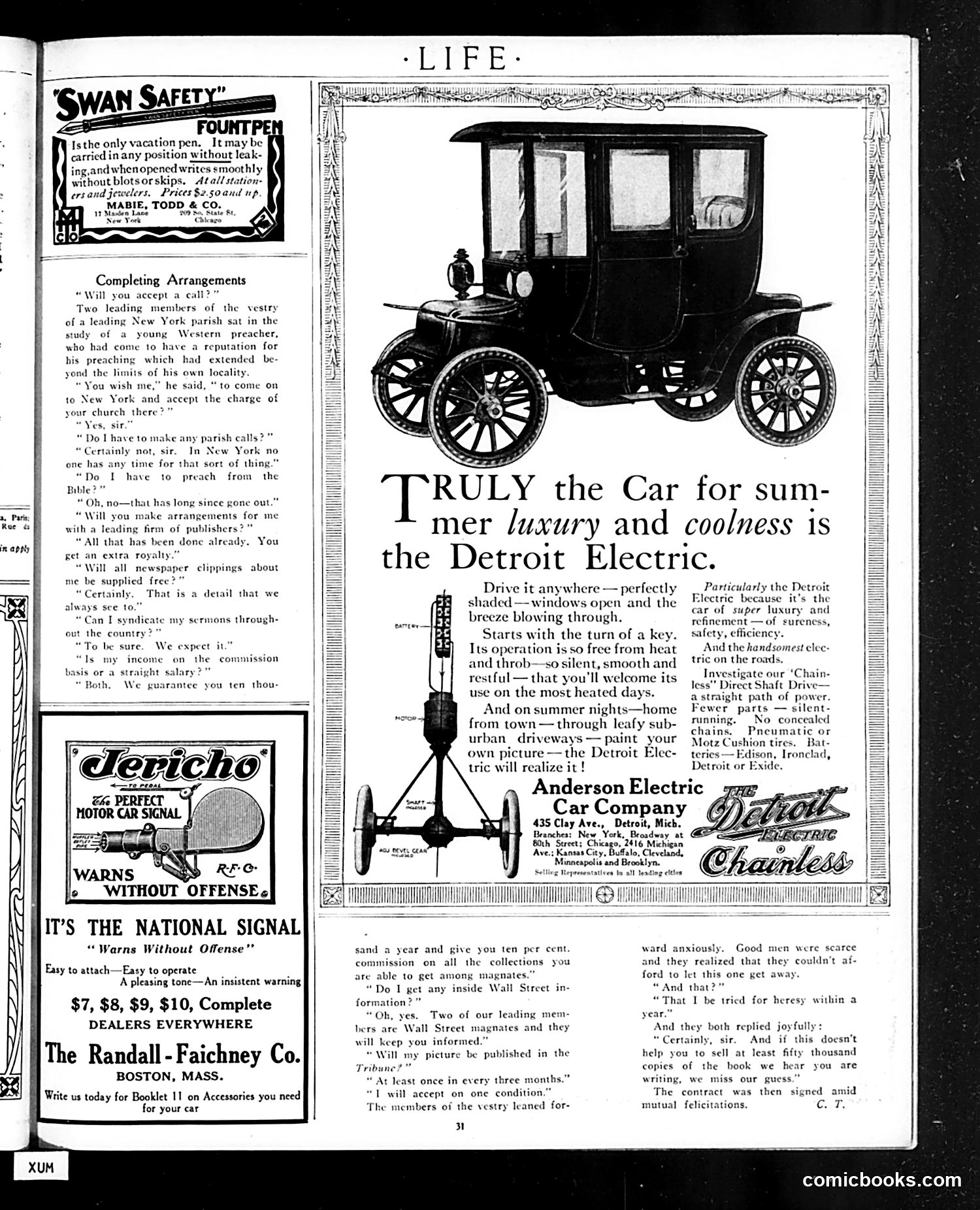
This page contains a satirical short story mocking the commercialization of religion and the compromises of modern Protestant ministers. **The Satire:** A wealthy New York parish recruits an acclaimed Western preacher by offering him an extraordinarily comfortable deal: no parish visits, syndicated sermons, newspaper promotion, guaranteed salary *plus* commission on fundraising, insider stock tips, and—most absurdly—a guaranteed heresy trial within a year to boost book sales. **The Point:** The joke exposes how 1920s organized religion had become a business venture. Ministers are treated like celebrities or salesmen; spiritual concerns have been replaced by marketing, royalties, and Wall Street connections. The punchline—that a heresy trial would help book sales—reveals the ultimate inversion: even doctrinal controversy becomes a commercial opportunity. **Context:** This reflects genuine anxieties about mainline Protestantism's increasing entanglement with consumer culture and capitalism during the Jazz Age. The page also contains period advertisements (Swan Safety fountain pen, Detroit Electric cars, motor signal) unrelated to the cartoon.
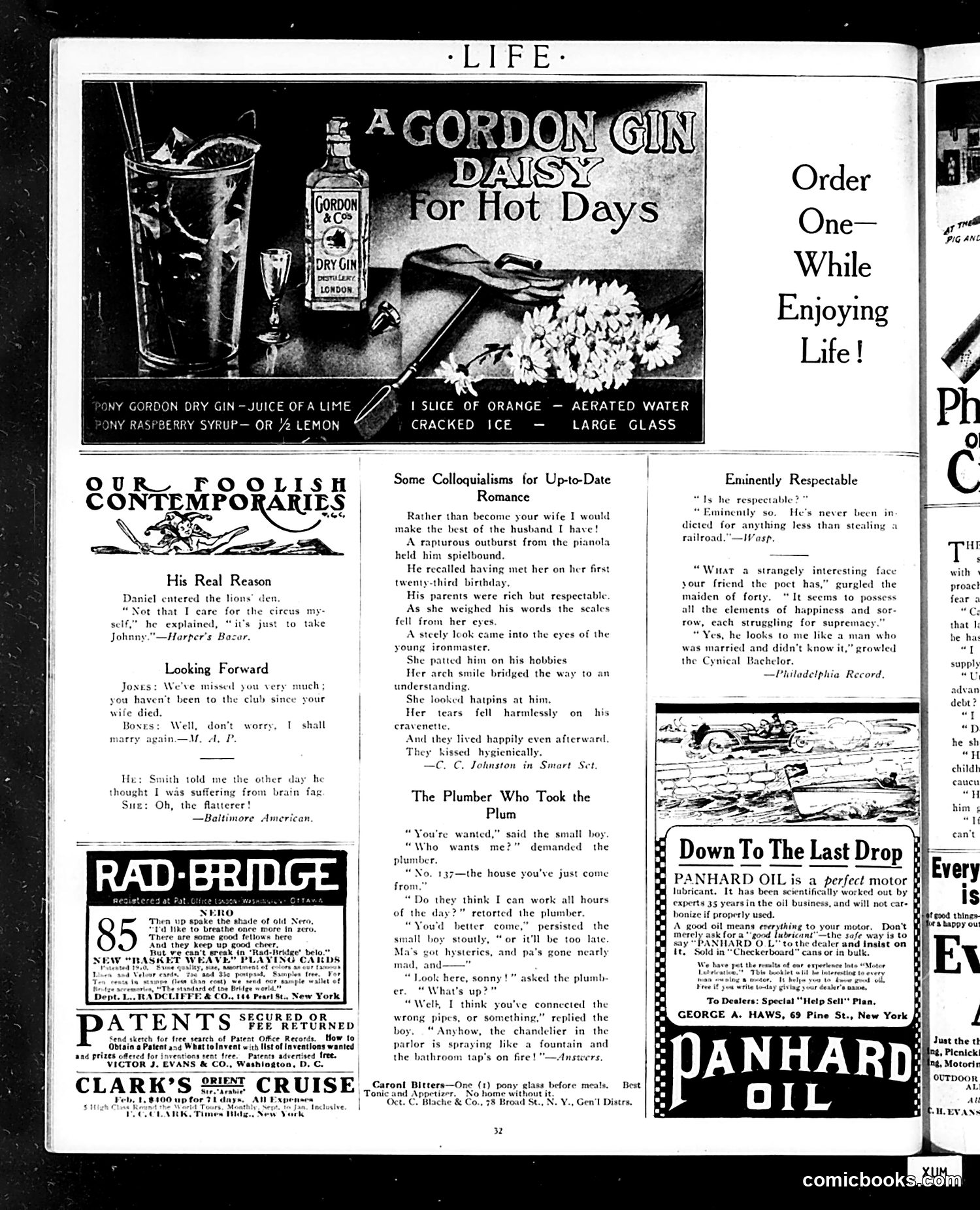
This page from *Life* magazine (a satirical publication) contains several humor pieces typical of the era: **"Our Foolish Contemporaries"** presents four brief satirical anecdotes mocking social pretenses and marital attitudes. The jokes ridicule men who justify circus visits to avoid wives, widowers eager to remarry, and someone feigning brain fatigue for status. **"Some Colloquialisms for Up-to-Date Romance"** parodies modern romantic language as awkwardly overwrought—phrases like "she looked hatpins at him" and "kissed hygienically" satirize how contemporary romance writers affected pseudo-sophisticated diction. **"The Plumber Who Took the Plum"** is a humorous anecdote about a plumber called to an emergency who discovers someone has connected pipes incorrectly, causing the chandelier to spray water and the bathroom tap to shoot flames—physical comedy highlighting incompetence. The remainder consists of period advertisements (Gordon Gin, Panhard Oil) and patent notices—typical magazine filler. The satire targets affectation, foolish behavior, and mangled modern speech rather than specific political figures.
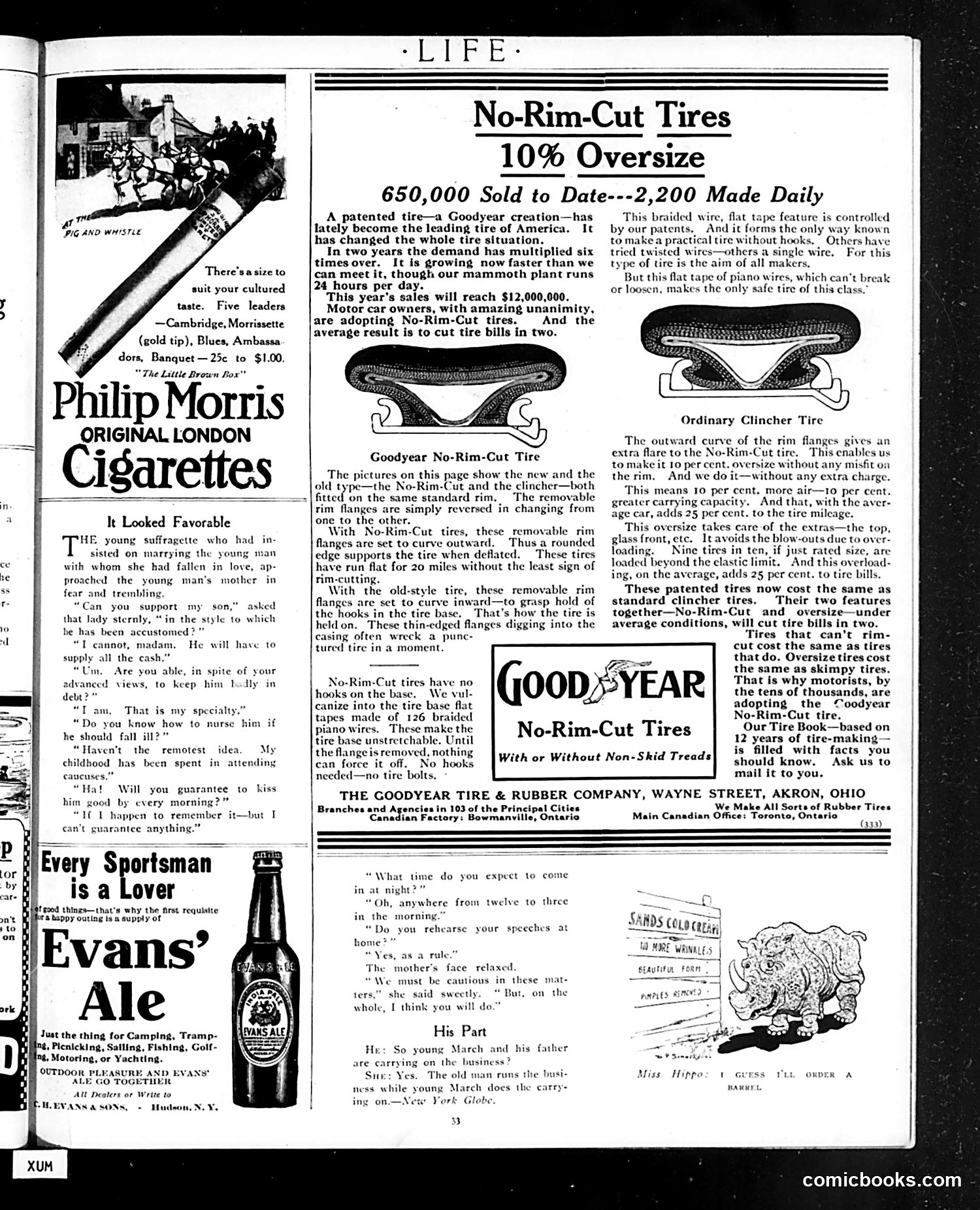
This page is primarily **advertising**, not political satire. It features: **Left side:** A short romantic comic sketch about a young suffragette marrying against her mother-in-law's wishes. The joke plays on the emerging "New Woman"—a woman advocating for women's rights (suffrage) who cannot perform traditional domestic roles (cooking, nursing, housekeeping). The humor stems from the era's anxiety about women's changing social roles. **Main content:** Large Goodyear tire advertisement for "No-Rim-Cut Tires," emphasizing their superior design with technical diagrams comparing them to older "clincher" tires. **Bottom:** Product ads for Philip Morris cigarettes and Evans' Ale. The suffragette sketch reflects early 1900s concerns about feminism and women's independence, presenting this as comedic rather than endorsing the woman's position.
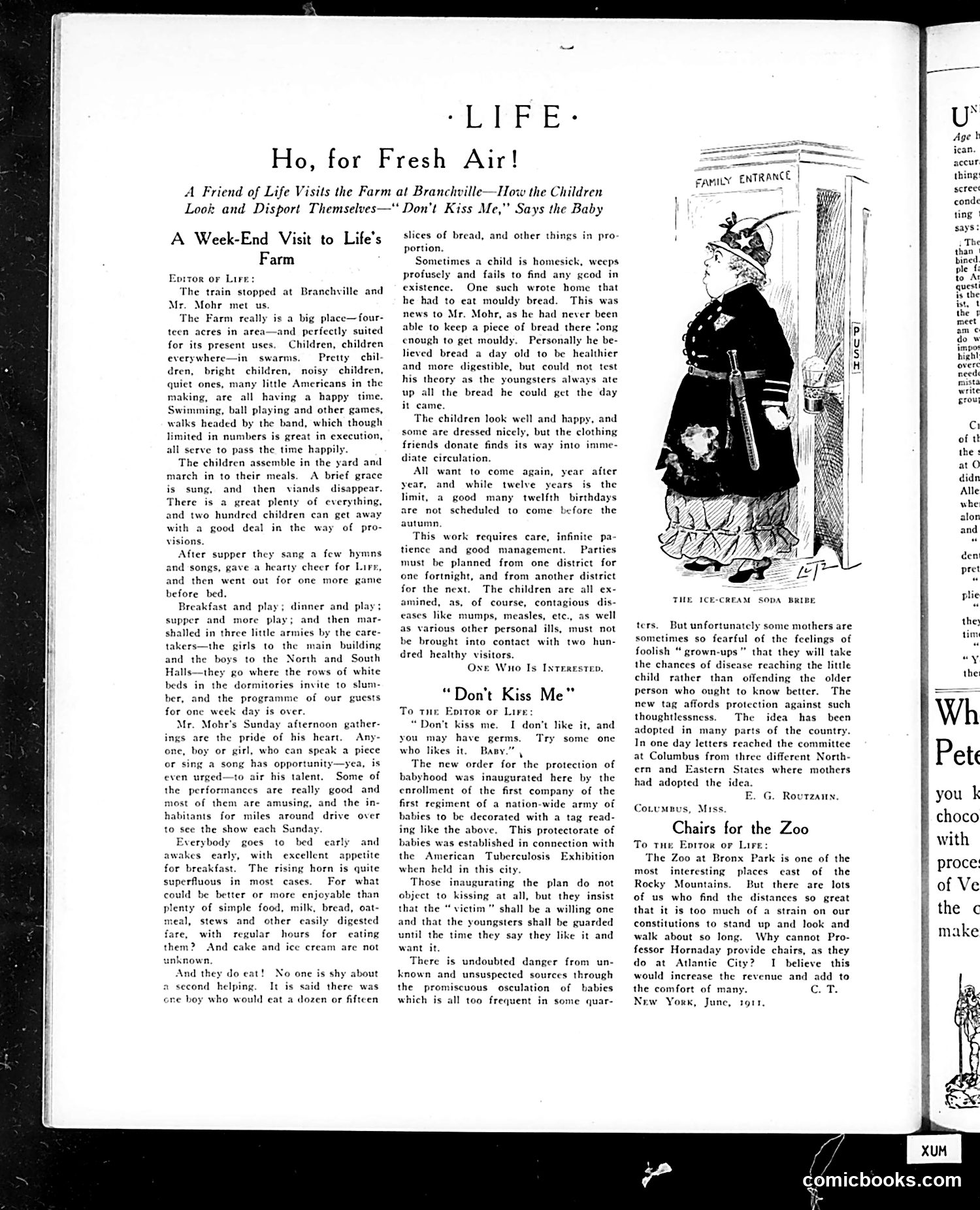
This page documents Life magazine's charitable "Fresh Air Farm" at Branchville—a real facility that gave urban children vacations in the countryside. The main article praises the farm's wholesome activities: swimming, games, meals, singing, and early bedtimes. The cartoon ("The Ice-Cream Soda Bribe") shows a woman offering ice cream to a baby at the farm's entrance, illustrating how treats were used to comfort homesick children. The "Don't Kiss Me" letter is satirical commentary on early 20th-century germ anxiety. A child's note humorously rejects kisses citing germs, reflecting contemporary fears about disease transmission—a serious public health concern of the era. The satire mocks both overprotective parenting and the newly popularized "germ theory." Overall, this documents a Progressive Era initiative mixing genuine child welfare advocacy with period anxieties about urban poverty, contagious disease, and proper child-rearing.
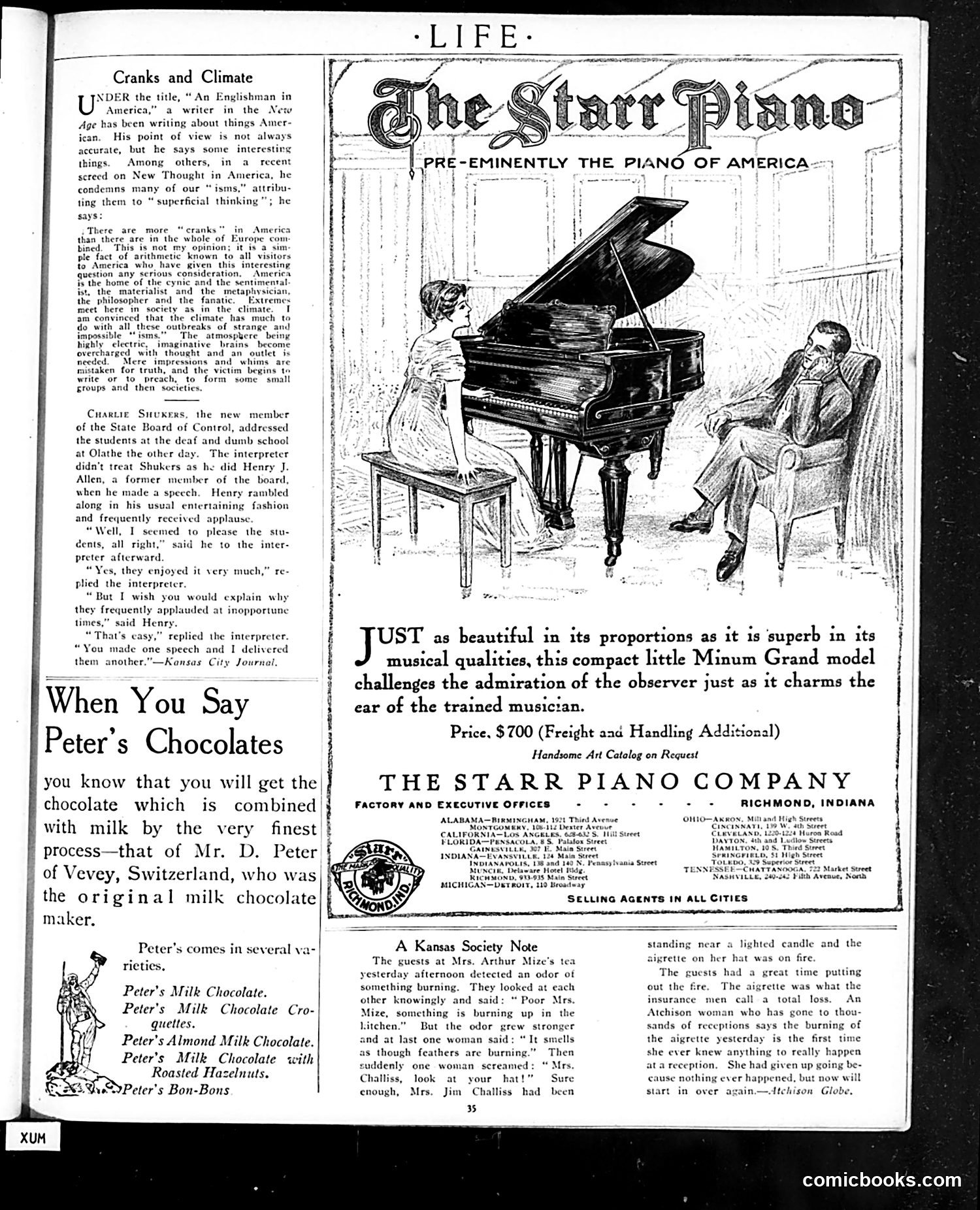
This page is primarily **advertising**, not political satire. The dominant feature is a full-page advertisement for the Starr Piano Company's "Minnum Grand" model ($700), depicted with an illustration of a woman playing while a man listens appreciatively. The page also includes: - **"Cranks and Climate"**: An essay criticizing an English writer who attributes American eccentricity to climate and "New Thought" philosophies, dismissing these as "superficial thinking." - **A humorous anecdote**: About interpreter mishaps at a deaf school in Kansas, where Henry J. Allen's rambling speech received inappropriate applause because the interpreter delivered it as a separate speech. - **Smaller advertisements**: For Peter's Chocolates and other products. The content reflects early 20th-century concerns about American intellectual movements and contains period humor about communication failures—none of which constitutes political cartooning.
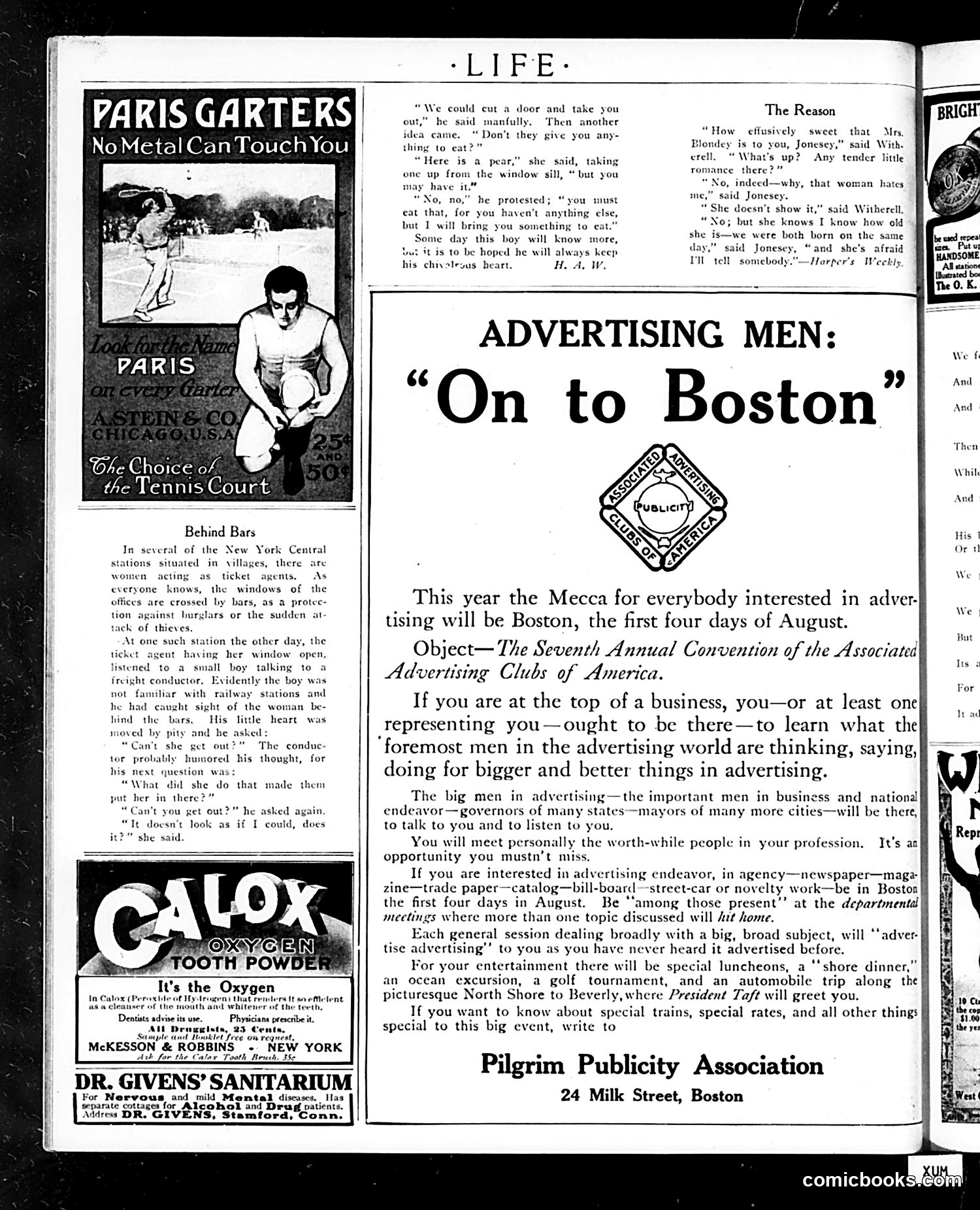
This page contains two brief humorous anecdotes and substantial advertising for a 1912 advertising industry convention. **"Behind Bars"** depicts a young boy at a railway station who sees a female ticket agent behind the protective bars of her office window. Assuming she's imprisoned, he expresses pity and offers to help her escape or bring her food. The satire mocks childhood innocence—the boy misinterprets safety infrastructure as punishment. **"The Reason"** is a short joke: one man observes another being unusually kind to a woman he claims to dislike. The punchline reveals she's pleasant to him because they're the same age, and she fears he'll reveal her age to others. The humor targets vanity and age anxiety, particularly among women. The large advertisement promotes the Seventh Annual Convention of the Associated Advertising Clubs of America in Boston (August, first four days). It appeals to business leaders and advertising professionals to attend, promising networking with governors, mayors, and industry leaders, plus entertainment including a shore dinner and golf tournament with President Taft.
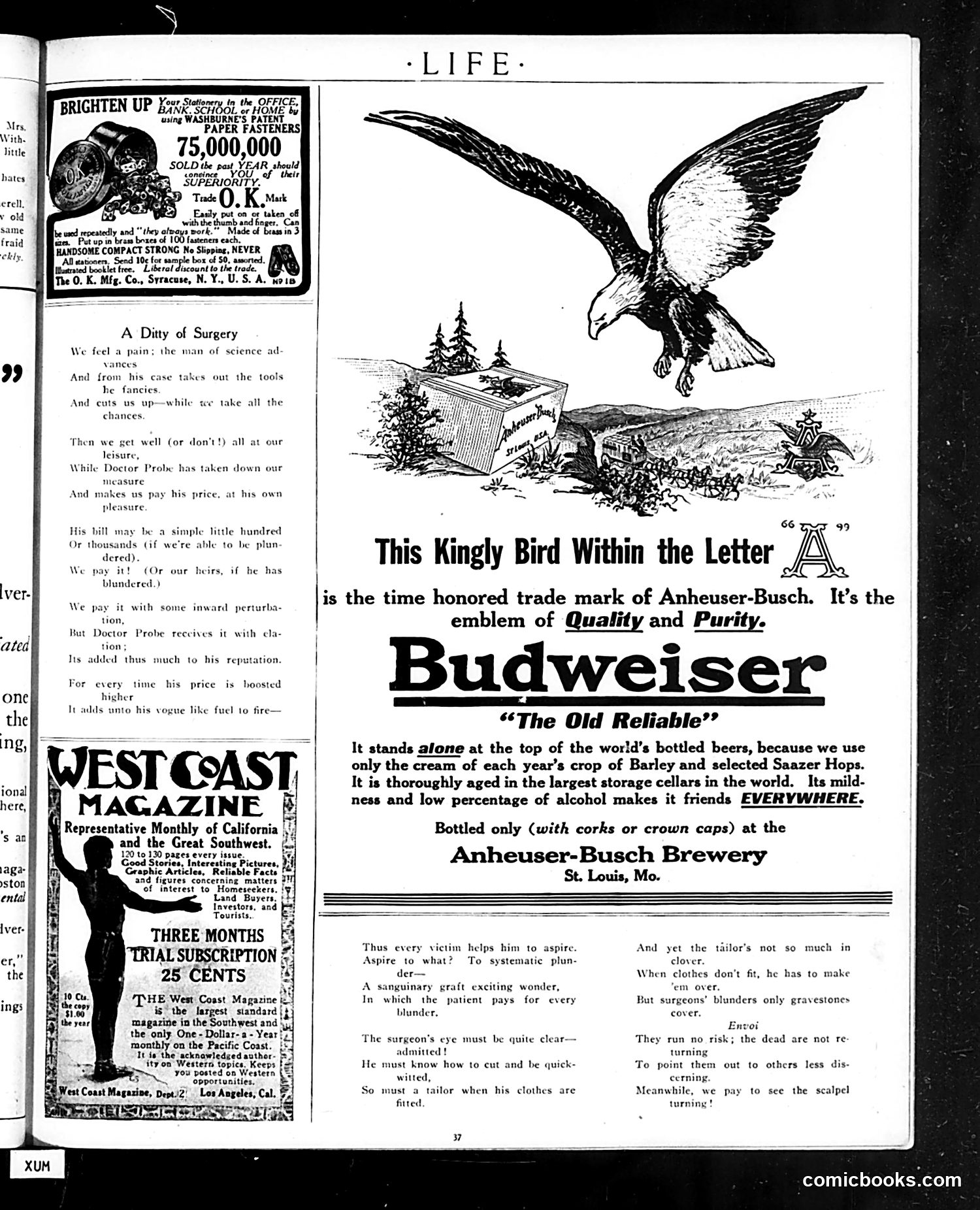
This page primarily features a **Budweiser advertisement** (center-right), which dominates the layout with an eagle logo and marketing copy about the beer being "The Old Reliable." To the left are two pieces of satirical content: 1. **"A Ditty of Surgery"** - A poem mocking doctors and surgical costs. The satire critiques physicians who charge exorbitant fees while patients bear all the risk ("we take all the chances"). The joke: doctors profit handsomely regardless of outcomes—their reputation actually *increases* when they raise prices, as if expense signals competence. 2. **A parallel comparison piece** (bottom) cleverly equates surgeons with tailors, suggesting both charge for their mistakes. The satire implies surgeons face no consequences for "blunders" (dead patients aren't returning complaints), while tailors at least must redo faulty work. The humor targets early-20th-century medical profession greed and the powerlessness of patients—a common *Life* magazine theme criticizing professional exploitation.
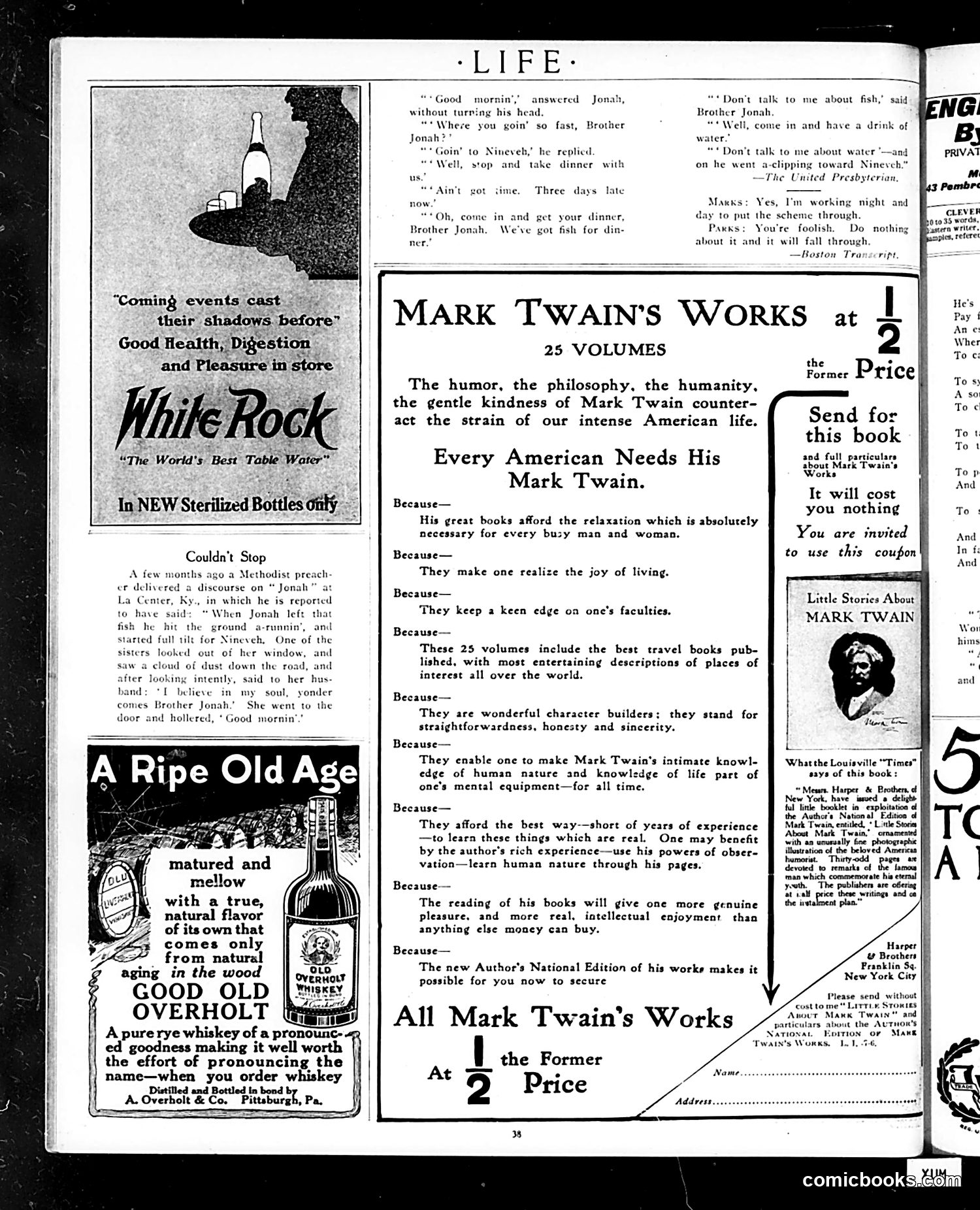
This page is primarily a **book advertisement** for Mark Twain's 25-volume collected works, with secondary content. The main humor piece is "Couldn't Stop"—a brief anecdote about a Methodist preacher's sermon on the biblical Jonah. The joke depicts Brother Jonah fleeing Nineveh so frantically that a woman mistakes the dust cloud for an arriving visitor. When she greets him and offers fish and water, he refuses both, claiming he has "no time"—ironically absurd given that Jonah's biblical story *is* about him being chased and eventually swallowed by a whale over water. The humor lies in this pious character's single-minded escape being so urgent he won't even pause for hospitality. The page also contains product advertisements for **White Rock Table Water** and **Old Overholt Whiskey**. The Mark Twain advertisement emphasizes his books' value for busy Americans seeking relaxation and life wisdom, using repeated "Because—" statements as persuasive rhetoric. A small coupon invites readers to request more information at no cost.

This page is primarily **advertising**, but includes a satirical poem titled "Man" by Carolyn Wells that mocks traditional gender roles and male subservience in relationships. **The Satire:** The poem presents husband/boyfriend duties from a woman's perspective, depicting the male as merely a utility—a "purse to pay her bills," an escort, emotional support, and servant who "hook[s] up the back of her modish frock" and performs menial tasks. The punchline, "he's such a fool that he loves the task," suggests men are foolish for accepting this subordinate domestic role. **Social Context:** This reflects 1920s-era satire about changing gender dynamics. Women had recently gained voting rights (1920), and the "New Woman" was asserting independence. Wells's poem gently mocks both the dependency of women on men's finances *and* the willingness of men to accept diminished, service-oriented roles in relationships. **Modern Parallel:** Today's readers would recognize this as proto-feminist commentary on unpaid domestic labor and economic imbalance in relationships—though expressed through gentle humor rather than explicit criticism.
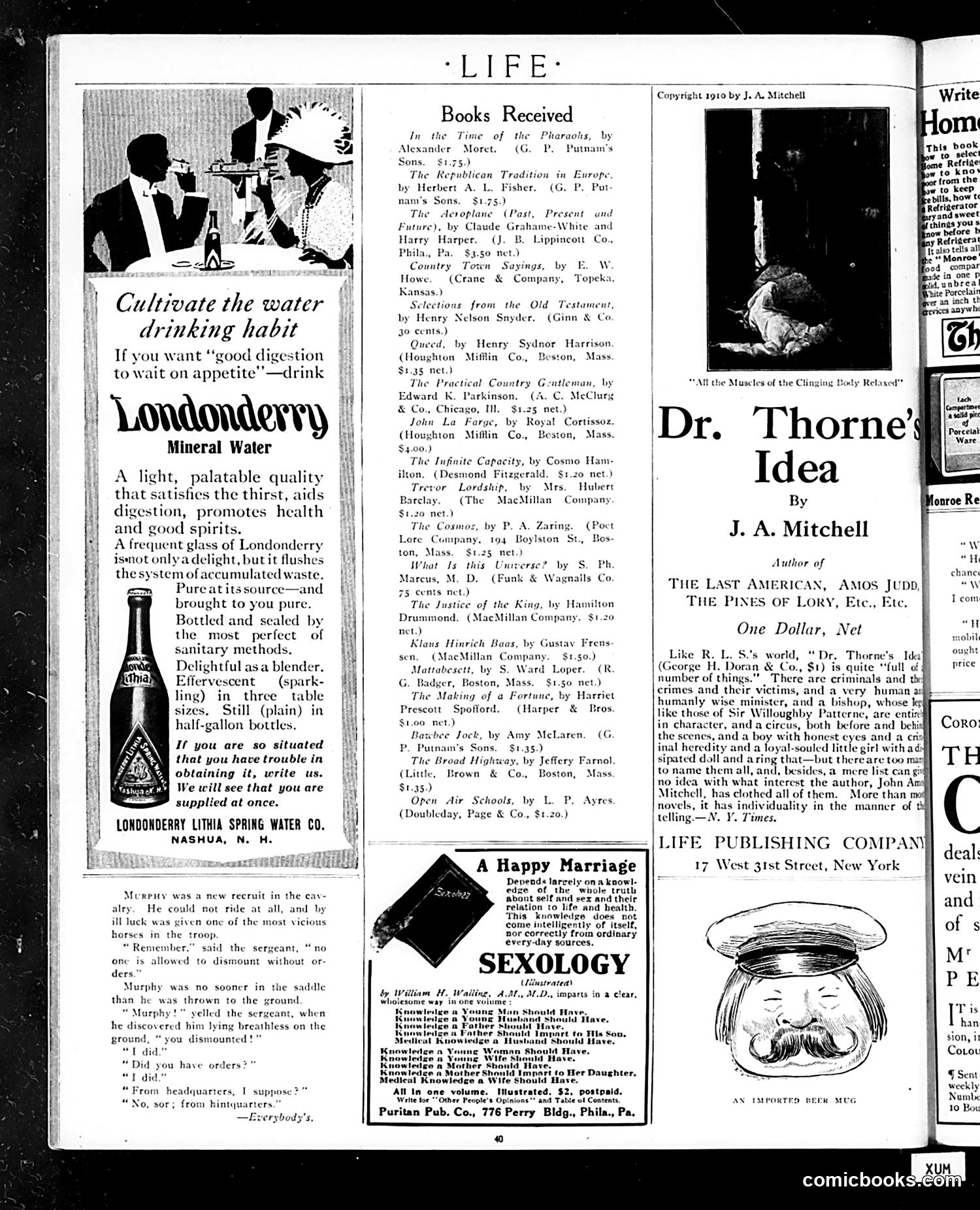
This page from Life magazine contains book advertisements and reviews typical of the era. The main editorial content is a review of "Dr. Thorne's Idea" by J. A. Mitchell, published by Life Publishing Company. The review describes it as a novel in the manner of R. L. Stevenson's work, featuring criminals, victims, a "humanly wise minister," a bishop, and circus scenes. The advertisements reflect period concerns: Londonderry Mineral Water promotes digestive health and "good spirits"; a "Sexology" book advertises intimate knowledge for married couples; and an "Imported Beer Mug" is featured. A brief narrative joke about "Murphy" — a cavalry recruit thrown from a vicious horse — appears at bottom left, typical of Life's humorous filler content. The page is primarily commercial and literary rather than politically satirical. No political figures or cartoons are prominently featured.
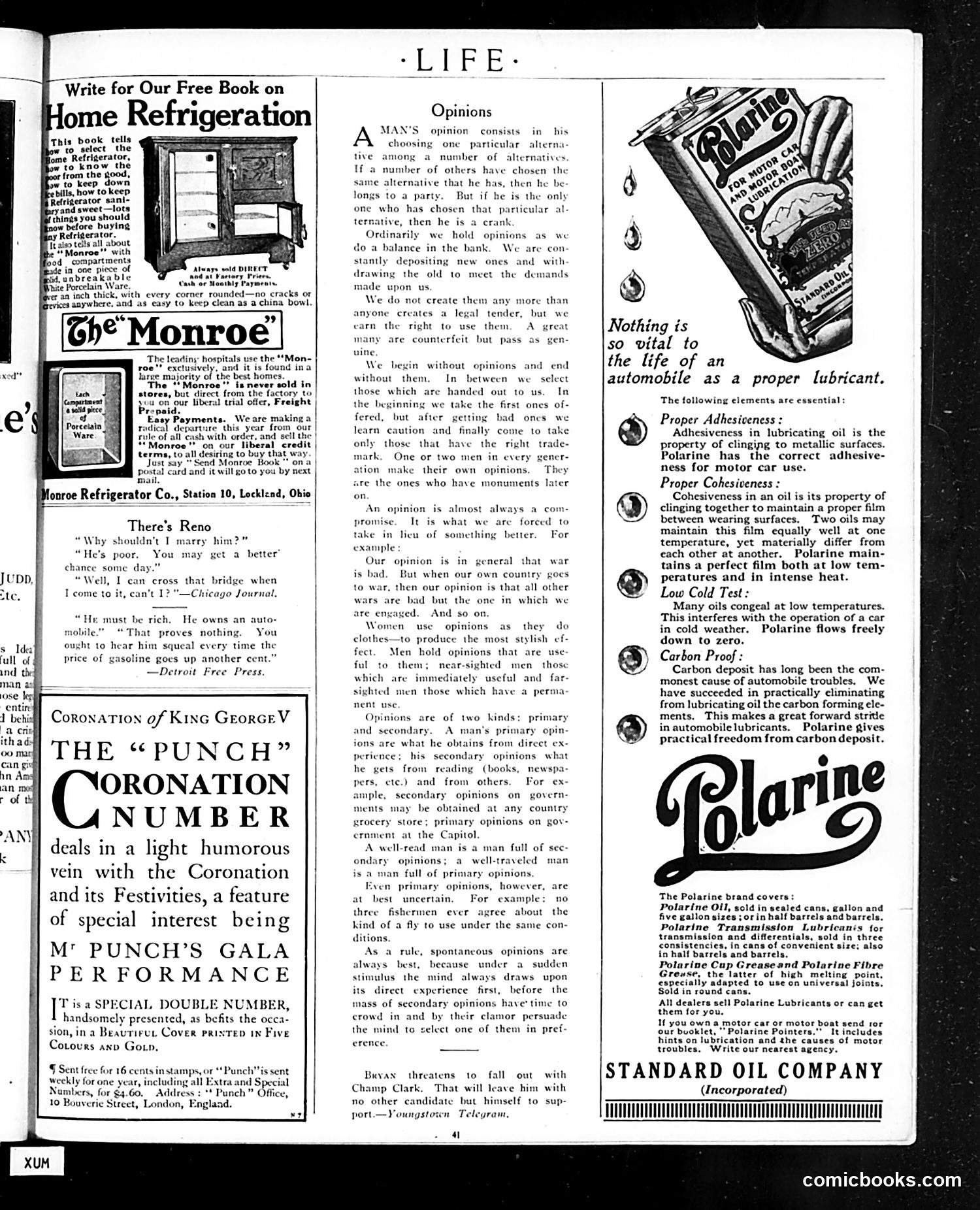
This page is primarily **advertising and editorial content** rather than political satire requiring historical context. The main content includes: - **Monroe refrigerator ad** (left column): promoting home refrigeration technology with a free informational book - **"Opinions" essay** (center): a philosophical piece distinguishing between personal opinions and those adopted from others, using examples like wartime patriotism and how women choose clothes - **Punch magazine advertisement** (lower left): promoting a special "Coronation Number" about King George V's coronation and court festivities - **Polarine motor oil ad** (right side): detailing lubricant properties essential for automobiles The satire is minimal and indirect—the "Opinions" essay gently mocks how people uncritically adopt popular views rather than thinking independently. The Reno anecdotes use light humor about marriage and poverty. **No specific political figures or events** requiring historical explanation are referenced. This appears to be a typical early 20th-century magazine page mixing consumer advertising with lighthearted social commentary.
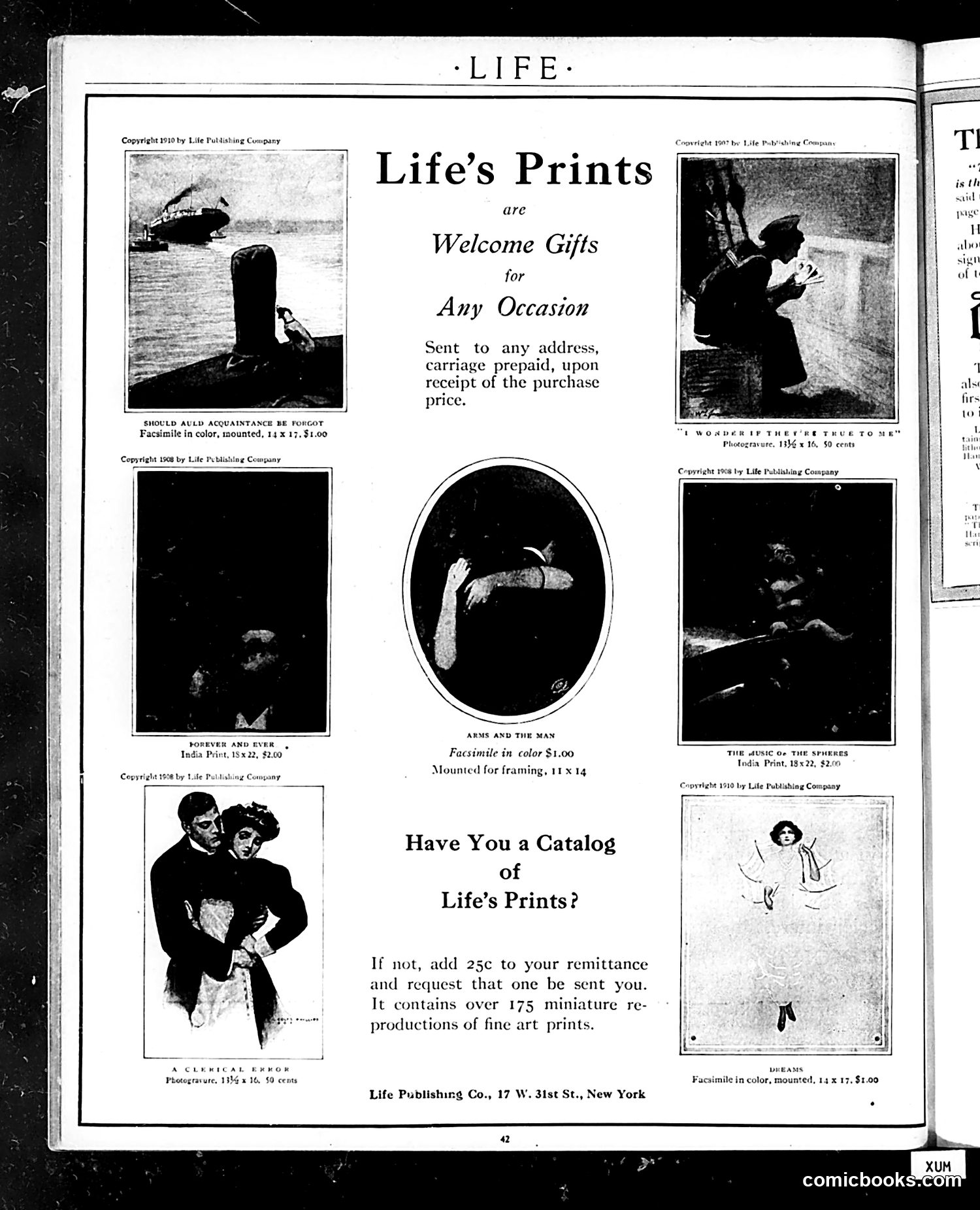
This page is primarily **advertising**, not satire or political commentary. Life Publishing Company is promoting fine art prints available for purchase as gifts. The page displays six sample prints with titles like "Should Auld Acquaintance Be Forgot," "Arms and the Man," "I Wondered If They Were True to Me," "Forever and Ever," "The Music of the Spheres," and "A Clerical Error." These appear to be sentimental or dramatic scenes typical of early 20th-century popular art—romantic moments, domestic situations, and artistic compositions. The advertisement emphasizes that prints are available in various formats (photogravures, facsimiles, India prints) and price points, with carriage prepaid delivery. There's a push to request a catalog containing "over 175 miniature reproductions of fine art prints." This represents **early commercial art merchandising**—making fine art accessible and affordable to middle-class households through mail order, a significant business model of the era.
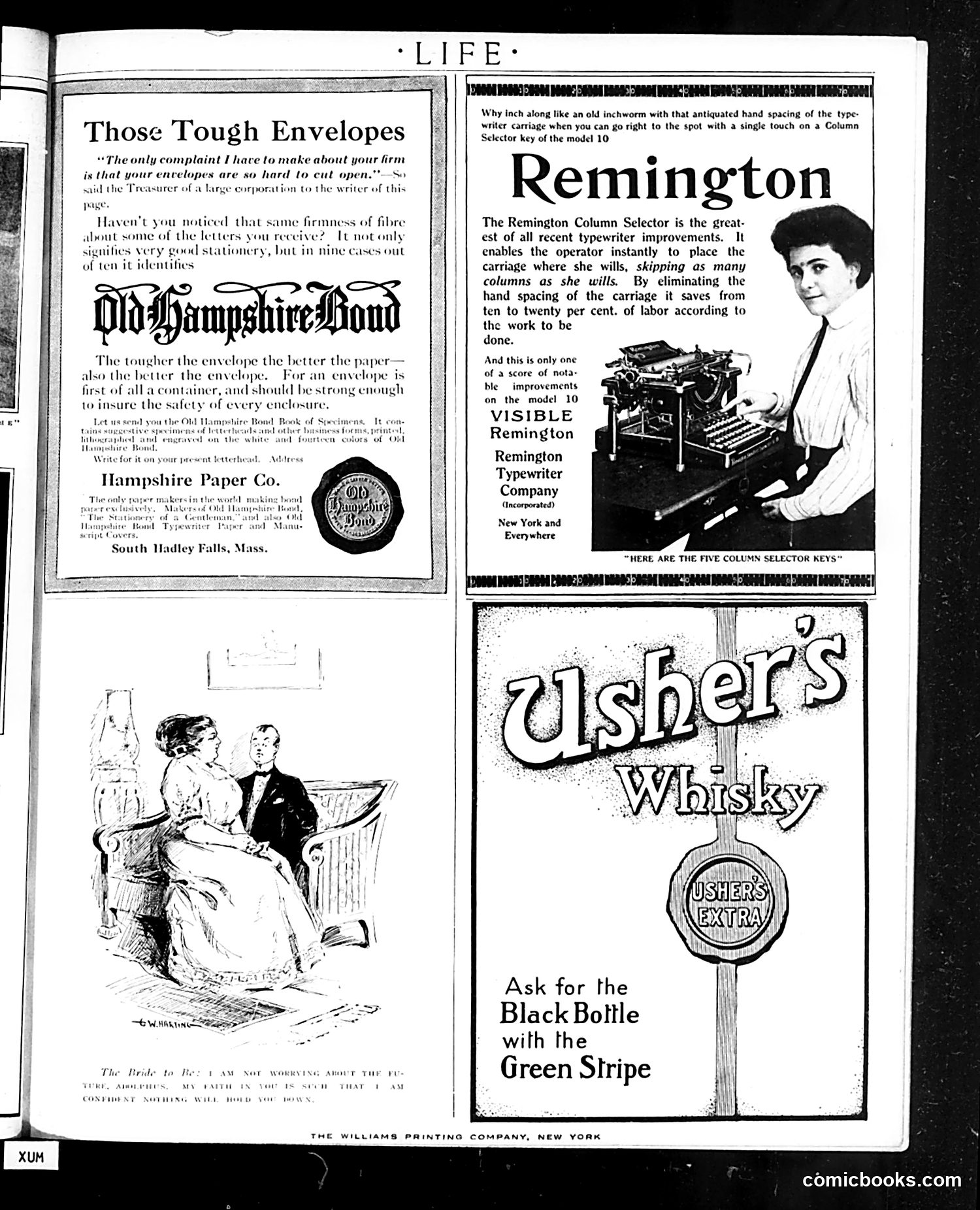
This page is primarily **advertising**, not editorial content or political satire. It contains three product advertisements: 1. **Hampshire Paper Co.** (top left): Promotes durable envelopes, claiming their superior fiber strength protects contents during mail delivery. The ad quotes a corporate treasurer praising their toughness. 2. **Remington Typewriter** (top right): Features a "Column Selector" innovation that allows operators to automatically space to different columns with one touch, saving 10-20% labor time. The woman operator demonstrates the Model 10 typewriter. 3. **Usher's Whisky** (bottom right): A simple product announcement asking customers to request the "Black Bottle with the Green Stripe." The small cartoon (bottom left) appears unrelated to advertising—a domestic scene, but the OCR'd caption is too garbled to interpret clearly. **No political satire or caricature is present.** This is a typical early-20th-century magazine page mixing consumer goods advertising.
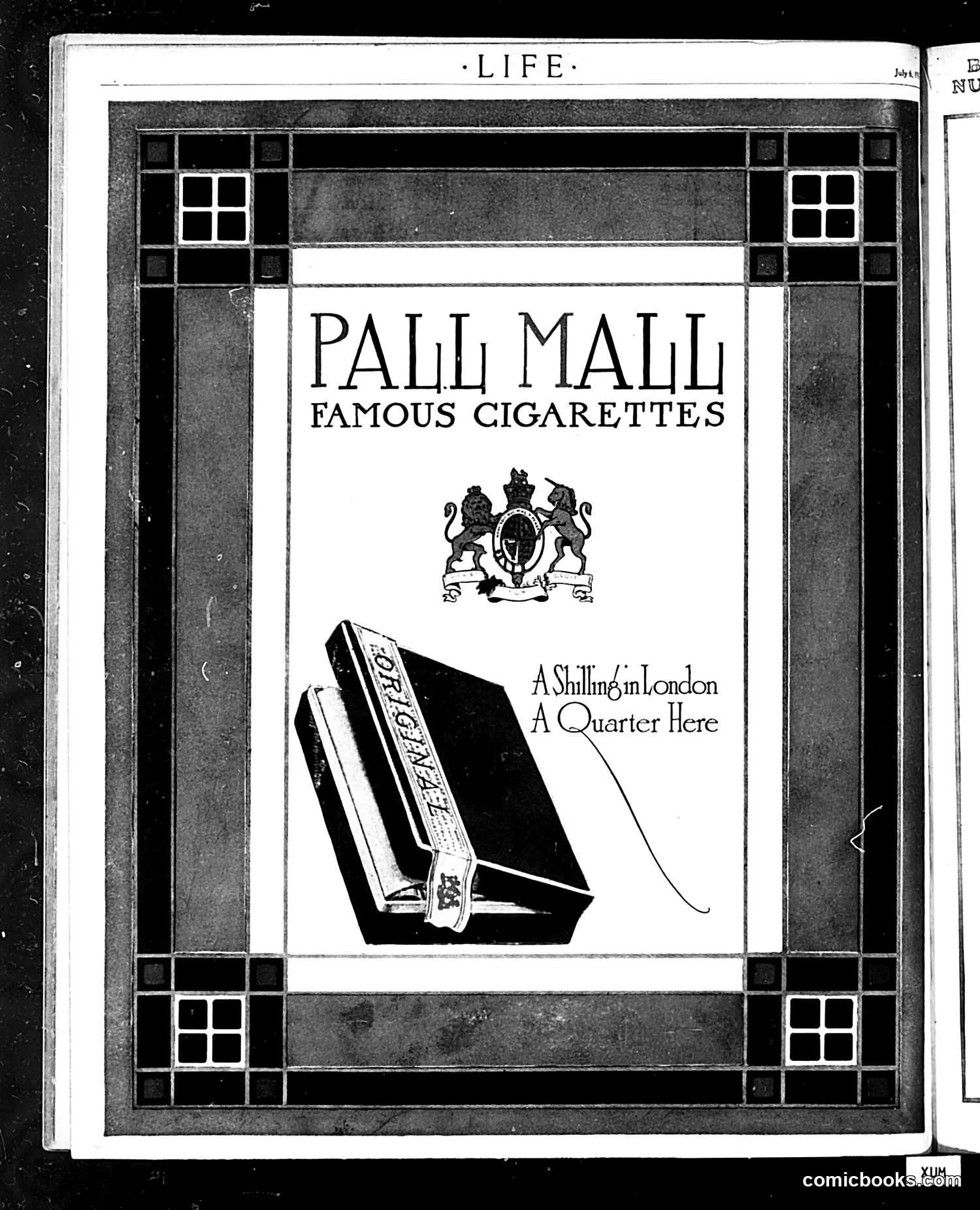
This is a **cigarette advertisement**, not political satire. The page promotes Pall Mall brand cigarettes, emphasizing their prestige through heraldic imagery (a coat of arms with lions and shield). The key sales pitch compares **British and American pricing**: "A Shilling in London / A Quarter Here." This highlights that Pall Malls cost less in America (a quarter, or 25 cents) than in Britain (a shilling), positioning them as an affordable luxury import. The elegant Art Deco border and formal presentation reflect early-20th-century advertising style, targeting affluent consumers. There is no satire—simply a straightforward commercial message leveraging transatlantic price differences to attract American buyers during an era when cigarette advertising in mainstream magazines was standard practice.