
Life, 1911-07-06 · page 26 of 44
Life — July 6, 1911 — page 26: what you’re looking at
What you’re looking at
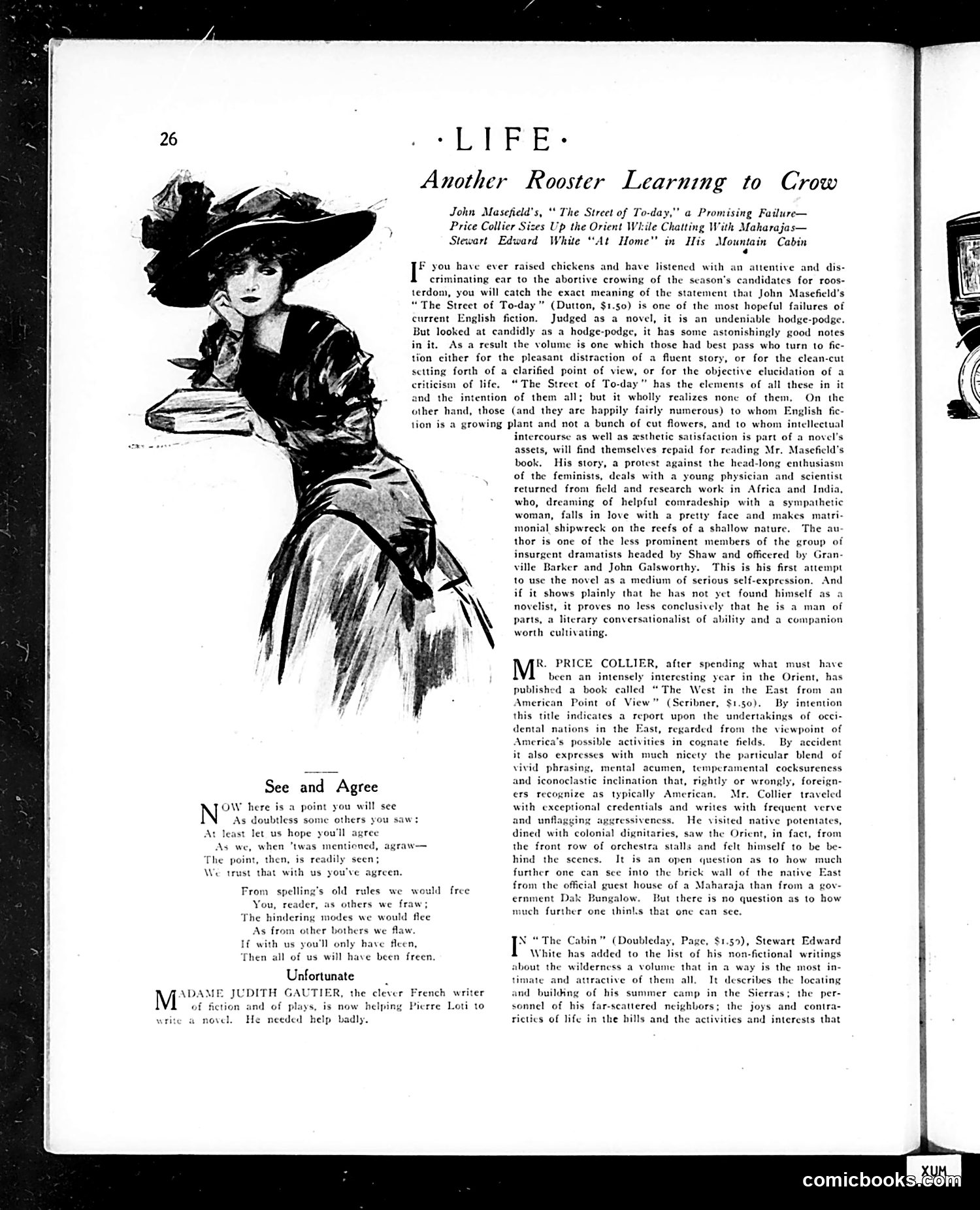
This page reviews three new books. The main illustration shows a fashionably dressed woman in an elegant hat—likely a visual reference to one of the discussed authors or their work, though the specific identity isn't labeled. The reviews discuss: 1. **John Masefield's "The Street of To-day"**: The critic uses the metaphor of a young rooster "learning to crow" (the page's title) to describe Masefield's novel as ambitious but unsuccessful—it attempts serious artistic expression but fails to fully achieve its goals. The reviewer notes it's a "hodge-podge" lacking coherent plot or philosophy, yet praises Masefield's intellectual capacity and literary conversation skills. 2. **Price Collier's "The West in the East"**: A travel/political report on Western activities in the Orient. The review satirizes Collier's American confidence and presumed authority, suggesting his privileged access (touring with maharajas, staying in official guest houses) may actually limit genuine understanding of Eastern cultures. The page exemplifies *Life*'s literary criticism style: witty, somewhat condescending, but intellectually engaged with contemporary authors.
📄 Transcribed text from this page (OCR, searchable)
Machine-transcribed from the original scan — historical spelling and the odd misread are preserved.
-*LPFE= Another Rooster Learning to Crow John Masefield's, “* The Street of To-da @ Promising Failure— Price Collier Sizes Up the Orient While Chatting With Maharajas— Stewart Edward White “At Home" in His Mountain Cabin ‘ F you have ever raised chickens and have listened with an attentive and dis- criminating ear to the abortive crowing of the season's candidates for roos- terdom, you will catch the exact meaning of the statement that John Masefield’s “The Street of To-day” (Dutton, $1.50) is one of the most hopeful failures of current English fiction. Judged as a novel, it is an undeniable hodge-podge. But looked at candidly as a hodge-podge, it has some astonishingly good notes in it. Asa result the volume is one which those had best pass who turn to fic- tion cither for the pleasant distraction of a fluent story, or for the clean-cut setting forth of a clarified point of view, or for the objective elucidation of a criticism of life. “The Street of To-day" has the elements of all these in it and the intention of them all; but it wholly realizes none of them. On the other hand, those (and they are happily fairly numerous) to whom English fic- tion is a growing plant and not a bunch of cut flowers, and to whom intellectual intercourse as well as xsthetic satisfaction is part of a novel's assets, will find themselves repaid for reading Mr. Maseficld’s book. His story, a protest against the head-long enthusiasm of the feminists, deals with a young physician and scientist returned from field and research work in Africa and India, who, dreaming of helpful comradeship with a sympathetic woman, falls in love with a pretty face and makes matri- monial shipwreck on the reefs of a shallow nature. The au thor is one of the less prominent members of the group of insurgent dramatists headed by Shaw and officered by Gran- ville Barker and John Galsworthy. This is his first attempt to use the novel as a medium of serious self-expression. And if it shows plainly that he has not yet found himself as a novelist, it proves no less conclusively that he is a man of parts, a literary conversationalist of ability and a companion worth cultivating. M* PRICE COLLIER, after spending what must have been an intensely interesting year in the Orient, has published a book called “The West in the East from American Point of View” (Scribner, $1.50). By intention this title indicates a report upon the undertakings of occi- dental nations in the East, regarded from the viewpoint of America’s possible activities in cognate fields. By accident it also expresses with much nicety the particular blend of _ vivid pbrasing, mental acumen, temperamental cocksureness and iconoclastic inclination that, rightly or wrongly, foreign- See and Agree ers recognize as typically American, Mr. Collier traveled OW here is a point you will see with exceptional credentials and writes with frequent verve IN As dutbtiess sonte orbere you saw: and unflagging aggressivencss, He visited native potentates, t least let us hope you'll agree dined with colonial dignitaries, saw the Oricnt, in fact, from ‘As we, when ‘twas mentioned, agraw— the front row of orchestra stalls and felt himself to be be- The point, then, is readily seen; hind the scenes. It is an open question as to how much We trust that with us you've agreen. further one can see into the brick wall of the native East from the official guest house of a Maharaja than from a gov- ernment Dak Bungalow. But there is no question as to how much further one thinks that one can see. From spelling’s old rules we would free You, reader, as others we fraw; The hindering modes we would flee As from other bothers we flaw. If with us you'll only have fleen, ‘Then all of us will have been freen. “The Cabin” (Doubleday, Page, $1.59), Stewart Edward White has added to the list of his non-fictional writings ‘ about the wilderness a volume that in a way is the most in- Unfortunate timate and attractive of them all, It describes the locating \DAME JUDITH GAUTIE of fiction and of plays, is now helping Pierre Loti to sonnel of his far-seattered neighbors; the joys and contra write a novel. He needed help badly. rictics of life in the hills and the activities and interests that . the clever French writer and building of his summer camp in the Sierras; the per-