
Life, 1911-07-06 · page 8 of 44
Life — July 6, 1911 — page 8: what you’re looking at
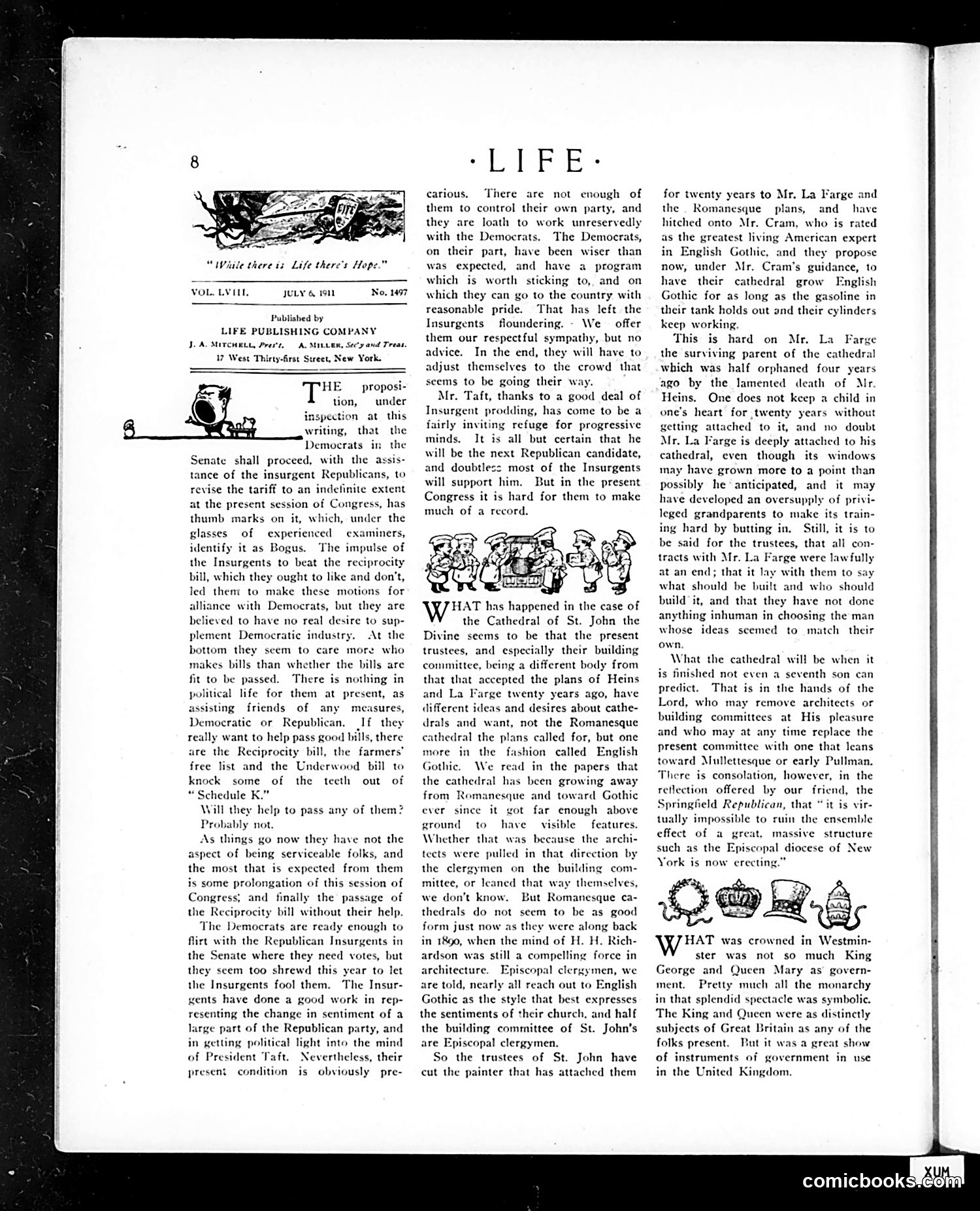
What you’re looking at
This *Life* magazine page (July 5, 1911) contains editorial commentary on two topics: 1. **Cathedral of St. John the Divine**: The text discusses tensions between trustees and architects over whether to continue Romanesque or switch to English Gothic style. The text notes trustees are pulling the cathedral in different directions architecturally—a metaphor for institutional indecision. 2. **Republican Party Division**: The main editorial criticizes insurgent Republicans challenging party leadership. It compares their internal conflict to the cathedral's architectural disputes, suggesting both groups lack unified direction and that Democrats are exploiting this Republican disarray. The piece's political point: the Republican Party, like the cathedral committee, suffers from conflicting visions that weaken institutional authority and invite external competitors (Democrats) to capitalize on internal weakness.
📄 Transcribed text from this page (OCR, searchable)
Machine-transcribed from the original scan — historical spelling and the odd misread are preserved.
“While there is Life there's Hope. VOL. LVI JULY 6 1911 No. 1497 Published by LIFE PUBLISHING COMPANY J. AL MITCH REL, Prestt, A. MILLER, Sec’y and Treas. 17 West Thirty-first Street, New York. HE __proposi- tion, under C4 inspection at this writing, that the Democrats in the Senate shall proceed, with the assis- tance of the insurgent Republicans, to revise the tariff to an indefinite extent at the present session of Congress, has thumb marks on it, which, under the glasses of experienced miners, identify it as Bogus. The impulse of the Insurgents to beat the reciprocity bill, which they ought to like and don’t, led them to make these motions for alliance with Democrats, but they are believed to have no real desire to sup- plement Democratic industry, At the bottom they seem to care more who makes bills than whether the bills are fit to be passed. There is nothing in political life for them at present, as assisting friends of any measures, Democratic or Republican. If they really want to help pass good bills, there are the Reciprocity bill, the farmers’ free list and the Underwood bill to knock some of the teeth out of “ Schedule K.” Will they help to pass any of them? Probably not. As things go now they have not the aspect of being serviceable folks, and the most that is expected from them is some prolongation of this session of Congress; and finally the passage of the Reciprocity bill without their help. The Democrats are ready enough to flirt with the Republican Insurgents in the Senate where they need votes, but they scem too shrewd this year to let the Insurgents fool them. The Insur- ents have done a good work in rep- resenting the change in sentiment of a large part of the Republican party, and in getting political light into the mind of President Taft. Nevertheless, their present condition is obviously pre- ‘CEP E« carious. There are not enough of them to control their own party, and they are loath to work unreservedly with the Democrats. The Democrats, on their part, have been wiser than was expected, and have a program which is worth sticking to, and on which they can go to the country with reasonable pride. That has left the Insurgents floundering. - We offer them our respectful sympathy, but no advice. In the end, they will have to adjust themselves to the crowd that seems to be going their way Mr. Taft, thanks to a good deal of Insurgent prodding, has come to be a fairly inviting refuge for progressive minds. It is all but certain that he will be the next Republican candidate, and doubtless most of the Insurgents will support him. But in the present Congress it is hard for them to make much of a record. HAT has happened in the case of the Cathedral of St. John the Divine seems to be that the present trustees, and especially their building committee, being a different body from that that accepted the plans of Heins and La Farge twenty years ago, have different ideas and desires about cathe- drals and want, not the Romanesque cathedral the plans called for, but one more in the fashion called English Gothic. We read in the papers that the cathedral has been growing away from Romanesque and toward Gothic ever since it got far enough above ground to have visible feature Whether that was because the archi- tects were pulled in that direction by the clergymen on the building com- mittee, or leaned that way themselves, we don't know. But Romanesque ca- thedrals do not seem to be as good form just now as they were along back in 1890, when the mind of H. H. Rich- ardson was still a compelling force in architecture. Episcopal clergymen, we are told, nearly all reach out to English Gothic as the style that best expresses the sentiments of their church, and half the building committee of St. John’s are Episcopal clergymen. So the trustees of St. John have cut the painter that has attached them for twenty years to Mr. La Farge and the Romanesque plans, and have hitched onto Mr. Cram, who is rated as the greatest living American expert in English Gothic, and they propose now, under Mr. Cram’s guidance, to have their cathedral grow English ‘othic for as long as the gasoline in their tank holds out and their cylinders keep working. This is hard on Mr, La Farge the surviving parent of the cathedral which was half orphaned four years ago by the lamented death of Mr. Heins. One does not keep a child in one’s heart for twenty years without getting attached to it, and no doubt Mr, La Farge is deeply attached to his cathedral, even though its windows may have grown more to a point than possibly he anticipated, and it may have developed an oversupply of privi- leged grandparents to make its train- ing hard by butting in. Still, it is to be said for the trustees, that all con- tracts with Mr. La Farge were lawfully at an end; that it lay with them to say what should be built and who should build it, and that they have not done anything inhuman in choosing the man whose ideas scemed to match their own What the cathedral will be when it is finished not even a seventh son can predict. That is in the hands of the Lord, who may remove architects or building committees at His pleasure and who may at any time replace the present committee with one that leans toward Mullettesque or early Pullman. There is consolation, however, in the reflection offered by our friend, the Springfield Republican, that “ it is vir- tually impossible to ruin the ensemble effect of a great, massive structure such the Episcopal diocese of New York is now erecting.” HAT was crowned in Westmin- ster was not so much King George and Queen Mary as’ govern- ment. Pretty much all the monarchy in that splendid spectacle was symbolic. The King and Queen were as distinetly subjects of Great Britain as any of the folks present. Tut it was a great show of instruments of government in use in the United Kingdom. comicbookMen 5