
A complete issue · 44 pages · 1911
Life — April 27, 1911
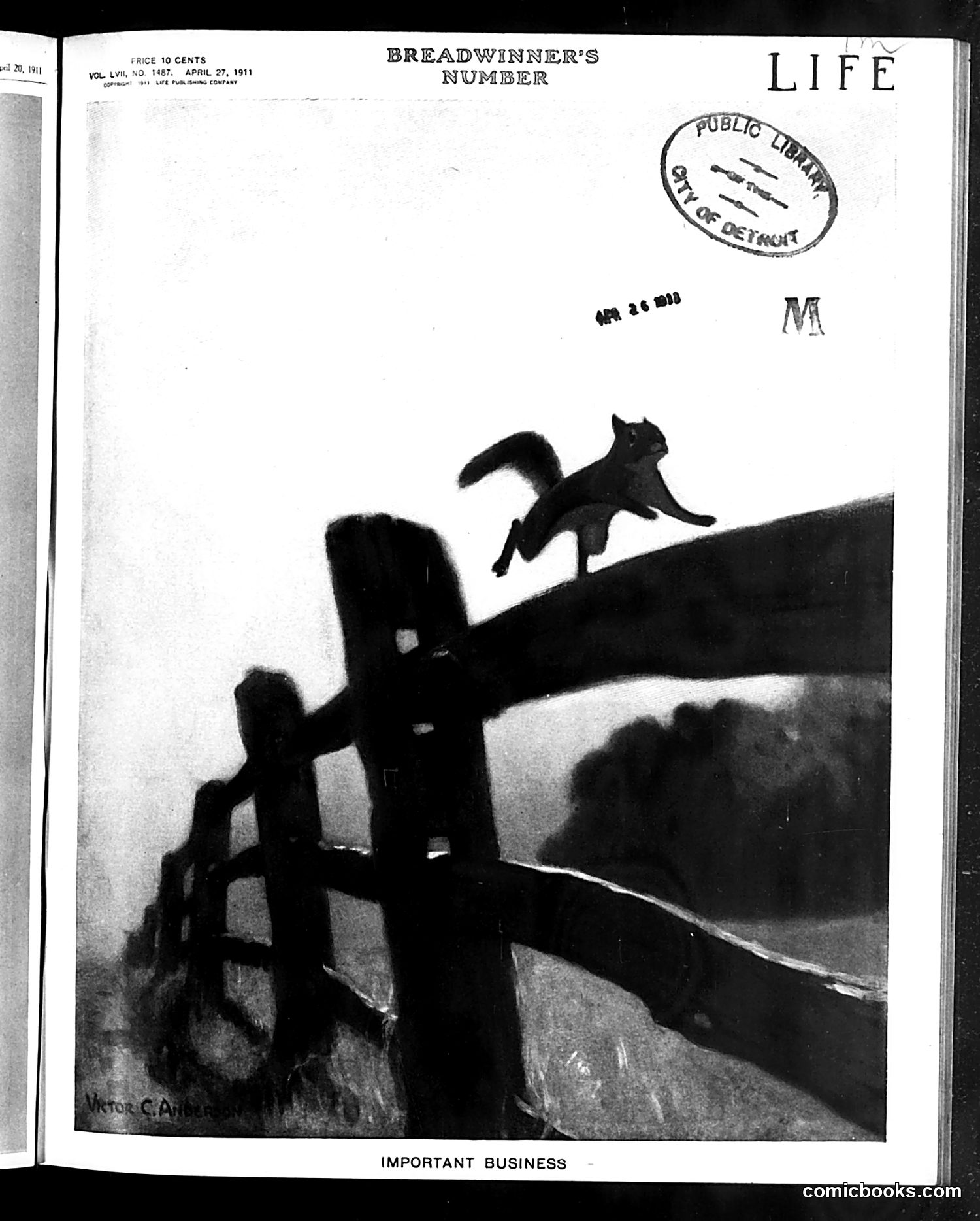
This silhouette cartoon shows a cat precariously balanced on a fence rail, appearing to pursue or stalk a smaller animal (possibly a mouse or bird) on the opposite side. The caption reads "IMPORTANT BUSINESS." The image uses animal figures as satire, likely commenting on political or social priorities of 1911. The cat's focused, single-minded pursuit—despite the precarious, awkward position required—suggests criticism of politicians or institutions obsessing over trivial or misguided goals while neglecting more pressing matters. The silhouette style was common in Life's satirical work of this era, allowing the artist (Victor C. Ander[sen], per the signature) to convey meaning through exaggerated postures and body language rather than facial details.
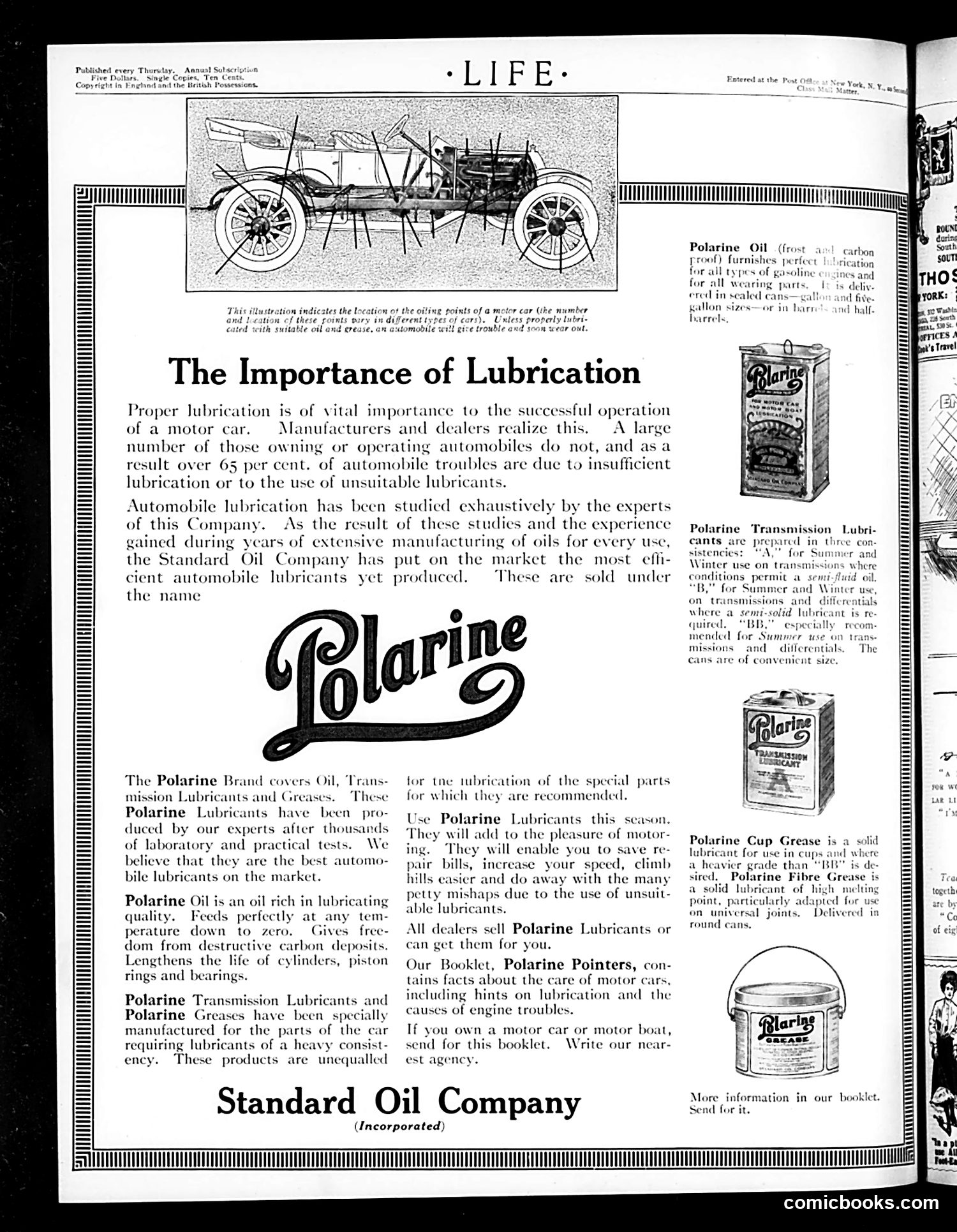
This page is **primarily advertising, not political satire**. It features a full-page advertisement for Polarine lubricants by the Standard Oil Company (Incorporated). The top illustration shows a side-view technical diagram of an early automobile's chassis and drivetrain, labeled to indicate "the location of the driving points of a motor car" requiring lubrication. This is educational advertising content, not political commentary. The ad emphasizes that proper lubrication prevents automobile troubles, promoting Polarine Oil, Transmission Lubricants, Greases, and Cup Grease as superior products. The copy includes testimonials to quality and mentions a "Polarine Pointers" booklet about motor-car maintenance. There is **no political cartoon or satire present** on this page—it is straightforward early-20th-century automotive industry advertising.
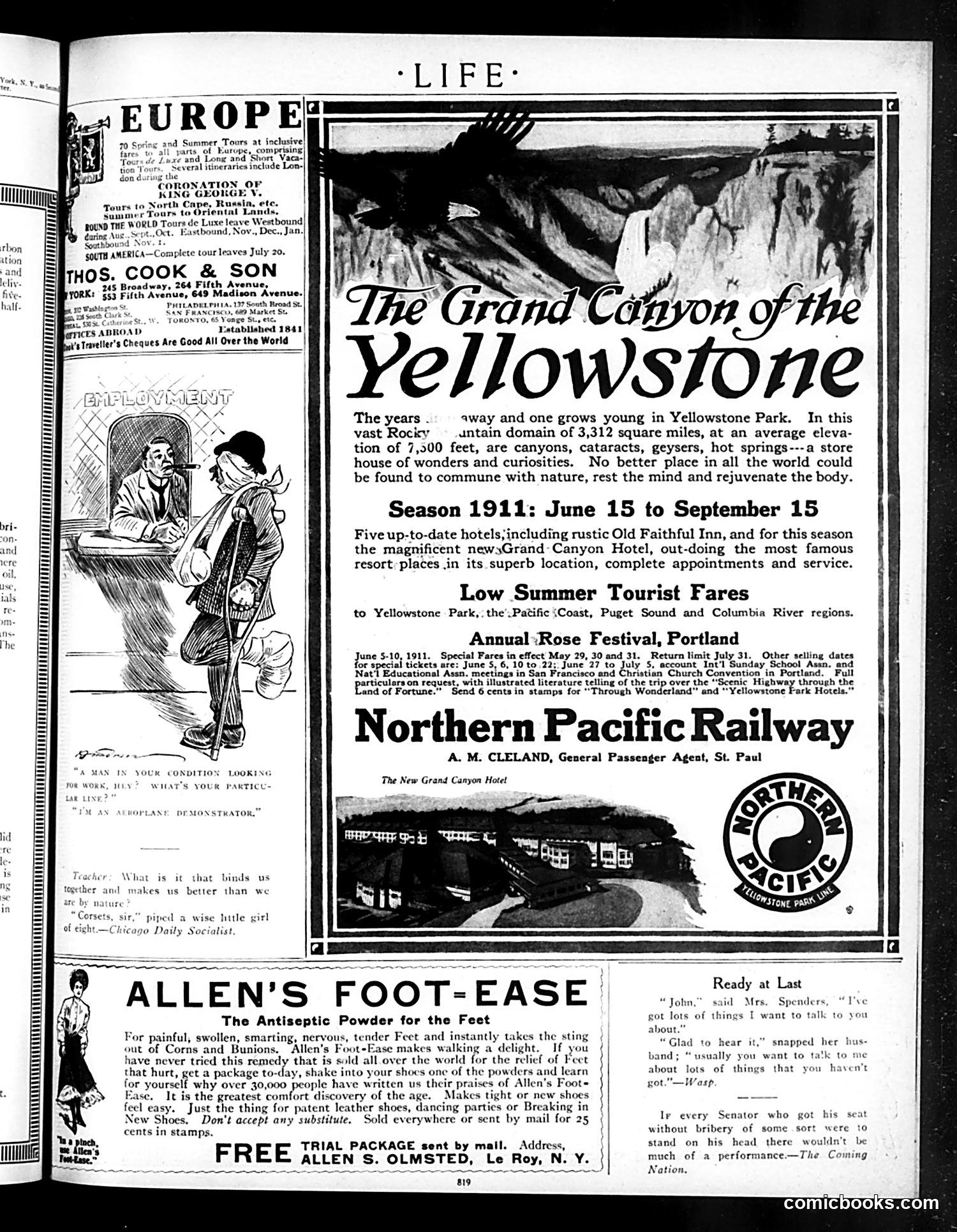
This page is primarily **advertising and travel promotion** rather than political satire. The dominant content features a Northern Pacific Railway advertisement for Yellowstone Park tourism (Season 1911: June 15–September 15), highlighting hotels, scenic attractions, and discounted fares. The small cartoon in the left column appears to show a conversation between two figures—likely a teacher and student based on the dialogue about what "binds us together"—illustrating nature's importance. The joke concludes with a reference to "Chicago Daily Socialist," suggesting mild social commentary about natural philosophy versus urban concerns. Below is an advertisement for "Allen's Foot-Ease" powder, a commercial product promising comfort relief. The page reflects early 20th-century American consumer culture: leisure tourism promotion and patent medicine advertising dominate over editorial content.
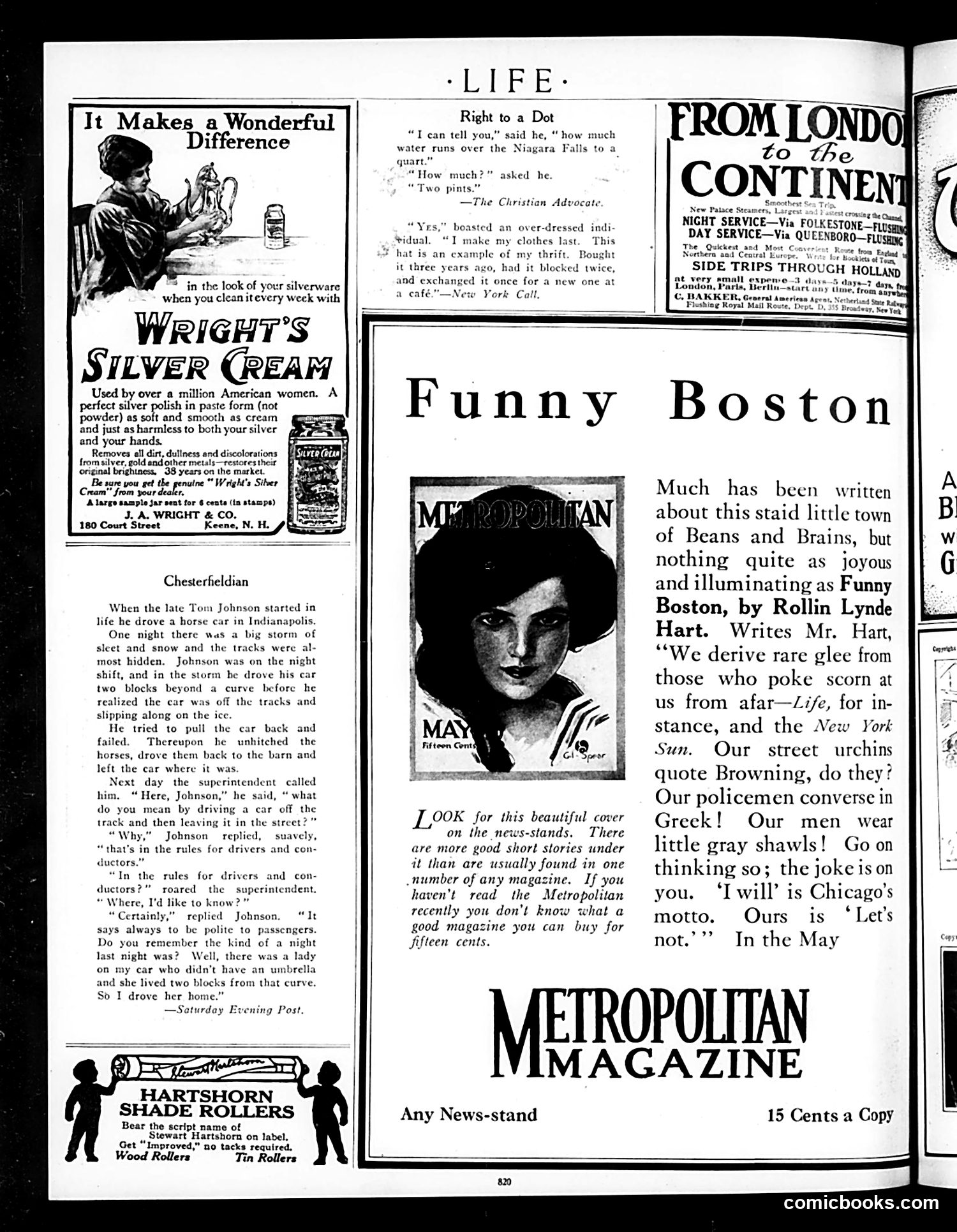
This page is **primarily advertising and editorial content** rather than political satire. **Left side:** Wright's Silver Cream ad (silverware polish) and a "Chesterfieldian" anecdote about Tom Johnson (appears to be a local Indianapolis figure) and his experience driving a car in winter conditions. The story illustrates politeness between drivers—a social commentary on etiquette rather than satire. **Right side:** Promotional coverage for *Metropolitan Magazine*, featuring "Funny Boston" by Rollin Lynde Hart. The text gently mocks Boston's provincial reputation—residents' pretensions, Greek conversation, gray shawls, and local sayings like "Let's not"—light social satire about regional characteristics rather than sharp political commentary. **Bottom:** Hartshorn Shade Rollers advertisement. The page reflects early 20th-century American magazine format: mixed advertising and lifestyle content.
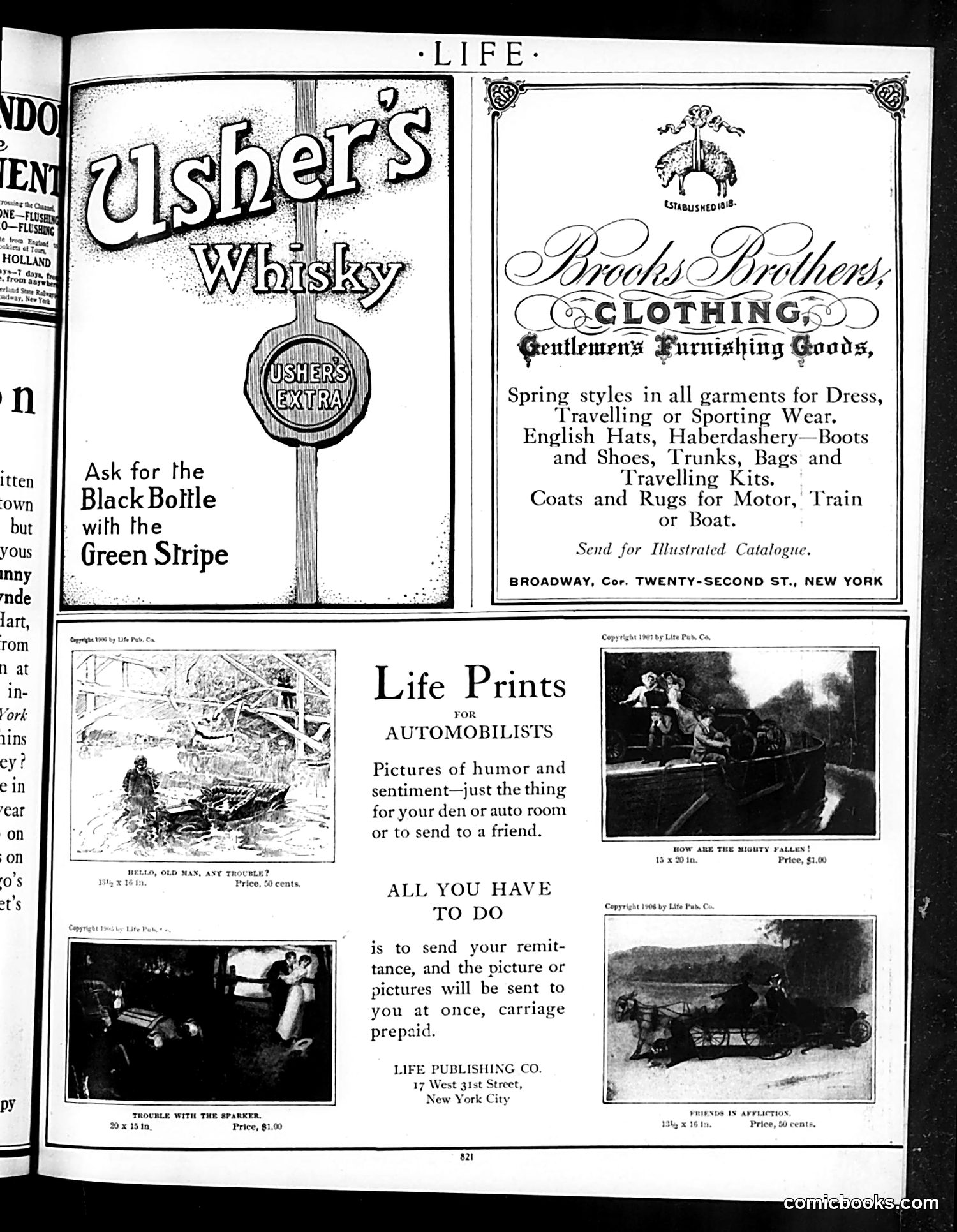
This page is primarily **advertising**, not editorial content or satire. The top features two ads: Usher's Whisky (promoting their "Black Bottle with the Green Stripe") and Brooks Brothers clothing for gentlemen. The lower half advertises "Life Prints for Automobilists"—humorous pictures for automobile enthusiasts. Three sample prints are shown with titles like "Hello, Old Man, Any Trouble?" and "Trouble with the Sparker," depicting early automotive mishaps and comedic situations. These are offered for 50 cents to $1.00, with ordering instructions from Life Publishing Co. The humor derives from the novelty and frequent breakdowns of early automobiles—a relatable source of comedy for the era's motorists. There is no political satire on this page.
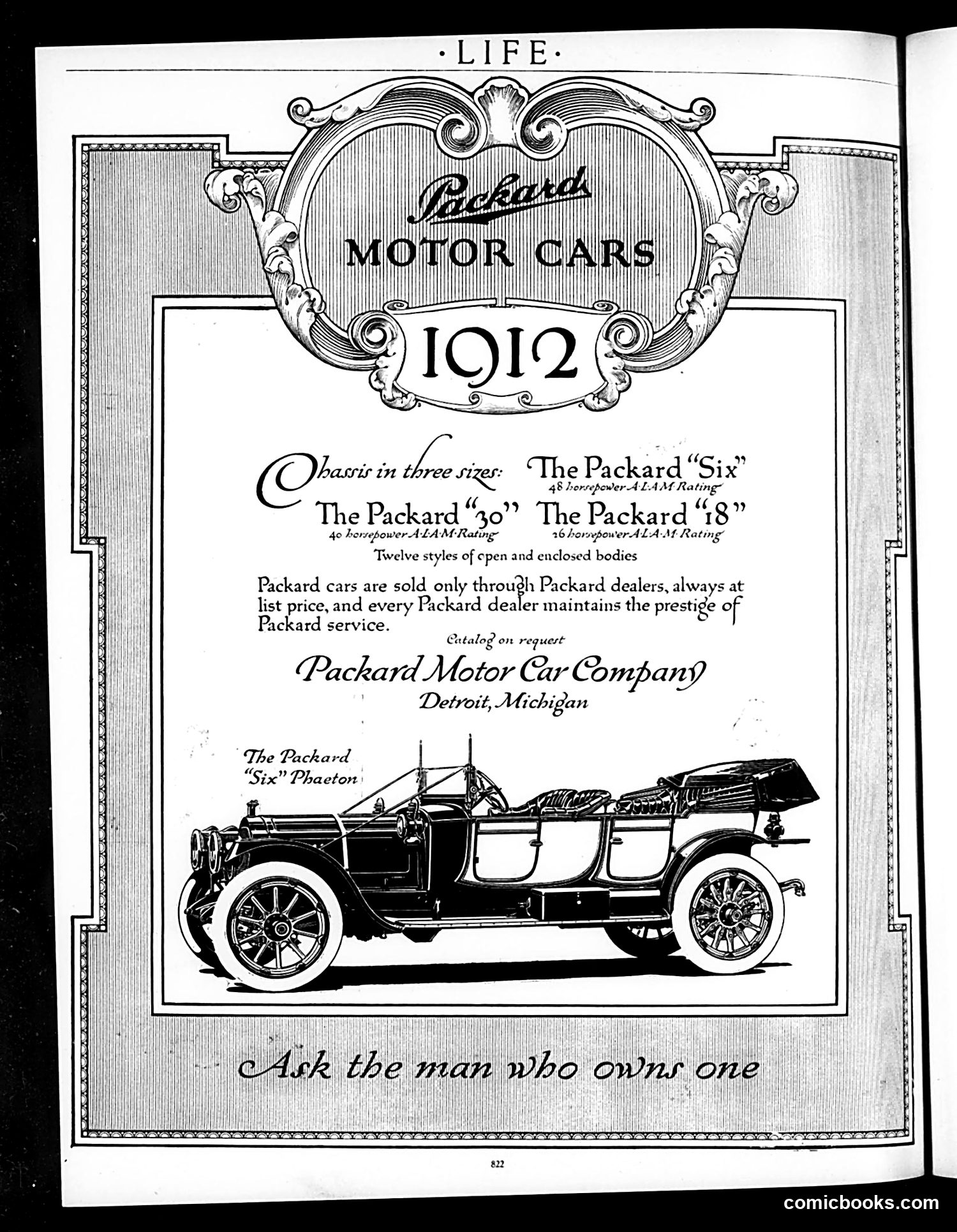
This page is primarily **advertising, not satire or political commentary**. It's a 1912 advertisement for Packard Motor Cars from Detroit, Michigan, published in *Life* magazine. The ad showcases three Packard models: the "Six" (48 horsepower), the "30" (40 horsepower), and the "8" (36 horsepower). The illustration features the "Six Phaeton," an open-air automobile. The text emphasizes that Packard cars are sold exclusively through authorized dealers at list price, stressing brand prestige and service quality. The ornate decorative border typical of early-1900s advertising frames the content. The closing line—"Ask the man who owns one"—was Packard's famous advertising slogan, appealing to customer testimonials as marketing validation.
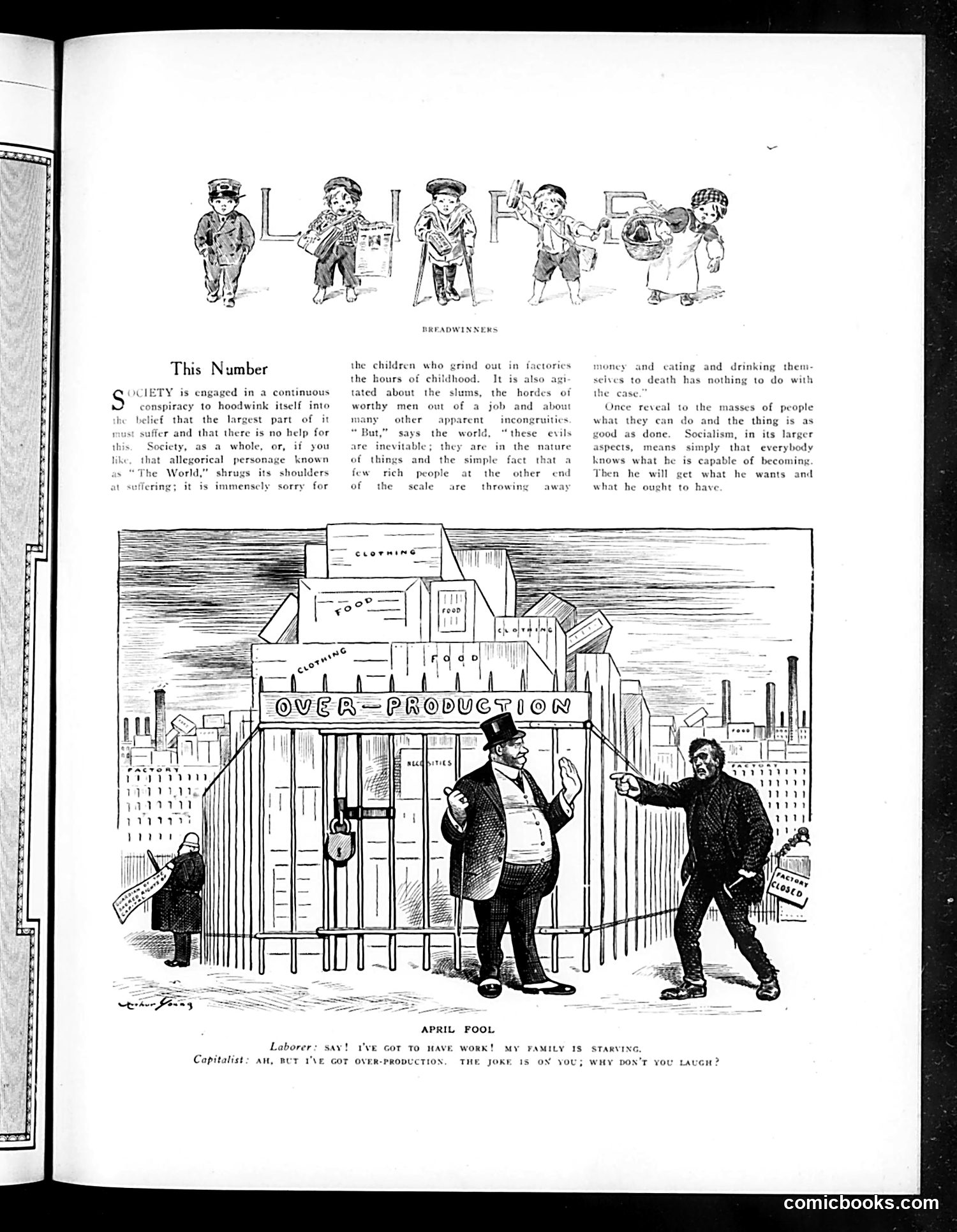
This cartoon satirizes capitalist exploitation during industrial labor disputes. A well-dressed capitalist (center, top hat) stands inside a locked factory labeled "OVER-PRODUCTION," surrounded by warehouse sections marked "CLOTHING," "FOOD," and "FEED." Outside the fence, a desperate laborer says: "Say! I've got to have work! My family is starving." The capitalist's response: "Ah, but I've got over-production. The joke is on you; why don't you laugh?" The satire is bitter: despite warehouses overflowing with goods (food, clothing), the capitalist refuses to employ workers or distribute supplies, claiming "over-production" justifies keeping people hungry. The "April Fool" title suggests this logic is absurd—yet tragically real. The cartoon critiques how capitalist systems can produce abundance while workers starve.
This page contains political commentary rather than cartoons. The main illustration shows **William Howard Taft and William Jennings Bryan** as caricatured figures in what appears to be a reconciliation scene, captioned "Wherefore is Life there's Hope." The text discusses Democratic Party divisions, specifically praising House Speaker Champ Clark's organization while analyzing internal tensions between progressive and conservative Democrats. It mentions **Mr. Taft** and **Mr. Bryan** competing for political influence within the party. The secondary item discusses **Tom Johnson's** death and his unsuccessful Cleveland transit plans, praising him as a well-intentioned but ultimately failed reformer. The overall tone is satirical commentary on early 20th-century Democratic Party politics and progressive reform efforts.
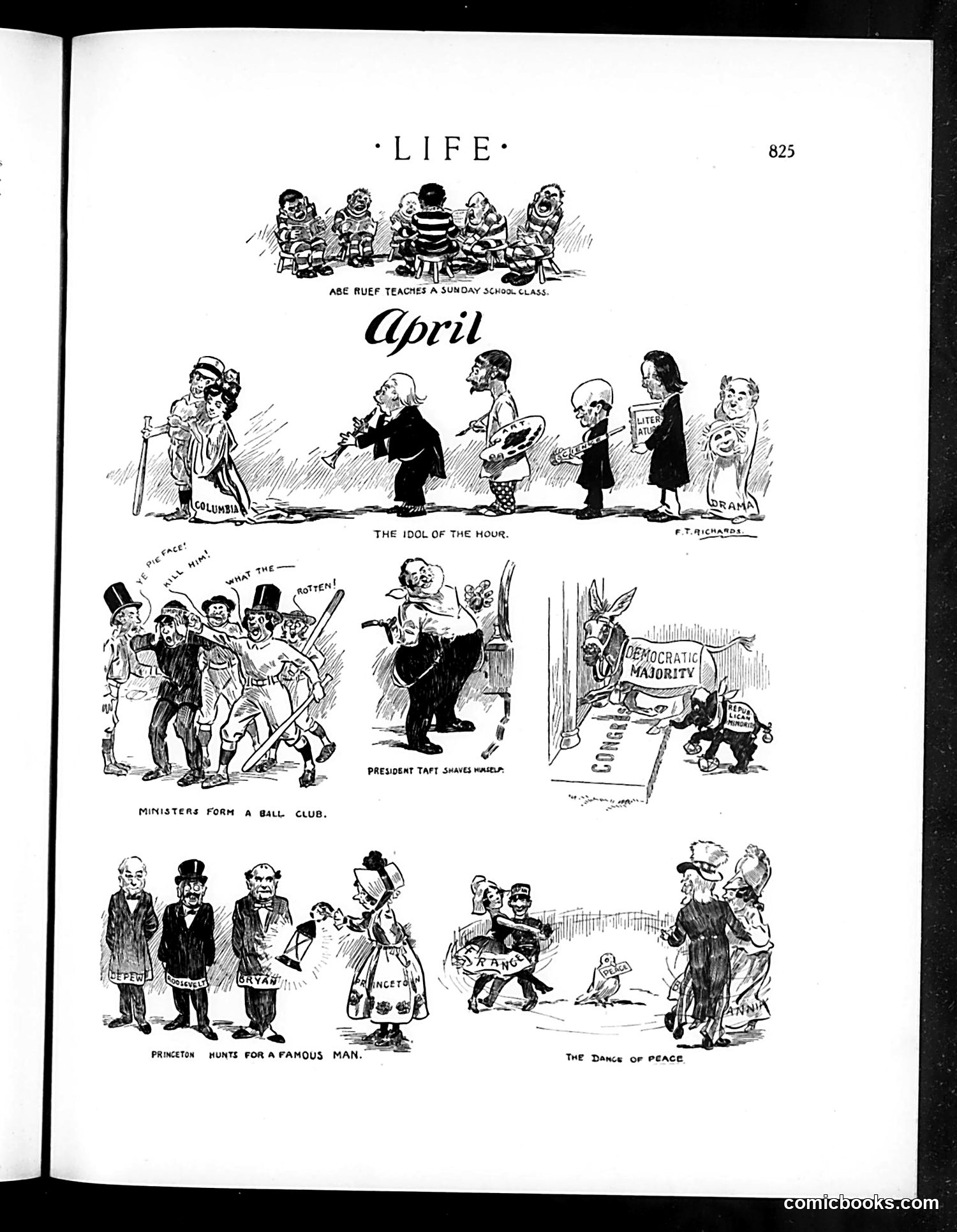
This page contains several cartoons satirizing April 1912 political events. "The Idol of the Hour" depicts a public figure (likely a political celebrity of the moment) surrounded by admirers. "Ministers Form a Ball Club" jokes about clergy engaging in secular entertainment. "President Taft Shakes Hands" mocks President William Howard Taft, a frequent target. "Princeton Hunts for a Famous Man" references the university's search for someone notable. "The Dance of Peace" appears to satirize international relations or political negotiations of the era. The cartoons employ exaggerated caricatures typical of early-20th-century political commentary. Without clearer identification of specific figures beyond Taft, precise interpretation of some cartoons remains uncertain, though the general thrust critiques public figures and contemporary social pretensions.
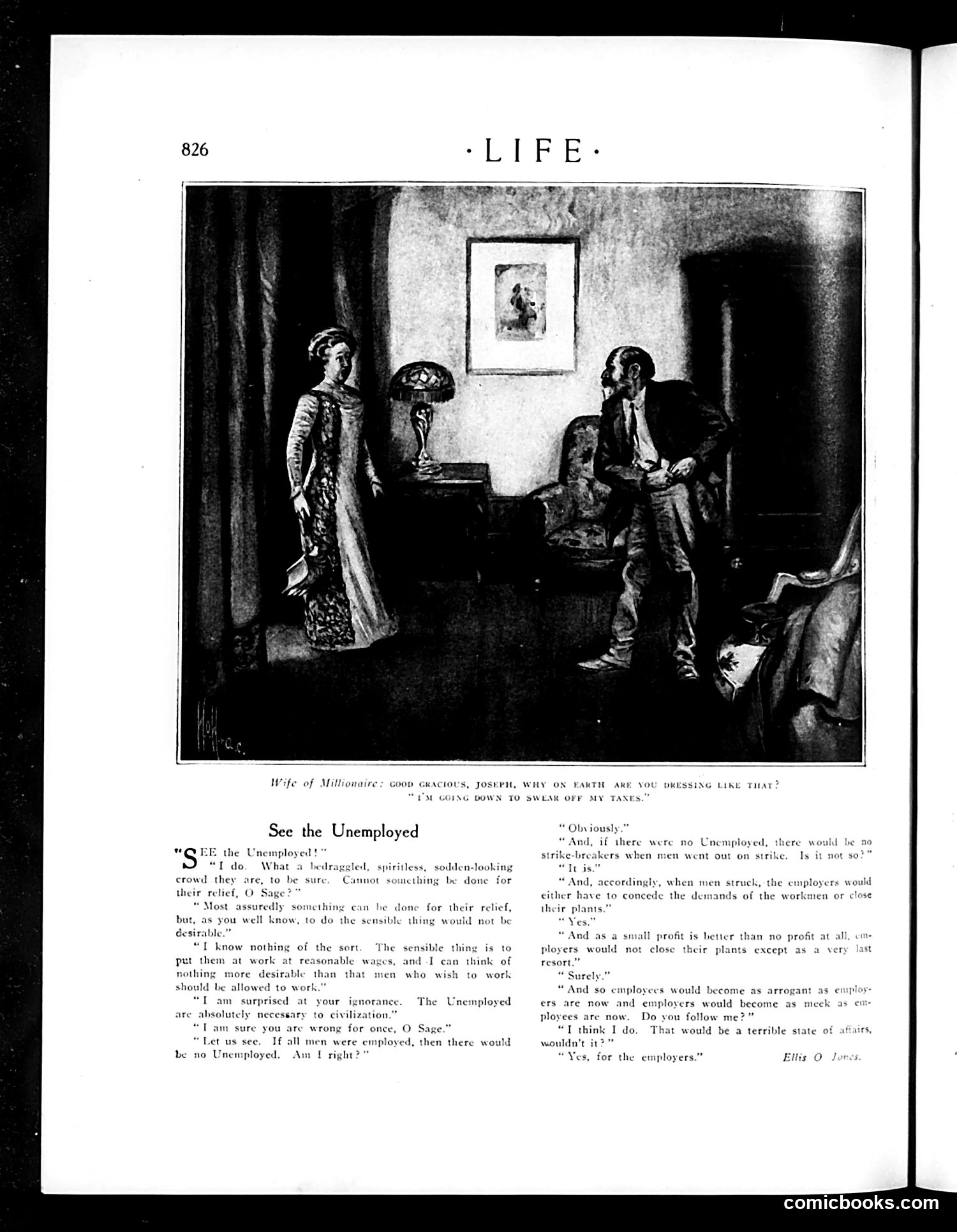
This satirical piece debates whether unemployment is necessary for civilization. A wealthy millionaire's wife questions her husband about the unemployed, saying "why on earth are you dressing like that? I'm going down to swear off my taxes." The dialogue presents opposing economic views: one character argues the unemployed are "absolutely necessary to civilization," while another counters that if everyone were employed, there would be no unemployment. The exchange satirizes the wealthy's contradictory attitudes—simultaneously dismissing the unemployed as essential to society while resisting tax obligations that might address poverty. The cartoon mocks upper-class hypocrisy: the wife gestures toward social concern while threatening tax evasion, exposing the gap between professed morality and actual financial responsibility during what appears to be a period of labor unrest or economic debate.
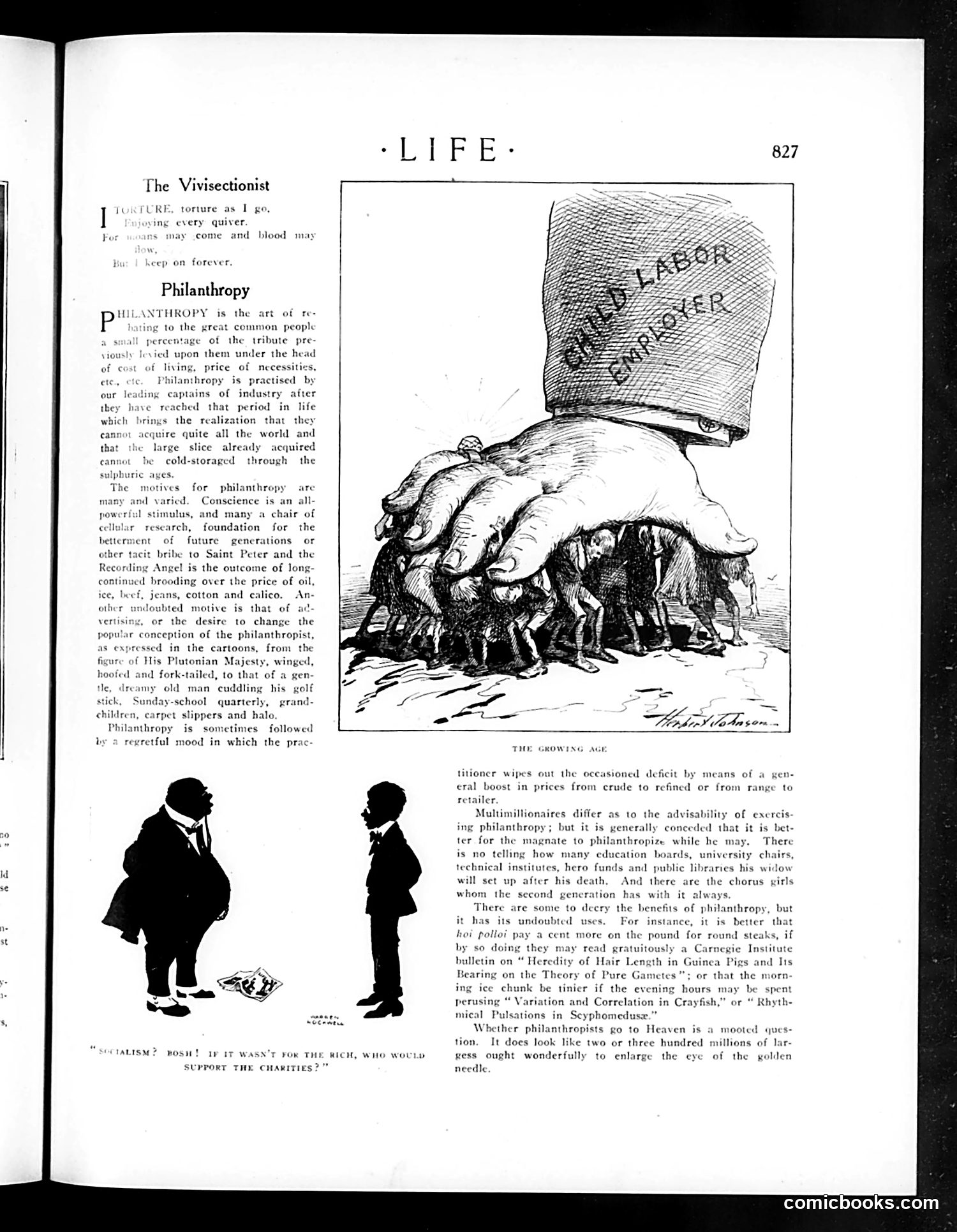
This page satirizes **philanthropy and wealth inequality**. The main cartoon titled "The Growing Age" depicts a wealthy hand dropping coins into a beggar child's palm—a visual critique of charity as insufficient and condescending. Below, a separate cartoon shows two silhouetted figures with the caption: "**Socialism? Bosh! If it wasn't for the rich, who would support the charities?**" This mocks the wealthy's self-congratulatory defense of their philanthropy, implying that charity merely patches problems their own wealth inequality creates, rather than addressing root causes. The text essay explores how industrialists turn to philanthropy late in life, questioning whether this genuinely benefits society or merely serves their reputation. Together, the content critiques wealthy donors' moral posturing around charitable giving.
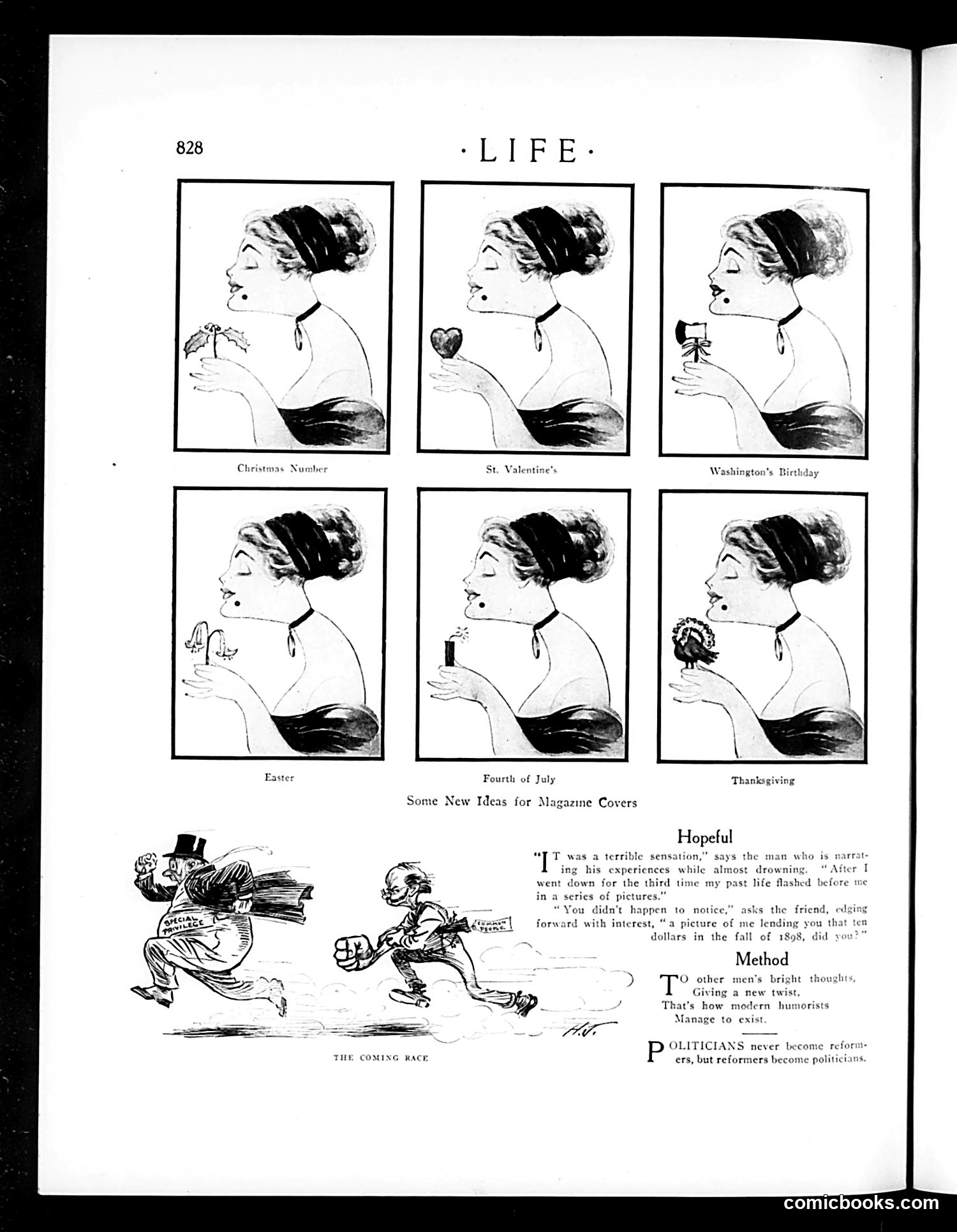
**Top Section:** Six panels titled "Some New Ideas for Magazine Covers" show a woman in profile holding different seasonal/holiday items (flowers, heart, gift, etc.) for Christmas, Valentine's Day, Washington's Birthday, Easter, Fourth of July, and Thanksgiving. This appears to be satirizing predictable, repetitive magazine cover designs based on holidays. **Bottom Section:** A cartoon titled "The Coming Race" depicts two caricatured figures in a running race—likely political opponents in a competitive electoral contest, though the specific candidates or election are unclear from visible text. The right column contains brief philosophical observations about "Hopeful" thinking and "Method," including a quip that "Politicians never become reformers, but reformers become politicians"—standard satirical commentary on political hypocrisy.
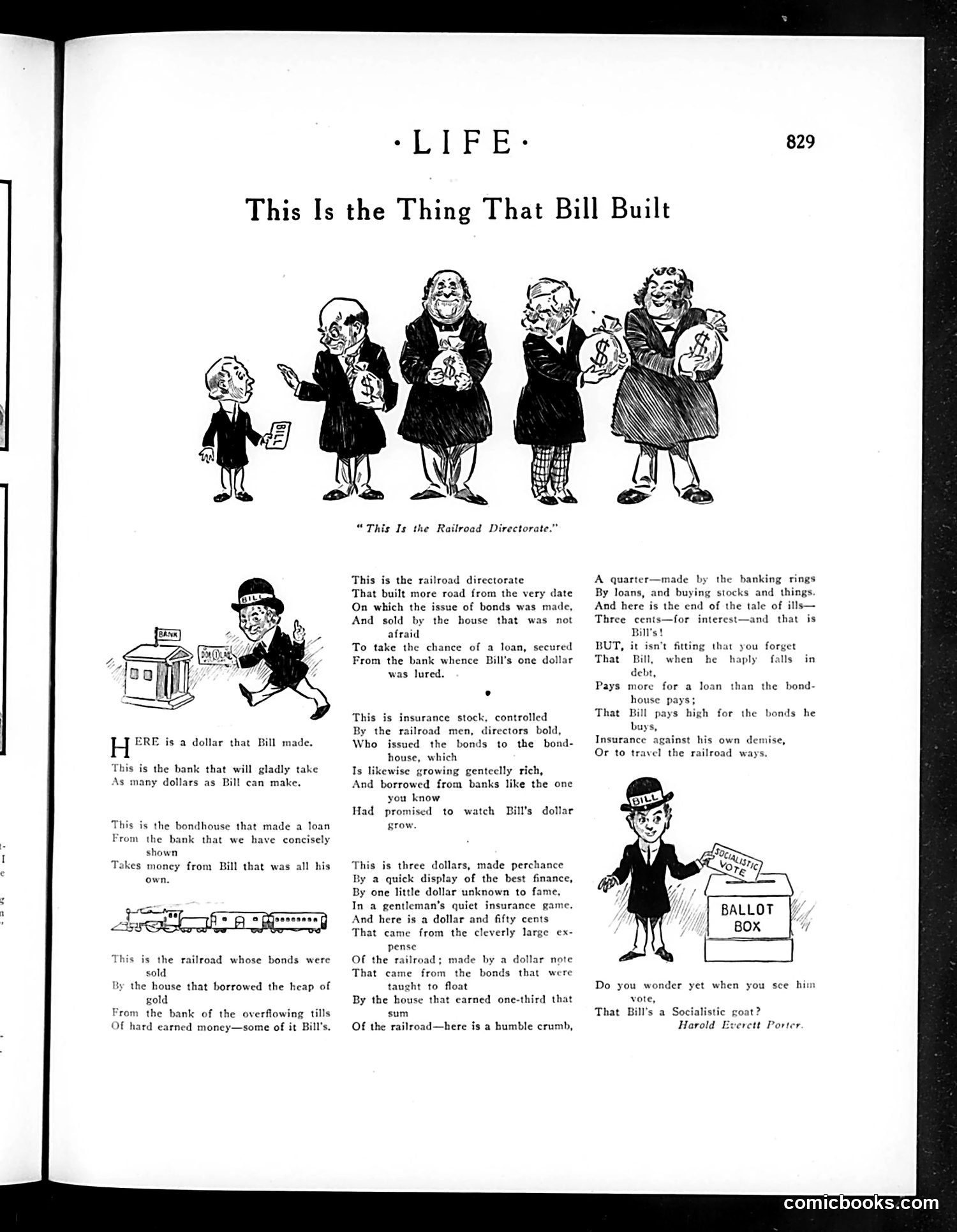
This satirical piece by Harold Everett Porter critiques what appears to be a financial scheme or corrupt railroad venture. The cartoon traces how a single dollar—made by someone named "Bill"—circulates through various institutions: a bank, a bondhouse, an insurance company, and finally a railroad directorate. The progression shows how these financial entities grow "genteel and rich" by borrowing and speculating with Bill's original dollar. The final panel depicts "Bill" voting (with a ballot box), with the author asking sarcastically if readers wonder "when you see him vote, That Bill's a Socialistic goat?" The satire attacks financial manipulation and suggests that ordinary workers like Bill are exploited by interconnected banking and corporate systems while paradoxically blamed for socialism.
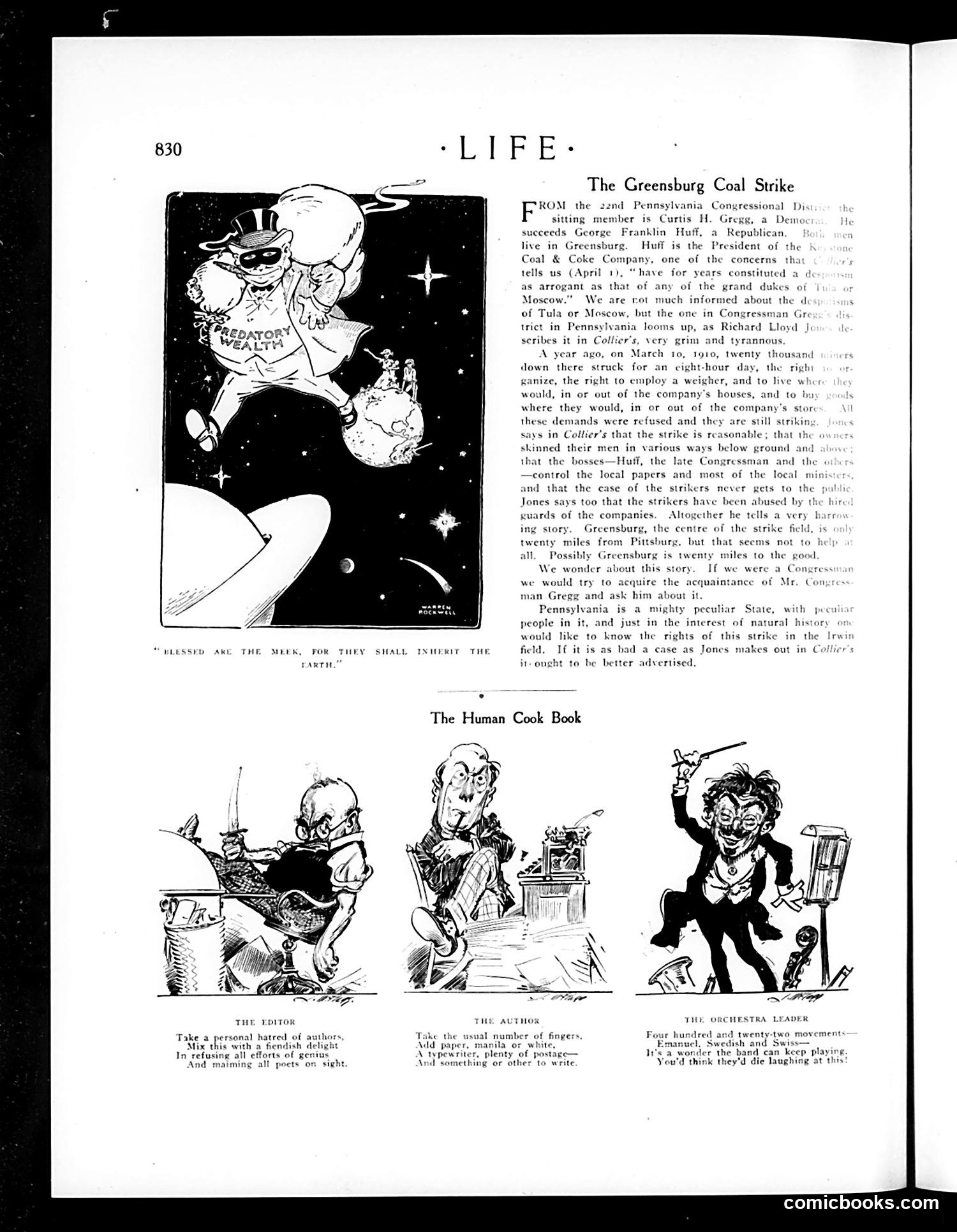
This page contains two satirical pieces from *Life* magazine (circa 1910): **"The Greensburg Coal Strike"**: The article and accompanying cartoon criticize the Greensburg Coal & Coke Company in Pennsylvania for operating with autocratic control—comparing their power to Russian czars. The strike of 20,000 miners (March 1910) sought basic rights: an 8-hour day, independent weighers, freedom to buy goods outside company stores, and housing choice. The article attacks President George Franklin Huff and alleges the company controls local media and intimidates strikers. The cartoonist lampoons the company's authoritarian power through the top illustration (featuring a bloated, imperious figure). **"The Human Cook Book"**: Below, three caricatured figures—labeled "The Editor," "The Author," and "The Orchestra Leader"—are depicted as recipes or ingredients to be consumed, satirizing these professional types in humorous, dehumanizing terms typical of *Life's* satirical style. The overall page critiques corporate monopoly power and labor exploitation while employing *Life's* characteristic visual mockery.
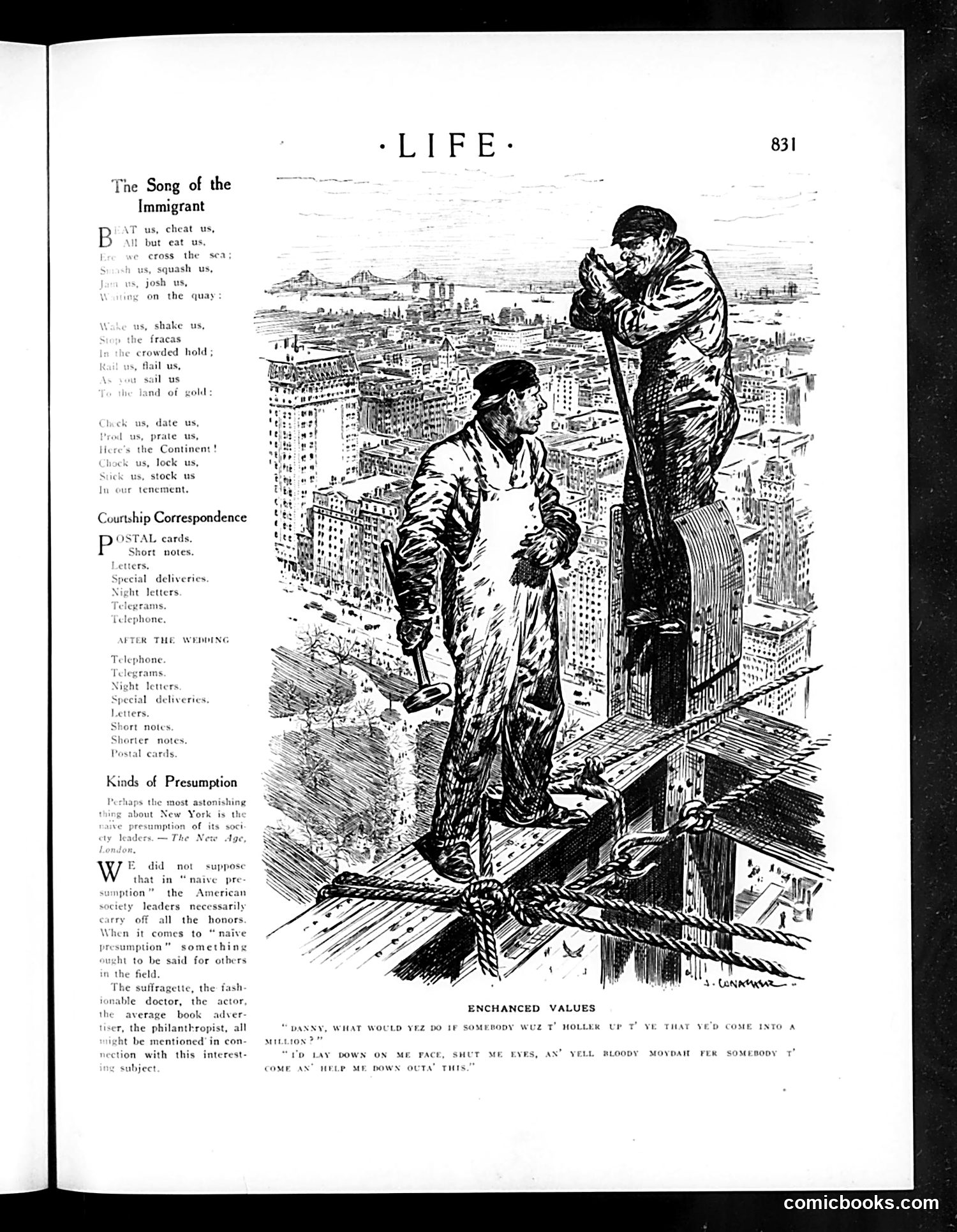
This illustration depicts two working-class immigrant men (likely Irish, based on the dialect in the caption) perched precariously on a skyscraper beam above a cityscape. The satire mocks the "get rich quick" mentality among immigrants and the working poor during the early 20th century. The joke plays on naive fantasies of sudden wealth: when asked what he'd do if someone offered him a million dollars, the man responds he'd fake an injury ("lay down on me face") and sue for damages—revealing how immigrants saw litigation as their only path to wealth rather than honest labor. The cartoon satirizes both the desperation of working-class life (dangerous jobs, low wages) and the widespread belief that personal injury lawsuits offered quick fortunes. It's a commentary on class aspiration, legal culture, and immigrant struggles in industrial America.
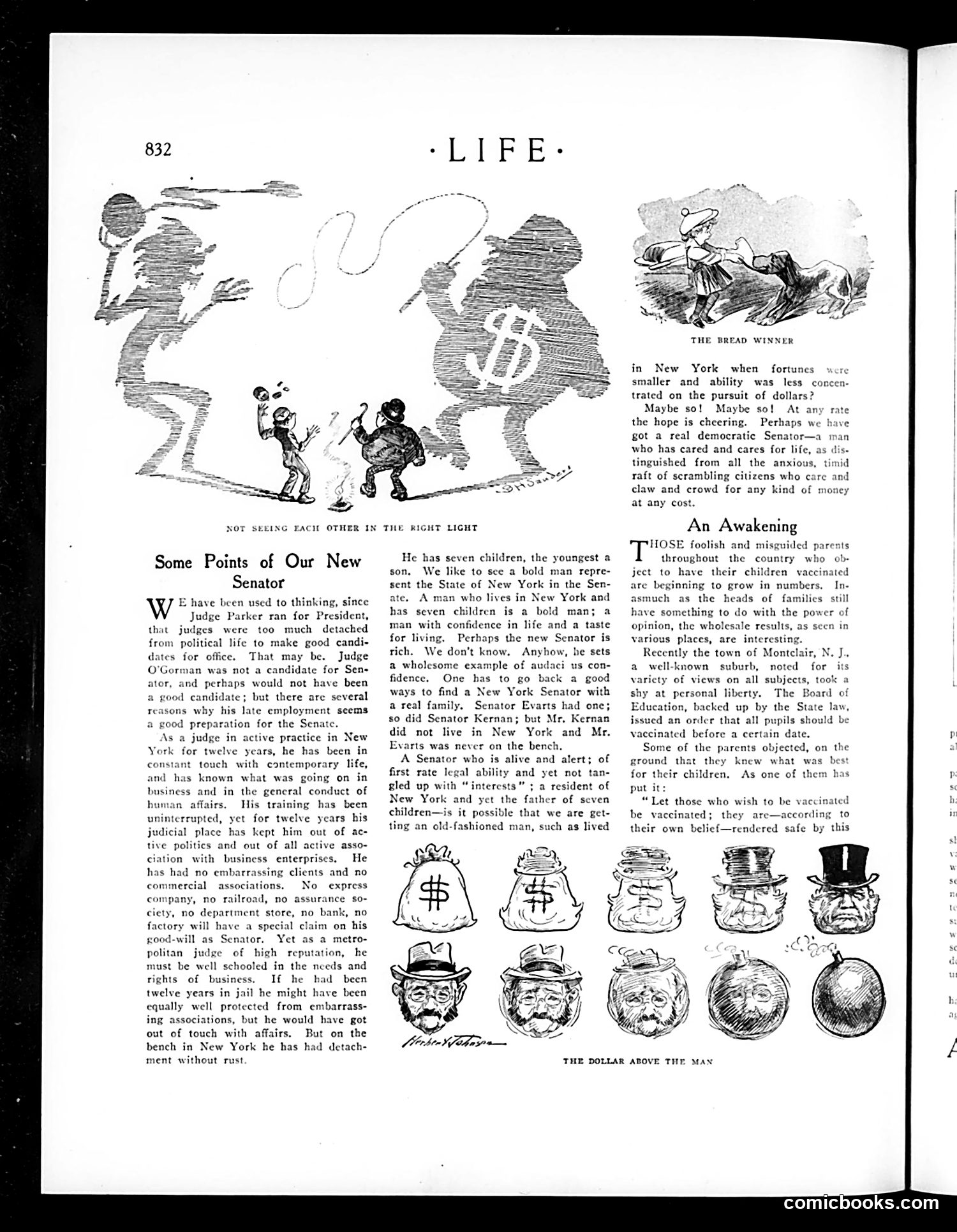
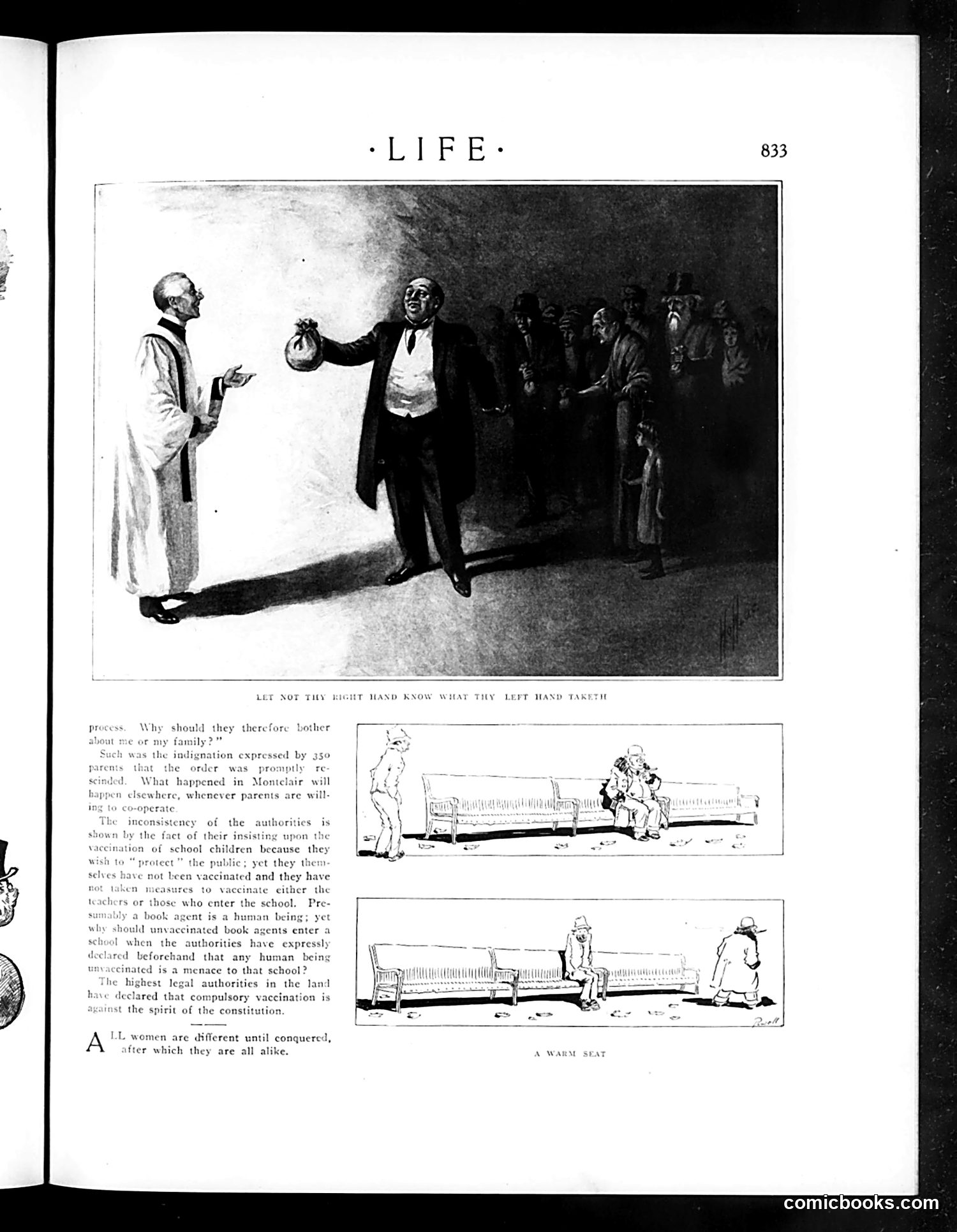
This page satirizes the appointment of Judge O'Gorman as New York Senator, celebrating him as an unusually qualified candidate because he maintains genuine connections to ordinary life—he has seven children, lives in New York, and isn't beholden to corporate interests. The top cartoon "Not Seeing Each Other in the Right Light" depicts two figures (likely representing different political perspectives) failing to recognize shared interests, illustrating partisan blindness. "The Dollar Above the Man" cartoon shows a progression of heads transforming from human to money bags, satirizing how wealth corrupts and dehumanizes people in pursuit of dollars. The page also discusses Montclair, N.J.'s vaccination mandate controversy, criticizing parents who oppose mandatory vaccination as foolishly prioritizing "personal liberty" over public health—a surprisingly modern debate. Overall, the satire champions politicians with actual life experience and criticizes both money-obsessed businessmen and anti-vaccination sentiment.
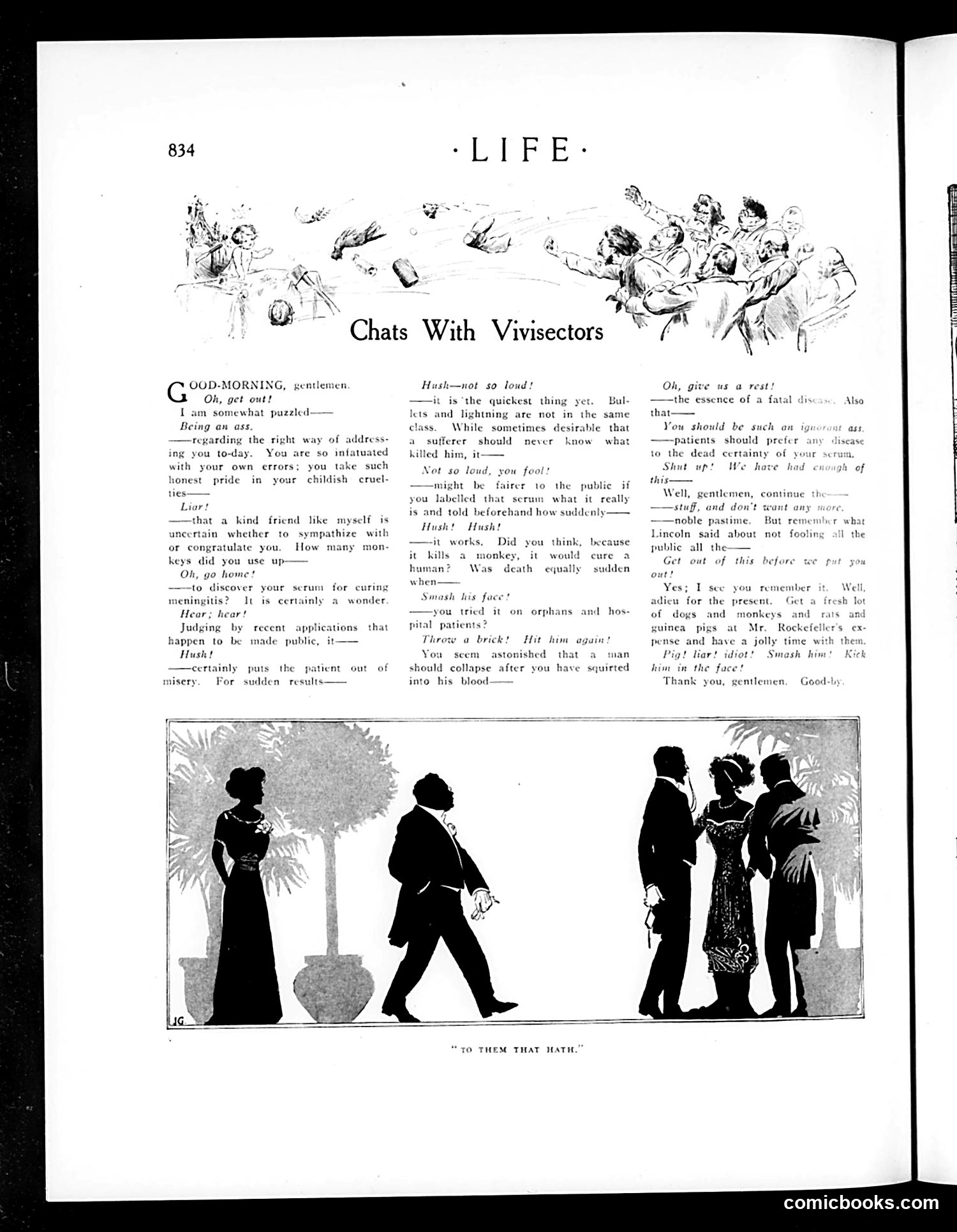
This is a satirical piece attacking medical vivisection (animal experimentation). The dialogue depicts gentlemen casually discussing brutal experiments on animals—orphans, hospital patients, dogs, monkeys, and pigs—performed under the guise of medical research, particularly serum development for meningitis. The satire works through escalating absurdity: speakers defend killing test subjects to avoid public knowledge of what "killed him," justify sudden deaths as necessary, and cite wealthy patrons like Rockefeller supporting such experiments. The audience's interjected outrage ("Smash his face!", "Liar! Idiot!") represents public moral opposition. The silhouette cartoon below shows gentlemen departing while a woman watches disapprovingly—visualizing social rejection of vivisectionists. The piece reflects early 20th-century anti-vivisection sentiment, when animal testing for medical advancement faced serious ethical criticism from reformers who viewed it as cruel and morally indefensible.
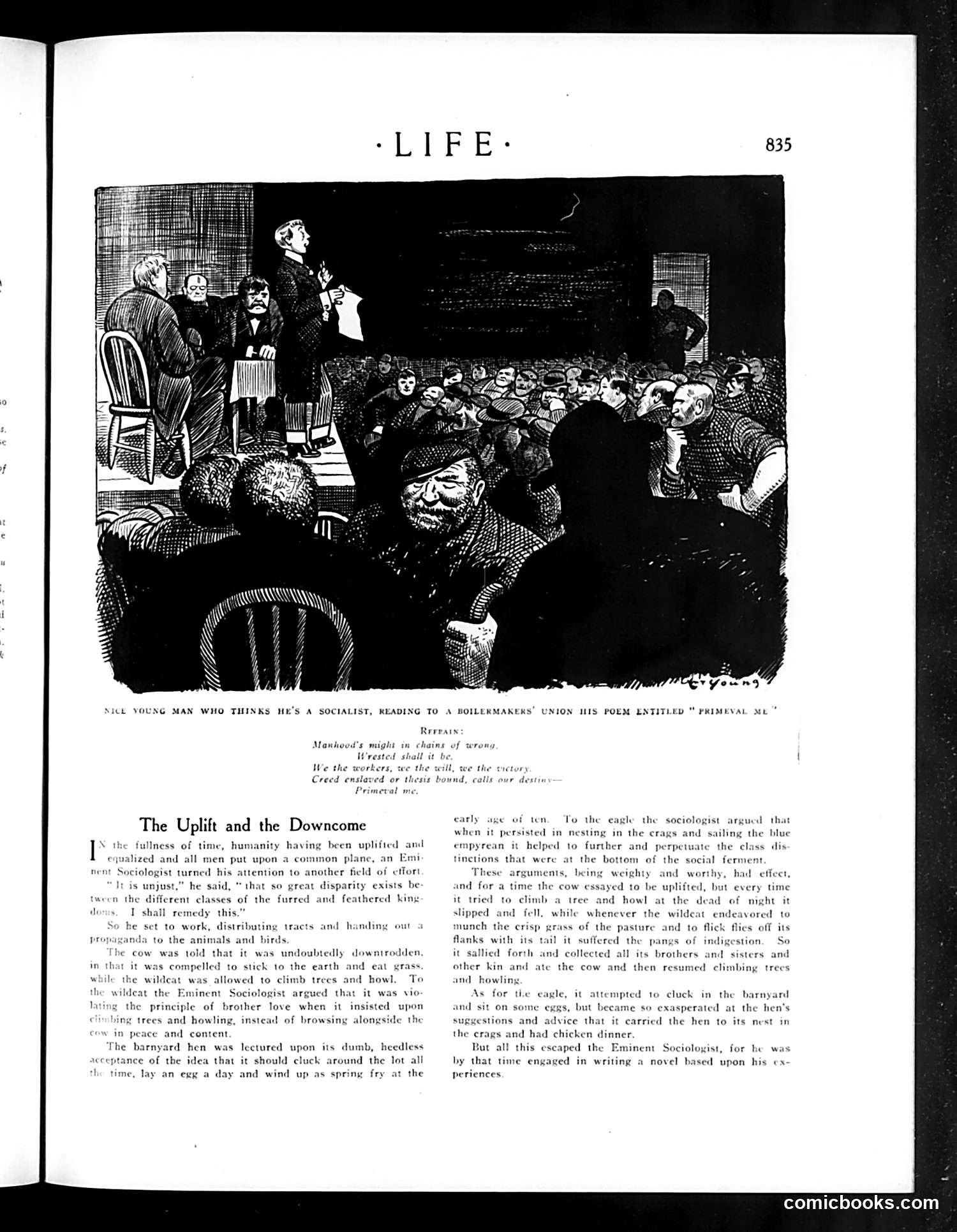
This page satirizes well-intentioned but impractical socialism and social reform. The cartoon shows a young idealistic socialist reading poetry to a working-class union meeting—his earnest "Primeval Me" likely mocking revolutionary rhetoric disconnected from reality. The accompanying story uses allegory to mock the concept: an "Eminent Sociologist" attempts to uplift oppressed animals by convincing a cow it's downtrodden and should climb trees, an eagle to cluck in barnyards, and a hen to resist its nature. The result is predictable chaos—each animal becomes miserable abandoning its nature. The satire's point: socialist ideology, however well-meaning, ignores human (and animal) nature and practical reality. By the story's end, the socialist has abandoned actual social work to write a novel based on his "experiences"—suggesting activists prioritize ideology and self-promotion over genuine reform. The mockery targets the disconnect between radical theory and workable solutions.
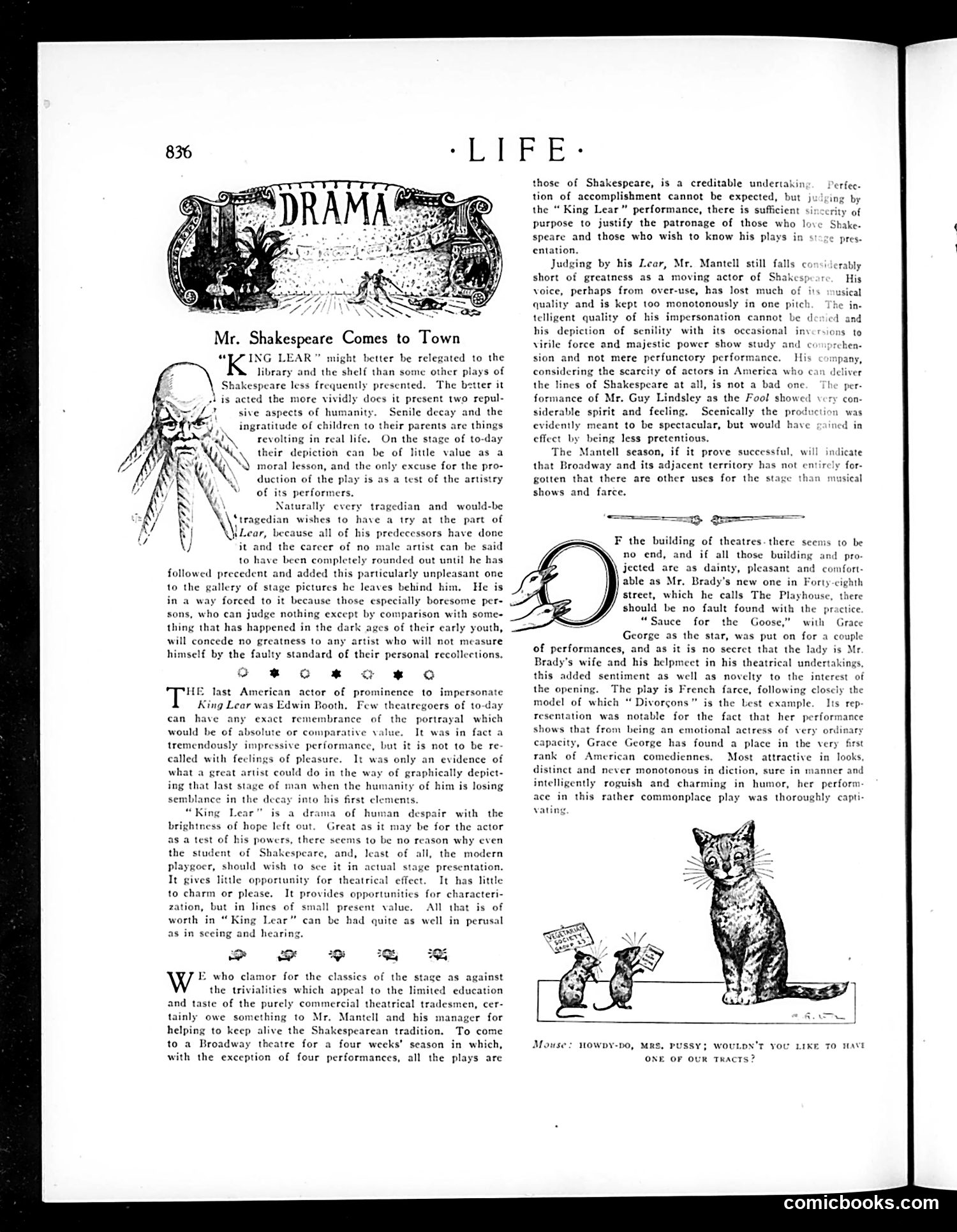
This page reviews Richard Mantell's Broadway production of Shakespeare's *King Lear*. The main article criticizes the play itself as unsuitable for modern theater—arguing it presents only "repulsive aspects of humanity" (senile decay, filial ingratitude) without moral value or theatrical charm. The critic acknowledges Mantell's earnest effort to preserve Shakespeare on Broadway, calling it "creditable" but notes Mantell falls "considerably short of greatness." His voice has lost musicality from overuse, though his depiction of senility shows study and occasional power. The accompanying illustrations—a bearded classical head (likely representing Shakespeare) and a humorous drawing of a cat with mice holding papers—appear to be decorative rather than directly satirical, with the cat caption making a mild joke about tracts. The piece reflects early-20th-century theatrical criticism valuing classical performance while questioning whether *King Lear* serves modern audiences better than reading it.
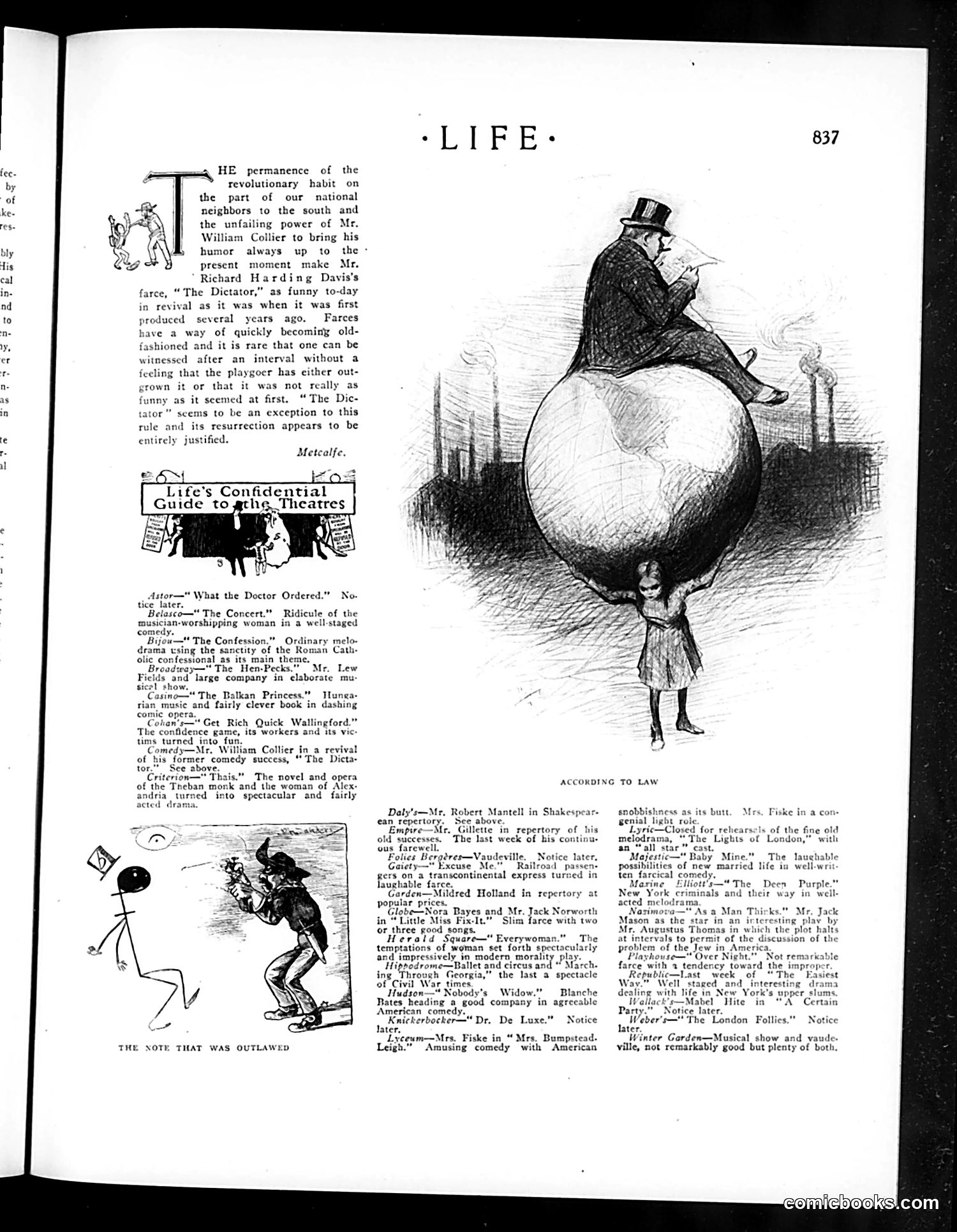
This page satirizes American anxieties about Latin American political instability. The main cartoon, titled "According to Law," depicts a tiny man in formal dress sitting atop an enormous spherical figure labeled as representing a Latin American nation or its government. The visual joke works through scale disparity: the small figure represents the nominal leader or "dictator," while the massive body beneath suggests the uncontrollable, bloated nature of Latin American political systems. The man appears precarious, holding on rather than commanding. This relates directly to the text's discussion of William Collier's revival of "The Dictator," a farce about Latin American instability. The accompanying text mentions "the revolutionary habit on the part of our national neighbors to the south"—referencing frequent coups and political upheaval in Central/South America, a consistent source of American satire and concern during this period. The cartoon mocks how nominal leaders appear insignificant against the chaotic forces they supposedly control—a commentary on Latin American governance that was standard fare in early-20th-century American satirical magazines.
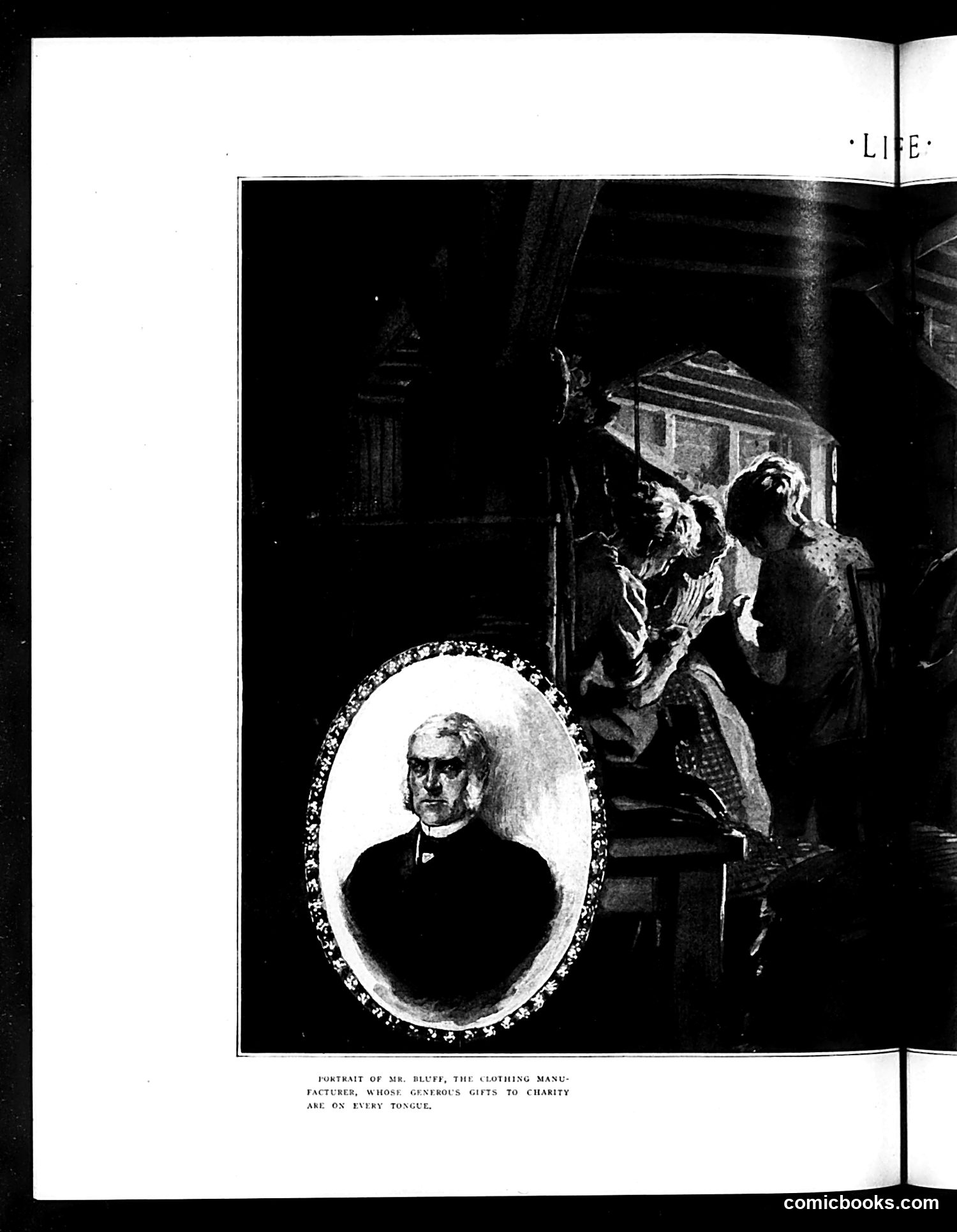
This appears to be a satirical illustration from *Life* magazine depicting a portrait of "Mr. Bluff" (OCR reads "IPF," likely an error), identified as a clothing manufacturer. The cartoon shows his portrait in an ornate oval frame, while behind it, several figures peer at or react to the image—suggesting scrutiny of the subject's public presentation. The satire targets the disconnect between Bluff's philanthropic reputation ("generous gifts to charity") and his actual character or business practices. The onlookers' expressions and positioning suggest irony or skepticism about his charitable claims. The dramatic lighting and theatrical framing emphasize the performative nature of his public image—implying his generosity may be more about reputation management than genuine benevolence. This was typical *Life* magazine social criticism of the Gilded Age wealthy.
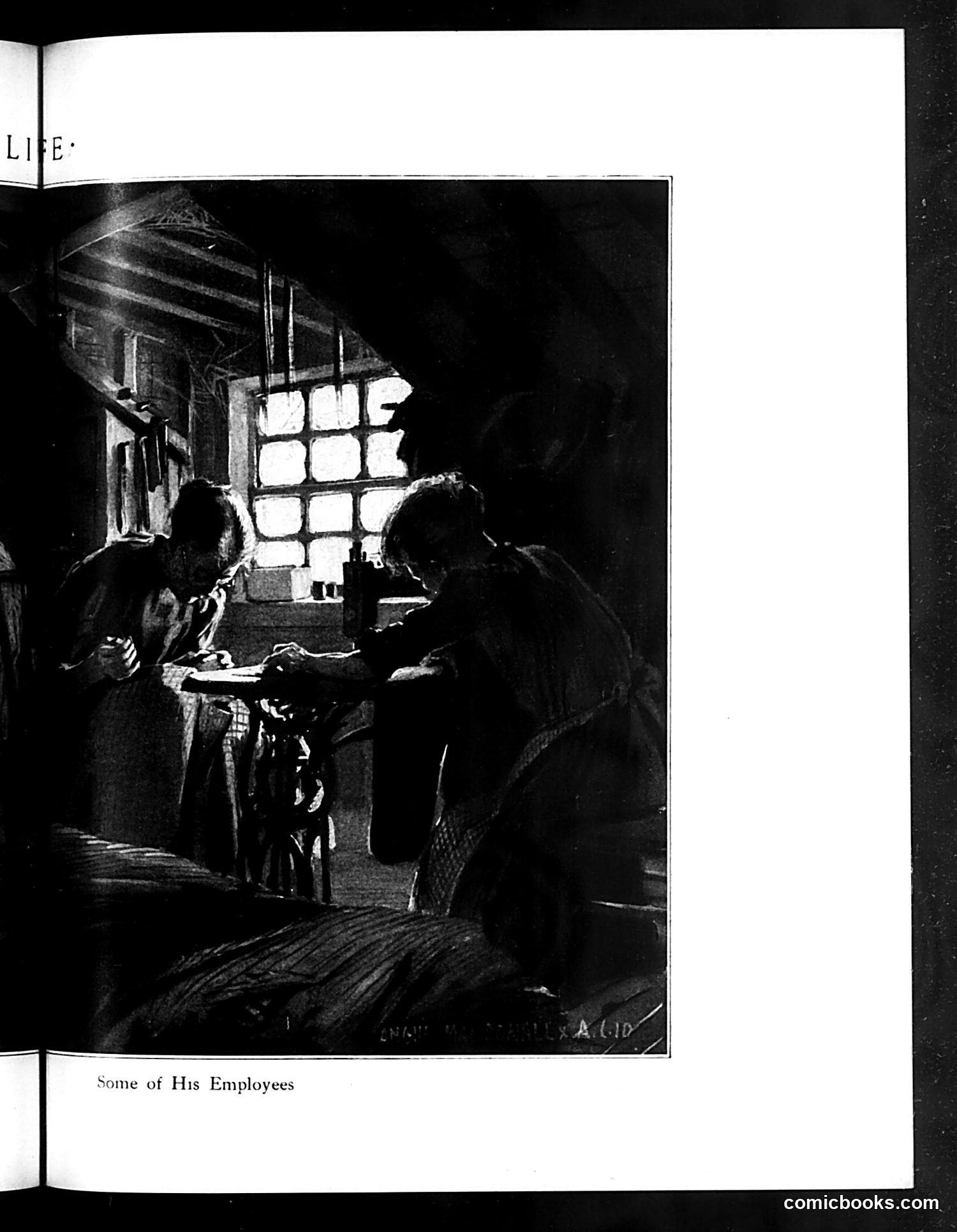
This black-and-white illustration shows two figures in what appears to be a dimly lit interior, possibly a workshop or factory, with a large gridded window providing harsh light. The caption "Some of His Employees" suggests this is political satire commenting on labor conditions or employment practices. The dramatic lighting and shadowy composition emphasize the grim working environment. Without additional context from the magazine issue—such as the surrounding article or headline—it's unclear which specific employer or industrial figure is being satirized. The image likely critiques either exploitative labor practices, poor working conditions, or a particular industrialist's treatment of workers, which were common subjects for *Life* magazine's social commentary during the early 20th century.
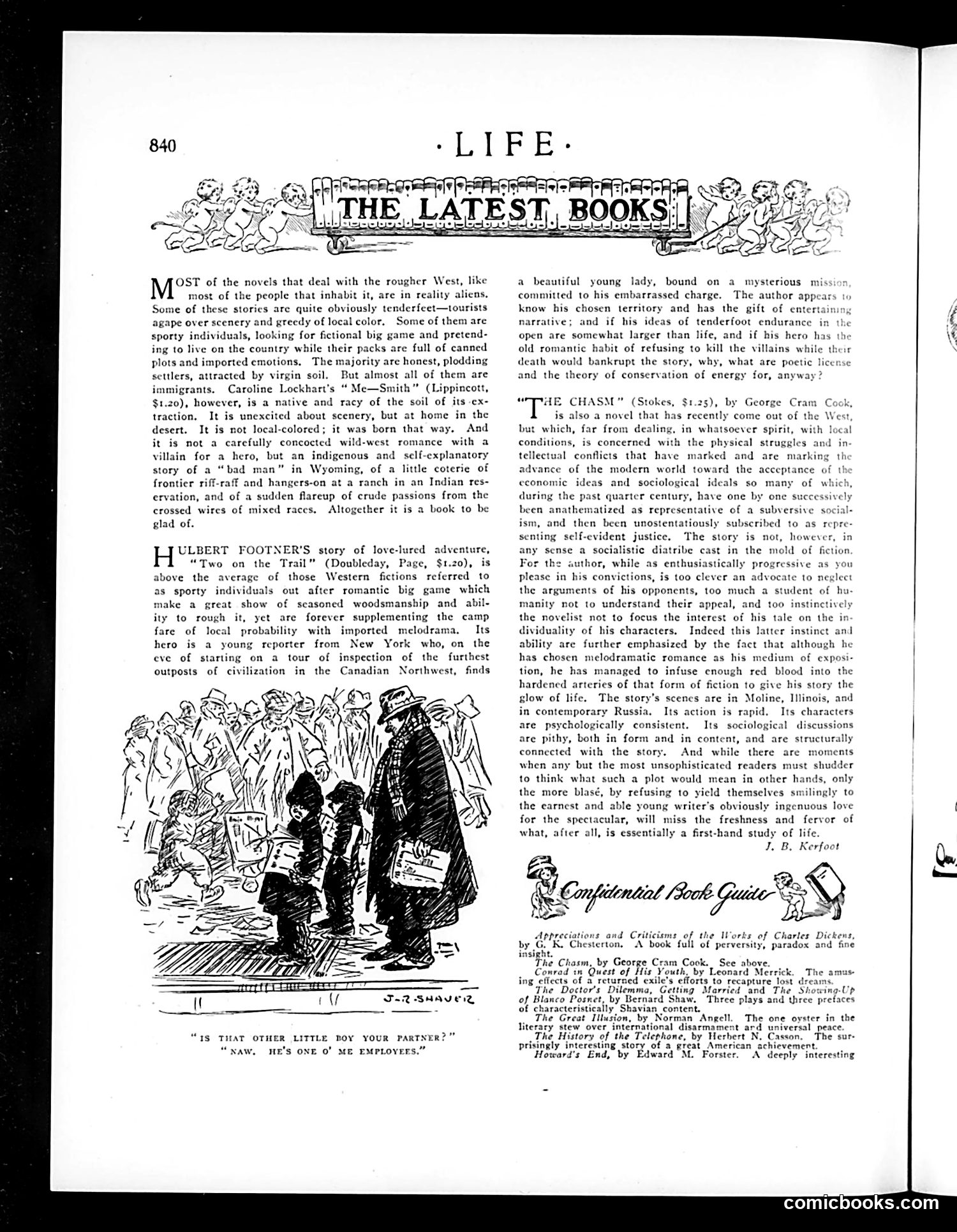
This page reviews contemporary Western novels and includes one cartoon. The cartoon depicts two men in frontier attire; one asks the other "Is that other little boy your partner?" and receives the reply "Naw, he's one o' me employees." The joke satirizes the brutality and exploitation of frontier labor practices—specifically, the casual reduction of child workers to "employees" rather than acknowledging them as human beings worthy of concern. It mocks the callous attitude of Western industrialists and ranch operators who treated vulnerable workers (including children) as disposable labor. The surrounding text discusses how most Western novels are written by outsiders seeking "local color," but praises Caroline Lockhart's "Me—Smith" as authentically native to the West. This reinforces the cartoon's implicit criticism: the real frontier wasn't romantic adventure fiction—it was a place where human exploitation went unremarked and unquestioned.
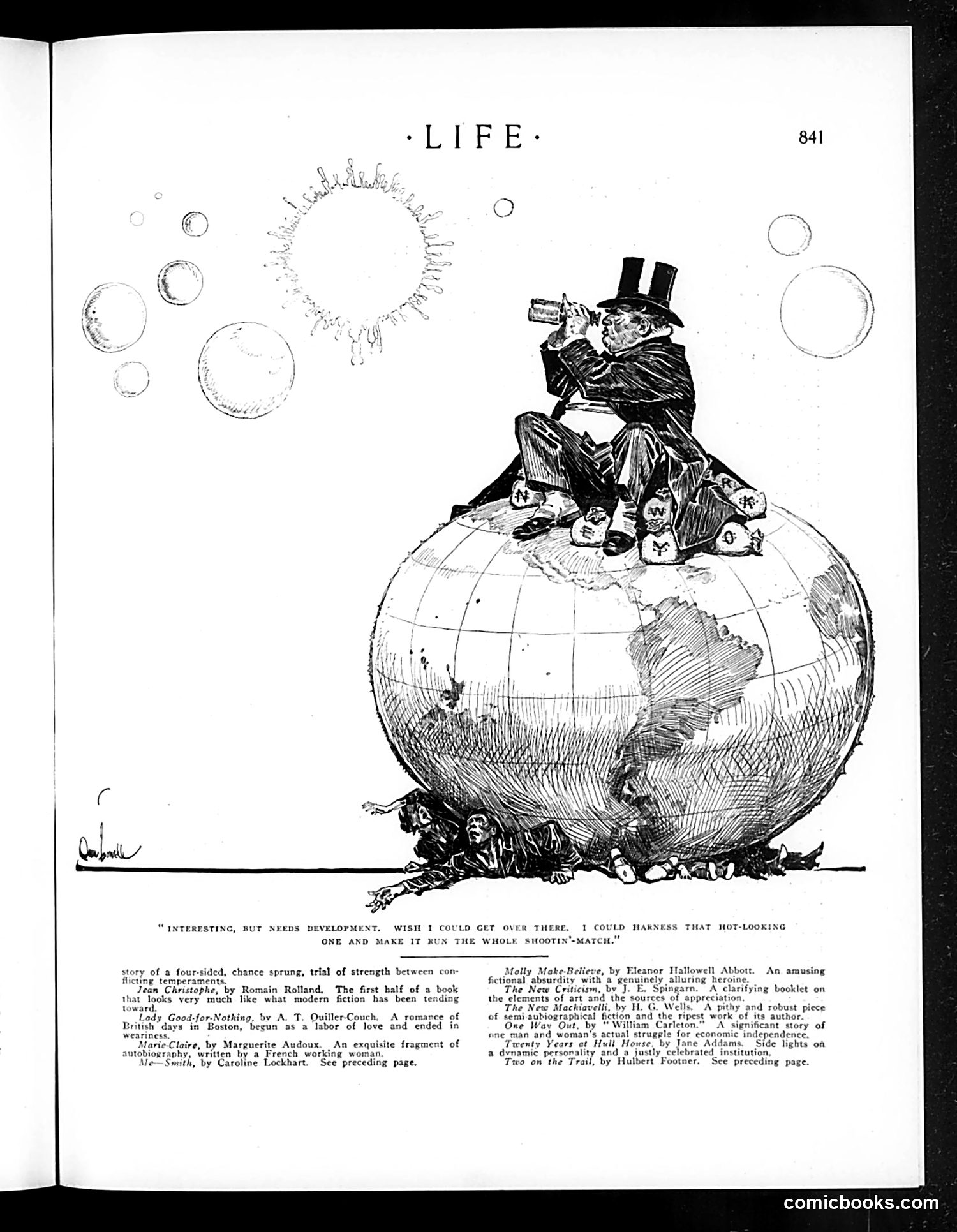
This Life magazine page features a satirical cartoon showing a figure in formal dress (top hat and coat) sitting atop a globe, looking through a telescope toward distant lands. He's surrounded by bubbles and dice, with text expressing desire to control distant territories: "I wish I could get over there. I could harness that hot-looking one and make it run the whole shootin'-match." **The satire targets**: American imperialist ambitions and capitalist expansion. The figure appears to represent American business interests or political power seeking to exploit and dominate foreign nations ("harness" them). The globe, dice, and bubbles suggest chance, gambling, and the viewing of world affairs as a game to be won and controlled. **The joke**: The man's casual, greedy attitude toward colonizing/controlling other lands, expressed in colloquial language, mocks American imperial pretensions and the reduction of sovereign nations to profitable ventures. This reflects early 20th-century progressive critique of American expansionism and corporate imperialism.
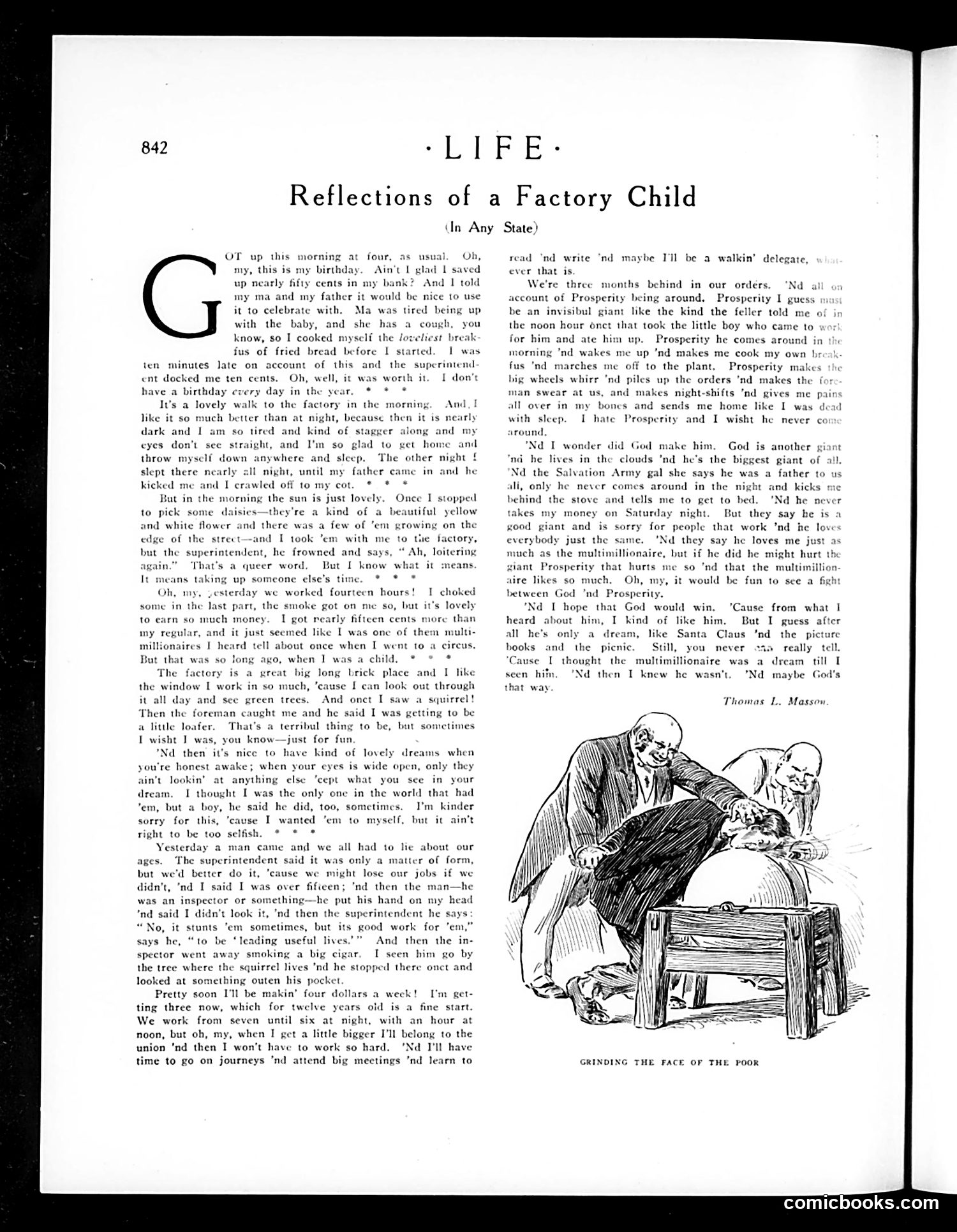
This is a first-person narrative by a factory child, accompanied by an illustration titled "Grinding the Face of the Poor" showing figures in distress. The piece satirizes child labor exploitation in early 20th-century American factories. The child narrator—working from 7am-6pm at age twelve for meager wages—describes systematic abuse: wage docking for being ten minutes late, fourteen-hour shifts in choking smoke, and being told to lie about her age to factory inspectors. The superintendent callously remarks that stunting children's growth through factory work is "good work for 'em, to be 'leading useful lives.'" The satire's dark irony lies in the child's naive optimism: she celebrates earning "four dollars a week," dreams of eventually becoming a union "walkin' delegate," and maintains innocent wonder (daisies, squirrels, dreams) despite brutal conditions. The biblical reference in the illustration's caption ("grinding the face of the poor") condemns industrial exploitation as moral sin, while the text exposes how "Prosperity" (mentioned at the article's end) requires sacrificing children's health and education.
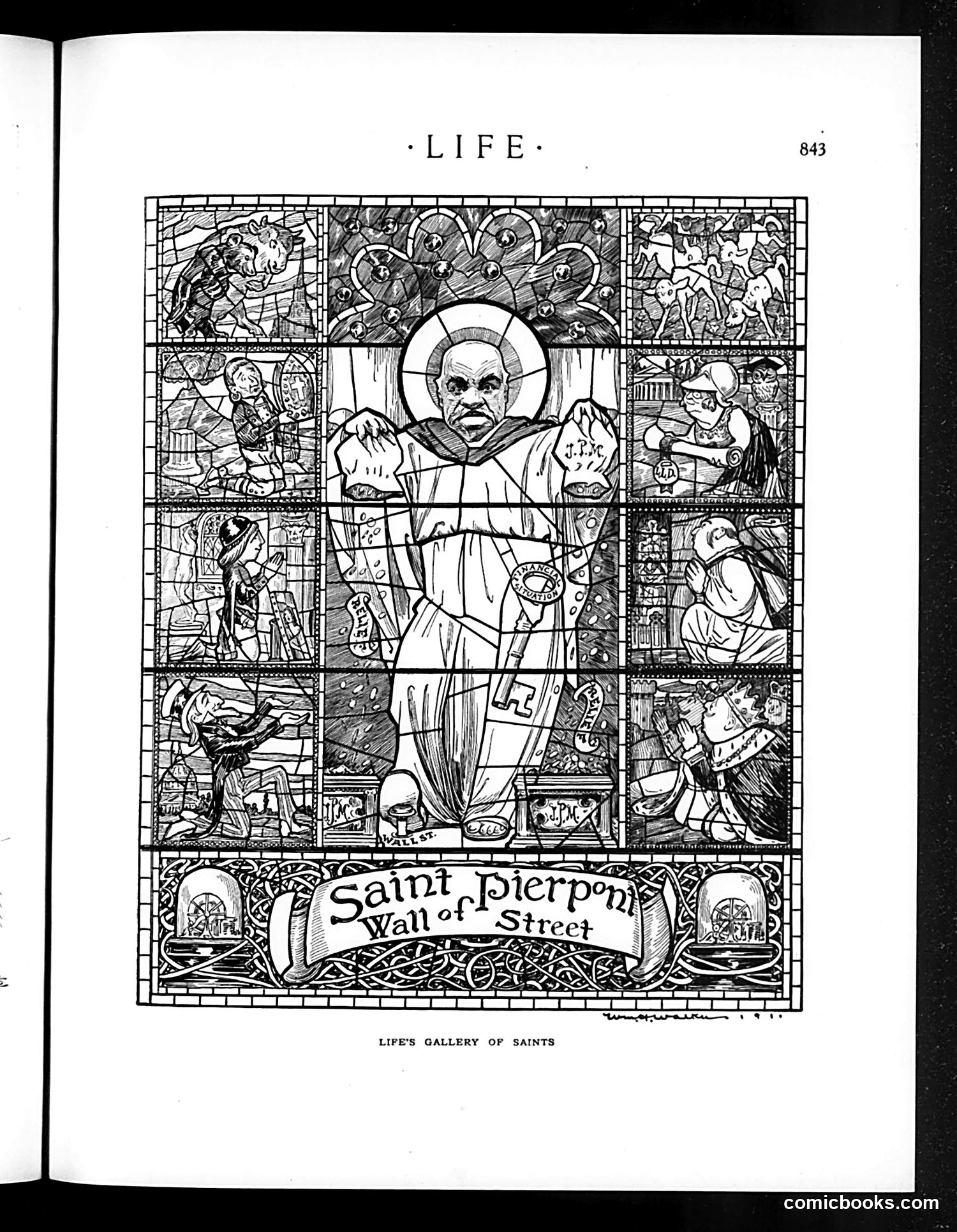
This is a religious parody satirizing wealthy financiers, specifically someone named Pierpont associated with Wall Street. The central figure is a stern man with a halo, dressed as a saint in robes, surrounded by a grid of smaller scenes depicting various activities—some appearing to show commerce, labor, leisure, and possibly exploitation. The satire equates financial success with sainthood, mocking the veneration of wealthy businessmen in American culture. The elaborate religious iconography (halo, formal saint-style presentation) contrasts sharply with the mundane or potentially questionable activities shown in the surrounding panels, suggesting hypocrisy or moral corruption beneath the glamorous facade of Wall Street wealth. This critiques the era's worship of industrial magnates.
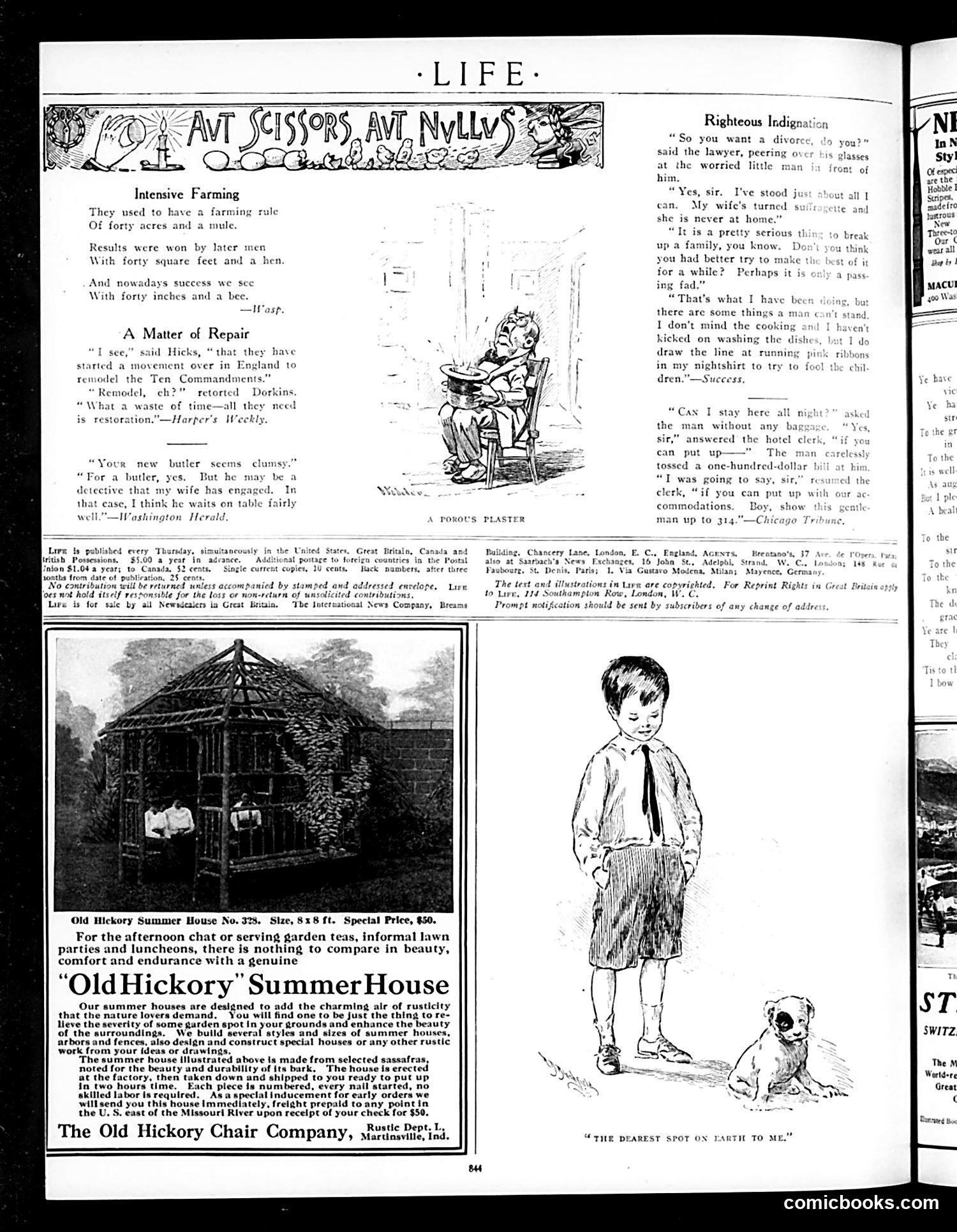
This page contains three distinct humor pieces: **"Intensive Farming"** satirizes modern agricultural efficiency. The progression from "forty acres and a mule" to "forty square feet and a hen" to "forty inches and a bee" mocks how small-scale, intensive farming has become the measure of success—suggesting that modern "progress" has reduced farming to absurdly minimal operations. **"A Matter of Repair"** presents two brief jokes about renovation and domestic service, poking fun at English trends and suspicious hiring practices. **"Righteous Indignation"** depicts a divorce scenario where a man complains his wife has become "sulky" and "never at home," but when the lawyer advises reconciliation, the man's complaints reveal petty domestic annoyances (cooking, washing dishes). The satire targets his self-righteous indignation over trivial marital grievances. The page also features period advertisements for rustic garden furniture—the "Old Hickory Summer House" and chair company—typical of Life's commercial content. The illustration "The Dearest Spot on Earth to Me" shows a boy, likely emphasizing sentimentality common to the era's sentimental advertising.
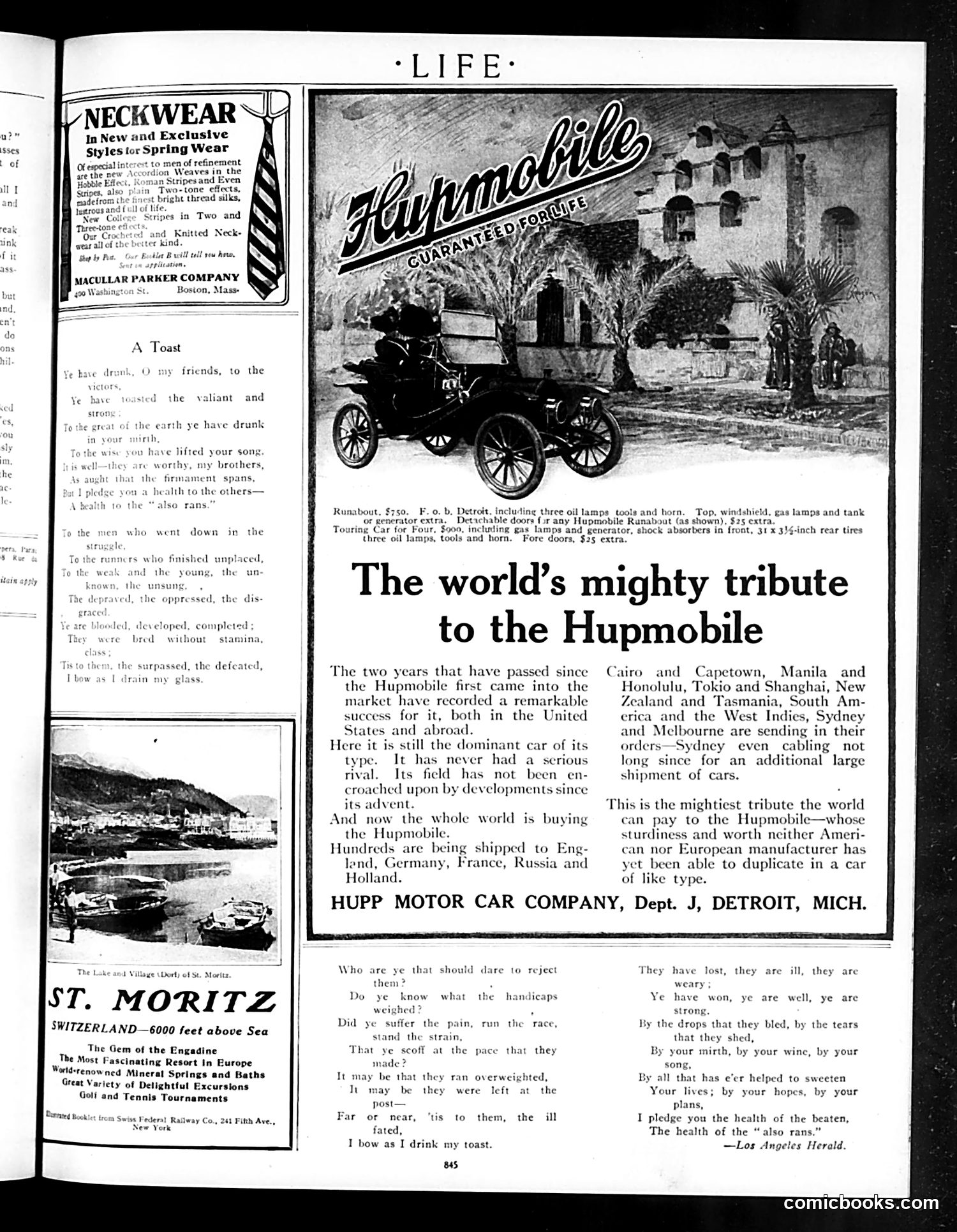
This page is primarily **advertising and poetry**, not satire or political cartooning. The main content features a **Hupmobile automobile advertisement** (right side), promoting this car brand's global success and reliability. The ad emphasizes international sales to places like Cairo, Manila, Tokyo, and Sydney, positioning the Hupmobile as superior to European competitors. The left side contains a **sentimental poem titled "A Toast"** (attributed to the Los Angeles Herald), which celebrates losers and underdogs—"the also rans." The poem honors those who competed but lost, emphasizing their struggle and suffering. Supporting advertisements include neckwear (Macullar Parker Company) and a Swiss resort (St. Moritz). **No political cartoon or satirical commentary is present.** This is a commercial magazine page mixing product advertisements with inspirational verse—typical early 20th-century Life magazine content before it evolved into primarily humor-focused publication.
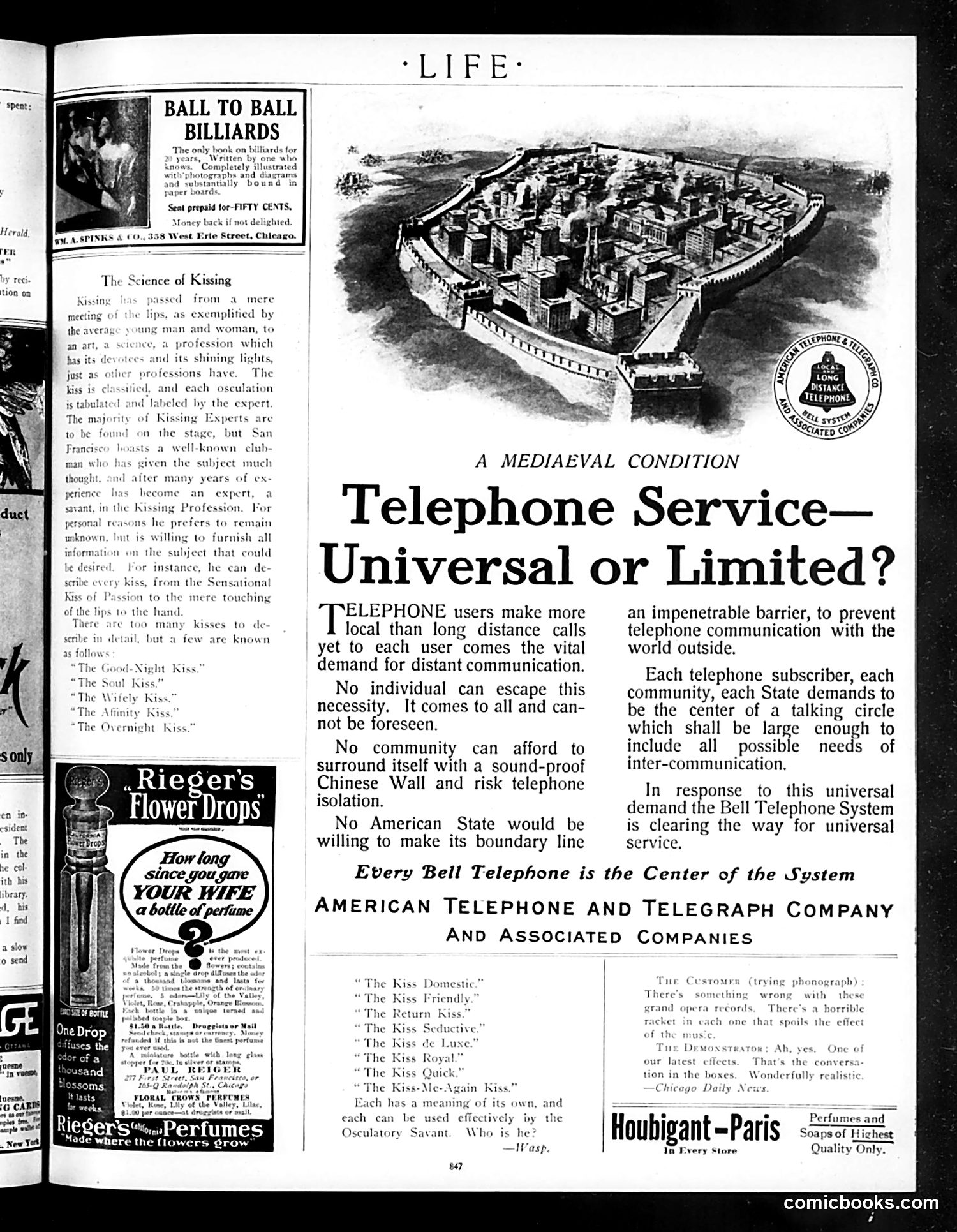
This page contains **advertisements and articles**, not political satire. The main content is a **Bell Telephone System advertisement** disguised as editorial commentary. The ad's central argument: telephone service should be "universal" (available everywhere, including across state lines) rather than "limited" (restricted by geography). It uses rhetoric comparing state boundaries that block phone service to a "Chinese Wall"—a barrier preventing communication. The advertisement cleverly frames universal service as inevitable and necessary, claiming every telephone user demands to be "the center of a talking circle" that spans beyond local areas. This was corporate advocacy for regulatory policy during the era when telephone service territories and interstate communication were contested. The other page content—articles on "The Science of Kissing" and various kiss types—are genuine satirical editorial pieces typical of Life magazine's humorous content.
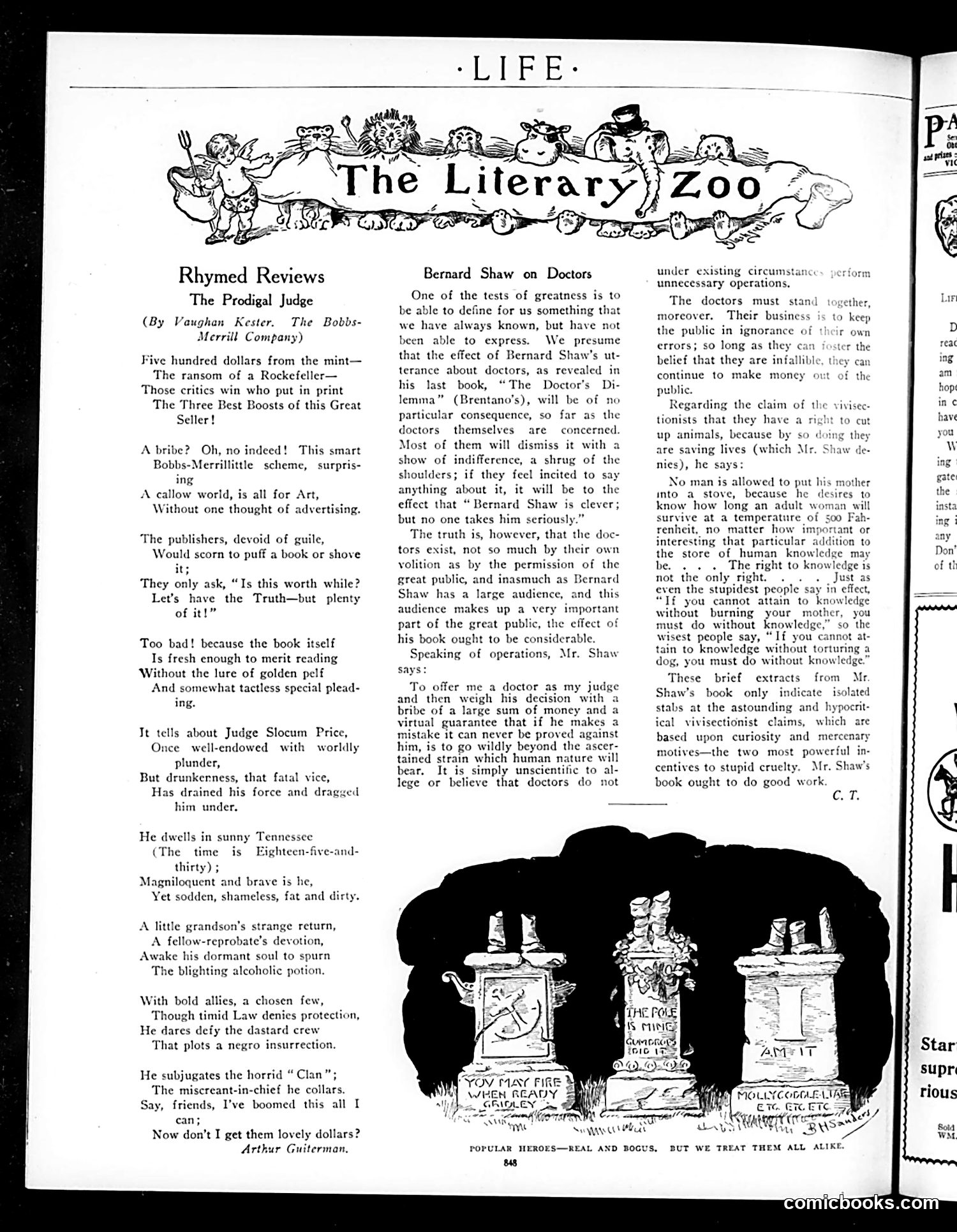
This Life magazine page contains two main pieces: **"The Prodigal Judge" Review:** Satirist Arthur Guiterman mocks the book's publisher for offering "$500 from the mint" as prize money for the three best promotional reviews—claiming this is "all for Art" while obviously being crass advertising. The review itself praises the novel (about a disgraced Tennessee judge fighting "negro insurrection") as worthy without such bribery tactics. **"Bernard Shaw on Doctors":** An excerpt from Shaw's play "The Doctor's Dilemma" critiques medical ethics. Shaw argues doctors profit from keeping patients ignorant and performing unnecessary operations. He compares vivisection advocates' claims about scientific necessity to absurdly justifying burning someone's mother for medical knowledge—both reveal how people rationalize unethical acts under the guise of progress. **The cartoon** (bottom) shows gravestones labeled with medical terms ("You may fire when ready Gridley," "The Pole is mine," "Pollywoggles"), satirizing doctors as agents of death. The page's theme: exposing hypocrisy in respectable institutions (publishing, medicine) hiding self-interest behind noble rhetoric.
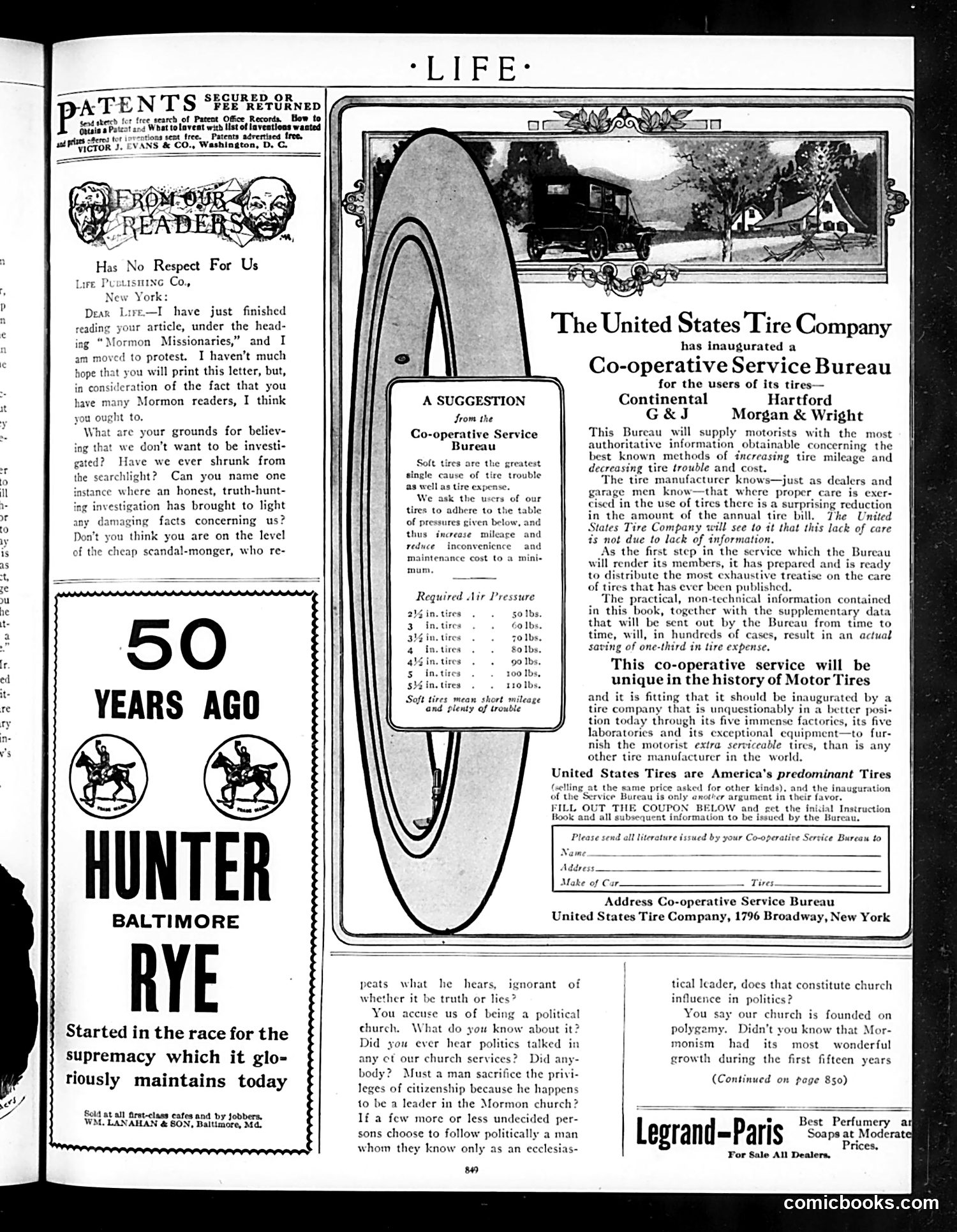
This page contains **no political cartoons**—it's primarily **advertisements and a reader's letter**. The letter ("From Our Readers") defends the Mormon church against Life's recent critical article on "Mormon Missionaries." The writer protests Life's investigation as sensationalism, challenging whether the magazine has evidence of wrongdoing and accusing it of operating like a "cheap scandal-monger." The letter then addresses an implicit accusation that Mormons constitute a "political church," arguing that church members' political choices shouldn't disqualify them from civic participation—a defender's response to anti-Mormon sentiment common in early 20th-century America. The remainder of the page features **commercial advertisements**: Hunter Baltimore Rye whiskey (celebrating 50 years of supremacy), United States Tire Company's new "Co-operative Service Bureau" promoting tire maintenance information, and Legrand-Paris perfume.
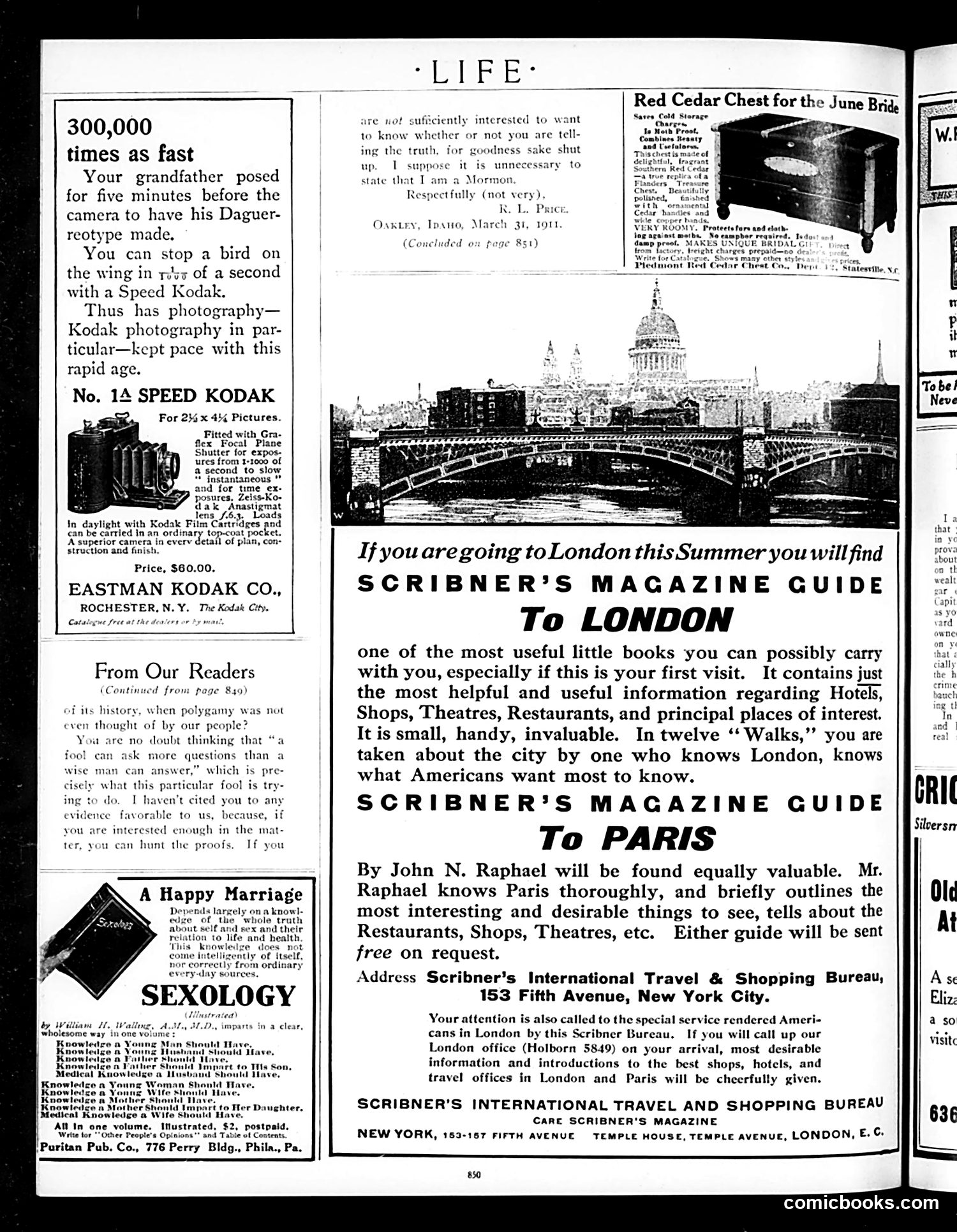
This page is **primarily advertising and reader correspondence**, not political satire. The main content includes: 1. **"From Our Readers"**: A letter from R.L. Price (Oakey, Idaho, March 31, 1911) responding to prior magazine content about Mormonism. Price defends Mormons against charges of dishonesty, stating most people don't care about religious truth-telling anyway. The tone is mildly satirical self-deprecation rather than sharp critique. 2. **Product Advertisements**: Kodak camera ads emphasizing speed ("300,000 times as fast"), a Red Cedar chest for brides, and "Sexology" book advertisements. 3. **Travel Guides**: Large advertisement for Scribner's Magazine travel guides to London and Paris, with contact information for their travel bureau. There is **no discernible political cartoon** on this page. The satirical element is limited to Price's dry, resigned tone about religious tolerance—essentially saying apathy protects Mormons better than belief in their honesty. The page reflects early 1900s commercial publishing rather than editorial commentary.
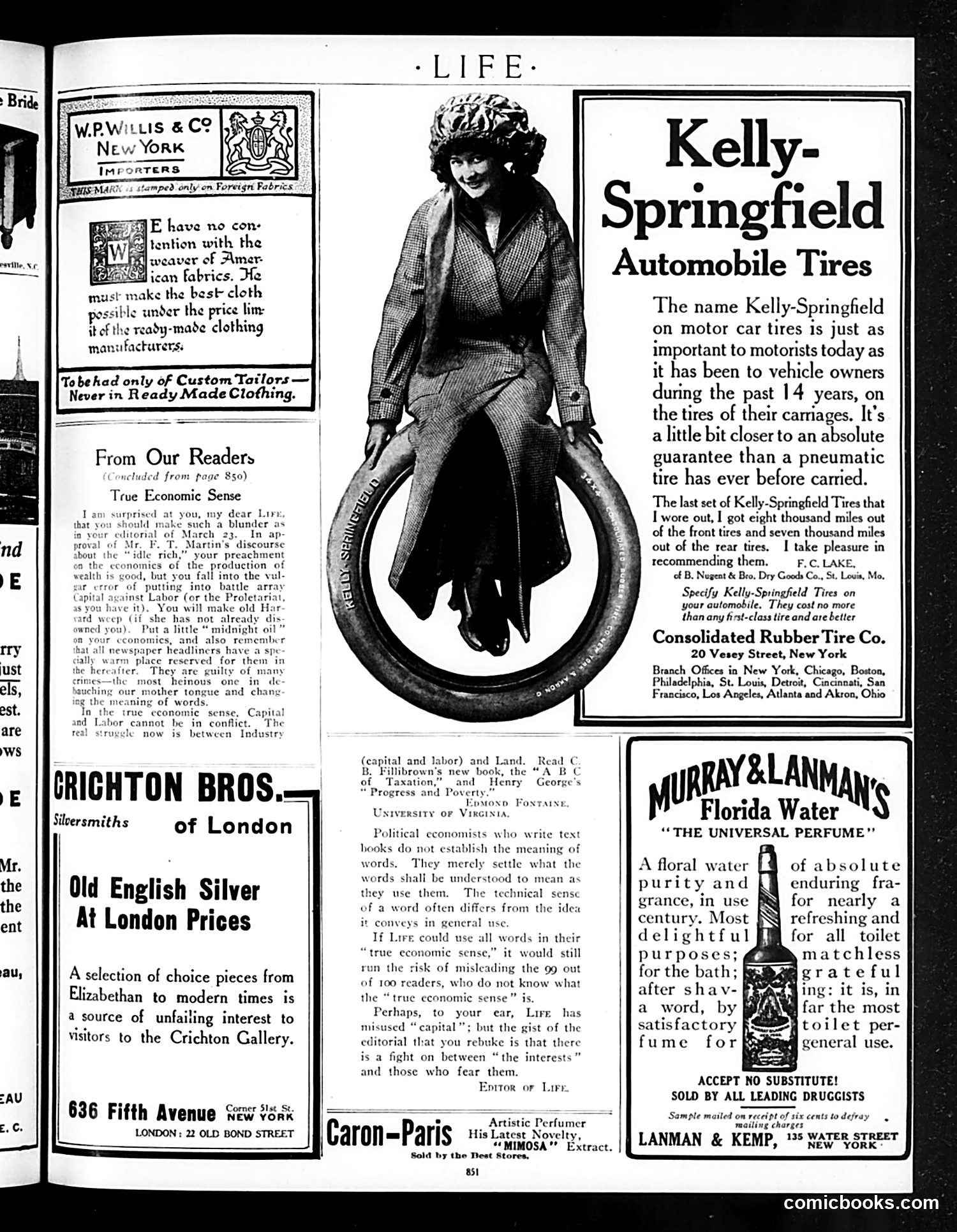
This page is **primarily advertisements** with a small editorial section. There is no political cartoon. The main content includes: **Advertisements:** - **W.P. Willis & Co.** (custom tailoring) argues American ready-made clothing cannot match hand-tailored garments at comparable prices - **Kelly-Springfield Automobile Tires** emphasizes reliability over 14 years - **Crichton Bros.** (Old English Silver at London prices) - **Murray & Lanman's Florida Water** perfume - **Caron-Paris** artistic perfume **Editorial:** A brief "From Our Readers" section debates "true economic sense," with a correspondent challenging *Life*'s editorial stance on capital versus labor economics. The *Life* editor responds that the term "economic sense" is being misused in the debate over "the interests" versus working people. **Historical Context:** This appears to be from the early 1900s, when debates over labor, capital, and economic justice were prominent American concerns. The page reflects these tensions within a commercial context.
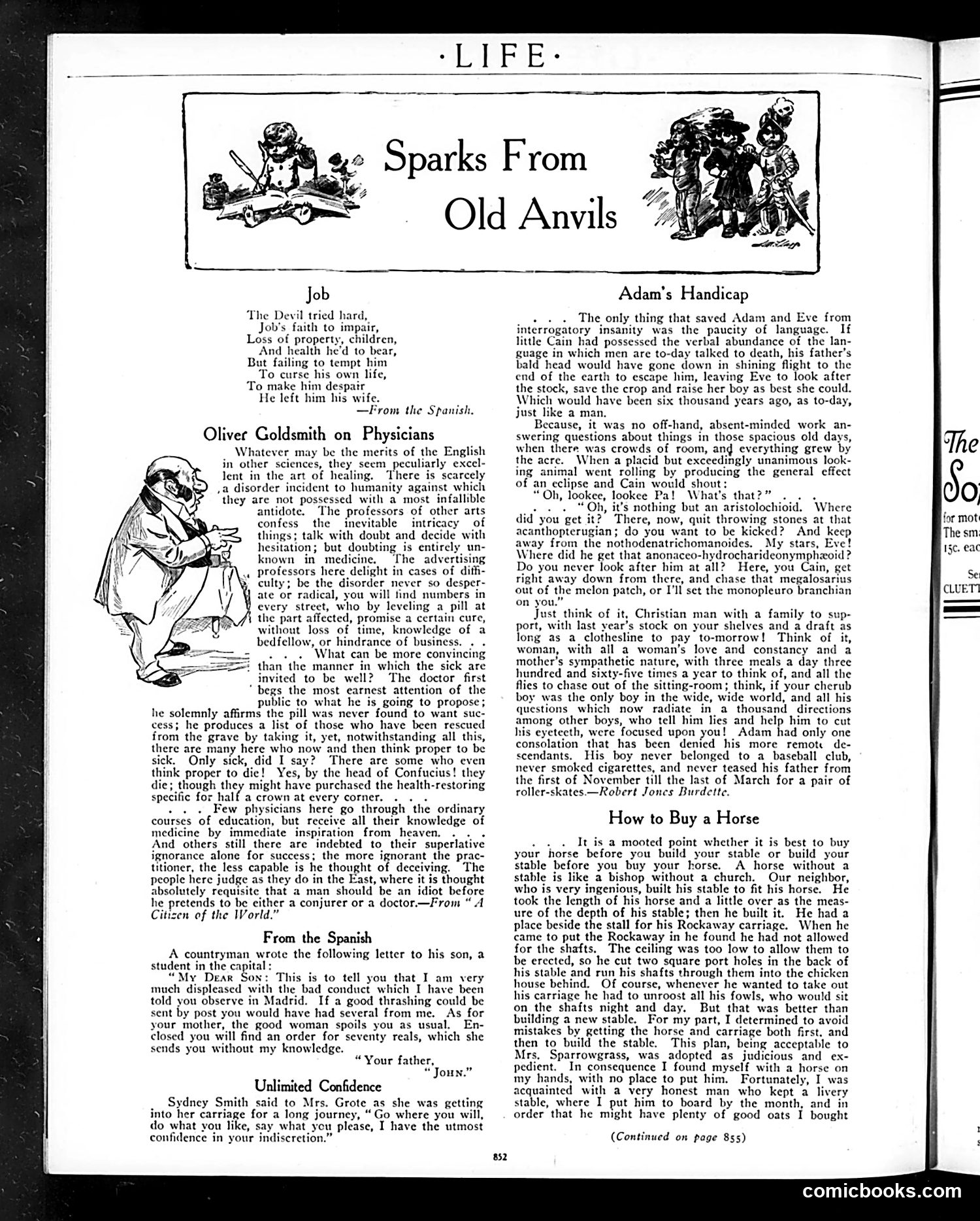
This page collects brief satirical pieces and quotations rather than political cartoons. The content targets **English physicians and social pretension**: **Oliver Goldsmith on Physicians** mocks English doctors for unfounded confidence. Goldsmith (18th-century Irish writer) satirizes physicians who promise miracle cures, produce testimonials from "rescued" patients, yet people still die—suggesting doctors rely on ignorance and deception rather than actual medical knowledge. The jab at "inspiration from heaven" implies charlatanism. **Other pieces** include classical proverbs (Job's wife as punishment; a Spanish father's letter to his wayward son) and a quip by Sydney Smith about Mrs. Grote's "indiscretion"—all emphasizing human folly. **The satirical target** is medical quackery and the gap between doctors' confident claims and actual results—a timeless complaint, though particularly pointed when formal medical training was genuinely limited and ineffective remedies were common.
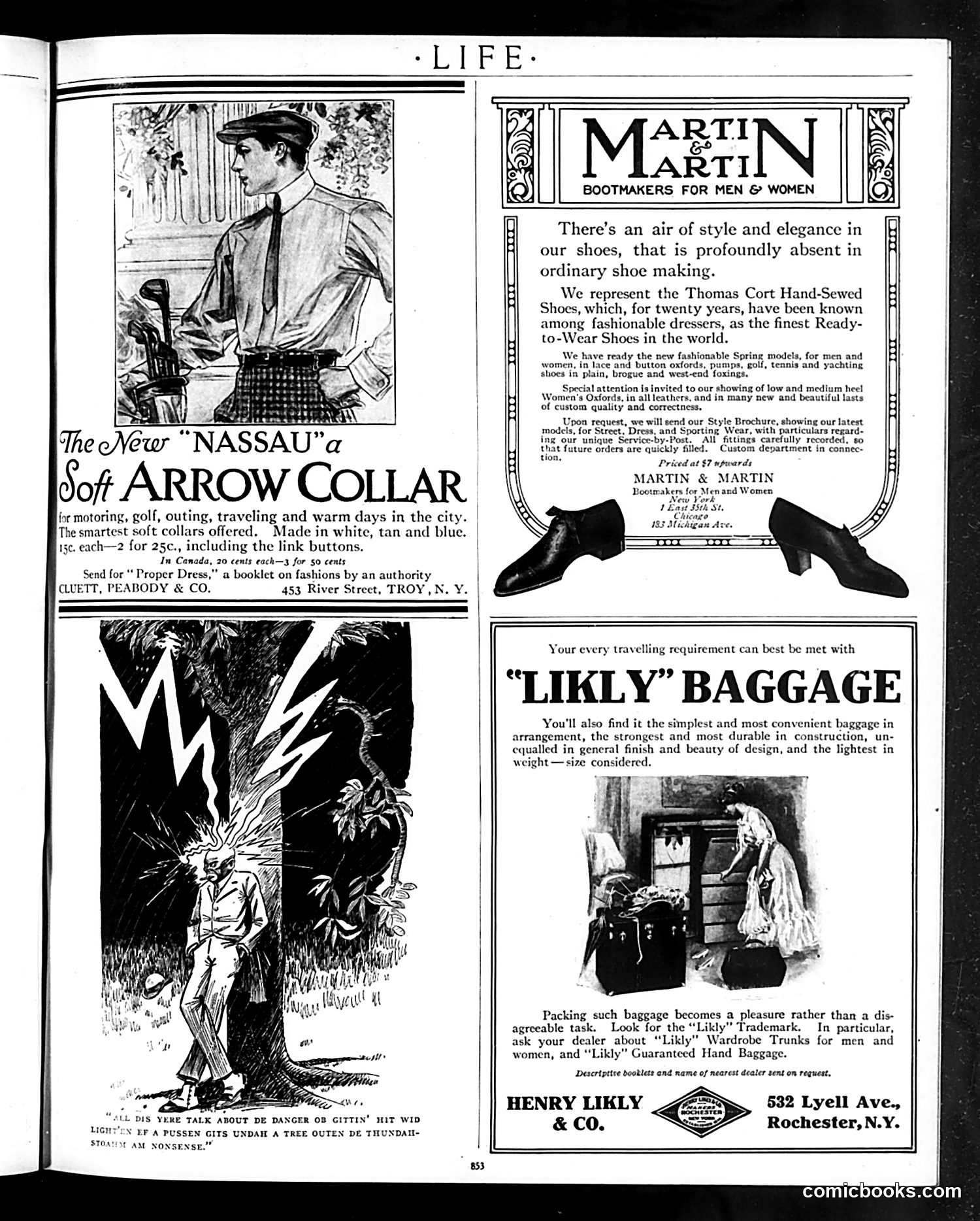
This page is primarily **advertising**, featuring four product endorsements typical of early 20th-century magazines. The only editorial cartoon appears at bottom-left: a figure sheltering under a tree during a thunderstorm, with dialect text dismissing lightning danger as "nonsense." This appears to be **satirizing public ignorance about electrical safety** — a relevant concern as electricity became widespread. The crude dialect suggests the speaker is portrayed as foolish or uneducated for disregarding genuine hazards. The rest of the page contains ads for: - **Arrow Collar** (soft collars for active pursuits) - **Martin & Martin** boots (emphasizing hand-sewn quality) - **Likly Baggage** (travel trunks and cases) These ads reflect affluent consumer culture and leisurely activities (motoring, golf, yachting) typical of the era's target readership. The cartoonish illustrations and refined language reinforce aspirational messaging around style and propriety.
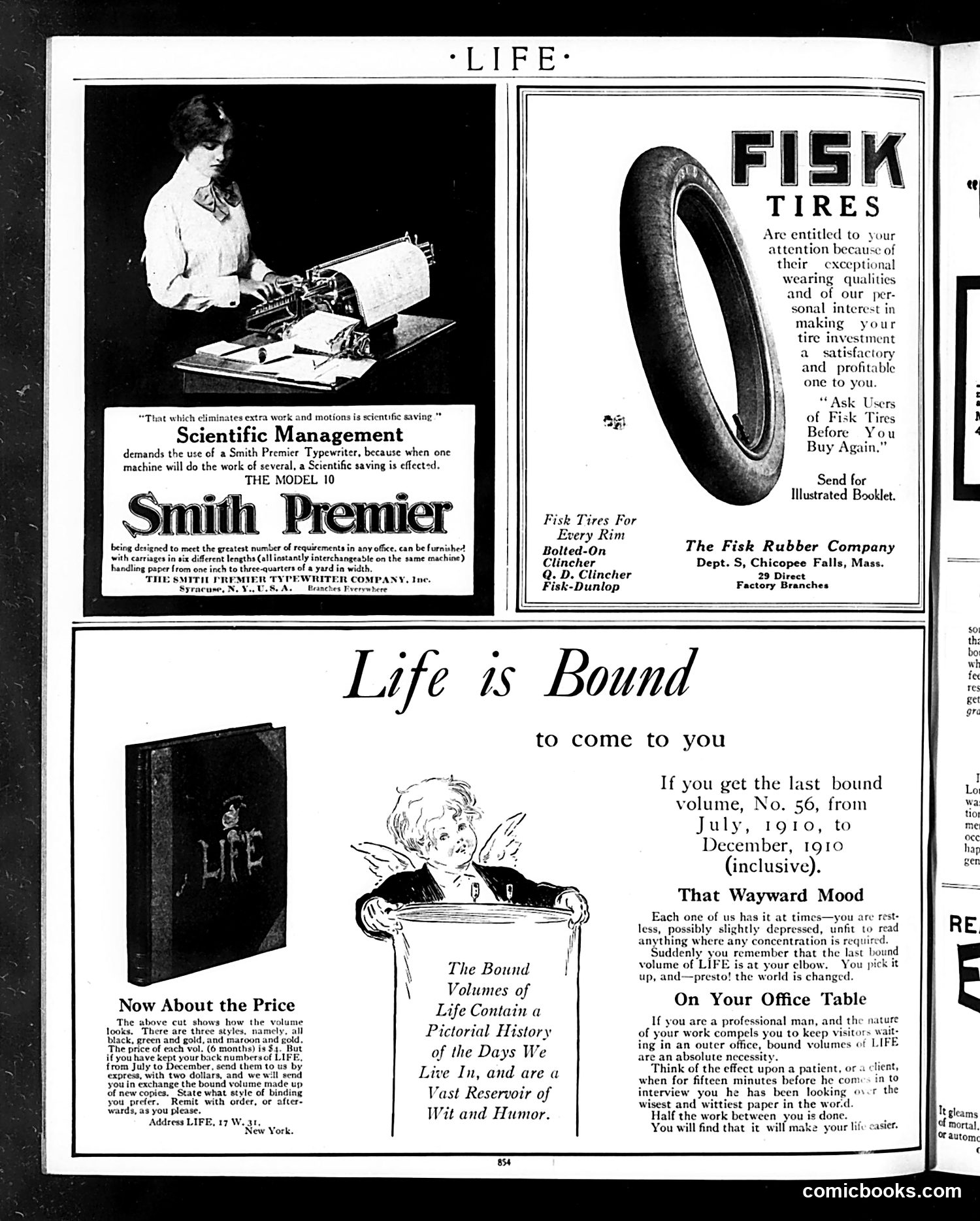
This page is primarily **advertising** rather than satire or political commentary. It contains three commercial advertisements interspersed with promotional content for Life magazine itself. The ads feature: 1. **Smith Premier Typewriter (Model 10)**: Marketed as embodying "scientific management" principles—the efficiency movement popular in early 1900s American business. The image shows a woman operating the machine, targeting office professionals. 2. **Fisk Tires**: A straightforward product advertisement emphasizing durability and user satisfaction. 3. **Life Magazine bound volumes**: The page's main content promotes subscription to Life's collected volumes (July-December 1910), describing the publication as a "Pictorial History" and "Vast Reservoir of Wit and Humor." The pitch emphasizes how bound volumes in an office convey professionalism and provide intellectual respite. The "That Wayward Mood" section uses mild humor to suggest Life magazine cures depression and restlessness—typical advertising copy of the era positioning leisure reading as therapeutic. **No political satire or caricature is present on this page.**
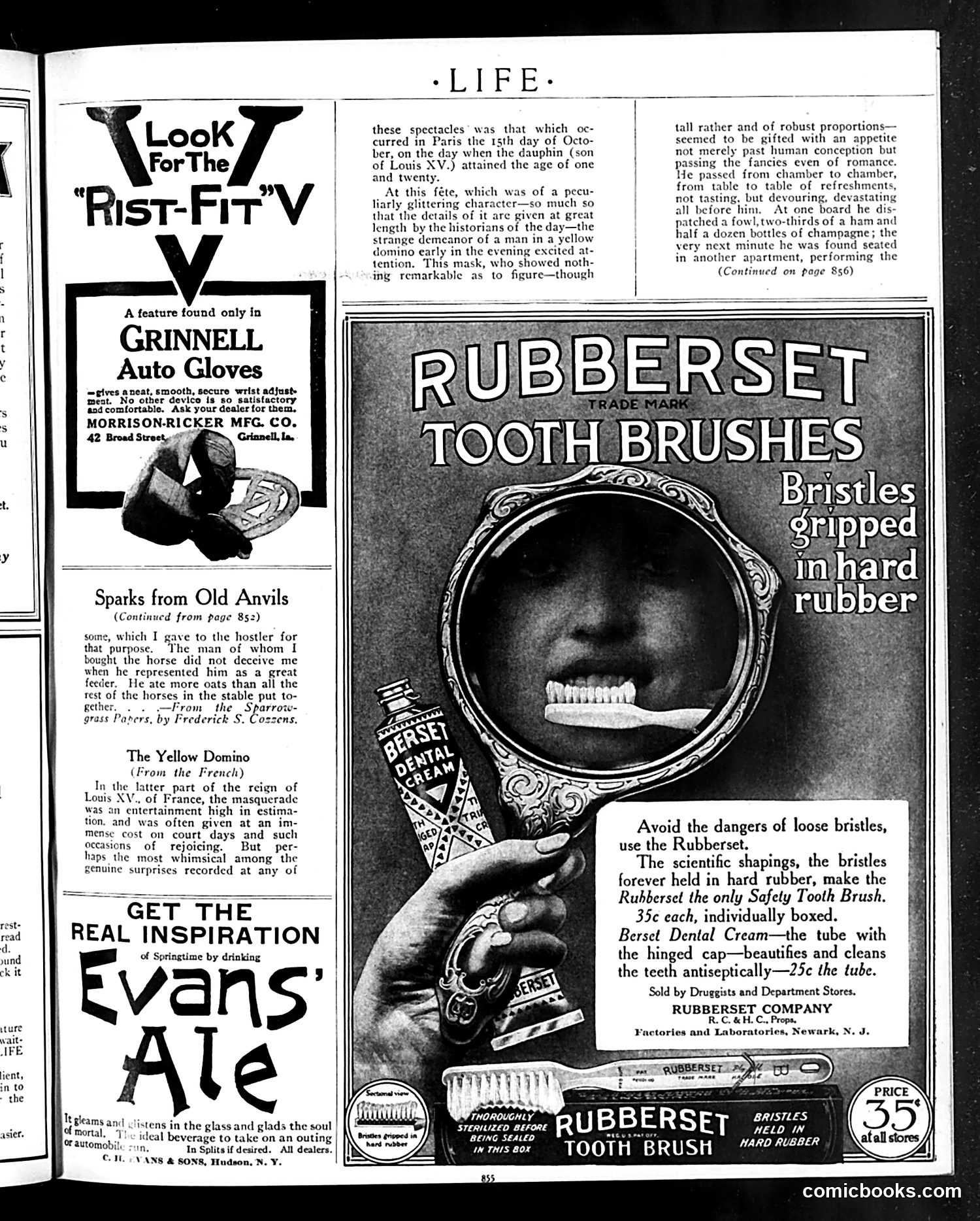
This page is primarily **advertising** interspersed with serialized fiction excerpts, not political satire. The advertisements include: - **Grinnell Auto Gloves** (wrist adjustment feature) - **Evans' Ale** (springtime beverage) - **Rubberset Tooth Brushes** (safety toothbrushes with rubber-gripped bristles, priced at 35¢) The text fragments are continuations of serialized stories: - "Sparks from Old Anvils" (about a horse trader) - **"The Yellow Domino"** (a French historical anecdote about an anonymous masked man at an 18th-century masquerade during Louis XV's reign, notable for his extraordinary appetite—eating massive quantities of food in succession) The page reflects early 20th-century Life magazine's format: mixing consumer products with literary serialization. No recognizable political figures or cartoons appear. The "Yellow Domino" is a period narrative piece, likely chosen for entertainment value rather than contemporary social commentary.
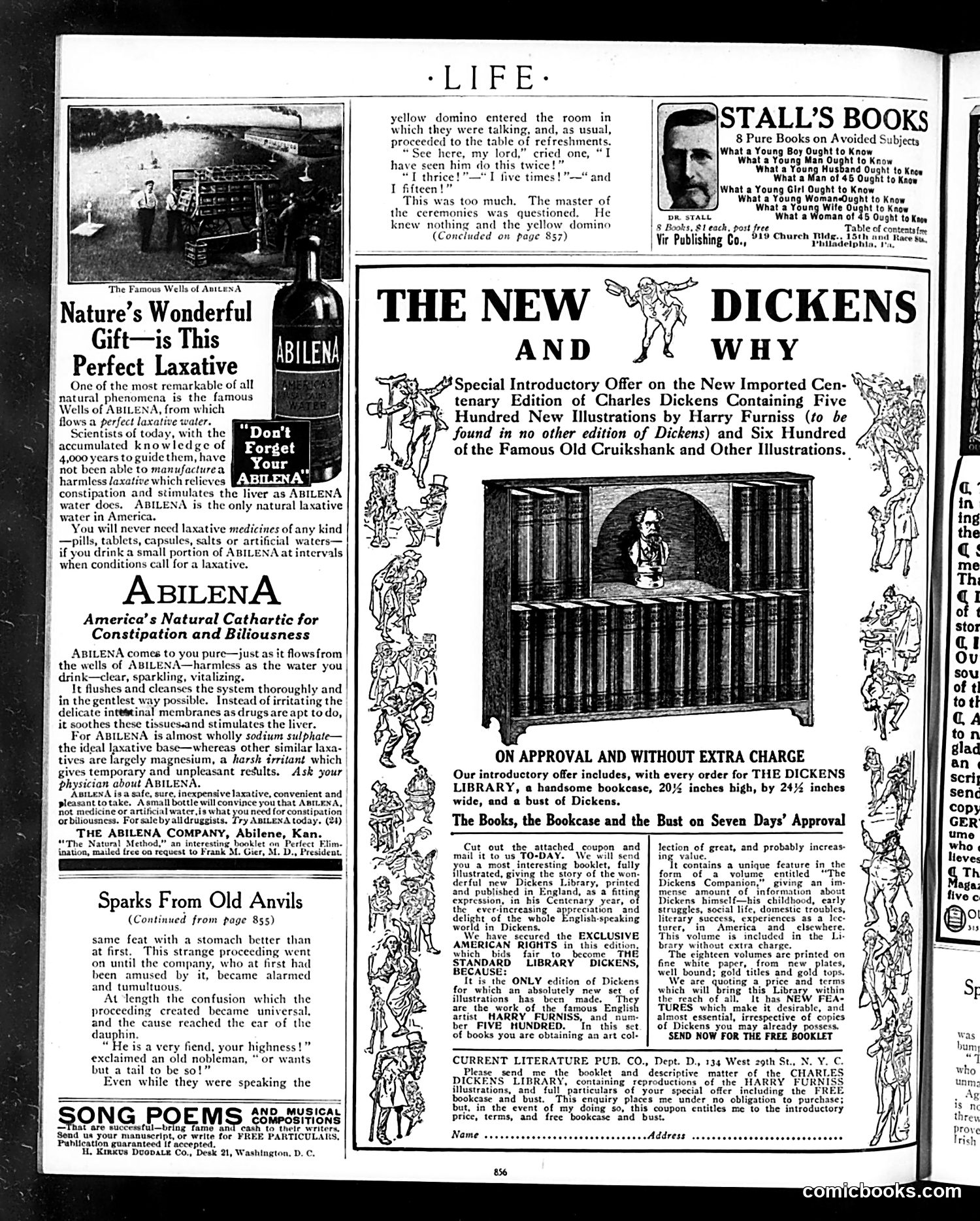
This page is primarily **advertising**, not political satire. The main content consists of three major advertisements: 1. **Abilena laxative water** (left column): Promotes a "natural" mineral laxative from Abilena, Kansas, claiming superiority over pills and artificial alternatives. Appeals to health-conscious readers seeking gentler remedies. 2. **Stall's Books** (top right): Advertises medical/educational books on intimate subjects—titles like "What a Young Boy Ought to Know" and "What a Woman of 45 Ought to Know"—representing the era's cautious approach to sex education through sanitized published guides. 3. **Dickens Library** (center/right): The largest ad offers a special centenary edition of Charles Dickens with new illustrations by Harry Furniss, bundled with a bookcase and bust, available on seven-day approval. The small text fragment at top appears concluding a narrative story about a "yellow domino" (masked figure), but without context, its satirical meaning is unclear. The page reflects early 1900s consumer culture and publishing trends.
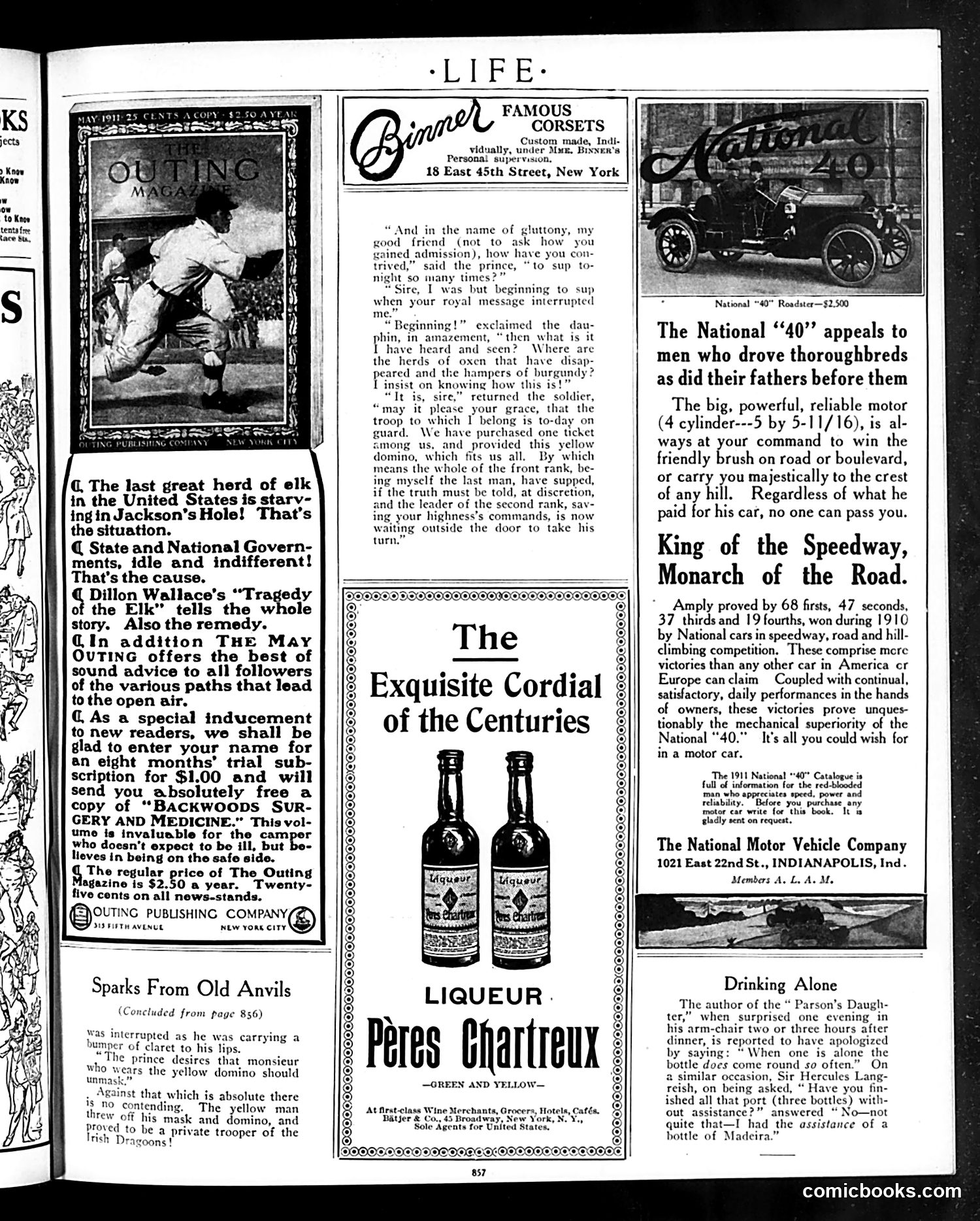
**Main Content:** This page is primarily advertising with scattered editorial features—not a cohesive satirical cartoon. **Notable Elements:** The left column features "Sparks From Old Anvils," a brief anecdote about a soldier in a yellow domino mask who deceives a French prince by having an entire military troop share one meal ticket. The joke's target: class and hierarchy absurdity—the prince's indignation at resource-sharing undermines his authority. **Advertisements dominate:** - National "40" automobile, marketed to wealthy men as superior/unpassable ("no one can pass you") - Liqueur and corset ads - The Outing Magazine, with an environmental note about starving elk herds in Jackson Hole **Historical Context:** This reflects 1911 concerns about conservation and reveals class aspirations through auto marketing, positioning cars as status symbols comparable to thoroughbred horses. The satire is gentle, mocking pretension rather than politics directly.
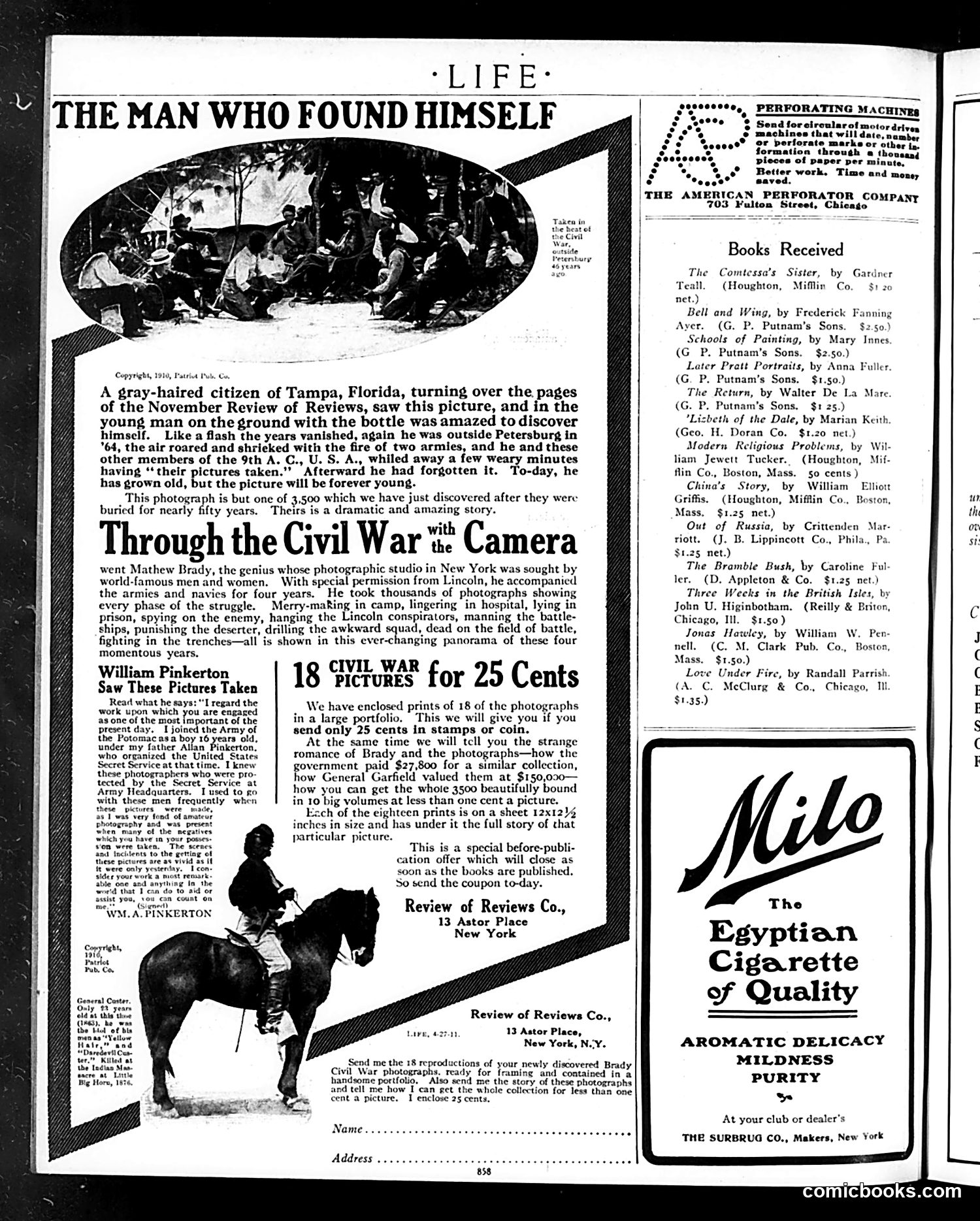
This page features a remarkable Civil War rediscovery story. A Tampa, Florida man recognized himself in a photograph from the *Review of Reviews* showing Union soldiers from the 9th Army Corps during the Civil War—a picture taken around 1864 that had been lost for nearly fifty years. The article promotes **Mathew Brady's famous Civil War photography collection**: thousands of images documenting camp life, hospitals, battles, and executions. Brady received special permission from Lincoln to photograph all aspects of the war. William Pinkerton (who organized the Secret Service) vouches for the photographs' historical importance. The piece advertises a special offer: 18 Civil War prints in a portfolio for 25 cents, along with the "romance" of how Brady's collection was valued at $27,800 by the government and $150,000 by General Garfield. This celebrates American documentary photography and nostalgia for Civil War veterans—marketing historical images to readers who may have participated in or lost relatives to the conflict.
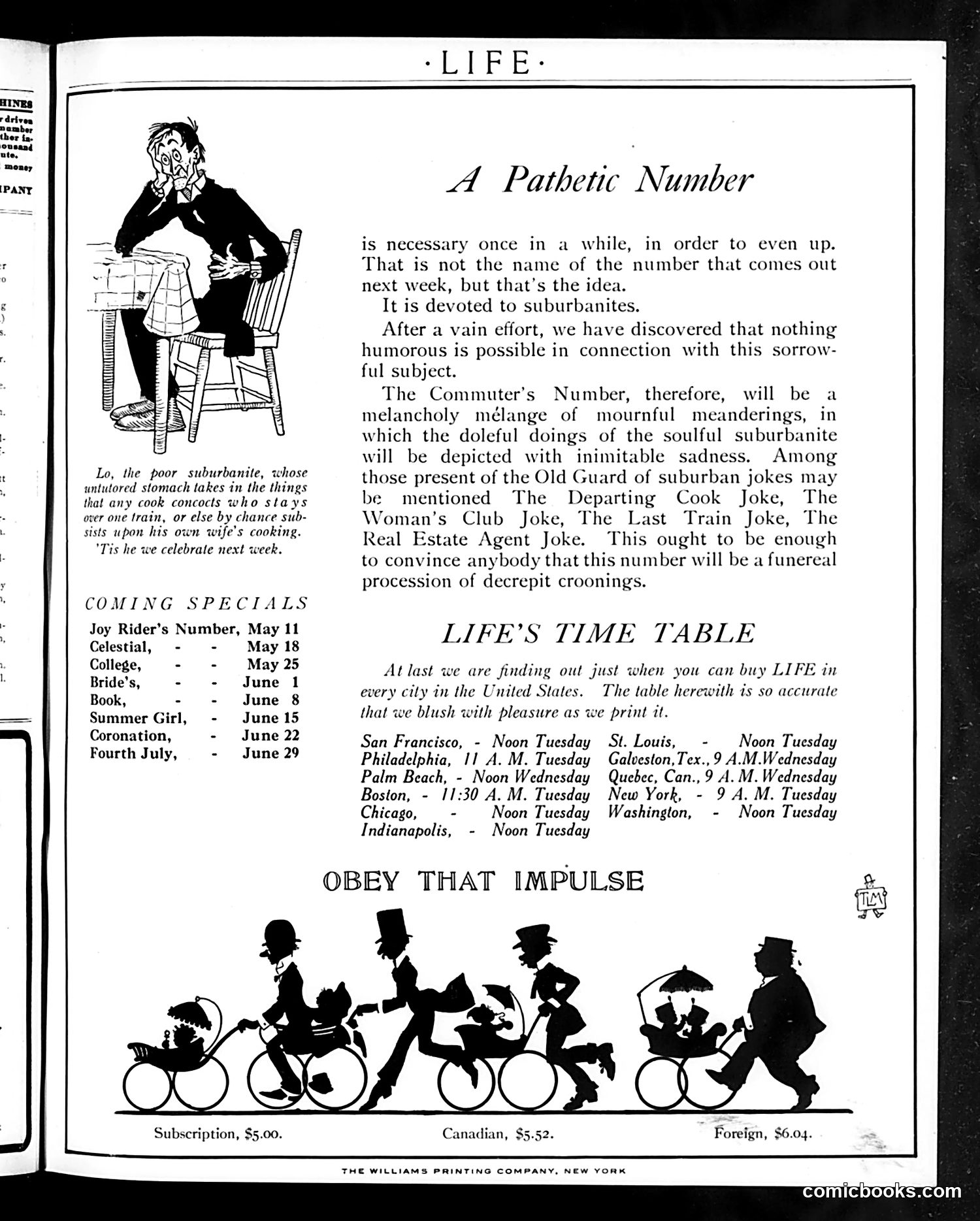
This *Life* magazine page advertises an upcoming "Commuter's Number" devoted to suburbanites—a satirical editorial introducing next week's issue. The text mockingly treats suburban life as inherently tragic and humorless, joking about the "poor suburbanite" eating mediocre food (whether from hired cooks or his wife's cooking). The editorial lists exhausted stereotypical jokes about suburban life—departing servants, women's clubs, commuter trains, real estate agents—suggesting the magazine will mine these tired tropes for dark humor. The bottom silhouette cartoon depicts suburban commuters in various states of chaos (riding bicycles, pushing carriages, juggling responsibilities) under the heading "OBEY THAT IMPULSE"—likely satirizing the impulsive consumer culture driving suburban expansion. The page functions primarily as promotional material announcing the magazine's upcoming special issue.
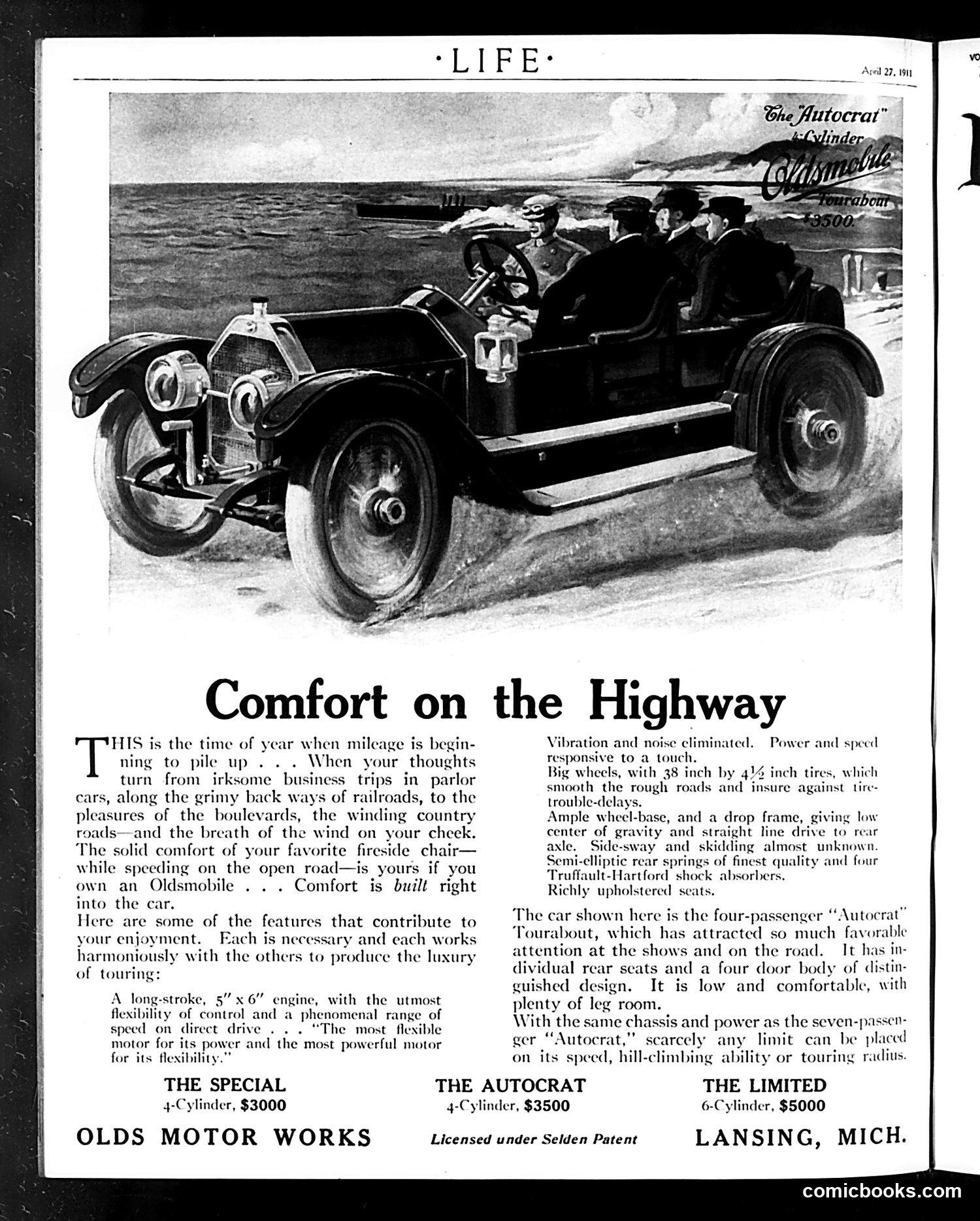
This is primarily **automobile advertising**, not political satire. The page features a promotional article for Oldsmobile vehicles, specifically highlighting three models: the Special, Autocrat, and Limited. The accompanying image shows a well-dressed group of men in an open-air touring car beside the ocean, illustrating the leisure and comfort promised by automobile ownership. The "comfort on the highway" theme positions motoring as an aspirational lifestyle upgrade—a shift from uncomfortable railway travel to pleasurable countryside driving. The text emphasizes technical features (engine flexibility, shock absorbers, wheel size) while appealing to leisure and status. The price points ($3,000–$5,000) indicate these were luxury vehicles for the affluent. **Historical context**: This 1911 advertisement reflects the early automotive era when cars represented modern luxury and freedom, contrasting with existing rail travel. The focus on "comfort" and social distinction was typical early marketing strategy. No political figures or satirical commentary are present on this page.