
Life, 1911-04-27 · page 11 of 44
Life — April 27, 1911 — page 11: what you’re looking at
What you’re looking at
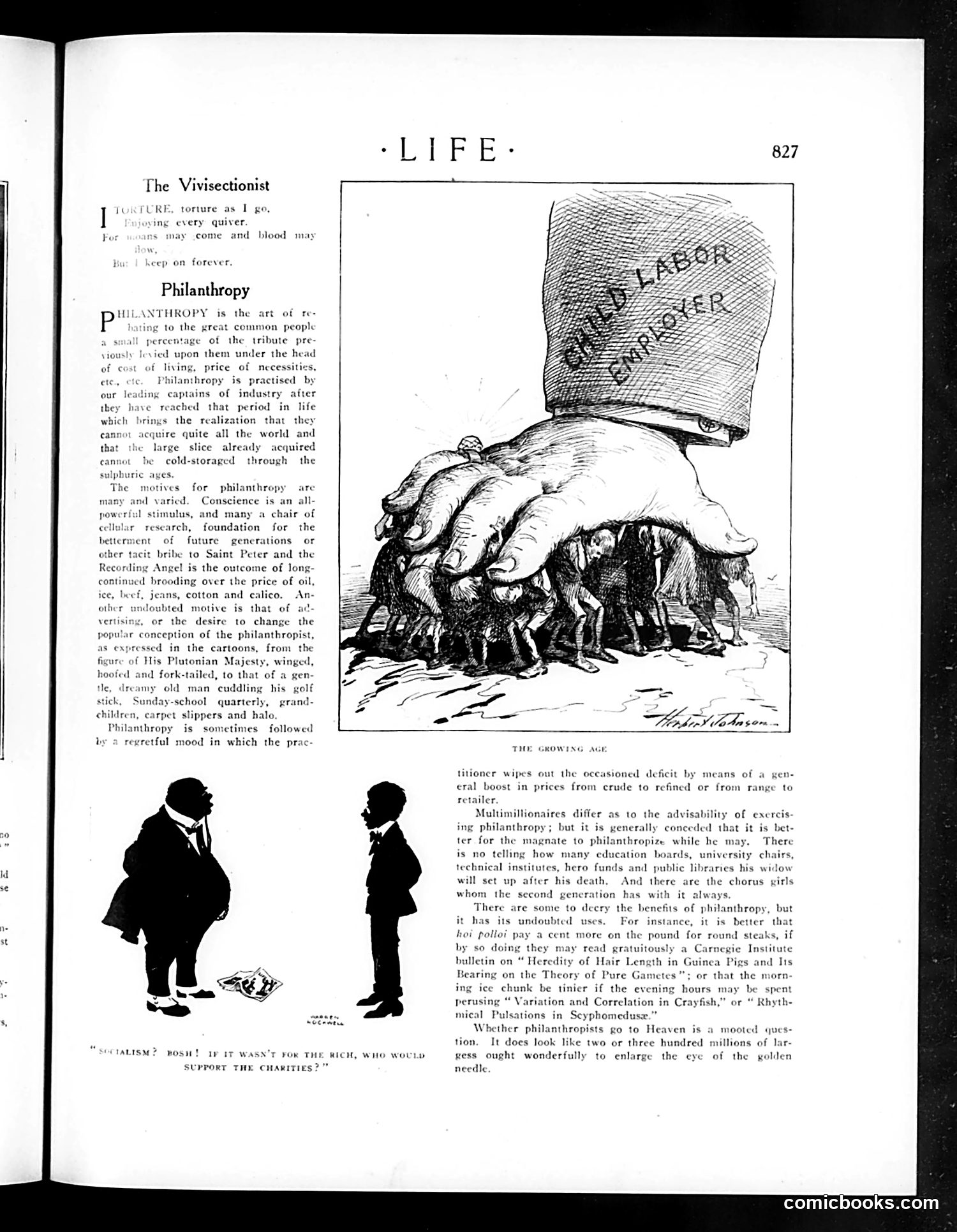
This page satirizes **philanthropy and wealth inequality**. The main cartoon titled "The Growing Age" depicts a wealthy hand dropping coins into a beggar child's palm—a visual critique of charity as insufficient and condescending. Below, a separate cartoon shows two silhouetted figures with the caption: "**Socialism? Bosh! If it wasn't for the rich, who would support the charities?**" This mocks the wealthy's self-congratulatory defense of their philanthropy, implying that charity merely patches problems their own wealth inequality creates, rather than addressing root causes. The text essay explores how industrialists turn to philanthropy late in life, questioning whether this genuinely benefits society or merely serves their reputation. Together, the content critiques wealthy donors' moral posturing around charitable giving.
📄 Transcribed text from this page (OCR, searchable)
Machine-transcribed from the original scan — historical spelling and the odd misread are preserved.
The Vivisectionist URE, torture as 1 go, ing every quiver. s may come and blood may Philanthropy HILANTHROPY is the art of re- a swall percentage of the tribute pre- \iously Jevied upon them under the head of cost of living, price of necessitic ete, Philanthropy is practised by our leading captains of industry after they have reached that period in life s the realization that they ¢ quite all the world and that the large slice already acquired cannot he cold-storaged through the sulphuric ayes. The motives for philanthropy are many and varied. Conscien in all- powerful stimulus, and many a chair of research, foundation for the nent of future generations or cit bribe to Saint Peter and the Angel is the outcome of long. ed brooding over the price of oil, jeans, cotton and calico. A andoubted motive is that of a or the desire to change the popular conception of the philanthropist, as expressed in the cartoons, from the of His Plutonian Majesty, winged, 1 and fork-tailed, to that of a , dreamy old man cuddling his go fe Sunday-school quarterly, gran Z _ : rs a children, carpet slippers and halo. KY SZ : : indir Aaa $0 Philanthropy is sometimes followed Coben regretful mood in which the prac- THE GROWING AGE titioner wipes out the occasioned deficit by means of a gen- eral boost in prices from crude to refined or from range to retailer, Multimillionaires differ as to the advisability of exercis ing philanthropy; but it is generally conceded that it is bet- ter for the magnate to philanthropize while he may. There is no telling how many education boards, university chairs, technical institutes, hero funds and public libraries his w will set up after his death. And there are the chorus gitls whom the second generation has with it always. There are some to decry the benefits of philanthropy, but it has its undoubted uses. For instance, it is better ¢ hoi polio’ pay a cent more on the pound for round steaks, if by so doing they may read gratuitously a Carnegie Institute bulletin on “ Heredity of Hair Length in Guinea Pigs and Its Bearing on the Theory of Pure Gametes"; or the morn- ing ice chunk be tinier if the evening hours may be spent perusing “ Variation and Correlation in Crayfish,” or “ Rhyth- mical Pulsations in Scyphomedusz.” Whether philanthropists go to Heaven is a mooted ques- tion. It does look like two or three hundred millions of lar- CIMLISM? WOSH! IP IT WASN'T YOR THE RICH, Wito WOULD ess ought wonderfully to enlarge the eye of the golden SUPPORT THE CHaRitiEs?” needle comicbooks.com