
Life, 1911-04-27 · page 24 of 44
Life — April 27, 1911 — page 24: what you’re looking at
What you’re looking at
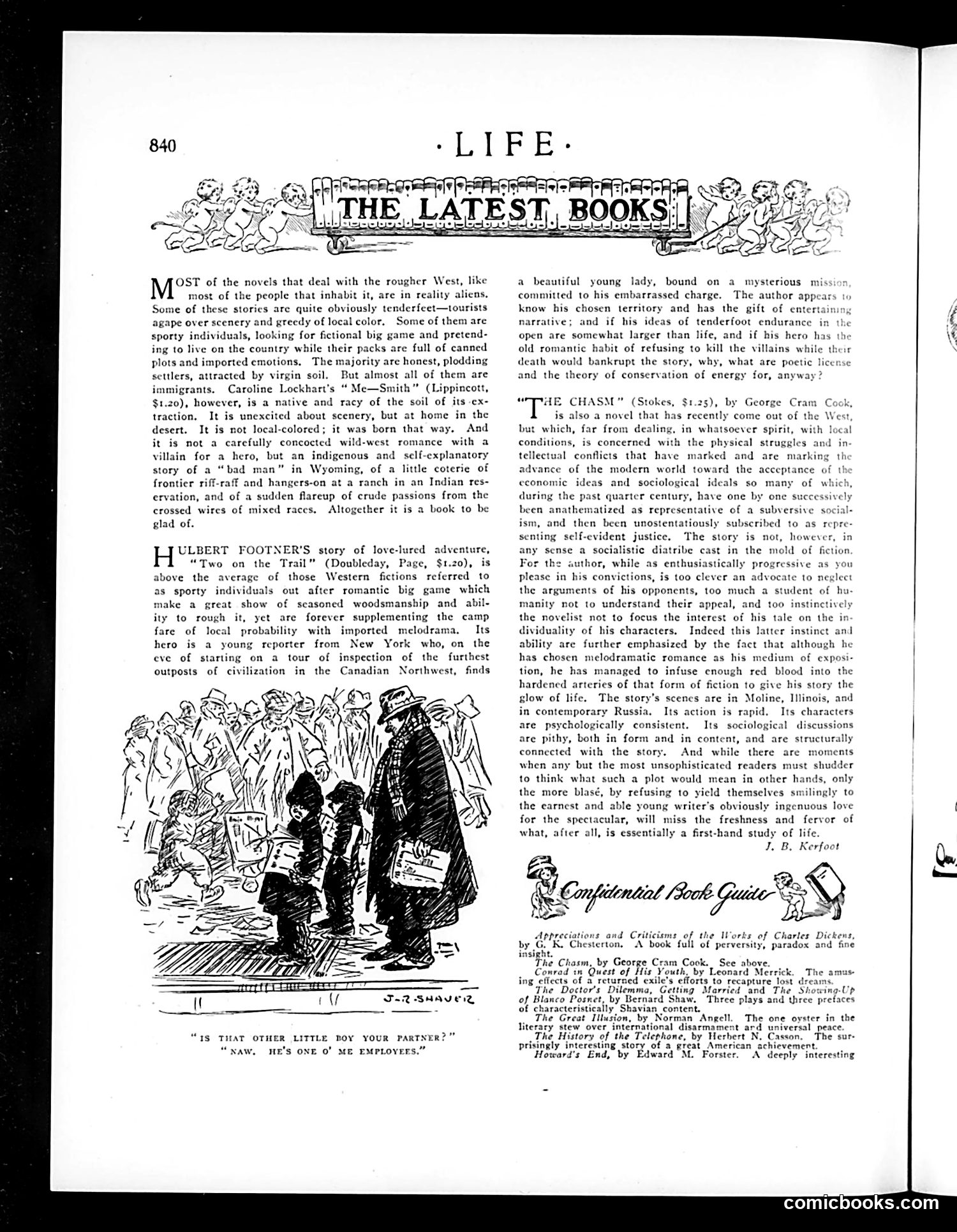
This page reviews contemporary Western novels and includes one cartoon. The cartoon depicts two men in frontier attire; one asks the other "Is that other little boy your partner?" and receives the reply "Naw, he's one o' me employees." The joke satirizes the brutality and exploitation of frontier labor practices—specifically, the casual reduction of child workers to "employees" rather than acknowledging them as human beings worthy of concern. It mocks the callous attitude of Western industrialists and ranch operators who treated vulnerable workers (including children) as disposable labor. The surrounding text discusses how most Western novels are written by outsiders seeking "local color," but praises Caroline Lockhart's "Me—Smith" as authentically native to the West. This reinforces the cartoon's implicit criticism: the real frontier wasn't romantic adventure fiction—it was a place where human exploitation went unremarked and unquestioned.
📄 Transcribed text from this page (OCR, searchable)
Machine-transcribed from the original scan — historical spelling and the odd misread are preserved.
M°* of the novels that deal with the rougher West, like most of the people that inhabit it, are in reality aliens. jerfeet—tourists Some of these stories are quite obviously te agape over scenery and greedy of local color, Some of them are sporty individuals, looking for fictional big game and pretend- ing to live on the country while their packs are full of canned plots and imported emotions, The majority arc honest, plodding settlers, attracted by virgin soil, But almost all of them are immigrants. Caroline Lockhart’s “ Me—Smith” (Lippincott, $1.20), however, is a native and racy of the soil of its -ex- traction. It is unexcited about scenery, but at home in the desert. It is not local-colored; it was born that way. And it is not a carefully concocted wild-west romance with a villain for a hero, but an indigenous and self-explanatory story of a “bad man” in Wyoming, of a little coterie of frontier riff-raff and hangers-on at a ranch in an Indian res- ervation, and of a sudden flareup of crude passions from the crossed wires of mixed races. Altogether it is a book to be glad of. ULBERT FOOTNER'S story of love-lured adventure, “Two on the Trail” (Doubleday, Page, $1.20), is above the average of those Western fictions referred to as sporty individuals out after romantic big game which make a great show of seasoned woodsmanship and abil- ity to rough it, yet are forever supplementing the camp fare of local probability with imported melodrama. Its hero is a young reporter from New York who, on the eve of starting on a tour of inspection of the furthest outposts of civilization in the Canadian Northwest, finds “8 THAT OTHER LITTLE BOY YOUR PARTNER?” “Naw, HE'S ONE 0’ ME EMPLOYEES.” a beautiful young lady, bound on a mysterious miss committed to his embarrassed charge. The author appc know his chosen territory and has the gift of enter: narrative; and if his ideas of tenderfoot endurance i open are somewhat larger than life, and if his hero has the old romantic habit of refusing to kill the villains while ther death would bankrupt the story, why, what are poetic license and the theory of conservation of energy for, anyway? “T IE CHASM” (Stokes, $1.25), by George Cram Cook, is also a novel that has recently come out of but which, far from dealing, in whatsoever spirit, with local conditions, is concerned with the physical struggles and in tellectual conflicts that have marked and are marking th advance of the modern world toward the acceptance of economic ideas and sociological ide during the been anathematized as representative of a subversive social- ism, and then been unostentatiously subscribed to as repre- senting self-evident justice. The story is not, howes any sense a socialistic diatribe cast in the mold of f For the author, while as enthusiastically progressive as you please in his convictions, is too clever an advocate to ne the arguments of his opponents, too much a student of hu- manity not to understand their appeal, and too instinctively the novelist not to focus the interest of his tale on the in dividuality of his characters, Indced this latter instinct and ability are further emphasized by the fact that although he has chosen melodramatic romance as his medium of exposi- tion, he has managed to infuse enough red blood into the hardened arteries of that form of fiction to give his story the glow of life. The story’s scenes are in Moline, Illinois, and in contemporary Russia, Its action is rapid. Its characters are psychologically consistent. Its sociological discussions are pithy, both in form and in content, and are structurally connected with the story. And while there are moments when any but the most unsophisticated readers must shudder to think what such a plot would mean in other hands, only the more blasé, by refusing to yicld themselves smilingly to the earnest and able young writer's obviously ingcnuous love for the spectacular, will miss the freshness and fervor of what, after all, is essentially a first-hand study of life. I. B. Kerfoot Is so m ny of w ast quarter century, have one by one success f, in fiction. Appreciations and Criticisms of the Works of Charles Dick by GK. Chesterton, “A book full of perversity, paradox and insight. The Chasm, by George C Conrad in Quest of His Youth, by Leonard Merrick. ing effects of a returned exile’s efforts to recapture lost The Doctor's Dilemma, Getting Married and The of Blanco Posnet, by Bernard Shaw. Three plays and three p of characteristically Shavian content. The Great Illusion, by Norman Angell. The one oyster in the literary stew over international disarmament ard universal peace. The History of the Telephone, by Herbert N. Casson. The sur- prisingly interesting story of a great American achievement. Howard's End, by Edward M. Forster. A deeply interesting am Cook. See above. comicbooks.com