
Life, 1911-04-27 · page 8 of 44
Life — April 27, 1911 — page 8: what you’re looking at
What you’re looking at
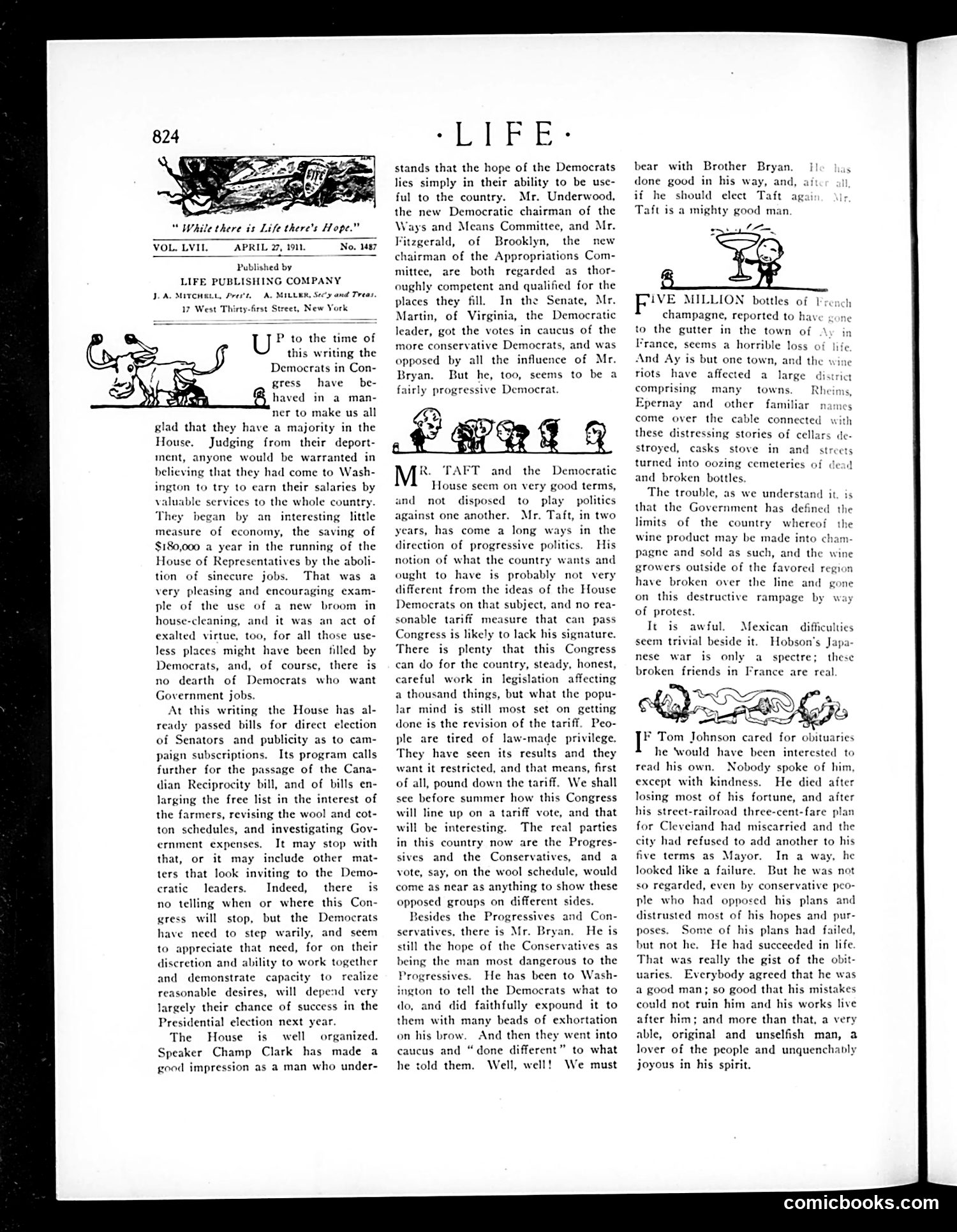
This page contains political commentary rather than cartoons. The main illustration shows **William Howard Taft and William Jennings Bryan** as caricatured figures in what appears to be a reconciliation scene, captioned "Wherefore is Life there's Hope." The text discusses Democratic Party divisions, specifically praising House Speaker Champ Clark's organization while analyzing internal tensions between progressive and conservative Democrats. It mentions **Mr. Taft** and **Mr. Bryan** competing for political influence within the party. The secondary item discusses **Tom Johnson's** death and his unsuccessful Cleveland transit plans, praising him as a well-intentioned but ultimately failed reformer. The overall tone is satirical commentary on early 20th-century Democratic Party politics and progressive reform efforts.
📄 Transcribed text from this page (OCR, searchable)
Machine-transcribed from the original scan — historical spelling and the odd misread are preserved.
“ While there is Life there's Hope.” VOL. LVIL. No. 1487 APRIL 2, 1911. Published by LIFE PUBLISHING COMPAN JOA MITCHELL, Prest, 17 West Thirty-first Ste U > to the time of this writing the Democrats in Con- gress have be- haved in ner tor glad that they have a majority in the House. Judging from their deport- ment, anyone would be warranted in believing that they had come to Wash- ington to try to earn their salaries by valuable services to the whole country. They began by an_ interesting little measure of economy, the saving of $180,000 a year in the running of the House of Representatives by the aboli- tion of sinecure jobs. That was a very pleasing and encouraging exam- ple of the use of a new broom in house-cleaning, and it was an act of exalted virtue, too, for all those use- less places might have been filled by Democrats, and, of course, there is no dearth of Democrats who want Government jobs. At this writing the House has al- ready passed bills for direct election of Senators and publicity as to cam- paign subscriptions. Its program calls further for the passage of the Cana- dian Reciprocity bill, and of bills en- larging the free list in the interest of the farmers, revising the wool and cot- ton schedules, and investigating Gov- ernment. expen It may stop with that, or it may include other mat- ters that look inviting to the Demo- cratic leaders. Indeed, there is no telling when or where this Con- gress will stop, but the Democrats have need to step warily, and seem to appreciate that need, for on their discretion and ability to work together: and demonstrate capacity to realize reasonable desires, will depend very largely their chance of success in the Presidential election next year. The House is well organized. Speaker Champ Clark has made a good impression as a man who under- A. MILURR, Sec'y and Treas On) cl) stands that the hope of the Democrats lies simply in their ability to be use- ful to the country. Mr. Underwood, the new Democratic chairman of the Ways and Means Committee, and Mr. Fitzgerald, of Brooklyn, the new chairman of the Appropriations Com- mittee, are both regarded as_thor- oughly competent and qualified for the places they fill. In the Senate, Mr. Martin, of Virginia, the Democratic leader, got the votes in caucus of the more conservative Democrats, and was opposed by all the influence of Mr. Bryan. But he, too, seems to be a fairly progressive Democrat. Mé® TAFT and the Democratic House seem on very good terms, and not disposed to play politics against one another. Mr. Taft, in two years, has come a long ways in the direction of progressive politics. His notion of what the country wants and ought to have is probably not very different from the ideas of the House Democrats on that subject, and no rea- sonable tariff measure that can pass Congress is likely to lack his signature. There is plenty that this Congress can do for the country, steady, honest, careful work in legislation affecting a thousand things, but what the popu- lar mind is still most set on getting done is the revision of the tariff. Peo- ple are tired of law-made privilege. They have seen its results and they want it restricted, and that means, first of all, pound down the tariff. We shall see before summer how this Congress will line up on a tariff vote, and that will be interesting. The real parties in this country now are the Progres- and the Conservatives, and a vote, say, on the wool schedule, would come as near as anything to show these opposed groups on different sides. Besides the Progressives and Con- servatives, there is Mr. Bryan. He is still the hope of the Conservatives as being the man most dangerous to the Progressives. He has been to Wash- ington to tell the Democrats what to do, and did faithfully expound it to them with many beads of exhortation on his brow. And then they went into caucus and “done different” to what he told them. Well, well! We must sives bear with Brother Bryan. done good in his way, and, ¢ if he should elect Taft agai Taft mighty good man IVE MILLION bottles of | champagne, reported to have to the gutter in the town of France, seems a horrible loss of And Ay is but one town, and the riots have affected a large d comprising = many Epernay and other familiar names come over the cable connected with these distressing stories of cellars de- stroyed, casks stove in and. streets turned into oozing cemeteries of dead and broken bottles. towns. Rheims, The trouble, as we understand it. is that the Government has defined the limits of the country whereof wine product may be made into cham- pagne and sold as such, and the wine growers outside of the favored region have broken over the line and gone on this destructive rampage by way of protest. It is awful, Mexican seem trivial beside it. Hobson's Japa- nese war is only a spectre; these broken friends in France are real NS SPORES F Tom Johnson cared for obituaries he Would have been interested to read his own. Nobody spoke of him, except with kindness. He died after losing most of his fortune, and after his street-railroad three-cent-fare plan for Cleveiand had miscarried and the city had refused to add another to his five terms as Mayor. In a way, he looked like a failure. But he was not so regarded, even by conservative p ple who had opposed his plans and distrusted most of his hopes and pur- Some of his plans had failed, but not he, He had succeeded in life. That was really the gist of the obit uaries. Everybody agreed that he was a good man; so good that his mistakes could not ruin him and his works live after him; and more than that, a very able, original and unselfish man, a lover of the people and unquenchably joyous in his spirit. difficulties poses. comicbooks.com