
Life, 1911-04-27 · page 36 of 44
Life — April 27, 1911 — page 36: what you’re looking at
What you’re looking at
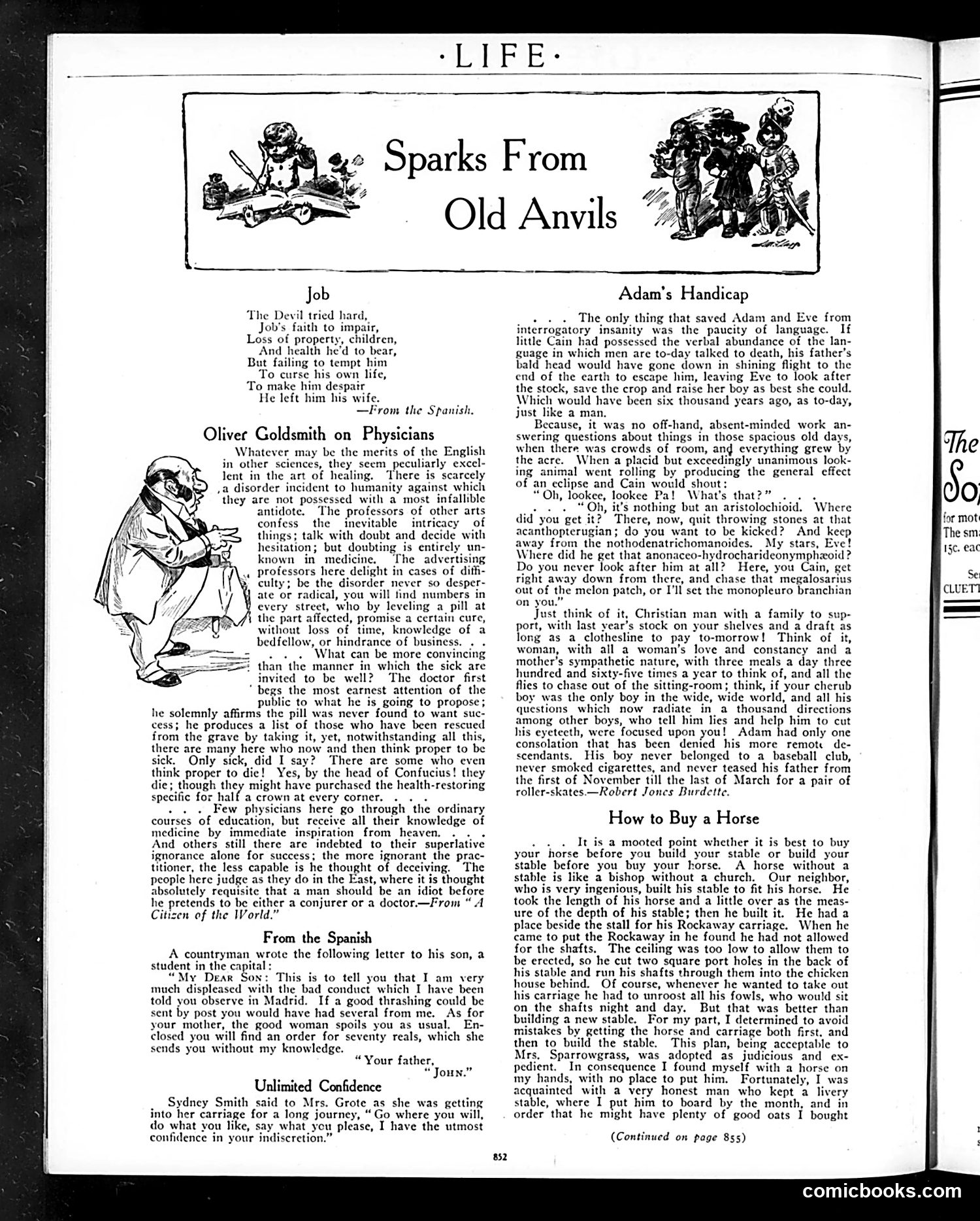
This page collects brief satirical pieces and quotations rather than political cartoons. The content targets **English physicians and social pretension**: **Oliver Goldsmith on Physicians** mocks English doctors for unfounded confidence. Goldsmith (18th-century Irish writer) satirizes physicians who promise miracle cures, produce testimonials from "rescued" patients, yet people still die—suggesting doctors rely on ignorance and deception rather than actual medical knowledge. The jab at "inspiration from heaven" implies charlatanism. **Other pieces** include classical proverbs (Job's wife as punishment; a Spanish father's letter to his wayward son) and a quip by Sydney Smith about Mrs. Grote's "indiscretion"—all emphasizing human folly. **The satirical target** is medical quackery and the gap between doctors' confident claims and actual results—a timeless complaint, though particularly pointed when formal medical training was genuinely limited and ineffective remedies were common.
📄 Transcribed text from this page (OCR, searchable)
Machine-transcribed from the original scan — historical spelling and the odd misread are preserved.
CRE Sparks From Old Anvils The Devil tried hard, Job's faith to impair, Loss of property, children, And health he'd to bear, But failing to tempt him To curse his own life, To make him despair He left him his wife. —From the Spanish. Oliver Goldsmith on Physicians Whatever may be the merits of the English in other sciences, they seem peculiarly excel- lent in the art of healing. There is scarcely ,a disorder incident to humanity against which they are not possessed with a most infallible antidote. The professors of other arts confess the inevitable intricacy of things; talk with doubt and decide with hesitation; but doubtin; known in medicine. professors here delight in cases of difh- culty; be the disorder never so desper- ate or radical, you will find numbers in Y every street, ‘who by leveling a_pill at the part affected, promise a certain cure, without loss of time, knowledge of a bedfellow, or hindrance of business. What can be more convincing than the manner in which the sick are invited to be well? The doctor first “begs the most earnest attention of the public to what he is going to propose; he solemnly affirms the pill was never found to want suc- cess; he produces a list of those who have been rescued from the grave by taking it, yet, notwithstanding all this, there are eee here who now and then think proper to be sick. Only sick, did I say? There are some who even think proper to die! Yes, by the head of Confucius! they die; though they might have purchased the health-restoring specific for half a crown at every corner. . . . . Few physicians here go through ‘the ordinary courses of education, but receive all their knowledge of medicine by immediate inspiration from heaven. . . And others still there are indebted to their superlative ignorance alone for success; the more ignorant the prac- titioner, the less capable is he thought of deceiving. The people here judge as they do in the East, where it is thought absolutely requisite that a man should be an idiot before he pretends to be cither a conjurer or a doctor—From “A Citizen of the World.” From the Spanish A countryman wrote the following letter to his son, a student in the capital : “My Dear Son: This is to tell you that I am very much displeased with the bad conduct which I have been told you observe in Madrid. If a good thrashing could be sent by post you would have had several from me. As for your mother, the good woman spoils you as usual, En- closed you will find an order for seventy reals, which she sends you without my knowledge. “Your father, * Joun.” Unlimited Confidence Sydney Smith said to Mrs. Grote, as she was getting into her carriage for a long journey, “Go where you will, do what you like, say what ut please, I have the utmost confidence in your indiscretion.” Adam's Handicap + . . The only thing that saved Adam and Eve from interrogatory insanity was the paucity of language. If little Cain had possessed the verbal abundance of the lan- guage in which men are to-day talked to death, his father’s bald head would have gone down in shining flight to the end of the earth to escape him, leaving Eve to look after the stock, save the crop and raise her boy as best she could. Which would have been six thousand years ago, as to-day, just like a man. Because, it was no off-hand, absent-minded work an- swering questions about things in those spacious old days, when there was crowds of room, ang everything grew by the acre. When a placid but exceedingly unanimous look- ing animal went rolling by producing the general effect of an. eclipse and Cain would shout: “Oh, lookee, lookee Pa! What's that?” . . “Oh, it’s nothing but an aristolochioid. Where did you ‘get it?” There, now, quit throwing stones at that acanthopterugian; do you want to be kicked? And keep away from the nothodenatrichomanoides. My stars, Eve! Where did he get that anonaceo-hydrocharideonymphzoid ? Do you never look after him at all? Here, you Cain, get right away down from there, and chase that megalosarius out of the melon patch, or I'll set the monopleuro branchian on you.” Just, think of it, Christian man with a family to sup- port, with last year’s stock on your shelves and a draft as long as a clothesline to pay to-morrow! Think of it, woman, with all a woman’s love and constancy and a mother’s sympathetic nature, with three meals a day three hundred and sixty-five times a year to think of, and all the flies to chase out of the sitting-room; think, if your cherub boy was the only boy in the wide, wide world, and all his questions which now radiate in| a thousand directions among other boys, who tell him lies and help him to cut his eyeteeth, were focused upon you! Adam had only one consolation that has been denied his more remote de- scendants. His boy never belonged to a baseball club, never smoked cigarettes, and never teased his father from the first of November till the last of March for a pair of roller-skates.—Robert Joncs Burdette. How to Buy a Horse It is a mooted point whether it is best to buy your horse before you build your stable or build your stable before you buy your horse. A horse without a stable is like a bishop without a church. Our neighbor, who is very ingenious, built his stable to fit his horse. He took the length of his horse and a little over as the meas- ure of the depth of his stable; then he built it. He had a place beside the stall for Rockaway carriage. When he came to put the Rockaway in he found he had not allowed for the shafts, The ceiling was too low to allow them to be erected, so he cut two square port holes in the back of his stable and run his shafts through them into the chicken house behind. Of course, whenever he wanted to take out his carriage he had to unroost all his fowls, who would sit on the shafts night and day. But that was better than building a new stable. For my part, I determined to avoid mistakes by getting the horse and carriage both first. and then to build the stable. This plan, being acceptable to Mrs, Sparrowgrass, was adopted as judicious and ex- pedient. In consequence I found myself with a horse on my hands, with no place to put him. Fortunately, I was acquainted with a very honest man who kept a livery stable, where I put him to board by the month, and in order that he might have plenty of good oats I bought (Continued on page 855) comicbooks.com