
Life, 1911-04-27 · page 20 of 44
Life — April 27, 1911 — page 20: what you’re looking at
What you’re looking at
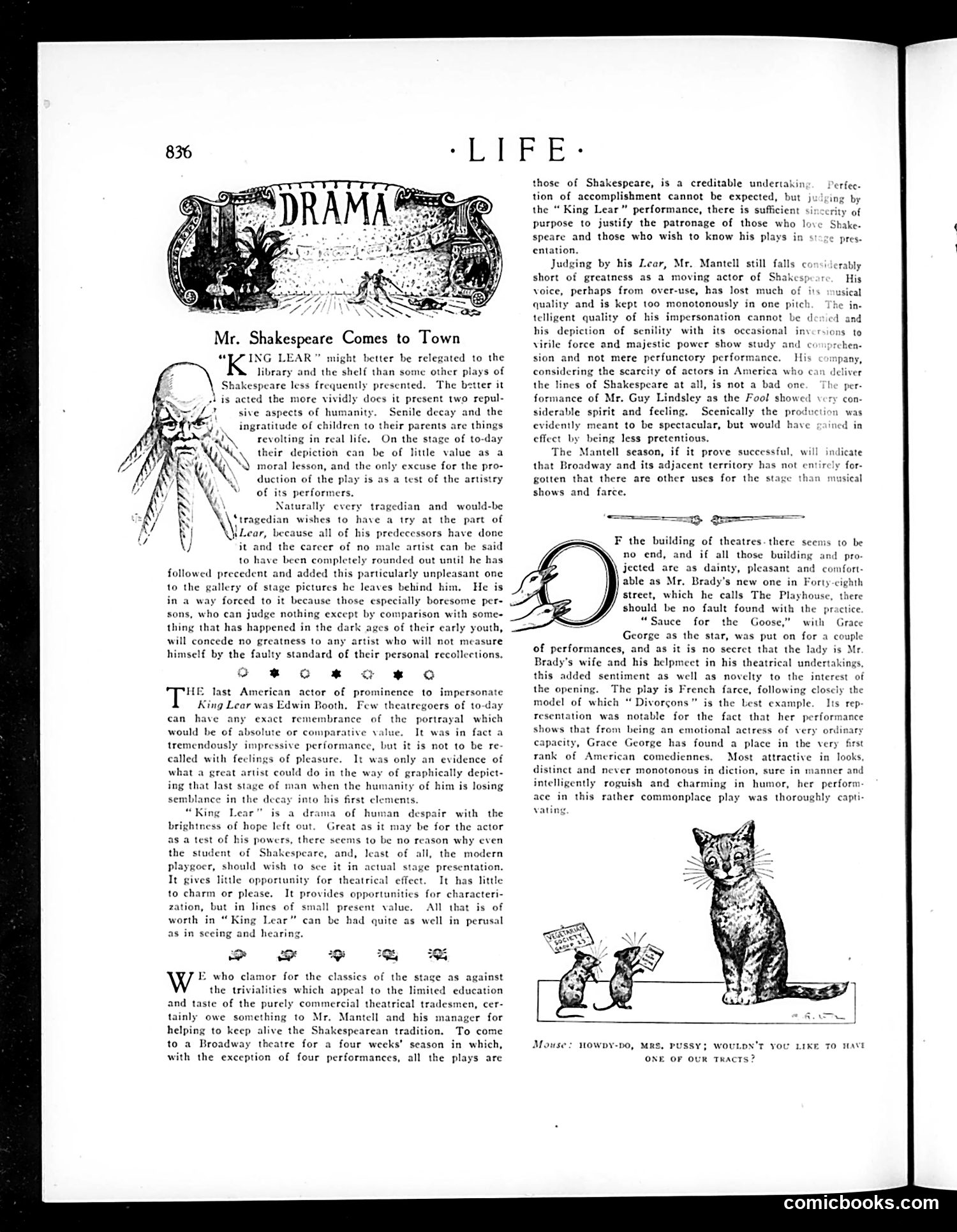
This page reviews Richard Mantell's Broadway production of Shakespeare's *King Lear*. The main article criticizes the play itself as unsuitable for modern theater—arguing it presents only "repulsive aspects of humanity" (senile decay, filial ingratitude) without moral value or theatrical charm. The critic acknowledges Mantell's earnest effort to preserve Shakespeare on Broadway, calling it "creditable" but notes Mantell falls "considerably short of greatness." His voice has lost musicality from overuse, though his depiction of senility shows study and occasional power. The accompanying illustrations—a bearded classical head (likely representing Shakespeare) and a humorous drawing of a cat with mice holding papers—appear to be decorative rather than directly satirical, with the cat caption making a mild joke about tracts. The piece reflects early-20th-century theatrical criticism valuing classical performance while questioning whether *King Lear* serves modern audiences better than reading it.
📄 Transcribed text from this page (OCR, searchable)
Machine-transcribed from the original scan — historical spelling and the odd misread are preserved.
“LIFE - SS? Ao Mr. Shakespeare Comes to Town “[Z ING LEAR” might better be relegated to the K library and the shelf than some other plays of Shakespeare less frequently presented. The better it 1 cted the more vividly does it present two repul- sive aspects of humanity. Senile decay and the ingratitude of children to their parents are things Aal revolting in real life. On the stage of to-day MC\ their depiction can be of little value as a : WS moral lesson, and the only excuse for the pro- M7 duction of the play is as a test of the artistry of its performers. Naturally every tragedian and would-be ‘tragedian wishes to have a try at the part of \\iLear, because all of his predecessors have done it and the carcer of no male artist can be said to have been completel followed precedent and added this particularly unpleasant one to the gallery of stage pictures he leaves behind him, He is in a way forced to it because those especially boresome per- sons, who can judge nothing by comparison with some- thing that has happened in the dark ages of their early youth, will concede no greatness to any artist who will not measure himself by the faulty standard of their personal recollections. o * © * 2 *# OG HE last American actor of prominence to impersonate King Lear was Edwin Booth, Few theatregoers of to-day can have any exact remembrance of the portrayal which rounded out until he has would be of absolute or comparative value. It was in fact a tremendously impressive performance, but it is not to be re called with feclings of pleasure. It was only an evidence of what a great artist could do in the way of graphically depict- ing that last stage of man when the humanity of him is losing semblance in the decay into his first elements. ng Lear” is a drama of human despair with the brightness of hope left out. Great as it may be for the actor as a test of his powers, there seems to be no reason why even the student of Shakespeare, and, least of all, the modern playgoer, should wish to sce it in actual stage presentation. It gives little opportunity for theatrical effect. It has little to charm or please, It provides opportunities for characteri- zation, but in lines of small present valuc. All that is of worth in “King Lear” can be had quite as well in perusal as in seeing and hearing. W who clamor for the classics of the stage as against the trivialities which appeal to the limited education and taste of the purely commercial theatrical tradesmen, cer- tainly owe something to Mr. Mantell and his mana helping to keep alive the Shakespearean tradition, To come to a Broadway theatre for a four weeks’ season in which, with the exception of four performances, all the plays are those of Shakespeare, is a creditable undertakin tion of accomplishment cannot be expected, but j the “ King Lear” performance, there is sufficient sincerity of purpose to justify the patronage of those who love Shake- speare and those who wish to know his plays in pres: entation. Judging by his Lear, Mr. Mantell still falls considerably short of greatness as a moving actor of Shakespeare. His voice, perhaps from over-use, has lost much of iis susical quality and is kept too monotonously in one pitel ¢ in- telligent quality of his impersonation cannot be desied and his depiction of senility with its occasional ons to virile force and majestic power show study a 1 sion and not mere perfunctory performance, His company, considering the scarcity of actors in America who can deliver the lines of Shakespeare at all, is not a bad one. ‘The per- formance of Mr. Guy Lindsley as the Fool showed very con- siderable spirit and fecling. Scenically the production was evidently meant to be spectacular, but would have gained in effect by being less pretentious. The Mantell season, if it prove successful, will indicate that Broadway and its adjacent territory has not entirely for- gotten that there are other uses for the stage than musical shows and farce. ==> F the building of theatres. there seems to be no end, and if all those building and pro- \ jected are as dainty, pleasant and comfort- | able as Mr. Brady's new one in Forty-cighth street, which he calls The Playhouse, there should be no fault found with the practice “Sauce for the Goose,” with Grace George as the star, was put on for a couple nces, and as it is no secret that the lady is Mr Brady's wife and his helpmect in his theatrical undertakings, this added sentiment as well as novelty to the interest of the opening. The play is French farce, following closely the model of which “ Divorgons” is the Lest example. Its rep resentation was notable for the fact that her performance shows that from being an emotional actress of very o1 ry capacity, Grace George has found a place in the very first rank of American comediennes. Most attractive in looks. distinct and never monotonous in diction, sure in manner and intelligently roguish and charming in humor, her perform ace in this rather commonplace play was thoroughly capti- Mouse: Wowpy-po, MRS, PUSSY; WOULDN'T YoU LIKE TO ONE OF OUR TRACTS? comicbooks.com