
A complete issue · 44 pages · 1911
Life — February 23, 1911
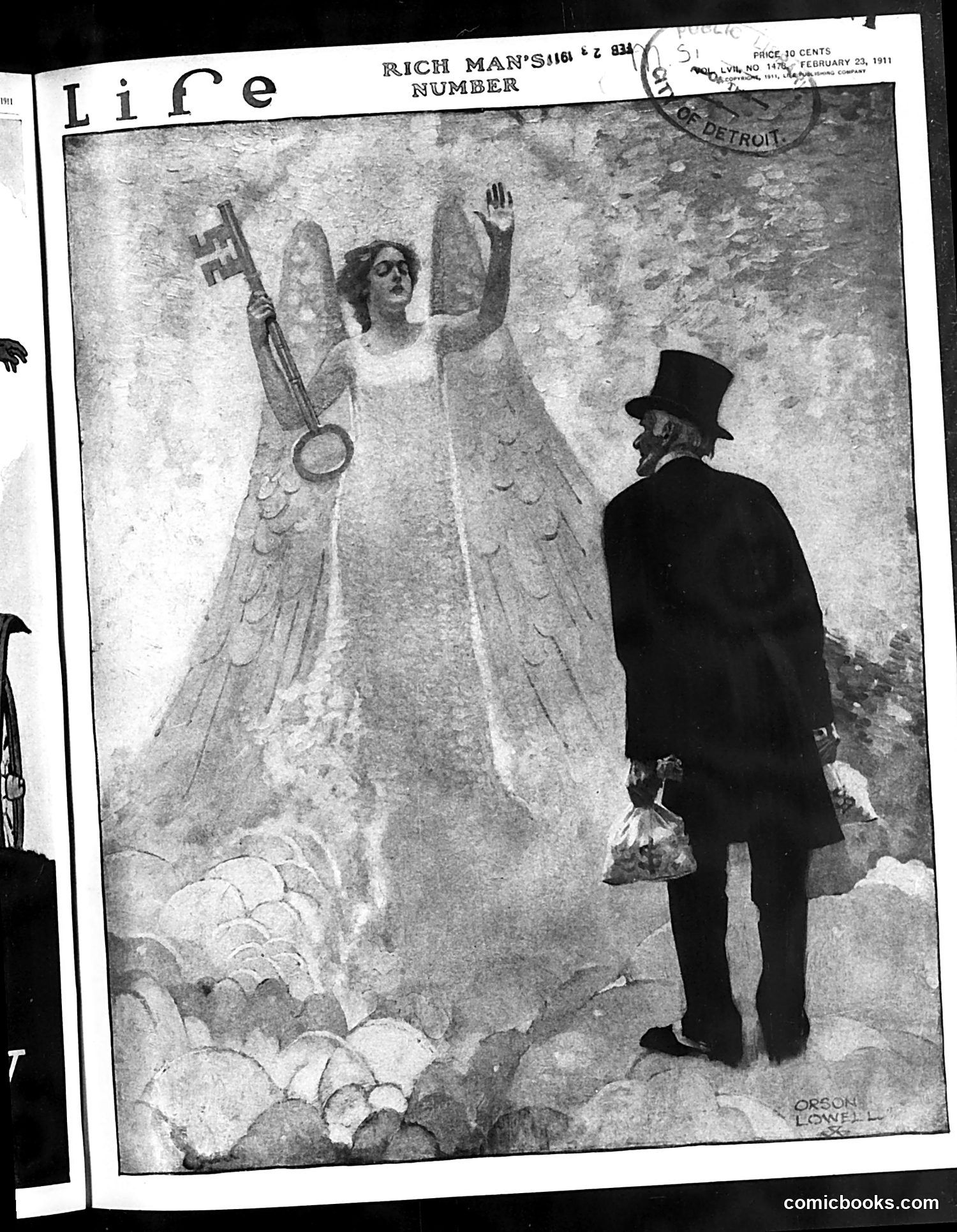
This appears to be a political cartoon from Life's "Rich Man's Number" issue (February 23, 1911). The image shows a well-dressed gentleman in a top hat approaching a winged female angel figure holding a key and raising her hand in blessing or welcome. The satire likely critiques wealthy individuals' relationship with morality or the afterlife—suggesting that riches might grant access to heaven or divine favor. The angel could represent heavenly gates or salvation, while the "rich man" approaches with apparent confidence, perhaps implying that wealth provides shortcuts to spiritual reward. The signed artist appears to be Orson Lowell. The cartoon reflects Progressive Era skepticism about capitalism and whether money could buy moral or spiritual standing.
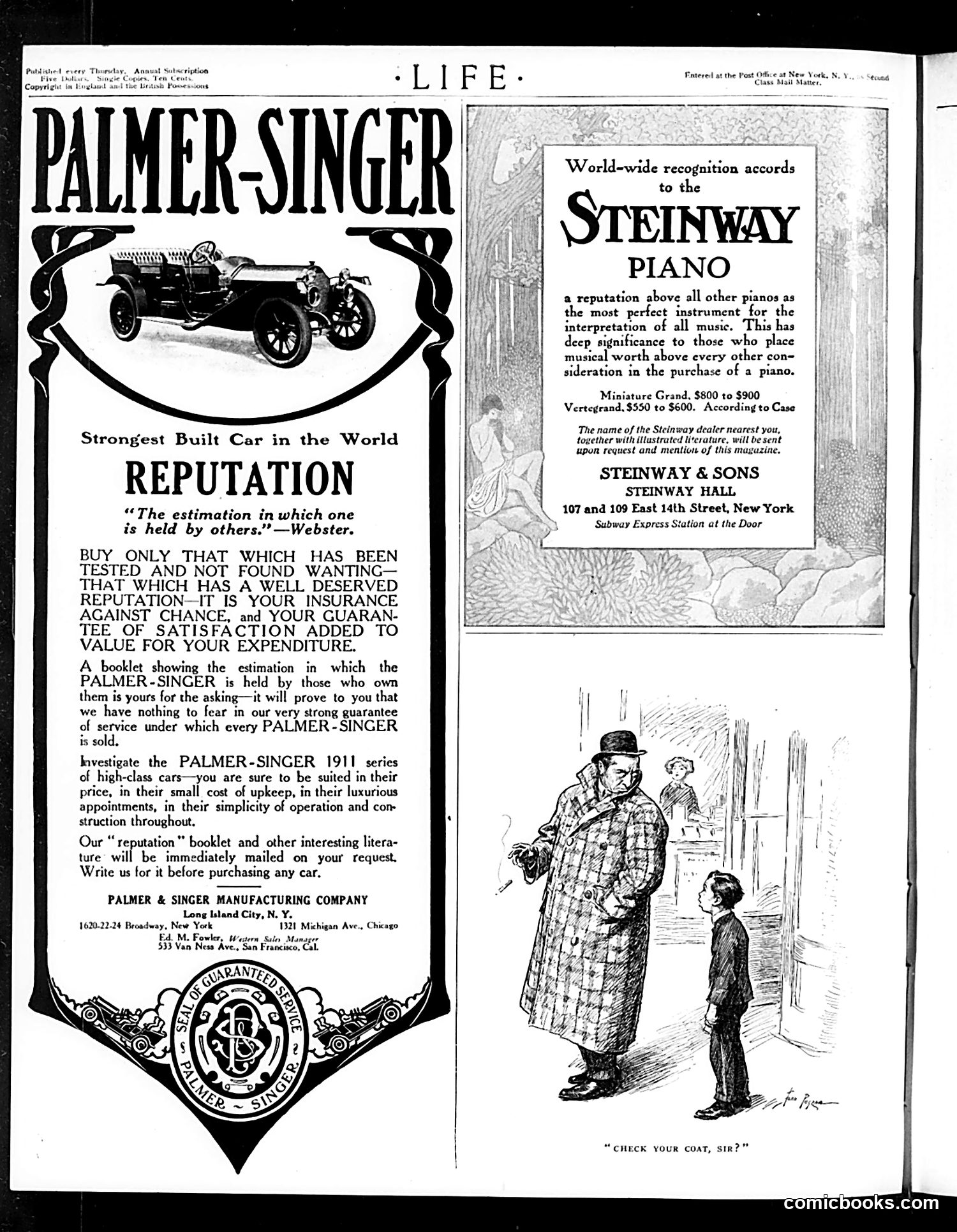
This page is primarily **advertising, not satire or political commentary**. The left side advertises the **Palmer-Singer automobile** (1911), emphasizing its reputation as "the strongest built car in the world." The ad appeals to buyers seeking reliability and value. The right side advertises **Steinway pianos**, highlighting their "world-wide recognition" as superior instruments for serious musicians, priced $800-$900 for miniature grands. The **single cartoon** ("Check Your Coat, Sir?") at bottom right is unrelated social humor: it shows a doorman or attendant asking a poorly-dressed visitor to check his shabby coat, implying class-based embarrassment. This is gentle observational comedy about social pretension, not political satire. The page reflects early 1900s consumer culture targeting affluent readers.
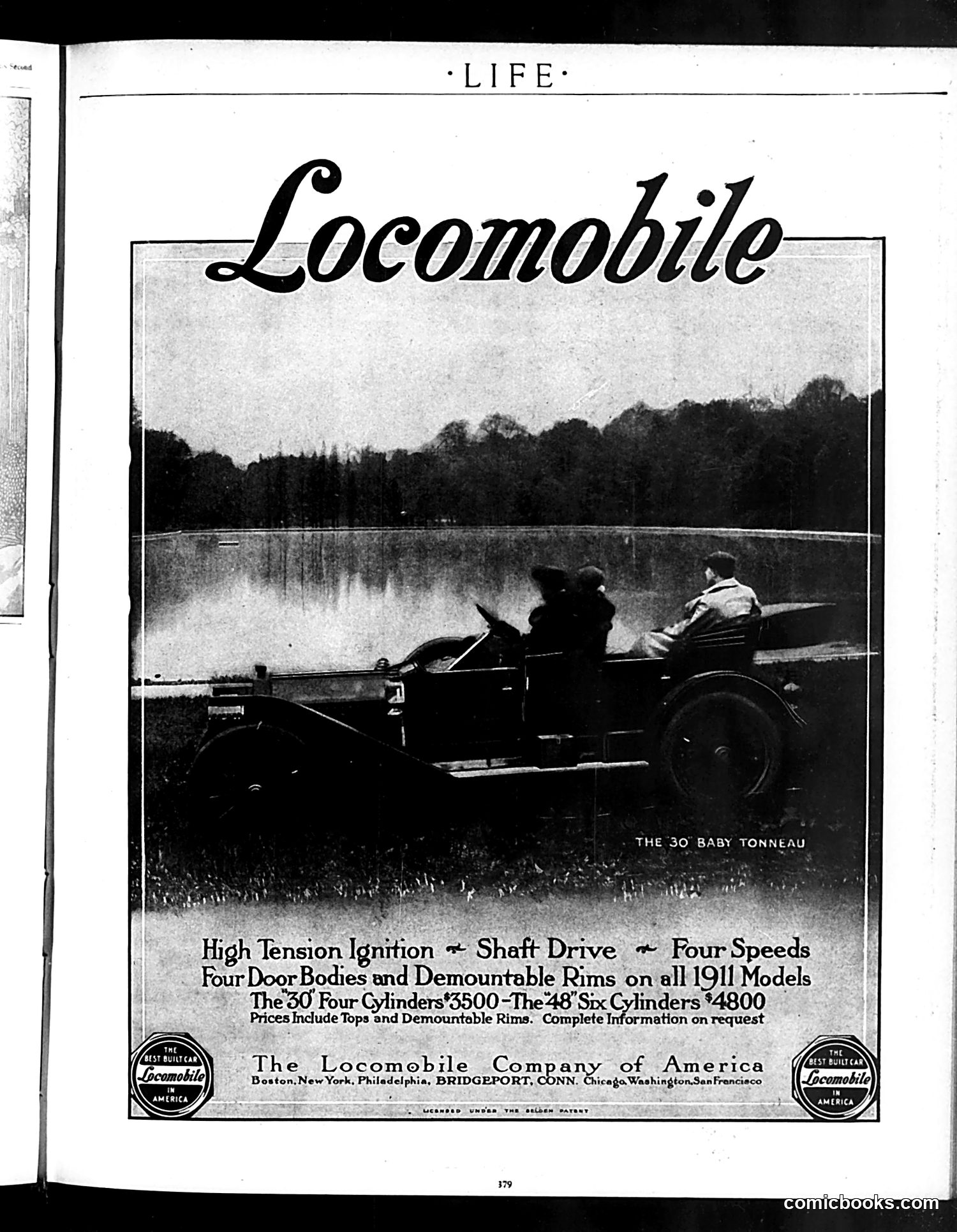
This is **not a political cartoon or satire**—it's a straightforward automobile advertisement from *Life* magazine. The page advertises the **Locomobile**, a luxury car manufactured by The Locomobile Company of America. The image shows two passengers in an open-air "Baby Tonneau" model posed beside a scenic lake with trees reflected in the water. The ad emphasizes technical features: high-tension ignition, shaft drive, four speeds, four-door bodies, and demountable rims. Pricing information for different cylinder models (30 Four-Cylinder, 48 Six-Cylinder) is listed, with prices including tops and rims. This represents early 1910s automotive marketing, targeting wealthy consumers interested in modern mechanical innovations and leisurely motoring experiences.
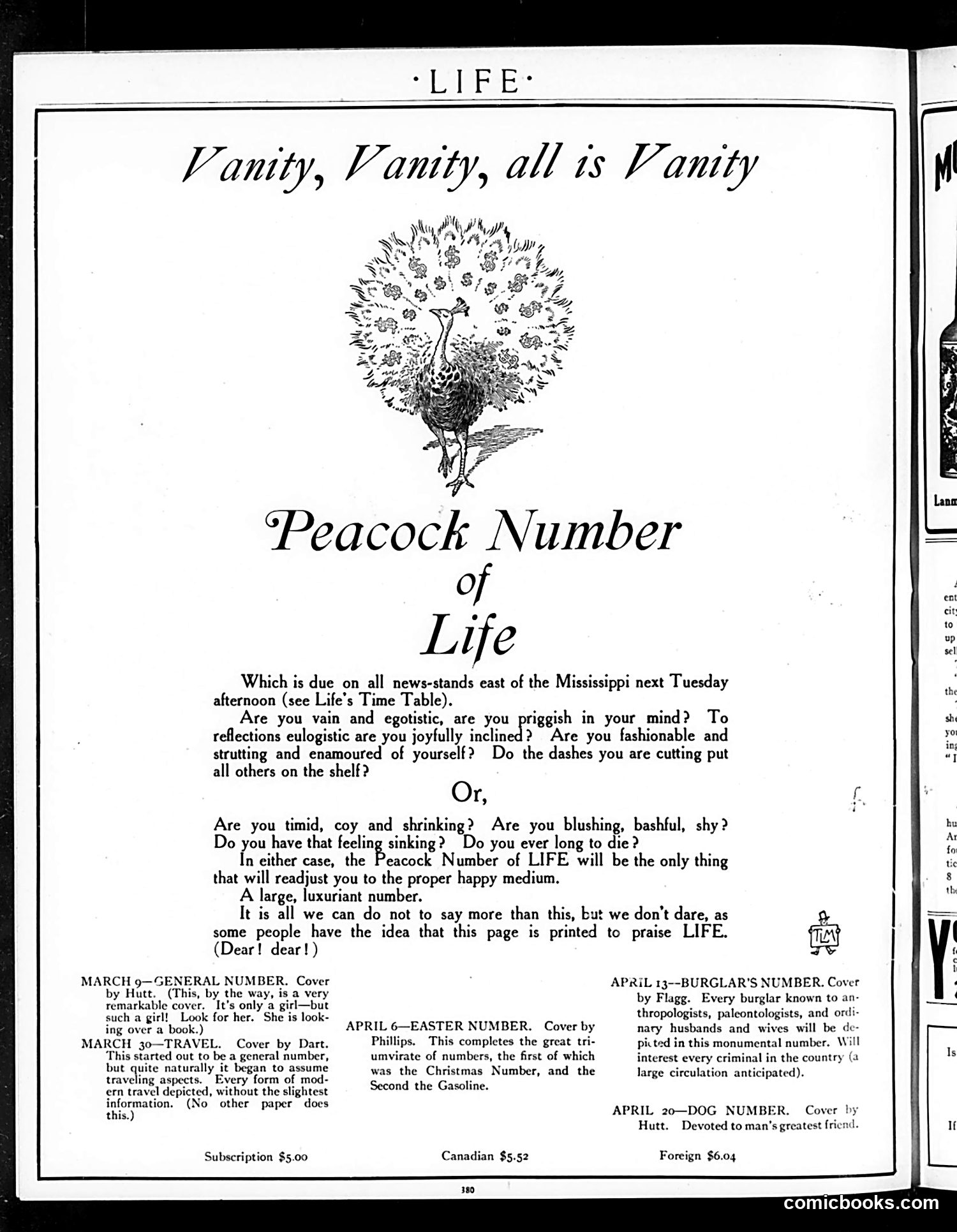
This page announces Life magazine's "Peacock Number" — a special issue using the peacock (the magazine's mascot) as its theme. The title "Vanity, Vanity, all is Vanity" plays on the biblical phrase about human pride. The satirical text poses two contrasting personality types to readers: Are you vain, egotistical, and fashionable — or timid, shy, and shrinking? The joke suggests that Life magazine's "Peacock Number" will help readers discover their "proper happy medium," implying that neither extreme is ideal. This is self-promotional satire: the text jokes that some people think the page "praises LIFE" while denying it does so — a tongue-in-cheek commentary on the magazine's own vanity in publishing special themed issues. The bottom lists upcoming special issues (Easter, Burglar's, Travel, Dog numbers), showing Life's regular practice of themed editions.
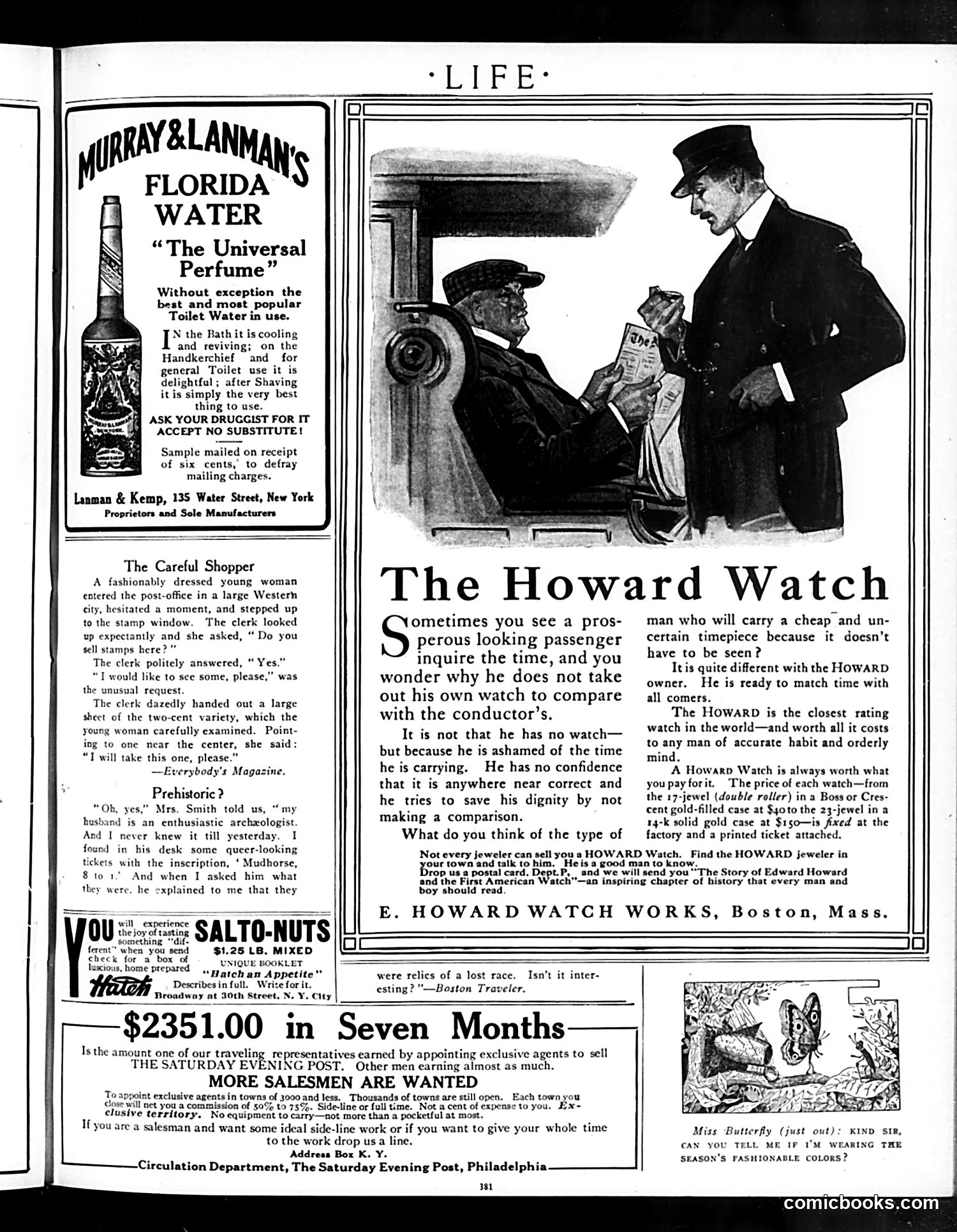
This page is primarily **advertising**, not political satire. The main content features three ads: 1. **Murray & Lanman's Florida Water** – a perfume/toilet water product 2. **The Howard Watch** – the dominant advertisement showing two men (a conductor and passenger) comparing timepieces, emphasizing the watch's reliability and affordability 3. **Salto-Nuts** – a snack food 4. **Saturday Evening Post** – recruiting traveling salesmen The smaller anecdotes ("The Careful Shopper," "Prehistoric") are brief humor pieces common to Life magazine, not political commentary. The **Howard Watch ad's central joke**: a prosperous-looking passenger is embarrassed to compare his cheap watch with a conductor's, fearing inferiority. The pitch reassures buyers that Howard watches are reliable and affordable—quality doesn't require shame. This reflects early 20th-century consumer anxiety about social status through purchased goods.
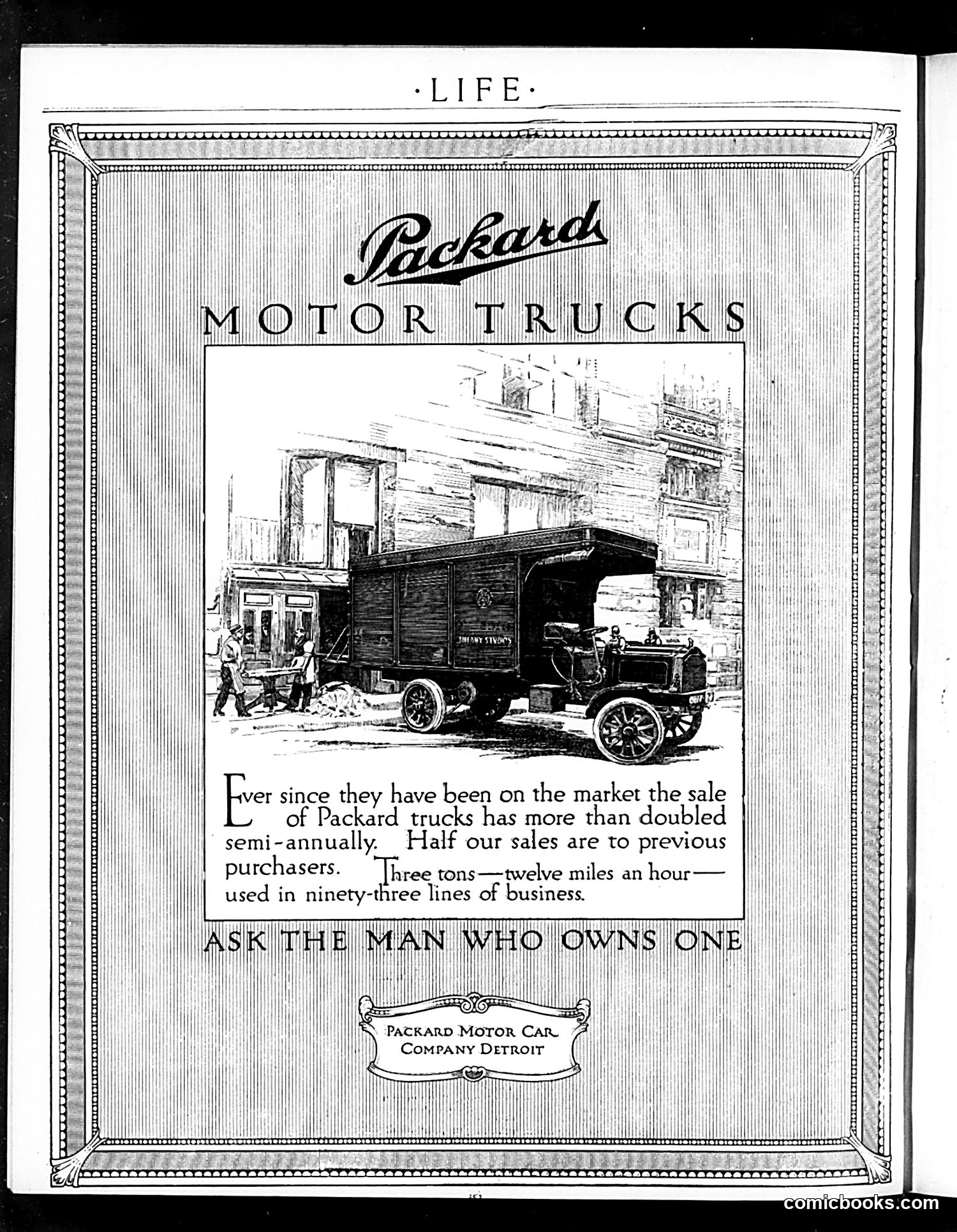
This is a **straightforward advertisement**, not satire or political commentary. It's a Packard Motor Car Company ad promoting their motor trucks, placed in *Life* magazine. The ad makes a straightforward business claim: Packard truck sales have "more than doubled semi-annually," with half their sales going to repeat customers. It emphasizes practical specs (three tons capacity, twelve miles per hour) and boasts the trucks are "used in ninety-three lines of business." The illustration shows a period delivery truck outside a brick building, with workers loading cargo. The tagline "Ask the man who owns one" was Packard's actual slogan, appealing to customer testimonials as proof of quality. There is no satire here—just early automotive marketing emphasizing reliability and market dominance.
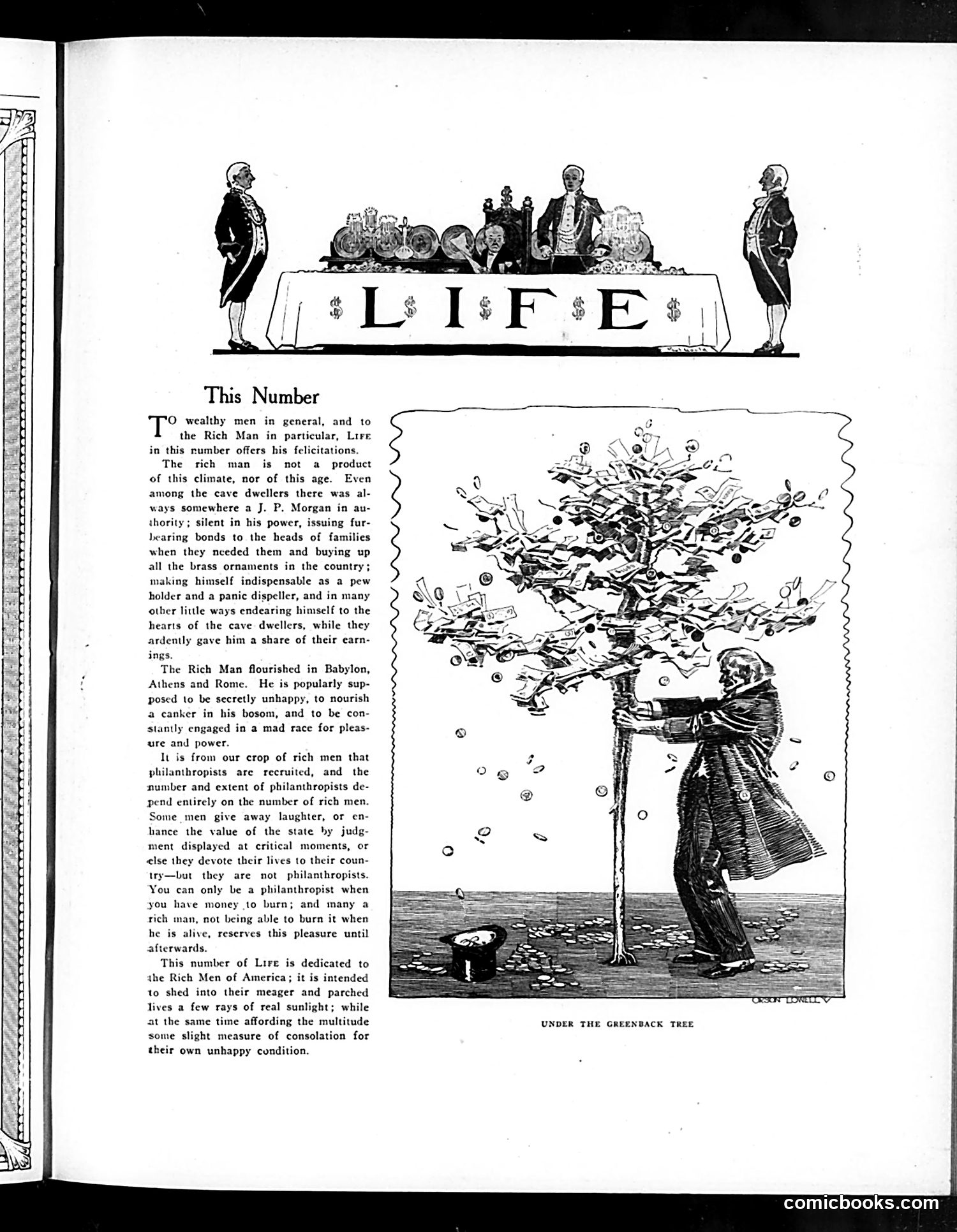
This is a satirical attack on wealthy American philanthropists. The text declares the issue dedicated to "Rich Men of America," criticizing them for giving charity only when it brings public acclaim or tax benefits—not from genuine compassion. The illustration shows a skeleton beneath a tree raining money (greenbacks), suggesting that rich men's philanthropy is hollow, death-bound, and mechanically dispensed rather than heartfelt. The skeleton may reference the "grim reaper" or death of authentic charity. The text specifically references J.P. Morgan as an example of a wealthy man wielding power through silent influence and strategic gift-giving to control institutions and family legacies—buying respectability rather than earning it through genuine virtue. The satire's core message: true philanthropy requires willingness to give while alive, not merely burnishing one's legacy posthumously.
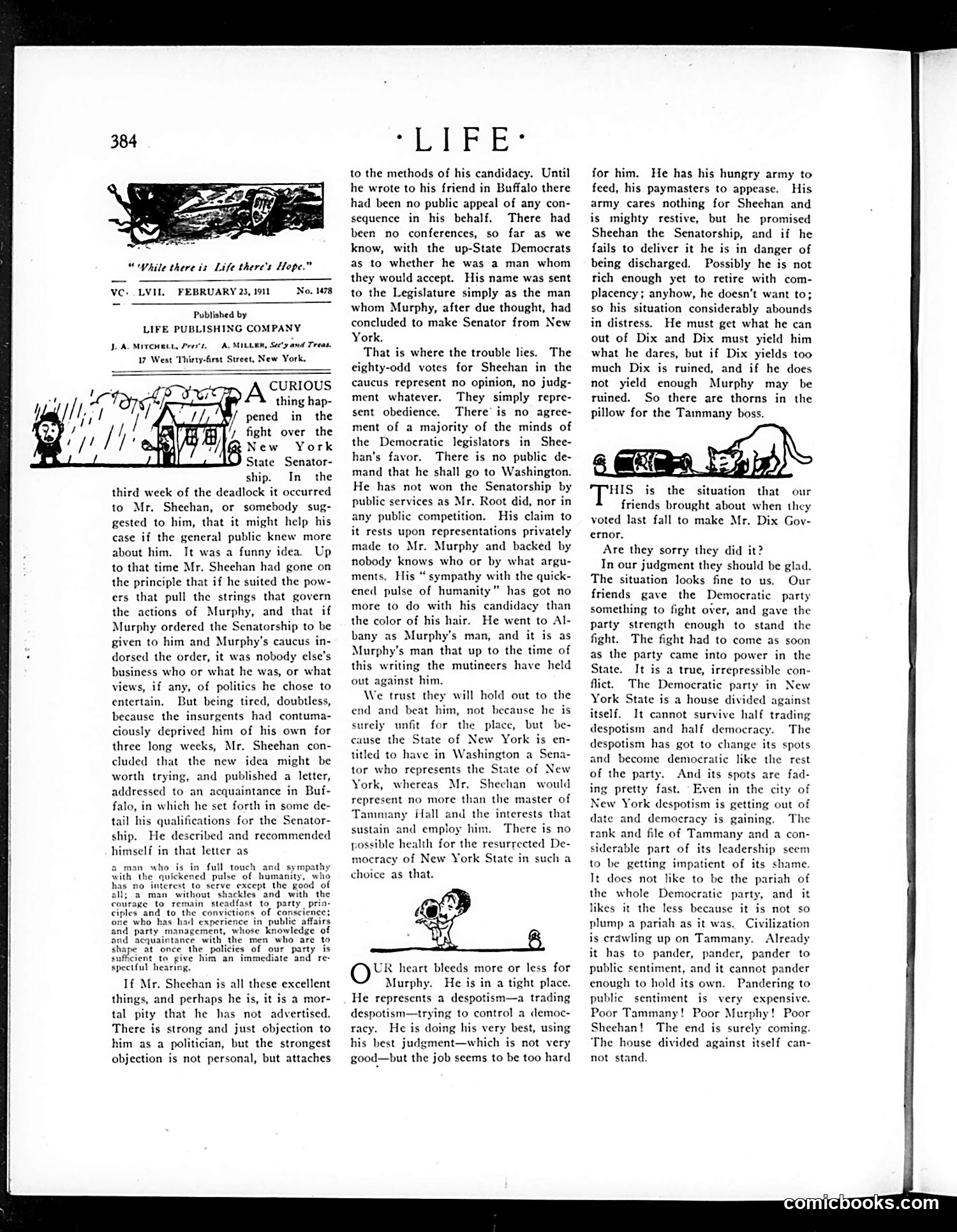
This page critiques New York State Democratic politics, specifically the Sheehan-Murphy senatorial dispute. The text discusses how William F. Sheehan lacks public support for a U.S. Senate seat despite backing from political boss Charles Murphy. The cartoons (though small and not entirely clear) appear to illustrate the internal Democratic Party conflict: one shows a figure in a house divided against itself, symbolizing the party's fracture between competing factions. The satire argues that the Democratic Party's despotism—pandering to Murphy's machine politics rather than genuine democratic principles—is destroying the party's legitimacy. The author warns that continued internal division will hand power to Republicans, making the party's survival questionable.
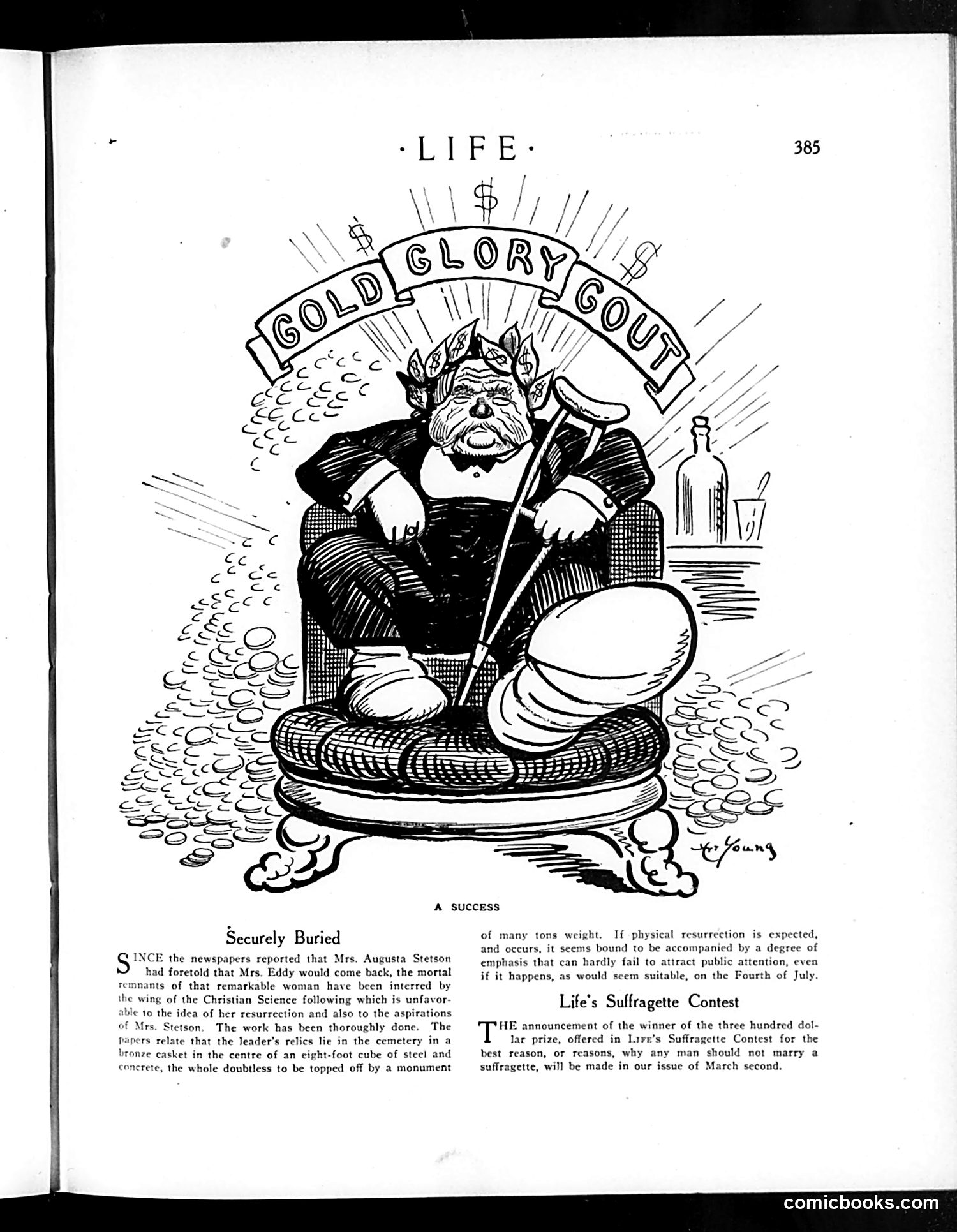
The main cartoon depicts a gnome-like figure sitting atop a large pile of coins, wearing a crown and holding a pipe—the archetypal image of wealth and greed. The banner reads "GOLDENGLORY GOUT," suggesting that excessive wealth brings physical ailment (gout was associated with rich indulgence). The two text sections below discuss: 1) "Securely Buried"—about Mrs. Augusta Stetson's remains and Christian Science burial practices; 2) "Life's Suffragette Contest"—announcing a $300 prize for reasons why men shouldn't marry suffragettes. The page satirizes both wealthy excess and contemporary social debates over women's suffrage rights. The cartoon's grotesque miser character embodies the satirical critique of materialistic greed common to Life magazine's social commentary.
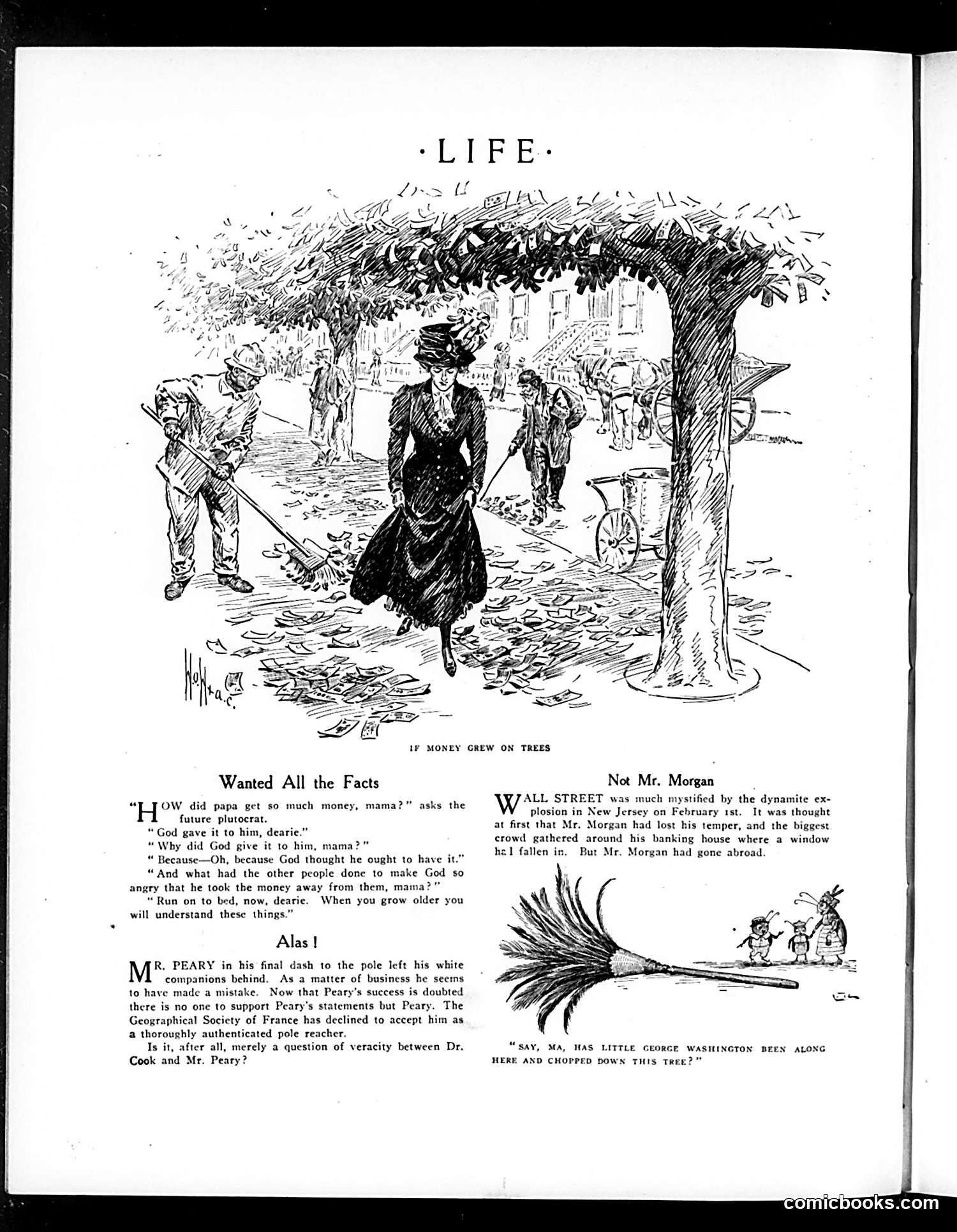
This page contains three satirical pieces: 1. **"LIFE" masthead illustration**: Shows a woman in dark dress walking beneath a massive tree in an urban setting, surrounded by various people and activity. The title "IF MONEY GREW ON TREES" suggests commentary on economic inequality and wealth distribution. 2. **"Wanted All the Facts"**: A dialogue where a child repeatedly asks "Why?" about God and money, satirizing parental evasion of economic questions. The humor lies in the parent's inability to provide satisfactory answers to uncomfortable truths about wealth and inequality. 3. **"Not Mr. Morgan"**: References a Wall Street explosion in New Jersey (February 1st, date unclear), humorously suggesting J.P. Morgan wasn't involved—a jab at the wealthy banker's prominence and the public's tendency to associate major events with powerful figures. The overall theme critiques wealth disparity and elite financiers.
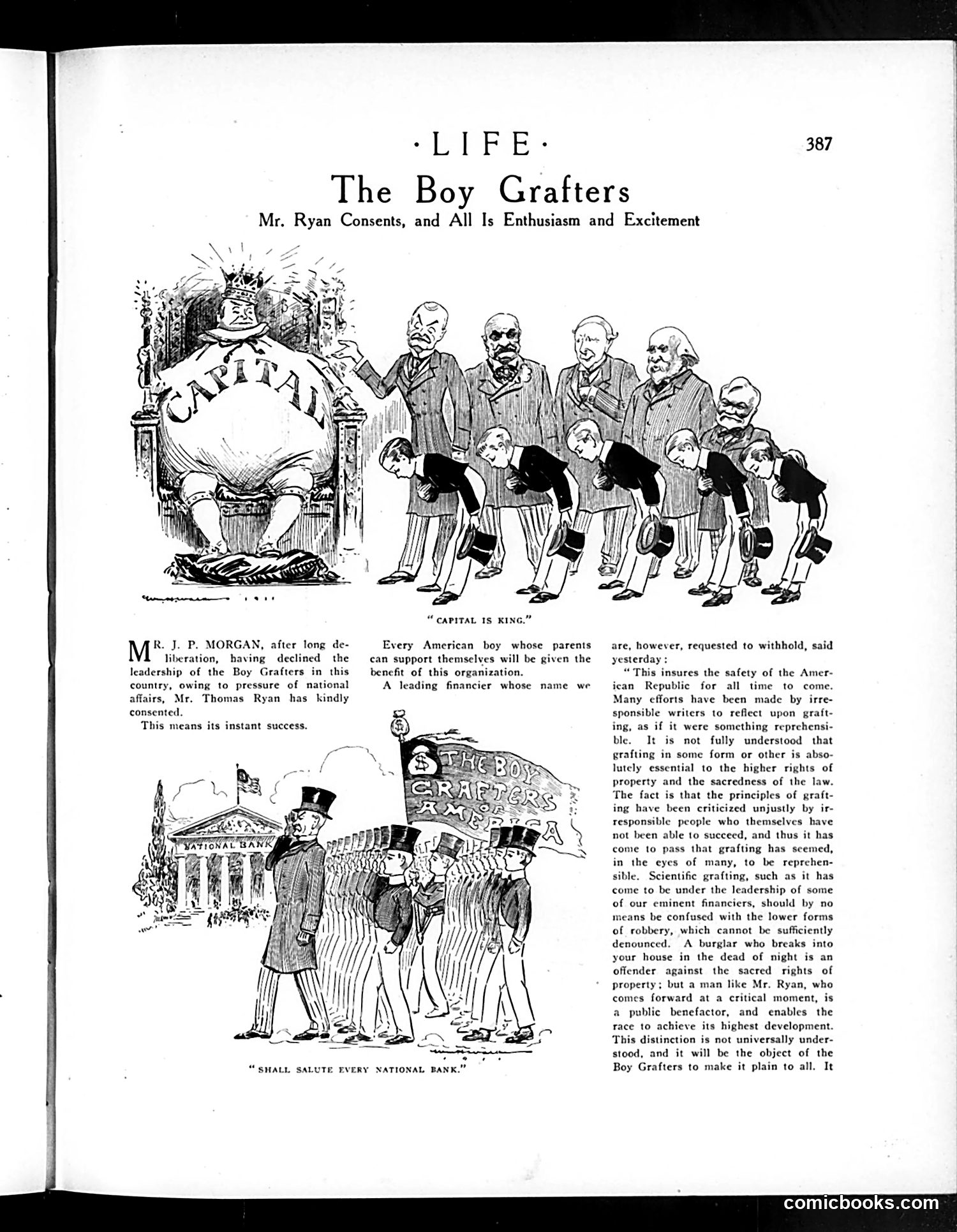
This satirical piece criticizes **J.P. Morgan and other wealthy financiers** for allegedly leading the "Boy Grafters" organization. The cartoons mock the hypocrisy of wealthy men claiming to develop youth morally while themselves engaging in financial corruption ("grafting"). The top cartoon shows fat, corrupt older men with boys bowing submissively—suggesting exploitation of youth. The bottom cartoon depicts these financiers "saluting" a National Bank, implying collusion with banking institutions. The accompanying text defends the concept of grafting as practiced by these elites, sarcastically arguing it's merely "scientific" and acceptable when done by "eminent financiers," while condemning ordinary theft. The satire attacks the double standard: wealthy men facing no consequences for financial crimes while criminalizing working-class theft.
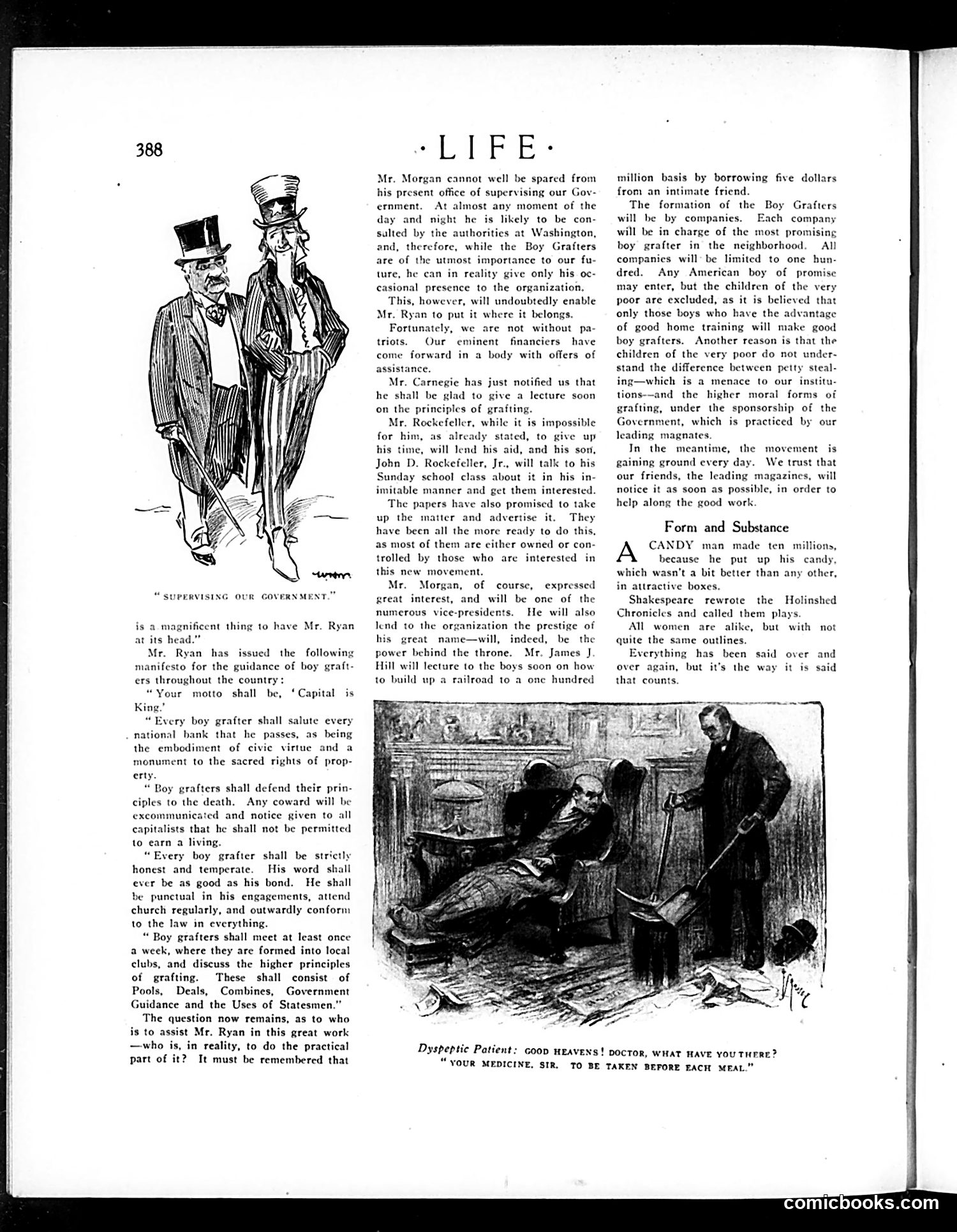
The top cartoon depicts two well-dressed gentlemen labeled "Supervising Our Government," satirizing wealthy businessmen's influence over government policy—likely referencing J.P. Morgan and John D. Rockefeller, who were prominent financiers of the era. The page discusses "Boy Grafters," an organization promoting moral character in youth. The bottom illustration, titled "Dyspeptic Patient," shows a doctor with a patient, captioned about medicine before meals. This appears to be unrelated satirical humor rather than political commentary. The overall piece critiques wealthy businessmen's outsized control over government while ironically promoting boy character-building—suggesting the wealthy elite should model ethics for youth, despite their own questionable practices. The contrast highlights Progressive Era concerns about corporate influence and moral corruption.
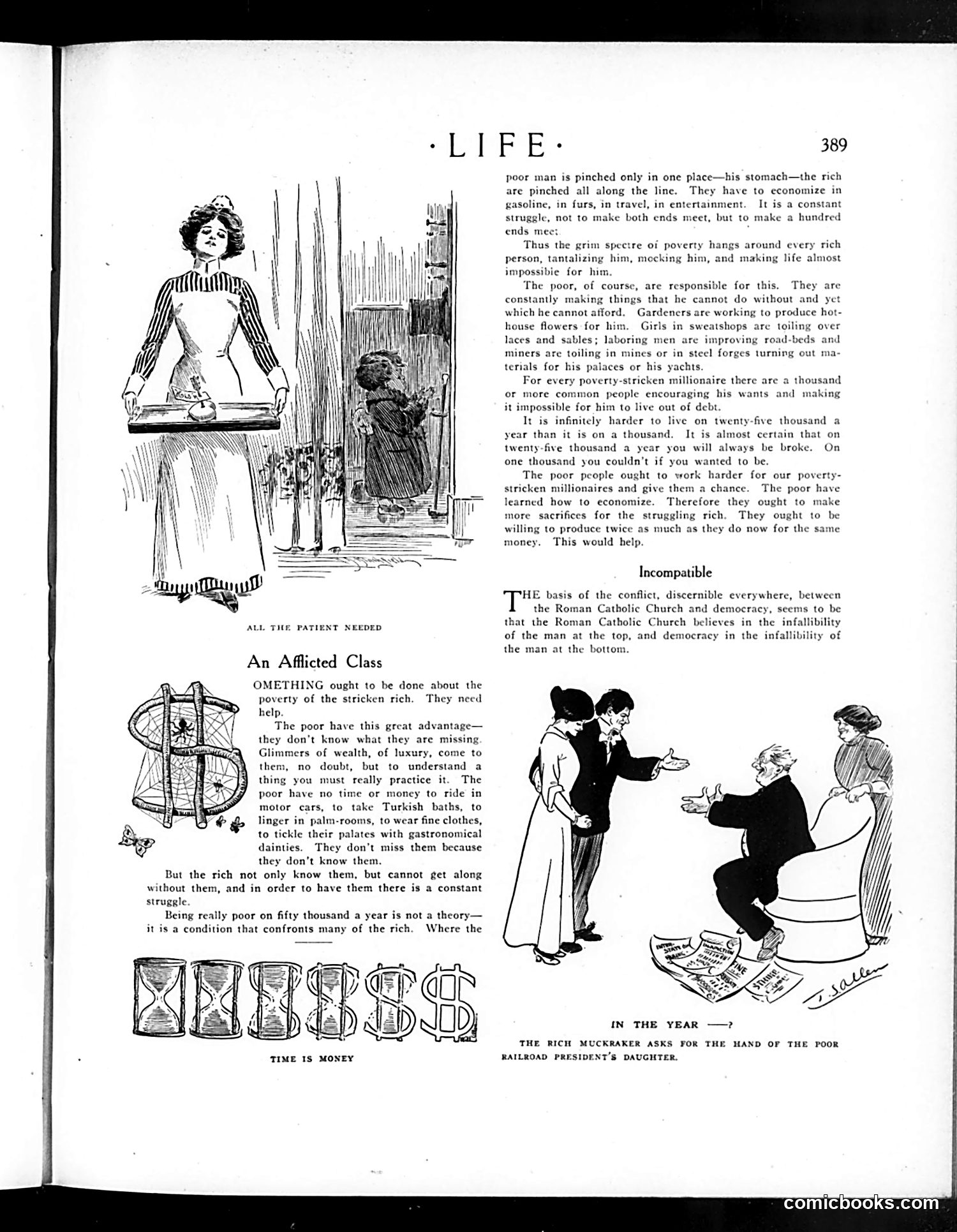
This page satirizes class conflict and economic inequality in early 20th-century America. **"An Afflicted Class"** critiques wealthy people's dependence on luxuries (fine clothes, restaurants, leisure activities) they claim not to need, while mocking their inability to function without them—portraying wealth as a kind of affliction requiring sympathy. **"Incompatible"** addresses the conflict between Catholic Church doctrine (hierarchical authority) and democratic principles, presenting these as fundamentally opposed ideologies. **The bottom cartoon** depicts a wealthy "muckraker" (likely a railroad magnate) attempting to marry his daughter to a poor man—presumably for social reform credibility while maintaining class privilege. The satire suggests such gestures are performative rather than genuinely egalitarian.
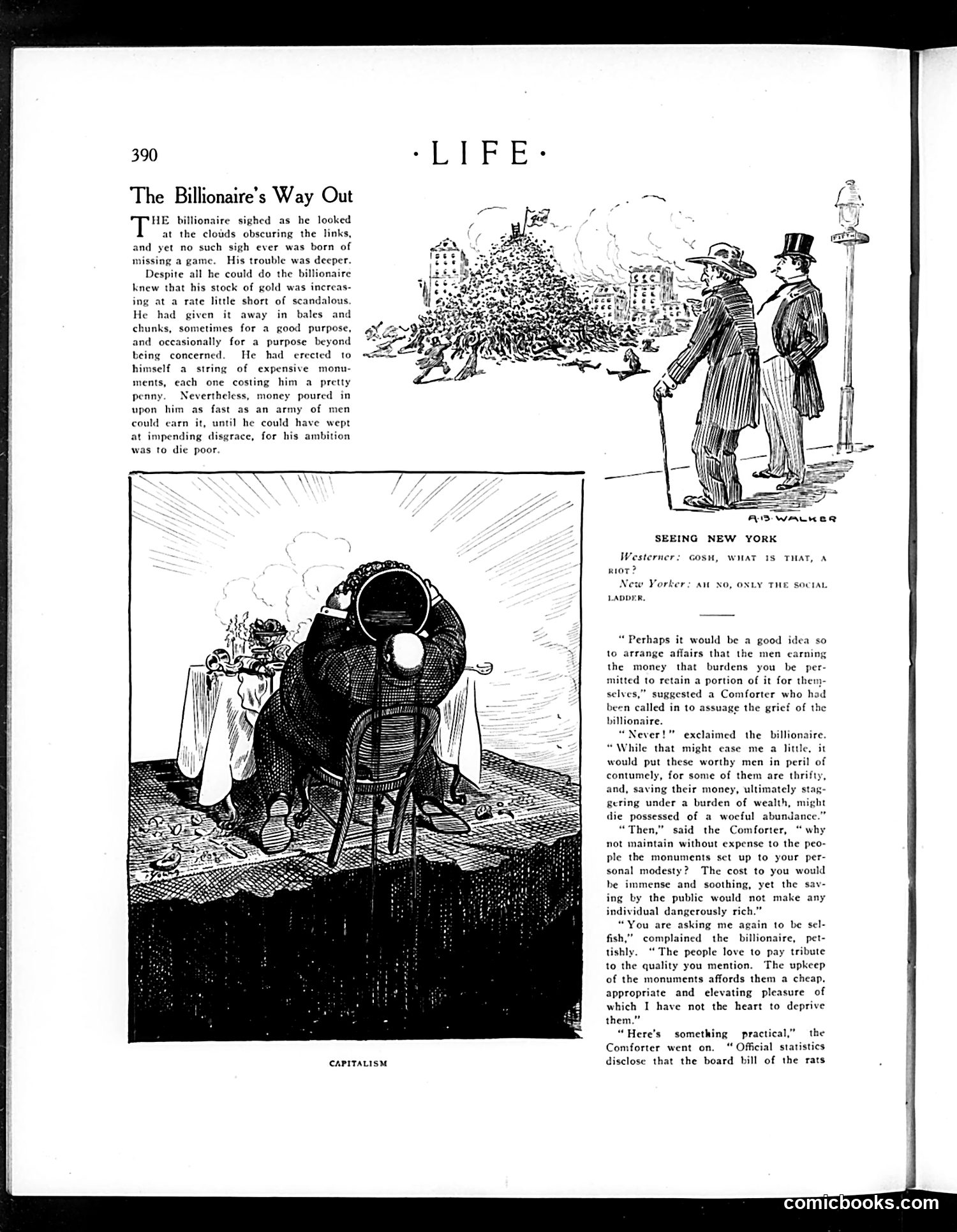
**Main Cartoon: "The Billionaire's Way Out"** This satire depicts a wealthy industrialist unable to spend his vast fortune fast enough, despite giving away money in "chunks" and erecting expensive monuments to himself. His stated ambition is to "die poor"—a absurd inversion of normal wealth-seeking. **The Satire's Point:** The piece mocks gilded-age billionaires' self-serving philanthropy and monument-building. When a "Comforter" suggests practical solutions—letting workers keep wages or maintaining monuments without public expense—the billionaire refuses each, claiming it would either harm workers or deprive the public of "elevating pleasure." This exposes the hypocrisy: wealthy industrialists justify extracting labor while claiming their monuments benefit the common people. **Secondary Cartoon: "Seeing New York"** A visitor mistakes urban crowding for a riot. The punchline equates the crowd with the "social ladder"—suggesting New York society is chaotic, climbing-focused, and indistinguishable from actual disorder. Both satirize capitalist excess and class inequality circa early 1900s.
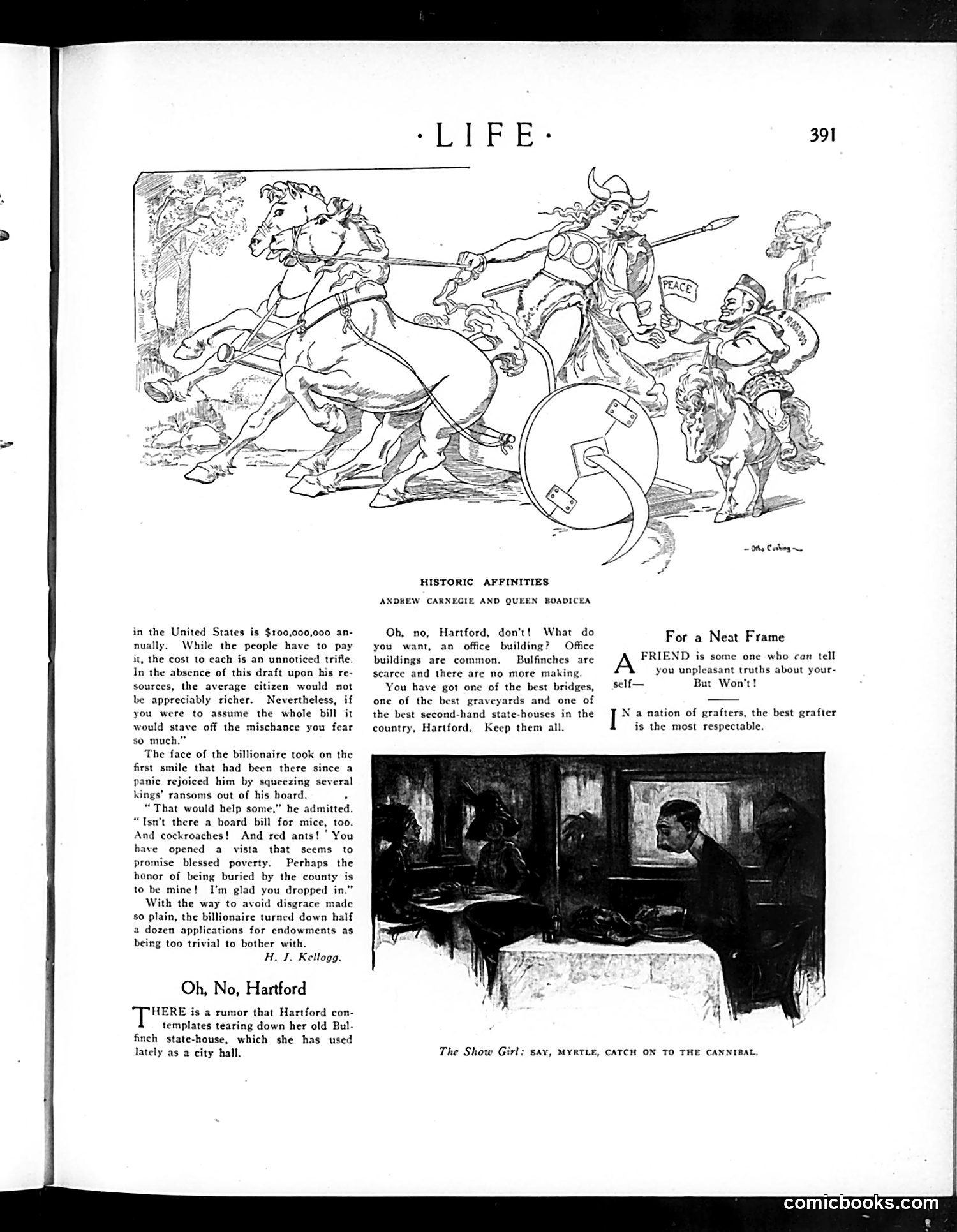
**Main Cartoon (Top):** Titled "Historic Affinities: Andrew Carnegie and Queen Boadicea," this satirical drawing compares the wealthy industrialist Andrew Carnegie to the ancient British queen who led a rebellion against Roman occupation. The cartoon depicts Carnegie as a modern conqueror/warrior figure, surrounded by symbols of wealth and power. The satire suggests Carnegie's aggressive business practices parallel Boadicea's violent resistance—implying both are destructive forces, though Carnegie destroys through capitalism rather than warfare. **"Oh, No, Hartford" Section:** This brief satire mocks Hartford's rumored plan to demolish its historic Bulfinch state-house (designed by prominent architect Charles Bulfinch). The writer argues Hartford should preserve this irreplaceable architectural landmark rather than replace it with a common office building—a commentary on early 20th-century American cities prioritizing commercial development over historical preservation. **Satirical Aphorisms:** The "For a Neat Frame" section offers cynical observations about friendship and graft (corruption), typical of Life's social criticism.
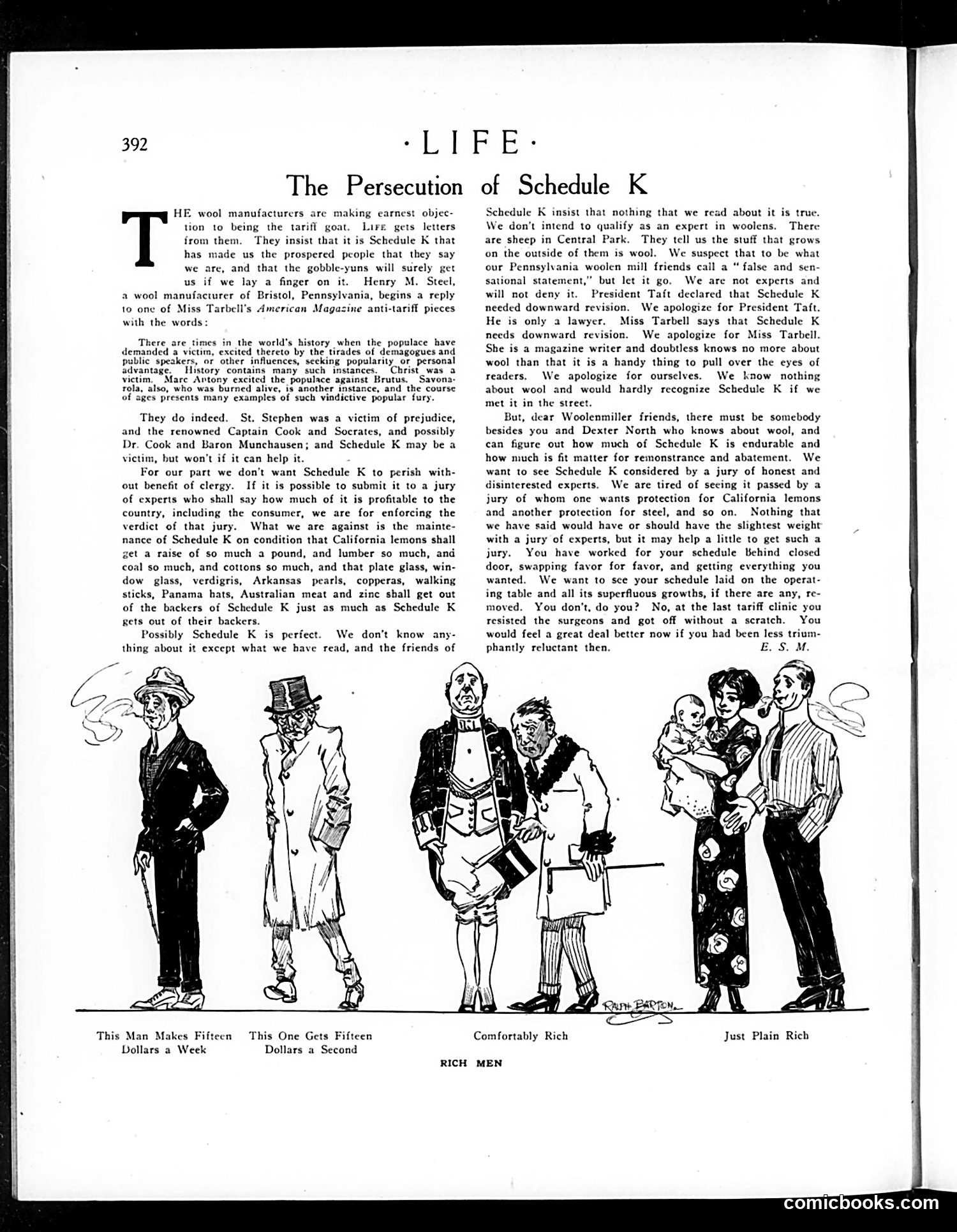
This Life magazine article mocks wool manufacturers defending **Schedule K**—a tariff provision protecting American wool imports. The piece satirizes their rhetoric by comparing Schedule K to historical persecution victims (Christ, Socrates), ridiculing the analogy as absurd. The cartoon below illustrates income inequality among "rich men": figures earning vastly different amounts ($15/week versus $15/second) despite similar status. The satire's point: wool manufacturers cry victimhood while Schedule K actually protects their profits through government favoritism. Life argues the tariff should face impartial expert review rather than remain a backroom deal where various industries (California lemons, steel, coal, glass) each extract protective provisions. The magazine positions itself as reasonable—not anti-tariff, but anti-corruption and pro-transparency in trade policy. The reference to **Miss Tarbell** likely means investigative journalist Ida Tarbell, known for exposing corporate monopolies.
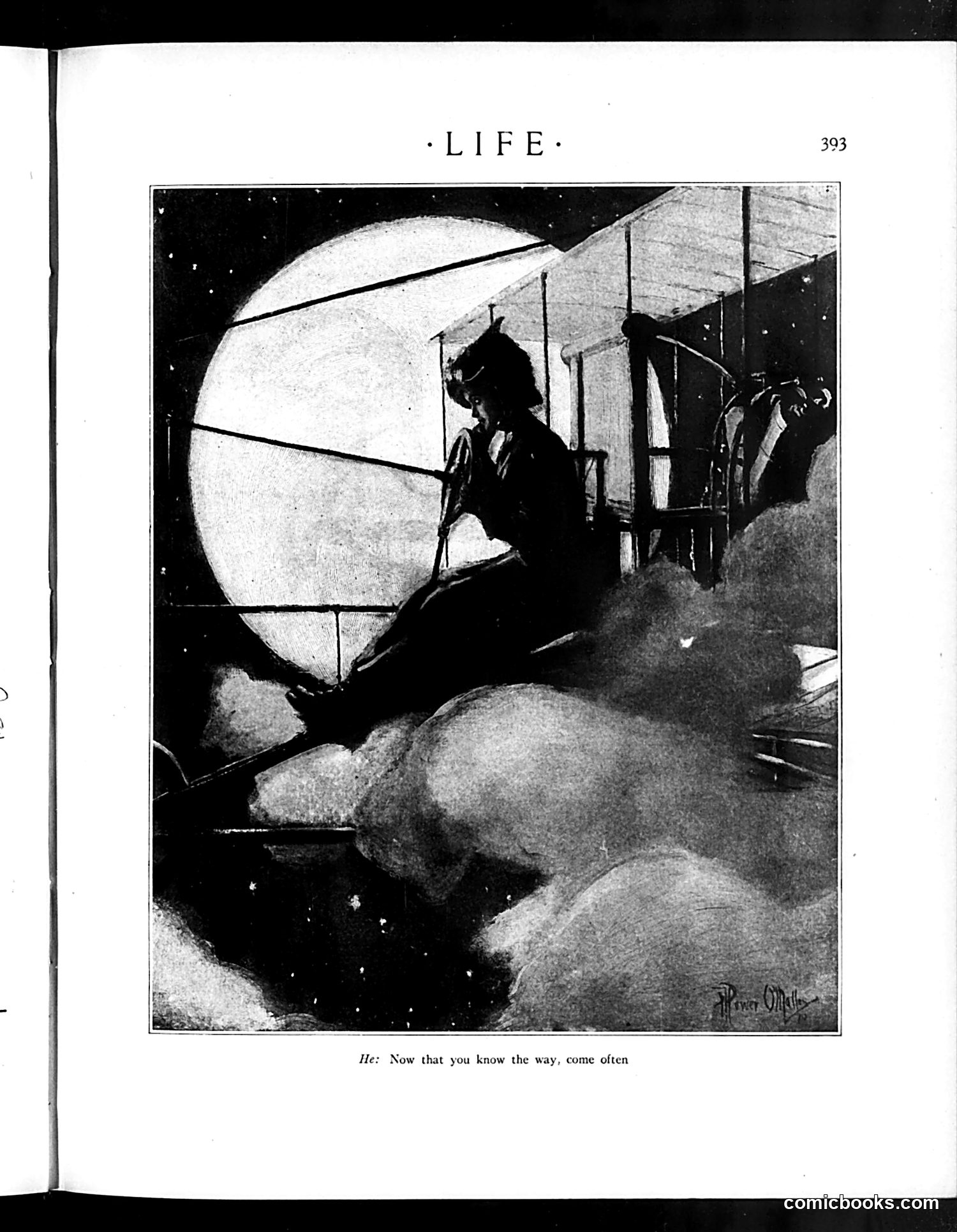
This is a romantic or suggestive illustration from *Life* magazine (page 393). The image shows silhouetted figures against a large moon, with a man and woman in an intimate setting near what appears to be a seaside location with railings and rocks visible. The caption "Now that you know the way, come often" suggests an invitation to a secret romantic meeting spot. This appears to be satirical commentary on courtship or romantic trysts, likely poking fun at the conventions of romance or suggesting clandestine meetings. The artwork style—silhouettes framed against the moon—emphasizes the romantic atmosphere. Without knowing the exact publication date or surrounding context, this appears to be gentle social satire about romance and meeting places, typical of *Life* magazine's humorous approach to contemporary social behavior.
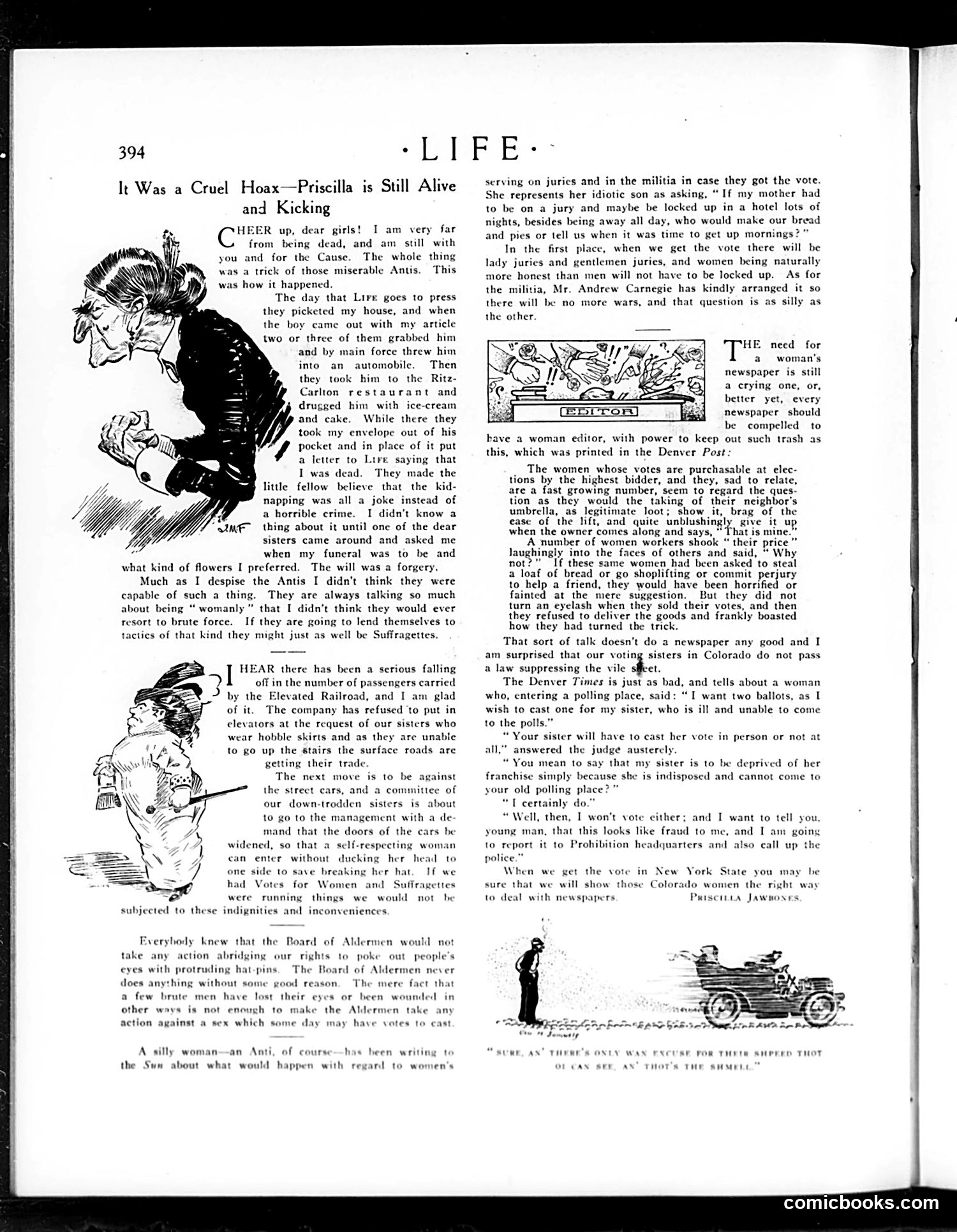
This *Life* satire mocks anti-suffrage women ("Antis") by having a suffragette named Priscilla report a cruel hoax: Antis allegedly kidnapped her article supporting women's voting rights, fabricated a death announcement, and spread rumors of her funeral—supposedly to embarrass the suffrage movement. The piece ridicules Antis' tactics while sarcastically praising their "womanly" restraint. It then pivots to absurdist complaints: women in hobble skirts avoiding elevated stairs (hurting rail transit), hat-pins being regulated, and concerns about women jurors leaving families unfed. The final section mocks an Anti woman's son questioning who'll feed the family if his mother serves jury duty—countered by praising women's "natural honesty" and noting Andrew Carnegie has "arranged" an end to wars. The satire defends suffragettes while portraying Antis as hypocritical and ridiculous, though occasionally capable of underhanded tactics.
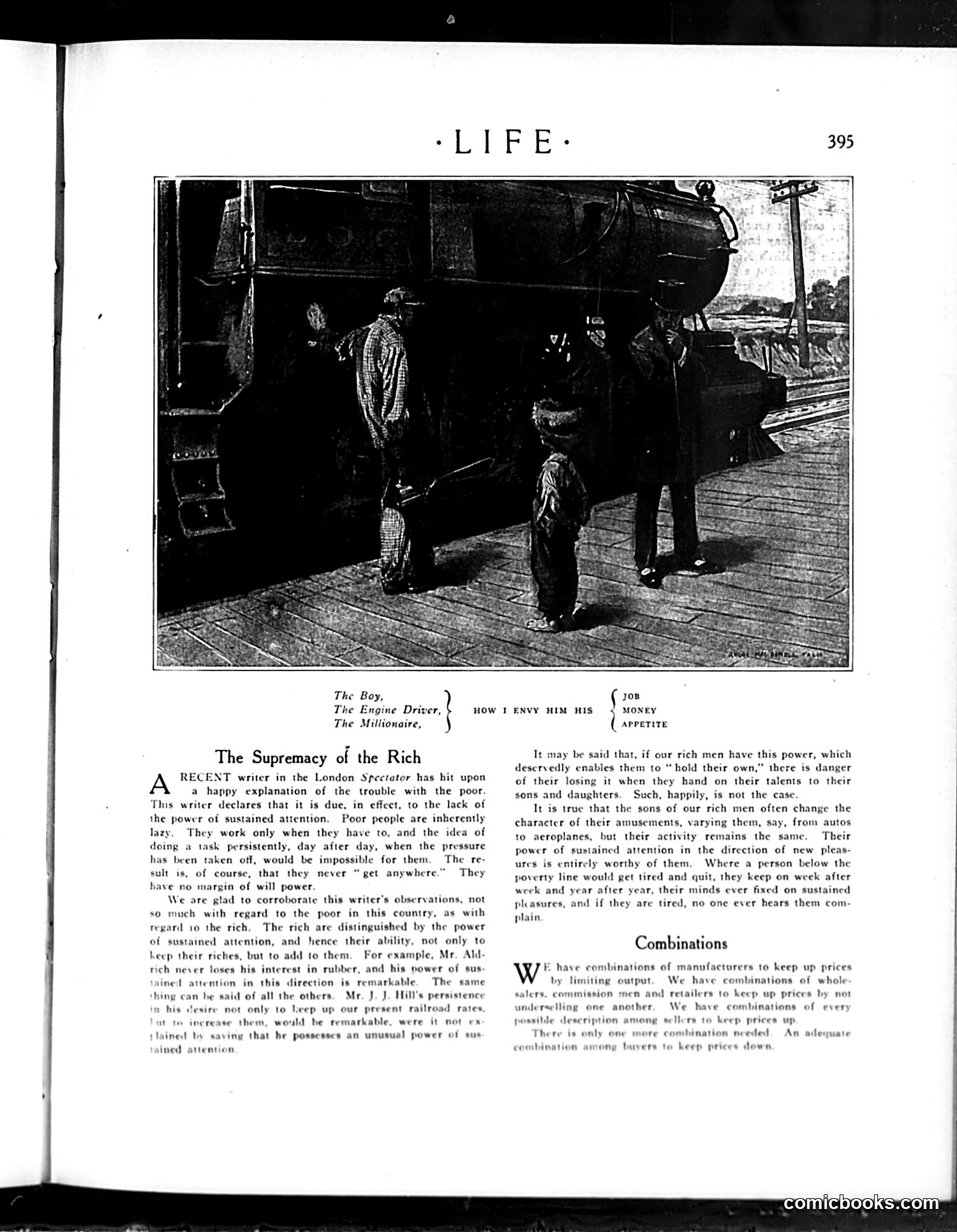
This page mocks the wealthy's claimed moral superiority through bitter irony. The article pretends to agree with a London Spectator writer who blamed poverty on poor people's lack of sustained attention and willpower. However, Life inverts this argument: the rich *do* possess sustained focus—but only toward self-interest. Aldrich obsesses over rubber profits; J.J. Hill over railroads. Their sons similarly "sustain attention" relentlessly pursuing pleasures (autos, aeroplanes) rather than productive work. The final section on "Combinations" extends the satire: manufacturers, wholesalers, and retailers all collude to keep prices artificially high, yet no "combination among buyers" exists to push prices down. The implication is clear—the wealthy's celebrated discipline serves only greed and monopolistic practices, not virtue. The photograph shows working-class figures beside a locomotive, visually contrasting ordinary laborers with the millionaires discussed above.
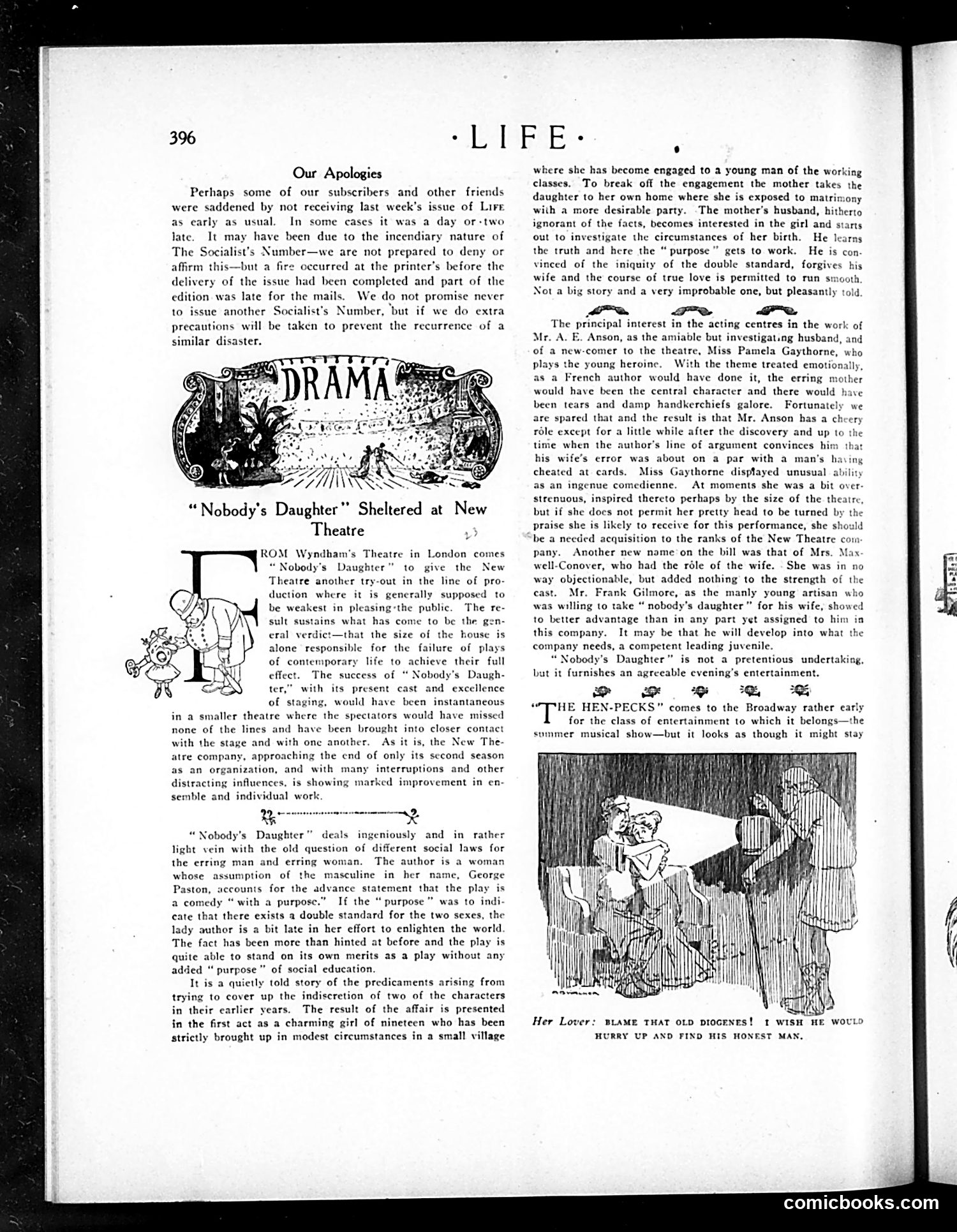
This page contains theater reviews from Life magazine's drama section. The main content discusses "Nobody's Daughter," a play about a woman's premarital indiscretion and the "double standard" condemning women while excusing men for similar behavior. The opening "Our Apologies" note is satirical—Life jokingly blames a printer's fire for late delivery of their recent "Socialist's Number" (a special issue), implying the fire was suspiciously convenient. This reflects Life's satirical stance toward socialist politics. The play review critiques both the work and its social commentary. The author, writing under the masculine pseudonym "George Paston," attempts to expose sexual hypocrisy. However, Life's reviewer dismisses this as unoriginal—the double standard was already well-known. The small illustration shows a romantic couple scene, typical theater section decoration of the era. The review praises the acting while noting the play works better in smaller, more intimate theaters.
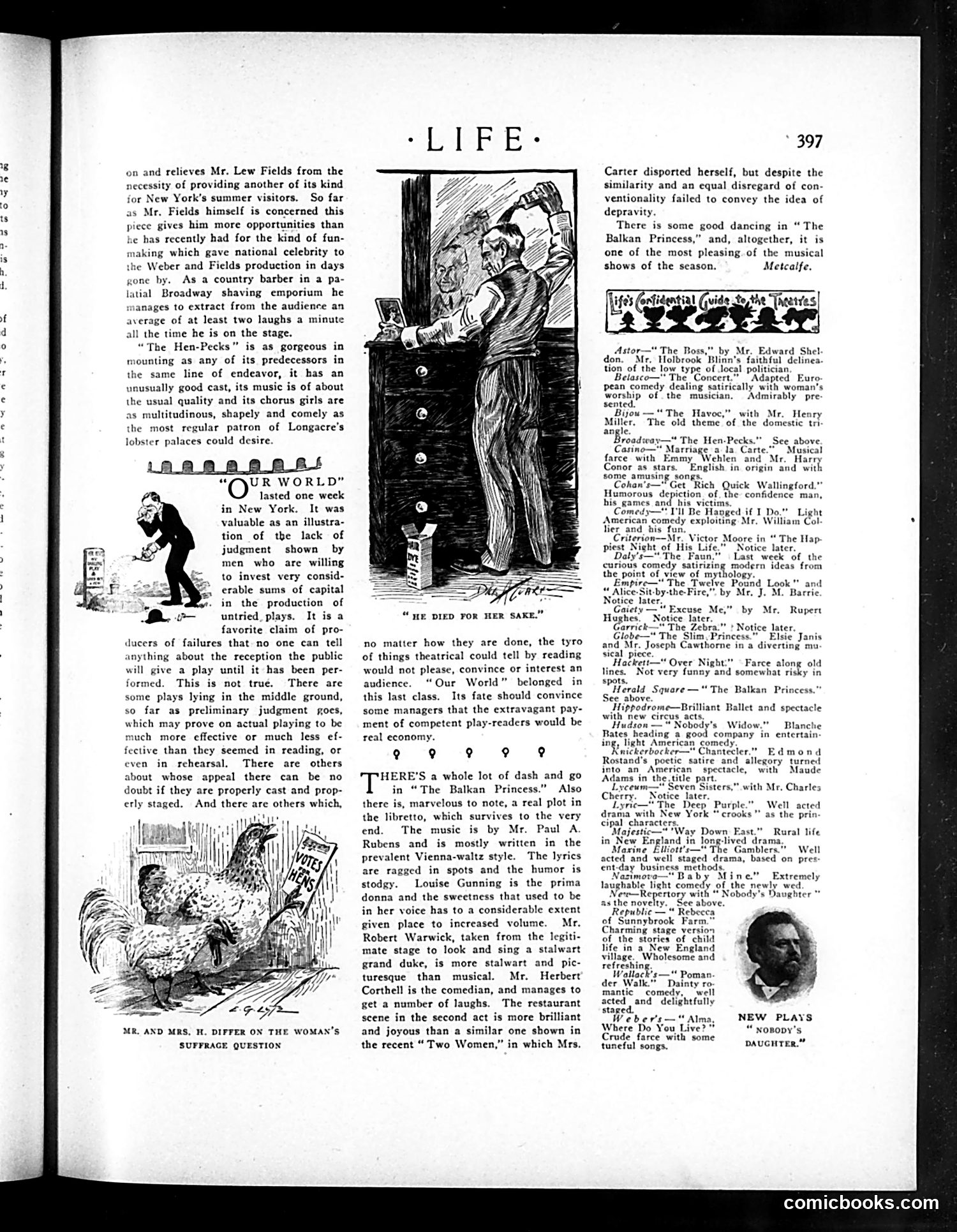
This page reviews Broadway theatrical productions from the early 1900s. The cartoons and illustrations support the text's criticism of theatrical judgment and playwriting. The upper cartoon titled **"He Died for Her Sake"** appears to depict a dramatic, melodramatic scene—likely satirizing overwrought theatrical conventions of the era. The lower cartoon, **"Mr. and Mrs. H. Differ on the Woman's Suffrage Question,"** shows a domestic dispute, presumably ridiculing how couples disagreed on the suffrage movement, a hot political topic of the period. The page's main function is theater criticism. The reviewer dismisses "Our World" as a failed production, arguing that experienced judges can predict theatrical failure. He reviews other shows like "The Hen-Pecks" (praising Lew Fields' comic performance) and "The Balkan Princess" (a musical with mixed results). The illustrations and reviews together mock both theatrical pretension and contemporary social debates like women's suffrage.
This page is difficult to analyze with certainty. The image itself is extremely dark and low-contrast, making specific details hard to discern. There appear to be some figures or silhouettes in an interior setting, possibly a stage or theatrical space, with what looks like hanging elements at the top right. The visible text reads "6 A.M." and a partial headline beginning "It Isn't Always the Eat..." (likely "Early"), which appears cut off. Without being able to read the complete caption or see the cartoon clearly, I cannot reliably identify specific figures, political references, or the intended satire. The page quality and darkness severely limit interpretation of the content's meaning for a modern reader.
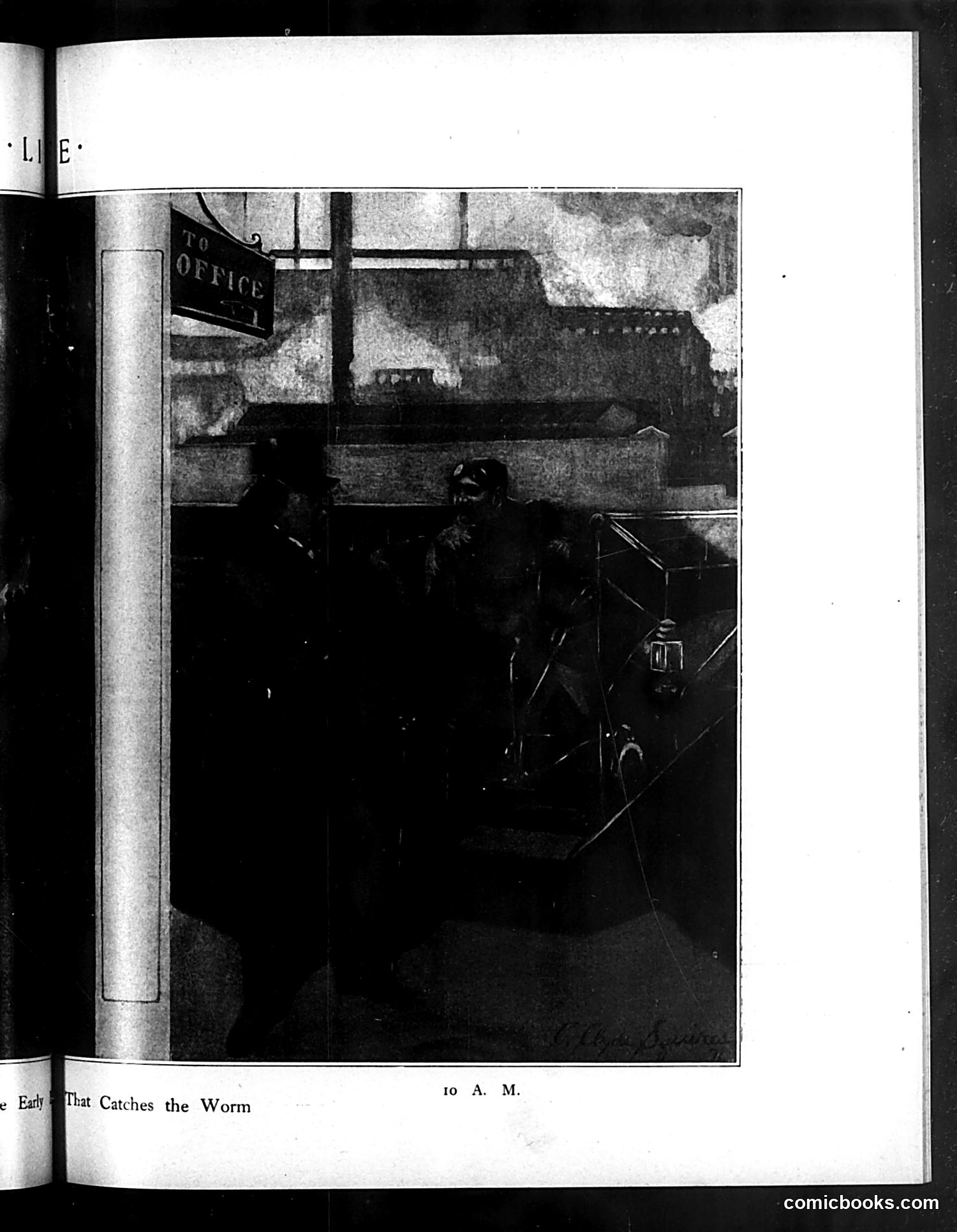
This appears to be a satirical photograph or illustration from *Life* magazine showing silhouetted figures outside what looks like a business entrance marked "TO OFFICE." The caption references the proverb about early birds catching worms—suggesting commentary on workplace punctuality or business culture. The image is quite dark and grainy, making specific identification difficult. The figures appear to be office workers or businesspeople, possibly arriving at work. Without clearer visibility of faces or additional context from surrounding pages, the precise satirical target remains unclear—though it likely mocks either excessive workplace punctuality, the competitive nature of business, or contemporary employment culture. The composition suggests this is documentary-style satire rather than a drawn cartoon.
This page from *Life* magazine reviews recently published books. The main content discusses H.G. Wells's *The New Machiavelli*, praising it as his most mature work despite his reputation for intellectual inconsistency. The reviewer argues Wells has moved from imagining "what might have been" to understanding "what is," a shift that scandalized conventional society but represents genuine intellectual growth. The page also reviews Rheta Childe Dorr's *What Eight Million Women Want*, a collection on the feminist movement. The reviewer notes the book's title—appearing "with something of the sinister peremptoriness of a six-shooter"—seems audaciously sweeping, but Dorr's actual analysis is reasonably conservative and grounded in demonstrated facts about women's achievements and needs. The satire is subtle: the review gently mocks both those who dismiss Wells as unreliable and those alarmed by feminist activism.
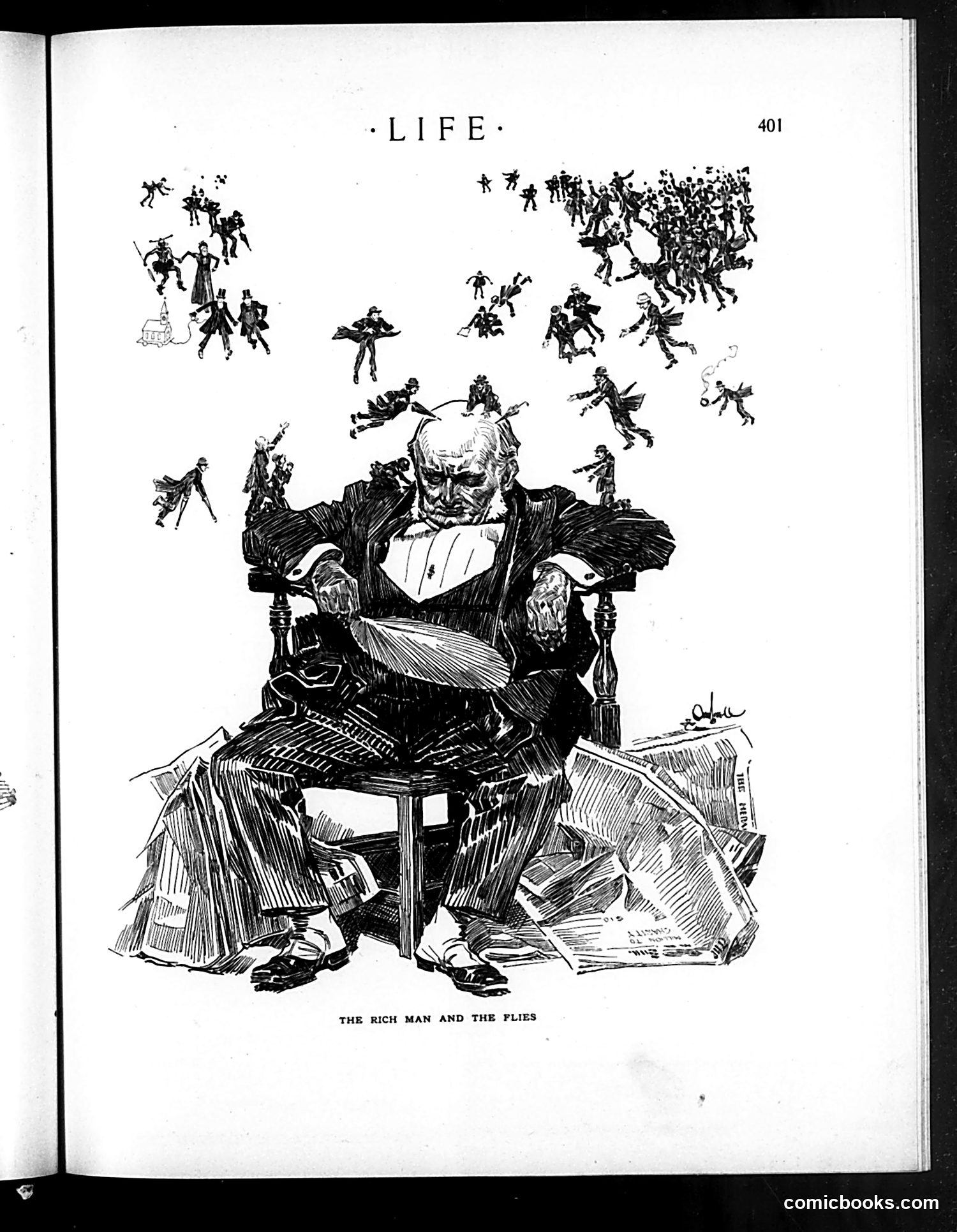
This satirical cartoon depicts a wealthy man seated in an ornate chair, surrounded by tiny figures swarming around him like flies. The title plays on Aesop's fable "The Lion and the Flies," suggesting parasitic relationships. The rich man sits amid scattered money and papers, appearing overwhelmed or besieged by the small figures—likely representing hangers-on, sycophants, or those seeking his wealth. His formal attire (tuxedo, decorations) emphasizes his status, while his stern expression suggests annoyance or resignation. The satire critiques how wealth attracts opportunists and social parasites. The "flies" metaphor suggests these people are bothersome pests drawn to the "corpse" of wealth. This reflects early 20th-century American attitudes about the corrupting nature of money and the social problems wealth creates.
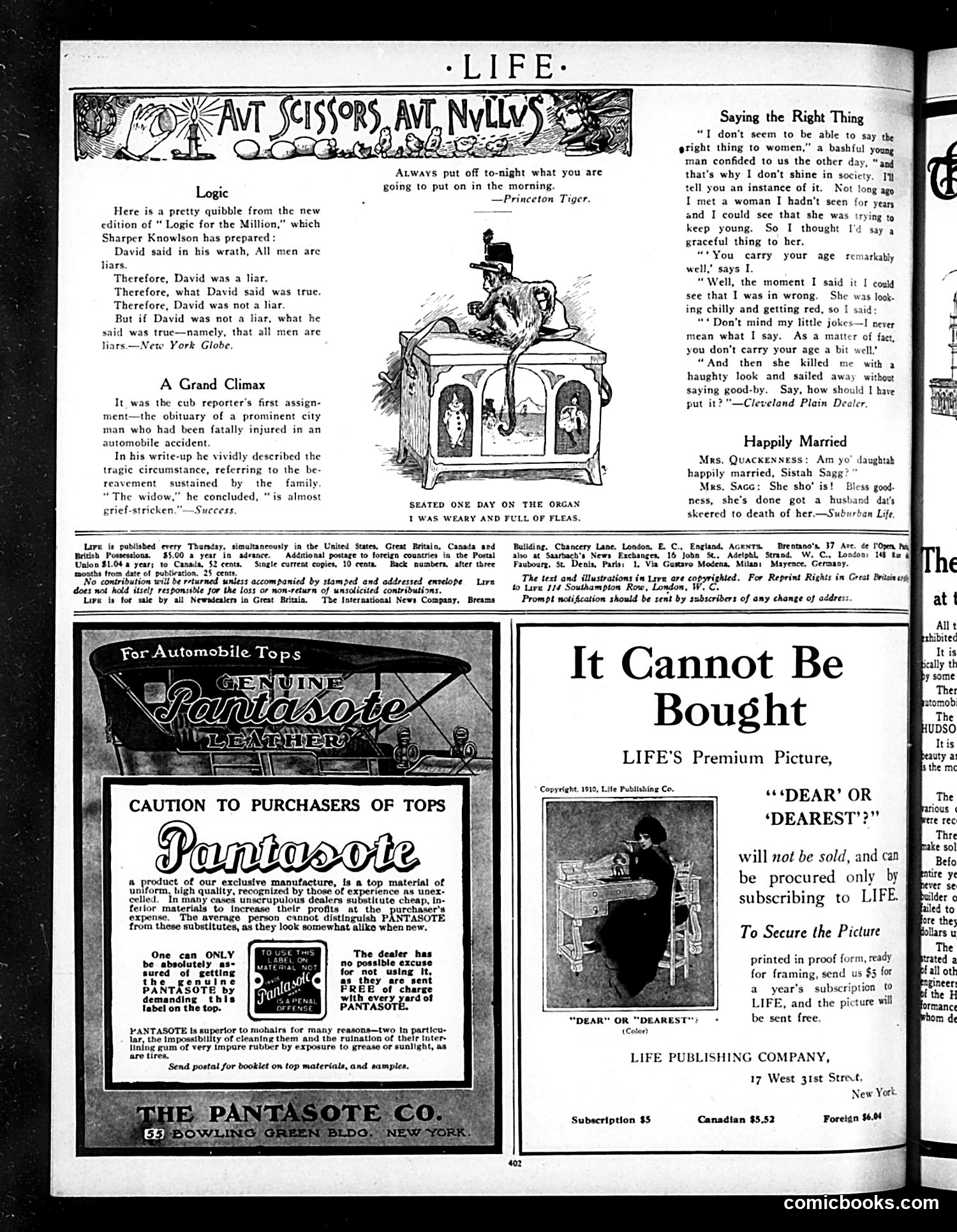
This page contains several humorous short pieces typical of Life's satirical format, plus advertisements. **The cartoons/jokes:** - **"Logic"**: A paradox about David claiming "all men are liars"—if true, David himself is a liar, making his statement false, creating a logical loop. This is intellectual humor for educated readers. - **"A Grand Climax"**: A joke about a cub reporter's malapropism—he writes a widow is "almost grief-stricken" when he meant to convey she's devastated. - **"Saying the Right Thing"**: A bashful man compliments a woman on "carrying her age well," she takes offense, he doubles down by saying she *doesn't* carry it well—and she leaves insulted. The satire mocks male social incompetence around women. - **"Happily Married"**: A dialect-humor piece (using stereotyped speech) where a woman is "happily married" because her husband "fears" her—satire on female domestic power through intimidation. **Bottom section:** Mostly advertising for Pantasote automobile leather and a Life subscription offer for an exclusive picture titled "Dear or Dearest."
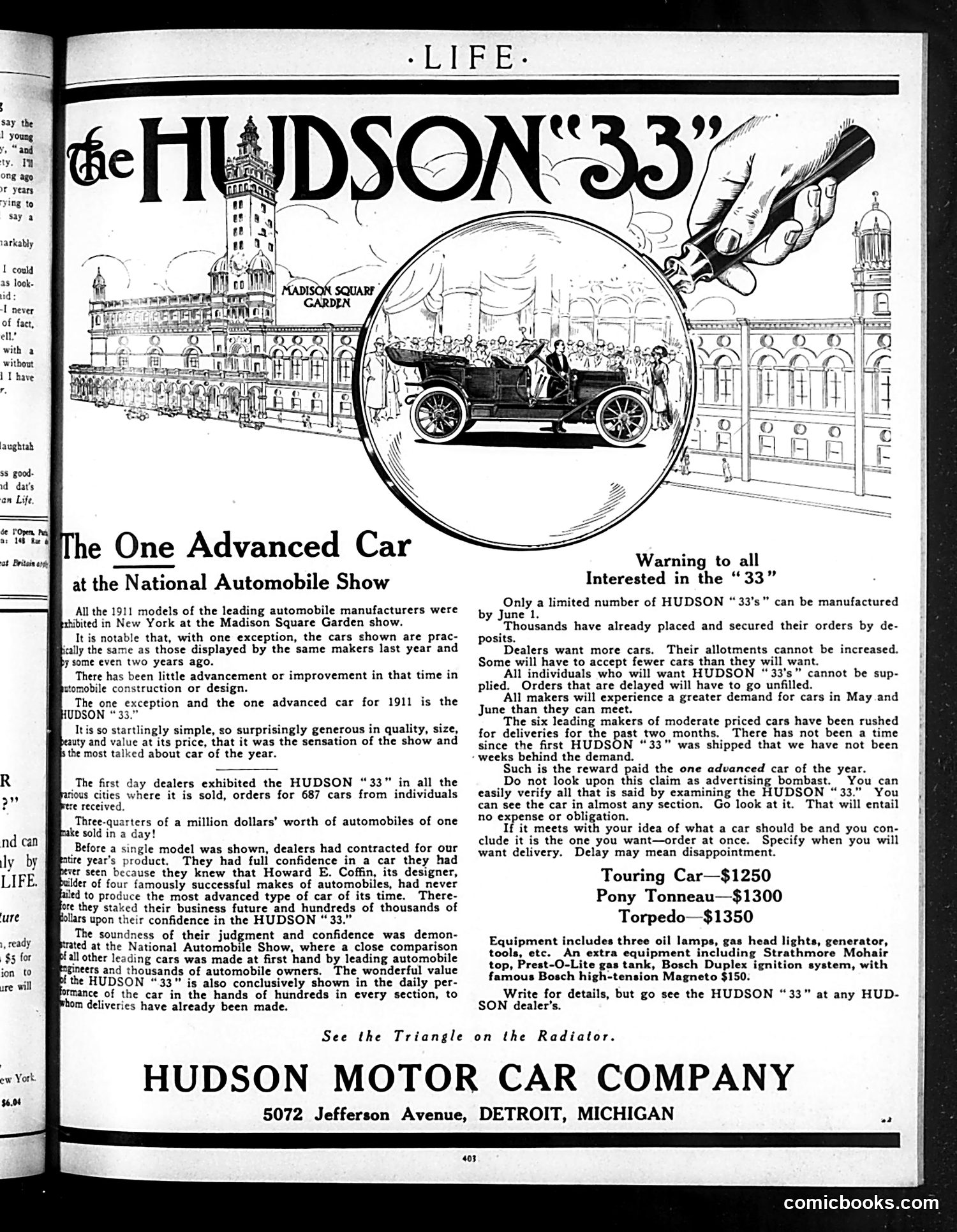
This is primarily a **car advertisement**, not political satire. It promotes the Hudson Motor Car Company's new 1933 model at the 1911 National Automobile Show at Madison Square Garden. The page's rhetorical strategy uses a competitive claim: the Hudson "33" is positioned as the **only genuinely advanced automobile** among 1911 models, while competitors merely repeat unchanged designs from prior years. The ad emphasizes the car's simplicity, quality, and value—attributes credited to designer Howard E. Coffin. The "Warning" section functions as demand-creation marketing: it claims limited production capacity and pre-existing dealer/customer orders to create urgency and exclusivity. This pressure-sales tactic suggests high demand already exists. There is **no political cartoon or satire** visible—the magnified circular inset simply showcases the vehicle at the show. The page is essentially product advertising using competitive differentiation and scarcity messaging to justify the product's premium market position.
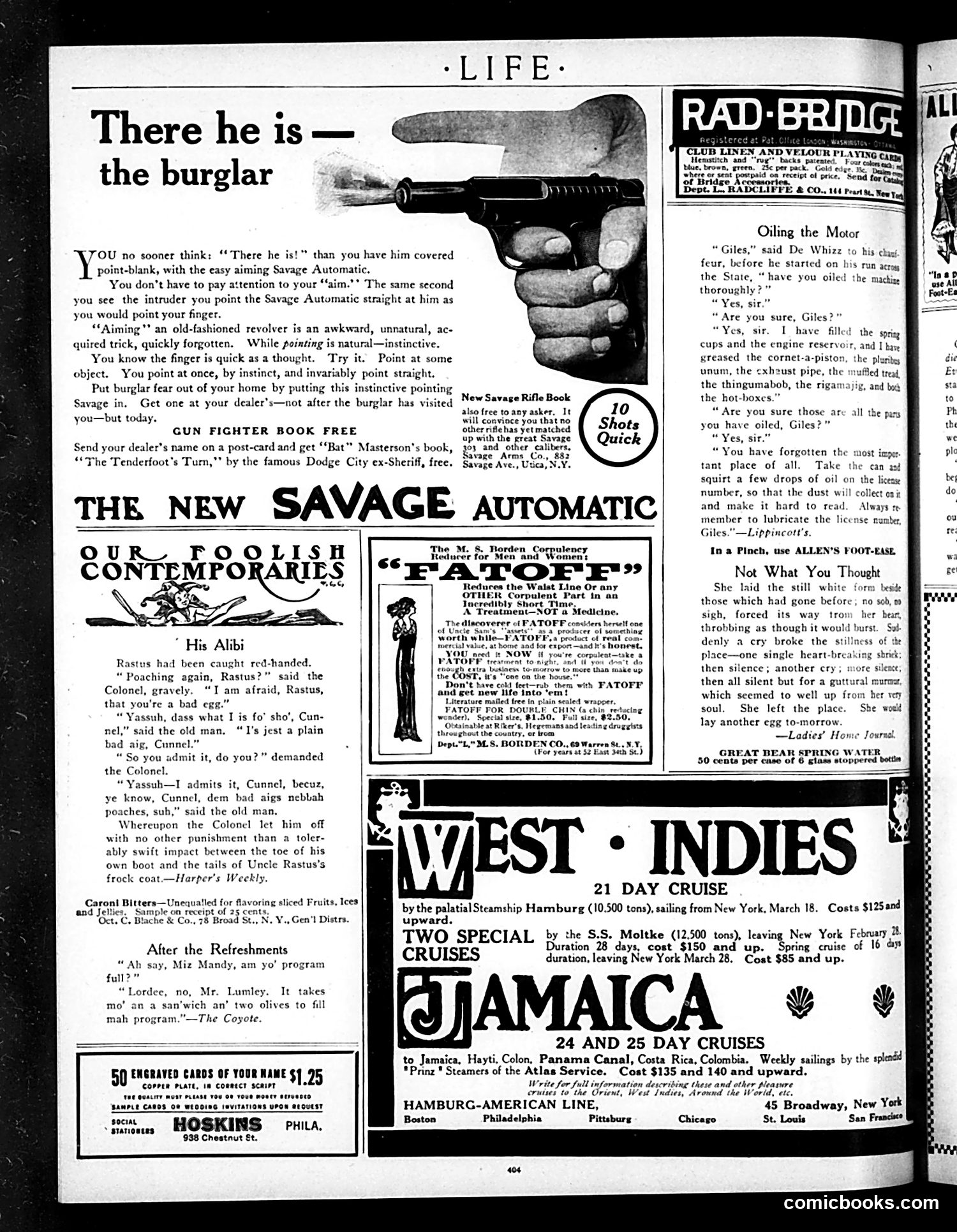
This page primarily contains **advertisements and humorous short fiction**, not political cartoons. The main content is a **Savage Automatic firearm advertisement** featuring the tagline "There he is—the burglar." The ad appeals to home-defense fears by arguing that pointing a gun is instinctive (like pointing your finger), requiring no special aiming skill. This represents early 20th-century marketing that weaponized anxiety about crime and home invasion. Below are several unrelated humor pieces: "His Alibi" uses a **racist dialect humor** format common to the era, depicting an African American man ("Rastus") caught poaching and attempting to justify himself through faulty logic to a white colonel. This reflects the period's crude racial stereotyping in mainstream publications. Other brief comedic sketches address automotive care and romantic disappointment, reflecting middle-class concerns of the time. The page is primarily **commercial content**, with advertisements for cruises, engraved cards, and patent medicines dominating the layout.
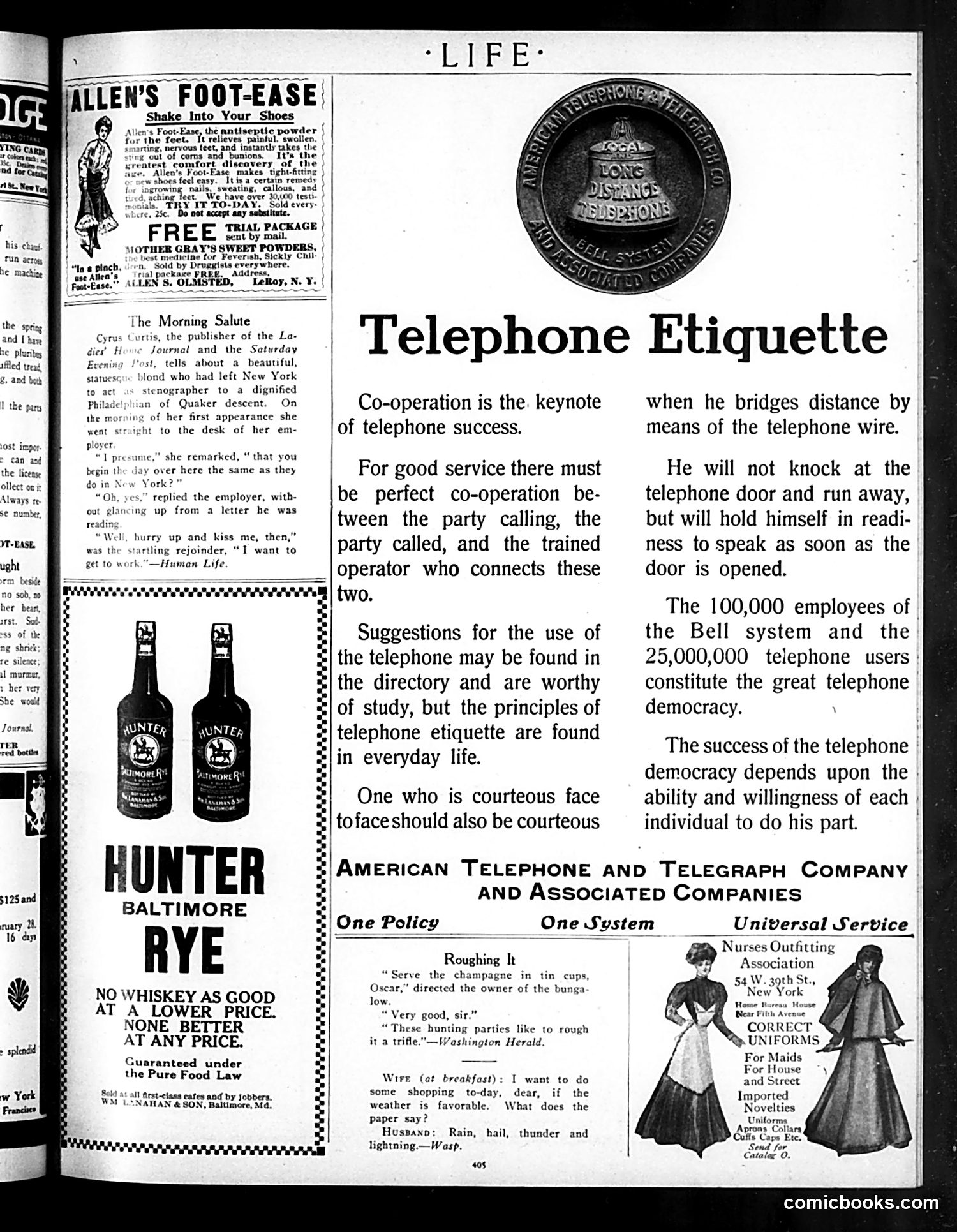
This page is primarily a **corporate advertisement** from American Telephone & Telegraph (AT&T), not political satire. The Bell System presents "Telephone Etiquette" as a civics lesson, framing proper phone use as democratic responsibility. **The Message:** With 100,000 Bell employees and 25 million users, the telephone company positions itself as a "great telephone democracy" where success depends on mutual cooperation and courtesy. Users must be courteous when calling, and callers should remain ready to speak when doors open—metaphorically bridging distance through proper behavior. **The Humor/Irony:** The accompanying anecdotes (a woman asking her boss to kiss her before work; champagne served in tin cups) gently mock pretension and social climbing. These contrast sharply with the earnest corporate message about democratic cooperation. The page also contains unrelated period advertisements for Allen's Foot-Ease powder and Hunter Baltimore Rye whiskey, typical of magazine content from this era.
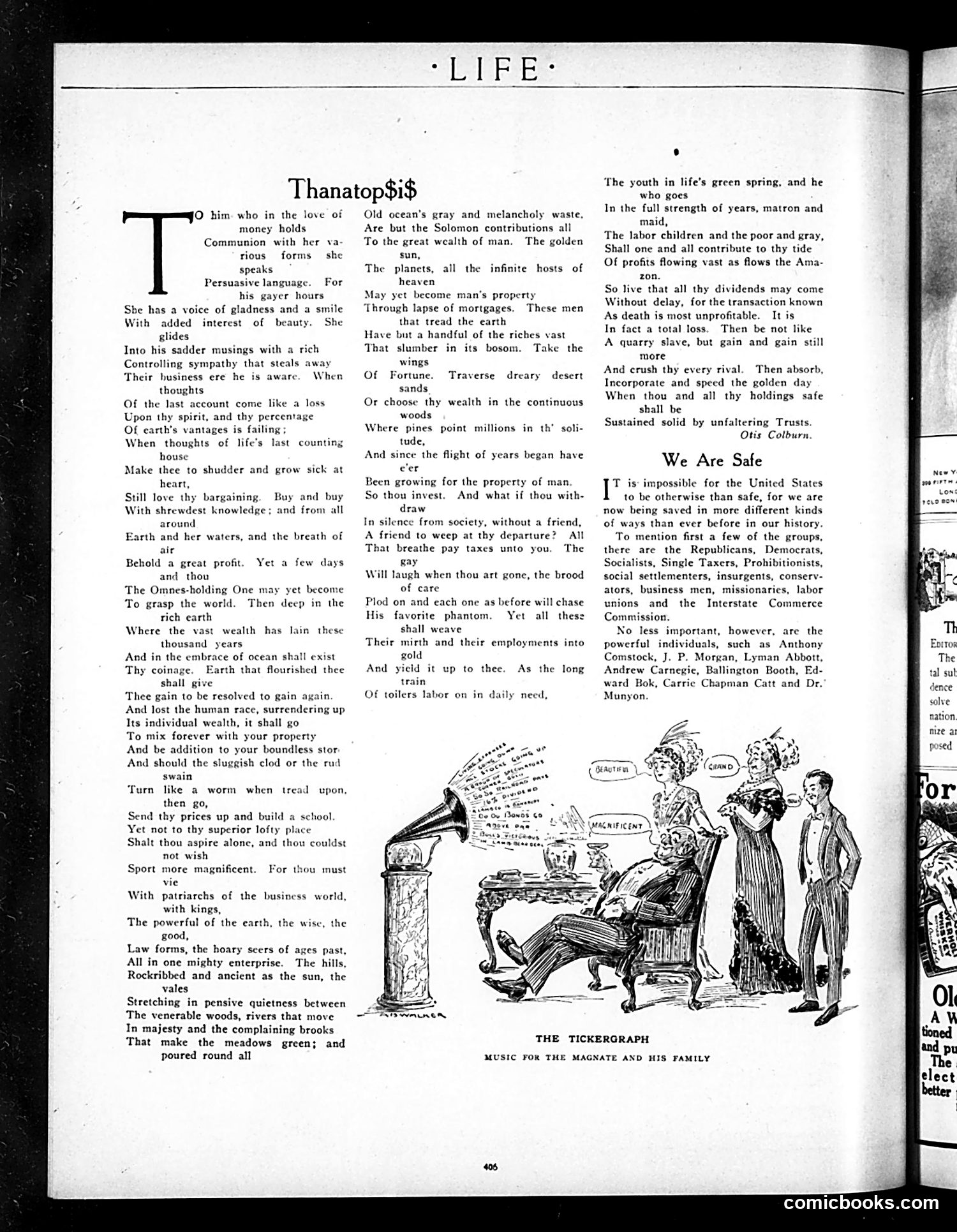
The left page presents a satirical poem titled "Thanatopsis" (mocking Bryant's famous work) that perverts the original's meditative philosophy into a crude manifesto of capitalist greed. It addresses a wealthy man, urging him to accumulate wealth relentlessly—buying, investing, extracting profits from labor and nature—while dismissing death as merely an "unprofitable" loss. The poem celebrates monopolies ("unfaltering Trusts") and crushing competitors. The cartoon "The Tickerograph: Music for the Magnate and His Family" depicts a wealthy businessman being serenaded by a gramophone-like device spouting financial terminology (labels visible include words like "profit"). His family members stand nearby, seemingly indifferent. Together, these mock the Gilded Age obsession with wealth accumulation and the dehumanizing effect of finance capitalism, where even culture and family relationships become subservient to profit. The satire targets the moral bankruptcy of unchecked materialism.
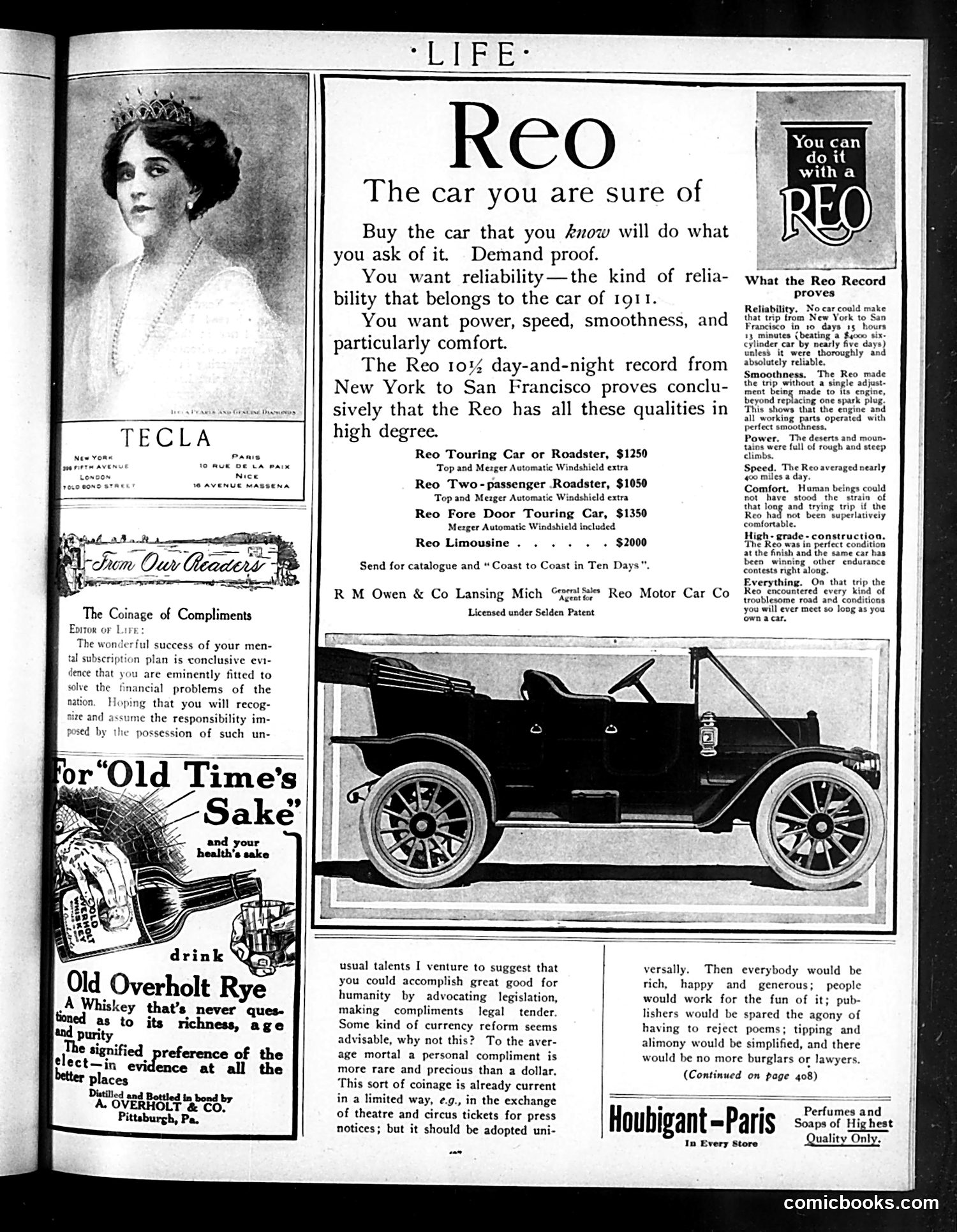
This is primarily an **advertising page** for the Reo automobile (circa 1911), with supporting advertisements. The main Reo ad emphasizes the car's reliability and performance, highlighting a successful New York-to-San Francisco endurance run that proved the vehicle's capabilities in power, speed, smoothness, and comfort. This was a common marketing tactic of the era—using long-distance driving records to demonstrate automobile reliability when cars were still novel and their dependability questioned. The secondary content includes a satirical piece titled "The Coinage of Compliments" (continued from an earlier page), which jokingly proposes making compliments legal tender as currency reform. The satire suggests this would solve social problems—eliminating rejection of poetry submissions, reducing tipping disputes, and eliminating need for lawyers and burglars. The page also advertises Old Overholt Rye whiskey and Houbigant-Paris perfumes, typical luxury goods of the period.
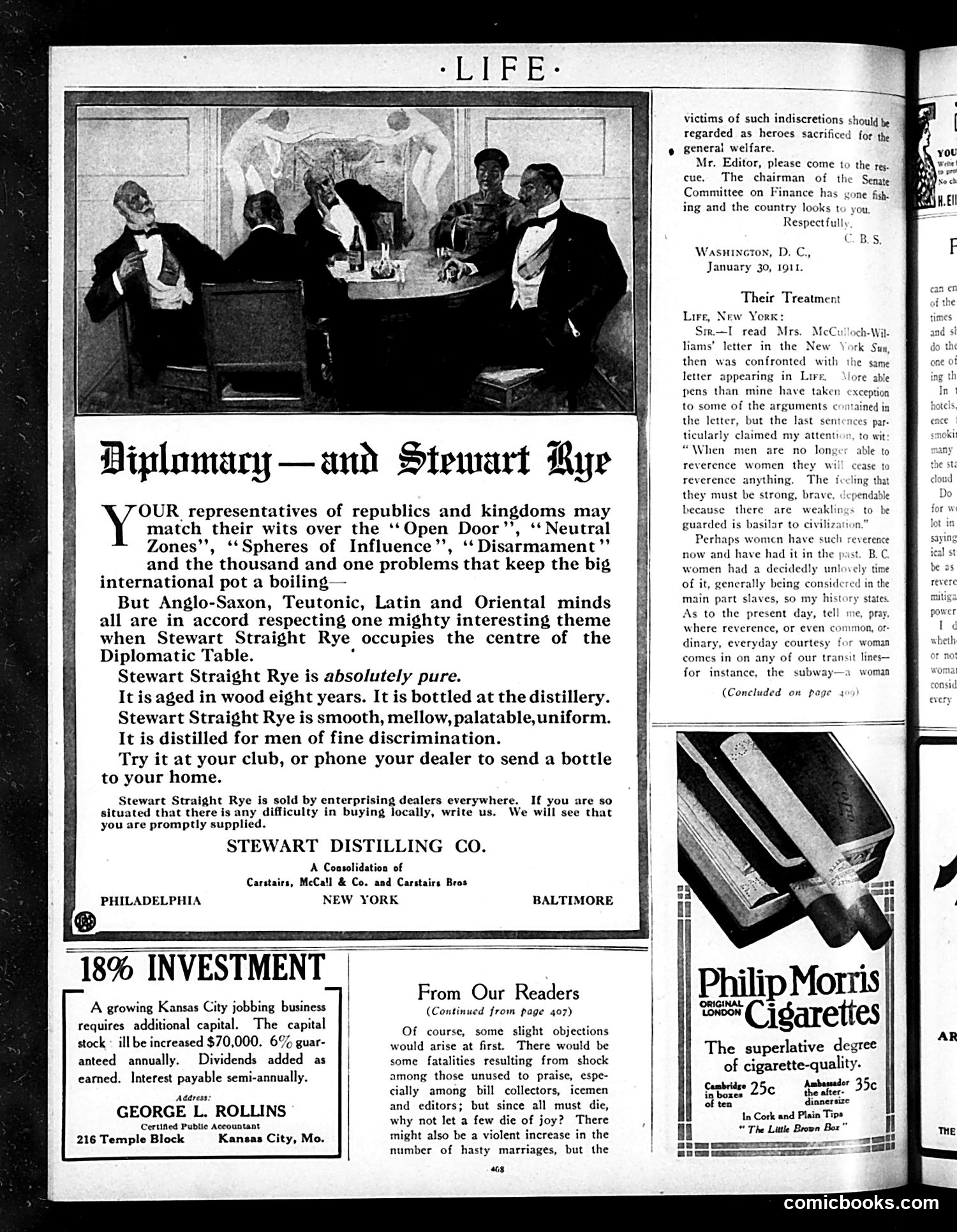
This page satirizes international diplomacy through a whiskey advertisement. The cartoon depicts diplomats from different nations (Anglo-Saxon, Teutonic, Latin, and Oriental) gathered around a table in formal attire, ostensibly negotiating complex geopolitical issues like the "Open Door" policy and disarmament. The joke: Despite their heated disagreements over serious international matters, all these rival nations mysteriously agree on one thing—Stewart Straight Rye whiskey. The ad humorously suggests that this liquor is the only thing uniting fractious world powers. This satirizes early 1900s diplomatic tensions (likely referencing WWI prelude tensions) by implying that diplomacy is ultimately futile except when lubricated by alcohol. The satire works by presenting a liquor advertisement as though it were solving what actual diplomacy cannot. The page also contains unrelated reader letters and investment notices, typical of Life's mixed content.
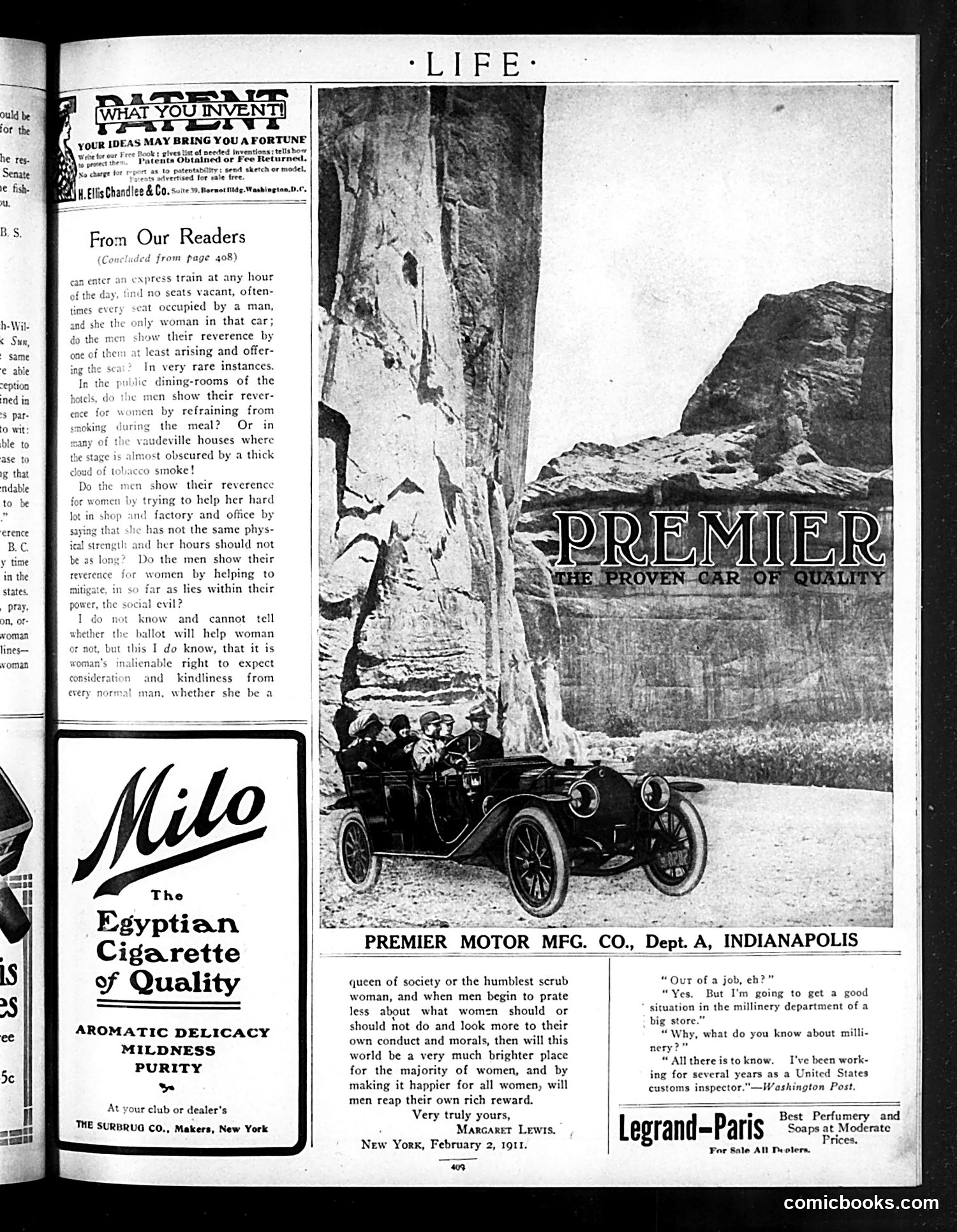
This page contains a letter-to-editor essay by Margaret Lewis arguing for women's rights. Lewis critiques men's performative "reverence" toward women—removing hats on trains, refraining from smoking at dinner—as empty gestures that mask deeper inequality. She demands genuine respect through equal treatment in workplaces and public life, arguing that improving women's conditions benefits men too. The accompanying joke, attributed to the Washington Post, satirizes gender segregation in employment. A man fired from his customs inspector job plans to work in "millinery" (a traditionally female field), boasting he knows "all there is" because of his previous experience. The humor relies on the era's assumption that women's work requires no real skill—that a man's unrelated government job qualifies him instantly for "women's work." Together, these pieces ironically illustrate Lewis's point: society simultaneously devalues women's labor while restricting their opportunities to specific fields.
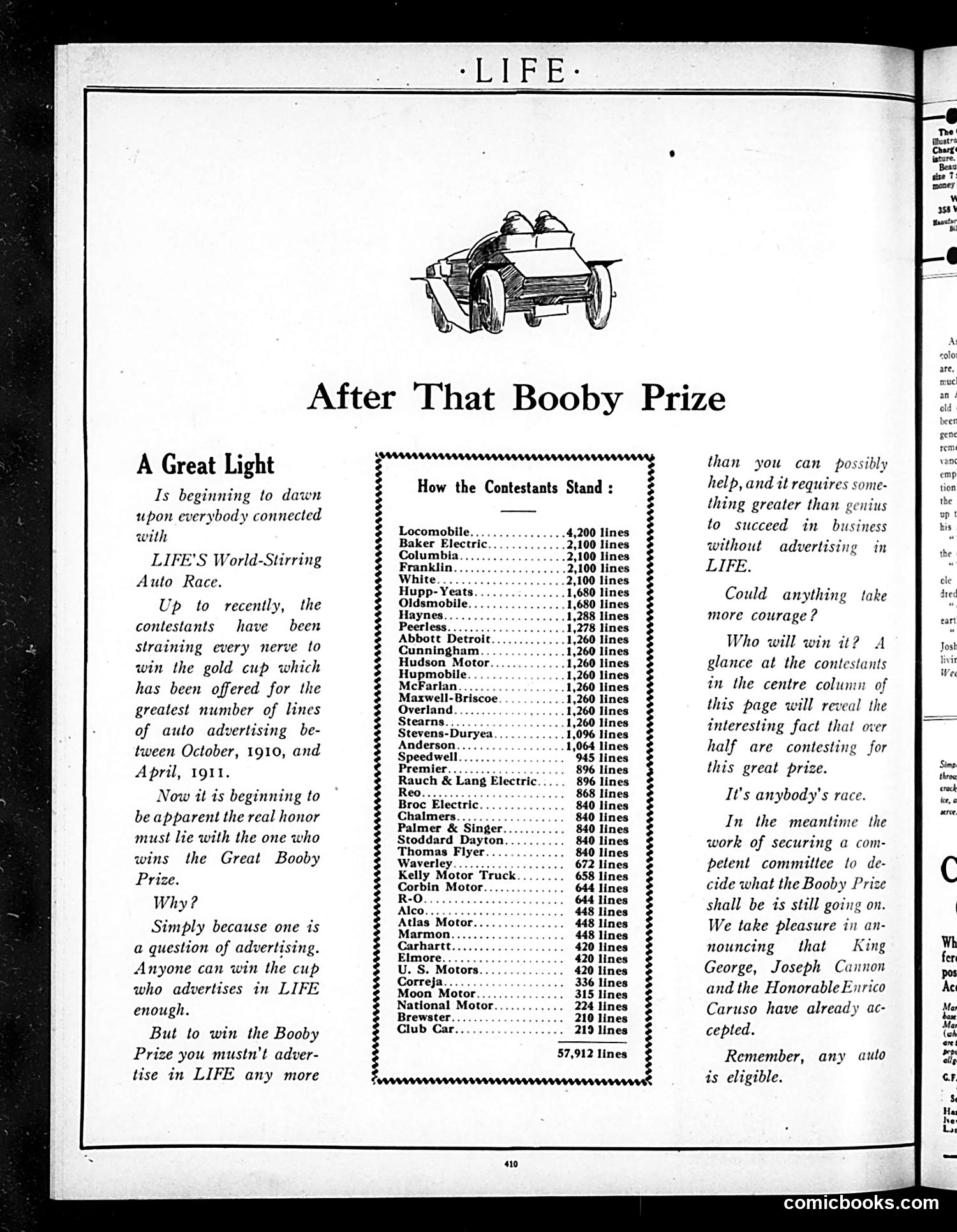
This is a satirical advertisement contest announcement from Life magazine (October 1910-April 1911). The joke targets automobile manufacturers competing for advertising prominence in the publication. **The Setup:** Life announces two prizes—a gold cup for the most advertising lines, and a "Booby Prize" (slang for a fool's prize, given as mockery) for whoever advertises *least* in the magazine. **The Satire:** Life mocks both the auto industry's desperation to advertise and the magazine's own mercenary nature. The text admits candidly that winning the cup simply requires spending money on ads in LIFE—it's not about quality or merit. By contrast, the Booby Prize humorously "honors" restraint, positioning non-advertisers as courageous rebels. **The Punchline:** Life then claims King George V, Speaker Joseph Cannon, and opera star Enrico Caruso have agreed to judge—absurd selections implying the entire enterprise is ridiculous. The underlying point: Life profits from advertising volume, not editorial quality.
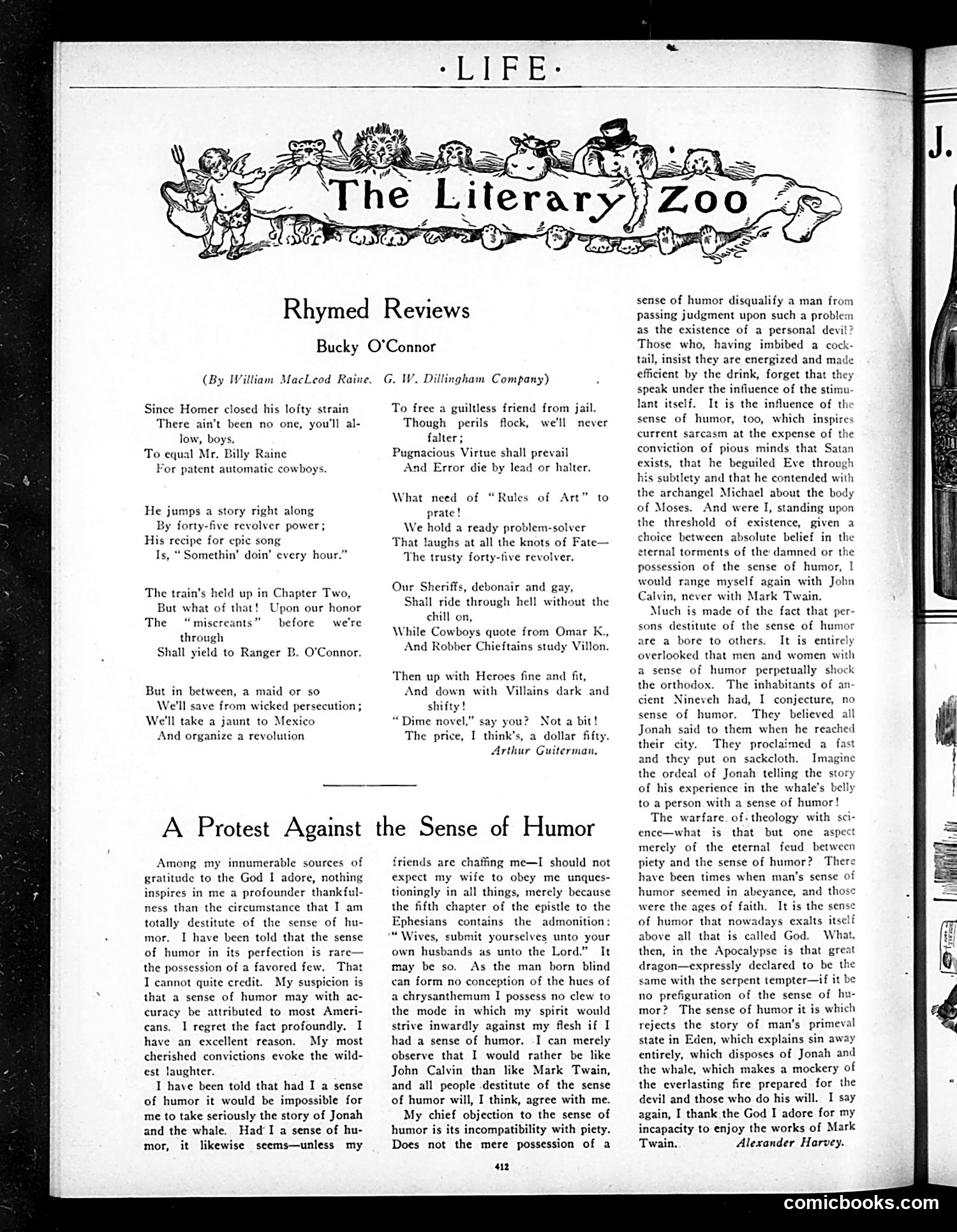
This Life magazine page contains two distinct pieces: **"Rhymed Reviews: Bucky O'Connor"** (by Arthur Guiterman) satirizes pulp Western novels, specifically William MacLeod Raine's formulaic cowboy stories. The poem mocks their predictable plots—train holdups, rescues of maidens, revolutions—all resolved by gunfire. Guiterman ridicules the genre's claim to literary merit while priced at a mere $1.50, calling it essentially a glorified "dime novel." **"A Protest Against the Sense of Humor"** (by Alexander Harvey) argues humorlessness is actually a virtue, claiming humor incompatibility with serious piety and religious conviction. The author contrasts himself favorably with Mark Twain, preferring John Calvin's humorless devotion. He suggests humor prevents proper judgment on matters like Satan's existence and divine torment. Both pieces use satire to critique: one targets cheap popular entertainment, the other defends rigid religious seriousness against modern irreverence. Together they reflect early-20th-century tensions between mass culture, religious orthodoxy, and modernist sensibility.
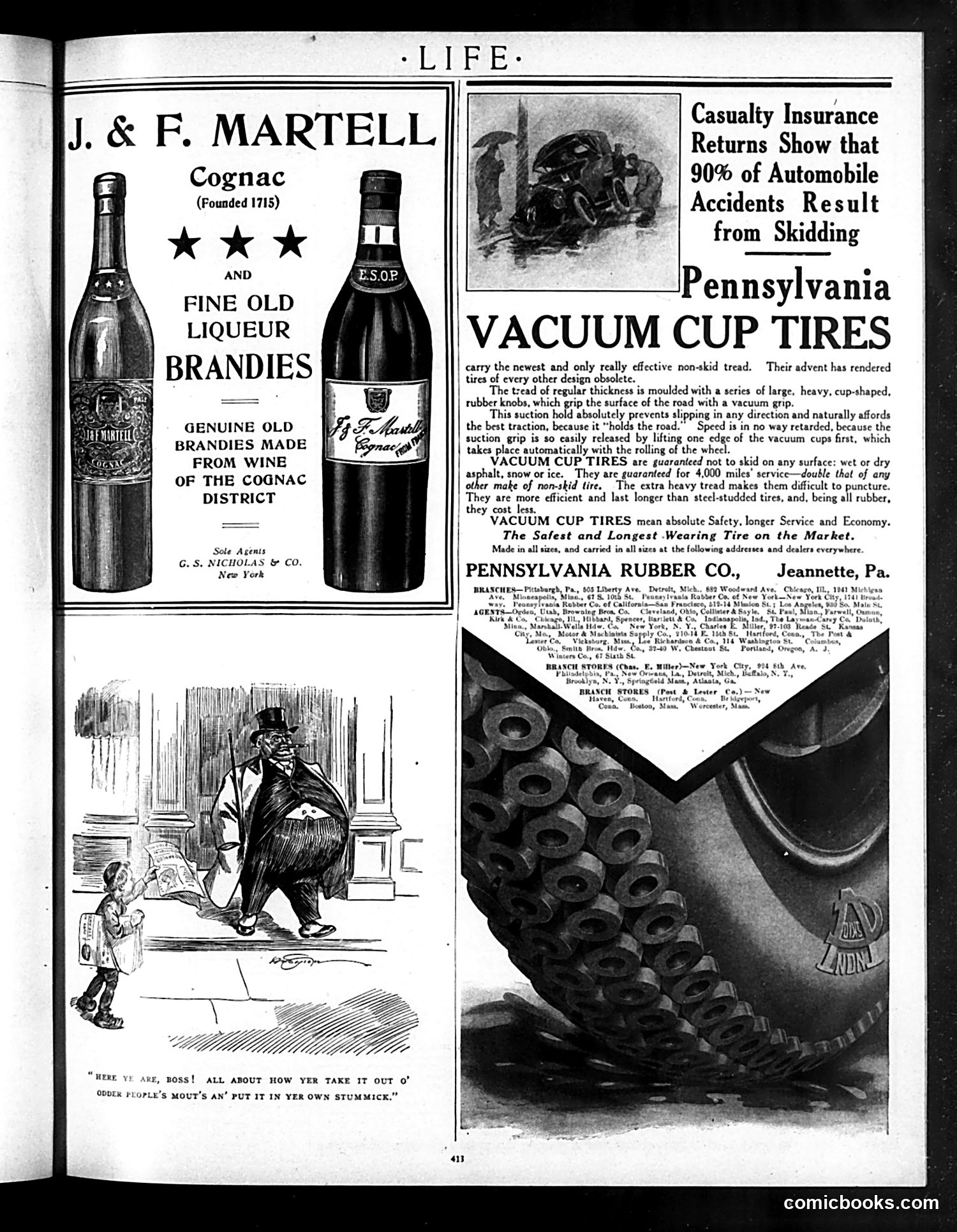
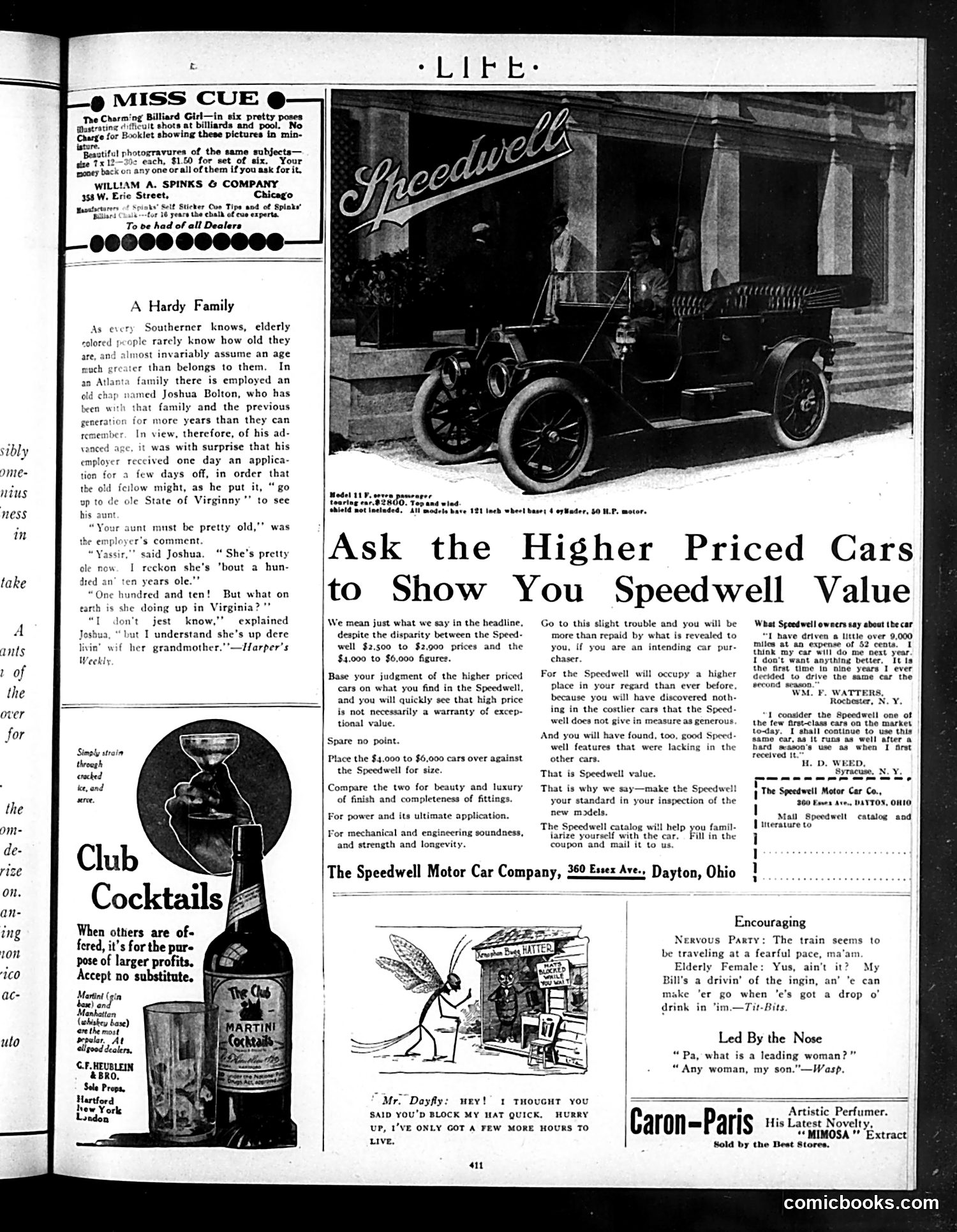
This page contains two distinct elements: **advertising and political satire**. **Left side:** Ads for Martell Cognac and a cartoon mocking Prohibition-era bootlegging. The sketch shows a small child offering an adult liquor, with dialect-heavy caption suggesting illicit alcohol distribution ("take it out of other people's mouths and put it in your own stomach"). This satirizes the widespread flouting of Prohibition laws and the brazenness of illegal alcohol sales, even involving minors as couriers. **Right side:** A Pennsylvania Rubber Company ad claiming their "Vacuum Cup Tires" prevent 90% of automobile accidents caused by skidding. The ad uses an accident photograph as marketing—a stark, uncomfortable juxtaposition of safety claims with crash imagery typical of early 20th-century advertising's less-regulated approach. The page reflects Jazz Age America: Prohibition's unpopularity, growing automobile culture, and aggressive (by modern standards) advertising tactics.
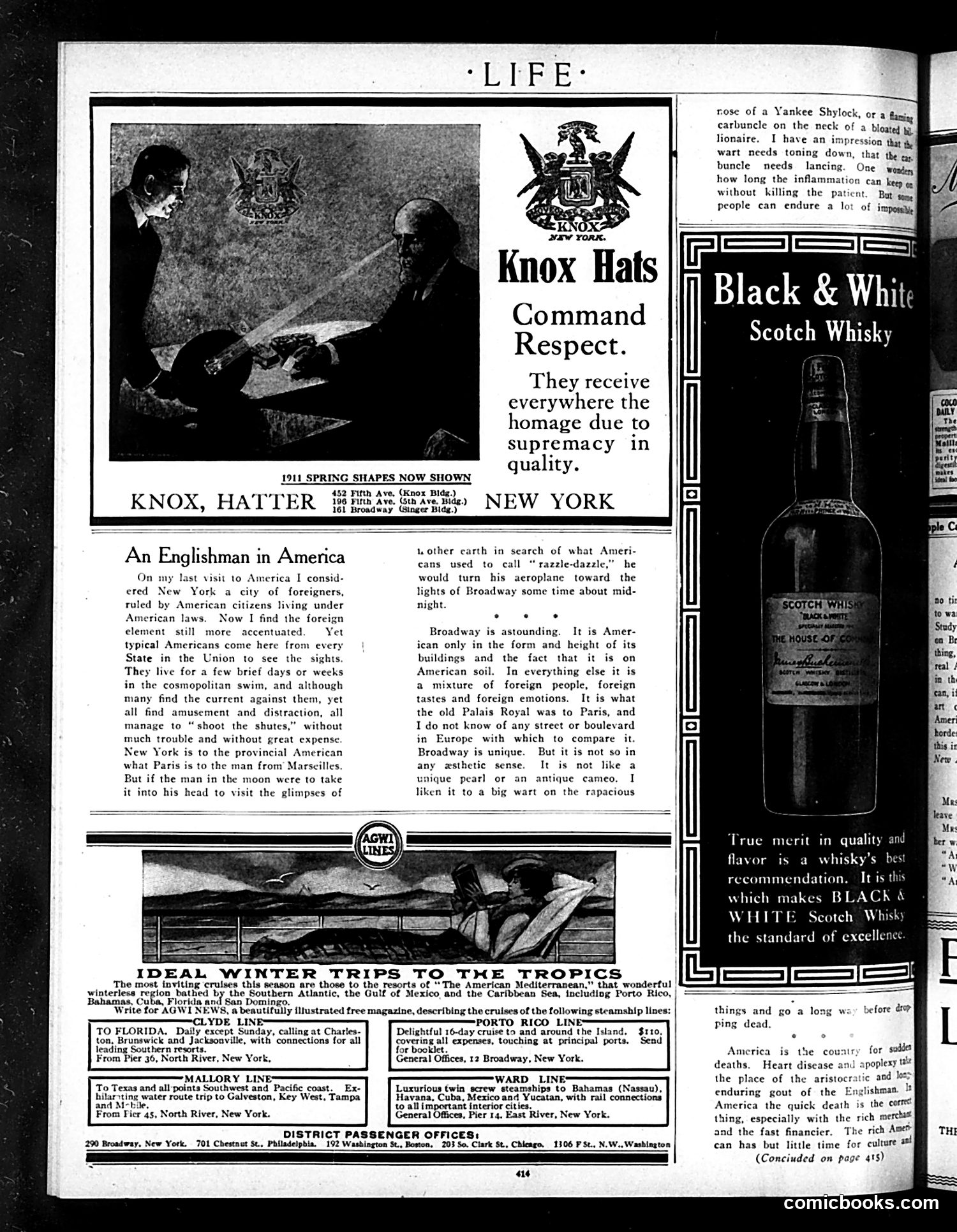
This page contains **advertisements and a satirical essay**, not a political cartoon. The main text, "An Englishman in America," is a critical commentary on Broadway and American culture by a visiting Englishman. He observes that New York is dominated by foreigners, and Broadway—though architecturally American—represents a chaotic mixture of foreign influences. His key point: Broadway is not aesthetically valuable but rather a "big wart" or "carbuncle" on America that needs removal, questioning how long Americans can tolerate such urban excess. The satire is cultural rather than political: it mocks American urbanization, commercialism, and cosmopolitanism through a foreigner's perspective. The author compares Broadway unfavorably to European cultural centers like Paris's Palais Royal. **Advertisements** for Knox Hats and Black & White Scotch Whisky occupy significant space, typical of *Life* magazine's format during this era (1911).
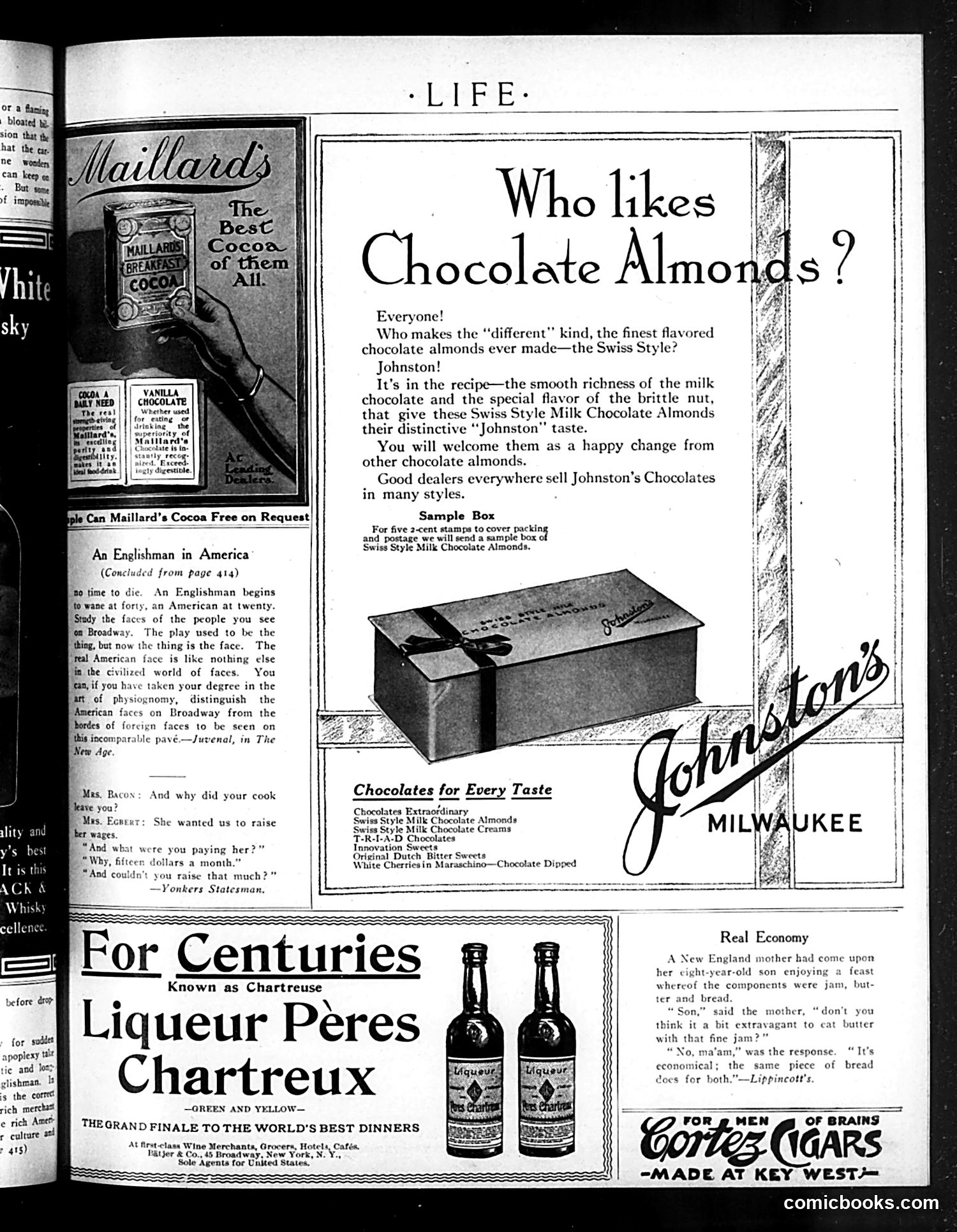
This is primarily an **advertising page** from Life magazine, not satirical content. The page contains three unrelated advertisements: 1. **Johnston's Chocolate Almonds** (top): A straightforward product ad emphasizing "Swiss Style" quality and offering a sample box for stamps. 2. **Liqueur Pères Chartreux** (bottom left): A liquor advertisement promoting French chartreuse as "the grand finale to the world's best dinners." 3. **Corleez Cigars** (bottom right): A cigar advertisement claiming to be "for men of brains," made in Key West. The page also includes two short **humorous anecdotes**: one about an Englishman's observations of American faces on Broadway, and another joke about a child's economical sandwich-making technique. There is **no political satire or caricature** on this page—it's typical early 20th-century magazine content mixing advertisements with brief comedic sketches.
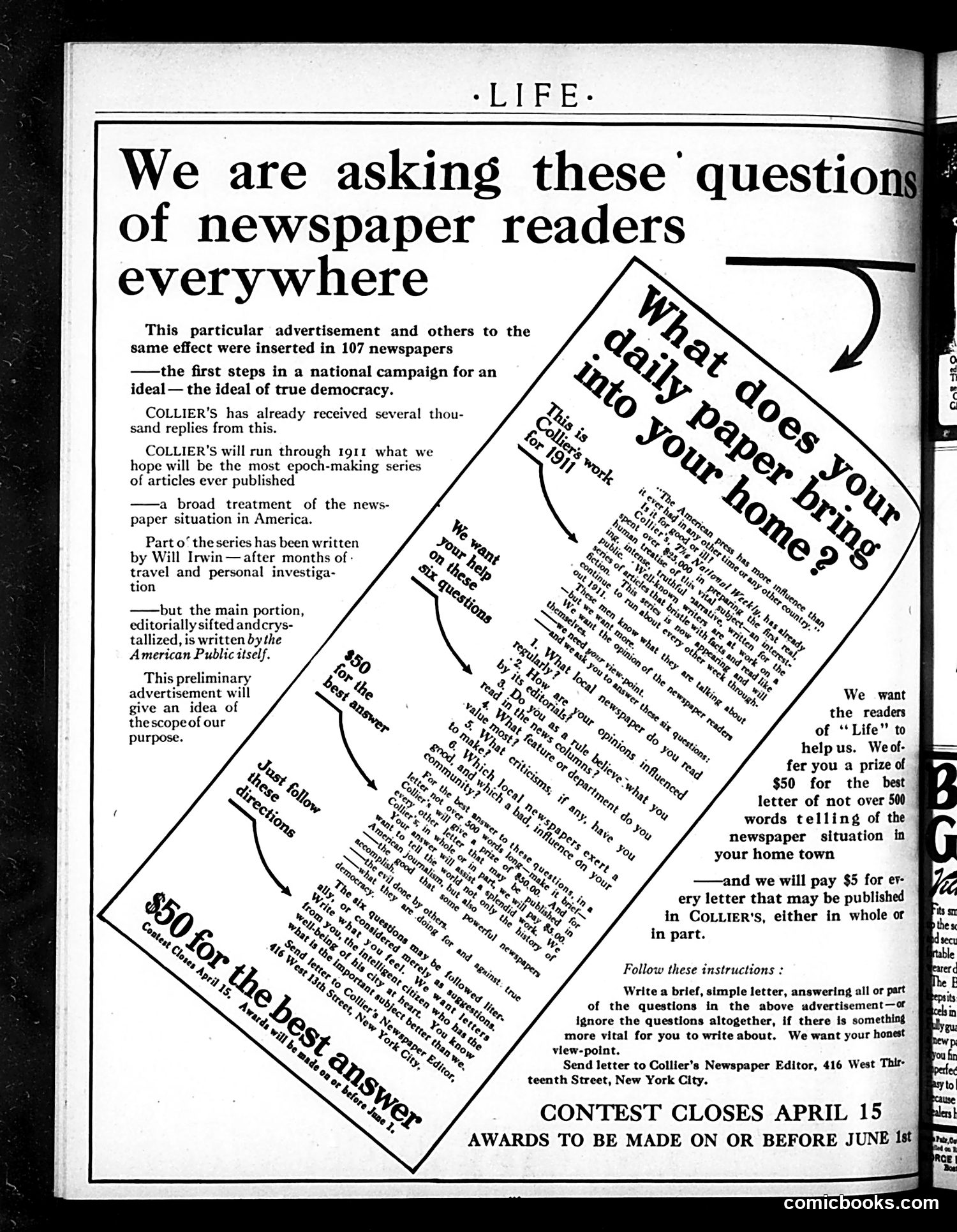
This is a **reader-participation advertisement**, not a satirical cartoon. Collier's magazine launched a 1911 national campaign investigating "the newspaper situation in America"—examining whether newspapers served democratic ideals or corrupt interests. The contest solicits readers' letters describing their **local newspaper's role and conduct** in their home towns. Collier's offered $50 for the best submission (500 words max) and $5 for any published letter, positioning ordinary citizens as investigators of press integrity. This reflects the **Progressive Era's** muckraking tradition: investigative journalism exposing institutional corruption. By crowdsourcing reader accounts, Collier's gathered grassroots evidence about whether newspapers functioned as democratic forums or tools of political/business elites—a central reform concern of the 1910s.
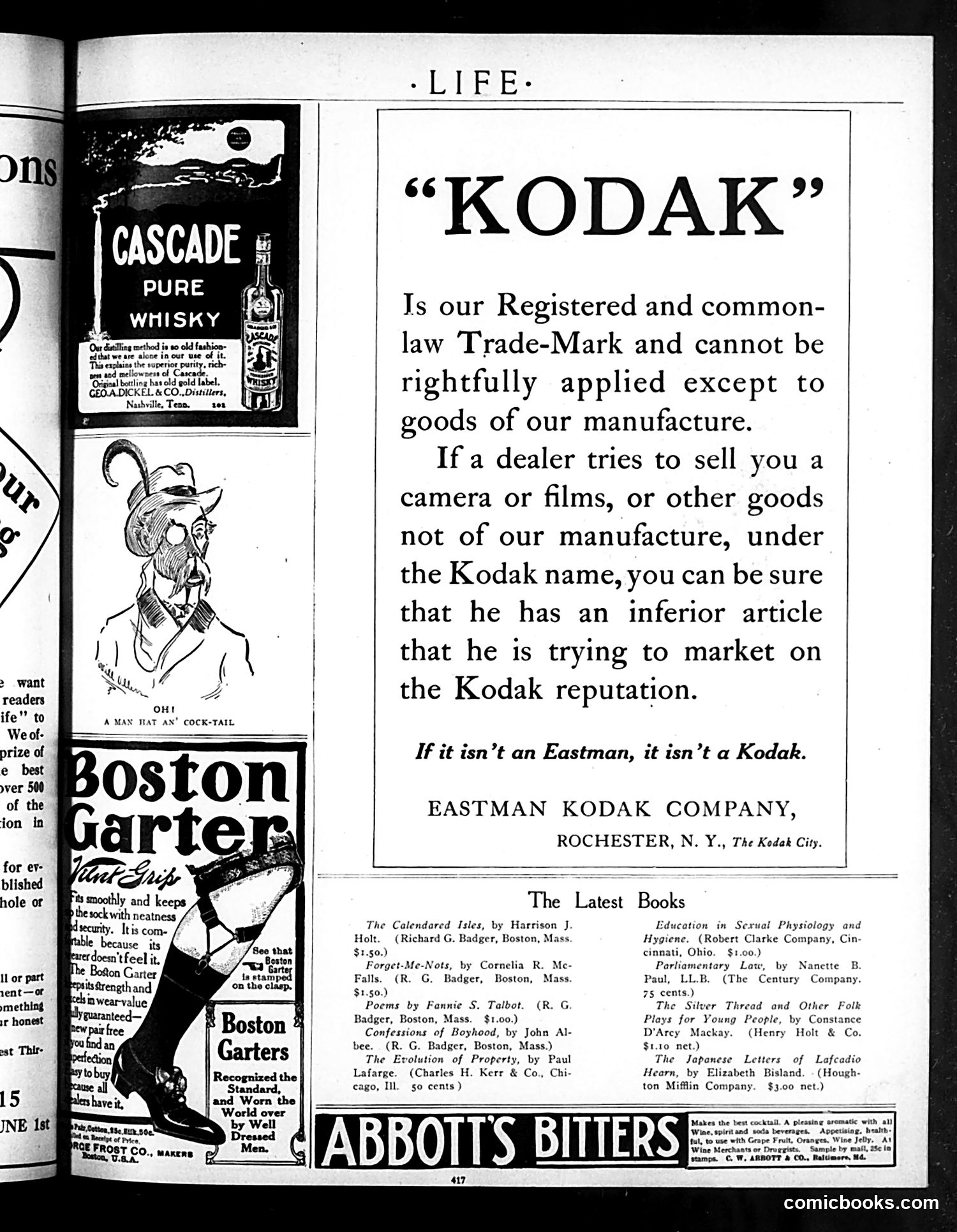
This page is primarily **advertising and book listings**, not political satire or comics. The main content is a **Kodak trademark protection notice** warning consumers against counterfeit goods. Eastman Kodak Company cautions that "Kodak" is their registered trademark and cannot be legally applied to non-Kodak products. The warning targets unscrupulous dealers attempting to sell inferior cameras or film under the Kodak name to exploit the brand's reputation. The slogan "If it isn't an Eastman, it isn't a Kodak" reinforces brand authenticity. The left side contains advertisements for **Cascade Pure Whisky** and **Boston Garters** (men's suspenders), both featuring period illustrations. Below are book listings from Boston and Chicago publishers, typical of Life's content of that era. The page reflects early 20th-century concerns about trademark protection and consumer fraud—companies needed to actively defend their brands against counterfeiters.
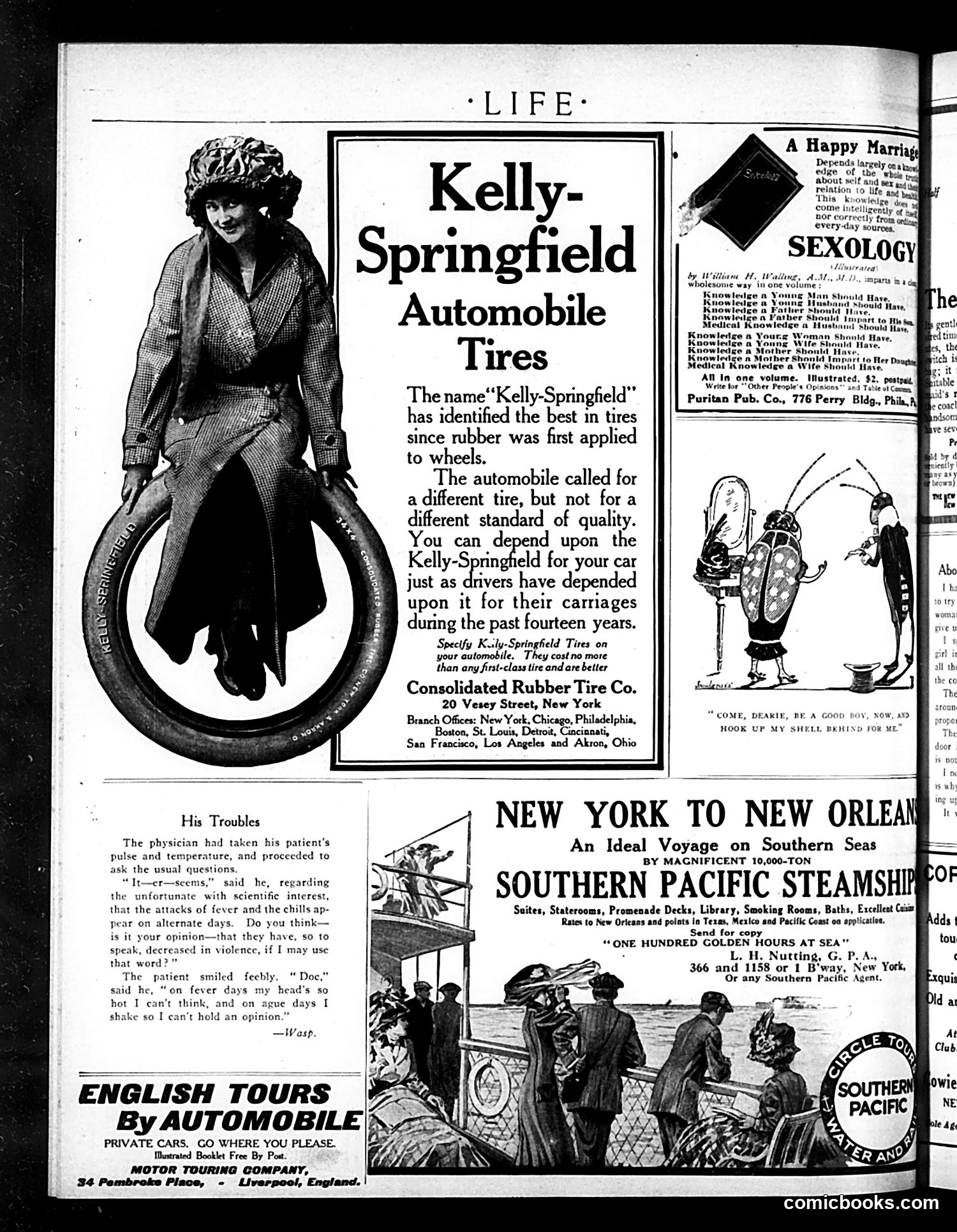
This page is primarily **advertising**, not political satire. The dominant content includes: **Kelly-Springfield Automobile Tires** (center): A large advertisement featuring a woman sitting in a giant tire, promoting the brand's reliability. The copy emphasizes the tire's fourteen-year track record and quality consistency. **"His Troubles"** (lower left): A brief humorous anecdote about a doctor questioning a feverish patient. The joke's punchline—that the patient "can't hold an opinion" on fever days due to physical discomfort—is a mild, gentle joke about illness affecting cognition. **Shipping & Travel Ads**: Additional advertisements for Southern Pacific Steamship (New York to New Orleans) and English automobile tours. **Sexology Book Advertisement** (upper right): Promoting a volume on marital relations. The page reflects early 20th-century magazine advertising practices, mixing commercial content with light humor. There is no significant political commentary or social satire present—it's standard period advertising fare.
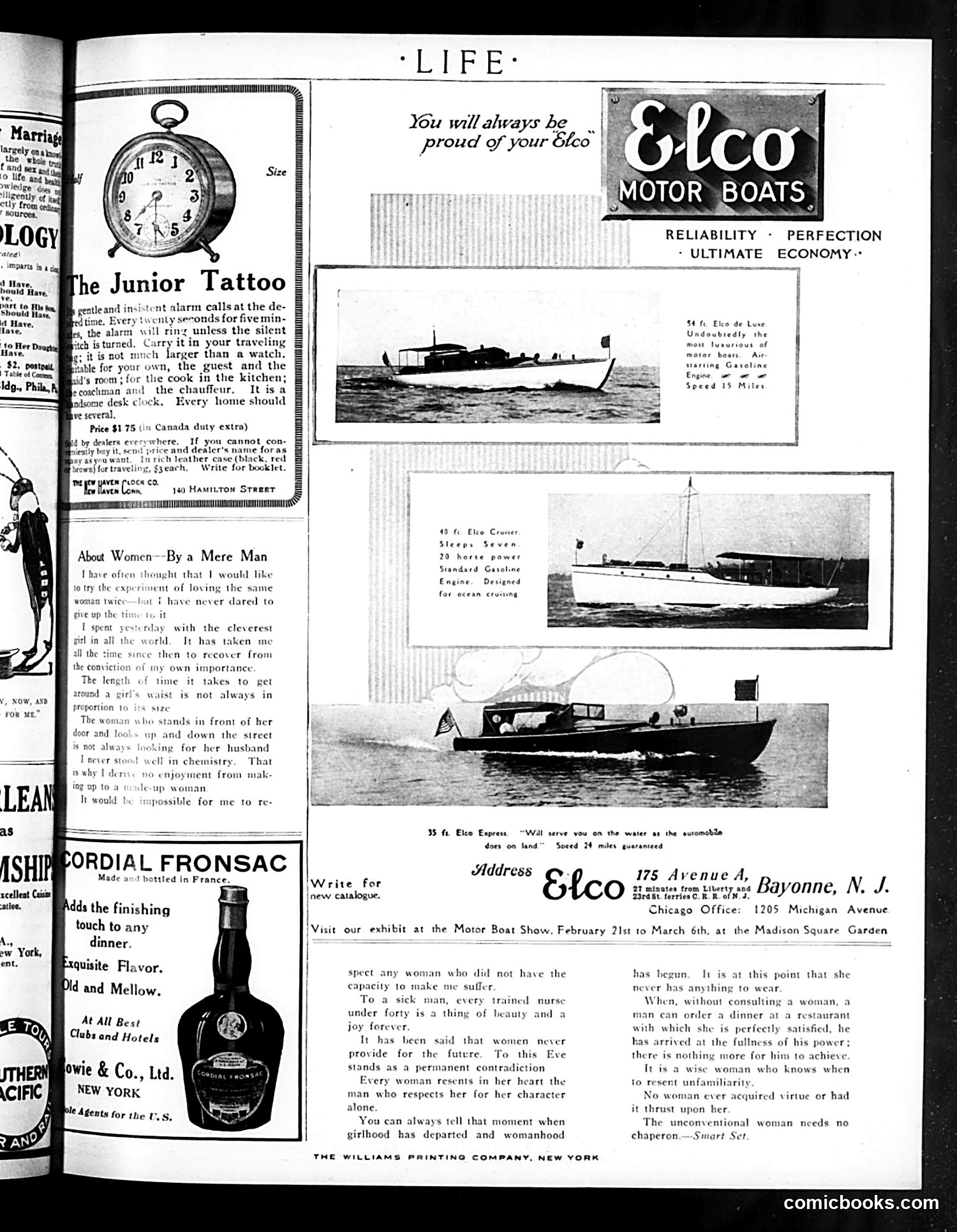
This page is **primarily advertising**, not satire or political cartooning. The dominant content consists of product advertisements interspersed with a brief opinion column. **Main Content:** - **"The Junior Tattoo"**: An alarm clock advertisement positioned as a practical travel item - **"About Women—By a Mere Man"**: A short misogynistic opinion piece offering reductive observations about women's behavior and character—typical of early 20th-century "bachelor philosophy" humor that mocked women's supposed inconsistencies - **Elco Motor Boats**: Multiple boat advertisements emphasizing reliability and luxury **Social Context for Modern Readers:** The "About Women" column reflects period attitudes treating women as objects of bemused male criticism. Statements like "every woman resents in her heart the man who respects her for her character alone" reflect outdated gender stereotypes. The piece's tone—condescending yet presented as clever observation—was considered acceptable magazine content of the era. The advertisements reflect the leisure interests of the magazine's affluent readership.
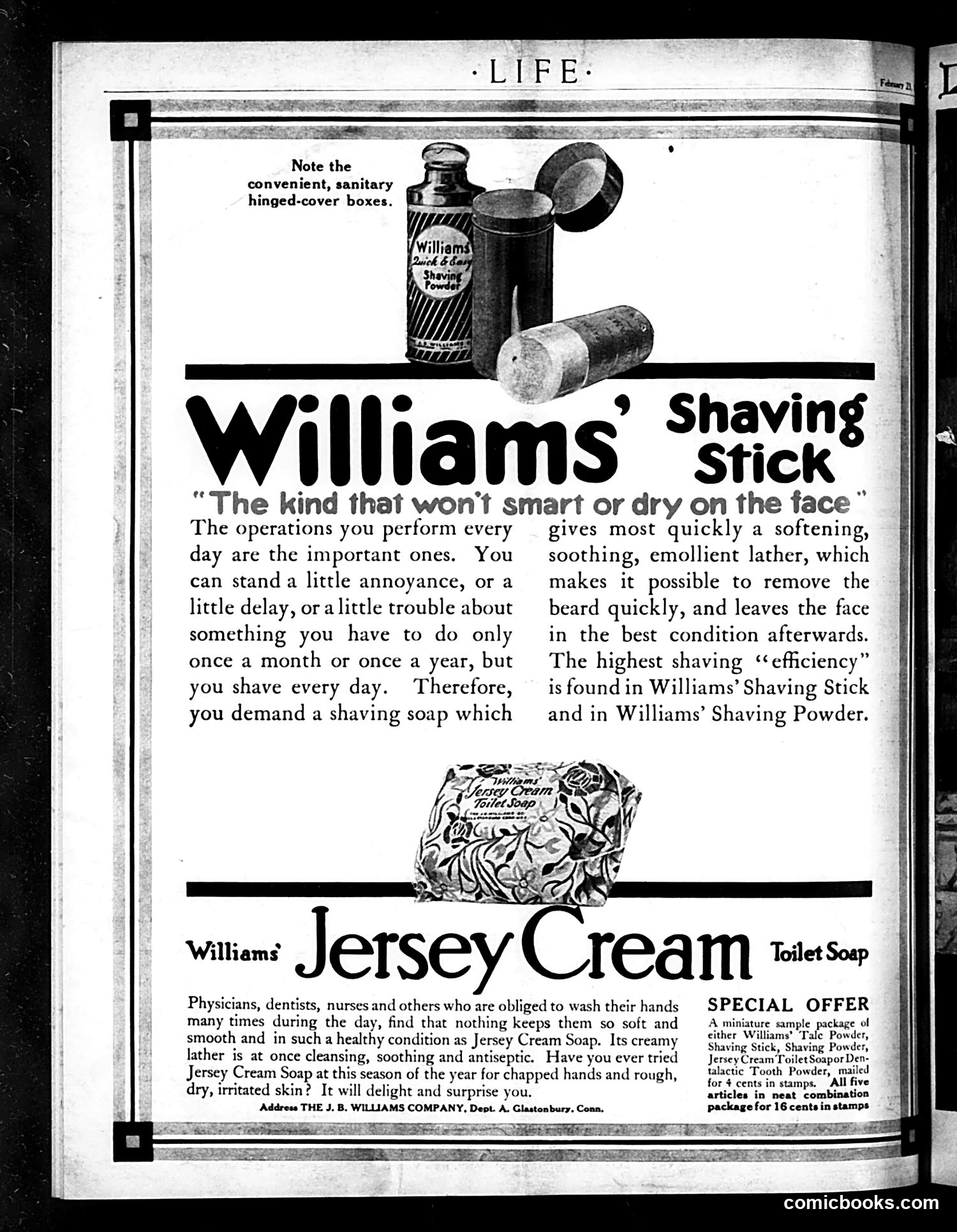
This is **not a cartoon or satirical content**—it's a straightforward **advertisement page** from Life magazine for Williams' grooming products (shaving stick, shaving powder, and Jersey Cream toilet soap). The page uses early 20th-century marketing rhetoric emphasizing "efficiency" and daily necessity. The ad argues that since men shave every day (unlike monthly or yearly tasks), they deserve superior shaving products that won't irritate skin. The soap is pitched to professionals—physicians, dentists, nurses—who wash hands frequently and need gentle cleansing. The "special offer" at bottom promotes sample packages at bargain prices (4-16 cents in stamps). There is no satire, political commentary, or caricature here. This represents typical period advertising that appealed to male grooming concerns and professional cleanliness standards of the era.