
Life, 1911-02-23 · page 24 of 44
Life — February 23, 1911 — page 24: what you’re looking at
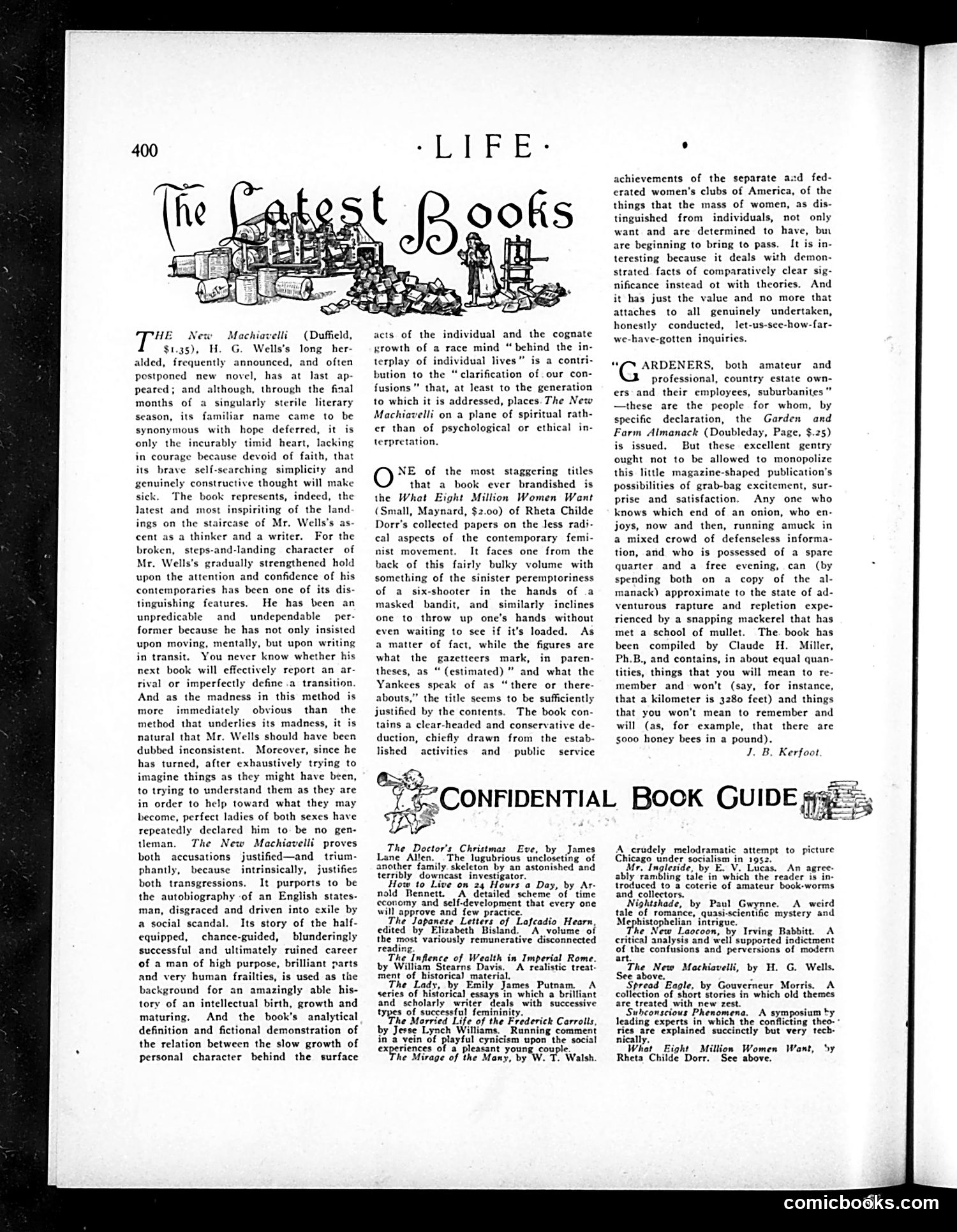
What you’re looking at
This page from *Life* magazine reviews recently published books. The main content discusses H.G. Wells's *The New Machiavelli*, praising it as his most mature work despite his reputation for intellectual inconsistency. The reviewer argues Wells has moved from imagining "what might have been" to understanding "what is," a shift that scandalized conventional society but represents genuine intellectual growth. The page also reviews Rheta Childe Dorr's *What Eight Million Women Want*, a collection on the feminist movement. The reviewer notes the book's title—appearing "with something of the sinister peremptoriness of a six-shooter"—seems audaciously sweeping, but Dorr's actual analysis is reasonably conservative and grounded in demonstrated facts about women's achievements and needs. The satire is subtle: the review gently mocks both those who dismiss Wells as unreliable and those alarmed by feminist activism.
📄 Transcribed text from this page (OCR, searchable)
Machine-transcribed from the original scan — historical spelling and the odd misread are preserved.
Machiavelli (Duffield, $1.35), H. G. Wells's long her- alded, frequently announced, and often postponed new novel, has at last ap- peared; and although, through the final months of a singularly sterile literary season, its familiar name came to be synonymous with hope deferred, it is only the incurably nid heart, lacking in courage because devoid of faith, that its brave self-searching simplicity and genuinely constructive thought will make sick. The book represents, indeed, the latest and most inspiriting of the land ings on the staircase of Mr. Wells's as- cent as a thinker and a writer. For the broken, steps-and-landing character of Mr. Wells’s gradually strengthened hold upon the attention and confidence of his contemporaries has been one of its dis- tinguishing features. He has been an unpredicable and undependable _ per- former because he has not only insisted upon moving, mentally, but upon writing in transit. You never know whether his next book will effectively report an ar- rival or imperfectly define .a transition. And as the madness in this method is more immediately obvious than the method that underlies its madness, it is natural that Mr. Wells should have been dubbed inconsistent. Moreover, since he has turned, after exhaustively trying to imagine things as they might have been, to trying to understand them as they are in order to help toward what they may become, perfect s of both sexes have repeatedly declared him to be no gen- tleman. The New Machiavelli proves both accusations justificd—and trium- phantly, because intrinsically, justifies both transgressions. It purports to be the autobiography of an English states- man, disgraced and driven into exile by a social scandal. Its story of the half- equipped, chance-guided, blunderingly successful and ultimately ruined career of a man of high purpose, brilliant parts and very human frailties, is used as the background for an amazingly able his- tory of an intellectual birth, growth and maturing. And the book's analytical definition and fictional demonstration of the relation between the slow growth of personal character behind the surface acts of the individual and the cognate growth of a race mind “behind the in- terplay of individual lives” is a contri- bution to the “clarification of our con- fusions” that, at least to the generation to which it is addressed, places. The New Machiavelli on a plane of spiritual rath- er than of psychological or ethical in- terpretation, NE of the most staggering titles that a book ever brandished is the What Eight Million Women Want (Small, Maynard, $2.00) of Rheta Childe Dorr’s collected papers on the less radi- cal aspects of the contemporary femi- nist movement. It faces one from the back of this fairly bulky volume with something of the sinister peremptoriness of a six-shooter in the hands of a masked bandit, and similarly inclines one to throw up one’s hands without even waiting to sce if it's loaded. As a matter of fact, while the figures are what the gazetteers mark, in paren- theses, as “ (estimated) ” and what the Yankees speak of as “there or there- abouts,” the title seems to be sufficiently justified by the contents. The book con- tains a clear-headed and conservative de- duction, chiefly drawn from the estab- lished activities and public service Lane Allen, The lugubrious uncloseting of another family skeleton by an astonished and terribly downcast investigator. How to Live on 24 Hours a Day, by Ar- nold Rennett. A detailed scheme ‘of time cconomy and self-development that every one will approve and few practice ¢ Japanese Letters of Lofcadio Hearn, edited by Elizabeth Bisland. A volume of the most variously remunerative disconnected reading. The Inflence of Wealth in Imperial Rome. by William Stearns Davis. A realistic treat: ment of historical material, The Lady, by Emily James Putnam A series of historical essays in which a bri and scholarly writer deals with success types of successful femininity, "he Married Life of the Frederick Carrolls, by Jesse Lynch Williams. Running comment in a vein of playful cynicism upon the social riences of a pleasant young couple. he Mirage of the Many, by W. T. Walsh achievements of the separate a:d fed- erated women's clubs of America, of the things that the mass of women, as dis- tinguished from individuals, not only want and are determined to have, bur are beginning to bring to pass. It is in- teresting because it deals with demon- strated facts of comparatively clear sig- nificance instead ot with theories. And it has just the value and no more that attaches to all genuinely undertaken, honestly conducted, _let-us-see-how-far- we-have-gotten inquiries. ey ARDENERS, both amateur and professional, country estate own- ers and their employees, suburbanites —these are the people for whom, by specific declaration, the Garden and Farm Almanack (Doubleday, Page, $.25) is issued, But these excellent gentry ought not to be allowed to monopolize this little magazine-shaped publication's possibilities of grab-bag excitement, sur- prise and satisfaction. Any one who knows which end of an onion, who en- joys, now and then, running amuck in a mixed crowd of defenseless informa- tion, and who is possessed of a spare quarter and a free evening, can (by spending both on a copy of the al- manack) approximate to the state of ad- venturous rapture and repletion expe- rienced by a snapping mackerel that has met a school of mullet. The. book has been compiled by Claude H. Miller, Ph.B., and contains, in about equal quan- tities, things that you will mean to re- member and won't (say, for instance, that a kilometer is 3280 feet) and things that you won't mean to remember and will (as, for example, that there are 000 honey bees in a pound). J. B. Kerfoot "CONFIDENTIAL Book GUIDE g3i% The Doctor's Christmas Eve, by James A crudely melodramatic attempt to picture Chicago under socialism in 1952. Mr. Ingleside, by E. V. Lucas. An agree- ably rambling tale in which the reader is in- troduced to a coterie of amateur book-worms and collectors. Nightshade, by Paul Gwynne. A weird tale of romance, quasi-scientific mystery and Mephistophelian’ intrigue. "he New Laocoon, by Irving Babbitt. A critical analysis and well supported indictment of the confusions and perversions of modern art. The New Machiavelli, by H. G. Wells. See above. S Spread Eagle, by Gouverneur Morris. A collection of short stories in which old themes are treated with new zest. Subconscious Phenomena, A symposium ty leading experts in which the conflicting theo-° ries are explained succinctly but very tech- nically. Eight Million Women Want, Sy Wheat Rheta Childe Dorr. See above. comicbo6éks.com