
Life, 1911-02-23 · page 36 of 44
Life — February 23, 1911 — page 36: what you’re looking at
What you’re looking at
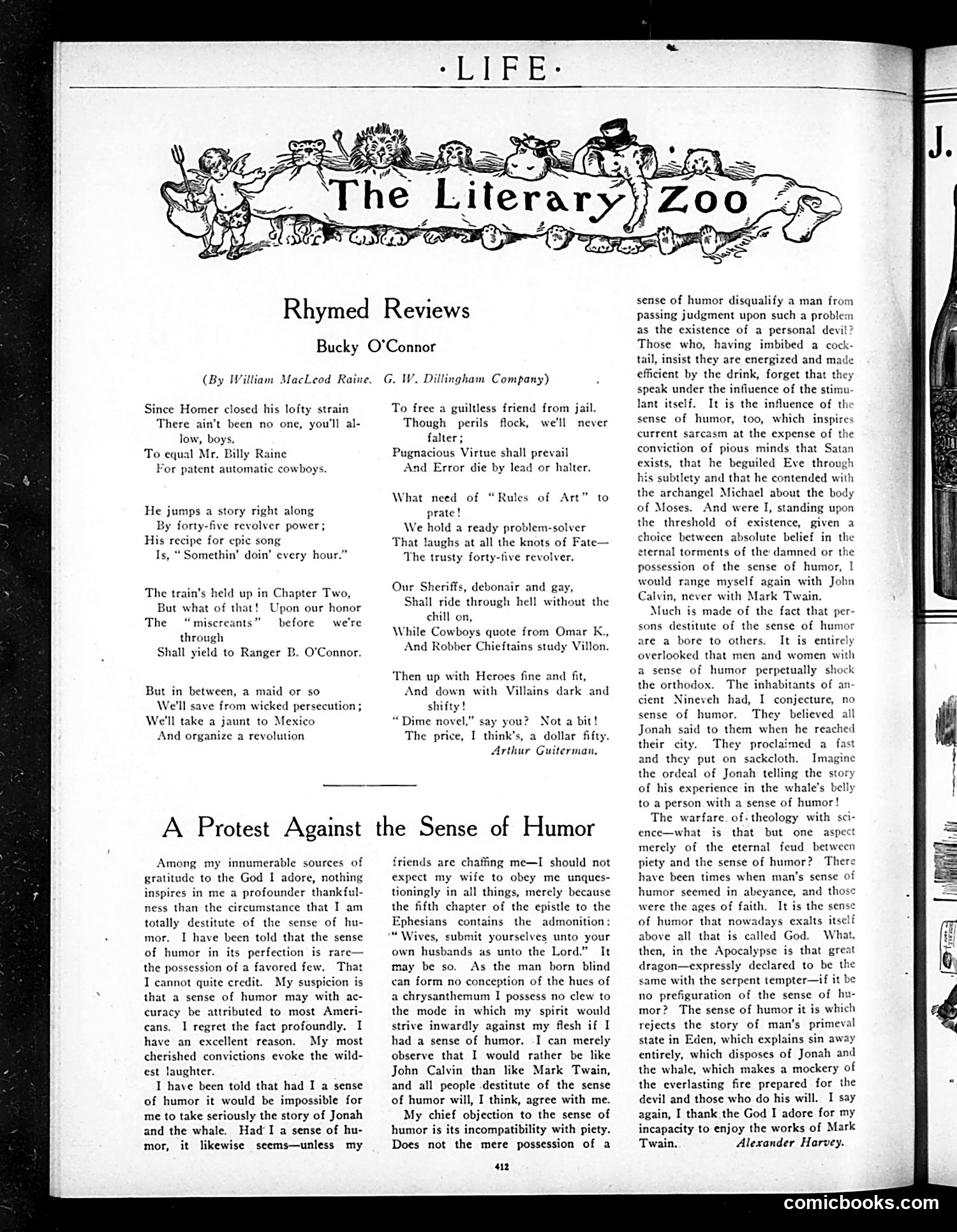
This Life magazine page contains two distinct pieces: **"Rhymed Reviews: Bucky O'Connor"** (by Arthur Guiterman) satirizes pulp Western novels, specifically William MacLeod Raine's formulaic cowboy stories. The poem mocks their predictable plots—train holdups, rescues of maidens, revolutions—all resolved by gunfire. Guiterman ridicules the genre's claim to literary merit while priced at a mere $1.50, calling it essentially a glorified "dime novel." **"A Protest Against the Sense of Humor"** (by Alexander Harvey) argues humorlessness is actually a virtue, claiming humor incompatibility with serious piety and religious conviction. The author contrasts himself favorably with Mark Twain, preferring John Calvin's humorless devotion. He suggests humor prevents proper judgment on matters like Satan's existence and divine torment. Both pieces use satire to critique: one targets cheap popular entertainment, the other defends rigid religious seriousness against modern irreverence. Together they reflect early-20th-century tensions between mass culture, religious orthodoxy, and modernist sensibility.
📄 Transcribed text from this page (OCR, searchable)
Machine-transcribed from the original scan — historical spelling and the odd misread are preserved.
Rhymed Reviews Bucky O'Connor (By William MacLeod Raine. Since Homer closed his lofty strain There ain’t been no one, you'll al- low, boys, To equal Mr, Billy Raine For patent automatic cowboys. He jumps a story right along By forty-five revolver power; His recipe for epic song I Somethin’ doin’ every hour.” The train’s held up in Chapter Two, But what of that! Upon our honor The before “ miscreants” we're through Shall yield to Ranger B. O'Connor. But in between, a maid or so We'll save from wicked persecution ; We'll take a jaunt to Mexico And organize a revolution A Protest Against Among my innumerable sources of gratitude to the God I adore, nothing inspires in me a profounder thankful- ness than the circumstance that I am totally destitute of the sense of hu- mor. I have been told that the sense of humor in its perfection is rare— the possession of a favored few, That I cannot quite credit. My suspicion is that a sense of humor may with ac- curacy be attributed to most Ameri- cans. I regret the fact profoundly. I have an excellent reason. My most cherished convictions evoke the wild- est laughter. I have been told that had I a sense of humor it would be impossible for me to take seriously the story of Jonah and the whale. Had’ a sense of hu- mor, it likewise seems—unless my W. Dillingham Company) To free a guiltless friend from jail. Though perils flock, we'll never falter; Pugnacious Virtue shall prevail And Error die by lead or halter. What need of “Rules of Art” to prate! We hold a ready problem-solver That laughs at all the knots of Fate— The trusty forty-five revolver. Our Sheriffs, debonair and gay, Shall ride through hell without the chill on, While Cowboys quote from Omar K., And Robber Chieftains study Villon. Then up with Heroes fine and fit, And down with Villains dark and shifty! “Dime novel,” say you? Not a bit! The price, I think’s, a dollar fifty. Arthur Guiterman, the Sense of Humor friends are chaffing me—I should not expect my wife to obey me unques- tioningly in all things, merely because the fifth chapter of the epistle to the Ephesians contains the admonition: “Wives, submit yourselves unto your own husbands as unto the Lord.” It may be so. As the man born blind can form no conception of the hues of a chrysanthemum I possess no clew to the mode in which my spirit would strive inwardly against my flesh if I had a sense of humor. I can merely observe that I would rather be like John Calvin than like Mark Twain, and all people destitute of the sense of humor will, I think, agree with me. My chief objection to the sense of humor is its incompatibility with piety. Does not the mere possession of a nz sense of humor disqualify a man from passing judgment upon such a problem as the existence of a personal devil Those who, having imbibed a cock- tail, insist they are energized and made efficient by the drink, forget that they speak under the infiuence of the stimu- lant itself. It is the influence of the sense of humor, too, which inspires current sarcasm at the expense of the conviction of pious minds that Satan exists, that he beguiled Eve throu; his subtlety and that he contended with the archangel Michael about the body of Moses. And were I, standing upon the threshold of existence, given a choice between absolute belief in the eternal torments of the damned or the possession of the sense of humor, I would range myself again with John Calvin, never with Mark Twain. Much is made of the fact that per- sons destitute of the sense of humor are a bore to others. It is entirely overlooked that men and women with a sense of humor perpetually shock the orthodox. The inhabitants of an- cient Nineveh had, I conjecture, no sense of humor. They believed all Jonah said to them when he reached their city. They proclaimed a fast and they put on sackcloth, Imagine the ord of Jonah telling the story of his experience in the whale’s belly to a person with a sense of humor! The warfare. of. theology with s ence—what is that but one aspect merely of the eternal feud between piety and the sense of humor? There have been times when man’s sense of humor seemed in abeyance, and tho were the ages of faith. It is the sense of humor that nowadays exalts itself above all that is called God. What, then, in the Apocalypse is that great dragon—expressly declared to be the same with the serpent tempter—if it be no prefiguration of the sense of hu- mor? The sense of humor it is which rejects the story of man’s primeval state in Eden, which explains sin away entirely, which disposes of Jonah and the whale, which makes a mockery of the everlasting fire prepared for the devil and those who do his will. I say again, I thank the God I adore for my incapacity to enjoy the works of Mark Twain. Alexander Harvey. comicbooks.com