
Life, 1911-02-23 · page 19 of 44
Life — February 23, 1911 — page 19: what you’re looking at
What you’re looking at
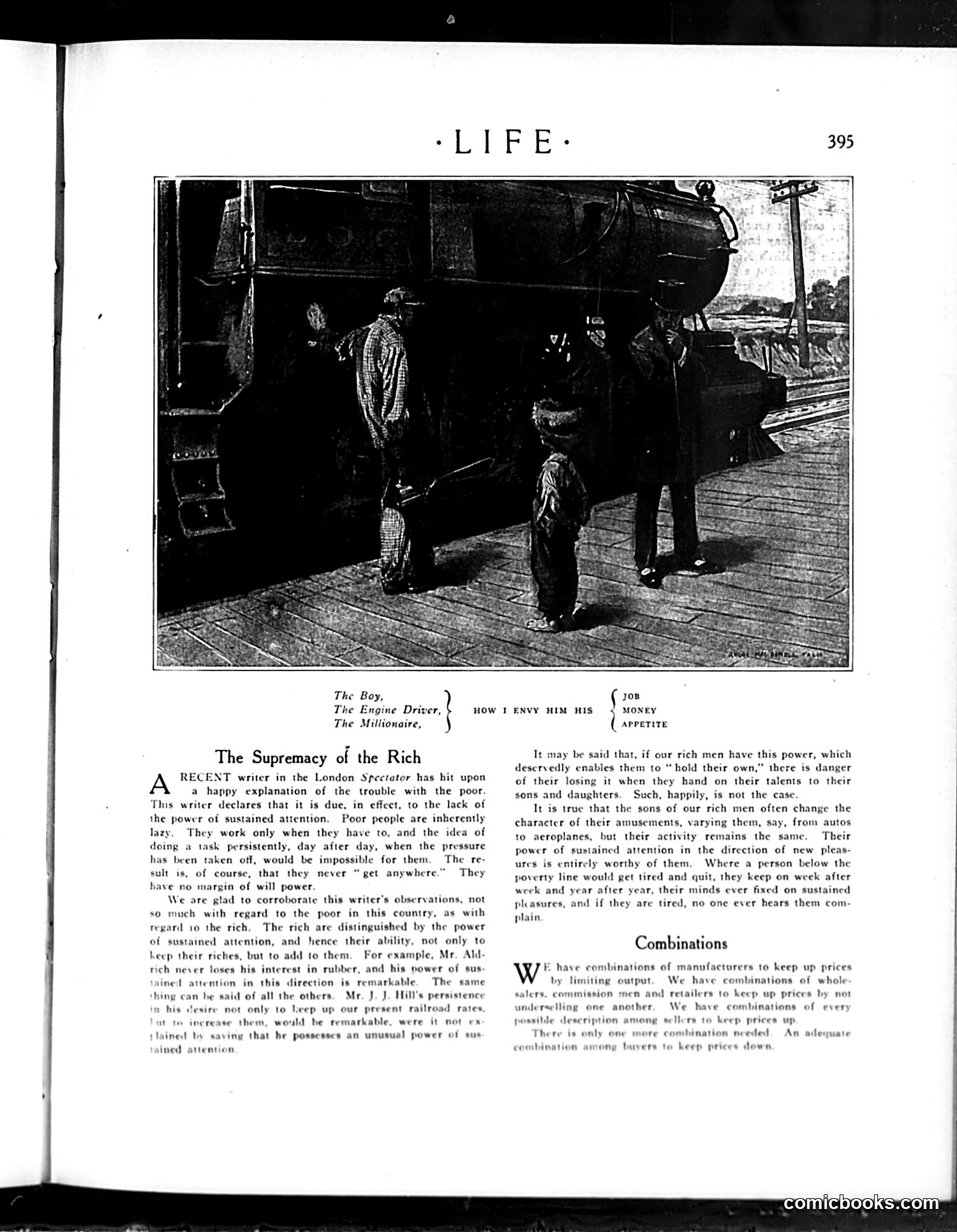
This page mocks the wealthy's claimed moral superiority through bitter irony. The article pretends to agree with a London Spectator writer who blamed poverty on poor people's lack of sustained attention and willpower. However, Life inverts this argument: the rich *do* possess sustained focus—but only toward self-interest. Aldrich obsesses over rubber profits; J.J. Hill over railroads. Their sons similarly "sustain attention" relentlessly pursuing pleasures (autos, aeroplanes) rather than productive work. The final section on "Combinations" extends the satire: manufacturers, wholesalers, and retailers all collude to keep prices artificially high, yet no "combination among buyers" exists to push prices down. The implication is clear—the wealthy's celebrated discipline serves only greed and monopolistic practices, not virtue. The photograph shows working-class figures beside a locomotive, visually contrasting ordinary laborers with the millionaires discussed above.
📄 Transcribed text from this page (OCR, searchable)
Machine-transcribed from the original scan — historical spelling and the odd misread are preserved.
és as aig SEG The Boy, The The Millionaire, The Supremacy of the Rich RECENT writer in the London Spectator has hit upon a happy explanation of the trouble with the poor. This writer declares that it is due, in effect, to the lack of the power of sustained attention. Poor people are inherently lazy. They work only when they have to, and the idea of doing a task persistently, day after day, when the pressure has been taken off, would be impossible for them. The re- of course, that they never “get anywhere.” They have no margin of will power We are glad to corroborate this writer's observations, not so much with regard to the poor in this country, as with regard 10 the rich, The rich are distinguished by the power of sustained attention, and hence their ability, not only to heep their riches, but to add to them. For example, Mr. Ald- rich never loses his interest in rubber, and his power of sus sult is, nin this direction is remarkable. The same of all the others, Mr. J. J. Hill's persistence hing can he s nt railroad ra not only to keep be remarkable, were it not ex ur pr increase them, we an unusual power of sus tained by saving that he possess gine pitees,) HOW T ENVY HIM HIS i MONEY ( Jos APPETITE It may be said that, if our rich men have this power, which deservedly enables them to “hold their own,” there is danger of their losing it when they hand on their talents to their sons and daughters. Such, happily, is not the case It is true that the sons of our rich men often change the character of their amusements, varying them, say, from autos to aeroplanes, but their activity remains the same. Their power of sustained attention in the direction of new pleas- ures is entirely worthy of them. Where a person below the poverty line would get tired and quit, they keep on week after week and year after year, their minds ever fixed on sustained pleasures, and if they are tired, no one ever hears them com plain. Combinations W' have combinations of manufacturers to keep up prices by limiting jon men and retailers to keep up prices by not uiput. We have combinations of whole salers. reselling one another. We have combinations every possible deserip tell ok sup is only comb An adequate combination among buyers te keep prices down