
Life, 1911-02-23 · page 20 of 44
Life — February 23, 1911 — page 20: what you’re looking at
What you’re looking at
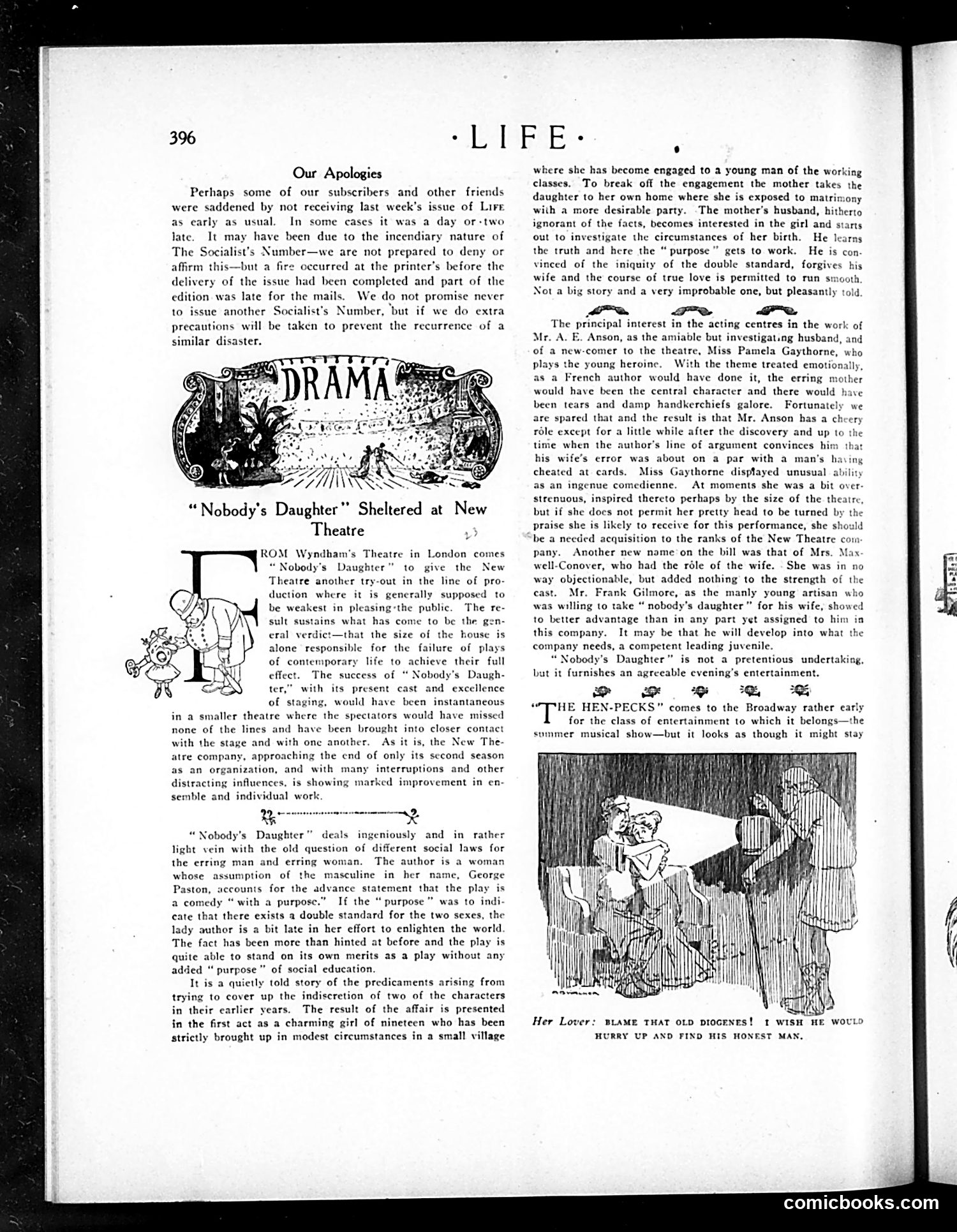
This page contains theater reviews from Life magazine's drama section. The main content discusses "Nobody's Daughter," a play about a woman's premarital indiscretion and the "double standard" condemning women while excusing men for similar behavior. The opening "Our Apologies" note is satirical—Life jokingly blames a printer's fire for late delivery of their recent "Socialist's Number" (a special issue), implying the fire was suspiciously convenient. This reflects Life's satirical stance toward socialist politics. The play review critiques both the work and its social commentary. The author, writing under the masculine pseudonym "George Paston," attempts to expose sexual hypocrisy. However, Life's reviewer dismisses this as unoriginal—the double standard was already well-known. The small illustration shows a romantic couple scene, typical theater section decoration of the era. The review praises the acting while noting the play works better in smaller, more intimate theaters.
📄 Transcribed text from this page (OCR, searchable)
Machine-transcribed from the original scan — historical spelling and the odd misread are preserved.
396 -LIFE- Our Apologies Perhaps some of our subscribers and other friends were saddened by not receiving last week’s issue of Lire as early as usual. In some cases it was a day or-two late. It may have been due to the incendiary nature of The Socialist’s Number—we are not prepared to deny or affirm this—but a fire occurred at the printer’s before the delivery of the issue had been completed and part of the edition was late for the mails. We do not promise never to issue another Socialist’s Number, ‘but if we do extra precautions will be taken to prevent the recurrence of a similar disaster. “Nobody's Daughter" Sheltered at New Theatre ROM Wyndham’s Theatre in London comes “Nobody's Daughter” to give the New Theatre another try-out in the line of pro- duction where it is generally supposed to be weakest in pleasing-the public. The re sult sustains what has come to be the ge eral verdict—that the size of the house is alone responsible for the failure of plays of contemporary life to achieve their full effect. The success of “ Nobody's Daugh- ter,” with its present cast and excellence of staging, would have been instantaneous in a smaller theatre where the spectators would have missed none of the lines and have been brought into closer contact with the stage and with onc another. As it is, the New The- atre company, approaching the cnd of only its second season as an organization, and with many interruptions and other distracting influences, is showing marked improvement in en- semble and individual work Re ae Sobody’s Daughter” deals ingeniously and in rather light vein with the old question of different social laws for the erring man and erring woman. The author is a woman whose assumption of the masculine in her name, George Paston, accounts for the advance statement that the play is a comedy “with a purpose.” If the “ purpose” was to indi- ¢ that there exists a double standard for the two sexes, the lady author is a bit late in her effort to enlighten the world The fact has been more than hinted at before and the play is quite able to stand on its own merits as a play without any added “ purpose” of social education. It is a quietly told story of the predicaments arising from trying to cover up the indiscretion of two of the characters in their earlier years. The result of the affair is presented in the first act as a charming girl of nineteen who has been strictly brought up in modest circumstances in a small village where she has become engaged to a young man of the working classes. To break off the engagement the mother takes the daughter to her own home where she is exposed to matrimony with a more desirable party. .The mother’s husband, hitherto ignorant of the facts, becomes interested in the girl and starts out to investigate the circumstances of her birth. He learns the truth and here the “ purpose" gets to work. He is con: vinced of the iniquity of the double standard, forgives his wife and the course of true love is permitted to run smooth Not a big story and a very improbable one, but pleasantly told. Oo Fe Fa The principal interest in the acting centres in the work of Mr. A. E. Anson, as the amiable but investigating husband, and of a new-comer to the theatre, Miss Pamela Gaythorne, who plays the young heroine, With the theme treated emotionally, as a French author would have done it, the erring mother would have been the central character and there would have been tears and damp handkerchiefs galore. Fortunat. are spared that and the result is that Mr. Anson has a cheery role except for a little while after the discovery and up to time when the author's line of argument convinces him that his wife’s error was about on a par with a man’s havi cheated at cards, Miss Gaythorne dispfayed unusual as an ingenue comedienne. At moments she was a bit over Strenuous, inspired thereto perhaps by the size of the theatre, but if she docs not permit her pretty head to be turned b: praise she is likely to receive for this performance, she should be a needed acquisition to the ranks of the New Theatre coin- pany. Another new name on the bill was that of Mrs. Max well-Conover, who had the rdle of the wife. She was in no way objectionable, but added nothing to the strength of the cast. Mr. Frank Gilmore, as the manly young artisan who was willing to take “ nobody's daughter” for his wife, showed to better advantage than in any part yet assigned to him in this company. It may be that he will develop into what company needs, a competent leading juvenile. “Nobody's Daughter" is not a pretentious undertaking, but it furnishes an agreeable evening's entertainment. HE HEN-PECKS"” comes to the Broadway rather early for the class of entertainment to which it belongs—the summer musical show—but it looks as though it might stay Her Lover: BLAME THAT OLD DIOGENES! f WISH HE WOULD HURRY UP AND FIND HIS HONEST MAN. comicbooks.com