
Life, 1911-02-23 · page 13 of 44
Life — February 23, 1911 — page 13: what you’re looking at
What you’re looking at
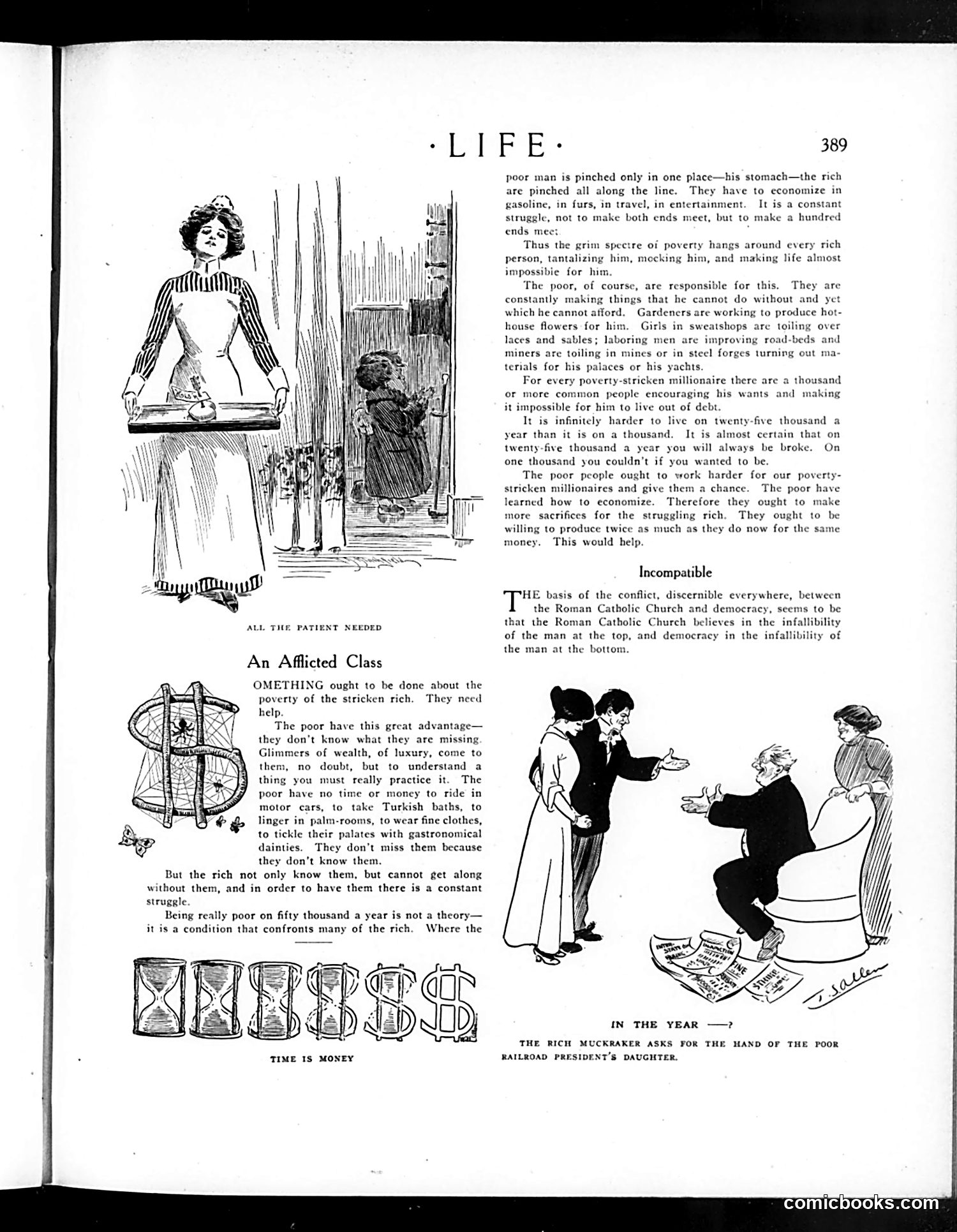
This page satirizes class conflict and economic inequality in early 20th-century America. **"An Afflicted Class"** critiques wealthy people's dependence on luxuries (fine clothes, restaurants, leisure activities) they claim not to need, while mocking their inability to function without them—portraying wealth as a kind of affliction requiring sympathy. **"Incompatible"** addresses the conflict between Catholic Church doctrine (hierarchical authority) and democratic principles, presenting these as fundamentally opposed ideologies. **The bottom cartoon** depicts a wealthy "muckraker" (likely a railroad magnate) attempting to marry his daughter to a poor man—presumably for social reform credibility while maintaining class privilege. The satire suggests such gestures are performative rather than genuinely egalitarian.
📄 Transcribed text from this page (OCR, searchable)
Machine-transcribed from the original scan — historical spelling and the odd misread are preserved.
ALL THE PATIENT NEEDED An Afflicted Class OMETHING ought to be done about the poverty of the stricken rich, They need help. The poor have this great advantage— they don’t know what they are missing Glimmers of wealth, of luxury, come to them, no doubt, but to understand a thing you must really practice it. The poor have no time or money to ride in motor cars, to take Turkish baths, to linger in palm-rooms, to wear fine clothes, to tickle their palates with gastronomical 0 dainties. They don't miss them because they don’t know them. But the rich not only know them, but cannot get along without them, and in order to have them there is a constant struggle. cally poor on fifty thousand a year is not a theory— it is a condition that confronts many of the rich. Where the TIME 1S MONEY “EE. 389 poor man is pinched only in one place—his stomach—the rich are pinched all along the line. They have to economize in gasoline, in furs, in travel, in entertainment. It is a constant struggle, not to make both ends meet, but to make a hundred ends mec: : Thus the grim spectre of poverty hangs a person, tantalizing him, mocking him, and making life almost impossibie for him. The poor, of course, are responsible for this. They are constantly making things that he cannot do without and yet which he cannot afford. Gardeners are working to produce hot- house flowers for him. Girls in sweatshops are toiling over laces and sables; laboring men are improving road-beds miners are toiling in mines or in steel forges turning out ma- terials for his palaces or his yachts. For every poverty-stricken millionaire there are a thousand or more common people encouraging his wants and making it impossible for him to live out of debt. It is infinitely harder to live on twenty-five thousand a year than it is on a thousand. It is almost certain that on twenty-five thousand a year you will always be broke. On one thousand you couldn't if you wanted to be. The poor people ought to work harder for our poverty- stricken millionaires and give them a chance. The poor have learned how to economize. Therefore they ought to make more sacrifices for the struggling rich. They ought to be willing to produce twice as much as they do now for the same This would help. and every rich money. Incompatible HE basis of the conflict, discernible everywhere, between the Roman Catholic Church and democracy, seems to be that the Roman Catholic Church believes in the infallibility of the man at the top, and democracy in the infallibility of the man at the bottom. IN THE YEAR —? THE RICH MUCKRAKER ASKS FOR THE MAND OF THE POOR RAILROAD PRESIDENTS DAUGHTER.