
A complete issue · 44 pages · 1911
Life — January 19, 1911
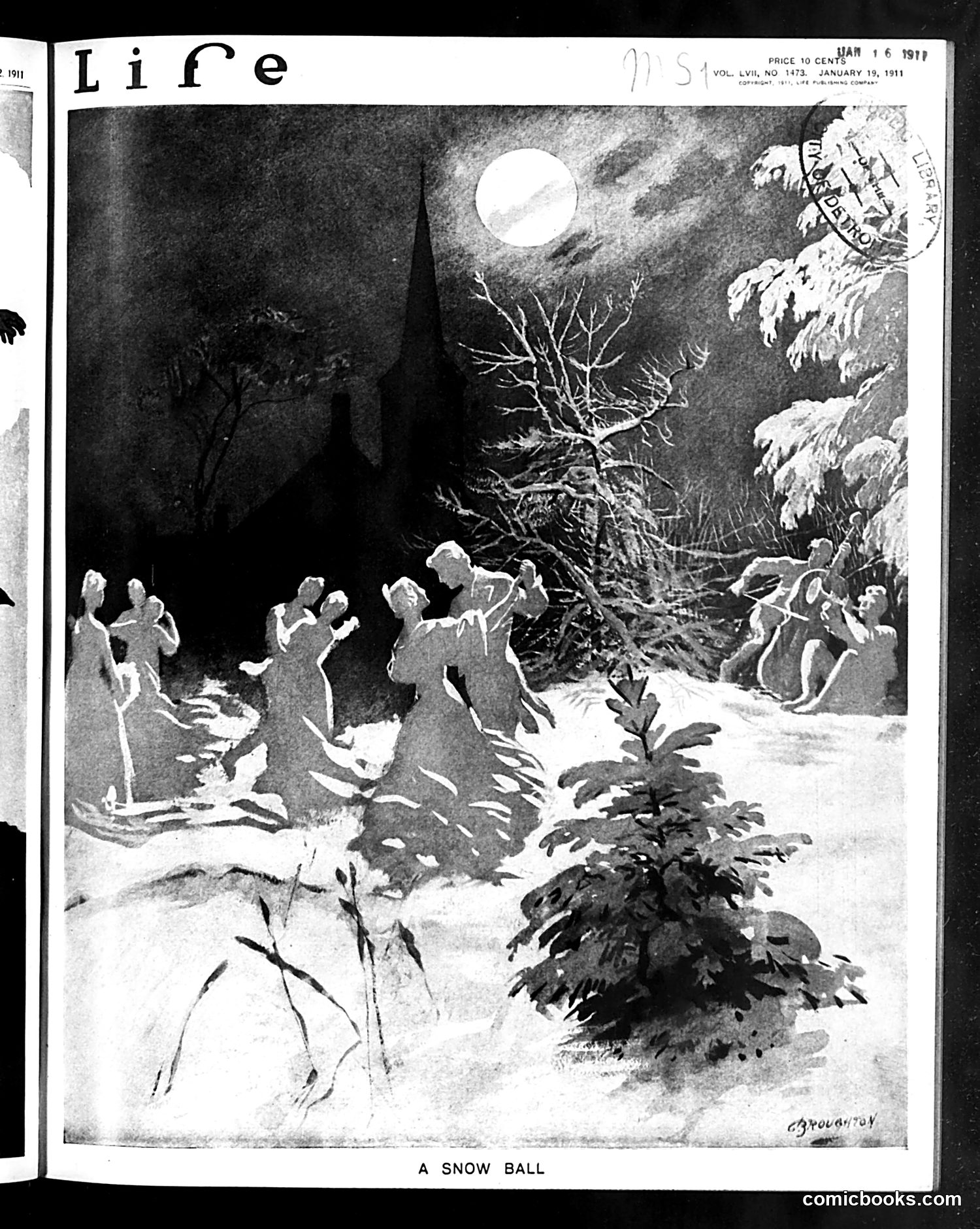
This illustration depicts a whimsical winter scene titled "A Snow Ball," showing figures engaged in a snowball fight beneath a full moon. The image appears to be purely recreational rather than political satire—depicting people (rendered as simplified silhouettes) playing in snow surrounded by evergreen trees and winter vegetation. The signature reads "Brouwer," identifying the artist. Without additional context or captions explaining the figures' identities, this appears to be a lighthearted seasonal illustration celebrating winter recreation rather than commentary on contemporary political or social events. The artistic style is typical of early 20th-century magazine illustration.
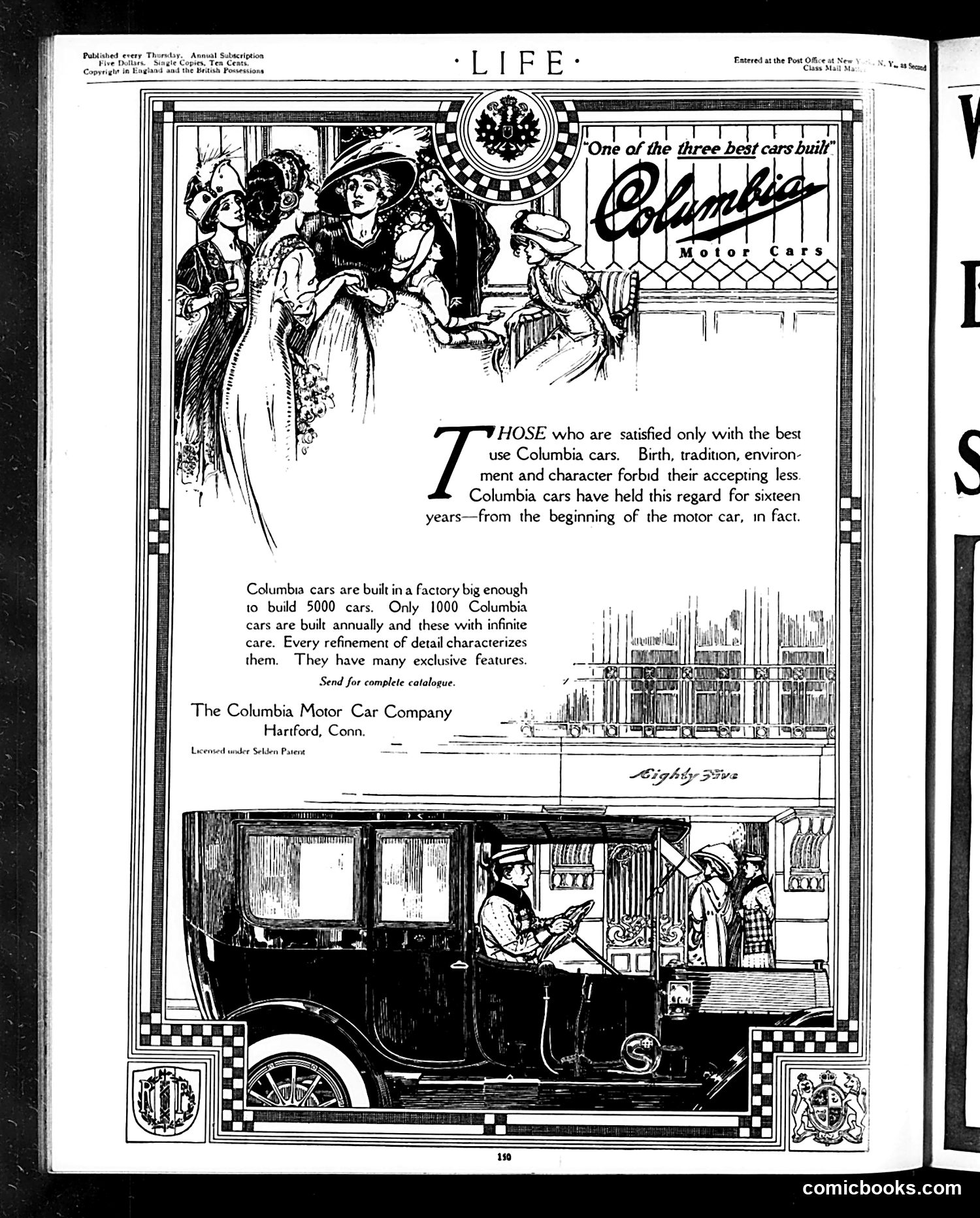
This page is primarily a **Columbia Motor Car Company advertisement**, not political satire. The upper illustration depicts fashionable women (dressed in 1910s-era clothing and large hats) admiring or discussing automobiles, establishing Columbia cars as a luxury product for the wealthy and genteel. The advertisement's text claims Columbia cars represent the pinnacle of automotive quality, mentioning they've maintained this reputation "for sixteen years." It emphasizes exclusivity: only 1,000 Columbia cars are built annually with "infinite care." The lower illustration shows the car's interior and construction details—a common advertising technique to demonstrate craftsmanship and engineering quality. This is essentially a **prestige marketing pitch** rather than commentary or satire—positioning Columbia as one of "three best cars built" for discerning buyers who accept nothing less than excellence.
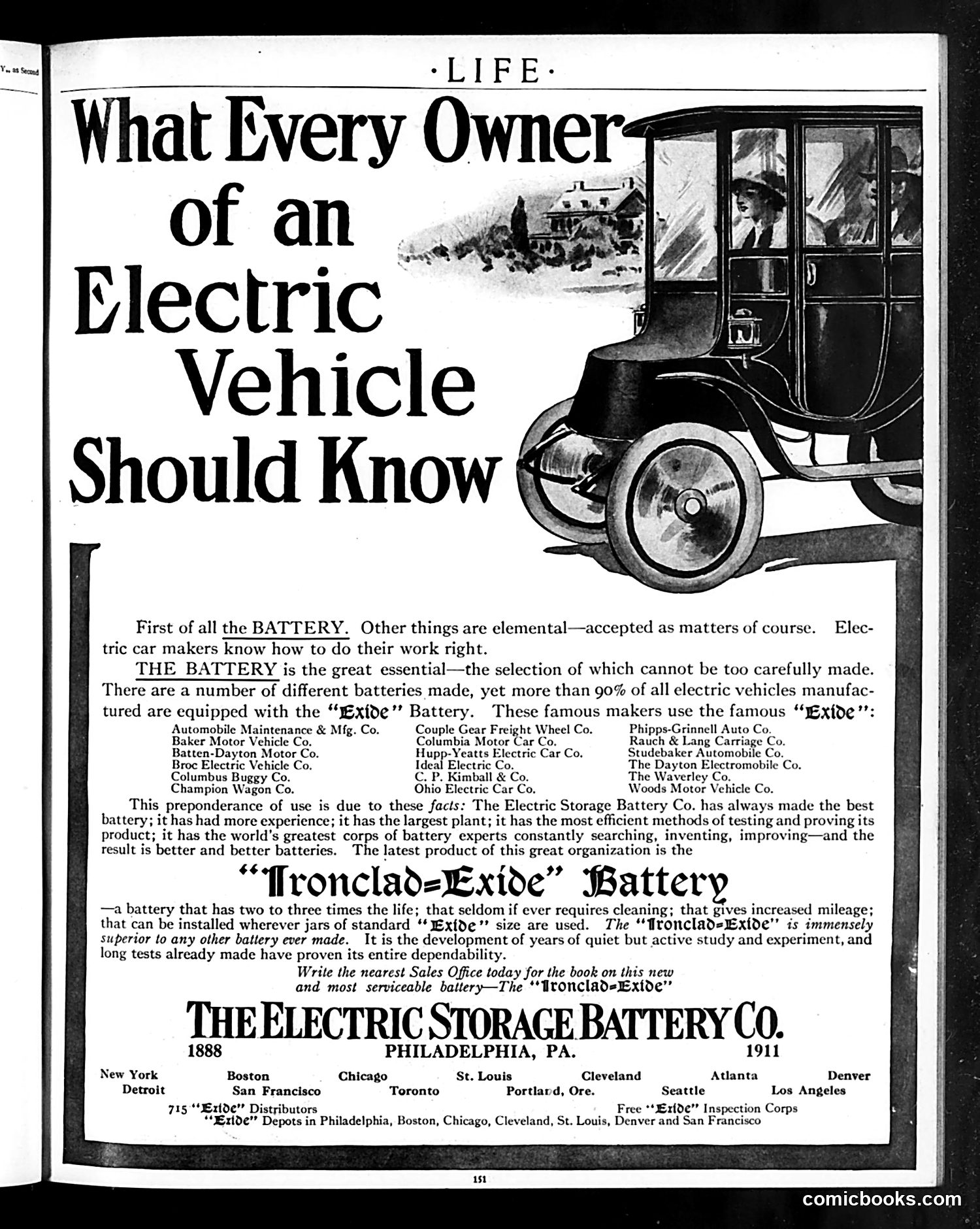
This is **not a political cartoon or satire**—it's a straightforward advertisement for the "Ironclad-Exide" battery, placed in Life magazine's advertising section. The image shows an early electric automobile with a well-dressed woman driver, representing the target market: affluent consumers considering electric vehicles. The ad emphasizes battery reliability, claiming the Exide battery powers over 90% of electric vehicles manufactured. The "Electric Storage Battery Co." (based in Philadelphia, 1888-1911) lists major automobile manufacturers using their product, including Baker, Columbia, and Rauch & Lang—names now historically obscure. This reflects a pre-1920 moment when electric vehicles competed seriously with gasoline cars, before internal combustion engines became dominant. The ad's emphasis on maintenance-free operation and improved mileage suggests these were genuine consumer concerns of the era.
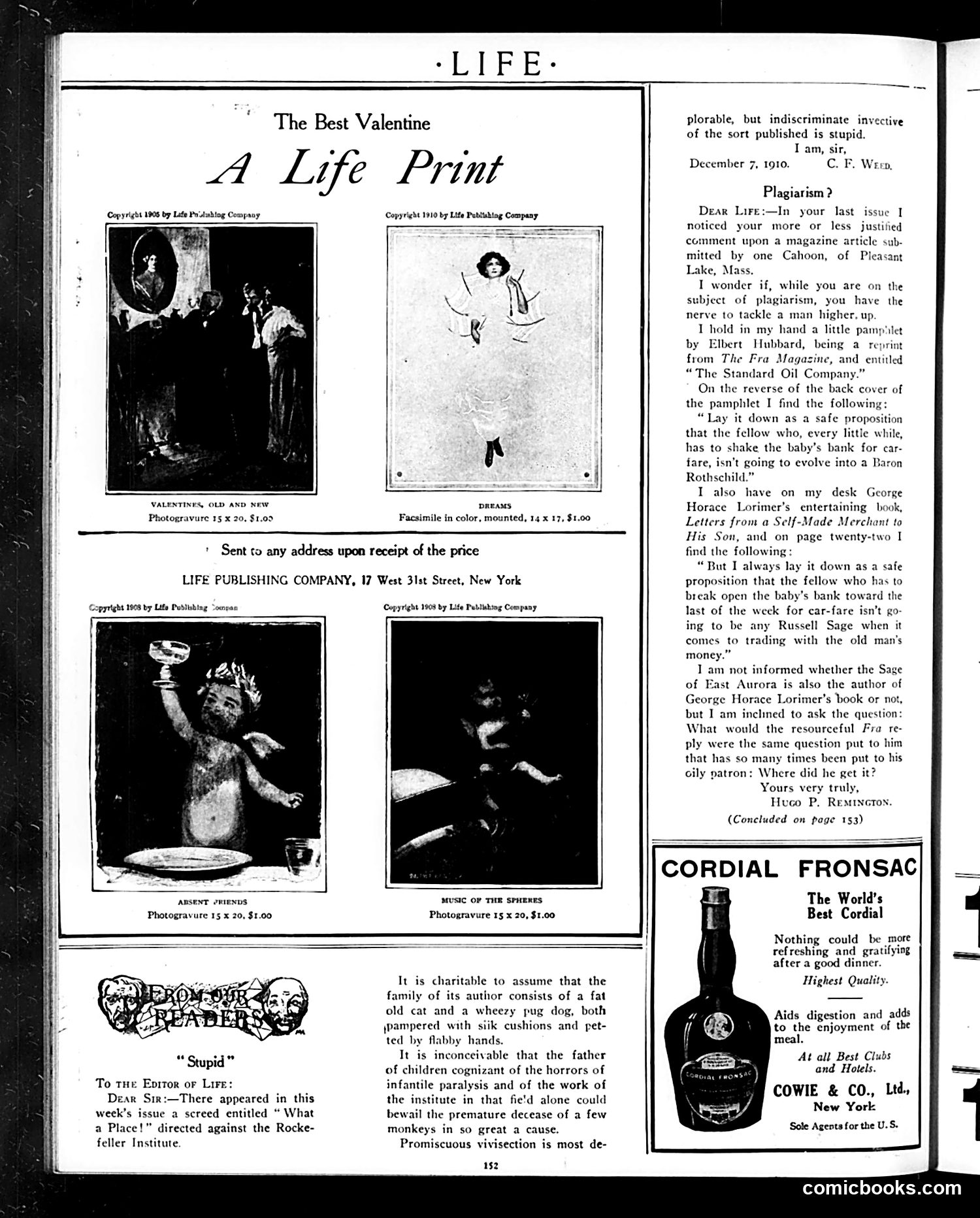
This page is primarily **advertising and editorial content** rather than political satire. The top section advertises "Life Prints"—photogravure reproductions for sale, including four titled works: "Valentines, Old and New," "Dreams," "Absent Friends," and "Music of the Spheres." These appear to be sentimental artistic prints popular in the early 1900s. The right column contains reader letters debating plagiarism accusations against Life magazine and discussing similar passages in various publications. The bottom includes a Cordial Fronsac liquor advertisement and a brief letter to the editor criticizing a Rockefeller Institute article titled "What Place!" **No significant political cartoons or satire appear on this page.** It represents typical early-20th-century magazine content mixing commercial advertising with reader correspondence.
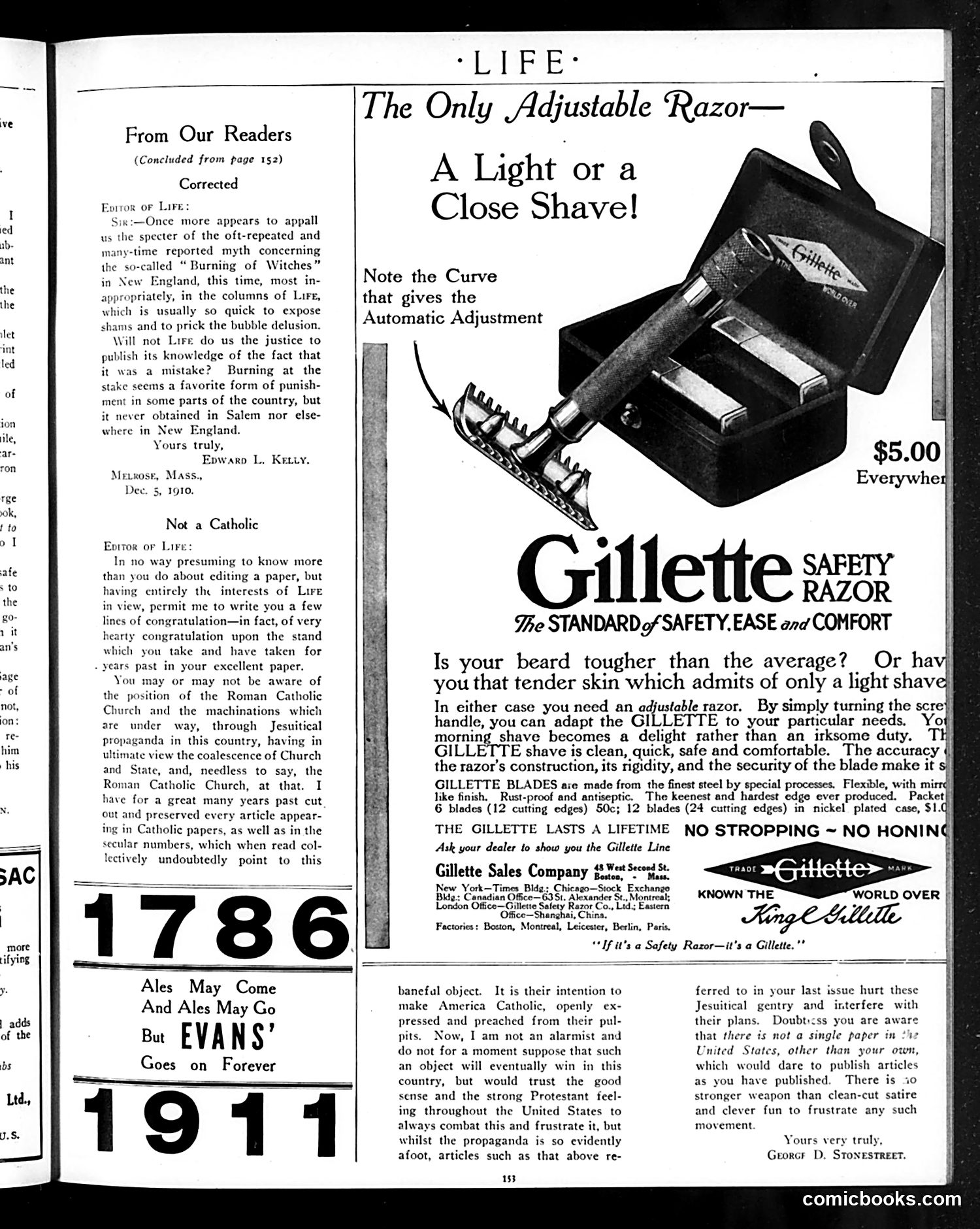
This page is primarily **advertising**, not political satire. The dominant content is a Gillette Safety Razor advertisement featuring the product's adjustable blade mechanism. The ad emphasizes the razor's versatility—offering "a light or close shave" depending on the user's needs. The left column contains readers' letters to Life's editor addressing two topics: (1) a correction about the historical "Burning of Witches" in New England, and (2) a lengthy letter criticizing what the writer perceives as Life magazine's anti-Catholic bias, specifically objecting to articles attacking the Catholic Church and Jesuits. The magazine excerpt shown is primarily commercial rather than satirical in nature.
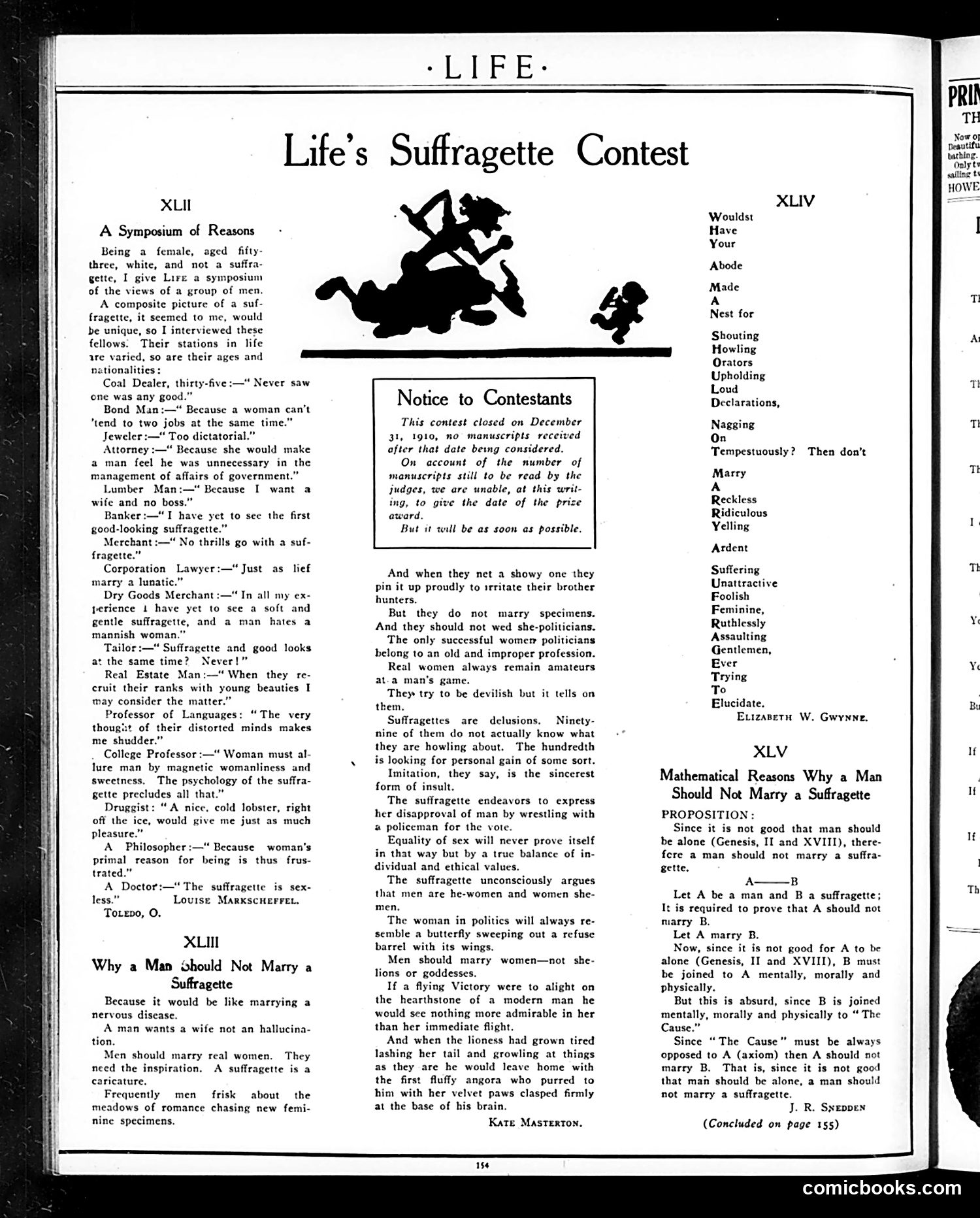
This page mocks the women's suffrage movement through a satirical contest format. The silhouette cartoon shows a woman wielding what appears to be a weapon or club against a man—visual mockery of suffragettes as aggressive and unwomanly. The "Notice to Contestants" announces a closed contest about reasons men shouldn't marry suffragettes. The accompanying essays present anti-suffrage arguments: that suffragettes are delusional, that voting women are unnatural ("she-politicians"), and that they're unsuitably masculine for marriage. The satire attacks both suffragettes themselves and men who might support them, positioning women's voting rights as incompatible with traditional gender roles and femininity. This represents mainstream American resistance to suffrage before the 19th Amendment's 1920 passage.
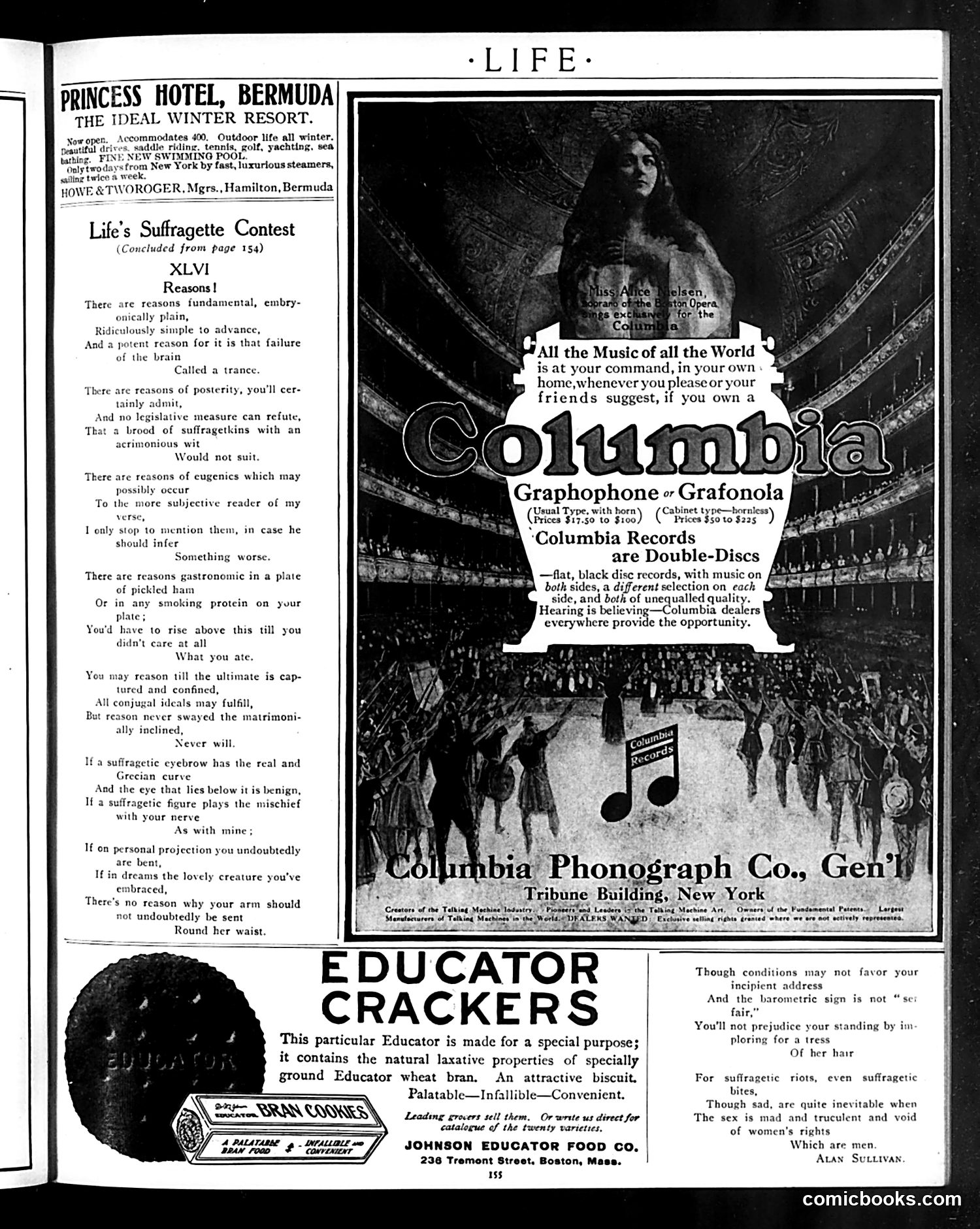
This page is primarily **advertising** with one substantial poem. The main content is "Life's Suffragette Contest," a satirical poem mocking women's suffrage advocacy. The poem lists absurd "reasons" against women voting—claiming suffragettes lack reasoning ability, that they're prone to "trance" states, that eugenics concerns arise, and making crude jokes about their appearance and bodies. The accompanying advertisements include Columbia Graphophones and Educator Crackers (featuring a bran biscuit). The satire reflects early-20th-century anti-suffrage arguments, presenting misogynistic stereotypes as "reasons" women shouldn't vote. The poem's humor relies on crude physical humor and pseudo-scientific claims about female inferiority—typical of opposition rhetoric during the suffrage movement.
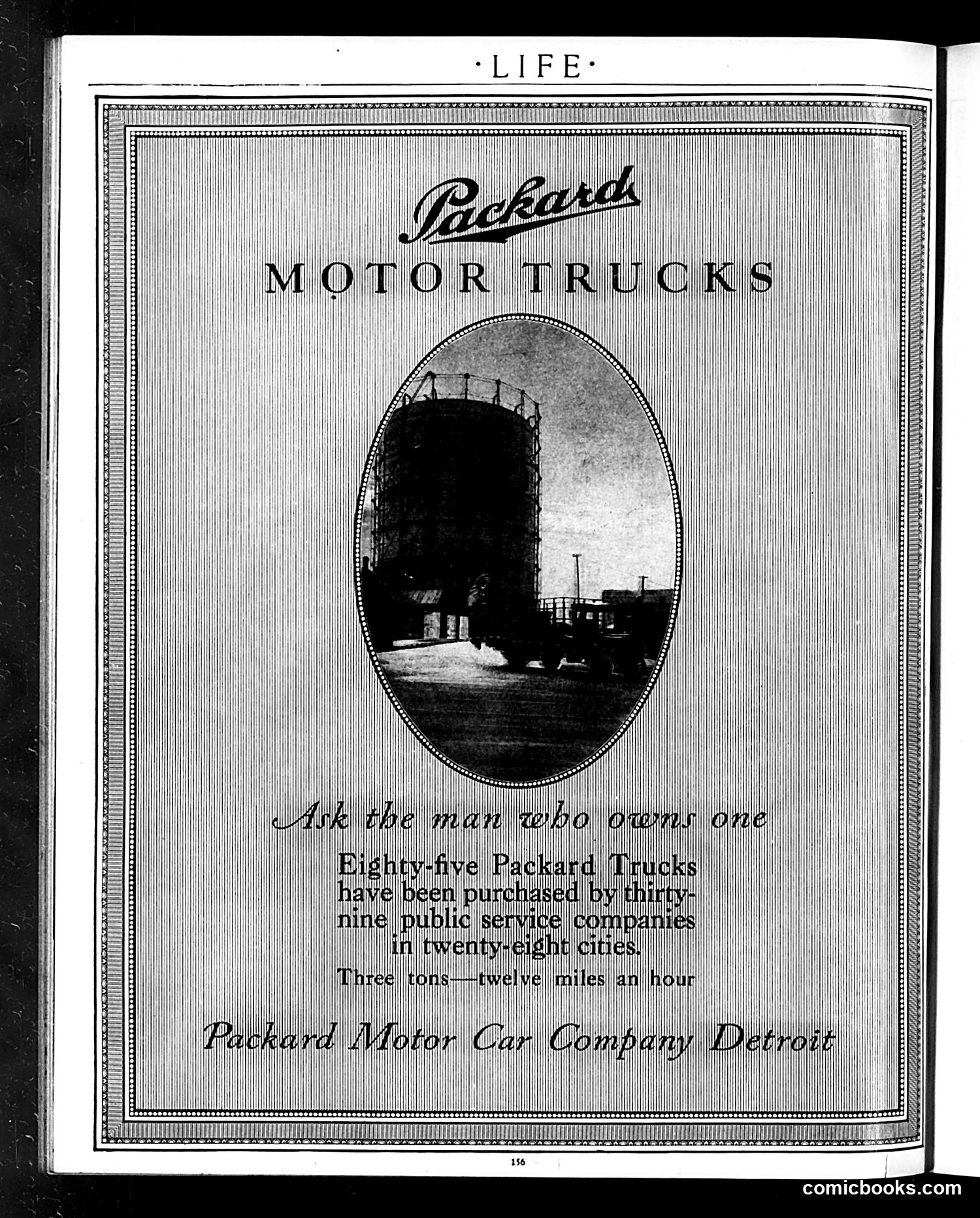
This is an advertisement for Packard Motor Trucks, not political satire. The page features a photograph of an industrial truck positioned beneath a large storage silo or grain elevator. The ad's tagline—"Ask the man who owns one"—was Packard's actual advertising slogan. The advertisement makes a straightforward commercial claim: eighty-five Packard trucks have been purchased by thirty-nine public service companies in twenty-eight cities. It emphasizes the truck's capacity ("three tons—twelve miles an hour"), appealing to businesses seeking reliable commercial vehicles. This represents early automotive advertising in *Life* magazine, targeting industrial and municipal buyers rather than consumers. The modest specifications reflect early 1900s truck technology before mass-produced alternatives became dominant.
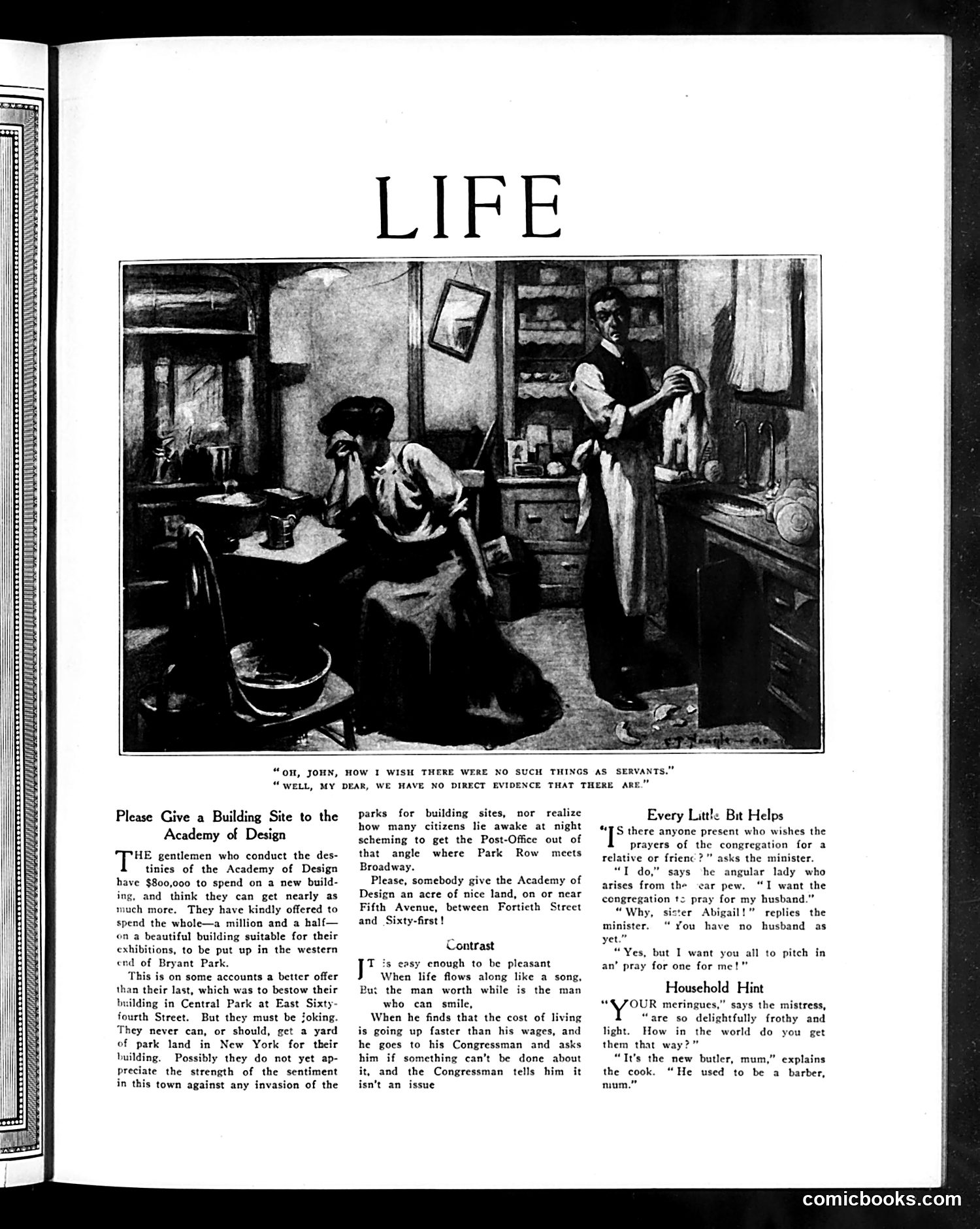
This page contains three separate satirical pieces rather than a single cartoon: 1. **"Please Give a Building Site to the Academy of Design"** criticizes wealthy New York gentlemen for refusing to donate land for an arts institution, despite their ability to do so. The satire suggests they're stingy despite their means. 2. **"Contrast"** contrasts two scenarios: a pleasant poor man versus an unhappy wealthy man whose living costs exceed his wages, forcing him to appeal to his congressman—satirizing how even the rich struggle financially. 3. **"Every Little Bit Helps"** and **"Household Hint"** are brief humorous anecdotes about prayer and domestic servants. The central image depicts a working-class domestic interior, illustrating the period's social class concerns that pervade these satirical pieces.
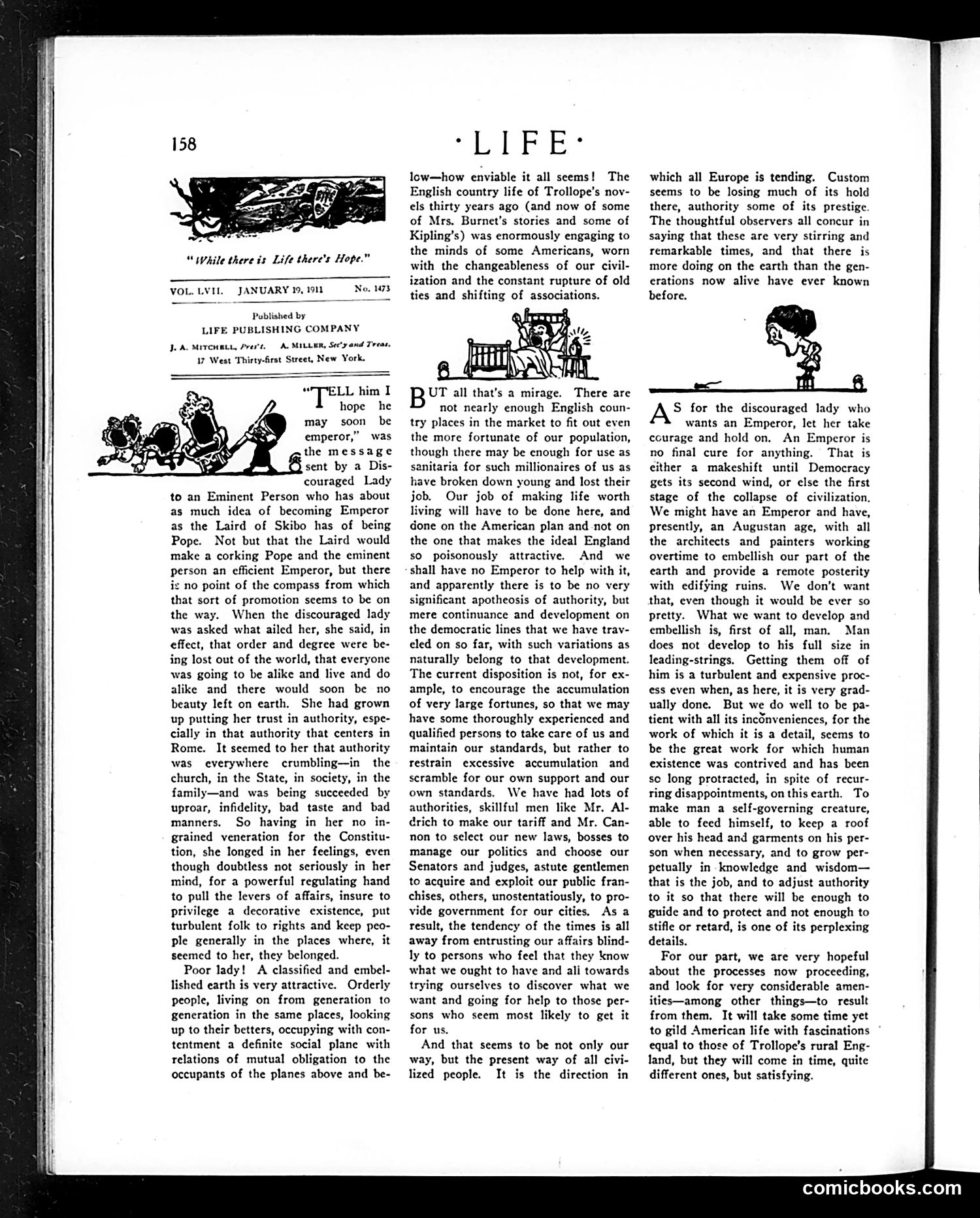
This page contains editorial text rather than cartoons. The main illustration shows a figure labeled "While there is Life there's Hope" - appearing to depict Lady Liberty or an allegorical female figure. The text discusses social and economic inequality in America. It critiques wealthy individuals and argues against excessive concentration of wealth, suggesting instead that fortunate people should support democratic institutions and public welfare rather than becoming isolated emperors of their fortunes. The article advocates for developing American life through widespread opportunity and participation rather than concentrating power in a few hands—reflecting Progressive Era debates about wealth distribution and democratic participation that were central to 1911 American politics.
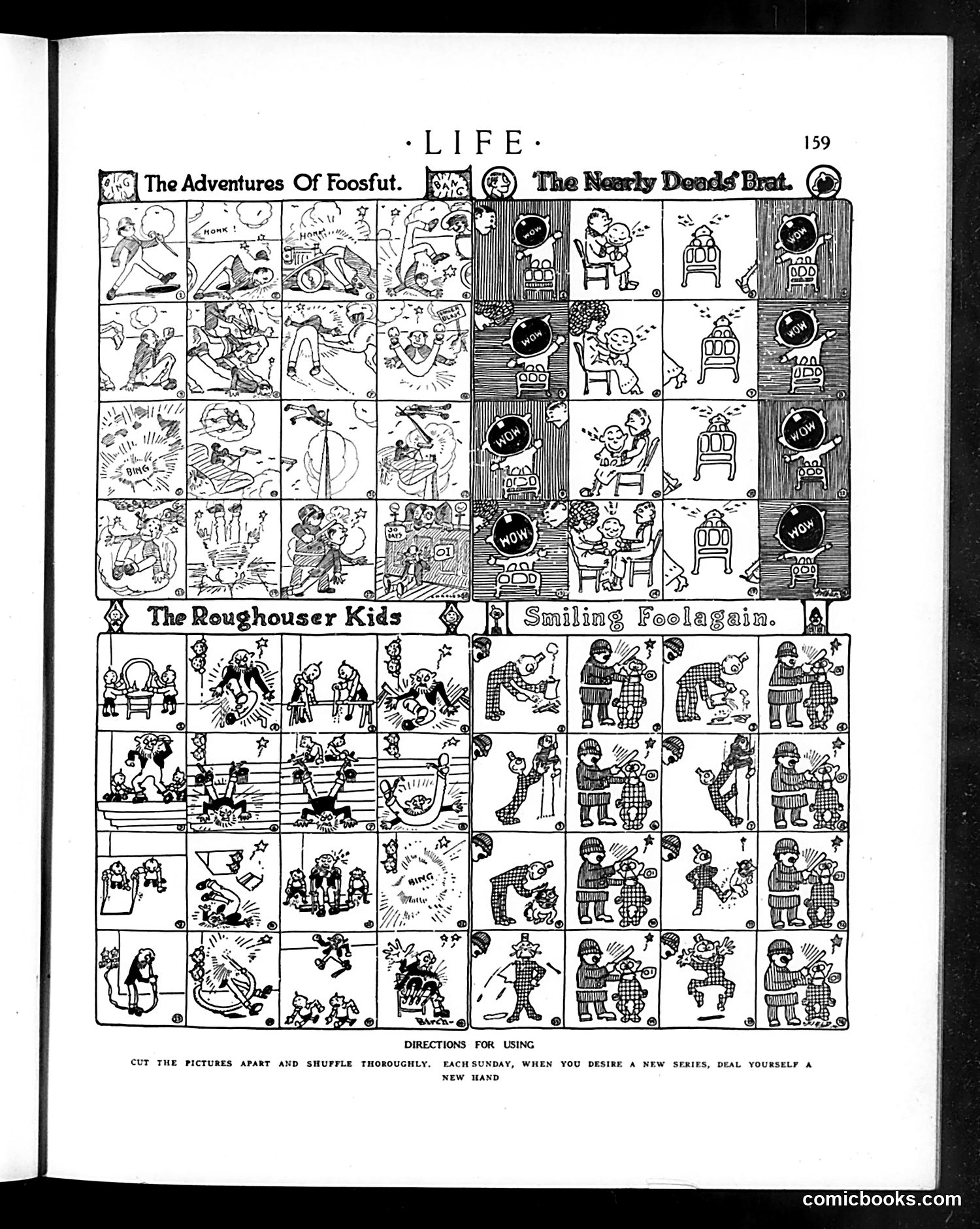
This page from *Life* magazine contains four separate comic strips: 1. **"The Adventures of Foosfut"** - A slapstick strip showing physical comedy and mishaps 2. **"The Nearly Deads' Brat"** - Appears to feature skeletal or ghost-like characters in domestic situations with "MOM" and "WOW" sound effects 3. **"The Roughhouser Kids"** - Shows children engaged in rough play and mischief 4. **"Smiling Fool Again"** - Features a character in checkered clothing repeatedly getting hit or struck The page includes instructions at the bottom directing readers to cut out pictures and shuffle them weekly to create new comic combinations—an interactive game format typical of early 20th-century *Life* magazine's audience participation features. These are humorous strips emphasizing physical comedy, domestic chaos, and slapstick humor rather than sophisticated satire.
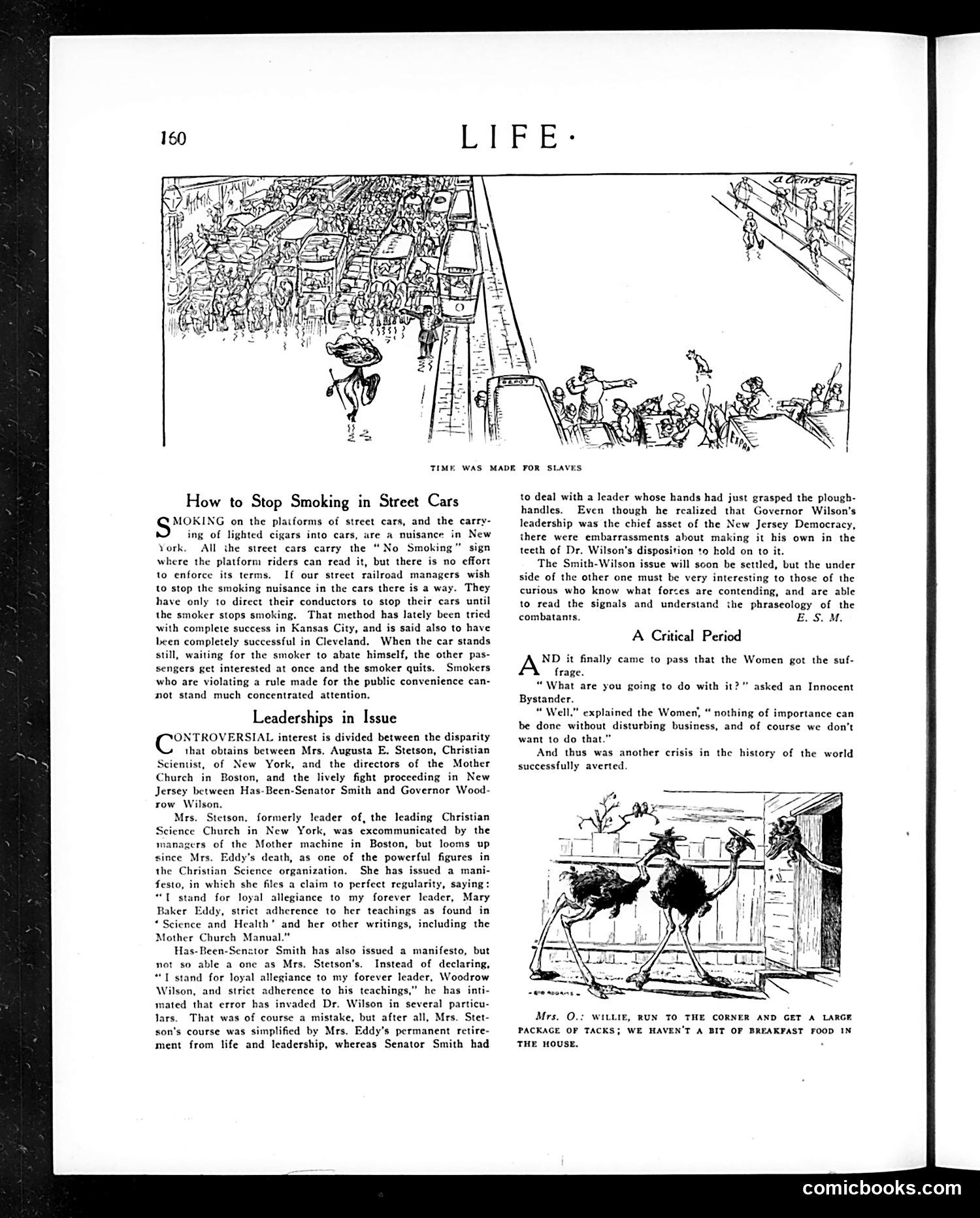
This page contains three sections: 1. **"How to Stop Smoking in Street Cars"** - A brief article describing a practical problem of smokers on New York public transit, with proposed solutions involving conductors stopping the nuisance. This is straightforward social commentary rather than satire. 2. **"Leaderships in Issue"** - Discusses a controversy among Christian Scientists regarding Augusta E. Stetson versus leaders including Mary Baker Eddy. Senator Smith and Governor Woodrow Wilson are also mentioned in a related dispute. This reports on internal organizational conflicts. 3. **A cartoon** (bottom right) labeled "Mrs. O.: Willie, run to the corner and get a large package of tacks; we haven't a sit of breakfast food in the house." This appears to be domestic humor about household management and children's errands, not political satire. The page is primarily informational/satirical commentary on contemporary social and organizational issues rather than sharp political cartoons.
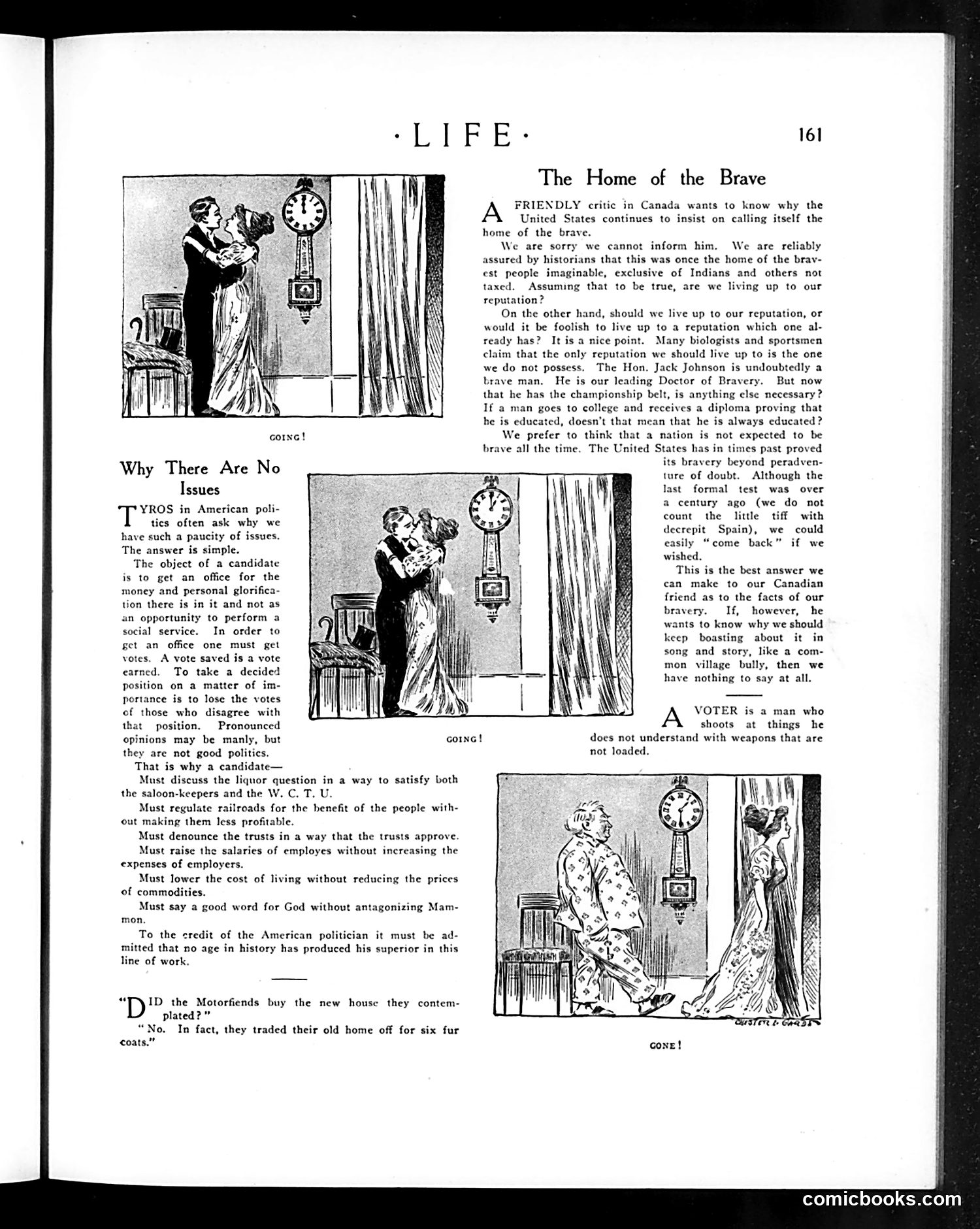
This page satirizes American politicians and political culture through three cartoon vignettes showing a man rushing to catch a clock/leaving hastily, labeled "GOING!" **"The Home of the Brave"** responds to a Canadian critic questioning why the U.S. boasts about bravery while seemingly lacking it. The article defends American courage historically but suggests modern politicians avoid discussing it—implying contemporary politicians are cowardly or hypocritical compared to America's past. **"Why There Are No Issues"** mocks campaign politics, arguing candidates avoid taking clear positions on substantive matters (saloon regulation, labor issues, cost of living, religious matters) to appease all voters and special interests. The satire suggests American politicians prioritize winning office over principle—a timeless critique of political expediency over conviction.
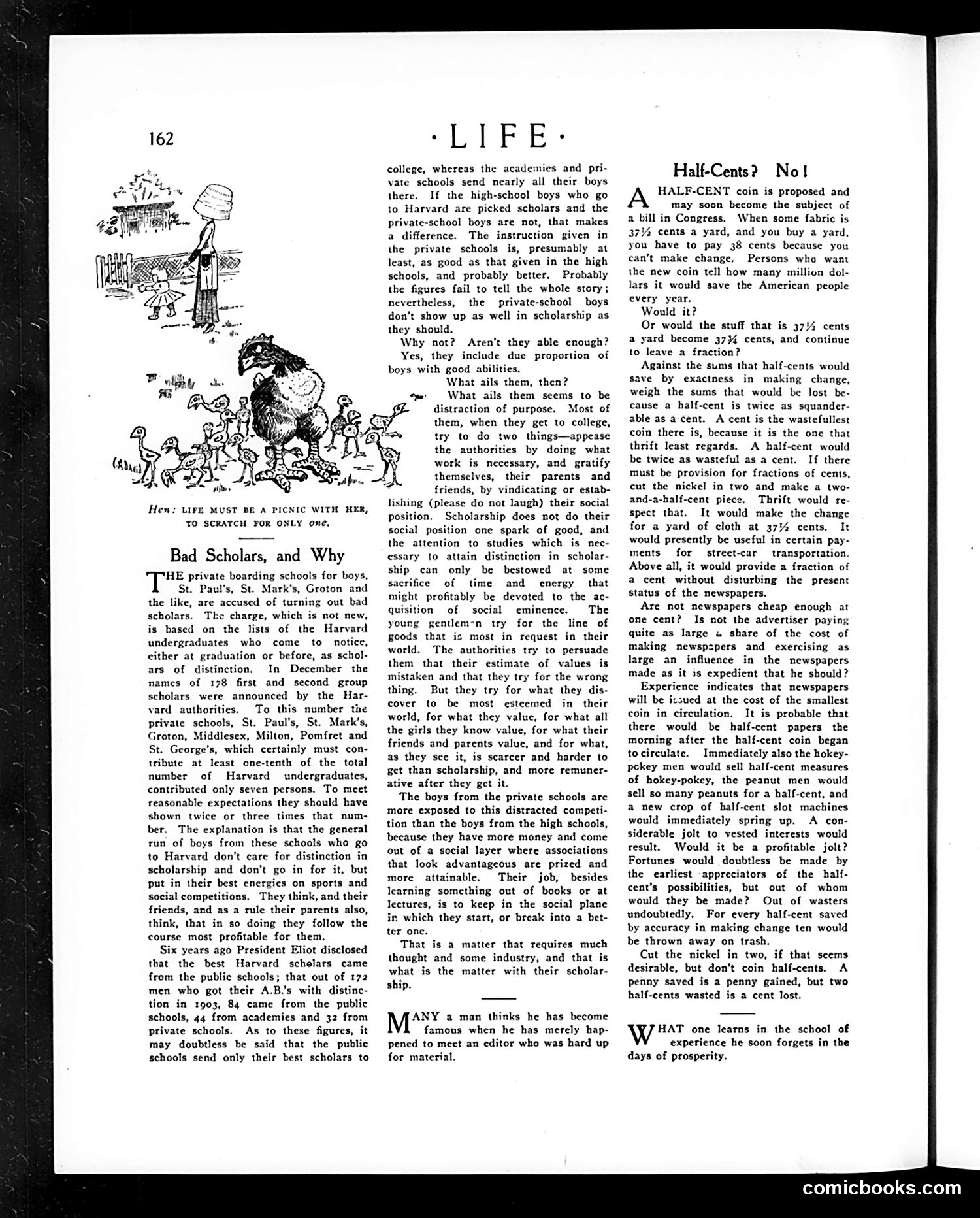
This satirical article critiques elite private boarding schools (St. Paul's, Groton, etc.) for producing poor academic scholars at Harvard, despite sending capable students. The opening cartoon shows a hen scratching for food—a metaphor for the article's point: these privileged boys prioritize social status and athletics over academics. The author argues that private-school boys aren't intellectually inferior; rather, they're distracted by social ambition. Unlike public-school students selected solely for academic merit, private-school boys have wealth and social standing to protect. They rationally pursue what their world values: athletic prowess, social connections, and romantic success—all more "remunerative" than scholarship. The satire lies in the irony: institutions designed to educate gentlemen produce scholars worse than public schools because their students follow the values their privileged environment actually teaches and rewards, ignoring what authorities preach about academic distinction.
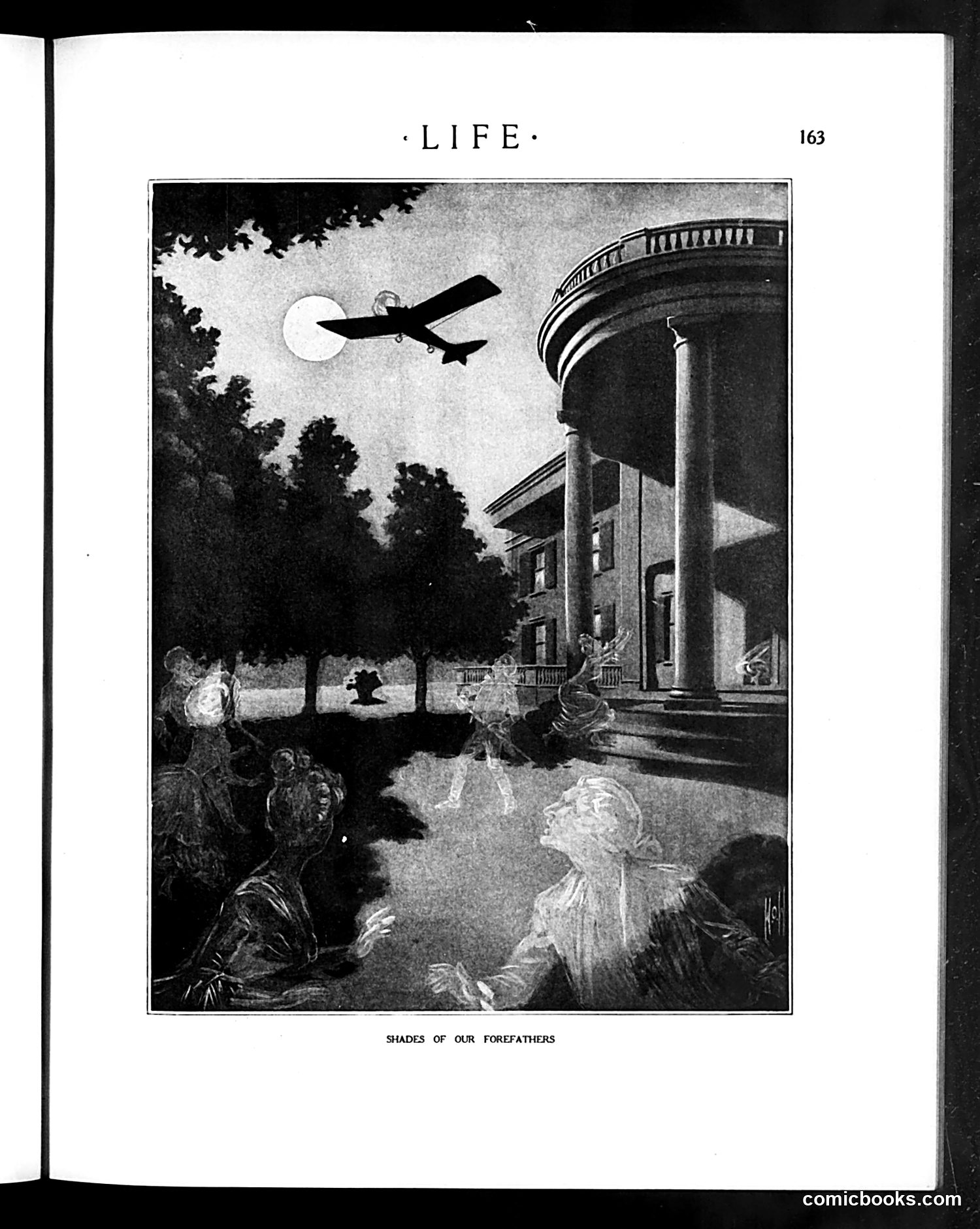
This satirical illustration depicts ghostly figures of America's founding fathers observing a modern airplane flying past a grand neoclassical building (likely representing the Capitol or a similar government structure). The "shades" (spirits) of the forefathers appear to be watching with concern or disapproval at this technological advancement. The satire likely comments on how rapidly American society has modernized—moving from the 18th-century world the founders knew to the aviation age. The juxtaposition suggests either admiration for progress, or anxiety that the nation has strayed far from the founders' original vision. Without a visible date, the exact historical moment is unclear, though the airplane style suggests early-to-mid 20th century publication.
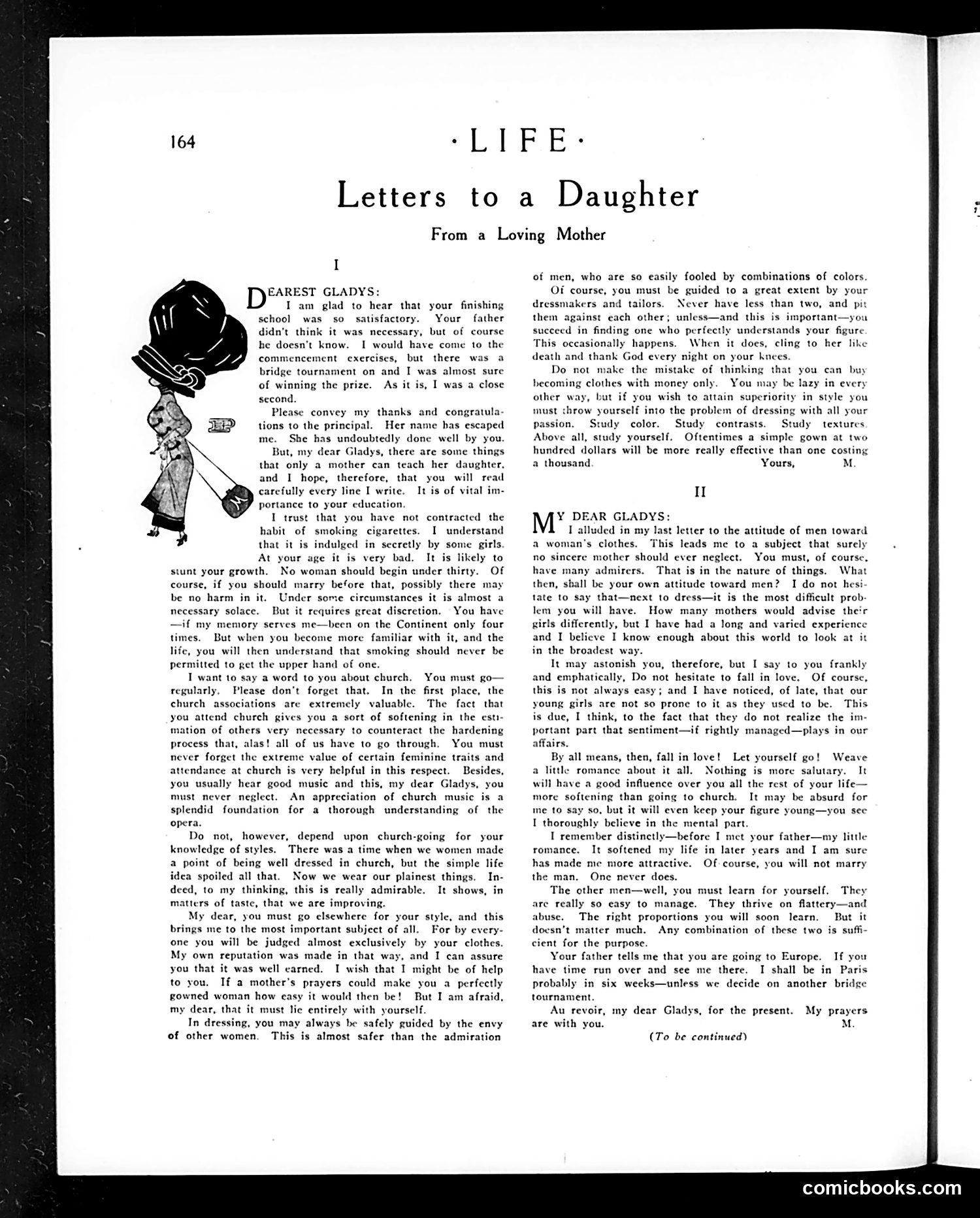
This satirical advice column mocks the priorities and superficiality of wealthy American society women in the early 20th century. The illustration shows a fashionably dressed woman—representing the society mother giving advice. The satire targets her absurd value system: she missed her daughter's graduation for a bridge tournament (nearly winning!), yet obsesses over clothing as the measure of a woman's worth. She emphasizes church attendance primarily for "softening" one's reputation and hearing good music (as opera preparation), not spirituality. The mother's guidance reveals shallow materialism—hiring multiple dressmakers to compete, dressing for envy rather than admiration, and treating fashion as life's "most important subject." Even her casual acceptance of smoking after thirty and vague hints about romance undercut any pretense of genuine maternal wisdom. The piece satirizes the leisure-class woman who equates feminine virtue, social success, and personal value entirely with appearance and fashion conformity.
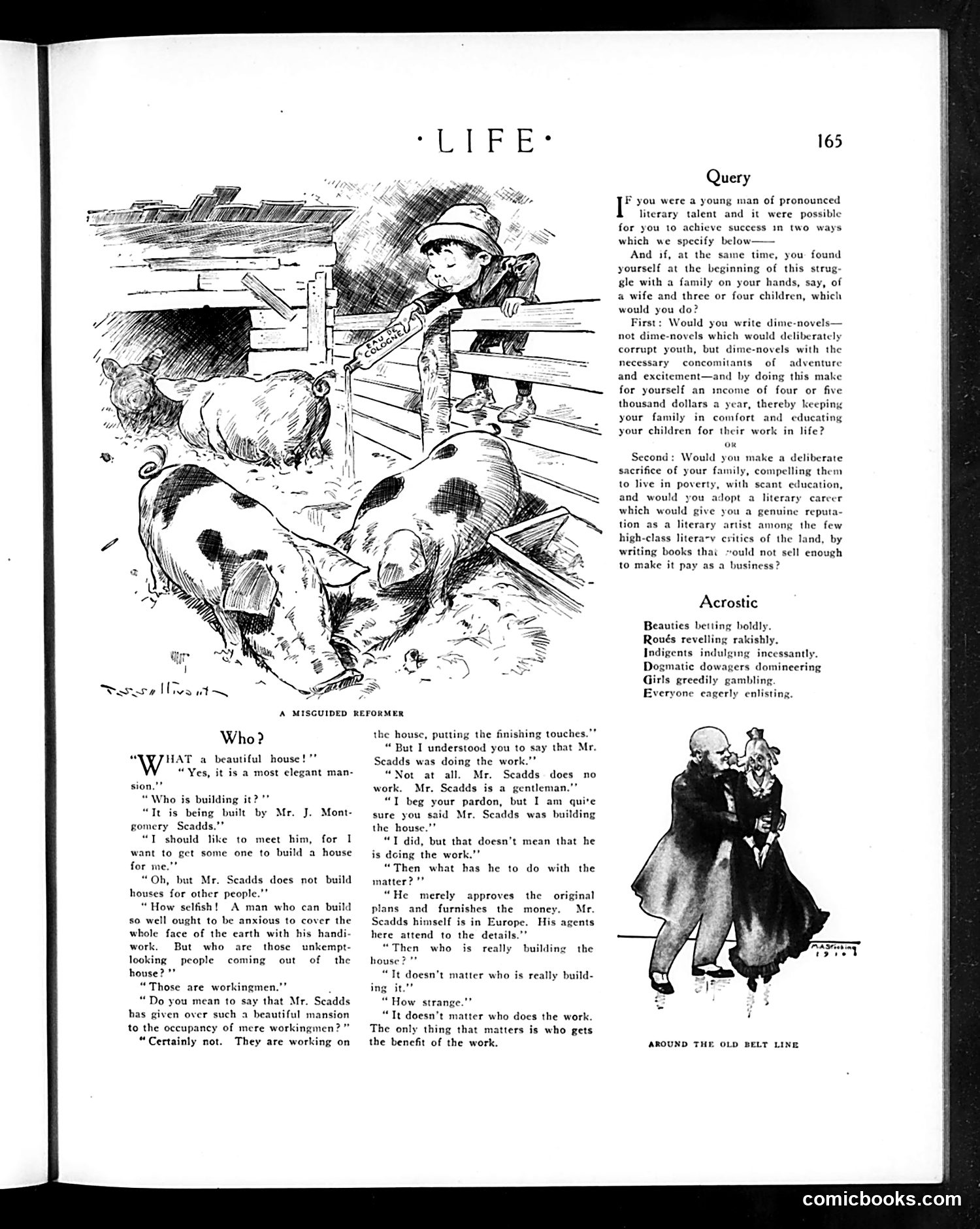
This satirical dialogue mocks wealthy industrialists who claim credit for grand accomplishments while doing no actual work themselves. Mr. Scadds, a gentleman financier, is celebrated for "building" an elegant mansion—yet he merely approves plans and provides money. The actual laborers (working men) perform all construction work while remaining invisible to society's esteem. The joke exposes class hypocrisy: society attributes achievement to the wealthy patron rather than the workers who create value. The cartoon's final line—"It doesn't matter who does the work. The only thing that matters is who gets the benefit"—cynically captures how industrial-era capitalism rewarded capital ownership over labor, and how social prestige followed money, not merit or effort. This reflects Progressive-era critiques of capitalist inequality common in early 1900s *Life* magazine satire.
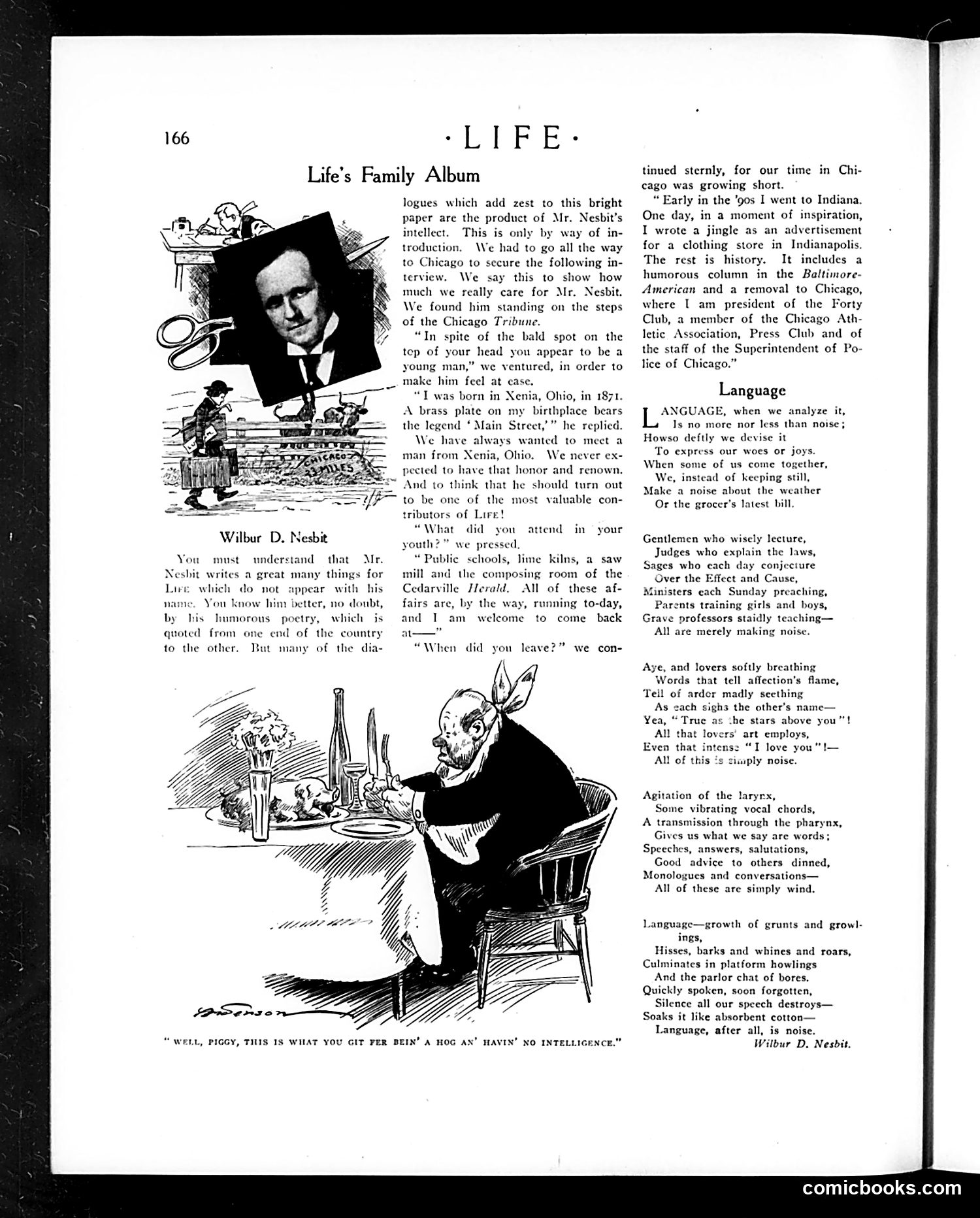
This page features an interview with **Wilbur D. Nesbit**, a humorist and poet who contributed to *Life* magazine. The text presents his biographical details: born in Xenia, Ohio (1871), worked in journalism and advertising, eventually becoming president of Chicago's Forty Club and involved with the police department. The cartoon below shows a pig at a dinner table with the caption: "Well, Piggy, this is what you git fer bein' a hog an' havin' no intelligence." This is a moralizing joke about gluttony and stupidity—the pig's lack of intelligence leads to its consumption, a common Victorian-era cautionary cartoon trope. The page also includes Nesbit's poem "Language," which satirizes human communication as merely "noise"—arguing that speeches, love declarations, and advice are all just vibrations without substance. This reflects early 20th-century cynicism about rhetoric and empty talk.
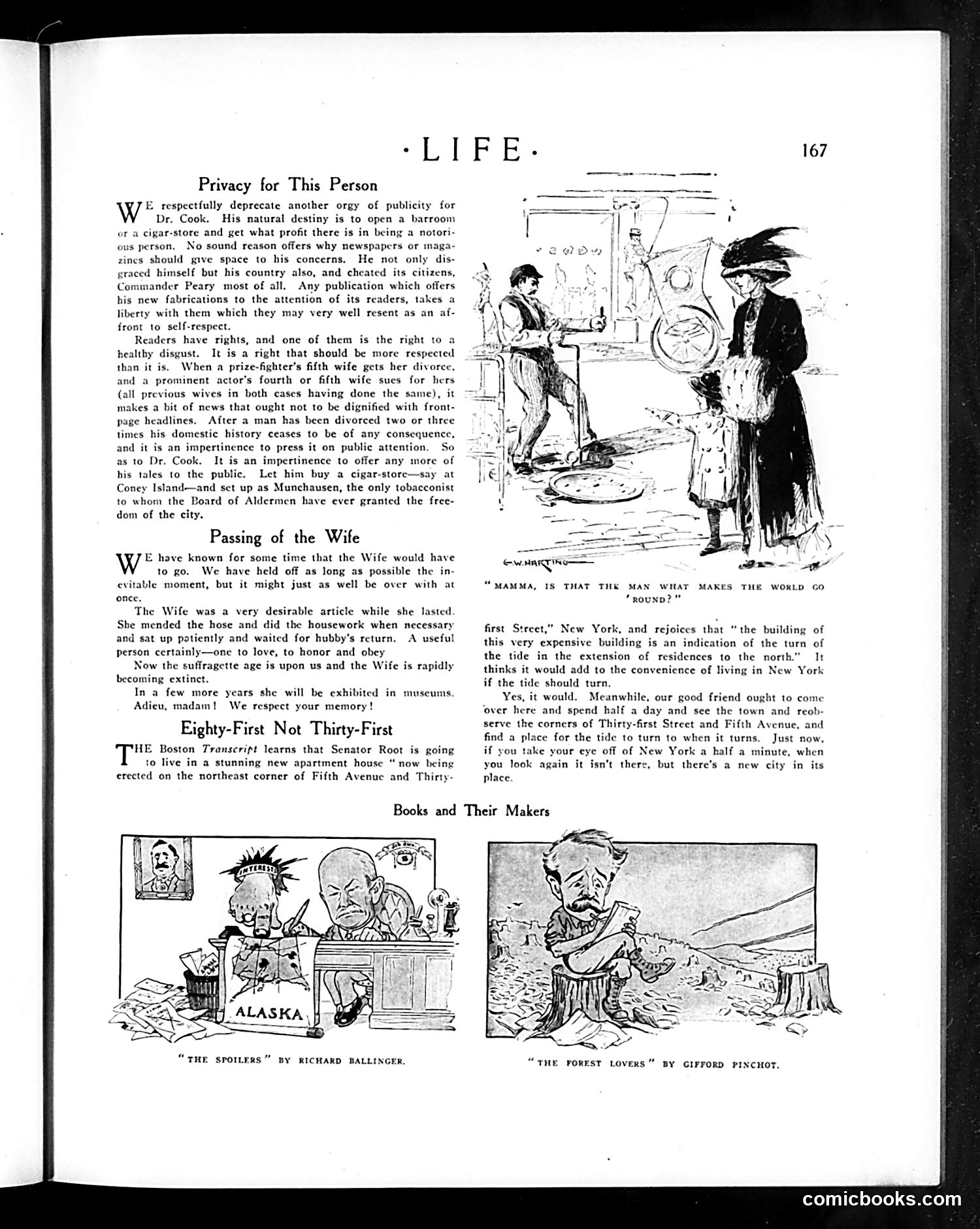
This page contains three distinct satirical pieces: **"Privacy for This Person"** attacks Dr. Frederick Cook, an Arctic explorer who claimed to reach the North Pole but was exposed as a fraud—discrediting Commander Peary's legitimate achievement. Life argues newspapers shouldn't publicize Cook's fabrications and suggests he open a cigar store instead, comparing him to Baron Munchausen (a fictional liar). **"Passing of the Wife"** sarcastically mourns the traditional housewife becoming "extinct" due to the suffragette movement and women's rights activism. It's tongue-in-cheek social commentary on changing gender roles. **"Eighty-First Not Thirty-First"** jokes about Senator Root's new apartment on Fifth Avenue and Thirty-First Street, claiming New York City changes so rapidly that if you look away briefly, the address has already changed—satirizing Manhattan's explosive urban development. The two book-jacket cartoons at bottom appear to mock political figures (Ballinger and Pinchot were conservation-era politicians) through exaggerated caricature.
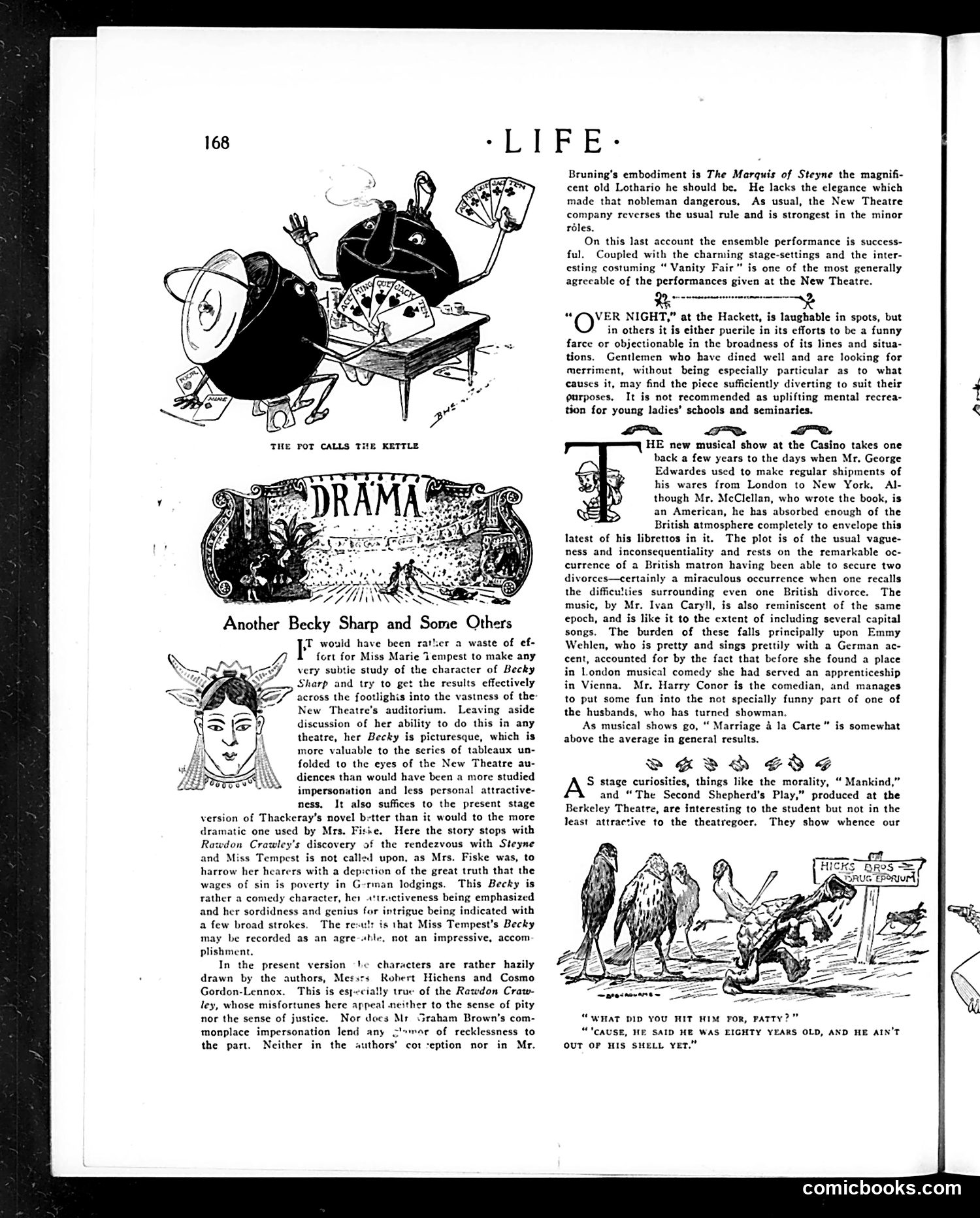
This page reviews theatrical productions at New York venues. The top cartoon "The Pot Calls the Kettle" satirizes theatrical productions through a visual pun—a anthropomorphic pot and kettle arguing, likely critiquing hypocrisy in theater reviews or performances. The main text discusses a "Vanity Fair" stage adaptation at the New Theatre, starring Marie Tempest as Becky Sharp (the famous morally ambiguous character from Thackeray's novel). The critic finds her performance "agreeable" but criticizes the adaptation for softening the character's consequences—unlike an earlier Mrs. Fiske production that showed her poverty and degradation, this version ends earlier with less moral weight. The review also covers other shows: "Over Night" at the Hackett (deemed crude farce unsuitable for young ladies), and a musical at the Casino inspired by George Edwardes' British theatrical tradition, featuring German-accented singer Emmy Wehlen. The humor assumes readers' familiarity with theatrical conventions and literary source material.
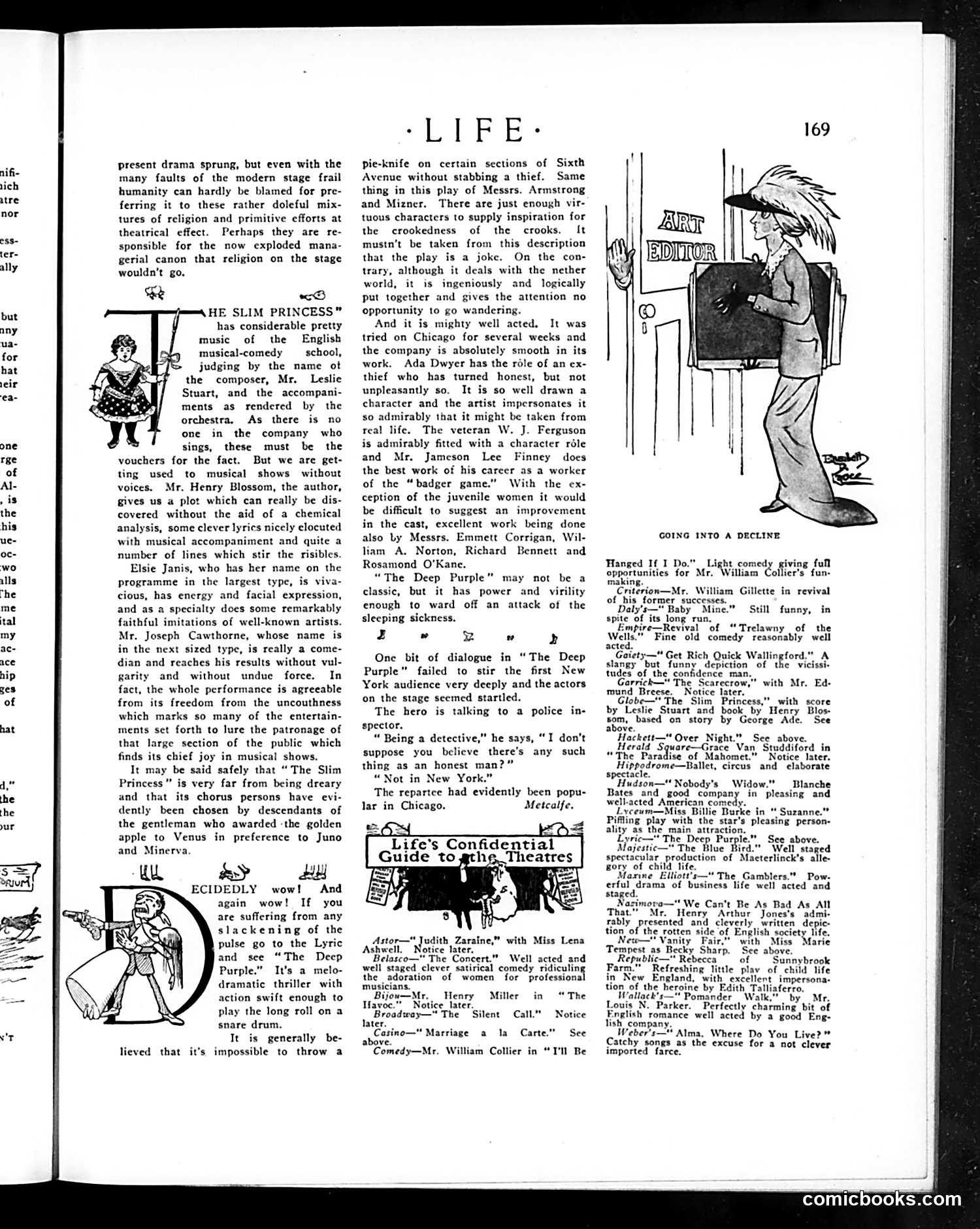
This page contains theater reviews from Life magazine's arts section. The cartoons and illustrations satirize theatrical productions of the era. **"The Slim Princess"** review mocks a musical comedy with pretty music but no actual singers—a critique of contemporary musical theater prioritizing spectacle over substance. The review notes the chorus was selected by "descendants of the gentleman who awarded the golden apple to Venus," a classical reference joking that the women were chosen purely for beauty. **"The Deep Purple"** review praises this melodramatic thriller set in New York's criminal underworld (Sixth Avenue). The satire lies in the setup: the play depicts a world where one cannot throw a "pie-knife" without hitting a thief, mocking the melodrama's density of criminals and virtue-testing scenarios. Both reviews employ the magazine's characteristic witty, sometimes cutting commentary on popular entertainment. The bottom illustration shows a dismissive figure labeled "Decidedly wow!" capturing Life's irreverent tone toward Broadway productions. The page represents early 20th-century American cultural criticism prioritizing clever wordplay over earnest analysis.
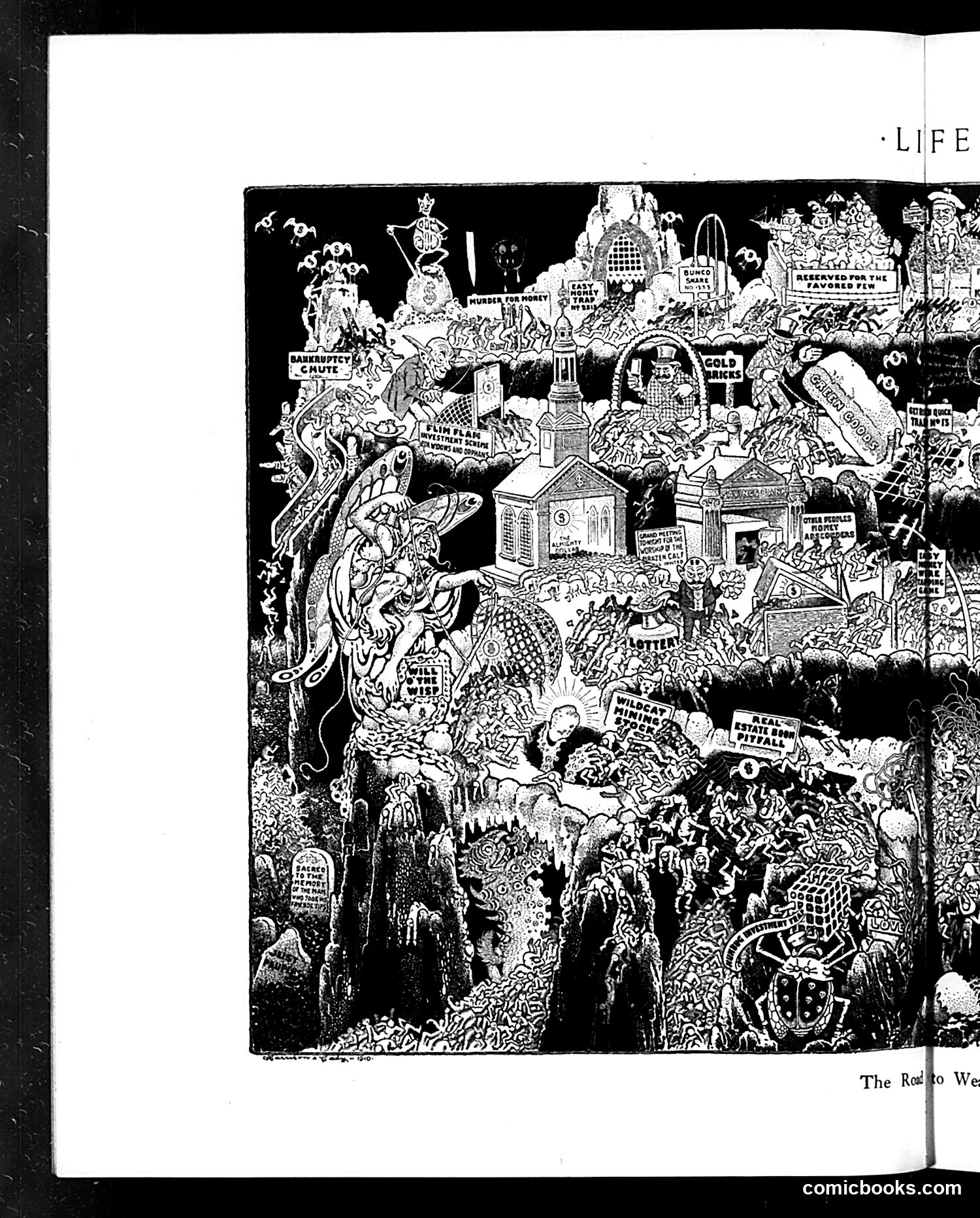
This is a densely packed satirical illustration titled "The Road to We[lfare]" (text cut off at bottom). It depicts a chaotic, allegorical landscape crowded with labeled buildings, signs, and figures representing various social institutions and problems. The cartoon appears to criticize the expansion of government welfare and social programs, using a fantastical cityscape to show how interconnected bureaucracies and public services have become overwhelming. Various labeled structures suggest institutions like hospitals, government offices, and poorhouses competing for space in an increasingly complex system. The style—with its intricate detail and moral judgment—is typical of early-to-mid 20th century American political satire about the New Deal or welfare state expansion, though without a clear date visible, the specific historical moment remains uncertain.
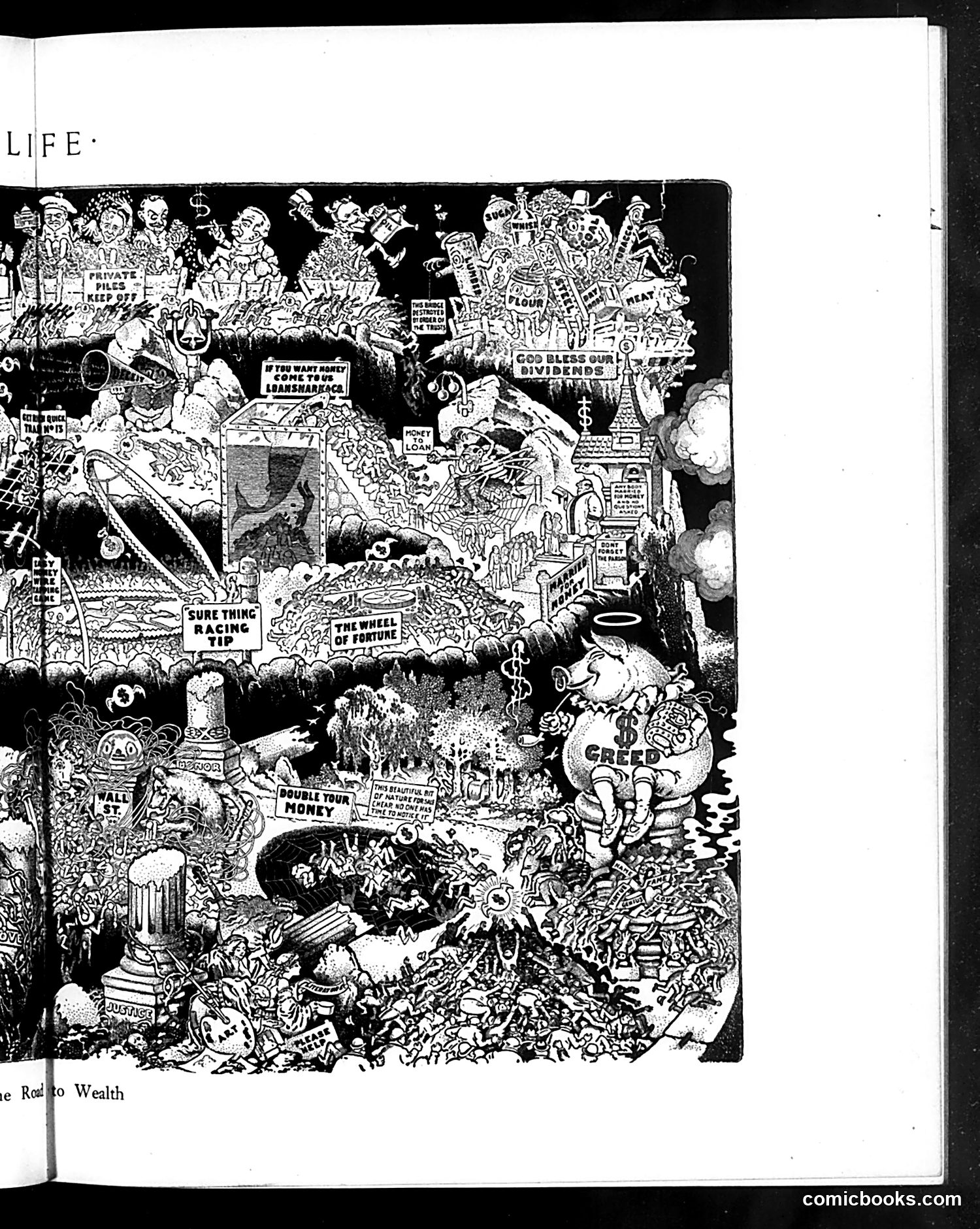
This is a densely detailed satirical illustration titled "The Road to Wealth" critiquing American capitalism and greed. The chaotic scene depicts various get-rich-quick schemes and financial temptations: **Visible elements include:** - Signs reading "SURE THING RACING," "DOUBLE YOUR MONEY," "THE WHEEL OF FORTUNE," and "GOD BLESS OUR DIVIDENDS" - References to "PILES," "EASY MONEY," and "GREED" - Caricatured figures pursuing wealth through gambling, speculation, and dubious schemes - A character labeled "CREED" riding what appears to be financial chaos **The satire targets:** 1920s-era financial speculation, stock market schemes, gambling, and the obsessive pursuit of wealth regardless of consequences. The overwhelming visual clutter emphasizes how these temptations consume society. This reflects concerns about unchecked capitalism and financial irresponsibility during the prosperous but speculative 1920s era preceding the Great Depression.
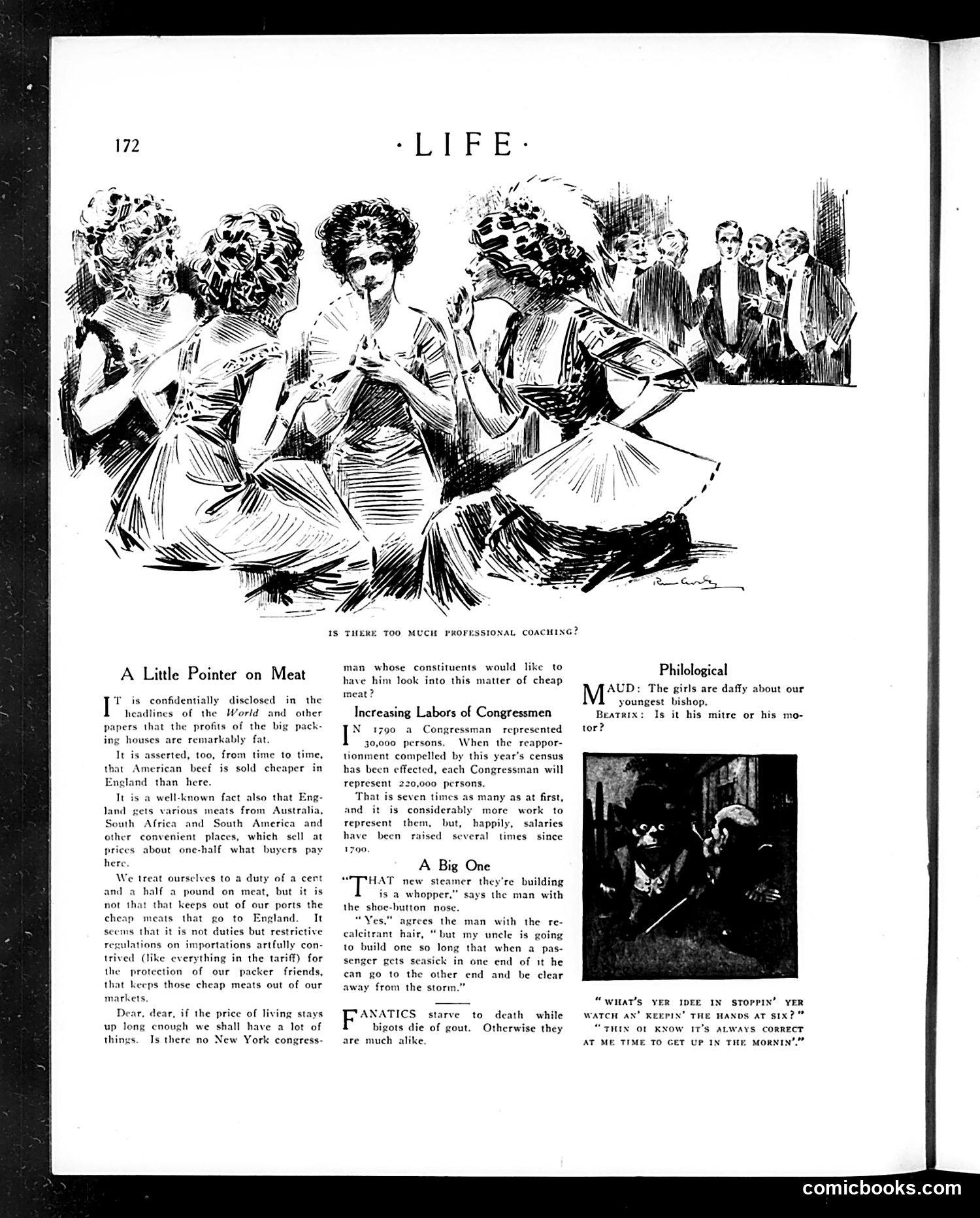
**Main Content: "A Little Pointer on Meat"** This article satirizes American meat-packing monopolies and protective tariffs. The writer notes that American beef sells cheaper in England despite import duties, suggesting restrictive regulations—not tariffs alone—artificially protect domestic packers from cheaper foreign competition. The piece challenges Congress to investigate whether constituents' interests (lower food costs) are being sacrificed for packer profits. **Secondary Articles:** "Increasing Labors of Congressmen" notes that representation has grown sevenfold since 1790 (from 30,000 to 220,000 constituents per representative), yet congressional salaries have only been "raised several times"—implying inadequate compensation for increased workload. **Cartoons & Jokes:** The top illustration shows women discussing coaching (unclear specific reference). Smaller items mock exaggeration, fanaticism, and domestic absurdity—typical Life humor. **Historical Context:** This reflects Progressive Era concerns about monopolies, tariff corruption, and whether government served ordinary citizens or corporate interests.
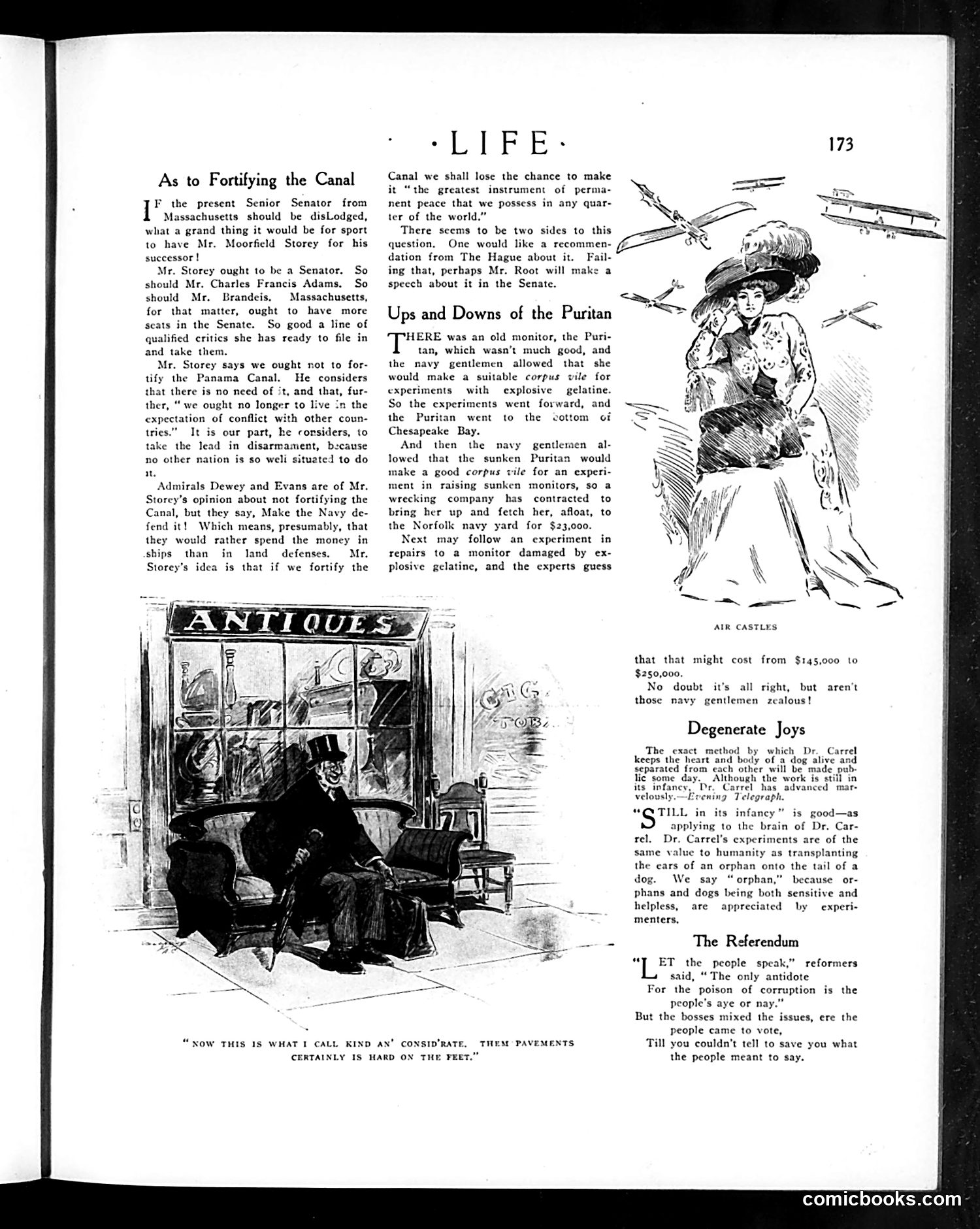
This page contains four distinct satirical pieces: **"As to Fortifying the Canal"**: Commentary on a debate over Panama Canal defense. The piece mocks Massachusetts Senator Henry Cabot Lodge (implied as "disLodged"), suggesting better critics like Moorfield Storey or Louis Brandeis could replace him. Storey opposes fortification, believing disarmament demonstrates moral leadership; admirals counter that naval defense is preferable. **The antiques shop cartoon**: A man sitting outside an antique store, captioned about "kind an' consid'rate" pavements. Likely satirizes antiquated attitudes or comfort in modern society. **"Ups and Downs of the Puritan"**: Mocks navy inefficiency. A worthless monitor ship is sunk for explosive experiments, then expensively salvaged ($23,000) for raising-sunken-ships experiments, with repairs potentially costing $145,000-$250,000—satirizing wasteful military spending and circular reasoning. **"The Referendum"**: Criticizes referendum democracy as corrupted by political bosses who deliberately confuse issues, making voters' true intent unknowable.
This page from *Life* magazine contains literary criticism rather than political cartoons. The main article critiques author **James Lane Allen**, whose recent works (*The Bride of the Mistletoe* and *The Doctor's Christmas Eve*) represent a troubling shift in his outlook. The reviewer notes Allen previously embodied optimistic idealism but has apparently undergone a "cataclysmic" change—becoming a pessimist who uses modern psychology and post-Darwinian science to argue that life is hopeless and humanity helpless. The critic objects not to pessimism as a theme, but to Allen's flawed reasoning: he's abandoning faith in human potential based on incomplete scientific understanding, comparable to rejecting God because the earth isn't flat. The "Confidential Book Guide" section below lists contemporary works, including titles exploring psychology, Western adventure, and Irish life. This reflects early 20th-century intellectual preoccupations with science, literature, and modernity's impact on traditional values.
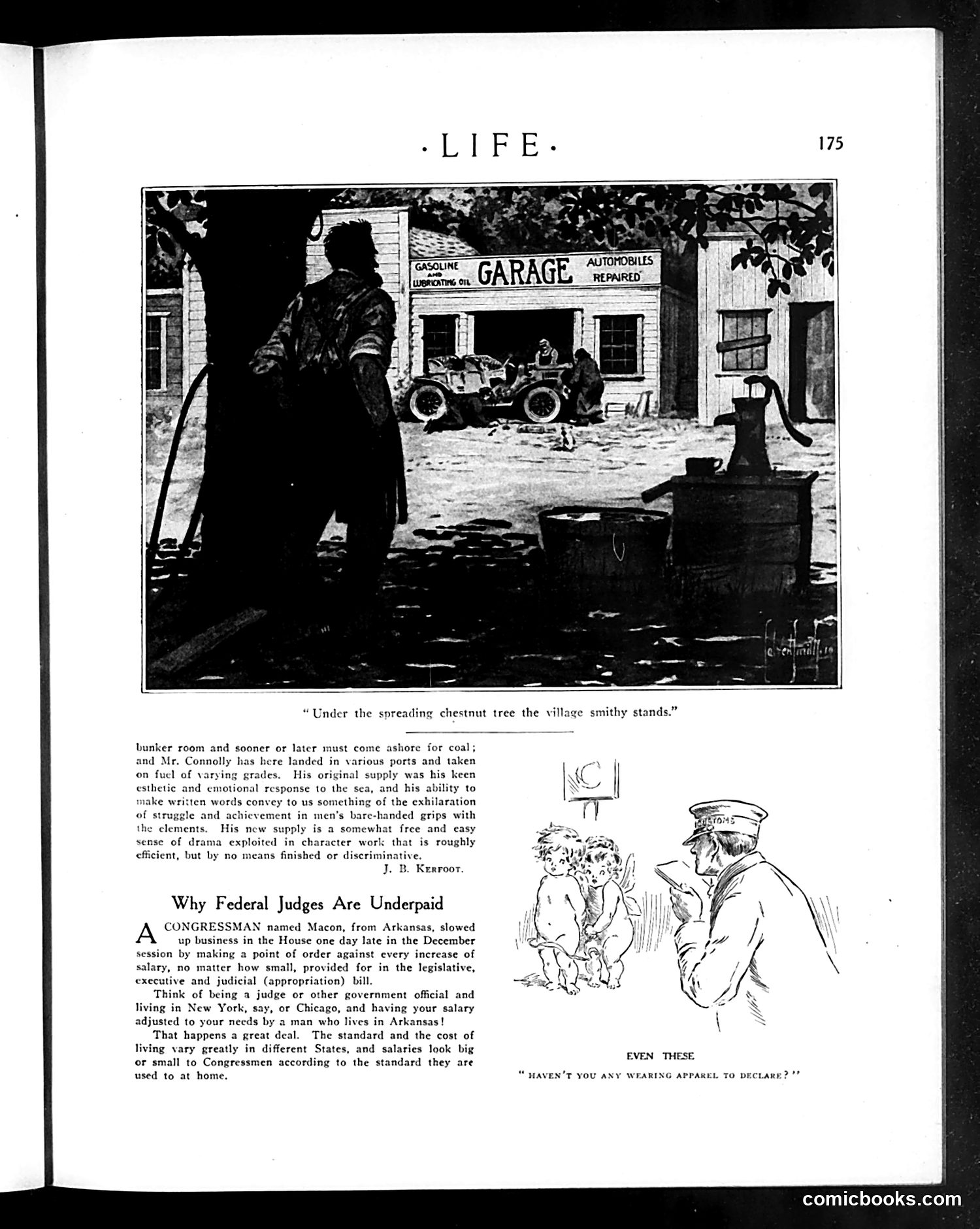
This page critiques Congressional salary-setting practices. Congressman Macon from Arkansas opposed all salary increases in an appropriations bill, illustrating an absurd problem: judges and federal officials in expensive cities like New York and Chicago have their pay determined by congressmen from lower-cost-of-living states like Arkansas. The article argues this is fundamentally unfair—a judge in New York earning what seems adequate to an Arkansan congressman actually cannot afford to live decently. The satire highlights how regional economic differences made centralized federal salary scales inequitable, forcing officials to either accept inadequate compensation or struggle financially. The accompanying cartoon (bottom right) uses customs inspection humor to reinforce the theme of officials lacking proper resources.
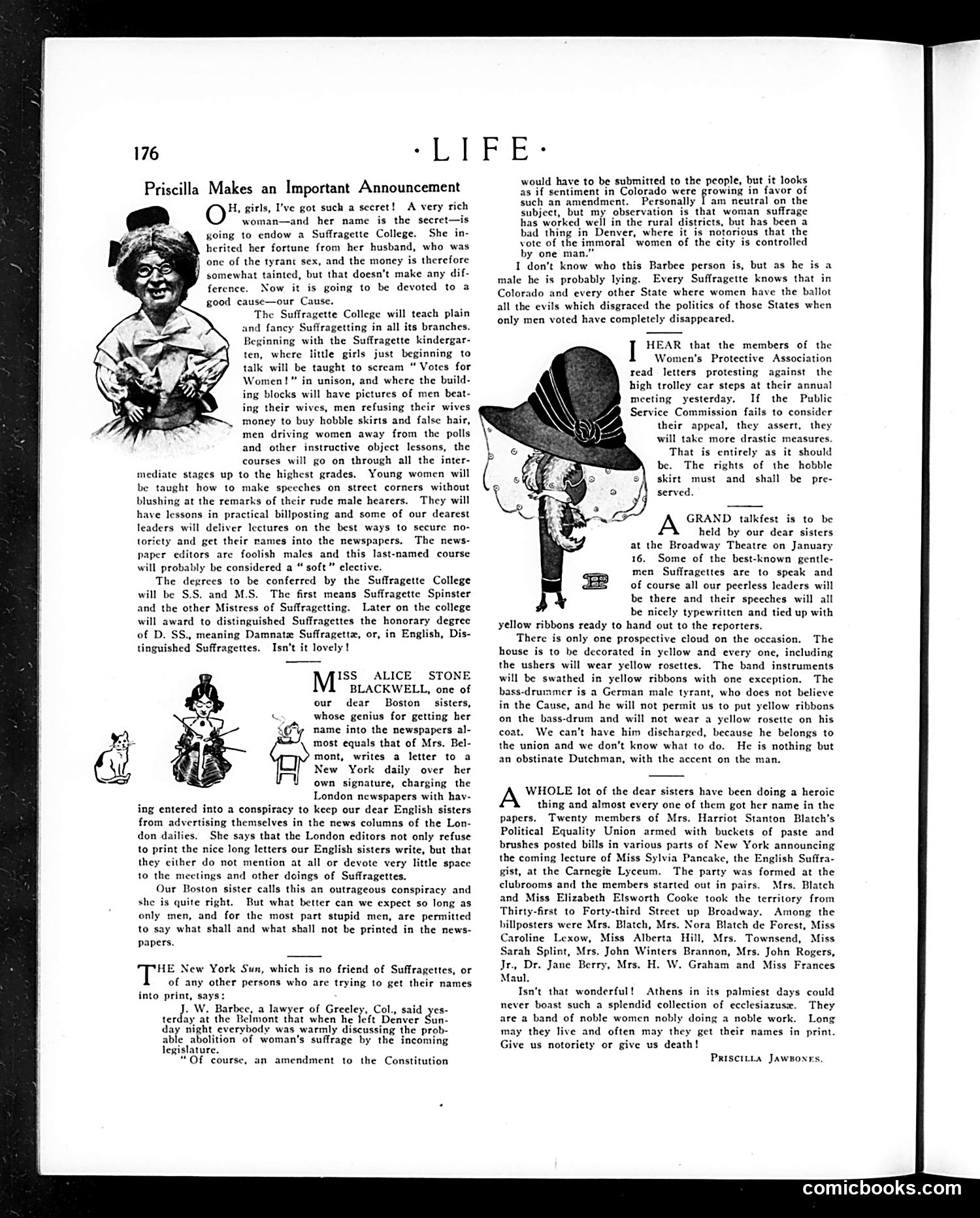
This page mocks early-20th-century American suffragettes through fictional announcements and commentary. The main cartoon depicts "Priscilla," who announces a wealthy widow will endow a "Suffragette College" teaching girls to scream "Votes for Women!" and make street speeches. The satire ridicules what the author saw as suffragettes' attention-seeking behavior, suggesting they prioritize newspaper publicity over genuine political work. A secondary section attacks Alice Stone Blackwell (a real Boston suffragist) for complaining that London newspapers suppress suffragette news, sarcastically suggesting male editors are conspiring against them. The piece concludes by dismissing a Colorado lawyer's claim that women's suffrage corrupted Denver politics, declaring all males are liars. The satire reflects *Life* magazine's anti-suffrage stance, portraying activists as vain, propagandistic, and unreasonable—common criticisms opponents leveled against the movement.
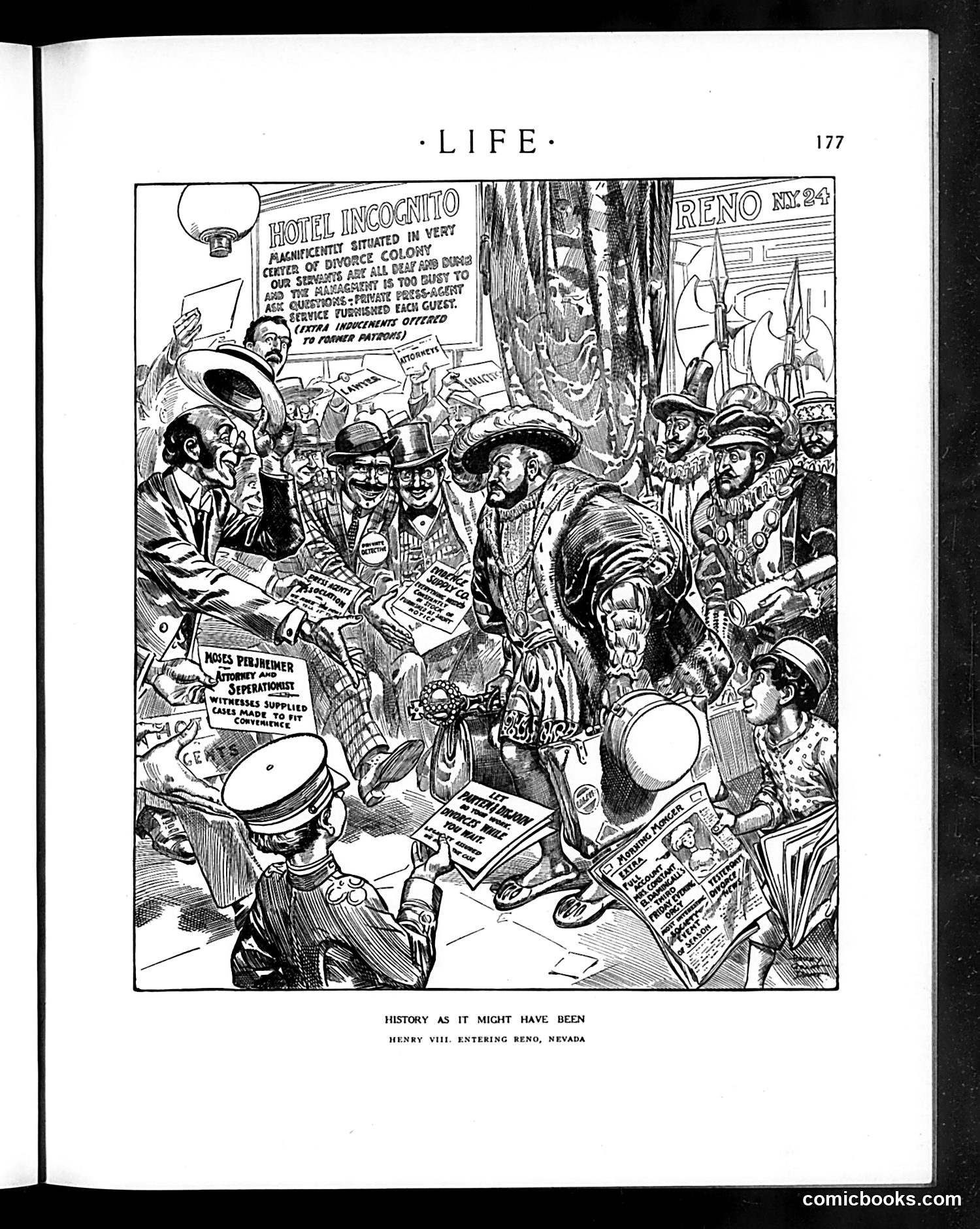
This is a satirical cartoon imagining King Henry VIII arriving in Reno, Nevada. The joke conflates Henry VIII's notorious history of multiple marriages—he famously had six wives and divorced/beheaded several—with Reno's reputation as a divorce destination. During the early-to-mid 20th century, Reno was known for lenient divorce laws that attracted people seeking quick divorces. The cartoon depicts Henry VIII surrounded by officials and what appears to be legal paperwork, with a sign for "Hotel Incognito" visible. The satire suggests that had Henry VIII lived in modern times, he could have simply used Reno's divorce courts instead of orchestrating the religious and political upheaval that characterized his actual reign. It's a humorous commentary on both Henry's marital history and Reno's then-scandalous role in American divorce culture.
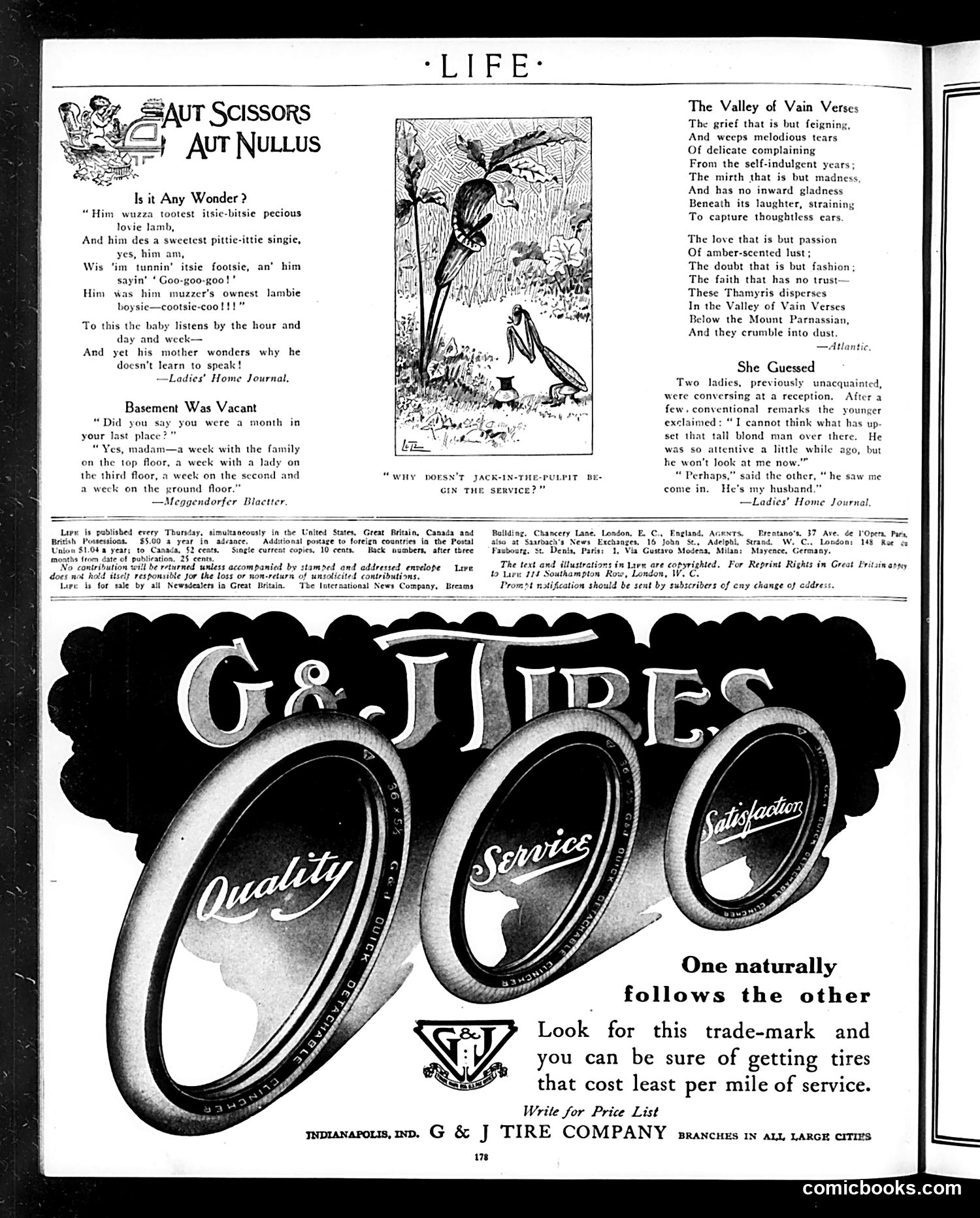
This page contains three separate humor pieces typical of early 20th-century Life magazine satire: **"Aut Scissors Aut Nullus"** mocks parents who use exaggerated baby-talk ("itsie-bitsie," "goo-goo") with their children, then wonder why the child doesn't develop proper speech. The satire is straightforward: you cannot teach language through nonsense sounds. **"Basement Was Vacant"** is a brief anecdote about someone describing various living arrangements, but the punchline is cut off in this OCR—the humor likely involves the absurdity of their housing situation. **"She Guessed"** presents a social comedy: two women at a reception discuss an inattentive man. The younger assumes he's upset with her; the older reveals he's actually her own husband—the joke being that the man ignores his own wife while being polite to strangers. The page also includes poetry ("The Valley of Vain Verses") and a **G&J Tire Company advertisement** emphasizing quality, service, and cost-efficiency. The humor reflects period concerns about child-rearing, domestic life, and social etiquette.
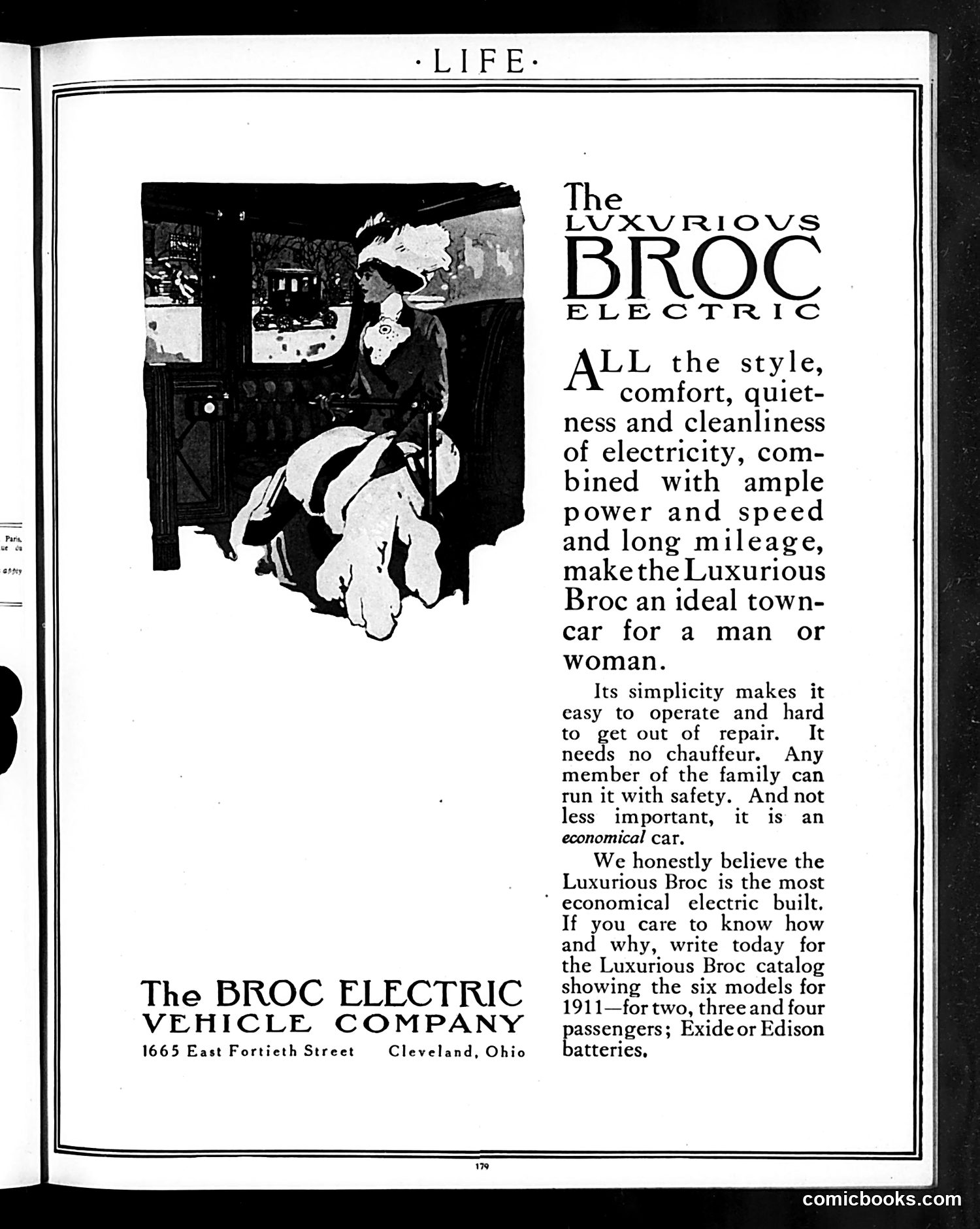
This is primarily a **full-page advertisement**, not satire or political commentary. It promotes the Broc Electric Vehicle Company's "Luxurious Broc" electric automobiles from 1911. The illustration shows a elegantly dressed woman operating the vehicle—significant because the ad emphasizes that electric cars require no chauffeur and are safe enough for "any member of the family" to operate. This targets women drivers, a relatively novel concept at the time, highlighting the car's simplicity compared to gas-powered vehicles. The marketing emphasizes electric vehicles' advantages: cleanliness, quiet operation, ease of use, and economy. The company offered six models for 2-4 passengers, with either Exide or Edison batteries. The ad's location in *Life* magazine indicates these luxury electric cars were marketed to affluent, modern-minded readers—likely before gas engines dominated the market.
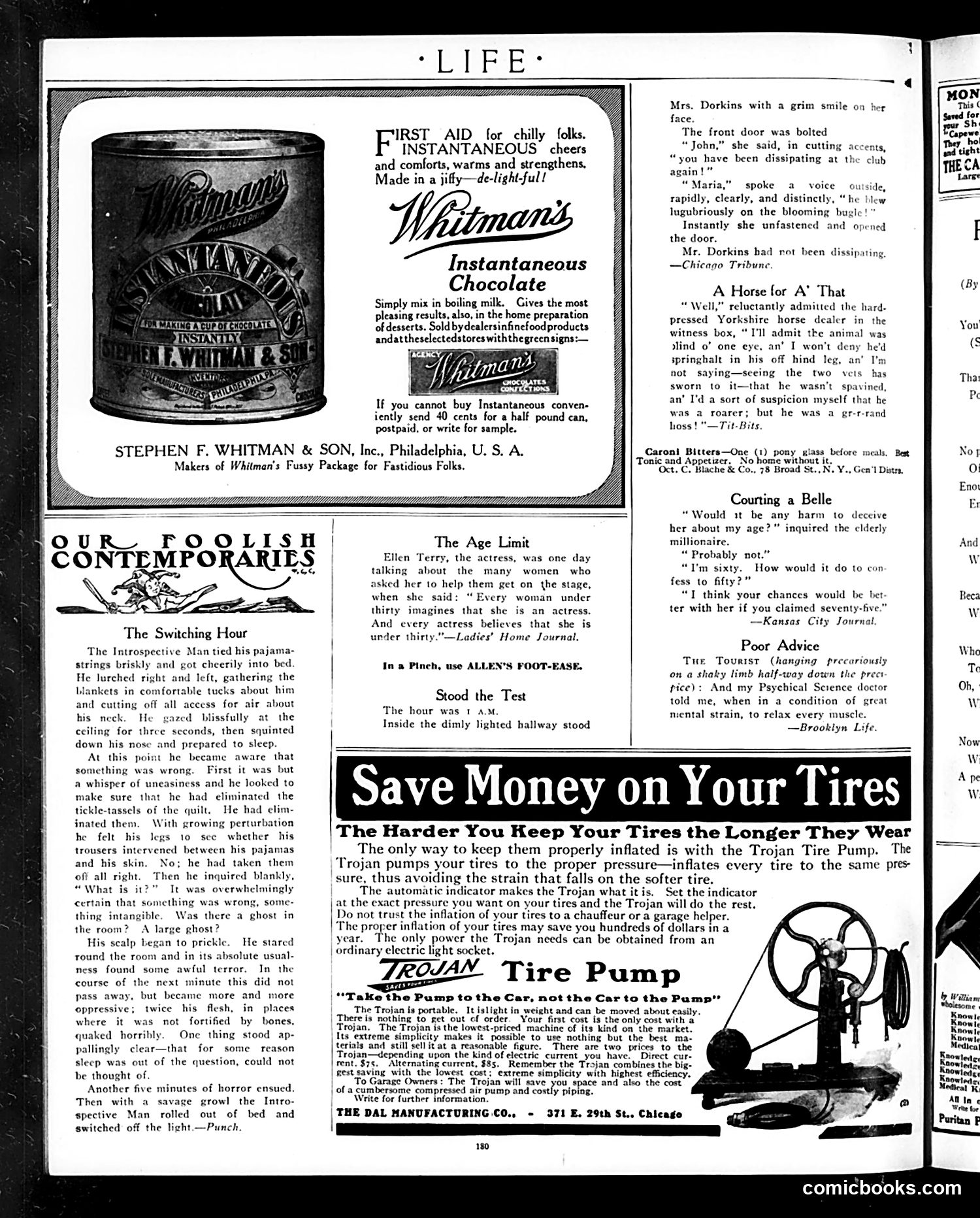
This page mixes humor columns and advertisements typical of early 20th-century *Life* magazine. The main satirical content includes: **"The Switching Hour"** (Punch): A humorous story about an anxious man unable to sleep, obsessing over whether something is wrong—finding nothing, he eventually gives up and turns off the light. The joke is the anticlimactic resolution to his paranoia. **"A Horse for A' That"** (Yorkshire dialect): A horse dealer reluctantly admits his horse is blind, lame, and diseased, yet still calls it a "grand hoss." The satire mocks dishonest salesmen's exaggerated praise despite obvious flaws. **"Courting a Belle"** and **"The Age Limit"**: Brief joke columns about deception in romance and courtship. The advertisements—Whitman's chocolate, Allen's Foot-Ease, and Trojan Tire Pump—occupy significant space, typical for *Life*'s business model. The page reflects period concerns: domestic life, gender relations, commerce, and working-class dialect humor.
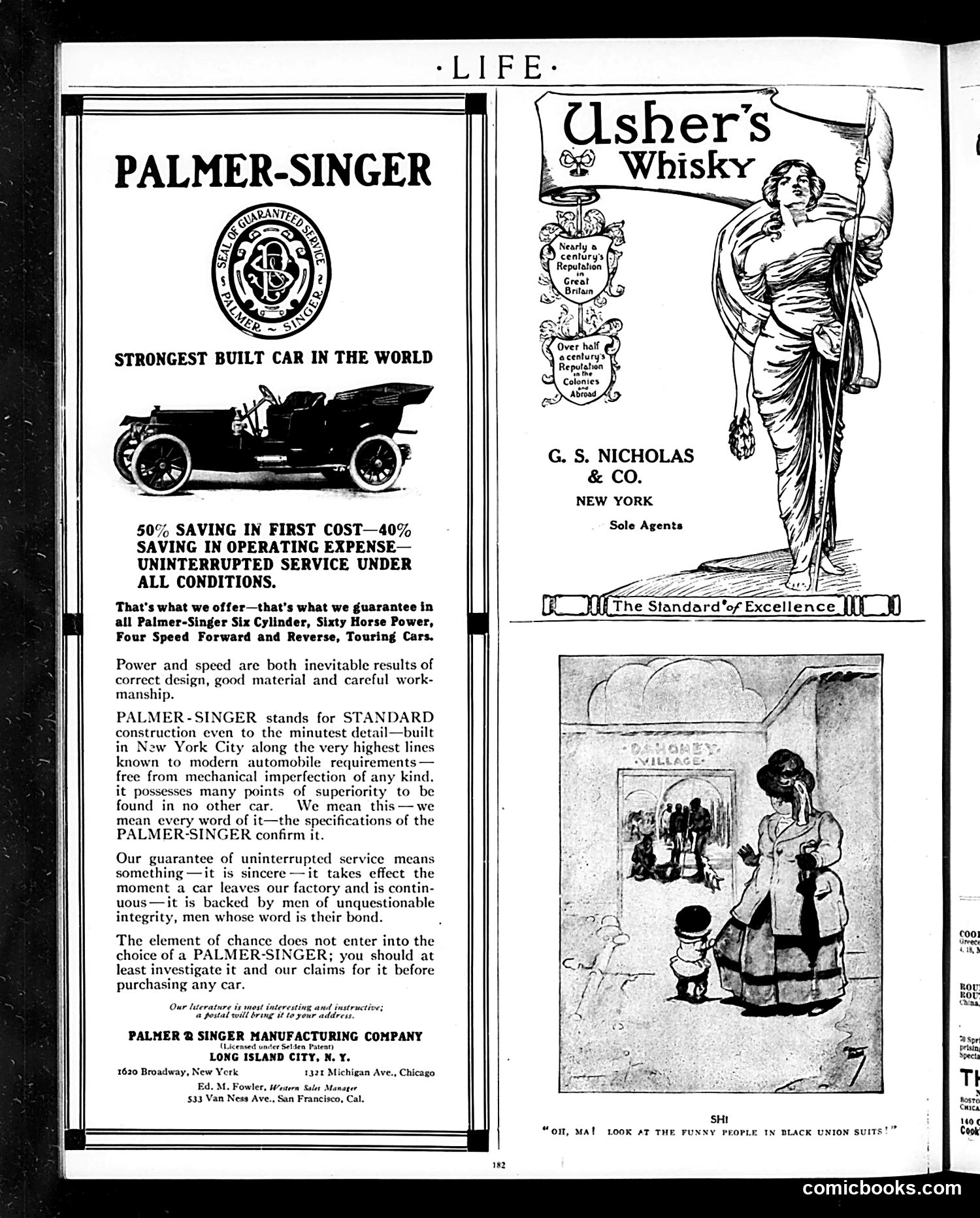
This page contains two period advertisements with no political cartoons. **Left side:** Palmer-Singer automobile ad emphasizing reliability and manufacturing quality. Standard early-1900s car advertising claiming superiority through construction standards and service guarantees. **Right side:** Usher's Whisky ad featuring a classical female figure (likely representing quality/tradition) with decorative heraldic imagery. Marketed as "The Standard of Excellence" with distribution through G.S. Nicholas & Co. in New York. **Bottom cartoon:** A domestic scene showing a woman pointing at children in dark swimwear, saying "Oh, Ma! Look at the funny people in black union suits!" The humor appears to be wordplay—"union suits" was period slang for one-piece undergarments/swimwear, making the children's beach attire the joke rather than any satirical commentary. This is primarily **advertising content**, typical of Life magazine's revenue model in this era.
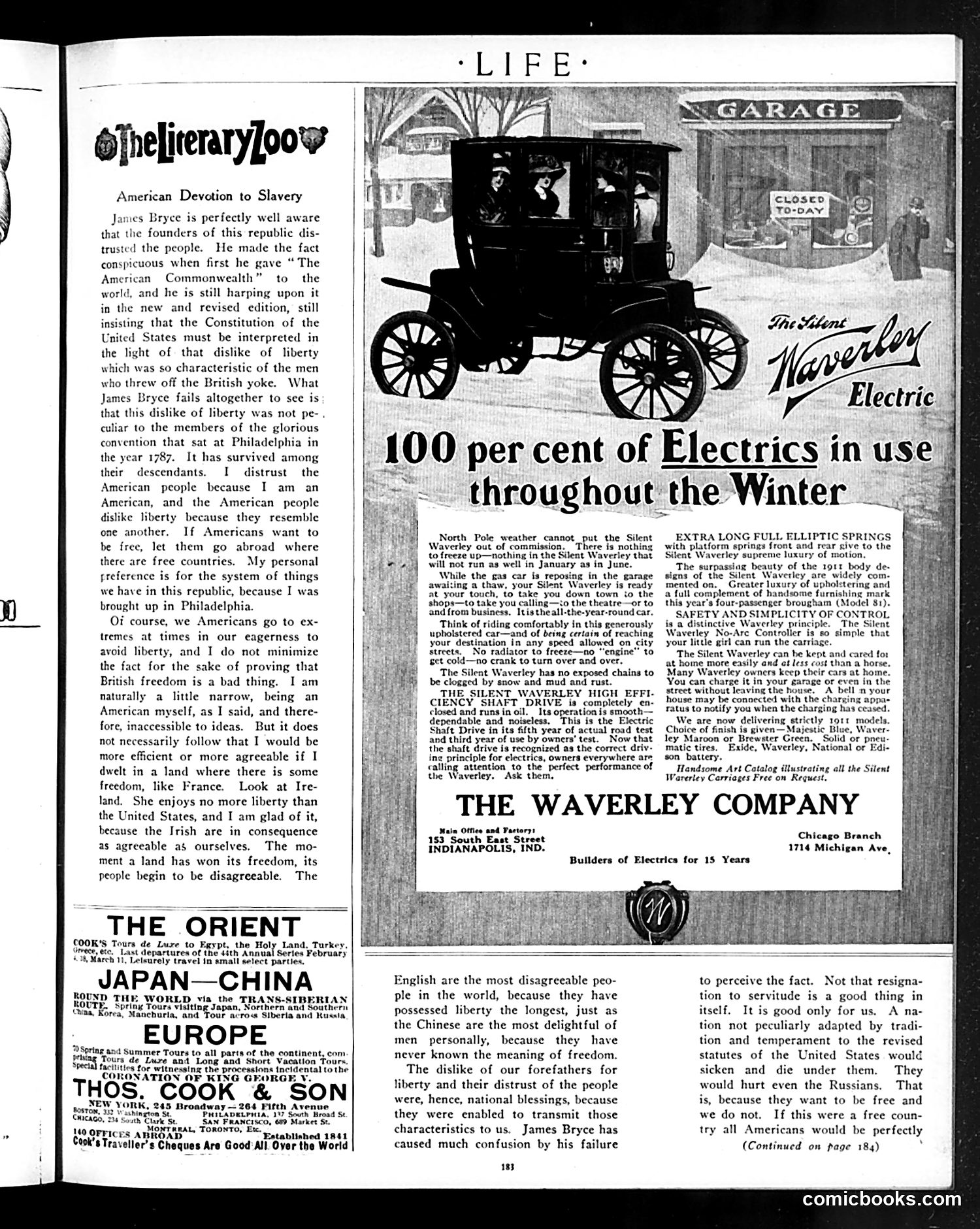
This page contains **satirical political commentary** rather than traditional cartoons. The main piece, "American Devotion to Slavery," is ironic social criticism attacking American attitudes toward liberty and freedom. The **satire's target**: The author mocks James Bryce (a British political theorist) and Americans generally, arguing that contrary to national mythology, Americans actually *distrust* freedom. The piece uses exaggerated logic—claiming Americans dislike liberty because they resemble each other, and that freedom makes people "disagreeable"—to expose the hypocrisy in American claims to champion liberty. **Key irony**: By calling this devotion to slavery (a term for preferring order over freedom), the author suggests Americans have inherited the Founders' skepticism of popular liberty and perpetuated it, despite revolutionary rhetoric. The page also includes **travel advertisements** (Cook's Tours, Thomas Cook & Son) and a **Waverley Electric automobile ad** emphasizing reliability in winter conditions—typical period advertising content. This is primarily a **text-based satire** rather than visual cartoon humor.
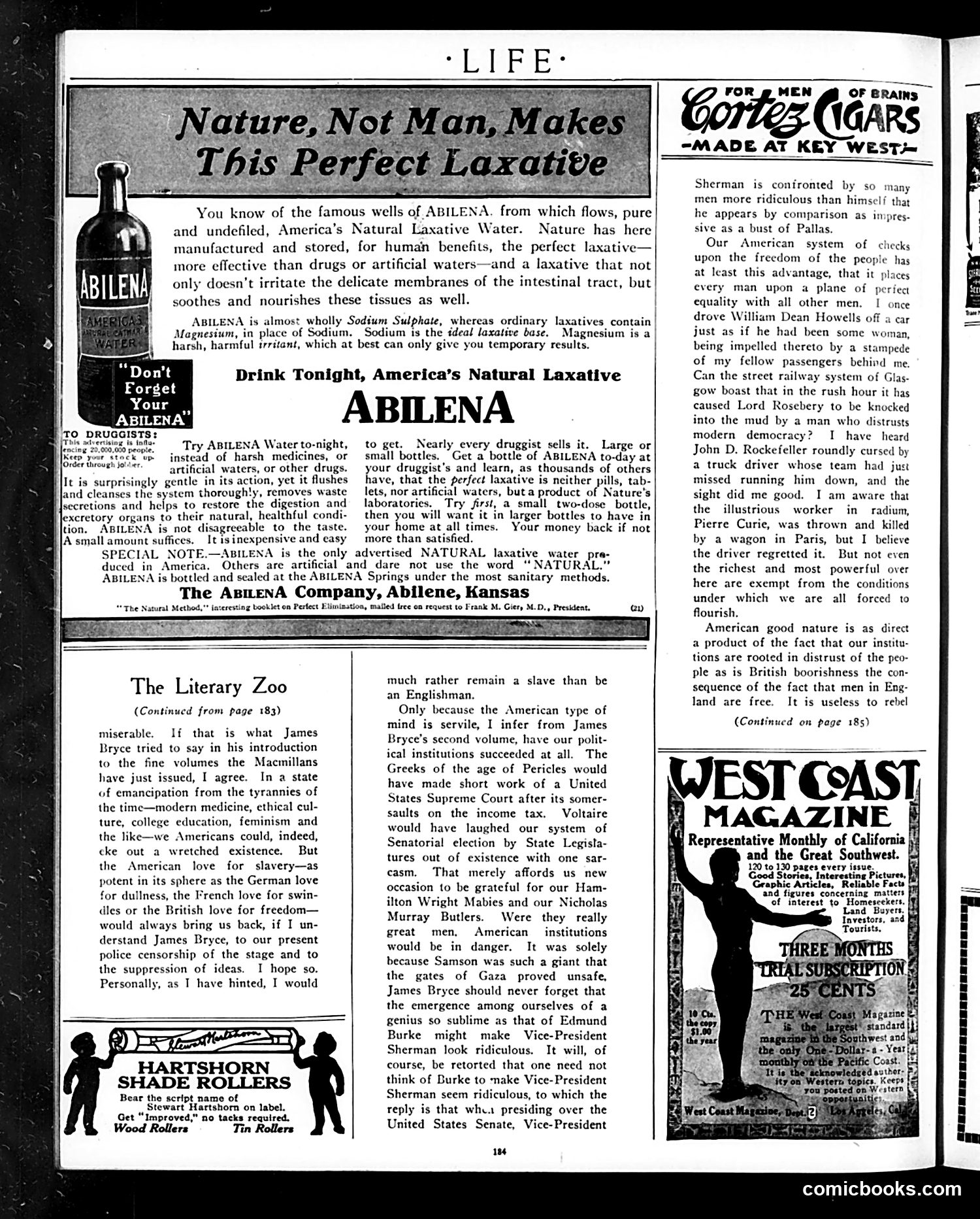
This page is primarily **advertising** rather than political cartooning. The dominant content is a full-page advertisement for Abilena, a commercial laxative water from Kansas, making dubious health claims about its "natural" properties and superiority to medicines. The page also contains **"The Literary Zoo,"** a satirical essay (continued from page 183) critiquing American political and cultural institutions through commentary on James Bryce's writings. The author argues Americans are inherently "servile" and that this servility—paradoxically—allows American democratic institutions to function. He suggests that if Americans were truly great minds (like Samson), our institutions would collapse under the weight of genius challenging them. The satire targets American complacency, suggesting we succeed *despite* our mediocrity, not because of our virtues—a backhanded critique of American exceptionalism. The tone is cynical about American character compared to European traditions.
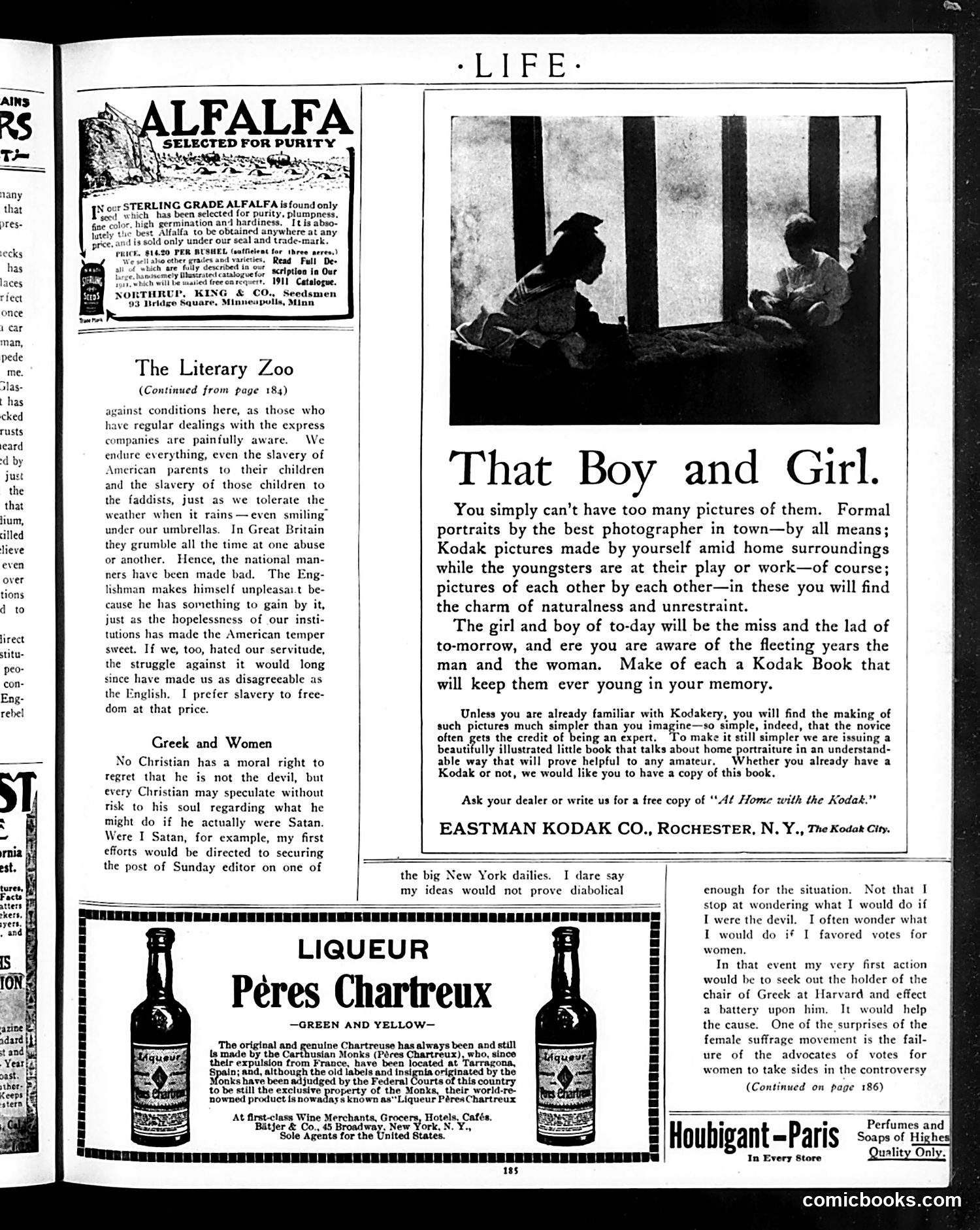
This page contains primarily **advertisements and opinion pieces** rather than political cartoons. The main content includes: 1. **Kodak Advertisement** ("That Boy and Girl"): A sentimental ad encouraging parents to photograph children, using nostalgic language about preserving youth and memory—typical early 1900s marketing appealing to middle-class family values. 2. **"The Literary Zoo"** article: A satirical commentary on American institutions and social conditions, comparing unfavorably to British society. The author criticizes American complacency and servitude to convention. 3. **"Greek and Women"** opinion piece: A provocative, tongue-in-cheek column using hyperbolic language. The author jokes about Satan's potential tactics (like controlling newspaper editorial positions) and sarcastically discusses women's suffrage, suggesting opposition through absurdist humor. 4. **Liqueur and Alfalfa advertisements**: Standard commercial copy. The page reflects early 20th-century Life magazine's mix of satire, social commentary, and advertising—the suffrage reference suggests pre-1920 publication.
This page mixes literary commentary with advertising. The main content discusses **Euripides' treatment of women** in ancient Greek drama, arguing he depicted them negatively because he adopted the misogynistic "Greek view of life" documented by classical scholars like J.P. Mahaffy and Churton Collins. The piece contends that Athenian society systematically excluded women from political power—they could only influence affairs as courtesans, not citizens. The **"Literary Zoo" section** extends this critique, arguing that modern education wrongly valorizes Greek civilization despite its contempt for women. It's a feminist critique of classical education's blind spot. The **Galba cigarette ad** at left promotes luxury smoking to gentlemen. Below, an advertisement for the serial novel **"The Chief"** (appearing in *Human Life* magazine) describes a Horatio Alger-style tale of a New York street orphan who climbs the police ranks through cunning and moral compromise to become Police Commissioner. The page juxtaposes intellectual critique of ancient misogyny with celebratory ads for male luxury and masculine ambition narratives.
This page is primarily **advertising and literary content**, not political satire. The main content includes: **"The Literary Zoo" (concluded)**: A satirical essay mocking British suffragettes, particularly their 1909 assault on Augustine Birrell (a Cambridge Greek scholar and politician). The author argues their violence was logically consistent with ancient Greek philosophy—a tongue-in-cheek defense that actually ridicules the suffragettes' tactics by comparing them to classical precedent. **"An Agony of Style"**: A humorous anecdote about a millionaire tormented by a neighbor's piano playing, used as a metaphor for suspense in serialized fiction. **Advertisements**: The Ritz-Carlton Hotel (luxury accommodations), Calox tooth powder, and Legrand-Paris perfume dominate the page. There are no political cartoons visible. The "Literary Zoo" offers social commentary on British women's suffrage activism circa 1909, but frames it as literary satire rather than direct political critique.
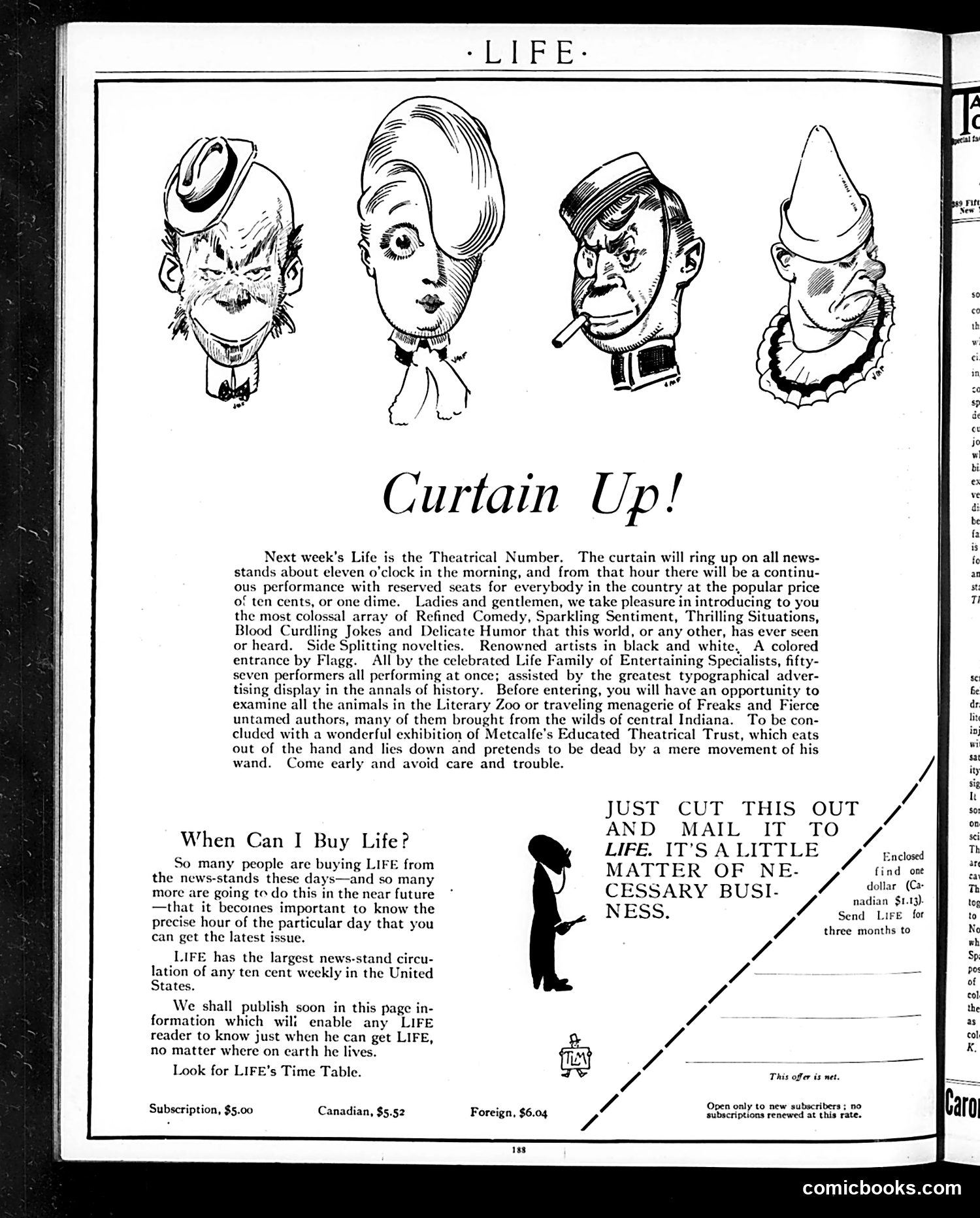
This is primarily a **subscription advertisement** disguised as theatrical promotion. The four caricatured heads at top represent theatrical character types—appearing to be stock figures from vaudeville or stage comedy (a cowboy, an exaggerated character, a performer with a cigar, and a pointed-headed figure). The text uses theatrical language metaphorically to promote Life's upcoming "Theatrical Number" issue, describing it as a grand performance with "fifty-seven performers" (Life's contributors) and "Metcalfe's Educated Theatrical Trust"—likely a satirical reference to corporate trusts, a major political concern of the era. The core message: Life magazine is so popular that readers need information about **when and where to buy it** at newsstands. The page announces an upcoming "Time Table" to help readers locate copies, acknowledging the high demand (described as "the largest news-stand circulation of any ten cent weekly"). The subscription rates ($5.00 domestic, $5.52 Canadian, $6.04 foreign) and the cut-out mail coupon are standard magazine marketing tactics of the period.
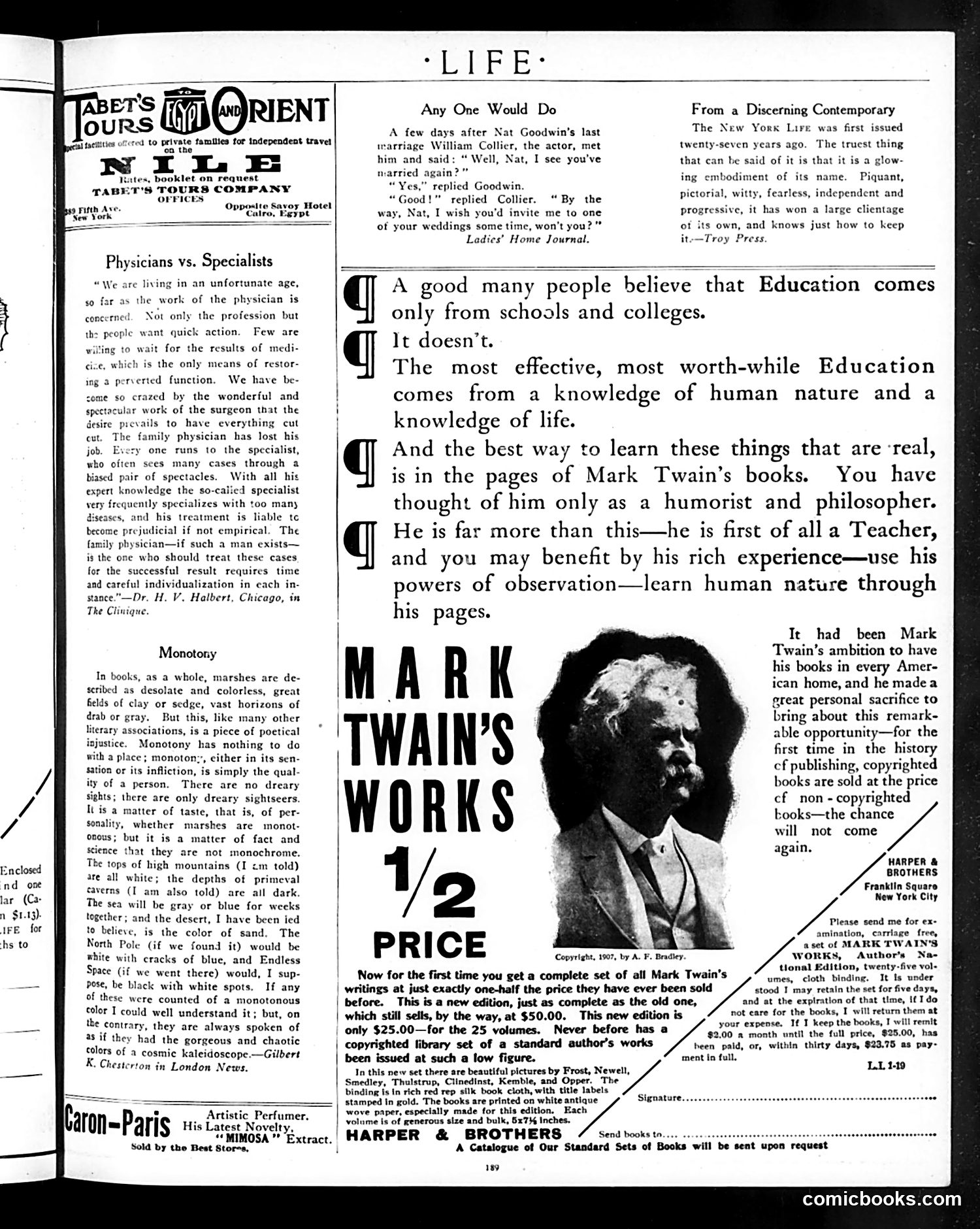
This page is primarily **advertising for Mark Twain's works** (1/2 price edition by Harper & Brothers), presented as editorial content praising his educational value. The large advertisement argues that Twain should be understood not merely as a humorist but as a "Teacher" offering genuine education about "human nature and life"—more valuable than formal schooling alone. This reflects early 20th-century American intellectual trends elevating literature as moral instruction. The page includes three separate opinion pieces: a doctor's complaint about patients preferring specialists to family physicians (reflecting contemporary medical debates), a philosophical essay by G.K. Chesterton on how "monotony" reflects the observer rather than the place, and a humorous anecdote about actor Nat Goodwin's repeated marriages. The layout mixes genuine editorial content with advertising—typical of *Life* magazine's satirical, densely-packed format. The overall thrust positions reading Twain as both entertainment and self-improvement during an era valuing literary culture.
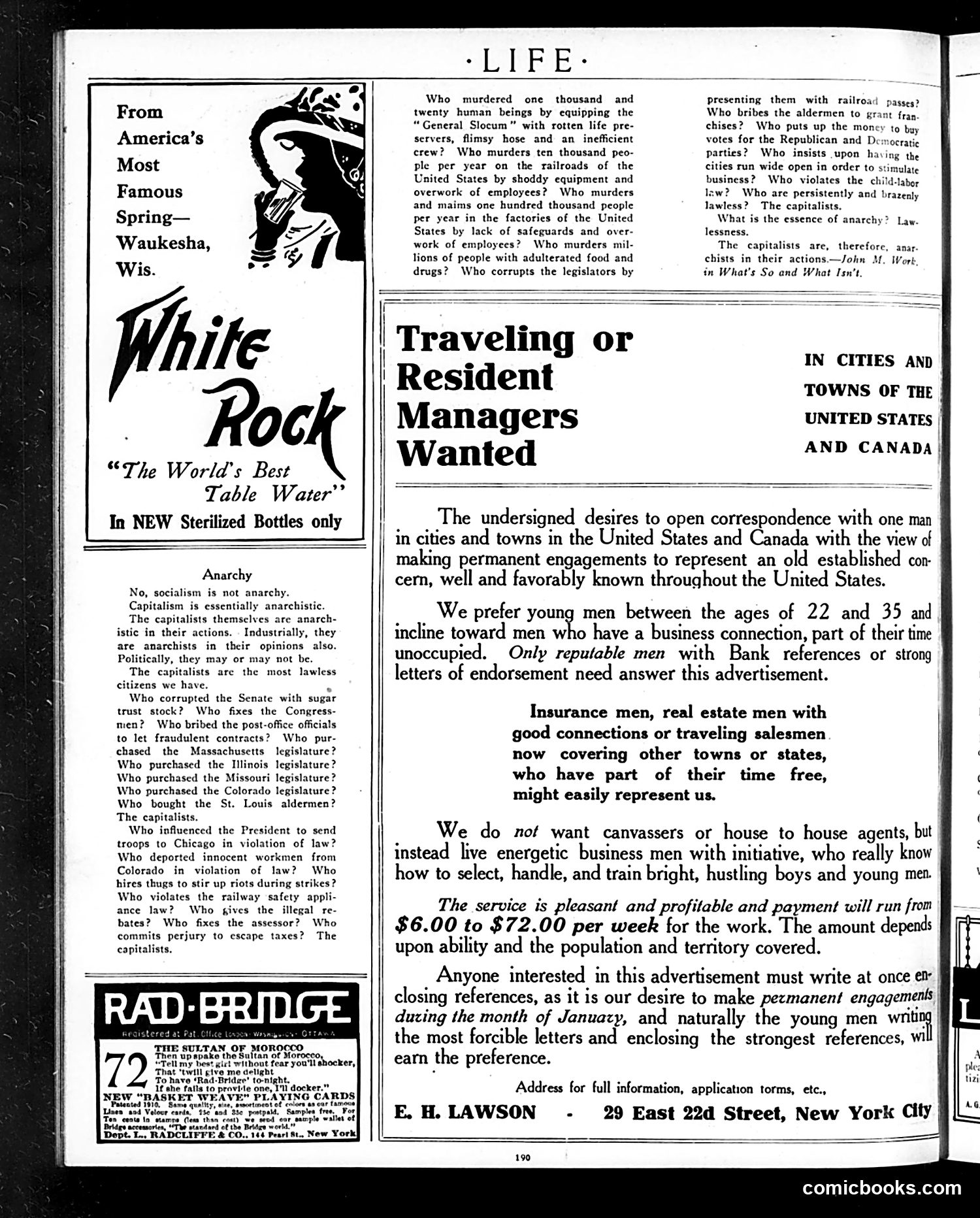
This page contains **political satire attacking capitalism** alongside period advertisements. The left column presents an **"Anarchy" essay** by John M. Work (credited in text) that inverts conventional rhetoric: it argues that **capitalists—not socialists—are the true anarchists** because they operate lawlessly. The piece catalogs capitalist crimes: bribing legislators, corrupting elections, causing industrial deaths through negligence, selling adulterated food, and violating child labor laws. The satire's point is that capitalists claim to oppose anarchy while practicing systematic lawlessness with impunity. The White Rock advertisement and Rad-Bridge playing card ads are period filler. The job posting for "Traveling or Resident Managers" seeking young businessmen to recruit sales agents appears incongruous—likely positioned to highlight the exploitative employment practices the editorial criticizes. **Context for modern readers:** This reflects early 20th-century muckraking journalism, when progressive publications openly attacked industrial capitalism's human costs and political corruption, framing wealthy industrialists as society's true lawbreakers.
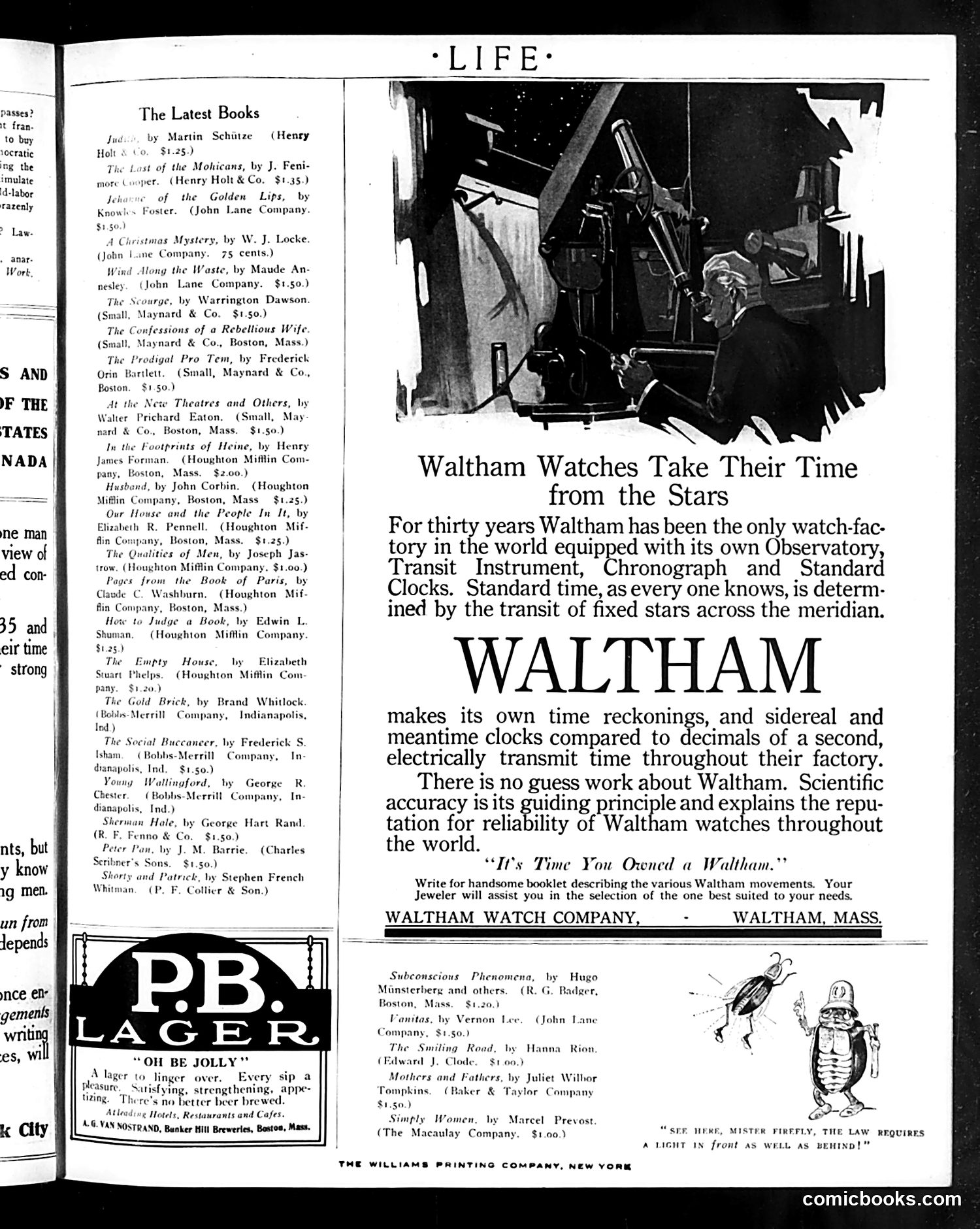
This page mixes book reviews with advertisements. The main content is a **Waltham Watch Company advertisement** featuring a photograph of an observatory with astronomical instruments. The ad's pitch: Waltham claims thirty-year exclusivity as the only watch factory with its own observatory, using star transits to determine precise time. This appeals to early-20th-century consumers' desire for scientific accuracy and reliability—positioning Waltham as grounded in astronomical fact rather than guesswork. At bottom right is a small cartoon showing a **firefly** being stopped by a policeman with the caption: "SEE HERE, MISTER FIREFLY, THE LAW REQUIRES A LIGHT IN FRONT AS WELL AS BEHIND!" This is a humorous safety joke about vehicle regulations, likely referencing newly implemented automobile headlight laws of the era. The left column lists contemporary book releases, and a **PB Lager beer ad** appears below ("OH BE JOLLY"). The page is primarily **advertising-driven content**, typical of Life's business model, not political satire.
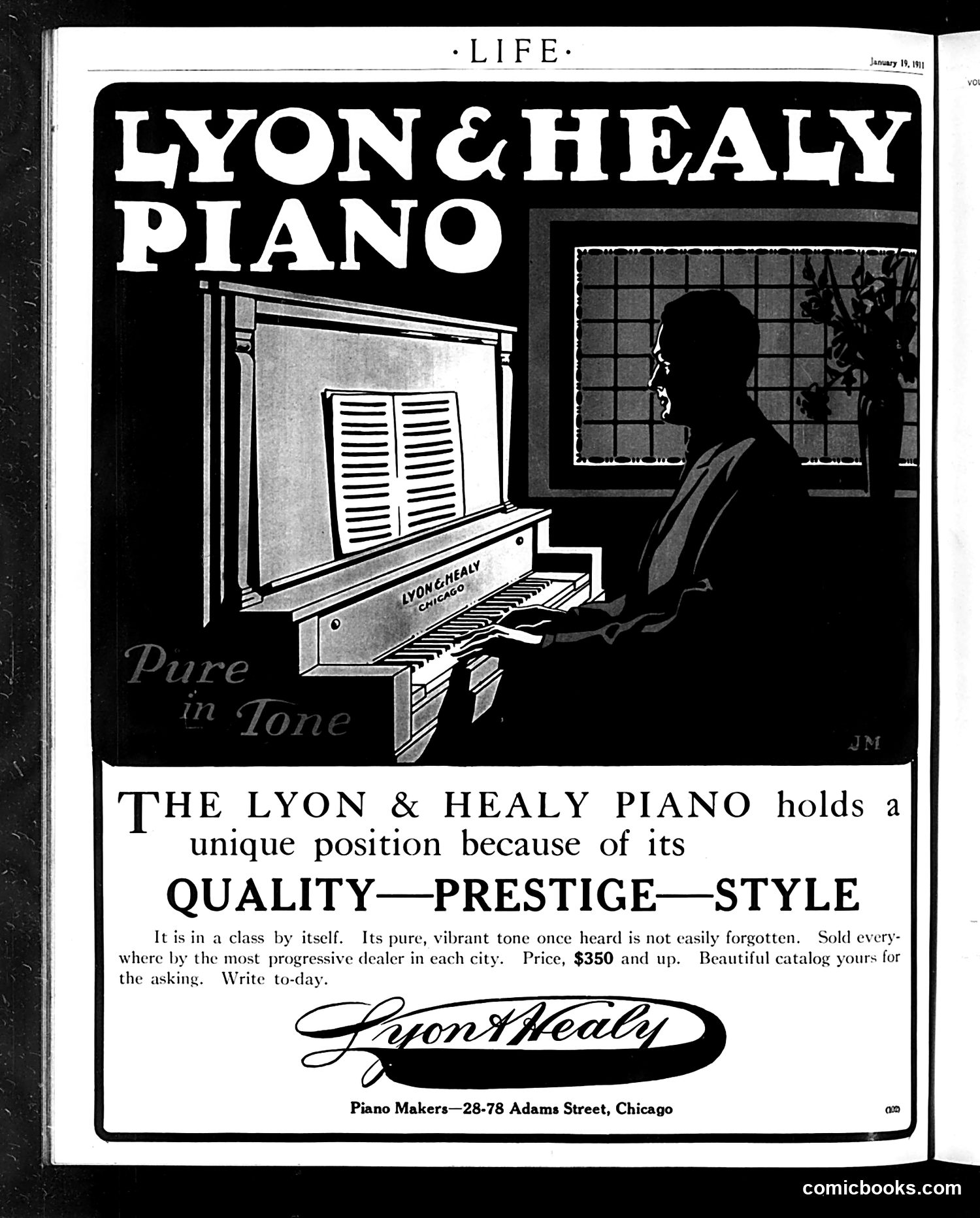
This is a **full-page advertisement**, not political satire. It promotes Lyon & Healy pianos, a Chicago-based manufacturer, from the January 19, 1911 *Life* magazine. The image shows a man in silhouette seated at a piano, gazing toward a window. The tagline reads "Pure in Tone." The ad emphasizes three selling points: **Quality, Prestige, and Style**—positioning the instrument as aspirational luxury goods for prosperous households. The $350 starting price (roughly $11,000 in modern dollars) underscores this as an upscale product. The advertisement appeals to "progressive dealers" in major cities, suggesting widespread distribution among retailers who catered to the wealthy. There is no cartoon or satire here—simply period advertising reflecting early 20th-century consumer culture and the piano's status as a prestigious home furnishing.