
Life, 1911-01-19 · page 16 of 44
Life — January 19, 1911 — page 16: what you’re looking at
What you’re looking at
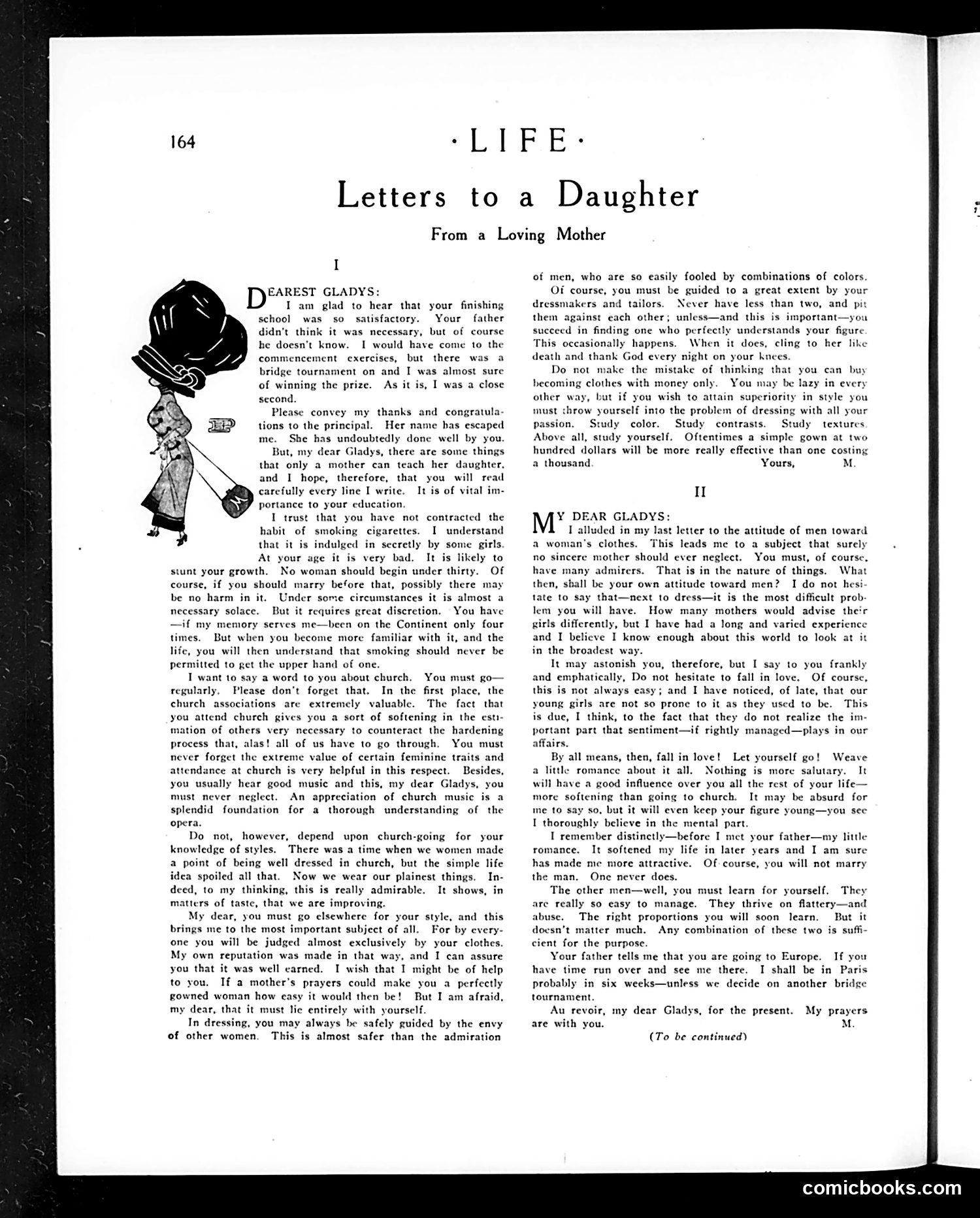
This satirical advice column mocks the priorities and superficiality of wealthy American society women in the early 20th century. The illustration shows a fashionably dressed woman—representing the society mother giving advice. The satire targets her absurd value system: she missed her daughter's graduation for a bridge tournament (nearly winning!), yet obsesses over clothing as the measure of a woman's worth. She emphasizes church attendance primarily for "softening" one's reputation and hearing good music (as opera preparation), not spirituality. The mother's guidance reveals shallow materialism—hiring multiple dressmakers to compete, dressing for envy rather than admiration, and treating fashion as life's "most important subject." Even her casual acceptance of smoking after thirty and vague hints about romance undercut any pretense of genuine maternal wisdom. The piece satirizes the leisure-class woman who equates feminine virtue, social success, and personal value entirely with appearance and fashion conformity.
📄 Transcribed text from this page (OCR, searchable)
Machine-transcribed from the original scan — historical spelling and the odd misread are preserved.
*LIFE« Letters to a Daughter From a Loving Mother EAREST GLADYS: I am glad to hear that your finishing school was so satisfactory. Your father didn’t think it was necessary, but of course he doesn’t know. I would have come to the commencement exercises, but there was a bridge tournament on and I was almost sure of winning the prize. As it is, I was a close second. Please convey my thanks and congratula tions to the principal. Her name bas escaped me. She has undoubtedly done well by you. But, my dear Gladys, there are some things that only a mother can teach her daughter, and I hope, therefore, that you will read carefully every line I write. It is of vital im- portance to your education I trust that you have not contracted the habit of smoking cigarettes. I understand that it is indulged in secretly by some girls At your age it is very bad. It is likely to stunt your growth. No woman should begin under thirty. Of course, if you should marry before that, possibly there ma be no harm in it. Under some circumstances it is almost a necessary solace. But it requires great discretion. You have —if my memory serves me—been on the Continent only four times. But when you become more familiar with it, and the life, you will then understand that smoking should never be permitted to get the upper hand of one. I want to say a word to you about church. You must go— regularly. Please don’t forget that. In the first place, the church associations are extremely valuable. The fact that you attend church gives you a sort of softening in the esti- mation of others very necessary to counteract the hardening process that, alas! all of us have to go through. You must never forget the extreme value of certain feminine traits and attendance at church is very helpful in this respect. Besides, you usually hear good music and this, my dear Gladys, you must never neglect. An appreciation of church music is a splendid foundation for a thorough understanding of the opera. Do not, however, depend upon church-going for your knowledge of styles. There was a time when we women made a point of being well dressed in church, but the simple life idea spoiled all that. Now we wear our plainest things. In- deed, to my thinking, this is really admirable. It shows, in matters of taste, that we are improving. My dear, you must go elsewhere for your style, and this brings me to the most important subject of all. For by every- one you will be judged almost exclusively by your clothes. My own reputation was made in that way, and I can assure you that it was well earned. I wish that I might be of help to you. If a mother's prayers could make you a perfectly gowned woman how casy it would then be! But I am afraid, my dear, that it must lic entirely with yourself. In dressing, you may always be safely guided by the envy of other women. This is almost safer than the admiration of men, who are so easily fooled by combinations of colors Oi course, you must be guided to a great extent by your dressmakers and tailors. Never have less than two, and pit them against each other; unless—and this is important—you succeed in finding one who perfectly understands your figure This occasionally happens. When it does, cling to her like death and thank God every night on your knees Do not make the mistake of thinking that you can buy becoming clothes with money only. You may be lazy in every other way, but if you wish to attain superiority in style you must :hrow yourself into the problem of dressing with all your sion. Study color. Study contrasts. Study textures Above all, study yourself, Oftentimes a simple gown at two hundred dollars will be more really effective than one costing a thousand Yours, M II M* DEAR GLADYS: I alluded in my last letter to the attitude of men toward a woman's clothes. This leads me to a subject that surely no sincere mother should ever neglect. You must, of course, many admirers. That is in the nature of things. What then, shall be your own attitude toward men? I do not hesi- tate to Say that—next to dress—it is the most difficult prob. lem you will have. How many mothers would advise their girls differently, but I have had a long and varied experience and I belicve I know enough about this world to look at it in the broadest way. It may astonish you, therefore, but I say to you frankly and emphatically, Do not hesitate to fall in love Of course, this is not always easy; and I have noticed, of late, that our young girls are not so prone to it as they used to be. This is due, I think, to the fact that they do not realize the im- portant part that sentiment—if rightly managed—plays in our affairs. By all means, then, fall in love! Let yourself go! Weave a little romance about it all. Nothing is more salutary. It will have a good influence over you all the rest of your life— more softening than going to church. It may be absurd for me to say so, but it will even keep your figure young—you sec I thoroughly believe in the mental part. I remember distinctly—before I met your father—my little romance. It softened my life in later years and I am sure has made me more attractive. Of course, you will not marry the man. One never does. The other men—well, you must learn for yourself. They are really so easy to manage. They thrive on flattery—and abuse. The right proportions you will soon learn. But it doesn’t matter much. Any combination of these two is suffi- cient for the purpose. Your father tells me that you are going to Europe. If you have time run over and see me there. I shall be in Paris probably in six weeks—unless we decide on another bridge tournament. Au revoir, my dear Gladys, for the present. My prayers are with you. M (To be continued) comicbooks.com