
Life, 1911-01-19 · page 20 of 44
Life — January 19, 1911 — page 20: what you’re looking at
What you’re looking at
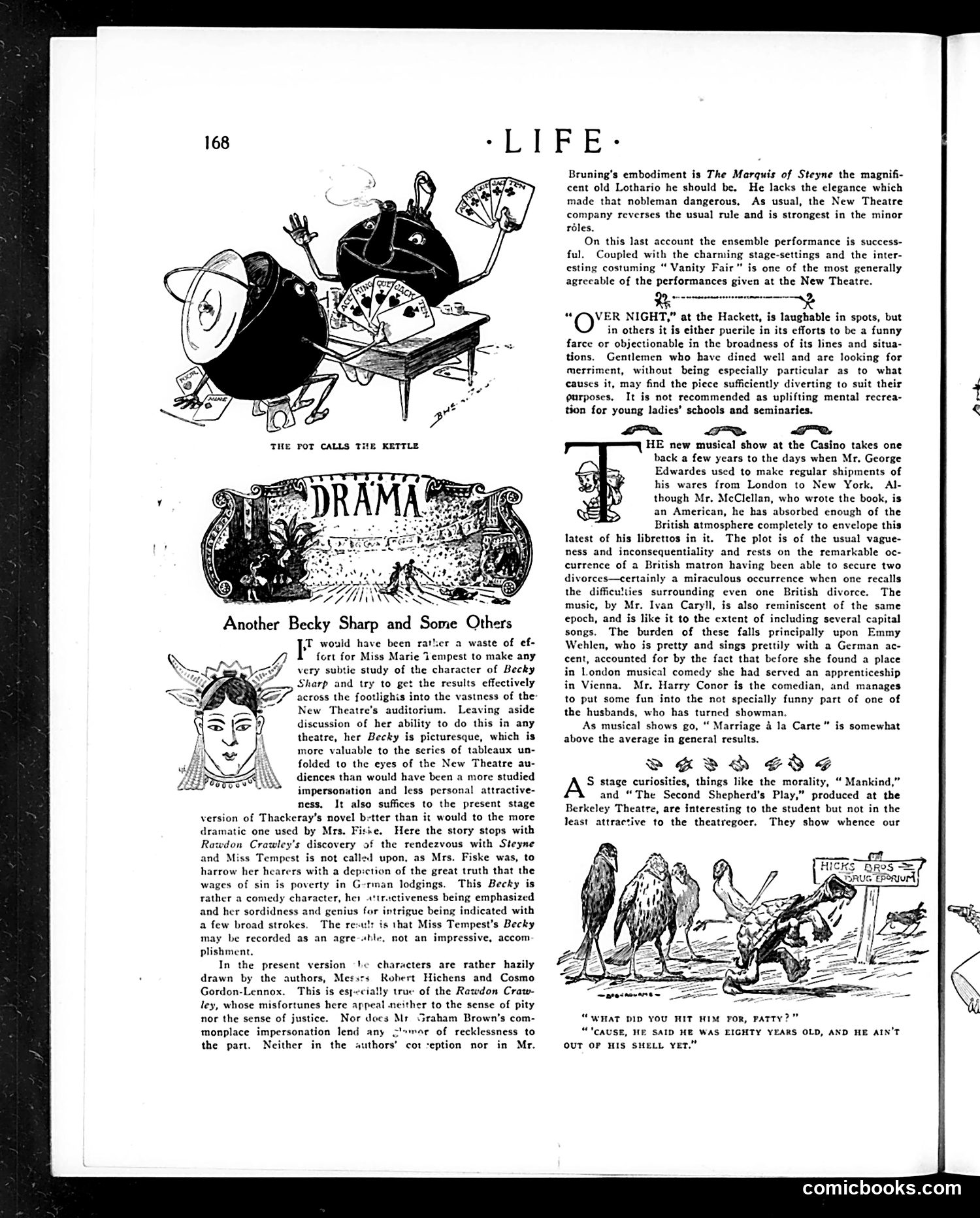
This page reviews theatrical productions at New York venues. The top cartoon "The Pot Calls the Kettle" satirizes theatrical productions through a visual pun—a anthropomorphic pot and kettle arguing, likely critiquing hypocrisy in theater reviews or performances. The main text discusses a "Vanity Fair" stage adaptation at the New Theatre, starring Marie Tempest as Becky Sharp (the famous morally ambiguous character from Thackeray's novel). The critic finds her performance "agreeable" but criticizes the adaptation for softening the character's consequences—unlike an earlier Mrs. Fiske production that showed her poverty and degradation, this version ends earlier with less moral weight. The review also covers other shows: "Over Night" at the Hackett (deemed crude farce unsuitable for young ladies), and a musical at the Casino inspired by George Edwardes' British theatrical tradition, featuring German-accented singer Emmy Wehlen. The humor assumes readers' familiarity with theatrical conventions and literary source material.
📄 Transcribed text from this page (OCR, searchable)
Machine-transcribed from the original scan — historical spelling and the odd misread are preserved.
*LIPFE* Another Becky Sharp and Some Others {I would have been rather a waste of ef- 1 © Sort for Miss Marie Tempest to make any fy very subtie study of the character of Becky > a > Sharp and try to get the results effectively across the footlighis into the vastness of the: New Theatre's auditorium. Leaving aside discussion of her ability to do this in any theatre, her Becky is picturesque, which is more valuable to the series of tableaux un- folded to the eyes of the New Theatre au- diences than would have been a more studied impersonation and less personal attractive- ness, It also suffices to the present stage version of Thackeray’s novel better than it would to the more dramatic one used by Mrs. e. Here the story stops with Rawdon Crawley’s discovery of the rendezvous with Steyne and Miss Tempest is not called upon, as Mrs. Fiske was, to harrow her hearers with a dep:ction of the great truth that the wages of sin is poverty in G-rman lodgings. This Becky is rather a comedy character, her «*tractiveness being emphasized and her sordidness and genius for intrigue being indicated with a few broad strokes. The ri is that Miss Tempest’s Becky may be recorded as an agre-uble, not an impressive, accom plishment. In the present version ‘ec characters are rather hazily drawn by the authors, Messrs Robert Hichens and Cosmo Gordon-Lennox. This is especially true of the Rawdon Craw- ley, whose misfortunes here appeal neither to the sense of pity nor the sense of justice. Nor docs Mr Graham Brown's com- monplace impersonation lend any <'mor of recklessness to the part. Neither in the authors’ cot -eption nor in Mr. Bruning’s embodiment is The Marquis of Steyne the magnifi- cent old Lothario he should be. He lacks the elegance which made that nobleman dangerous, As usual, the New Theatre company reverses the usual rule and is strongest in the minor réles. On this last account the ensemble performance is success- ful. Coupled with the charming stage-settings and the inter- esting costuming “ Vanity Fair” is one of the most generally agreeable of the performances given at the New Theatre. oo a Y * VER NIGHT,” at the Hackett, is laughable in spots, but in others it is either puerile in its efforts to be a funny farce or objectionable in the broadness of its lines and situa- tions. Gentlemen who have dined well and are looking for merriment, without being especially particular as to what causes it, may find the piece sufficiently diverting to suit their ourposes, It is not recommended as uplifting mental recrea- tion for young ladies’ schools and seminaries. rn FR Fre HE new musical show at the Casino takes one back a few years to the days when Mr. George Edwardes used to make regular shipments of his wares from London to New York, Al- though Mr. McClellan, who wrote the book, is an American, he has absorbed cnough of the British atmosphere completely to envelope this latest of his librettos in it. The plot is of the usual vague- ness and inconsequentiality and rests on the remarkable oc- currence of a British matron having been able to secure two divorces—certainly a miraculous occurrence when one recalls the difficulties surrounding even one British divorce. The music, by Mr. Ivan Caryll, is also reminiscent of the same epoch, and is like it to the extent of including several capital songs. The burden of these falls principally upon Emmy Wehlen, who is pretty and sings prettily with a German ac- cent, accounted for by the fact that before she found a place in London musical comedy she had served an apprenticeship in Vienna. Mr. Harry Conor is the comedian, and manages to put some fun into the not specially funny part of one of the husbands, who has turned showman, As musical shows go, “ Marriage a la Carte” is somewhat above the average in general results. eS GZ2 dE S stage curiosities, things like the morality, “ Mankind,” and “The Second Shepherd's Play,” produced at the Berkeley Theatre, are interesting to the student but not in the least attractive to the theatregoer. They show whence our “WHAT DID YOU HIT HIM FoR, PATTY?” “CAUSE, HE SAID HE WAS EIGHTY YEARS OLD, AND HE AIN'T OUT OF HIS SHELL yer.” comicbooks.com