
Life, 1911-01-19 · page 26 of 44
Life — January 19, 1911 — page 26: what you’re looking at
What you’re looking at
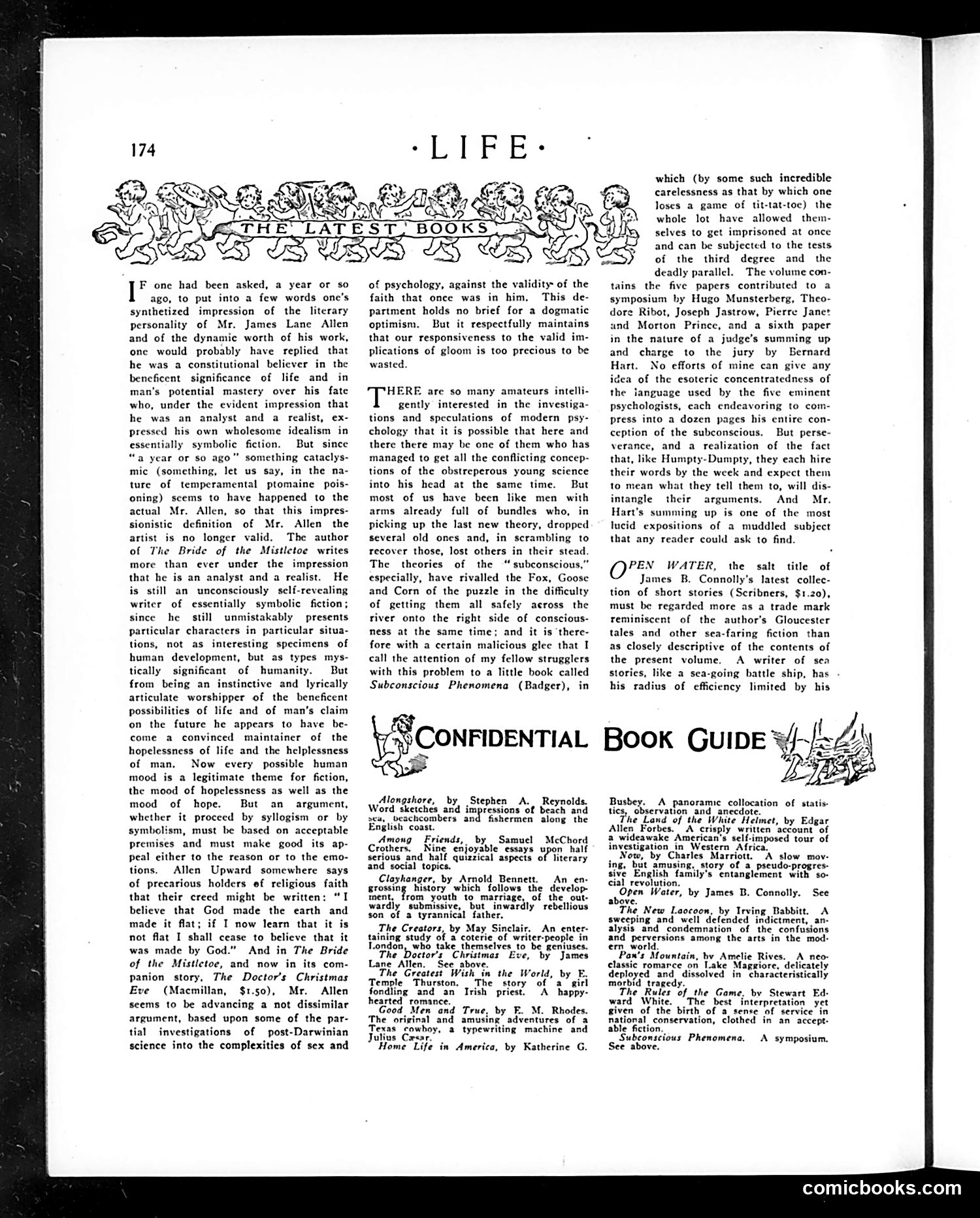
This page from *Life* magazine contains literary criticism rather than political cartoons. The main article critiques author **James Lane Allen**, whose recent works (*The Bride of the Mistletoe* and *The Doctor's Christmas Eve*) represent a troubling shift in his outlook. The reviewer notes Allen previously embodied optimistic idealism but has apparently undergone a "cataclysmic" change—becoming a pessimist who uses modern psychology and post-Darwinian science to argue that life is hopeless and humanity helpless. The critic objects not to pessimism as a theme, but to Allen's flawed reasoning: he's abandoning faith in human potential based on incomplete scientific understanding, comparable to rejecting God because the earth isn't flat. The "Confidential Book Guide" section below lists contemporary works, including titles exploring psychology, Western adventure, and Irish life. This reflects early 20th-century intellectual preoccupations with science, literature, and modernity's impact on traditional values.
📄 Transcribed text from this page (OCR, searchable)
Machine-transcribed from the original scan — historical spelling and the odd misread are preserved.
F one had been asked, a year or so ago, to put into a few words one’s synthetized impression of the literary personality of Mr. James Lane Allen and of the dynamic worth of his work, ‘onc would probably have replied that he was a constitutional believer in the beneficent significance of life and in man’s potential mastery over his fate who, under the evident impression that he was an analyst and a realist, ex- pressed his own wholesome idealism in essentially symbolic fiction. But since “a year or so ago” something cataclys- mic (something, let us say, in the na- ture of temperamental ptomaine pois- oning) scems to have happened to the actual Mr. Allen, so that this impres- sionistic definition of Mr. Allen the artist is no longer valid. The author of The Bride of the Mistletoe writes more than ever under the impression that he is an analyst and a realist. He is still an unconsciously self-revealing writer of essentially symbolic fiction; since he still unmistakably presents particular characters in particular situa- tions, not as interesting specimens of human development, but as types mys- tically significant of humanity. But from being an instinctive and lyrically articulate worshipper of the beneficent possibilities of life and of man’s claim on the future he appears to have be- come a convinced maintainer of the hopelessness of life and the helplessness of man. Now every possible human mood is a legitimate theme for fiction, the mood of hopelessness as well as the mood of hope. But an argument, whether it proceed by syllogism or by symbolism, must be based on acceptable premises and must make good its ap- peal either to the reason or to the emo- tions. Allen Upward somewhere says of precarious holders ef religious faith that their creed might be written: “I believe that God made the earth and made it flat; if I now learn that it is not flat I shall cease to believe that it was made by God.” And in The Bride of the Mistletoe, and now in its com- panion story, The Doctor’s Christmas Eve (Macmillan, $1.50), Mr. Allen seems to be advancing a not dissimilar argument, based upon some of the par- tial investigations of post-Darwinian science into the complexities of sex and of psychology, against the validity of the faith that once was in him, This de- partment holds no brief for a dogmatic optimism, But it respectfully maintains that our responsiveness to the valid im- plications of gloom is too precious to be wasted. HERE are so many amateurs intelli- gently interested in the investiga- tions and speculations of modern psy- chology that it is possible that here and there there may be one of them who has managed to get all the conflicting concep- tions of the obstreperous young science into his head at the same time. But most of us have been like men with arms already full of bundles who, in picking up the last new theory, dropped several old ones and, in scrambling to recover those, lost others in their stea The theories of the “ subconsciou: especially, have rivalled the Fox, Goose and Corn of the puzzle in the difficulty of getting them all safely across the river onto the right side of conscious- ness at the same time; and it is ‘there- fore with a certain malicious glee that I call the attention of my fellow strugglers with this problem to a little book called Subconscious Phenomena (Badger), in CONFIDENTIAL Alongshore, by Stephen A. Reynolds. Word sketches and impressions of beach and zea, veachcombers and fishermen along the English coast. Among Friends, McChord yn half iterary Er _ by Samuel Crothers. Nine enjoyable essays serious and half quizzical aspects of and social topics. Clayhanger, by Arnold Bennett. An en- grossing history which follows the develop- ment, from youth to marriage, of the out- wardly submissive, but inwardly rebellious son of a tyrannical father, The Creators, by May Sinclair. An enter- taining study of a coterie of writer-people in London, who take themselves to be geniuses. The Doctor's Christmas Eve, by James Lane Allen. See above. The Greatest Wish in the World, by E. Temple Thurston. The story of a girl fondling and an’ Irish priest. A happy- hearted romance. Good Men and True, by F. M. Rhodes. The original and amusing adventures of a Texas cowboy, a typewriting machine and Julius Crear. Home Life in America, by Katherine G. which (by some such incredible carelessness as that by which one loses a game of tit-tat-toc) the whole lot have allowed them- selves to get imprisoned at once and can be subjected to the tests of the third degree and the deadly parallel. The volume con- tains the five papers contributed to a symposium by Hugo Munsterberg, Theo- dore Ribot, Joseph Jastrow, Pierre Janet und Morton Prince, and a sixth paper in the nature of a judge’s summing up and charge to the jury by Bernard Hart. No efforts of mine can give any idea of the esoteric concentratedness of the language used by the five eminent psychologists, each endeavoring to com- press into a dozen pages his entire con- ception of the subconscious. But perse- verance, and a realization of the fact that, like Humpty-Dumpty, they each hire their words by the week and expect them to mean what they tell them to, will dis- intangle their arguments. And Mr. Hart's summing up is one of the most lucid expositions of a muddled subject that any reader could ask to find. ore WATER, the salt title of James B. Connolly's latest collec- tion of short stories (Scribners, $1.20), must be regarded more as a trade mark reminiscent of the author's Gloucester tales and other sea-faring fiction than as closely descriptive of the contents of the present volume. A writer of sea stories, like a sea-going battle ship, has his radius of efficiency limited by Book GUIDE Busbey. A panoramic collocation of statis: tics, observation and anecdote. The Land of the White Helmet, by Edgar Allen Forbes. A crisply written ‘account of a wideawake American's self-imposed tour of investigation in Western Africa. Now, by Charles Marriott. A slow mov- ing, but amusing, story of a pseudo-progres- sive English family’s entanglement with so- cial revolution. ‘Open Water, by James B. Connolly. See above. The New Laocoon, by Irving Babbitt. A sweeping and well defended indictment, an- alysis and condemnation of the confusions and perversions among the arts in the mod- ern, world. Pan's Mountain, by Amelie classic romarce on Lake Maggiore, delicately deployed and dissolved in characteristically morbid tragedy. The Rules of the Game, by Stewart Ed- ward White. The best interpretation yet given of the birth of a sense of service in national conservation, clothed in an accept- able fiction Subconscious Phenomena, A. symposium, See above. ee comicbooks.com