
Life, 1911-01-19 · page 14 of 44
Life — January 19, 1911 — page 14: what you’re looking at
What you’re looking at
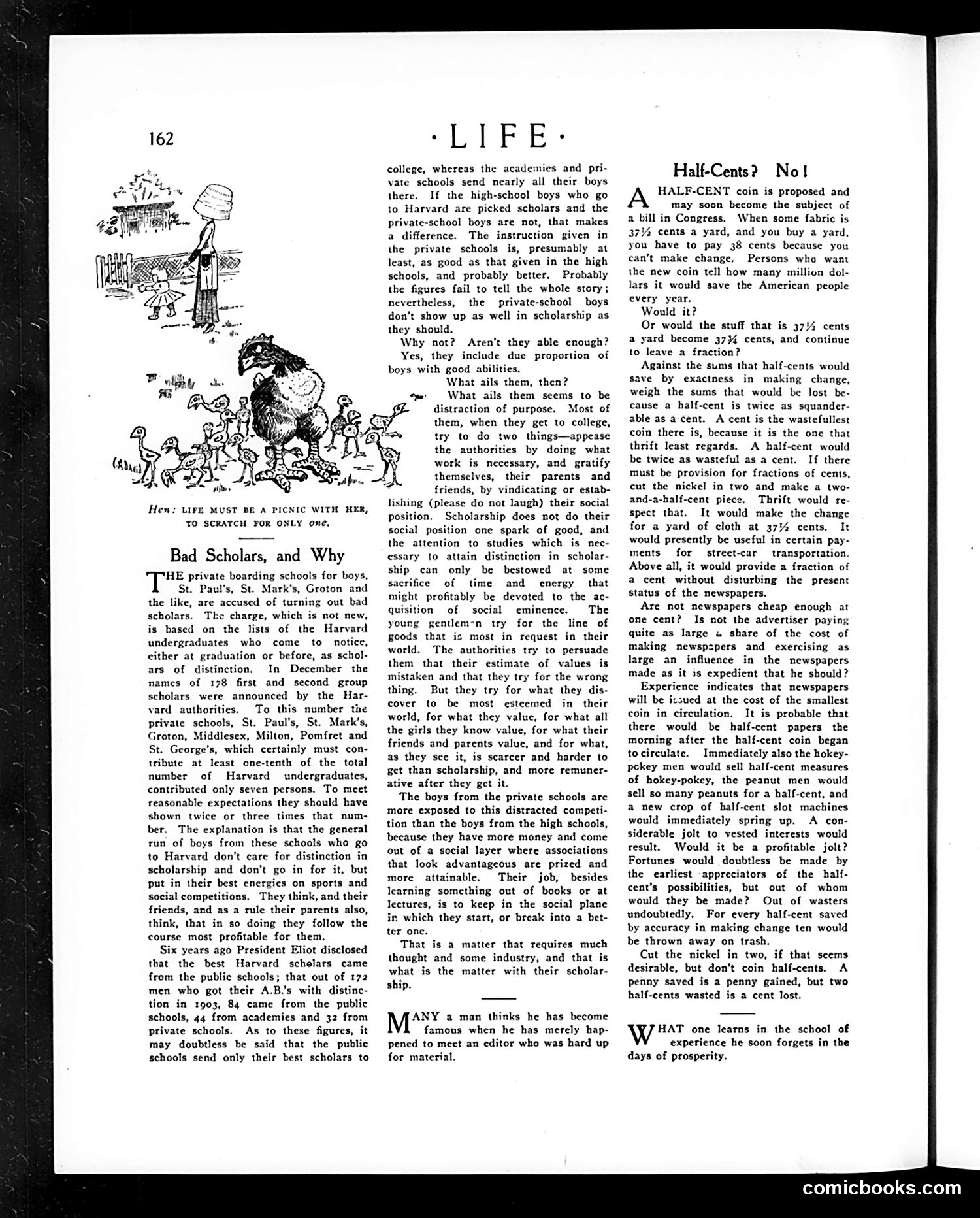
This satirical article critiques elite private boarding schools (St. Paul's, Groton, etc.) for producing poor academic scholars at Harvard, despite sending capable students. The opening cartoon shows a hen scratching for food—a metaphor for the article's point: these privileged boys prioritize social status and athletics over academics. The author argues that private-school boys aren't intellectually inferior; rather, they're distracted by social ambition. Unlike public-school students selected solely for academic merit, private-school boys have wealth and social standing to protect. They rationally pursue what their world values: athletic prowess, social connections, and romantic success—all more "remunerative" than scholarship. The satire lies in the irony: institutions designed to educate gentlemen produce scholars worse than public schools because their students follow the values their privileged environment actually teaches and rewards, ignoring what authorities preach about academic distinction.
📄 Transcribed text from this page (OCR, searchable)
Machine-transcribed from the original scan — historical spelling and the odd misread are preserved.
Hen: Lire MUST BE A PICNIC WITH HER, TO SCRATCH FOR ONLY one, Bad Scholars, and Why HE private boarding schools for boys, St. Paul's, St. Mark's, Groton and the like, are accused of turning out bad scholars. The charge, which is not new, is based on the lists of the Harvard undergraduates who come to notice, either at graduation or before, as schol- ars of distinction. In December the names of 178 first and second group scholars were announced by the Har- vard authorities. To this number the private schools, St. Paul's, St. Mark’s, Groton, Middlesex, Milton, Pomfret and St. George’s, which certainly must con- tribute at least one-tenth of the total number of Harvard undergraduates, contributed only seven persons. To meet reasonable expectations they should have shown twice or three times that num- ber. The explanation is that the general run of boys from these schools who go to Harvard don’t care for distinction in scholarship and don’t go in for it, but put in their best energies on sports and social competitions. They think, and their friends, and as a rule their parents also, think, that in so doing they follow the course most profitable for them. Six years ago President Eliot disclosed that the best Harvard schelars came from the public schools; that out of 172 men who got their A.B.’s with distinc- tion in 1903, 84 came from the public schools, 44 from academies and 32 from private schools. As to these figures, it may doubtless be said that the public schools send only their best scholars to *LIPE: college, whereas the academies and pri- vate schools send nearly all their boys there. If the high-school boys who go to Harvard are picked scholars and the private-school boys are not, that makes a difference. The instruction given in the private schools is, presumably at least, as good as that given in the high schools, and probably better. Probably the figures fail to tell the whole story; nevertheless, the private-school boys don’t show up as well in scholarship as they should. Why not? Aren't they able enough? Yes, they include due proportion of boys with good abilities. What ails them, then? ~ What ails them seems to be distraction of purpose. Most of them, when they get to college, try to do two things—appease the authorities by doing what work is necessary, and gratify themselves, their parents and friends, by vindicating or estab- lishing (please do not laugh) their social position. Scholarship does not do their social position one spark of good, and the attention to studies which is nec- essary to attain distinction in scholar- ship can only be bestowed at some sacrifice of time and energy that might profitably be devoted to the ac- quisition of social eminence. The young gentlem-n try for the line of goods that is most in request in their world. The authorities try to persuade them that their estimate of values is mistaken and that they try for the wrong thing. But they try for what they dis- cover to be most esteemed in their world, for what they value, for what all the girls they know value, for what their friends and parents value, and for what, as they see it, is scarcer and harder to get than scholarship, and more remuner- ative after they get it. The boys from the private schools are more exposed to this distracted competi- tion than the boys from the high schools, because they have more money and come out of a social layer where associations that look advantageous are prized and more attainable. Their job, besides learning something out of books or at lectures, is to keep in the social plane in which they start, or break into a bet- ter one. That is a matter that requires much thought and some industry, and that is what is the matter with their scholar- ship. Maxx a man thinks he has become famous when he has merely hap- pened to meet an editor who was hard up for material. Half-Cents? No! HALF-CENT coin is proposed and may soon become the subject of a bill in Congress. When some fabric is 37% cents a yard, and you buy a yard, you have to pay 38 cents because you can’t make change. Persons who want the new coin tell how many million dol- lars it would save the American people every year. Would it? Or would the stuff that is 374 cents a yard become 37} cents, and continue to leave a fraction? Against the sums that half-cents would save by exactness in making change, weigh the sums that would be lost be- cause a half-cent is twice as squander- able as accent. A cent is the wastefullest coin there is, because it is the one that thrift least regards. A half-cent would be twice as wasteful as a cent. If there must be provision for fractions of cents, cut the nickel in two and make a two- and-a-half-cent piece. Thrift would re- spect that. It would make the change for a yard of cloth at 37% cents. It would presently be useful in certain pay- ments for street-car transportation. Above all, it would provide a fraction of a cent without disturbing the present Status of the newspapers. Are not newspapers cheap enough at one cent? Is not the advertiser paying quite as large & share of the cost of making newspspers and exercising as large an influence in the newspapers made as it is expedient that he should? Experience indicates that newspapers will be issued at the cost of the smallest coin in circulation. It is probable that there would be half-cent papers the morning after the half-cent coin began tocirculate. Immediately also the hokey- pokey men would sell half-cent measures of hokey-pokey, the peanut men would sell so many peanuts for a half-cent, and a new crop of half-cent slot machines would immediately spring up. A con- siderable jolt to vested interests would result, Would it be a profitable jolt? Fortunes would doubtless be made by the earliest appreciators of the half- cent’s possibilities, but out of whom would they be made? Out of wasters undoubtedly. For every half-cent saved by accuracy in making change ten would be thrown away on trash. Cut the nickel in two, if that seems desirable, but don’t coin half-cents. A penny saved is a penny gained, but two half-cents wasted is a cent lost. HAT one learns in the school of experience he soon forgets in the days of prosperity. comicbooks.com