
A complete issue · 40 pages · 1910
Life — September 22, 1910
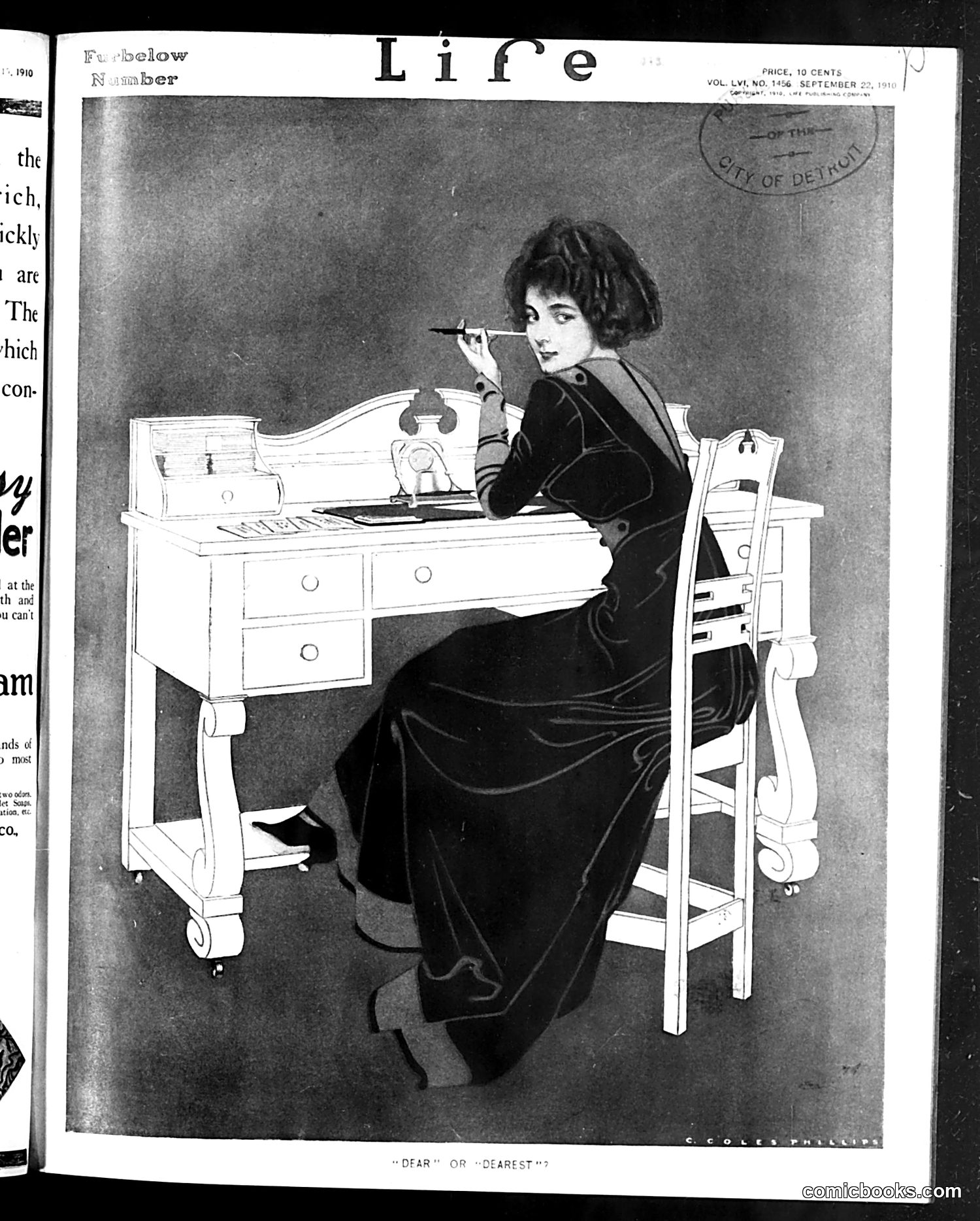
This is a cover illustration from *Life* magazine (September 22, 1910), priced at 10 cents. The image shows a woman seated at a writing desk, holding a cigarette holder to her lips while writing or drawing. She wears fashionable dark clothing typical of the era. The caption reads "DEAR" OR "DEAREST"?—a playful reference to romantic letter-writing. The satire likely comments on women's changing social roles in the early 20th century: the depiction of a woman smoking and engaged in writing (possibly love letters) would have been considered daring or transgressive for the period. The ambiguous caption suggests uncertainty about romantic intention, satirizing modern courtship conventions and women's new social freedoms.
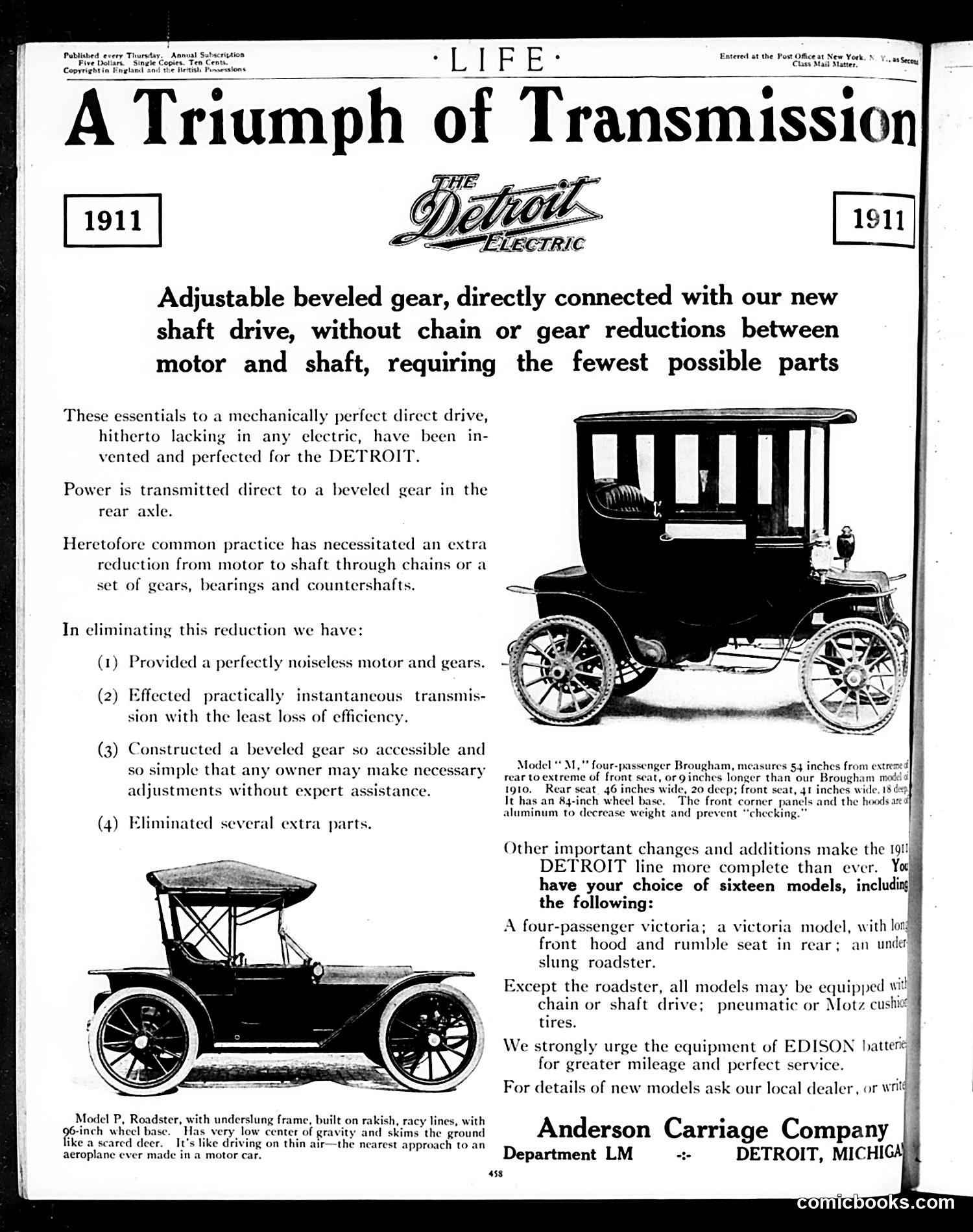
This is **not a satirical cartoon page** but rather a **straightforward automobile advertisement** from Life magazine in 1911. The page advertises the Detroit Electric automobile, highlighting its "direct drive" transmission system—an engineering innovation eliminating chains and gear reductions between motor and shaft. The ad emphasizes practical benefits: quietness, efficiency, simplicity, and fewer moving parts. Two vehicle illustrations show different Detroit Electric models: a four-passenger brougham and a roadster. The accompanying text describes specifications and options, including Edison batteries for extended range. This represents genuine technological competition in early automotive development. Electric vehicles were serious contenders before gasoline engines dominated. The ad's technical claims reflect real engineering discussions of the era, not satire.
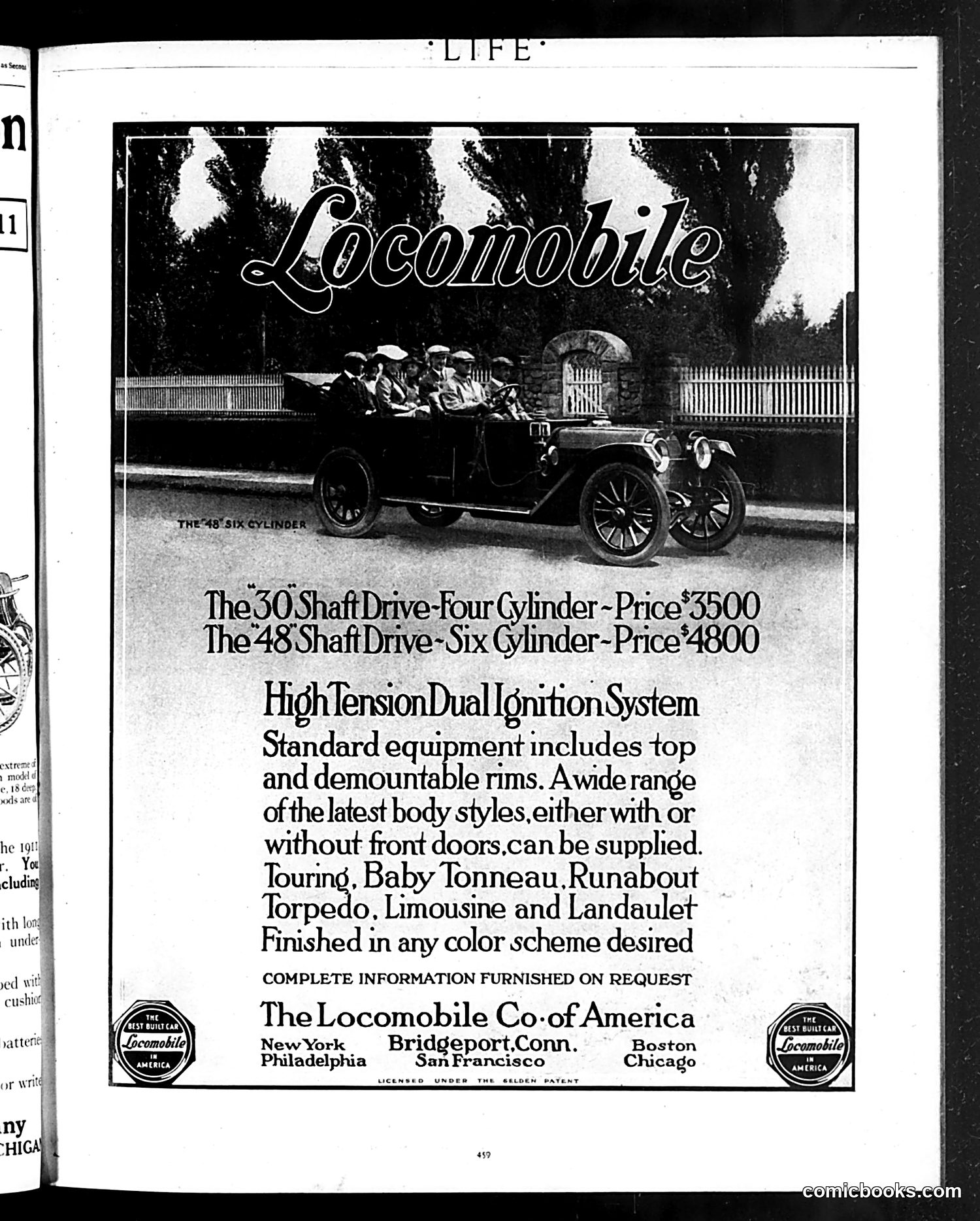
This page is primarily a **product advertisement**, not political satire. It promotes the Locomotile automobile by The Locomotile Co. of America, featuring their 1912 models. The ad emphasizes two vehicle options: a 30 Shaft Drive four-cylinder ($3,500) and a 48 Shaft Drive six-cylinder ($4,800)—premium prices for the era. Key selling points include the "High Tension Dual Ignition System" and customizable body styles (Touring, Baby Tonneau, Runabout, Torpedo, Limousine, Landaulet). The photograph shows an early motorcar with passengers, depicting the vehicle as elegant and modern. The company lists multiple offices (New York, Philadelphia, Boston, Chicago, San Francisco, Bridgeport, Connecticut), suggesting national presence and respectability during the early automotive boom.
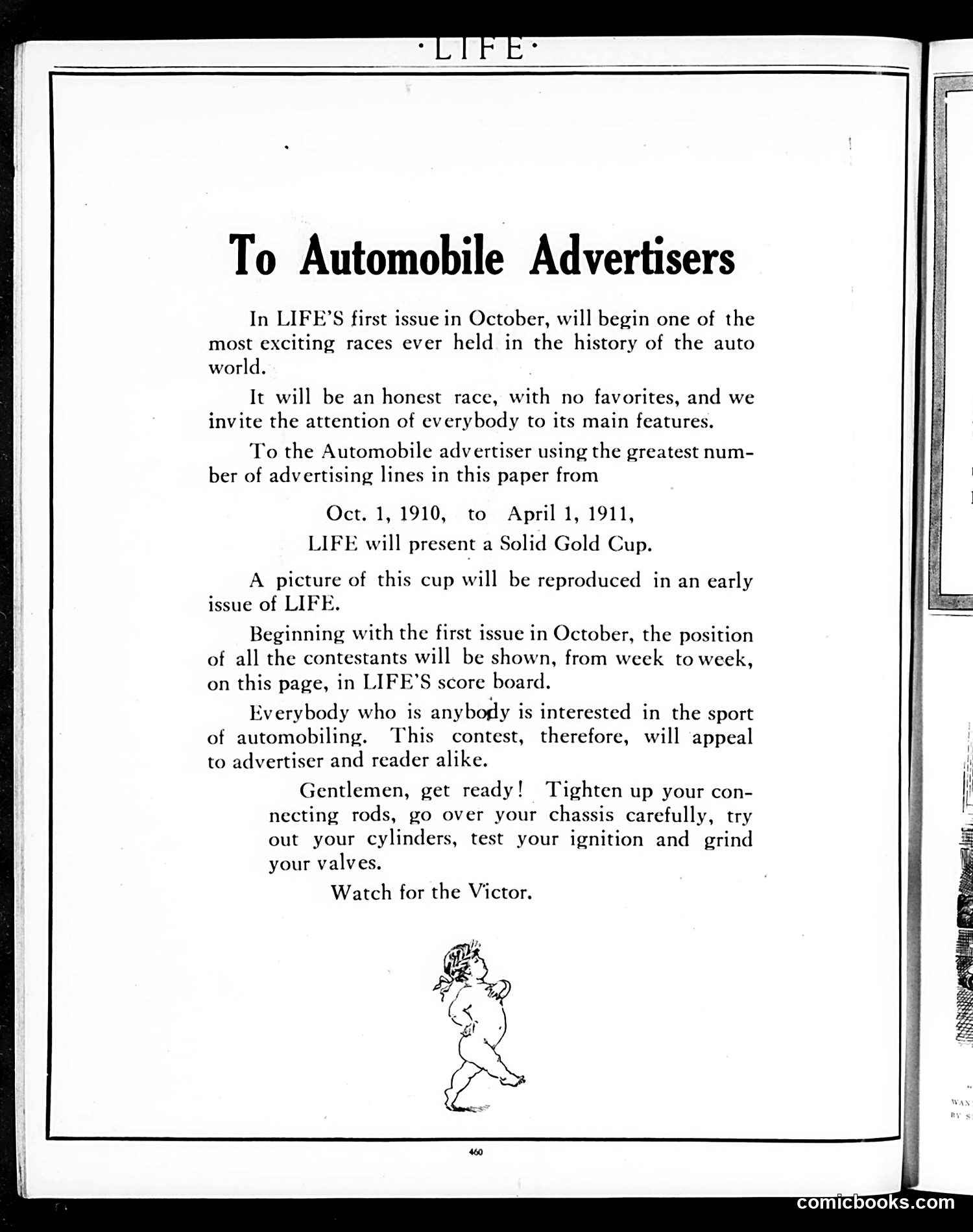
This page is primarily an advertisement addressed to automobile manufacturers, not a political cartoon. **Content:** LIFE magazine announced a competition for automotive advertisers running from October 1, 1910 to April 1, 1911. The advertiser purchasing the most advertising lines would receive a solid gold cup, with weekly standings published in LIFE's "score board." **The Satire:** The small cartoon figure at bottom appears to be LIFE's mascot, depicted in a competitive pose—likely representing the magazine itself as referee of this advertising "race." The piece humorously frames commercial advertising competition as if it were an exciting automotive sport, appealing to both advertisers' competitive instincts and readers' interest in automobiles. **Context:** This reflects early 1900s automotive industry enthusiasm and LIFE's role as a prestigious venue for luxury goods advertising.
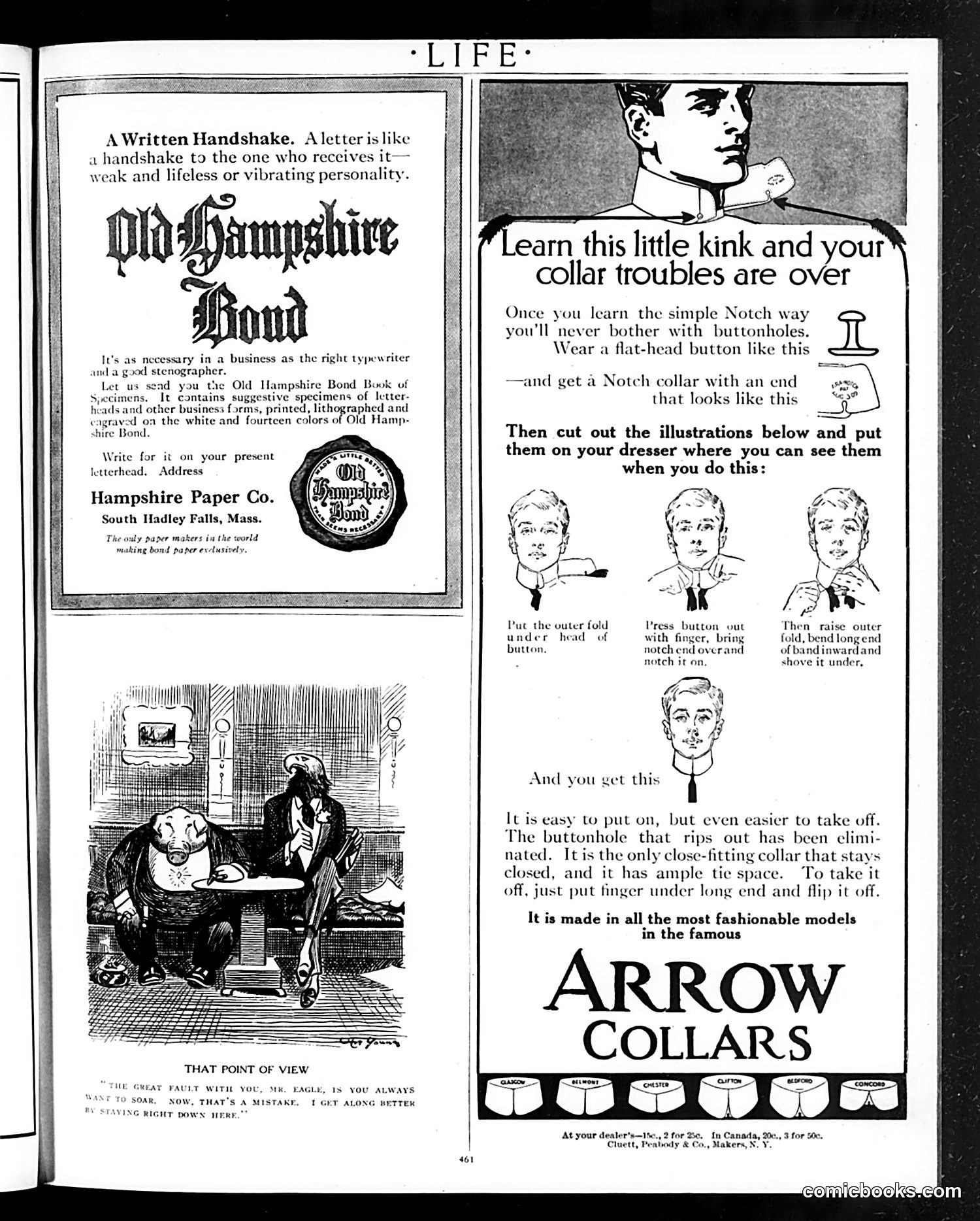
This page contains two distinct items: **Left side:** An advertisement for Old Hampshire Bond paper, emphasizing that good letterhead is essential to business, comparing it to having a competent typewriter and stenographer. **Bottom left:** A cartoon titled "That Point of View" showing two men in what appears to be a basement or cellar. One says he wants to soar but stays down because "that's a mistake," claiming he gets along better "by staying right down here." This appears to be social satire about class aspiration or ambition—poking fun at someone resigned to a lower station in life. **Right side:** An extended advertisement for Arrow Collars, with instructional diagrams showing how to properly wear and adjust a detachable collar with a special notch mechanism. This was a common men's fashion innovation of the early 20th century. The page is primarily commercial content with light satirical humor.
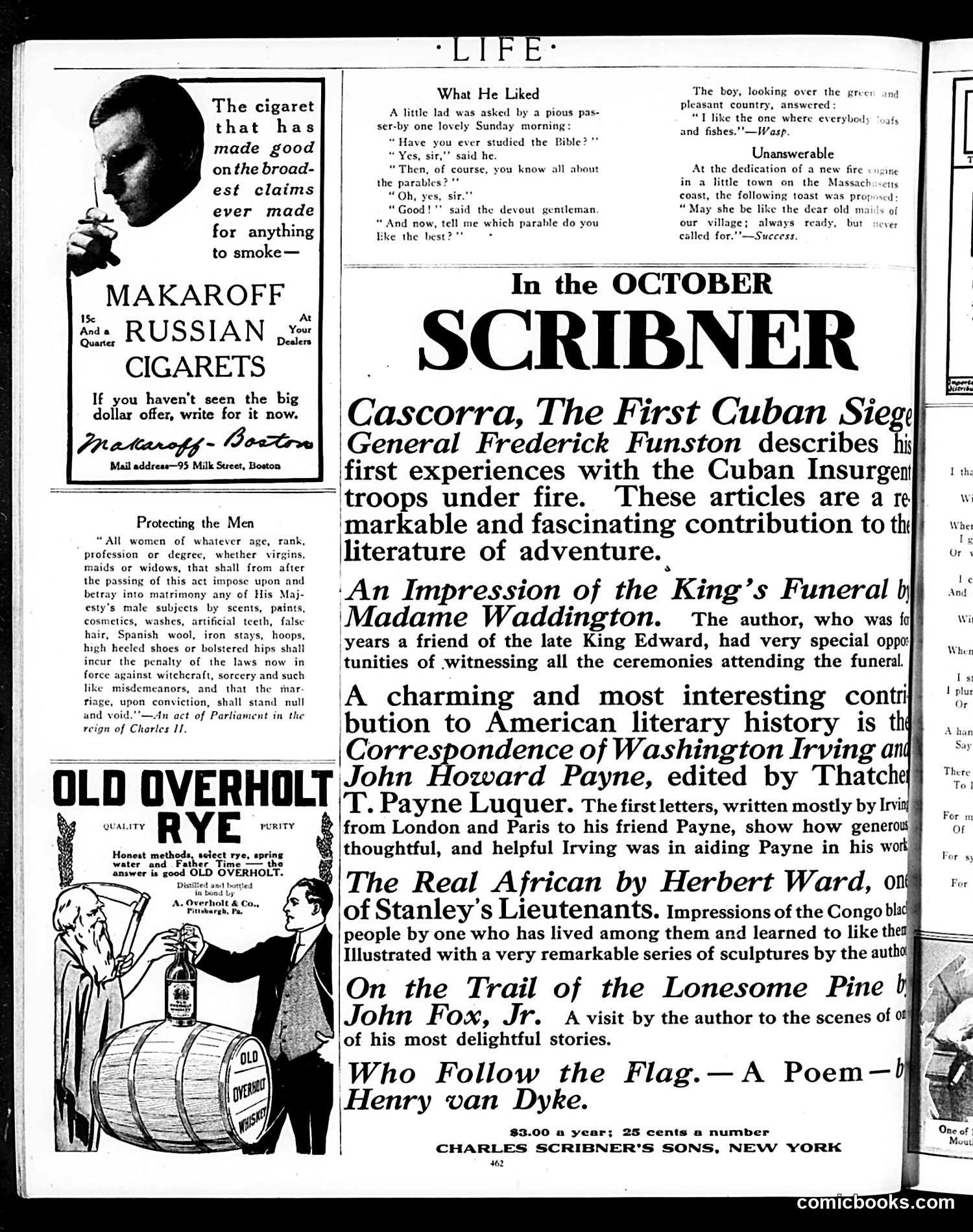
This page is primarily **advertising and magazine promotion**, not political satire. **Left side:** Two ads—one for Makaroff Russian Cigarettes (claiming superiority for smoking) and one for Old Overholt Rye whiskey, showing a man with a barrel. **Center/Right:** Promotion for the **October issue of Scribner's Magazine**, listing upcoming articles including pieces on the Cuban Insurgency by General Frederick Funston, King Edward's funeral by Madame Waddington, and works by Washington Irving and Herbert Ward. **Small satire section** titled "Protecting the Men" quotes Charles II regarding women's legal rights—likely mocking outdated attitudes toward women's property and marriage laws. The page reflects **turn-of-century American publishing**: advertising luxury goods while promoting literary content on contemporary events (Cuba, the British monarchy).
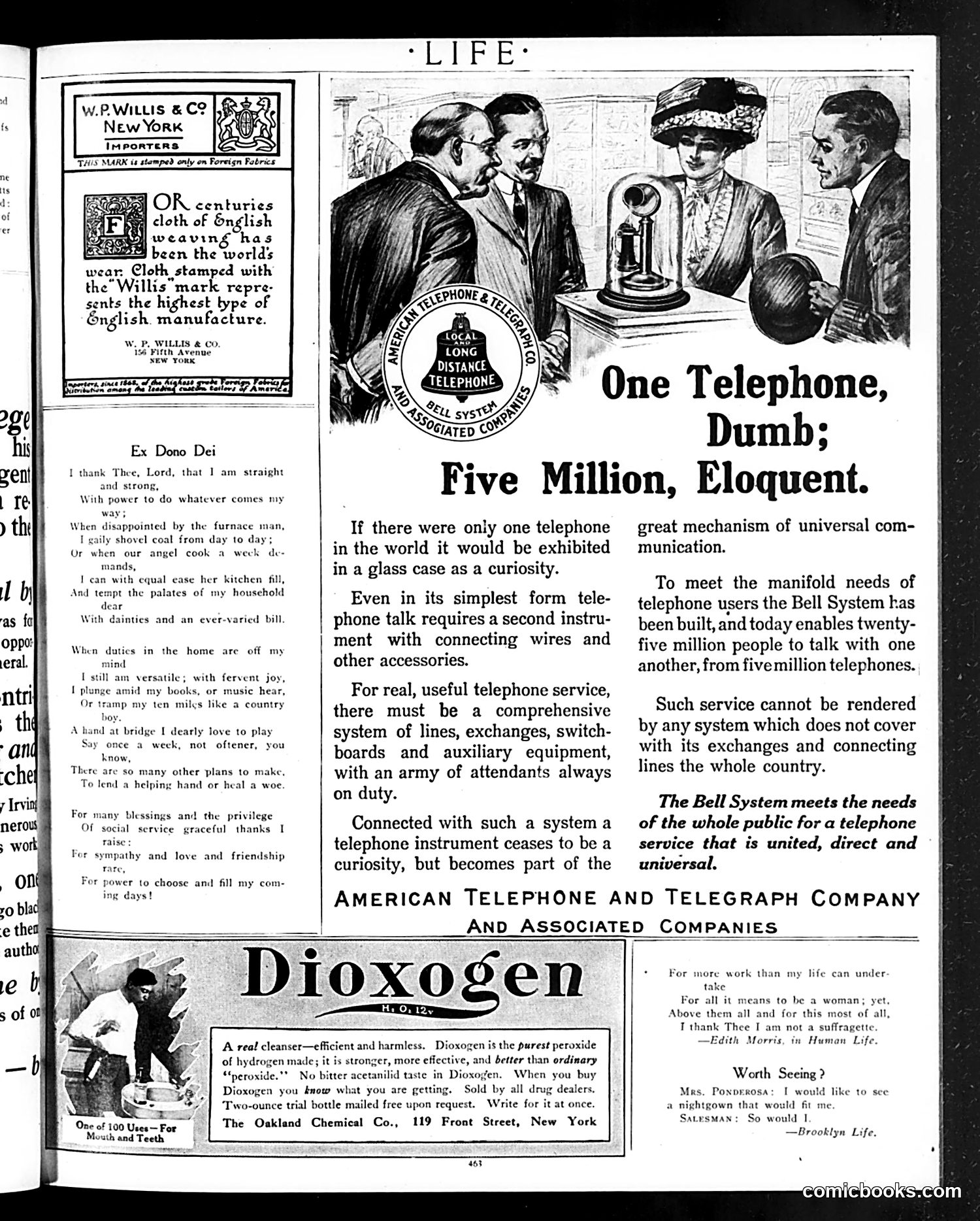
This page is primarily **advertising and promotional content** rather than political satire. The main feature is an advertisement for the American Telephone and Telegraph Company (AT&T), using the clever headline "One Telephone, Dumb; Five Million, Eloquent." The ad argues that a single telephone is useless without a network—it requires AT&T's comprehensive system of lines, exchanges, and switchboards to function. The accompanying illustration shows businesspeople gathered around an early telephone device, likely depicting the novelty and limited utility of isolated telephone technology. Below this are smaller ads: one for W.P. Willis & Co. (English cloth importers) and one for Dioxogen (a hydrogen peroxide cleanser). The page reflects early 20th-century commercial marketing rather than satirical commentary.
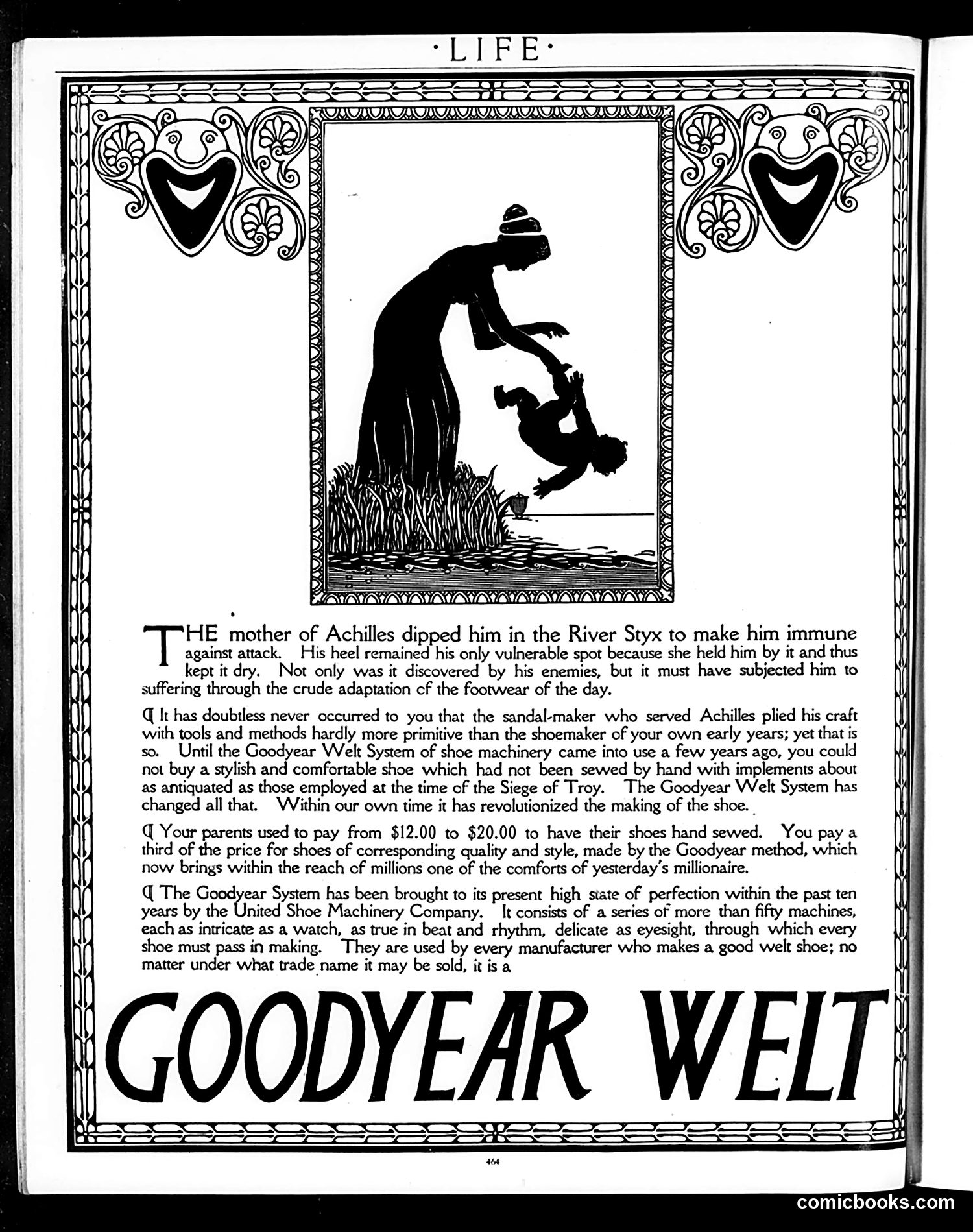
This is a **Goodyear Welt advertising page**, not a political cartoon. The art shows a silhouetted mother figure dipping a child into water—a classical reference to Achilles and the River Styx from Greek mythology. The ad uses this mythological allusion to argue that Goodyear Welt shoe manufacturing has revolutionized shoe-making, making quality footwear affordable. The text explains that hand-sewn shoes once cost $12-$20, but the new Goodyear Welt System allows consumers to buy comparable quality for roughly one-third the price. The implicit message: just as Achilles' mother protected him through the river dip, Goodyear protects consumers by making durable, well-made shoes accessible to "millions" rather than just the wealthy.
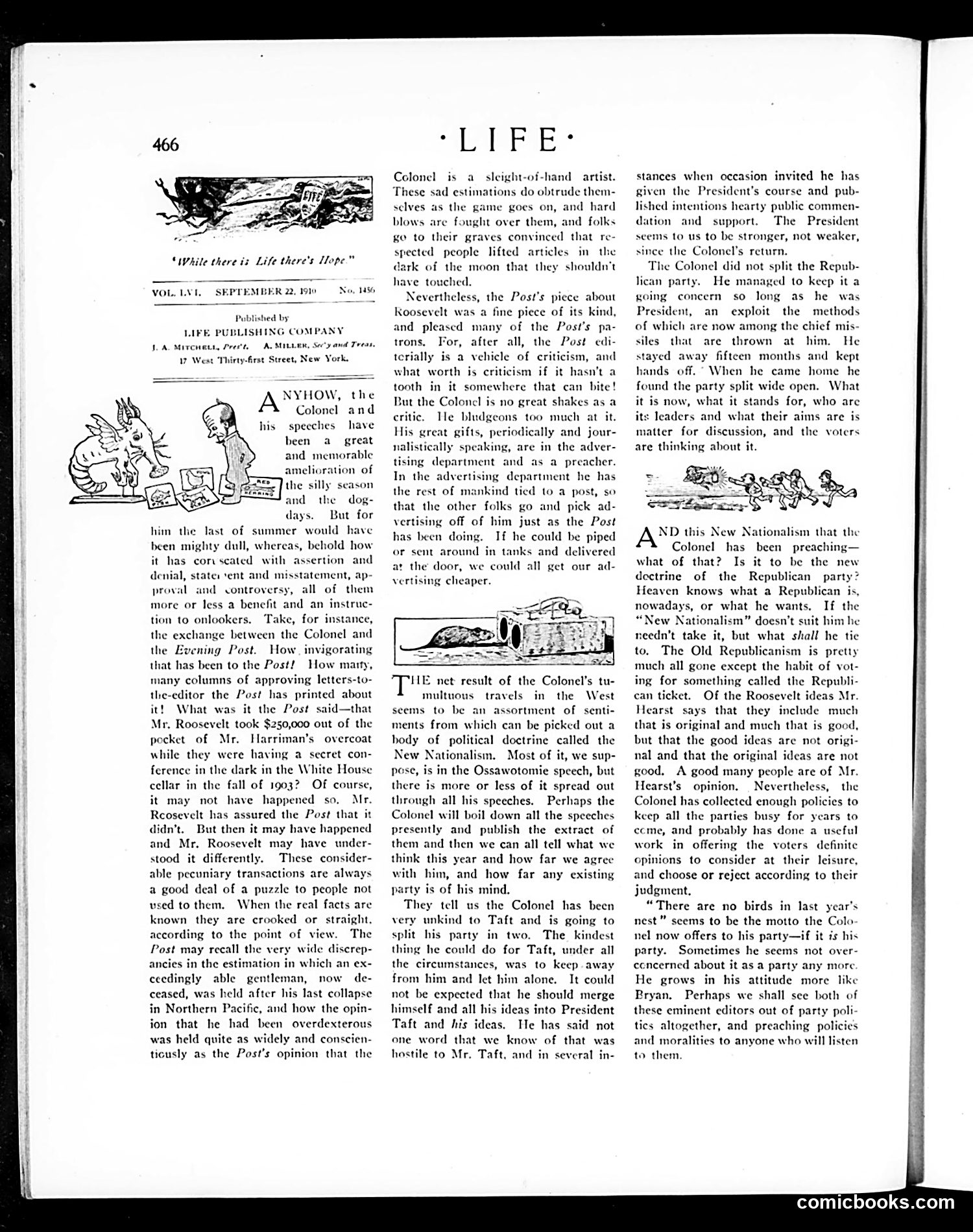
The main cartoon depicts **Colonel Theodore Roosevelt** (identifiable by the text and characteristic features) engaged in political maneuvering. The satire centers on Roosevelt's relationship with the Republican Party and "New Nationalism." The article criticizes Roosevelt for his attempts to influence Republican politics while remaining outside the party structure—specifically regarding the 1912 party split when Roosevelt ran as a Progressive ("Bull Moose") candidate against President Taft. The cartoon's central joke appears to be that Roosevelt, despite his outsider status, maintains considerable influence over Republican discourse and strategy, much like a puppet master controlling proceedings from behind the scenes. The piece satirizes his continued political relevance and interventionist approach to party matters.
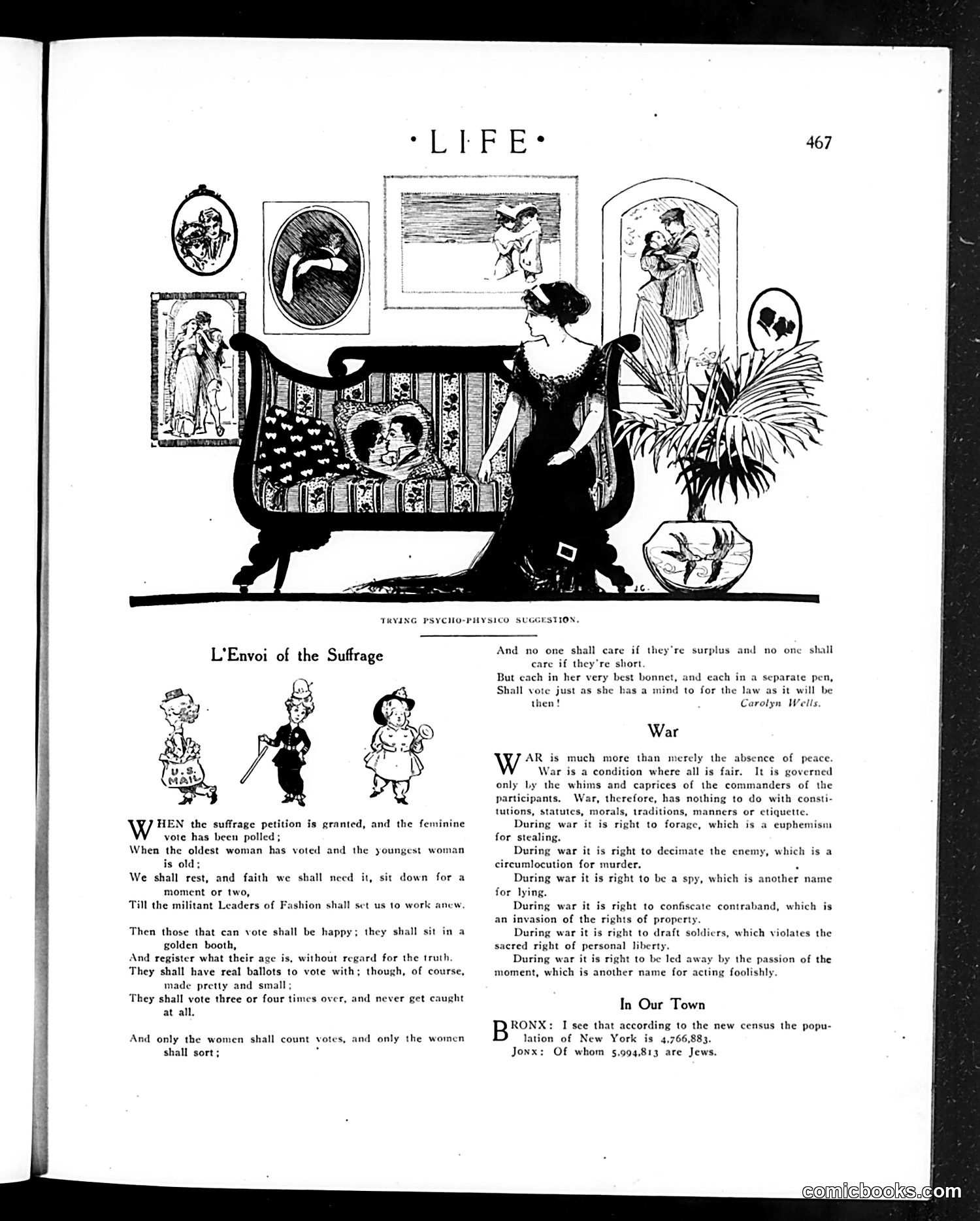
This page satirizes women's suffrage through multiple pieces. The top illustration titled "Trying Psycho-Physico Suggestions" depicts a woman attempting to influence a baby in a crib using pictures and artwork—likely mocking claims that women could exert subtle psychological influence if granted voting rights. "L'Envoi of the Suffrage" poem mockingly describes women voting procedures, suggesting women voters would be easily manipulated ("They shall have real ballots to vote with; though, of course, made pretty and small") and prone to fraud ("They shall vote three or four times over, and never get caught"). The "War" section presents arguments *for* wartime moral flexibility, appearing to contrast with suffrage arguments. "In Our Town" provides census data about New York's Jewish population—possibly linking immigration anxieties to suffrage debates, though the connection remains unclear.
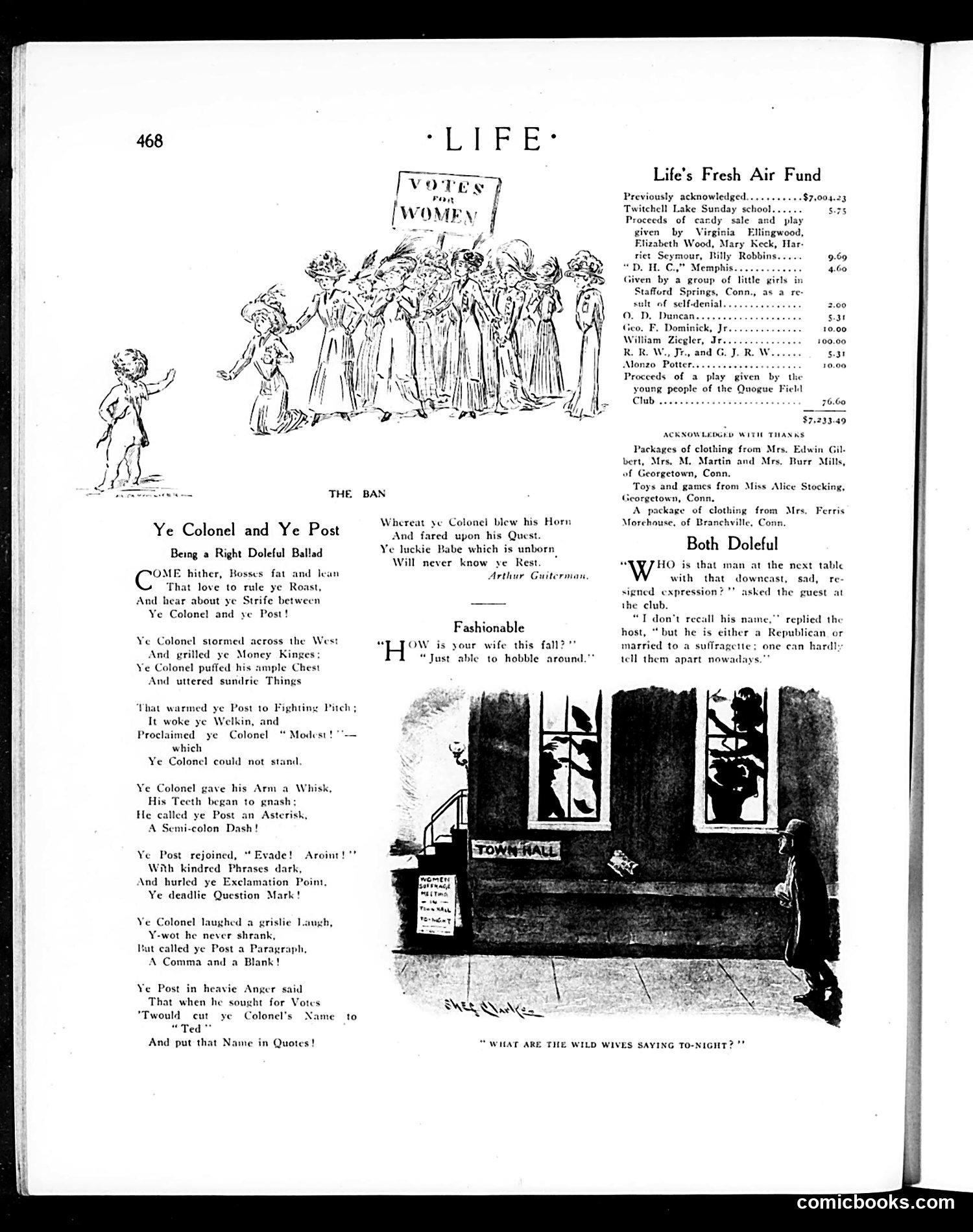
This page contains three distinct pieces: 1. **"Life's Fresh Air Fund"** - A fundraising list acknowledging donations for a charitable program providing outdoor recreation for children. 2. **"Ye Colonel and Ye Post"** - A humorous poem in archaic/mock-colonial English parodying historical writing styles. It appears to mock pompous military figures through exaggerated dialogue and archaic language ("ye," "'Evade! Aroint!'"). 3. **"Fashionable"** - A cartoon showing a woman at Town Hall questioning her appearance, with the caption "What are the wild wives saying to-night?" This satirizes women's suffrage activism and social reform movements of the era, suggesting suffragettes were perceived as socially unconventional or "wild." The page overall employs satire to mock both military pretension and women's political activism through humor and caricature.
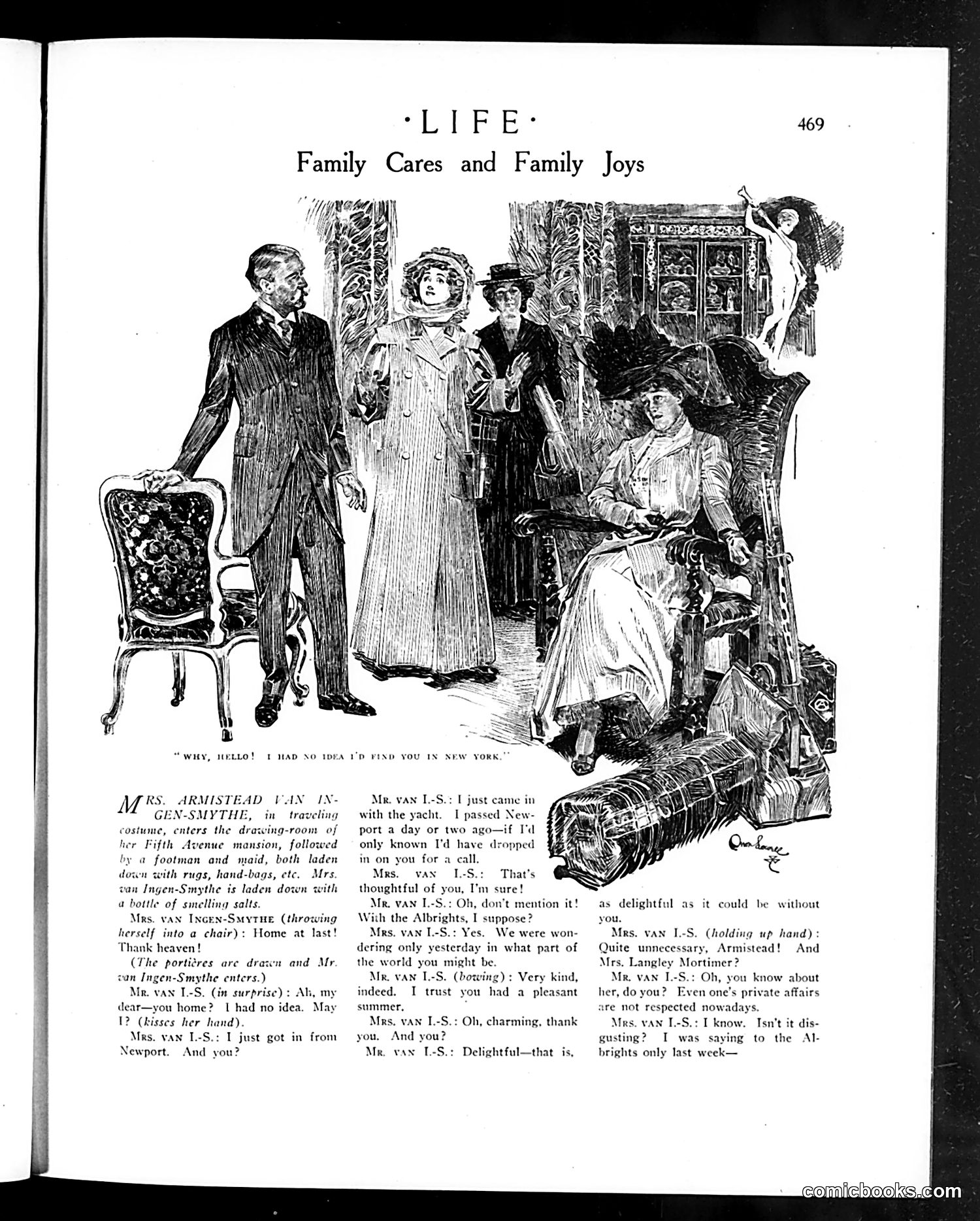
This is a satirical social scene depicting upper-class New York society. The illustration shows a fashionable interior where Mrs. van Ingen-Smythe encounters Mr. van I.-S., whom she hasn't seen in some time. The dialogue reveals social pretense: they exchange polite pleasantries about a yacht visit and summer travels, while Mrs. van I.-S. pointedly asks about Mrs. Langley Mortimer—implying marital infidelity or scandal. The final line suggests Mrs. van I.-S. was staying at the prestigious Albrights' home, hinting at society gossip and the performative nature of elite social interactions where private affairs are conducted under a veneer of civility.
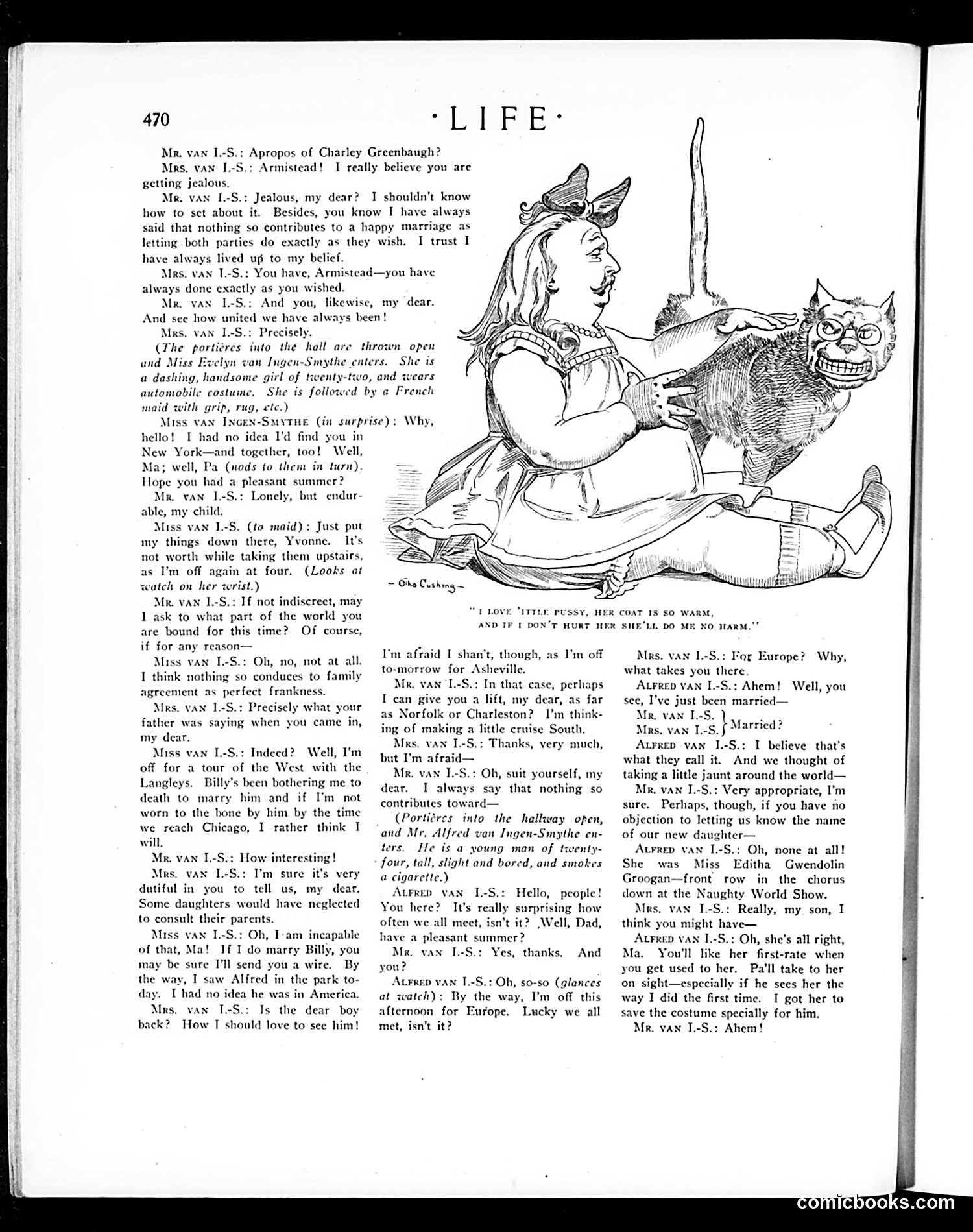
This page satirizes upper-class hypocrisy about family values and marital fidelity. The Van Ingen-Smythes are a wealthy couple who congratulate themselves on their "perfect frankness" and letting each family member do "exactly as they wish"—code for tolerating infidelity and loose behavior. The joke unfolds through their daughter Evelyn and son Alfred's casual announcements: she's traveling with a man (Billy) she may marry; he's just married a chorus girl (Miss Groogan) and is leaving for Europe. The parents accept each revelation with transparent indifference, revealing their supposed principle of "family agreement through frankness" is actually moral permissiveness disguised as sophistication. The illustration shows Evelyn playfully riding a mechanical cat, reinforcing the theme of childish, consequence-free behavior among the wealthy. The satire mocks Gilded Age pretense—the facade of proper values masking actual moral laxity.
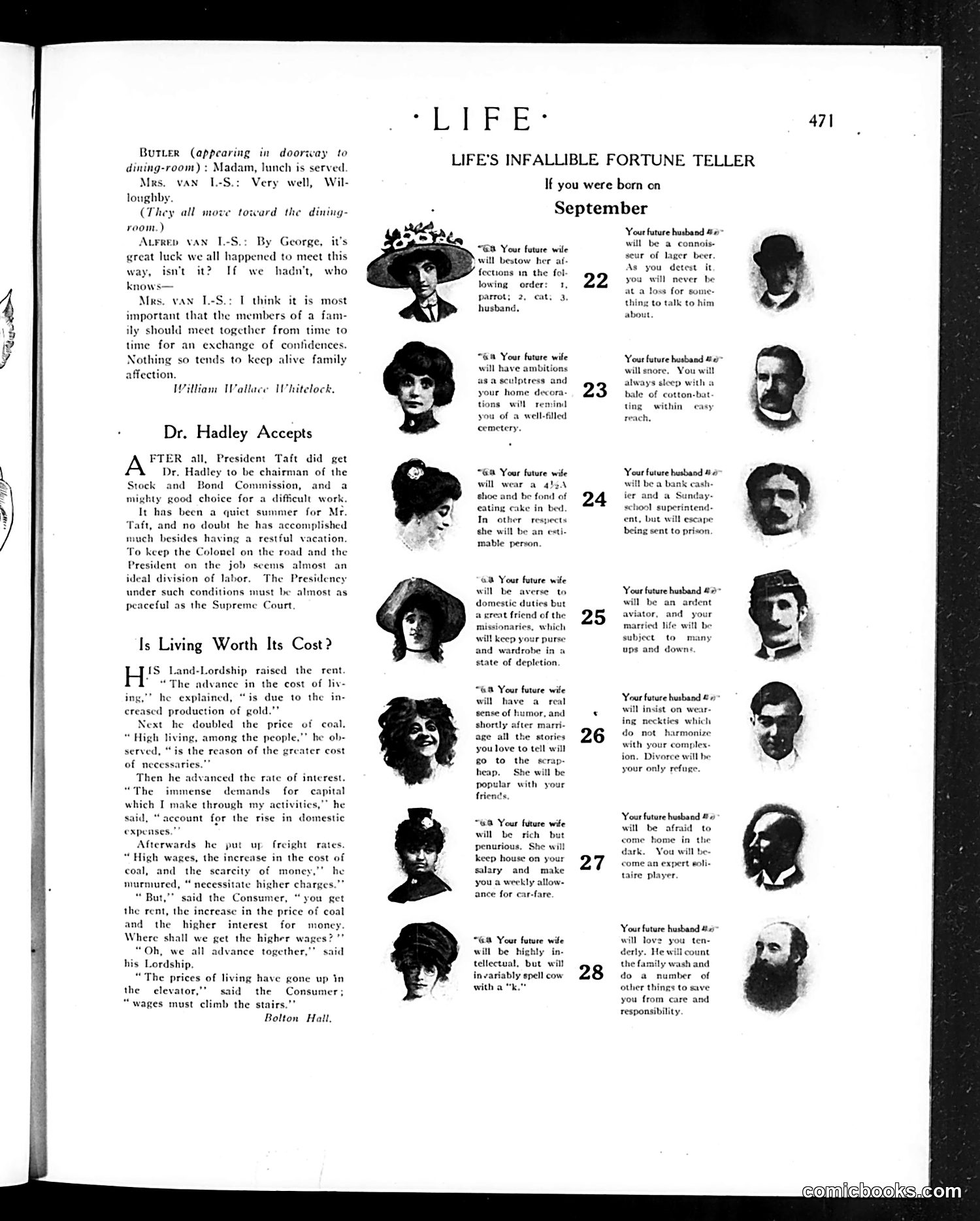
This page from *Life* magazine features satirical content mocking early-20th-century anxieties about marriage and economic inequality. **The Fortune Teller Section**: The right side presents humorous "fortunes" for people born in September, using exaggerated stereotypes about spouses. Each prediction ridicules contemporary marriage expectations—wives are portrayed as neglectful, frivolous, or intellectually tedious, while husbands are depicted as philistine drinkers, snorers, or financially incompetent. The humor relies on the audience recognizing these as common marital complaints. **Left Side Commentary**: The articles criticize wealth inequality and landlord exploitation. "Is Living Worth Its Cost?" satirizes a landlord who justifies raising rents, coal prices, and freight rates while blaming workers' "high living" and wage demands—the irony being that wages haven't risen proportionally. The piece mocks the circular logic of capitalism: the wealthy blame the poor for inflation while profiting from it themselves. Both sections use satire to critique social problems: unrealistic marriage ideals and economic injustice.
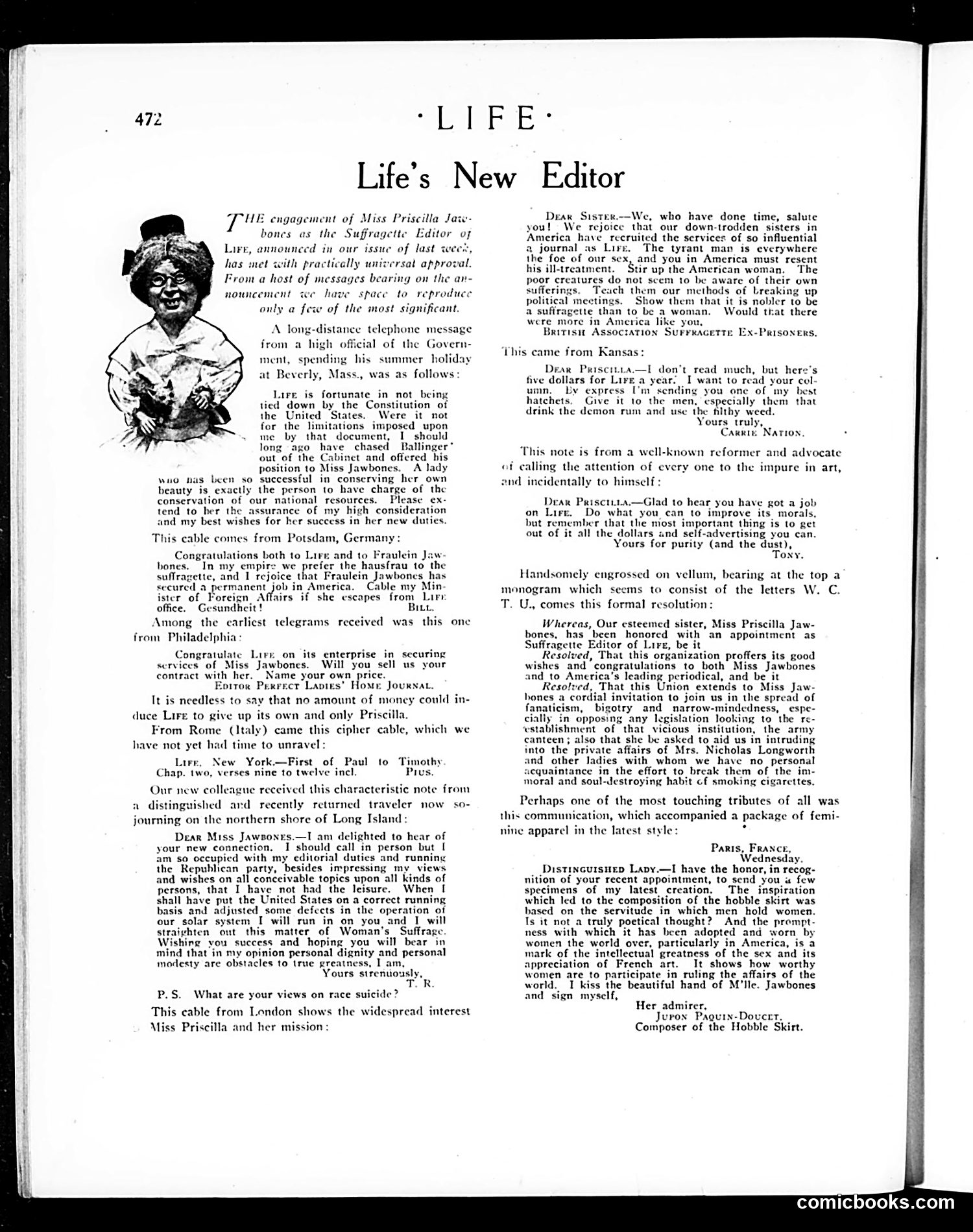
This page satirizes the appointment of "Miss Priscilla Jawbones" as *Life* magazine's new Suffragette Editor. The cartoon depicts an exaggerated, aggressive caricature of a militant suffragist—likely referencing British suffragettes known for disruptive protest tactics. The satire mocks both the suffrage movement and *Life*'s editorial decision through mock congratulatory messages. A British suffragette group praises the hire, urging Americans to adopt militant tactics. A Kansas reader sends "hatchets" for use against men. A German official jokes about preferring traditional housewives to suffragettes. A Philadelphia reformer criticizes moral impurity in art. The humor relies on portraying suffragists as humorless, destructive zealots while mocking *Life*'s supposed editorial pandering. The exaggerated praise from extremists is meant to discredit the entire movement as fanatical and dangerous to American values.
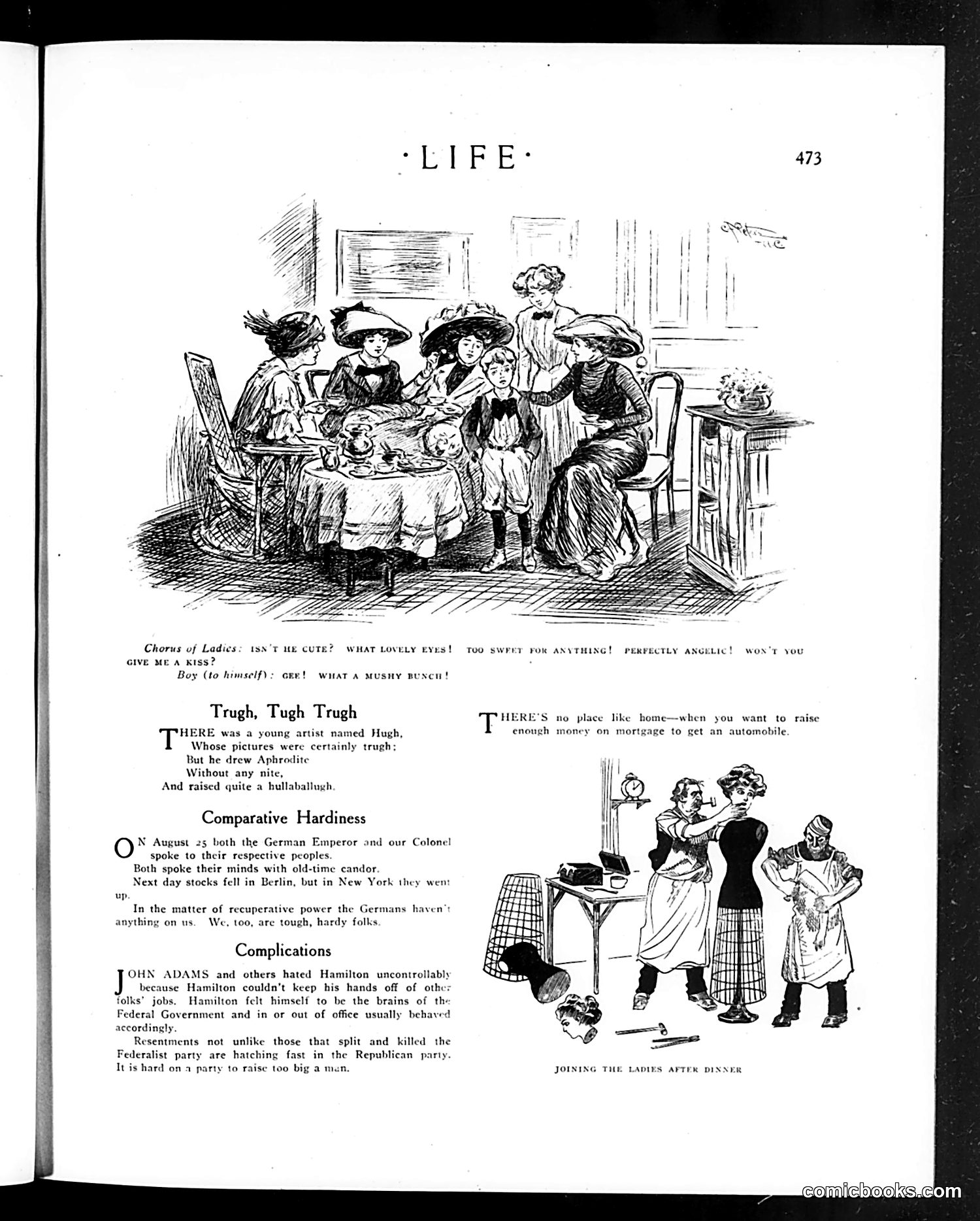
This satirical page contains three distinct pieces: **"Trugh, Tugh Trugh"** mocks an artist named Hugh whose realistic paintings ("trugh") lack refinement—specifically, he drew the goddess Aphrodite without beauty ("nite"), causing an uproar ("hullaballugh"). The crude rhyme scheme itself parodies doggerel verse. **"Comparative Hardiness"** references August 25, likely 1914 (during World War I's opening). The German Emperor and an unnamed American Colonel both made bold speeches. While Berlin stocks fell the next day, New York stocks rose—suggesting American financial resilience and confidence contrasted with German instability. The satire praises American toughness. **"Complications"** draws a historical parallel: just as Alexander Hamilton's ambition split the Federalist Party in the early 1800s, similar power struggles are now dividing the Republican Party. The point: it's dangerous for a party when one dominant figure (likely Theodore Roosevelt, recently split from Republicans) becomes too powerful. The top illustration shows ladies fawning over an uncomfortable boy, satirizing excessive sentimentality or flattery.
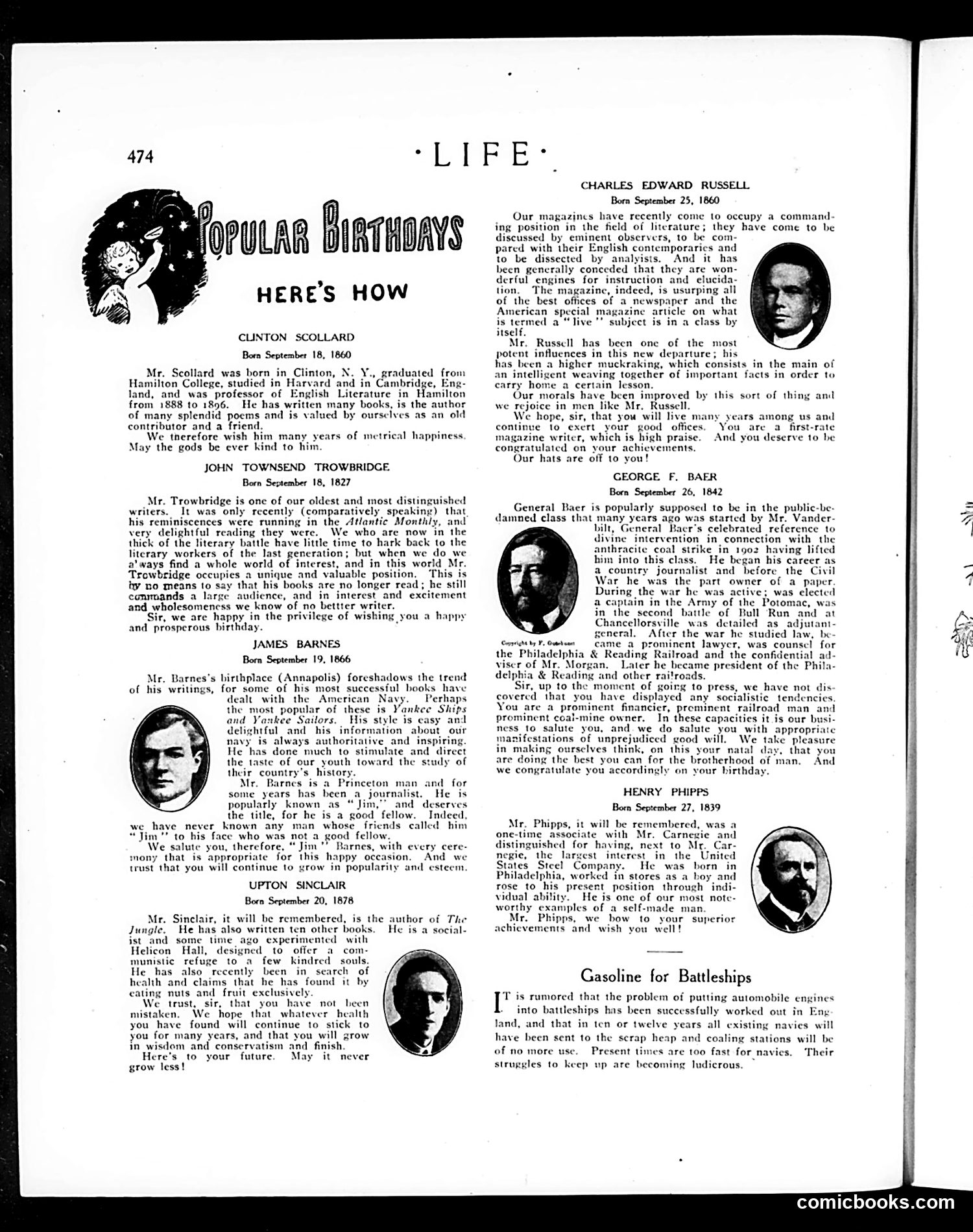
This page celebrates the September birthdays of five prominent American writers and public figures. It's structured as congratulatory tributes rather than satire. The featured figures include: - **Clinton Scollard** (poet/professor) - **John Townsend Trowbridge** (established literary figure from the previous generation) - **James Barnes** (naval historian and author of *Yankee Ships and Yankee Sailors*) - **Upton Sinclair** (author of *The Jungle*, socialist experimenter) - **Charles Edward Russell** (influential muckraking journalist) The tone is affectionate and respectful, with gentle humor—particularly regarding Sinclair's recent diet of "nuts and fruit exclusively," which Life hopes won't be a mistake. The tributes praise each writer's contributions to literature and American culture, positioning the magazine as arbiter of literary taste and celebrator of intellectual achievement. This appears to be a prestige feature rather than satirical content.
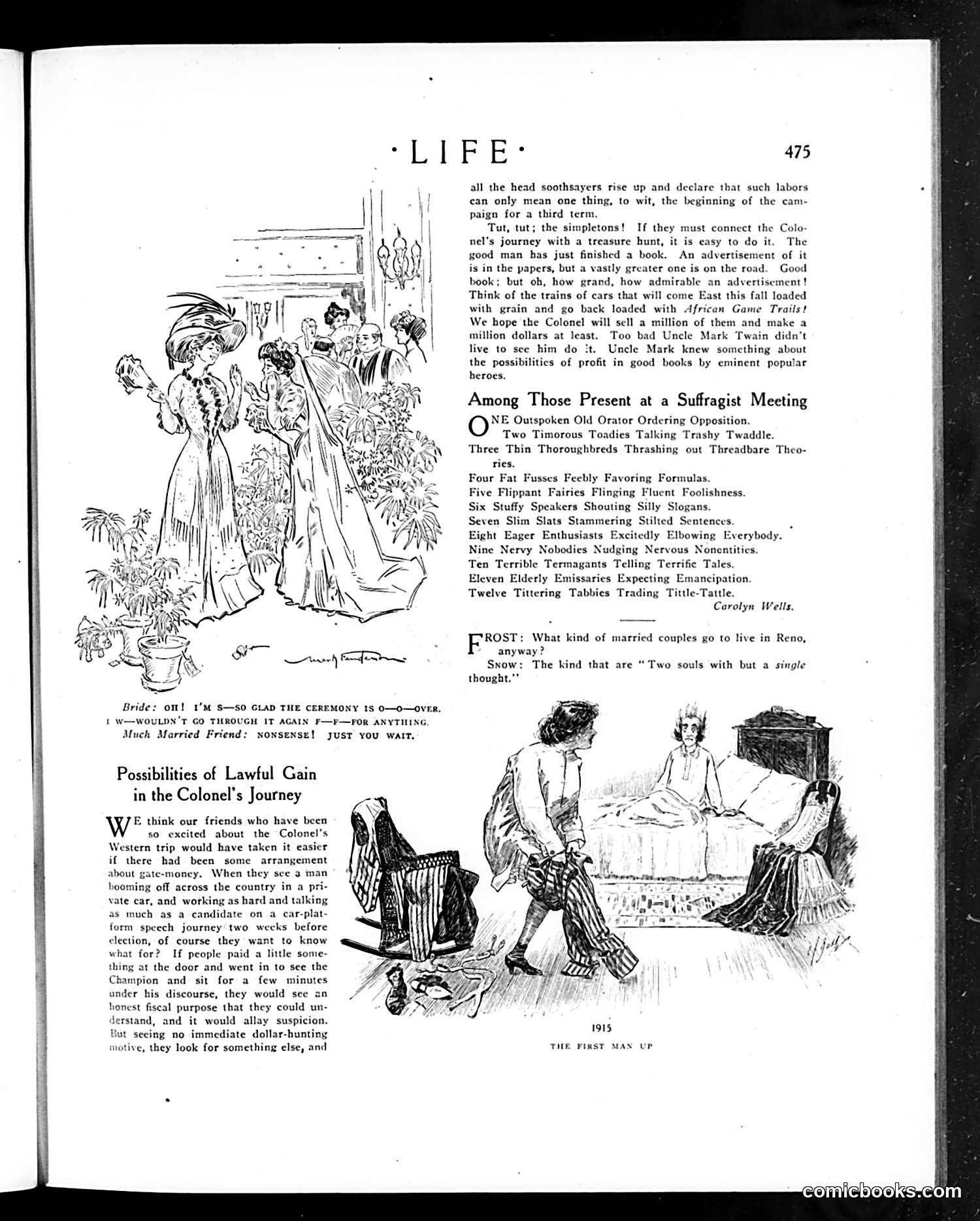
This 1915 *Life* page contains three distinct satirical pieces: **Top cartoon**: A bride expressing wedding regret to a "much married friend," who dismisses her concerns. The joke mocks the institution of marriage itself—suggesting serial remarriage is common enough that initial hesitation is foolish. **Middle section**: Sarcastically defends Theodore Roosevelt's Western tour as a book-promotion scheme for his recently published *African Game Trails*, rather than a campaign for a third presidential term. The satire suggests observers see sinister political motives where there's merely commercial self-interest. **Lower section**: Mocks a women's suffrage meeting through alliterative character types—"Outspoken Old Orator," "Timorous Toadies," "Fat Fusses," etc. The caricatures portray suffragists as ineffectual, silly, or overwrought, reflecting anti-suffrage attitudes common in 1915. The final joke about Reno couples references Nevada's then-lenient divorce laws, again mocking marriage instability.
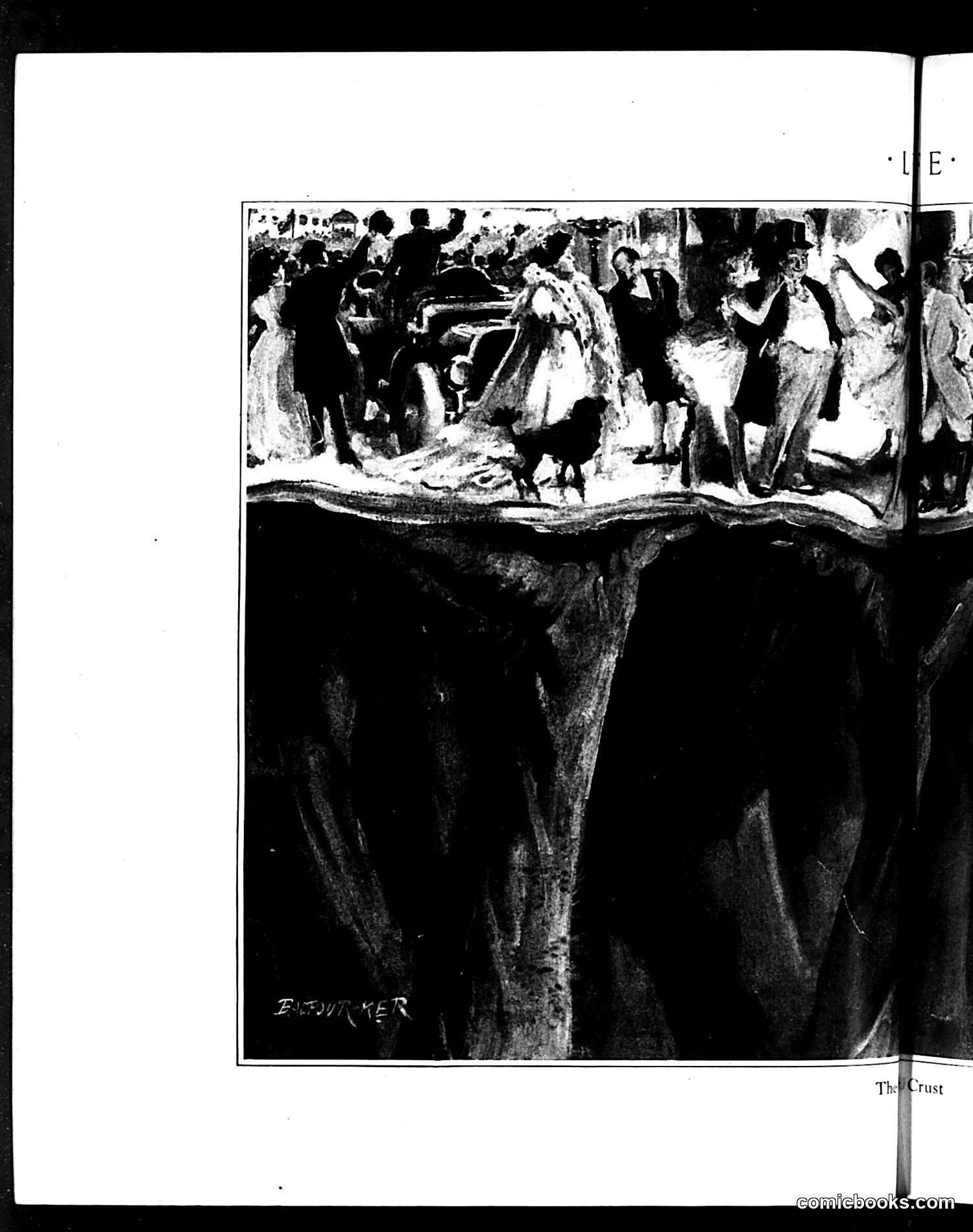
This appears to be a satirical illustration by Kemble (signed at lower left) depicting a dramatic social scene. The upper portion shows an elegant gathering with formally dressed figures, including women in elaborate gowns and men in formal attire, with what appears to be a small dog present. The lower two-thirds consists of a dark, cavernous void beneath this surface scene, rendered in heavy shadow. This visual metaphor—a polished social gathering literally built atop a chasm—likely critiques the hollowness or instability underlying fashionable society. The contrast between refined surface appearances and underlying emptiness or corruption was a common satirical theme in early 20th-century American magazines. The specific social commentary remains unclear without additional context about the publication date.
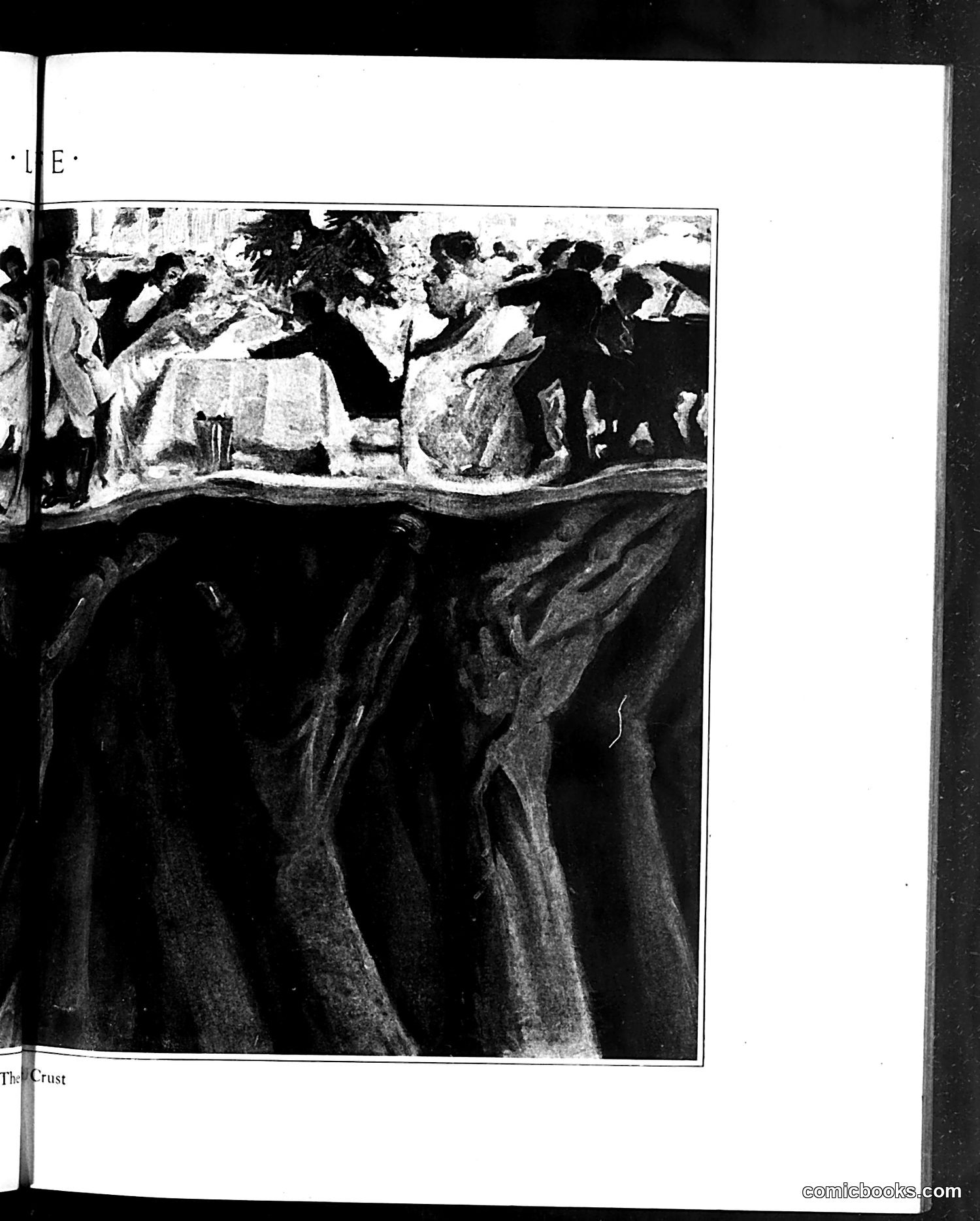
This appears to be a satirical illustration titled "The Crust" showing a stark class division. The upper portion depicts well-dressed figures dining at a table with food and drinks, appearing to enjoy leisure and plenty. Below them, separated by a dramatic dark barrier, are numerous figures in darker clothing—appearing impoverished and crowded together. The cartoon satirizes economic inequality and class stratification, using the metaphor of "crust" (the hard outer layer of bread, or colloquially, the wealthy upper class) versus those beneath struggling for survival. The visual hierarchy and the physical separation emphasize the disconnect between rich and poor during what was likely the Progressive Era or Depression period when Life magazine frequently critiqued social injustice.
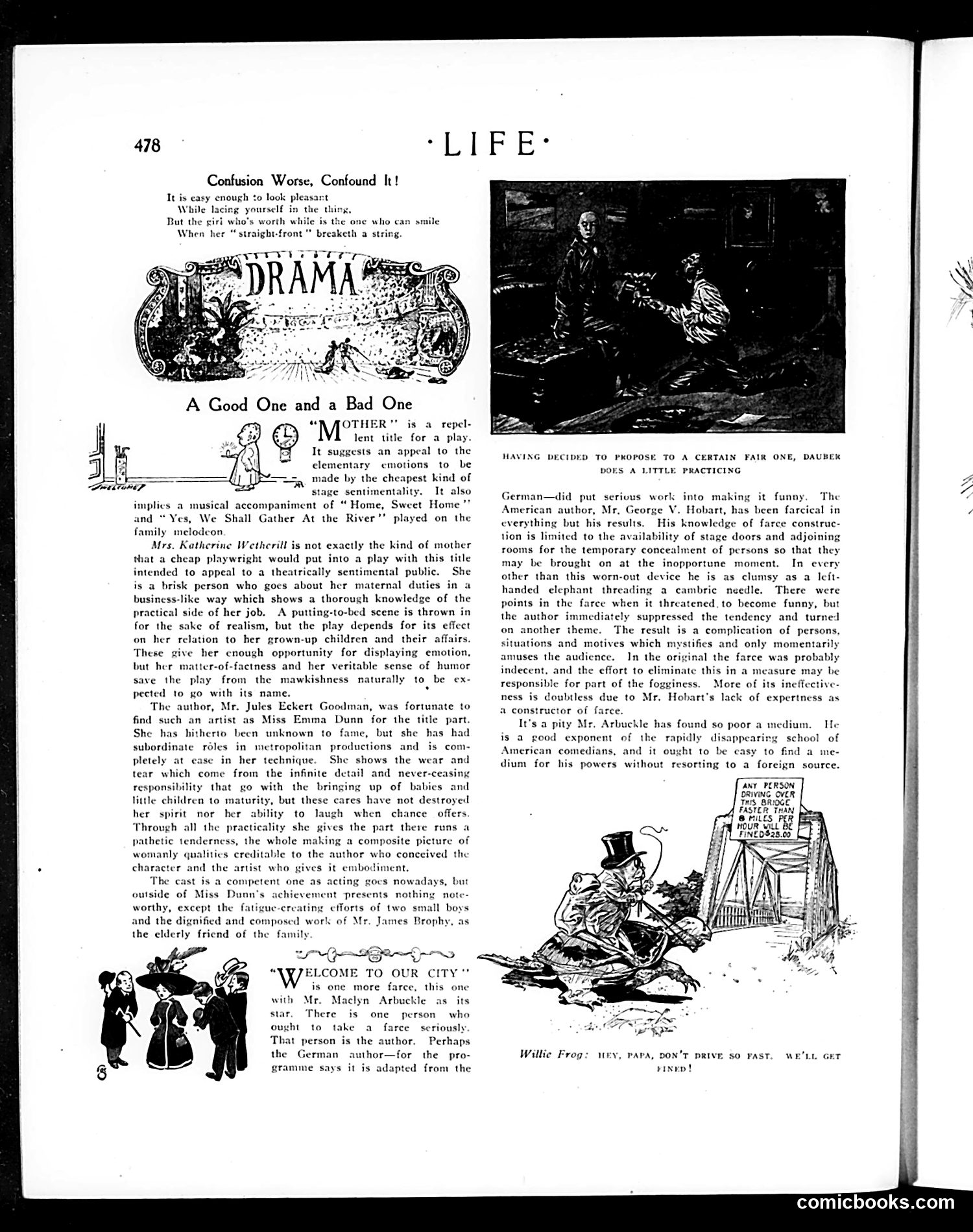
This page contains two theatrical reviews discussing drama productions of the early 20th century. **"A Good One and a Bad One"** critiques two plays: "Mother" (praised) and "Welcome to Our City" (criticized). The reviewer praises actress Emma Dunn's realistic portrayal of a practical, unsentimental mother in "Mother," contrasting her with cheap theatrical sentimentality. The critic argues the play succeeds because Dunn avoids mawkishness despite the title's melodramatic connotations. By contrast, "Welcome to Our City," adapted from a German source, is dismissed as incompetent farce. The American adapter, George V. Hobart, is criticized for relying on tired stage mechanics (doors, adjoining rooms) rather than genuine comic construction. The reviewer suggests the original may have been "indecent," and Hobart's attempt to sanitize it created confusion rather than humor. The cartoons appear to illustrate theatrical moments—one showing a proposal scene practice.
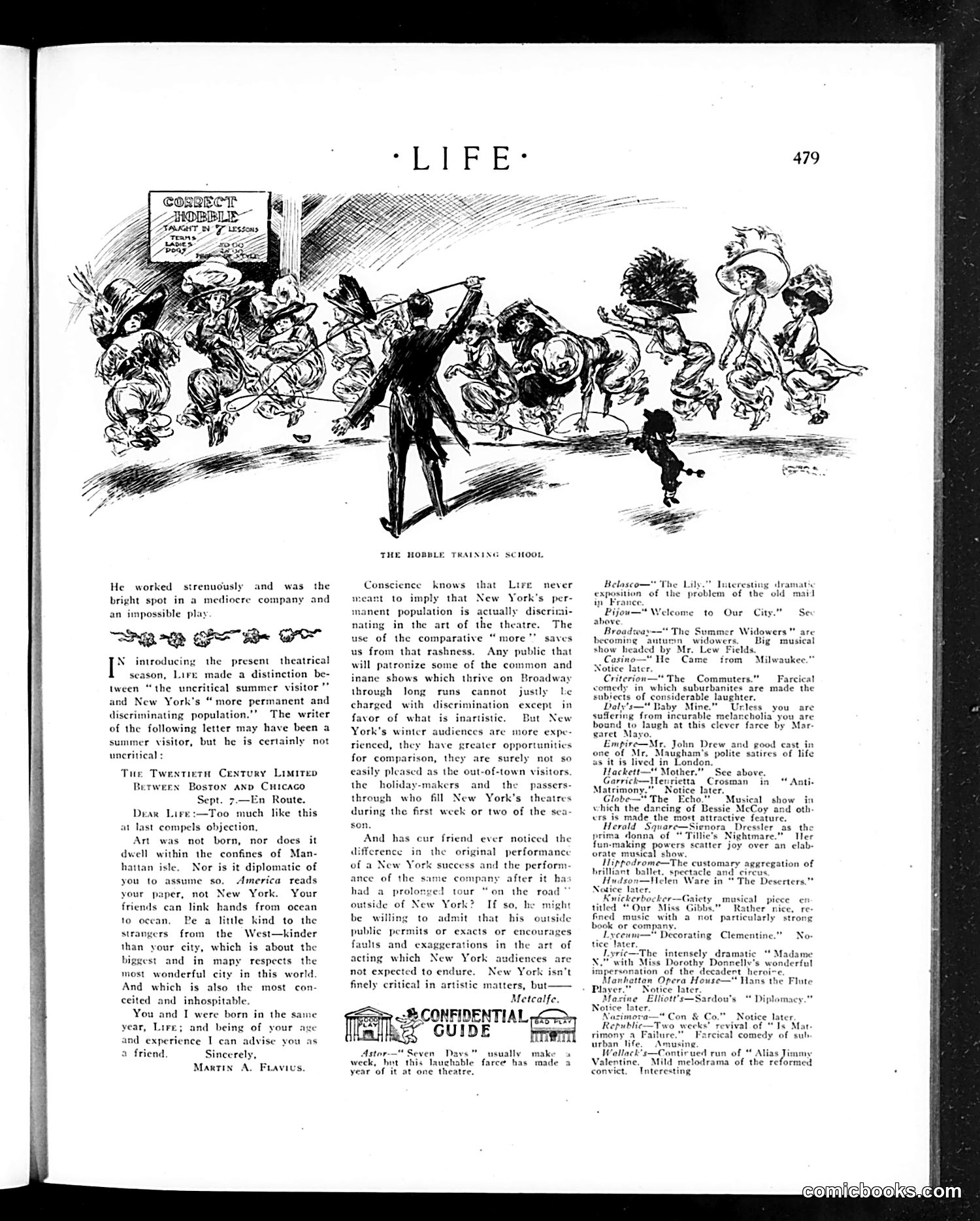
This cartoon satirizes New York City's theatrical snobbery. The sketch depicts a tall, thin instructor in formal dress training a group of rotund, awkwardly-postured figures labeled "The Hobble Training School"—a reference to the fashionable but restrictive "hobble skirt" silhouette popular around 1910. The accompanying letter from a reader (Martin A. Flavius) criticizes *Life* magazine for dismissive attitudes toward "summer visitors" and out-of-town audiences, arguing that New York unfairly considers itself the arbiter of theatrical taste. The cartoon visualizes this critique: the "training" transforms ordinary people into conformist, uncomfortable shapes—suggesting New York's establishment forces artificial standards onto outsiders rather than judging theater on genuine artistic merit.
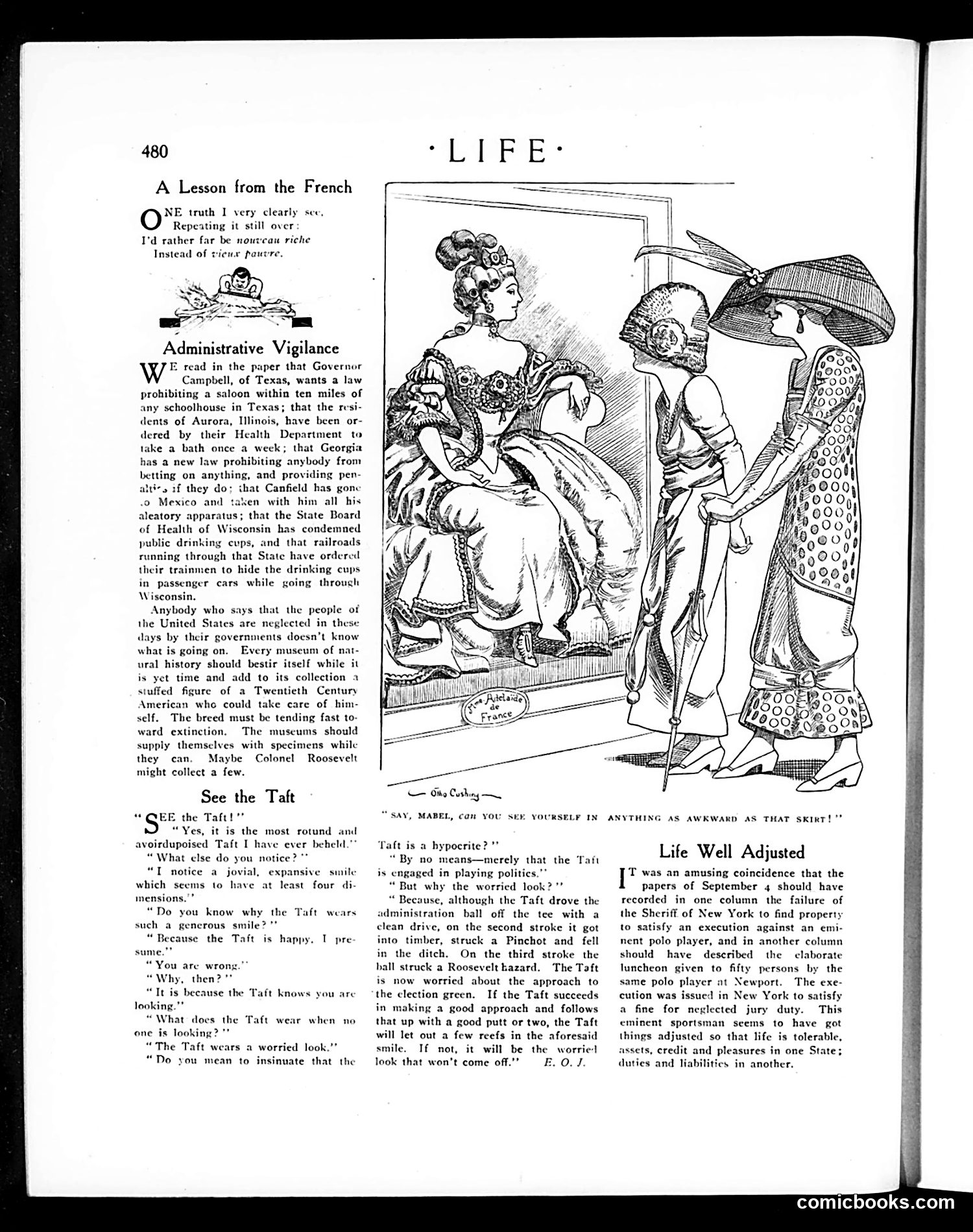
This page contains three satirical pieces about American public life circa 1909-1910: **"Administrative Vigilance"** mocks excessive government regulation—listing absurd laws from Texas, Illinois, Georgia, and Wisconsin (saloon distance requirements, mandatory weekly baths, betting prohibitions, hidden drinking cups). The satire suggests Americans are becoming too dependent on government to manage their lives, with the author sarcastically proposing museums preserve stuffed specimens of self-reliant twentieth-century Americans before the breed goes extinct. **"See the Taft"** is a dialogue mocking President William Howard Taft. Using golf metaphors, it portrays Taft as anxiously navigating political troubles: his "clean drive" (taking office) went awry when he hit "a Pinchot" (the Pinchot-Ballinger conservation controversy) and "a Roosevelt hazard" (tension with ex-President Theodore Roosevelt). The cartoon depicts fashionable women discussing Taft's awkward appearance and worried expression. **"Life Well Adjusted"** criticizes a wealthy polo player who evades New York court judgments while enjoying lavish Newport social events, suggesting the rich exploit jurisdictional gaps to avoid consequences.
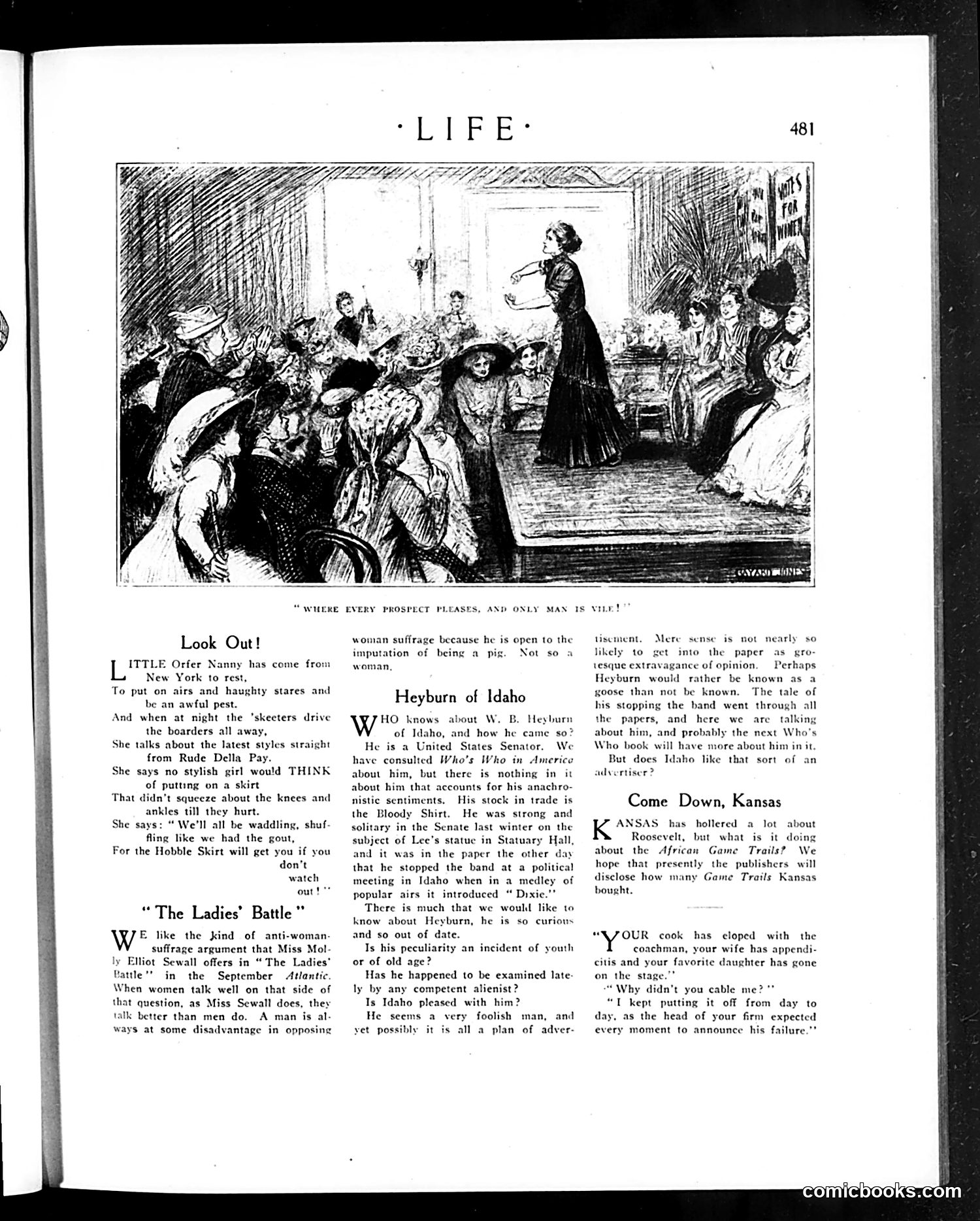
This Life magazine page contains three satirical pieces: **"Look Out!"** mocks the "Hobble Skirt"—a restrictive women's fashion trend that cinched ankles and knees, forcing an awkward shuffling walk. The piece ridicules a snobbish visitor from New York promoting this painful style as fashionable. **"The Ladies' Battle"** references an Atlantic Monthly essay by anti-suffrage advocate Molly Elliot Sewall. Life notes the irony that women arguing *against* women's voting rights actually make better arguments than men do—men appear self-interested opposing suffrage. **"Heyburn of Idaho"** satirizes Senator W.B. Heyburn for his reactionary politics. Life mocks him as anachronistic—notably for opposing a Lee statue in Congress and stopping a band from playing "Dixie" (a Confederate anthem) at an Idaho rally. Life questions whether his behavior is genuine foolishness or calculated publicity-seeking. **"Come Down, Kansas"** criticizes Kansas for not purchasing Roosevelt's popular "African Game Trails" memoir despite his prominence.
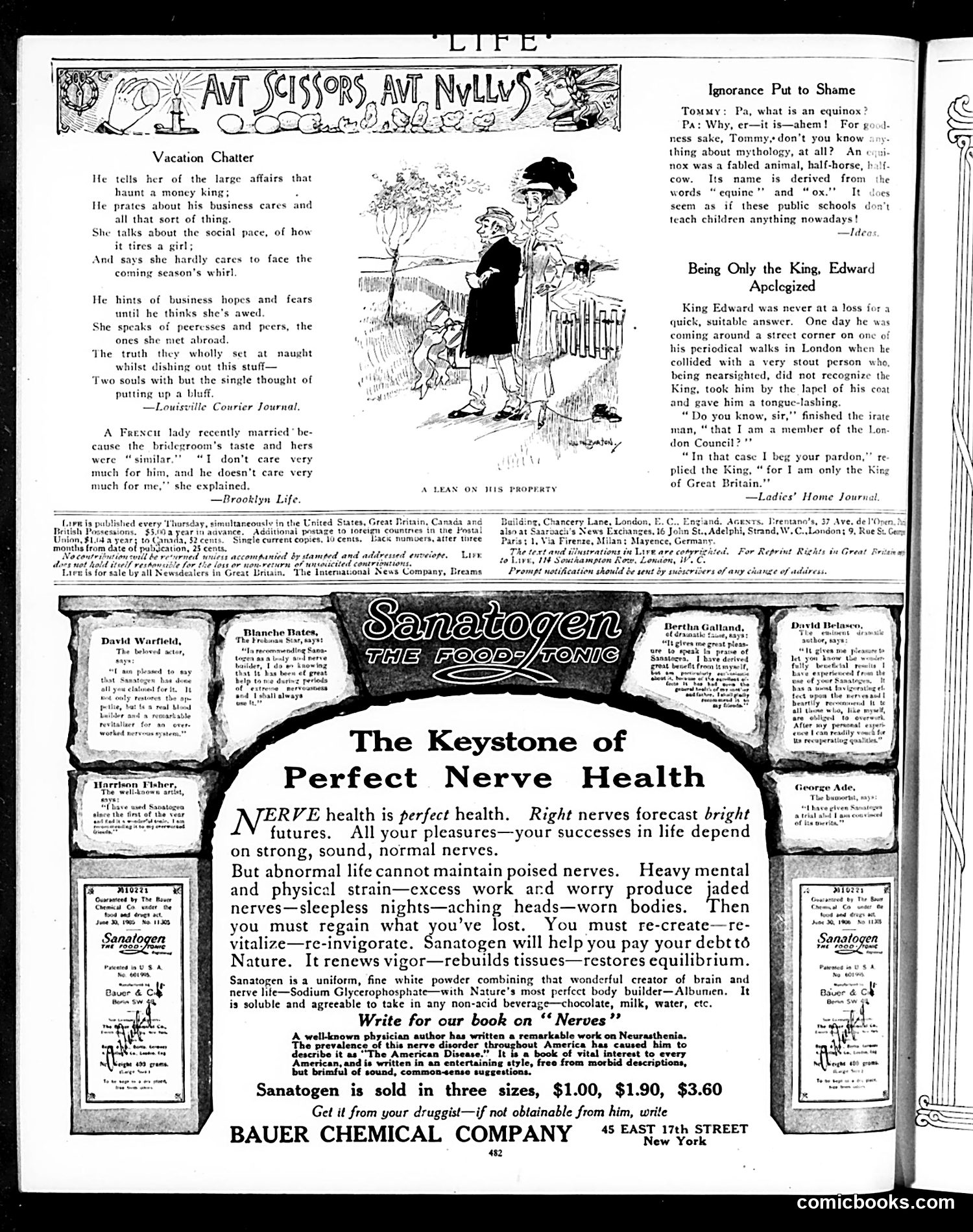
This page contains three distinct humorous pieces satirizing early 20th-century American life: **"Vacation Chatter"** mocks the pretentiousness of social climbers—a businessman boasts about his importance while his companion brags about aristocratic connections she met abroad, both exaggerating to impress each other. **"Ignorance Put to Shame"** ridicules paternal pomposity: a father, asked by his son what an equinox is, fabricates a completely false answer (claiming it's a mythical half-horse, half-cow creature) rather than admitting ignorance. The joke critiques both parental pride and public education's failures. **"Being Only the King, Edward Apologized"** presents a witty anecdote about King Edward VII's quick thinking when colliding with a nearsighted stranger who doesn't recognize him. The King graciously apologizes upon learning the man is a London Council member—humor derived from royal humility and the reversal of expected deference. The remainder is a Sanatogen advertisement promoting a nerve tonic as a cure-all for modern stress and exhaustion—typical of dubious patent medicines of this era.
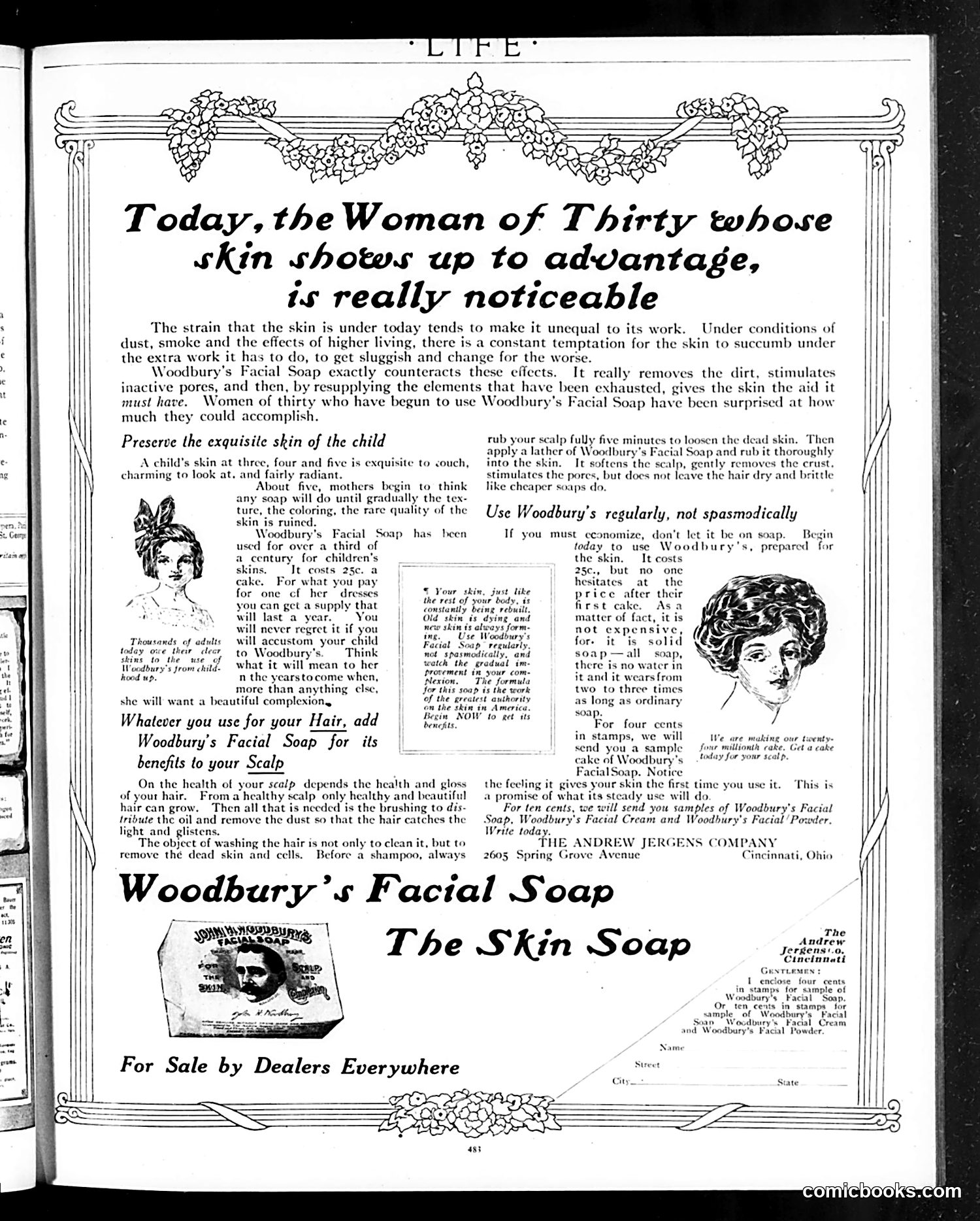
This is primarily a **commercial advertisement** rather than political satire or editorial cartoon. It's a full-page ad for Woodbury's Facial Soap from The Andrew Jergens Company (Cincinnati, Ohio). The ad targets women concerned about aging and skin quality, playing on anxieties about appearance. Key marketing claims include: - Women at thirty whose skin "shows up to advantage" are "really noticeable" - The product counteracts environmental damage (dust, smoke, "effects of higher living") - It preserves children's "exquisite skin" - Regular use produces better results than sporadic application - It's worth the cost (25 cents per cake) despite economic pressures to economize The accompanying illustrations show idealized young women's faces. The ad includes testimonial-style text and offers free samples to encourage trial purchases. This reflects **early 20th-century beauty marketing**: appealing to women's insecurities about appearance while positioning the product as scientifically beneficial rather than merely cosmetic.
This page is primarily **advertising and humorous filler content** rather than political satire. The layout includes: **Advertisement sections** dominate: Hamburg-American cruise lines, Hunyadi János mineral water, Club Cocktails, Milo Egyptian cigarettes, and Abbott's Bitters—typical early 1911 luxury goods marketed to affluent readers. **Humorous anecdotes** fill the editorial space, including: - A Maine janitor's confusion over "greatest common divisor" (mathematical term misunderstood as a lost object) - An actor's excessive modesty - Dialect humor about Pennsylvania Dutch speakers ("Gusty, come and eat yourself once") - Gender and marriage jokes ("we'll be divorced long before that") **The satire is mild and domestic** — focused on class distinctions, marital relations, and ethnic humor rather than politics. The page reflects *Life's* role as a genteel satirical magazine for the educated middle and upper classes, blending light social commentary with luxury product promotion. No identifiable political figures or specific contemporary events are referenced.
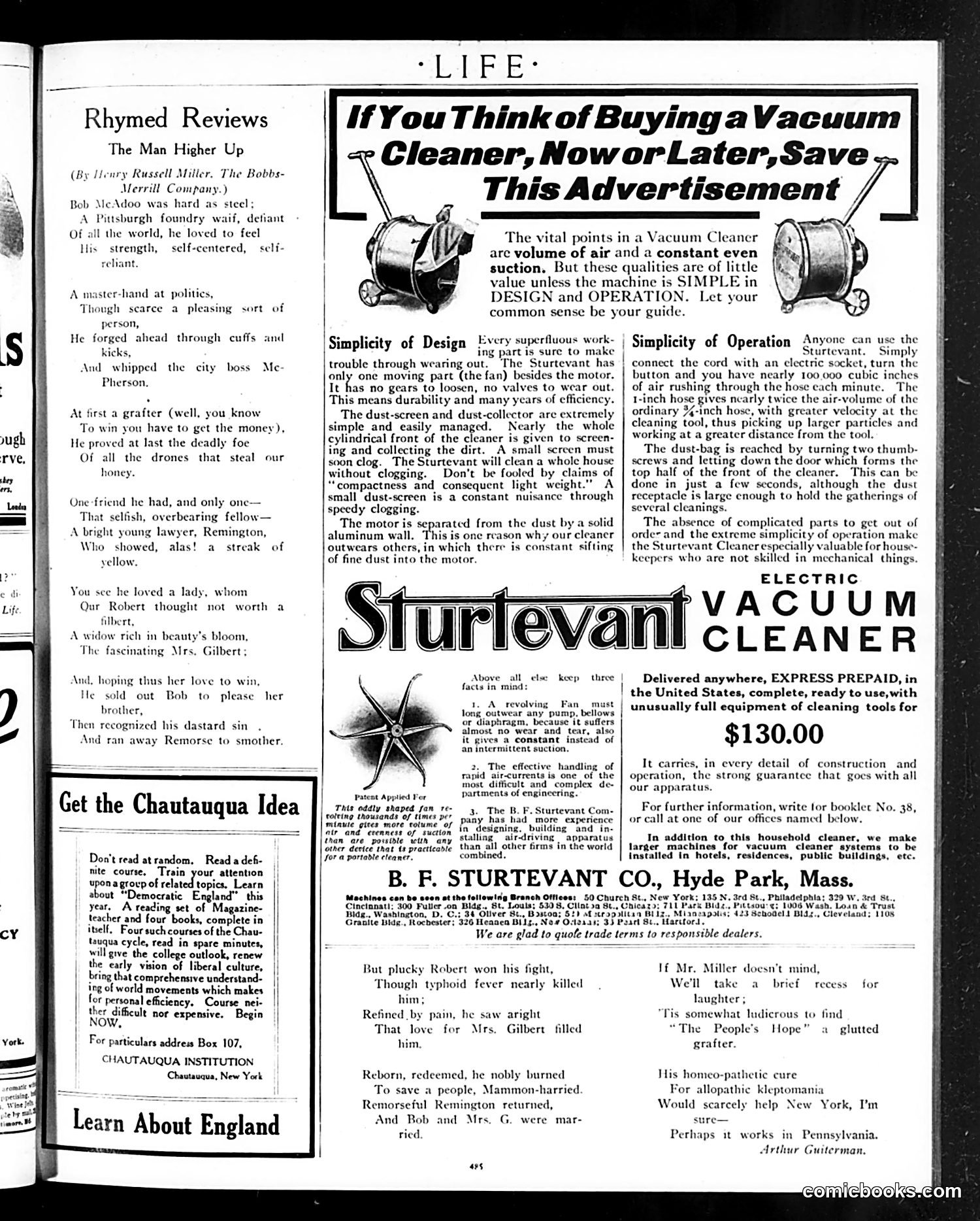
This page contains a **book review in verse** ("The Man Higher Up" by Henry Russell Miller) and a **vacuum cleaner advertisement**, with two smaller notices about educational programs. The book review critiques a novel about Bob McAdoo, a self-made Pittsburgh foundry worker who rises through politics and graft but is ultimately betrayed by his only friend—a lawyer named Remington who loves a wealthy widow (Mrs. Gilbert) and sells out Bob to her brother out of romantic desperation. The poem's moral condemns both McAdoo's ruthless ambition and Remington's cowardice. The large **Sturtevant vacuum cleaner ad** emphasizes mechanical simplicity as a selling point—few moving parts means durability and ease of operation for ordinary users. This reflects early 1900s consumer marketing targeting middle-class housewives. The page represents typical Life content: literary criticism, consumer advertising, and self-improvement notices aimed at educated American readers.
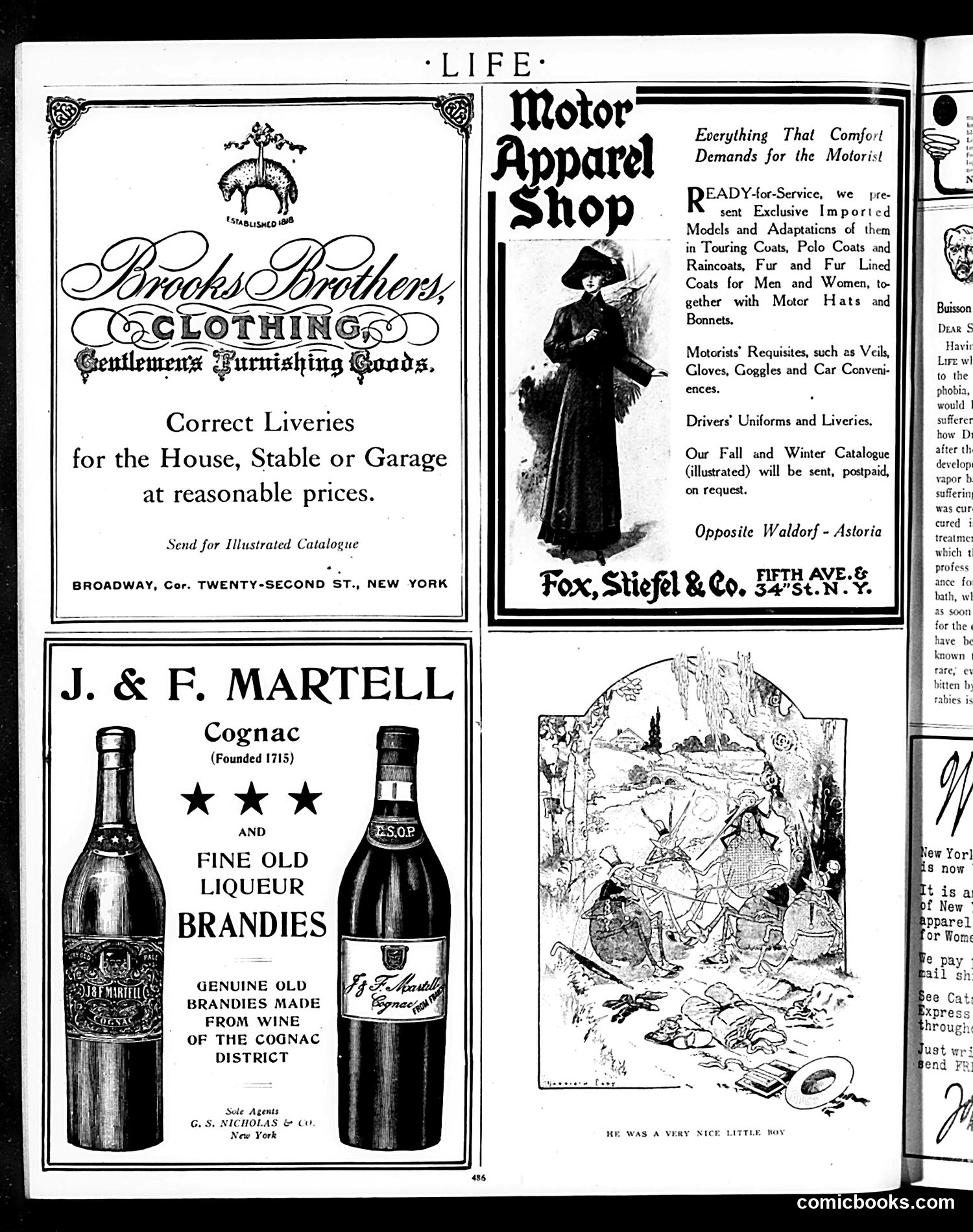
This page is primarily **advertisements**, not political satire or editorial cartoons. The visible ads include: - **Brooks Brothers** (men's clothing and formal wear) - **Motor Apparel Shop** (Fox, Stiefel & Co.) - specialized clothing for early automobile drivers, including coats, hats, goggles, and "motorists' requisites" - **J. & F. Martell** (cognac and brandy, founded 1715) The small illustration captioned "HE WAS A VERY NICE LITTLE BOY" appears to be a humorous sketch, likely from a story or regular feature, but lacks sufficient context on this page to explain its specific meaning. The Motor Apparel ad is historically interesting as evidence that automobiles were new enough (early 1900s) to require specialized protective clothing for drivers and passengers—goggles, fur-lined coats, and veils being necessary for open-air motoring.
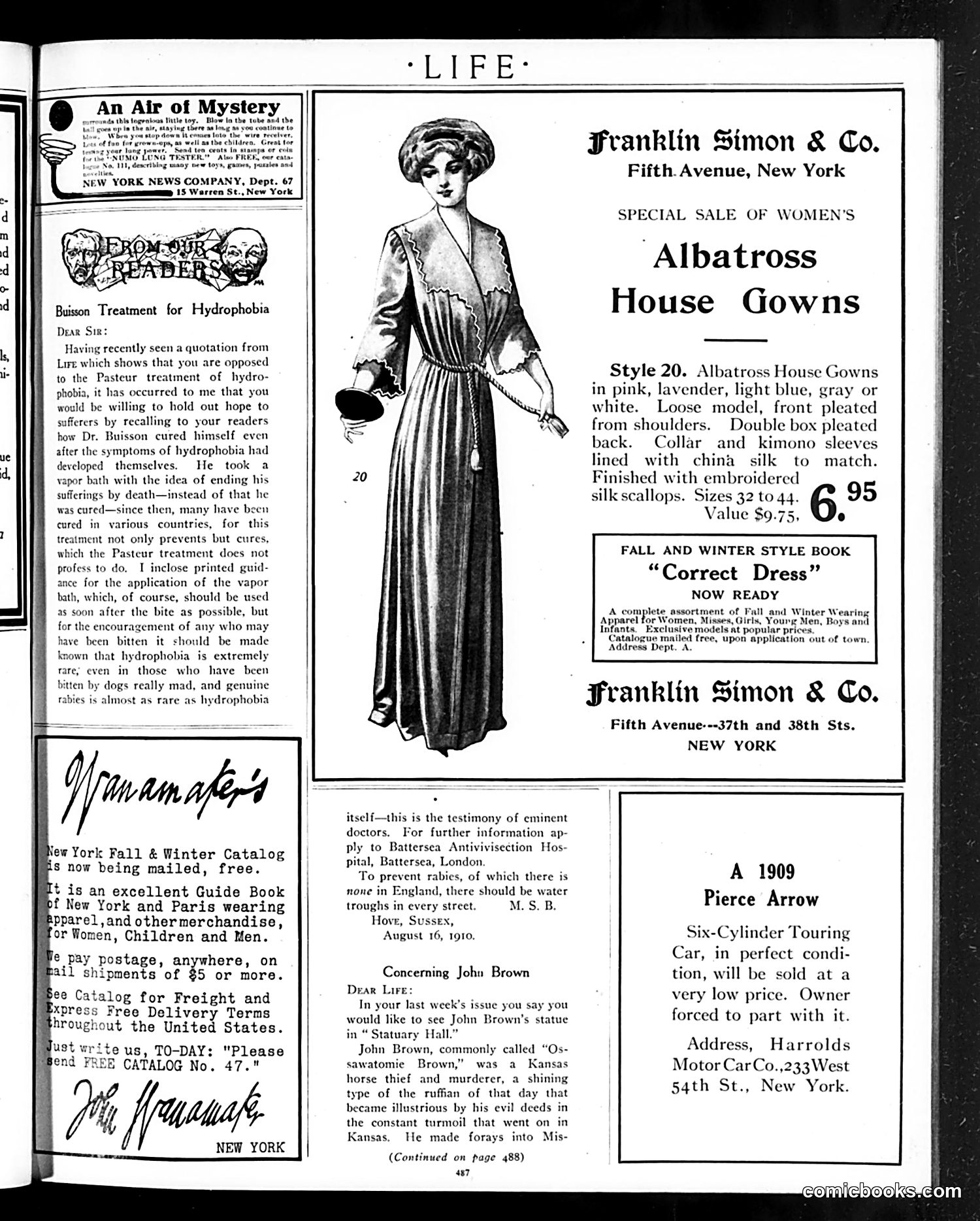
This page is primarily **advertising and reader letters**, not satire or political cartooning. The content includes: **Letters to the Editor**: Readers debate the Buisson treatment for rabies versus Pasteur's method, and discuss whether abolitionist John Brown deserves a statue in Statuary Hall—a serious historical and medical discussion reflecting early 1910s concerns. **Advertisements**: The main visual is a **fashion advertisement** for Franklin Simon & Co.'s "Albatross House Gowns" (loose, flowing women's dresses, priced at $6.95), alongside ads for a mail-order clothing catalog and a Pierce Arrow automobile for sale. **No significant satire or caricature** is present. The page reflects typical Life magazine content from this era—mixing serious reader correspondence about contemporary issues with commercial advertising, presented in a straightforward manner rather than through humor or political commentary.
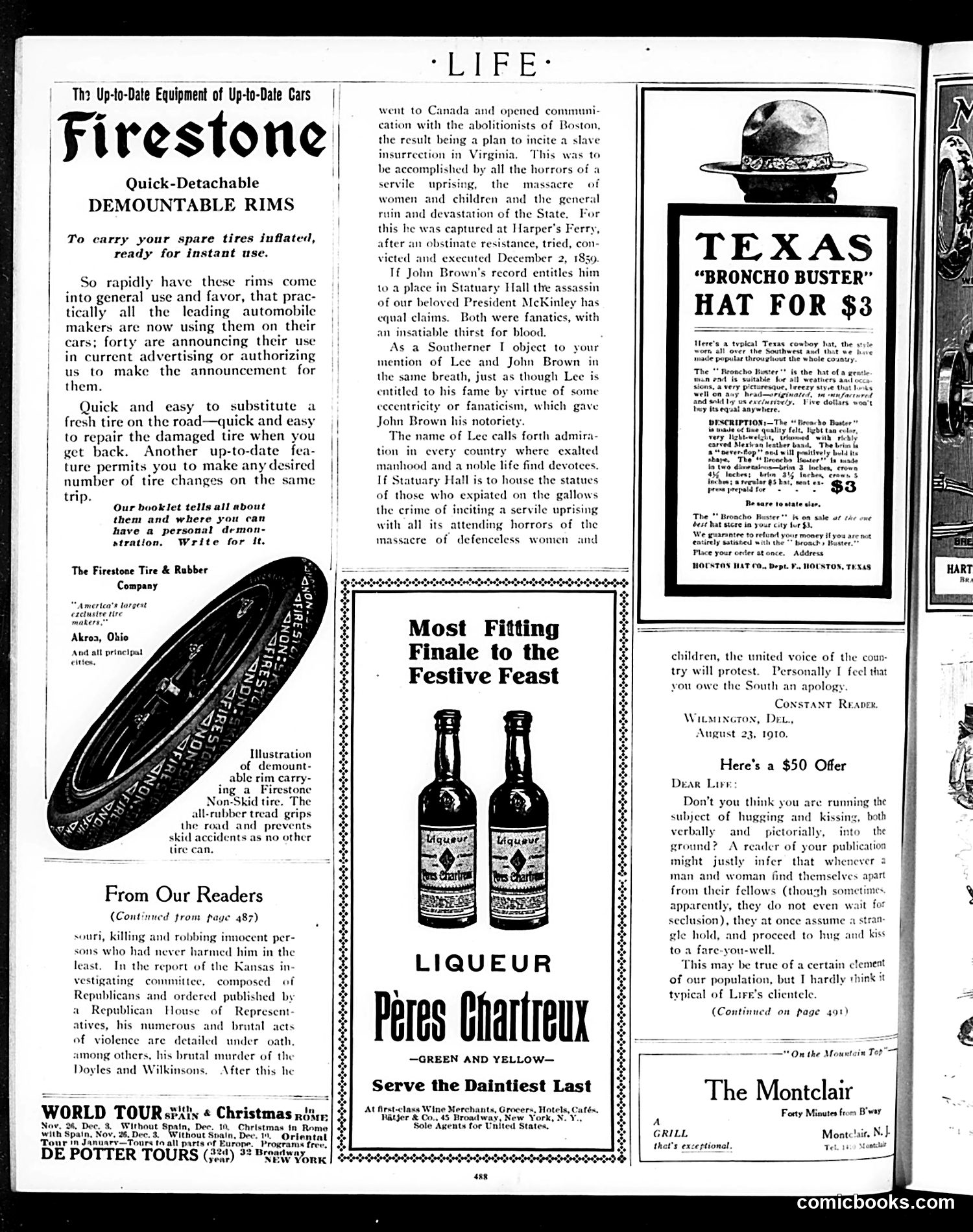
This page is primarily **advertising and reader letters**, not political cartoons. The notable content includes: **Reader Letter (main text):** A Southern writer objects to Life magazine's earlier comparison of Confederate General Robert E. Lee with abolitionist John Brown. The letter defends Lee as a noble figure while characterizing Brown—who led the failed 1859 Harper's Ferry raid to incite slave rebellion—as a fanatical murderer equivalent to President McKinley's assassin. The writer argues Brown's violent methods (massacring civilians) make him unworthy of commemoration in Statuary Hall. **Context for modern readers:** This reflects post-Civil War sectional tensions and Lost Cause mythology—the Southern romanticization of Confederate leadership despite the slavery system it defended. **Advertisements:** The page features typical 1910 ads: Firestone demountable rims, Pères Chartreux liqueur, a Texas cowboy hat, and travel tours. These are straightforward product pitches without satirical content. The page contains no cartoons or significant satire beyond the implicit bias in the reader's historical argument.
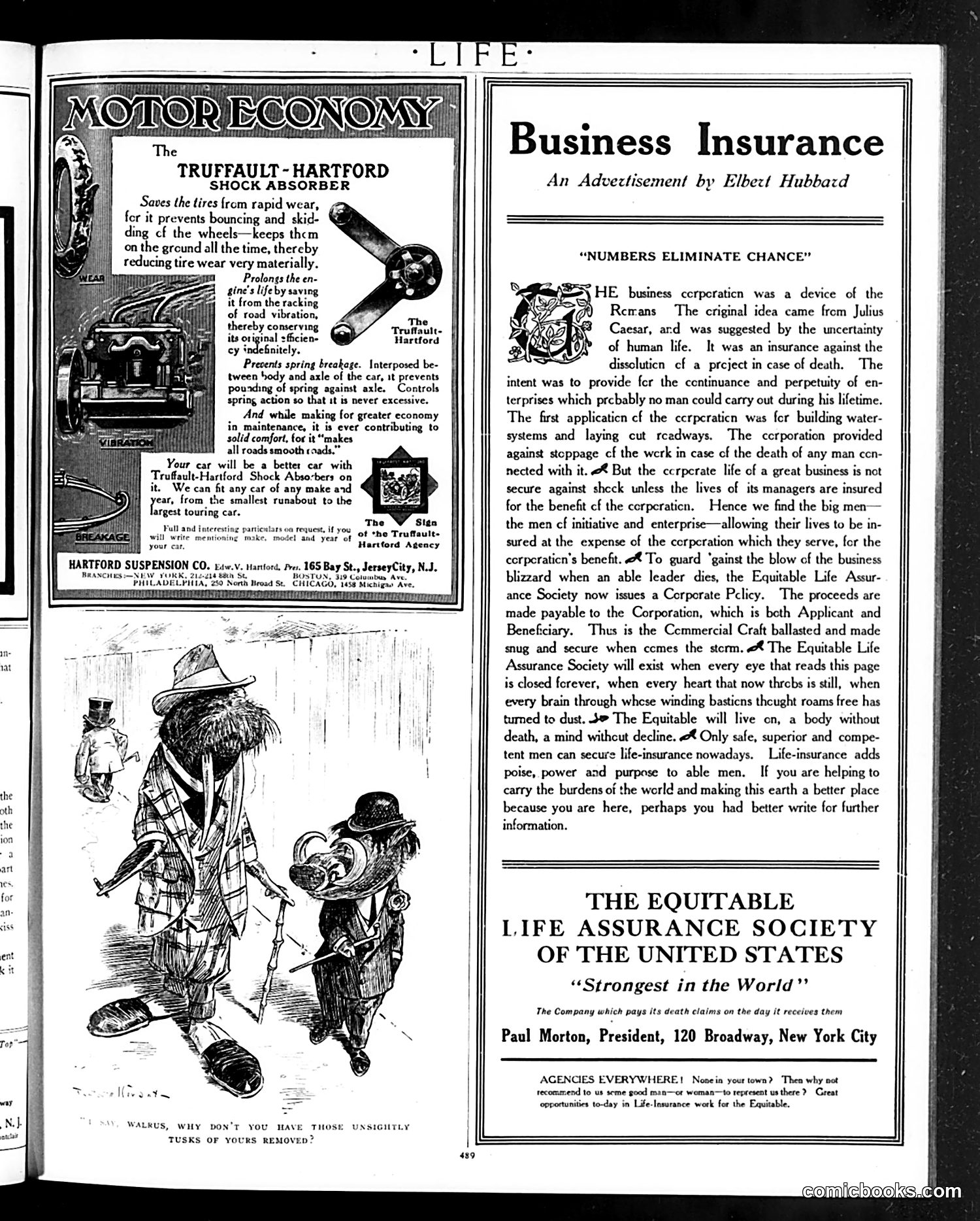
This page contains two distinct advertisements separated by an unrelated cartoon. **Left side:** Motor Economy ad for Truffault-Hartford shock absorbers, promoting automotive improvements (reduced tire wear, smoother rides, prevented spring breakage). **Right side:** The Business Insurance advertisement by Elbert Hubbard for Equitable Life Assurance Society emphasizes corporate life insurance. It argues that businesses need to insure their key executives' lives to ensure continuity after death—a relatively novel concept presented as protecting corporate interests when vital leaders die unexpectedly. **Bottom cartoon:** A small, separate satirical drawing shows a walrus being confronted by smaller figures about removing his tusks. The caption reads: "WALRUS, WHY DON'T YOU HAVE THOSE UNSIGHTLY TUSKS OF YOURS REMOVED?" This appears to be commenting on unnecessary vanity or conformity pressures, though the specific satirical target is unclear from context alone. The page primarily functions as advertising space rather than editorial content.
This is **not a cartoon or satirical piece**—it's a full-page advertisement for *Success Magazine*. The ad promotes *Success* magazine's circulation growth, claiming a monthly edition of 350,000 copies is now needed to meet demand. It emphasizes their subscription success: 100,000 new subscribers acquired through branch offices across major U.S. cities, with 90% of sales coming from subscriptions rather than newsstand purchases (95% net sales). The ad boasts that *Success* has more paid-in-advance subscribers than any competing standard magazine. The messaging targets advertisers, encouraging them to make ad reservations "now at present rates for 1911" before rates increase. Two advertising managers are listed: Frank E. Morrison (New York) and Harry T. Evans (Chicago). This represents typical early-1900s magazine advertising strategy—emphasizing circulation numbers and subscriber loyalty as selling points to potential advertisers.
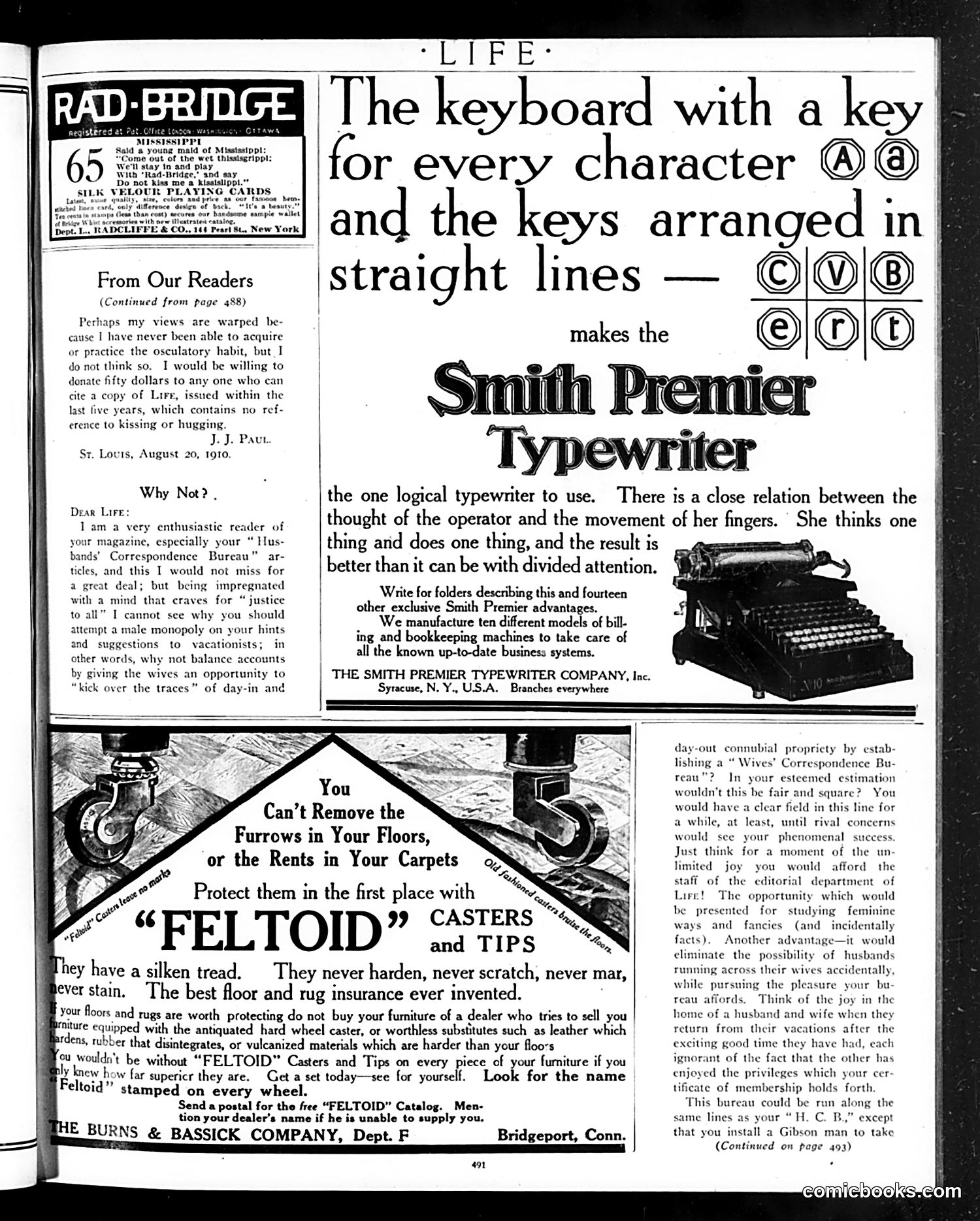
This page mixes reader letters with advertisements typical of *Life* magazine circa 1910. The "From Our Readers" section contains two letters debating magazine content. The first criticizes *Life*'s obsession with kissing and hugging. The second, titled "Why Not?", sarcastically proposes a "Wives' Correspondence Bureau" to balance what the writer calls *Life*'s male-focused "Husbands' Correspondence Bureau"—suggesting wives should get equal opportunity to misbehave during vacations. The writer's tone is tongue-in-cheek, mocking the magazine's apparent gender bias while also poking fun at marital propriety. The advertisements (Smith Premier Typewriter and Feltoid Casters) are unrelated to the satirical content and represent standard period marketing.
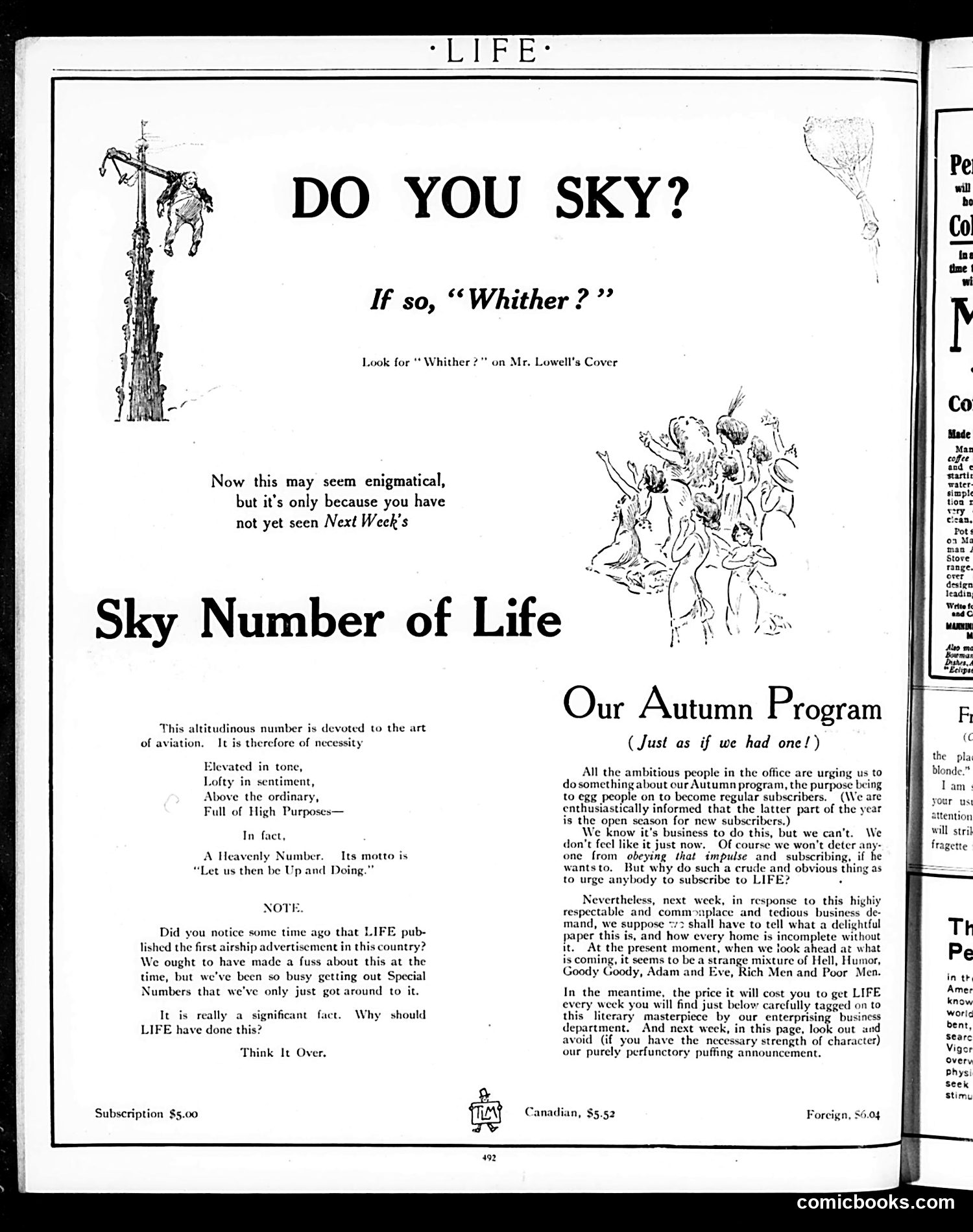
This page promotes an upcoming "Sky Number" of Life magazine devoted to aviation—a cutting-edge topic of the era. The illustrations show figures engaged in early aviation activities (climbing poles, using primitive flying apparatus). The text is deliberately tongue-in-cheek satire. Life's editors mock their own promotional efforts, admitting they're pushing subscriptions but too lazy to do so enthusiastically. The humor lies in this self-aware confession: they know subscription campaigns are "crude and obvious," yet they're doing one anyway. The references to aviation as "altitudinous" (lofty) and "heavenly" make puns on the literal and metaphorical meanings of "sky." The editors joke that readers won't understand the upcoming issue without seeing it first—a paradoxical sales pitch. The subscription prices ($5.00 domestic, higher for Canadian/foreign) suggest this was an expensive, premium publication aimed at educated, affluent readers who would appreciate such ironic, self-mocking humor.
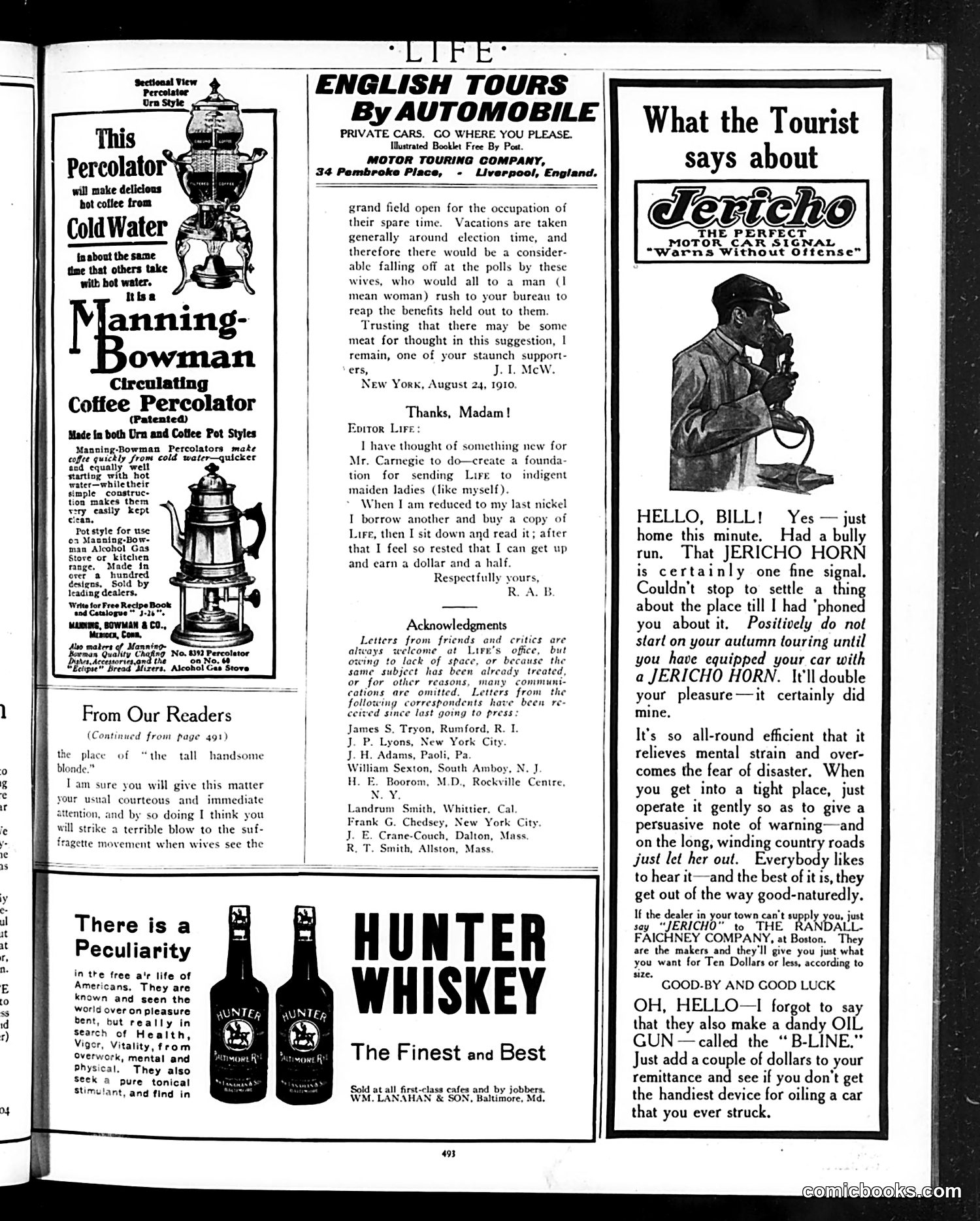
This page is primarily **advertising and reader correspondence**, not political satire. It contains: **Advertisements**: Manning-Bowman coffee percolators, English automobile touring services, Hunter whiskey, and the Jericho automobile horn (a mechanical warning device). **Reader Letters**: The "From Our Readers" section includes three letters to the editor. One suggests women should be encouraged to take vacations during election time to reduce their voting participation—a jab at women's suffrage. Another humorously proposes Andrew Carnegie fund magazines for poor unmarried women. A third acknowledges received correspondence. **Social Context**: The anti-suffrage letter reflects the pre-1920 opposition to women voting, treating female political participation as something to discourage. The page otherwise represents typical early 1910s commercial culture—automobiles, modern appliances, and consumer goods marketed to leisure-class readers. The page contains **no political cartoons**, only product advertisements and reader mail typical of this satirical magazine's format.
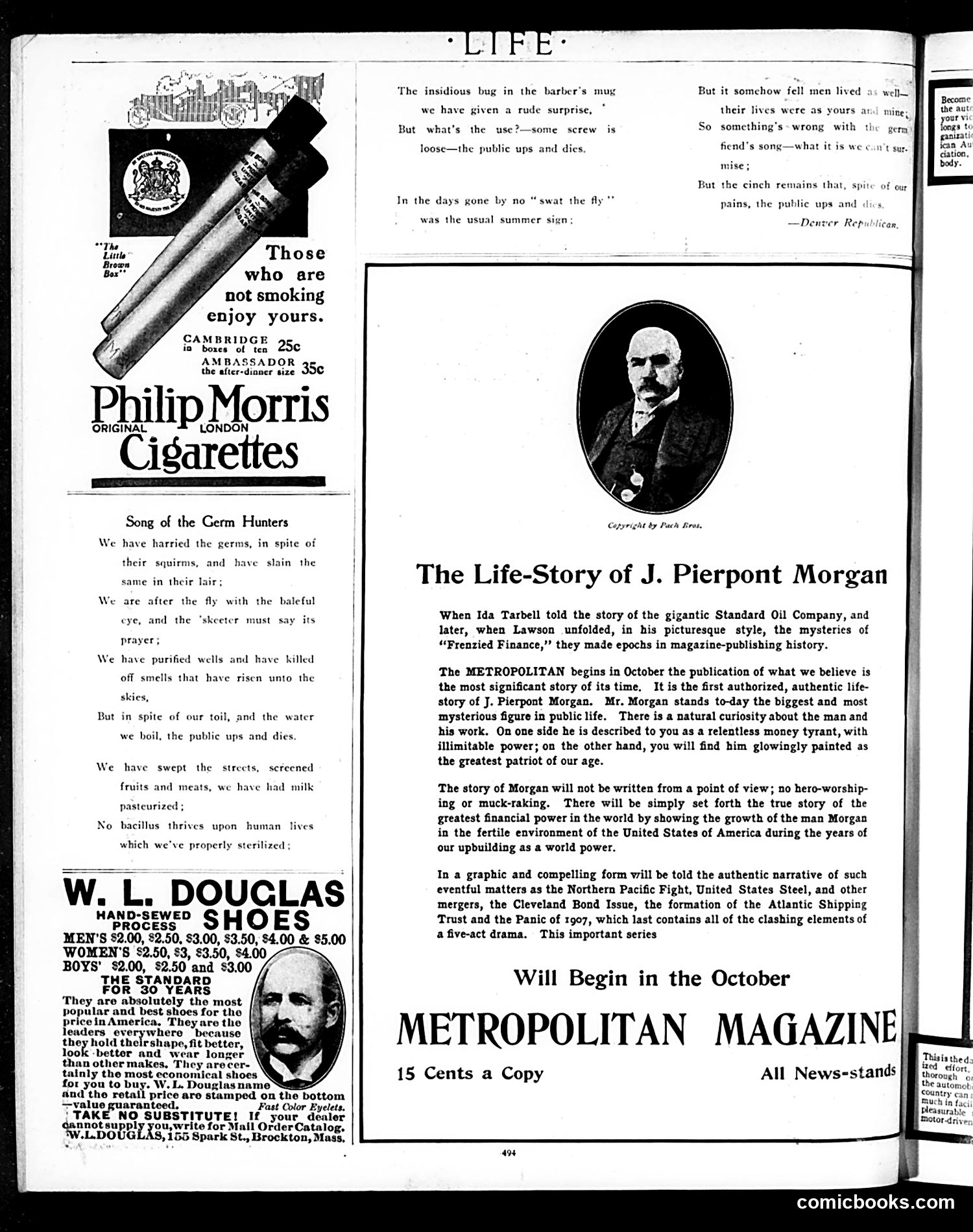
This page mixes advertising with editorial promotion. The dominant content announces *Metropolitan Magazine's* upcoming serialization of "The Life-Story of J. Pierpont Morgan," positioning it as a major journalistic event comparable to Ida Tarbell's exposé of Standard Oil. The "Song of the Germ Hunters" poem is satire about public health campaigns—acknowledging efforts to eliminate disease through sanitation, yet observing that "the public ups and dies" anyway. The joke is that despite all this modern scientific progress, people still die, suggesting the limits of contemporary medicine. The cigarette and shoe advertisements are period commercial content. The Morgan story announcement frames him as "the biggest and most mysterious figure in public life"—both "relentless money tyrant" and "greatest patriot," reflecting early-20th-century ambivalence toward monopolist titans during the Progressive Era.
This is primarily an advertisement/announcement page, not a political cartoon. It promotes *American Motorist*, the official magazine of the American Automobile Association (AAA), published in 1910. The page announces the magazine's circulation (over 142,000 copies in early 1910) and explains the AAA's mission: providing motorists with accurate information about roads, touring routes, and automobile laws. The text notes the publication gained manufacturer support and reaches actual car owners with advertising for vehicles and accessories. The sidebar boxes encourage readers to join local AAA clubs or become individual members—standard membership recruitment messaging for a growing automobile advocacy organization during the early automotive era. This reflects the rapid expansion of motorism in America circa 1910, when automobiles were still relatively new and owners needed guides and community organization.
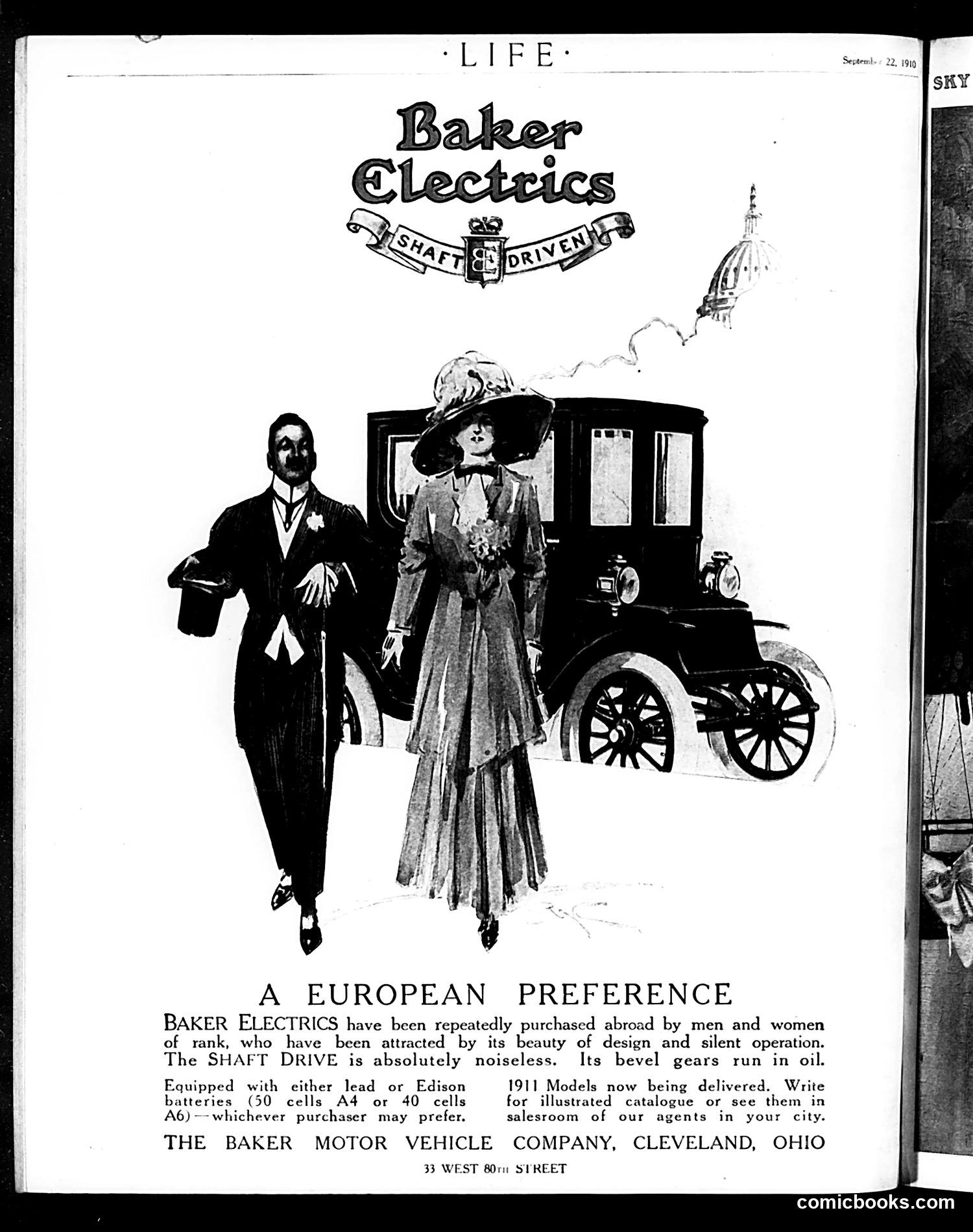
This is primarily a **product advertisement**, not political satire. It promotes Baker Electric automobiles in the September 22, 1910 *Life* magazine. The image depicts an elegantly dressed couple—a man in formal attire and a woman in fashionable dress with a wide-brimmed hat—standing beside a Baker Electric motorcar. The Capitol building appears in the background, suggesting prestige and respectability. The ad's appeal targets wealthy, sophisticated buyers by emphasizing that European nobility ("men and women of rank") prefer Baker Electrics for their "beauty of design and silent operation." This was a key selling point: electric cars were quiet and required no hand-cranking, unlike gasoline vehicles—making them particularly attractive to wealthy women and the upper classes. The mention of lead or Edison batteries reflects early electric vehicle technology options available in 1911. The ad essentially positions Baker Electrics as the choice of refined, international taste.