
Life, 1910-09-22 · page 22 of 40
Life — September 22, 1910 — page 22: what you’re looking at
What you’re looking at
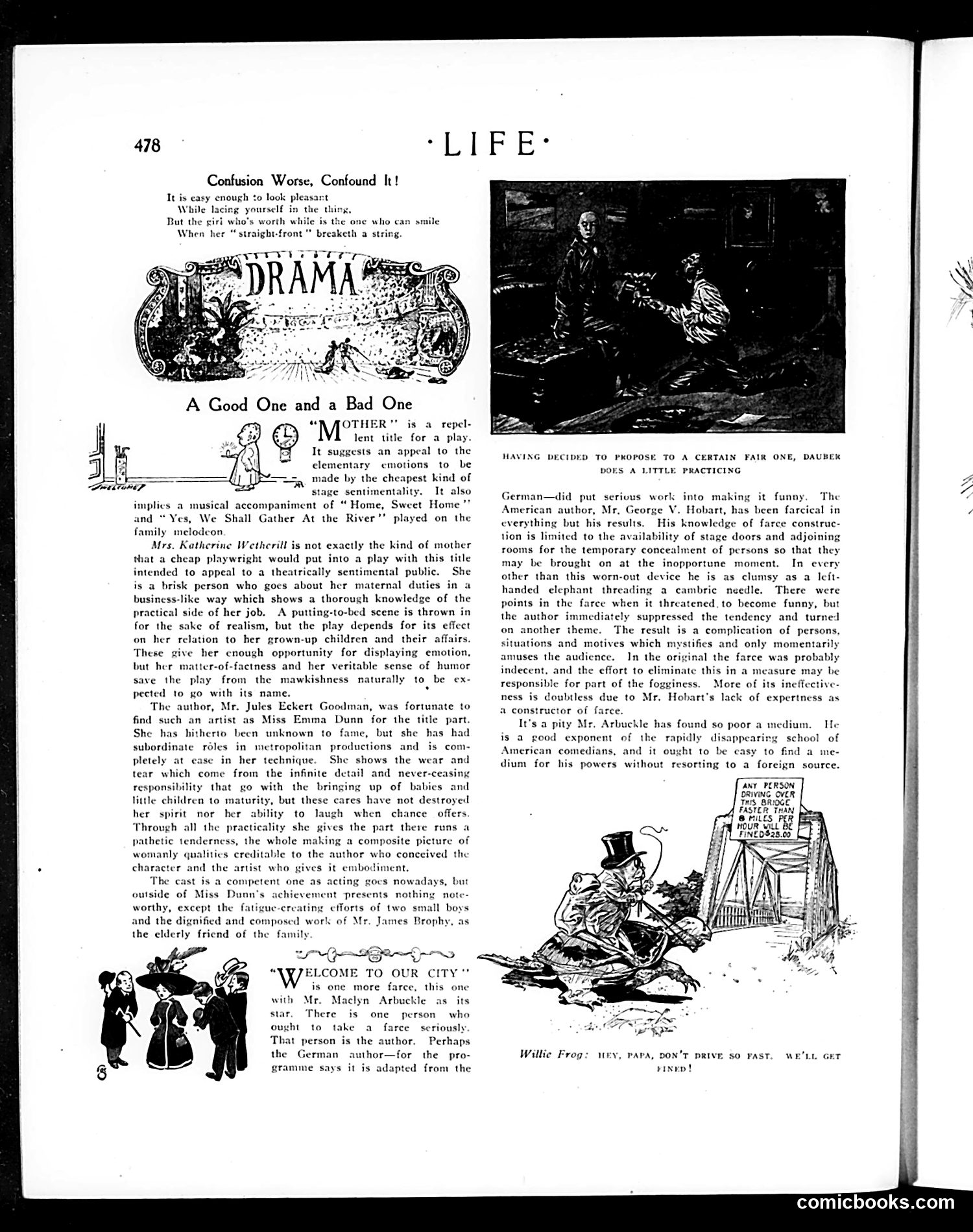
This page contains two theatrical reviews discussing drama productions of the early 20th century. **"A Good One and a Bad One"** critiques two plays: "Mother" (praised) and "Welcome to Our City" (criticized). The reviewer praises actress Emma Dunn's realistic portrayal of a practical, unsentimental mother in "Mother," contrasting her with cheap theatrical sentimentality. The critic argues the play succeeds because Dunn avoids mawkishness despite the title's melodramatic connotations. By contrast, "Welcome to Our City," adapted from a German source, is dismissed as incompetent farce. The American adapter, George V. Hobart, is criticized for relying on tired stage mechanics (doors, adjoining rooms) rather than genuine comic construction. The reviewer suggests the original may have been "indecent," and Hobart's attempt to sanitize it created confusion rather than humor. The cartoons appear to illustrate theatrical moments—one showing a proposal scene practice.
📄 Transcribed text from this page (OCR, searchable)
Machine-transcribed from the original scan — historical spelling and the odd misread are preserved.
478 Confusion Worse, Confound It! It is easy enough to look ple: While lacing yourself in But the girl who's worth while is the one who can sn When her “ straight-front " breaketh a string. A Good One and a Bad One “OTHER” isa repel- lent title for a play. It suggests an appeal to the elementary emotions to be made by the cheapest kind of stage sentimentality. It also implies a musical accompaniment of “Home, Sweet Home” and “Yes, We Shall Gather At the River’ played on the family melodeon Mrs. Katherine Wetherill is not exactly the kind of mother that a cheap playwright would put into a play with this title intended to appeal to a theatrically sentimental public. She is a brisk person who gocs about her maternal duties in a business-like way which shows a thorough knowledge of the practical side of her job, A putting-to-bed scene is thrown in for the sake of realism, but the play depends for its effect on her relation to her grown-up children and their affairs. These give her enough opportunity for displaying emotion, but her matter-of-factness and her veritable sense of humor save the play from the mawkishness naturally to be ex- pected to go with its name. . The author, Mr. Jules Eckert Goodman, was fortunate to find such an artist as Miss Emma Dunn for the title part She has hitherto been unknown to fame, but she has had subordinate rdles in metropolitan productions and is com- pletely at case in her technique. She shows the wear and tear which come from the infinite detail and never-ceasing responsibility that go with the bringing up of babies and little children to maturity, but these cares have not destroyed her spirit nor her ability to laugh when chance offers ‘Through all the practicality she gives the part there runs a pathetic tenderness, the whole making a composite picture of womanly qualities creditable to the author who conceived the character and the artist. who gives it embodiment. The cast is a competent one as acting gocs nowadays, but outside of Miss Dunn's achievement presents. nothin worthy, except the fatigue-creating efforts of two small boys and the dignified and composed work of Mr. James Brophy the elderly friend of the family Be Oe eee ELCOME TO OUR CITY" is one more farce, this one with Mr. Maclyn Arbuckle as_ its star, There is one person who ought to take a farce seriously That person is the author. Perhaps the German author—for the pro- gramme says it is adapted from the HAVING DECIDED TO PKOPOSE TO A CERTAIN FAIR ONE, DAUBEK DOES A LITTLE PRACTICING German—did put serious work into making it funny. The American author, Mr, George V. Hobart, has been farcical in everything but his results. His knowledge of farce construc- tion is limited to the availability of stage doors and adjoining rooms for the temporary concealment of persons so that they may be brought on at the inopportune moment. In every other than this worn-out device he is as clumsy as a left- handed elephant threading a cambric needle. There were points in the farce when it threatened. to become funny, but the author immediately suppressed the tendency and turned on another theme. The result is a complication of persons, situations and motives which mystifies and only momentarily amuses the audience, In the original the farce was probably indecent, and the effort to eliminate this in a measure ma: responsible for part of the fogginess. More of its ineffective ness is doubtless due to Mr. Hobart’s lack of expertness as a constructor of farce. It’s a pity Mr, Arbuckle has found so poor a medium. Ie is a good exponent of the rapidly disappearing school of American comedians, and it ought to be easy to find a me dium for his powers without resorting to a foreign source. “ANY PERSON DRIVING OVER Tmis BRIDGE ee NOUR WiLL FINED $25.09 Willie Frog: Wey, Para, DON’T DRIVE SO PAST. WE'LL GET rinep! comicbooks.com