
Life, 1910-09-22 · page 10 of 40
Life — September 22, 1910 — page 10: what you’re looking at
What you’re looking at
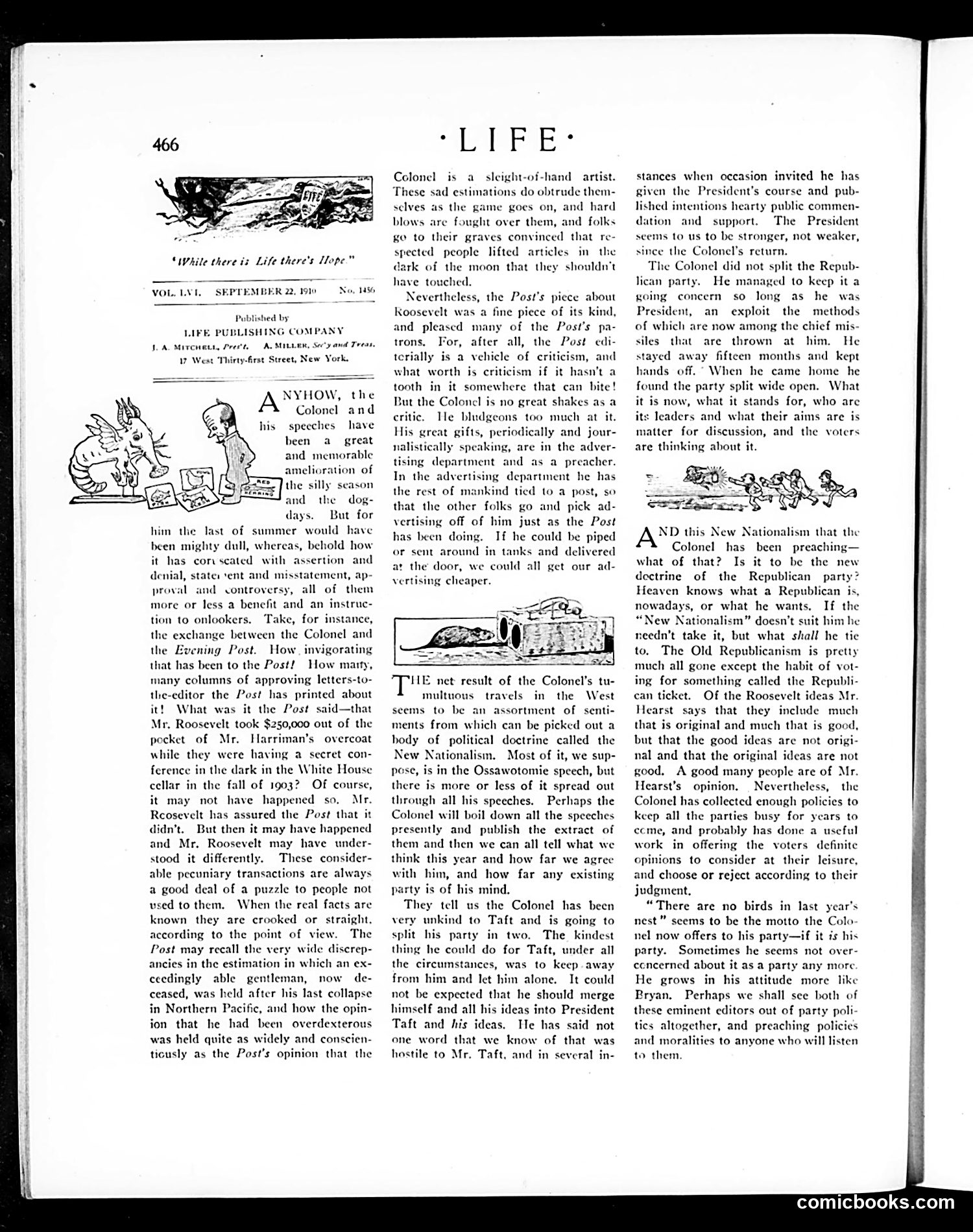
The main cartoon depicts **Colonel Theodore Roosevelt** (identifiable by the text and characteristic features) engaged in political maneuvering. The satire centers on Roosevelt's relationship with the Republican Party and "New Nationalism." The article criticizes Roosevelt for his attempts to influence Republican politics while remaining outside the party structure—specifically regarding the 1912 party split when Roosevelt ran as a Progressive ("Bull Moose") candidate against President Taft. The cartoon's central joke appears to be that Roosevelt, despite his outsider status, maintains considerable influence over Republican discourse and strategy, much like a puppet master controlling proceedings from behind the scenes. The piece satirizes his continued political relevance and interventionist approach to party matters.
📄 Transcribed text from this page (OCR, searchable)
Machine-transcribed from the original scan — historical spelling and the odd misread are preserved.
Poblished by LIFE PUBLISHING COMPANY AM ey and Treas. NYHOW, the Colonel and his speeches have been a great and memorable ation of amelic the s andthe days. But for him the last of summer would have been mighty dull, whereas, behold how it has coriscated with assertion and denial, state tent and misstatement, ap- proval and controversy, all of them more or less a benefit and an instruc- tion to onlookers. Take, for instance, the exchange between the Colonel and the Evening Post. How. invigorating that has been to the Post! How marty, many columns of approving letters-to- the-editor the Post has printed about it! What was it the Post said—that Mr, Roosevelt took $250,000 out of the pocket of Mr. Harriman’s overcoat while they were having a secret con- ference in the dark in the White House cellar in the fall of 1903? Of course, it may not have happened so. Mr. Reosevelt has assured the Post that it didn’t. But then it may have happened and Mr. Roosevelt may have under- stood it differently. These consider- able pecuniary transactions are alway a good deal of a puzzle to people not used to them. When the real facts are known they are crooked or straight. according to the point of vie The Post may recall the very wide discrep- ancies in the estimation in which an ex- ceedingly able gentleman, now de- ceased, was held after his last collapse in Northern Pacific, and how the opin- ion that he had been overdexterous was held quite as widely and conscien- ticusly as the Post’s opinion that the “aLAIRP AE. Colonel is a sleight-of-hand artist. These sad estimations do obtrude them- selves as the game goes on, and hard blows are fought over them, and folks go to their graves convinced that re- spected people lifted articles in th dark of the moon that they shouldn't have touched. Nevertheless, the Post's piece about Koosevelt was a fine piece of its kind, and pleased many of the Post's pa- trons, For, after all, the Post edi- terially is a vehicle of criticism, and what worth is criticism if it hasn't a tooth in it somewhere that can bite! But the Coloncl is no great shakes as a critic. He bludgeons too much at it. His great gifts, periodically and jour- nalistically speaking, are in the adver- tising department and as a preacher. In the advertising department he has the rest of mankind tied to a post, so that the other folks go and pick ad- vertising off of him just as the Post has been doing. If he could be piped or sent around in tanks and delivered at the door, we could all get our ad- vertising cheaper. = net result of the Colonel's tu- multuous travels in the Wes: seems to be an assortment of senti- nts from which can be picked out a body of political doctrine called the New Nationalism. Most of it, we sup- pose, is in the Ossawotomie speech, but there is more or less of it spread out through all his speeches. Perhaps the Colonel will boil down all the speeches presently and publish the extract of them and then we can all tell what we think this year and how far we agree with him, and how far any existing party is of his mind. They tell us the Colonel has been very unkind to Taft and is going to split his party in two. The kindest thing he could do for Taft, under all the circumstances, was to keep. away from him and let him alone. It could not be expected that he should merge himself and all his ideas into President Taft and his ideas. He has said not one word that we know of that was hostile to Mr. Taft, and in several in- stances when occasion invited he has given the President's course and pub- lished intentions hearty public commen- dation and support, The President seems to us to be stronger, not weaker, since the Colonel's return. The Colonel did not split the Repub- lican party. He managed to keep ita going concern so long as he was President, an exploit the methods of which are now among the chief mis- siles that are thrown at him. He stayed away fifteen’ months and kept hands off.’ When he came home he found the party split wide open. What it is now, what it stands for, who are its leaders and what their aims are is matter for discussion, and the voters ing about it. ND this New Nationalism that the Colonel has been preaching— what of that? Is it to be the new dectrine of the Republican party? Heaven knows what a Republican is, nowadays, or what he wants. If the “New Nationalism” doesn’t suit him he needn't take it, but what shall he tic to, The Old Republicanism is pretty much all gone except the habit of vot- ing for something called the Republi- can ticket. Of the Roosevelt ideas Mr. Hearst that they include much that is original and much that is good, but that the good ideas are not origi- nal and that the original ideas are not good, A good many people are of Mr. Hearst’s opinion. Nevertheless, the Colonel has collected enough policies to keep all the parties busy for years to ecme, and probably has done a useful work in offering the voters definite opinions to consider at their leisure, and choose or reject according to their judgment. “There are no birds in last year’s nest” seems to be the motto the Colo. nel now offers to his party—if it is his party. Sometimes he seems not over- concerned about it as a party any more He grows in his attitude more like Bryan. Perhaps we shall sce both of these eminent editors out of party poli- tics altogether, and preaching policies and moralities to anyone who will listen to them. comicbooks.com