
Life, 1910-09-22 · page 23 of 40
Life — September 22, 1910 — page 23: what you’re looking at
What you’re looking at
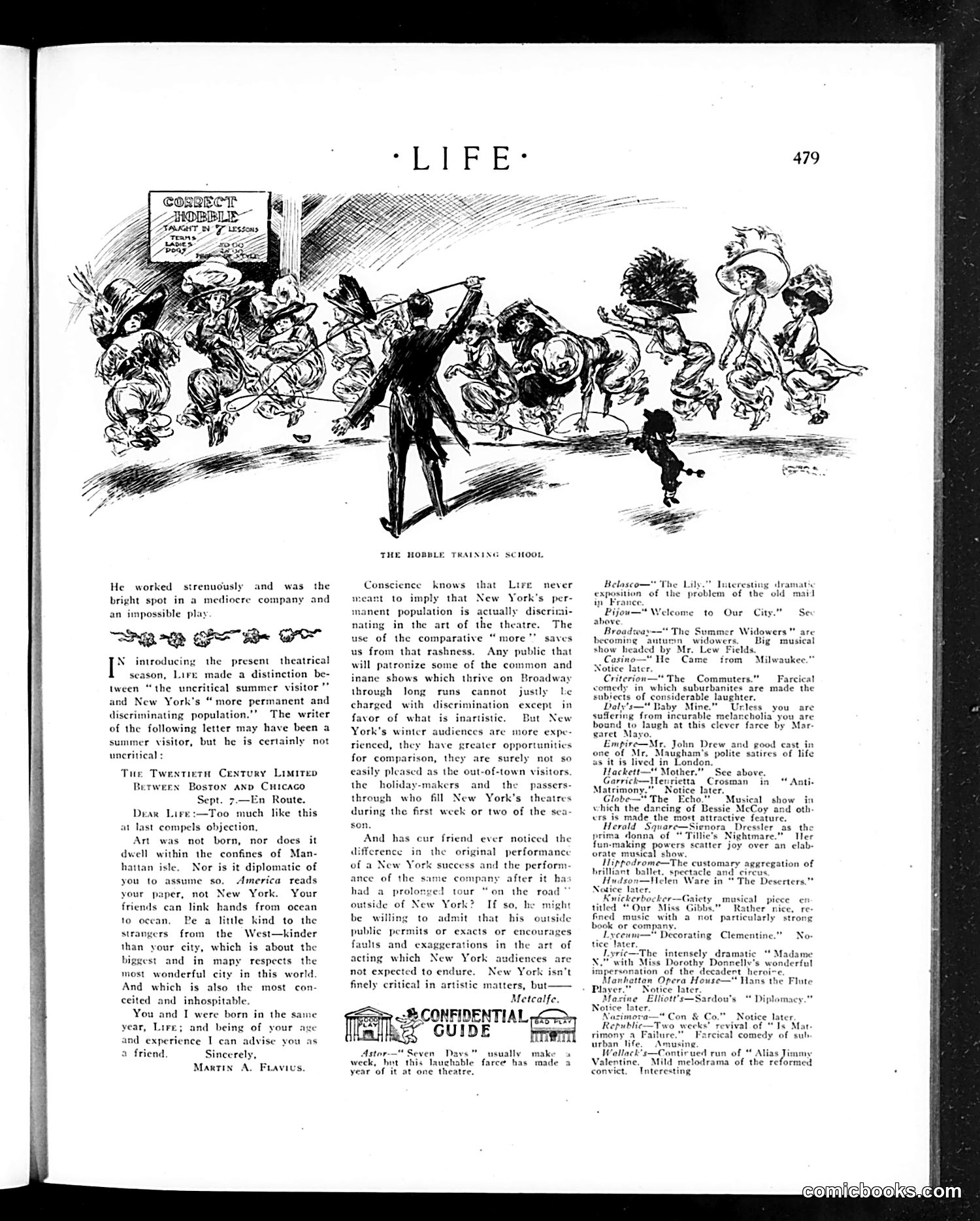
This cartoon satirizes New York City's theatrical snobbery. The sketch depicts a tall, thin instructor in formal dress training a group of rotund, awkwardly-postured figures labeled "The Hobble Training School"—a reference to the fashionable but restrictive "hobble skirt" silhouette popular around 1910. The accompanying letter from a reader (Martin A. Flavius) criticizes *Life* magazine for dismissive attitudes toward "summer visitors" and out-of-town audiences, arguing that New York unfairly considers itself the arbiter of theatrical taste. The cartoon visualizes this critique: the "training" transforms ordinary people into conformist, uncomfortable shapes—suggesting New York's establishment forces artificial standards onto outsiders rather than judging theater on genuine artistic merit.
📄 Transcribed text from this page (OCR, searchable)
Machine-transcribed from the original scan — historical spelling and the odd misread are preserved.
He worked strenuously and was the bright spot in a mediocre company and I the present theatrical season, Lirr made a distinction be- tween “the uncritical summer visitor" and New York's “more permanent and discriminating population."’ The writer of the following letter may have been a summer visitor, but he is certainly not uncritical Tue Twextiert Century Listitep Rerweex Bostox axp Cuicaco cpt. 7.—En Route. Dear Lire:—Too much like this at last compels objection. Art was not born, nor does it dwell within the confines of Man- hattan isle, Nor is it diplomatic of you to assume so, America reads your paper, not New York. Your friends can link hands from ocean to ocean. Pe a little kind to the strangers from the West—kinder than your city, which is about the biggest. and in many respects the most wonderful city in this world And which is also the most con- ceited and inhospitable You and I were born in the same r, Lire; and being of your axe and experience I can advise you as a friend. Sincerely, Maxtin A. Fravivs. THE MOBBLE TRAINING SCItOOL Conscience knows that Lire never meant to imply that New York's per- manent population is actually diserirai nating in the art of the theatre use of the comparative “ more’? saves us from that rashness. Any public that will patronize some of the common and inane shows which thrive on Broadway through long runs cannot justly be charged with discrimination except in favor of what is inartistic. But New York's winter audiences are more expe- rienced, they have greater opportunities for comparison, they are surely not so easily ple out-of-town visitors. the ho crs and the passers- through who fill New York's theatres during the first week or two of the sea son. And has cur friend ever noticed the difference in the original performance New Y The ofa success and the perform- of the same company after it bas had a prolonged tour “on the road outside of New York? If so, he might be willing to admit that his public permits or exacts or encourages rt of ane uiside faults and exaggerations in the acting which New York audiences a: not expected to endure. New York isn’t finely critical in artistic matters, but Metcalfe. % CONFIDENTIAL n> GUIDE Astor. ven Dave usually make 4 week, hut this laughable farce has made a year of it at one theatre, TT 479 Lily.” Interesting exposition of the problem of the old in Francs Pijou—" Welcome to Our City above Bro. becoming autumn show headed by Mr. Lew F c Summer Widowers" are widowers. Big musical Ids. .Casino—" He Came from Milwaukee.” Notice later. Criterion—" The Commuters." — Farcical comedy in which suburbanites are made the subjects of considerable laughter. Del. Baby Mine.” Urless you are suffering from incurable melancholia you are bound to laugh at this clever farce by Mar- garet Mayo. Empire—Mr. John Drew and good cast in ¢ of Mr. Maugham’s polite satires of life as it is lived in London. Hackett—" Mother.” See above. Garrick—Menrietta Crosman in“ Anti. Matrimon: Notice later. Globe—* The Echo." “Musical show in which the dancing of Bessie McCoy and oth ers is made the most attractive feature, Herald Square—Sienora Dressler as the prima donna of “ Tillie’s Nightmare.” Her n-making powers scatter joy over an elab- orate musical show. intodrome—The customary aggregation of brilliant ballet. spectacle i) cian Helen Ware in “The Deserters.” iety musical picce ss Gibbs.” Rather nice, re fined music with a not particularly. strong book or company. —" Decorating Clementine.” No tice later, Lyrie—The intensely dramatic “ Madame "with Miss Dorothy Donnellv’s wonderful n of the decadent he Notice later vival of “Is Mar cal comedy of sul rimony a Failure.” urban life, Amusing. Wellack's—Contirued run of “ Alias Ji Vale Mild melodrama of the refoi ct. Interesting icomicbooksseom a=