
A complete issue · 40 pages · 1910
Life — September 15, 1910
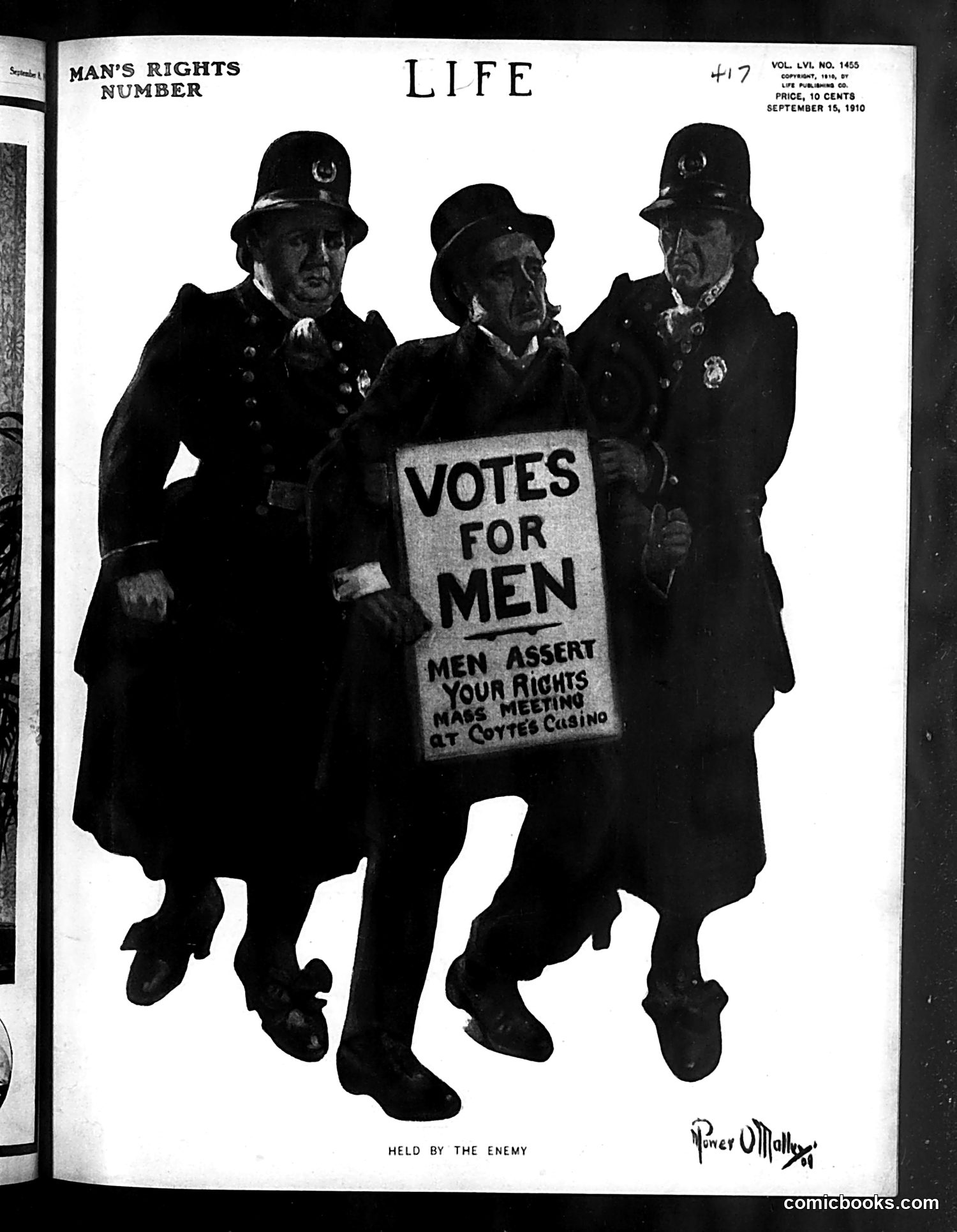
This Life magazine cover from September 15, 1910 is titled "Man's Rights Number" and depicts three German military officers in spiked helmets ("Pickelhaube") being arrested or confronted by authorities. The central figure holds a sign reading "VOTES FOR MEN / MEN ASSERT YOUR RIGHTS / MASS MEETING AT COYTED CASINO." The caption reads "HELD BY THE ENEMY." The satire appears to mock German men's rights advocates by portraying them as prisoners of their own militaristic state. The imagery suggests that aggressive German militarism—represented by the authoritarian military uniforms—actually oppresses men's freedoms rather than liberates them. This likely comments on contemporary debates about suffrage and male political rights, contrasting them with Germany's repressive military culture. The cartoon critiques German authoritarianism through dark humor.
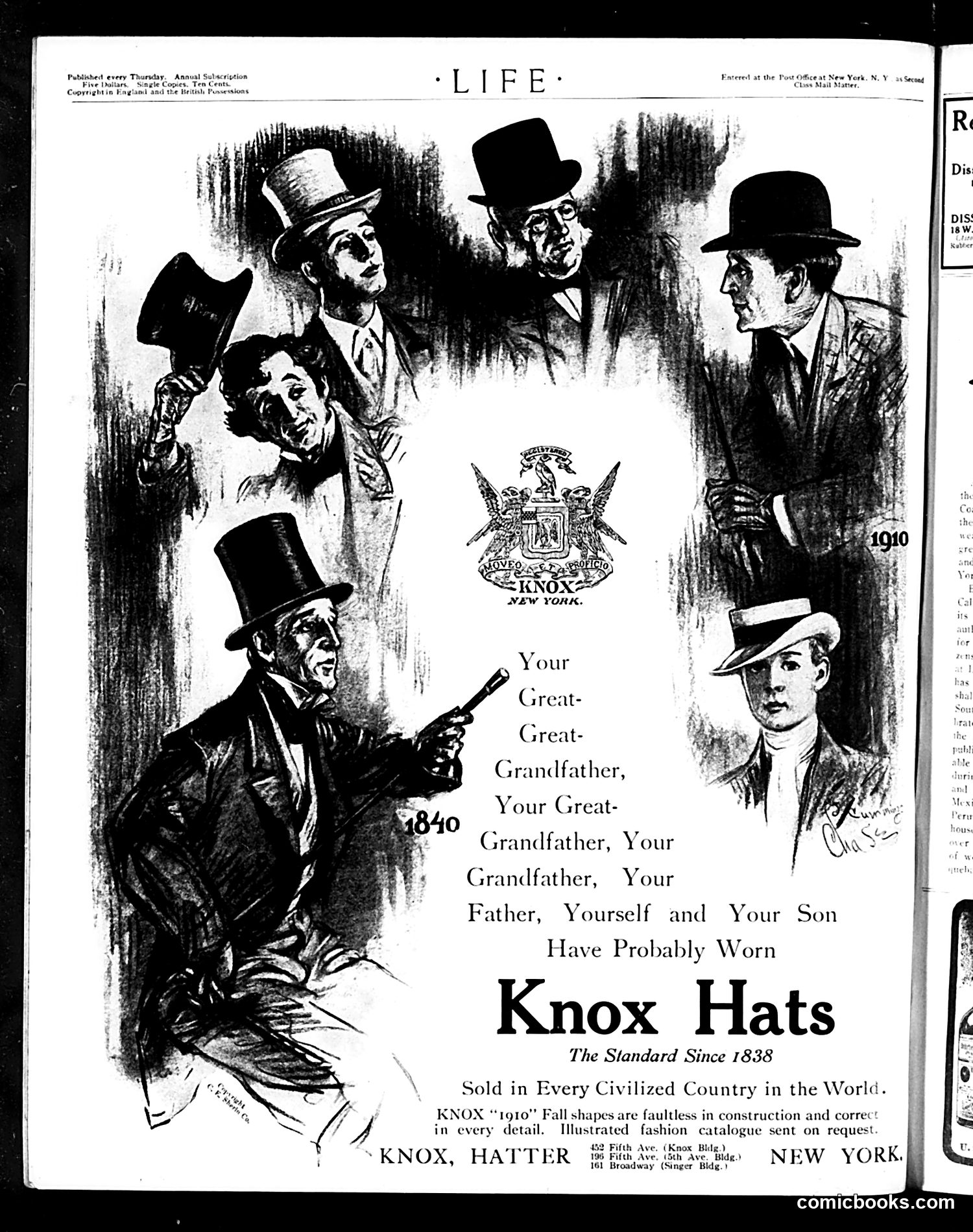
This is primarily a **commercial advertisement** for Knox Hats, a real American hat manufacturer established in 1838. Rather than a political cartoon, it's a marketing campaign using historical imagery for brand prestige. The illustration shows six men in formal dress spanning generations—labeled "1840" to "1910"—representing a family lineage from great-great-grandfather through son. Each wears a Knox hat, visually arguing the product's longevity and respectability across American history. The accompanying text claims Knox hats have been "The Standard Since 1838" and were "Sold in Every Civilized Country in the World." This reflects early 20th-century advertising strategy: linking consumer products to tradition, social status, and generational continuity to encourage purchases among aspirational middle-class readers of *Life* magazine.
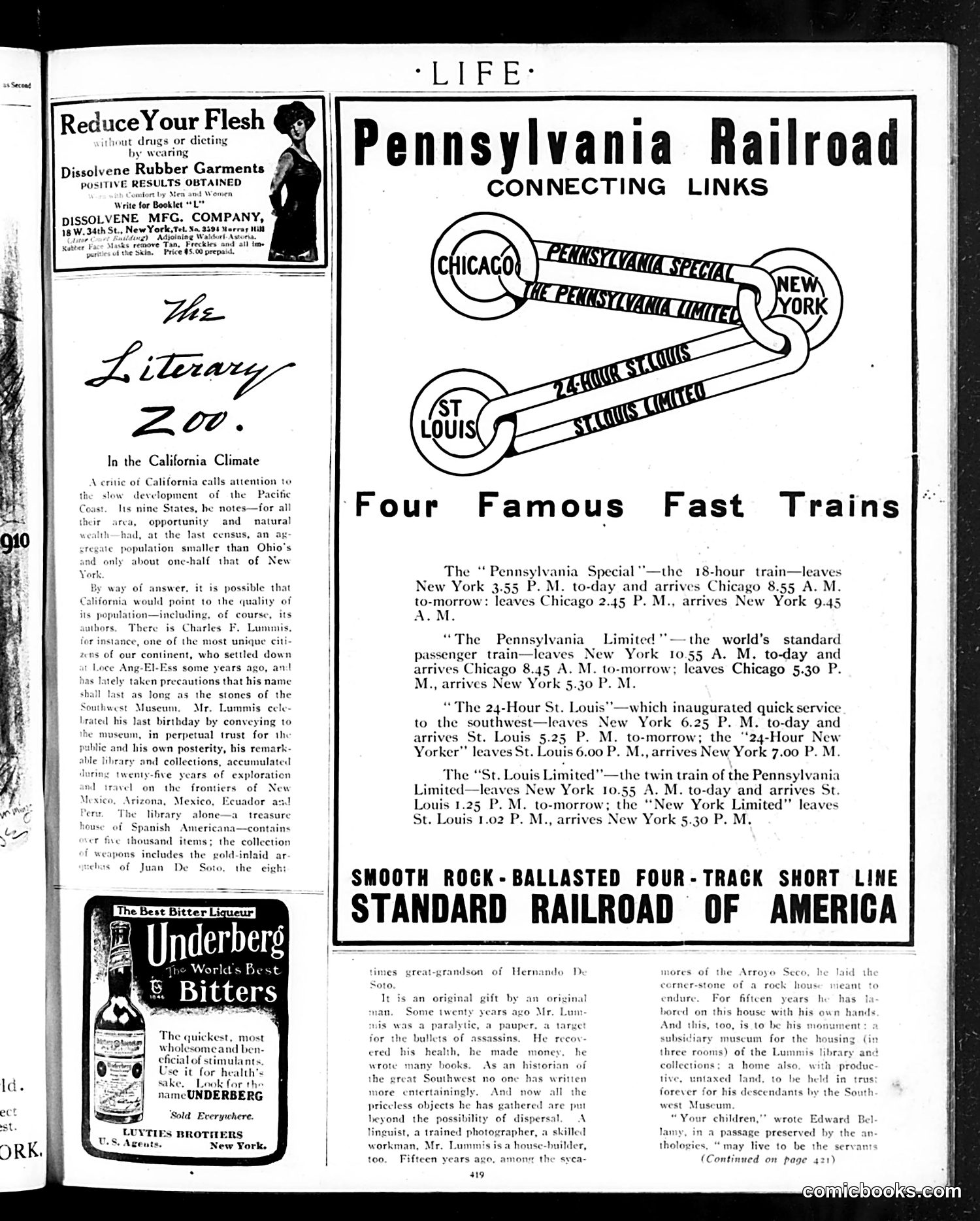
This page is primarily **advertising and informational content**, not satirical cartoons. The main feature is a Pennsylvania Railroad advertisement promoting "Four Famous Fast Trains" connecting Chicago, New York, and St. Louis. The diagram shows route connections with specific train names and schedules (the Pennsylvania Special, Pennsylvania Limited, 24-Hour St. Louis, and St. Louis Limited). The left side contains advertisements for: - Dissolyene rubber reducing garments - "The Literary Zoo" article about California - Underberg Bitters The humor appears limited to a small illustration in the rubber garment ad showing a woman in period dress, typical of early 20th-century product marketing rather than political satire. This is a standard magazine page mixing editorial content with commercial advertisements.
This page is not a political cartoon but rather satirical editorial commentary titled "A New Mental Régime." Life magazine announces a premium subscription system for its "would-be mental subscribers," charging five imaginary dollars to access mental content. The satire targets readers described as "purely physical materialistic" who struggle with intellectual engagement. Life proposes this mock "mental régime" as humorous self-improvement, suggesting readers need help graduating from purely physical to "higher mental life." The piece includes a complaint letter from an advertiser who wants mental advertising without paying premium rates, which Life dismissively rejects. This is primarily satirical commentary on intellectual capacity and magazine economics rather than political cartooning, using absurdist humor to critique both reader sophistication and advertiser entitlement.
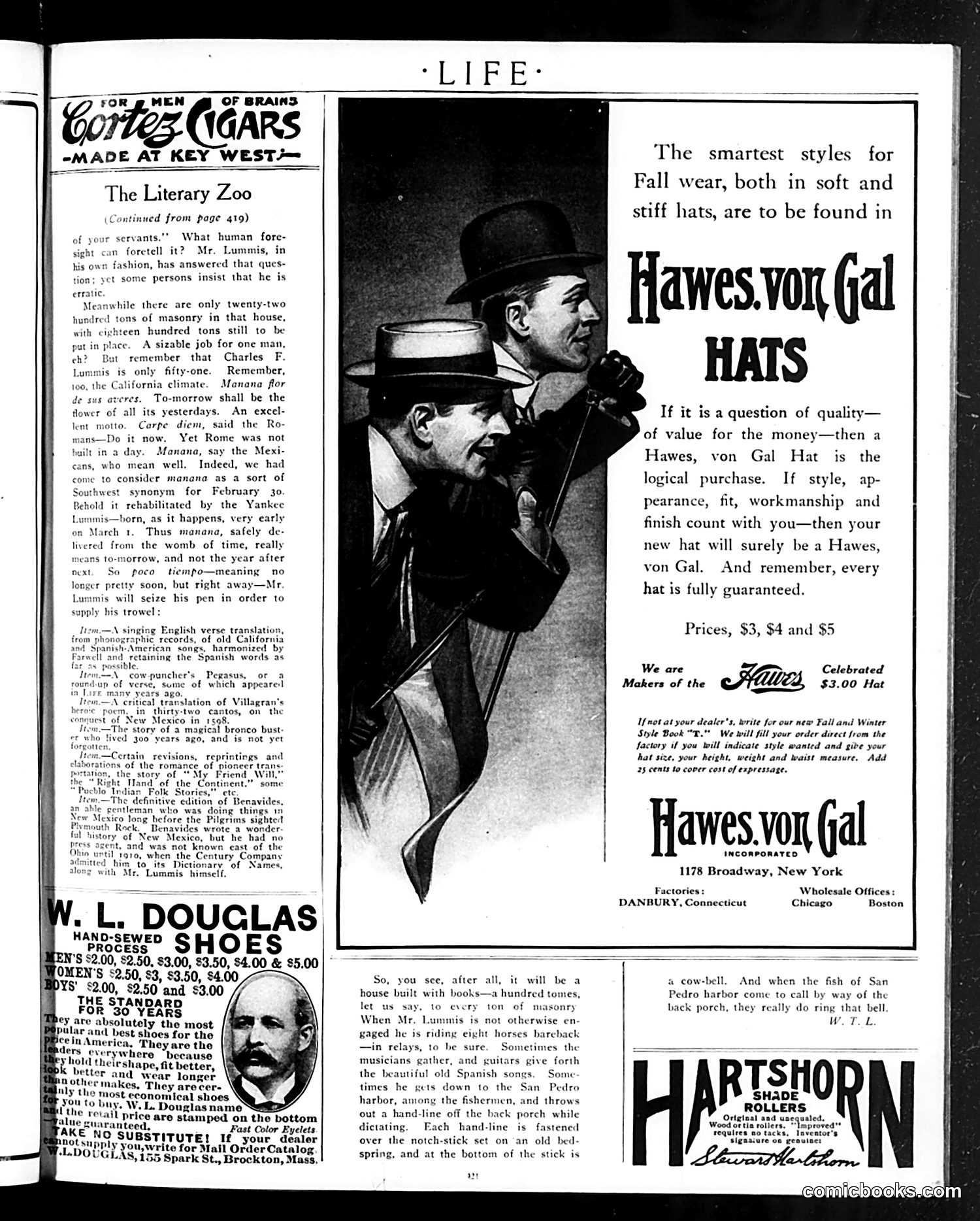
This page is primarily **advertising** for three products: Cortez Cigars, W.L. Douglas Shoes, and Hawes von Gal Hats. The only editorial content is a small section titled "The Literary Zoo" (continued from page 219), which appears to be a humorous column about literary figures and wordplay. The OCR text is largely illegible, but references Spanish words, translations, and folk stories, suggesting satire of literary pretension or obscure cultural references. The cartoon illustration accompanying the text shows two men in period dress, but without clearer context from the garbled OCR, I cannot definitively identify them or explain the specific satirical point. The column seems aimed at educated readers who'd recognize literary allusions, but the exact target of the satire remains unclear from this image alone.
This page is primarily a **cigarette advertisement**, not political satire. It promotes Pall Mall "Famous Cigarettes" with pricing ("A Shilling in London / A Quarter Here"), indicating this is from an era when cigarette advertising was common in magazines. The advertisement includes a coat of arms and a decorative box claiming "Aristocrats of select Ancestry"—marketing language positioning the product as premium and exclusive, appealing to aspirational consumers. There is no political cartoon or satire present. This represents straightforward early-20th-century luxury product marketing that emphasized social status and exclusivity, using heraldic imagery to suggest prestige and heritage.
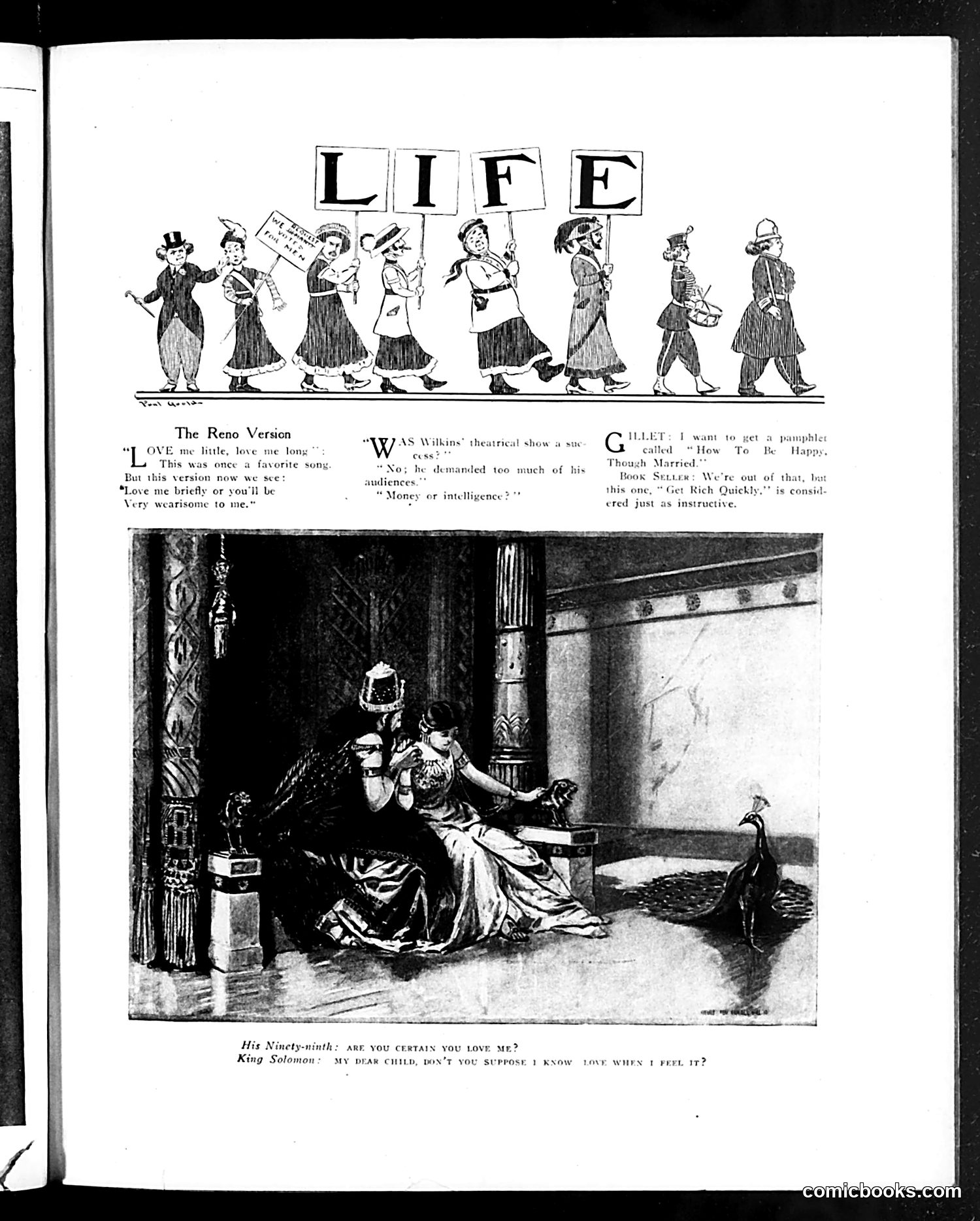
This page satirizes contemporary theatrical and social conventions. **Top illustration:** Eight figures in a procession hold letters spelling "LIFE," satirizing how the word represents different meanings to different people—a visual pun on life's varied interpretations. **Text sections** mock theatrical productions ("WAS Wilkins' theatrical show a success?") and self-help literature ("Get Rich Quickly"), suggesting these were popular but superficial responses to life's questions. **Bottom photograph:** Labeled "His Ninety-ninth," depicts an ornate scene with a reclining woman and peacock, likely referencing King Solomon's many wives. The caption humorously asks about certainty in love—implying skepticism about romantic devotion and fidelity. The overall satire critiques how early 20th-century Americans sought meaning through entertainment, quick-fix advice, and romantic idealization rather than substantive wisdom.
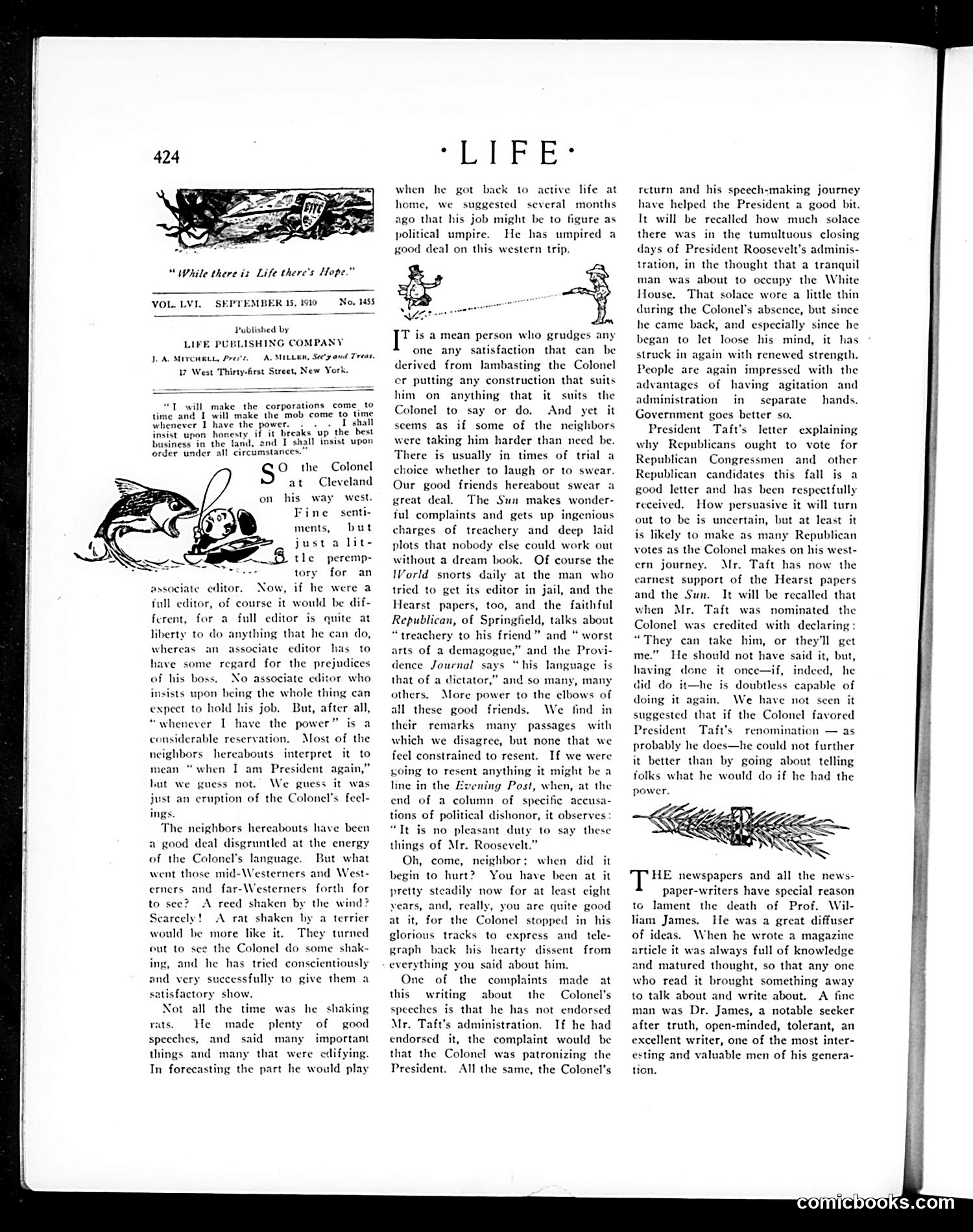
This page contains editorial commentary on Colonel Roosevelt (Theodore Roosevelt Jr., son of the former president). The text discusses the Colonel's recent western speaking tour and his relationship with the Taft administration. The small cartoon at top-left shows two figures in what appears to be a confrontational stance, likely depicting the Colonel's contentious public persona. The main satirical point: the Colonel has been criticizing President Taft's administration vocally, yet some observers question whether his complaints are justified or merely reflect his combative nature. The editorial suggests the Colonel "swears a great deal" and makes "ingenious charges" while others question his motives. The piece also notes admiration for the Colonel's energy and speech-making abilities, even while questioning the substance of his political critiques.
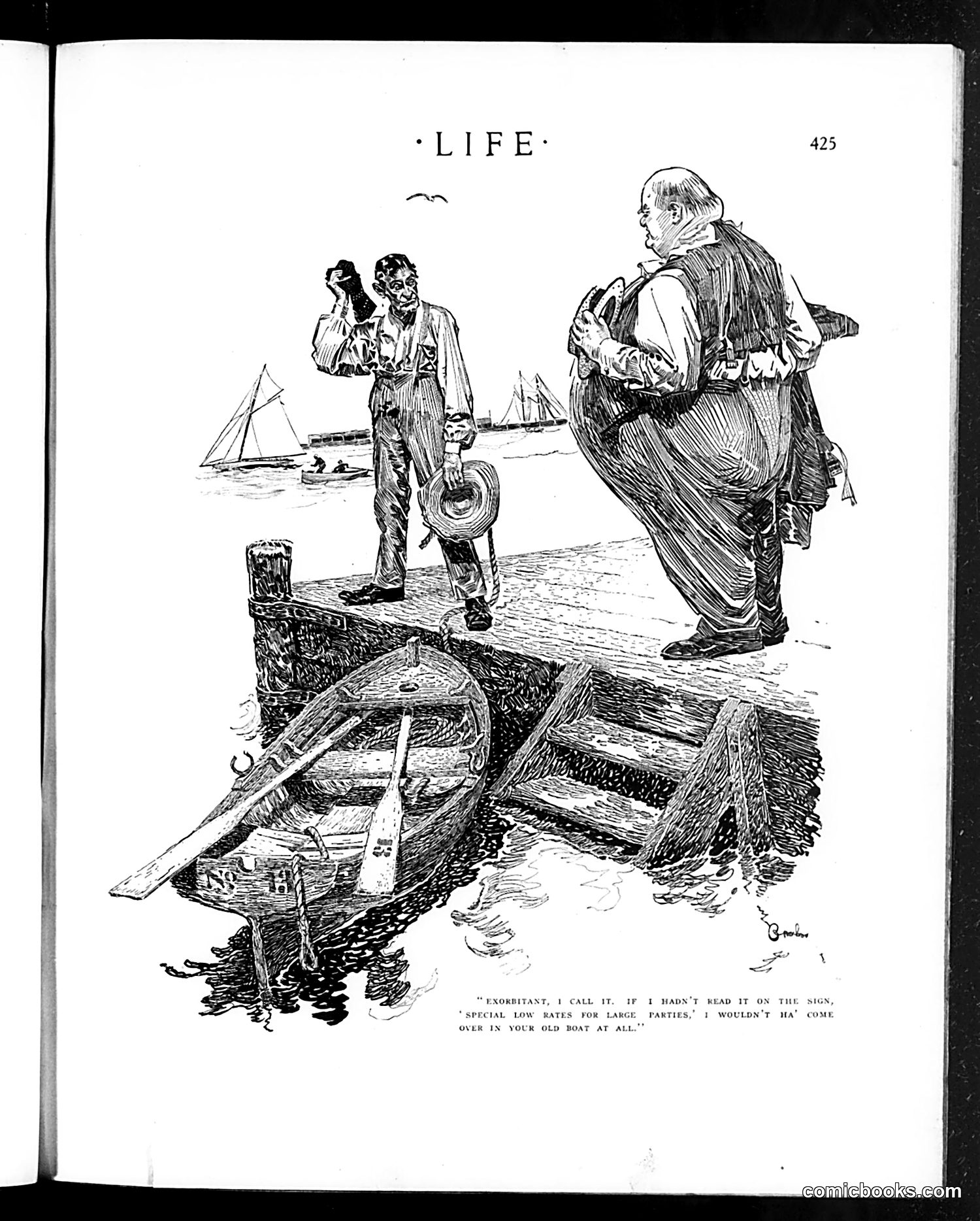
This cartoon depicts a seaside encounter between two men beside a dilapidated rowboat. The well-dressed man on the right appears to be a wealthy tourist or businessman, while the figure on the left seems to be a local boatman or operator. The caption reveals the joke's target: the man is complaining about exorbitant rental rates. He claims he wouldn't have rented the decrepit boat if he hadn't seen an advertised sign promising "special low rates for large parties." The satire mocks deceptive advertising practices—specifically, businesses displaying attractive promotional offers while relying on fine print or misleading signage to justify charging high prices anyway. This reflects early 20th-century consumer frustrations with commercial dishonesty.
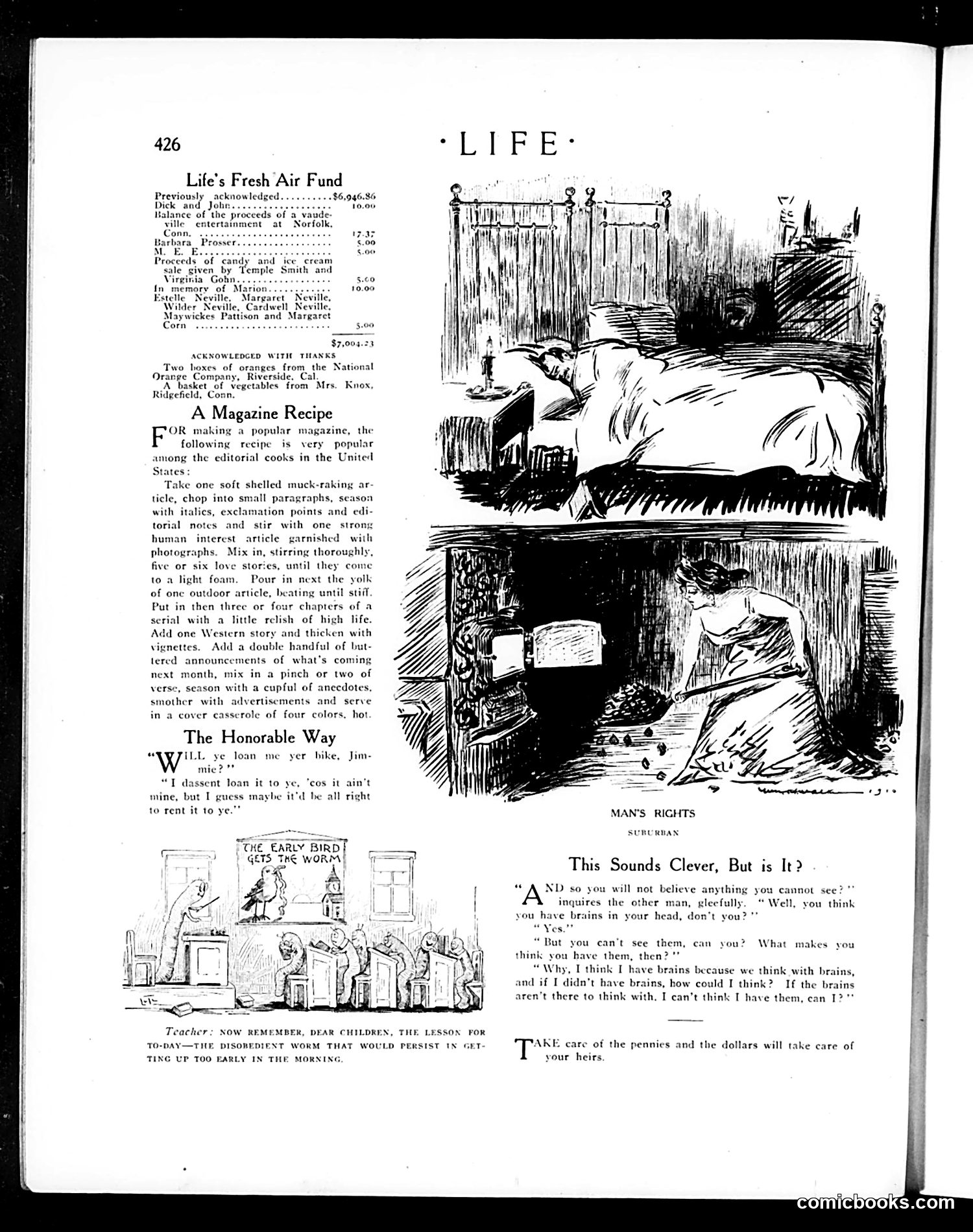
This page contains several distinct sections: **"A Magazine Recipe"** offers satirical editorial advice: take a "soft shelled muck-raking article," combine with human-interest stories and outdoor content, then "season with a little relish of high life" and advertisements. It's mockingly instructing how to construct a popular magazine formula. **"The Honorable Way"** depicts a lending transaction where one man asks to borrow a bike, offering to repay it later. The joke plays on the phrase "it ain't mine"—suggesting he can't lend what he doesn't own, yet he offers anyway. **"The Early Bird Gets the Worm"** (bottom cartoon) shows a classroom scene where a teacher instructs children about disobedient worms rising early, with the caption emphasizing the lesson's ironic moral. These are light satirical sketches typical of Life's humor focus.
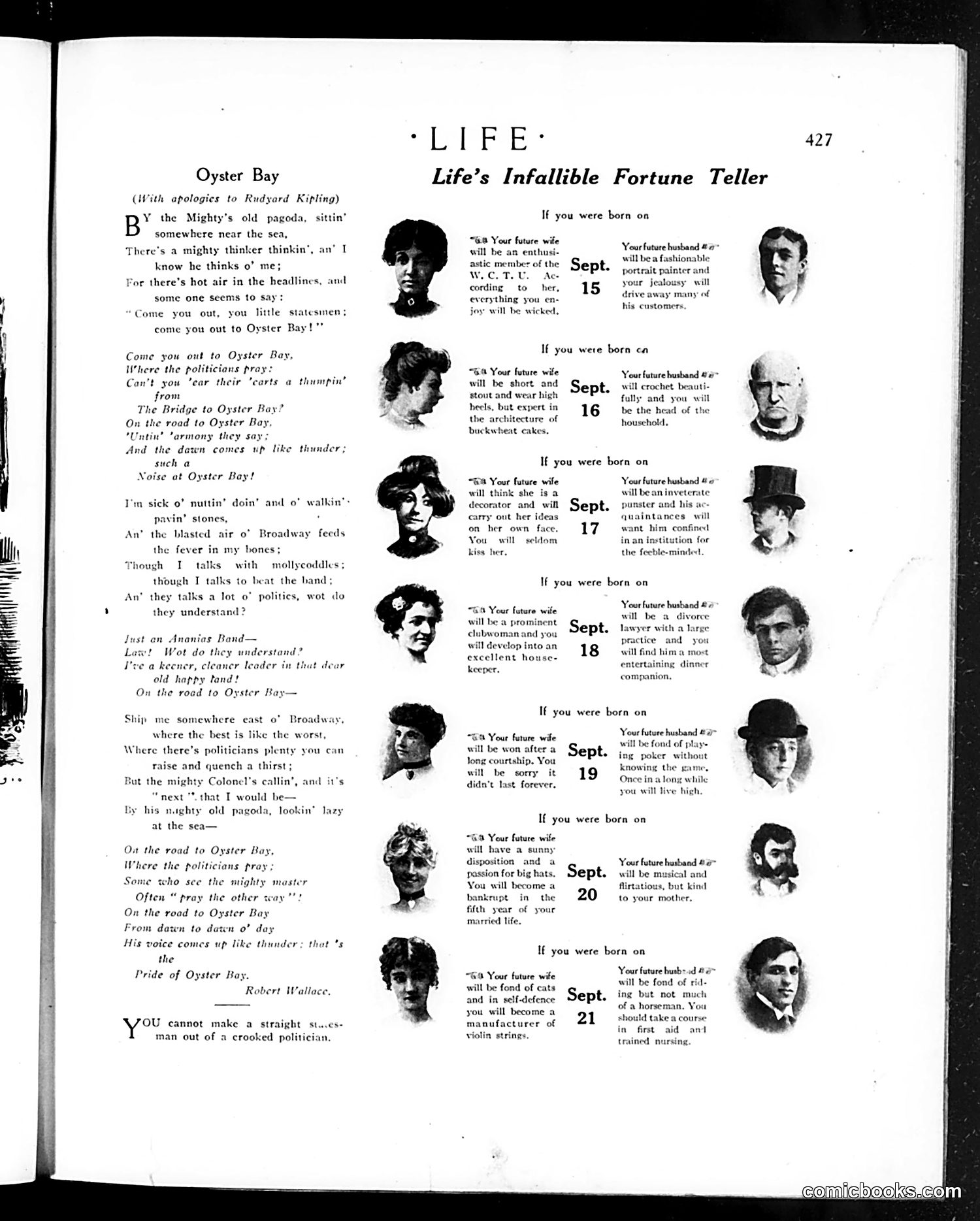
This page presents "Life's Infallible Fortune Teller," a satirical feature matching birthdates (September 15-21) with predictions about future spouses. Each date pairs a woman's portrait with a man's, accompanied by humorous predictions about their compatibility and roles. The satire mocks period gender stereotypes: women are predicted to become decorators, homemakers, and mothers, while men become "fashionable portrait painters," "divorce lawyers," and "musicians." The feature ridicules both fortune-telling pseudoscience and rigid Victorian gender expectations. The left page contains "Oyster Bay" poetry (with Kipling attribution), likely satirizing political figures associated with that location, though specific identities are unclear from the text alone.
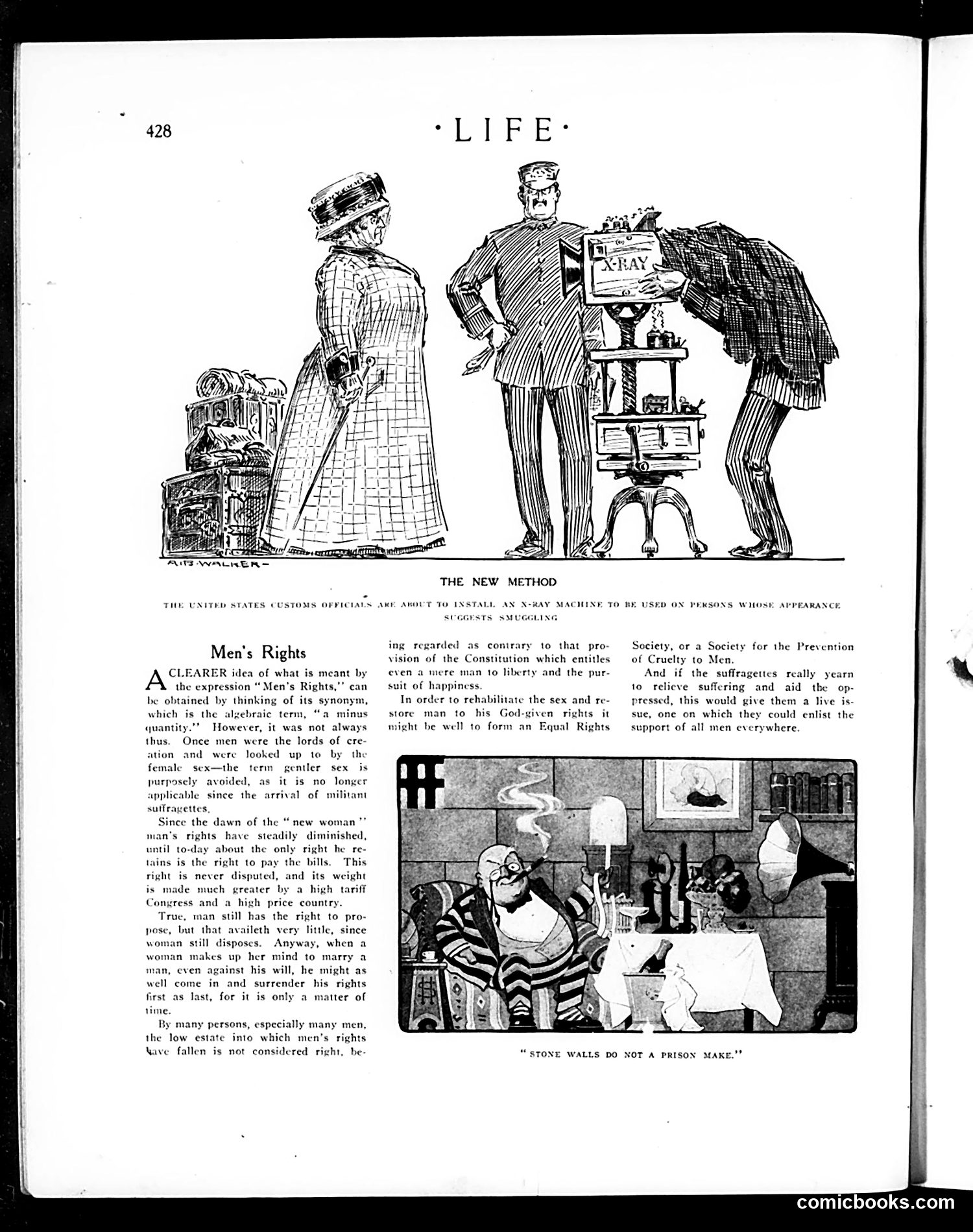
The top cartoon mocks proposed X-ray machines for detecting smuggling at U.S. Customs. It shows officials about to scan a woman's luggage, with the implication that X-rays would reveal contraband—and potentially expose her body beneath clothing, creating an invasive privacy violation. The article below, "Men's Rights," argues sarcastically that men have lost authority and rights to women, particularly regarding marriage and property. It advocates for an "Equal Rights" society to restore male dominance. The bottom photograph's caption, "Stone Walls Do Not a Prison Make," likely references women's domestic confinement, contrasting the suffragette movement's calls for freedom with their actual restrictions. Together, the page satirizes early 20th-century tensions between technological progress, gender relations, and individual privacy.
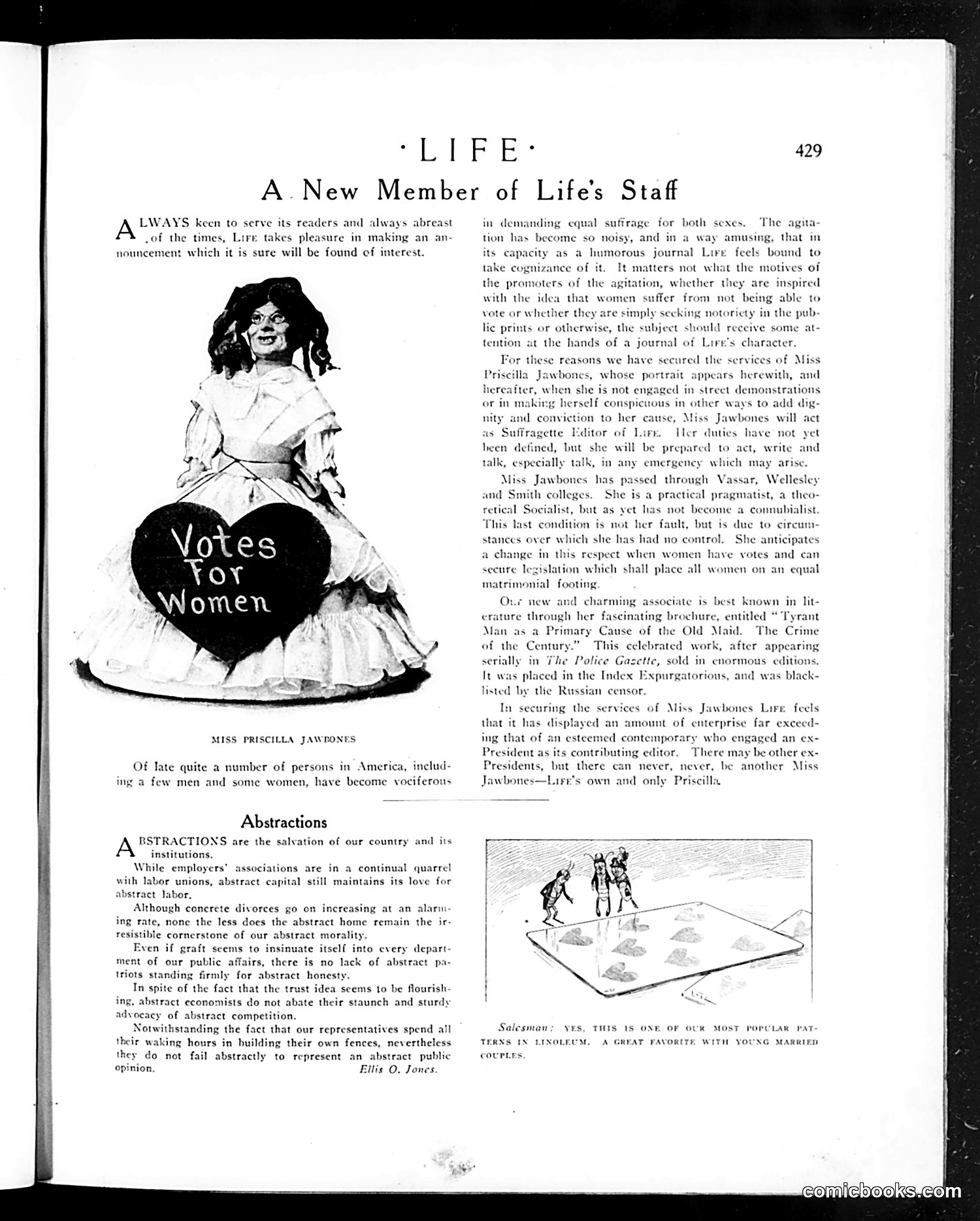
This page announces **Priscilla Jawbones as Life's new "Suffragette Editor."** The illustration shows a woman in Edwardian dress holding a large button reading "Votes for Women"—a direct reference to the women's suffrage movement of the early 20th century. The text indicates Jawbones is a practical socialist and author of works on social issues. Life presents her appointment ironically: while claiming to serve readers with "abreast of the times," the magazine satirizes the suffrage cause itself. The bottom section titled "Abstractions" mocks abstract idealism in politics, suggesting Life viewed such reform movements as impractical. The cartoonist's point: suffragettes are earnest but somewhat ridiculous advocates, worthy of satirical coverage rather than serious political consideration.
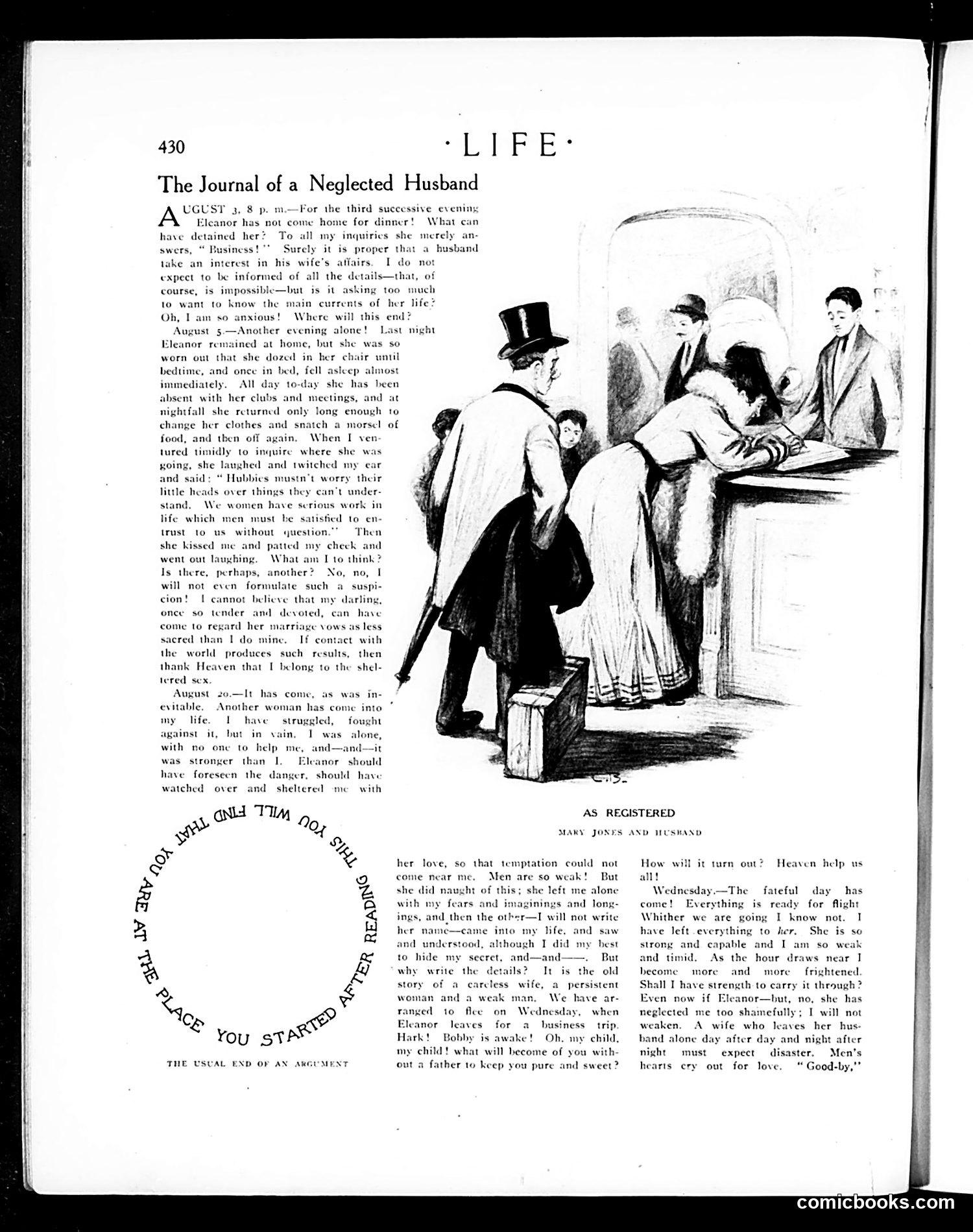
This is a serialized satirical narrative mocking a self-pitying husband. Over several August diary entries, a neglected husband complains that his wife Eleanor is constantly absent—attending clubs, meetings, and mysterious engagements without explanation. When he timidly asks where she goes, she dismisses his concerns as unmanly worry. The satire escalates: the husband, feeling lonely and vulnerable, allows another woman into his life. By August 20, he has decided to run away with her, justifying his infidelity by blaming Eleanor's neglect. The final entry shows him departing as Eleanor leaves for a business trip, with the moral: wives who leave husbands alone should "expect disaster." The joke targets the husband's weakness and self-deception—he blames Eleanor while absolving himself of responsibility. The illustration ("As Registered: Mary Jones and Husband") sardonically captures the domestic tension. The page satirizes both neglectful spouses and men's tendency to rationalize their own failings.
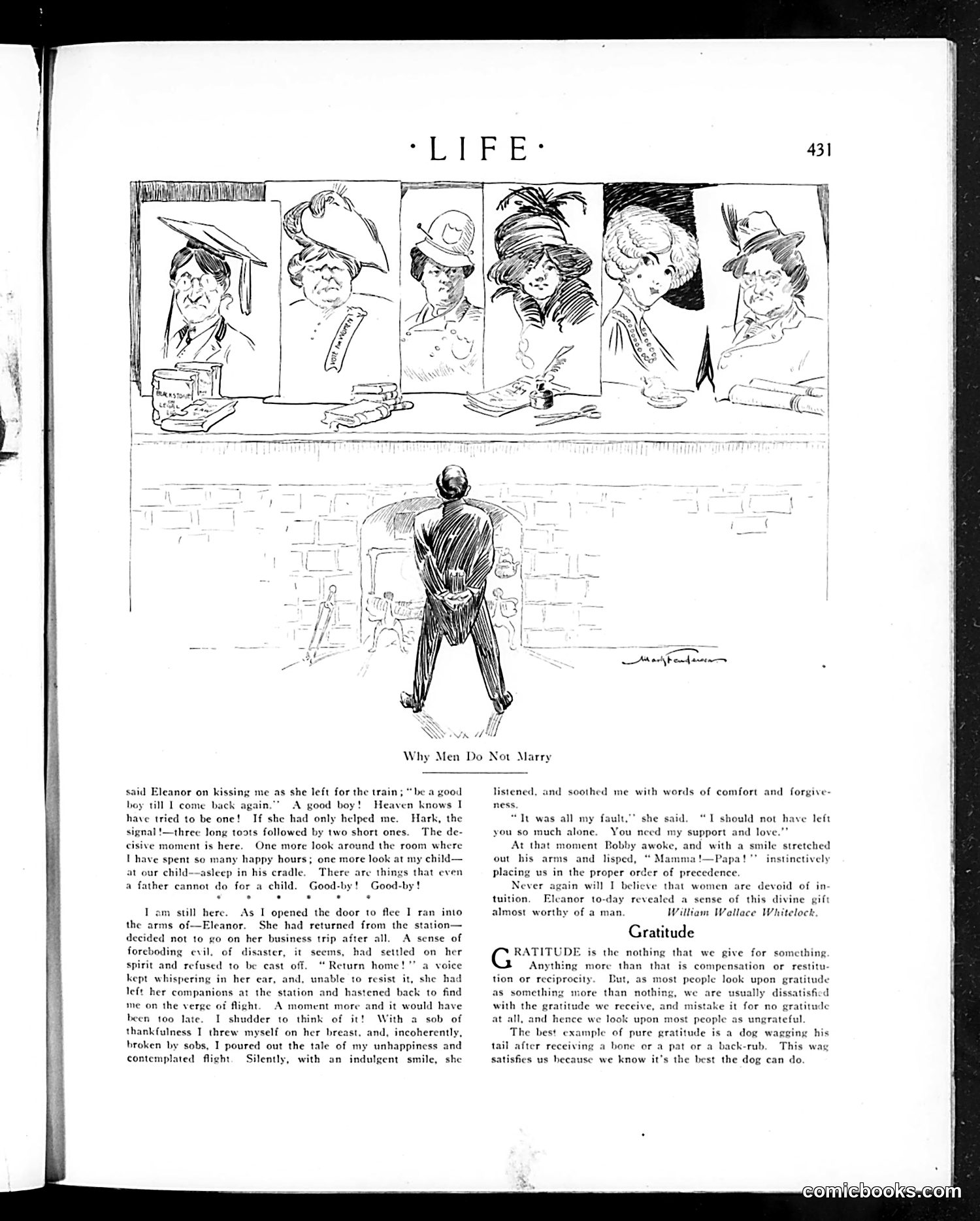
This page contains a humorous short story illustrated with six caricatured character sketches at the top, likely depicting various types of men or marital situations (the specific identities are unclear from the image alone). The main narrative is a sentimental domestic tale: a husband, on the verge of abandoning his wife and child, is stopped when his wife Eleanor returns from the train station, having had a premonition to come back. She forgives him, and their child awakes, symbolically placing the parents "in the proper order of precedence." The satire appears to mock both overly sentimental domestic fiction and the contradictions of marriage itself—the title "Why Men Do Not Marry" ironically frames a story where a man nearly leaves his family, only to be emotionally manipulated back into compliance through his wife's intuition and the child's innocence. The accompanying essay on "Gratitude" extends this cynical view, defining gratitude as "nothing" and comparing human gratitude unfavorably to a dog's tail-wagging—suggesting people are inherently ungrateful.
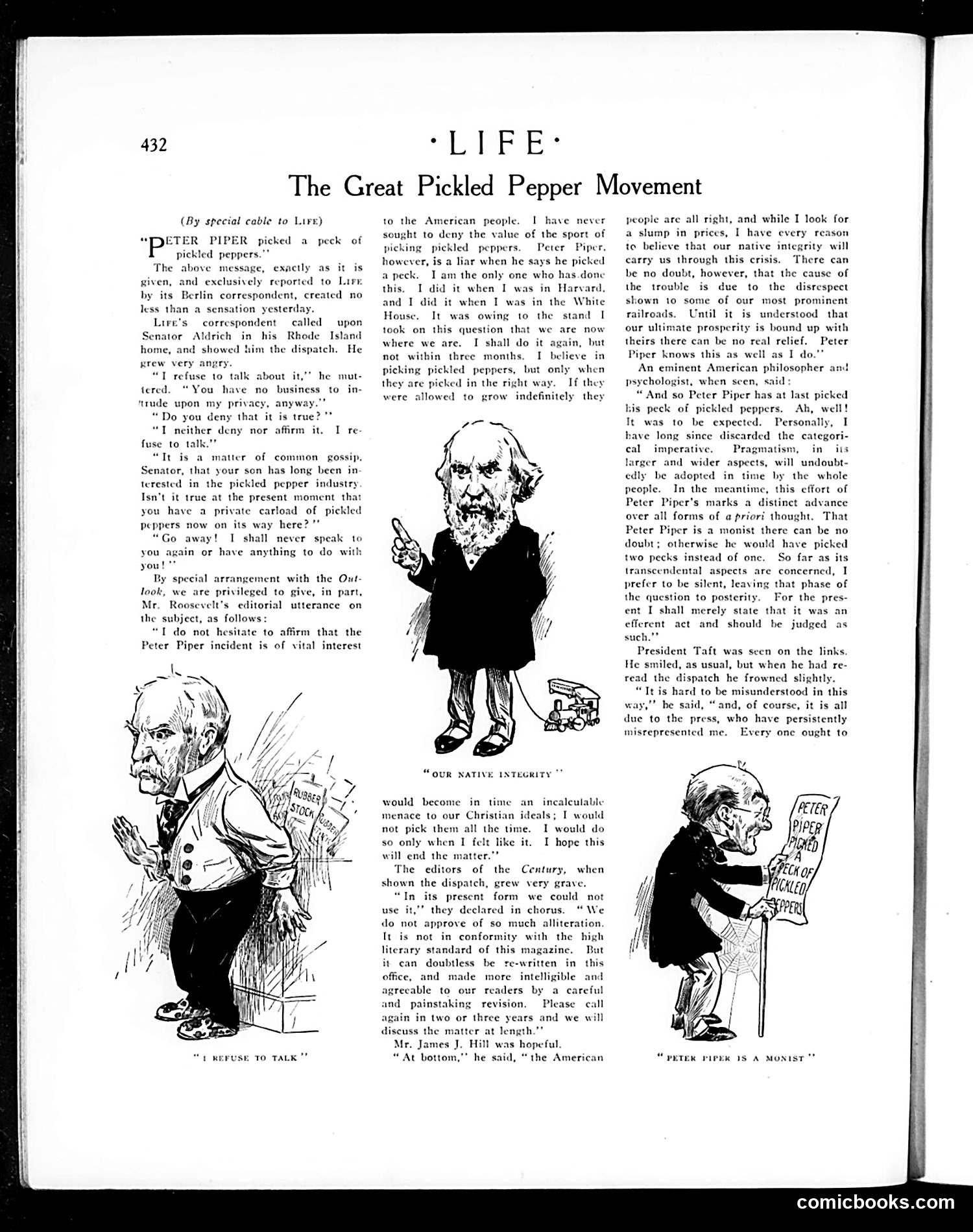
This Life magazine satire mocks prominent American figures' evasiveness about a trivial scandal: Peter Piper allegedly picking pickled peppers. The cartoon parodies how politicians and intellectuals respond to minor controversies with inflated rhetoric and self-aggrandizement. **Identified figures:** - Senator Aldrich (Rhode Island politician) refuses to discuss his son's pepper involvement - President Theodore Roosevelt claims he invented pepper-picking and alone possesses the authority to judge proper technique - James J. Hill (railroad magnate) uses the incident to promote railroad interests - Various magazine editors and philosophers offer overwrought commentary **The satire's point:** It mocks the era's tendency for prominent men to treat trivial matters with grandiose self-importance, dodge simple questions, and inject their pet causes (Roosevelt's accomplishments, Hill's railroads) into unrelated discussions. The nursery rhyme becomes a vehicle for skewering political posturing and intellectual pretension.
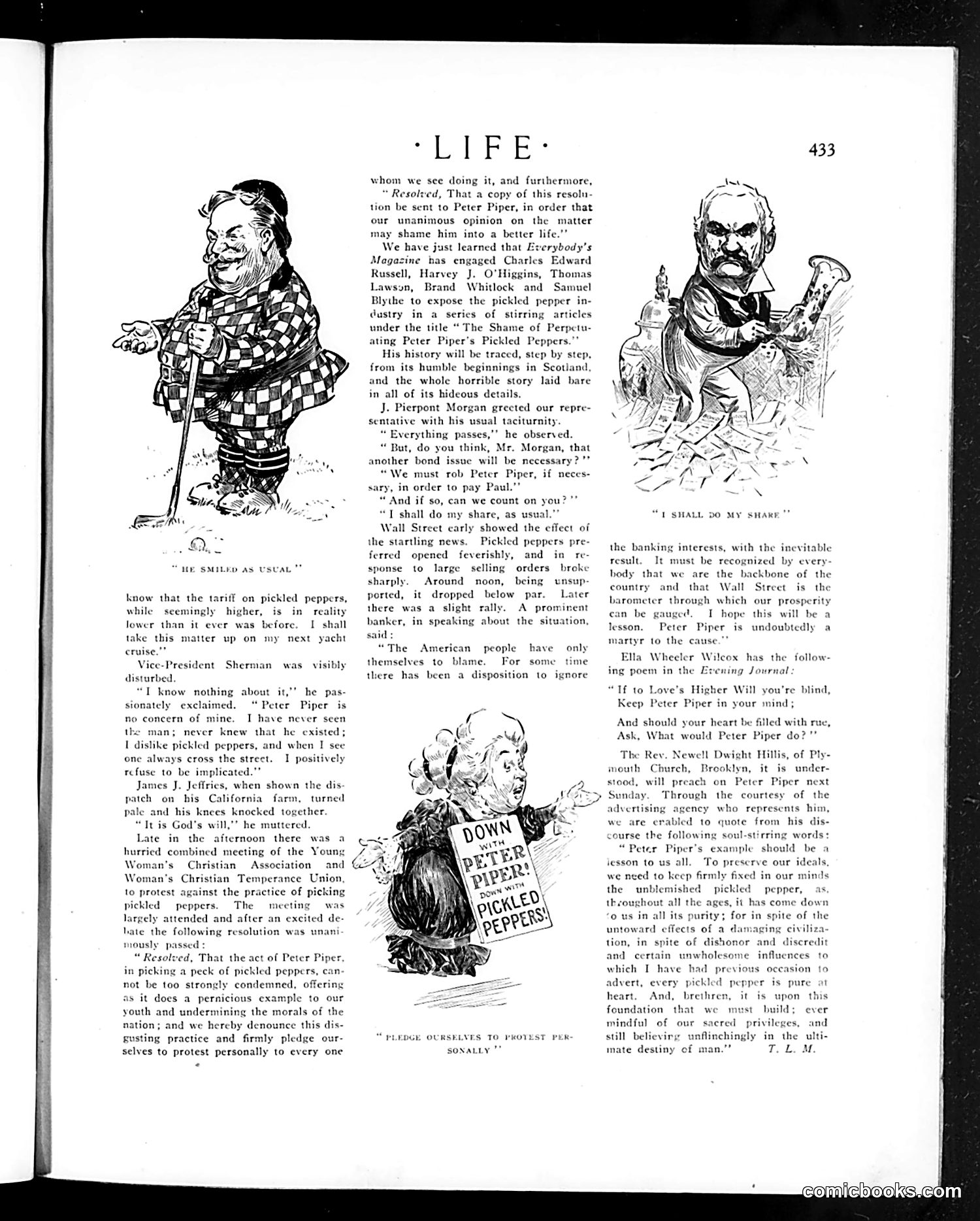
This is a satirical attack on the muckraking journalism trend of early 1900s America. The article mockingly imagines major public figures responding to a scandal about Peter Piper's pickled pepper industry—a nursery-rhyme figure used as an absurd stand-in for real corporate malfeasance. The cartoon ridicules how various powerful men deflect responsibility: Vice-President Sherman claims ignorance, J. Pierpont Morgan equivocates about finances, and prominent magazines (like *Everybody's*) rush to expose the "scandal" with sensationalist investigative series. The satire targets the era's widespread muckraking exposés (actual investigations into real industries), suggesting they're performative moral theater. Temperance unions pass resolutions, religious figures preach lessons, and Wall Street reacts dramatically—all over a children's rhyme. The joke: *Life* is mocking how America's institutions and media manufacture outrage over trivialities while ignoring (or participating in) actual corruption.
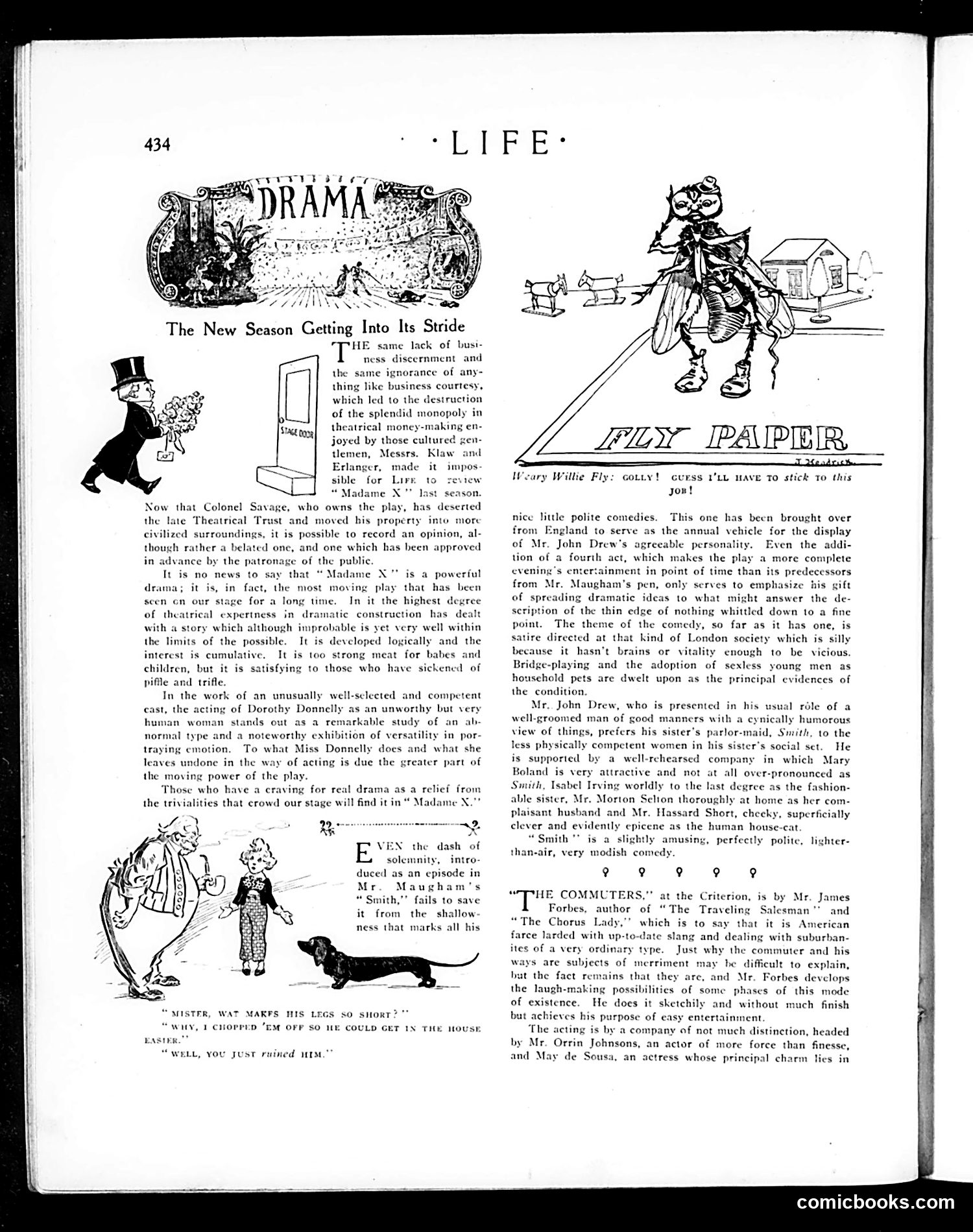
This page reviews current Broadway productions. The main article discusses **"Madame X,"** praising it as genuinely powerful drama—contrasting it with the theatrical monopoly previously controlled by producers Klaw and Erlanger, whom the writer criticizes for poor business practices. Dorothy Donnelly's performance is highlighted as exceptional. A secondary review covers **"Smith,"** a Somerset Maugham comedy imported from England featuring actor John Drew. The satire targets both the play's shallow London society setting (where wealthy people play bridge and keep "sexless young men as household pets") and Maugham's tendency to spread thin dramatic ideas. The cartoon at bottom shows "Weary Willie" (a common comic tramp character) discussing his amputated legs—he cut them off so his body would fit through a house door to avoid the expense of going around. His companion says this ruined the legs' usefulness. This is absurdist humor typical of Life's visual comedy, with no apparent connection to the theater reviews above.
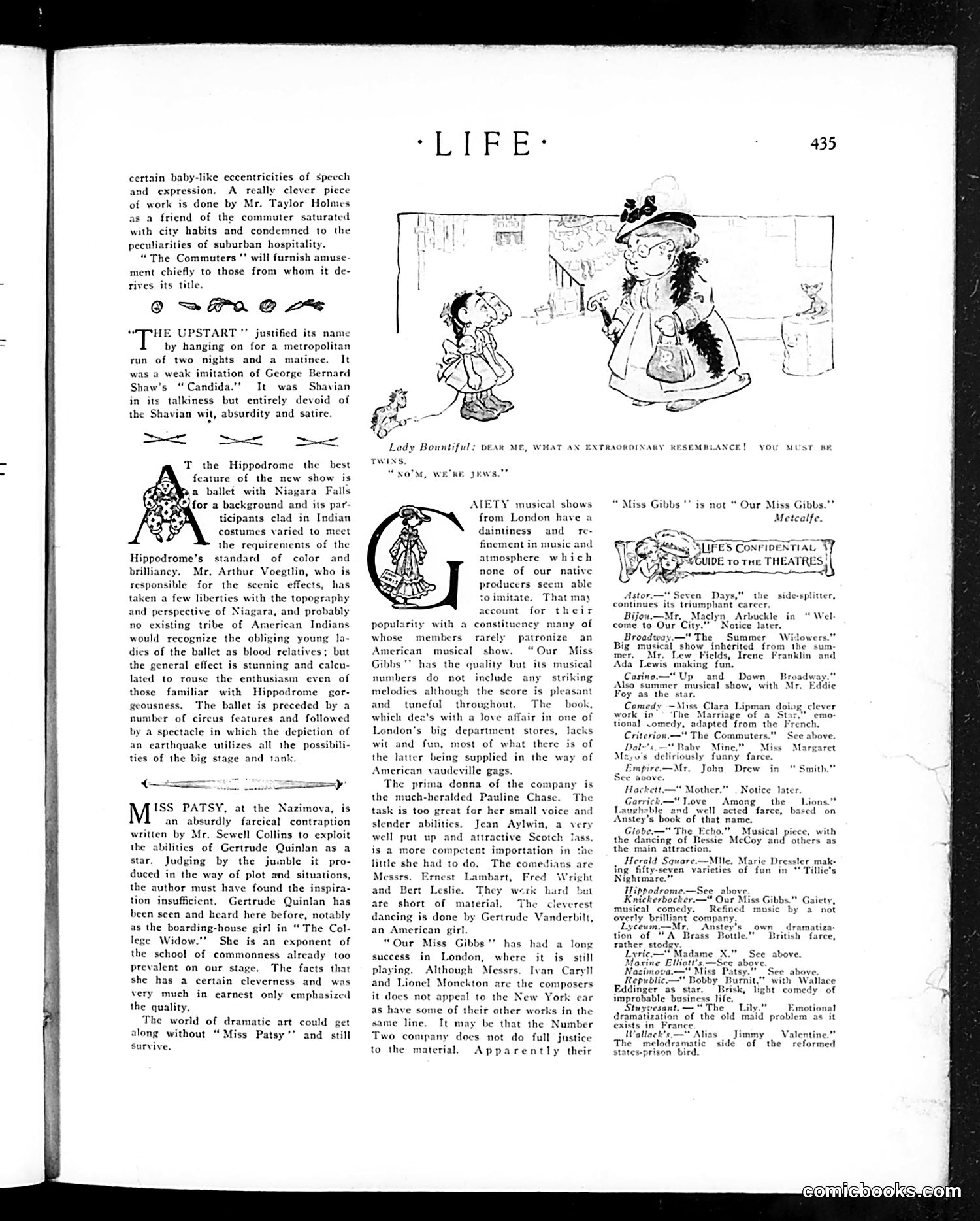
This page contains theater reviews from what appears to be an early 1900s issue of Life magazine. The main cartoon at top shows a wealthy woman (Lady Bountiful) encountering twins and remarking on their "extraordinary resemblance" — the joke being the obvious absurdity of commenting on twins looking alike. The bulk of the page reviews contemporary Broadway shows: "The Upstart" (dismissed as a weak Shaw imitation), the Hippodrome's spectacle featuring a ballet with Niagara Falls and Native American costumes (which the reviewer notes takes liberties with historical accuracy), "Miss Patsy" (criticized as exploitative vehicle for actress Gertrude Quinlan), and "Our Miss Gibbs" (a London import praised for refinement but finding less success in New York). The reviews are frankly critical, particularly of American-produced shows, which the writer suggests lack the "daintiness and refinement" of London productions. The satire targets both theatrical mediocrity and the star system's ability to showcase performers regardless of talent.
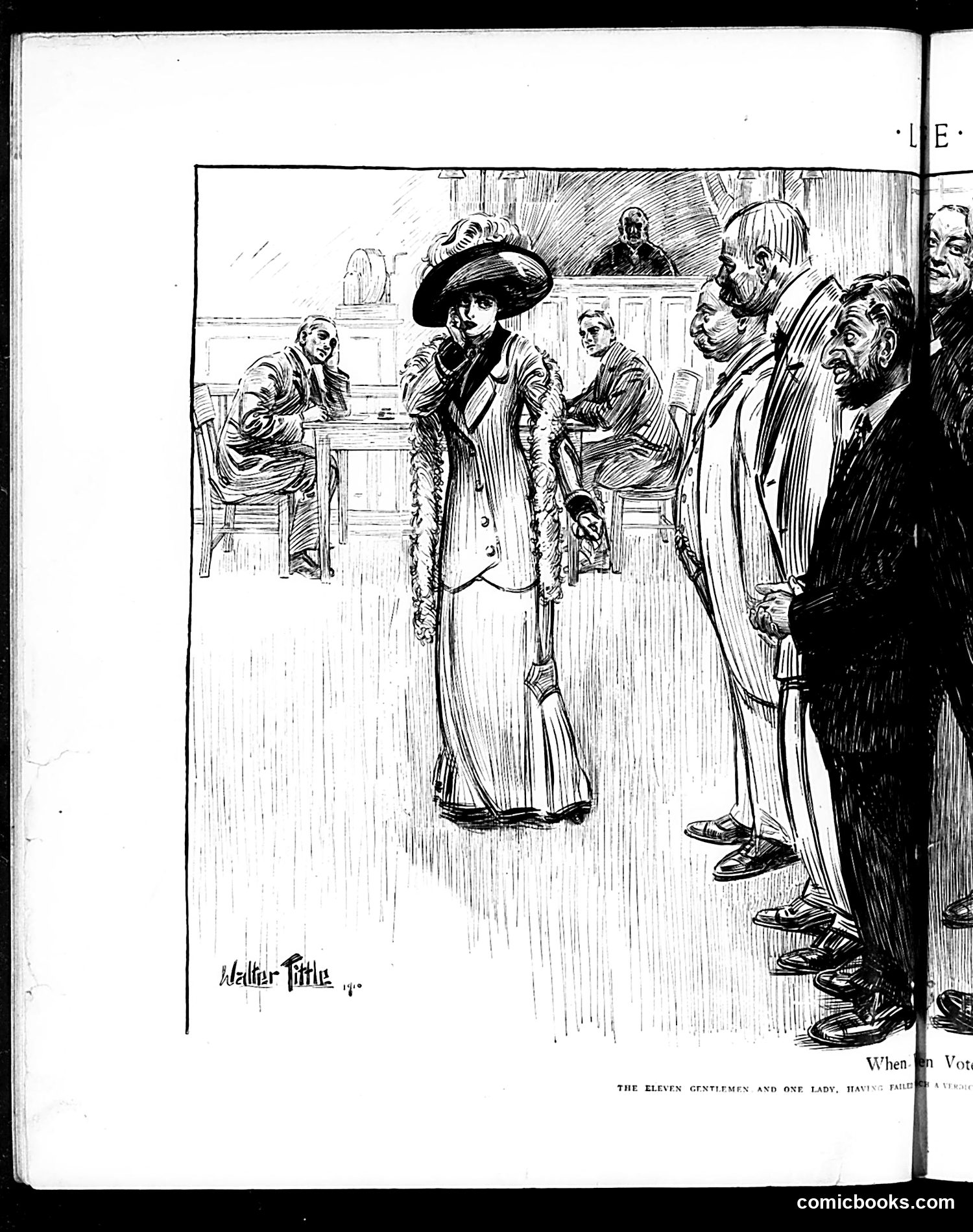
This illustration by Walter Tittle depicts a courtroom or legal proceeding scene. A well-dressed woman in a hat and coat stands at center, surrounded by eleven men in suits—apparently jurors or legal officials. The caption's reference to "eleven gentlemen and one lady" suggests this concerns a jury composition, likely commenting on gender dynamics in the legal system. The satire appears to critique either the novelty of having a woman serve on a jury (historically rare) or the awkwardness such presence created among male jurors. The men's body language—leaning in, appearing engaged or surprised—suggests the woman's presence is unusual or noteworthy. This likely reflects early-20th-century debates about women's suffrage and participation in civic institutions, when female jurors were still controversial or newly permitted in American courts.
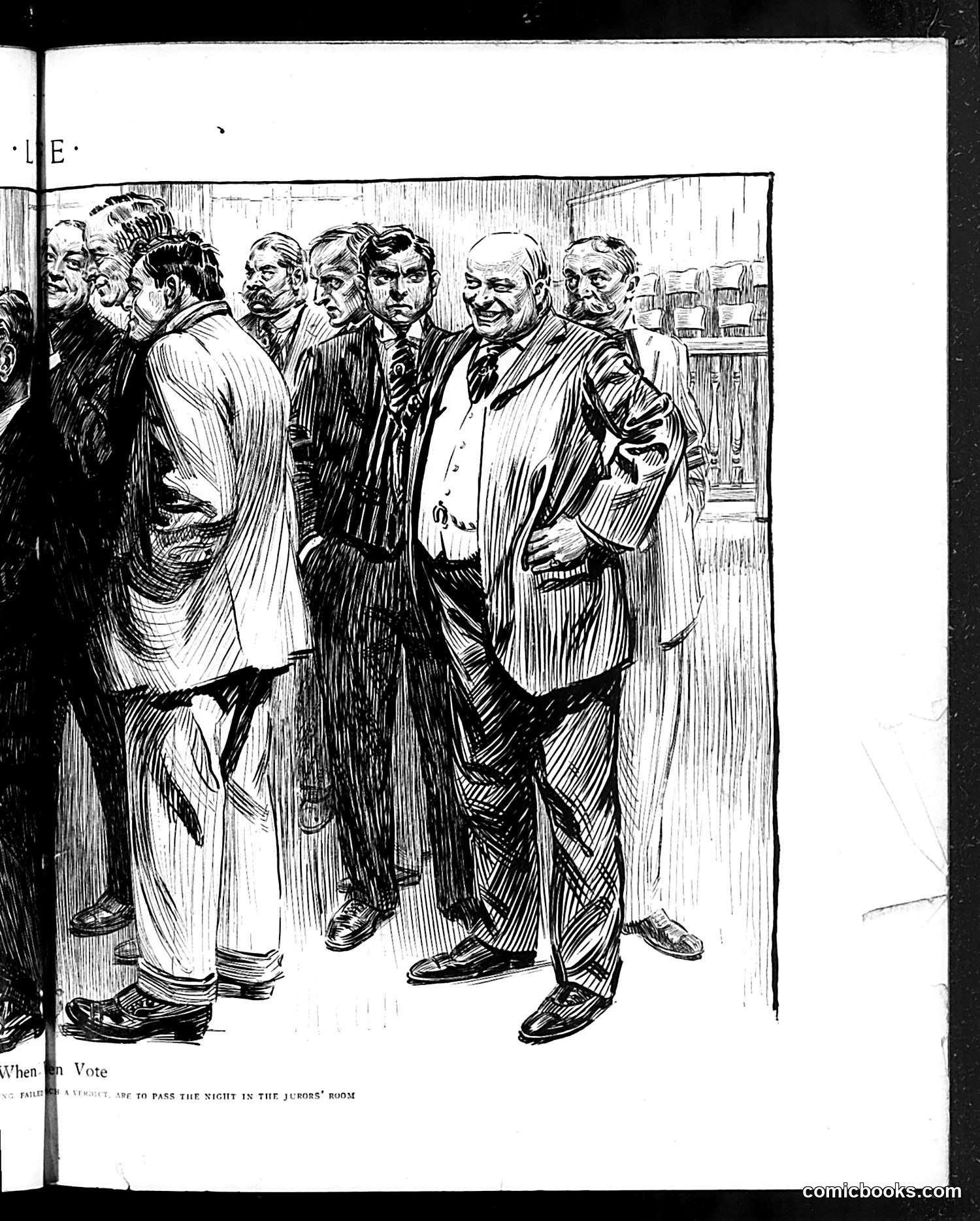
This is a satirical cartoon titled "When [Men] Vote" depicting a group of well-dressed men gathered in what appears to be an official room (likely a jury room, based on the partial caption mentioning "jurors' room"). The satire critiques male voting or jury behavior—showing a crowded, informal scene of men in suits, some appearing to socialize or converse rather than conduct serious business. The cartoon suggests men approach civic duties (voting or jury service) casually or frivolously, treating important legal/political processes as social gatherings rather than serious responsibilities. This reflects early-20th-century satirical commentary on male participation in governance, though the exact historical context (specific election or trial) is unclear from the visible text.
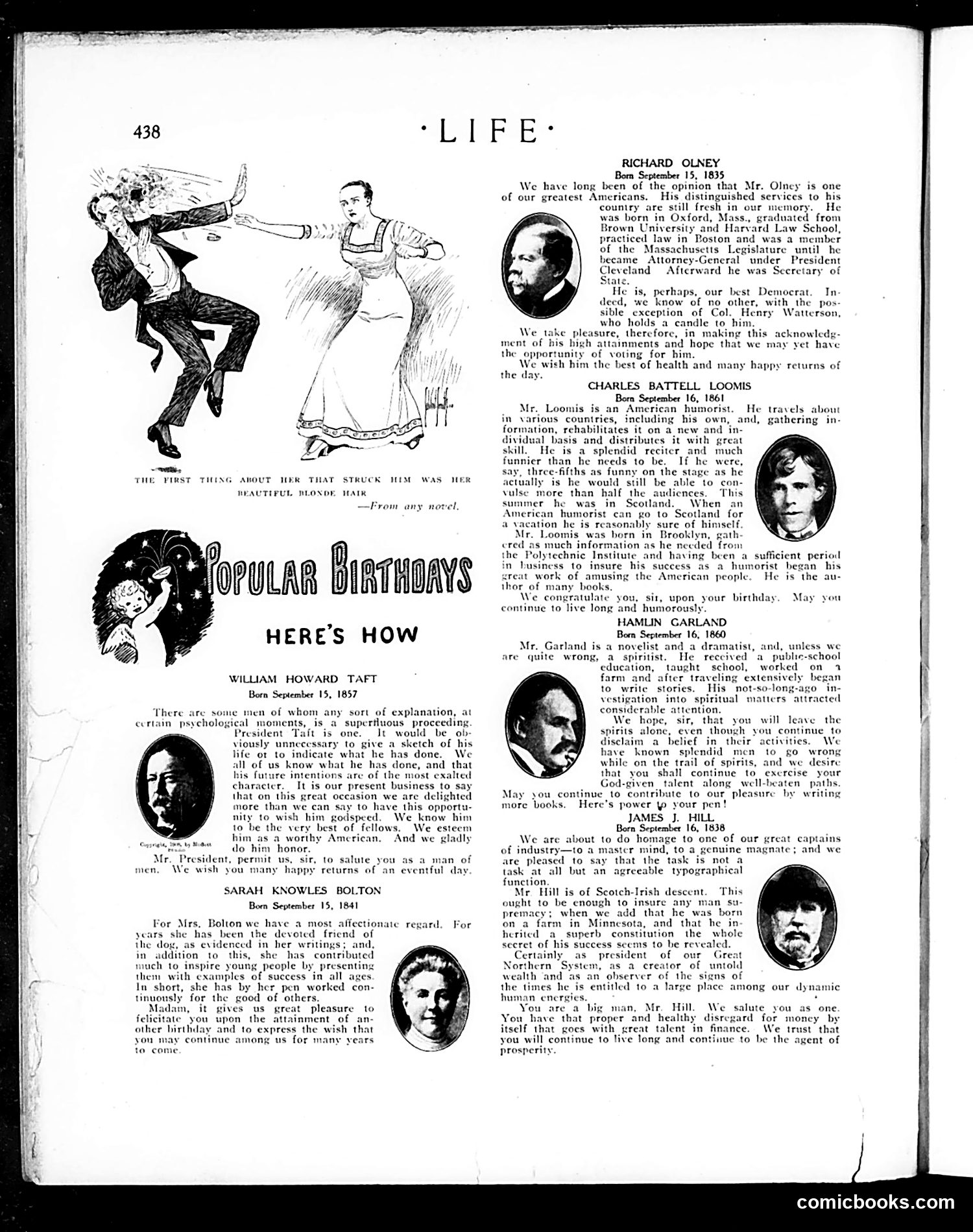
This page celebrates September birthdays of prominent American figures through congratulatory essays. The top cartoon illustrates a hackneyed literary trope—the cliché that a character's "beautiful blonde hair" is what first attracts attention—mocking overworn romantic fiction conventions. The main content honors President **William Howard Taft** (born Sept. 15, 1857), treating him with respectful formality befitting his office. Also celebrated are **Richard Olney** (former Attorney-General and Secretary of State under Cleveland), whom Life calls "perhaps our best Democrat," and humorist **Charles Battell Loomis** and novelist **Hamlin Garland**. The tone is typically Life magazine—satirical yet affectionate, mixing genuine respect with gentle mockery of literary clichés and public figures' pretensions. The page represents early-20th-century American magazine humor: urbane, focused on notable citizens, and assuming educated readership familiar with these personalities.
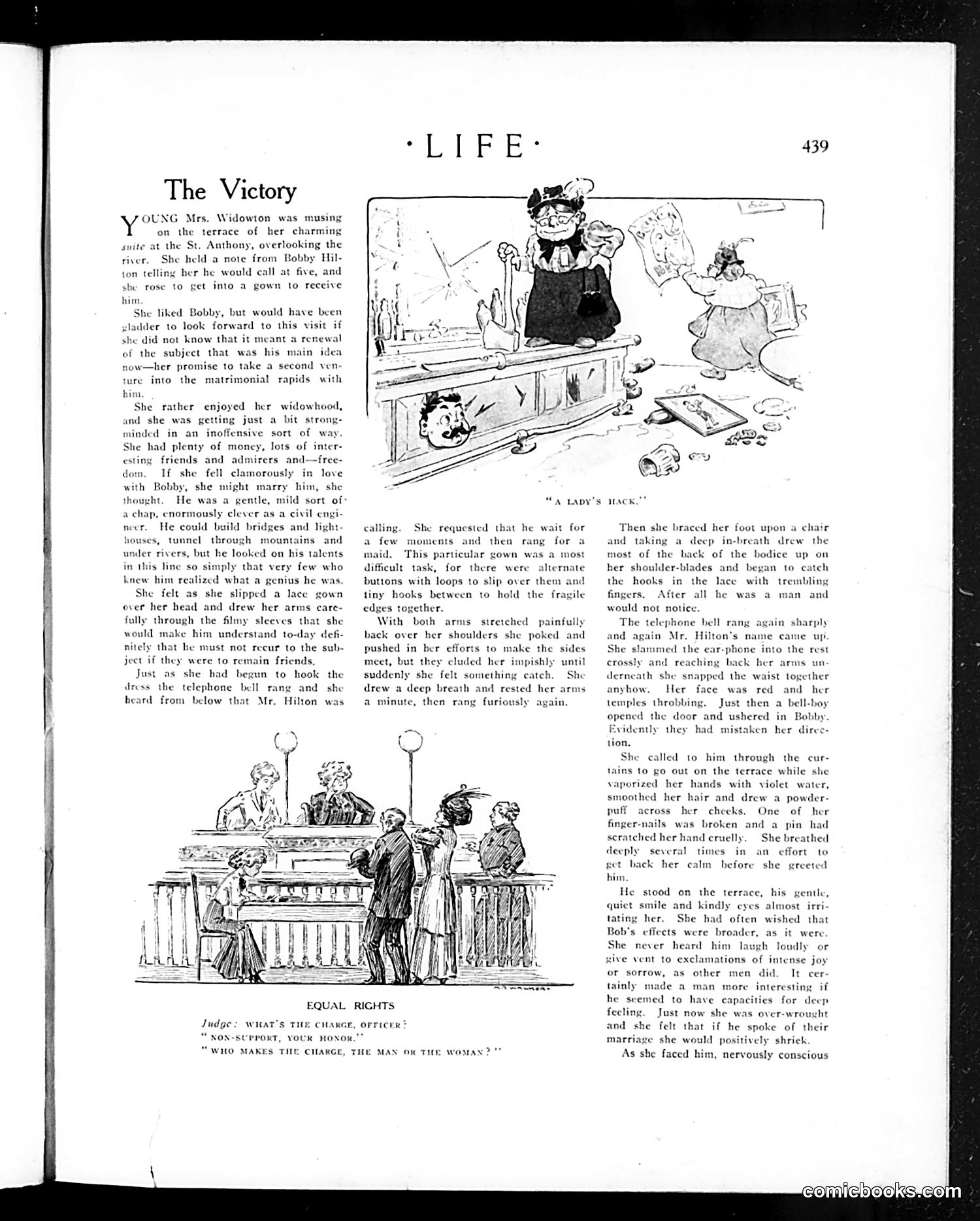
This *Life* magazine page contains a short story about modern courtship and a single-panel political cartoon. **"The Victory"** satirizes the "New Woman" of the 1920s—a wealthy, independent widow (Mrs. Widowton) who enjoys her freedom and resists remarriage despite pressure from her suitor Bobby Hilton. The story's humor derives from her internal conflict: she values her autonomy but fears appearing unfeminine or cold. The detailed description of her struggling to fasten her dress comically illustrates her trying to "button up" her emotions and appear composed before his arrival—a physical metaphor for emotional control. **"Equal Rights"** (the cartoon below) directly satirizes women's rights debates. A judge asks an officer who filed a "non-support" charge: "Who makes the charge, the man or the woman?" The joke critiques inconsistency in marriage law—women demanded equal legal rights, yet traditional law often placed financial support obligations solely on husbands. The cartoon implies absurdity: if women claim equality, can they also demand male financial responsibility? Together, these pieces reflect 1920s anxiety about changing gender roles.
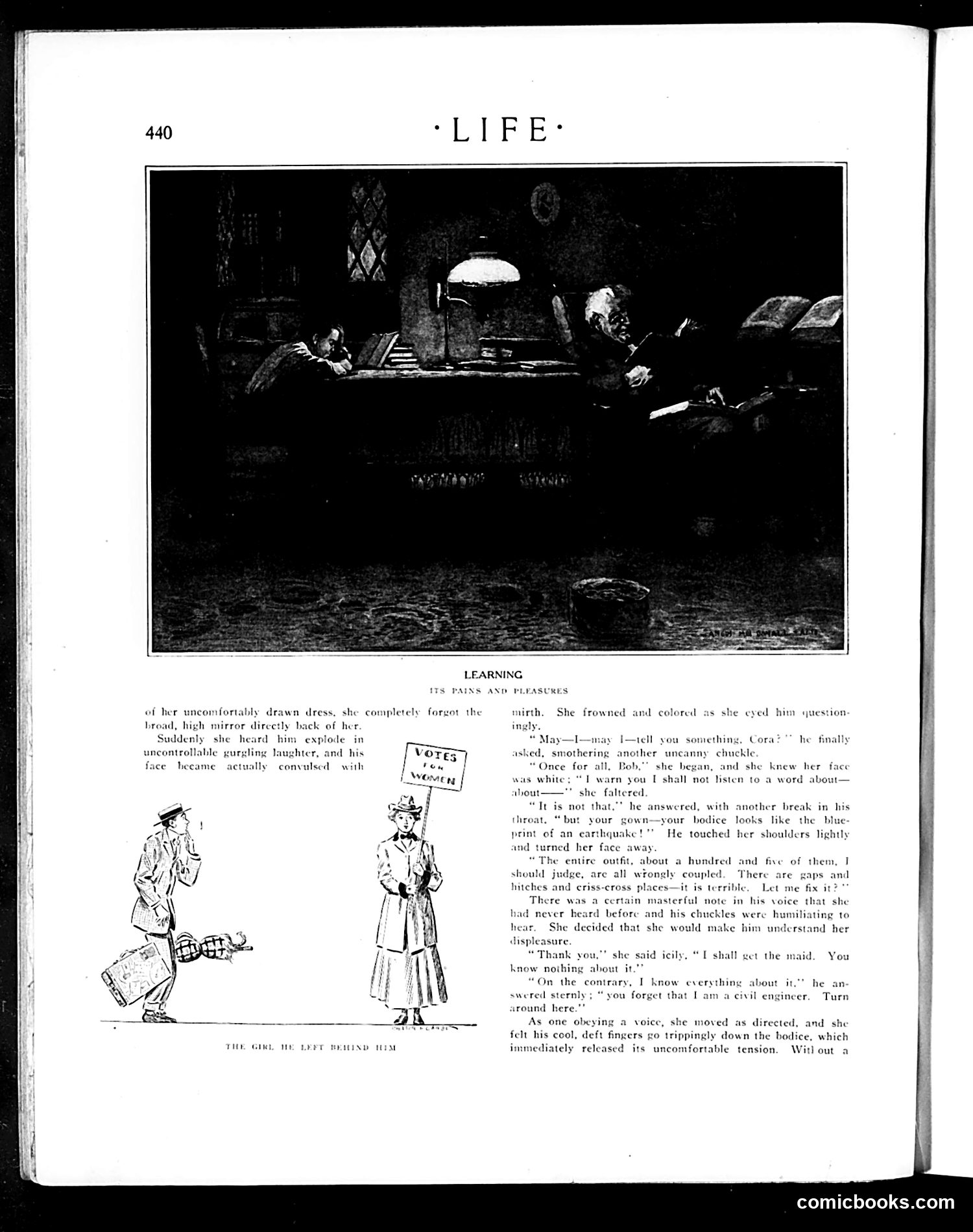
This page illustrates a serialized romance story titled "Learning: Its Pains and Pleasures." The narrative depicts a young woman named Cora in an awkward social moment—her dress is uncomfortably tight, causing visible distress. A man named Bob (likely her love interest or suitor) notices her discomfort and makes a bold, somewhat forward gesture: he offers to fix her bodice, comparing her appearance to a "blueprint of an earthquake." The woman initially protests, claiming she'll call a maid, but Bob confidently insists he can help, positioning himself as capable and masterful. The cartoon captioned "The Girl He Left Behind Him" (bottom left) appears to show a man departing, possibly satirizing the contrast between this forward male character and absent suitors. The scene reflects early 20th-century courtship dynamics where a man's "helpful" intervention in a woman's clothing could read as both scandalous intimacy and gallant assistance—the ambiguity itself being the romantic/comedic tension Life's readers would find amusing.
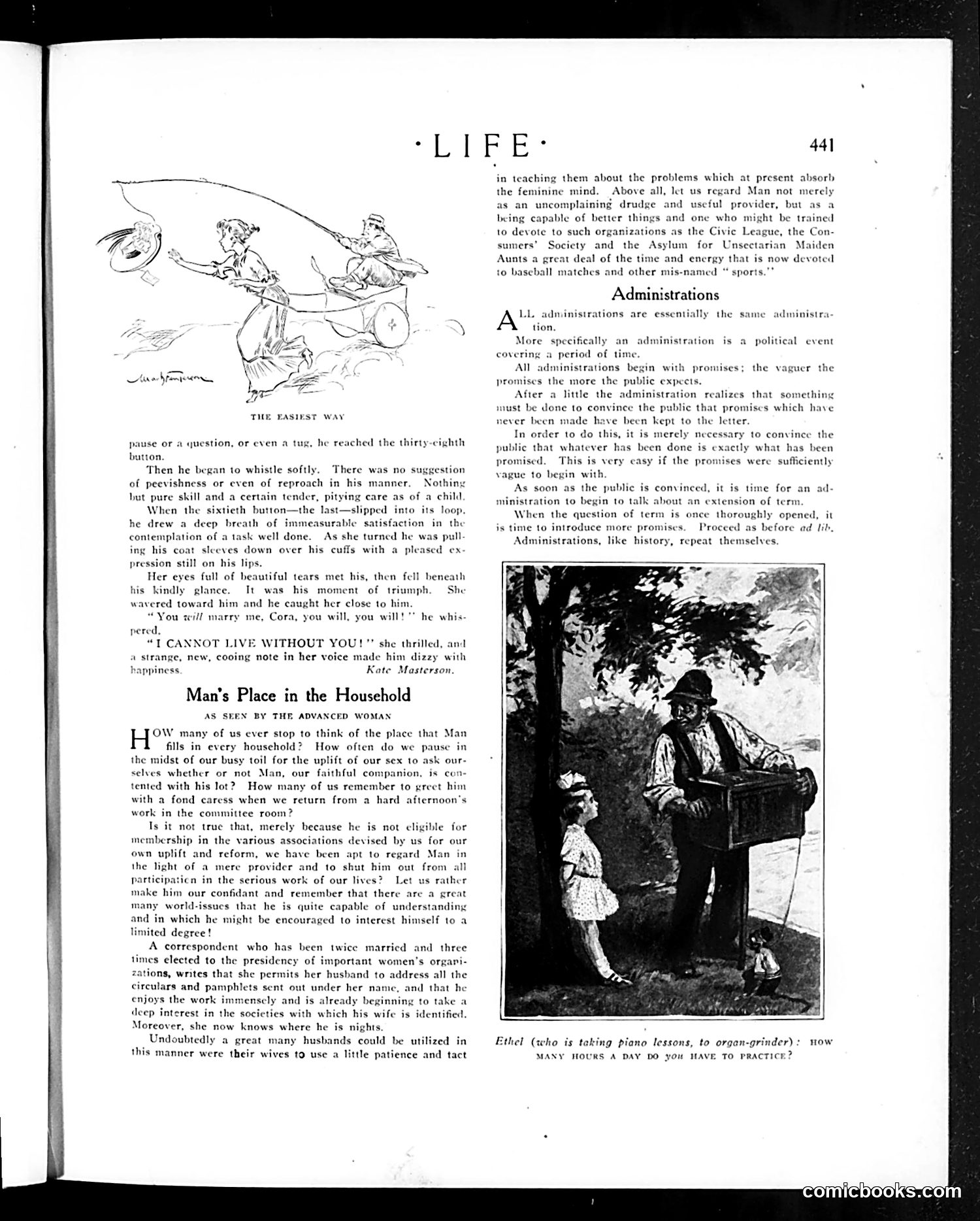
This page satirizes the "advanced woman" or early feminist movement by reversing gender roles. The article, credited to "The Advanced Woman," ostensibly advocates for men's greater household participation and involvement in women's organizations. However, the satire is evident: it patronizingly suggests husbands should be "trained" like children, given busy-work (addressing circulars), and kept occupied so wives "know where [they are] nights"—implying suspicion and control. The upper illustration shows a domestic scene supporting this theme: a woman controlling a man like a puppet on strings labeled with buttons, depicting manipulative domesticity. The piece mocks both the earnestness of women's reform movements AND the condescension underlying their rhetoric about male capability. By suggesting men need "patience and tact" to understand "women's issues," it exposes the same exclusionary logic the movements claimed to oppose.
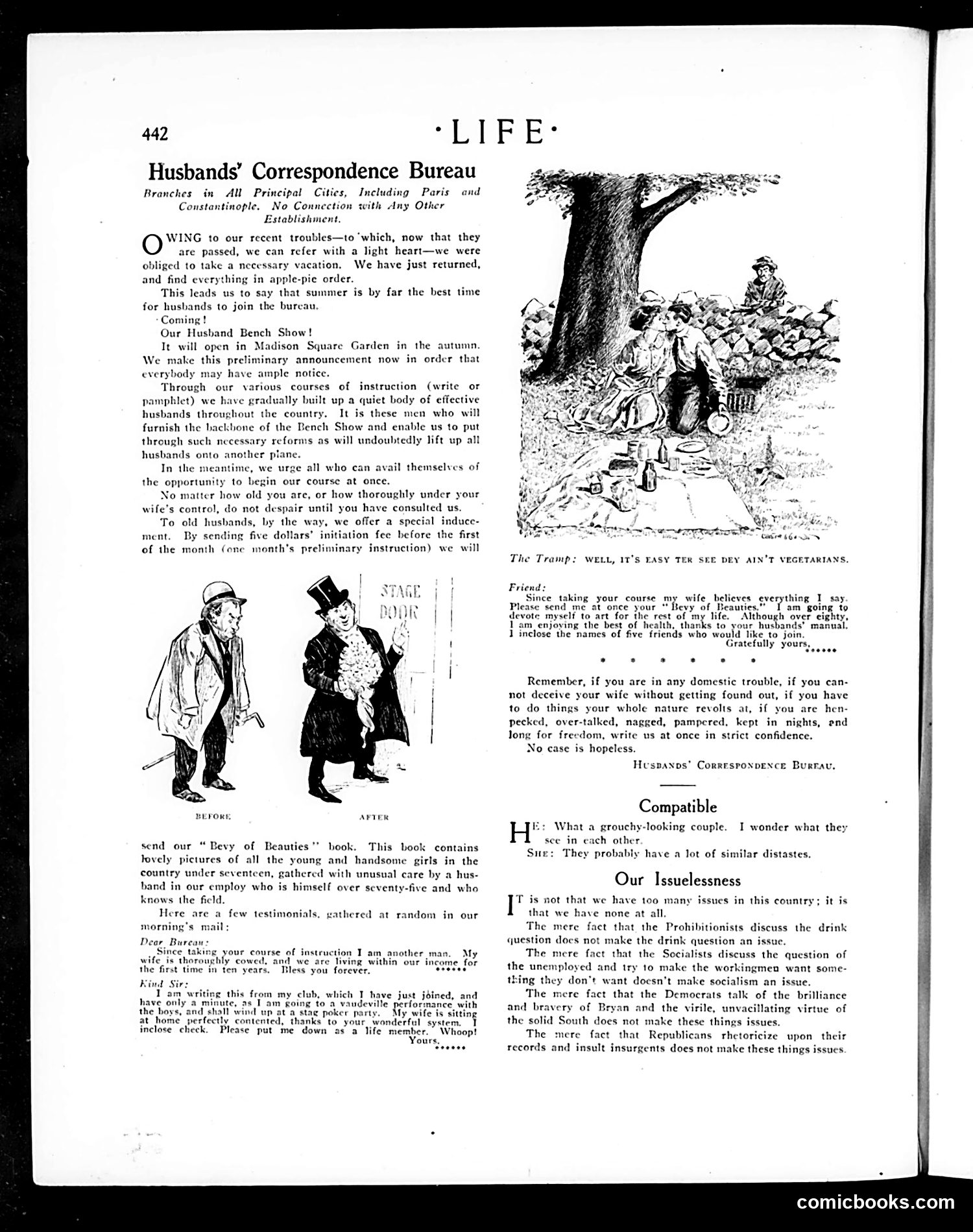
This page satirizes turn-of-the-century gender relations through a mock "bureau" offering courses to help husbands escape their wives' control. The satire targets **henpecked husbands**—men dominated by their wives—presenting absurd "solutions" like a "Husband Bench Show" at Madison Square Garden and a mail-order book of young women. The testimonials mock male fantasies: one husband brags he's now at his club avoiding home; another, over eighty, pursues "art" instead of marital duties. The satire ridicules both the desperation of controlled husbands and the predatory schemes exploiting them. The "Before/After" cartoon shows a shabby man transformed into a well-dressed gentleman—implying the bureau's promised transformation. This reflects genuine anxieties about **shifting domestic power dynamics** in early 20th-century America, where wives increasingly controlled household finances and social decisions, while husbands sought escape through clubs and establishments. The satire mocks male resentment of female authority while exposing the schemes targeting frustrated men.
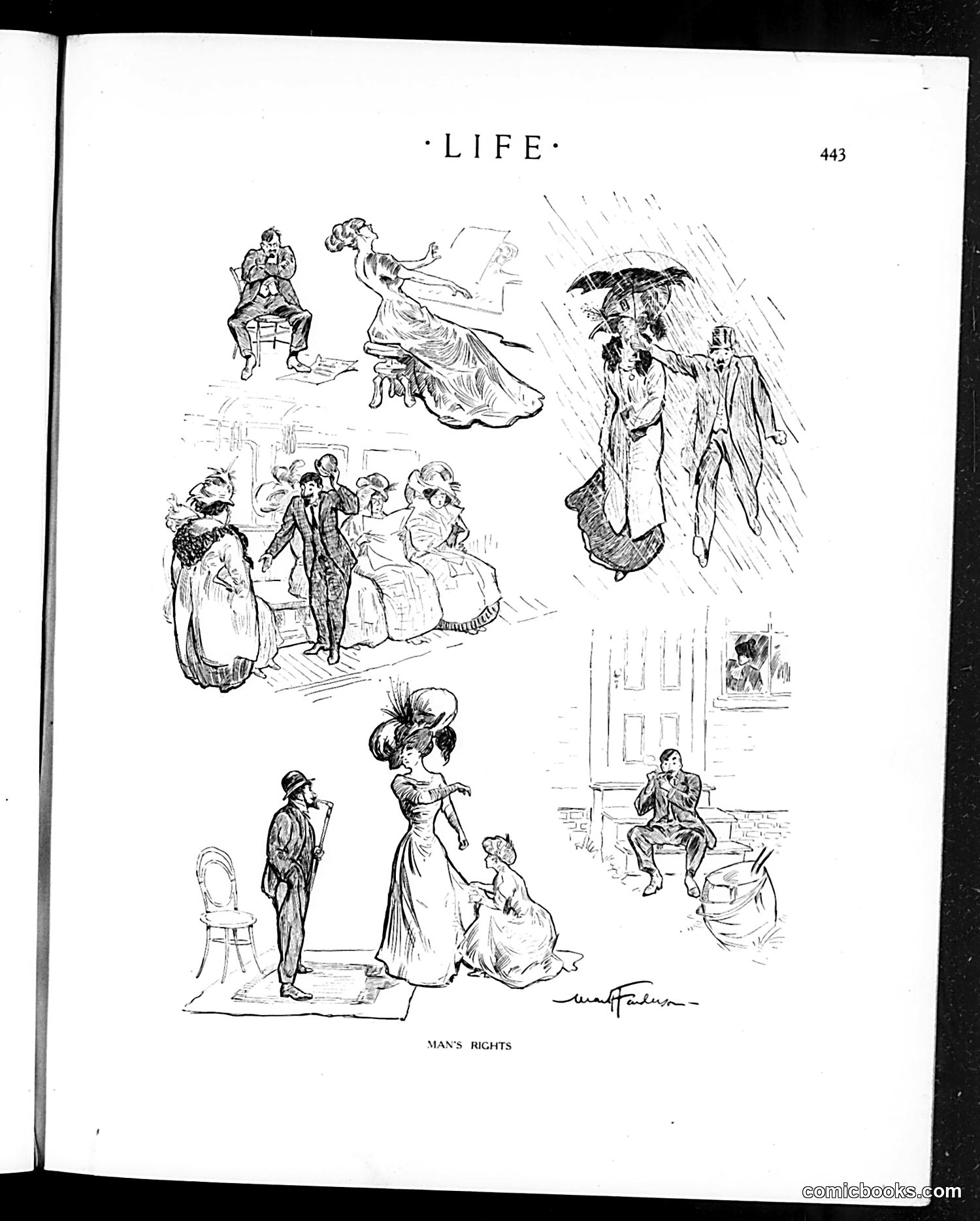
This satirical cartoon titled "Man's Rights" depicts various domestic scenes showing men in traditionally female roles or experiencing domestic difficulties. The sketches appear to mock men claiming to have "rights" while being subjected to household responsibilities and marital complications. The scenes show men doing laundry, managing children, enduring rain while women stay dry under umbrellas, and sitting alone in domestic spaces—situations presented as humorous reversals or complaints. This is likely satirizing contemporary men's rights arguments or complaints about changing gender roles, positioning such grievances as trivial or absurd when compared to women's actual social restrictions. The cartoon uses humor to critique men claiming victimhood regarding domestic arrangements, suggesting their "rights" complaints lack substance.
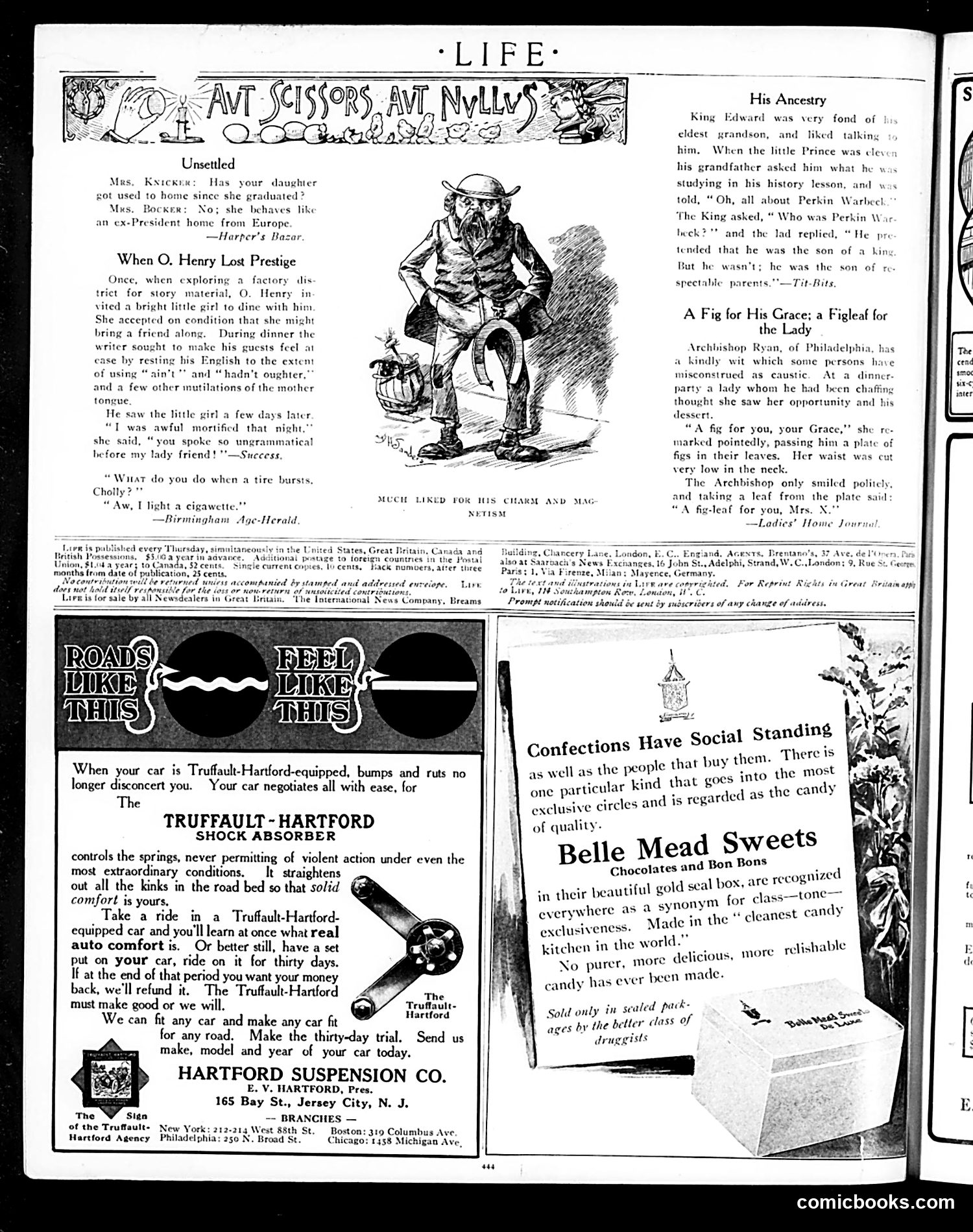
This page contains several brief humorous anecdotes rather than political cartoons: **"Unsettled"**: A joke about a recent college graduate behaving like an "ex-President home from Europe"—mocking the pretentious behavior of former U.S. presidents returning from European trips. **"When O. Henry Lost Prestige"**: The famous writer O. Henry invites a child to dinner but uses poor grammar ("ain't," "hadn't oughter"). The child scolds him for ungrammatical speech, embarrassing the celebrated author. The joke satirizes how even accomplished people can be corrected by children. **"His Ancestry"**: King Edward asks his young grandson about history lessons; the boy discusses Perkin Warbeck (a 15th-century impostor claiming the English throne). The humor lies in the ironic comparison—the boy admits Warbeck falsely claimed royal parentage despite common parents, an awkward parallel to discussing royal lineage. **"A Fig for His Grace"**: Archbishop Ryan receives figs from a woman in an immodestly low-cut dress, implying the gift is a veiled insult. He responds with witty grace, turning the insult harmless. The page is primarily **humor/anecdotes with advertising**, not political satire.
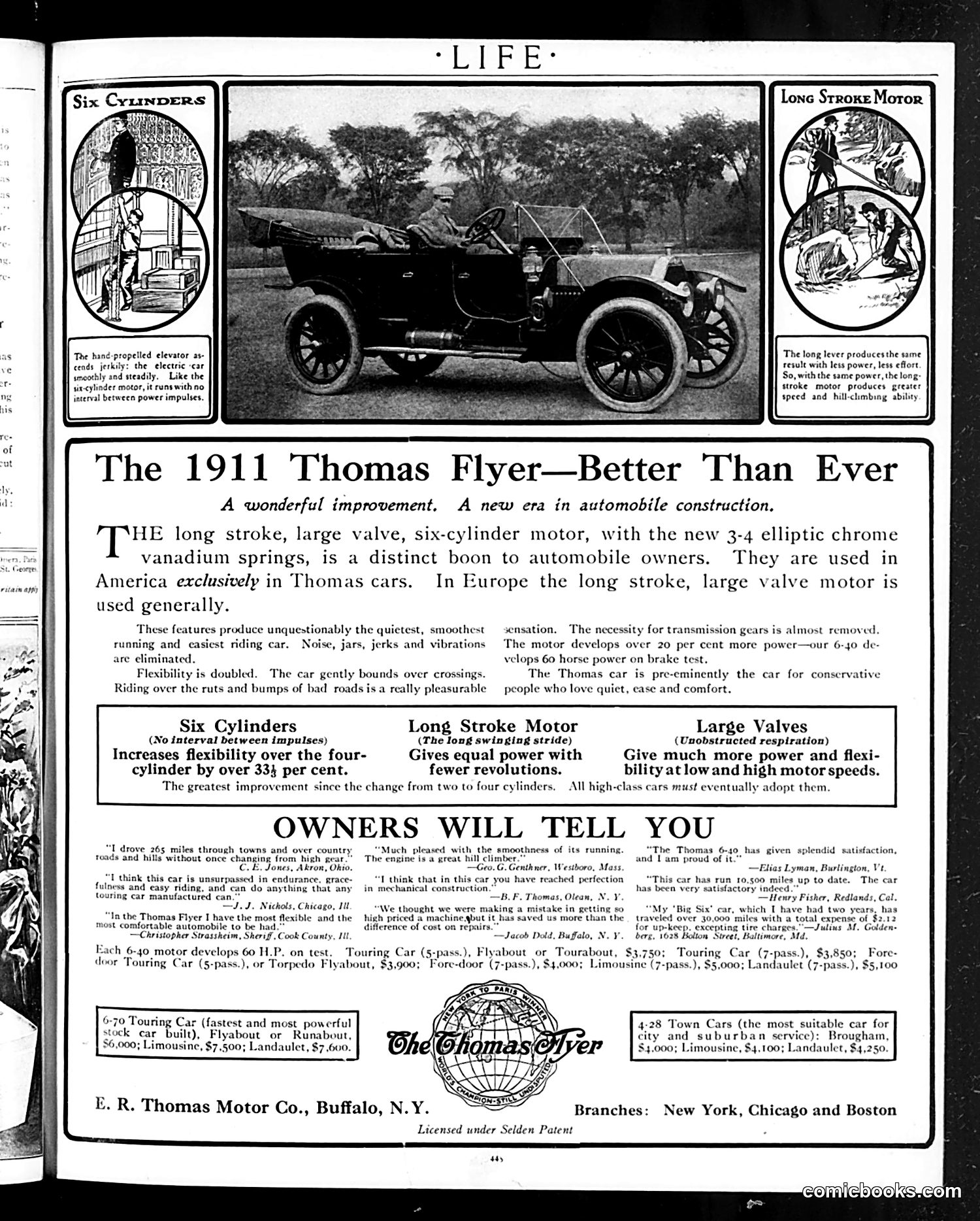
This is **not a cartoon or satire**—it's a straightforward automobile advertisement from *Life* magazine for the 1911 Thomas Flyer, published by the E.R. Thomas Motor Company in Buffalo, New York. The page promotes technical innovations in the Thomas automobile: a six-cylinder long-stroke engine with large valves and chrome-vanadium springs. Three diagrams compare these features to competing designs, emphasizing smoothness, power, and reliability. The "OWNERS WILL TELL YOU" section quotes satisfied customers from various American cities, a common advertising technique lending credibility through testimonials. Prices ranged from $3,730 to $7,600—substantial sums in 1911. The reference to "Licensed under Selden Patent" reflects patent disputes over early automotive technology that dominated the era. This represents early-20th-century American consumer advertising—no satire intended, though modern readers may find the breathless enthusiasm for engineering specifications quaint.
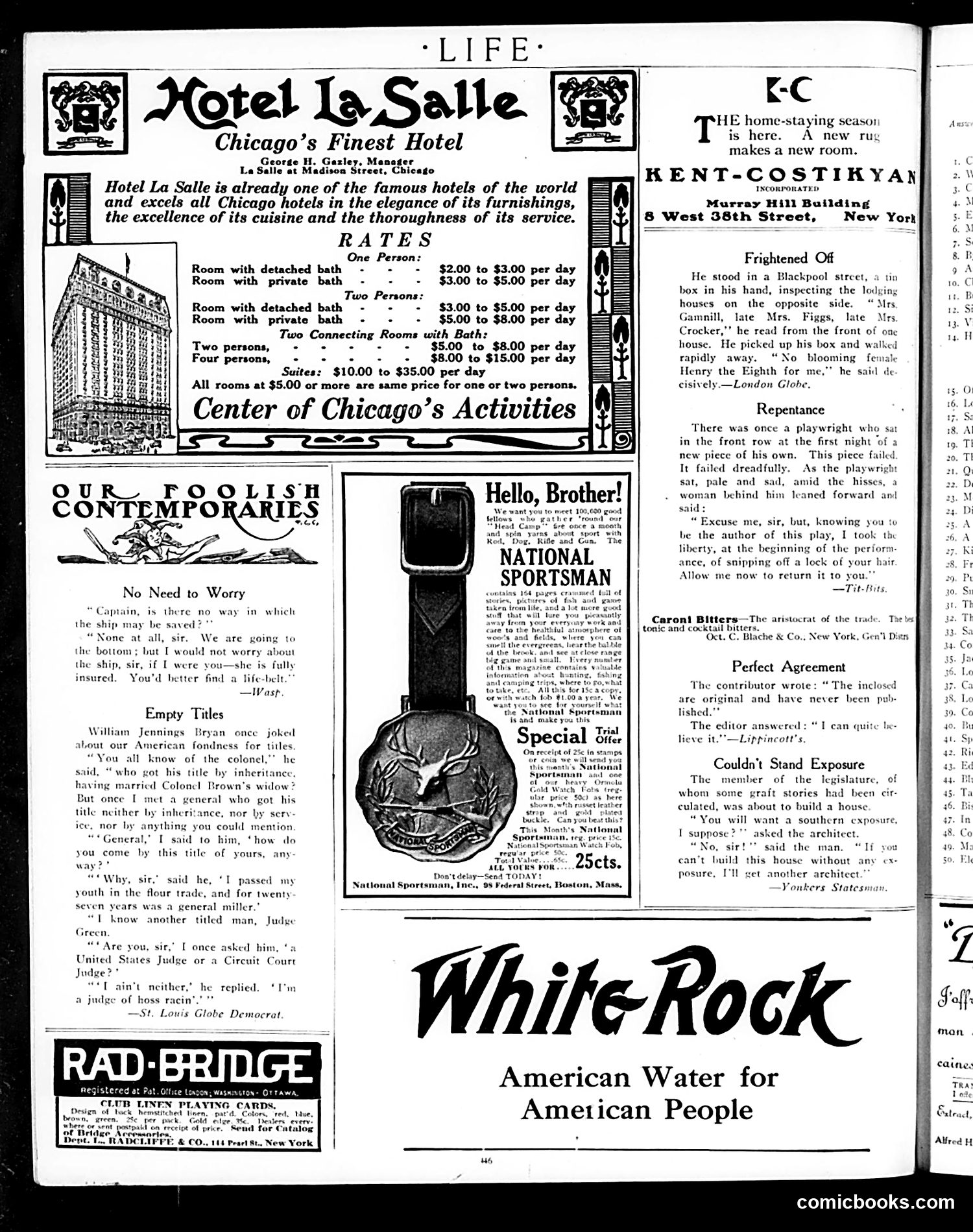
This is primarily a **commercial/advertising page** rather than satirical content. The page features: **Main Advertisements:** - Hotel La Salle in Chicago (top) - Kent-Costikyan real estate in New York - National Sportsman magazine - White Rock water - Rad-Bridge playing cards **Humor Sections** (minor content): - "Our Foolish Contemporaries" - reprints joke exchanges from other publications - Several brief anecdotes about titles, including a William Jennings Bryan joke about Americans' obsession with honorifics and social rank - A playwright story about a failed opening night - A legislature member refusing a southern exposure on his new house **Context for Modern Readers:** The humor trades on early 20th-century American class consciousness and the gap between pretension and reality. The "Empty Titles" section mocks how Americans accumulated social designations (colonel, general, judge) that didn't necessarily reflect actual accomplishment—a common satirical target of the era. The page is primarily merchandising with light entertainment filler.
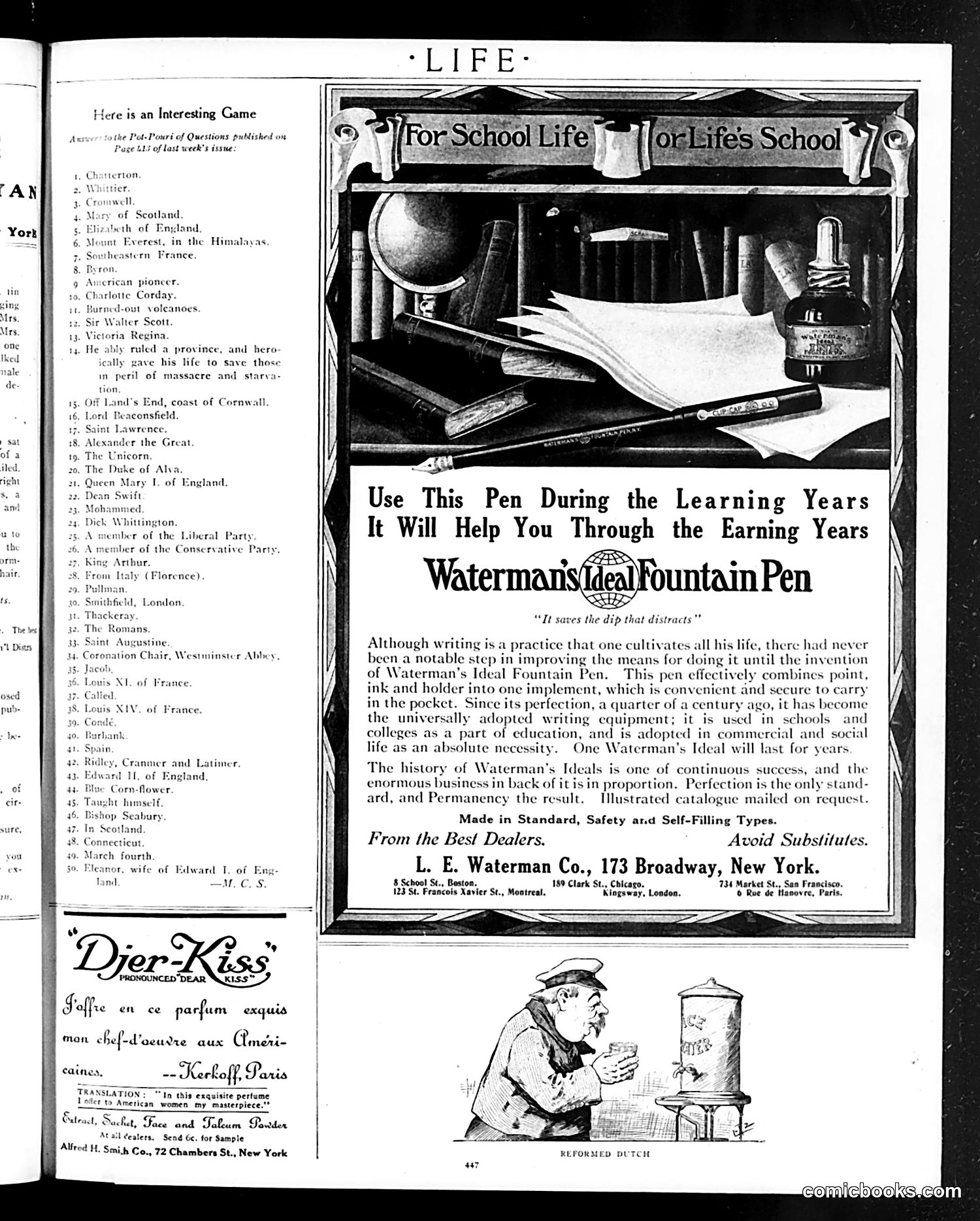
This page is **primarily advertising**, not political satire. The main content consists of: 1. **A trivia game** (left column)—a potpourri of historical and literary questions published as reader entertainment, typical of Life's educational puzzle features. 2. **Waterman's Ideal Fountain Pen advertisement** (center/right)—the dominant content. The ad emphasizes the pen's role in education and professional success, using the slogan "Use This Pen During the Learning Years / It Will Help You Through the Earning Years." It appeals to students and professionals by promising reliability and prestige. 3. **Djer-Kiss perfume ad** (bottom left)—a luxury product marketed to American women, attributed to a Parisian perfumeur. 4. **"Reformed Dutch" cartoon** (bottom)—a small, unclear illustration that appears unrelated to the advertisements. The page reflects early 20th-century consumer culture targeting educated, aspirational readers through product endorsements positioning goods as essential to success.
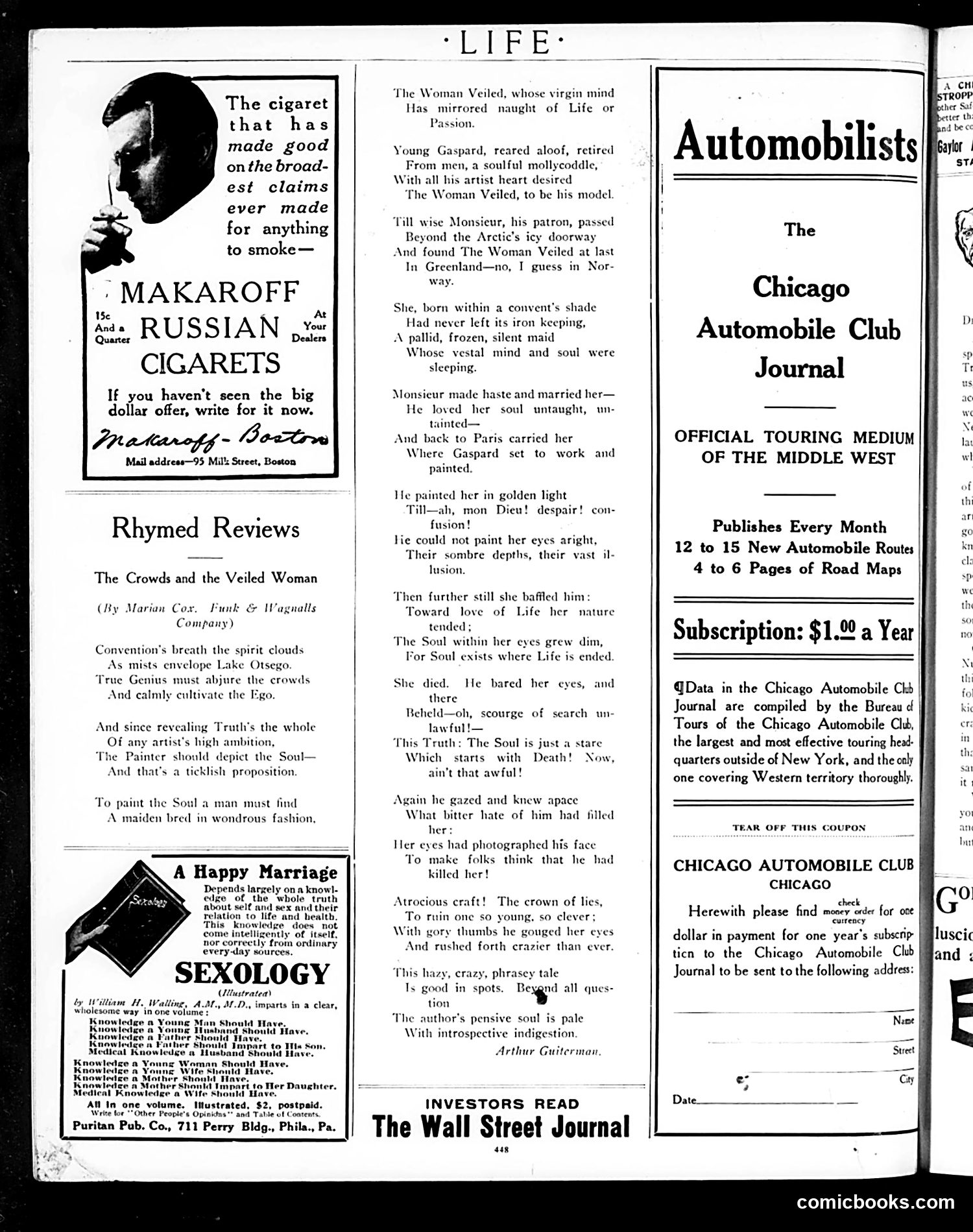
This page is primarily **advertising and literary content** rather than political satire. It contains: **Left side:** A cigarette ad for Makaroff Russian Cigarets, claiming broad health benefits—typical of early 1900s tobacco marketing before regulations. **Center:** A lengthy poem titled "The Crowds and the Veiled Woman," a literary review of a book by Marian Cox. The poem satirizes Romantic artistic pretension: a sheltered young woman becomes an artist's muse, but her "soul" (the artist's obsession) vanishes once she experiences actual life. The twist ending—her eyes photograph his face to frame him for her death—is dark comic absurdity mocking overwrought artistic angst. **Right side:** Subscription solicitation for the *Chicago Automobile Club Journal*, presenting itself as authoritative touring information. **Bottom left:** An ad for *Sexology*, a sex-education book marketed as respectable health knowledge. The page reflects early 20th-century concerns: automotive leisure, sexual enlightenment, and artistic bohemianism.
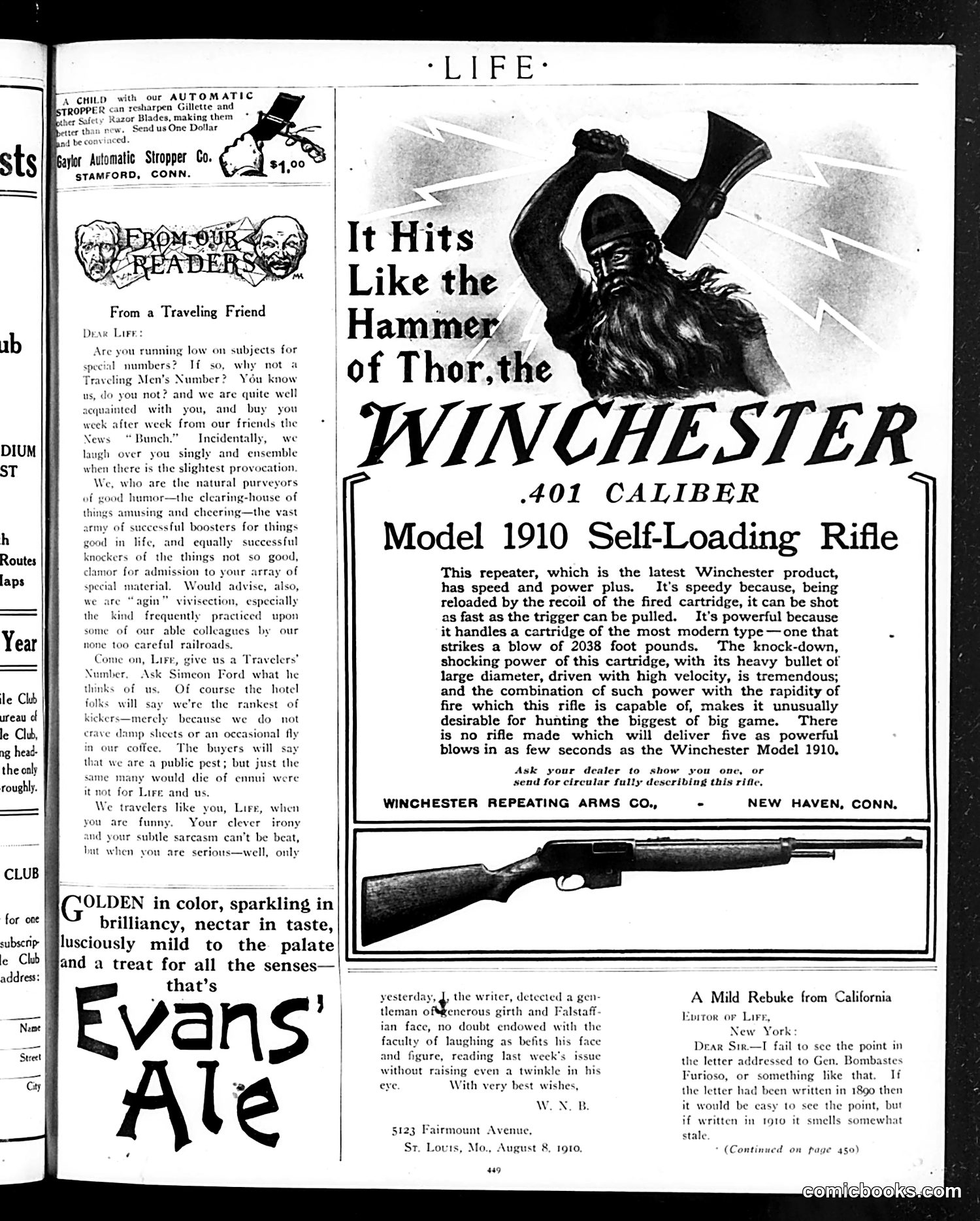
This page from *Life* magazine (August 1910) contains mostly advertisements and reader letters rather than political satire. **The Main Content:** The dominant feature is a Winchester rifle advertisement using mythological hyperbole—comparing the Model 1910 Self-Loading Rifle to "the Hammer of Thor" to emphasize its power and speed. The ad promises 2,038 foot-pounds of striking force and rapid-fire capability, marketing it for hunting big game. **The Letters Section:** "From a Traveling Friend" requests *Life* create a special issue featuring traveling salesmen, positioning them as natural purveyors of humor. A separate "Mild Rebuke from California" critiques an earlier *Life* article (apparently satirizing a character named "Gen. Bombastes Furioso"), claiming it feels dated—suggesting 1890s-style satire no longer resonates in 1910. **Historical Context:** This reflects early 20th-century advertising aesthetics and *Life*'s reader engagement model, with no significant political cartoon or sustained satire on this particular page.
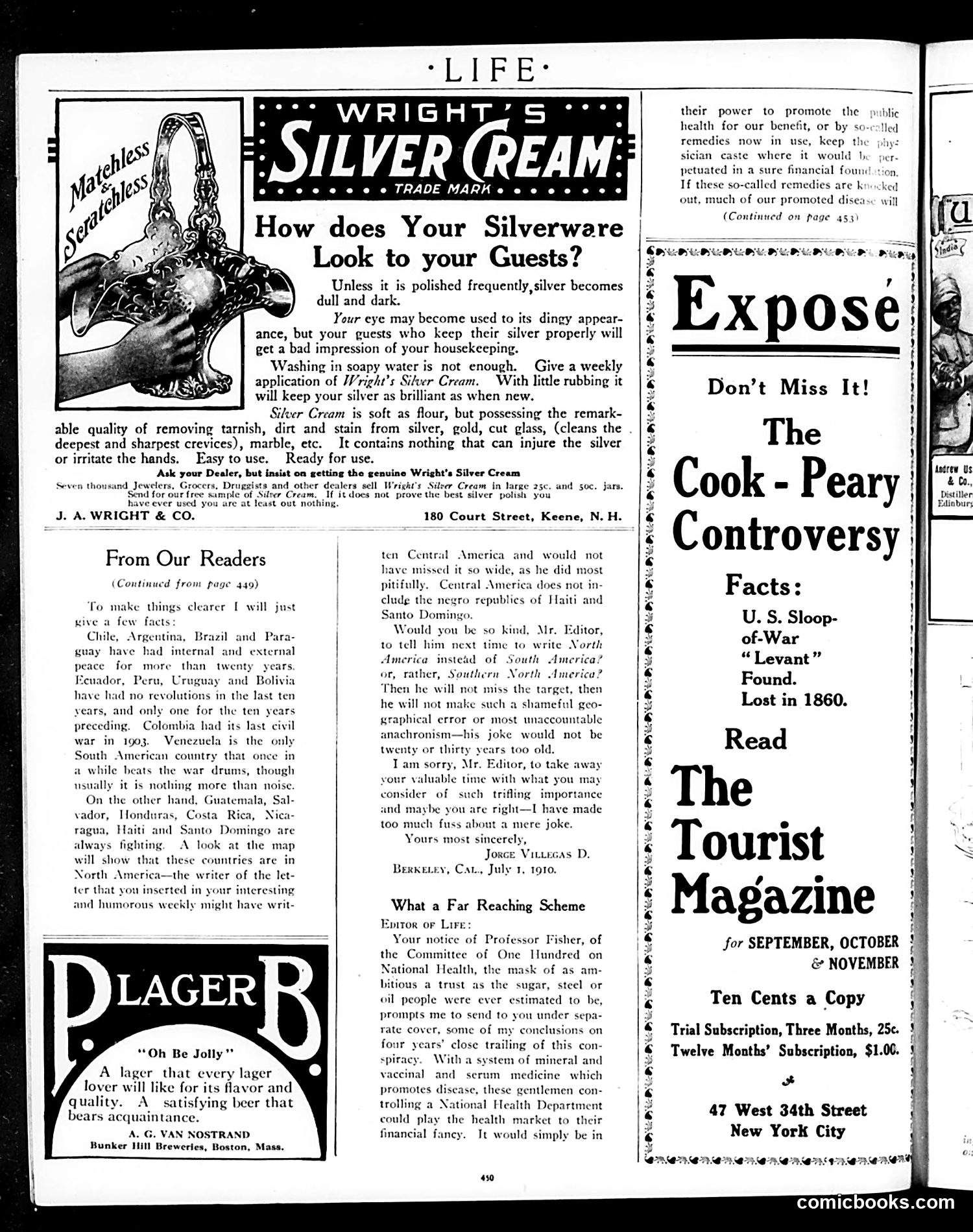
This page is primarily **advertisements and reader letters**, not political cartoons. The main content includes: 1. **Wright's Silver Cream ad**: A straightforward product advertisement emphasizing that polished silverware reflects good housekeeping to guests—playing on early 20th-century anxieties about domestic propriety and social impression. 2. **Reader letters section**: A correspondent corrects a previous writer's geography, noting that Central America (Guatemala, Honduras, etc.) shouldn't be conflated with South America. The letter sarcastically mocks the original writer's "joke" as anachronistic. 3. **"Cook-Peary Controversy" teaser**: References what appears to be a contemporary dispute (likely about Arctic exploration claims), promoting *The Tourist Magazine*. 4. **P. Lager beer ad**: Simple product endorsement. The page reflects early 1900s concerns: domestic standards, geographic literacy, and competitive commercial publishing. No significant political satire is present—this is a typical magazine page mixing advertising with reader correspondence.
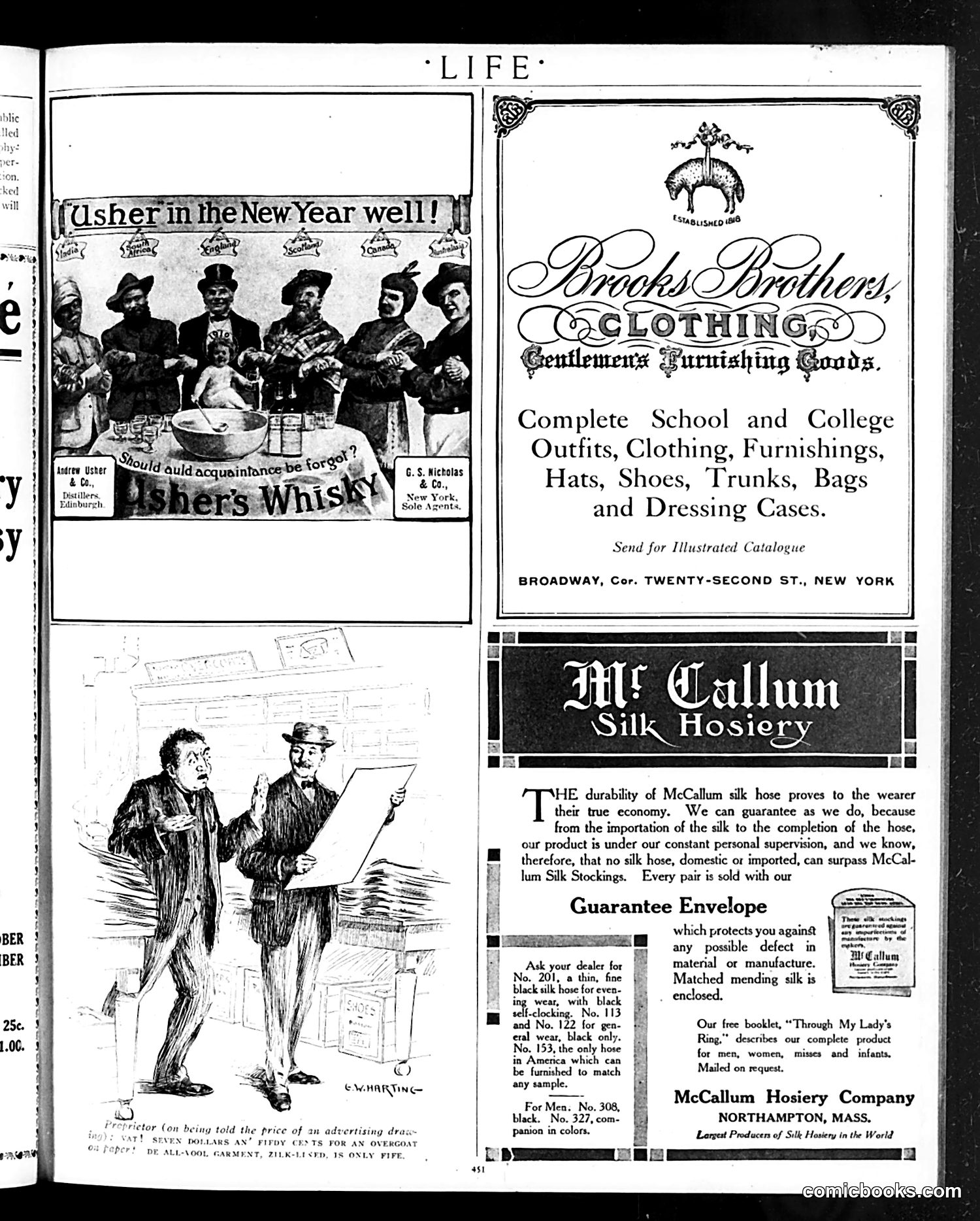
**Top Left Cartoon:** A satirical advertisement for "Fishers Whisky" depicting six well-dressed men in formal attire at what appears to a New Year's celebration. The caption reads "Fisher in the New Year well!" with the tagline "Should auld acquaintance be forgot?" This is a play on "Auld Lang Syne," the Scottish song traditionally sung on New Year's Eve. The joke mocks the notion that whisky is essential to proper New Year's celebrations and social bonding among gentlemen. **Bottom Cartoon:** Two men examining architectural plans, discussing an overcoat priced at "$7.50." The caption satirizes the disconnect between advertising claims and reality—the joke being that the advertisement cost far more to produce ($7.50) than seems reasonable, mocking the inflated costs of advertising itself and suggesting such expense for promoting cheap clothing is absurd. **Right Page:** Standard period advertising for Brooks Brothers clothing and McCallum silk hosiery—not satirical content.
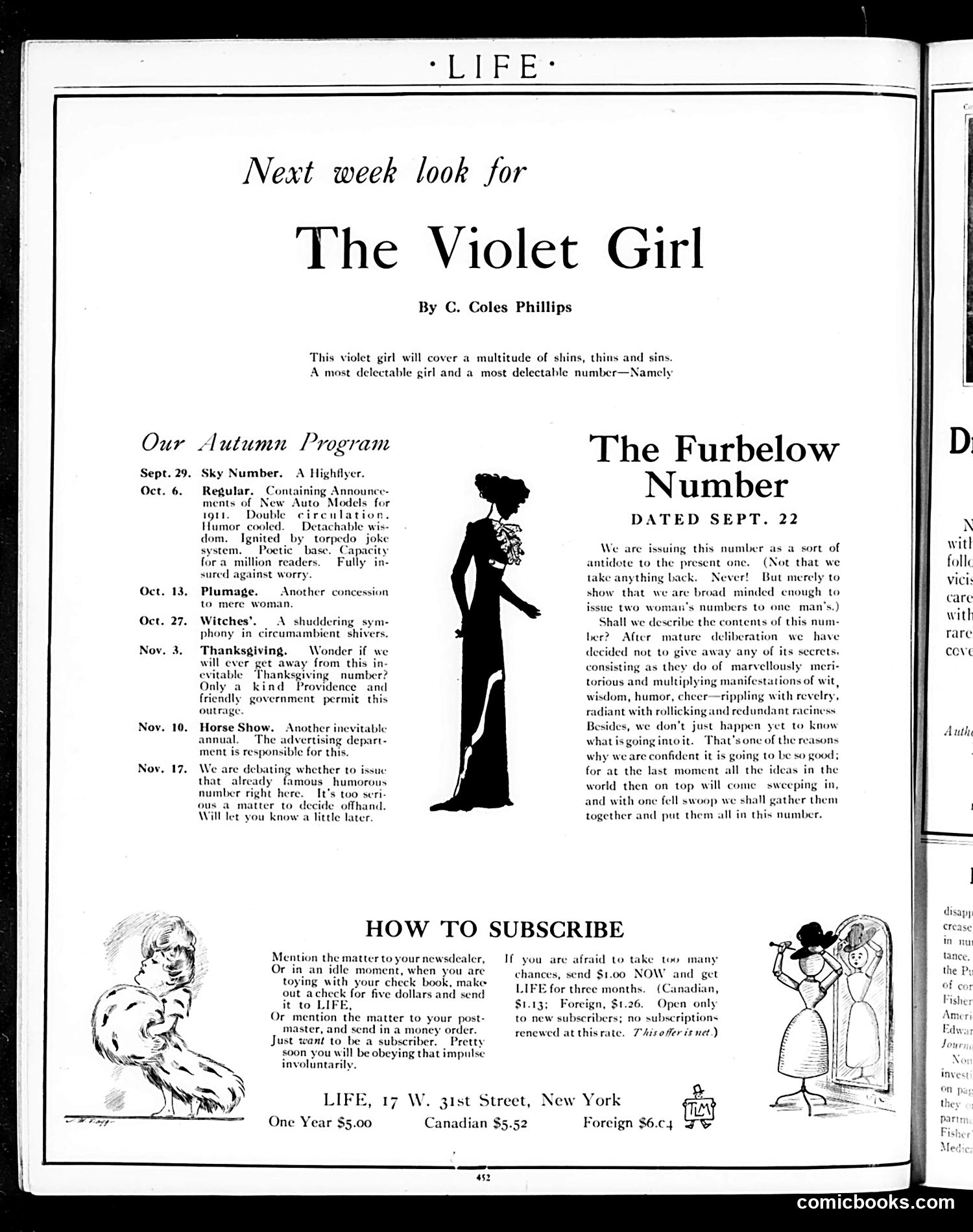
This is primarily a **cover announcement and subscription page** from Life magazine, a major American satirical weekly. The page promotes upcoming content rather than presenting completed cartoons. **Key Content:** The main feature advertised is "The Violet Girl" by C. Coles Phillips, a popular illustrator of the era known for stylized female figures. The accompanying silhouette shows his characteristic art deco style—an elegantly posed woman in profile. **"Our Autumn Program"** lists upcoming themed issues (Sky Number, Auto Models, Plumage, Witches, Thanksgiving, Horse Show), reflecting Life's practice of publishing special numbers around seasonal topics and current events. **"The Furbelow Number"** (dated Sept. 22) is presented as a response to the previous issue, humorously claiming superiority while refusing to reveal its contents—a tongue-in-cheek advertisement for the magazine's wit and humor. The bottom section provides **subscription information** at various rates, indicating Life's business model as a premium publication requiring paid subscriptions rather than newsstand-only distribution.
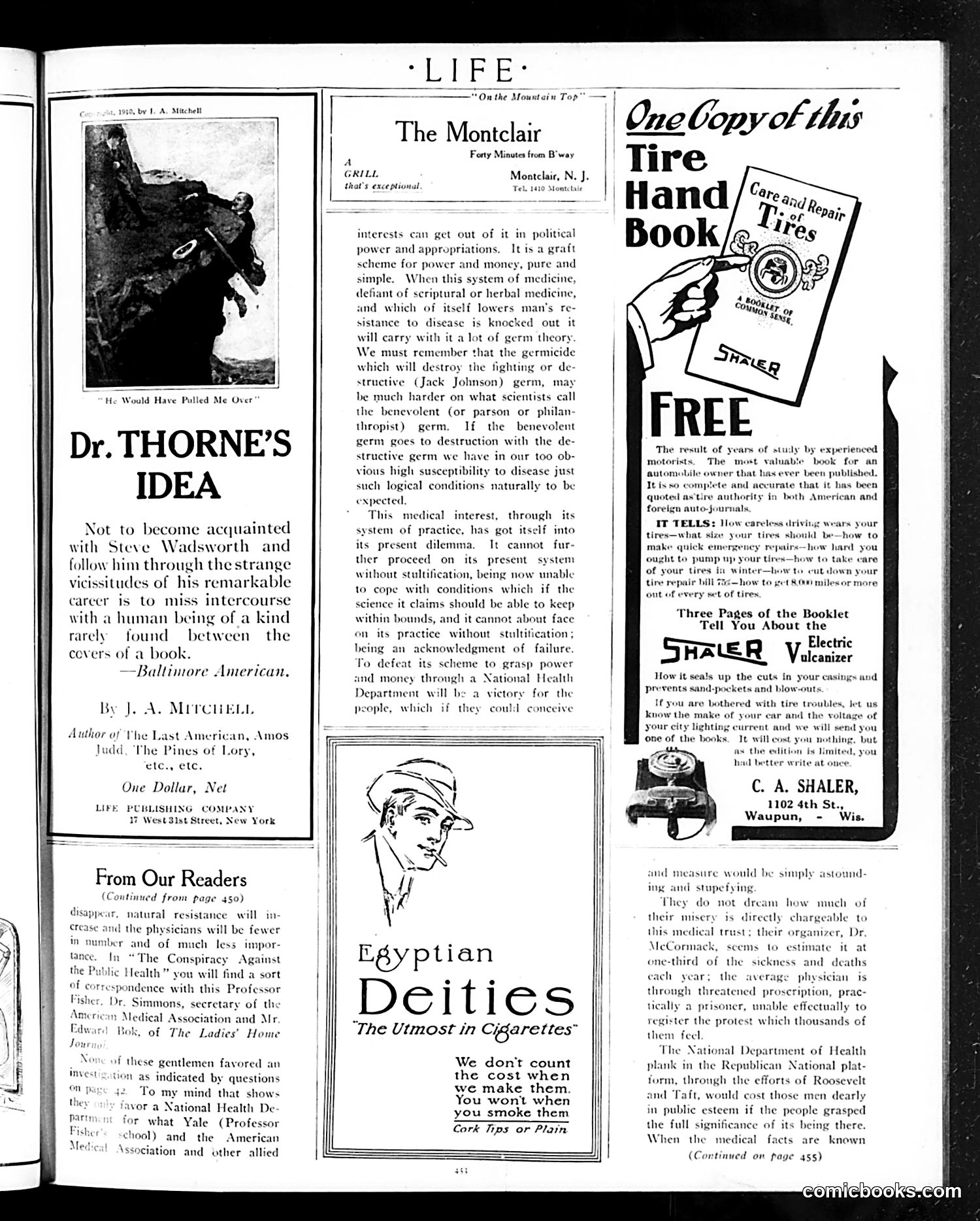
This page contains a book advertisement and editorial content, not political cartoons. The main visual element is a small illustration titled "He Would Have Pulled Me Over" accompanying J.A. Mitchell's article about "Dr. Thorne's Idea"—likely promoting his novel about a character named Steve Wadsworth. The page reflects early 20th-century anti-establishment sentiment. A "From Our Readers" section includes a lengthy letter attacking the American Medical Association and the proposed National Health Department as a "graft scheme" favoring allopathic medicine over "scriptural or herbal medicine." The letter references Jack Johnson (the boxer) in discussing "germs," suggesting broader social anxieties. The tone is conspiratorial, opposing centralized medical authority. The advertisements—for Shaler tire vulcanizers and Egyptian Deities cigarettes—are period commercial content unrelated to the editorial message.
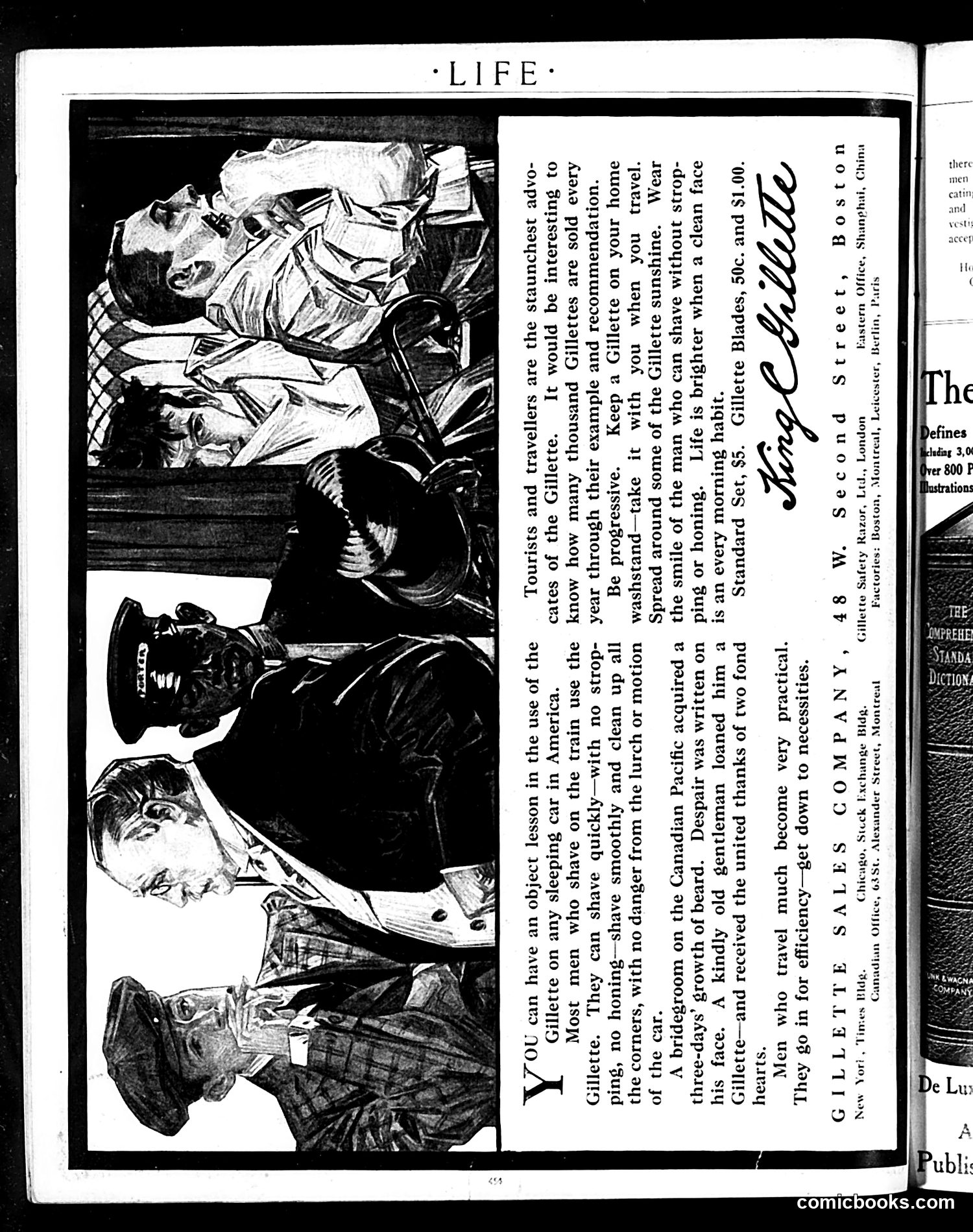
This is a **Gillette safety razor advertisement**, not political satire. The page shows illustrated male figures demonstrating the product's convenience and efficiency for travelers. The text emphasizes that Gillette razors are ideal for men on the go—tourists, businessmen, and travelers who need reliable shaving without the hassle of straight razors. Key selling points include portability, safety ("no stropping or honing"), and the standard two-blade design. The ad promises efficiency and practicality: "Men who travel much become very practical" about grooming. This represents early 20th-century consumer advertising aimed at middle-class men, promoting safety razors as modern, convenient alternatives to traditional straight razors. The illustrated vignettes show different travel scenarios where the product proves useful.
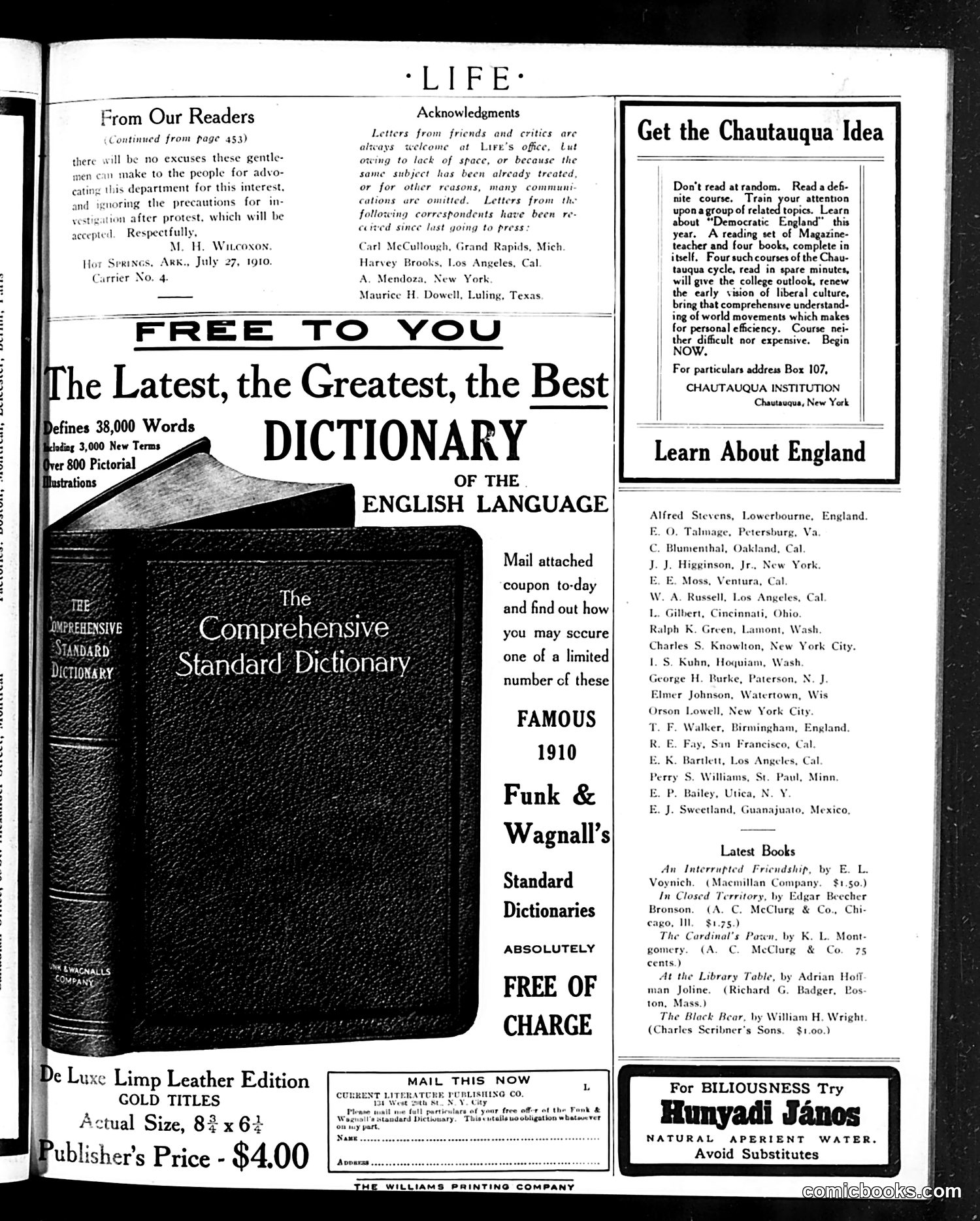
This page is primarily **advertising and reader correspondence**, not satirical content. It contains: **Main Advertisement**: A large promotion for the "Comprehensive Standard Dictionary" by Funk & Wagnall's, offered free in a de luxe leather edition (normally $4.00). The appeal emphasizes the dictionary's comprehensiveness: 38,000 words, 3,000 new terms, and 900 pictorial illustrations. **Reader Letters**: A brief "Acknowledgments" section thanks readers for submissions while noting that space constraints and duplicate topics require omitting many letters. **Secondary Advertisements**: - The Chautauqua Institution promoting self-education courses - "Learn About England" travel/cultural content - Hunyadi Janos natural aperient water (a laxative) - Various book reviews and listings **No cartoon or political satire appears on this page.** It represents typical early 1900s magazine filler material combining reader engagement with advertising revenue.
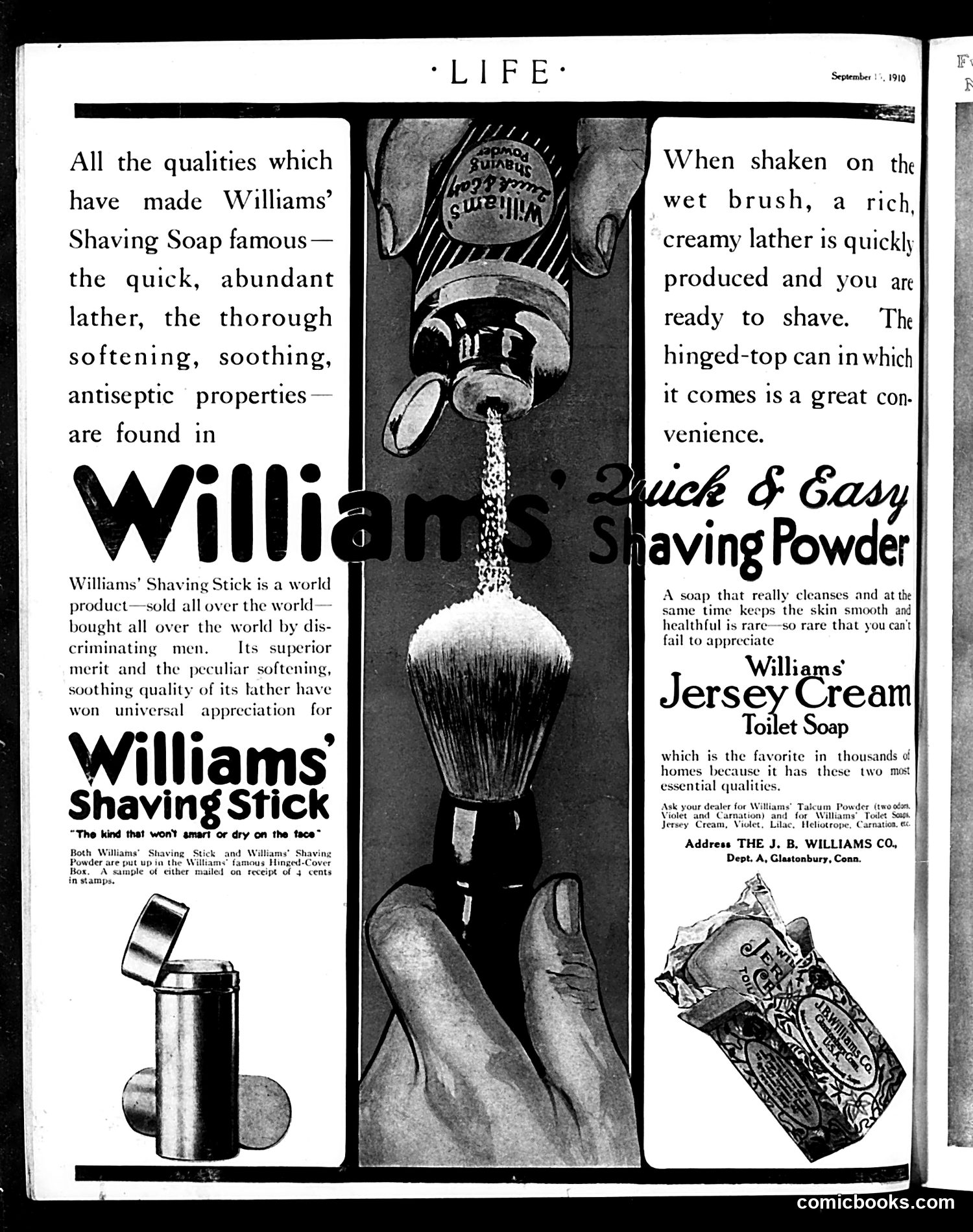
This is **not a political cartoon or satire**—it's a straightforward **advertisement page** from Life magazine (September 1910). The page promotes Williams' brand shaving products: shaving stick, shaving powder, and Jersey Cream toilet soap. The central image shows a man's face and hands demonstrating the shaving process, with powder being shaken onto a wet brush to create lather. There is **no satirical or political content** here. This represents Life magazine's business model of the era: while known for satirical cartoons and humor elsewhere in each issue, the publication also carried conventional advertising to generate revenue. The "Life" header and layout simply identify the magazine hosting the ad. For modern readers, the main historical interest is the *products themselves*—these grooming items and their marketing appeal to "discriminating men" reflect early 20th-century male grooming practices and commercial messaging, now quaint in their formality and emphasis on "soothing" and "antiseptic" properties.