
Life, 1910-09-15 · page 8 of 40
Life — September 15, 1910 — page 8: what you’re looking at
What you’re looking at
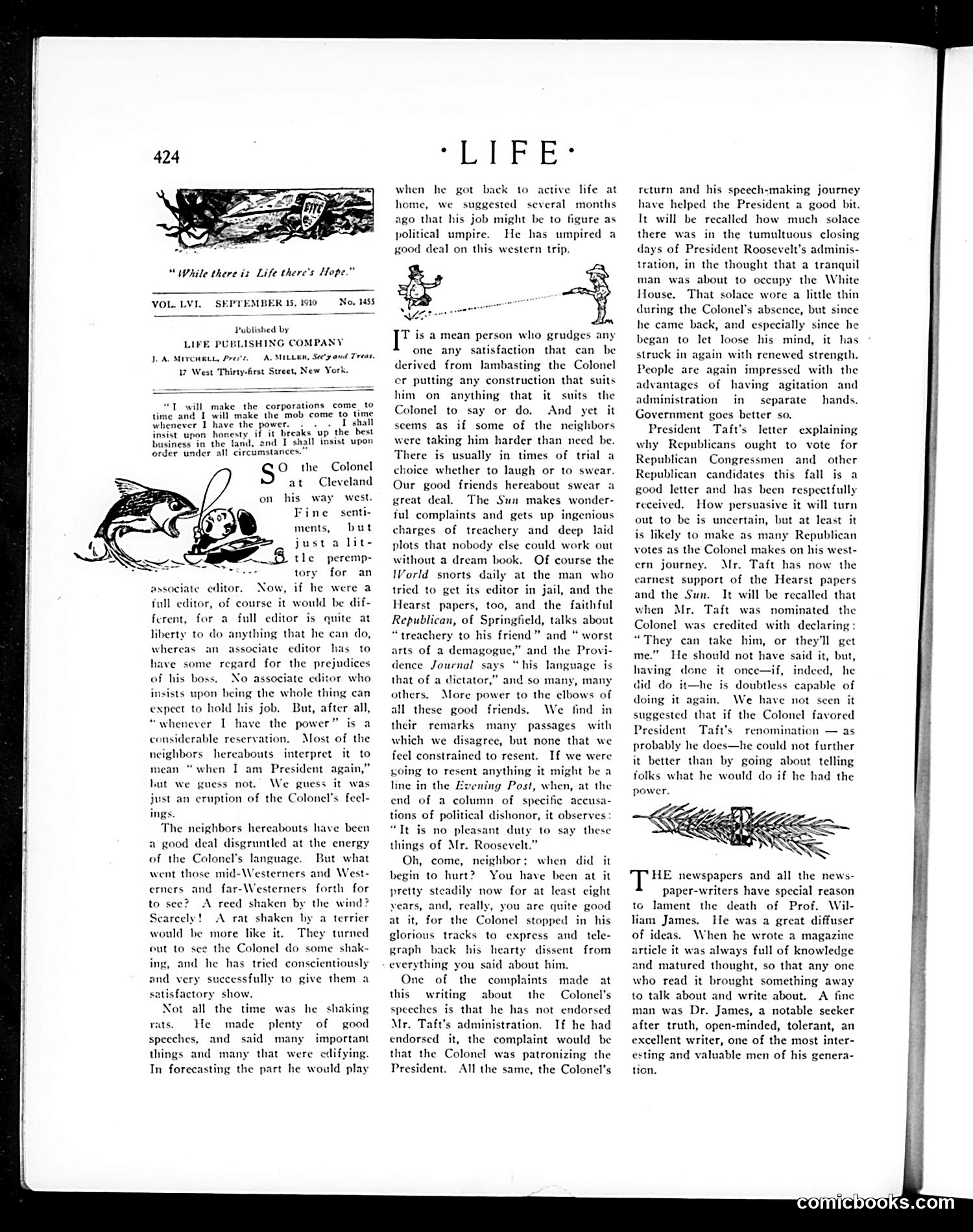
This page contains editorial commentary on Colonel Roosevelt (Theodore Roosevelt Jr., son of the former president). The text discusses the Colonel's recent western speaking tour and his relationship with the Taft administration. The small cartoon at top-left shows two figures in what appears to be a confrontational stance, likely depicting the Colonel's contentious public persona. The main satirical point: the Colonel has been criticizing President Taft's administration vocally, yet some observers question whether his complaints are justified or merely reflect his combative nature. The editorial suggests the Colonel "swears a great deal" and makes "ingenious charges" while others question his motives. The piece also notes admiration for the Colonel's energy and speech-making abilities, even while questioning the substance of his political critiques.
📄 Transcribed text from this page (OCR, searchable)
Machine-transcribed from the original scan — historical spelling and the odd misread are preserved.
“ While there is Life there's Hope.” TEMBER 15, 1910 VOL. LVI. SE! 1» 1485 Published by LIFE PUBLISHING COMPANY JA MITCHRLL, Prete, A MILLRR, See’y ant Treas, 17 West Thirty-first Street, New York. il make the corporations come. to time and I will make the mob come to time whenever IL have the power... . I shall insist upon honesty if it breaks ‘up the best business in the land, and I shall insist upon order under all circumstance S° the Colonel at Cleveland on his way Fine sent ments, but justa lit- tle peremp- tory for an sociate editor, Now, if he were a full editor, of course it would be dif- ferent, for a full editor is quite at liberty to do anything that he can do, whereas an associate editor has to have some regard for the prejudices of his boss. No associate editor who sts upon being the whole thing can expect to hold his job. But, after all, ve the power” is a considerable reservation. Most of the neighbors hereabouts interpret it to mean, I am President again,” Iut we guess not. We guess it was just an eruption of the Colonel's feel- west. “whenever I when ings. The neighbors hereabouts have been a good deal disgruntled at the energy of the Colonel's language. But what went those mid-Westerners and West- erners and far-Westerners forth for to see? A reed shaken by the wind? Scareely! A rat shaken by a terrier would be more like it. They turned out to see the Colonel do some shak- ing, and he has tried conscientiously and very successfully to give them a satisfactory show. Not all the time was he shaking rats. He made plenty of good speeches, and said many important things and many that were edifying. In forecasting the part he would play * LIF E* back to several active life at months when he got home, we suggested ago that his job might be to figure as political umpire. He has umpired a good deal on this western trip. Wat T is a mean person who grudges any one any satisfaction that can be derived from lambasting the Colonel cr putting any construction that suits him on anything that it suits the Colonel to say or do. And yet it seems as if some of the neighbors were taking him harder than need be. There is usually in times of trial a choice whether to laugh or to swear. Our good friends hereabout swear a great deal, The Sun makes wonder- ful complaints and gets up ingenious charges of treachery and deep laid plots that nobody else could work out without a dream book. Of course the IVorld snorts daily at the man who tried to get its editor in jail, and the Hearst papers, too, and the faithful Republican, of Springfield, talks about “treachery to his friend” and “ worst arts of a demagogue,” and the Provi- dence Journal says “his language is that of a dictator,” and so many, many More power to the elbows of We find in with others. all these good friends, their remarks many passages which we disagree, but none that we feel constrained to resent. If we were going to resent anything it might be a line in the Evening Post, when, at the end of a column of specific accusa- tions of political dishonor, it observes “Tt is no pleasant duty to say these things of Mr. Roosevelt.” Oh, come, neighbor; when did it begin to hurt? You have been at it pretty steadily now for at least cight years, and, really, you are quite good at it, for the Colonel stopped in his glorious tracks to express and_ tele- graph back his hearty dissent from everything you said about him. One of the complaints made at this writing about the Colonel’s speeches is that he has not endorsed Mr. Taft's administration. If he had endorsed it, the complaint would be that the Colonel was patronizing the President. All the same, the Colonel’s return and his speech-making journey have helped the President a good bit. It will be recalled how much solace there was in the tumultuous closing days of President Roosevelt's adminis- tration, in the thought that a tranquil man was about to occupy the White House. That solace wore a little thin during the Colonel’s absence, but since he came back, and especially since he began to let loose his mind, it has struck in again with renewed strength. People are again impressed with the advantages of having agitation and administration in separate hands. Government goes better so. President Taft’s letter explaining why Republicans ought to vote for Republican Congressmen and other Republican candidates this fall is a good letter and has been respectfully received. How persuasive it will turn out to be is uncertain, but at least it is likely to make as many Republican votes as the Colonel makes on his west- ern journey. Mr. Taft has now the rest support of the Hearst papers and the Sun. It will be recalled that when Mr. Taft v nominated the Colonel was credited with declaring: “They can take him, or they'll get He should not have said it, but, ving done it once—if, indeed, he did do it—he is doubtless capable of doing it again. We have not seen it suggested that if the Colonel favored President Taft's probably he does—he could not further it better than by going about telling folks what he would do if he had the power. renomination — as HE newspapers and all the news- paper-writers have special reason to lament the death of Prof. Wil- liam James. He was a great diffuser of ideas. When he wrote a magazine article it was always full of knowledge and matured thought, so that any one who read it brought something away to talk about and write about. A fine man was Dr. James, a notable seeker after truth, open-minded, tolerant, an xcellent writer, one of the most inter- esting and valuable men of his genera- ton.