
Life, 1910-09-15 · page 18 of 40
Life — September 15, 1910 — page 18: what you’re looking at
What you’re looking at
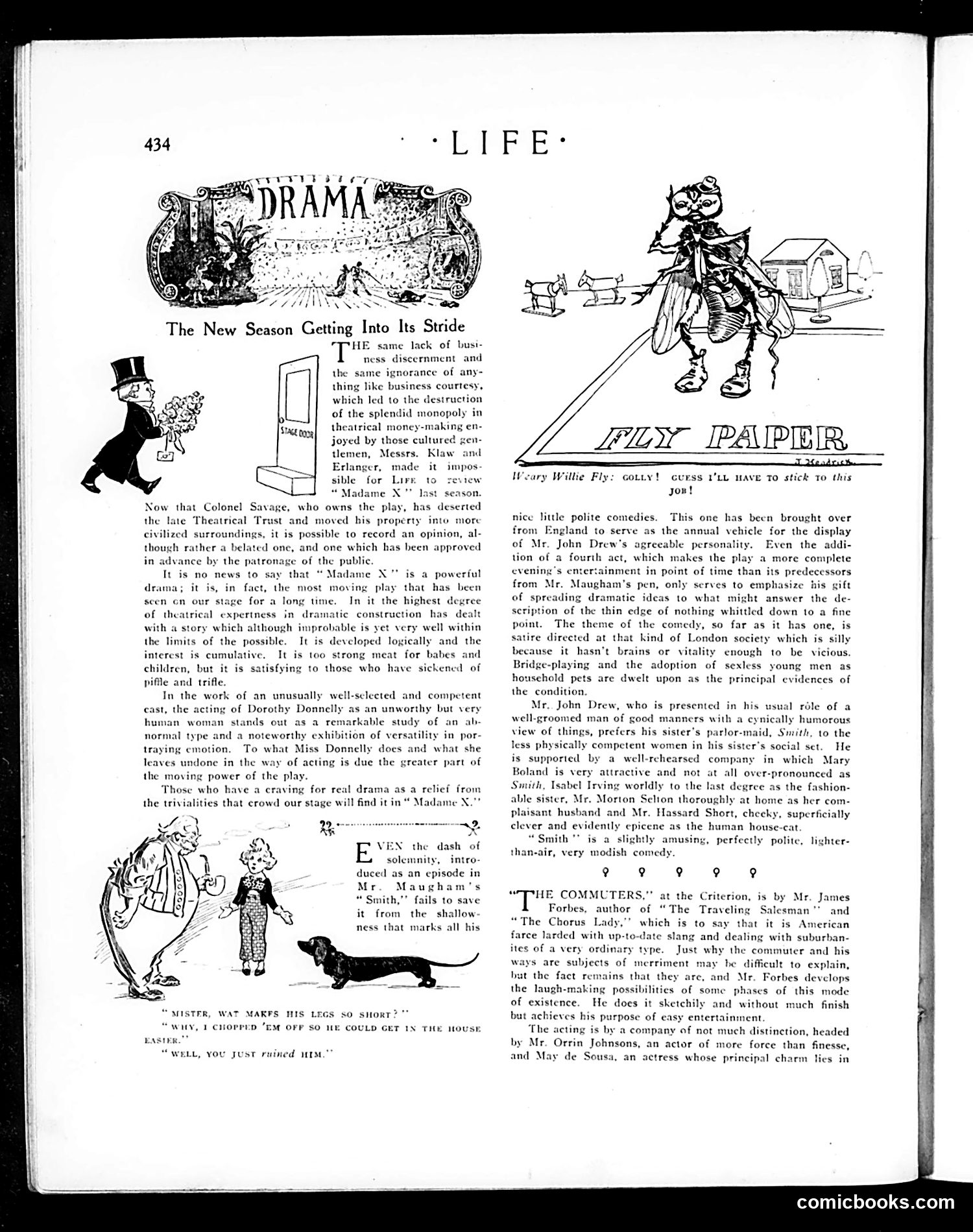
This page reviews current Broadway productions. The main article discusses **"Madame X,"** praising it as genuinely powerful drama—contrasting it with the theatrical monopoly previously controlled by producers Klaw and Erlanger, whom the writer criticizes for poor business practices. Dorothy Donnelly's performance is highlighted as exceptional. A secondary review covers **"Smith,"** a Somerset Maugham comedy imported from England featuring actor John Drew. The satire targets both the play's shallow London society setting (where wealthy people play bridge and keep "sexless young men as household pets") and Maugham's tendency to spread thin dramatic ideas. The cartoon at bottom shows "Weary Willie" (a common comic tramp character) discussing his amputated legs—he cut them off so his body would fit through a house door to avoid the expense of going around. His companion says this ruined the legs' usefulness. This is absurdist humor typical of Life's visual comedy, with no apparent connection to the theater reviews above.
📄 Transcribed text from this page (OCR, searchable)
Machine-transcribed from the original scan — historical spelling and the odd misread are preserved.
The New Season Getting ifs Its Stride HE same lack of busi- ness discernment and the same ignorance of any- thing like business courtesy, which led to the destruction of the splendid monopoly in theatrical money-making en- Klaw and Erlanger, made it impos- sible for Lirk to review Madame X last. season. Now that Colonel Savage, who owns the play, has deserted the late Theatrical to more civilized surroundings, it is possible to record an opinion, al- though rather a belated one, and one which has heen approve in advance by the patronage of the public. t and moved his property is a powerful It is no news to say that “ Madame X"" drama; it is, in fact, the most moving play that has been scen on our stage for a long time. In it the highest degree of theatrical expertness in dramatic construction has ded with a story which although improbable is yet very well within the limits of the possible. It is developed logically and the interest is cumulative. It is too strong meat for babes and children, but it is satisfying to those who have sickened of pifle and trifle In the work of an unusually well-selected and competent cast, the acting of Dorothy Donnelly as an unworthy but very human woman stands out as a remarkable study of an ab normal type and a noteworthy exhibition of versatility in por- traying emotion. To what Miss Donnelly docs and what she leaves undone in the way of acting is due the greater part of the moving power of the play. Those who have a craving for real drama as a relief from the trivialities that crowd our stage will find it in Madame X."* nine ne 9, VEN the dash of solemnity, intro- duced as an episode in Mr. Maugham’s “Smith,”’ fails to save it from the shallow ness that marks all his “MISTER, WAT MAKFS IIS LEGS so sort?” “WHY, 1 CHOPPED ’EMt OFF SO ILE COULD GET IN THE Mouse. Este.” “WELL, You JUST ruined MEM." GUESS I'LL MAVE To stick To this you! Weary Willie Fi cotty! nice little polite comedies. This one has been brought over from England to serve as the annual vehicle for the display of Mr. John Drew’s agreeable personality. Even the add tion of a fourth act, which makes the play a more complete evening's entertainment in point of time than its predecessors from Mr. Maugham’s pen, only serves to emphasize his gift of spreading dramatic ideas to what might answer the de- scription of the thin edge of nothing whittled down to a fine point. The theme of the comedy, so far as it has one, is satire directed at that kind of London society which is silly because it hasn't brains or vitality enough to be vicious. Bridge-playing and the adoption of sexless young men as household pets are dwelt upon as the principal evidences of the condition. Mr. John Drew, who is presented in his usual réle of a well-groomed man of good manners with a cynically humorous view of things, prefers his sister's parlor-maid, Smith, to the less physically competent women in his sister's social set. He is supported by a well-rchearsed company in which Mary Boland is very attractive and not at all over-pronounced as Smith, Isabel Irving worldly to the last degree as the fashion- able sister, Mr. Morton Scion thoroughly at home as her com- plaisant husband and Mr. Hassard Short, cheeky, superficially clever and evidently epicene as the human house-cat “ Smith perfectly polite, lighter- than-air, very modish comedy. g 2 g 9 2 HE COMMUTERS," at the Criterion, is by Mr. James Forbes, author of “The Traveling Salesman" and “The Chorus Lady,” which is to say that it is American farce larded with up-to-date slang and dealing with suburban- ites of a very ordinary type. Just why the commuter and his ways are subjects of merriment may be difficult to explain, but the fact remains that they are, and Mr. Forbes develops the laugh-making possibilities of some phases of this mode of existence. He does it sketchily and without much finish but achieves his purpose of € ‘The acting is by a company of not much distinction, headed by Mr. Orrin Johnsons, an actor of more force than finesse, and May de Sousa, an actress whose principal charm Ii is a slightly amusin; entertainment comicbooks.com