
Life, 1910-09-15 · page 25 of 40
Life — September 15, 1910 — page 25: what you’re looking at
What you’re looking at
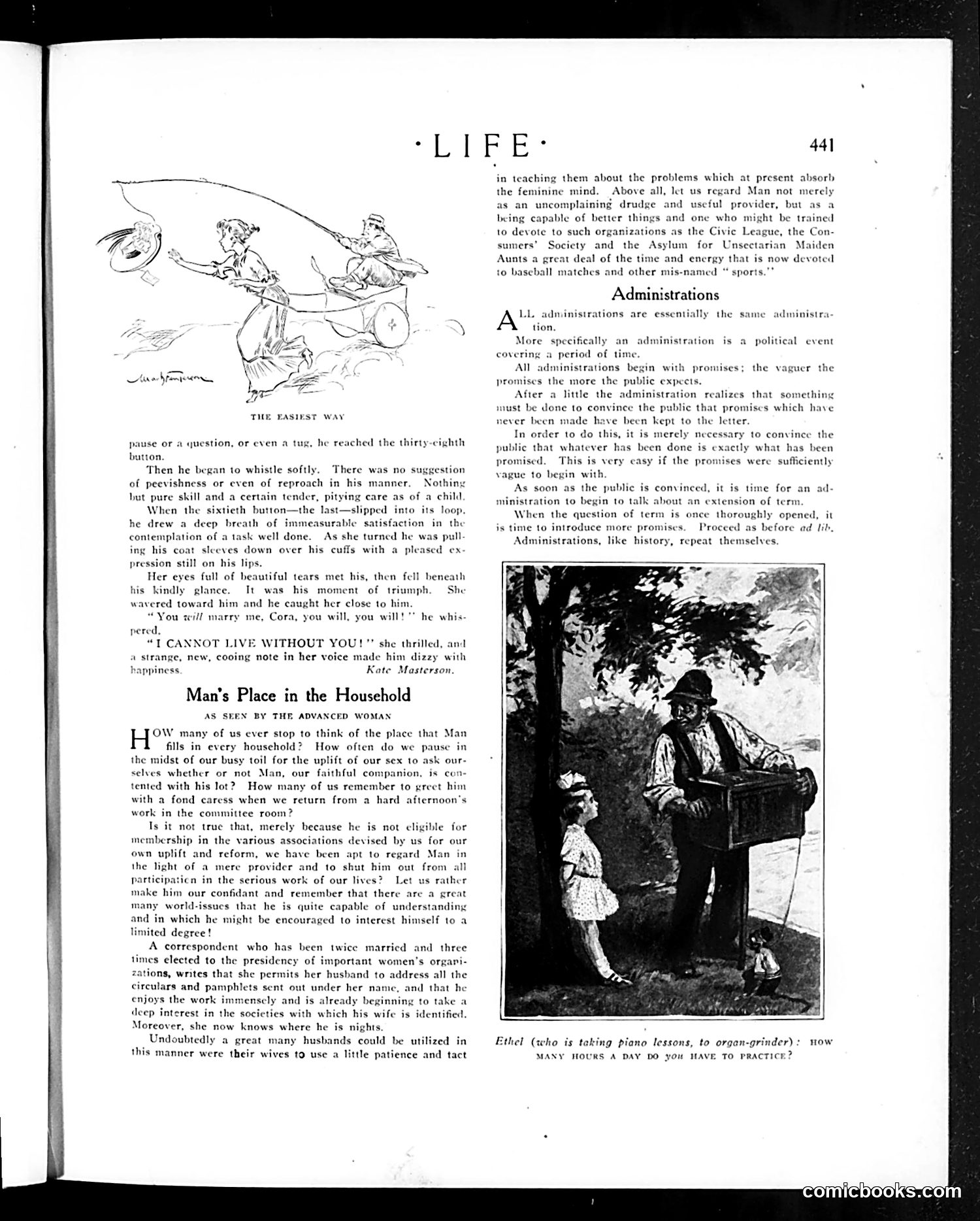
This page satirizes the "advanced woman" or early feminist movement by reversing gender roles. The article, credited to "The Advanced Woman," ostensibly advocates for men's greater household participation and involvement in women's organizations. However, the satire is evident: it patronizingly suggests husbands should be "trained" like children, given busy-work (addressing circulars), and kept occupied so wives "know where [they are] nights"—implying suspicion and control. The upper illustration shows a domestic scene supporting this theme: a woman controlling a man like a puppet on strings labeled with buttons, depicting manipulative domesticity. The piece mocks both the earnestness of women's reform movements AND the condescension underlying their rhetoric about male capability. By suggesting men need "patience and tact" to understand "women's issues," it exposes the same exclusionary logic the movements claimed to oppose.
📄 Transcribed text from this page (OCR, searchable)
Machine-transcribed from the original scan — historical spelling and the odd misread are preserved.
“LIFE: 441 THE EASIEST Way pause or a question, or even a tug, he reached the thirty-cighth button, Then he began to whistle softly. There was no suggestion of peevishness or even of reproach in his manner. Nothing but pure skill and a certain tender, pitying care as of a child When the sixtieth button—the last—slipped into its loop, he drew a deep breath of immeasurable satisfaction in the contemplation of a task well done ing his coat sleeves down over his cuffs with a pleased ex As she turned he was pull pression still on his lips. Her eyes full of beautiful tears met his, then fell beneath his kindly glance. It was his moment of triumph. wavered toward him and he caught her close to him. “You will marry me, Cora, you will, you will!” he whis pered, “T CANNOT LIVE WITHOUT YOU!” she thrilled, and \ strange, new, cooing note in her voice made him dizzy with Kate Masterson. Man’s Place in the Household AS SEEN BY THR ADVANCED WOMAN ppiness OW many of us ever stop to think of the place that Man fills in every household? How often do we pause in the midst of our busy toil for the uplift of our sex to ask our- selves whether or not Man, our faithful companion, is con- tented with his lot? How many of us remember to greet him with a fond caress when we return from a hard work in the committee room? Is it not truc that, merely because he is not cligible for membership in the various associations devised by us for our own uplift and reform, we have been apt to regard Man in the light of a mere provider and to shut him out from all participatien in the serious work of our lives? Let us rather make him our confidant and remember that there are a gre fternoon’s many world-issues that he is quite capable of understanding and in which he might be encouraged to interest himself to a limited degree! A correspondent who has been twice married and three elected to the presidency of important women's organi- ions, writes that she permits her husband to address all the circulars and pamphlets sent out under her name, and that he enjoys the work immensely and is already beginning to take : deep interest in the societies with which his wife i Moreover, she now knows where he is nights. Undoubtedly a great many husbands could be utilized in this manner were their wives to use a little patience and tact in teaching them about the problems which at present absorb the feminine mind. Above as an uncomplaining drudge and useful provider, but as a being capable of better things and one who might be trained to devote to such organizations as the Civic League, the Con- sumers’ Society and the Asylum for Unsectarian Maiden Aunts a great deal of the time and energy that is now devoted to baseball matches and other mis-named ports.”* Il, let us regard Man not merely Administrations A . administrations are essentially the same administra- tion. More specifically an covering a period of time ministration is a political event All administrations be promises; the vaguer the promises the more the public expects. After a little the administration realizes that something must be done to convince the public that promises which have never been made have been kept to the letter. In order to do this, it is merely necessary to convince the ic that whatever promised. s been done is exactly what has been This is very easy if the promises were sufficiently vague to begin with. As soon as the public is convinced, it is time for an ad ministration to begin to talk about an extension of term When the question of term is once thoroughly opened, it is time to introduce more promises. Proceed as b Administrations, like history, repeat themselves. hel (who is taking piano lessons, to organ-grinder): now MANY HOURS A DAY DO you MAVE TO PRACTICE?