
Life, 1910-09-15 · page 19 of 40
Life — September 15, 1910 — page 19: what you’re looking at
What you’re looking at
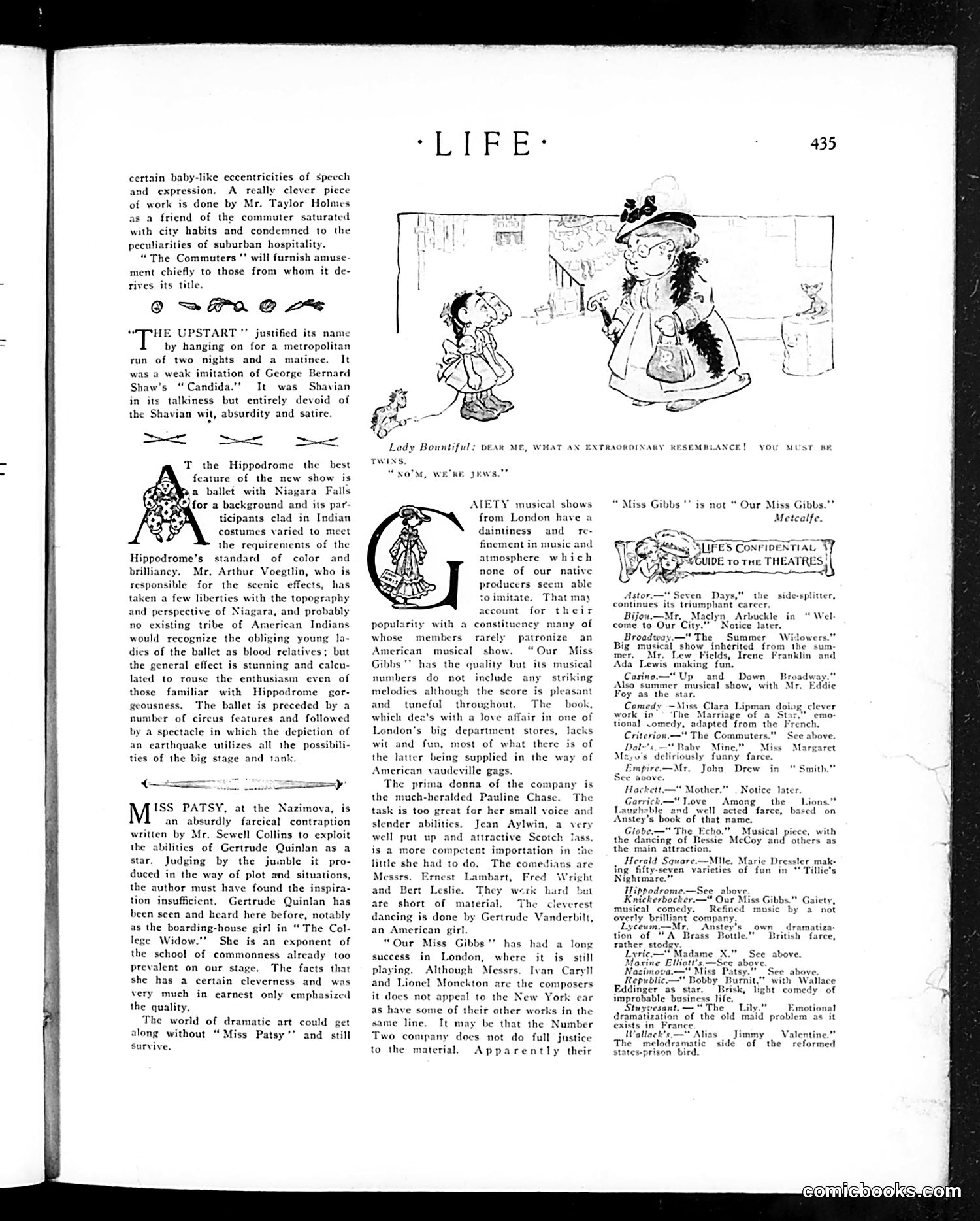
This page contains theater reviews from what appears to be an early 1900s issue of Life magazine. The main cartoon at top shows a wealthy woman (Lady Bountiful) encountering twins and remarking on their "extraordinary resemblance" — the joke being the obvious absurdity of commenting on twins looking alike. The bulk of the page reviews contemporary Broadway shows: "The Upstart" (dismissed as a weak Shaw imitation), the Hippodrome's spectacle featuring a ballet with Niagara Falls and Native American costumes (which the reviewer notes takes liberties with historical accuracy), "Miss Patsy" (criticized as exploitative vehicle for actress Gertrude Quinlan), and "Our Miss Gibbs" (a London import praised for refinement but finding less success in New York). The reviews are frankly critical, particularly of American-produced shows, which the writer suggests lack the "daintiness and refinement" of London productions. The satire targets both theatrical mediocrity and the star system's ability to showcase performers regardless of talent.
📄 Transcribed text from this page (OCR, searchable)
Machine-transcribed from the original scan — historical spelling and the odd misread are preserved.
certain baby-like eccentricities of speech and expression. A really clever piece of work is done by Mr. Taylor Holmes as a friend of the commuter saturated with city habits and condemned to the peculiarities of suburban hospitality. “The Commuters " will furnish amuse- ment chiefly to those from whom it de- rives its title. 0 >a OAs “"THE UPSTART "" justified its name T by hanging on for a metropolitan run of two nights and a matinee. It was a weak imitation of George Bernard Shaw’s “ Candida." It was Shavian in its talkiness but entirely devoid of the Shavian wit, absurdity and satire. == oS the Hippodrome the best feature of the new show is a ballet with Niagara Falls {for a background and its par- ticipants clad in Indian costumes varied to meet the requirements of the Hippodrome’s standard of color and brilliancy. Mr, Arthur Voegtlin, who is responsible for the scenic effects, has taken a few liberties with the topography and perspective of Niagara, and probably no existing tribe of American Indians would recognize the obliging young la- dies of the ballet as blood relatives; but the general effect is stunning and calcu- lated to rouse the enthusiasm even of those familiar with Hippodrome gor- geousness. The ballet is preceded by a number of circus features and followed by a spectacle in which the depiction of an earthquake utilizes all the possibili- ties of the big stage and tank. = < ISS PATSY, at the Nazimova, is an absurdly farcical contraption written by Mr. Sewell Collins to exploit the abilities of Gertrude Quinlan as a star. Judging by the jumble it pro- duced in the way of plot and situations, the author must have found the inspira- tion insufficient. Gertrude Quinlan has been seen and heard here before, notably as the boarding-house girl in “The Col- lege Widow.'? She is an exponent of the school of commonness already too prevalent on our stage. The facts that she has a certain cleverness and was very much in earnest only emphasized the quality. The world of dramatic art could get along without “Miss Patsy’? and still survive. ity oOo Lady Bountiful: peak x2, WHAT AN EXTRAORDINARY KESEMMLANCE ! TWINS, NOM, WERE JEWS. AIETY musical shows from London have « daintiness and re- finement in music and atmosphere which none of our native producers seem able roimitate. That may account for their h a constituency many of whose patronize an merican “Our Miss bs"? has the quality but its musical numbers do not include any striking melodies although the score is pleasant and tuneful throughout. The book, which dez's with a love affair in one of London’s big department stores, and fun, most of what there is of the latter being supplied in the way of American vaudeville gags. The prima donna of the company is the much-heralded Pauline Chase. The task is too great for her small voice and slender abilities. Jean: Aylwin, a very well put up and attractive Scotch is a more competent importation in the little she had to do. Messrs. Ernest Lambart, Fred Wright and Bert Leslie. They werk hard bet are short of material, The cleverest dancing is done by Gertrude Vanderbilt, an American girl Our Miss Gibbs"? has had a long success in London, where it is still playing. Although Messrs. Ivan Caryl and Lionel Monckton are the composers it does not appeal to the New York ear as have some of their other works in the same line. It may be that the Number Two company docs not do full justice to the material. Apparently their popularit members rarely musical show. lacks The comedians are you must 1 “ Miss Gibbs "' is not “ Our Miss Gibbs.’* Metcalfe. SLUFES Conripentian ¥ SSGUIDE ro THe THEATRES! ¢ Days," the continues its triumphant carcer. Bijow—Mer,_Maclyn, Arbuckle in come to Our City.” © Notice later. Broadway.—"The Summer Wiowers." Big musical show inherited from the sum- mer. Mr. Lew Fields, Irene Franklin and Ada Lewis making fun. Cosino.—" Up and | Down Mroadway.” Also summer musical show, with Mr. Eddie Foy as the star, Comedy Miss Clara Lipman d work in” ‘The Marriage of a S tional .omedy, adapted from the French Criterion —" The Commuters.” Dal-'s.—** Raby Mine.” Miss Ma;u's deliriously funny fare Empire—Mr. Joha Drew ii See avove. “Mother.” Notice later Hackett, Love Among the side-splitter, “Wel clever See above. Margaret Smith Garrick.— Lions.” ughable and well acted farce, based on Anstey’s book of that name. Globe.—“ The Echo. Musical piece, with the dancing of Bessie McCoy and others as the main attraction. Herald Square.—M lle. Marie Dressler mak+ ing fifty-seven varieties of fun in “ Tillie’s Nightmare.” Hippodrome.—Se above. Knickerbock: Our Miss Gibbs.” Gaiety, musical comedy. Refined music by a not overly brilliant compan: ‘cum.—Mr.Anstey's own dramatiza- tion of “A Brass Bottle." British farce, rather stodgy. ie.—"Madame X." See above. Na: ova. ec above. Republic.—" Bobby Teurnit,” with Eddinger as star. Bris improbable business life. Stuyvesant. —“ The Lily Emotional dramatization of the old maid problem as it exists in France Wallack’s—" Alias Jimmy — Valentine.” The ‘melodramatic sidé of the reformed states-prison bird.