
Life, 1910-09-15 · page 15 of 40
Life — September 15, 1910 — page 15: what you’re looking at
What you’re looking at
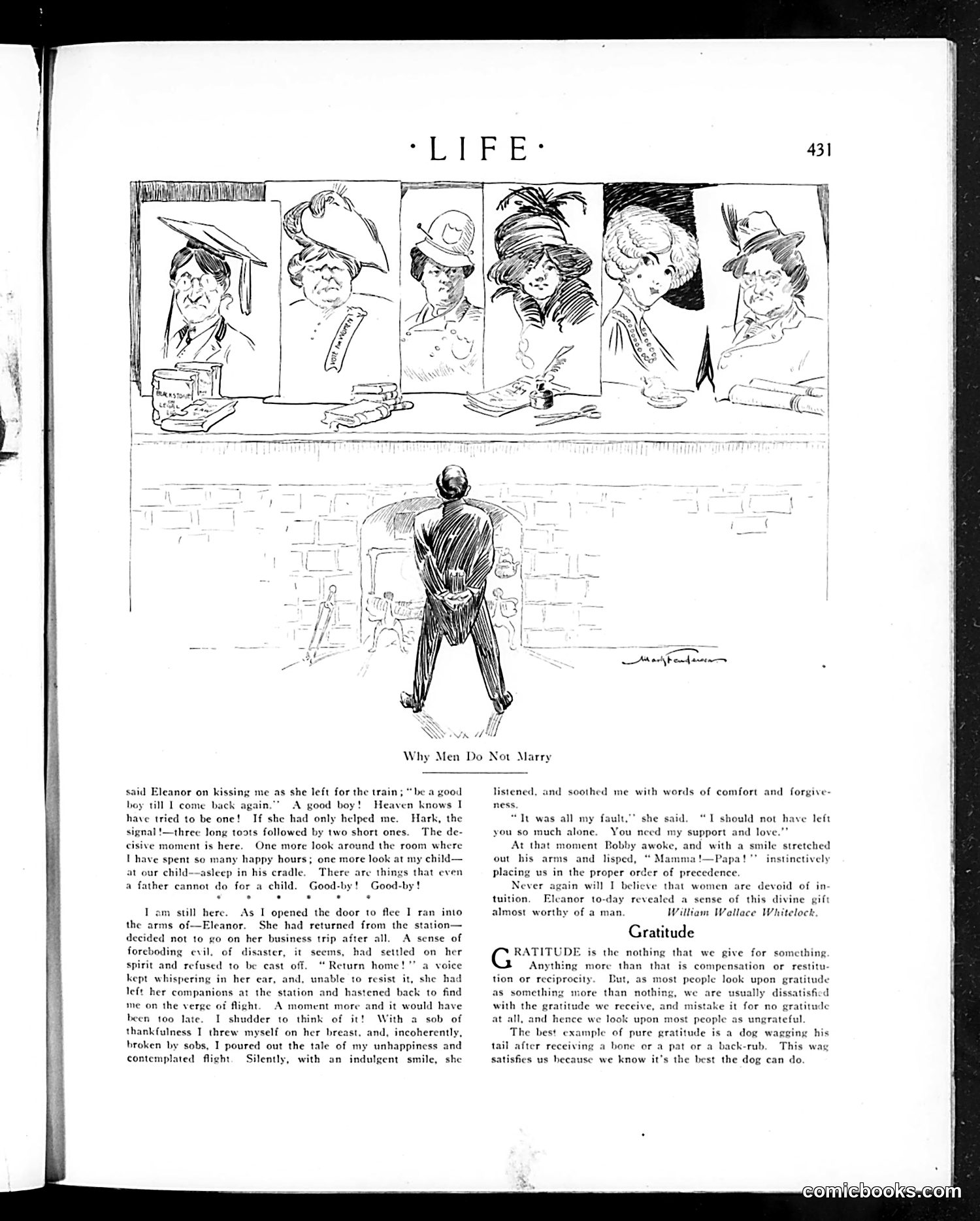
This page contains a humorous short story illustrated with six caricatured character sketches at the top, likely depicting various types of men or marital situations (the specific identities are unclear from the image alone). The main narrative is a sentimental domestic tale: a husband, on the verge of abandoning his wife and child, is stopped when his wife Eleanor returns from the train station, having had a premonition to come back. She forgives him, and their child awakes, symbolically placing the parents "in the proper order of precedence." The satire appears to mock both overly sentimental domestic fiction and the contradictions of marriage itself—the title "Why Men Do Not Marry" ironically frames a story where a man nearly leaves his family, only to be emotionally manipulated back into compliance through his wife's intuition and the child's innocence. The accompanying essay on "Gratitude" extends this cynical view, defining gratitude as "nothing" and comparing human gratitude unfavorably to a dog's tail-wagging—suggesting people are inherently ungrateful.
📄 Transcribed text from this page (OCR, searchable)
Machine-transcribed from the original scan — historical spelling and the odd misread are preserved.
4 i i | ! \ | | i i a 4 | i | oa SS SETH ISIEDRTIT were ae, Why Men Do Not Marry said Eleanor on kissing me as she left for the train; “be a good boy till I come back again.” A good boy! Heaven knows I have tried to be one! If she had only helped me. Hark, the signal !—three long toats followed by two short ones. The de- cisive moment is here. One more look around the room where Thave spent so many happy hours; one more look at my child— at our child~asleep in his cradle. There are things that even a father cannot do for a child. Good-by! Good-by! Iam still here. As I opened the door to flee I ran imo the arms of—Eleanor. She had returned from the station— decided not 10 go on her business trip after all. A sense of foreboding evil. of disaster, it seems, had settled on her listened, and soothed me with words of comfort and forgive- ness “It was all my fault,” she said. “1 should not have left you so much alone. You need my support and love.”” At that moment Bobby awok out his arms and lisped, “ M placing us in the proper 0 and with a smile stretched instinctively jer of precedence. eve that women are devoid of in anor to-day revealed a sense of this divine gift almost worthy of a man. William Wallace Whitelock, Gratitude is the nothing that we give for something. RATITUL 1 spirit and refused to be east off. “Return home!" a voice Anything more than that is compensation oF restitu- f 4 kept whispering in her ear, and, unable to resist it, she had tion or reciprocity. But, as most people look upon gratitude | i left her companions at the station and hastened back to find as something more than nothing, we are usually dissatisfied | me on the verge of flight. A moment more and it would have with the gratitude we receive, and mistake it for no gratitude been too late. I shudder to think of it! With a sob of at all, and hence we look upon most people as ungrateful. ] thankfulness I threw myself on her breast, and, incoherently, The best example of pure gratitude is a dog wagging his } i broken by sobs, I poured out the tale of my unhappiness and tail after receiving a bone or a pat or a back-rub. This wag | i contemplated flight. Silently, with an indulgent smile, she satisfies us hecause we know it's the best the dog can do | 3 i ¥ 4 icomicbooks-com