
A complete issue · 40 pages · 1910
Life — July 21, 1910
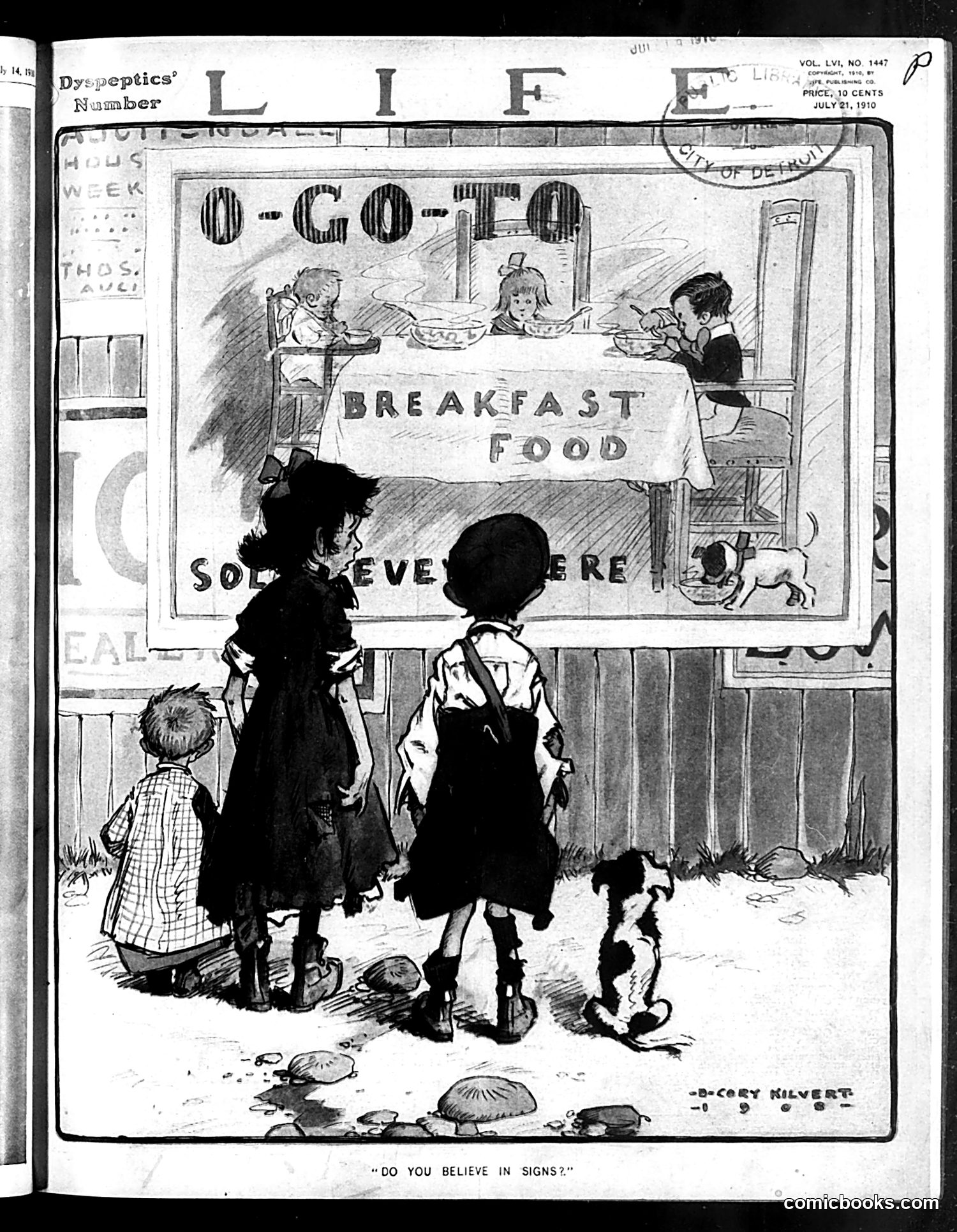
This Life magazine cover depicts a social commentary on poverty and inequality. Three children and a small dog stand outside a restaurant window displaying a sign reading "0-CO-H-0" (likely "Cocoa" or similar establishment) advertising "BREAKFAST FOOD" and "SO[M]IEVEV[?]ERE." The children, dressed in tattered clothing, gaze longingly at the restaurant where well-fed diners eat. The caption reads "DO YOU BELIEVE IN SIGNS?"—a sardonic question suggesting the irony of advertising food to hungry people who cannot afford it. This appears to be Depression-era social criticism, contrasting commercial messaging promoting consumption with the reality of destitute children excluded from that abundance. The cartoon critiques both poverty and the apparent callousness of advertising luxury to the desperate.
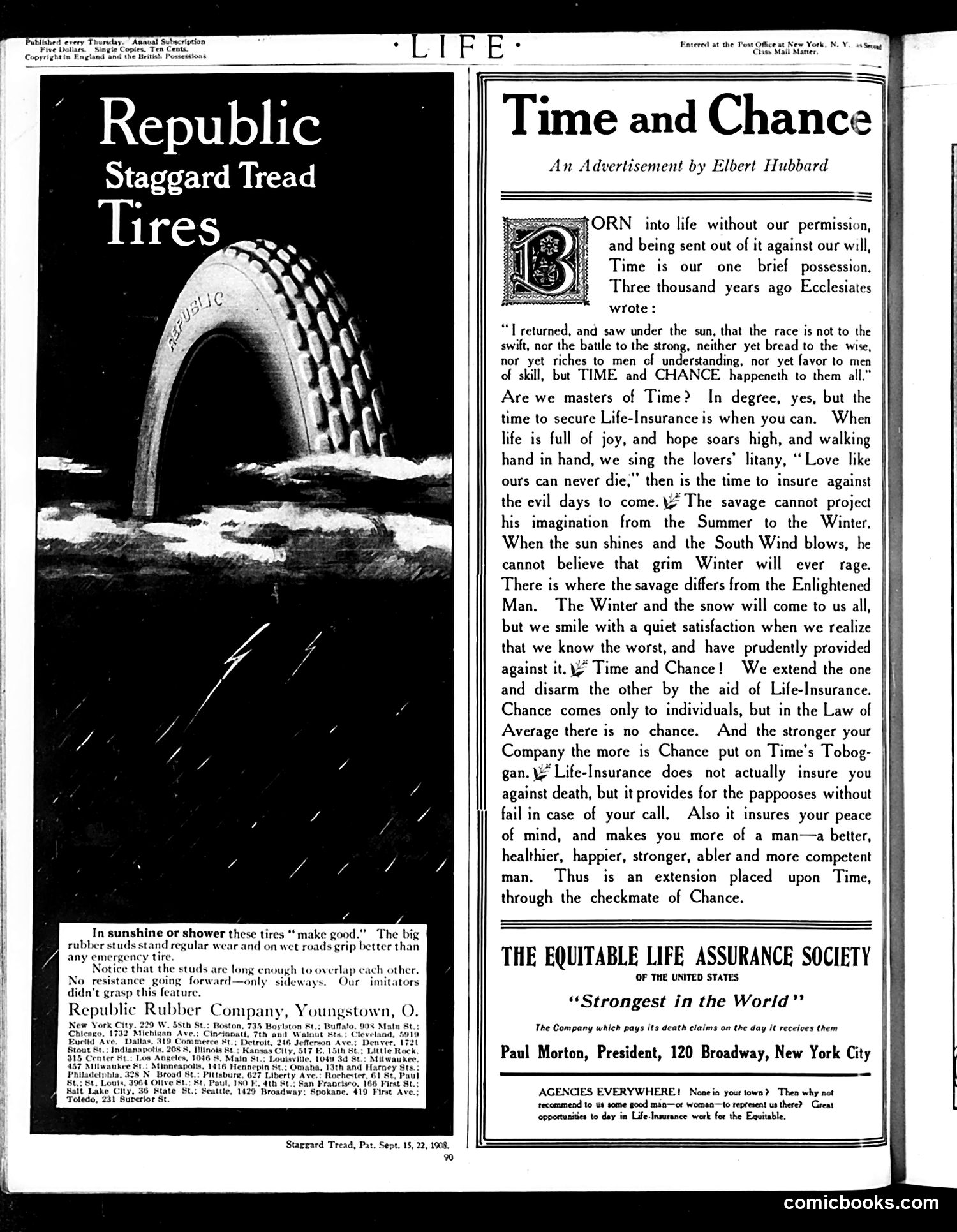
This page contains **two separate advertisements**, not political cartoons or satire. **Left side:** Republic Rubber Company advertises Staggard Tread Tires. The image shows a tire in rain, emphasizing durability and grip on wet roads. The copy claims these tires outperform competitors through better tread design and overlap construction. **Right side:** The Equitable Life Assurance Society publishes a philosophical advertisement titled "Time and Chance" by Elbert Hubbard. It opens with a biblical quote about life's unpredictability, then pivots to promoting life insurance as protection against uncertainty. The company positions insurance as enlightened preparation against life's inevitable hardships. Both ads represent early 20th-century American marketing strategies using lifestyle messaging rather than direct product claims.

This page is **not a cartoon or satire** — it's a straightforward automobile advertisement from 1911. "The Locomobile Announcement" promotes two car models: the "30" (four cylinders) and "48" (six cylinders). The ad highlights technical features like a high-tension dual ignition system and four-speed selective transmission, then lists available body styles (Touring, Baby Tonneau, Runabout, Torpedo, Limousine, Landaulet). The Locomobile Co. of America — with offices in New York, Philadelphia, Bridgeport, Boston, San Francisco, and Chicago — emphasizes customization options including paint colors chosen by the purchaser. This represents early automotive marketing aimed at affluent buyers during the nascent automobile era. There is no political or social satire present; it's purely commercial content within *Life* magazine's pages.
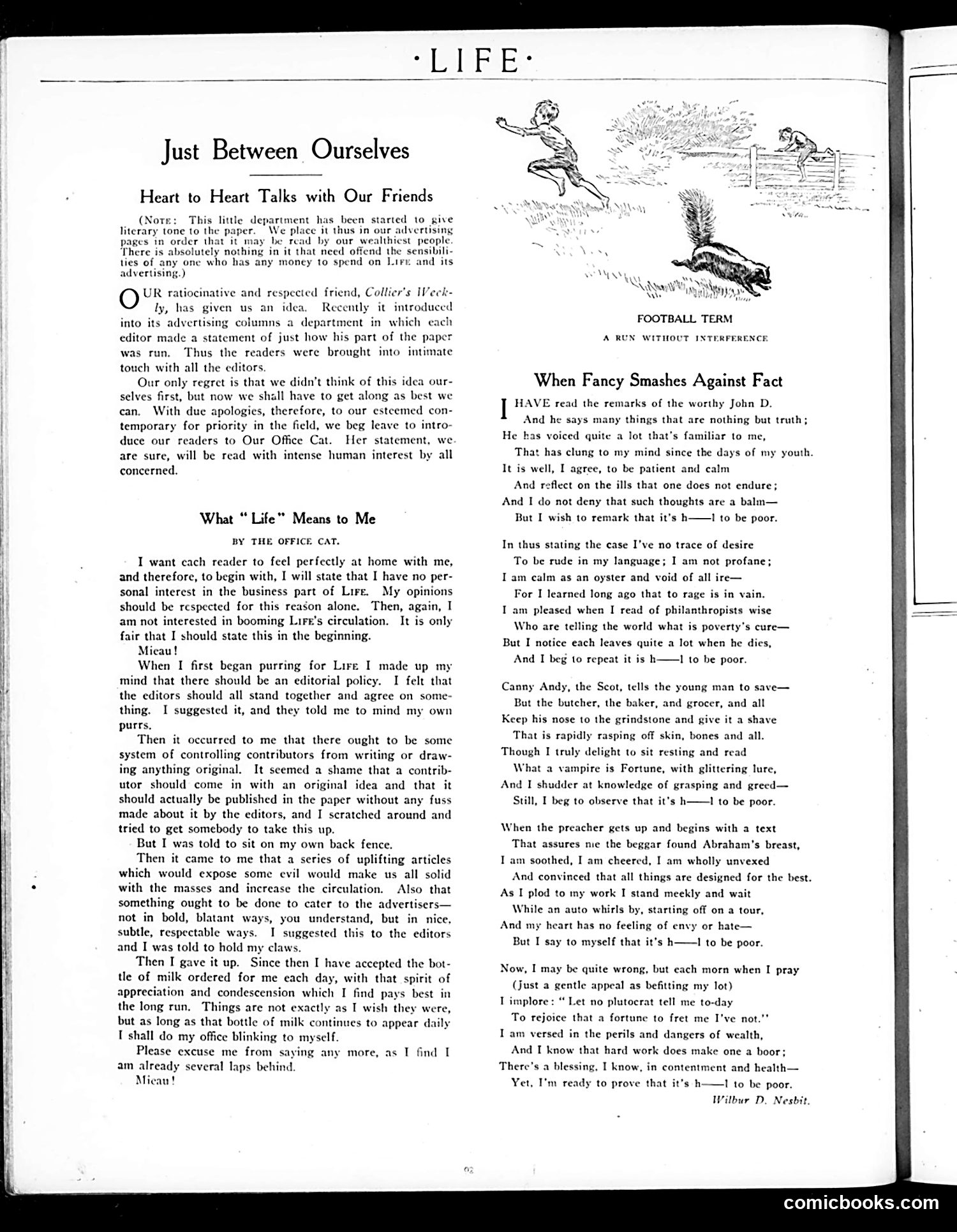
This page contains editorial content rather than political cartoons. The "Football Team: A Run Without Interference" illustration shows a skunk evading pursuers—a visual metaphor for an unobstructed play. The main article "When Fancy Smashes Against Fact" by Wilbur D. Nesbit is a philosophical poem criticizing idealistic rhetoric. Nesbit argues against those who preach abstract virtues (contentment, hard work, poverty as noble) while ignoring material reality. He references preachers citing Abraham's wealth and characters like "Canny Andy, the Scot," who tell working people to accept grinding poverty while the wealthy prosper. The satire targets the hypocrisy of those promoting acceptance of poverty as virtuous while themselves benefiting from the system—a critique of class inequality dressed in moral language.
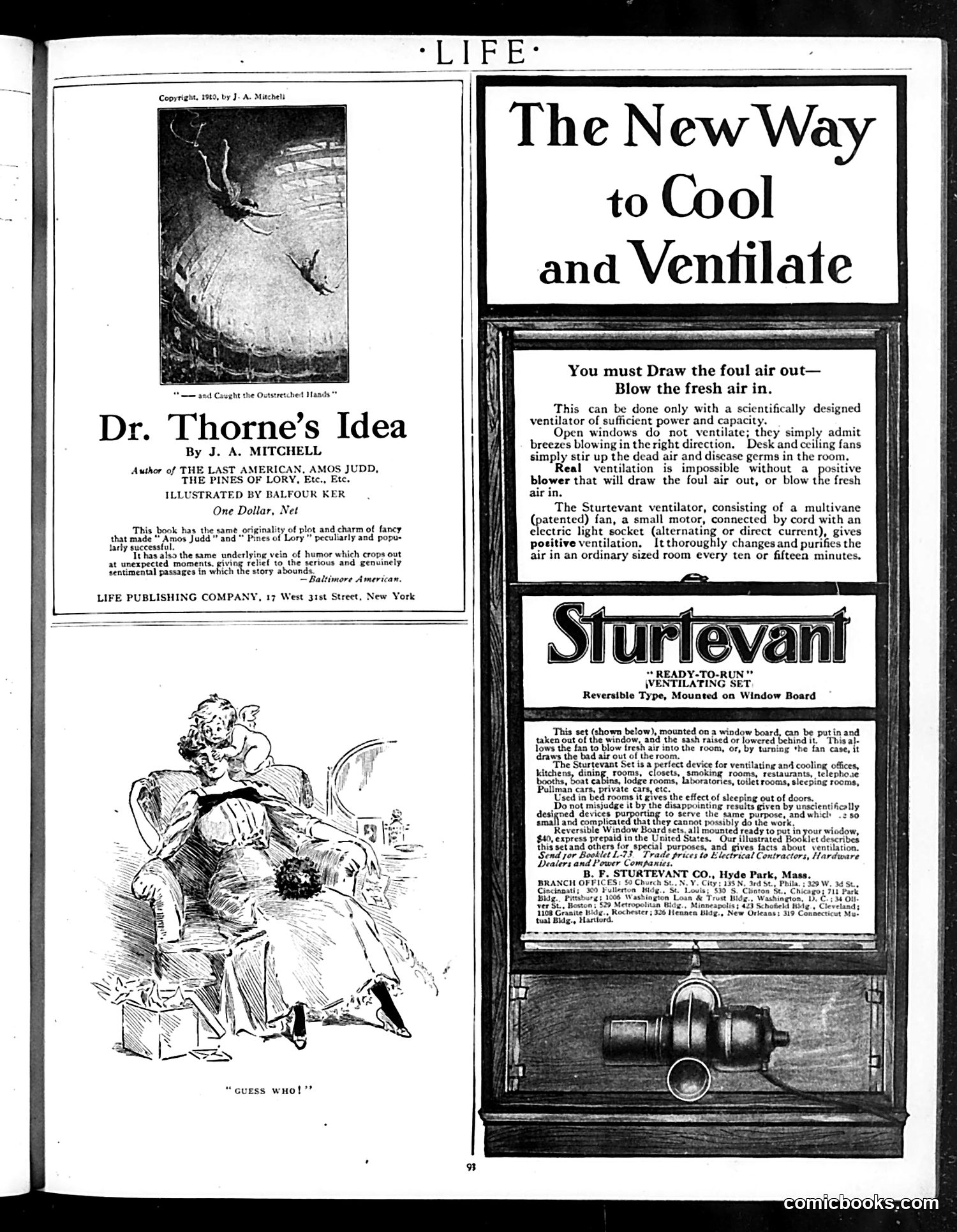
This page contains two unrelated items: **Left side:** An advertisement for J.A. Mitchell's book "Dr. Thorne's Idea," illustrated with a humorous sketch labeled "Guess Who!" The cartoon shows a cherub-like figure interacting with what appears to be a person in old-fashioned dress—likely meant as lighthearted visual humor rather than political satire. **Right side:** A product advertisement for the "Sturtevant" ventilation system, emphasizing its ability to draw foul air out while blowing fresh air in. This is a straightforward commercial pitch with technical specifications. This appears to be a typical Life magazine page mixing editorial content with advertising—common practice for the era. Neither item contains identifiable political commentary or contemporary social satire requiring historical context.
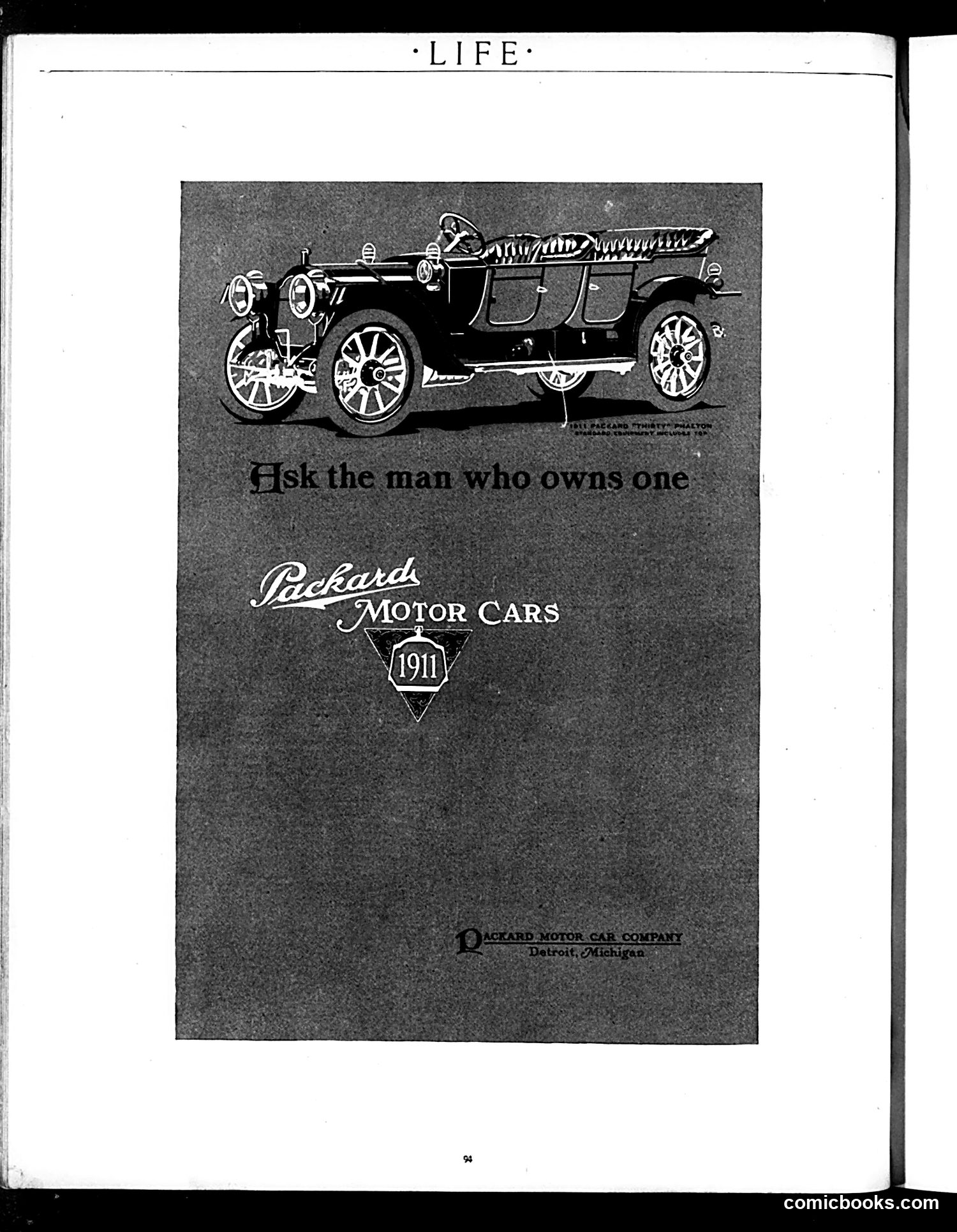
This is a **Packard Motor Cars advertisement** from 1911, not satirical content. The ad features an illustration of an early automobile and uses the slogan "Ask the man who owns one" — a marketing appeal to consumer testimonials as proof of quality. The image shows a luxury touring car typical of the era, with open seating, large spoked wheels, and prominent headlamps. The tagline suggests that satisfied owners themselves provide the best advertisement. The Packard Motor Car Company, based in Detroit, Michigan, was positioning their vehicles as premium automobiles. This represents early automotive advertising targeting affluent buyers who could afford luxury cars during the pre-mass-production era.
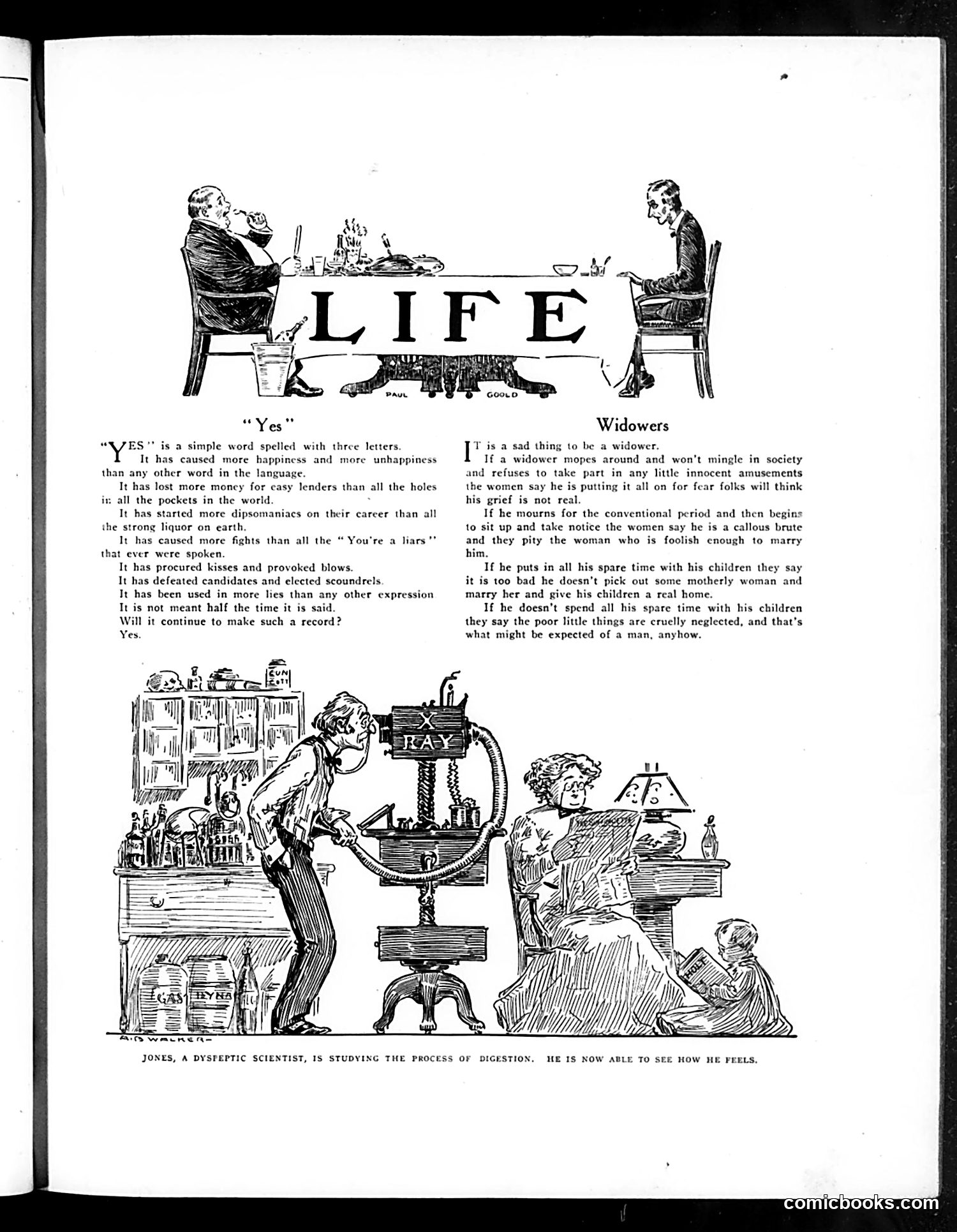
**Top Cartoon:** Two men dining across from each other illustrate the word "LIFE." The accompanying text satirizes how "Yes"—a simple word—has caused disproportionate social damage: unhappiness, financial loss, disputes, fights, and electoral consequences. This appears to critique impulsive affirmation or agreement in relationships and politics. **Bottom Cartoon:** Titled "Jones, a Dyspeptic Scientist, is Studying the Process of Digestion. He is Now Able to See How He Feels," it shows a man using an X-ray machine on himself while a woman and child observe. This mocks the era's enthusiasm for scientific gadgetry and medical technology, suggesting obsessive self-examination or hypochondria among contemporary scientists and the wealthy. Both mock social pretension and technological excess.
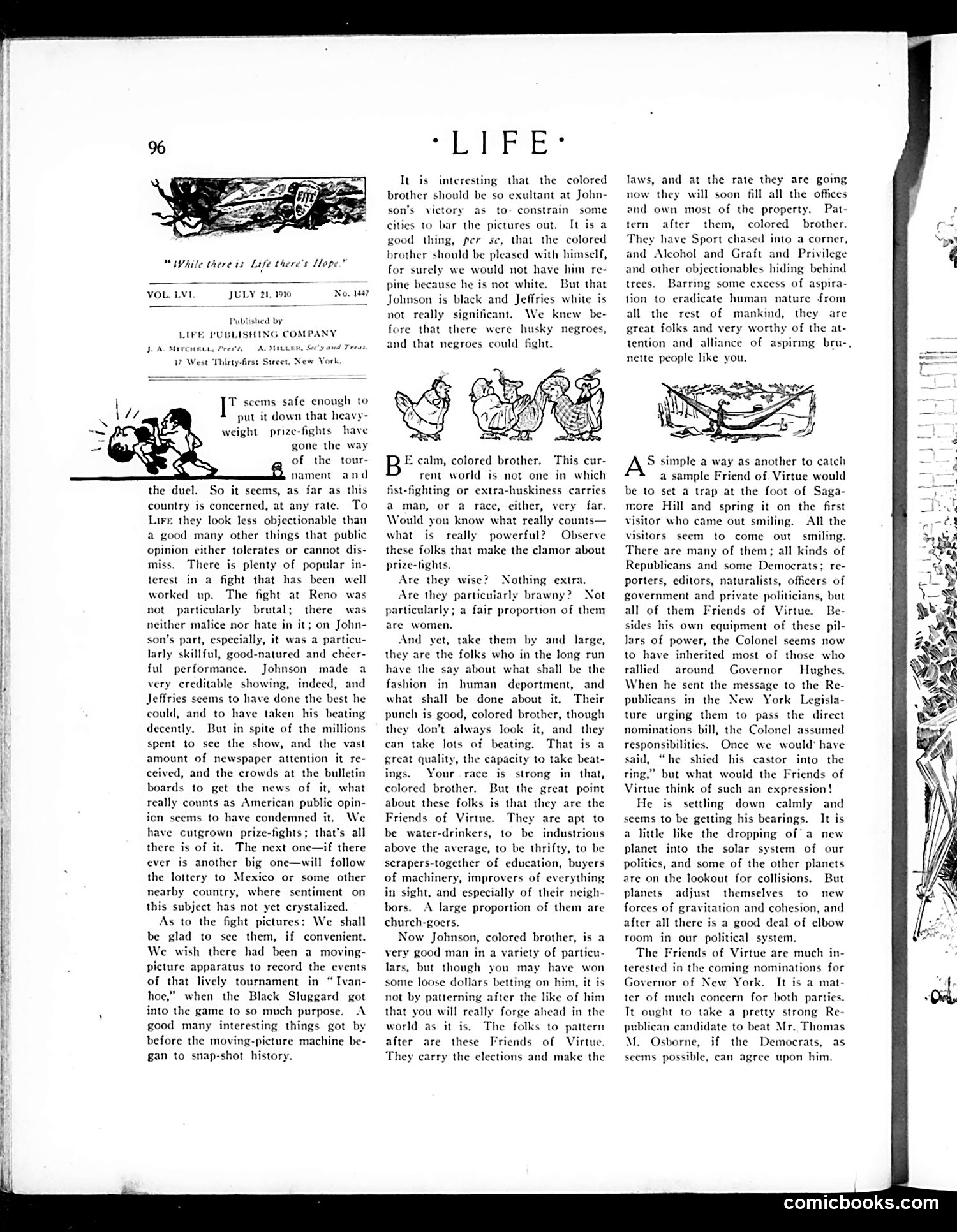
This page satirizes the "Friends of Virtue" — apparently a reform movement concerned with public morality and boxing regulations. The left cartoon depicts a boxing match, mocking how reformers have intervened in prize fights. The main article criticizes these well-intentioned but misguided activists. It argues they focus on superficial issues (like fighters' races in a Reno boxing match) while missing the real substance of what matters. The text particularly targets their moral posturing about "colored brother" Johnson, suggesting their concern masks racial attitudes. The satire ultimately portrays the "Friends of Virtue" as self-righteous busybodies whose activism on trivial matters distracts from genuine social problems — a common Progressive-era critique of moral reform movements.
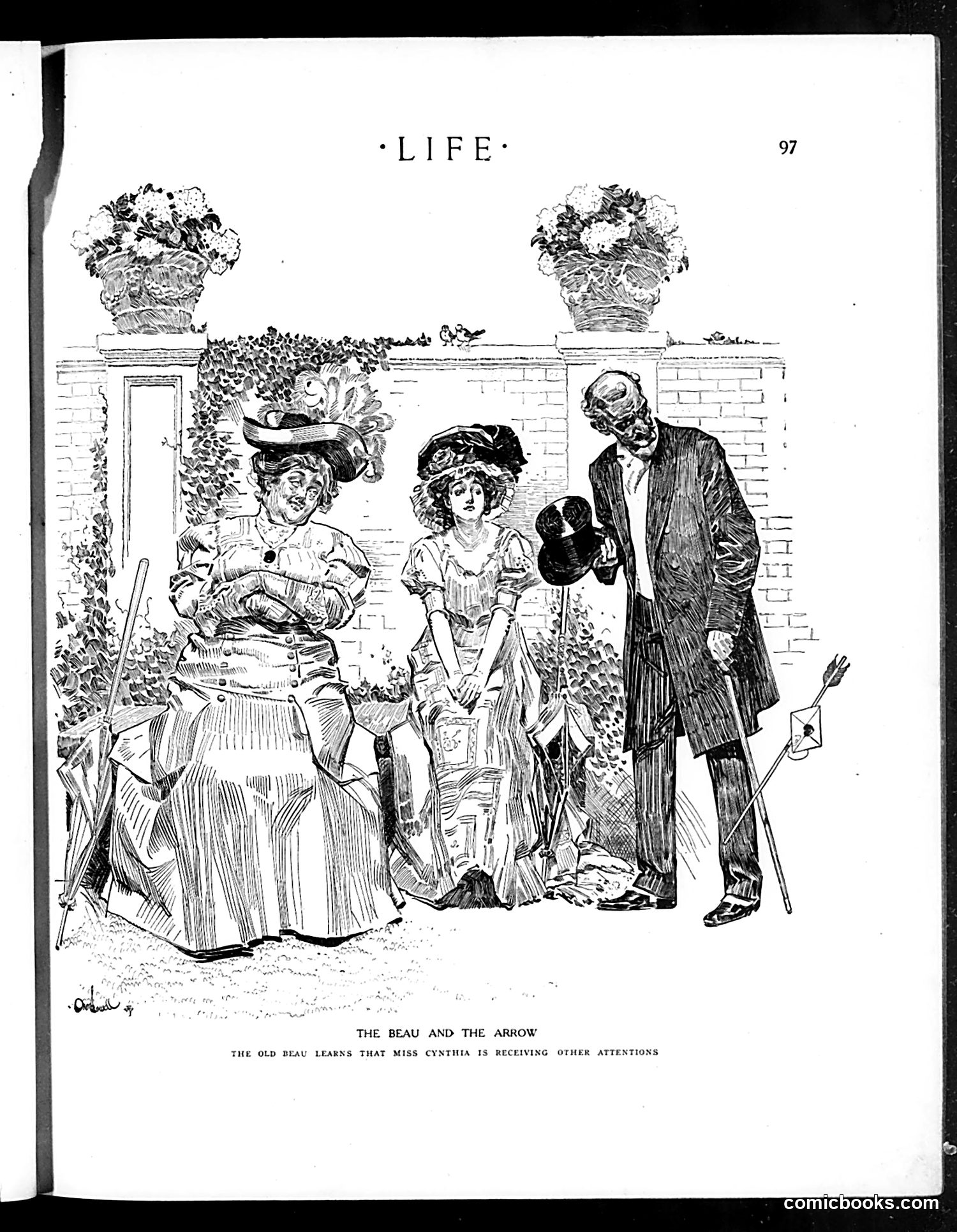
This single-panel cartoon satirizes romantic jealousy and social competition. An older, well-dressed gentleman ("the beau") stands holding his hat, appearing dismayed or contemplative. He observes two women: one seated (identified as "Miss Cynthia" in the caption), who is receiving attention from another man holding what appears to be an arrow or pointing stick. The caption reads: "THE OLD BEAU LEARNS THAT MISS CYNTHIA IS RECEIVING OTHER ATTENTIONS." The joke mocks the gentleman's realization that his romantic interest is being courted by someone else. The "arrow" likely symbolizes Cupid's arrows—a classical reference to love and romance—suggesting the rival is successfully "striking" where the old beau has failed. The satire targets male vanity and romantic disappointment.
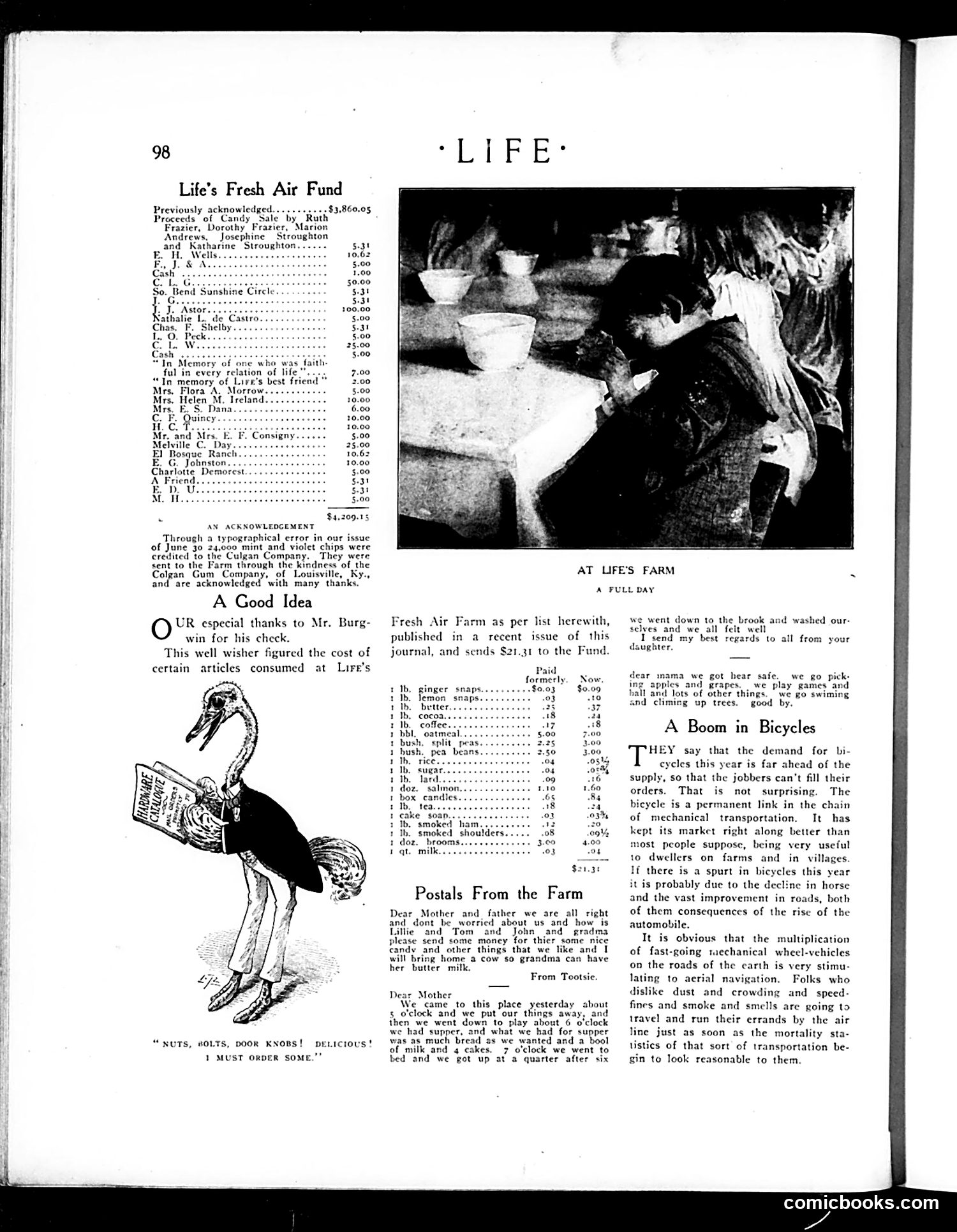
This page combines charitable fundraising with rural lifestyle commentary. The main cartoon features an anthropomorphic ostrich holding a check, illustrating "A Good Idea" — apparently a humorous mascot for the Fresh Air Fund, a real charity providing farm experiences for urban children. The text discusses donations to this fund and includes several sections: "Postals From the Farm" (letters from children who visited farms), and "A Boom in Bicycles" (commentary on increased bicycle demand, attributed to improved roads and declining horse use due to automobiles). The page reflects early-20th-century themes: urbanization creating need for children's nature exposure, automobile transportation disrupting traditional horse-based infrastructure, and the bicycle's intermediate role in mechanical transportation during industrial transition.
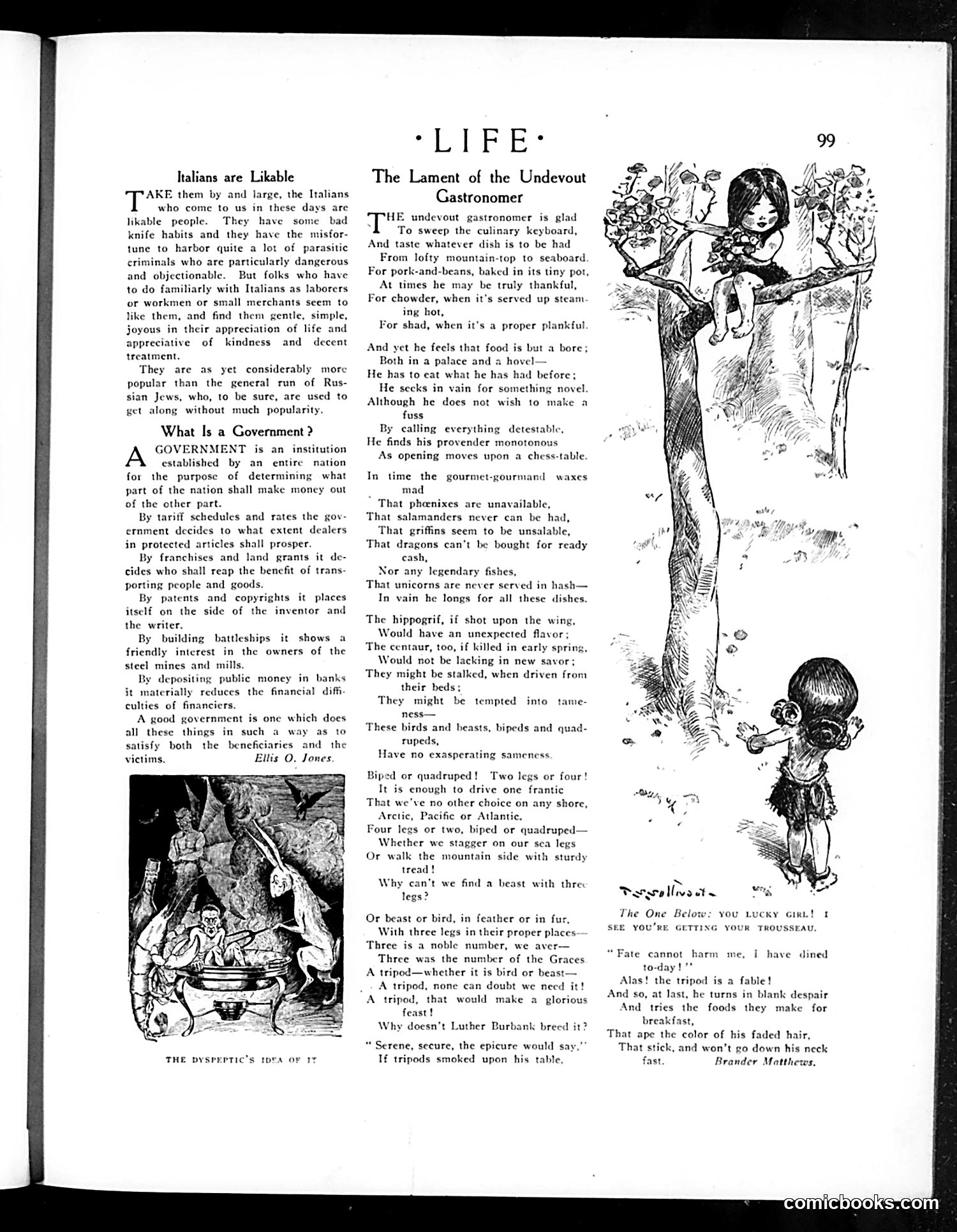
This page combines three distinct pieces: 1. **"Italians are Likable"** - A sympathetic essay praising Italian immigrants for their gentleness and appreciation of kindness, contrasting them with criminals. This reflects early 20th-century immigration debates. 2. **"What is a Government?"** - An essay by Ellis O. Jones defining government's economic and social functions, with an illustration titled "The Dyspeptic's Idea of It" showing a chaotic kitchen scene (likely satirizing inefficient governance). 3. **"The Lament of the Undevout Gastronomist"** - A humorous poem mocking a disappointed diner frustrated that exotic dishes (hippopotamus, centaur, griffin) are unavailable. The accompanying illustration shows an elegantly dressed woman being served by a waiter, poking fun at pretentious dining culture. The page reflects turn-of-the-century American concerns: immigration, governmental theory, and upper-class gastronomy.
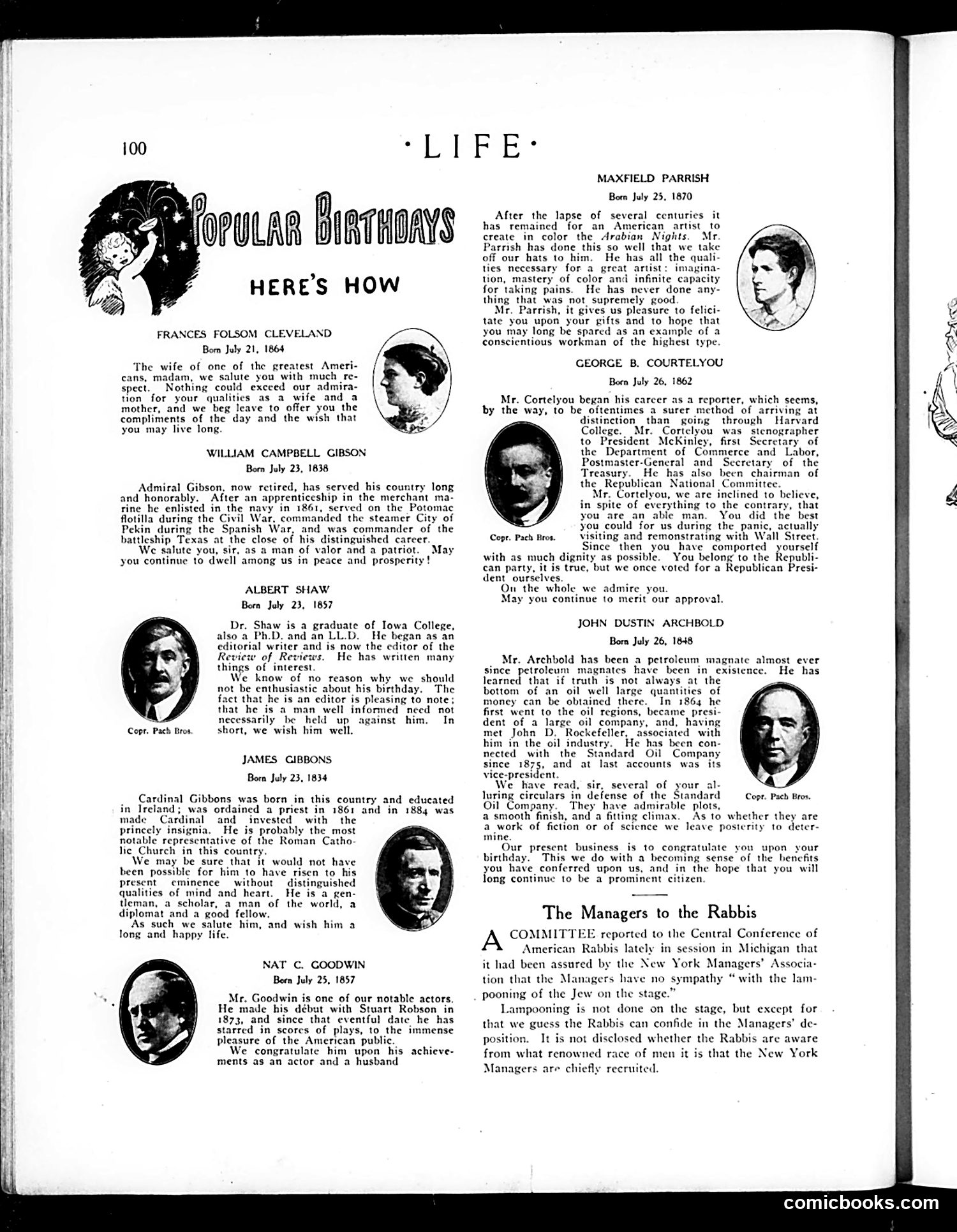
This page from *Life* magazine features birthday tributes to notable Americans born in July, alongside portraits and brief biographical sketches. The left column celebrates figures like Frances Folsom Cleveland (wife of President Cleveland), Admiral William Campbell Gibson, Dr. Albert Shaw, Cardinal James Gibbons, and actor Nat C. Goodwin. The right side includes tributes to Maxfield Parrish (artist), George B. Courtelyou (government official), and John Dustin Archbold (oil industry executive). The final section, "The Managers to the Rabbis," appears to be satirical commentary on American Rabbis' concerns about anti-Semitic lampooning in theatrical performances, suggesting theater managers show little sympathy to Jewish concerns about stage stereotypes. This is essentially a society/celebrity page with light satirical commentary on contemporary social issues.
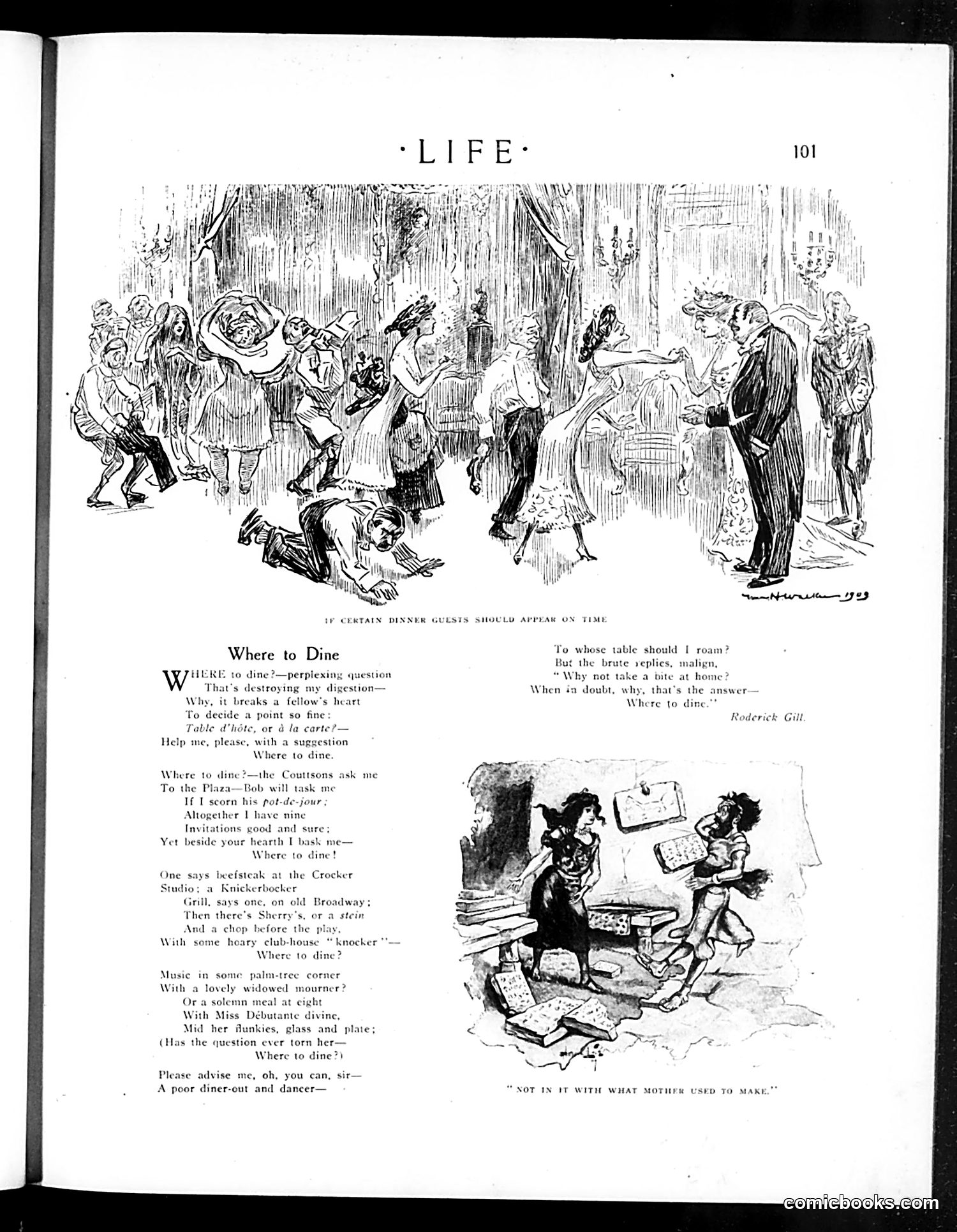
This page satirizes the social anxiety of deciding where to dine in what appears to be early 20th-century New York. The top illustration depicts a chaotic dinner party where guests appear uncomfortable or awkward—likely mocking the pretentiousness of dining culture. The poem humorously catalogs dining dilemmas: should one go to the Plaza? Broadway restaurants? A chop house? Each option presents its own social complications. The satirical point is that choosing a restaurant has become an overwrought social performance, filled with etiquette concerns and status anxiety. The bottom cartoon shows two figures examining menus or dining guides, captioned "Not in it with what mother used to make," suggesting nostalgic criticism of modern restaurant dining compared to home cooking. The overall satire targets fashionable society's dining pretensions.
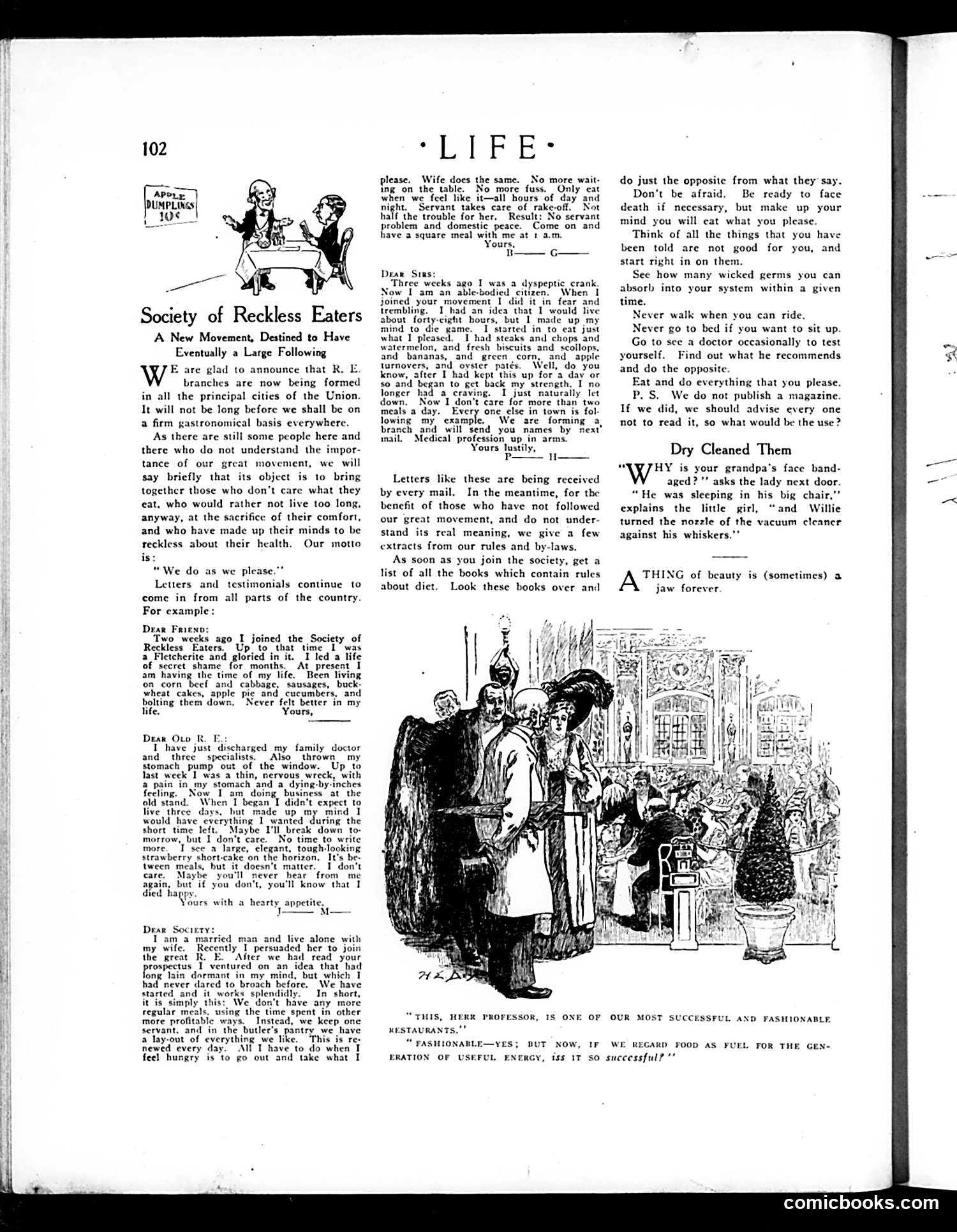
This page satirizes the early 20th-century "Fletcherism" dietary movement, which promoted slow, methodical chewing and strict eating discipline for health. Life mocks this by inventing a fake "Society of Reckless Eaters" with the motto "We do as we please." The satire works through ironic testimonials from fictional members claiming that abandoning dietary restraint actually improves their health. A formerly nervous dyspeptic becomes "able-bodied"; a Fletcherite disciple escapes "secret shame" by eating corned beef and cabbage freely; a man recovers by indulging in steaks, watermelon, and oyster patés instead of following rules. The cartoon (bottom right) appears to show well-dressed men at an upscale restaurant, likely contrasting fashionable dining with the movement's philosophy. The joke: by pushing health-obsession to absurd extremes (claiming recklessness cures ailments), Life ridicules both fad diets and the anxiety surrounding food consumed by health-conscious readers.
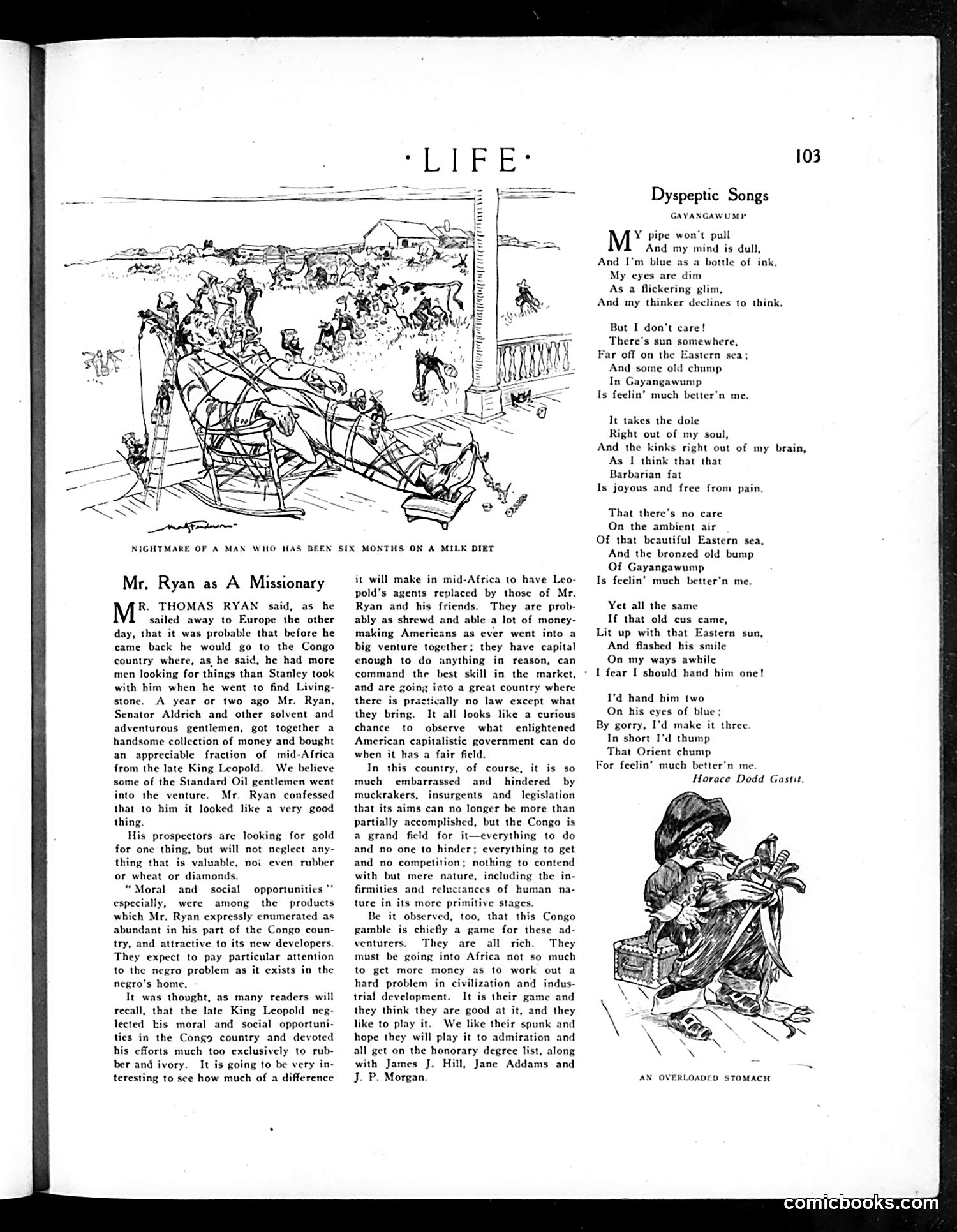
**The Main Cartoon** depicts a chaotic scene labeled "Nightmare of a Man Who Has Been Six Months on a Milk Diet"—a surreal, nightmarish landscape representing digestive distress. **The Article "Mr. Ryan as A Missionary"** satirizes Thomas Ryan, a wealthy industrialist who—along with Senator Aldrich and Standard Oil associates—purchased colonial territories in the Congo from King Leopold II. Life's satire is biting: it mocks Ryan's stated moral and social objectives while highlighting the hypocrisy. The piece notes that Leopold was criticized for prioritizing rubber and ivory extraction over moral development, yet Ryan's venture appears equally profit-driven. Life sarcastically praises the "enlightened American capitalistic" approach while emphasizing that in the unregulated Congo (unlike America, hampered by "muckrakers, insurgents and legislation"), these capitalists face no legal constraints—only "nature" and "human nature in its more primitive stages." **The Satire's Point:** American industrialists mask exploitative colonialism with humanitarian language while operating in lawless territories. **"Dyspeptic Songs"** is unrelated verse about homesickness and consolation.
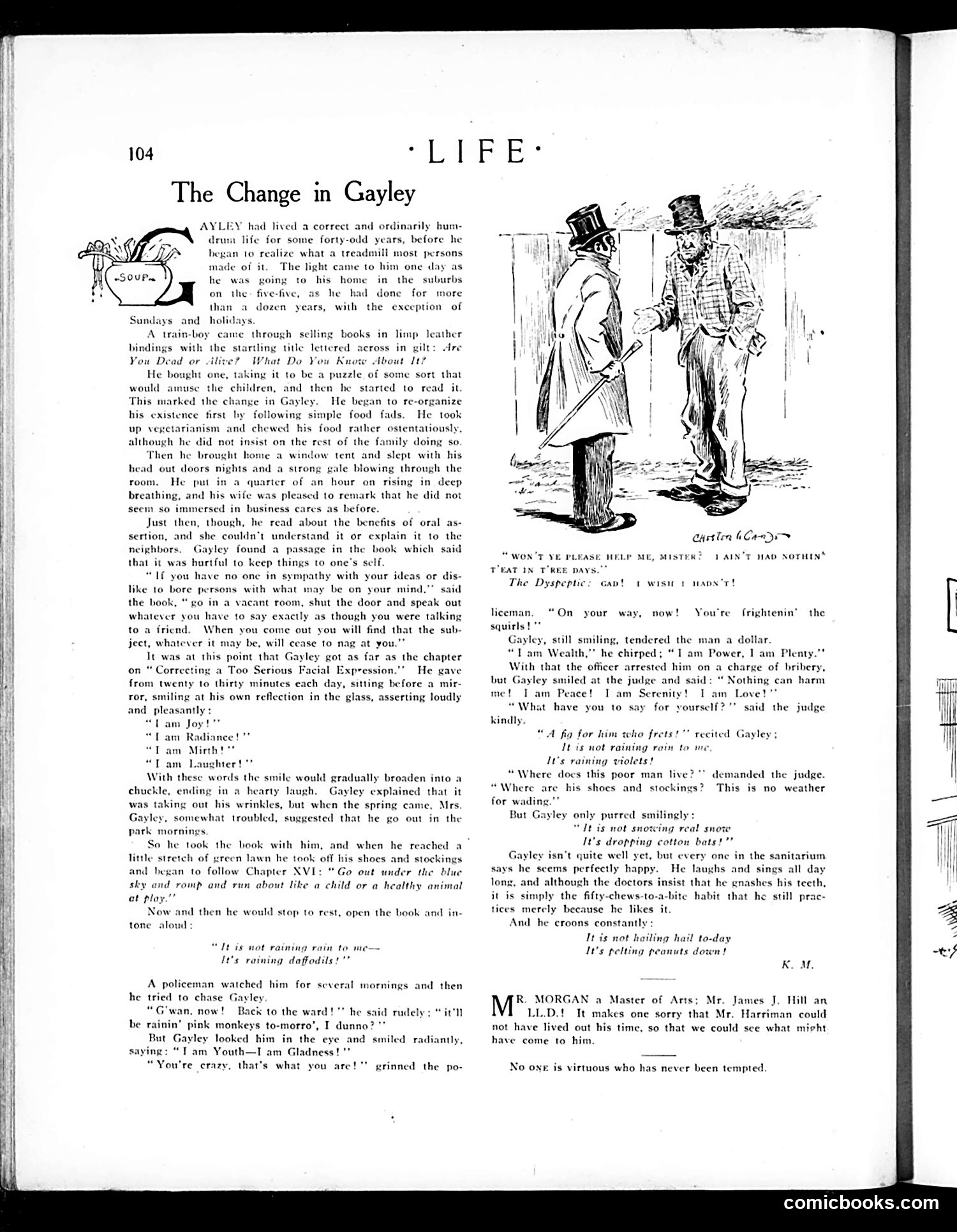
This page satirizes the early 1900s self-help and "New Thought" movement—particularly the trend of positive affirmations and unconventional wellness practices. **The story**: A middle-aged businessman, Gayley, reads a self-help book and becomes obsessed with its prescriptions: vegetarianism, sleeping outdoors, deep breathing, and especially "oral assertion"—loudly declaring affirmations like "I am Joy!" and "I am Radiance!" in mirrors. **The satire's point**: As Gayley adopts these practices, they progressively embarrass him and alienate society. He removes his shoes to "romp" in parks like a child, quotes poetry about "raining daffodils" to a skeptical cop, and ultimately bribes an officer while grinning vacuously—landing him in court. **The joke for readers then**: The satire mocks how earnestly people embrace trendy self-improvement fads, and how their obsessive practice becomes socially ridiculous. The cartoon accompanying the text (showing two figures) visualizes this disconnect between Gayley's newfound "inner peace" and the bewilderment of normal society around him.
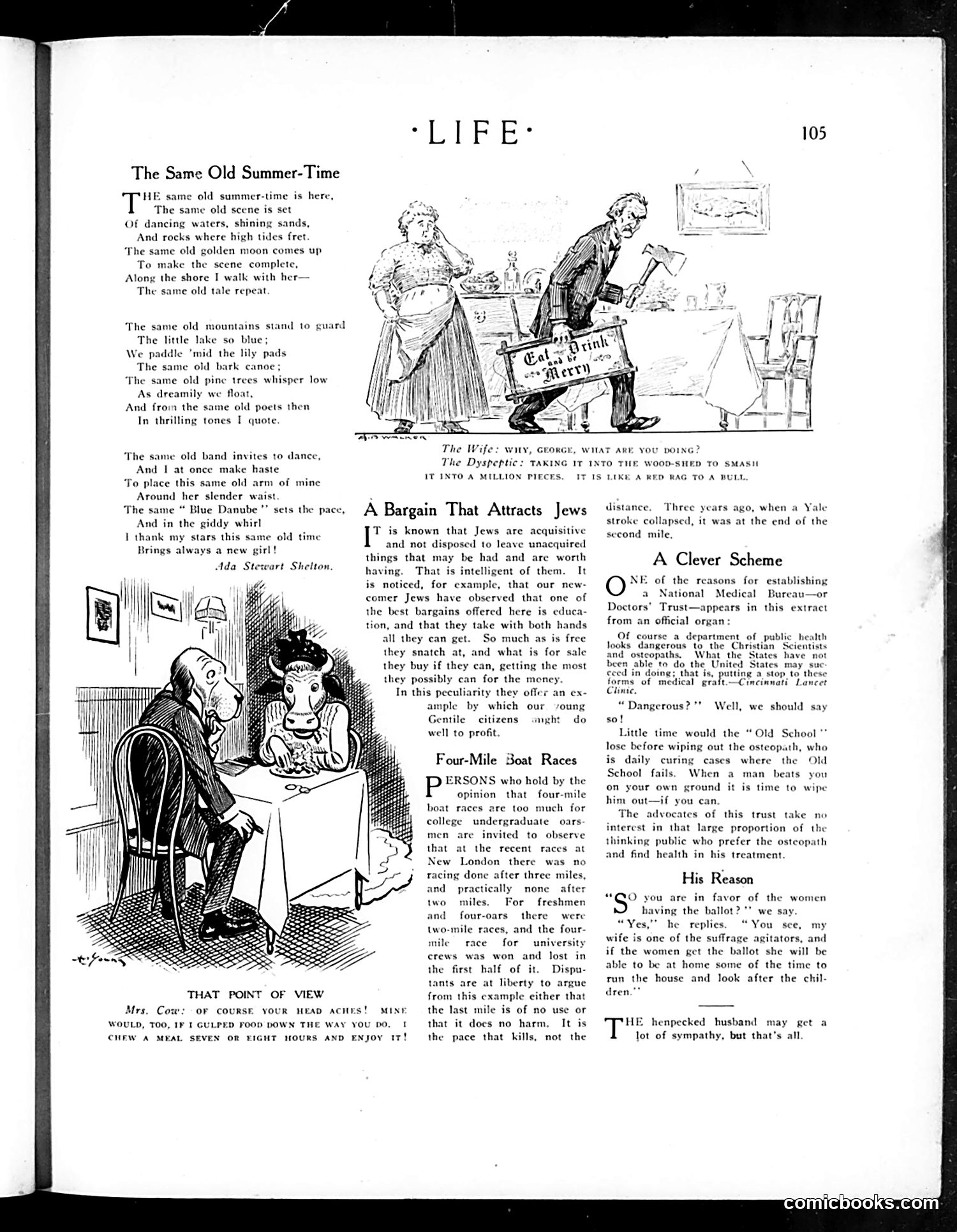
This page contains several satirical pieces typical of early 20th-century Life magazine humor: **"The Same Old Summer-Time"** is a romantic poem mocking male sentimentality—the speaker romantically quotes poetry and dances with a woman, yet the punchline reveals his inconsistency: "Brings always a new girl!" **"That Point of View"** is a crude dietary joke about digestion, with little satirical content. **"A Bargain That Attracts Jews"** contains ethnic stereotyping characteristic of the era. It "praises" Jewish immigrants for valuing education and aggressive acquisition, presenting this as both inherent to Jewish character and something gentiles should imitate—a backhanded compliment rooted in harmful stereotypes about Jewish greed. **"A Clever Scheme"** satirizes medical establishment attempts to suppress osteopathy through a "doctors' trust," suggesting orthodox medicine fears competition from practitioners achieving better results. **"His Reason"** jokes about a henpecked husband supporting women's suffrage, hoping it will keep his activist wife occupied at home rather than campaigning. The page reflects Period attitudes including casual antisemitism alongside progressive humor about gender relations.
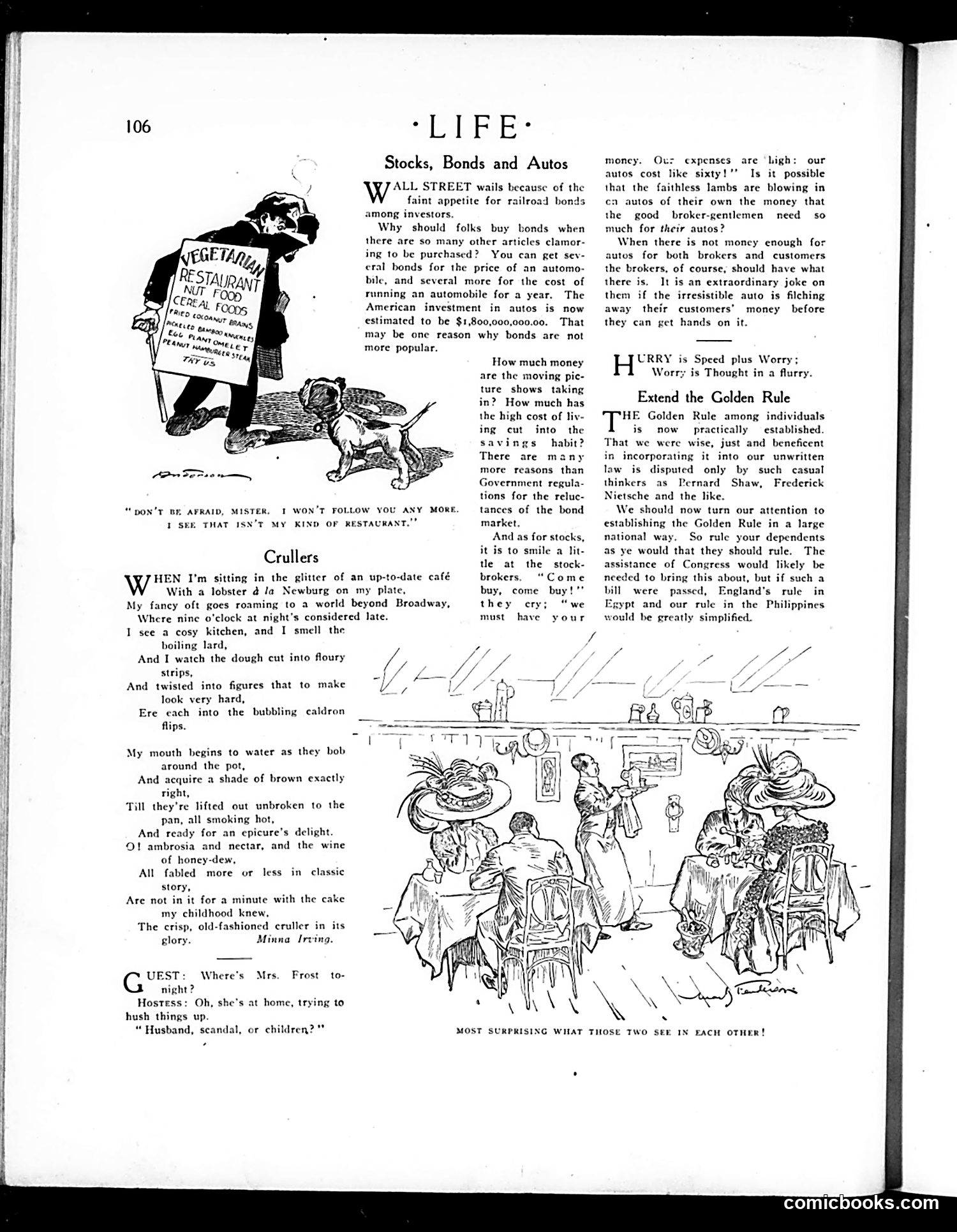
**Main Cartoon (top left):** A thin, bedraggled figure representing the restaurant industry flees from a pursuing dog labeled "Vegetarian Restaurant." The caption reads: "Don't be afraid, mister, I won't follow you any more. I see that isn't my kind of restaurant." This satirizes the vegetarian restaurant movement as a threat to traditional dining establishments. **"Stocks, Bonds and Autos" article:** Mocks Wall Street's complaint about poor bond sales. The satire points out that Americans are spending enormous sums ($1.8 billion) on automobiles instead of investing in bonds—and that brokers themselves are buying autos, depleting the money customers might invest. It's a commentary on competing consumer desires and wealth priorities during the automobile boom era. **"Crullers" poem:** A nostalgic tribute to old-fashioned fried pastries versus modern upscale dining, reflecting period tensions between traditional and contemporary tastes. **"Golden Rule" piece:** Social commentary suggesting nations should apply the Golden Rule internationally (specifically critiquing British rule in Egypt and American rule in the Philippines). The page balances light humor with pointed social criticism.
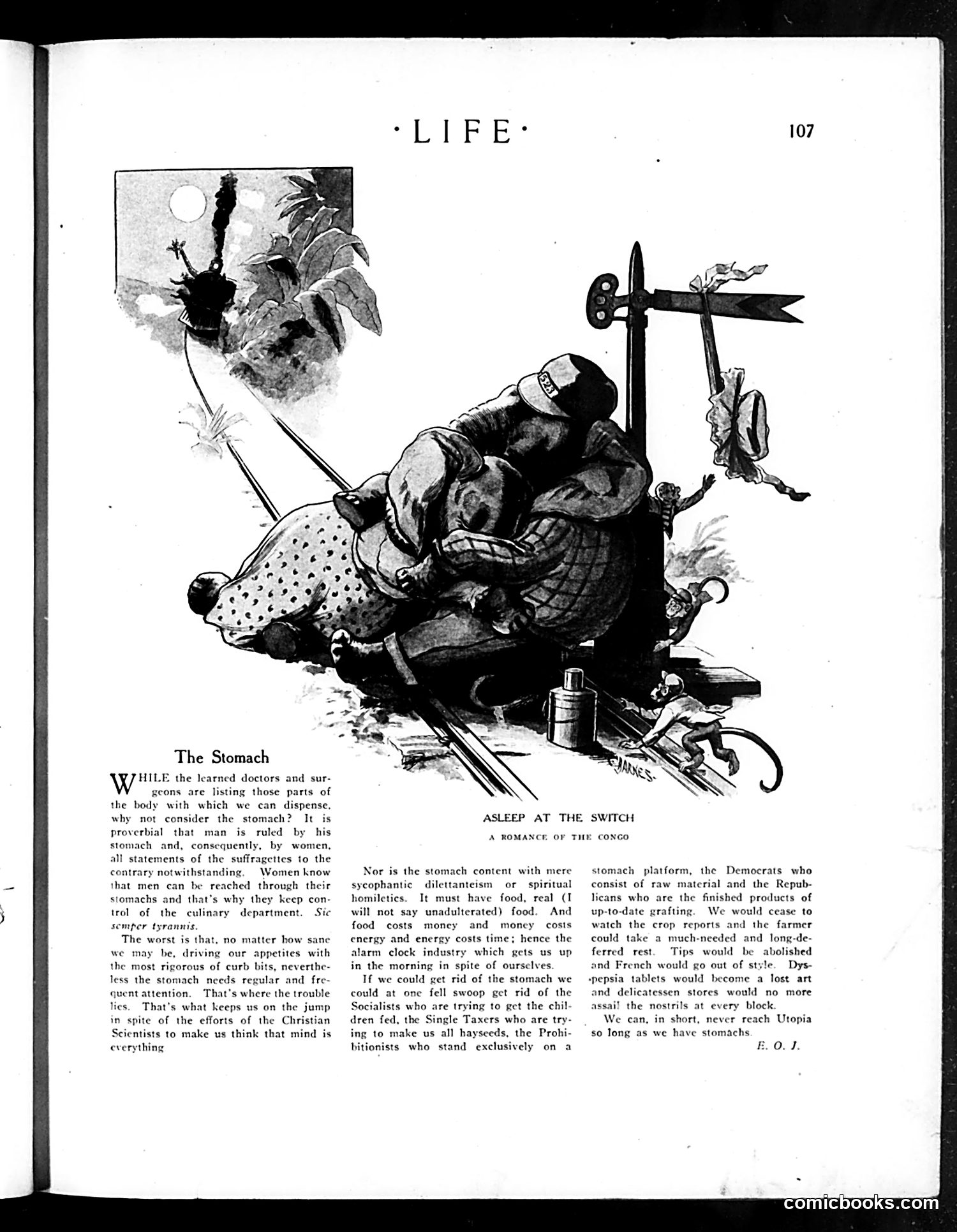
This 1910s *Life* magazine page satirizes how human appetites—especially hunger—drive society and politics, making utopian ideals impossible. **The Main Cartoon** ("Asleep at the Switch") depicts a railway worker sleeping while a train approaches, titled "A Romance of the Congo"—likely a colonial reference, though the specific allusion is unclear. **The Text Essay** argues that the stomach is humanity's true master. It mocks various political movements of the era—Socialists (advocating child nutrition programs), Single Taxers (land reformers), and Prohibitionists—as impractical because they ignore that humans will always be enslaved by hunger and appetite. The writer suggests eliminating the stomach would eliminate these reform movements, French cuisine, tips, and indigestion tablets, making Utopia possible. The satire targets idealistic reformers as naive: you cannot perfect society while people must constantly eat, work, and worry about food costs. It's a cynical commentary on progressive-era activism.
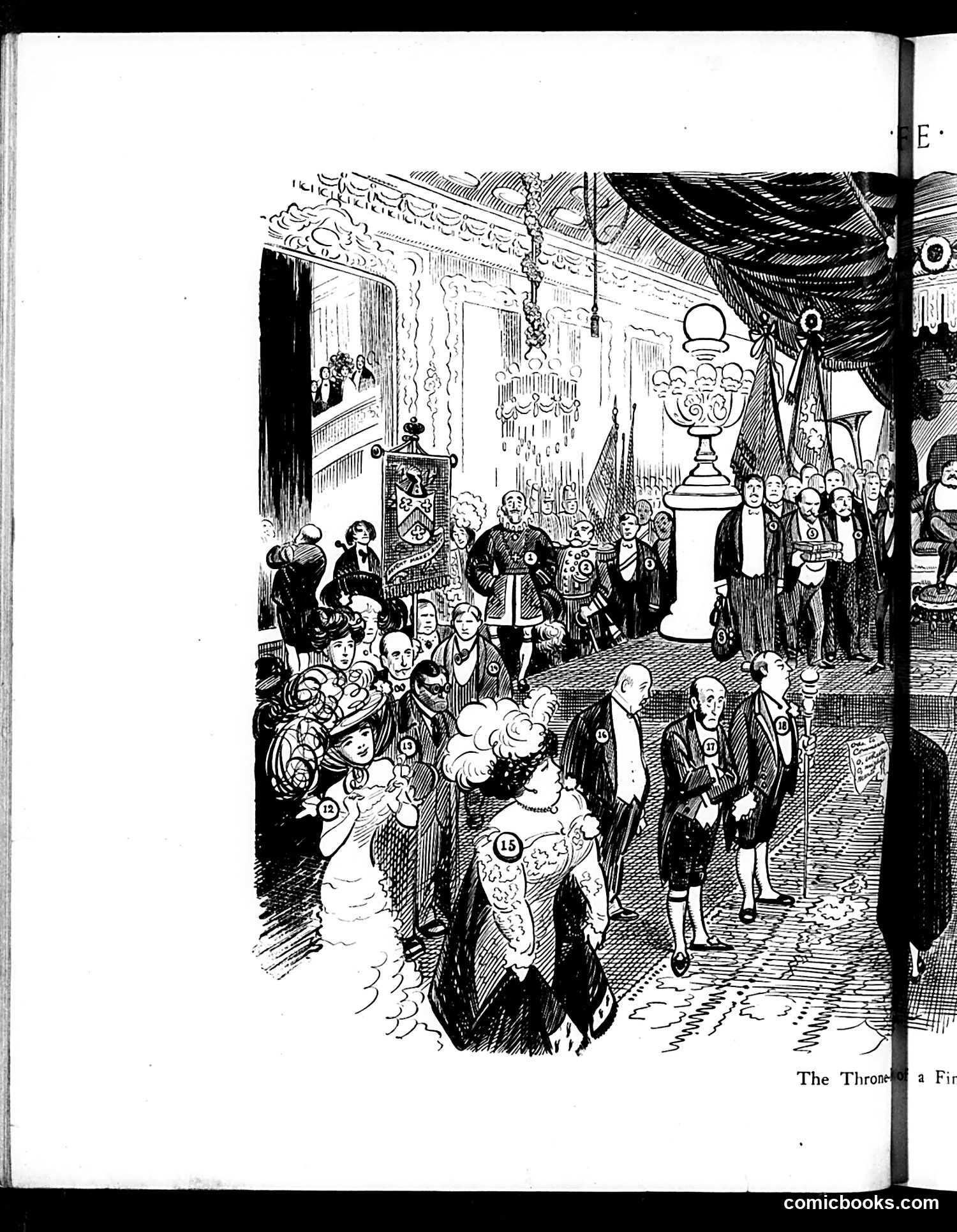
This satirical illustration depicts a grand royal or formal court reception with ornate architectural details—chandelier, decorative walls, and ceremonial furnishings. A diverse crowd of formally dressed attendees fills the space, many wearing numbered badges or medals, suggesting they're dignitaries or officials at some official state function. The title "The Throne a Fir[e]" (likely "The Throne Afire") appears to be a political commentary, possibly suggesting chaos, scandal, or upheaval within the court or government. The satirical nature typical of Life magazine suggests this mocks contemporary political figures or institutions, though without clearer context or visible date, the specific political event or figures being lampooned cannot be definitively identified from the image alone.
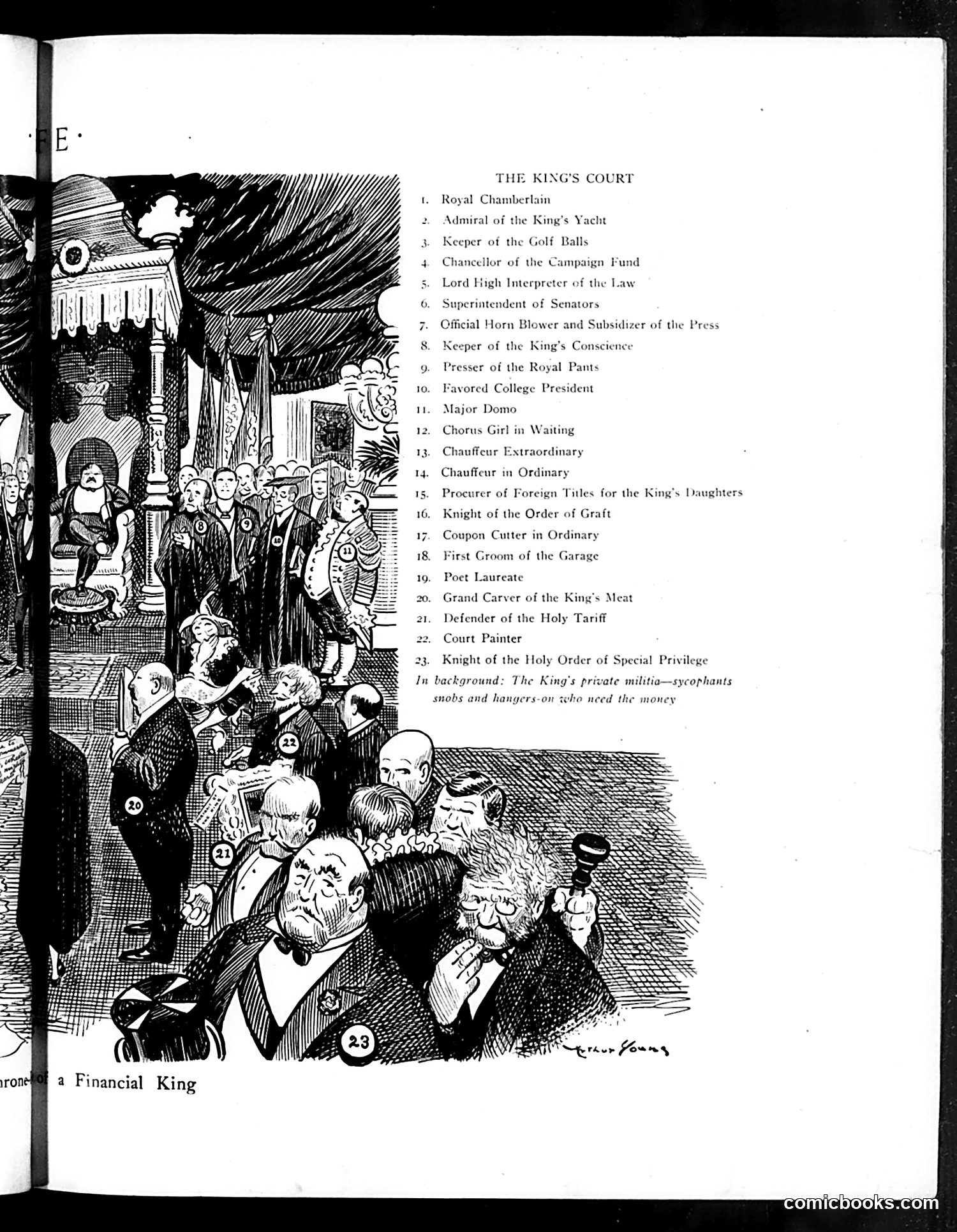
This page satirizes the bloated, corrupt patronage system of American government—likely from the early 20th century, possibly targeting a sitting president or wealthy industrialist treated as a "king." The numbered list mocks absurd court positions that parody real government roles and influence-peddlers: a "Chancellor of the Campaign Fund" suggests corruption, "Subsidizer of the Press" mocks media manipulation, and "Defender of the Holy Tariff" references protectionist trade policy. Positions like "Keeper of the King's Conscience" and "Knight of the Order of Graft" are deliberately contradictory, highlighting hypocrisy. The cartoon shows numerous figures in formal dress surrounding a central authority figure, representing sycophants and hangers-on seeking money and favor. The caption notes these are "sycophants, snobs and hangers-on who need the money." The satire attacks cronyism, the appointment of unqualified friends to positions of power, and the pervasive corruption where government exists primarily to enrich insiders rather than serve the public interest.
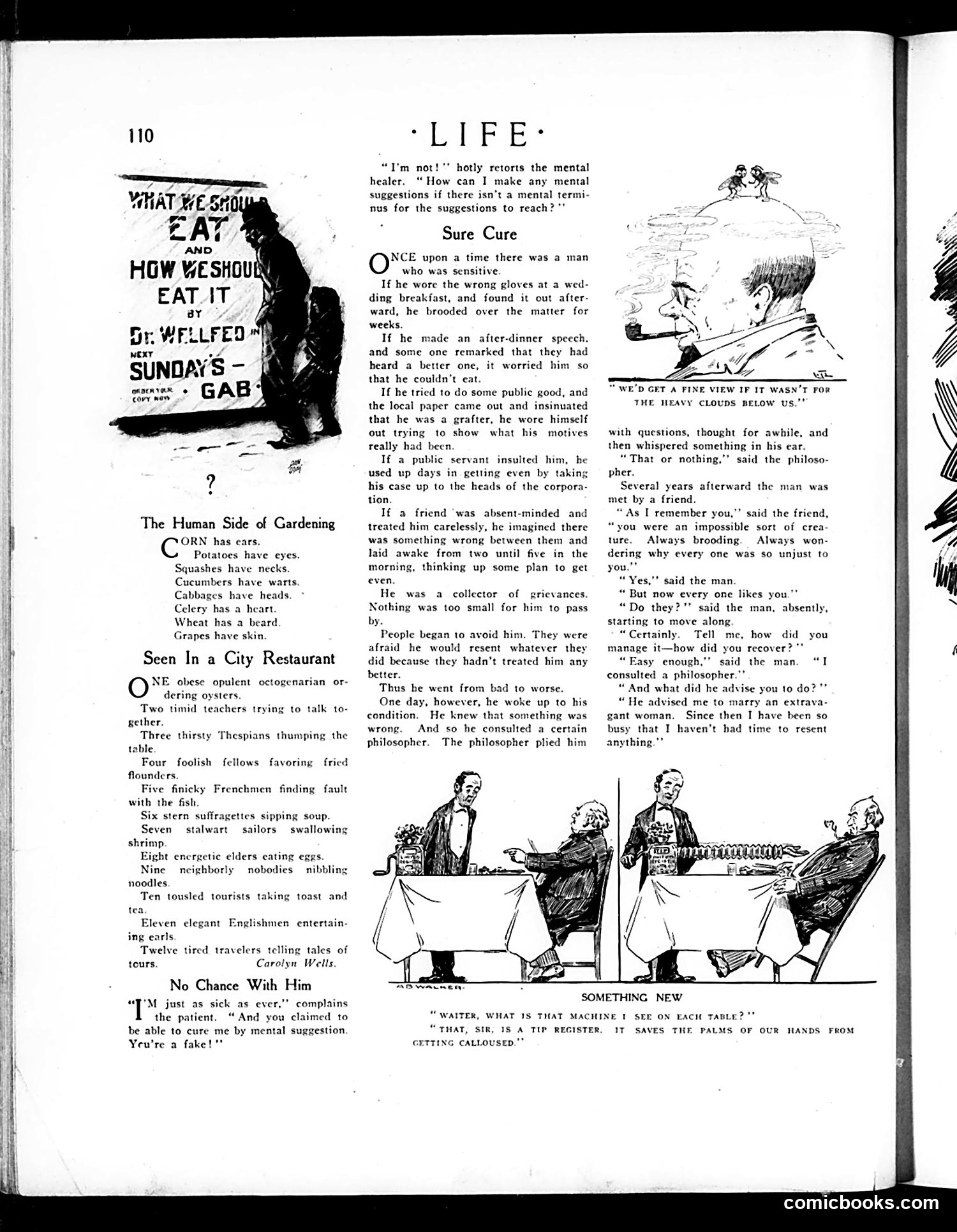
This page contains several humorous pieces satirizing early 20th-century American social anxieties: **"Sure Cure"** tells of an oversensitive man who broods obsessively over minor slights—wrong gloves, critical remarks, perceived insults. He consults a philosopher who whispers secret advice. The cure: marrying an extravagant woman who keeps him so busy managing her spending that he has no time to resent anything. The joke mocks both masculine sensitivity and the stereotype of wives as expensive burdens. **"Seen in a City Restaurant"** is alliterative humor cataloging restaurant patrons, including "six stern suffragettes sipping soup"—a topical reference to the women's suffrage movement of that era, gently poking fun at activist women. **"The Human Side of Gardening"** is a brief, whimsical piece personifying vegetables (corn has ears, potatoes have eyes). **"No Chance With Him"** satirizes mental healing/"mental suggestion" (early psychology/mind-cure movements), with a practitioner claiming inability to help without a patient's cooperation—implying the therapy is circular or fraudulent. The cartoons mock contemporary fads, feminism, psychological trends, and social pretension.
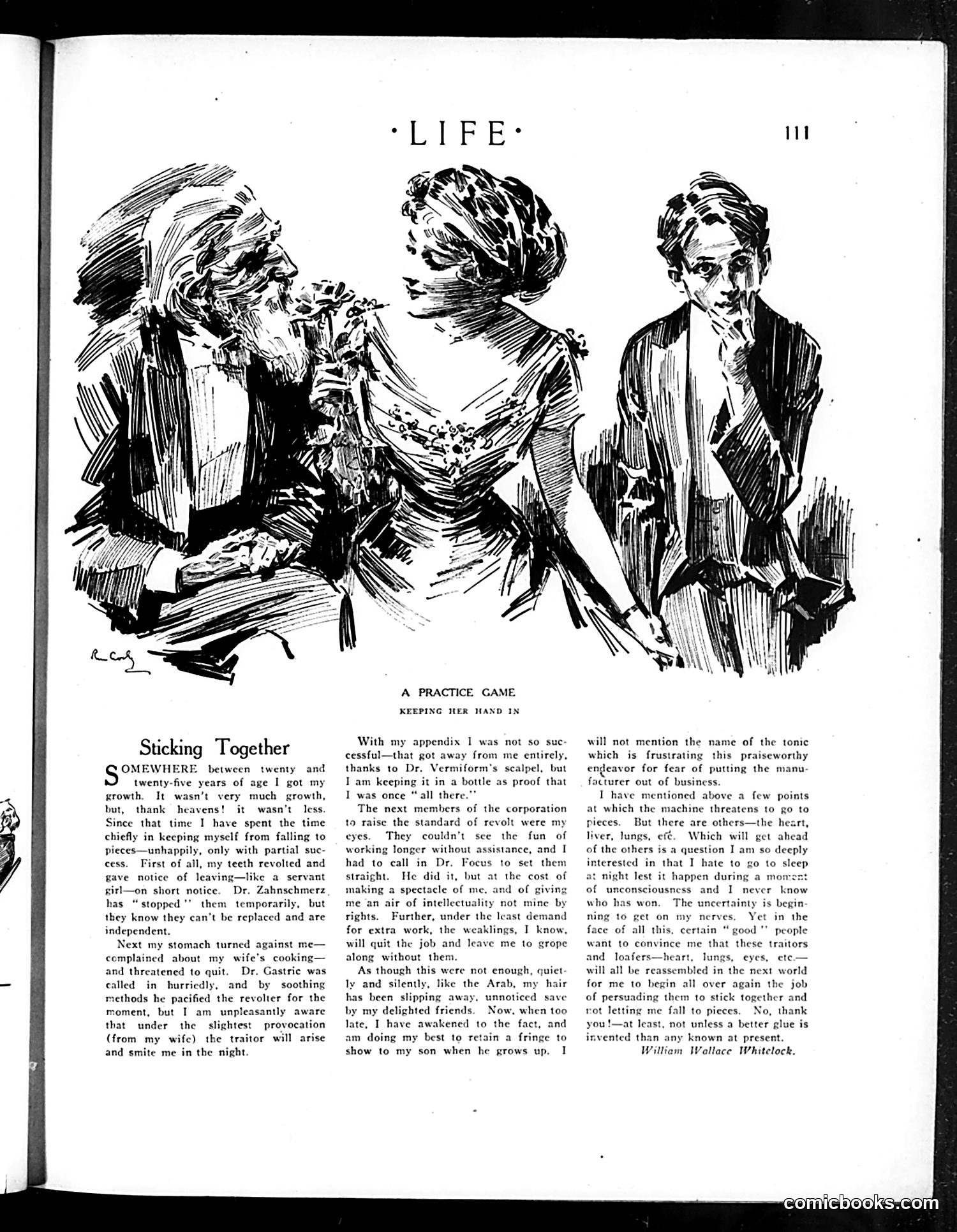
This page combines a humorous essay with a satirical cartoon about bodily aging and decay. The three sketched figures appear to represent a middle-aged man with various afflictions, a woman, and another man—likely illustrating the essay's theme of bodily "revolt." Whitelock's essay uses dark humor to describe aging as a series of betrayals: teeth, stomach, appendix, eyes, and hair all "turn against" him like disloyal servants. He's consulted various doctors (with pun-laden names like "Dr. Zahnschmerz"—German for toothache pain). The satire targets both bodily decline and contemporary religious platitudes. Whitelock mocks those promising reassembly in the afterlife, sardonically refusing that "better glue" unless a superior adhesive is invented. This reflects early 20th-century skepticism toward comforting Victorian pieties about spiritual redemption. The cartoon's caption, "A Practice Game—Keeping Her Hand In," suggests the woman is practicing or demonstrating something, though without additional context, the specific reference remains unclear.
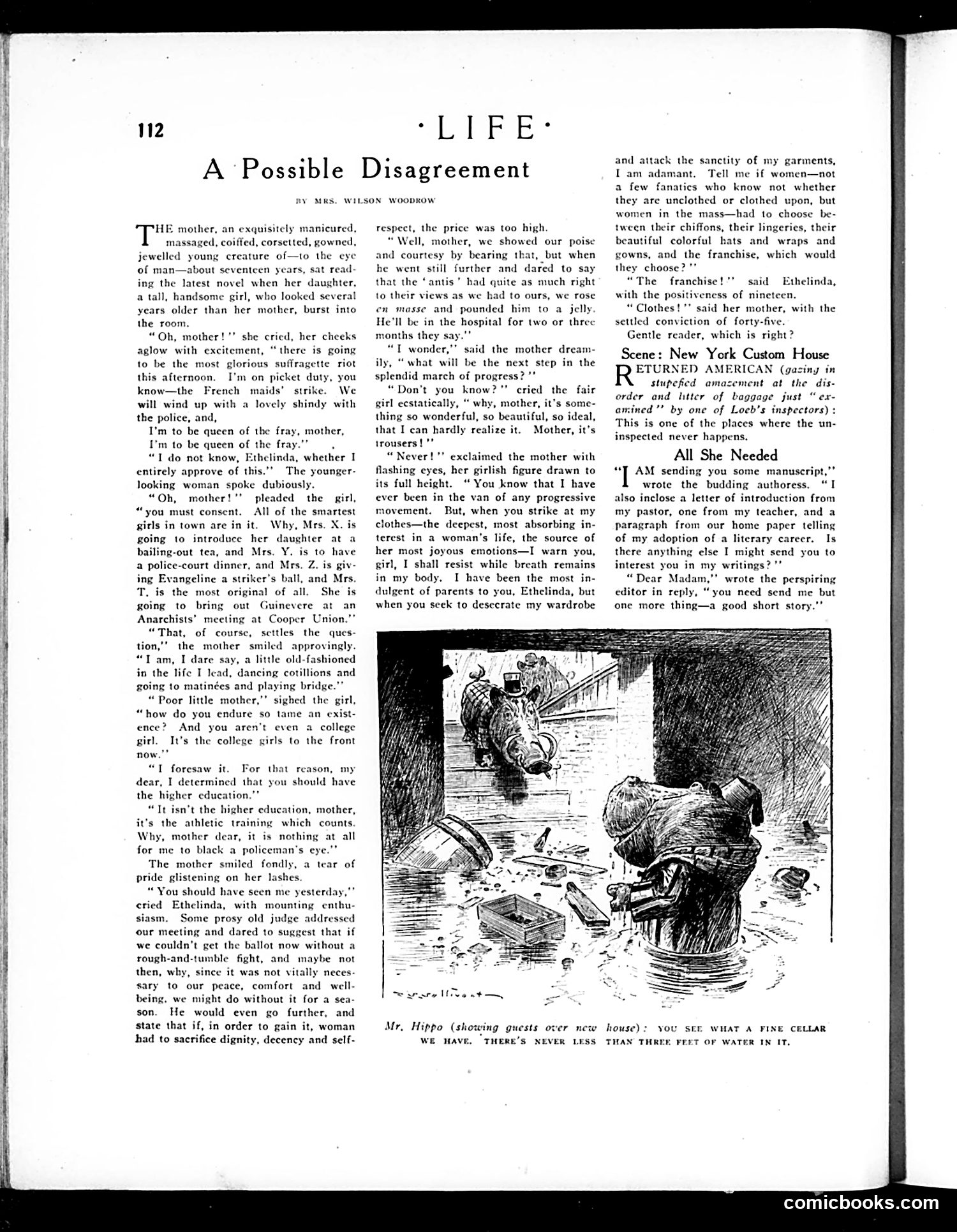
This satirical story by Mrs. Wilson Woodrow mocks the suffragette movement through generational role-reversal. The daughter, Ethelinda, is an eager young activist planning to riot for women's voting rights, while her mother—described as youthful and fashionable—initially seems supportive of progressive causes. The satire's target becomes clear in the ending: the mother enthusiastically endorses suffrage activism, police brutality, and even anarchism, but draws the line at women wearing trousers. This exaggerates the perceived hypocrisy of society—that women would fight violently for political rights yet remain obsessed with fashion and appearance. The accompanying cartoon below (Mr. Hippo) appears unrelated to the main text. The piece reflects early 20th-century debates about suffragettes' militant tactics and satirizes both the movement's tactics and society's shallow priorities regarding women's roles.
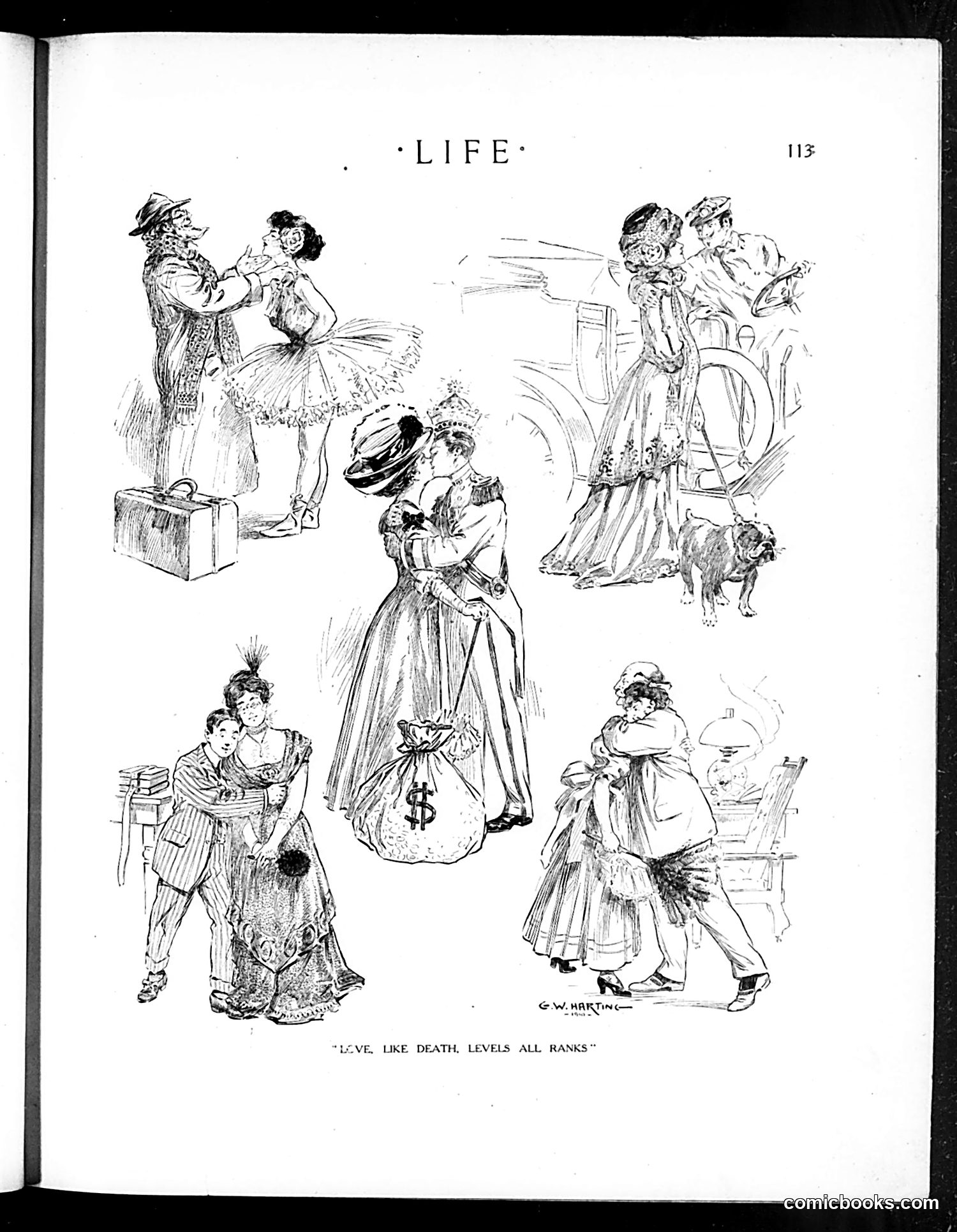
This page presents six vignettes illustrating the caption's aphorism that love transcends social class. The sketches depict romantic encounters across different social strata: wealthy aristocrats, middle-class couples, and working-class pairs. Each scene shows people of presumably different ranks engaged in similar romantic gestures—flirtation, courtship, embrace. The satire's point appears to be social commentary on human nature: despite hierarchical class distinctions that defined early 20th-century society, romantic love affects everyone equally. Whether rich or poor, people behave similarly when smitten. This democratizing theme—that emotion overrides social position—was a recurring satirical subject in *Life* magazine's humor. The artist (signed G.W. Martin) uses the visual parallelism to underscore the universality of romantic feeling.
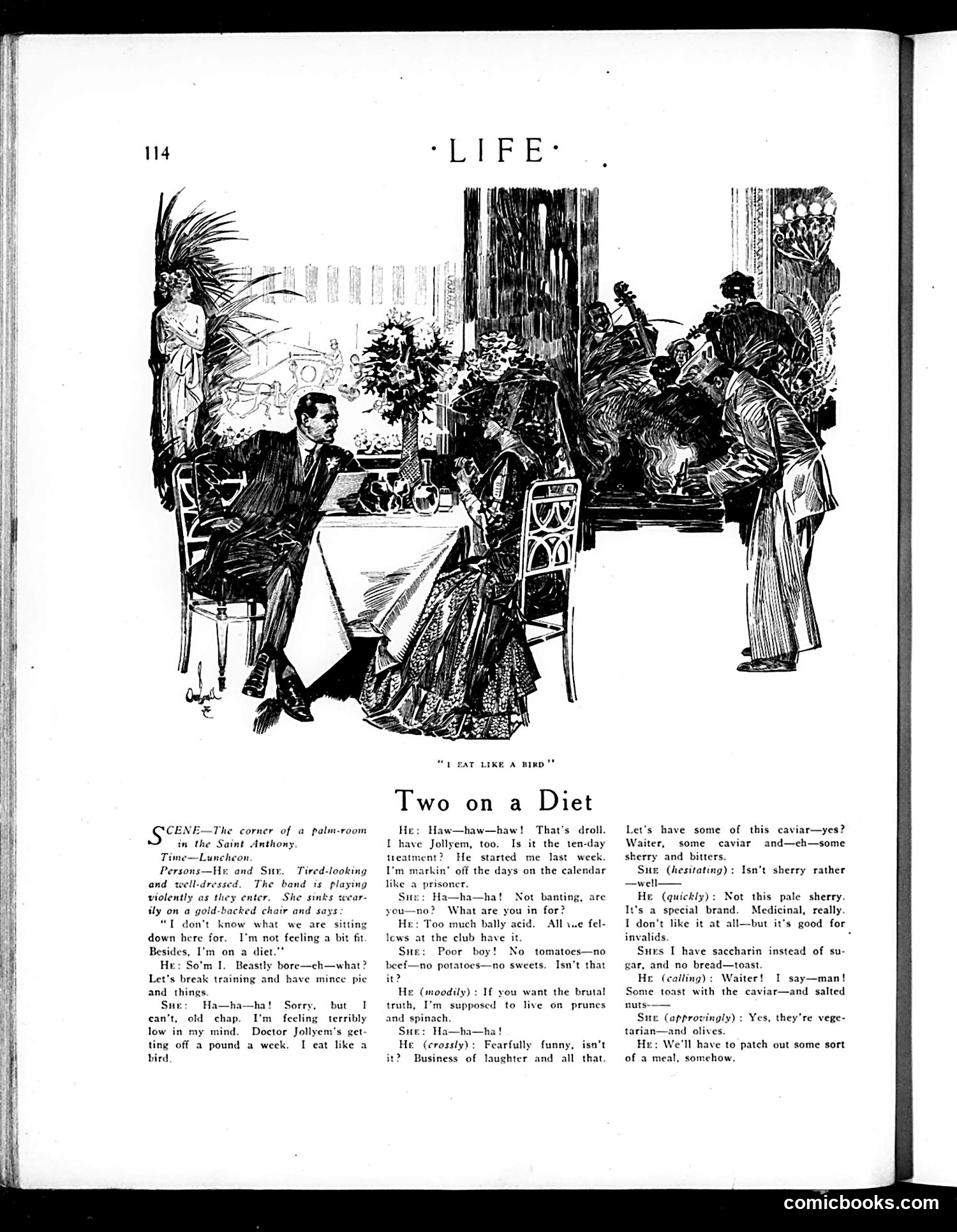
This sketch satirizes the hypocrisy of wealthy dieting socialites. A well-dressed couple, both claiming to be on strict doctor-supervised diets, meet at an upscale restaurant (the Saint Anthony's palm room). They discuss their deprivations—no tomatoes, potatoes, sweets, bread—imposed by "Doctor Jollyem's" regimen. However, the satire's punch lies in their immediate contradiction: despite these restrictions, they proceed to order caviar, sherry (which he claims is "medicinal"), salted toast, and vegetables with olives. The humor captures the gap between their professed sacrifice and actual indulgence. The drawing style and setting suggest early 20th-century American affluence. The joke mocks how the wealthy use doctors' authority to justify their dietary choices while maintaining luxurious consumption—a critique of both vanity dieting and the pretense of self-discipline among the leisure class.
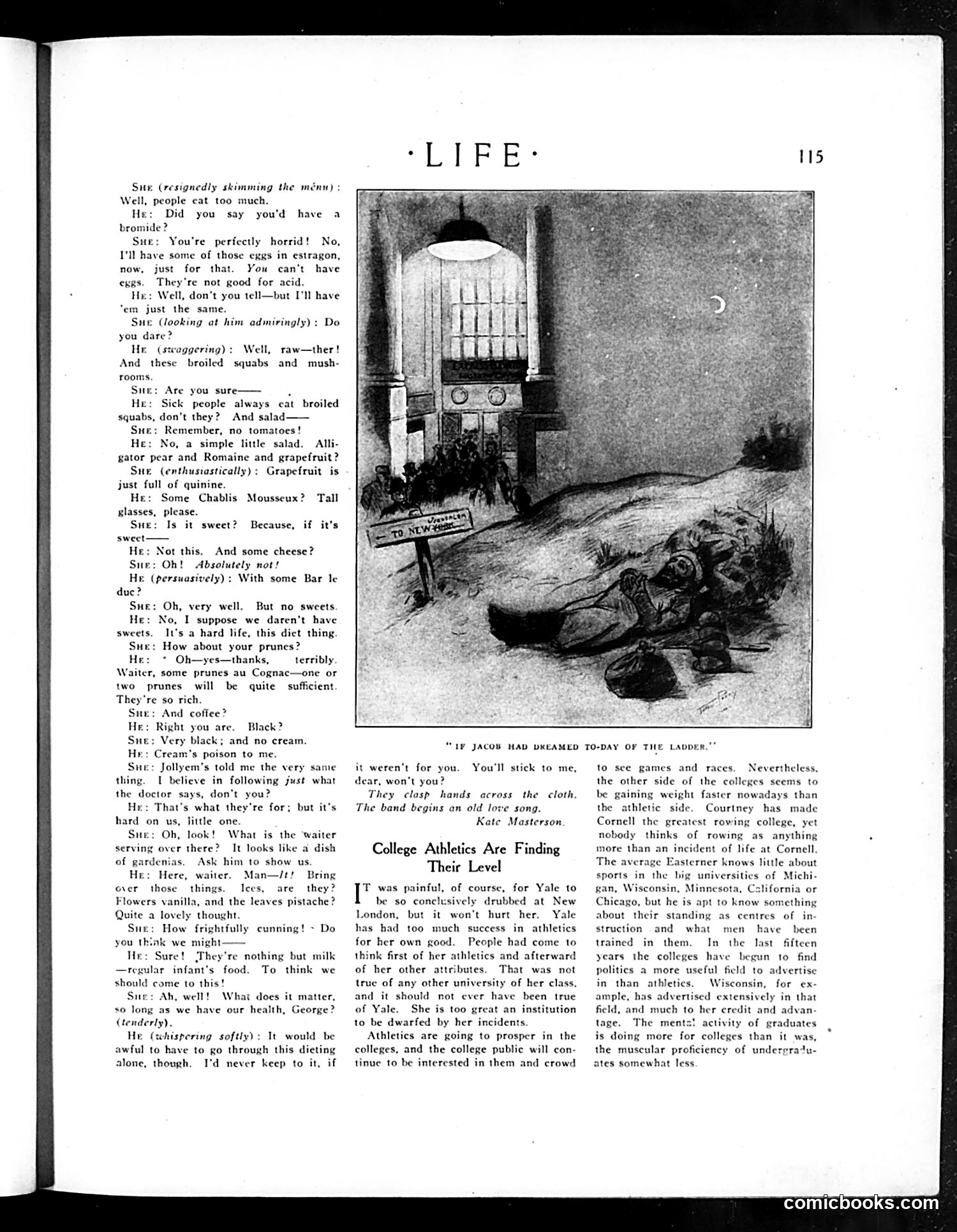
## The Cartoon The main image shows a couple dining at what appears to be an upscale restaurant, with the caption "IF JACOB HAD DREAMED TO-DAY OF THE LADDER." This is a biblical reference to Jacob's ladder (Genesis 28:12), sarcastically suggesting that modern restaurant dining—with its elaborate, health-conscious menu negotiations—represents a spiritual ascent. ## The Satire The accompanying dialogue mocks early 20th-century fad dieting and health obsession among the wealthy. The couple engages in performative dietary restriction (eggs for "acid," no tomatoes, black coffee) while simultaneously ordering rich foods (Chablis wine, cheese, prunes in Cognac, fancy ices). The humor lies in their contradiction: they claim health consciousness while indulging lavishly, and their romantic moment occurs precisely when they surrender dietary principles ("no sweets... Oh, very well"). ## Social Context This satirizes the era's emerging diet culture and pseudo-scientific health claims among affluent urbanites—a new phenomenon of the 1920s where dietary restriction became a status marker and source of conspicuous restraint.
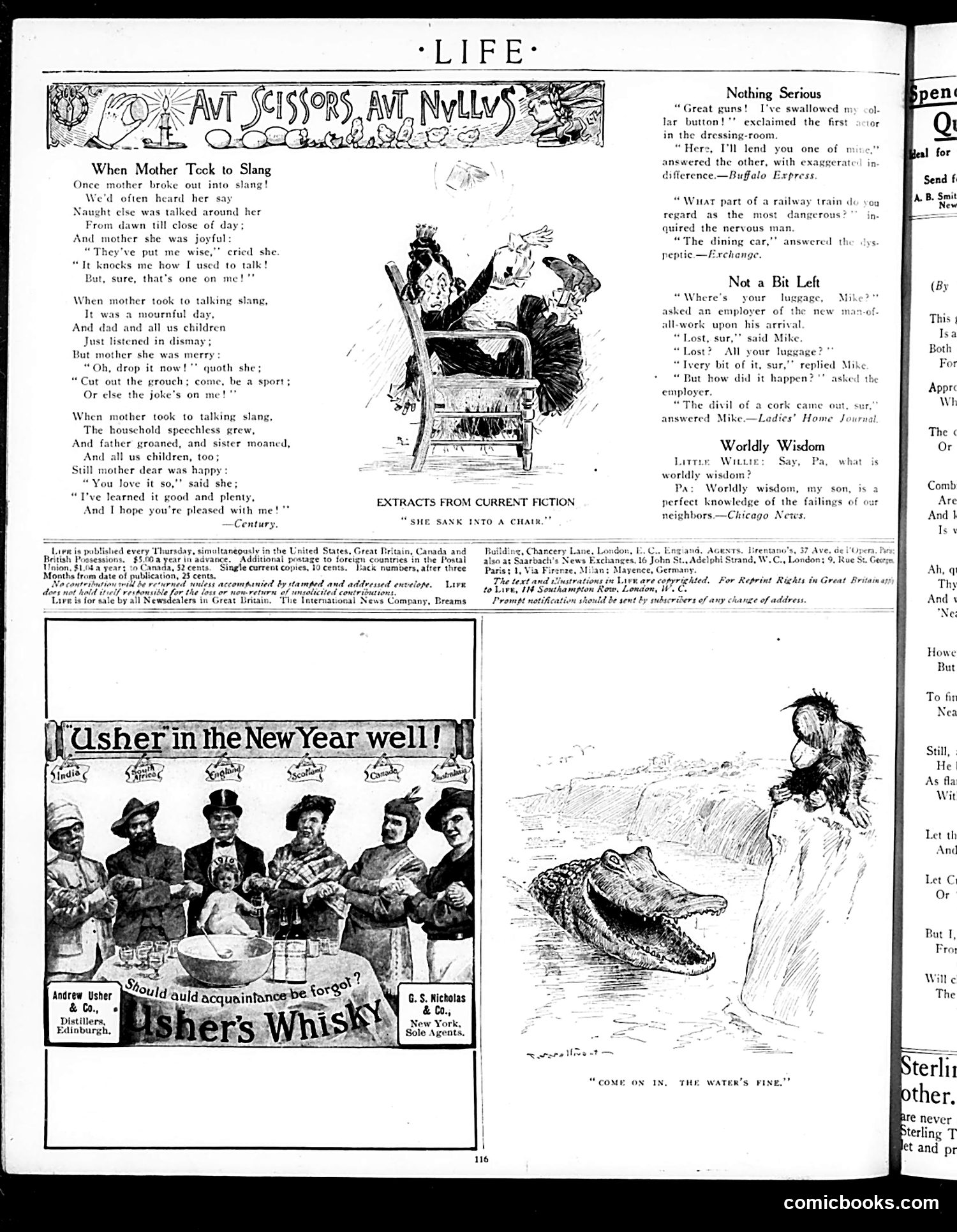
This page contains several brief humorous pieces typical of Life's satirical style: **Main Comic Strip:** "When Mother Took to Slang" depicts a mother adopting contemporary slang speech while her family reacts with dismay and disapproval. The joke satirizes generational language gaps and how jarring it was when older people adopted youth slang—treating it as undignified behavior that embarrasses the household. **Right Column Jokes:** Several short comic anecdotes mock social pretense and misunderstandings—a doctor swallowing a button, an employee losing luggage, and a definition of "worldly wisdom" as knowing neighbors' faults. These are standard vaudeville-style gag fare. **Illustration:** A man beckoning an alligator from a riverbank with "Come on in, the water's fine"—a darkly ironic visual gag about false reassurance leading to danger. **Advertisement:** An "Usher in the New Year" whiskey ad featuring six figures in period costume, promoting Usher's Whisky as an appropriate holiday drink. The page reflects early 20th-century American humor's focus on language, class anxieties, and gentle domestic comedy rather than sharp political satire.
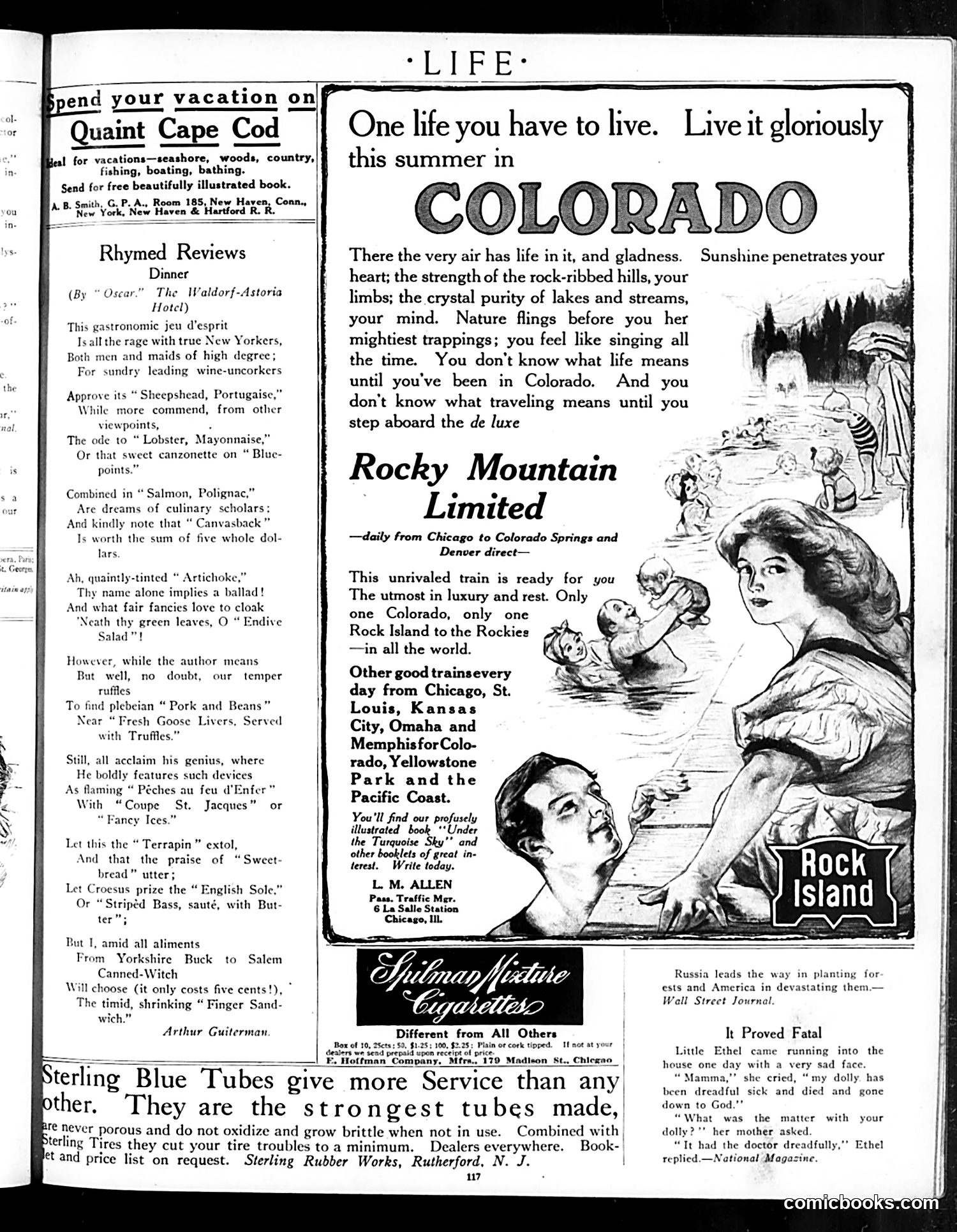
This page is primarily **advertising and light entertainment**, not political satire. The main content includes: 1. **"Rhymed Reviews: Dinner"** — A humorous poem by "Oscar" (attributed to the Waldorf-Astoria Hotel) satirizing pretentious New York dining culture. It mocks the affectation of fancy French dish names while confessing preference for humble "finger sandwiches" at five cents. The joke: haute cuisine snobbery contrasted with ordinary taste. 2. **Colorado tourism advertisement** — Promotes the "Rocky Mountain Limited" train with romantic imagery of mountain scenery and leisure travel, typical early-20th-century travel marketing. 3. **Minor advertisements** — For Cape Cod vacations, Sterling Blue Tubes (car tires), and Spilman-Mixture Cigarettes. 4. **"It Proved Fatal"** — A brief humorous anecdote about a child's misunderstanding of medical care, using the phrase "had the doctor dreadfully" as a pun. The page reflects early 1900s American consumer culture and leisure travel rather than containing political commentary or complex satire requiring historical context.
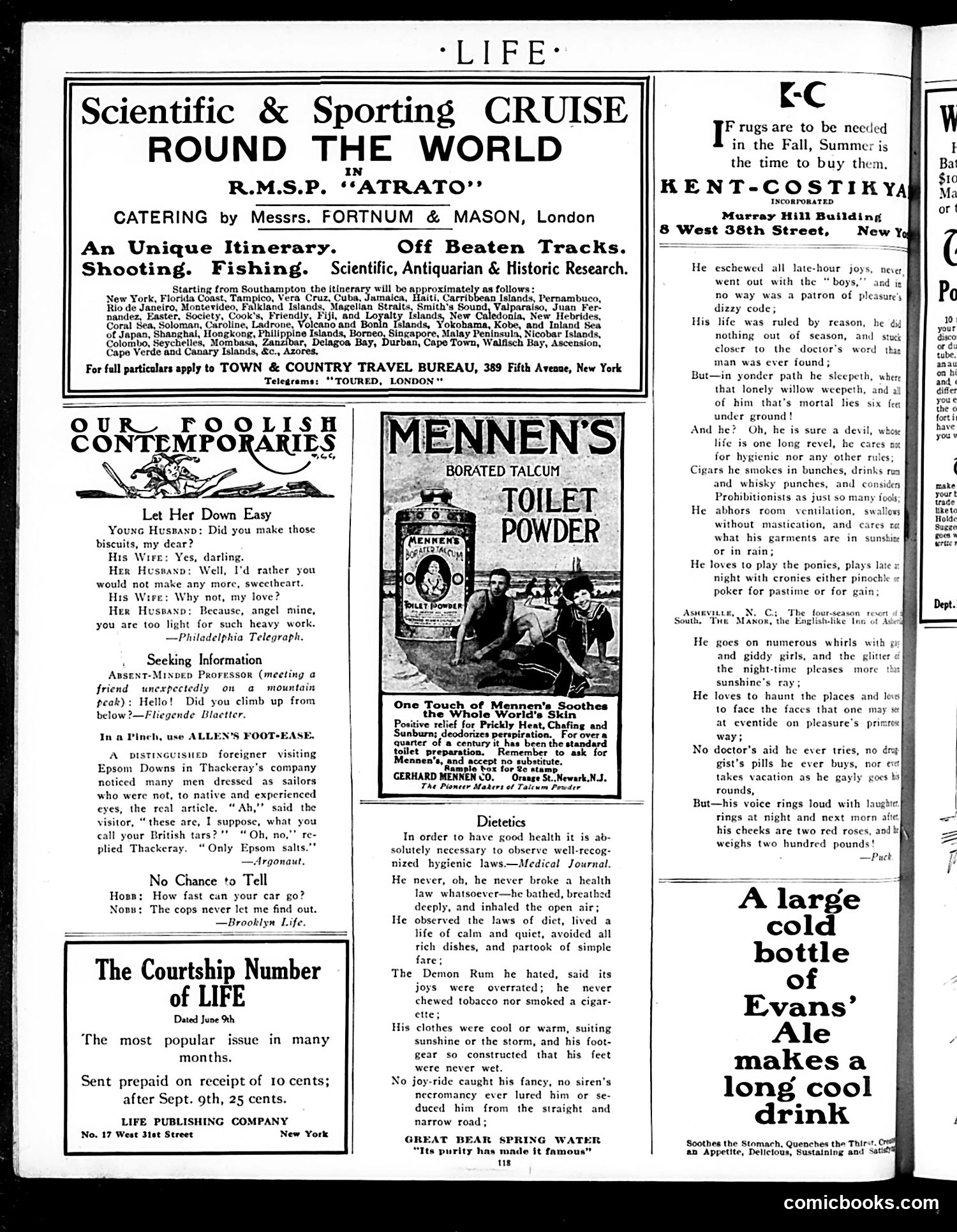
This page is primarily **advertisements and humor columns** with minimal political content. The main items are: **"Our Foolish Contemporaries"** — a humor section featuring three brief jokes: - A newlywed husband criticizing his wife's biscuits as "too light for heavy work" (mild domestic satire) - An absent-minded professor on a mountaintop (stock character humor) - A foreigner at Epsom Downs mistaking sailors for "Epsom salts" — a pun on the location and laxative brand (wordplay humor) **"The Courtship Number of LIFE"** — advertises a special June issue about courtship, available cheaply before September 9th. **"Dietetics"** — a humorous poem about a perfectly health-conscious man who follows every hygiene law, avoids alcohol, smoking, and temptation, yet (implied) presumably dies anyway — gentle irony about obsessive health compliance. The remaining content is **straightforward advertising**: world cruise, talcum powder, ale, spring water, and fur coats. This reflects Life's role as a commercial publication alongside satire.
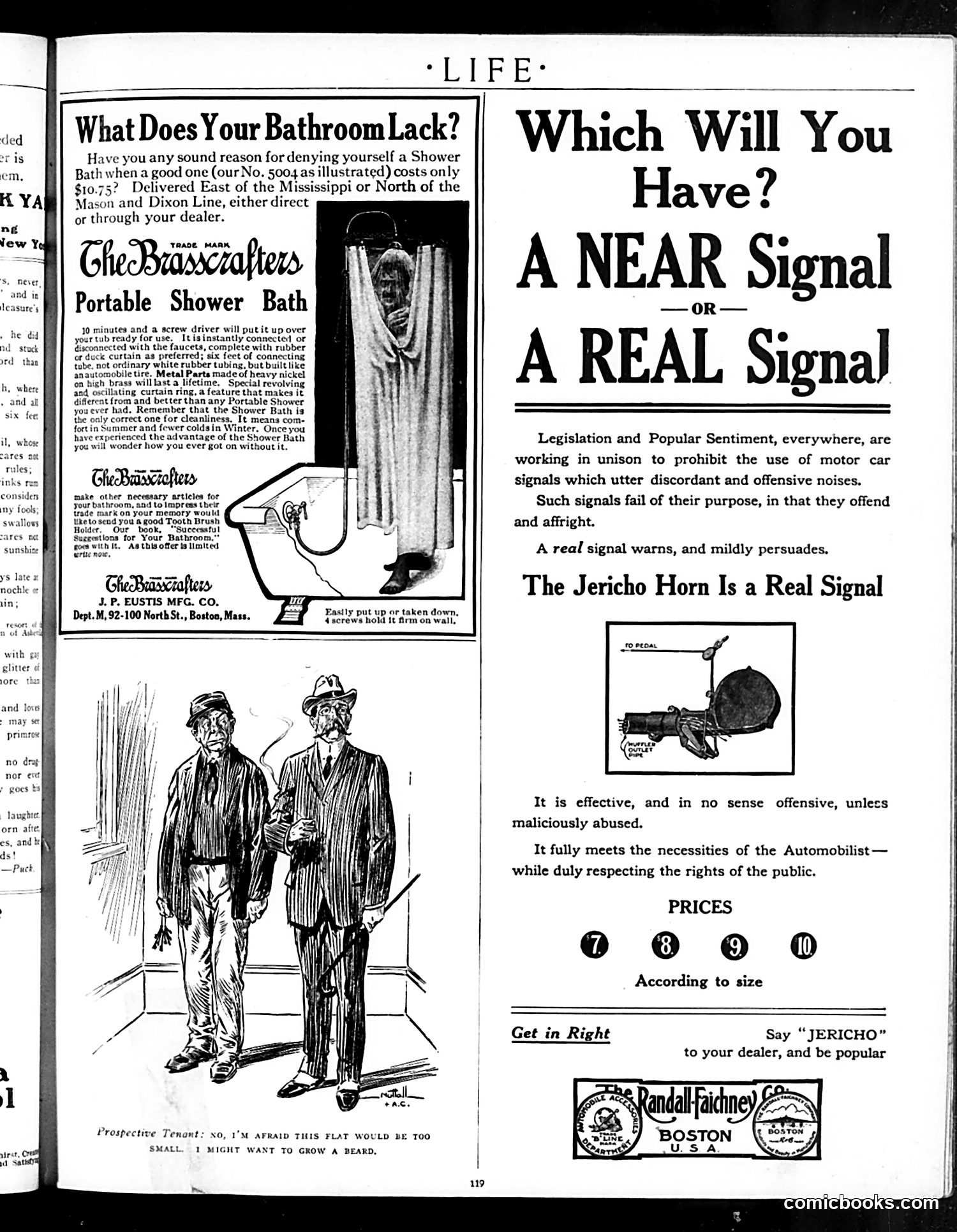
This page contains two separate advertisements and one cartoon. **The Advertisements:** - **Clic Basscrafter's Portable Shower Bath** (left): A practical bathroom fixture ad emphasizing convenience and durability—marketed as an affordable luxury at $10.75. - **The Jericho Horn** (right): An automobile horn advertisement arguing for "real signals" over loud, discordant ones. The text advocates for legislation prohibiting offensive car horns, positioning the Jericho Horn as a genteel alternative that "warns and mildly persuades" rather than offends. **The Cartoon:** A single-panel joke showing two men in hats discussing an apartment. One says he fears a flat would be "too small" because "I might want to grow a beard." The humor lies in the absurdity: growing a beard requires only facial hair space, not apartment space. The joke satirizes either vanity about appearance or perhaps critiques people's impractical reasoning when renting—using trivial personal concerns to justify needing larger (and presumably more expensive) living quarters. The cartoon's exact satirical target beyond the general humor is unclear from the image alone.
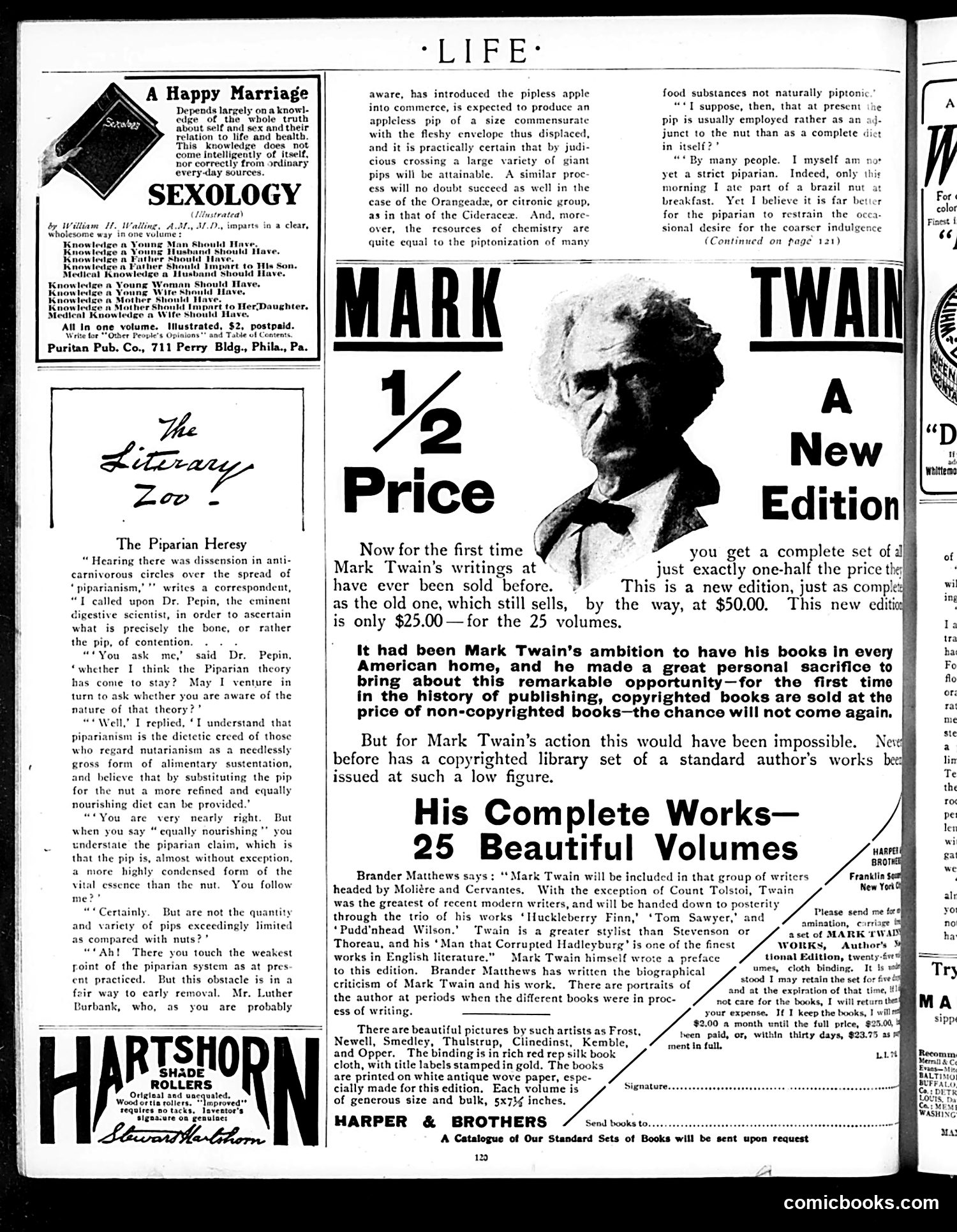
This is a satirical dialogue mocking dietary fads and pseudoscientific health claims. Dr. Pepin advocates "piparianism"—a diet based on eating fruit pits instead of whole fruits—as a more "refined" and nutritious alternative to nut-eating ("nutarianism"). The humor lies in the absurdity: the characters seriously debate whether apple pits are nutritionally superior to apples, credit Luther Burbank (a real botanist famous for plant breeding) with developing "pipless apples" to harvest their pits, and discuss chemistry's ability to make pits more edible. The satire targets early 20th-century diet crazes and the pseudo-intellectual justifications people invented for them. By pushing the logic to an obviously ridiculous extreme—eating inedible seeds as health food—Life magazine mocks how fashionable diet trends appeal to vanity and false sophistication rather than genuine nutrition. The page also contains Mark Twain advertising, unrelated to the cartoon.
This page features a serialized satirical piece mocking dietary fads and pseudoscientific nutrition claims popular in the early 20th century. The excerpt presents an interview with "Dr. Pepin," a fictional expert promoting an absurd "piparian diet"—allegedly based entirely on eating pips (seeds). The humor escalates through increasingly ridiculous details: pip broth, pip-flour scones, pipkin stew, even "pipsy cake" and "pear-pip tartlets." The satire targets both gullible consumers chasing trendy diets and charlatans marketing implausible health claims. The doctor's pompous pseudoscientific language ("parallelo pipeds," claims about disease rarity) parodies how dubious health theories were dressed up in legitimate-sounding jargon to sell to the public. This reflects broader contemporary anxieties about industrialization, health crazes, and the proliferation of mail-order "cure-alls"—concerns *Life* magazine regularly lampooned through satirical fiction and advertisements.
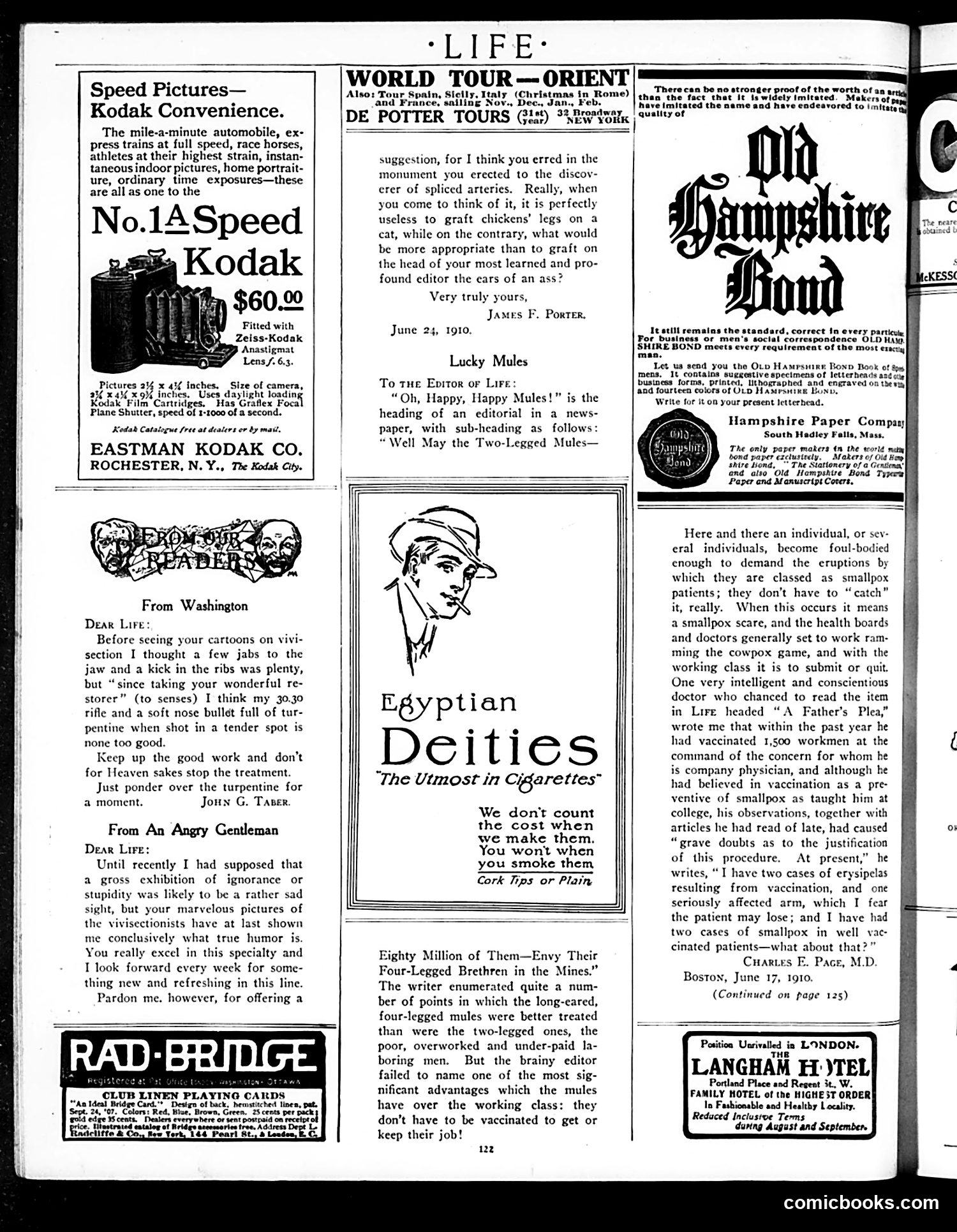
This page contains several distinct elements: **Main Content:** Reader letters to *Life* magazine's editor, debating **vaccination against smallpox**. One letter sarcastically praises "Lucky Mules" (two-legged humans forced into vaccination), while another doctor defends vaccination, noting he'd vaccinated 1,500 workers and observed only two cases of side effects (erysipelas). The debate reflects early-1900s anti-vaccination sentiment versus public health advocacy. **Advertisements:** Period product ads (Kodak cameras, cigarettes, hotels, paper company, bridge club cards). **Illustration:** A sketch of an "Egyptian" figure advertising cigarettes—likely reflecting the era's casual ethnic stereotyping in marketing. The vaccination debate was genuine public controversy in 1910, with some opposing mandatory vaccination on freedom/safety grounds while health authorities pushed it as disease prevention.
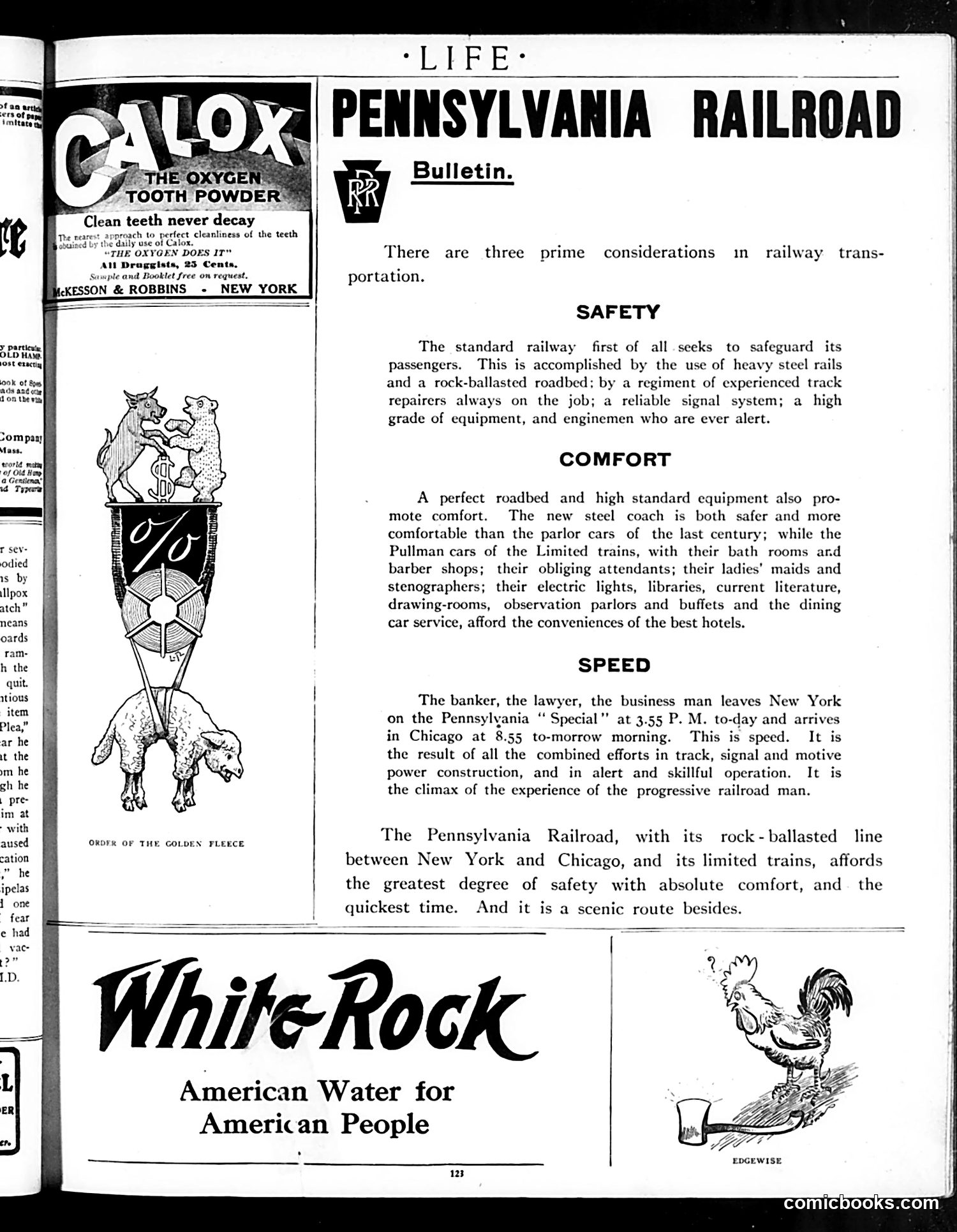
This page is primarily **advertising** for the Pennsylvania Railroad and White Rock water, with a small decorative emblem (the "Order of the Golden Fleece" — an ornamental heraldic design, not political satire). The Pennsylvania Railroad bulletin makes a straightforward business pitch: their trains offer three selling points—**Safety, Comfort, and Speed**. It boasts that business travelers can leave New York at 3:55 PM and arrive in Chicago by 8:55 AM the next morning, highlighting modern steel coaches, Pullman cars with amenities (barbers, libraries, dining cars), and reliable equipment. The **Calox tooth powder ad** (upper left) uses the marketing phrase "The Oxygen Does It!" to claim superior cleaning. There is **no political cartoon or satire here**—this is a standard early 20th-century advertising page. The rooster illustration (bottom right) appears to be merely decorative branding for White Rock's slogan: "American Water for American People."
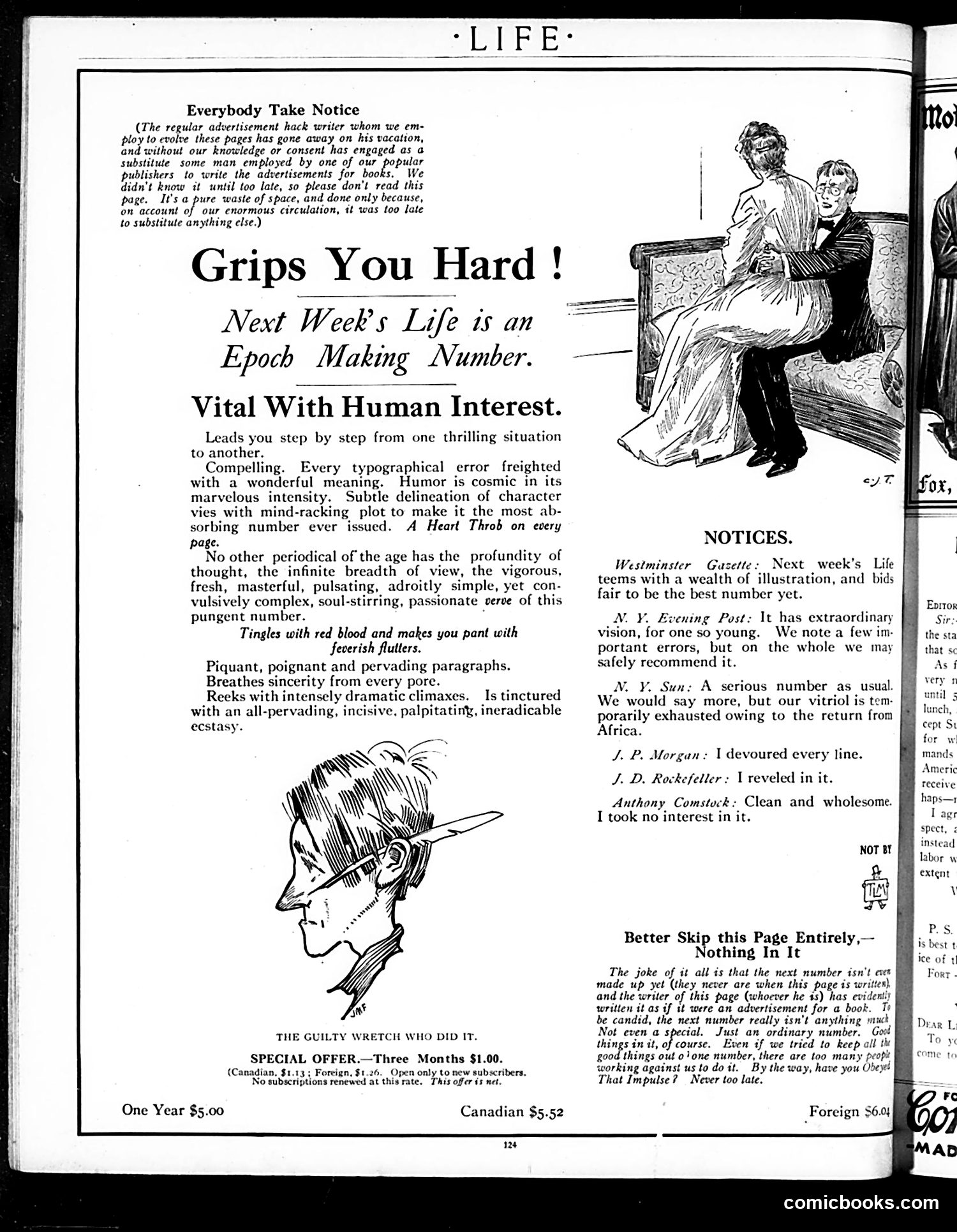
This page is **Life magazine satirizing itself**—a meta-joke about advertising hype. The masthead admits their regular ad writer was on vacation, so a substitute (hired by a book publisher) wrote this page as an actual book advertisement masquerading as promotion for next week's Life issue. **The satire:** The florid, absurdly overwrought language ("Tingles with red blood," "cosmic intensity," "soul-stirring passion") parodies the hyperbolic book-advertising copy Life's readers would recognize. The cartoon shows Pinocchio—the liar—labeled "THE GUILTY WRETCH WHO DID IT," identifying the deceptive advertising writer. **The punchline:** The footer confesses the truth: next week's issue isn't even finished yet, it's just ordinary, and they're mocking themselves for running this page anyway because of their "enormous circulation"—they can waste space and readers will still buy it. The fake "notices" from major papers and celebrities (J.P. Morgan, Rockefeller, Anthony Comstock) further parody testimonial advertising.
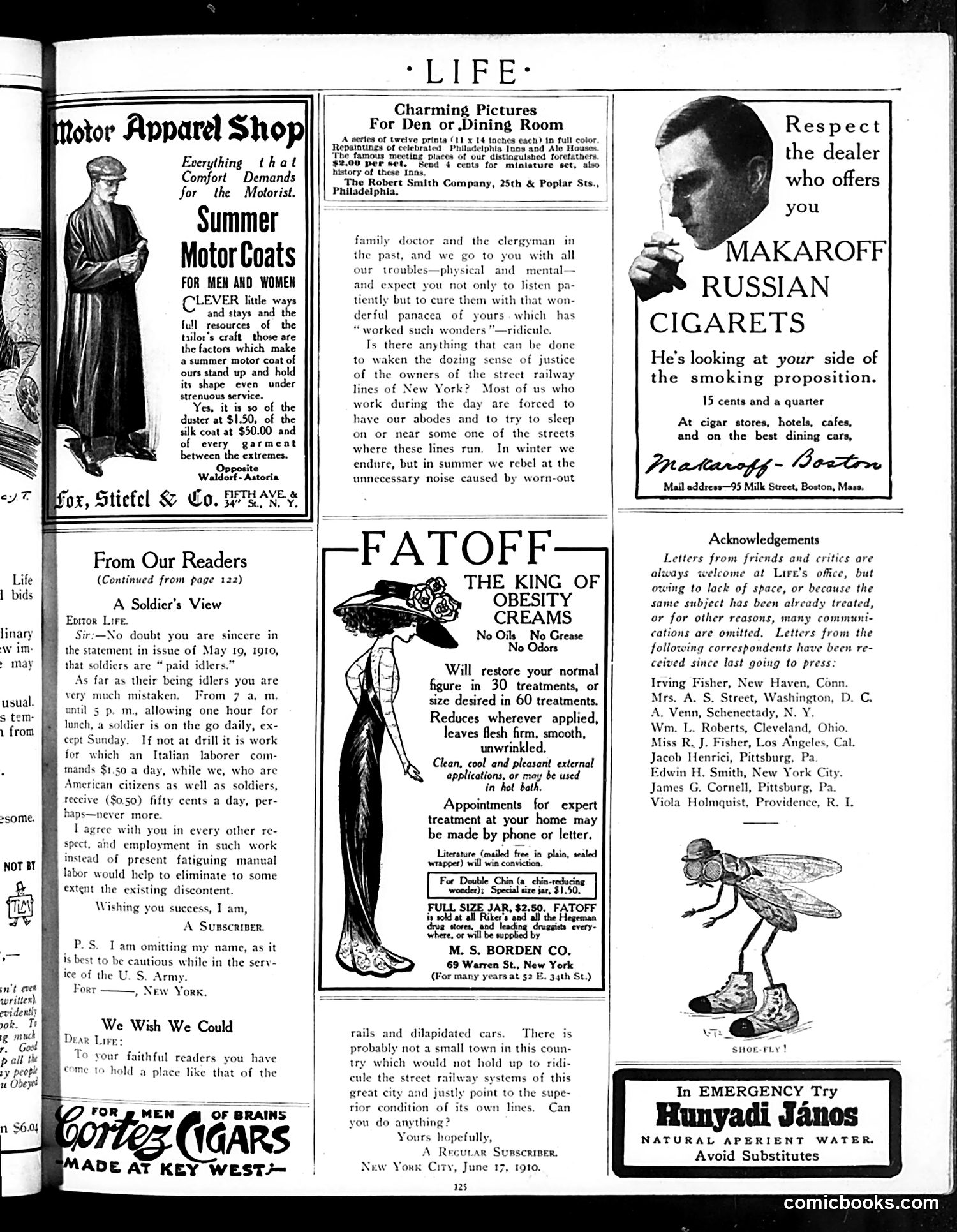
This page is primarily **advertising with reader letters**, not political satire. The notable content includes: **"Fatoff" obesity cream ad**: Features a caricatured overweight woman. This represents early 20th-century weight-loss marketing—a common advertising trope promising figure restoration through topical applications. **Reader letters** address practical grievances: A soldier complains about low pay (50 cents daily versus $1.30 for Italian laborers doing equivalent work) and disputes characterizations of military idleness. Another reader criticizes New York streetcar companies for noise pollution from worn-out rails. **Motor apparel, Russian cigarettes, and Makaroff water ads** fill remaining space—typical period advertising. The page reflects **early 1900s consumer culture and working-class concerns** rather than political satire. The soldier's letter notably invokes citizenship and comparative labor worth—suggesting class and immigrant labor tensions of the era.
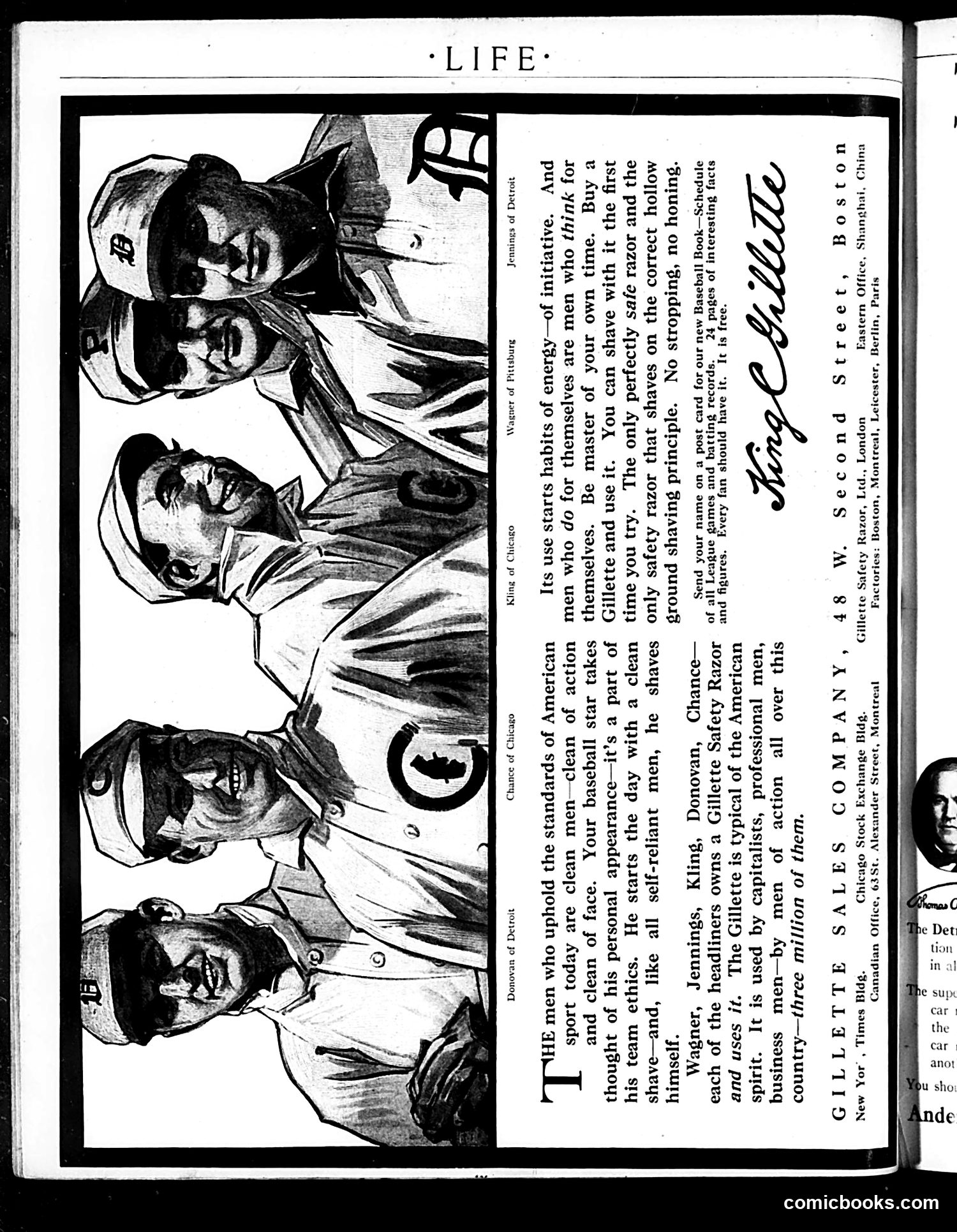
This page from *Life* magazine features a satirical cartoon about American business leadership and safety standards. The image shows five men in suits and hats arranged vertically, appearing to represent industrial or corporate figures of the era. The accompanying text discusses men who "uphold the standards of American business" while simultaneously prioritizing profit over worker safety. The satire critiques corporate leaders who publicly champion American values and initiative but privately ignore safety hazards—they "share with a clear time try. The only safety measure being their own profit and self-reliance." The cartoon mocks the hypocrisy of executives who promote ideals of American character and responsibility while cutting corners on worker protection. This reflects early 20th-century labor reform debates, when industrial safety violations were common and corporate accountability remained contested. The figures likely represent generic "captains of industry" rather than specific individuals, making the critique broadly applicable to American business practices of that period.
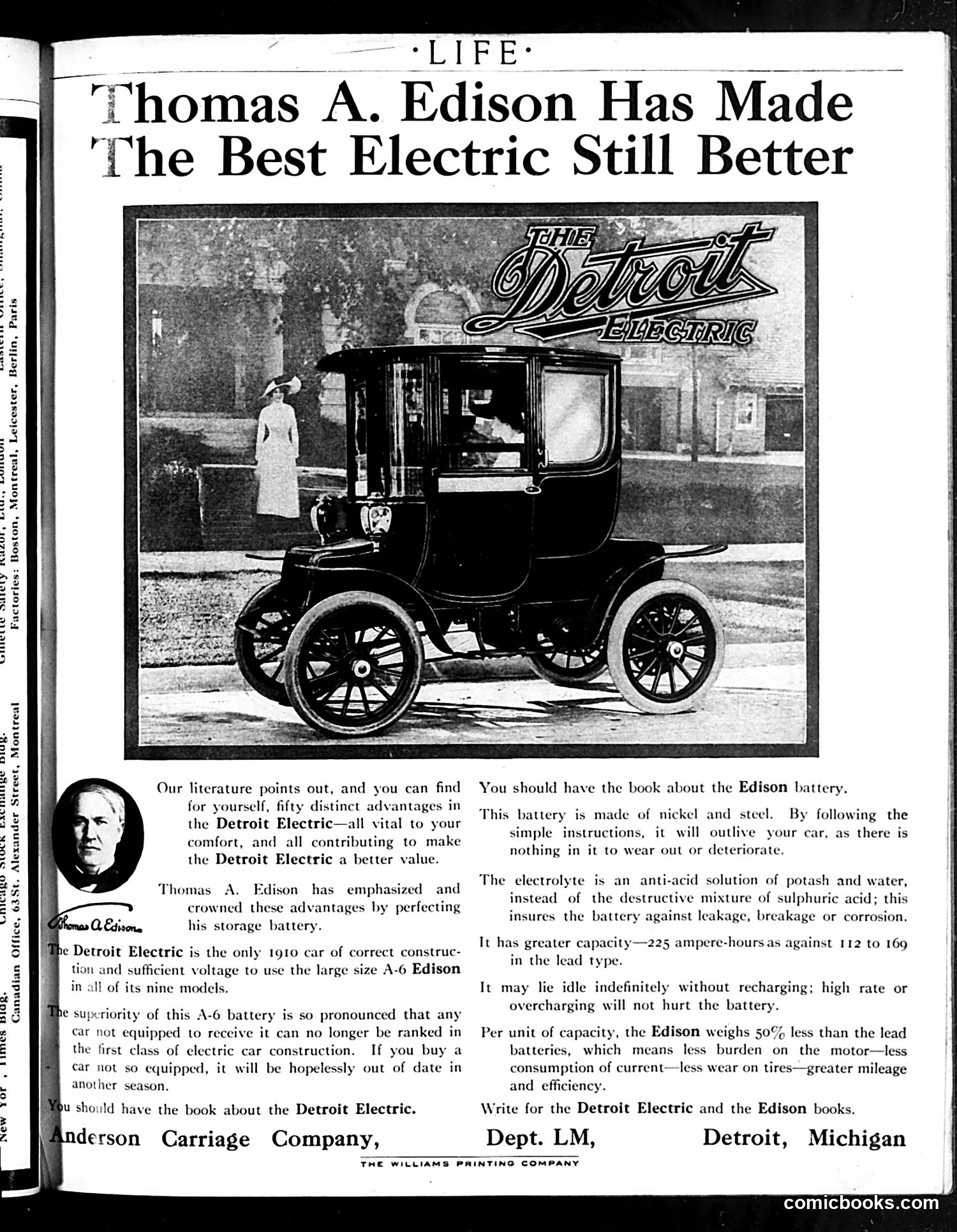
This is primarily **advertising**, not satire or political commentary. The page promotes the Detroit Electric automobile, featuring a photograph of the 1910 vehicle with a woman standing beside it. The advertisement leverages **Thomas A. Edison's endorsement** and his improved storage battery to market the car. Edison's portrait and signature appear, lending his prestige to the product. The text emphasizes that Edison has "perfected" the A-6 battery specifically for this vehicle, making it superior to competitors—claiming any electric car without this battery is "hopelessly out of date." The appeal targets **comfort and reliability** for what appears to be a vehicle marketed toward women, given the elegantly dressed woman pictured. The technical details (nickel-steel construction, anti-acid electrolyte, greater capacity) are presented to justify the premium positioning. This reflects the **early automotive era** when electric cars competed seriously with gasoline vehicles, and celebrity endorsements—particularly Edison's, as the era's most famous inventor—carried substantial marketing weight.
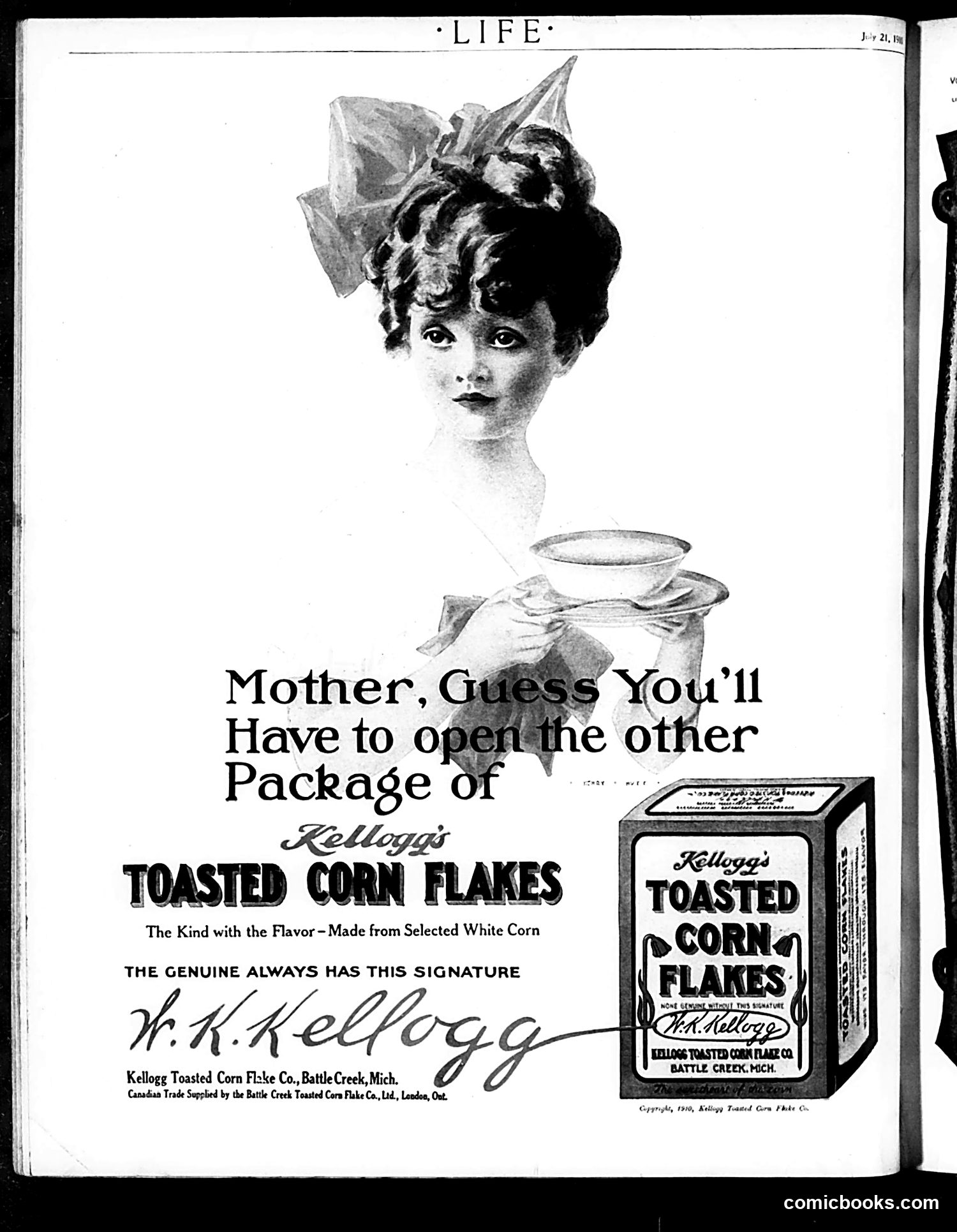
This is a **Kellogg's Toasted Corn Flakes advertisement**, not satire or political commentary. The page features an elegant woman in early 1910s fashion (upswept hair, large decorative bow) holding stacked bowls, with the tagline: "Mother, Guess You'll Have to open the other Package of Kellogg's Toasted Corn Flakes." The humor is domestic and gentle: the joke implies the cereal is so popular that one package won't suffice—mother must open a second. The ad emphasizes authenticity by highlighting W.K. Kellogg's signature on all genuine boxes, addressing counterfeiting concerns of the era. This reflects early twentieth-century advertising strategy: using aspirational imagery and mild humor to position the product as a desirable household staple.