
Life, 1910-07-21 · page 27 of 40
Life — July 21, 1910 — page 27: what you’re looking at
What you’re looking at
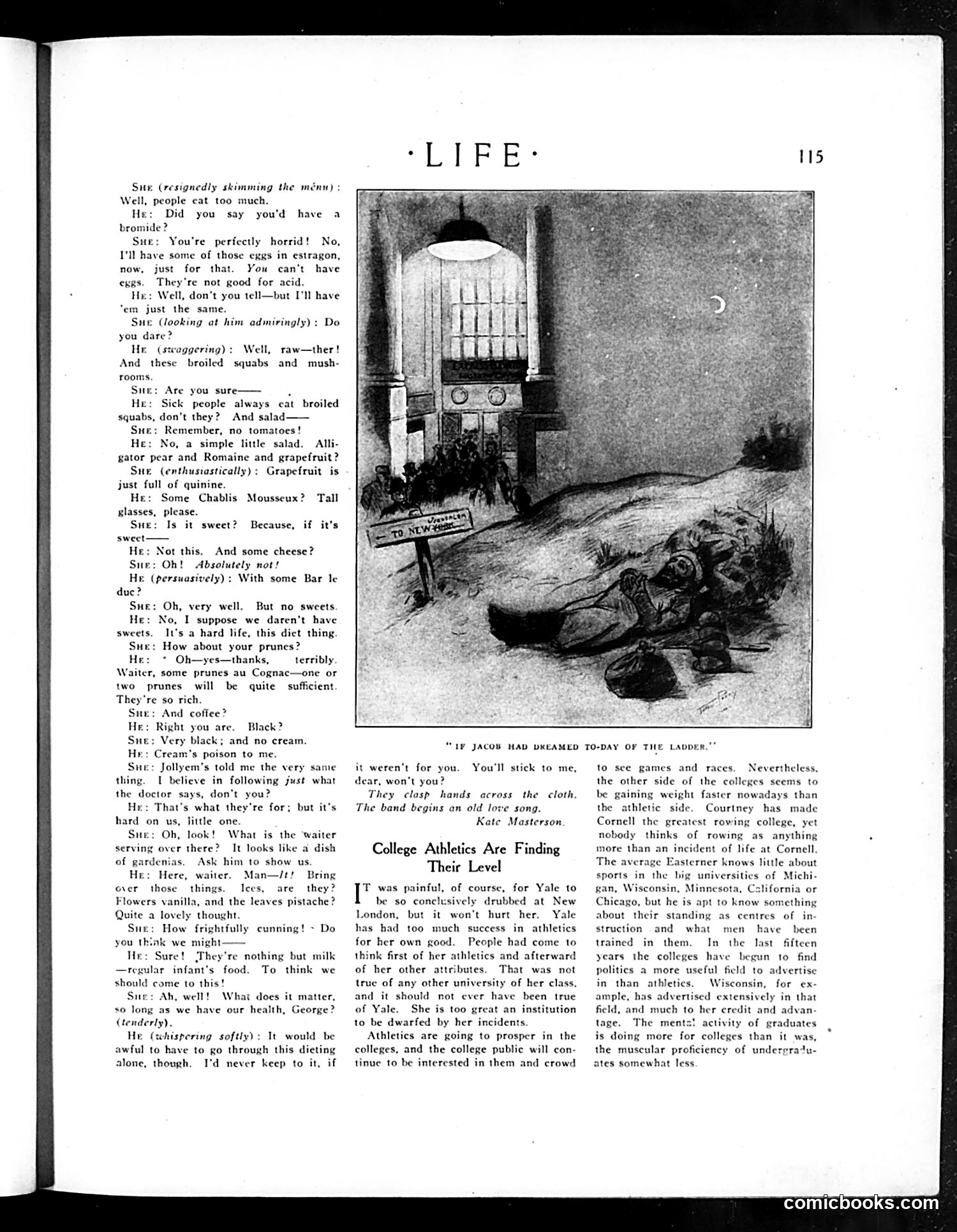
## The Cartoon The main image shows a couple dining at what appears to be an upscale restaurant, with the caption "IF JACOB HAD DREAMED TO-DAY OF THE LADDER." This is a biblical reference to Jacob's ladder (Genesis 28:12), sarcastically suggesting that modern restaurant dining—with its elaborate, health-conscious menu negotiations—represents a spiritual ascent. ## The Satire The accompanying dialogue mocks early 20th-century fad dieting and health obsession among the wealthy. The couple engages in performative dietary restriction (eggs for "acid," no tomatoes, black coffee) while simultaneously ordering rich foods (Chablis wine, cheese, prunes in Cognac, fancy ices). The humor lies in their contradiction: they claim health consciousness while indulging lavishly, and their romantic moment occurs precisely when they surrender dietary principles ("no sweets... Oh, very well"). ## Social Context This satirizes the era's emerging diet culture and pseudo-scientific health claims among affluent urbanites—a new phenomenon of the 1920s where dietary restriction became a status marker and source of conspicuous restraint.
📄 Transcribed text from this page (OCR, searchable)
Machine-transcribed from the original scan — historical spelling and the odd misread are preserved.
Sue (resignedly skimming the ménn) : Well, people cat too much. He: Did you say you'd have a bromide? Sue: You're perfectly horrid! No, I'll have some of those eggs in estragon, now, just for that. You can’t have exes. They're not good for acid. He: Well, don’t you tell—but I'll have just the same. Sue (looking at him admiringly) ; Do you dare? He ( And these rooms. Site: Are you sure. . He: Sick people always eat broiled squabs, don’t they? And salad. Sue: Remember, no tomatoes! He: No, a simple little salad. Alli- gator pear and Romaine and grapefruit? Sue (enthusiastically): Grapefruit is just full of quinine. He: Some Chablis Mousseux? glasses, please. Sue: Is it sweet He: Nott And some cheese? Sur: Oh! Absolutely not! He (persuasively) : With some Bar le duc? Sue: Oh, very well. But no sweets. He: No, I suppose we daren’t have sweets, It's a hard life, this dict thing. Sux: How about your prunes? He: * Oh—yes—thanks, terribly. Waiter, some prunes au Cognac—one or two prunes will be quite sufficient They're so rich. Sue: And coffee? He: Right you are. Black? Sune: Very black; and no cream. Hr: Cream's poison to me. Sue: Jollyem’s told me the very same thing. I believe in following just what or says, don’t you? That's what they're for; but i hard on us, little one. Sune: Oh, look! What is the ter serving over there? It looks like a dish of gardenias, Ask him to show us. He: Here, waiter. Man—/t! Bring over those things. Ices, are they? Flowers vanilla, and the leaves pistache? Quite a lovely thought. Sue: How frightfully cunnin; you think we might He: Sure! The —regular infant's food. To should come to this! Su h, well! What does it matter, we have our health, George? aggering): Well, raw—ther! broiled squabs and mush- Tall sweet? Because, if it's > Do "re nothing but milk think we so long (tenderly). He (whispering softly): It awful to have to go through this dieting alone, though. I'd never keep to it, if would be “IP JACOB MAD DREAMED TO-DAY OF THE LADDER.’” it weren't for you. You'll stick to me, dear, won't you? They clasp hands across the The band begins an old love song. Kate Masterson College Athletics Are Finding Their Level T was painful, of course, for Yale to be so conclusively drubbed at New London, but it won't hurt her. Yale has had too much success in athletics for her own good. People had come to think first of her athletics and afterward of her other attributes. That was not true of any other university of her class. and it should not ever have been true of Yale. She is too great an institution to be dwarfed by her incidents. Athletics are going to prosper in the colleges, and the college public will con- tinue to be interested in them and crowd cloth, to sce games and races. Nevertheless, the other side of the colleges seems to be gaining weight faster nowadays than the athletic side. Courtney has made Cornell the greatest rowing college, yet nobody thinks of rowing as anything more than an incident of life at Cornell. The average Easterner knows little about sports in the big universities of Michi- gan, Wisconsin, Minnesota, California or Chicago, but he is apt to know something about their standing as centres of in- struction and what men have been trained in them. In the last. fifteen years the colleges have begun to find politics a more useful ficld to advertise in than athletics. Wisconsin, for ex- ample, has advertised extensively in that field, and much to her credit and advan- tage. The ments! activity of graduates is doing more for colleges than it was, the muscular proficiency of undergratu- ates somewhat less. comicbooks.com