
Life, 1910-07-21 · page 24 of 40
Life — July 21, 1910 — page 24: what you’re looking at
What you’re looking at
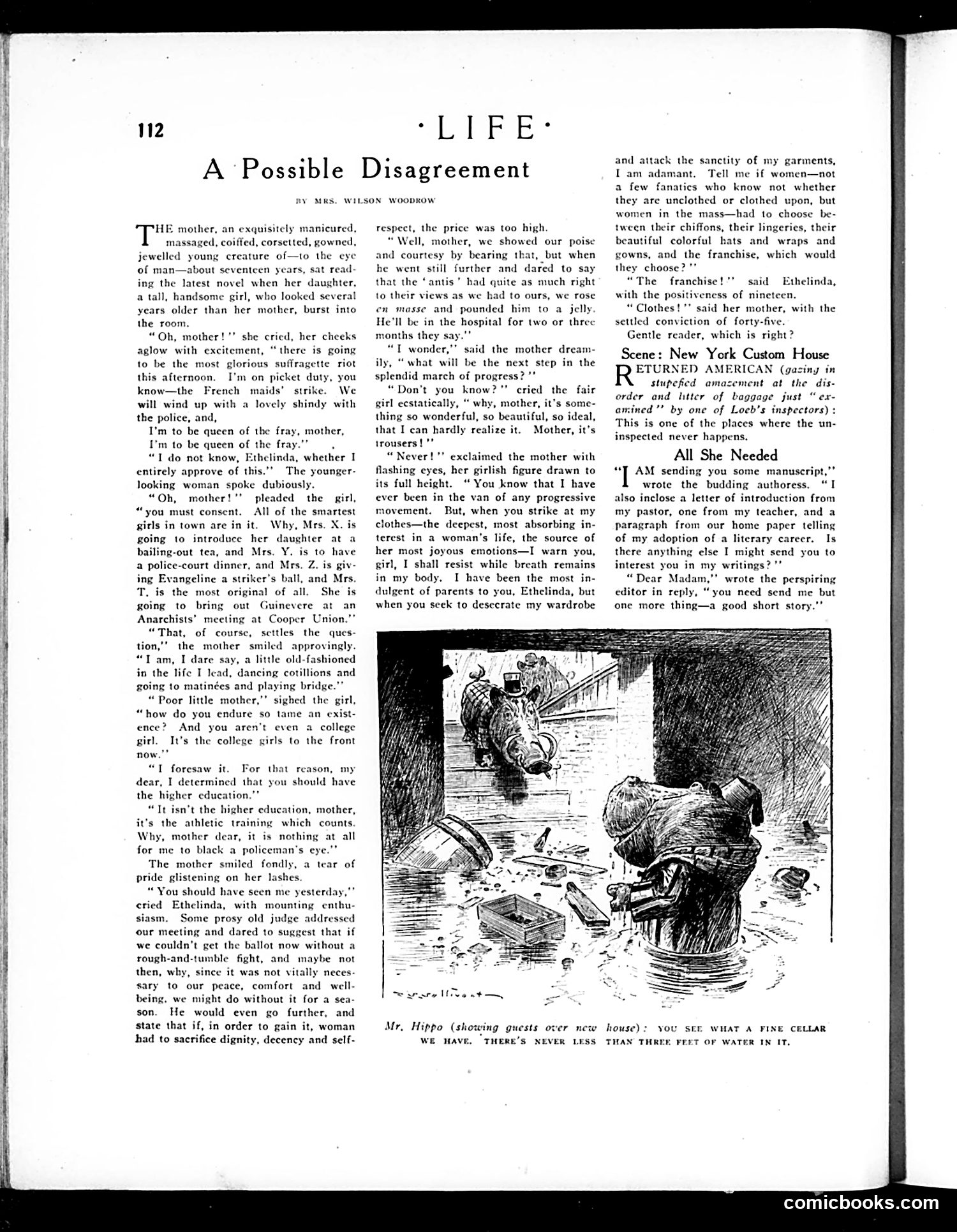
This satirical story by Mrs. Wilson Woodrow mocks the suffragette movement through generational role-reversal. The daughter, Ethelinda, is an eager young activist planning to riot for women's voting rights, while her mother—described as youthful and fashionable—initially seems supportive of progressive causes. The satire's target becomes clear in the ending: the mother enthusiastically endorses suffrage activism, police brutality, and even anarchism, but draws the line at women wearing trousers. This exaggerates the perceived hypocrisy of society—that women would fight violently for political rights yet remain obsessed with fashion and appearance. The accompanying cartoon below (Mr. Hippo) appears unrelated to the main text. The piece reflects early 20th-century debates about suffragettes' militant tactics and satirizes both the movement's tactics and society's shallow priorities regarding women's roles.
📄 Transcribed text from this page (OCR, searchable)
Machine-transcribed from the original scan — historical spelling and the odd misread are preserved.
{ i 4 } 1 = H i 112 “LIF E- A Possible Disagreement BY MRS. WILSON WoopKow HE mother, an exquisitely manicured, massaged, coiffed, corsetted, gowned, jewelled young creature of—to the eye of man—about seventeen years, sat read ing the latest novel when her daughter, a tall, handsome girl, who looked several years older than her mother, burst into the room. “Oh, mother! "’ she cried, her cheeks aglow with excitement, “there is going to be the most glorious suffragette riot this afternoon. I'm on picket duty, you know—the French maids’ strike. We will wind up with a lovely shindy with the police, and, I'm to be queen of the fray, mother, I'm to be queen of the fray. ‘ “T do not know, Ethelinda, whether I entirely approve of this.” The younger- looking woman spoke dubiously. “Oh, mother!" pleaded the girl, “you must consent. All of the smartest girls in town are in it. Why, Mrs. X. is going to introduce her daughter at a bailing-out tea, and Mrs. Y. is to have a police-court dinner, and Mrs. Z. is giv- ing Evangeline a striker’s ball, and Mrs. T. is the most original of all. She is going to bring out Guinevere at an Anarchists’ meeting at Cooper Union.’” “That, of course, scttles the ques- tion,” the mother smiled approvingly. “Tam, I dare say, a little old-fashioned in the life I lead, dancing cotillions and going to matinées and playing bridge.”’ “Poor little mother,” sighed the girl, “how do you endure so tame an exist- ence? And you aren't even a college girl. It’s the college girls to the front now.”" I foresaw it. For that reason, my dear, I determined that you should have the higher education.’ “Tt isn’t the higher education, mother, it's the athletic training which counts. Why, mother dear, it is nothing at all for me to black a policeman’s eye.” The mother smiled fondly, a tear of pride glistening on her lashes. “You should have seen me yesterday,’ cried Ethelinda, with mounting enthu- siasm. Some prosy old judge addressed our meeting and dared to suggest that if we couldn't get the ballot now without a rough-and-tumble fight, and maybe not then, why, since it was not vitally neces. sary to our peace, comfort and well- being. we might do without it for a sea- son. He would even go further, and state that if, in order to gain it, woman had to sacrifice dignity, decency and self- respect, the price was too high. “Well, mother, we showed our poise and courtesy by bearing that, but when he went still further and dared to say that the ‘antis’ had quite as much right to their views as we had to ours, we rose en masse and pounded him to a jelly He'll be in the hospital for two or thre: months they “T wonder," said the mother dream- ily, “what will be the next step in the splendid march of progress?" “Don't you know?" cried the fair girl ecstatically, “ why, mother, it's some- thing so wonderful, so beautiful, so ideal that I can hardly realize it. Mother, it trousers! "? “Never! "’ exclaimed the mother with flashing eyes, her girlish figure drawn to its full height. “ You know that I have ever been in the van of any progressive movement. But, when you strike at my clothes—the deepest, most absorbing in- terest in a woman's life, the source of her most joyous emotions—I warn you, girl, I shall resist while breath remains in my body, I have been the most in- dulgent of parents to you, Ethelinda, but when you seek to desecrate my wardrobe te rare Hie ty Mr, Hippo (showing guests over nev WE HAVE, “THERE’S NEVI and attack the sanctity of my garments, Iam adamant. Tell me if women—not a few fanatics who know not whether they are unclothed or clothed upon, but women in the mass—had to choose be tween their chiffons, their lingeries, their beautiful colorful hats and wraps and gowns, and the franchise, which would they choose?" “The franchise!" said Ethelinda, with the positivencss of ninete “ Clothes!" said her mother, with the settled conviction of forty-fiv Gentle reader, which is right? Scene: New York Custom House ETURNED AMERICAN (gazing in stupeficd amazement at the dis- order and hitter of boggage just “ex- amined”’ by one of Loeb’s inspectors): This is one of the places where the un- inspected never happens. All She Needed “T AM sending you some manuscript,” wrote the budding authoress. “TI also inclose a letter of introduction from my pastor, one from my teacher, and a paragraph from our home paper telling of my adoption of a literary career. Is there anything else I might send you to interest you in my writings? “Dear Madam,” wrote the perspiring editor in repl; you need send me but one more thing—a good short story.’’ house): You SEE WHAT A FINE CELLAR THAN THREE FRET OF WATER IN IT, comicbooks.com