
Life, 1910-07-21 · page 4 of 40
Life — July 21, 1910 — page 4: what you’re looking at
What you’re looking at
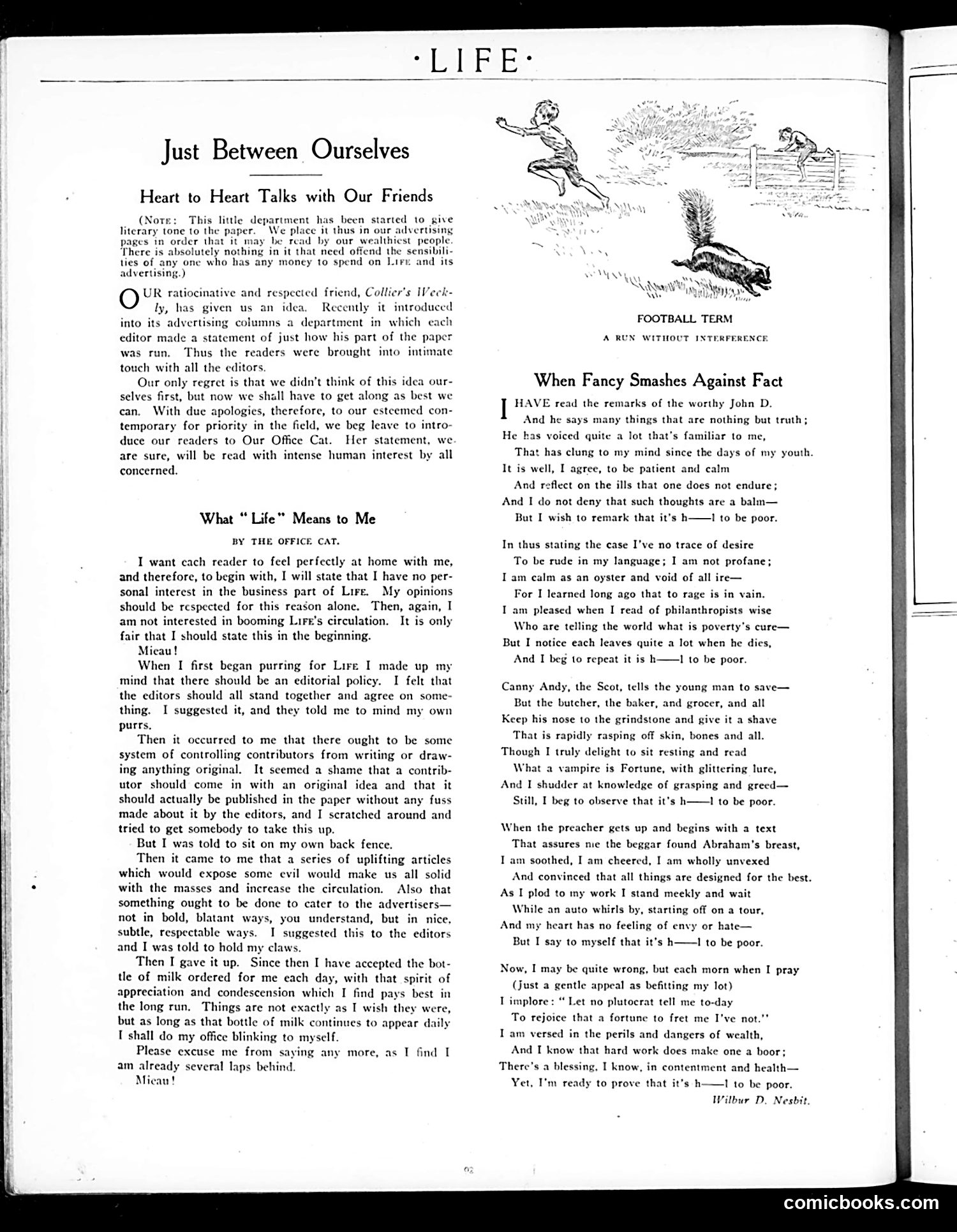
This page contains editorial content rather than political cartoons. The "Football Team: A Run Without Interference" illustration shows a skunk evading pursuers—a visual metaphor for an unobstructed play. The main article "When Fancy Smashes Against Fact" by Wilbur D. Nesbit is a philosophical poem criticizing idealistic rhetoric. Nesbit argues against those who preach abstract virtues (contentment, hard work, poverty as noble) while ignoring material reality. He references preachers citing Abraham's wealth and characters like "Canny Andy, the Scot," who tell working people to accept grinding poverty while the wealthy prosper. The satire targets the hypocrisy of those promoting acceptance of poverty as virtuous while themselves benefiting from the system—a critique of class inequality dressed in moral language.
📄 Transcribed text from this page (OCR, searchable)
Machine-transcribed from the original scan — historical spelling and the odd misread are preserved.
Just Between Ourselves Heart to Heart Talks with Our Friends (Note: This little department has been started to give literary tone to the paper. We place it thus in our advertising pages in order that it may be read by our wealthiest people. There is absolutely nothing in it that need offend the sensibili- lies of any one who has any money to spend on Lire and its advertising.) UR ratiocinative and respected friend, Collier's Week ly, has given us an idea, Recently it introduced into its advertising columns a department in which each editor made a statement of just how his part of the paper was run. Thus the readers were brought into intimate touch with all the editors. Our only regret is that we didn’t think of this idea our- selves first, but now we shall have to get along as best we can. With duc apologies, therefore, to our esteemed con- temporary for priority in the field, we beg leave to intro- duce our readers to Our Office Cat. Her statement, we are sure, will be read with intense human interest by all concerned. What “ Life’ Means to Me BY THE OFFICE CAT. I want cach reader to feel perfectly at home with me, and therefore, to begin with, I will state that I have no per- sonal interest in the business part of Lire. My opinions should be respected for this reason alone. Then, again, I am not interested in booming Lire’s circulation. It is only fair that I should state this in the beginning. Micau! When I first began purring for Lire I made up my mind that there should be an editorial policy. I felt that the editors should all stand together and agree on some- thing. I suggested it, and they told me to mind my own purrs, Then it occurred to me that there ought to be some system of controlling contributors from writing or draw- ing anything original. It seemed a shame that a contrib- utor should come in with an original idea and that it should actually be published in the paper without any fuss made about it by the editors, and I scratched around and tried to get somebody to take this up. But I was told to sit on my own back fence. Then it came to me that a series of uplifting articles which would expose some evil would make us all solid with the masses and increase the circulation. Also that something ought to be done to cater to the advertisers— not in bold, blatant ways, you understand, but in nice, subtle, respectable way: I suggested this to the editors and I was told to hold my claws. Then I gave it up. Since then I have accepted the bot- tle of milk ordered for me each day, with that spirit of appreciation and condescension which I find pays best in the long run, Things are not exactly as I wish they were, but as long as that bottle of milk continues to appear d I shall do my office blinking to myself. Please excuse me from saying any more, as T find I am already several laps behind. Mieau! FOOTBALL TERM ARUN WITHOUT INTERFERENCE When Fancy Smashes Against Fact HAVE read the remarks of the worthy John D. And he says ma He |: That has clung to my mind since the days of my youth. y things that are nothing but truth; $s voiced quite a lot that’s familiar to me, It is well, I agree, to be patient and calm And reflect on the ills that one does not endure; And I do not deny that such thoughts are a balm— But I wish to remark that it’s h. 1 to be poor. In thus stating the case I've no trace of desire To be rude in my language; I am not profane; Tam calm as an oyster and void of all ire— For I learned long ago that to rage is in vain. I am pleased when I read of philanthropists wise Who are telling the world what is poverty’s cure— But I notice each leaves quite a lot when he dies, And I beg to repeat it is h 1 to be poor. Canny Andy, the Scot, tells the young man to save— But the butcher, the baker, and grocer, and all Keep his nose to the grindstone and give it a shave That is rapidly rasping off skin, bones and all. Though I truly delight to sit resting and read What a vampire is Fortune, with glittering lure, And I shudder at knowledge of grasping and greed— Still, I beg to observe that it's h—1 to be poor. When the preacher gets up and begins with a text That assures me the beggar found Abraham's breast, Iam soothed, I am cheered, I am wholly unvexed And convinced that all things are designed for the best. As I plod to my work I stand meekly and wait While an auto whirls by, starting off on a tour, And my heart has no feeling of envy or hate— But I say to myself that it’s h——I to be poor. Now, I may be quite wrong, but each morn when I pray (just a gentle appeal as befitting my lot) T implore: “ Let no plutocrat tell me to-day To rejoice that a fortune to fret me I've not.” I am versed in the perils and dangers of wealth, And I know that hard work does make one a boo There's a blessing, I know, in contentment and health— Yet, I'm ready to prove that it’s h- 1 to be poor. Wilbur D. Nesbit. comicbooks.com