
A complete issue · 36 pages · 1910
Life — January 13, 1910
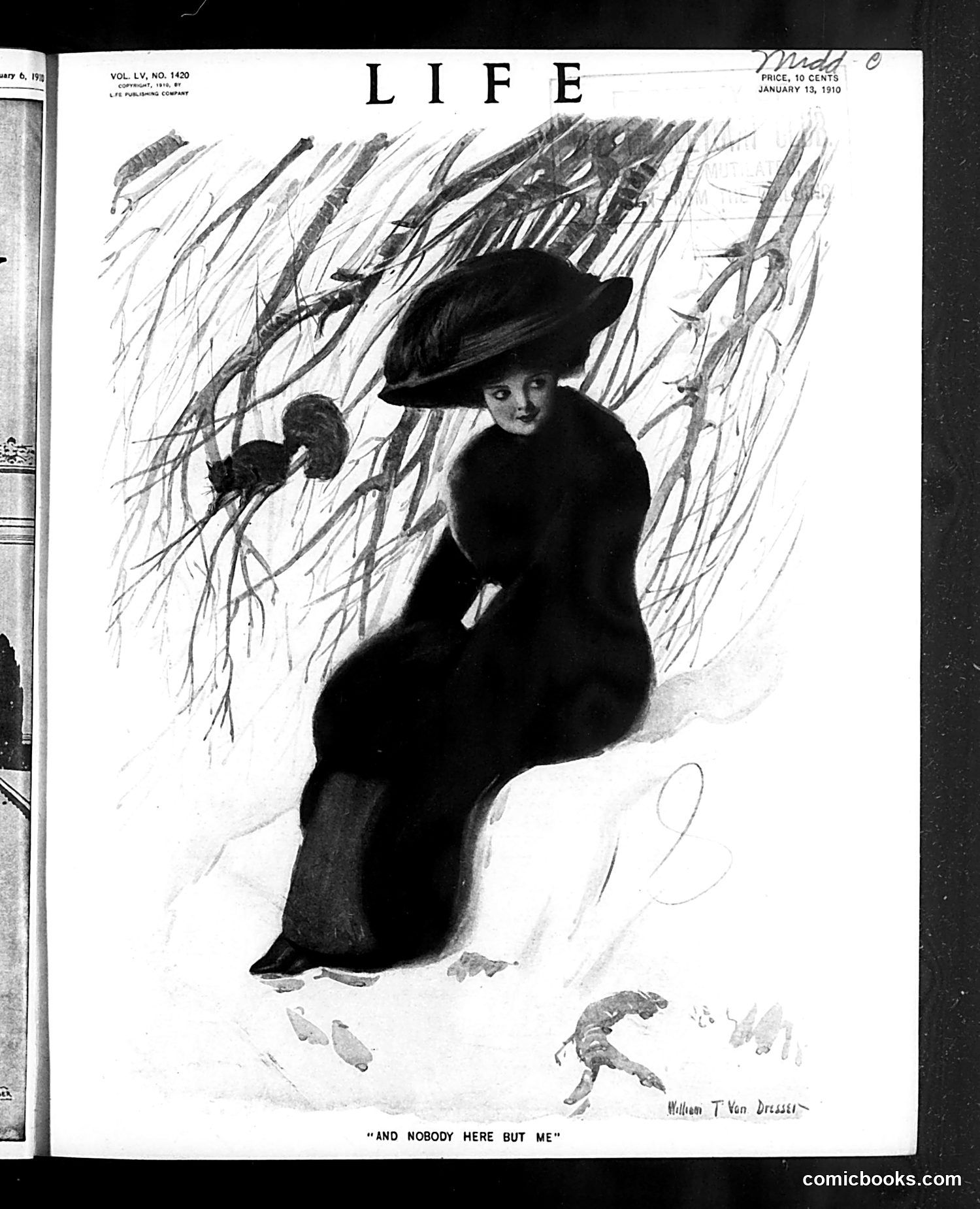
This cover illustration by William T. Van Dresser depicts a fashionably dressed woman in an elegant black coat and wide-brimmed hat, standing alone in a snowy winter landscape with bare, windswept branches. Small animals (possibly rabbits or squirrels) appear in the foreground. The caption reads: "AND NOBODY HERE BUT ME" The satire appears to comment on **isolation or loneliness**, likely reflecting early 20th-century social anxieties about urban solitude or perhaps critiquing fashionable society women who find themselves alone. The contrast between her refined appearance and the stark, desolate winter setting emphasizes the emotional disconnection. The specific social context or event this references remains unclear without additional period documentation.
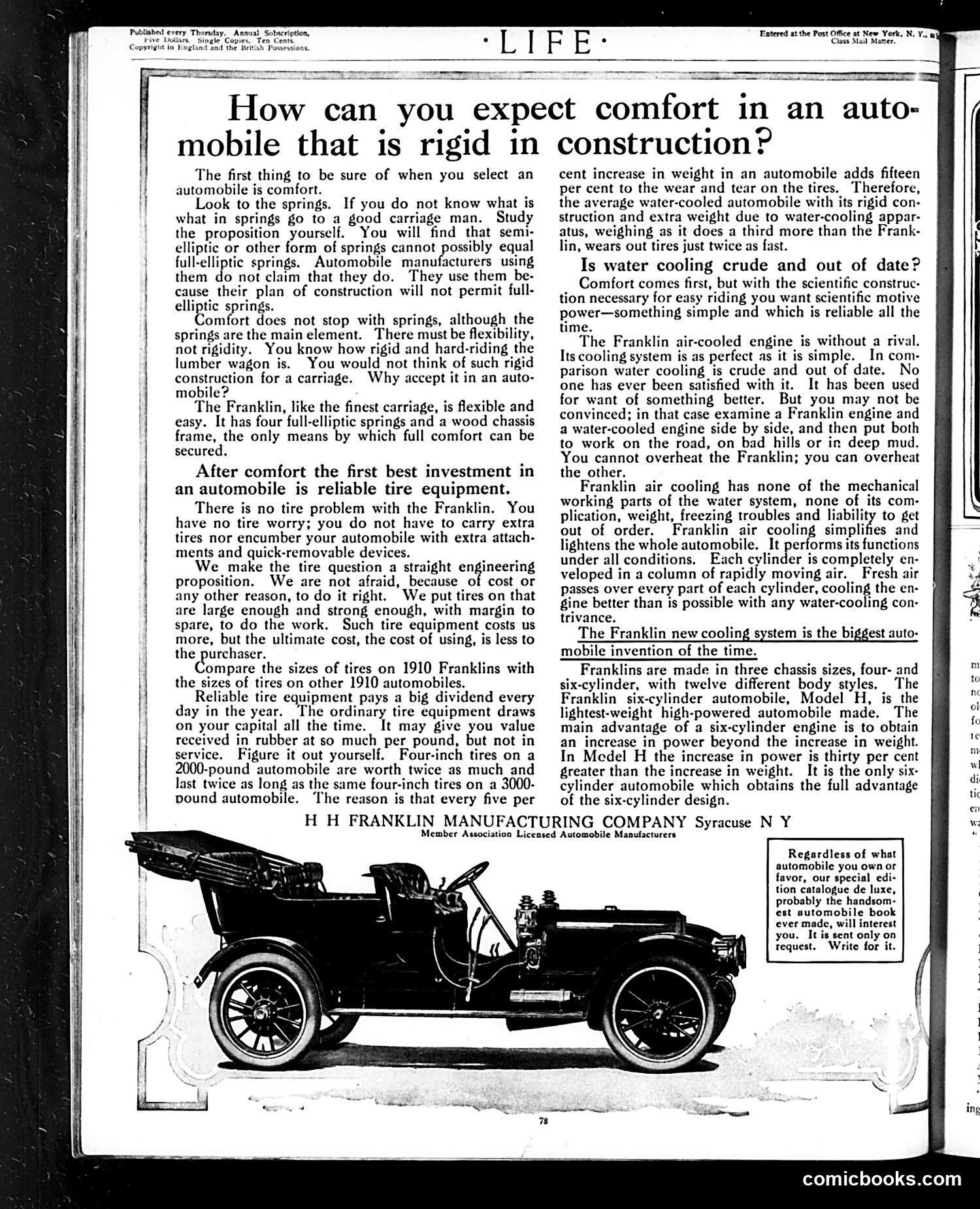
This page is **not satirical content** but rather a **straightforward advertisement** for the Franklin automobile, published in *Life* magazine (which carried advertising alongside humor). The ad argues that Franklin cars offer comfort despite their rigid construction by emphasizing their superior springs, flexible chassis, and notably, their **air-cooled engines**—presented as innovative and superior to the water-cooling systems used by competitors. The text claims air-cooling is simpler, more reliable, and less prone to overheating than water systems. It positions the Franklin as offering both comfort and engineering superiority, with the vehicle illustration showing a luxury touring car of the early 1910s era. This represents early automotive marketing emphasizing technical specifications to affluent buyers.
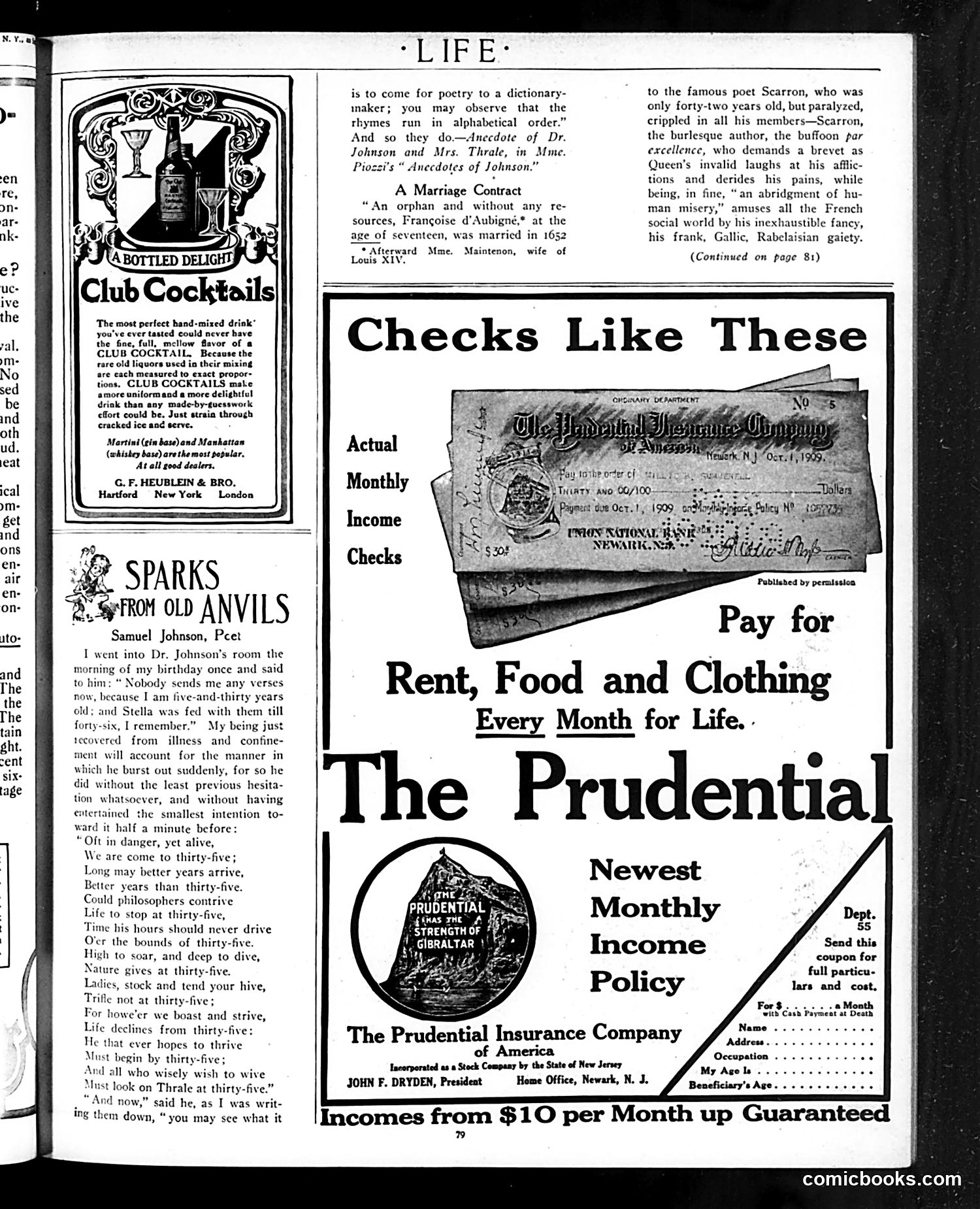
This page is primarily **advertising**, not political satire. The dominant content features two ads: 1. **Club Cocktails** (top left): A liquor advertisement emphasizing the drink's quality and consistency. 2. **The Prudential Insurance Company** (center-right): A large ad promoting their "Newest Monthly Income Policy," guaranteeing incomes "from $10 per month up." The ad displays an actual canceled check as proof of legitimacy. The smaller "**Sparks from Old Anvils**" section (left) is a humorous anecdote by Samuel Johnson, the 18th-century writer, about visiting Dr. Johnson's room and being surprised by Stella's presence. This is literary commentary, not political satire. The page reflects 1920s consumer culture and insurance marketing strategies.
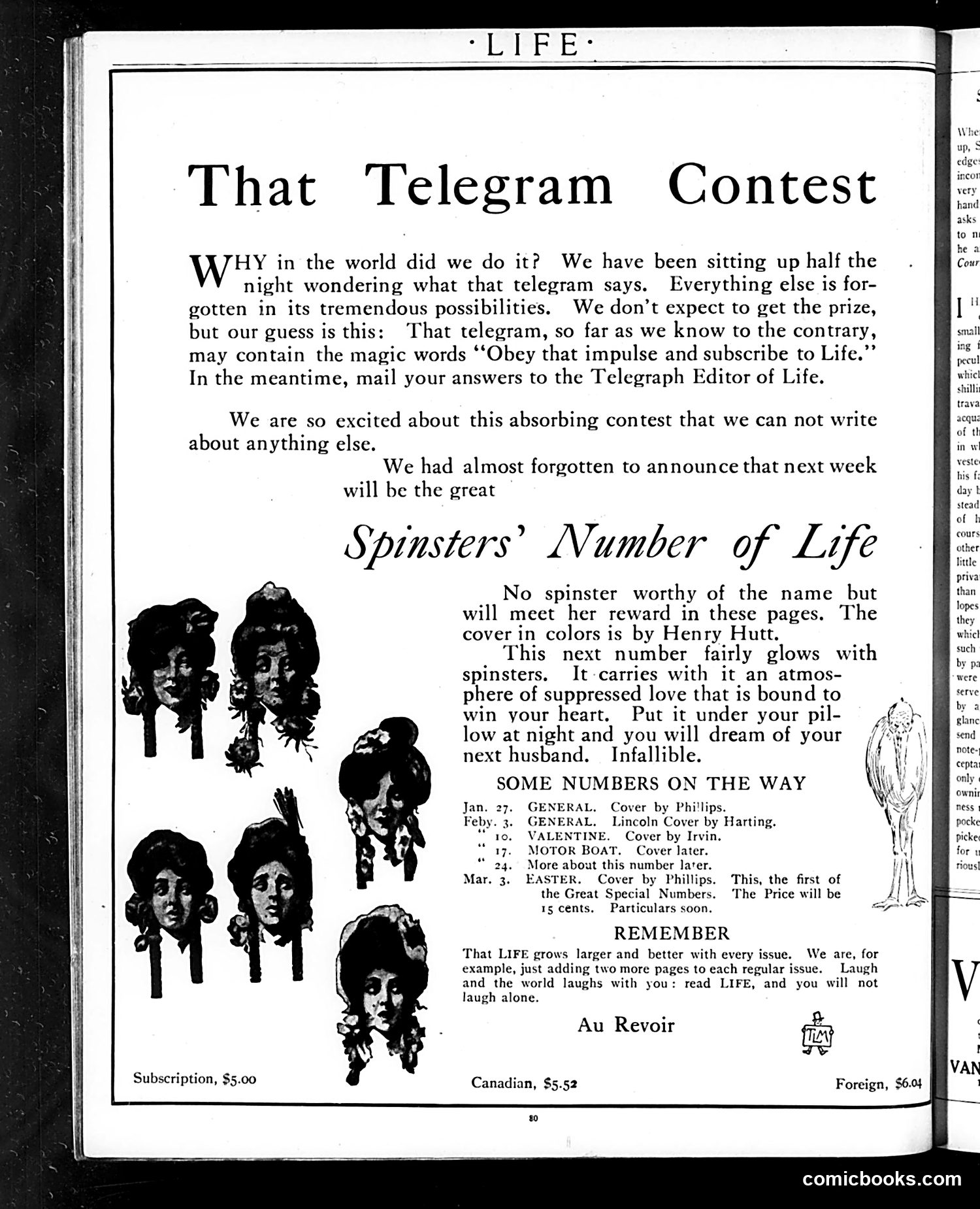
This page announces a contest where readers guess the meaning of a mysterious telegram containing the words "Obey that impulse and subscribe to Life." The editors claim uncertainty about its true message, inviting reader speculation. The main visual feature is the "Spinsters' Number" promotion for the following week's issue, illustrated with six stylized female faces in black silhouette. This appears to be lighthearted satire targeting unmarried women, with copy suggesting the issue will help readers "dream of your next husband"—playing on stereotypes about spinsters' romantic aspirations. The page is primarily **advertising and promotional content** rather than political commentary, using humor to encourage magazine subscriptions through contests and special-themed issues typical of early 20th-century periodicals.
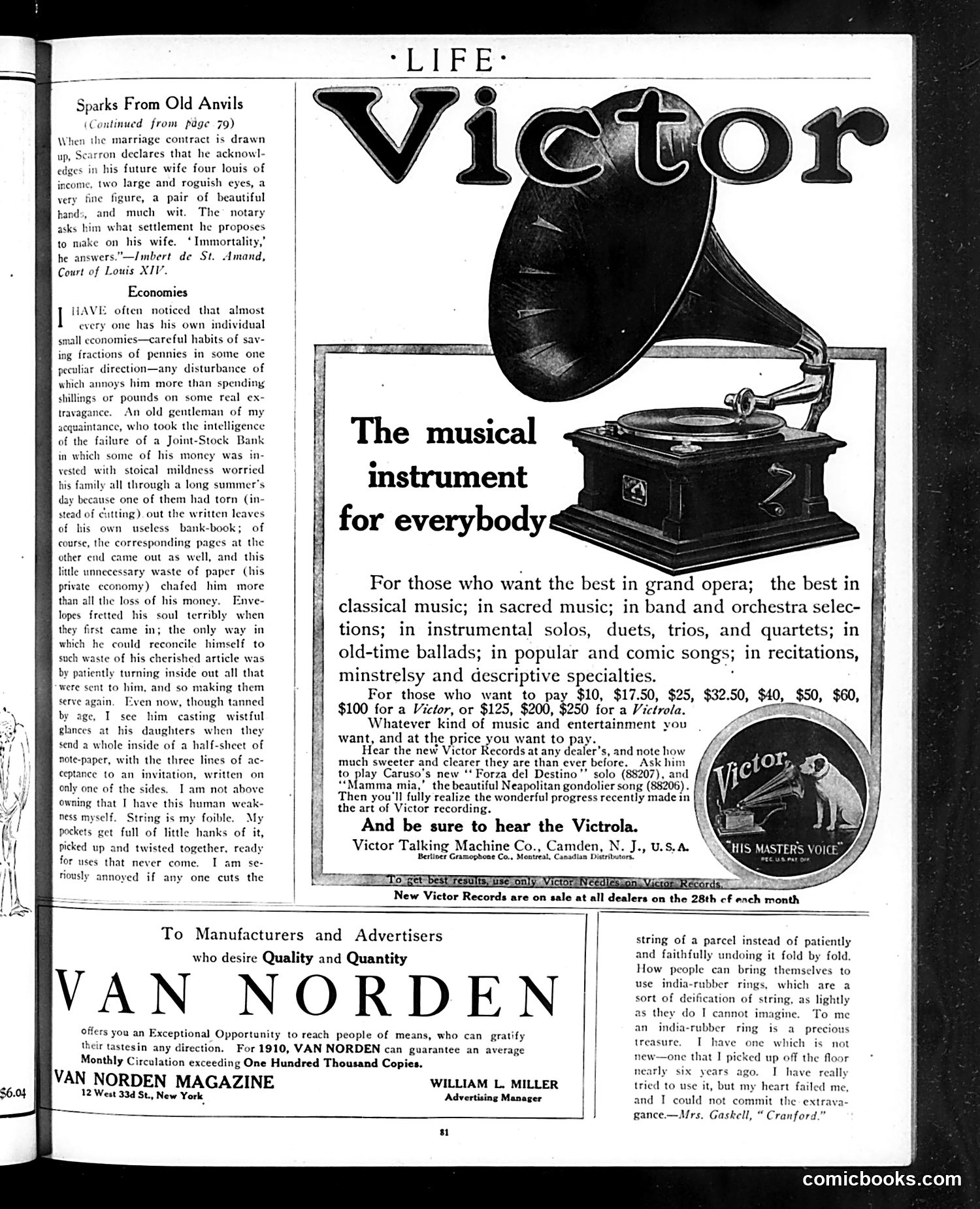
This page contains **two distinct sections**: a satirical article and advertising. **Left column ("Sparks From Old Anvils"):** A humorous piece about marriage contracts, featuring witty dialogue. The satirist mocks formal legal language by having a character propose settling his wife's future on "Immortality"—citing "Imbert de St. Amand, Court of Louis XIV." The joke is the absurdity of promising eternal life as a marriage settlement. **Center/Right:** A **Victor Victrola gramophone advertisement** positioned as editorial content. It claims the phonograph is "the musical instrument for everybody," listing various musical genres available on Victor Records at different price points ($10-$250). **Bottom:** Advertisement for **Van Norden Magazine**, promoting its circulation and advertising reach. The page exemplifies early 20th-century Life magazine's blend of satire, lifestyle commentary, and advertising presented as editorial material.
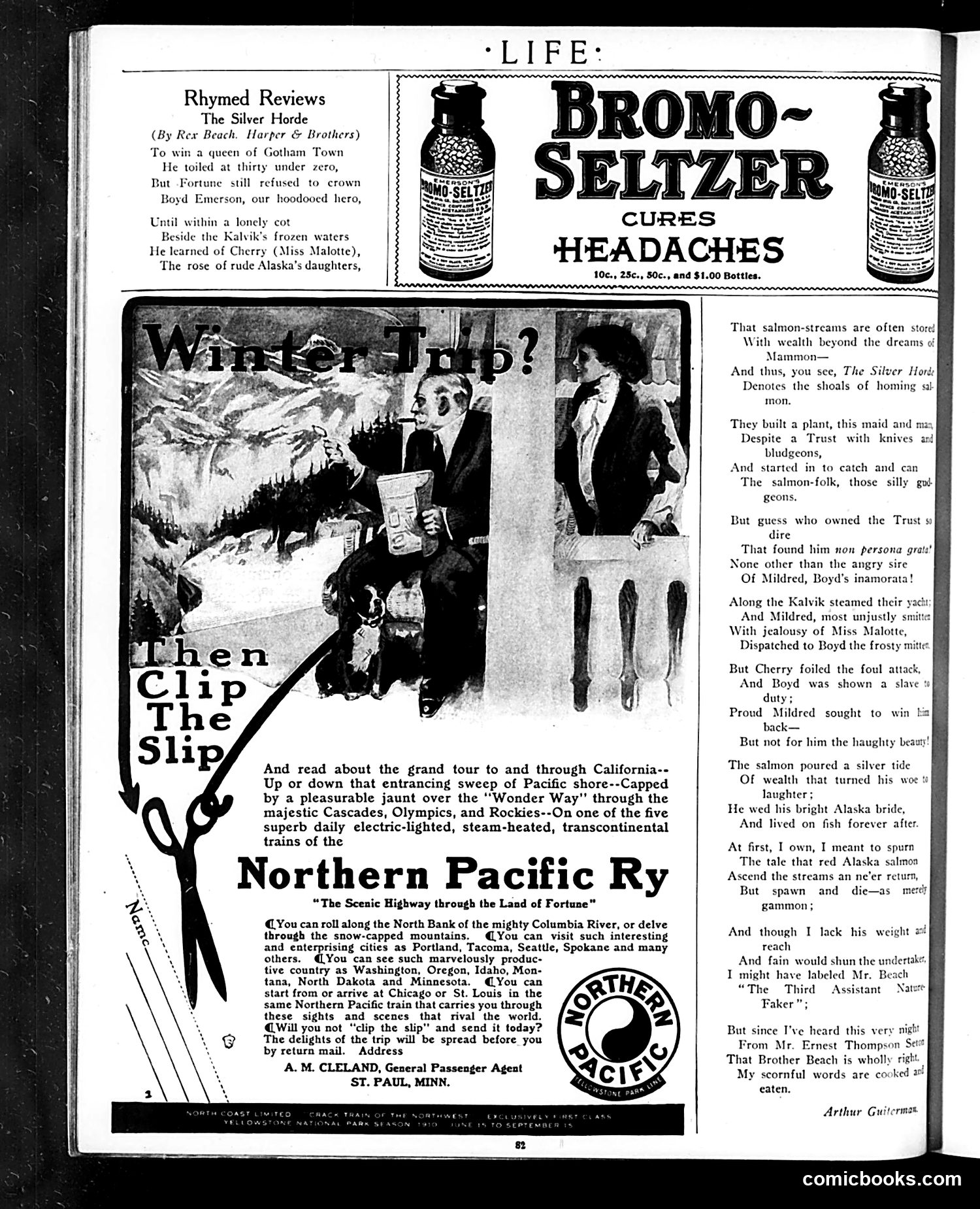
This page is primarily **advertising and poetry**, not political satire. The left side features a Northern Pacific Railway advertisement with a scenic winter photograph and the slogan "When you clip the slip"—a common early 20th-century coupon-redemption marketing technique. The ad promotes transcontinental train travel through the American West. The right side contains "Rhymed Reviews: The Silver Horde," a poem by Rex Beach reviewing his own work about Alaska salmon fishing. It's lighthearted verse about romance and adventure in the Klondike. Above is a Bromo-Seltzer headache remedy advertisement. There is **no political satire present**. The page represents typical Life magazine content: commercial advertisements interspersed with entertainment and product reviews from the early 1900s era.
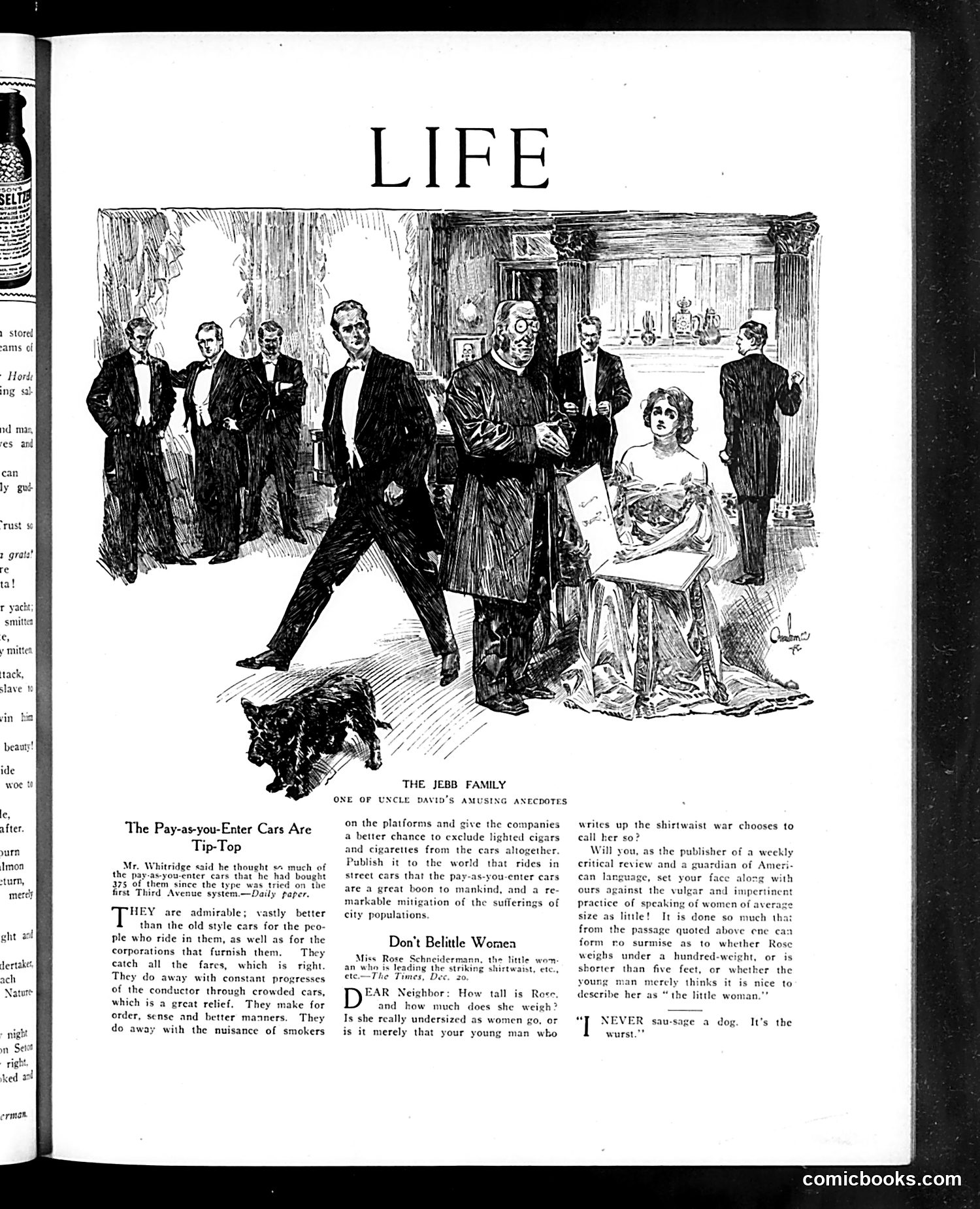
This satirical cartoon depicts a social scene centered on "The Pay-as-you-Enter Cars" — a new public transportation system. The illustration shows well-dressed men in formal attire surrounding a seated woman, with a dog in the foreground. The accompanying articles mock this transportation innovation and social conventions of the era. "The Pay-as-you-Enter Cars Are Tip-Top" discusses how these cars improved conductor efficiency by collecting fares during boarding rather than after. "Don't Belittle Women" and "I Never Sausage a Dog" appear to be humorous advice columns addressing contemporary social etiquette. The satire appears to ridicule both the transportation system's practical benefits and society's formal pretensions during this period.
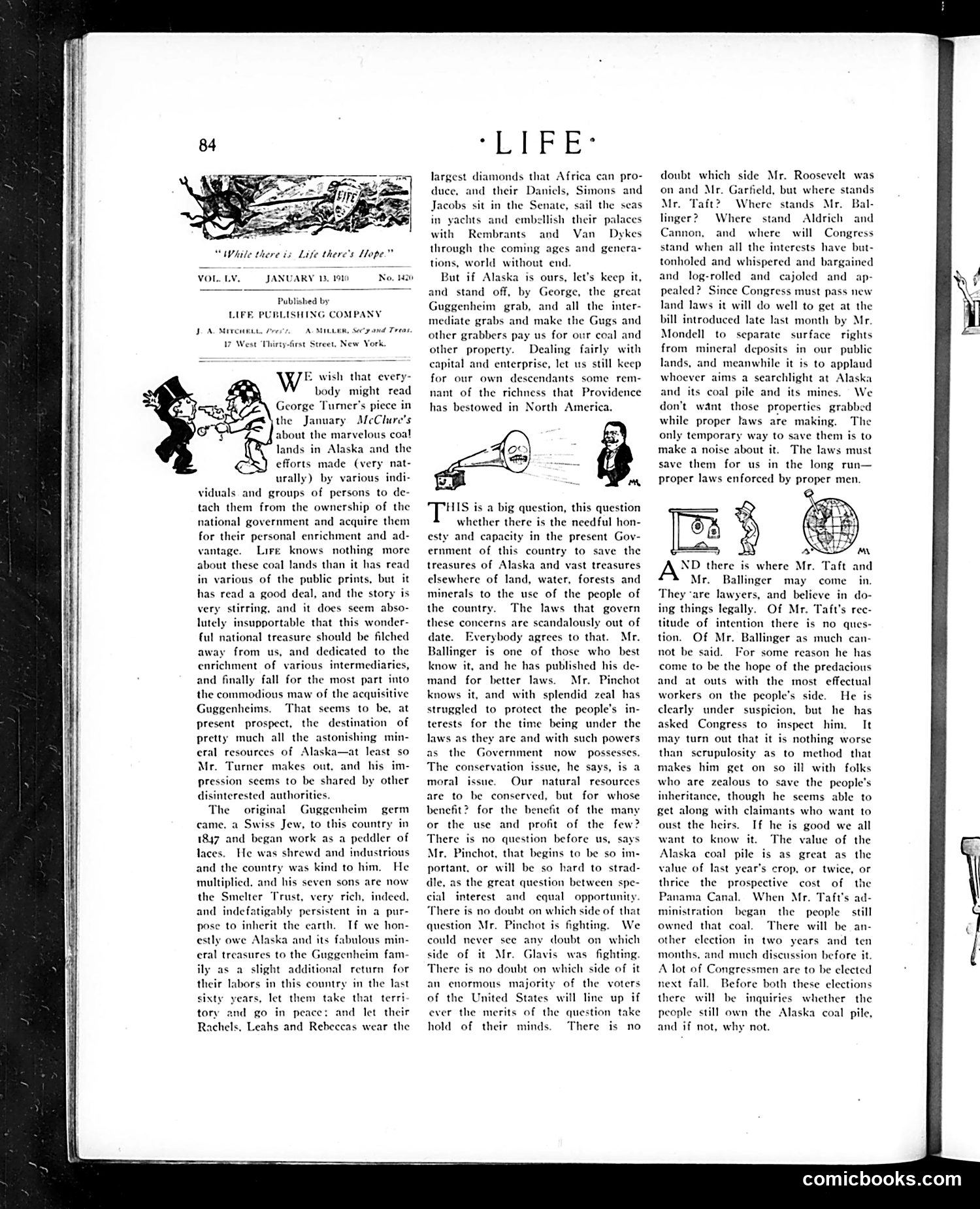
This page discusses Alaska's natural resources and conservation policy. The main cartoon shows two figures in debate—likely representing different political positions on Alaska development. The text references Mr. Taft and Mr. Ballinger regarding whether Alaska's coal lands and minerals should be exploited or protected. The satire appears to target the tension between resource conservation and commercial development. References to "Guggenheim" and "Smelter Trust" suggest criticism of wealthy industrialists seeking to profit from Alaska. The cartoon illustrates the political divide over whether government should prioritize preserving public lands or allow private enterprise access. The context involves early 20th-century Progressive Era debates about conservation versus development—a major political issue of the Taft administration.
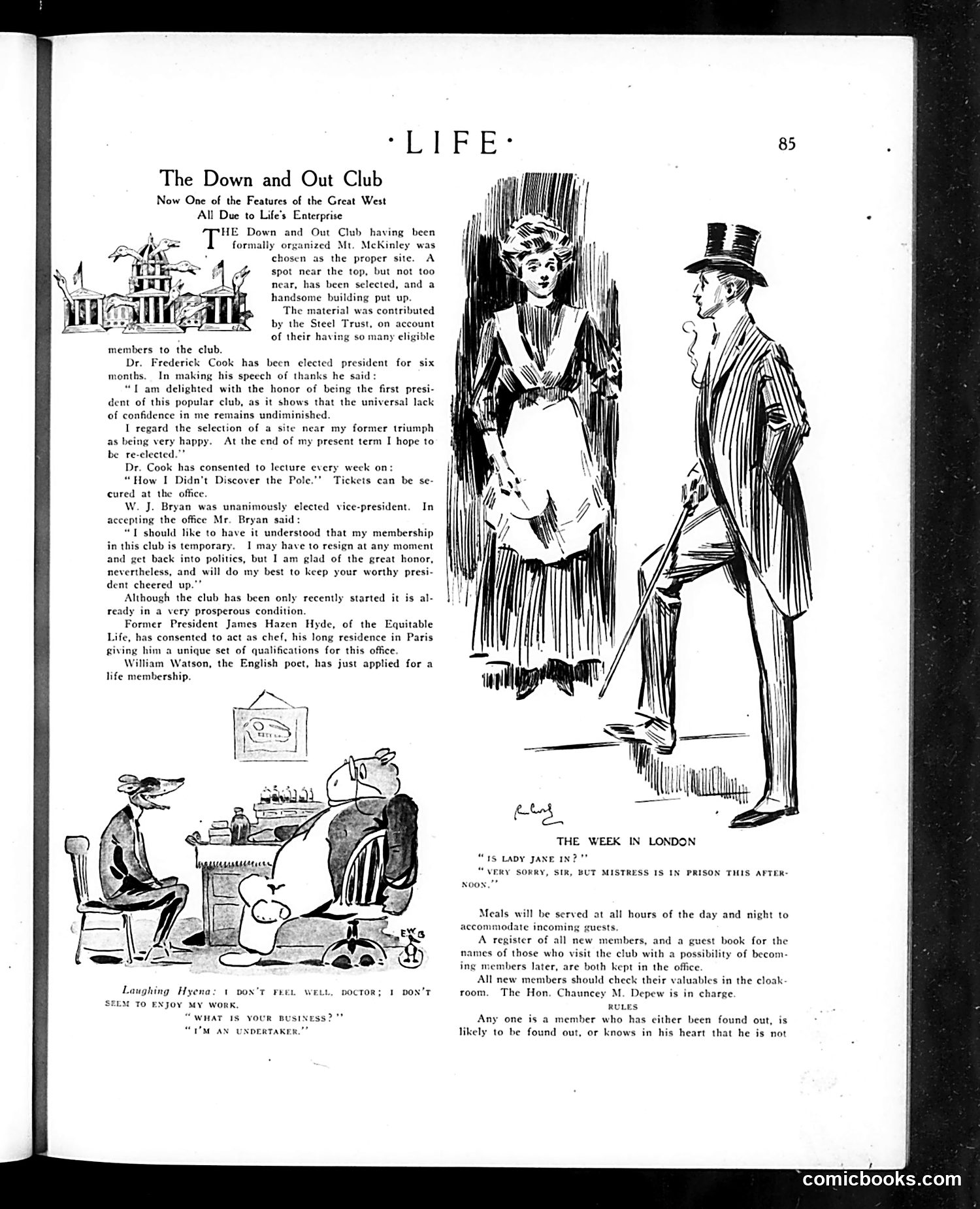
This page describes a newly established gentlemen's club in the American West, founded through the enterprise of Life magazine itself. The main illustration shows a comedic scene labeled "The Week in London," depicting a well-dressed gentleman encountering a woman, with the caption suggesting Lady Jane is unavailable because "Mistress is in prison this afternoon." The lower cartoon, titled "Laughing Hyenas," depicts a doctor and patient in comic dialogue. The doctor claims he doesn't "feel well" and doesn't "seem to enjoy my work," while the patient asks "What is your business?" The patient responds "I'm an undertaker"—the joke being the dark irony of an undertaker complaining about feeling unwell around death. Both cartoons employ satire about social pretension and professional absurdity typical of Life's humor.
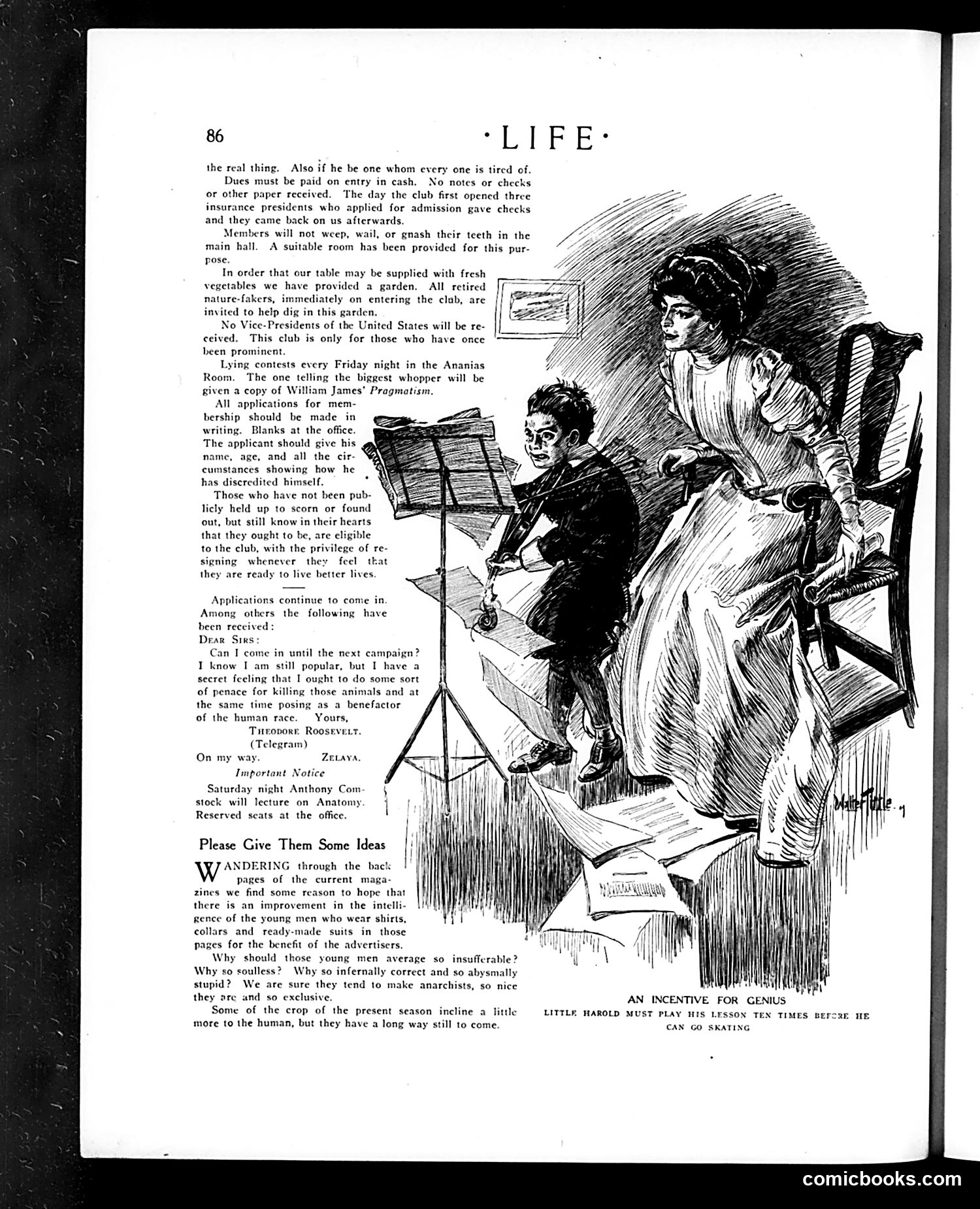
This page satirizes the intelligence and behavior of young men, particularly those from wealthy backgrounds. The heading "Please Give Them Some Ideas" introduces a critical commentary on the "current magazine" set—described as insufferably stupid, internally incoherent, and prone to anarchism despite their exclusivity. The illustration titled "An Incentive for Genius" depicts a young boy taking a music lesson, likely satirizing the notion that such genteel education produces intelligent adults. The caption suggests repeated drilling ("ten times before he can go skating") is necessary, mocking both privileged education and the apparent need to drill basic sense into the privileged classes. The page also includes several application letters to what appears to be a club, showing would-be members' ineptitude and revealing the satire's target: wealthy but intellectually vacant young men.
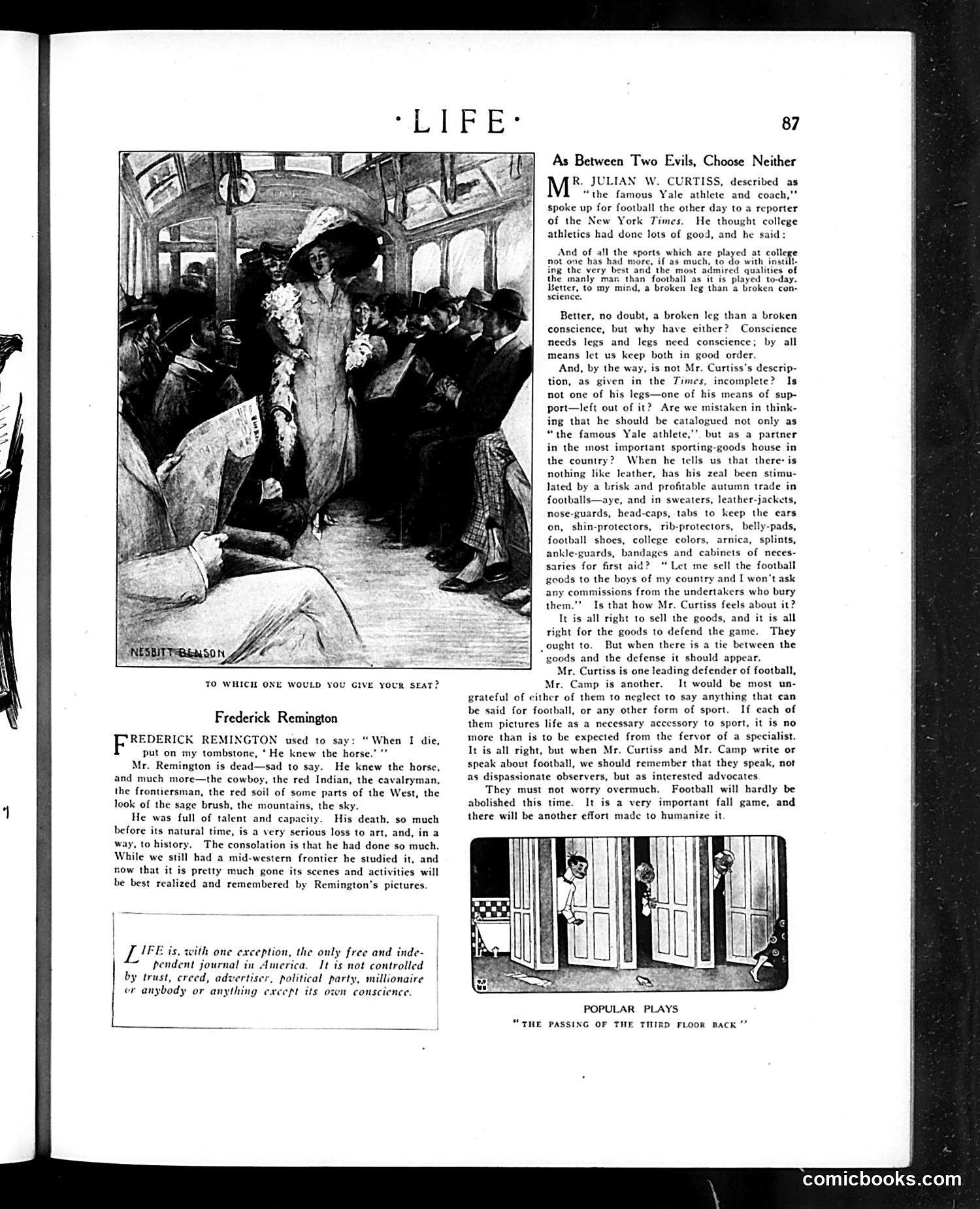
This page critiques commercialization of college football through Mr. Julian W. Curtiss, described as a Yale athlete and coach. The article argues that Curtiss and others profit excessively by selling football merchandise—shoes, leather jackets, nose-guards, head-caps, ankle-guards, bandages, and medical supplies—to boys playing the sport. The satire's point: while defending football itself as important, the author objects to specialists like Curtiss treating the game primarily as a commercial enterprise rather than sport. The article advocates that sports figures should prioritize the game's integrity over profit-taking. The Remington illustration depicts a crowded streetcar scene, likely representing ordinary people's lives contrasted with such commercial opportunism in athletics.
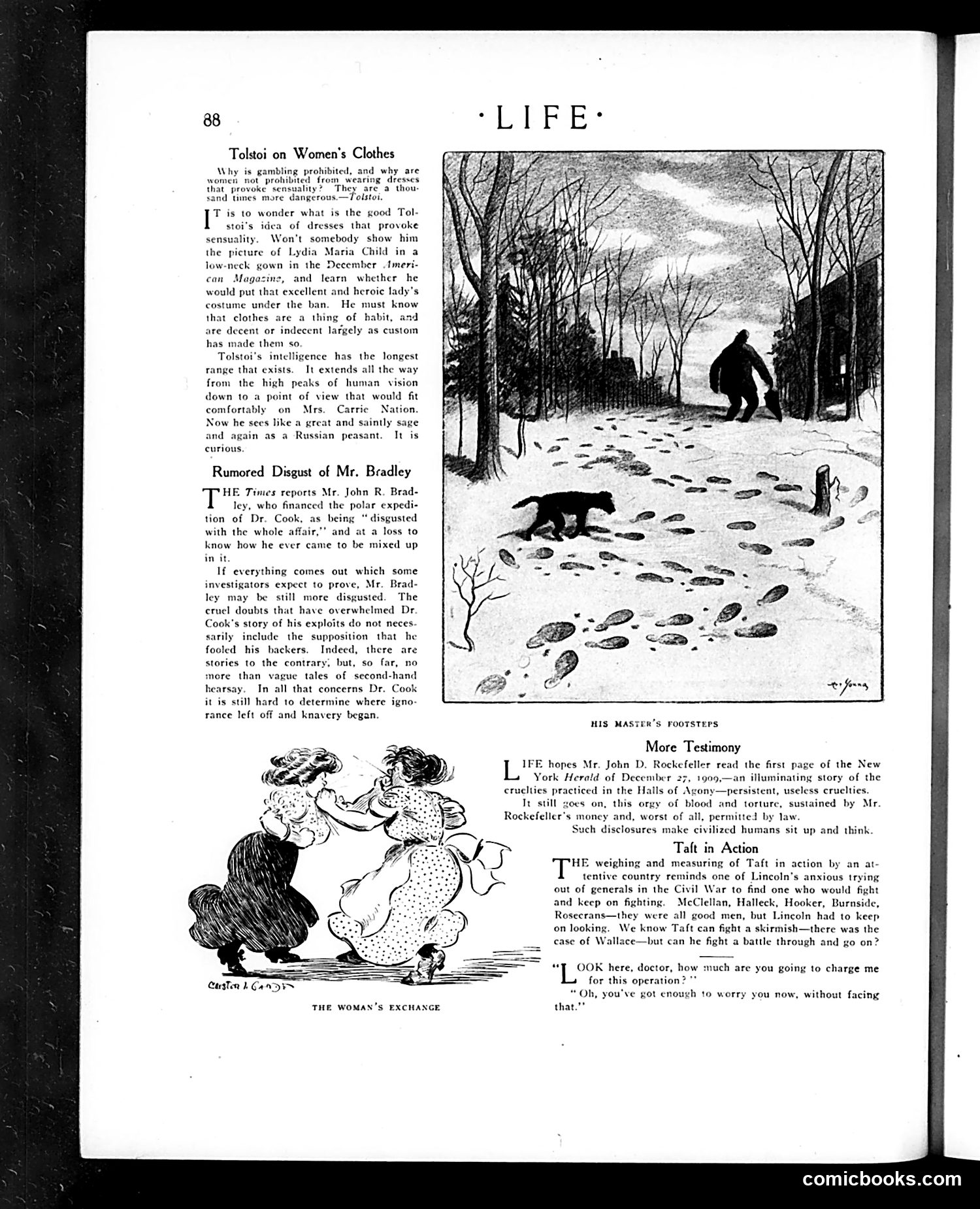
This *Life* magazine page contains three satirical pieces: 1. **"Tolstoi on Women's Clothes"**: Critiques Russian writer Leo Tolstoy's moral stance against fashionable dress, noting his influence extends from high society to the working class. The satire questions whether clothes are merely "habit" or if Tolstoy's reach into fashion morality is overblown. 2. **"His Master's Footsteps"**: An illustration showing a man following a dog's paw prints in snow, likely satirizing blind imitation or servile behavior. 3. **"The Woman's Exchange"**: A cartoon depicting two women in an exchange, suggesting commentary on women's social or economic transactions (details unclear from visible text). The page overall reflects turn-of-century American satire targeting social pretension and gender dynamics.
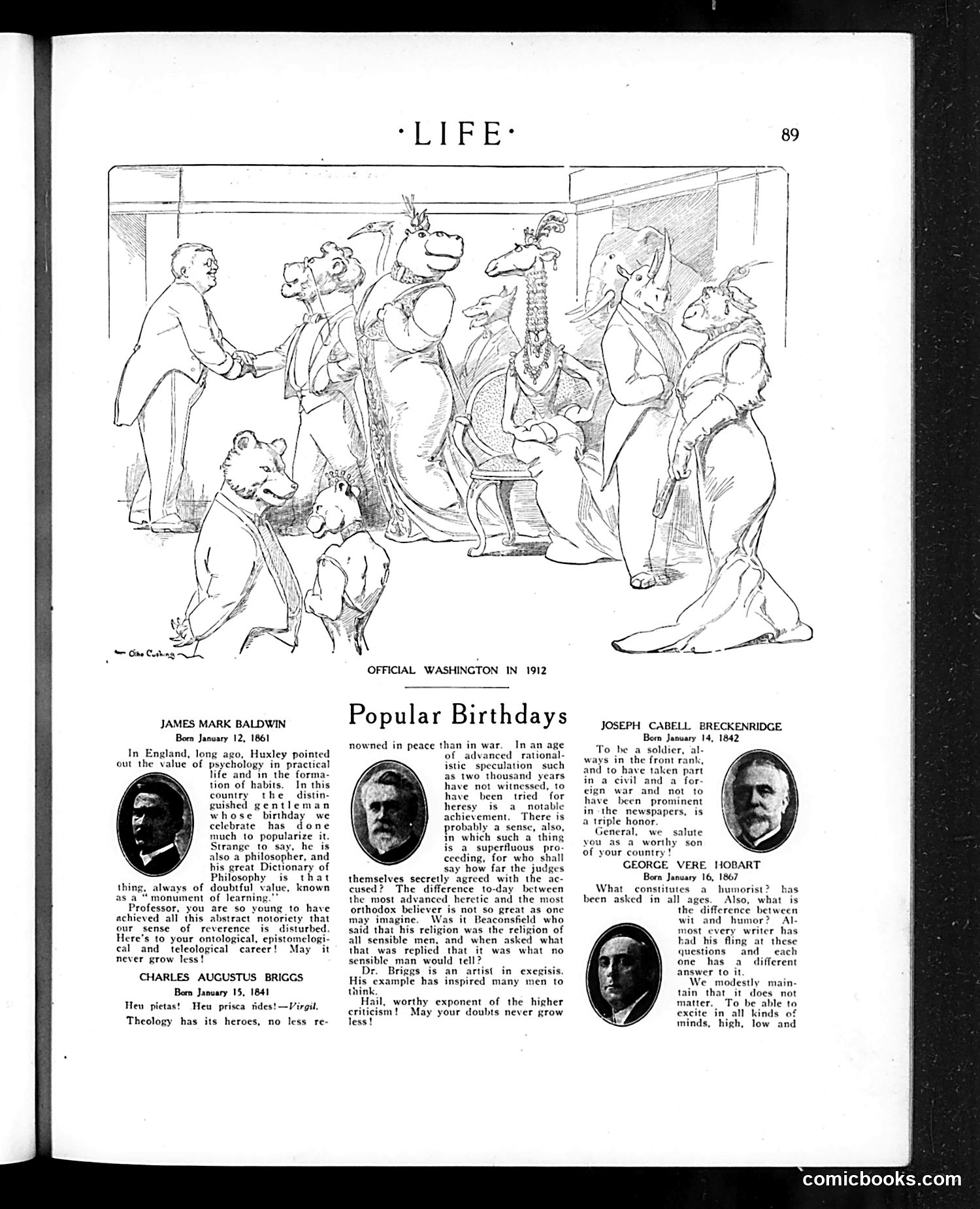
This satirical cartoon depicts anthropomorphized animals in formal dress at what appears to be a Washington social gathering. The animals—including bears, a giraffe, and other creatures—represent political figures engaged in social interaction, shaking hands and conversing. The title "Official Washington in 1912" suggests commentary on the absurdity or animal-like behavior of Washington's political establishment during that election year (notably featuring the Roosevelt/Taft split). By depicting politicians as various animals in human clothing, the cartoonist mocks their conduct as bestial or primitive rather than dignified. The page also features "Popular Birthdays"—brief biographical tributes to figures born in January, including James Mark Baldwin, Charles Augustus Briggs, and others, balancing the satirical cartoon with straightforward celebratory content.
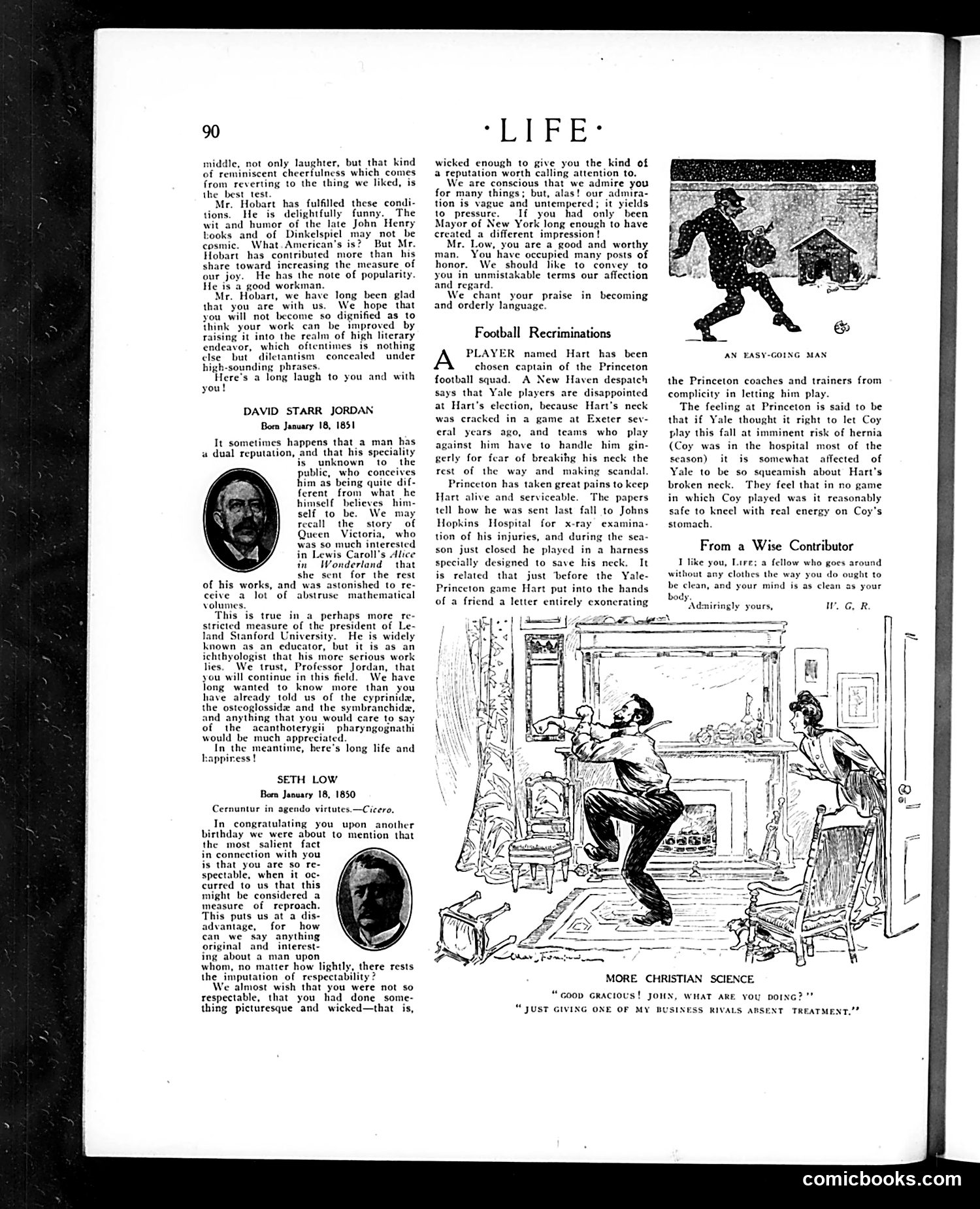
This page contains birthday congratulations to three notable Americans born in January, followed by sports commentary. **The tributes** praise humorist **Mr. Hobart** (author/cartoonist), **David Starr Jordan** (Stanford University president, ichthyologist), and **Seth Low** (Columbia University president, former NYC mayor). The jokes are gentle roasts: Jordan's fish expertise is unknown to the public; Low is criticized as too "respectable" and lacking picturesque scandal. **The football section** mocks Yale's complaint about Princeton selecting **Hart** as captain despite his fractured neck from a prior game. The satire suggests Yale players fear injuring Hart during play—making them appear both cowardly and hypocritically concerned about his wellbeing. The cartoon below depicts a business rival receiving "absent treatment" (Christian Science healing), commenting on competitive ruthlessness disguised as respectability. The page satirizes respectability and virtue as masks for self-interest.
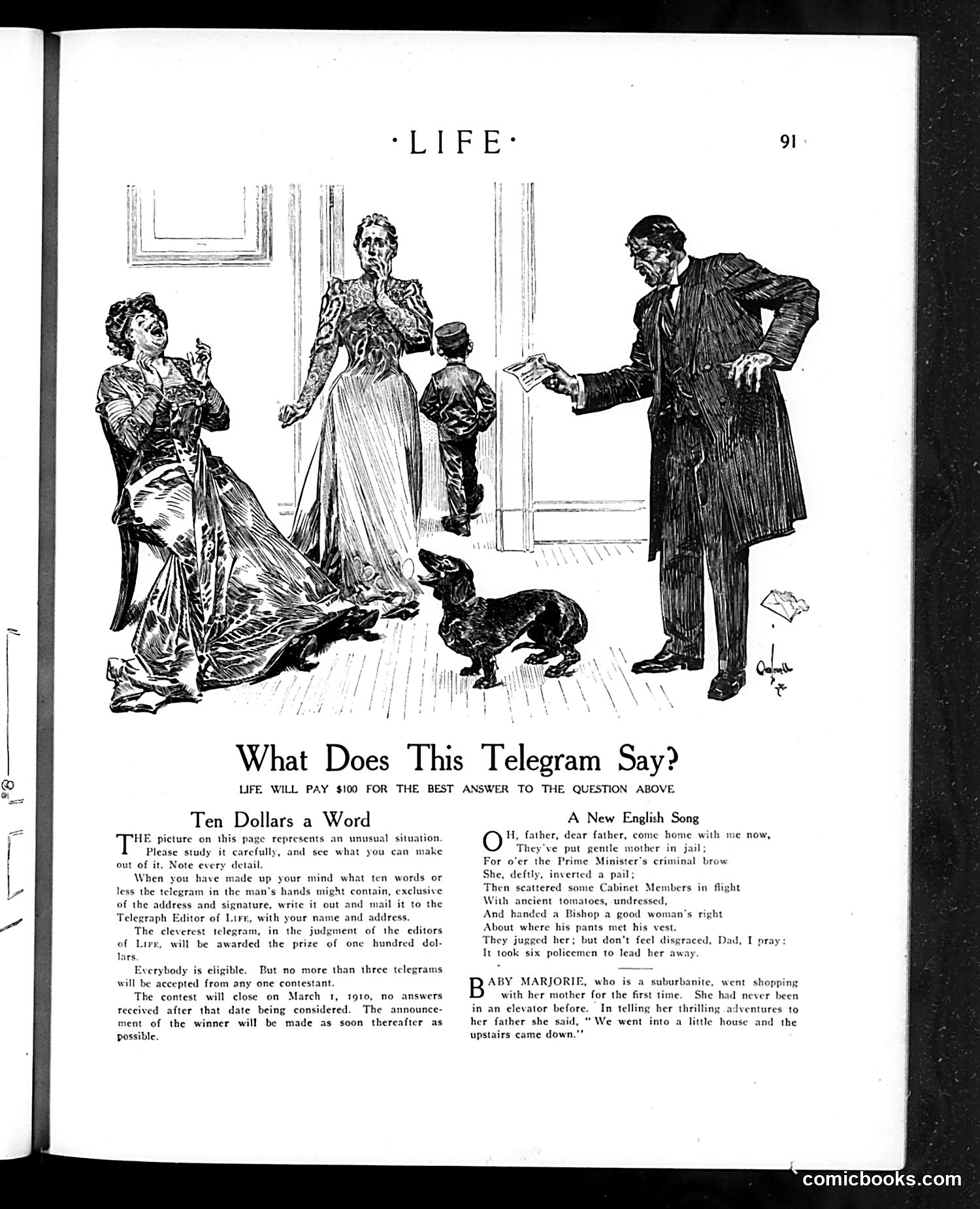
This page presents a **reader contest** rather than a traditional cartoon. The central illustration shows a domestic scene: a well-dressed man holds a telegram while a woman, child, and small dog observe. The challenge asks readers to deduce what message the telegram contains—a puzzle based on visual clues in the scene. The page also includes humorous content: a satirical song mocking British politics (referencing the Prime Minister and Cabinet, with a woman violently protesting), and a brief anecdote about a suburbanite child's confusion about elevators. The contest structure—paying $100 for the best answer—was typical of early 1900s **Life magazine's interactive humor**, encouraging reader participation. The puzzle requires interpretation of the scene's visual narrative to reconstruct the telegram's implied message, making this a form of visual-linguistic wordplay popular in that era.
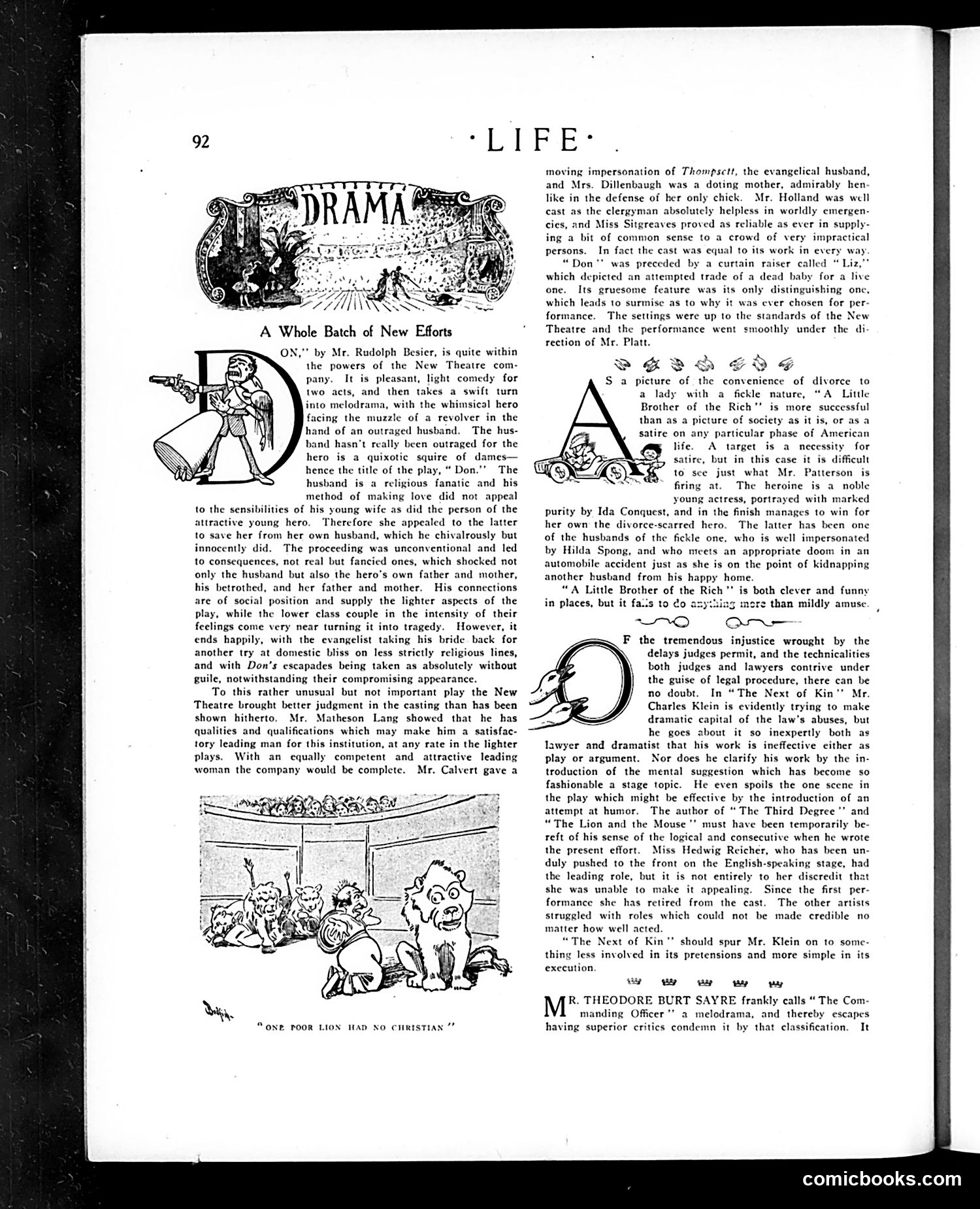
This page contains theater reviews from Life magazine's "Drama" section, critiquing several New Theatre productions. **The Main Cartoons:** The top illustration depicts a man with a telescope or rifle labeled "DRAMA," suggesting Life's critical "aim" at theatrical productions. Below is a cartoon captioned "ONE POOR LION HAD NO CHRISTIAN"—a visual gag showing what appears to be a lion surrounded by figures, likely referencing religious hypocrisy or predatory behavior in society. **The Reviews:** The text discusses plays including "Don" by Rudolph Besier (a comedy-melodrama about a quixotic hero and an outraged husband), and "A Little Brother of the Rich" (a satirical piece about divorce and fickle nature). **The Satire:** Life's critics evaluate whether these productions effectively target their subjects. They note that "A Little Brother of the Rich" lacks a clear satirical target, making it merely "mildly amusing" rather than sharp social commentary—the essential function of satire that Life magazine prided itself on.
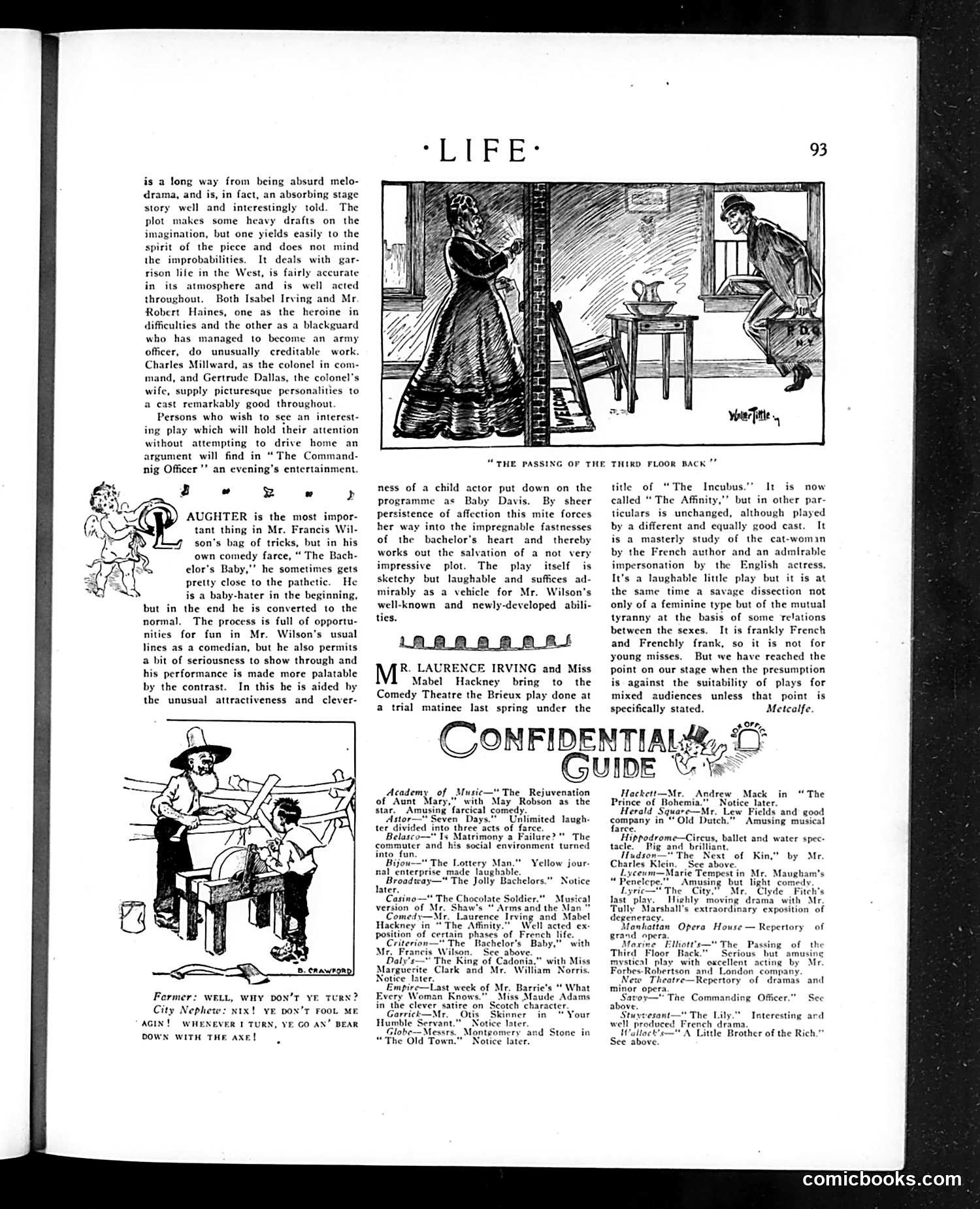
This page from *Life* magazine contains theatrical reviews and satirical commentary typical of early 20th-century American humor. **The Main Cartoon** (bottom left) depicts a "Former" (rural farmer) and a "City Nephew" in a comedic dialogue. The farmer warns the city visitor that whenever he turns around, the nephew bears down with an axe—a visual gag about rural wariness of city folk and their unfamiliar, potentially dangerous ways. **The Reviews** critique contemporary stage productions: *The Commanding Officer* (dealing with Western garrison life), Francis Wilson's farce *The Bachelor's Baby* (about a confirmed bachelor won over by a child), and Laurence Irving's production of *The Affinity* (a serious French play about problematic relations between the sexes, noted as unsuitable for "young misses"). The *Confidential Guide* section lists current theatrical offerings with brief descriptions, reflecting the magazine's focus on entertainment and urban leisure activities for its educated readership.
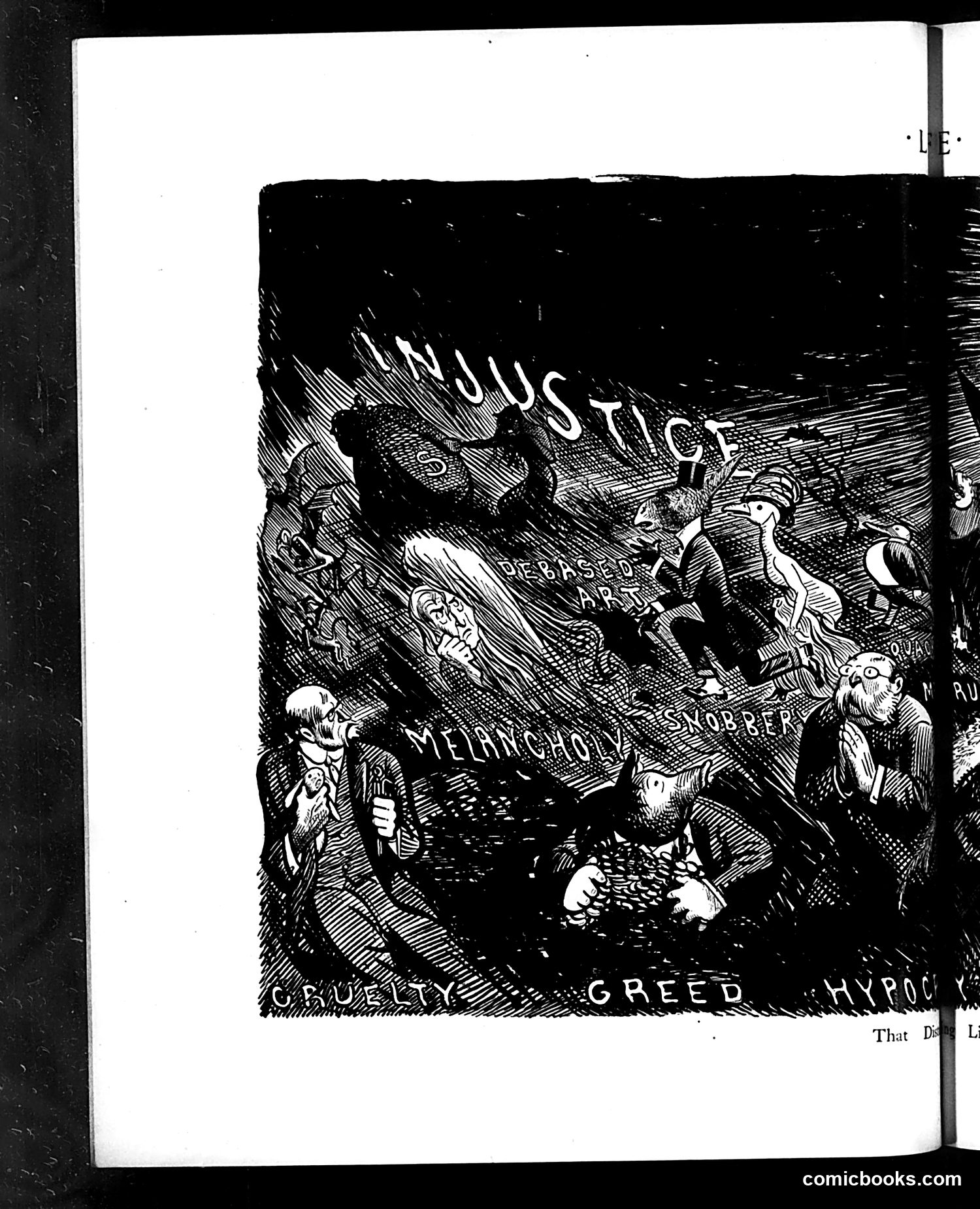
This appears to be a political cartoon depicting the seven deadly sins as caricatured figures. The visible labels at the bottom read "CRUELTY," "GREED," and "HYPOCRISY" (partially visible). The scene shows multiple grotesque human figures in what seems to be an infernal or chaotic setting, rendered in dark cross-hatched woodcut or engraving style typical of early Life magazine satire. The cartoon likely critiques widespread social vices of its era through allegorical representation. The distorted facial features and exaggerated body language emphasize moral corruption. Without clearer dating or additional context, the specific historical references remain uncertain, though the artistic style suggests late 19th or early 20th century American satirical commentary on societal failings.
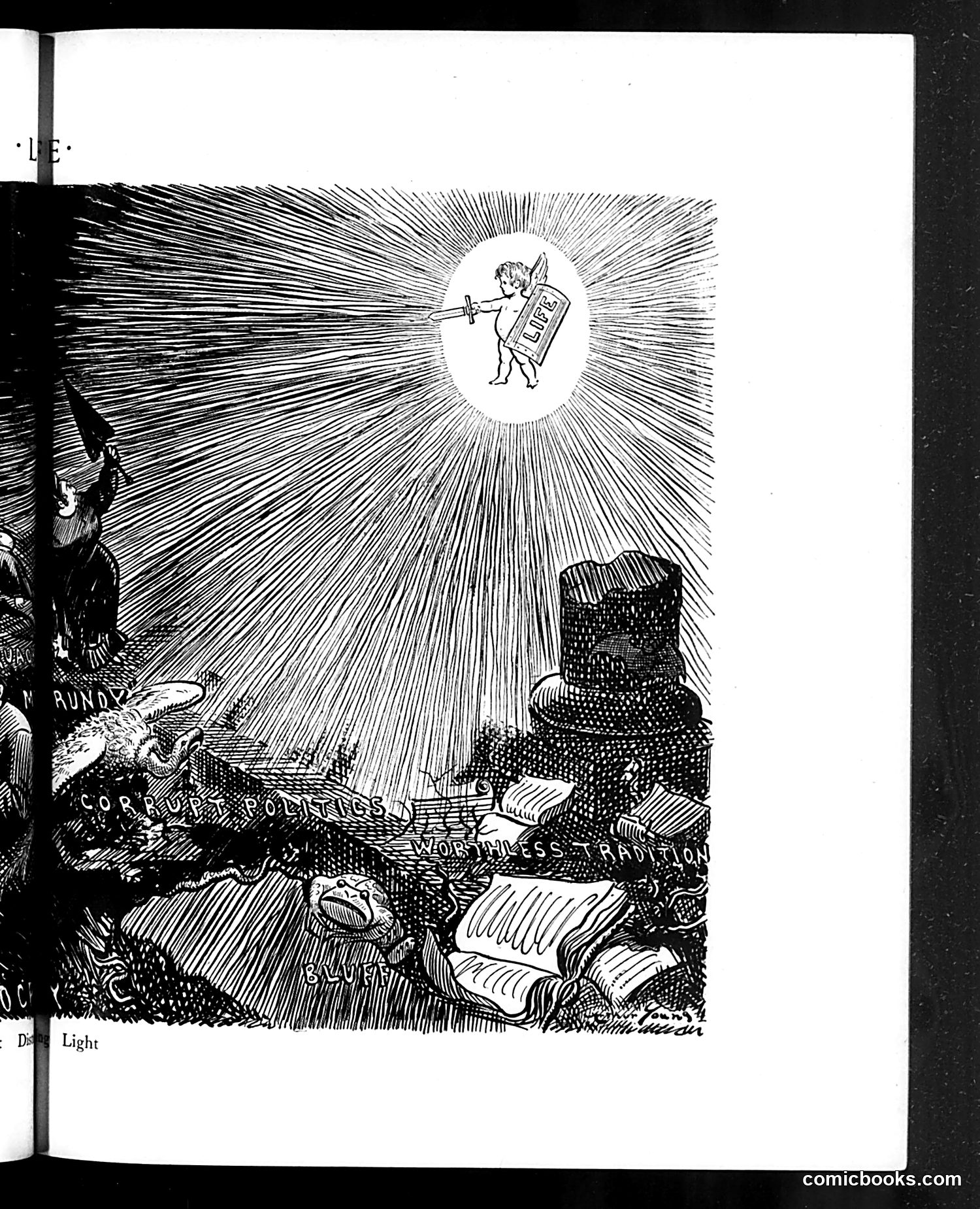
This engraving depicts an angelic cherub radiating divine light descending over ruins of corruption. The cherub carries what appears to be a torch or beacon labeled "LIFE" (the magazine's masthead). Below, the wreckage includes toppled institutions and debris labeled with words suggesting moral decay—"CORRUPTION" and "WORTHLESS TRADITION" are partially visible among broken structures. The satire expresses *Life* magazine's role as an enlightening force exposing and cleansing society of corruption and outdated traditions through investigative journalism and satirical commentary. The imagery—divine light penetrating darkness and rubble—symbolizes how the publication positioned itself as a moral authority combating institutional rot and hypocrisy in American society, likely during the Gilded Age or Progressive Era when *Life* was most politically active.
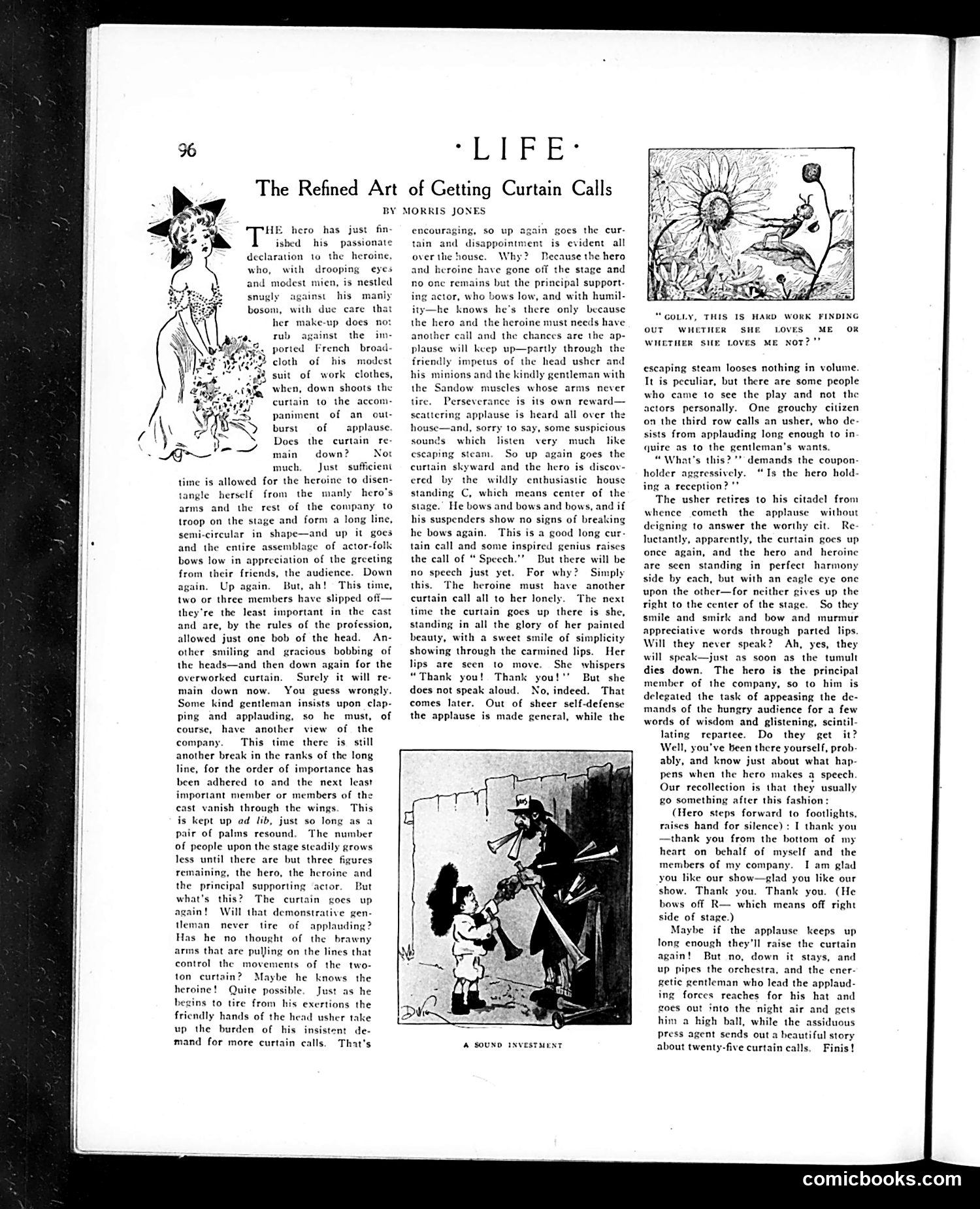
This article satirizes the theatrical tradition of repeated curtain calls following a stage performance. The text humorously describes how audiences' applause keeps drawing actors back onstage in diminishing groups—first the hero and heroine together, then supporting players dropping out by rank of importance, until only the lead remains. The satire targets both audience behavior (the persistent gentleman clapping) and theatrical vanity. It mocks the physical toll on stagehands operating the heavy curtain and the actors' desperate hunger for validation. The accompanying cartoon (captioned "A SOUND INVESTMENT") appears to show an actor performing an exaggerated curtain-call bow. The piece gently ridicules how theatrical hierarchies determine who gets solo bows, and suggests that endless curtains calls reflect actors' insecurity rather than genuine audience appreciation.
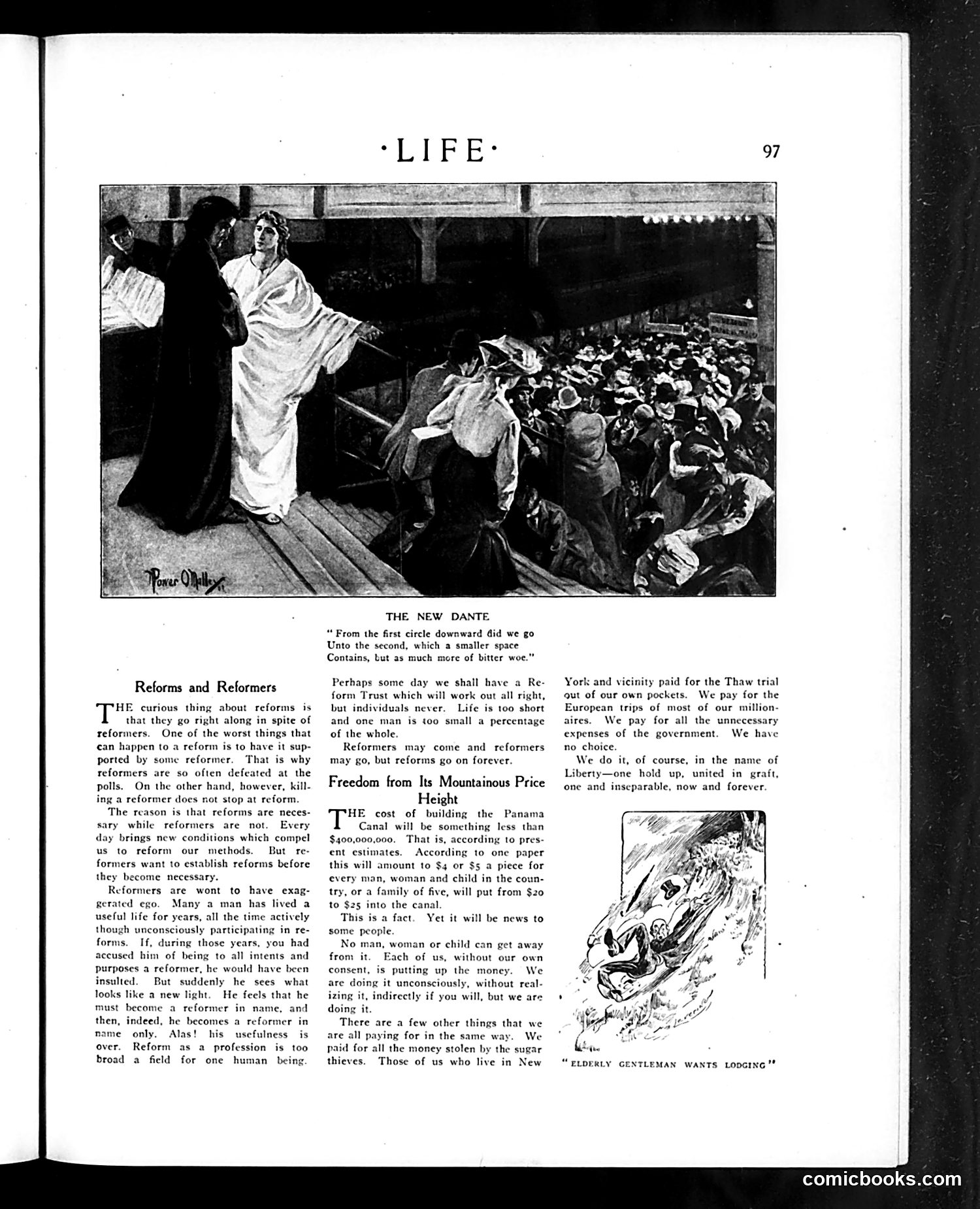
**"The New Dante" (top illustration):** This Dante-inspired image depicts a figure in white robes addressing a large crowd from an elevated platform, evoking Dante's descent through Hell's circles. The caption quotes Dante's *Inferno*, suggesting the cartoon satirizes a public figure or movement addressing masses, likely comparing their rhetoric to Dante's moral journey through damnation. **"Reforms and Reformers" (main text):** A cynical essay arguing that actual reforms succeed despite individual reformers, who often damage causes through ego and self-aggrandizement. The piece criticizes reformers as self-important, noting that genuine reforms occur naturally with changing conditions—individual reformers are unnecessary and counterproductive. **"Freedom from Its Mountainous Price Height":** This critiques Panama Canal funding ($400 million), distributed among citizens as taxes ($4-5 per person). The author sarcastically notes Americans unknowingly fund it "in the name of Liberty," while also paying for government waste, scandals (the Thaw trial), and millionaires' European trips. It's a biting commentary on hidden taxation and government excess.
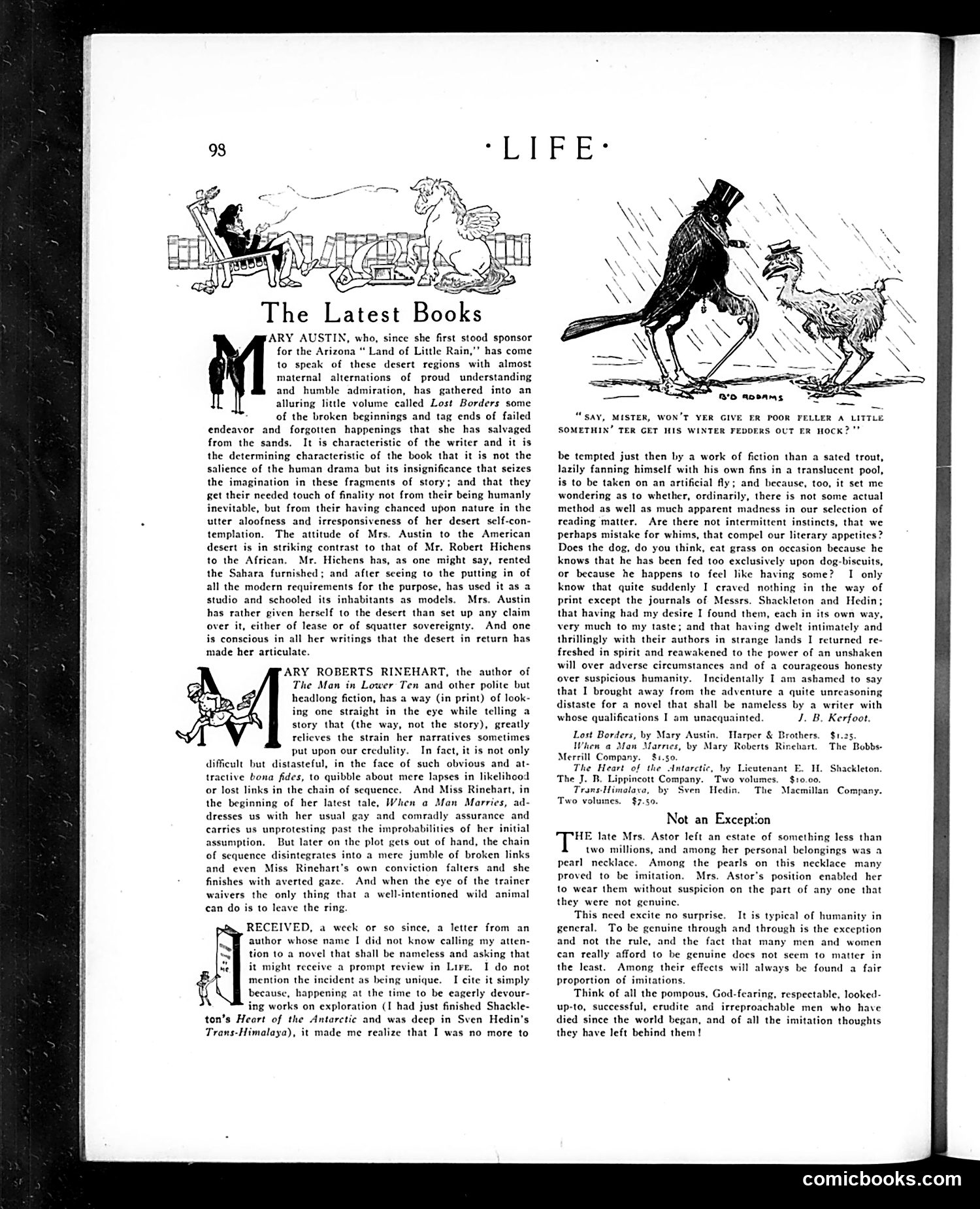
This page reviews recent literary works, featuring two small editorial cartoons alongside text. **The cartoons:** The top illustration shows a gentleman in a top hat offering money to a bedraggled bird, with the caption asking the bird to help him retrieve his winter coat from a pawn shop. This is a visual pun on financial hardship—the bird's feathers suggest "winter plumage," while the gentleman needs funds to reclaim his coat from hock (pawned). **The book reviews:** The text discusses Mary Austin's *Lost Borders* (desert stories) and Mary Roberts Rinehart's *When a Man Marries* (fiction). The reviewer praises Austin's humble attitude toward nature but criticizes Rinehart's plot construction, using the metaphor of a circus trainer losing control of a wild animal. A final section discusses receiving unsolicited review requests, comparing the reviewer's reluctance to read fiction while absorbed in exploration literature (Shackleton, Sven Hedin) to a satiated trout ignoring artificial flies. The cartoons add levity to what is otherwise straightforward literary criticism.
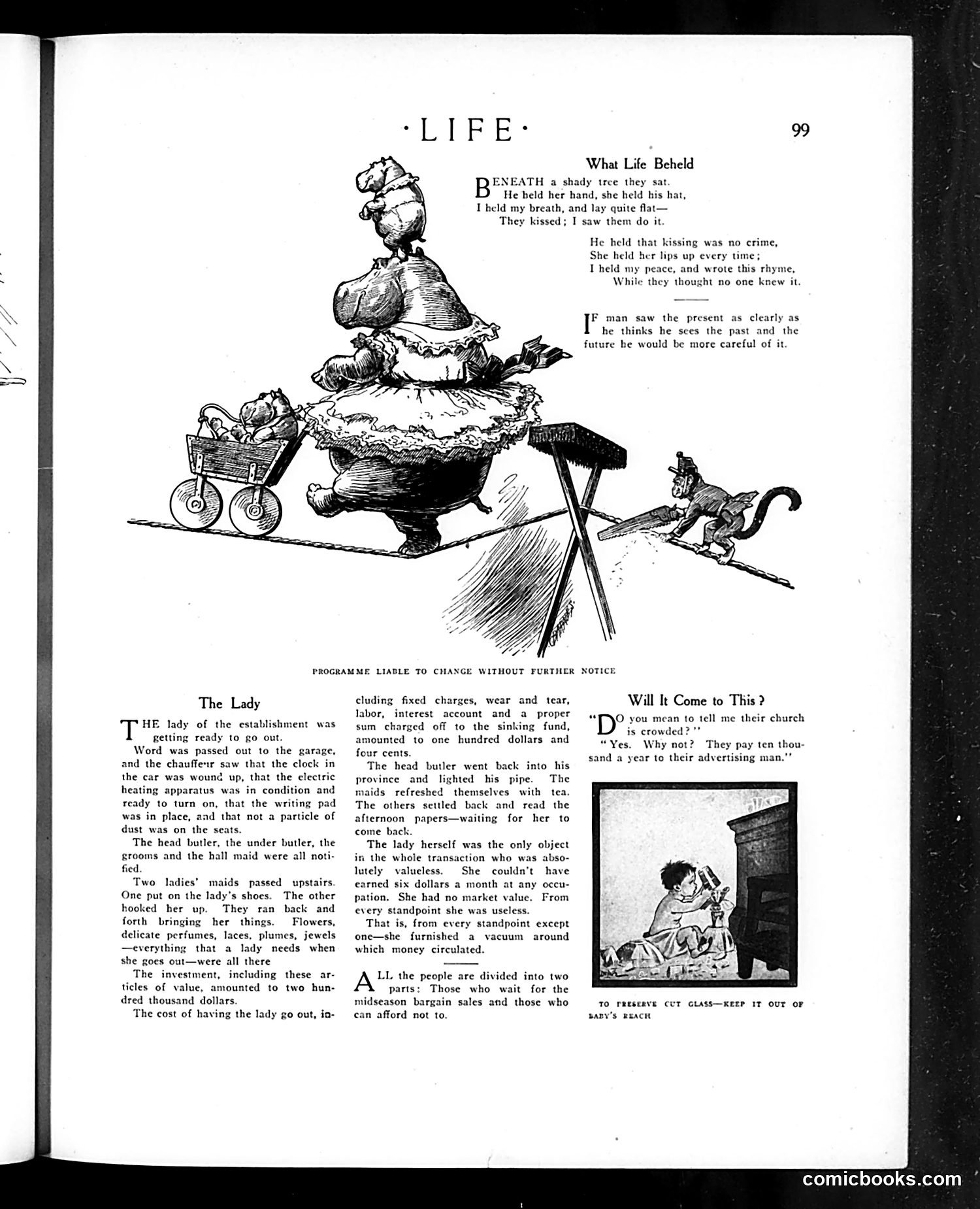
This satirical piece critiques the economic absurdity of wealthy women's social roles in early 20th-century America. **The Setup:** A wealthy woman's outing requires mobilizing an entire household staff—butlers, maids, chauffeurs—plus hundreds of thousands of dollars in jewelry, clothing, and equipment. The total cost: $100.04. **The Satirical Point:** The woman herself—the supposed beneficiary—is deemed "absolutely valueless." She cannot earn six dollars monthly through any occupation and exists solely as a "vacuum around which money circulates." She produces nothing; she merely *consumes*. **The Joke's Target:** Life mocks both the economic system that assigns women no intrinsic worth beyond consumption, and the wealthy woman's dependence on this system. She is paradoxically central to massive expenditure yet utterly economically useless—a passenger in her own life. The secondary cartoon "Will It Come to This?" jokes that churches now compete like businesses, requiring advertising budgets to draw crowds, reflecting anxieties about commercialization of American institutions.
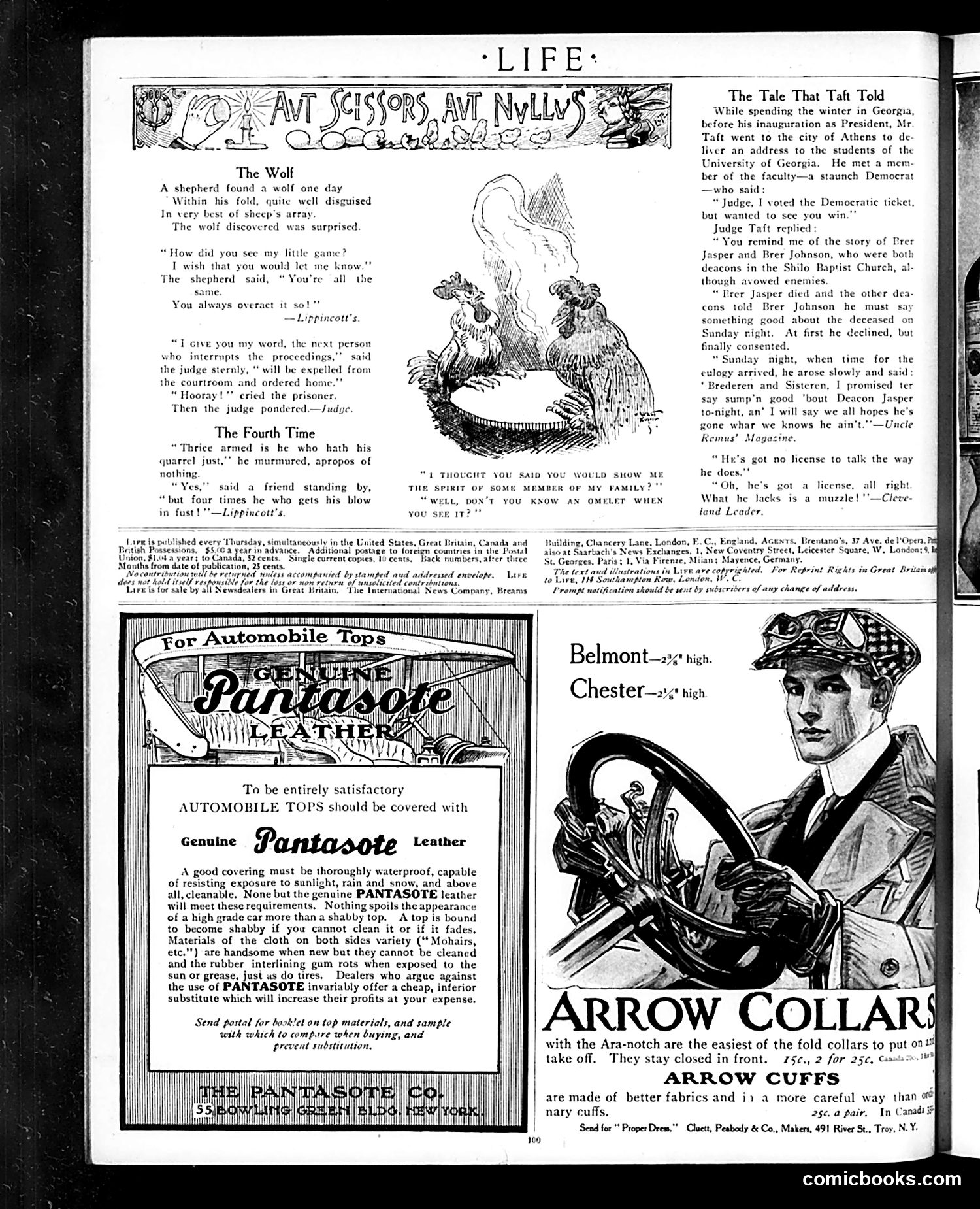
This page contains several short humorous anecdotes rather than political cartoons. The main content includes: **"The Wolf"** — A fable about deception: a wolf disguises itself as a sheep but is discovered by a shepherd who notes the wolf "always overacts" its disguise. The satirical point appears to be about obvious imposters who fail at concealment through excessive effort. **"The Fourth Time"** and **Judge Taft story** — These reference President William Howard Taft (clearly identified as "Judge Taft"). The anecdotes present Taft as a folksy raconteur; one story involves a Georgia Democrat who voted Democratic but wanted to see Taft win, prompting Taft to tell a dialect story about two feuding deacons. The humor relies on Taft's willingness to engage common people and his use of folk wisdom/humor rather than political grandstanding. The page is otherwise dominated by **period advertisements** for Pantasote leather automobile tops, Arrow collars, and Arrow cuffs — typical early-20th-century product marketing.
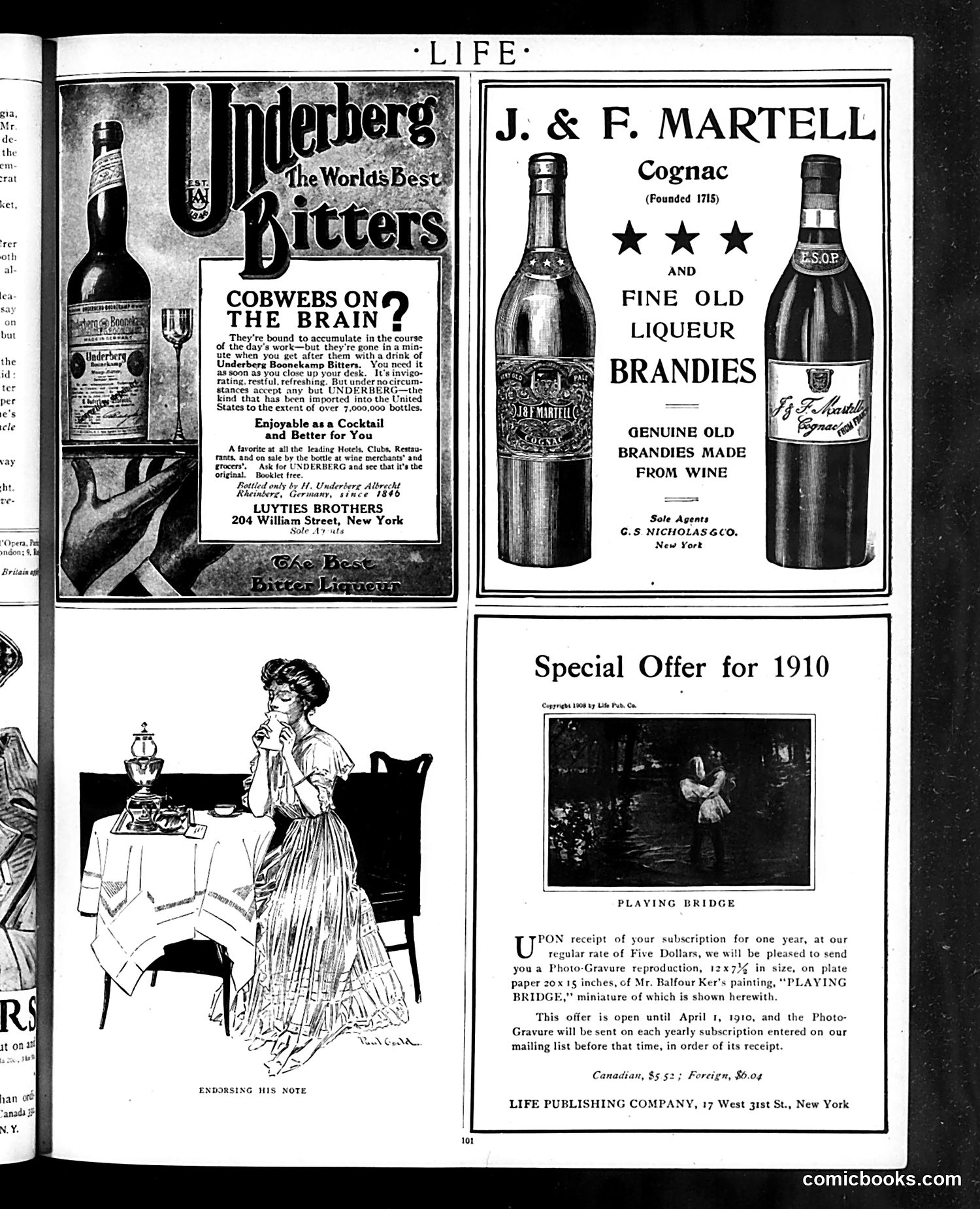
This page is primarily **advertising and promotional content** rather than editorial satire. It contains three distinct advertisements: 1. **Underberg Bitters**: A German digestive liqueur marketed as a work-day remedy for mental fatigue ("cobwebs on the brain"), positioning alcohol as medicinal and restorative—common early 20th-century marketing before modern drug regulation. 2. **J. & F. Martell Cognac**: A French brandy advertisement emphasizing its founding date (1715) and premium status through star ratings and "genuine old" branding. 3. **Life Magazine Subscription Offer**: Promoting a yearly subscription by offering a photogravure reproduction of Balfour Ker's painting "Playing Bridge" as an incentive—typical magazine marketing of the era. The illustration labeled "Endorsing His Note" depicts a woman in period dress at a vanity, likely endorsing the products through implied social approval. The content reflects pre-Prohibition attitudes toward alcohol and early 20th-century advertising conventions.
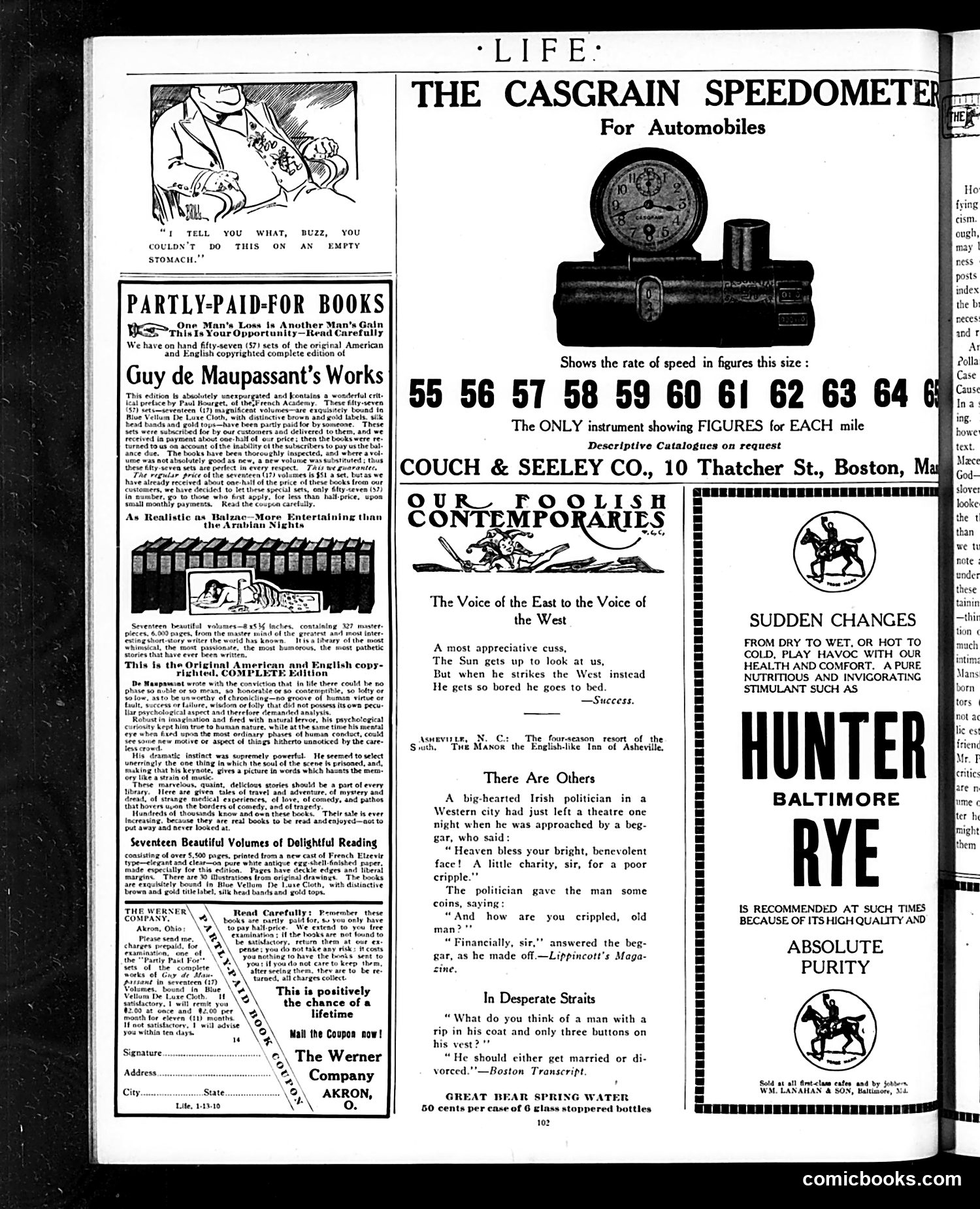
This is primarily an **advertising page** from Life magazine, not a political cartoon page. The main content consists of several advertisements and book promotions. The top cartoon is a simple humorous sketch showing someone commenting that another person "couldn't do this on an empty stomach"—likely referring to some physical feat or activity. The page is dominated by three major advertisements: 1. **Guy de Maupassant's Works** — a "partly-paid-for books" offer selling 57 complete sets at discount due to subscriber defaults 2. **The Casgrain Speedometer** — an automobile instrument that displays speed figures for each mile 3. **Hunter Baltimore Rye** — whiskey advertisement promoting it for "sudden changes" in health and vigor, with claims of "absolute purity" There's also a small "Our Foolish Contemporaries" section reprinting humorous anecdotes from other publications, and a Hunter Rye whiskey ad. The page reflects early 20th-century consumer culture and patent medicine-style health claims now considered dubious.
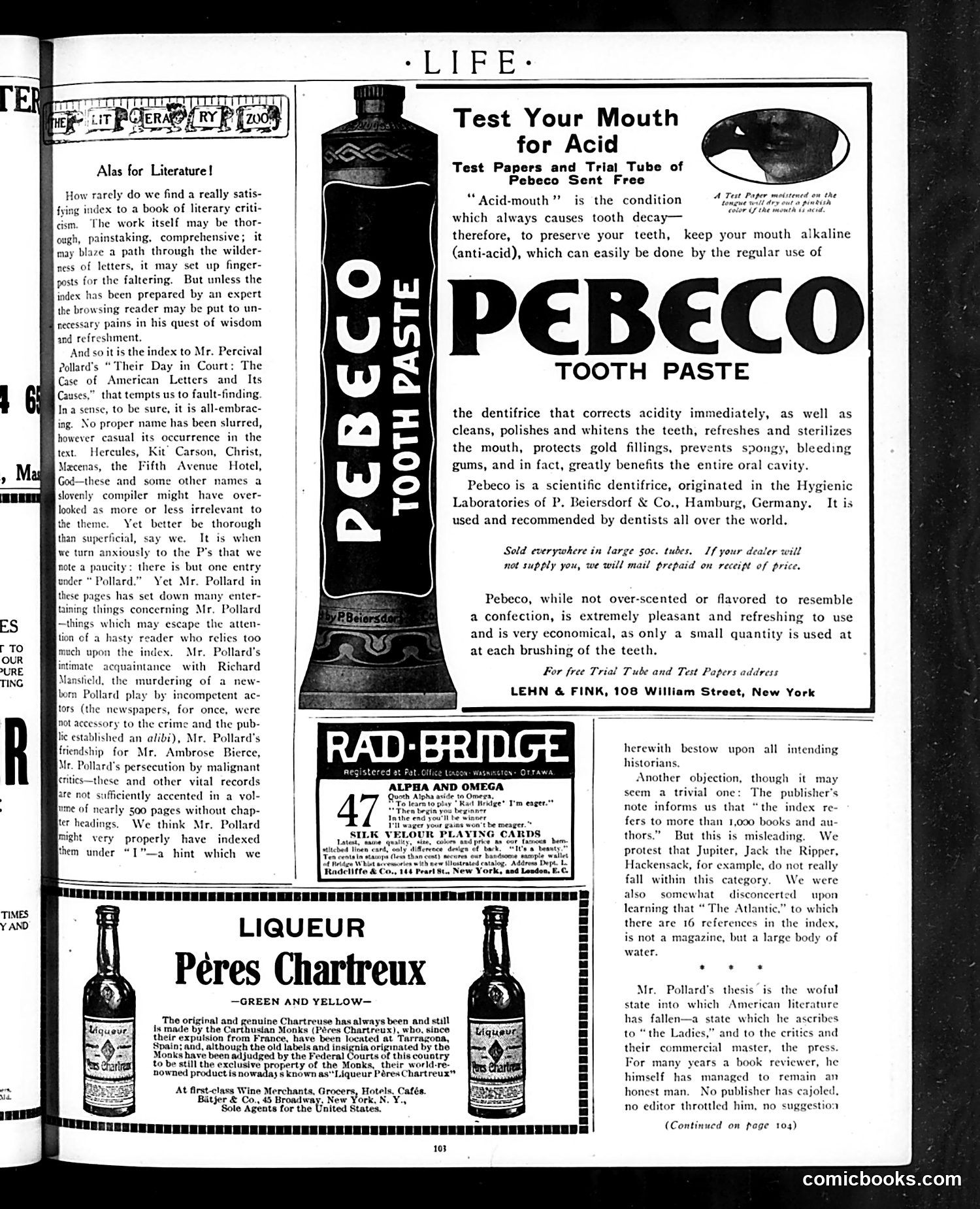
This page is primarily **advertising** for consumer products (Pebeco toothpaste, Rad-Bridge playing cards, and Pères Chartreux liqueur), with a literary essay on the left side. The essay critiques an index to Percival Pollard's book *Their Day in Court: The Case of American Letters and Its Causes*. The satire targets the index's **over-inclusiveness**: it pedantically catalogs every name mentioned, regardless of relevance—including "Hercules, Kit Carson, Christ, Macenas, the Fifth Avenue Hotel, God"—treating trivial references equally with substantive ones. The author mockingly notes the index lists 1,000+ books and authors, yet absurdly includes entries for mythological figures (Jupiter), serial killers (Jack the Ripper), and geographic locations (Hackensack) as if they were actual historical sources. The final jab: "The Atlantic" is indexed as a historical source when it's merely a magazine. The joke: **an index so exhaustively literal it becomes useless**, conflating genuine scholarship with meaningless cataloging. This reflects early 20th-century literary criticism's standards for scholarly rigor.
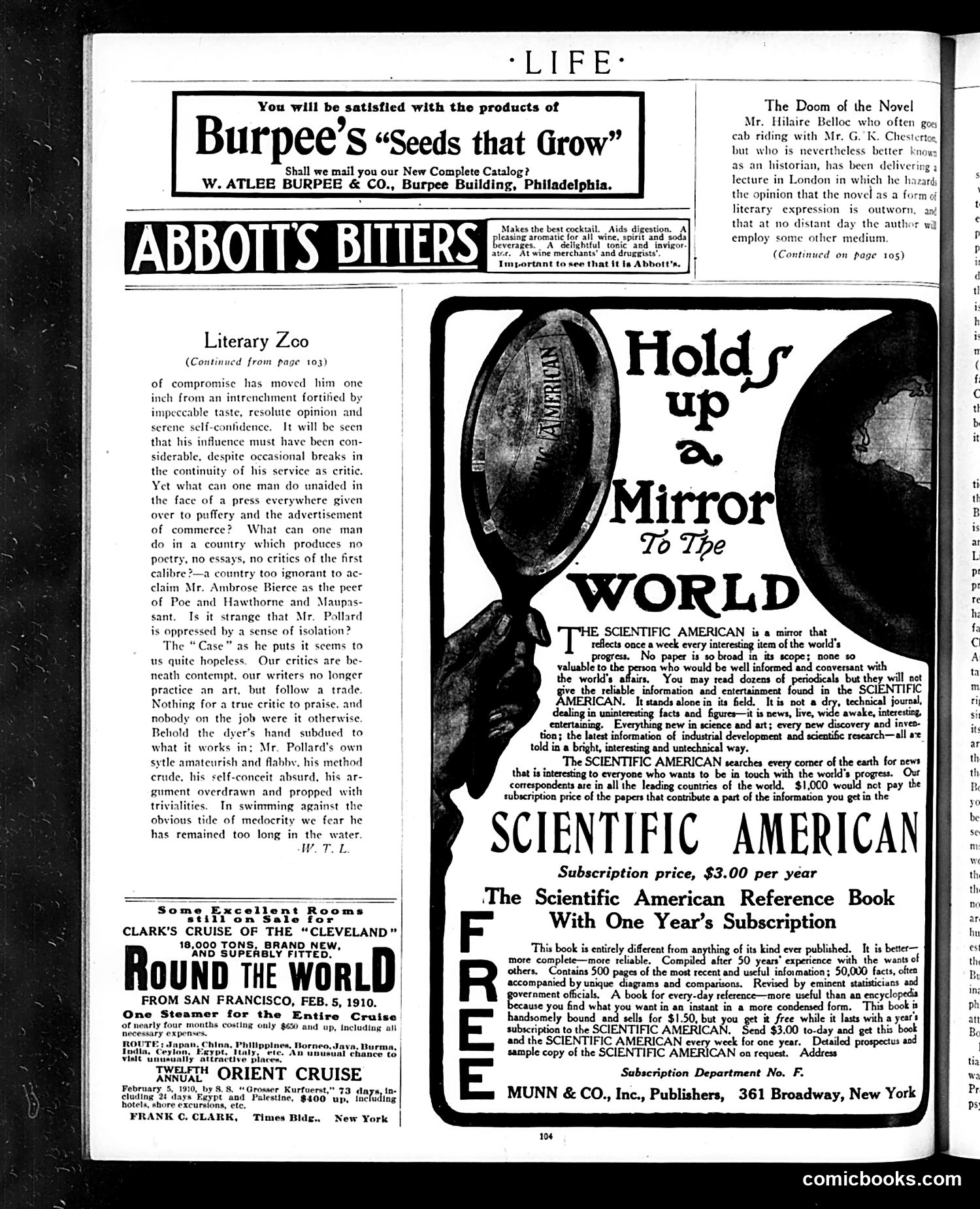
This page is primarily advertising, featuring several product and publication advertisements typical of early 20th-century Life magazine. The main content piece is a literary critique titled "Literary Zoo" (continued from page 103), discussing what appears to be Mr. Pollard's critical work. The author laments that serious literary criticism cannot compete against commercial puffery in a nation that produces little quality poetry or essays and fails to recognize genuine talent like Ambrose Bierce. The piece criticizes both the cultural environment and Pollard's own writing style as "amateurish and flabby." A separate note titled "The Doom of the Novel" references historian Hilaire Belloc's London lecture arguing that the novel as a literary form is becoming outdated and will be replaced by other media. The advertisements include Burpee's seeds, Abbott's Bitters, cruise line offers, and prominently, Scientific American magazine—which positions itself as essential for staying informed about world progress and scientific advancement.
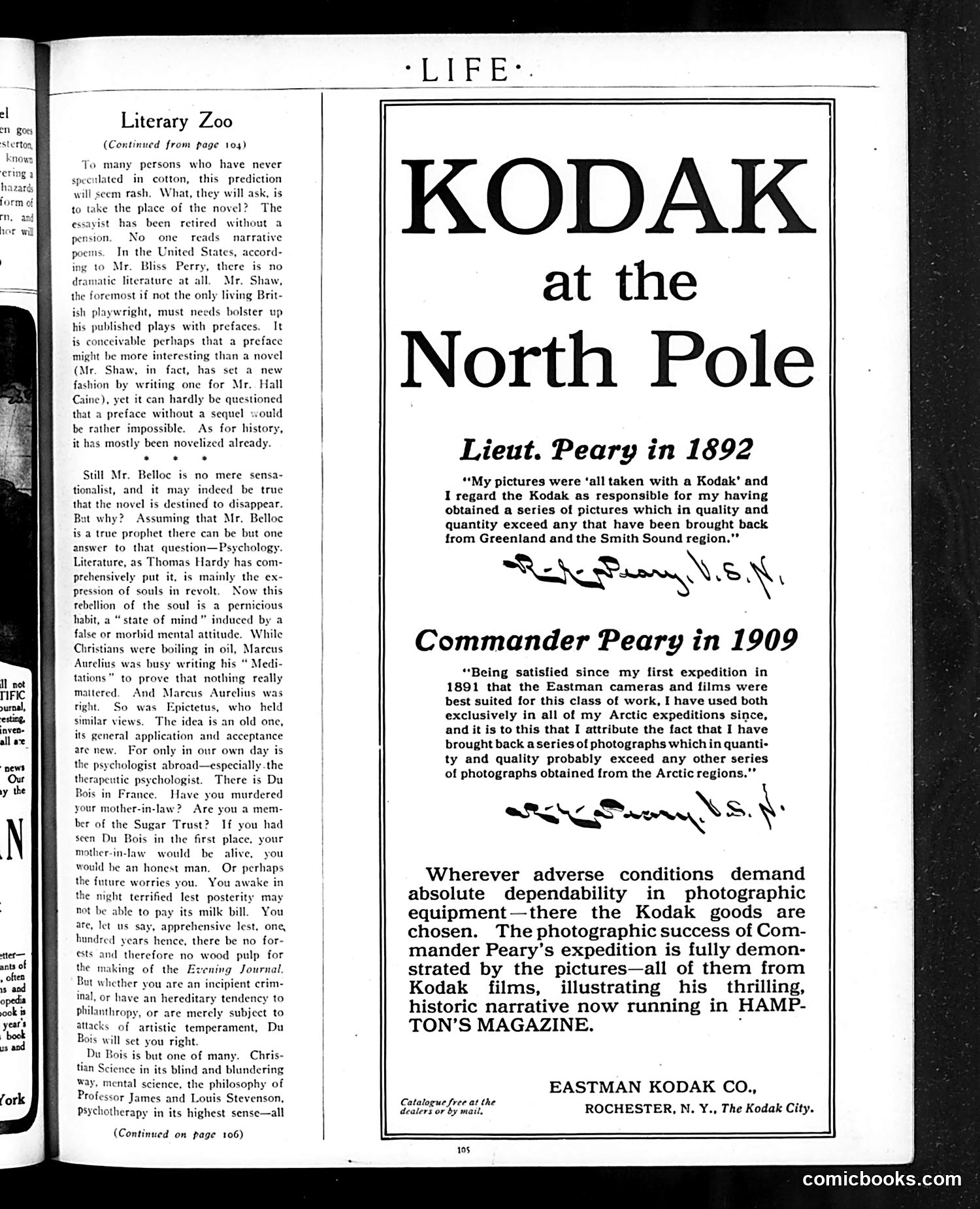
This page is primarily a **Kodak advertisement**, not satire or political commentary. The left column contains literary criticism (continued from a previous page), but the dominant right-hand content promotes Kodak cameras. The advertisement features **testimonials from Lieutenant Robert Peary**, the Arctic explorer, endorsing Kodak equipment. Peary provides two quotes—one from his 1892 expedition and one from 1909—attesting that Kodak cameras and film produced superior photographs compared to any other Arctic expedition results. His signatures appear below each statement, lending credibility. The final section emphasizes Kodak's "absolute dependability in photographic equipment," positioning the brand as essential for serious explorers. The ad connects Peary's "thrilling, historic narrative" (running in Hampton's Magazine) to Kodak's superiority. This is straightforward corporate advertising leveraging Peary's celebrity and Arctic achievements to market consumer cameras—no satire or hidden meaning intended.
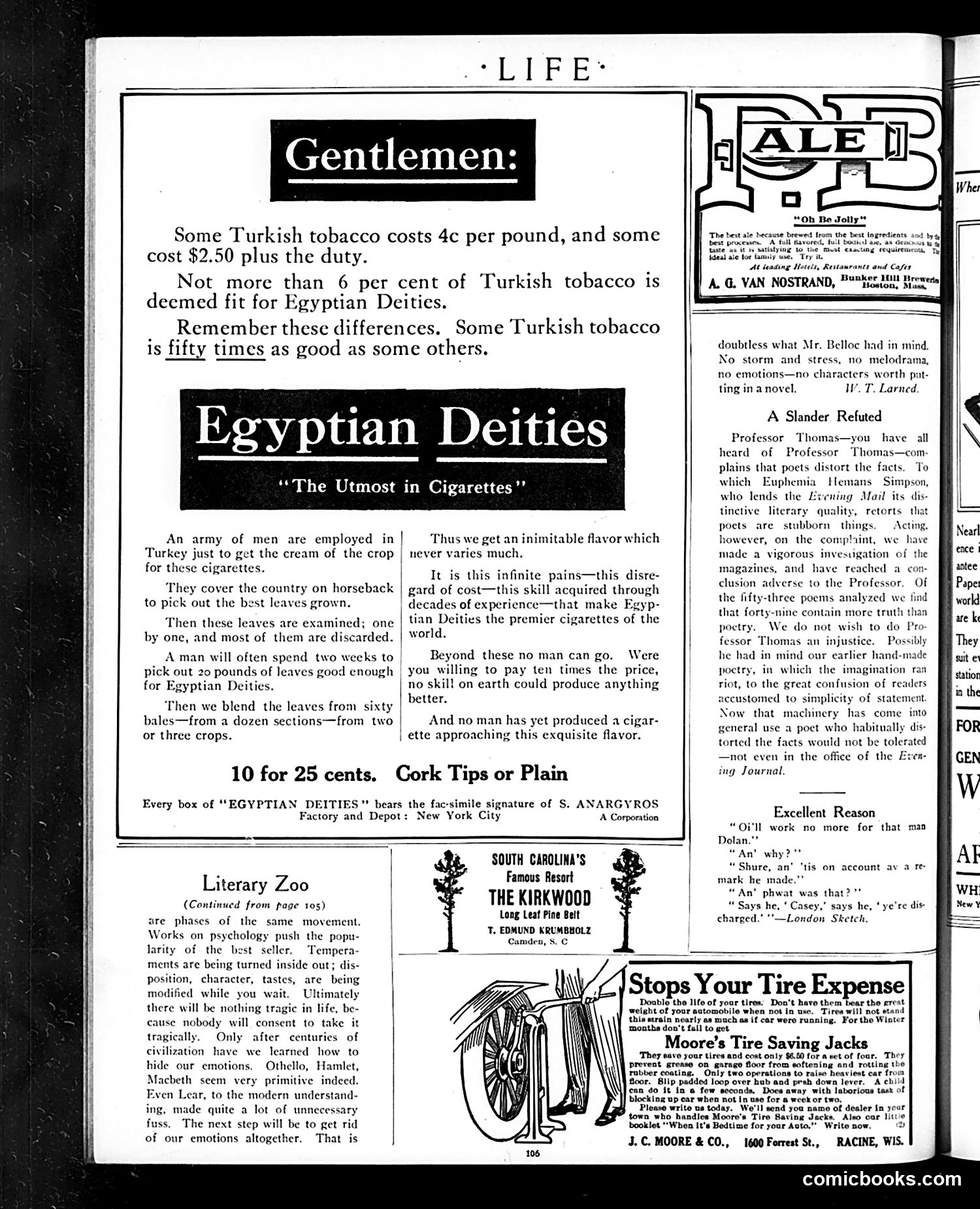
This page is primarily a **cigarette advertisement** for "Egyptian Deities" brand, with supporting content. There are no political cartoons. The ad uses a common early 20th-century marketing tactic: establishing product superiority through claims of meticulous sourcing and production. It describes Turkish tobacco procurement—men on horseback selecting leaves, discarding most, spending weeks to find quality—to justify premium pricing (10 cigarettes for 25 cents). The rhetorical strategy appeals to gentlemen consumers by suggesting that paying more reflects connoisseurship: "no skill on earth could produce anything better." The signature of "S. ANARGYROS" (Greek for "without silver/poor") is ironic branding. The page also contains unrelated ads (Kirkwood resort, tire jacks) and a literary column discussing poetry and facts. This mixed-content layout was typical of *Life* magazine's format.
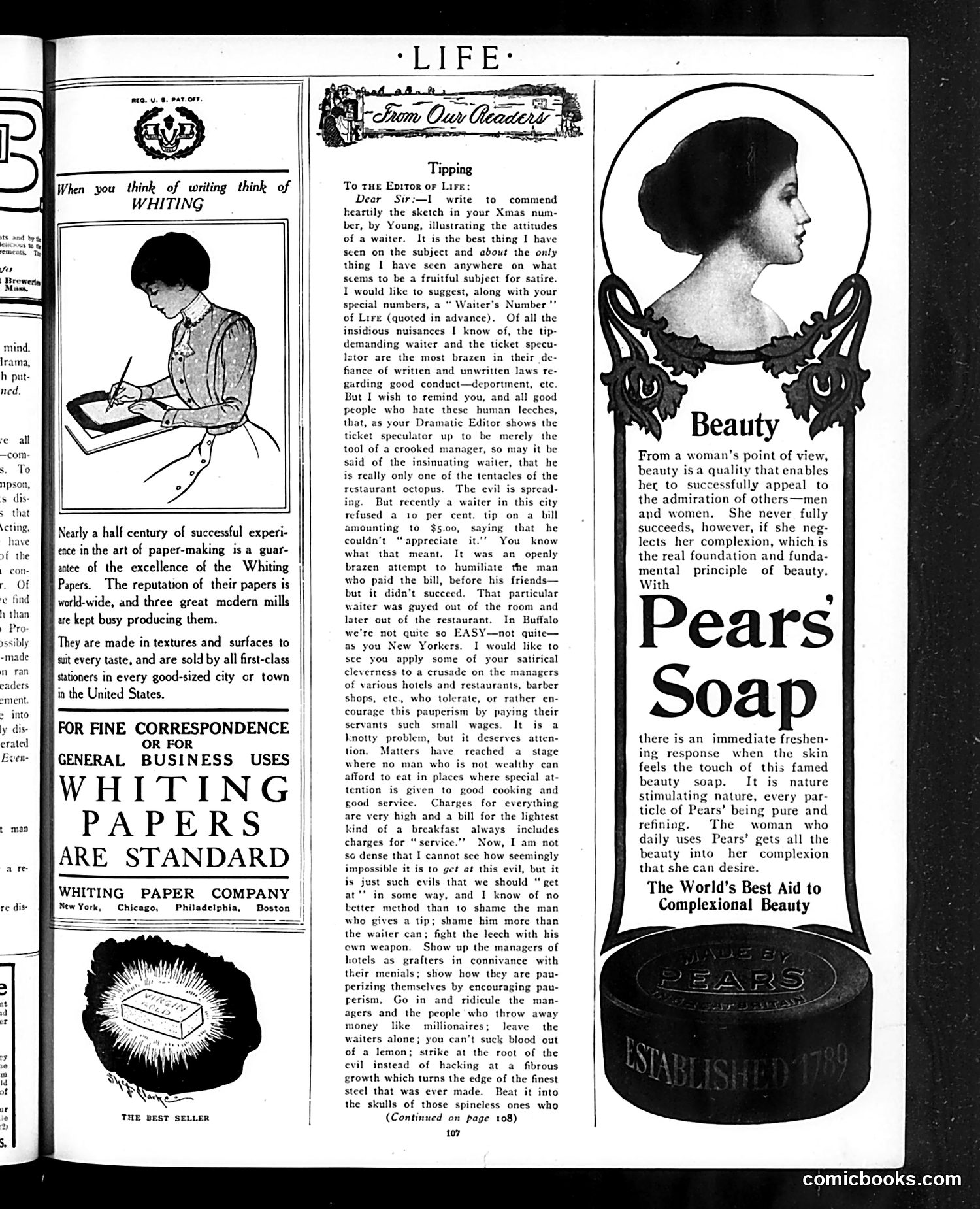
This page combines advertisements with a reader's letter criticizing tipping culture in early 20th-century America. **The Letter's Context:** A Buffalo reader praises Life's recent satirical sketch about waiters' behavior, proposing a dedicated "Waiter's Number" issue. The writer complains that tip-demanding waiters represent a broader systemic evil—that restaurant managers deliberately underpay staff, forcing customers to subsidize wages through tips. A specific anecdote describes a waiter refusing a 10% tip as insufficiently generous, which the writer calls an "openly brazen attempt to humiliate." **The Satire's Point:** Rather than shame individual tippers or waiters, the letter argues Life should expose restaurant *managers* as "grafters" who exploit this system. The writer suggests ridiculing wealthy patrons who enable it through excessive tipping, rather than blaming working waiters—"you can't suck blood out of a lemon." **Modern Relevance:** This reveals that American tipping culture's exploitative structure and moral debates are century-old problems, not recent developments. The page also features period advertisements for Whiting Papers and Pears' Soap.
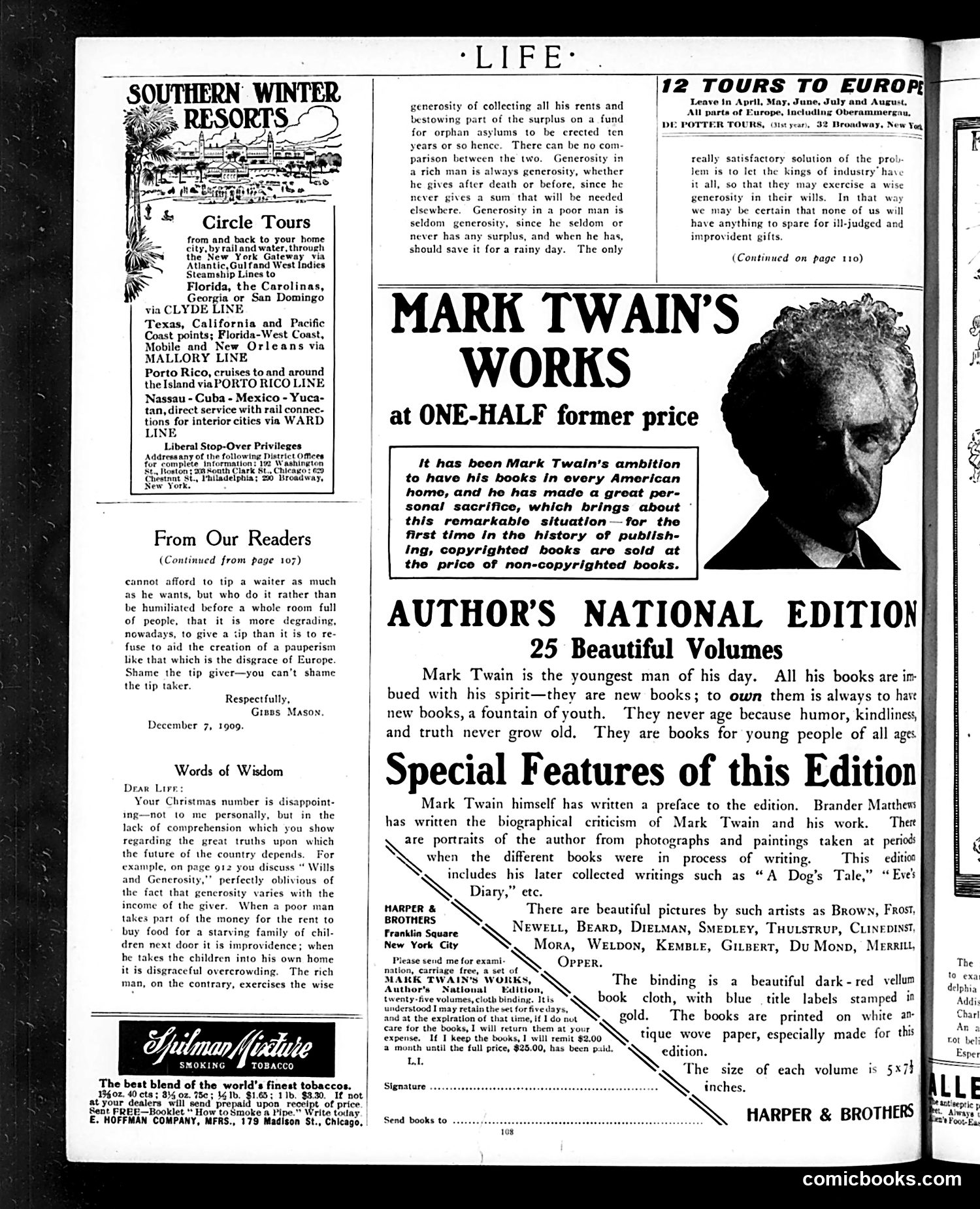
This page is primarily **advertising and reader correspondence**, not political satire requiring historical context. The main content includes: 1. **Travel advertisements** for Southern winter resorts and European tours via various shipping lines 2. **"From Our Readers" letters** debating generosity and tipping culture. One correspondent (Grins Mason) argues tipping degrades workers; another critiques how "generosity" means different things for rich versus poor people—the wealthy can afford large charitable gifts while the poor sacrifice necessities 3. **A major advertisement for Mark Twain's works** at half-price, framed as Twain's "personal sacrifice" to put his books in American homes. The ad emphasizes his universal appeal and timeless relevance. 4. **Spulman Mixture tobacco advertisement** The page reflects early 1900s concerns about class inequality, charitable giving, and consumer culture. No specific political figures or satirical cartoons are present—this is straightforward advertising and correspondence addressing social attitudes.
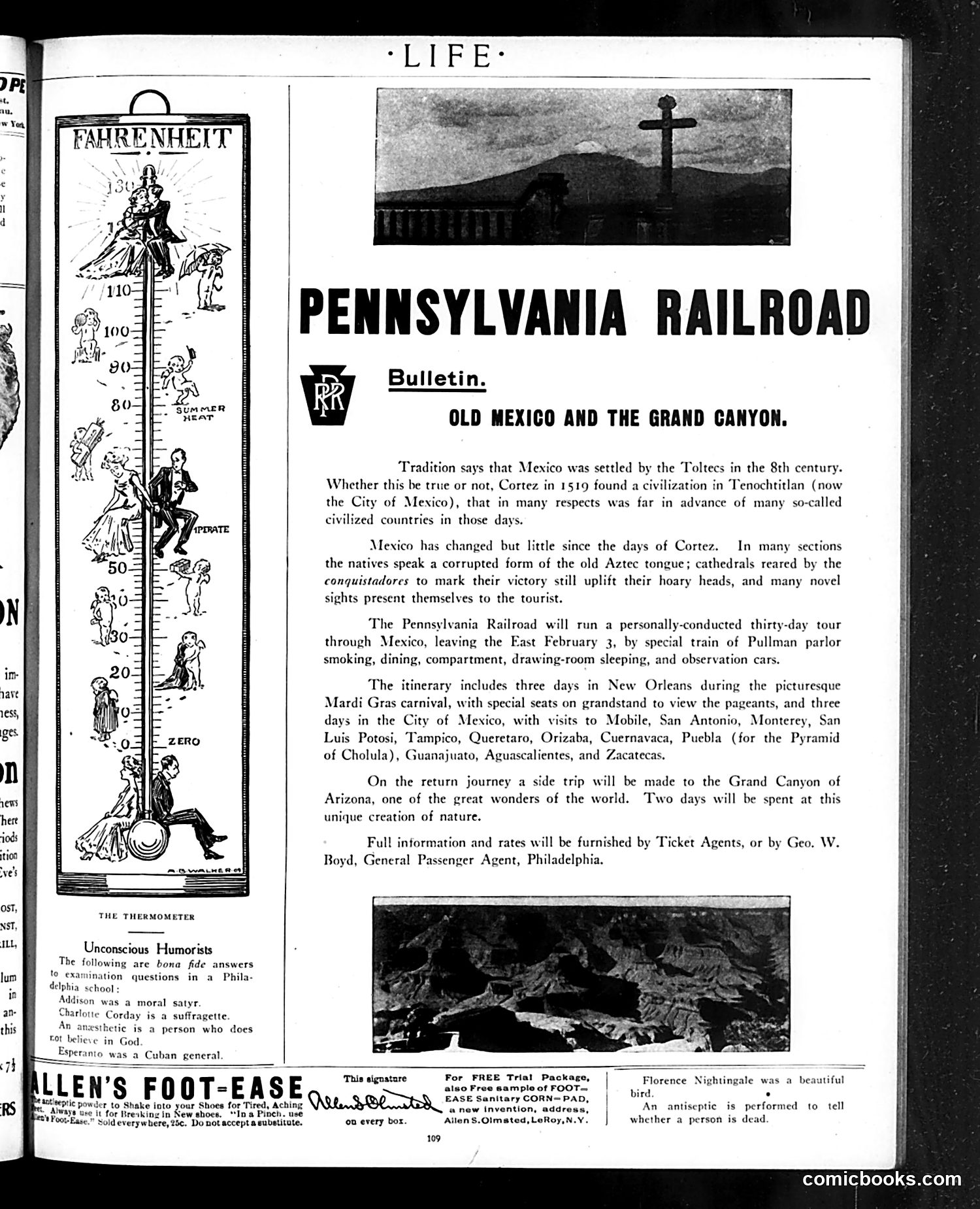
This page is primarily a **Pennsylvania Railroad advertisement** for a thirty-day luxury tour through Mexico and the Grand Canyon, departing February 3. It promises Pullman cars, stops in New Orleans for Mardi Gras, and visits to Mexican historical sites including Aztec ruins and colonial cathedrals—appealing to wealthy American tourists interested in "exotic" destinations. The humor section, titled "Unconscious Humorists," presents **genuine student exam answers** from a Philadelphia school, likely meant to amuse readers with children's innocent malapropisms and misunderstandings: - "Addison was a moral satyr" (likely "satirist") - "Charlotte Corday is a suffragette" (the French Revolutionary figure) - "Esperanto was a Cuban general" (the constructed language, not a person) These mistakes were presented as comic relief—a common feature in *Life* magazine's satirical approach to American education and literacy.
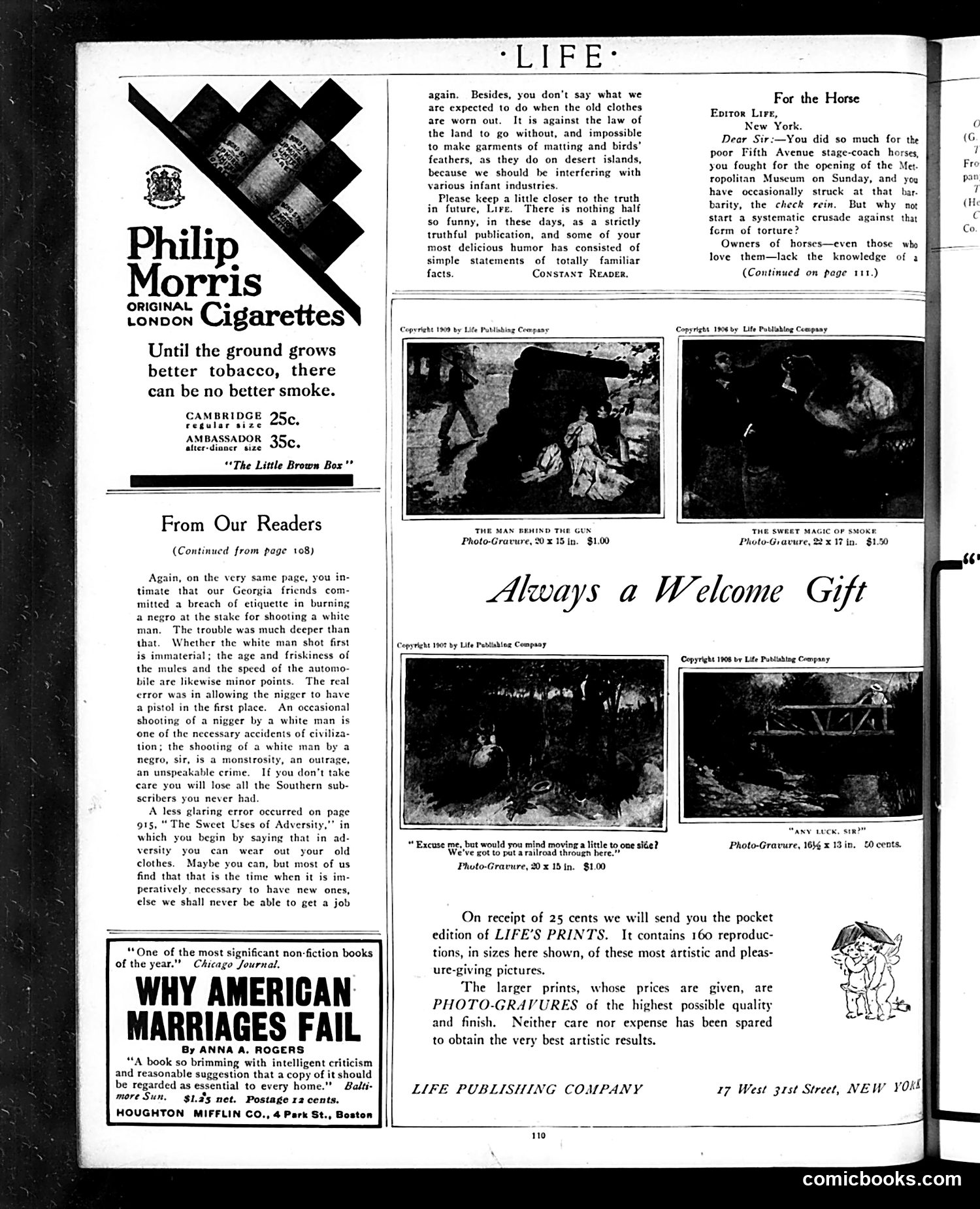
This page is primarily **advertising and reader mail**, not political cartoons. The content includes: **Main Features:** - Philip Morris cigarette advertisement - "From Our Readers" section featuring a disturbing letter defending racial violence in Georgia, where a Black man was lynched for shooting a white man. The writer argues this was justified and criticizes *Life* for suggesting otherwise—a deeply racist perspective that *Life* appears to be satirizing by publishing it. - Book advertisement for "Why American Marriages Fail" - Product advertisements for photo-gravures and prints **Historical Context:** The reader's letter represents actual Jim Crow-era attitudes *Life* (a satirical publication) likely intended to expose as absurd through publication. The casual brutality and logic—that occasional Black deaths are "necessary accidents" while white deaths constitute "monstrosities"—exemplifies the racist violence of the era. The page offers no explicit editorial commentary, relying on readers recognizing the letter's moral bankruptcy.
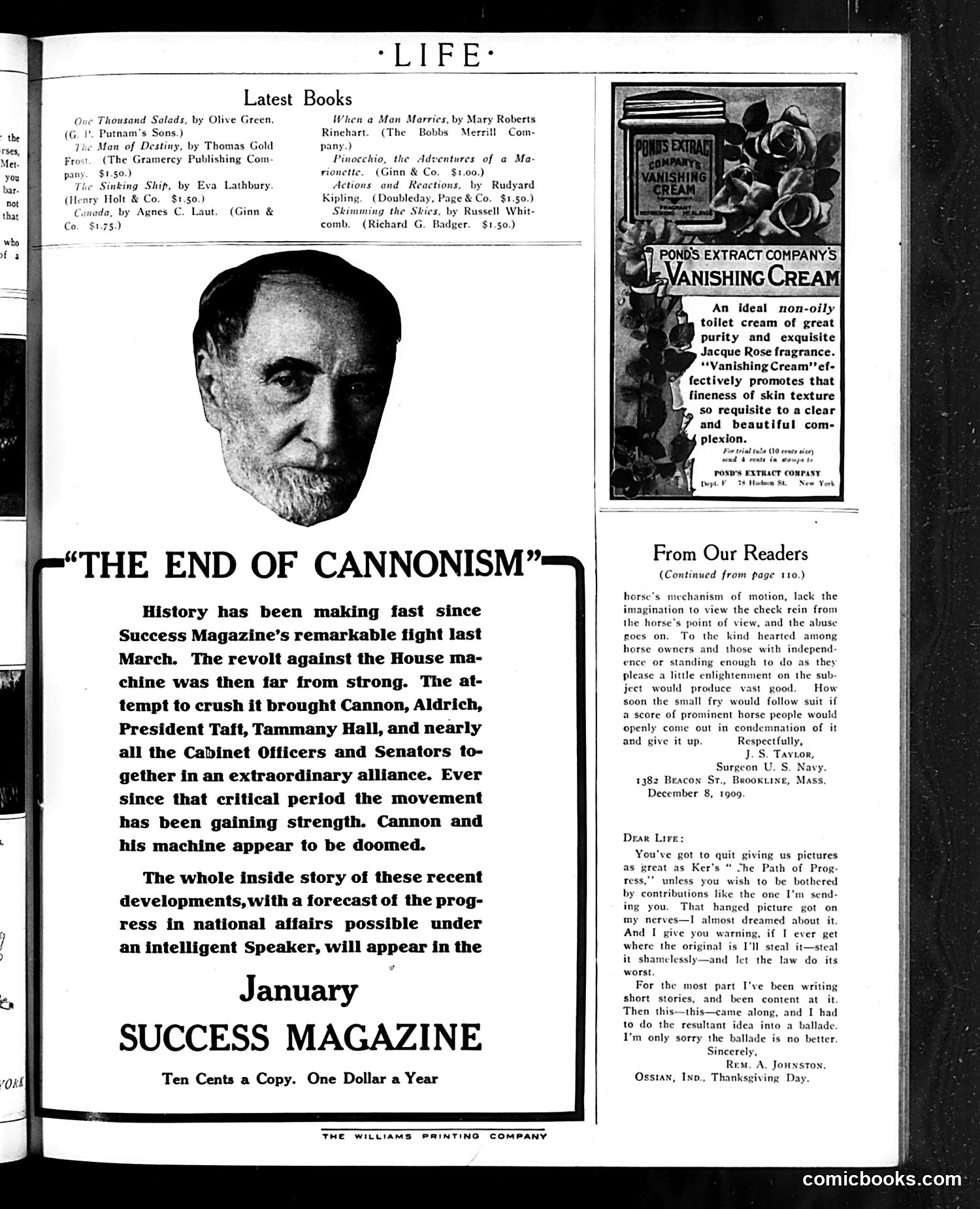
This page features an advertisement for an upcoming January issue of *Success Magazine* announcing the apparent political downfall of **Joseph G. Cannon**, Speaker of the House of Representatives (the portrait shown is likely Cannon). The text celebrates a recent "revolt against the House machine"—a reference to the 1909-1910 uprising within Congress against Cannon's autocratic control. The piece claims that Cannon's attempted suppression of this revolt backfired, forcing him into alliance with unlikely allies including President Taft, Senator Aldrich, and Tammany Hall politicians. The advertisement promises readers the "inside story" of these developments. This was a genuine political moment: conservative Republicans and progressives clashed over parliamentary reform, ultimately leading to Cannon's removal as Speaker in 1910. The magazine exploits this dramatic political news as compelling cover material. The page also includes book advertisements and reader letters, standard magazine content of the period.
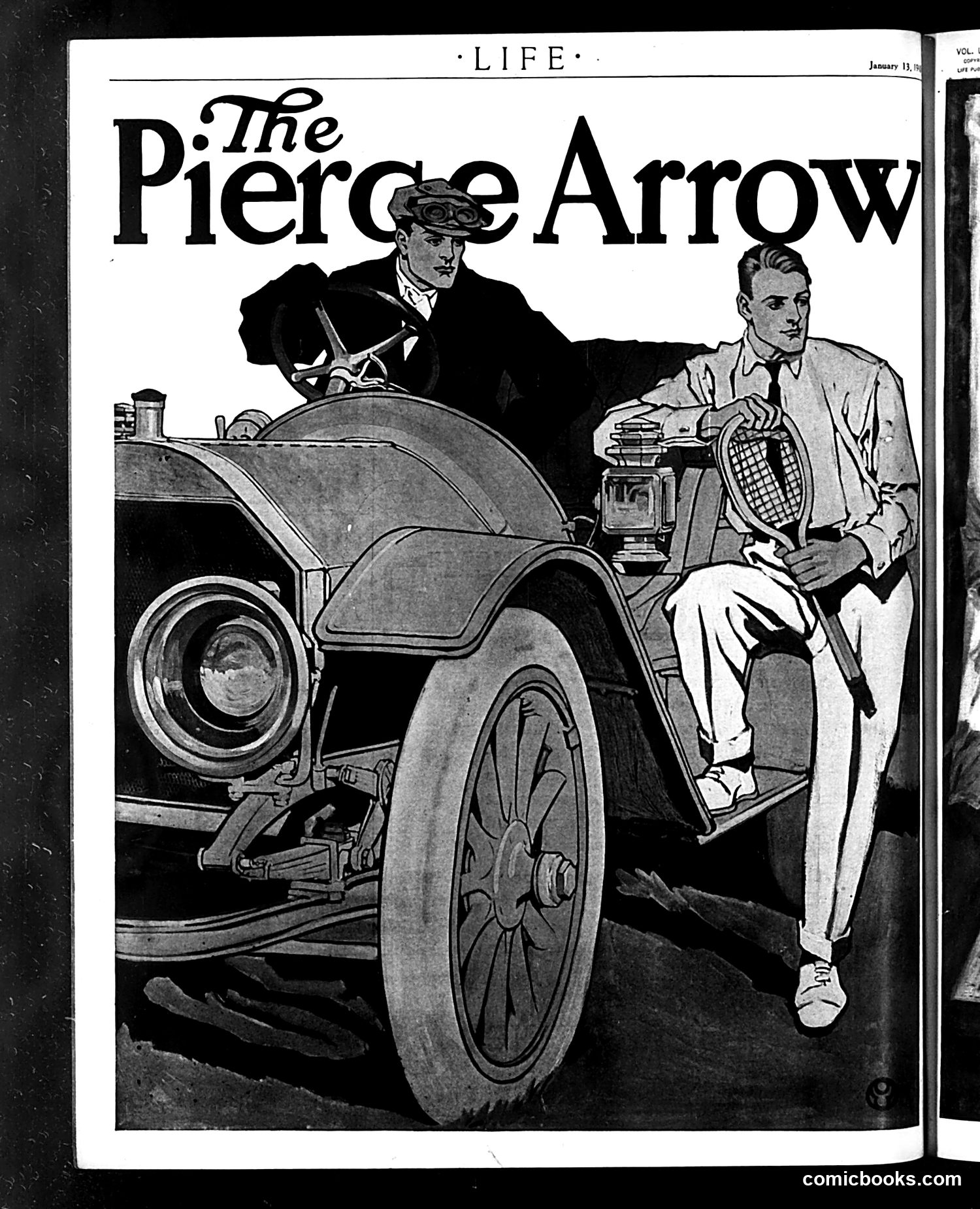
This appears to be an advertisement for the Pierce-Arrow automobile, presented as a satirical magazine cover for *Life*. The image shows two well-dressed men with a luxury car from the early 20th century. One man sits in the driver's seat wearing a cap and formal coat, while the other stands beside the vehicle holding what appears to be sporting equipment (possibly a tennis racket). The satire likely mocks the pretensions of wealthy automobile owners—suggesting that owning a Pierce-Arrow was a status symbol requiring both leisure time and fashionable attire. The juxtaposition of the formal men with the advanced machinery pokes fun at how automobiles were marketed to the affluent as symbols of sophistication and leisure, rather than practical transportation.