
Life, 1910-01-13 · page 22 of 36
Life — January 13, 1910 — page 22: what you’re looking at
What you’re looking at
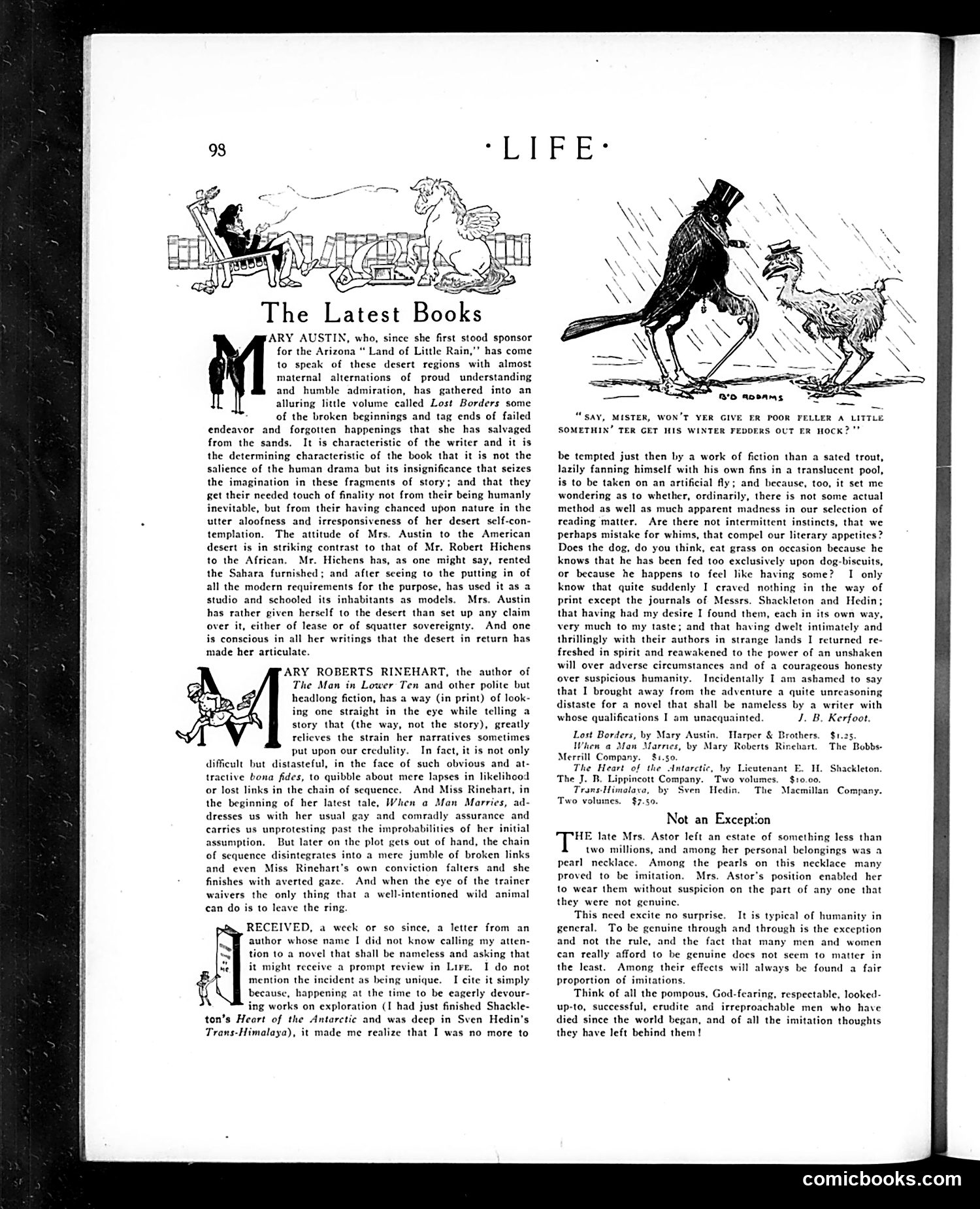
This page reviews recent literary works, featuring two small editorial cartoons alongside text. **The cartoons:** The top illustration shows a gentleman in a top hat offering money to a bedraggled bird, with the caption asking the bird to help him retrieve his winter coat from a pawn shop. This is a visual pun on financial hardship—the bird's feathers suggest "winter plumage," while the gentleman needs funds to reclaim his coat from hock (pawned). **The book reviews:** The text discusses Mary Austin's *Lost Borders* (desert stories) and Mary Roberts Rinehart's *When a Man Marries* (fiction). The reviewer praises Austin's humble attitude toward nature but criticizes Rinehart's plot construction, using the metaphor of a circus trainer losing control of a wild animal. A final section discusses receiving unsolicited review requests, comparing the reviewer's reluctance to read fiction while absorbed in exploration literature (Shackleton, Sven Hedin) to a satiated trout ignoring artificial flies. The cartoons add levity to what is otherwise straightforward literary criticism.
📄 Transcribed text from this page (OCR, searchable)
Machine-transcribed from the original scan — historical spelling and the odd misread are preserved.
The Latest Bo ARY AUSTIN, who, since she first stood sponsor for the Arizona “ Land of Little Rain,”’ has come to speak of these desert regions with almost maternal alternations of proud understanding and humble admiration, has gathered into an alluring little volume called Lost Borders some of the broken beginnings and tag ends of failed endeavor and forgotten happenings that she has salvaged from the sands. It is characteristic of the writer and it is the determining characteristic of the book that it is not the salience of the human drama but its insignificance that seizes the imagination in these fragments of story; and that they get their needed touch of finality not from their being humanly inevitable, but from their having chanced upon nature in the utter aloofness and irresponsiveness of her desert self-con- templation. The attitude of Mrs. Austin to the American desert is in striking contrast to that of Mr. Robert Hichens to the African. Mr. Hichens has, as one might say, rented the Sahara furnished; and after seeing to the putting in of all the modern requirements for the purpose, has used it as a studio and schooled its inhabitants as models. Mrs. Austin has rather given herself to the desert than set up any claim over it, cither of lease or of squatter sovereignty. And one is conscious in all her writings that the desert in return has made her articulate. ARY ROBERTS RINEHART, the author of The Man in Lower Ten and other polite but headlong fiction, has a way (in print) of look- ing one straight in the eye while telling a story that (the way, not the story), greatly relieves the strain her narratives sometimes put upon our credulity. In fact, it is not only difficult but distasteful, in the face of such obvious and at- tractive bona fides, to quibble about mere lapses in likelihood or lost links in the chain of sequence. And Miss Rinehart, in the beginning of her latest tale, When a Man Marries, ad- dresses us with her usual gay and comradly assurance and carries us unprotesting past the improbabilities of her initial assumption. But later on the plot gets out of hand, the chain of sequence disintegrates into a mere jumble of broken links and even Miss Rinehart’s own conviction falters and she finishes with averted gaze. And when the eye of the trainer waivers the only thing that a well-intentioned wild animal can do is to leave the ring. RECEIVED, a week or so since, a letter from an author whose name I did not know calling my atten- tion to a novel that shall be nameless and asking that it might receive a prompt review in Lire. I do not & mention the incident as being unique. I cite it simply at because, happening at the time to be eagerly devour- ‘ ing works on exploration (I had just finished Shackle- ton’s Heart of the Antarctic and was deep in Sven Hedin's Trans-Himalaya), it made me realize that I was no more to MISTER, WON'T YER GIVE ER POOR FELLER A LITTLE SOMETHIN’ TER GET HIS WINTER FEDDERS OUT ER HOCK? "? be tempted just then by a work of fiction than a sated trout, lazily fanning himself with his own fins in a translucent pool, is to be taken on an artificial fly; and because, too, it set me wondering as to whether, ordinarily, there is not some actual method as well as much apparent madness in our selection of reading matter. Are there not intermittent instincts, that we perhaps mistake for whims, that compel our literary appetites? Does the dog, do you think, eat grass on occasion because he knows that he has been fed too exclusively upon dog-biscuits, or because he happens to feel like having some? I only know that quite suddenly I craved nothing in the way of print except the journals of Messrs. Shackleton and Hedin; that having had my desire I found them, each in its own way, very much to my taste; and that having dwelt intimately and thrillingly with their authors in strange lands I returned re- freshed in spirit and reawakened to the power of an unshaken will over adverse circumstances and of a courageous honesty over suspicious humanity. Incidentally I am ashamed to say that I brought away from the adventure a quite unreasoning distaste for a novel that shall be nameless by a writer with J. B. Kerfoot. Lost Borders, by Mary Austin, Harper & Brothers. $1.25. When a Man Marnes, by Mary Roberts Rinehart. The Bobbs- Merrill Company. 81.5 The Heart of the Antarctic, by Licutenant E. H. Shackleton. The J. B. Lippincott Company. “Two volumes. $10.00. TransHimolara, by Sven Hedin. The Macmillan Company. Two volumes. $7.50. whose qualifications I am unacquainted Not an Exception HE late Mrs. Astor left an estate of something less than two millions, and among her personal belongings was a pearl necklace. Among the pearls on this necklace many proved to be imitation. Mrs. Astor's position enabled her to wear them without suspicion on the part of any one that they were not genuine. This need excite no surprise, It is typical of humanity in general. To be genuine through and through is the exception and not the rule, and the fact that many men and women can really afford to be genuine docs not seem to matter in the least. Among their effects will always be found a fair proportion of imitations. Think of all the pompous, God-fearing, respectable, looked- up-to, successful, erudite and irreproachable men who have died since the world began, and of all the imitation thoughts they have left behind them! comicbooks.com