
Life, 1910-01-13 · page 8 of 36
Life — January 13, 1910 — page 8: what you’re looking at
What you’re looking at
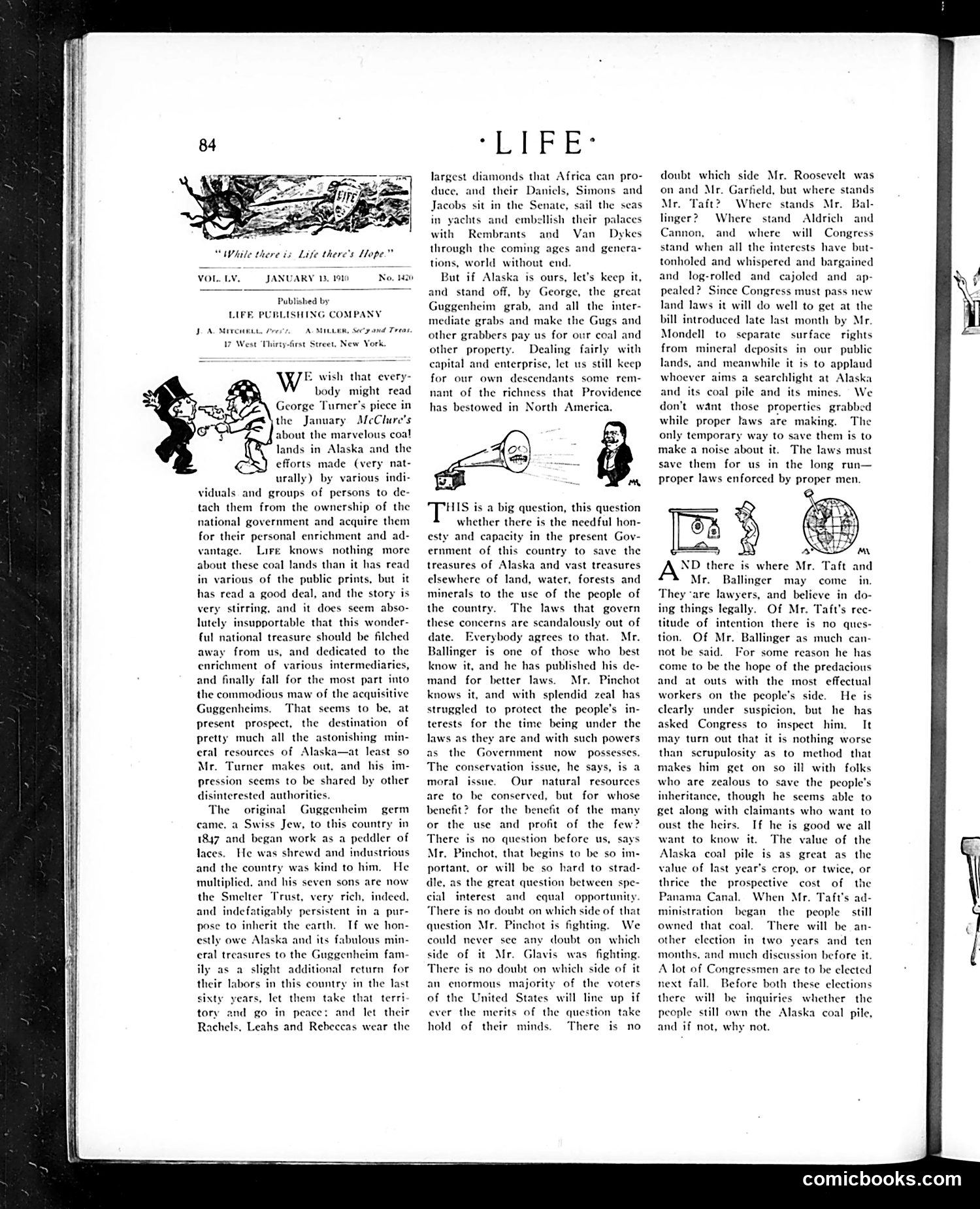
This page discusses Alaska's natural resources and conservation policy. The main cartoon shows two figures in debate—likely representing different political positions on Alaska development. The text references Mr. Taft and Mr. Ballinger regarding whether Alaska's coal lands and minerals should be exploited or protected. The satire appears to target the tension between resource conservation and commercial development. References to "Guggenheim" and "Smelter Trust" suggest criticism of wealthy industrialists seeking to profit from Alaska. The cartoon illustrates the political divide over whether government should prioritize preserving public lands or allow private enterprise access. The context involves early 20th-century Progressive Era debates about conservation versus development—a major political issue of the Taft administration.
📄 Transcribed text from this page (OCR, searchable)
Machine-transcribed from the original scan — historical spelling and the odd misread are preserved.
VOL.LY, JANUARY 13, 1910 Published by LUPE PUBLISHING COMPANY JA. Mereunet. “re he, Seep and Treas West Thirt New York. Wt wish that every- body might read George Turner's piece in the January McClure's about the marvelous coal lands in Alaska and the efforts made (very nat- urally) by various indi- viduals and groups of persons to de- tach them from the ownership of the national government and acquire them for their personal enrichment and ad- vantage. Lire knows nothing more about these coal lands than it has read in various of the public prints, but it has read a good deal, and the story is very stirring, and it does seem abso- lutely insupportable that this wonder- ful national treasure should be filched away from us, and dedicated to the enrichment of various intermediaries, and finally fall for the most part into the commodious maw of the acquisitive Guggenheims. That seems to be, at Present prospect, the destination of pretty much all the astonishing min- eral resources of Alaska—at least so Mr. Turner makes out, and his im- pression seems to be shared by other disinterested authorities. The original Guggenheim germ came, a Swiss Jew, to this country in 1847 and began work as a peddler of laces. He was shrewd and industrious and the country was kind to him. He multiplied, and his seven sons are now the Smelter Trust, very rich, indeed, and indefatigably persistent in a pur- pose to inherit the carth. If we hon- estly owe Alaska and its fabulous min- eral treasures to the Guggenheim fam- ily as a slight additional return for their labors in this country in the last sixty rs, let them take that terri tory and go in peace: and let their Rachels, Leahs and Rebeceas wear the *LIPFE* largest diamonds that Africa can pro- duce, and their Daniels, Simons and Jacobs sit in the Senate, sail the seas in yachts and embellish their palaces with Rembrants and Van Dykes through the coming ages and genera- tions, world without end. But if Alaska is ours, let’s keep it, and stand off, by George, the great Guggenheim grab, and all the inter- mediate grabs and make the Gugs and other grabbers pay us for our coal and other property. Dealing fairly with capital and enterprise, let us still keep for our own descendants some rem- nant of the richness that Providence has bestowed in North America. HIS is a big question, this question whether there is the needful hon- esty and capacity in the present Gov- ernment of this country to save the treasures of Alaska and vast treasures elsewhere of land, water, forests and minerals to the use of the people of the country. The laws that govern these concerns are scandalously out of date. Everybody agrees to that. Mr. Ballinger is one of those who best know it, and he has published his de- mand for better laws. Mr. Pinchot knows it, and with splendid zeal has struggled to protect the people’s in- terests for the time being under the laws as they are and with such powers as the Government now possesses. The conservation issue, he says, is a moral issue. Our natural resources are to be conserved, but for whose benefit? for the benefit of the many or the use and profit of the few? There is no question before us, says Mr. Pinchot, that begins to be so im- portant, or will be so hard to strad- dle, as the great question between spe- cial interest. and equal opportunity. There is no doubt on which side of that question Mr. Pinchot is fighting. We could never see any doubt on which side of it Mr. Glavis was fighting There is no doubt on which side of it an enormous majority of the voters of the United States will line up if ever the merits of the question take hold of their minds. doubt which side Mr. Roosevelt was on and Mr. Garfield, but where stands Mr. Taft? Where stands Mr. Bal- linger? Where nd Aldrich and Cannon, and where will Congress stand when all the interests have but- tonholed and whispered and bargained and log-rolled and cajoled and ap- pealed? Since Congress must pass new land laws it will do well to get at the Dill introduced late last month by Mr. Mondell to separate surface rights from mineral deposits in our public lands, and meanwhile it is to applaud whoever aims a searchlight at Alask: and its coal pile and its mines. We don't want those properties grabbed while proper laws are making. The only temporary way to save them is to make a noise about it. The laws must save them for us in the long run— proper laws enforced by proper men. @ . ND there is where Mr. Taft and Mr. Ballinger may come in. They ‘are lawyers, and believe in do- ing things legally. Of Mr. Taft's ree- titude of intention there is no qu tion. Of Mr. Ballinger as much can- not be said. For some reason he has come to be the hope of the predacious and at outs with the most effectual workers on the people’s side. He is clearly under suspicion, but he has asked Congress to inspect him. It may turn out that it is nothing worse than scrupulosity as to method that makes him get on so ill with folks who are zealous to save the people's inheritance, though he seems able to get along with claimants who want to oust the heirs. If he is good we all want to know The value of the Alaska coal pile is as great as the value of last year’s crop, or twice, or thrice the prospective cost of the Panama Canal. When Mr. Taft's ad- ministration began the people still owned that coal. There will be an- other election in two years and ten months, and much discussion before it. A lot of Congressmen are to be elected next fall. Before both these elections there will be inquiries whether the people still own the Alaska coal pile, and if not, why not. comicbooks.com