
Life, 1910-01-13 · page 23 of 36
Life — January 13, 1910 — page 23: what you’re looking at
What you’re looking at
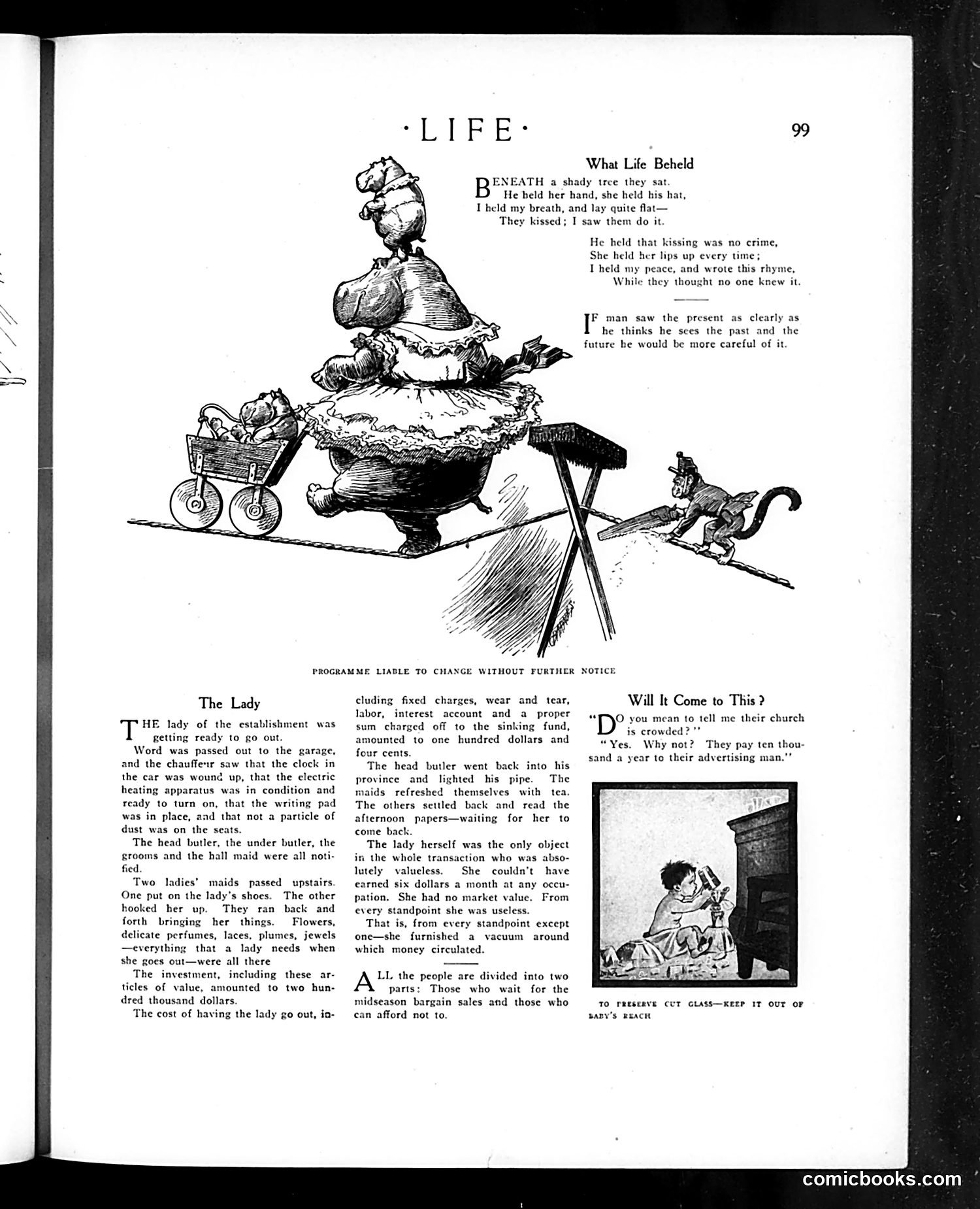
This satirical piece critiques the economic absurdity of wealthy women's social roles in early 20th-century America. **The Setup:** A wealthy woman's outing requires mobilizing an entire household staff—butlers, maids, chauffeurs—plus hundreds of thousands of dollars in jewelry, clothing, and equipment. The total cost: $100.04. **The Satirical Point:** The woman herself—the supposed beneficiary—is deemed "absolutely valueless." She cannot earn six dollars monthly through any occupation and exists solely as a "vacuum around which money circulates." She produces nothing; she merely *consumes*. **The Joke's Target:** Life mocks both the economic system that assigns women no intrinsic worth beyond consumption, and the wealthy woman's dependence on this system. She is paradoxically central to massive expenditure yet utterly economically useless—a passenger in her own life. The secondary cartoon "Will It Come to This?" jokes that churches now compete like businesses, requiring advertising budgets to draw crowds, reflecting anxieties about commercialization of American institutions.
📄 Transcribed text from this page (OCR, searchable)
Machine-transcribed from the original scan — historical spelling and the odd misread are preserved.
What Life Beheld ATH a shady trce they sat He held her hand, she held his hat, I held my breath, and lay quite flat— They kissed; I saw them do it He held that kissing was no crime, She held her lips up every time; T held my peace, and wrote this rhyme, While they thought no one knew it. F man saw the present as clearly as he thinks he sees the past and the future he would be more careful of it PROGRAMME LIADLE TO CHANGE WITHOUT FURTHER NOTICE The Lady HE lady of the establishment was getting ready to go out. Word was passed out to the garage, and the chauffetr saw that the clock in the car was wound up, that the electric heating apparatus was in condition and ready to turn on, that the writing pad was in place, and that not a particle of dust was on the seats. The head butler, the under butler, the grooms and the hall maid were all noti- fied Two ladies’ maids passed upstairs. One put on the lady's shoes. The other hooked her up. They ran back and forth bringing her things. Flowers, delicate perfumes, laces, plumes, jewels —everything that a lady needs when she goes out—were all there The investment, including these ar- ticles of value, amounted to two hun- dred thousand dollars. The cost of having the lady go out, in- cluding fixed charges, wear and tear, labor, interest account and a_ proper sum charged off to the sinking fund, amounted to one hundred dollars and four cents. The head butler went back into his province and lighted his pipe. The maids refreshed themselves with tea. The others settled back and read the afternoon papers—waiting for her to come back The lady herself was the only object in the whole transaction who was abso- lutely valueless. She couldn't have carned six dollars a month at any occu- pation. She had no market value. From every standpoint she was useless. That is, from every standpoint except one—she furnished a vacuum around which money circulated. LL the people are divided into two parts: Those who wait for the midseason bargain sales and those who can afford not to. Will It Come to This ? “D0 you mean to tell me their church is crowded?” es. Why not? They pay ten thou- sand a year to their advertising man."’ TO PRESERVE CUT GLASS—KEEP IT OUT OF BARY’S REACH comicbooks.com