
Life, 1910-01-13 · page 11 of 36
Life — January 13, 1910 — page 11: what you’re looking at
What you’re looking at
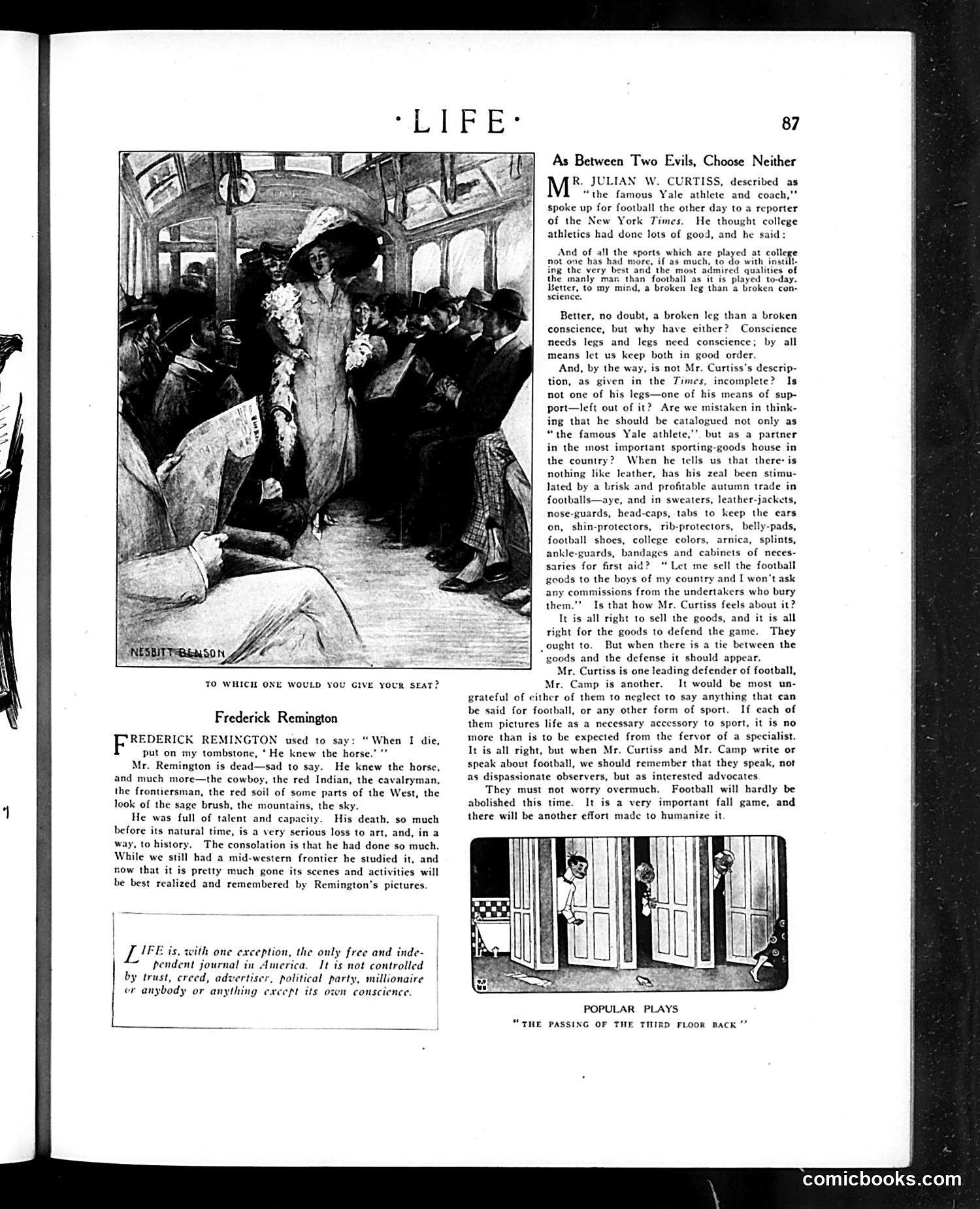
This page critiques commercialization of college football through Mr. Julian W. Curtiss, described as a Yale athlete and coach. The article argues that Curtiss and others profit excessively by selling football merchandise—shoes, leather jackets, nose-guards, head-caps, ankle-guards, bandages, and medical supplies—to boys playing the sport. The satire's point: while defending football itself as important, the author objects to specialists like Curtiss treating the game primarily as a commercial enterprise rather than sport. The article advocates that sports figures should prioritize the game's integrity over profit-taking. The Remington illustration depicts a crowded streetcar scene, likely representing ordinary people's lives contrasted with such commercial opportunism in athletics.
📄 Transcribed text from this page (OCR, searchable)
Machine-transcribed from the original scan — historical spelling and the odd misread are preserved.
87 As Between Two Evils, Choose Neither R. JULIAN W. CURTISS, described as “the famous Yale athlete and coach," spoke up for football the other day to a reporter of the New York Times, He thought college athletics had done lots of good, and he said: And of all the sports which are played at college not one has had more, if as much, to do with instill. ing the very best and the most admired qualities of the manly man than football as it is played to-day. Better, to my mind, a broken leg than a broken con- science. Better, no doubt, a broken leg than a broken conscience, but why have either? Conscience needs legs and legs need conscience; by all means let us keep both in good order. And, by the way, is not Mr. Curtiss’s descrip- tion, as given in the Times, incomplete? Is not one of his legs—one of his means of sup- port—left out of it? Are we mistaken in think- ing that he should be catalogued not only as “the famous Yale athlete,” but as a partner in the most important sporting-goods house in the country? When he tells us that there: is nothing like leather, has his zeal been stimu- lated by a brisk and profitable autumn trade in footballs—aye, and in sweaters, leather-jackets, nose-guards, head-caps, tabs to keep the ears on, shin-protectors, rib-protectors, belly-pads, football shoes, college colors, arnica, splints, ankle-guards, bandages and cabinets of neces- ies for first aid? “Let me sell the football s of my country and I won't ask any commissions from the undertakers who bury them.’’ Is that how Mr. Curtiss feels about it? It is all right to sell the goods, and it is all right for the goods to defend the game. They cought to. But when there is a tie between the goods and the defense it should appear. TO WHICH ONE WOULD you GIVE youR SEAT? Frederick Remington REDERICK REMINGTON used to say: “When I die, put on my tombstone, ‘He knew the horse.’ "’ Mr. Remington is dead—sad to say. He knew the horse, and much more—the cowboy, the red Indian, the cavalryman, the frontiersman, the red soil of some parts of the West, the look of the sage brush, the mountains, the sky. He was full of talent and capacity. His death, so much before its natural time, is a very serious loss to art, and, in a way, to history, The consolation is that he had done so much. While we still had a mid-western frontier he studied it, and now that it is pretty much gone its scenes and activities will be best realized and remembered by Remington's pictures. L IFE is, with one exception, the only free and inde- —~ pendent journal in America. It is not controlled by trust, creed, advertiser, political party, millionaire or anybody or anything except its own conscience. Mr. Curtiss is one leading defender of football, Mr. Camp is another. It would be most un- grateful of cither of them to neglect to say anything that ean be said for football, or any other form of sport. If each of them pictures life as a necessary accessory to sport, it is no more than is to be expected from the fervor of a specialist. It is all right, but when Mr. Curtiss and Mr. Camp write or speak about football, we should remember that they speak, not as dispassionate observers, but as interested advocates They must not worry overmuch. Football will hardly be abolished this time. It is a very important fall game, and there will be another effort made to humanize it POPULAR PLAYS “THE PASSING OF THE TIITRD FLOOR BACK’? ‘comicbooks.com