
A complete issue · 44 pages · 1909
Life — October 7, 1909
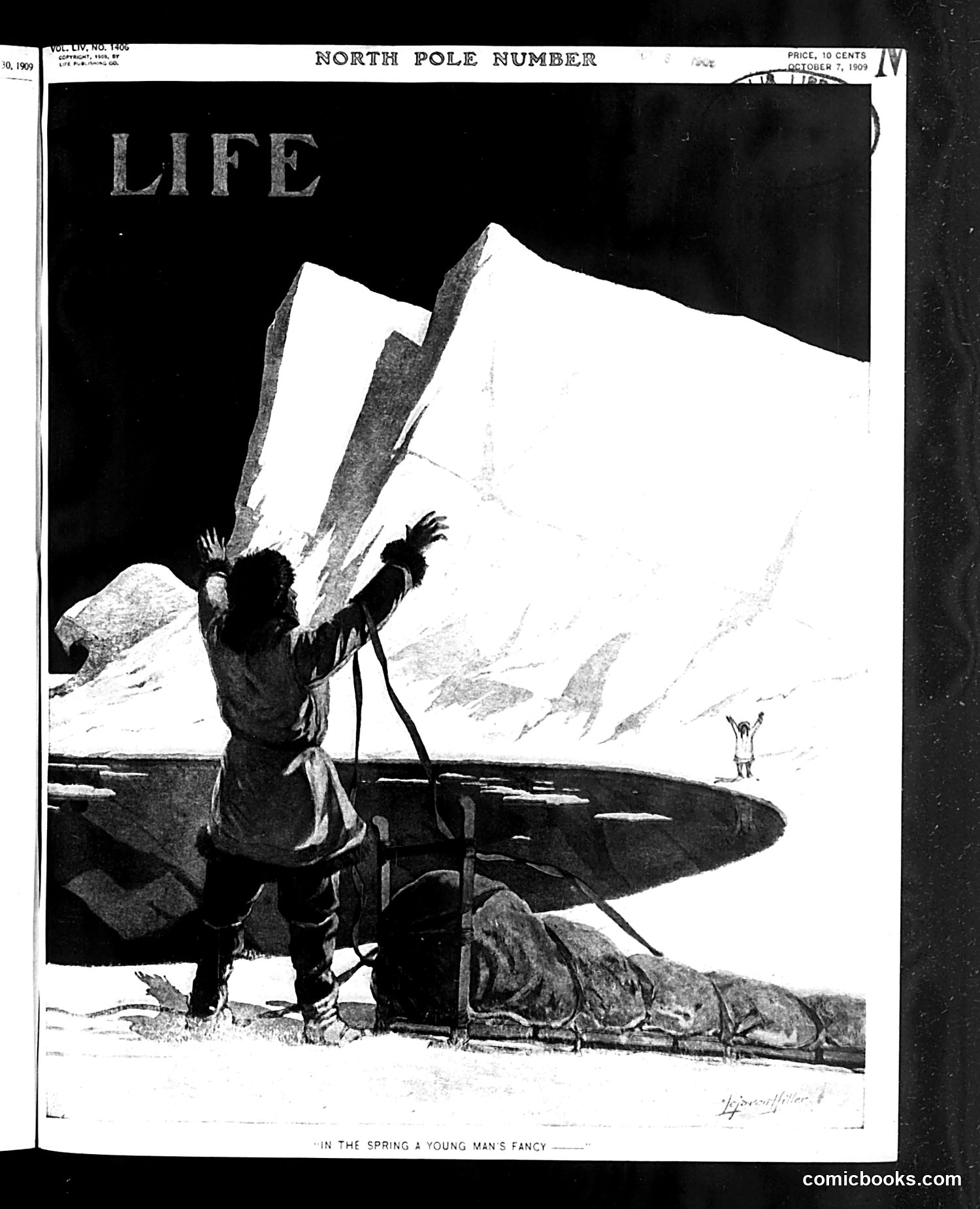
This is the cover of Life's "North Pole Number," published following Frederick Cook and Robert Peary's competing claims to have reached the North Pole in 1909. The cartoon depicts a figure planting a flag at the pole while another watches in the distance—likely satirizing the heated dispute over who actually reached it first. The caption "In the Spring a Young Man's Fancy" is a humorous reference to the famous poem line, suggesting Arctic exploration as romantic ambition. The silhouetted figure raising arms triumphantly captures the era's celebration of polar exploration, while the composition mocks the competing expeditions' dramatic claims and the public controversy surrounding their rival achievements.
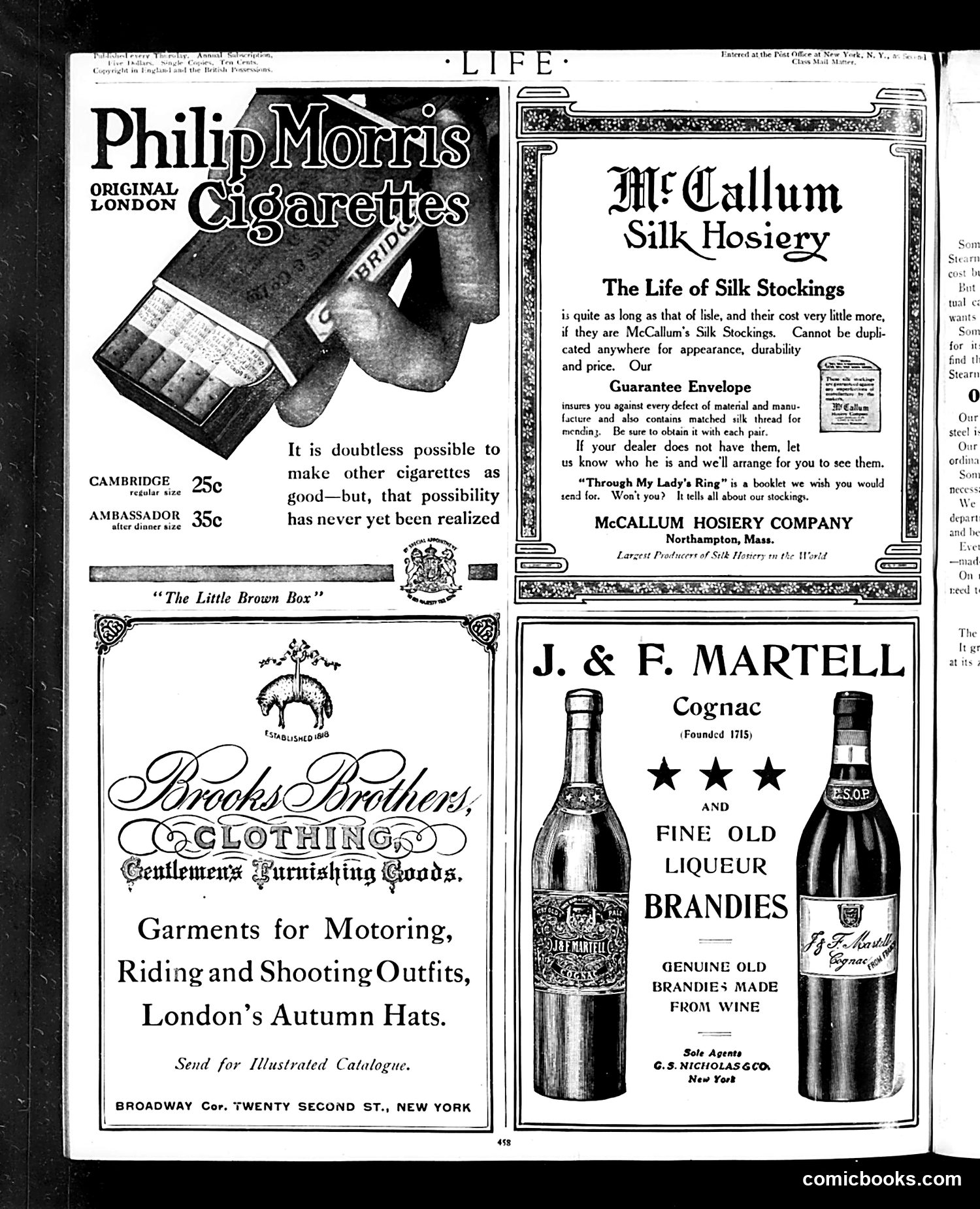
This page is **primarily advertising**, not satirical content. It contains four commercial advertisements from the early 20th century: 1. **Philip Morris Cigarettes** — promoting their "Original London" brand at 25¢ (Cambridge) and 35¢ (Ambassador), claiming superior quality 2. **McCullum Silk Hosiery** — advertising silk stockings with a "Guarantee Envelope" promising durability 3. **Brooks Brothers** — clothing for gentlemen's activities (motoring, riding, shooting) and London hats 4. **J. & F. Martell Cognac** — brandy advertisement featuring three-star and V.S.O.P. varieties There is **no political cartoon or satire** visible on this page. It represents typical *Life* magazine content from an era when quality publications subsidized editorial content through premium advertising.
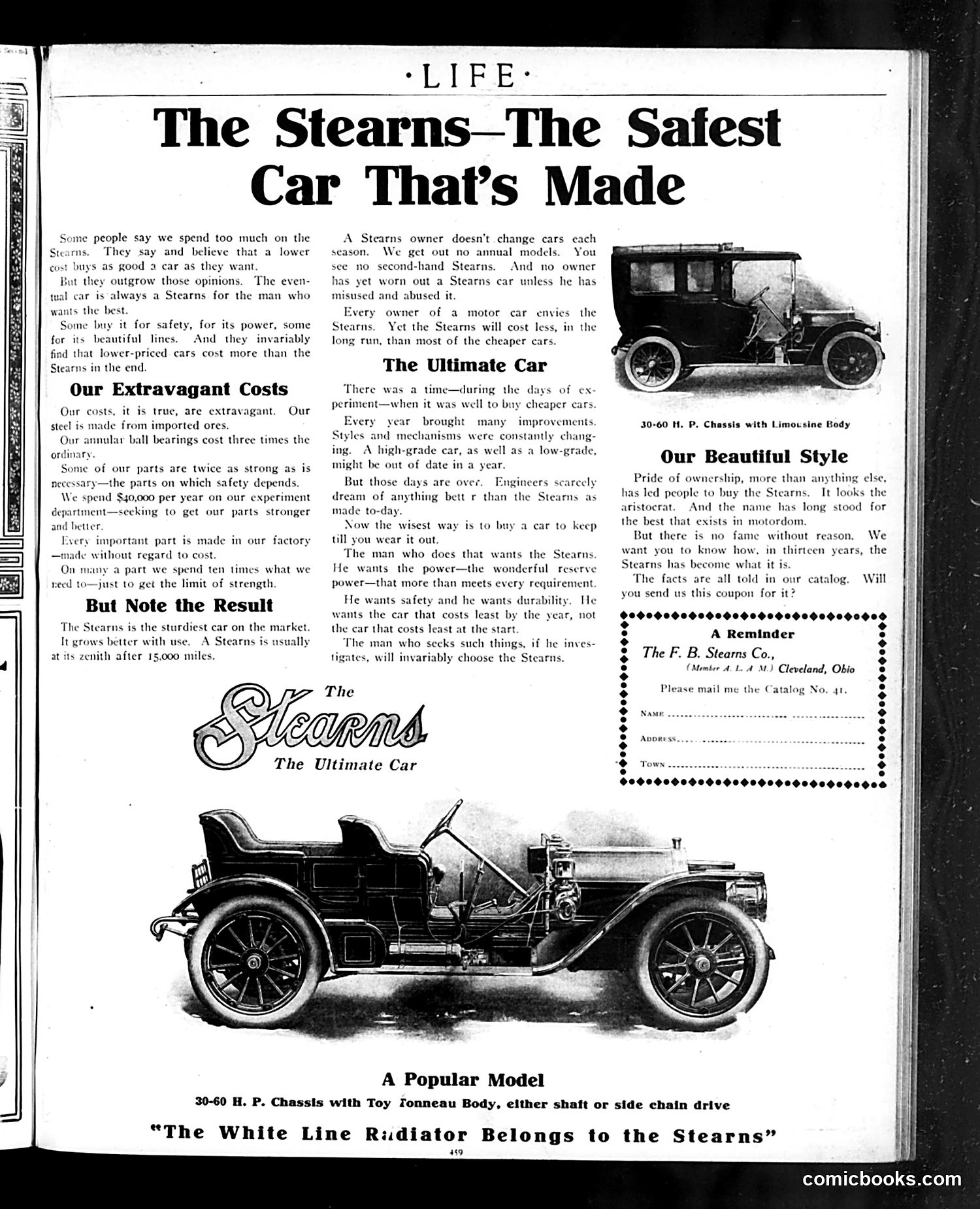
This is **not a political cartoon or satire page**—it's a straightforward automobile advertisement for the Stearns car, published in *Life* magazine (which ran both satirical and commercial content). The page promotes the Stearns as "The Safest Car That's Made" through several persuasive arguments: durable construction, imported steel parts, powerful engines, and long-term reliability. The company emphasizes that Stearns owners rarely change vehicles and that the cars improve with age. Two vehicle illustrations showcase different models: a limousine and a toy tonneau body variant, both featuring the "White Line Radiator" trademark. The coupon at bottom invited readers to request a catalog from the F.B. Stearns Co. in Cleveland, Ohio. This is simply period automotive marketing, not editorial commentary.
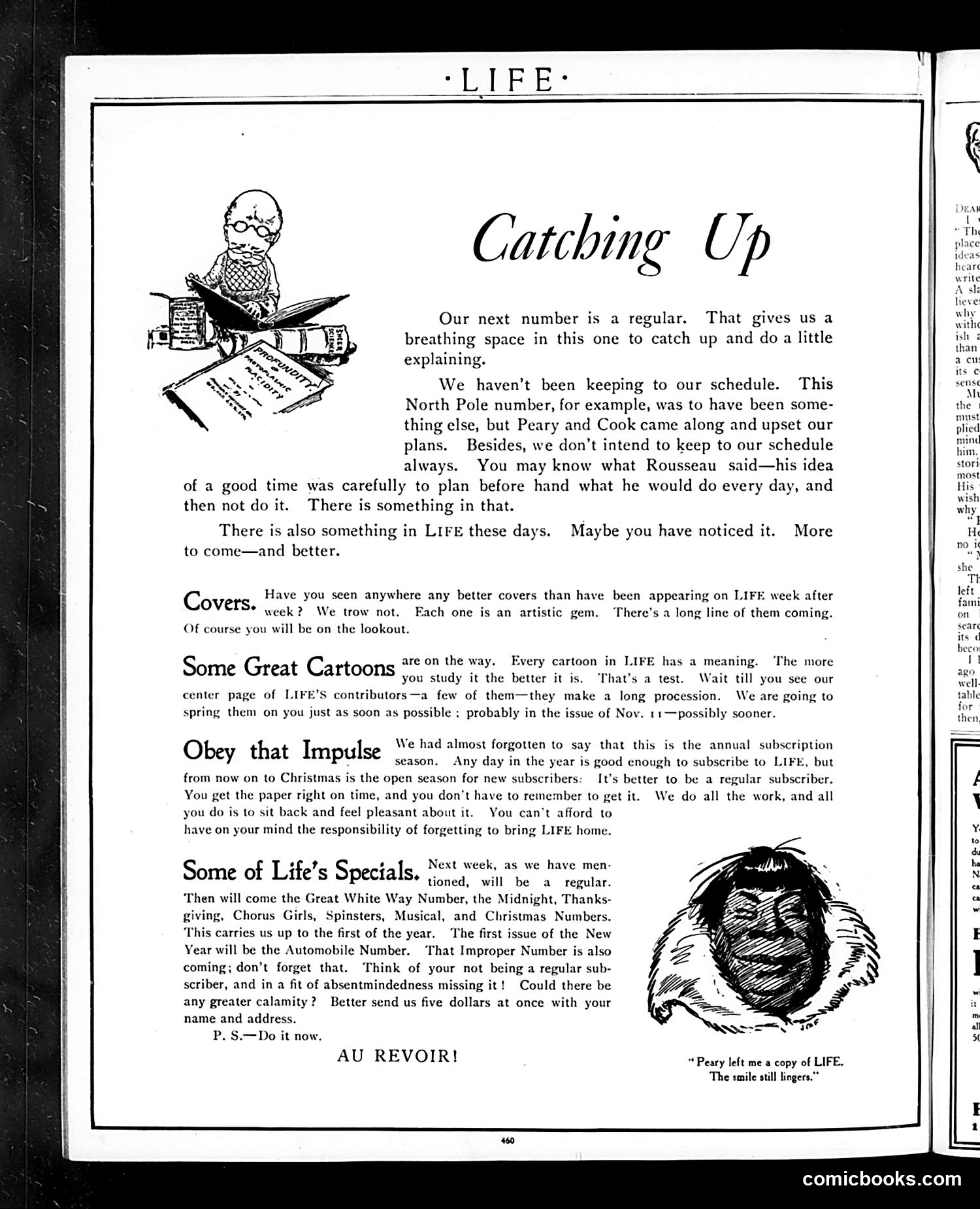
This appears to be an editorial/administrative page rather than political satire. The main content titled "Catching Up" addresses the magazine's editorial operations. The text references **Peary and Cook**, early 20th-century Arctic explorers whose competing claims to reaching the North Pole caused public controversy, disrupting Life's planned coverage schedule. The editorial jokes that Rousseau (likely Jean-Jacques Rousseau, referenced philosophically) had the right idea: carefully planning daily activities then ignoring the plan. The page promotes **Life subscriptions**, emphasizing benefits like timely delivery and special numbered issues (Great White Way Number, Thanksgiving issue, etc.). Two small illustrations appear: a child at a desk with papers and books (top left) and what appears to be a seal or similar animal (bottom right), likely decorative rather than thematically significant to the text.
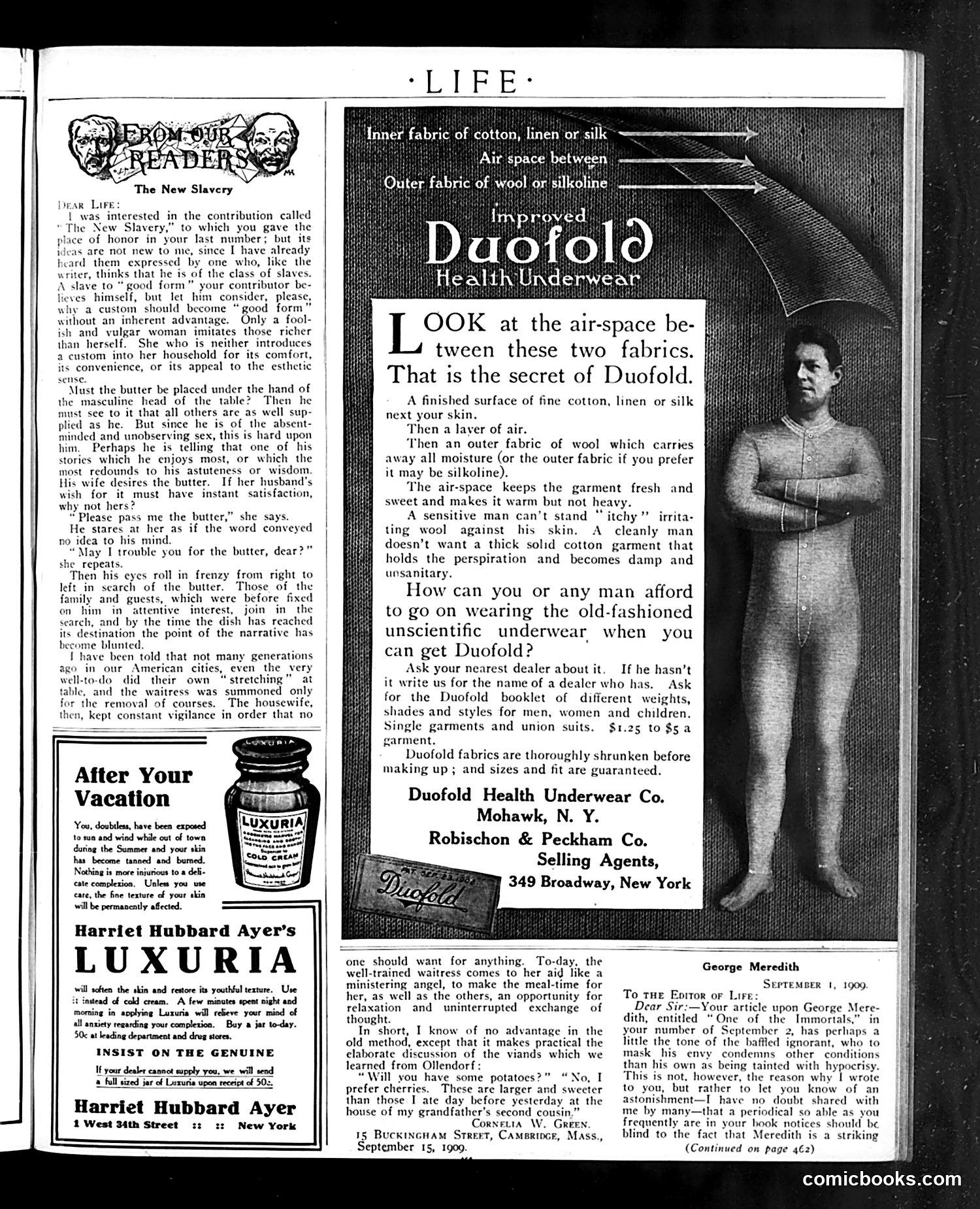
This page is primarily **advertising and letters to the editor**, not political satire. The main content includes: 1. **"From the Readers" section** - A letter criticizing a previous Life article called "The New Slavery," debating whether domestic servants should adopt "good form" without personal advantage. 2. **Duofold Health Underwear advertisement** - A large commercial promoting thermal underwear with an air-space design, featuring a man modeling the garment. 3. **Harriet Hubbard Ayer's Luxuria advertisement** - Promoting a skin care product for post-vacation sun damage. 4. **Letter from George Meredith** - A reader's response to a September 1 article about immortals. The page contains no political cartoons or satirical commentary—it's a typical early-20th-century magazine mix of reader correspondence and period advertisements.
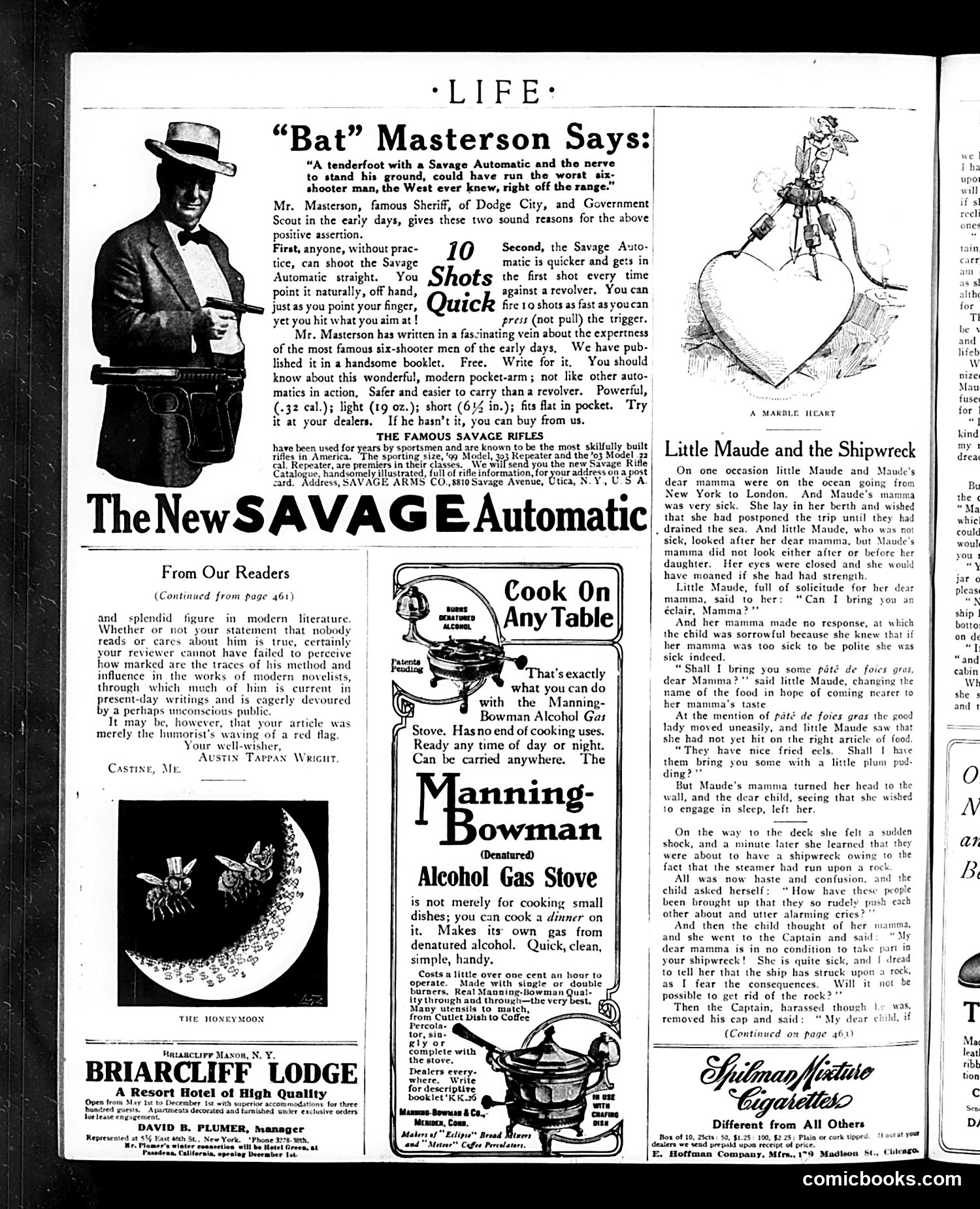
This page is primarily **advertising**, not satire or political commentary. The dominant feature is an advertisement for the **Savage Automatic pistol**, endorsed by "Bat" Masterson, a famous Old West sheriff and gunfighter. The ad emphasizes the weapon's speed and reliability, claiming it "Shots Quick" and is superior to revolvers. Masterson's endorsement lends credibility to the product. Below are additional advertisements: the **Manning-Bowman Alcohol Gas Stove** (which makes its own fuel from denatured alcohol), the **Briarcliff Lodge** resort hotel, and **Sulmona Noctule cigarettes**. The right side contains a serialized story, "Little Maude and the Shipwreck." The page reflects early 20th-century consumer advertising culture targeting middle-class readers with practical household goods and recreational products.
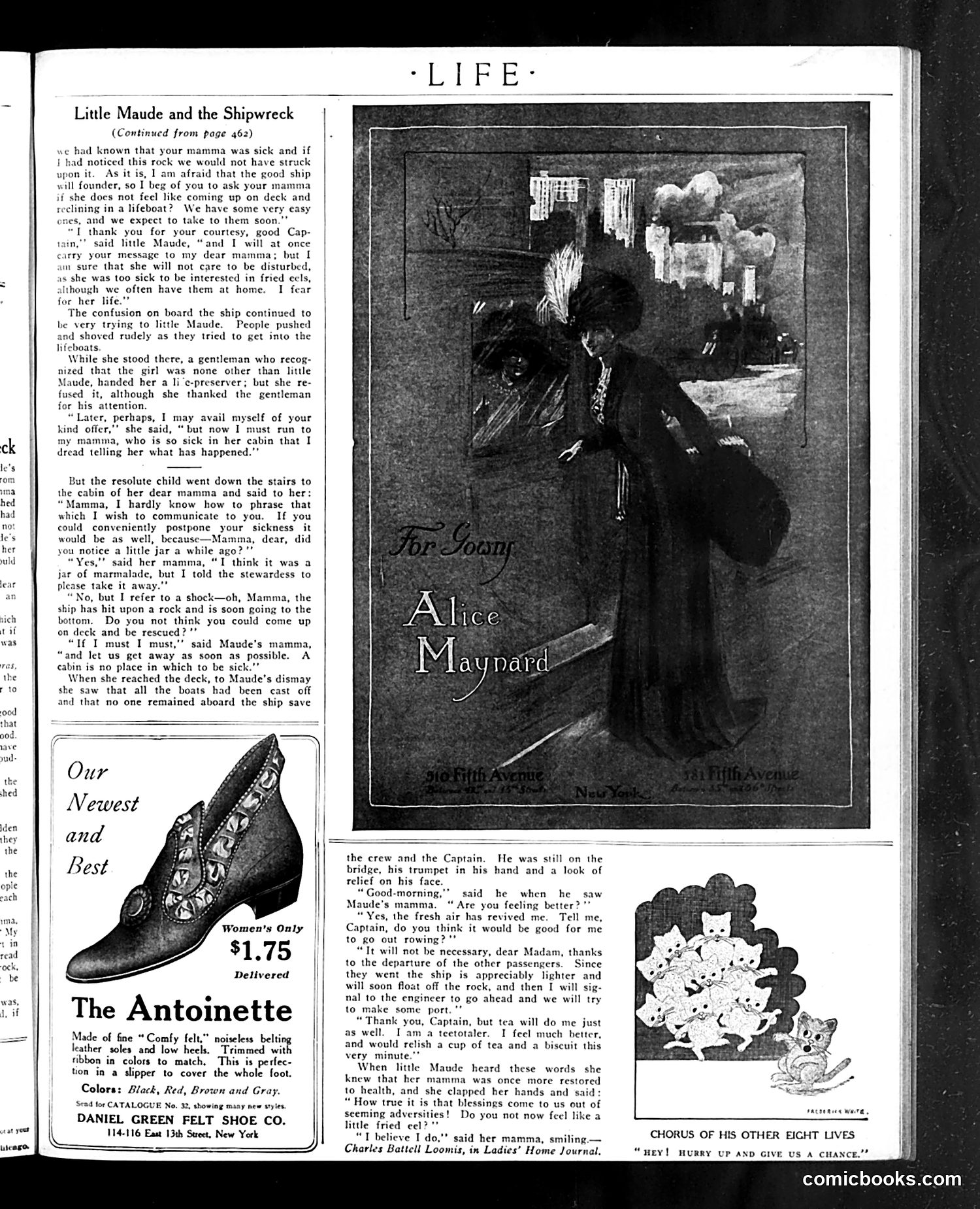
This page contains a serialized story titled "Little Maude and the Shipwreck" (continued from page 462). The left column continues the narrative prose, while the right side features a large photograph of actress **Alice Maynard** from the 245 Fifth Avenue address in New York—likely a theatrical promotion or illustration for the story. Below is an advertisement for **The Antoinette shoe** ($1.75, women's only) by Daniel Green Felt Shoe Co., featuring a decorative women's shoe illustration. At the bottom right is a small cartoon titled "Chorus of His Other Eight Lives" with a humorous caption "Hey! Hurry up and give us a chance," depicting kittens—a lighthearted joke about cats' supposed nine lives. This is primarily **serialized fiction with advertising**, not political satire.
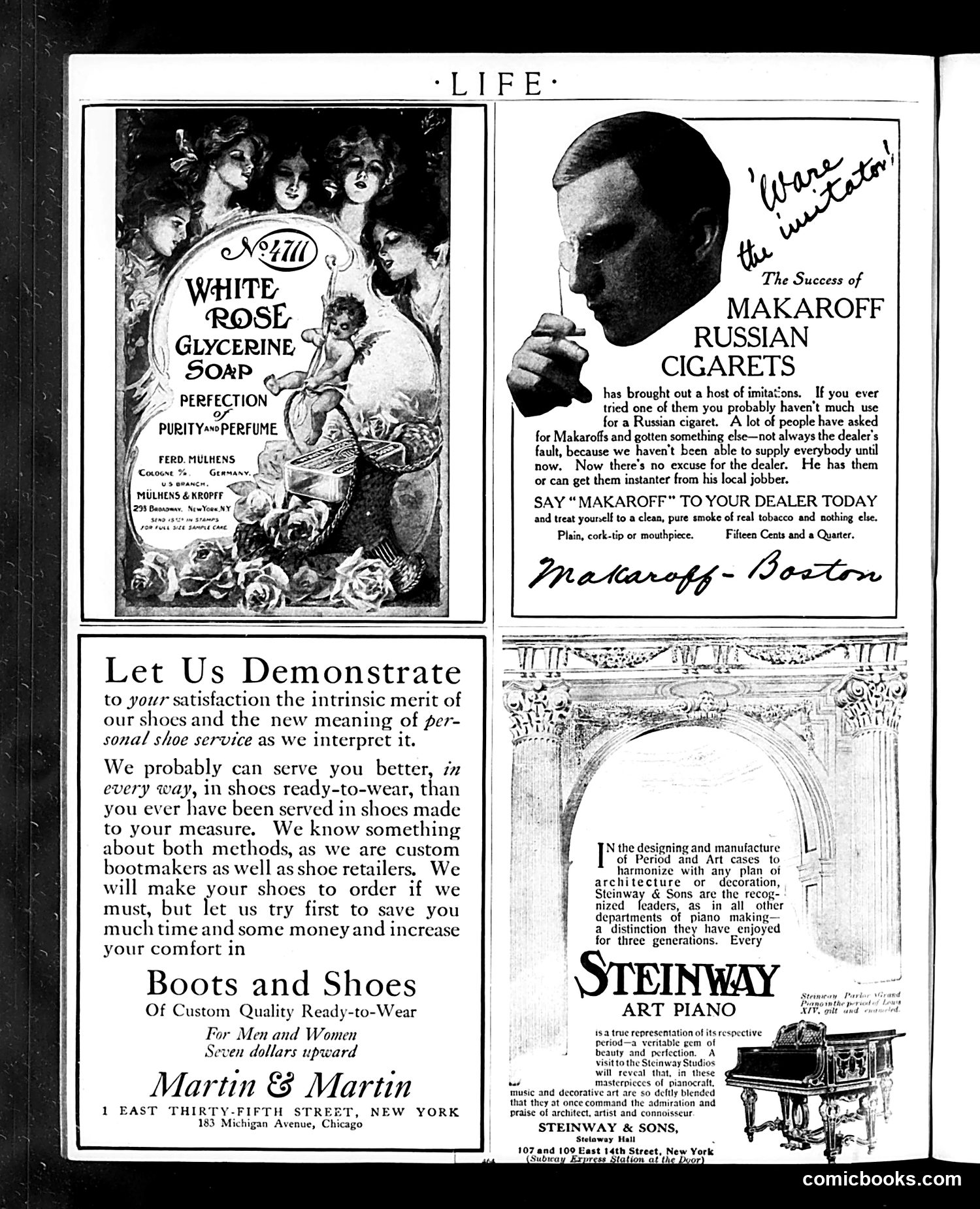
This page contains **four advertisements**, not political cartoons or satire. The ads feature: 1. **White Rose Glycerine Soap** - emphasizes "purity and perfume" with decorative imagery of women and cherubs 2. **Makaroff Russian Cigarettes** - shows a man's profile and discusses the cigarette's popularity and authenticity, addressing imitations flooding the market 3. **Martin & Martin Boots and Shoes** - promotes custom-quality ready-to-wear footwear for men and women 4. **Steinway Art Piano** - highlights the piano manufacturer's design and craftsmanship heritage These are straightforward early 20th-century product advertisements using period marketing conventions: appeals to quality, exclusivity, and consumer satisfaction. There is no satirical content or political messaging visible on this page.
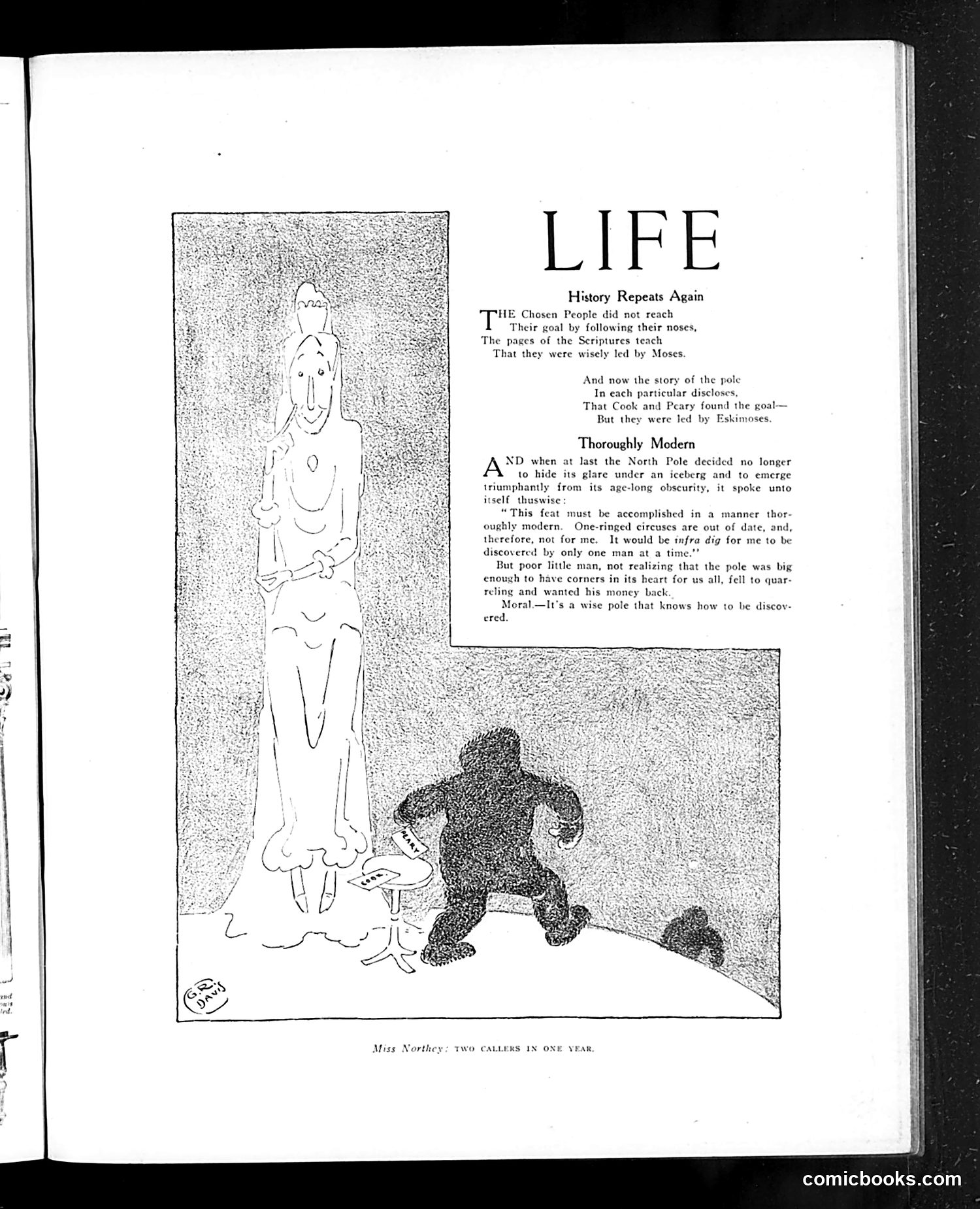
This satirical cartoon compares two polar expeditions. The text references the Chosen People following Moses to reach their goal, then contrasts this with Cook and Peary's attempts to reach the North Pole—but being "led by Eskimoses" instead. The cartoon depicts a tall, thin figure (appearing to represent a polar explorer) standing beside a darker, heavyset figure (an Eskimo guide) in an arctic setting. The caption reads "Miss Northice: Two Callers in One Year." The satire mocks the irony that famous explorers required indigenous guides to succeed, suggesting they were as dependent on native peoples as the ancient Israelites were on Moses. It's commentary on exploration mythology versus practical reality—the "modern" expeditions still needed native expertise.
This *Life* magazine page (October 7, 1909) contains editorial commentary on President Taft's tariff policies and mentions of Colonel Roosevelt's African travels. The text criticizes Taft's handling of tariff reform, particularly the wool schedule, suggesting he compromised too much with his own party rather than pushing for genuine reform. It notes Roosevelt's endorsement of Taft's Winona speech and tariff bill. The page also includes brief political profiles: Governor Johnson is praised as "likeable" and humble despite poverty origins; Otto H. Bannard, the fusion candidate for NYC Mayor, is assessed as qualified but needing to unite both Republican and Democratic constituencies for citywide appeal. The small decorative illustrations appear to be generic political vignettes rather than specific character caricatures.
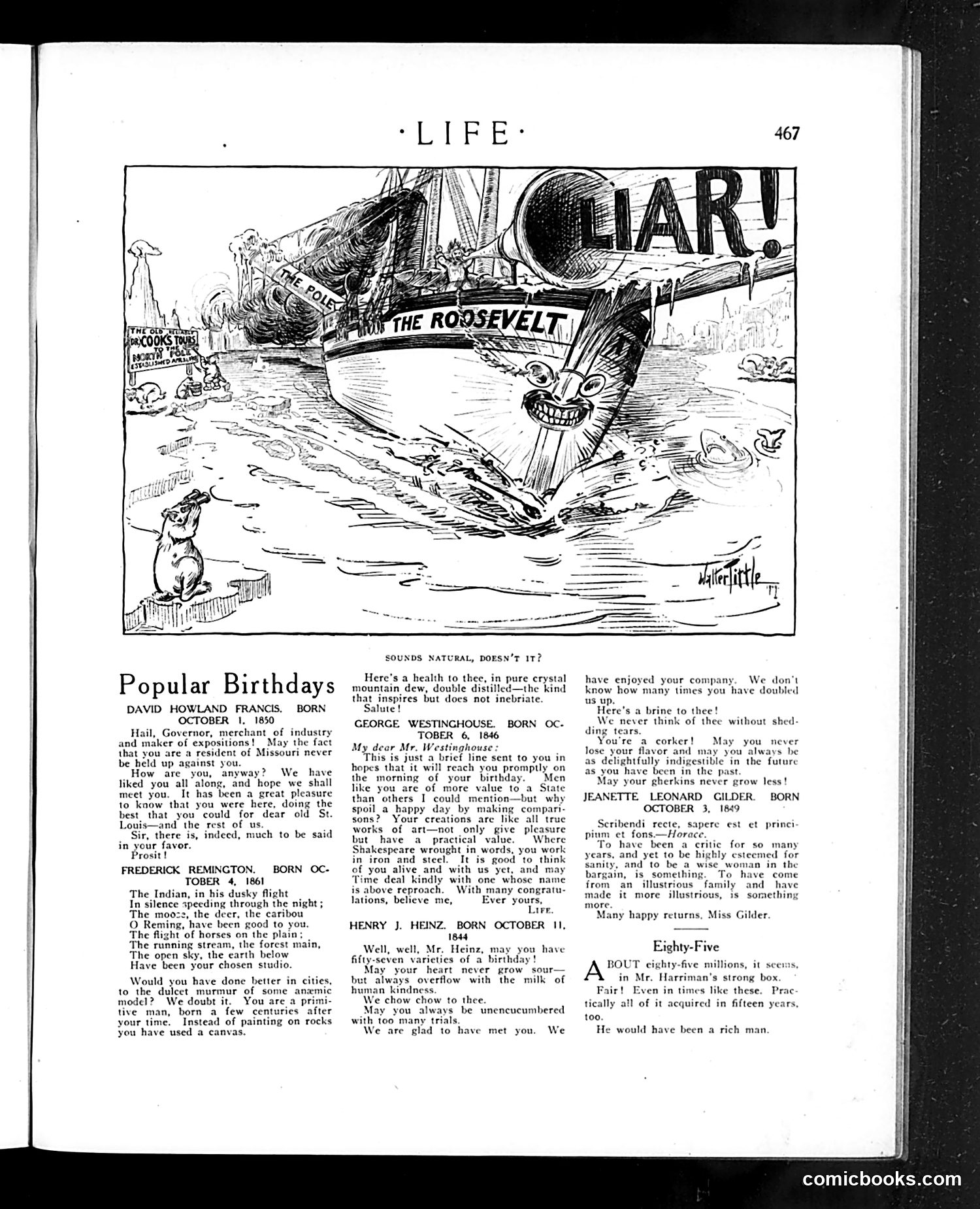
This cartoon depicts a ship labeled "THE ROOSEVELT" sinking or breaking apart in water, with a large speech bubble proclaiming "LIAR!" The caption reads "SOUNDS NATURAL, DOESN'T IT?" The satire targets Theodore Roosevelt, likely during or after his presidency (the page dates to the early 1900s based on the "Popular Birthdays" section). The cartoon suggests Roosevelt made false or exaggerated claims—a common criticism leveled against him. The sinking ship metaphor implies his credibility or political fortunes were deteriorating. The joke's effectiveness relied on contemporary readers' familiarity with Roosevelt's public statements and controversies. Without knowing the specific incident referenced, modern readers would struggle to appreciate the precise target of this satirical attack.
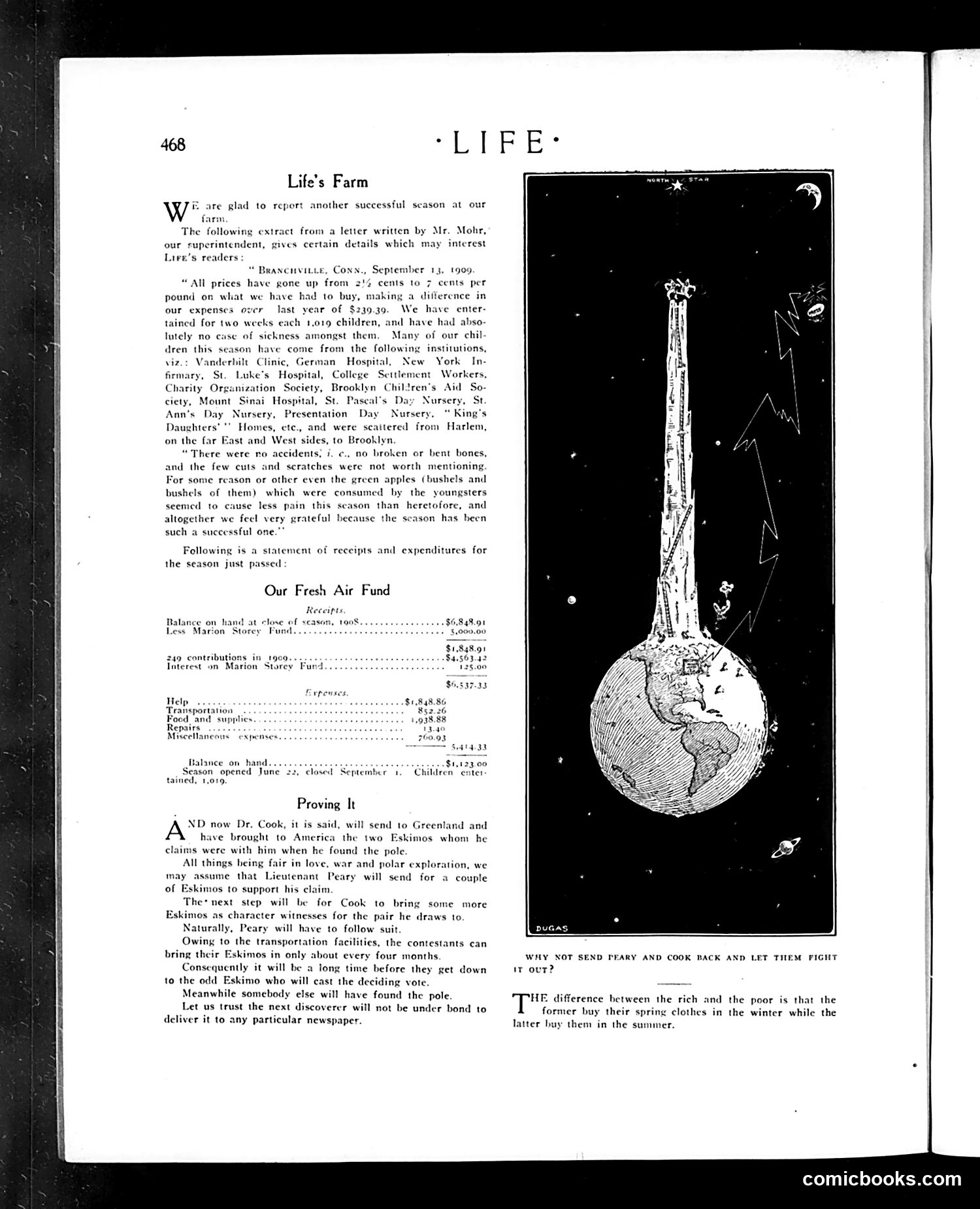
The cartoon by Dugas depicts an astronomer or explorer standing on Earth, gazing upward at a tall structure (likely representing a telescope or pole) extending into a starry sky. The caption asks: "WHY NOT SEND PEARY AND COOK BACK AND LET THEM FIGHT IT OUT?" This references the famous 1909 polar exploration controversy: both Robert Peary and Frederick Cook claimed to have reached the North Pole first. The dispute over priority was contentious and unresolved. The satire suggests settling their competing claims through physical combat rather than debate—a humorous solution to a genuine historical controversy that captivated American public attention during this period.
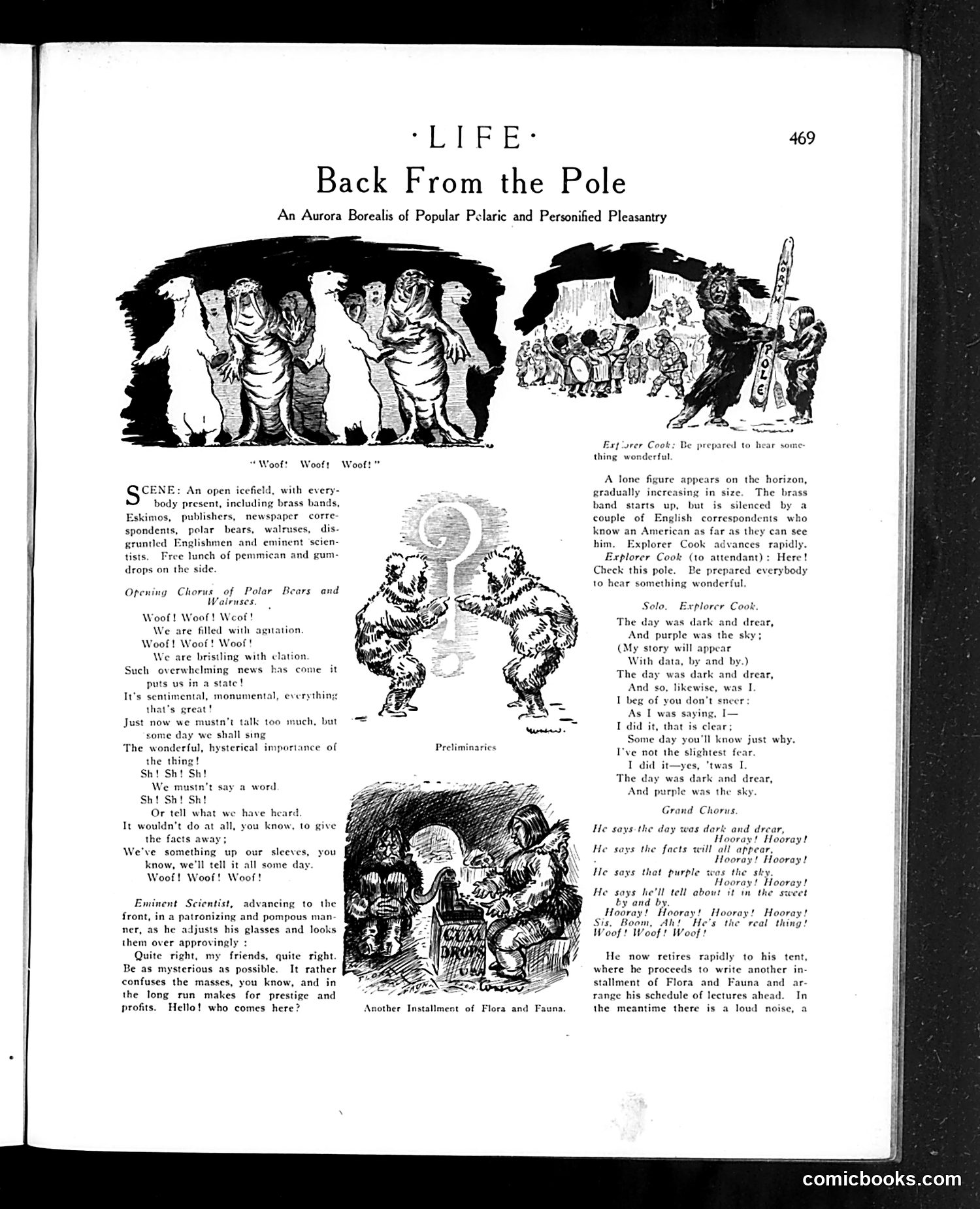
This is a satirical dramatic piece about polar exploration, featuring anthropomorphized polar bears as the main characters. The sketch mocks the grandiose reporting and public spectacle surrounding Arctic expeditions, particularly those of the early 20th century. The "Preliminaries" section shows bears discussing an expedition's arrival. The humor derives from presenting serious exploration narratives through absurd animal characters, with bears speaking in exaggerated theatrical dialogue about "dark and dreary" conditions and "purple" skies. The "Flora and Fauna" illustrations appear to satirize the pseudo-scientific documentation explorers provided to justify expensive expeditions. The overall piece mocks both the romanticization of polar exploration and the sensationalized journalism surrounding it—treating momentous geographic achievements with comedic deflation through this animal-centered parody.
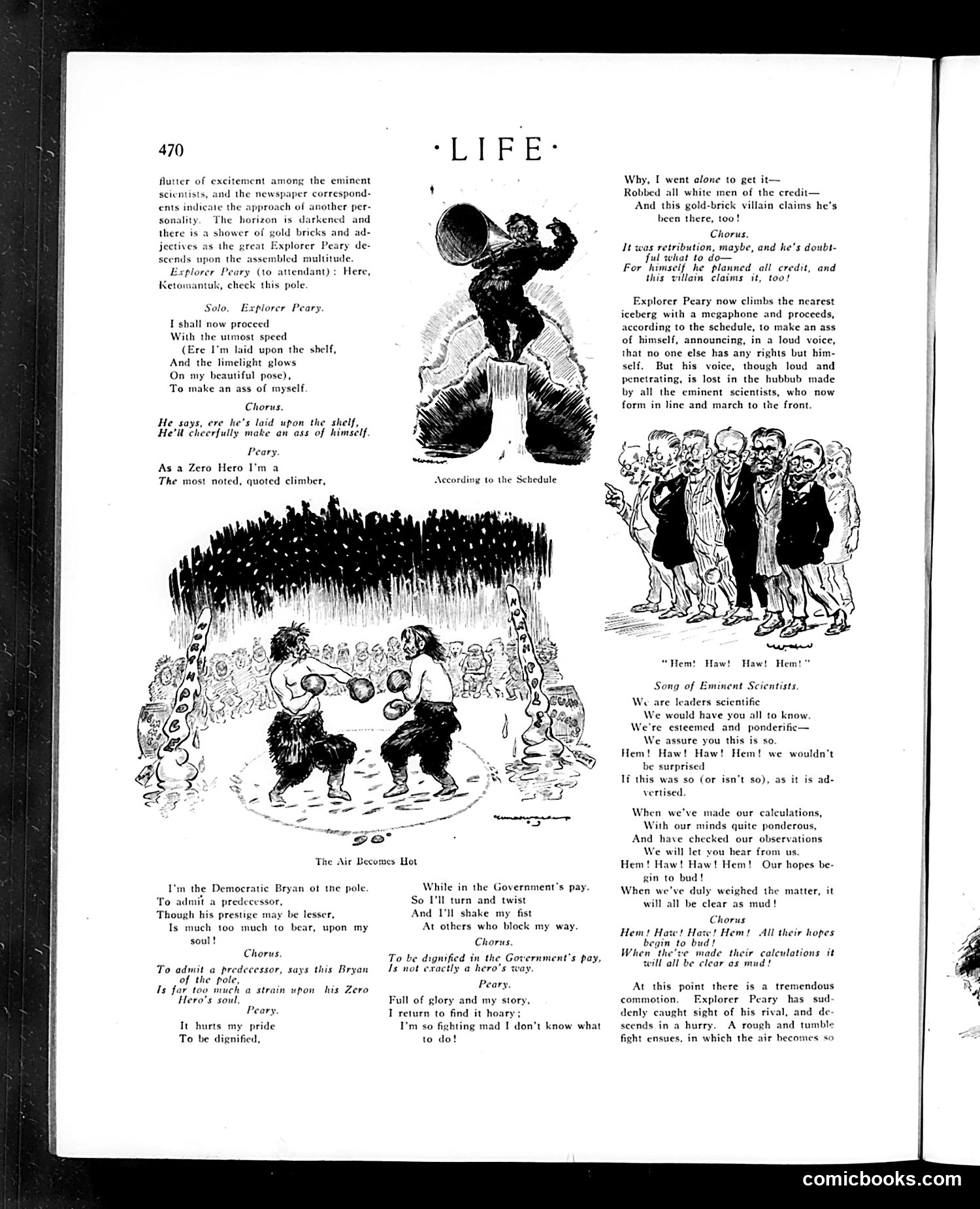
This Life magazine satire mocks explorer Robert Peary's egotistical claim to sole credit for reaching the North Pole. The cartoon depicts Peary as a "Zero Hero"—comparing him to William Jennings Bryan (the "Democratic Bryan"), a politician known for self-aggrandizing rhetoric. Peary is outraged that another explorer claims to have reached the pole first, demanding all credit for himself despite being paid by the government. The satire ridicules both Peary's vanity and the "eminent scientists" who support him with pompous, meaningless proclamations ("it will all be clear as mud"). The piece likely references the real-world dispute between Peary and Frederick Cook over who first reached the North Pole (1908-1909), satirizing how explorers and scientists scrambled for glory and credibility. The cartoon mocks ego-driven exploration and institutional hypocrisy.
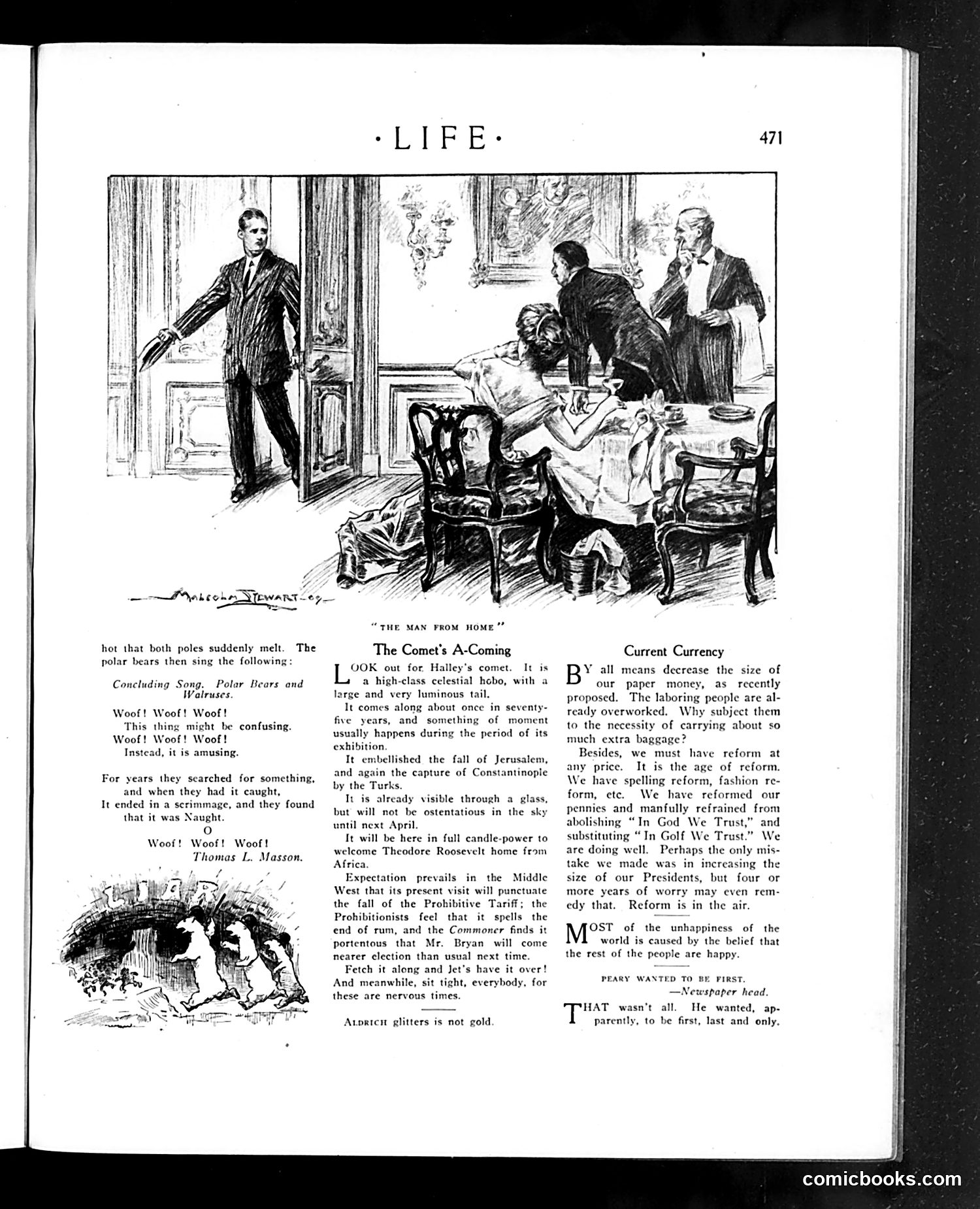
This page contains two main pieces of political satire from early 20th-century Life magazine. **"The Comet's A-Coming"** satirizes Halley's Comet's 1910 appearance by mocking how different political factions interpreted it as an omen for their causes. The text jokes that Prohibitionists saw it as signaling the end of alcohol, while supporters of William Bryan (the "Commoner") believed it portended his electoral success. Theodore Roosevelt's African return is mentioned, placing this around 1909-1910. The piece ridicules superstitious political prediction. **"Current Currency"** mockingly critiques proposed reforms to reduce paper money size, sarcastically suggesting this burdens laborers with "extra baggage." It satirizes America's obsession with reform movements (spelling reform, etc.), noting the absurdity of reforming currency size while maintaining religious phrases on coins. The illustration titled **"The Man from Home"** shows a formal interior scene, likely depicting a social situation, though its specific narrative isn't clarified in the visible text.
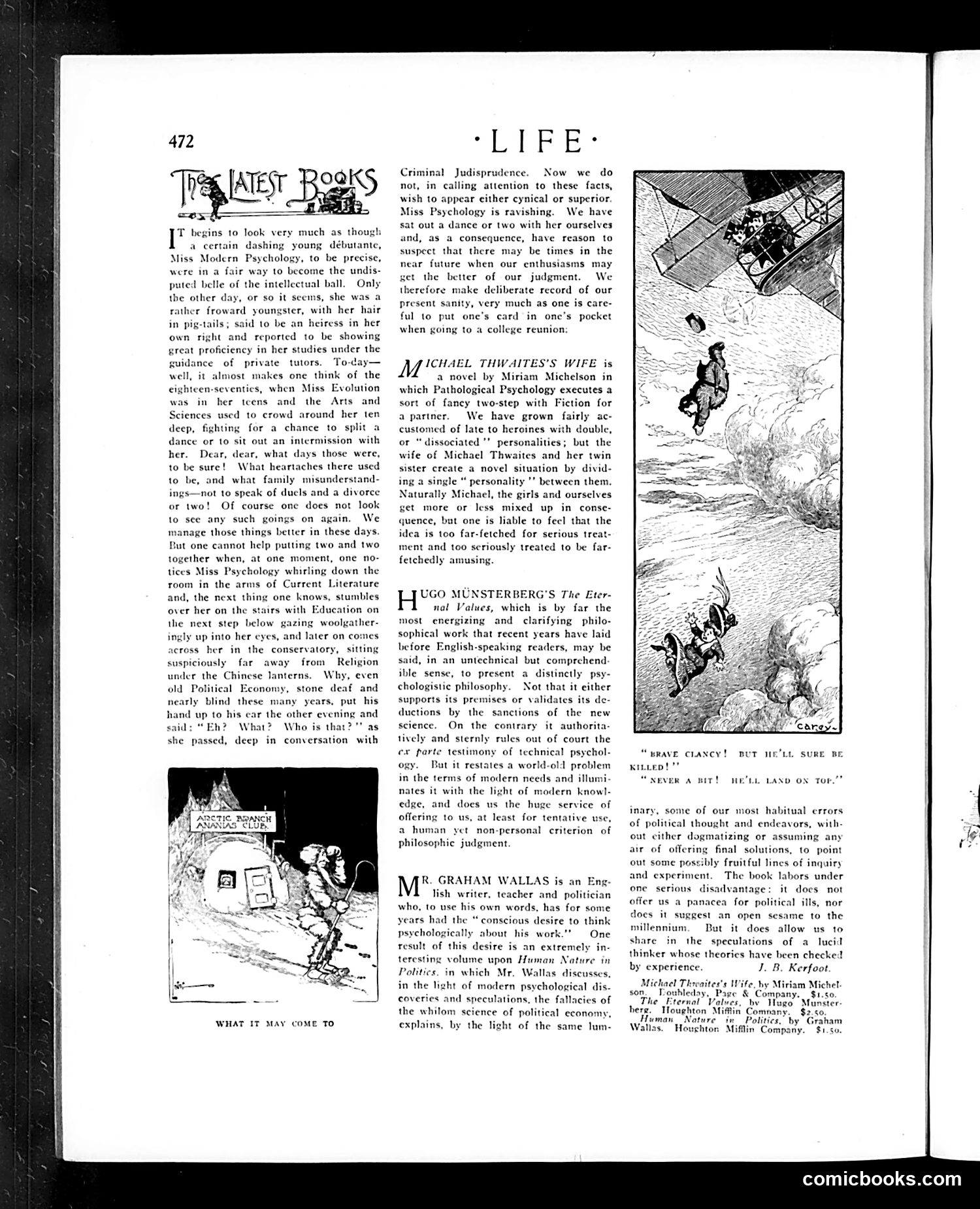
This page satirizes the sudden intellectual popularity of **Psychology as a discipline**. The main text uses extended metaphor: Psychology is personified as a young debutante who has unexpectedly become the "belle of the intellectual ball," now courted by various fields of study. The cartoon (lower left, captioned "What It May Come To") depicts this literalized: Psychology is shown flirting with multiple suitors—**Current Literature, Education, Religion, and Political Economy**—suggesting how eagerly established intellectual disciplines are adopting psychological frameworks. The satire targets the **faddish, uncritical embrace of psychology** in early 20th-century intellectual circles. The author humorously warns readers that Psychology's attractiveness may lead to poor judgment, just as romantic infatuation does, hence the advice to record one's "sanity" before Psychology becomes irresistible. The book reviews that follow reinforce this theme by discussing psychology's expanding influence in philosophy and fiction, documenting how thoroughly the discipline has infiltrated contemporary thought.
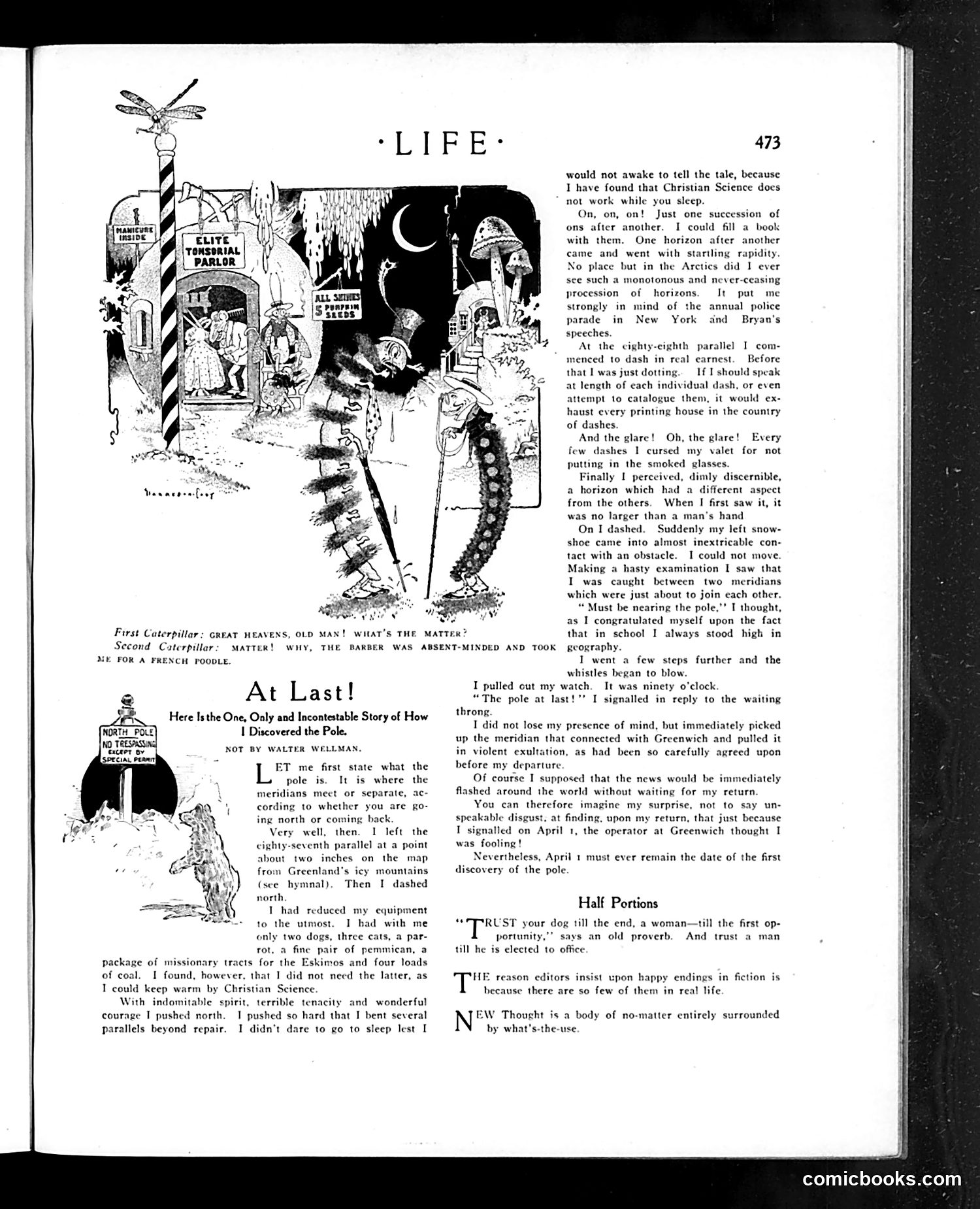
This page contains two satirical pieces mocking prominent figures and contemporary attitudes. **Top Cartoon (Caterpillars):** A joke about an absent-minded barber who mistakes a caterpillar for a French poodle and grooms it, leaving it bald. This is straightforward humor with no political reference. **"At Last!" Article:** A parody of explorer **Walter Wellman's** Arctic expeditions. The narrator claims to have discovered the North Pole using absurdly minimal equipment (dogs, cats, a parrot, Christian Science for warmth). The satire mocks both Wellman's expeditions and the era's exploration craze. The joke's punchline—signaling his discovery on April 1st (April Fools' Day), leading Greenwich operators to dismiss it as a hoax—ridicules the reliability of such claims and contemporary communication failures. **"Half Portions" Aphorisms:** Three cynical observations: dogs are loyal until opportunity tempts women to betrayal; men are trustworthy only before elected office; and editors prefer fictional happy endings because real life lacks them—commentary on political corruption, human nature, and literary escapism.
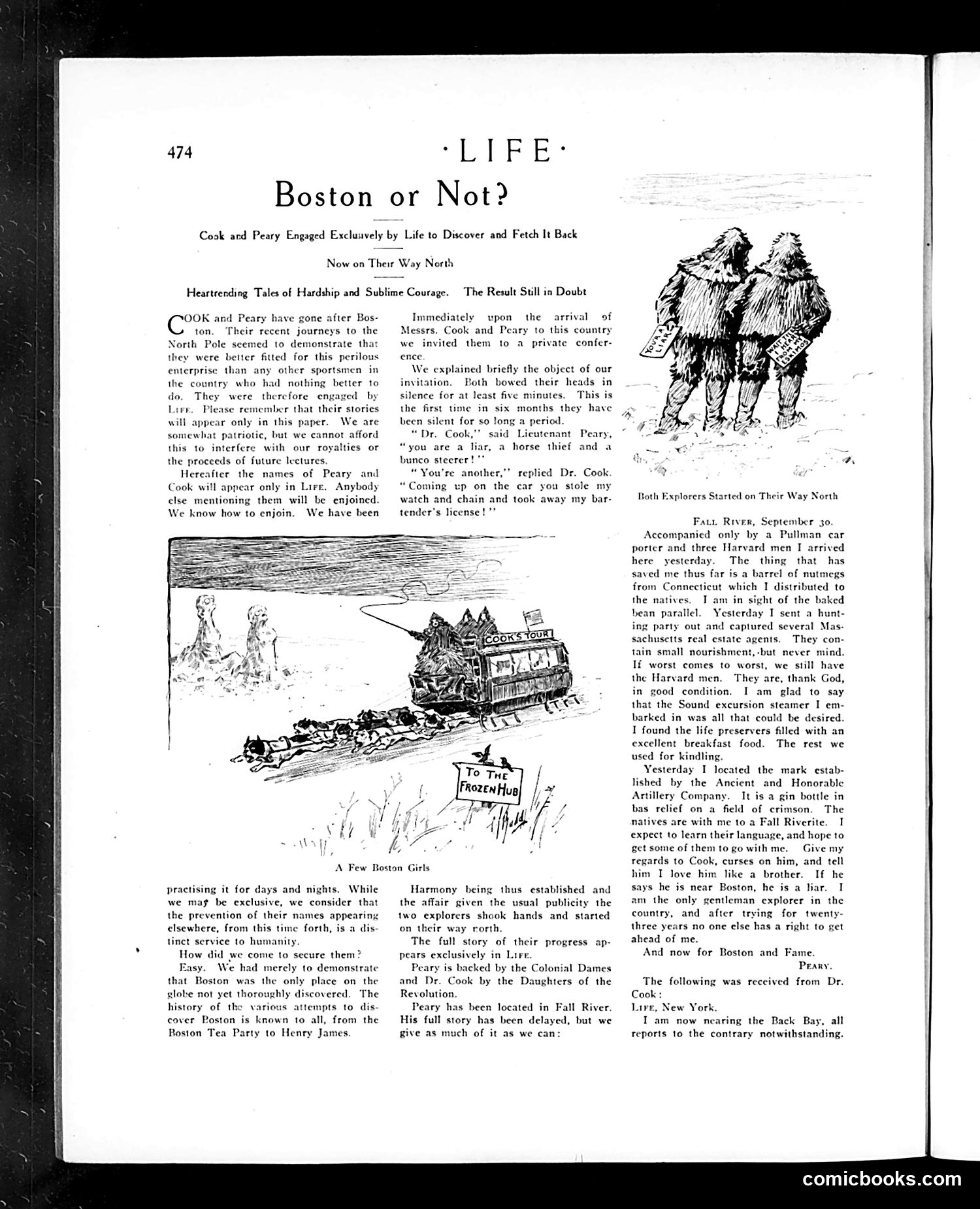
This satirical piece mocks the famous polar exploration rivalry between Frederick Cook and Robert Peary, both claiming to have reached the North Pole. Life magazine's joke: they've hired both explorers exclusively to "discover" Boston instead—treating the American city as an unexplored frontier. The satire works on multiple levels. It ridicules the explorers' bitter mutual accusations (calling each other liars and thieves), mocks Boston's cultural pretension (referencing the Boston Tea Party and Henry James), and lampoons Life's own practice of buying exclusive stories. The cartoon illustrations show the explorers' journey with comedic expedition imagery. The concluding "letter" from Peary at Fall River humorously describes Massachusetts natives and landscape features as exotic discoveries, with absurd details like life preservers filled with breakfast food. The satire ultimately skewers both the explorers' credibility and American fascination with their rivalry.
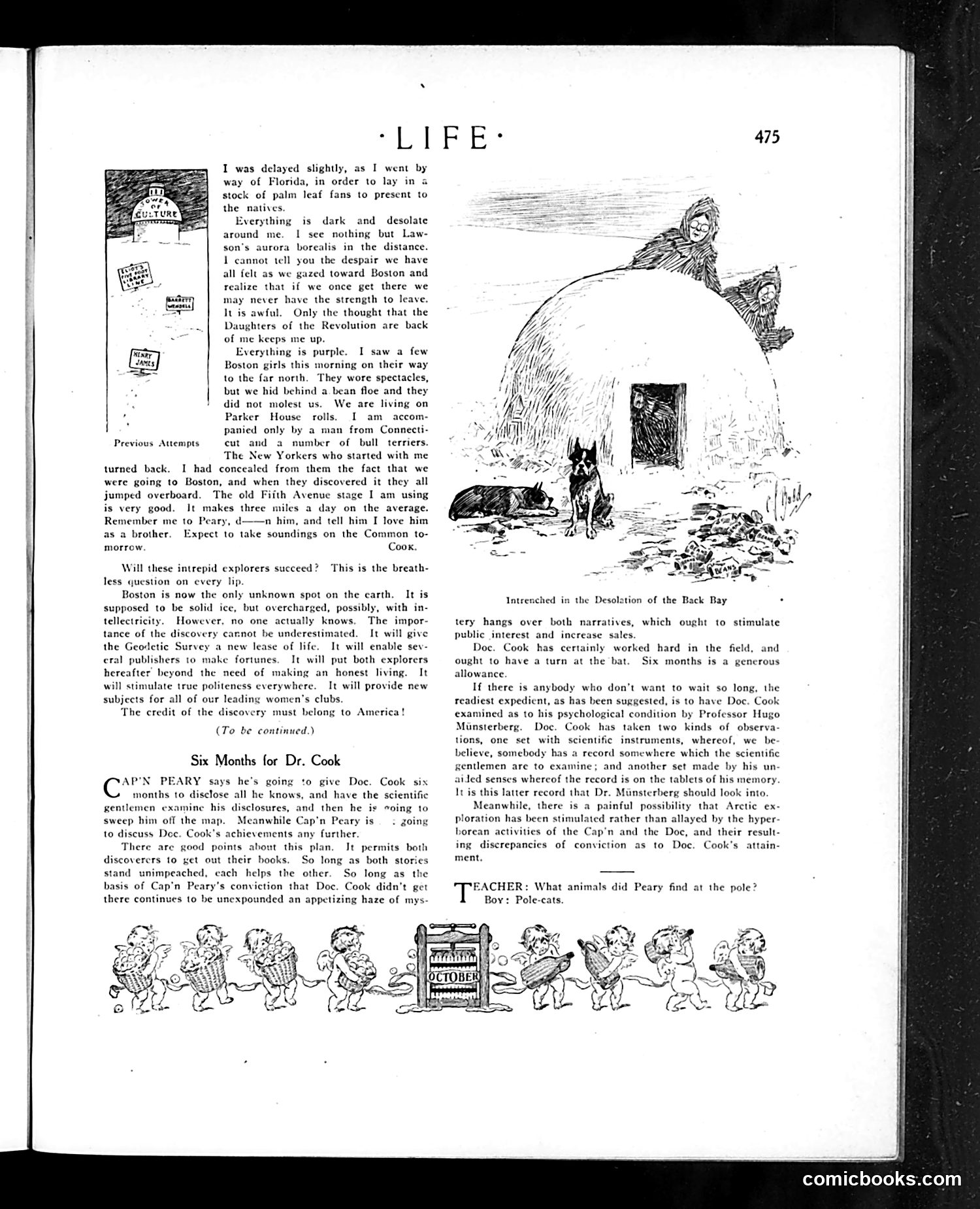
This 1909 Life magazine page satirizes the competing claims of Arctic explorers Robert Peary and Frederick Cook, who both claimed to have reached the North Pole. The main narrative (left column) mockingly presents an expedition to Boston as if it were an unexplored Arctic wasteland—a jest at Boston's remoteness and insularity from the rest of America. The humor works through absurd exaggeration: explorers traveling via "Fifth Avenue stage," encountering "pole-cats" instead of actual polar animals, and treating Boston like an undiscovered continent. References to "Lawson's aurora borealis" and "Daughters of the Revolution" add period-specific social jabs. The "Six Months for Dr. Cook" section addresses the real controversy: Peary's public dismissal of Cook's North Pole achievement. Life suggests both men's competing narratives actually *boost* book sales, and proposes Cook undergo psychological examination by Professor Hugo Münsterberg to settle the matter. The bottom joke—"TEACHER: What animals did Peary find at the pole? BOY: Pole-cats"—is a pun on the word "pole."
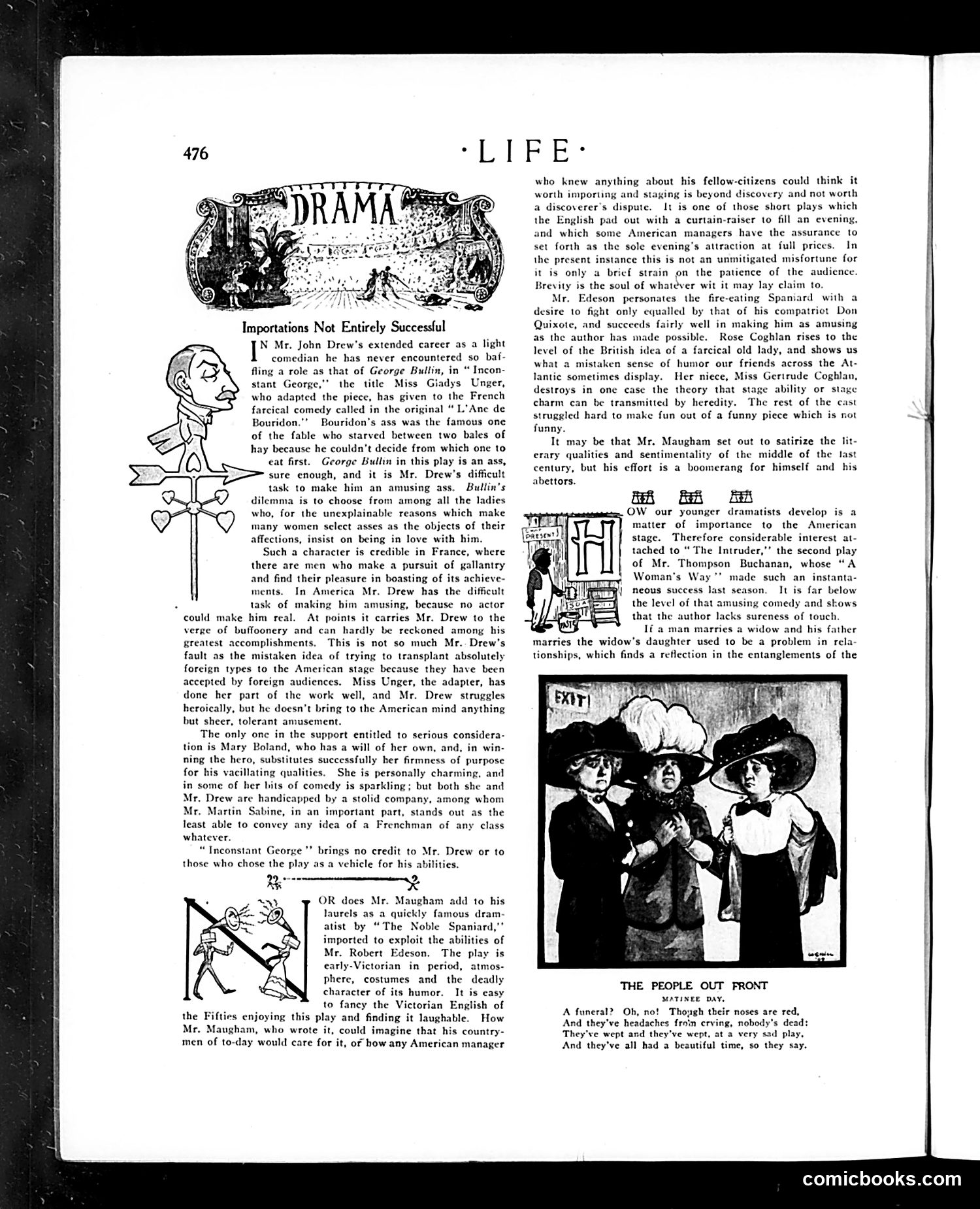
This page critiques two imported theatrical productions, revealing early 20th-century attitudes about adapting foreign plays for American audiences. **"Inconstant George"** stars light comedian John Drew in a French farce adapted by Gladys Unger. The critic argues the character—a indecisive man pursued by multiple women—works in France (where gallantry is culturally valued) but fails in America. Drew "struggles heroically" but cannot make the role genuinely amusing to American audiences unfamiliar with this social type. Only Mary Boland succeeds through her own talent. **"The Noble Spaniard"** by Somerset Maugham, starring Robert Edeson, suffers similarly. The critic deems it outdated Victorian humor (amusing to 1850s English audiences) now incomprehensible. Maugham apparently couldn't gauge modern taste; American managers showed poor judgment importing it. Both reviews reflect the widespread belief that foreign theatrical styles—however successful abroad—often fail when transplanted wholesale to American stages without cultural adaptation.
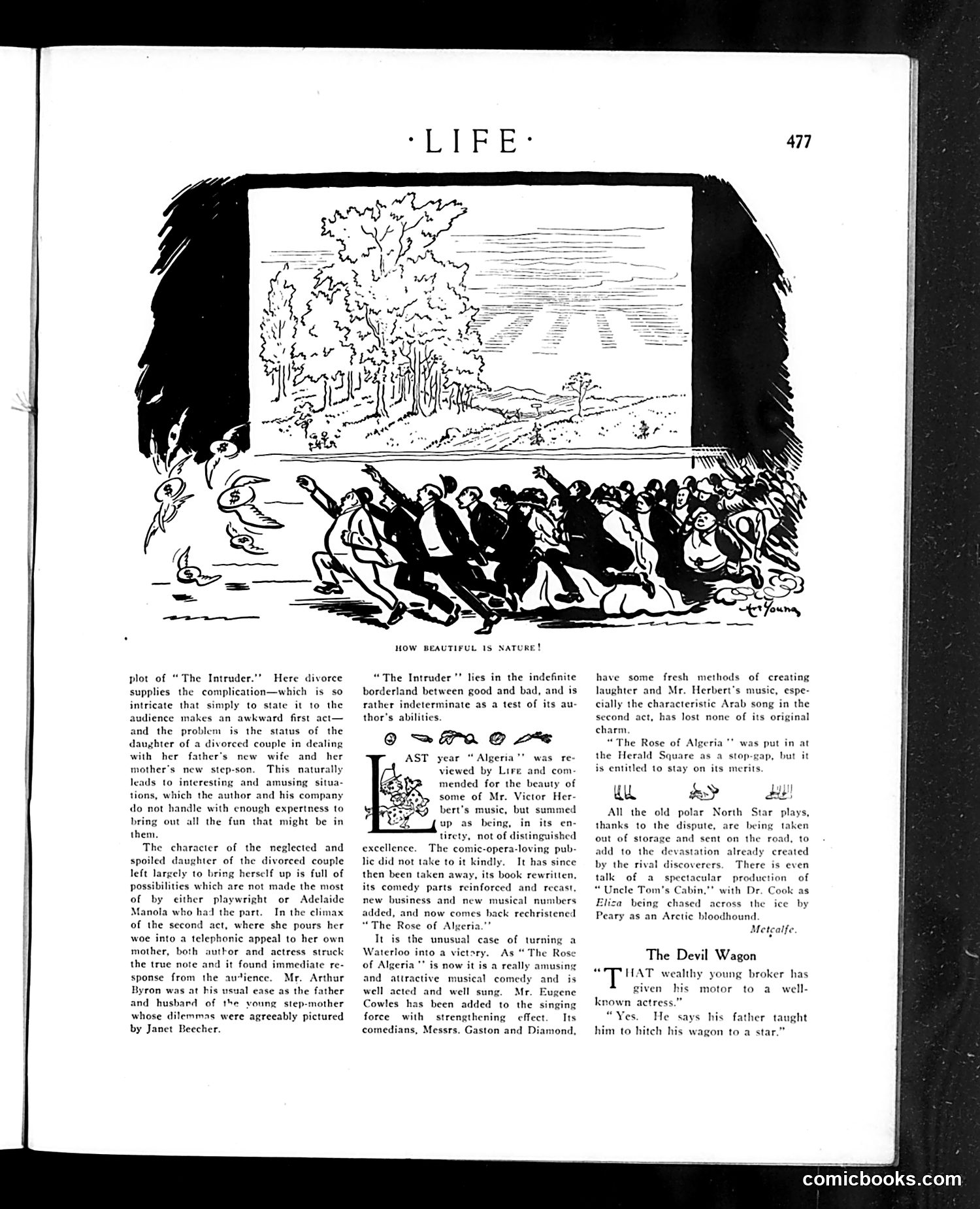
This page reviews theatrical productions from the early 1900s. The main cartoon depicts an audience watching a pastoral landscape scene—illustrating a review of "The Intruder," a play about divorce and its complications within a family. The text critiques the play's awkward exposition of its divorce plot and praises certain performances while finding the overall work mediocre. Below, a section on "The Rose of Algeria," a comic opera by Victor Herbert, celebrates its transformation from initial failure to successful revival through script rewrites and added comedians. At bottom, a humorous section satirizes the contemporary **Peary-Cook Arctic exploration controversy**—both explorers claimed to have reached the North Pole around 1909, sparking public dispute. Life mocks this by suggesting old polar plays are being revived to capitalize on the scandal, and joking that Cook chases Eliza across ice like Peary pursuing a rival. The closing joke plays on the phrase "hitch your wagon to a star"—the wealthy broker's father meant ambition; instead, his son literally hitched his motor car to an actress.
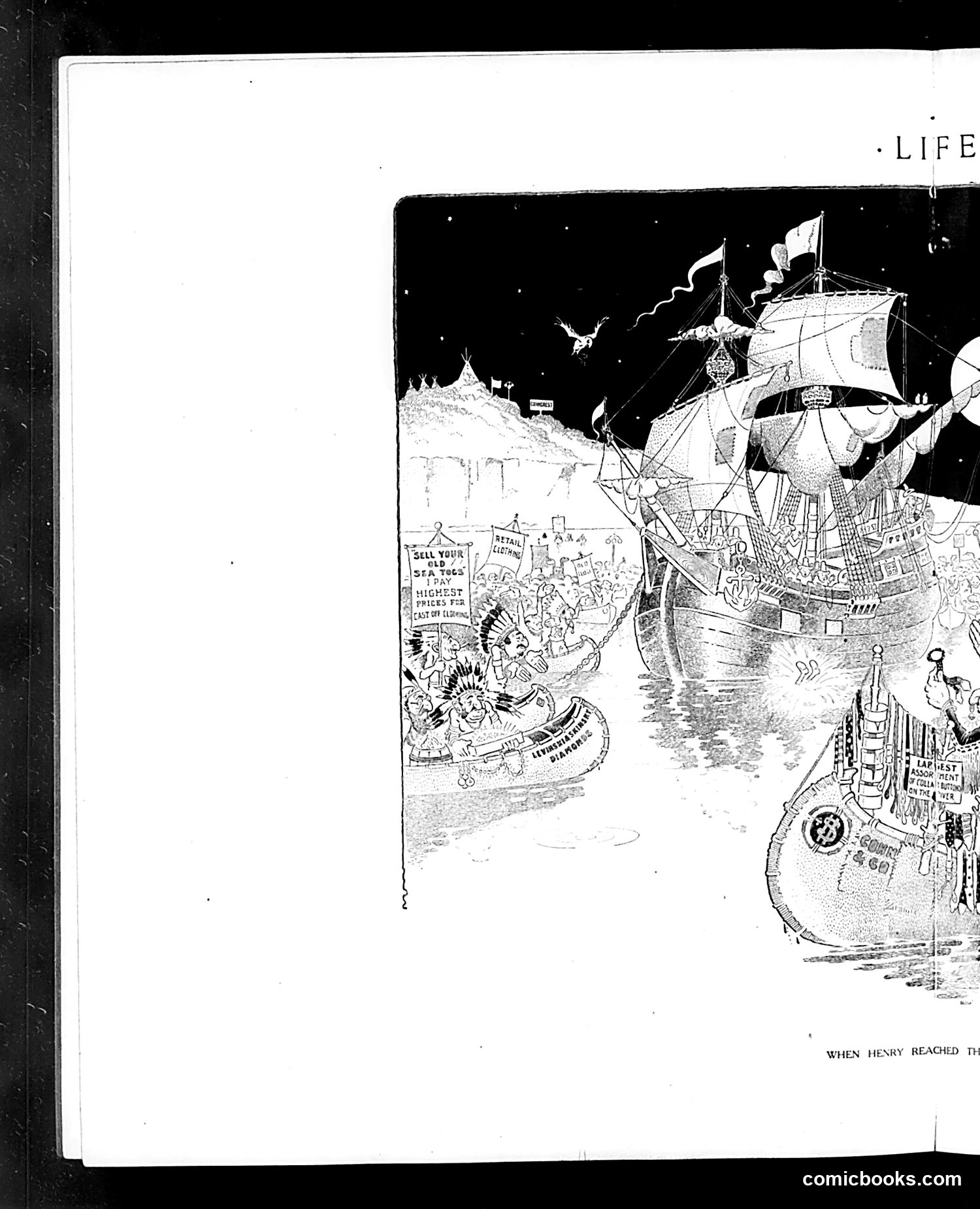
This page from *Life* magazine shows an elaborate illustration of a colonial-era harbor scene with multiple sailing ships and period figures. The text fragment "WHEN HENRY REACHED TH[E]" suggests this is part of a narrative or story sequence, likely referencing a historical figure named Henry—possibly Henry Hudson or another colonial explorer. The detailed engraving depicts what appears to be a satirical or humorous take on early American/colonial commerce and settlement, with visible shop signs and period dress suggesting economic activity or trade. However, the OCR text is too corrupted to determine the specific satire's target. Without the complete caption or article text, the precise political or social commentary remains unclear. The illustration style and composition suggest *Life*'s typical approach of blending historical reference with contemporary social commentary.
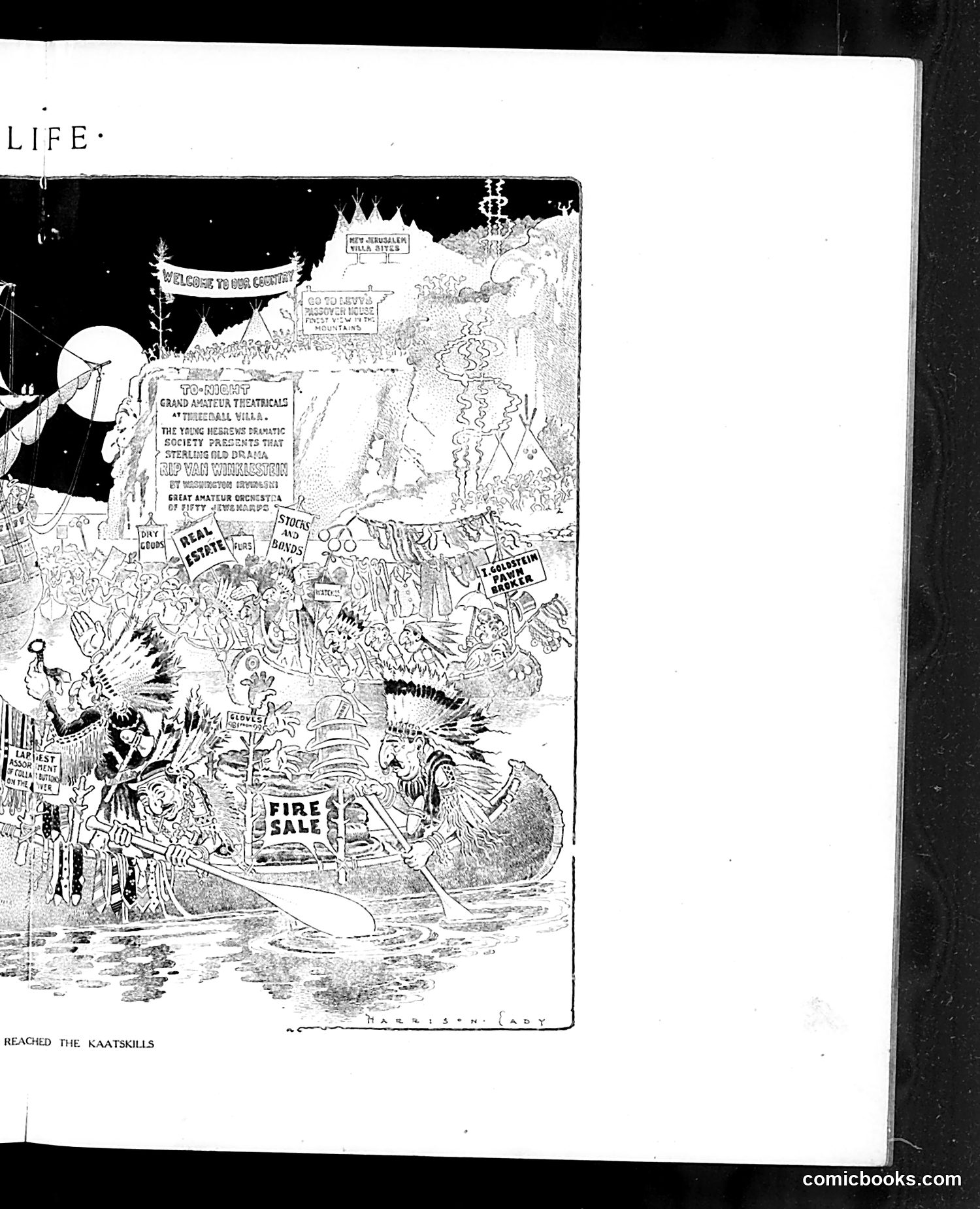
This appears to be a satirical cartoon titled "Reached the Kaatskills" depicting a crowded, chaotic scene at what looks like a popular vacation destination in New York's Catskill Mountains. The cartoon shows masses of tourists and visitors creating mayhem—with signs advertising "Fire Sale," "Real Estate," and various commercial attractions. The scene suggests satirical commentary on over-commercialization and the invasion of crowds into previously natural areas. Text boxes reference theatrical productions and amateur performances, indicating mockery of summer entertainment culture in the Catskills resort area. The overall point appears to be satirizing how popular natural destinations become overwhelmed by commercialism, crowds, and lowbrow entertainment once they become fashionable tourist spots—a familiar theme in early 20th-century American satire about leisure and mass tourism.
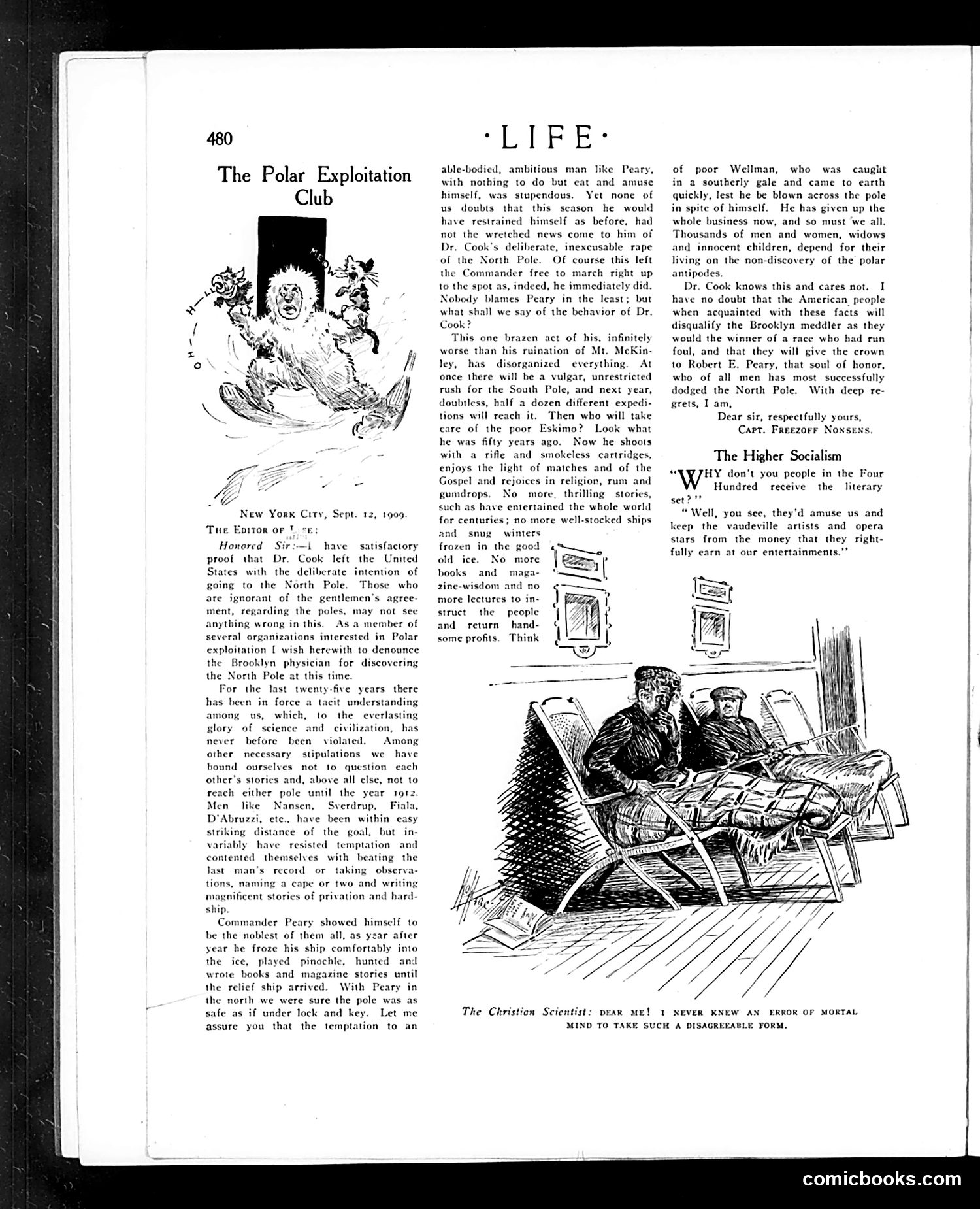
This satire mocks the bitter competition between polar explorers Dr. Frederick Cook and Robert Peary, who both claimed to have reached the North Pole in 1909. The letter writer, a fictional member of a "Polar Exploitation Club," sarcastically denounces Cook for actually *discovering* the pole—supposedly violating a gentlemen's agreement to delay polar expeditions until 1912. The joke inverts expectations: explorers are portrayed as self-interested profiteers who benefit from *untested* claims and dramatic stories, not genuine discovery. Peary is praised for his "restraint" in merely freezing his ship and writing magazine stories for profit. Cook's actual success is framed as scandal because it triggers an unseemly "vulgar, unrestricted rush" that threatens the lucrative exploration industry—and supposedly harms Eskimos by introducing modern rifles and religion instead of providing "thrilling stories." The satire critiques how polar exploration served primarily commercial and promotional interests rather than scientific advancement.
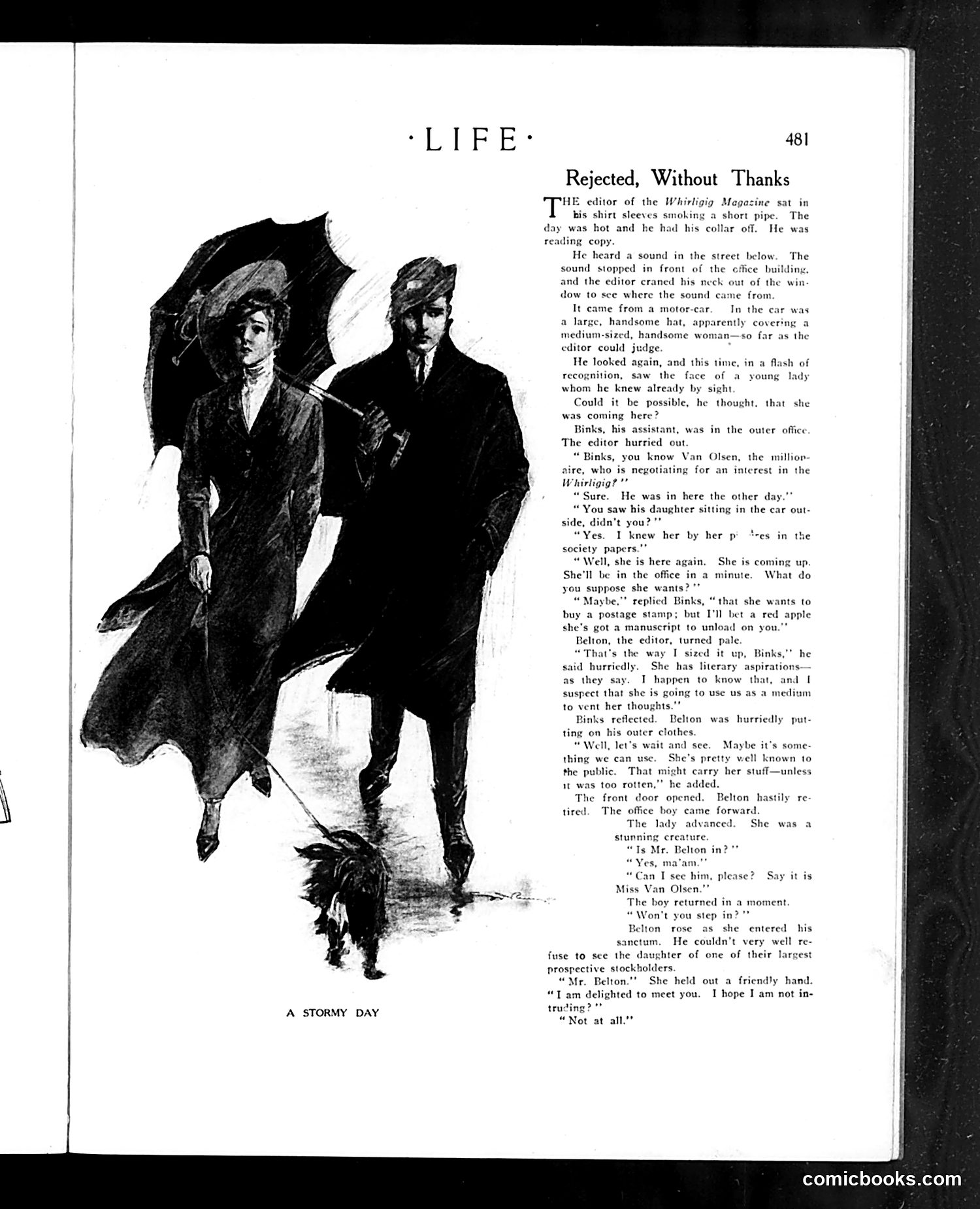
This page satirizes the publishing world's vulnerability to wealthy people's vanity projects. The cartoon illustrates a common editorial predicament: Miss Van Olsen, daughter of millionaire Van Olsen (a major prospective investor in *Whirligig Magazine*), arrives with what the editor and his assistant Binks immediately suspect is an unsolicited manuscript she wants published. The joke targets both the ambitious amateur writer and the compromised editor. Despite their professional judgment that her work will likely be poor ("too rotten"), editor Belton cannot refuse her because her father is negotiating a significant financial stake in the magazine. The illustration's title, "A Stormy Day," suggests the uncomfortable situation ahead. This satirizes how financial interests override editorial standards—a persistent publishing industry problem then and now.
This appears to be a serialized story (not a political cartoon) about editorial integrity. The narrative depicts editor **Belton** confronting pressure to publish an inferior manuscript submitted by **Miss Van Olsen**, a socially prominent woman whose father is apparently a major advertiser or investor ("Van Olsen is here...People will recognize just why we are using it"). The central conflict is between professional standards and business pressure. Belton refuses the proprietor's request to publish "rotten" work simply because Van Olsen's family holds financial influence over the magazine. Belton argues this compromises editorial independence: "They will think we are owned body and soul." For modern readers, this reflects early 20th-century tensions between journalism ethics and commercial interests—issues still relevant today regarding advertiser influence on editorial decisions. The story satirizes how social prominence and financial power attempt to override merit-based publishing standards.
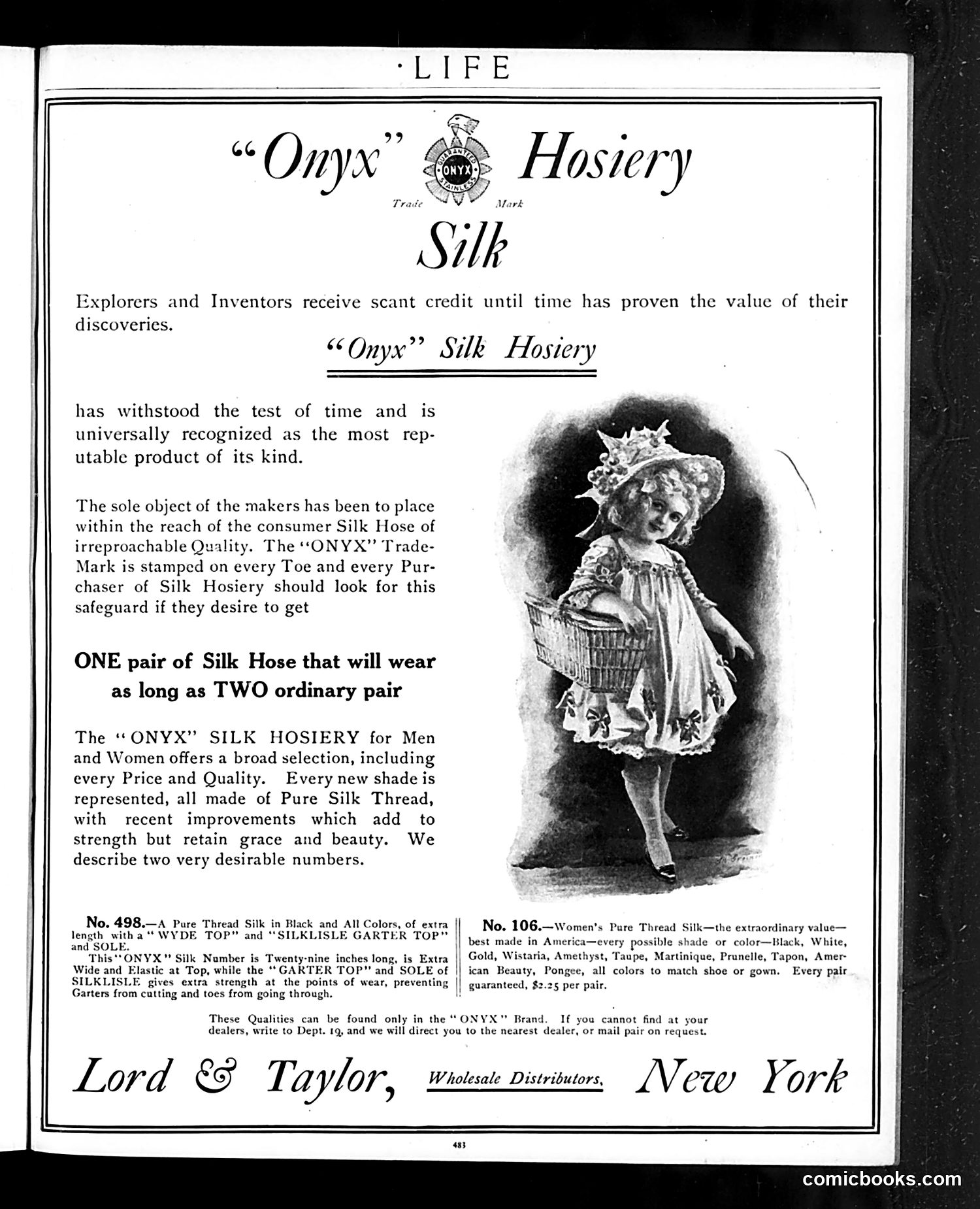
This is primarily an **advertisement for Onyx brand silk hosiery**, not a political cartoon. The page appears in Life magazine and promotes women's and men's silk stockings. The only illustrative element is a sketch of a fashionable woman in early 20th-century dress modeling the hosiery. The advertisement uses the opening line about "Explorers and Inventors" receiving scant credit to create a rhetorical parallel: just as innovations prove themselves over time, Onyx hosiery has "withstood the test of time" and earned recognition as superior. The copy emphasizes durability ("one pair will wear as long as two ordinary pairs"), quality materials ("pure silk thread"), and the importance of checking for the Onyx trademark. Two specific product numbers are described with available colors and prices ($2.25 per pair). Lord & Taylor of New York is listed as the wholesale distributor. This is straightforward commercial advertising with no satirical content.
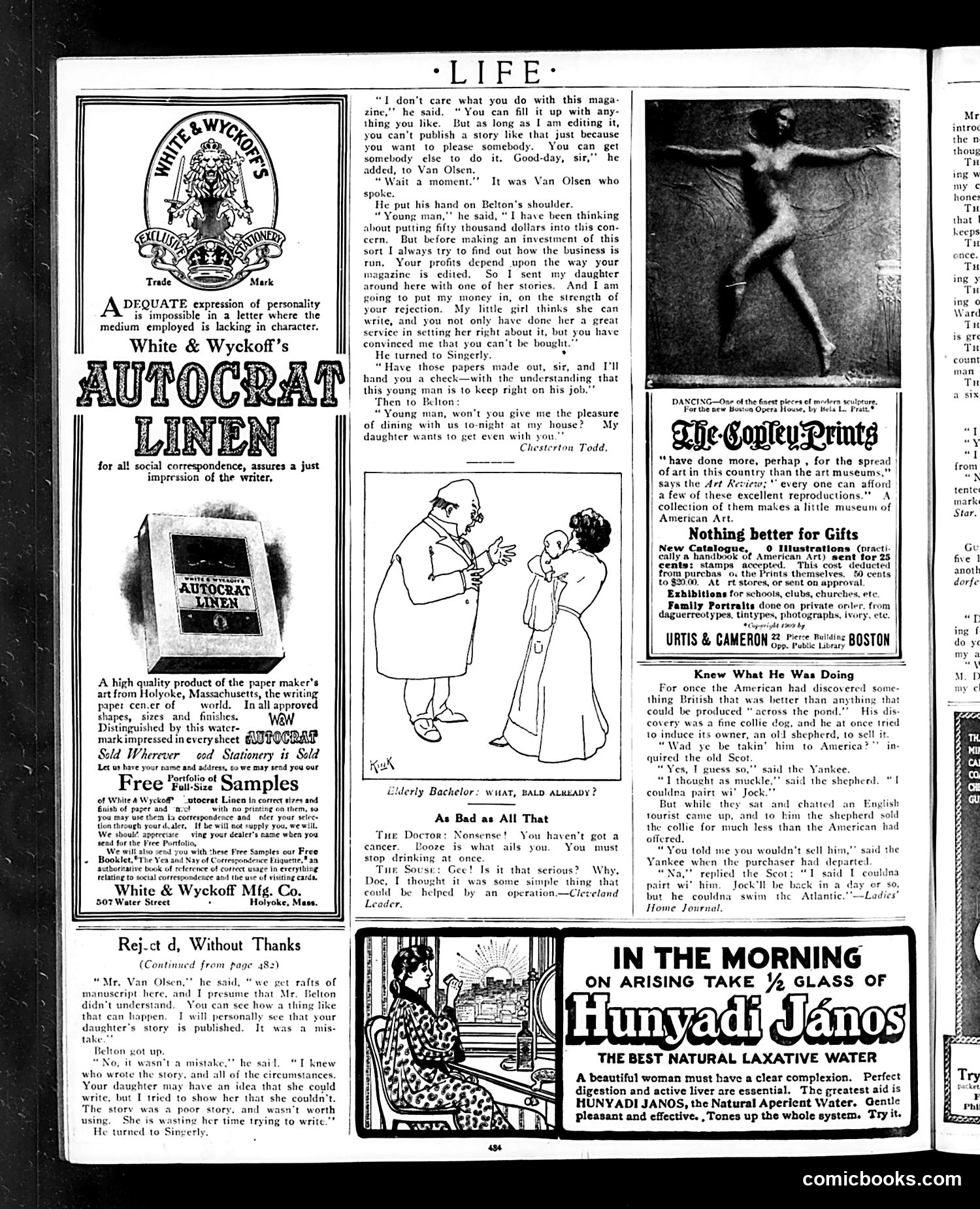
This page contains a narrative story about editorial integrity at a magazine. A wealthy investor (Van Olsen) tests the editor (Belton) by submitting a poorly-written story from his daughter, intending to gauge the magazine's standards. When Belton rejects the story despite knowing Van Olsen's financial interest, the investor is impressed—not insulted—by this principled stance. Van Olsen rewards Belton's refusal to compromise editorial standards by investing fifty thousand dollars anyway. The satire targets the tension between commercial pressures and journalistic integrity. The joke is that honest business practices—rejecting mediocre work regardless of financial incentive—ultimately prove more profitable than editorial compromise. This reflects Progressive Era concerns about corporate influence on publishing. The page also includes period advertisements (Autocrat Linen, art prints, laxative water) typical of early 1900s magazines.
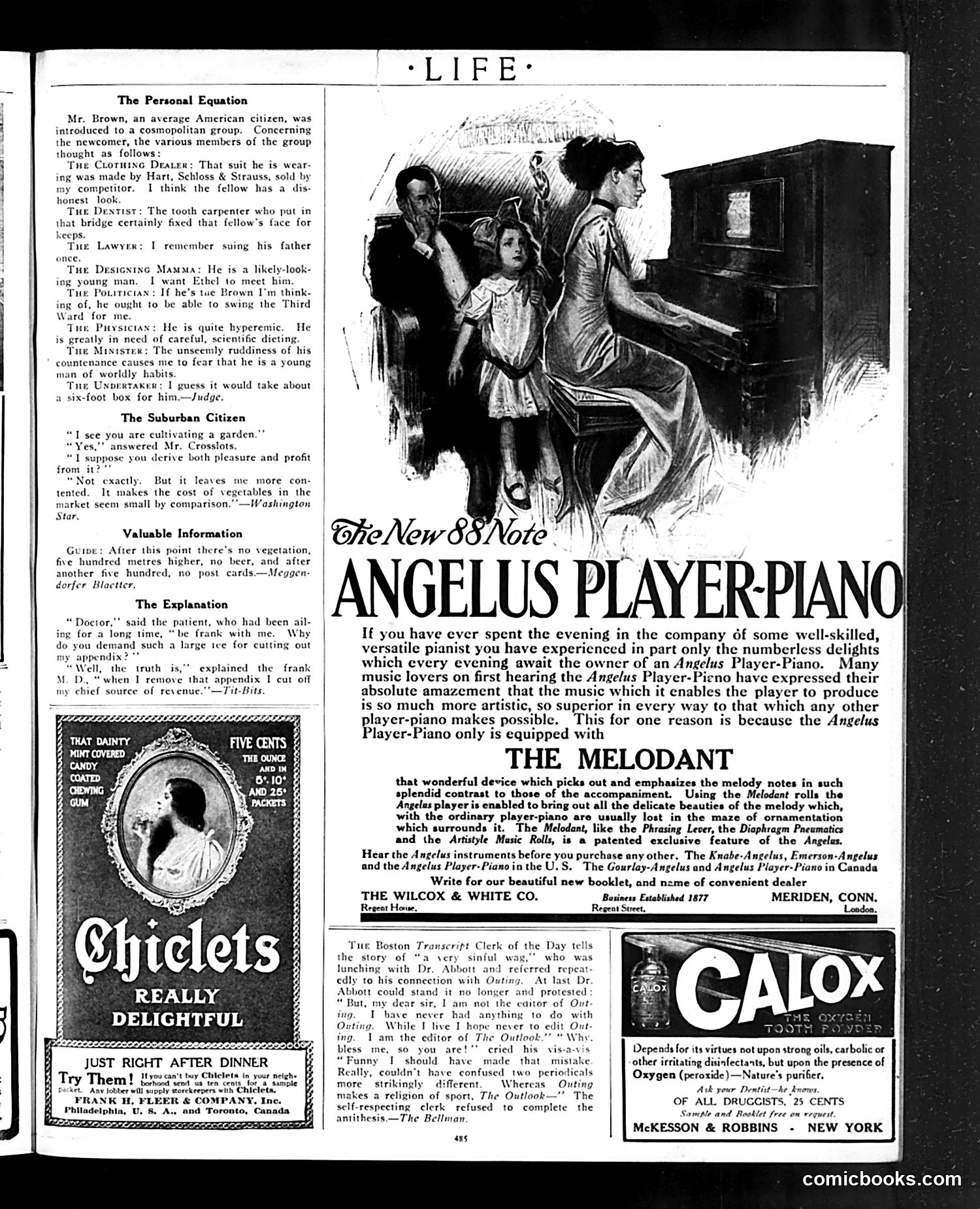
This satirical piece presents six professionals' snap judgments of an average citizen named Mr. Brown, each filtered through their own commercial or professional interests. The joke exposes how people interpret others entirely through self-interest rather than objective observation: - The **clothing dealer** suspects dishonesty because Brown wears a competitor's suit - The **dentist** fixates on his bridgework - The **lawyer** recalls suing his father - The **politician** sees a potential voter to manipulate - The **physician** diagnoses poor health from his complexion - The **undertaker** estimates his casket size The satire mocks how professionals project their narrow expertise and commercial concerns onto strangers, unable to see people as complete human beings. Each character's commentary reveals more about their own preoccupations than about Brown himself—a sharp critique of American commercial culture's reductive nature.
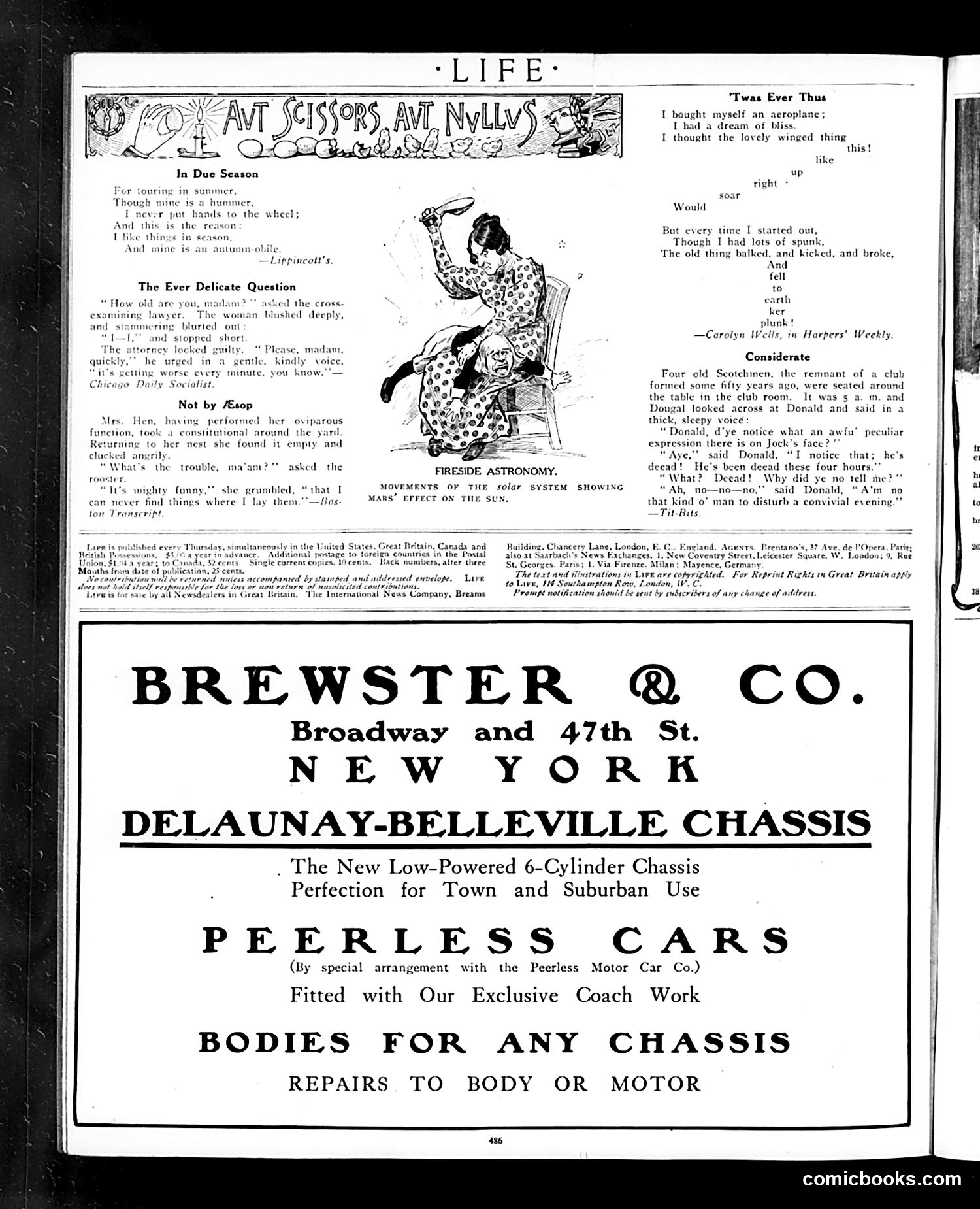
This is primarily an **advertising page** with several short humorous pieces interspersed. The main content includes: **The Cartoons/Jokes:** - "'Twas Ever Thus": A man buys an airplane expecting bliss, but it constantly breaks down—satirizing the unreliability of early aviation technology - "The Ever Delicate Question": A lawyer awkwardly asks a woman her age in court; she refuses to answer—poking fun at outdated courtroom etiquette and gender sensitivity - "Not by Aesop": A hen finds her empty nest; the rooster explains eggs disappear—a farmyard joke about forgetfulness - "Fireside Astronomy": Four old Scottish men notice their friend appears dead but don't disturb his "convivial evening"—dark humor about Scottish drinking culture and social politeness - "Considerate": Similar Scottish joke about not interrupting **The Advertisement:** The lower half showcases **Brewster & Co.** (Broadway, NYC), advertising Delaunay-Belleville chassis and Peerless automobiles—early 20th-century luxury vehicles. The humor reflects period concerns: aviation skepticism, gender politics, and ethnic stereotypes (Scots portrayed as heavy drinkers).
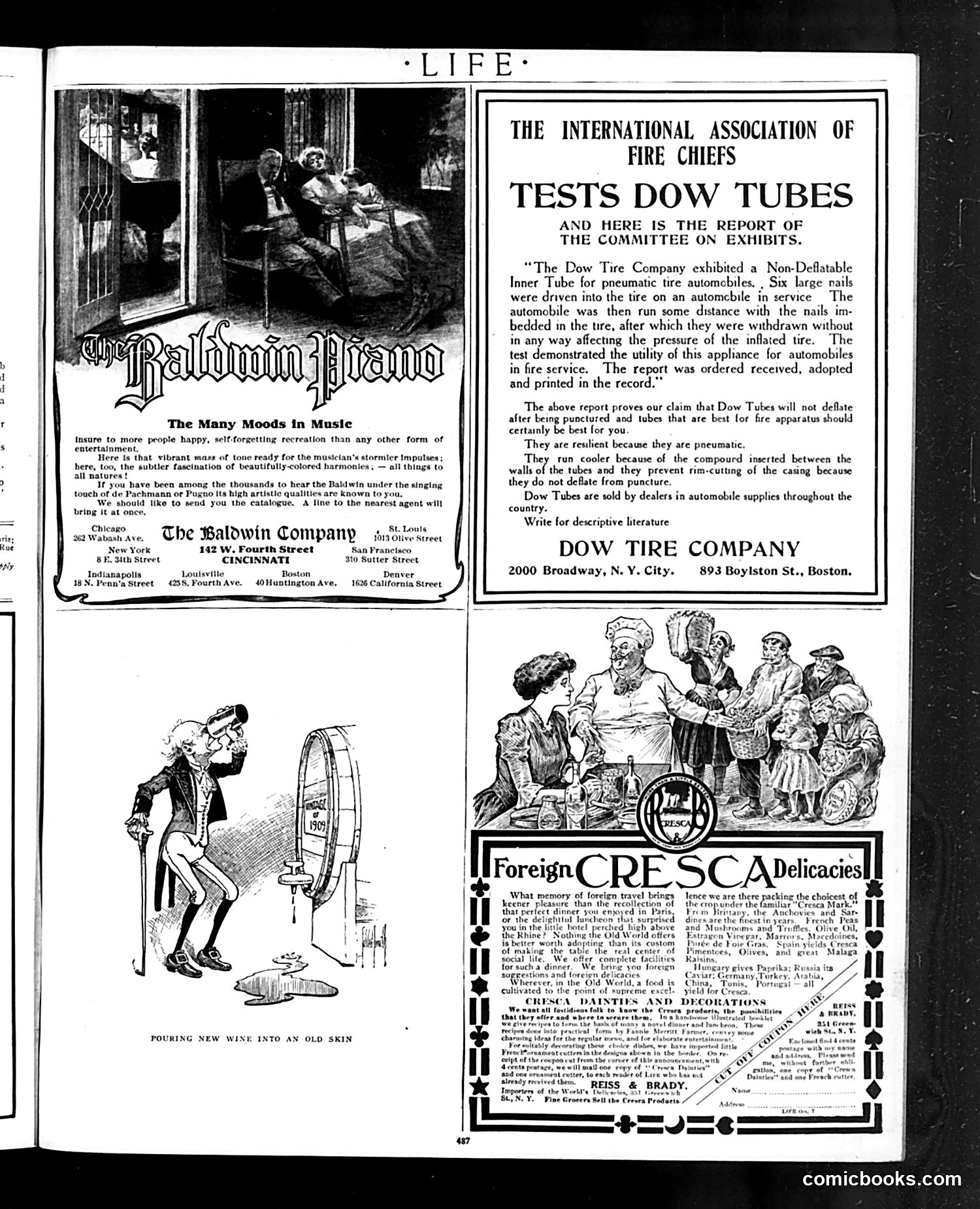
This page is primarily **advertising**, not political satire. It contains: 1. **Baldwin Company ad** (top left): Musical instrument manufacturer promoting pianos, emphasizing emotional range in music. 2. **Dow Tire Company ad** (top right): Features a formal report from the International Association of Fire Chiefs testing puncture-resistant inner tubes. Six nails were driven into a tire; after removal, the tire maintained pressure. The ad argues these tubes are superior for both fire apparatus and consumer automobiles. 3. **"Pouring New Wine Into an Old Skin"** (bottom left): A cartoon illustration showing a man pouring wine into what appears to be an old wineskin—a visual pun on the biblical idiom about incompatibility. 4. **Cresca Delicacies ad** (bottom right): Advertisement for imported food products (anchovies, truffles, oils) targeting nostalgic travelers. The page reflects early 20th-century consumer advertising rather than political commentary.
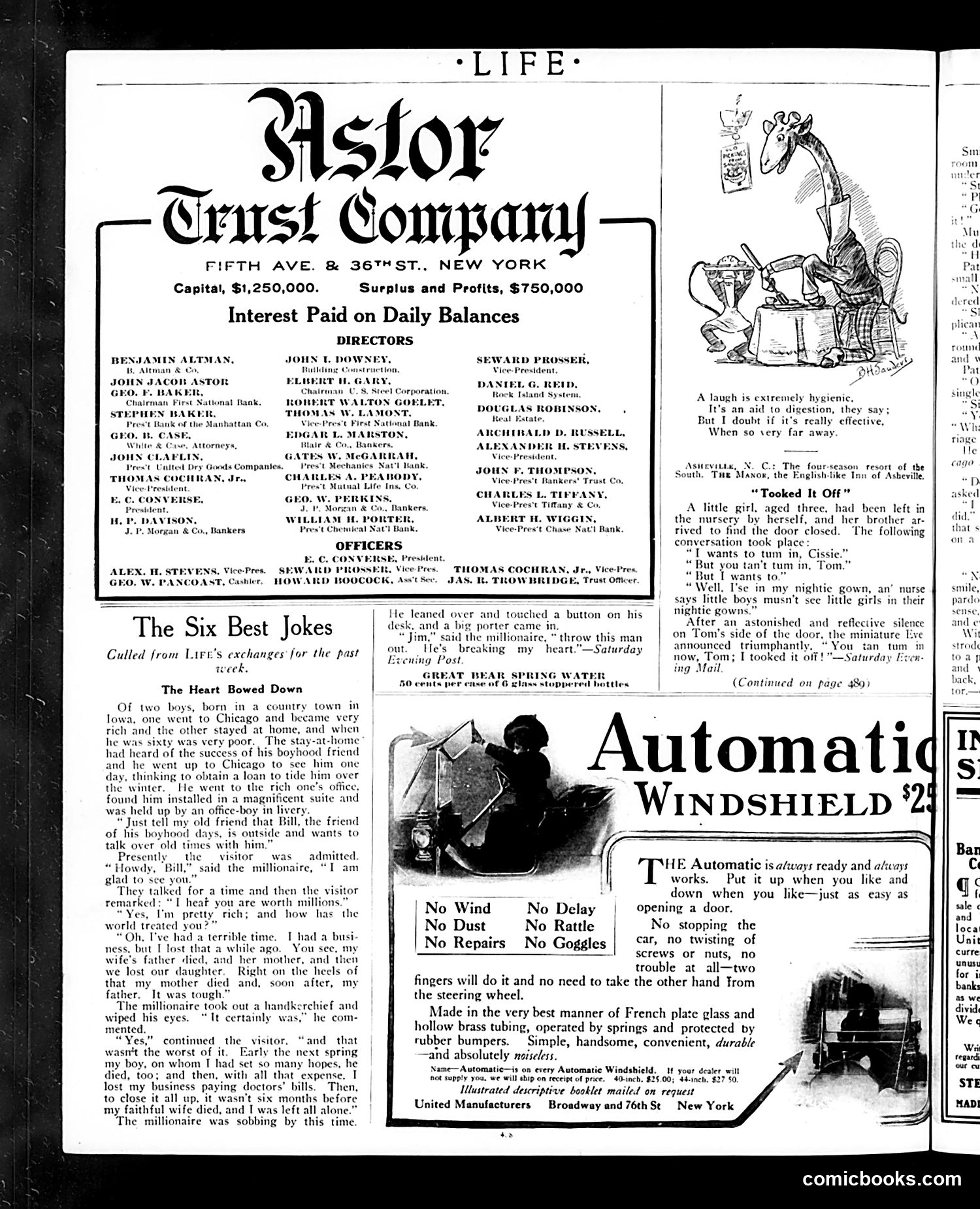
This page is primarily **advertising and business notices** rather than editorial satire. The top features an **Astor Trust Company bank advertisement** listing officers and financial details (Fifth Avenue, New York). Below are "**The Six Best Jokes**"—humorous anecdotes collected from Life's readers. The main story, "The Heart Bowed Down," contrasts two childhood friends: one who became wealthy in Chicago, the other who remained poor in Iowa, experiencing personal tragedies (deaths of family members, lost business). When the poor man visits his rich friend seeking a loan, the wealthy man weeps upon hearing of these hardships—a sentimental joke playing on emotional manipulation and class difference. The page also includes an **Automatic Windshield advertisement** featuring a photograph of early automotive windshield technology, emphasizing convenience and ease of use ("no wind, no dust, no repairs"). Overall, this is a typical early 20th-century magazine page mixing light humor with commercial content rather than political commentary.
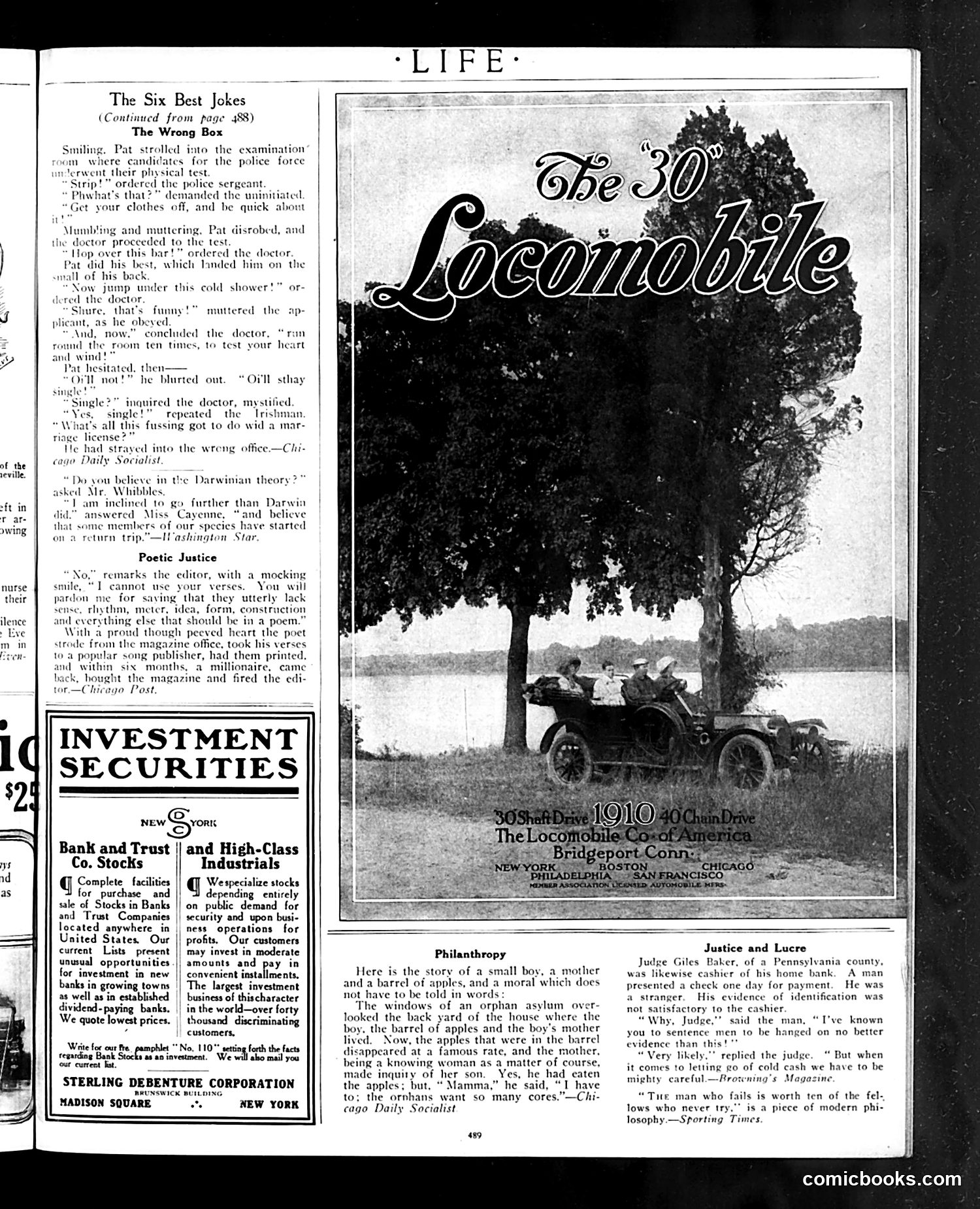
This page contains humor pieces and advertisements typical of early 20th-century Life magazine. **"The Six Best Jokes"** presents four brief comedic anecdotes: 1. **"The Wrong Box"** — An Irish immigrant (Pat) applying for the police force misunderstands the medical examination, thinking the sergeant's command to "strip" relates to undressing rather than a surname. This plays on ethnic stereotypes about Irish immigrants and language confusion. 2. **Darwin reference** — A woman claims to believe in Darwinian evolution "further" than Darwin himself, suggesting some humans are "returning" to primitive states—a satirical jab at contemporary social attitudes. 3. **"Poetic Justice"** — A rejected poet, vindicated when his rejected verses become a popular song, buys the magazine and fires the editor. It's anti-intellectual satire about commercial success trumping artistic merit. 4. **Philanthropy anecdote** — A boy steals apples from an orphan asylum, justifying it by saying orphans "have" the cores. Dark humor about poverty and rationalization. The page is primarily advertising, with investment securities and banking promotions occupying significant space.
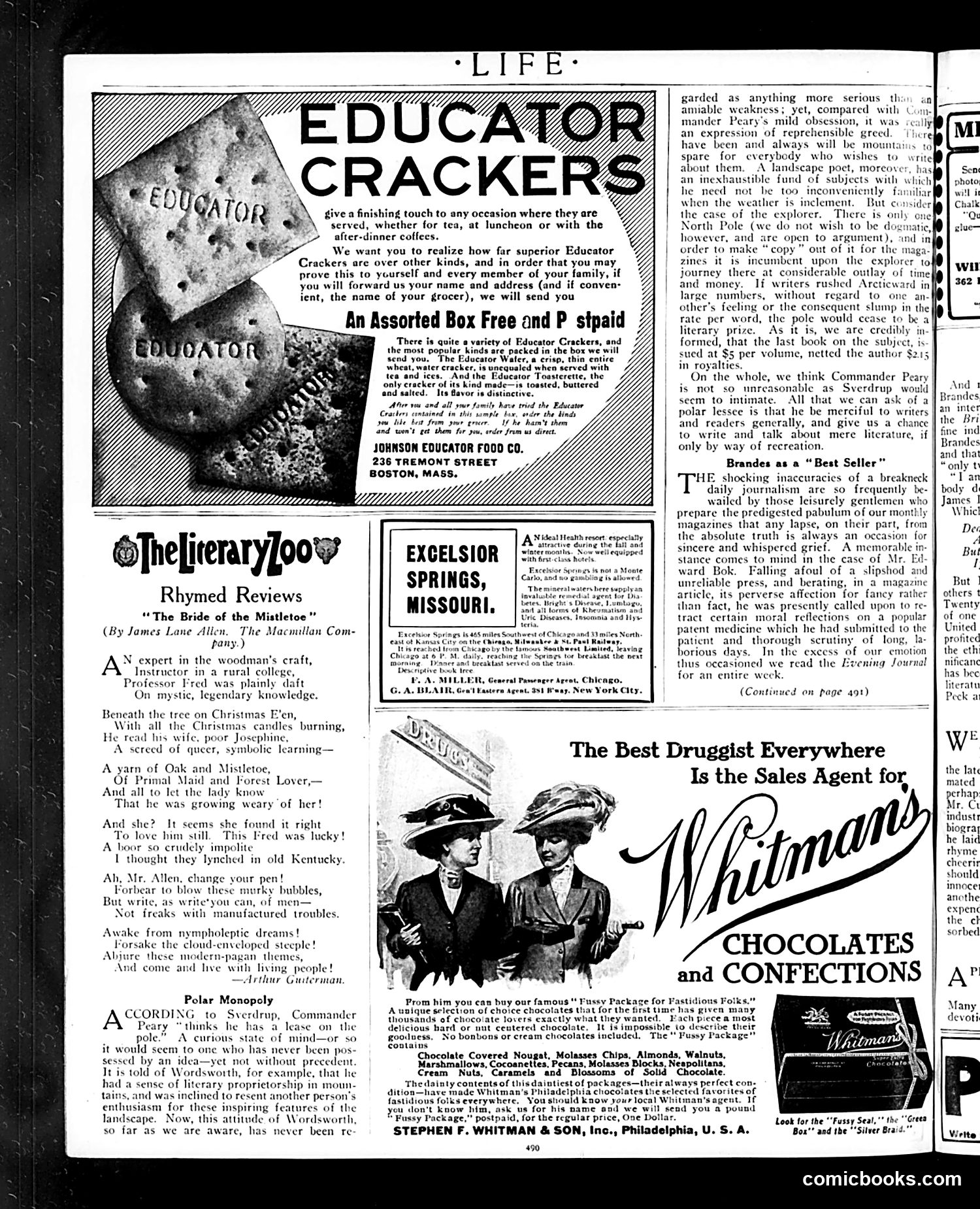
This brief satirical piece mocks Commander Peary's possessive attitude toward the North Pole. The author argues that while poet Wordsworth's similar territorial feelings about mountains were merely "amiable weakness," Peary's claim represents actual greed—because unlike mountains, there is only *one* North Pole. The satire's point: explorers who invest significant time and money reaching the pole deserve exclusive literary rights to profit from it. If other writers rushed north freely, the pole's commercial value for magazine articles would collapse, making the explorer's investment worthless. This references the early 20th-century race for polar exploration, when figures like Peary competed for discovery claims. The piece humorously treats geographic exploration as intellectual property, suggesting the pole is a finite literary commodity rather than a natural wonder.
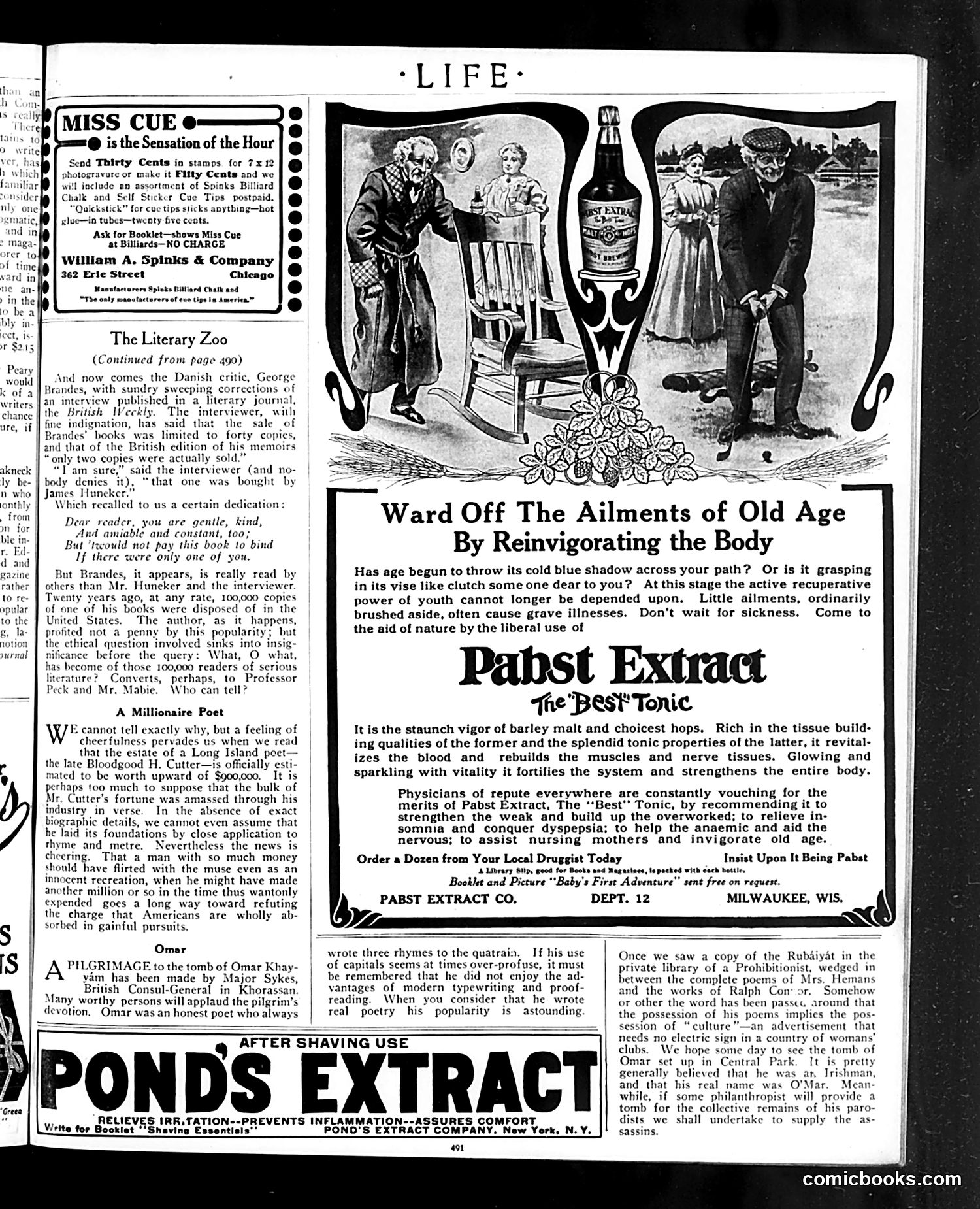
This page mixes satirical literary commentary with period advertisements. **The Literary Content:** The main satire critiques the gap between literary reputation and actual readership. It notes Danish critic George Brandes' books sold only two copies in Britain, yet claims 100,000 copies sold in America twenty years prior—raising the question: "What has become of those 100,000 readers?" The piece humorously implies serious literature has a tiny actual audience despite claims of popularity. A secondary item celebrates poet Bloodgood H. Cutter's $900,000 estate, sarcastically noting it's reassuring that Americans occasionally pursue art rather than purely chasing money. **The Advertisements:** Two prominent tonic ads (Pabst Extract and Pond's Extract) dominate, targeting aging readers with promises of rejuvenation and vitality. A "Miss Cue" billiards advertisement appears at top left. The contrast is typical of *Life*'s satirical approach: juxtaposing serious cultural criticism with frivolous period advertising to mock both literary pretension and commercial snake-oil marketing.
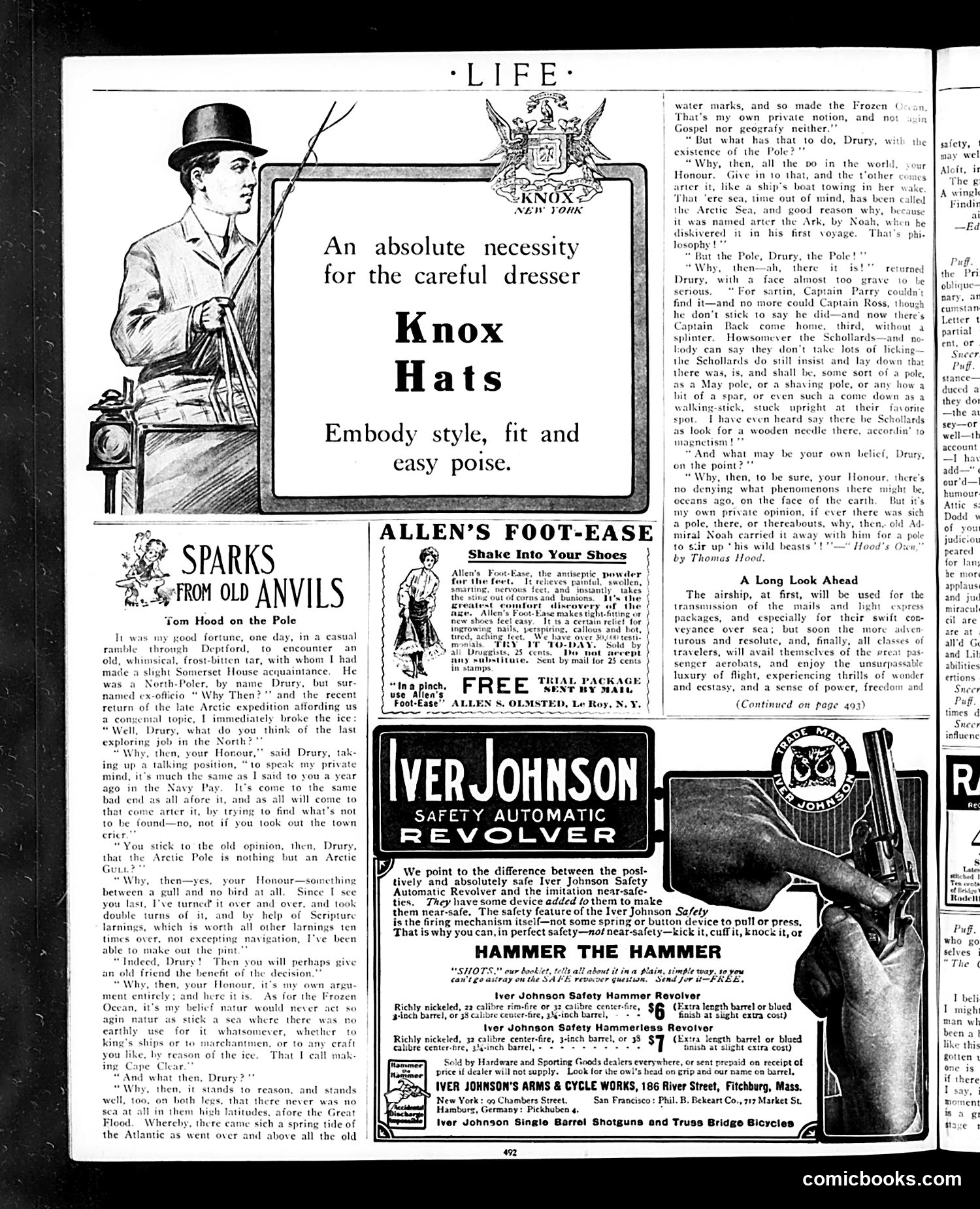
This page primarily features a humorous dialogue piece titled "Tom Hood on the Pole," a satirical conversation between a naval officer ("your Honour") and an elderly Arctic explorer named Drury about the existence of the North Pole. **The Satire:** The joke targets 19th-century Arctic exploration debates. Drury represents the skeptical working-class sailor who dismisses the Pole's existence as mere scholarly fancy. He offers absurd "folk logic"—attributing the Arctic Sea's name to Noah, claiming explorers like Parry and Back never actually found anything definitive, and suggesting old Admiral Noah stole the Pole to use on wild beasts. The humor lies in his earthy common sense undermining pretentious geographic authority. **Context:** This reflects real Victorian-era Arctic expedition controversies and the gap between educated assumption and practical sailor experience. The page is primarily **advertisements** (Knox Hats, Iver Johnson Revolvers, Allen's Foot-Ease), with "A Long Look Ahead" (about future airships) as secondary content.
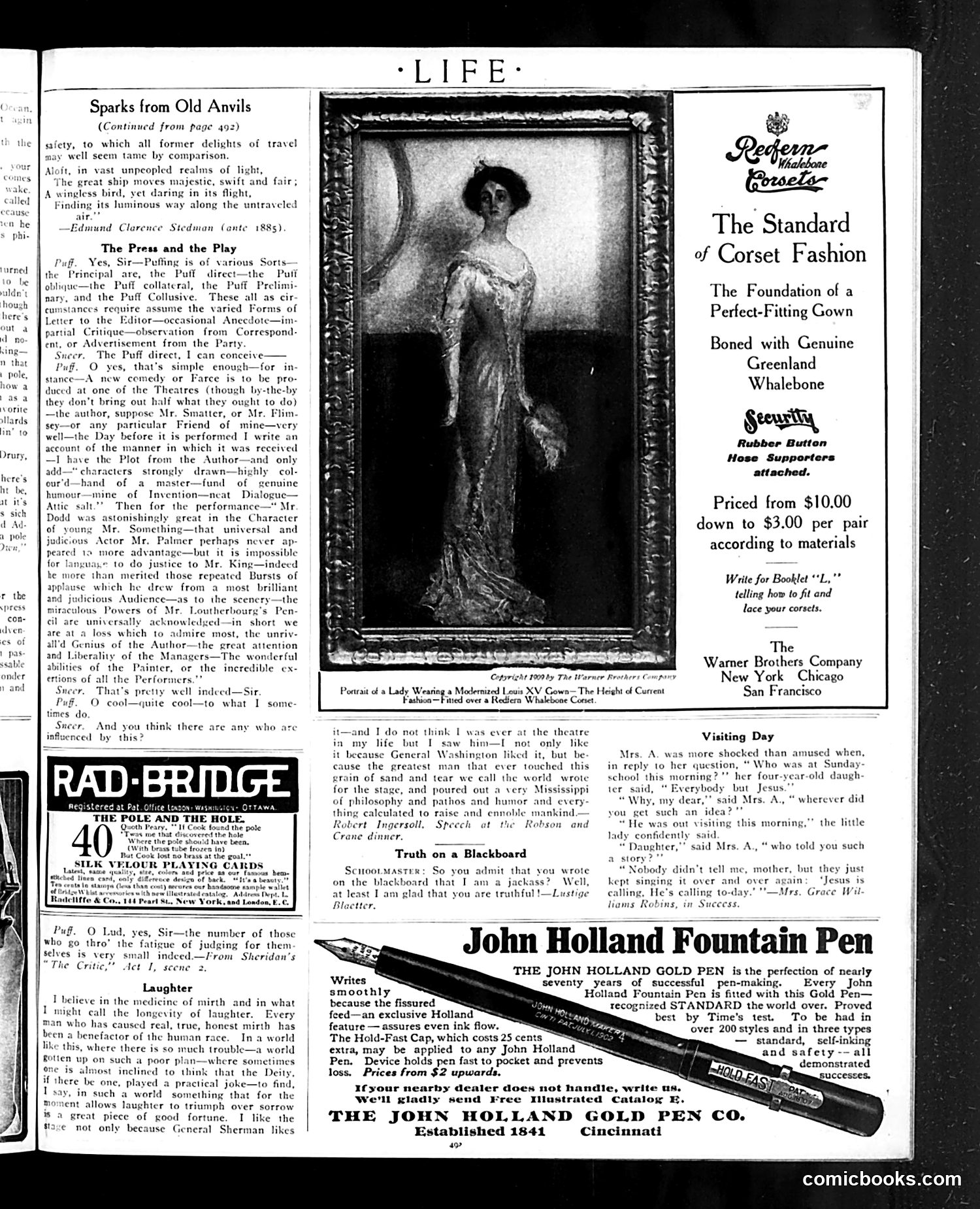
This page is primarily **advertising and editorial content** rather than political satire. The main visual element is a portrait of a fashionably dressed woman in Edwardian-era clothing, accompanying an advertisement for Redfern Corsets—"The Standard of Corset Fashion." The text sections titled "Sparks from Old Anvils" are **literary excerpts and theatrical criticism**, not political cartoons. They discuss 18th-century theater practices, specifically the various forms of "puffing" (promotional hype) used by theater managers and critics. References to actors like Mr. Palmer and Mr. Dodd appear to be historical theatrical commentary rather than contemporary satire. The bottom sections include a Robert Ingersoll quote celebrating laughter's value, and a brief joke ("Truth on a Blackboard") about a schoolmaster. **Overall**: This is a typical Life magazine page mixing advertising, literary reprints, and light humor—not a vehicle for political satire or social commentary.
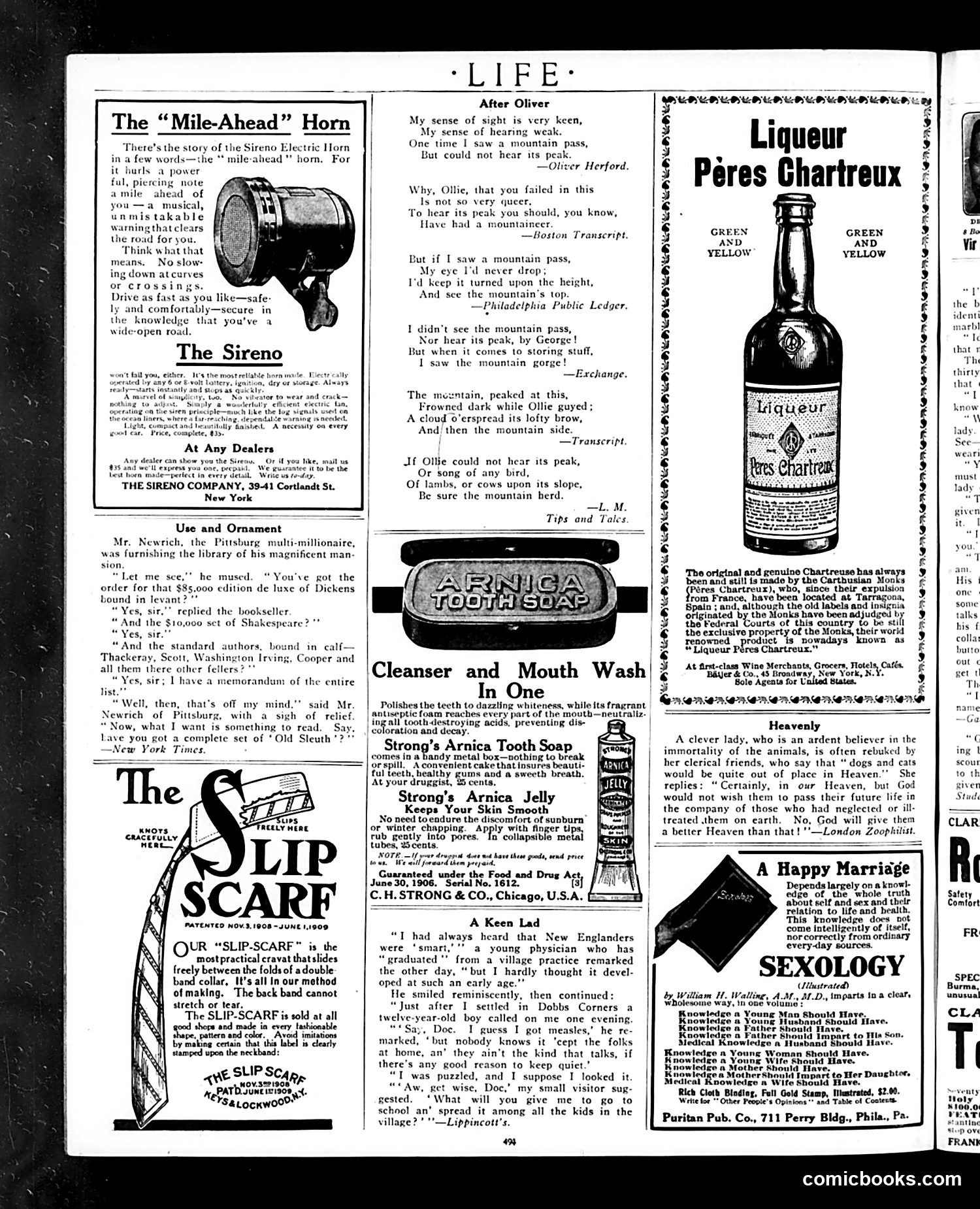
This page from *Life* magazine contains primarily **advertisements and light humorous content** rather than political cartoons. **Main Content:** 1. **"Mile-Ahead" Horn advertisement** (top left): Promotes the Sireno Electric Horn for automobiles, emphasizing safety and comfort while driving fast. 2. **"Use and Ornament" anecdote**: A satirical joke about Mr. Newrich, a wealthy Pittsburgh industrialist who buys expensive leather-bound editions of classic literature (Dickens, Shakespeare) purely as decoration for his mansion library—then asks for "Old Sleuth" pulp novels to actually read. The satire targets nouveau riche pretension: wealthy industrialists displaying culture through expensive books they don't value intellectually. 3. **Poetry section "After Oliver"**: Humorous plays on words about mountain passes and peaks. 4. **Product advertisements**: Slip-Scarf neckwear, Strong's Arnica Tooth Soap, Strong's Arnica Jelly, and Liqueur Pères Chartreux. 5. **"A Keen Lad" anecdote**: A brief story about a precocious New England boy visiting a doctor. This appears to be a standard *Life* magazine issue mixing advertising revenue with light entertainment content.
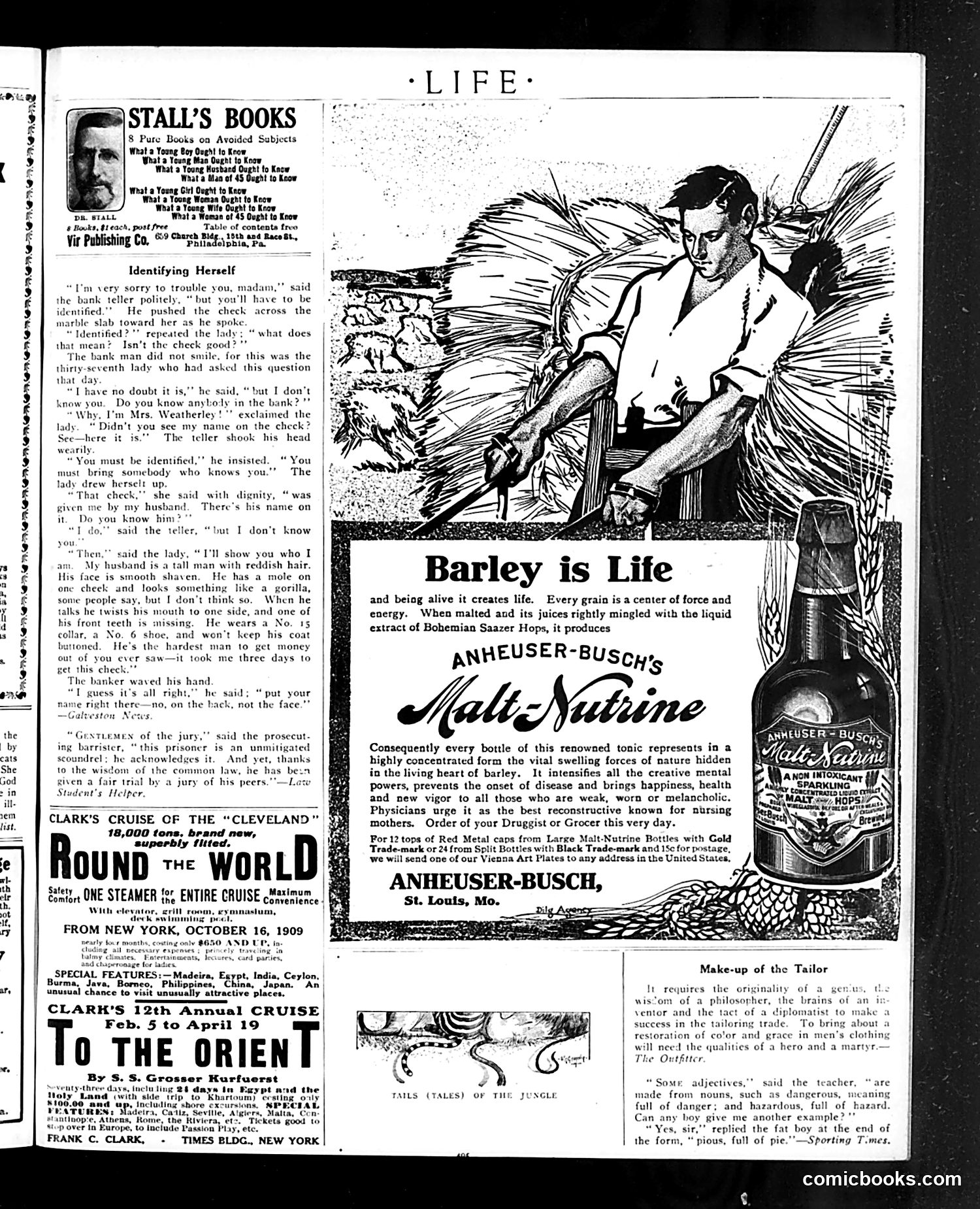
This page mixes editorial humor with period advertising. The main cartoon, "Identifying Herself," satirizes early 20th-century banking bureaucracy. A bank teller requires a woman to produce identification for a check, but she cannot simply prove who she is by name or signature. Instead, she must describe her husband in unflattering detail (tall, reddish hair, mole, gorilla-like appearance, missing tooth, won't keep his coat buttoned) as proof of identity—suggesting women had no independent legal standing and could only be "identified" through male relatives. The page also advertises Dr. Stall's euphemistically titled self-help books about health and sexuality, cruise packages, and an Anheuser-Busch product called "Malt-Nutrine," marketed as a tonic with quasi-medicinal properties for nursing mothers and the weak or melancholic. This reflects common early-1900s patent-medicine advertising before FDA regulations.
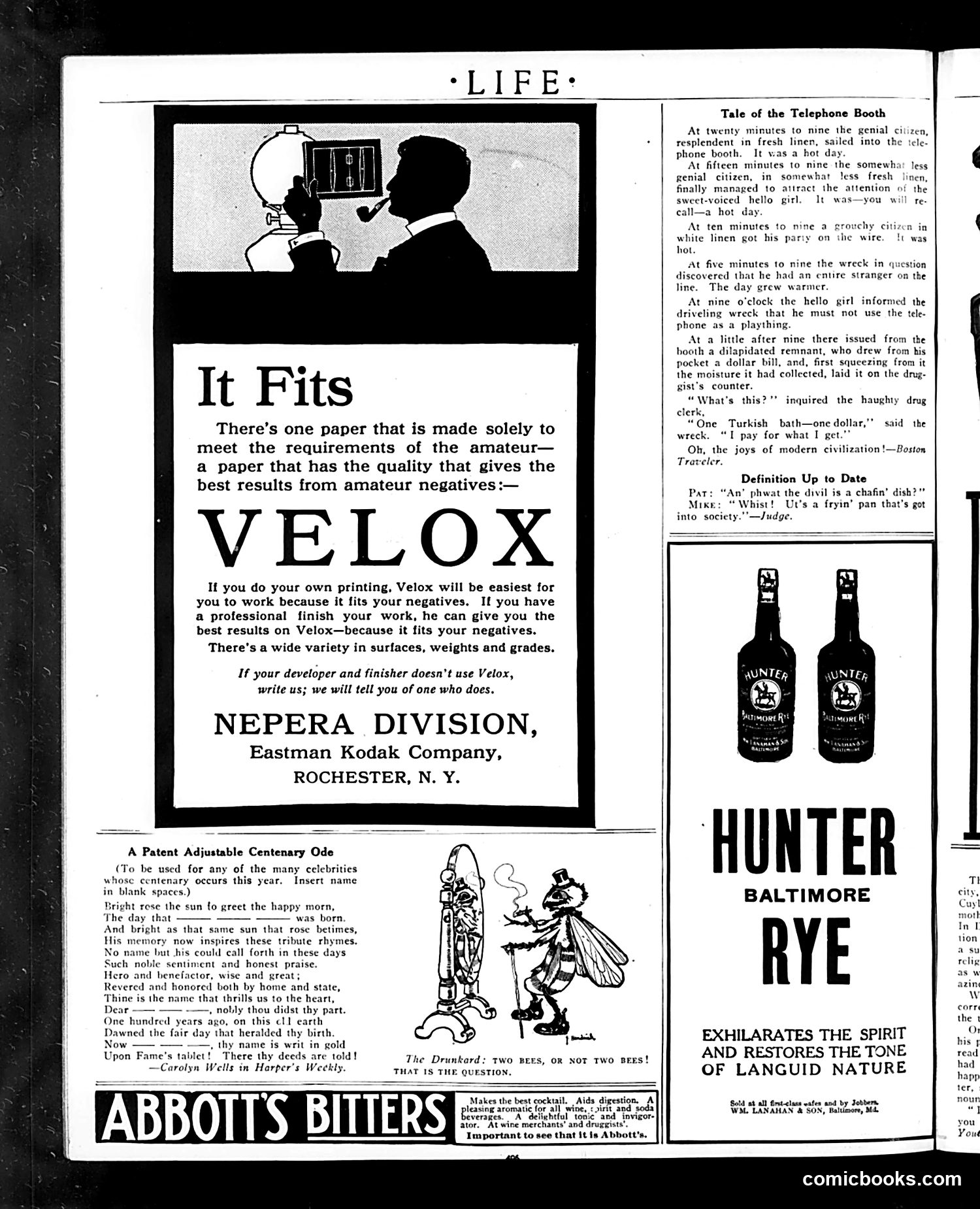
This page contains several satirical pieces typical of early 20th-century Life magazine: **"Tale of the Telephone Booth"** is a humorous narrative about a man's increasingly desperate experience trying to use a public telephone on a hot day. The joke follows his degradation as he waits for connection, finally emerging as a "dilapidated remnant" who pays a dollar—described as compensation equivalent to a Turkish bath. The satire mocks both the inefficiency of early telephone systems and the physical ordeal of confined spaces in summer heat. **The two brief definitions** are quick jokes playing on words: one about a "chafin' dish" (using Irish dialect for humor), the other about modern social pretension. **"A Patent Adjustable Centenary Ode"** is a template poem mocking the generic nature of celebratory verses written for anniversaries—the blanks invite substitution of any notable figure's name. The remaining content is **advertising**: Velox photographic paper, Hunter Baltimore Rye whiskey, and Abbott's Bitters (a patent medicine/cocktail ingredient). These ads were standard revenue sources for the magazine.
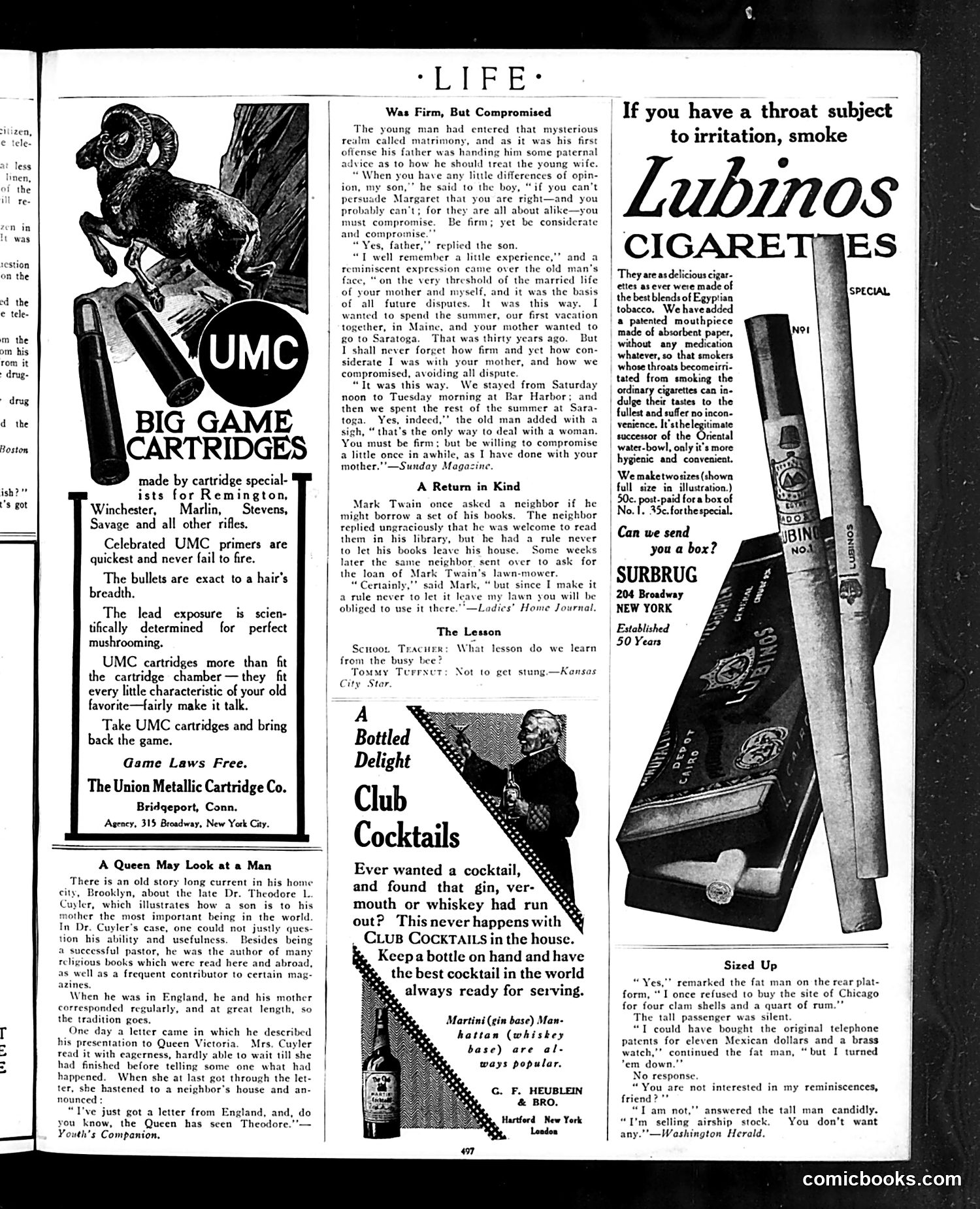
This page contains mostly **advertisements and humorous anecdotal stories**—not political cartoons. The ads promote **UMC ammunition** (emphasizing precision manufacturing) and **Lubinos cigarettes** (claiming they soothe throat irritation). The three brief humorous pieces are: 1. **"A Queen May Look at a Man"**: A Brooklyn anecdote about Dr. Theodore Cuyler's mother boasting that Queen Victoria saw her son—playing on maternal pride and social aspiration. 2. **"Was Firm, But Compromised"**: A father advises his son on marriage by recounting how he "compromised" with his wife—they vacationed at Bar Harbor *and* Saratoga. The joke: he presents capitulation as firm resolve. 3. **"The Lesson"**: A schoolboy joke where a student answers that bees teach us "not to get stung"—wordplay on the dual meaning of "stung" (by bees/deceived). These are gentle domestic humor pieces typical of early 20th-century magazines, with no explicit political or social satire beyond gentle ribbing of marital dynamics and pomposity.
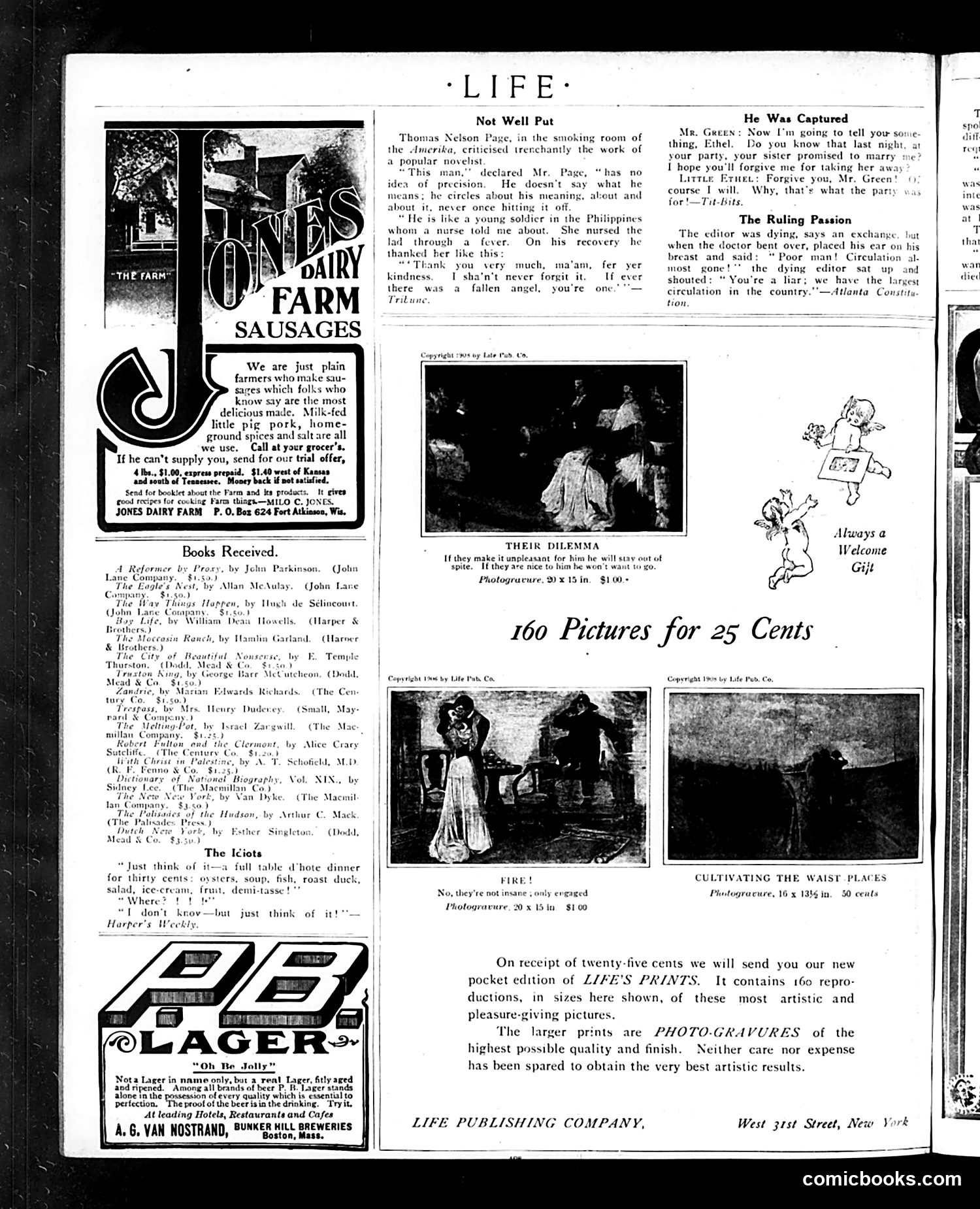
This page contains **three separate humorous anecdotes** rather than political cartoons: 1. **"Not Well Put"**: Criticizes author Thomas Nelson Page for imprecise writing—his prose "circles about his meaning" like a sick soldier, never hitting the target directly. 2. **"He Was Captured"**: A domestic comedy where Mr. Green's sister elopes; Green claims he's not angry because elopement was "what the party was for"—a joke about him wanting her off his hands. 3. **"The Ruling Passion"**: A dying editor, when told his circulation is failing, sits up indignantly to insist his newspaper actually has the *largest* circulation in the country—satirizing editors' obsessive pride in circulation numbers even at death's door. The page is primarily **advertising-heavy**, with promotions for Jones Dairy Farm sausages, P.B. Lager beer, and Life Publishing's print collection. These brief jokes represent typical early-20th-century American humor: gentle domestic satire and professional vanity mockery.
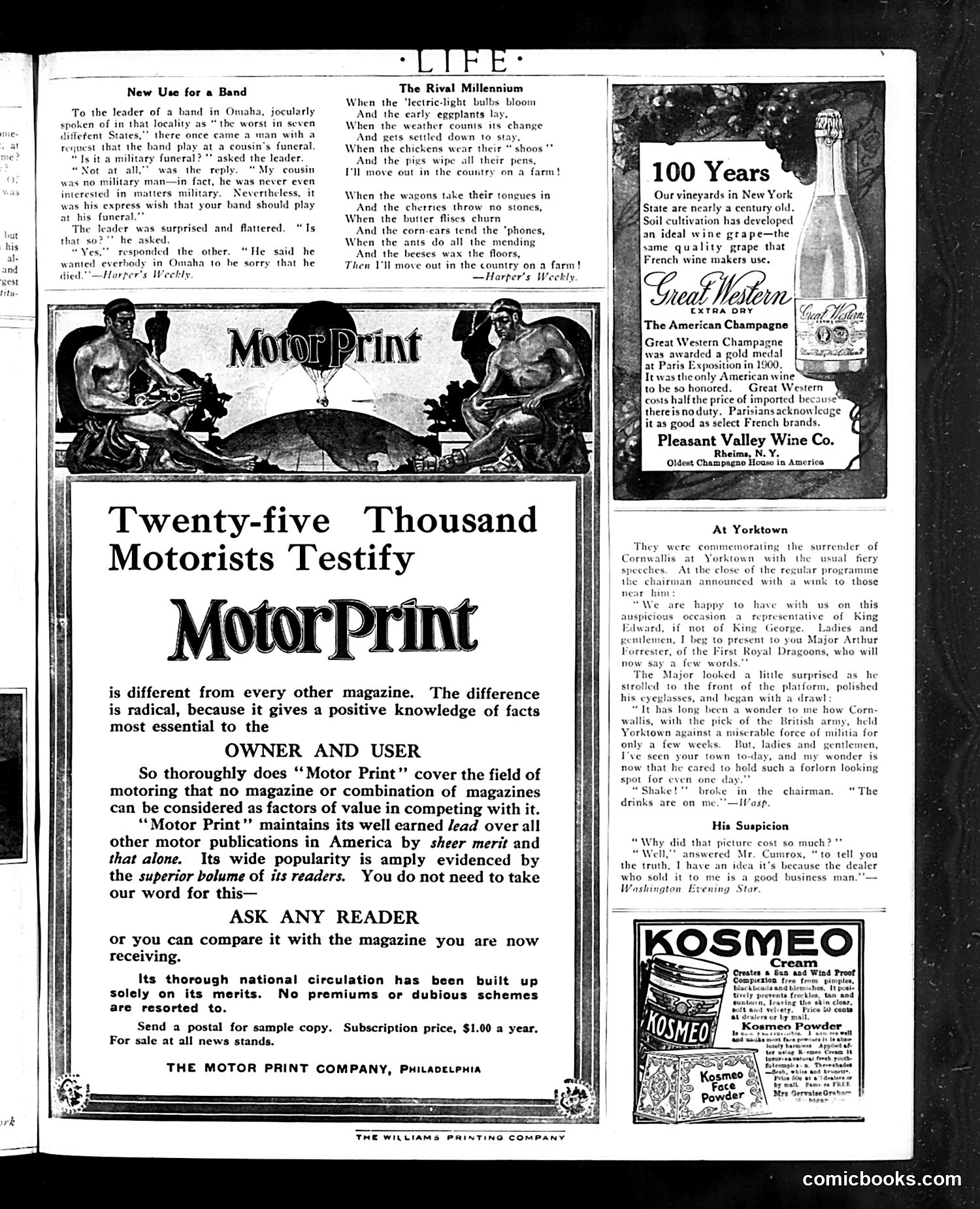
This page contains **three separate humorous pieces** rather than a unified cartoon: 1. **"New Use for a Band"**: A joke about an Omaha band leader (apparently notoriously bad) asked to play at a funeral. The cousin's reply—that he wants everyone in Omaha to be sorry the man died—is darkly funny, implying the band's awful music will torture mourners into wishing they'd attended instead. 2. **"The Rival Millennium"**: A sentimental poem imagining rural farm life where farm equipment and animals have achieved impossible things (pigs wiping pens, ants mending, bees making wax). The satire mocks urban nostalgia for agrarian simplicity through absurdist imagery. 3. **"At Yorktown"**: A joke about a British military officer commemorating the American Revolutionary War surrender. Major Forrester's backhanded "compliment" questions why Cornwallis bothered holding such a miserable town—insulting Yorktown while pretending civility. The remaining content is **advertising** for Motor Print magazine, wine, and cosmetics.
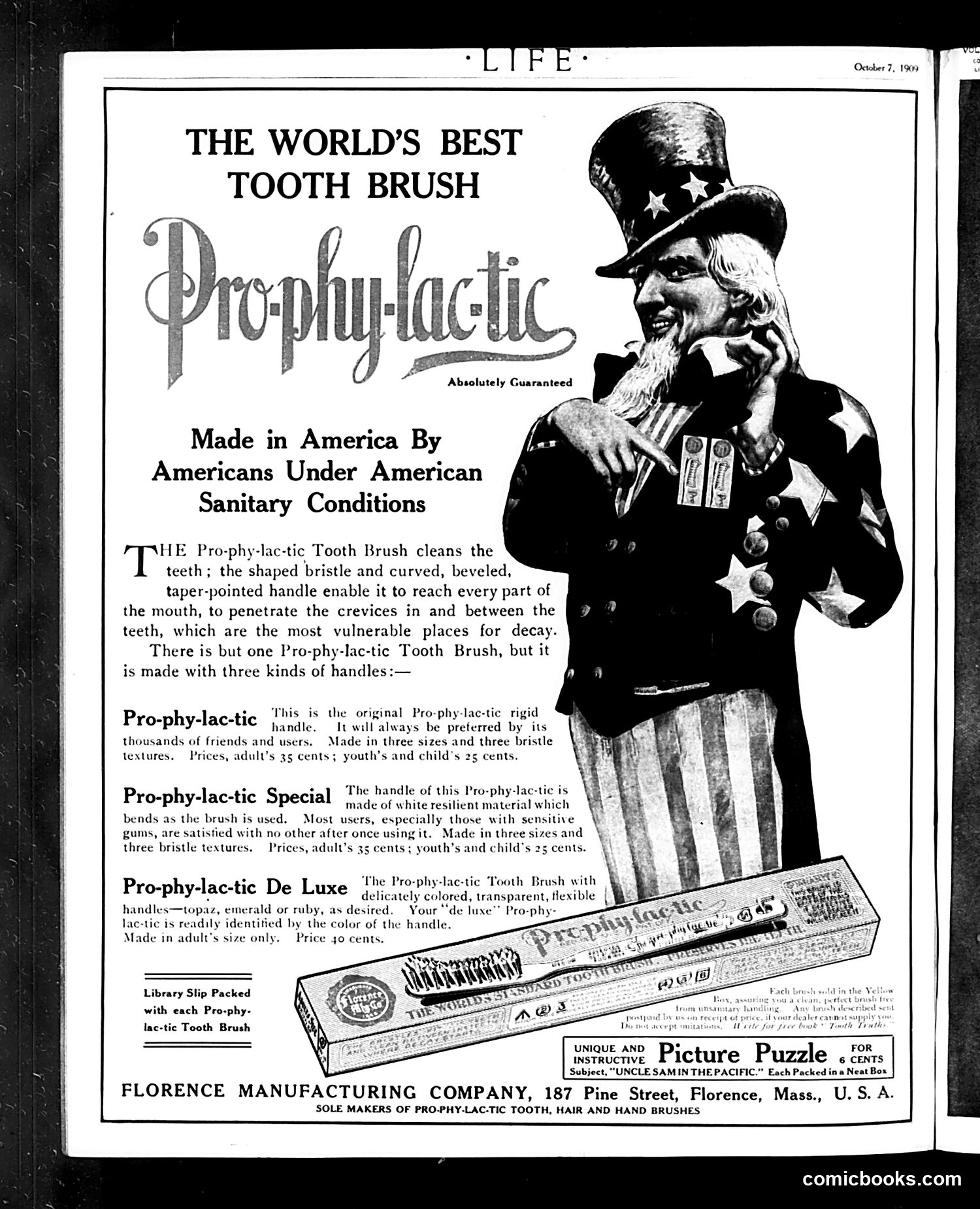
This is primarily a **product advertisement** for Pro-phy-lactic toothbrushes, not political satire. The page shows Uncle Sam as a cheerful pitchman in patriotic dress (starred top hat, striped pants), endorsing an American-made product. The illustration leverages **nationalist marketing**: the text emphasizes the brush is "Made in America By Americans Under American Sanitary Conditions"—appealing to early 1900s consumer pride in domestic manufacture and anxieties about foreign goods or unsanitary production. Uncle Sam's presence suggests the advertiser is claiming the product represents American values and quality. The small mention of an included "Picture Puzzle" featuring "Uncle Sam in the Pacific" appears to reference American imperial expansion, though details are unclear. This reflects 1909 consumer culture rather than satire—using patriotic imagery to sell mundane hygiene products.