
Life, 1909-10-07 · page 26 of 44
Life — October 7, 1909 — page 26: what you’re looking at
What you’re looking at
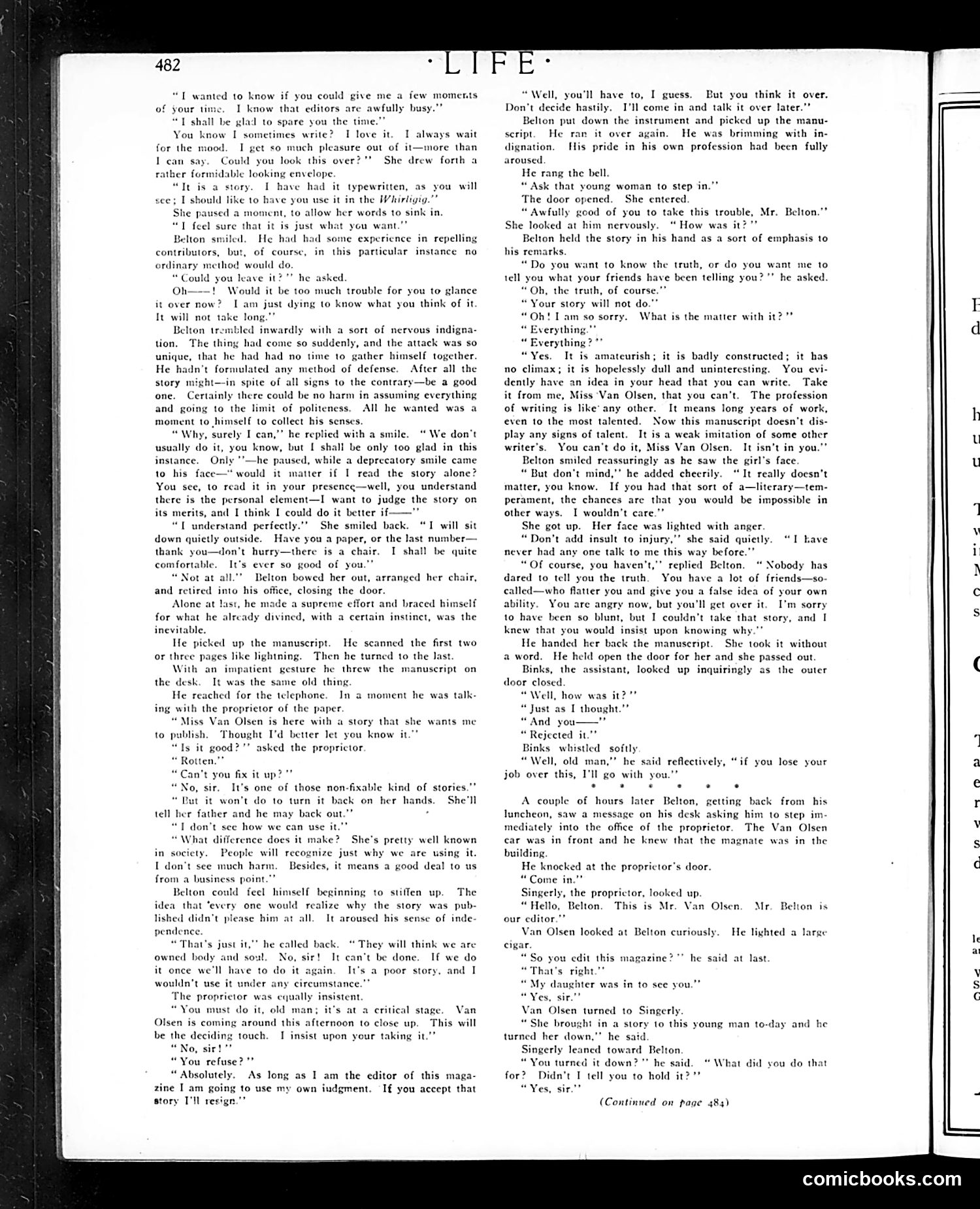
This appears to be a serialized story (not a political cartoon) about editorial integrity. The narrative depicts editor **Belton** confronting pressure to publish an inferior manuscript submitted by **Miss Van Olsen**, a socially prominent woman whose father is apparently a major advertiser or investor ("Van Olsen is here...People will recognize just why we are using it"). The central conflict is between professional standards and business pressure. Belton refuses the proprietor's request to publish "rotten" work simply because Van Olsen's family holds financial influence over the magazine. Belton argues this compromises editorial independence: "They will think we are owned body and soul." For modern readers, this reflects early 20th-century tensions between journalism ethics and commercial interests—issues still relevant today regarding advertiser influence on editorial decisions. The story satirizes how social prominence and financial power attempt to override merit-based publishing standards.
📄 Transcribed text from this page (OCR, searchable)
Machine-transcribed from the original scan — historical spelling and the odd misread are preserved.
“T wanted to know if you could give me a few moments your time. I know that editors are awfully busy.’” I shall be glad to spare you the time.”” You know I sometimes write? I love it. I always wait or the mood. I get so much pleasure out of it—more than 1 can say. Could you look this over?" She drew forth a ther formidable looking envelope. “It is a story, I have had it typewritten, as you will I like to have you use it in the Whirligig.”” She paused a moment, to allow her words to sink in, “T feel sure that it is just what you want.’ Belton smiled. He had had some experience in repelling contributors, but, of course, in this particular instance no ordinary method would do. Could you leave it?" he asked. Oh——=! Would it be too much trouble for you to glance it over now? I am just dying to know what you think of it It will not take long. Belton trembled inwardly with a sort of nervous indigna- tion. The thing had come so suddenly, and the attack was so unique, that he had had no time to gather himself together. He hadn't formulated any method of defense. After all the story might—in spite of all signs to the contrary—be a good one. Certainly there could be no harm in assuming everything and going to the limit of politeness. All he wanted was a moment to himself to collect his sense “Why, surely I can,” he replied with a smile. “We don’t usually do it, you know, but [ shall be only too glad in this instance. Only "'—he paused, while a deprecatory smile came to his face—* would it matter if I read the story alone? You see, to read it in your presencg—well, you understand there is the personal element—I want to judge the story on its merits, and I think I could do it better if—"" “{ understand perfectly."" She smiled back. “I will sit down quietly outside. Have you a paper, or the last number— thank you—don't hurry—there is a chair. I shall be quite comfortable. It's ever so good of you.”* Not at all."" Belton bowed her out, arranged her cl and retired into his office, closing the door. Alone at last, he made a supreme effort and braced himself for what he already divined, with a certain instinct, was the inevitable. He picked up the manuscript. He scanned the first two or three pages like lightning. Then he turned to the last With an impatient gesture he threw the manuscript on the desk. It was the same old thing. He reached for the telephone. In a moment he was talk- ing with the proprietor of the paper. “Miss Van Olsen is here with a story that she wants me to publish. Thought I'd better let you know it.”’ Is it good? '’ asked the proprictor. * Rotten.” Can't you fix it up?” “No, sir, It's one of those non-fixable kind of stories."* “But it won't do to turn it back on her hands. She'll tell her father and he may back out “I don't see how we can use it.” “What difference does it make? She's pretty well known in society. People will recognize just why we are using it. I don't see much harm. Besides, it means a good deal to us from a business point Belton could feel himself beginning to stiffen up. The idea that ‘every one would realize why the story was pub- lished didn’t please him at all. It aroused his sense of inde- pendence. “That's just it,” he called back. “ They will think we are owned body and soul. No, sir! It can't be done. If we do it once we'll have to do it again. It's a poor story, and I wouldn't use it under any circumstance. The proprietor was equally insistent “You must do it, old man; it's ata critical stage. Van Olsen is coming around this afternoon to close up. This will be the deciding touch. I insist upon your taking it.” “No, sir!” “You refuse?" “Absolutely, As long as I am the editor of this maga- zine I am going to use my own iudgment. If you accept that story I'll resign.” “Well, you'll have to, I guess. But you think it over. Don’t decide hastily. I'l come in and talk it over later.”” Belton put down the instrument and picked up the manu- script. He ran it over again. He was brimming with in- dignation. His pride in his own profession had been fully aroused. He rang the bell “Ask that young woman to step in. The door opened. She entered “Awfully good of you to take this trouble, Mr. Belton.’* She looked at him nervously.“ How was it? Belton held the story in his hand as a sort of emphasis to his remarks. “Do you want to know the truth, or do you want me to tell you what your friends have been telling you?’ he asked “Oh, the truth, of course “Your story will not do “Oh! Lam so sorry. What is the matter with it * Everything.” “ Everything?” “Yes. It is amateurish; it is badly constructed; it has no climax; it is hopelessly dull and uninteresting. You evi- dently have an idea in your head that you can write. Take it from me, Miss ‘Van Olsen, that you can’t. The profession of writing is like’any other. It means long years of work, even to the most talented. Now this manuscript doesn’t dis- play any signs of talent. It is a weak imitation of some other writer's. You can’t do it, Miss Van Olsen. It isn’t in you.”” Belton smiled reassuringly as he saw the girl’s face. “But don’t mind,’ he added checrily. “It really doesn’t matter, you know. If you had that sort of a—literary—tem- perament, the chances are that you would be impossible in other ways. I wouldn’t care.” She got up. Her face was lighted with anger. “Don’t add insult to injury,”” she said quietly. “I kave never had any one talk to me this way before.”” “Of course, you haven’t,”’ replied Belton. “ Nobody has dared to tell you the truth. You have a lot of friends—so- called—who flatter you and give you a false idea of your own ability. You are angry now, but you'll get over it. I’m sorry on to have been so blunt, but I couldn't take that story, and [ knew that you would insist upon knowing why."’ He handed her back the manuscript. She took it without a word. He held open the door for her and she passed out Binks, the assistant, looked up inquiringly as the outer door closed. "Well, how was it? "Just as I thought.” And you——"” “ Rejected Binks whistled softly “Well, old man,’ he said reflectively, “if you lose your job over this, I'll go with you.”” A couple of hours later Belton, getting back from his luncheon, saw a message on his desk asking him to step im- mediately into the office of the proprictor. The Van Olsen car was in front and he knew that the magnate was in the building. He knocked at the proprictor’s door. “Come in.” Singerly, the proprictor, looked up. "Hello, Belton. This is Mr. Van Olsen. Mr. Belton is our editor.” Van Olsen looked at Belton curiously. He lighted a s magazine? "’ he said at last “That's right.”* “ My daughter was in to see you.”” Van Olsen turned to Singerly. She brought in a story to this young man to-day and he turned her down,” he said Singerly leaned toward Belton “You turned it down?" he said. “What did you do that for? Didn't I tell you to hold it?”? “Yes, sir.” (Continued on page 484) comicbooks.com