
Life, 1909-10-07 · page 16 of 44
Life — October 7, 1909 — page 16: what you’re looking at
What you’re looking at
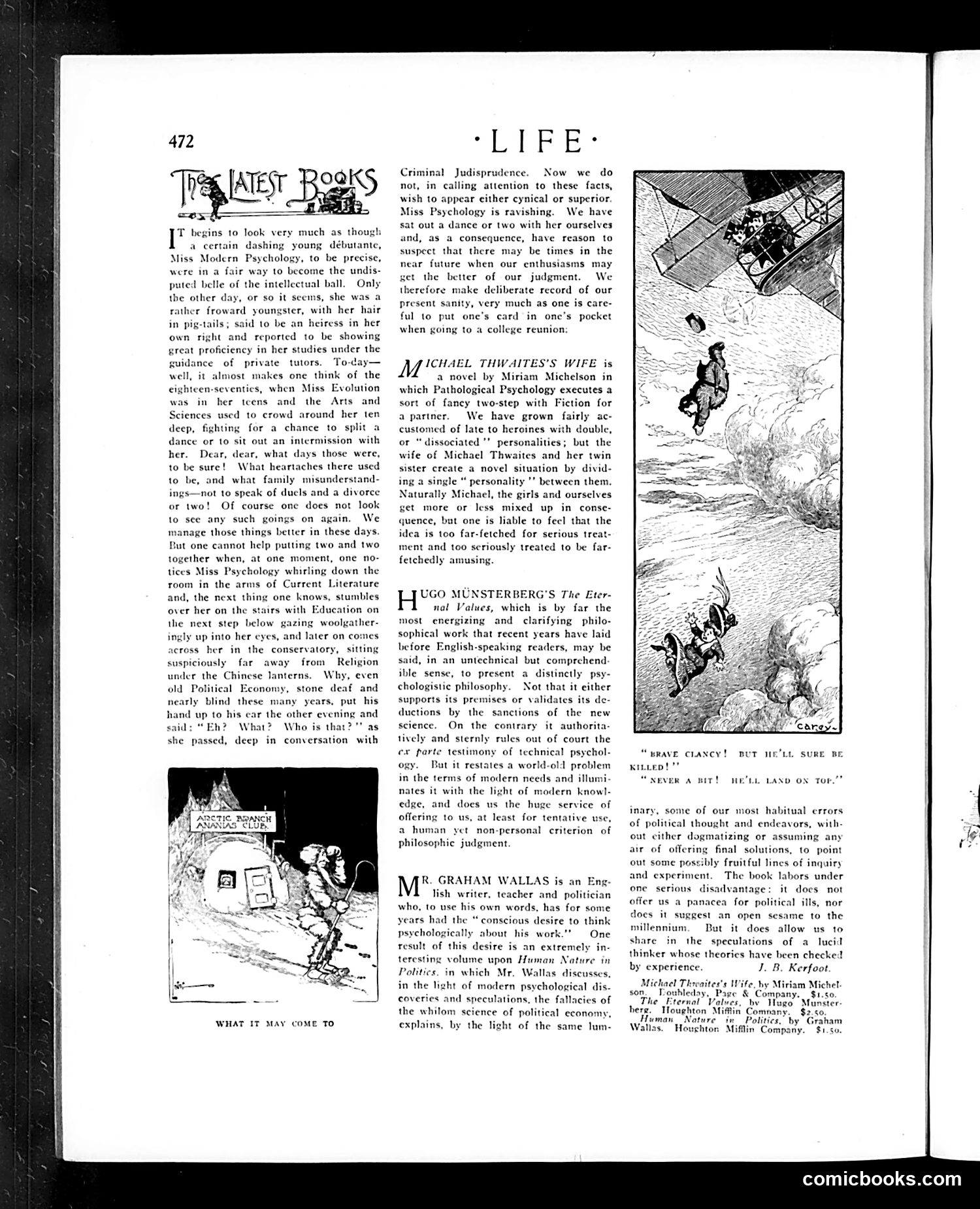
This page satirizes the sudden intellectual popularity of **Psychology as a discipline**. The main text uses extended metaphor: Psychology is personified as a young debutante who has unexpectedly become the "belle of the intellectual ball," now courted by various fields of study. The cartoon (lower left, captioned "What It May Come To") depicts this literalized: Psychology is shown flirting with multiple suitors—**Current Literature, Education, Religion, and Political Economy**—suggesting how eagerly established intellectual disciplines are adopting psychological frameworks. The satire targets the **faddish, uncritical embrace of psychology** in early 20th-century intellectual circles. The author humorously warns readers that Psychology's attractiveness may lead to poor judgment, just as romantic infatuation does, hence the advice to record one's "sanity" before Psychology becomes irresistible. The book reviews that follow reinforce this theme by discussing psychology's expanding influence in philosophy and fiction, documenting how thoroughly the discipline has infiltrated contemporary thought.
📄 Transcribed text from this page (OCR, searchable)
Machine-transcribed from the original scan — historical spelling and the odd misread are preserved.
472 Tepe ao T begins to look very much as though a certain dashing young débutante, Miss Modern Psychology, to be precise, were in a fair way to become the undis- puted belle of the intellectual ball. Only the other day, or so it scems, she was 3 rather froward youngster, with her hair in pig-tails; said to be an heiress in her own right and reported to be showing great proficiency in her studies under the guidance of private tutors. To-day— well, it almost makes one think of the cighteen-seventics, when Miss Evolution was in her tcens and the Arts and Sciences used to crowd around her ten deep, fighting for a chance to split a dance or to sit out an intermission with her. Dear, dear, what days those were, to be sure! What heartaches there used to be, and what family misunderstand- ings—not to speak of duels and a divorce or two! Of course one does not look to see any such goings on again. We manage those things better in these days. But one cannot help putting two and two together when, at one moment, one no- tices Miss Psychology whirling down the room in the arms of Current Literature and, the next thing one knows, stumbles over her on the stairs with Education on the next step below gazing woolgather- ingly up into her eyes, and later on comes across her in the conservatory, sitting suspiciously far away from Religion under the Chinese lanterns. Why, even 1d Political Economy, stone deaf and nearly blind these many years, put his hand up to his car the other evening and said: “Eh? What? Who is that?" as she passed, deep in conversation with WHAT IT MAY come TO “LIFE: Criminal Judisprudence. Now we do not, in calling attention to these fact wish to appear either cynical or superior. Miss Psychology is ravishing. We have sat out a dance or two with her ourselves and, as a consequence, have reason to suspect that there may be times in the near future when our enthusiasms may ct the better of our judgment. We perefore make deliberate record of our present sanity, very much as one is care- ful to put one’s card in one’s pocket when going to a college reunion: ICHAEL THWAITES’S WIFE is a novel by Miriam Michelson in which Pathological Psychology executes a sort of fancy two-step with Fiction for a partner. We have grown fairly ac- customed of late to heroines with double, or “dissociated ’’ personalities; but the wife of Michael Thwaites and her twin sister create a novel situation by divid- ing a single “ personality '’ between them, Naturally Michael, the girls and ourselves get more or less mixed up in. conse- quence, but one is liable to feel that the idea is too far-fetched for serious treat- ment and too seriously treated to be far- fetchedly amusing. He MUNSTERBERG'S The Eter- nal Values, which is by far the most energizing and clarifying philo- sophical work that recent years have laid before English-speaking readers, may be said, in an untechnical but comprehend. ible sense, to present a distinetly psy- chologistic philosophy. Not that it either supports its premises or validates its de- ductions by the sanctions of the new science. On the contrary it authorita- tively and sternly rules out of court the ex parte testimony of technical psychol- ogy. But it restates a world-old problem in the terms of modern needs and illumi- nates it with the light of modern know!l- edge, and docs us the huge service of offering to us, at least for tentative use, a human yet non-personal criterion of Philosophie judgment. R. GRAHAM WALLAS is an Eng: lish writer, teacher and politician who, to use his own words, has for some years had the “conscious desire to think psychologically about his work."" One result of this desire is an extremely in- teresting volume upon Human Nature in Politics. in which Mr. Wallas discusses, in the light of modern psychological dis- coveries and speculations, the fallacies of the whilom science of political economy, explains, by the light of the same lum “MRAVE CLANCY! BUT IIn’LL SURE BE wKintep!” “NEVER AIT! IE'LL LAND ON Tor.’” inary, some of our most habitual errors of political thought and endeavors, with- out cither dogmatizing or assuming any air of offering final solutions, to point out some possibly fruitful lines of inquiry and experiment. The book labors under one serious disadvantage: it docs not offer us a panacea for political ills, nor does it suggest an open sesame to the millennium But it does allow us to share in the speculations of a lucid thinker whose theories have been checked by experience. J.B. Kerfoot. ichael Throaites's Wife, hy Miriam Michel: day, Page & Company. $1.50. 1 Valves, by Hugo Munster- Houghton Mifflin Comnany. $2.s0. Human Nature in Politics. by Graham Wallas. Houghton Mifflin Company. $1 comicbooks.com