
Life, 1909-10-07 · page 10 of 44
Life — October 7, 1909 — page 10: what you’re looking at
What you’re looking at
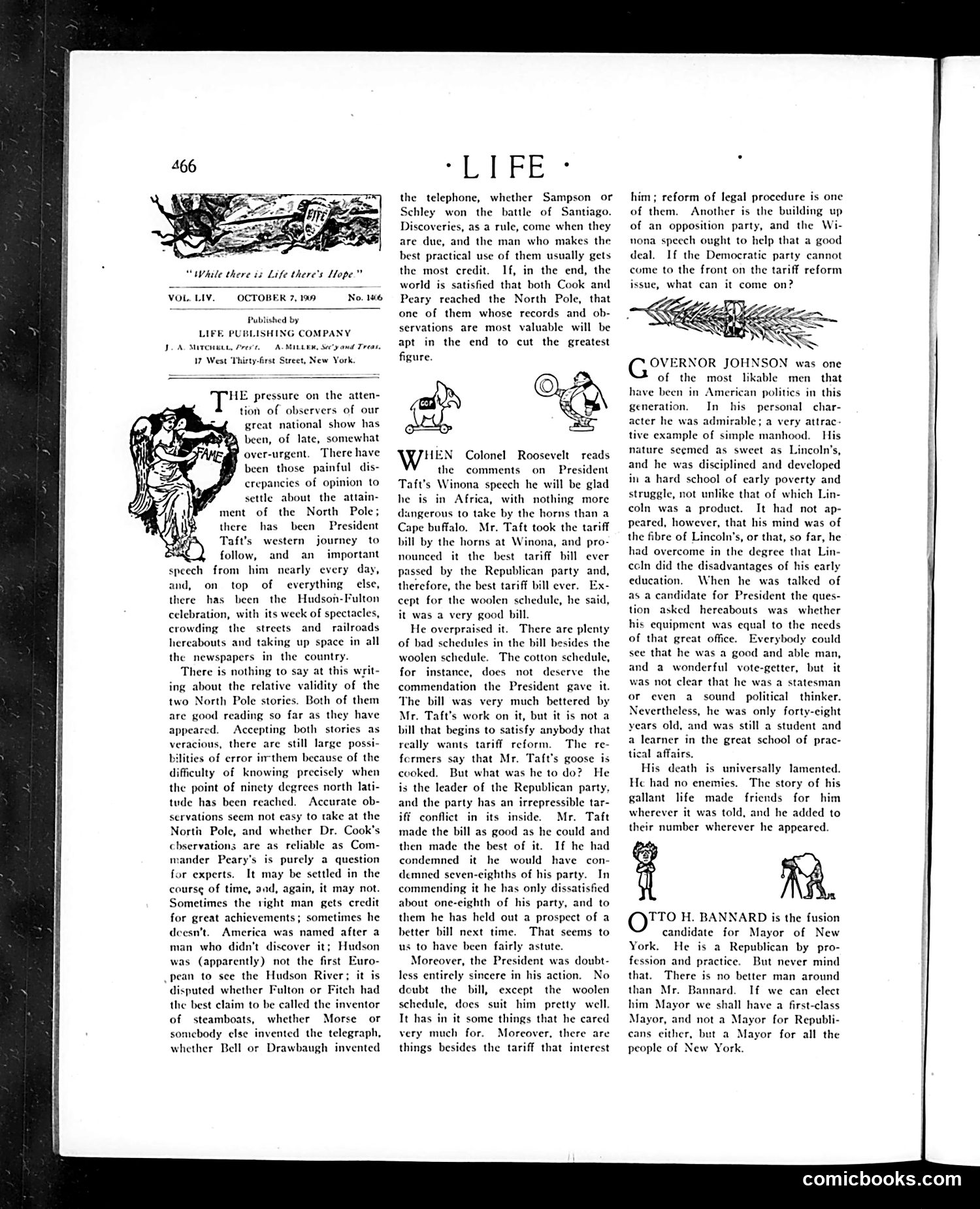
This *Life* magazine page (October 7, 1909) contains editorial commentary on President Taft's tariff policies and mentions of Colonel Roosevelt's African travels. The text criticizes Taft's handling of tariff reform, particularly the wool schedule, suggesting he compromised too much with his own party rather than pushing for genuine reform. It notes Roosevelt's endorsement of Taft's Winona speech and tariff bill. The page also includes brief political profiles: Governor Johnson is praised as "likeable" and humble despite poverty origins; Otto H. Bannard, the fusion candidate for NYC Mayor, is assessed as qualified but needing to unite both Republican and Democratic constituencies for citywide appeal. The small decorative illustrations appear to be generic political vignettes rather than specific character caricatures.
📄 Transcribed text from this page (OCR, searchable)
Machine-transcribed from the original scan — historical spelling and the odd misread are preserved.
“Whale there iz Life there's Hope” OCTOBER 7, 199 hed by LIFE PUBLISHING COMPANY AL MILLEN, Sec'y amd Treas. New York. No. 166 JOA MiTeMMLL, Prose, 17 West Thirty HE pressure on the atten- tion of observers of our great national show has been, of late, somewhat over-urgent. There have been those painful dis- crepancies of opinion to settle about the attain- ment of the North Pole; there has been President Taft's western journey to follow, and an important speech from him nearly every day, and, on top of everything else, there has been the Hudson-Fulton celebration, with its week of spectacles, crowding the streets and railroads hereabouts and taking up space in all the newspapers in the country. There is nothing to say at this writ- ing about the relative validity of the two North Pole stories. Both of them are good reading so far as they have appeared. Accepting both stories as veracious, there are still large possi- bilities of error imthem because of the difficulty of knowing precisely when the point of ninety degrees north lati- tude has been reached. Accurate ob- servations seem not easy to take at the North Pole, and whether Dr. Cook's cbservations are as reliable as Com- mander Peary’s is purely a quest for experts. It may be settled in the coursg of time, and, again, it may not. Sometimes the right man gets credit for great achievements; sometimes he deesn’t. America was named after a man who didn't discover it; Hudson was (apparently) not the first Euro- pean to sce the Hudson River; it is disputed whether Fulton or Fitch had the best claim to be called the inventor of steamboats, whether Morse or somebody else invented the telegraph, whether Bell or Drawbaugh invented “LIFE. - the telephone, whether Sampson or Schley won the battle of Santiago. Discoveries, as a rule, come when they are due, and the man who makes the best practical use of them usually gets the most credit. If, in the end, the world is satisfied that both Cook and Peary reached the North Pole, that one of them whose records and ob- servations are most valuable will be apt in the end to cut the greatest figure. 6°) HEN Colonel Roosevelt reads the comments on President Taft’s Winona speech he will be glad he is in Africa, with nothing more dangerous to take by the horns than a Cape buffalo, Mr. Taft took the tariff bill by the horns at Winona, and pro- nounced it the best tariff bill ever passed by the Republican party and, therefore, the best tariff bill ever. Ex- cept for the woolen schedule, he said, it was a very good bill. He overpraised it. There are plenty of bad schedules in the bill besides the woolen schedule. The cotton schedule, for instance, does not deserve the commendation the President gave it. The bill was very much bettered by Mr. Taft's work on it, but it is not a Dill that begins to satisfy anybody that really wants tariff reform. The re- formers say that Mr. Taft's goose is cooked. But what was he to do? He is the leader of the Republican party, and the party has an irrepressible tar- iff conflict in its inside. Mr. Taft made the bill as good as he could and then made the best of it. If he had condemned it he would have con- demned seven-eighths of his party. In commending it he has only dissatisfied about one-eighth of his party, and to them he has held out a prospect of a better bill next time. That seems to us to have been fairly astute. Moreover, the President was doubt- less entirely sincere in his action. No doubt the bill, except the woolen schedule, does suit him pretty well. It has in it some things that he cared very much for. Moreover, there are things besides the tariff that interest him; reform of legal procedure is one of them. Another is the building up of an opposition party, and the Wi- nona speech ought to help that a good deal. If the Democratic party cannot come to the front on the tariff reform issue, what can it come on? OVERNOR JOHNSON was one of the most likable men that have been in American polities in this generation. In his personal char- acter he was admirable; a very attrac- tive example of simple manhood. His nature seemed as sweet as Lincoln's, and he was disciplined and developed in a hard school of early poverty and struggle, not unlike that of which Lin- coln was a product. It had not ap- peared, however, that his mind was of the fibre of Lincoln's, or that, so far, he had overcome in the degree that Lin- coln did the disadvantages of his early education. When he was talked of as a candidate for President the ques- tion asked hereabouts was whether his equipment was equal to the needs of that great office. Everybody could see that he was a good and able man, and a wonderful vote-getter, but it was not clear that he was a statesman or even a sound political thinker. Nevertheless, he was only forty-cight years old, and was still a student and a learner in the great school of prac- tical affairs. His death is universally lamented. He had no enemies. The story of his gallant life made friends for him wherever it was told, and he added to their number wherever he appeared. TTO H. BANNARD is the fusion candidate for Mayor of New York. He is a Republican by pro- fession and practice. But never mind that. There is no better man around than Mr. Bannard. If we can elect him Mayor we shall have a first-class Mayor, and not a Mayor for Republi- cans either, but a Mayor for all the people of New York. comicbooks.com