
Life, 1909-10-07 · page 20 of 44
Life — October 7, 1909 — page 20: what you’re looking at
What you’re looking at
This page critiques two imported theatrical productions, revealing early 20th-century attitudes about adapting foreign plays for American audiences. **"Inconstant George"** stars light comedian John Drew in a French farce adapted by Gladys Unger. The critic argues the character—a indecisive man pursued by multiple women—works in France (where gallantry is culturally valued) but fails in America. Drew "struggles heroically" but cannot make the role genuinely amusing to American audiences unfamiliar with this social type. Only Mary Boland succeeds through her own talent. **"The Noble Spaniard"** by Somerset Maugham, starring Robert Edeson, suffers similarly. The critic deems it outdated Victorian humor (amusing to 1850s English audiences) now incomprehensible. Maugham apparently couldn't gauge modern taste; American managers showed poor judgment importing it. Both reviews reflect the widespread belief that foreign theatrical styles—however successful abroad—often fail when transplanted wholesale to American stages without cultural adaptation.
📄 Transcribed text from this page (OCR, searchable)
Machine-transcribed from the original scan — historical spelling and the odd misread are preserved.
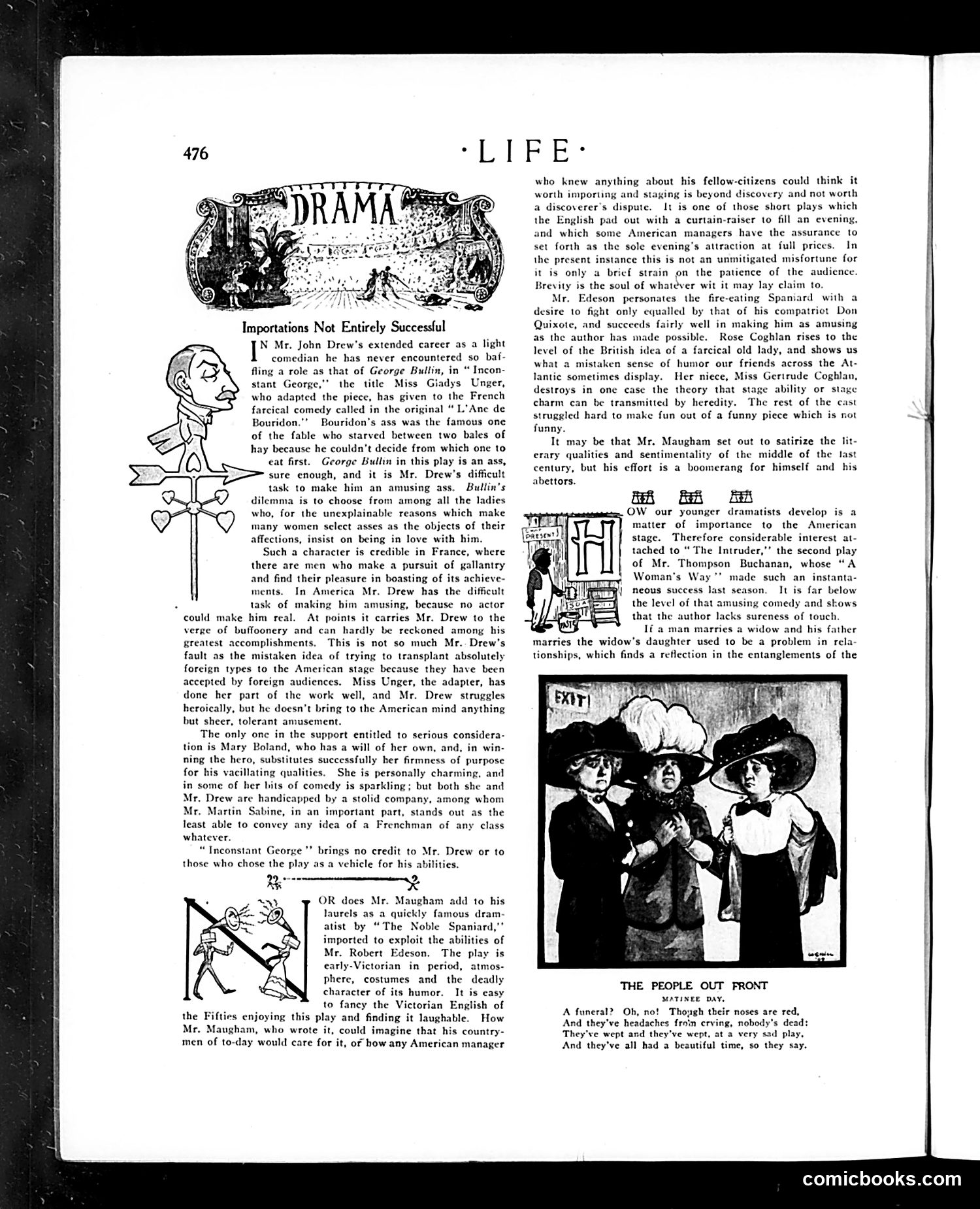
“LIFE: Importations Not Entirely Successful N Mr. John Drew's extended career as a light comedian he has never encountered so ba fling a role as that of George Bullin, in “ Incon- stant George,” the title Miss Giadys Unger, who adapted the piece, has given to the French farcical comedy called in the original “ L’Ane de Bouridon."” Bouridon’s ass was the famous one of the fable who starved between two bales of hay because he couldn’t decide from which one to eat first. George Bullin in this play is an ass, sure enough, and it is Mr. Drew's difficult task to make him an amusing ass. Bullin’s dilemma is to choose from among all the ladies who, for the unexplainable reasons which make many women select asses as the objects of their affections, insist on being in love with him. Such a character is credible in France, where there are men who make a pursuit of gallantry and find their pleasure in boasting of its achieve- ments. In America Mr. Drew has the difficult task of making him amusing, because no actor could make him real. At points it ries Mr. Drew to the verge of buffoonery and can hardly be reckoned among his greatest accomplishments, This is not so much Mr.. Drew's fault as the mistaken idea of trying to transplant absolutely foreign types to the American stage because they have been accepted by foreign audiences. Miss Unger, the adapter, has done her part of the work well, and Mr. Drew struggles heroically, but he doesn’t bring to the American mind anything but sheer, tolerant amusement. The only onc in the support entitled to serious considera- tion is Mary Boland, who has a will of her own, and, in win- ning the hero, substitutes successfully her firmness of purpose for his vacillating qualities. She is personally charming, and in some of her hits of comedy is sparkling; but both she and Mr. Drew are handicapped by a stolid company, among whom Mr. Martin Sabine, in an important part, stands out as the least able to convey any idea of a Frenchman of any class whatever. “Inconstant George"? brings no credit to Mr. Drew or to those who chose the play asa vehicle for his abiliti me ee en TL OR does Mr. Maugham add to his laurels as a quickly famous dram- atist by “The Noble Spaniard,” imported to exploit the abilities of Mr. Robert Edeson. The play is carly-Victorian in period, atmos- phere, costumes and the deadly character of its humor. It is easy to fancy the Victorian English of the Fifties enjoying this play and finding it laughable. How Mr, Maugham, who wrote it, could imagine that his country- men of to-day would care for it, of how any American manager who knew anything about his fellow-citizens could think it worth importing and staging is beyond discovery id not worth a discoverer’s dispute. It is one of those short plays which the English pad out with a curtain-raiser to fill an evening, nd which some American managers have the assurance to set forth as the sole evening's attraction at full prices. In the present instance this is not an unmitigated misfortune for it is only a brief strain on the patience of the audience. Brevity is the soul of whatever wit it may lay claim to. Mr. Edeson personates the fire-eating Spaniard with a desire to fight only equalled by that of his compatriot Don Quixote, and succeeds fairly well in making him as amusing as the author has made possible. Rose Coghlan rises to the level of the British idea of a farcical old lady, and shows us what a mistaken sense of humor our friends across the At- lantic sometimes display. Her niece, Miss Gertrude Coghlan, destroys in one case the theory that stage ability or stage charm can be transmitted by heredity. The rest of the cast struggled hard to make fun out of a funny piece which is not funny. It may be that Mr. Maugham set out to satirize the lit- erary qualities and sentimentality of the middle of the tast century, but his effort is a boomerang for himself and his GR RA a OW our younger dramatists develop is a matter of importance to the American stage. Therefore considerable interest at- tached to “ The Intruder,” the second play of Mr. Thompson Buchanan, whose “A Woman's Way’? made such an instan neous success t season. It is far below the level of that amusing comedy and skows that the author lacks sureness of touch If a man marries a widow and his father marries the widow's daughter used to be a problem in rela- tionships, which finds a reflection in the entanglements of the THE PEOPLE OUT FRONT MATINEE DAY, A funeral? Oh, no! Thozgh their noses are red, And they've headaches froin erving, nobody's dead: ‘They've wept and they've wept, at a very sad play And they've all had a beautiful time, so they say. comicbooks.com