
A complete issue · 28 pages · 1909
Life — July 29, 1909
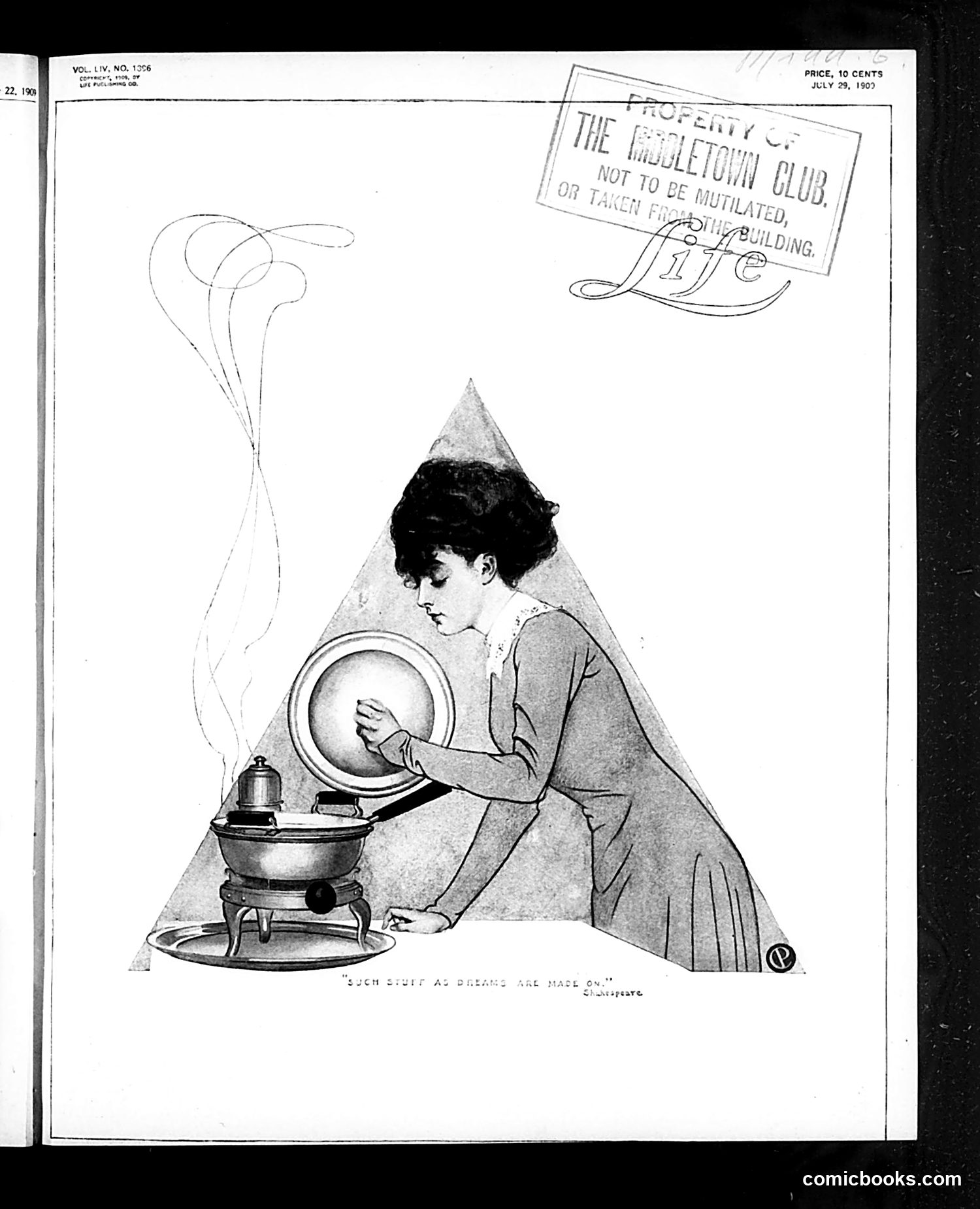
This satirical cover depicts a woman in fortune-telling attire, gazing into a crystal ball while seated within a triangular tent. The image appears to reference "mesmerism" or spiritualist fortune-telling, popular entertainment in the early 1900s. The stamp reading "Property of the Midgetown Club / Not to be mutilated or taken from this building" suggests this was a library copy. The caption beneath reads "Such stuff as dreams are made on," quoting Shakespeare's *The Tempest*. The satire likely mocks the era's fascination with spiritualism and occult practices among middle-class Americans, presenting fortune-telling as frivolous entertainment. The artistic style—pen-and-ink illustration typical of Life's humor—emphasizes the absurdity of consulting crystal balls for guidance.
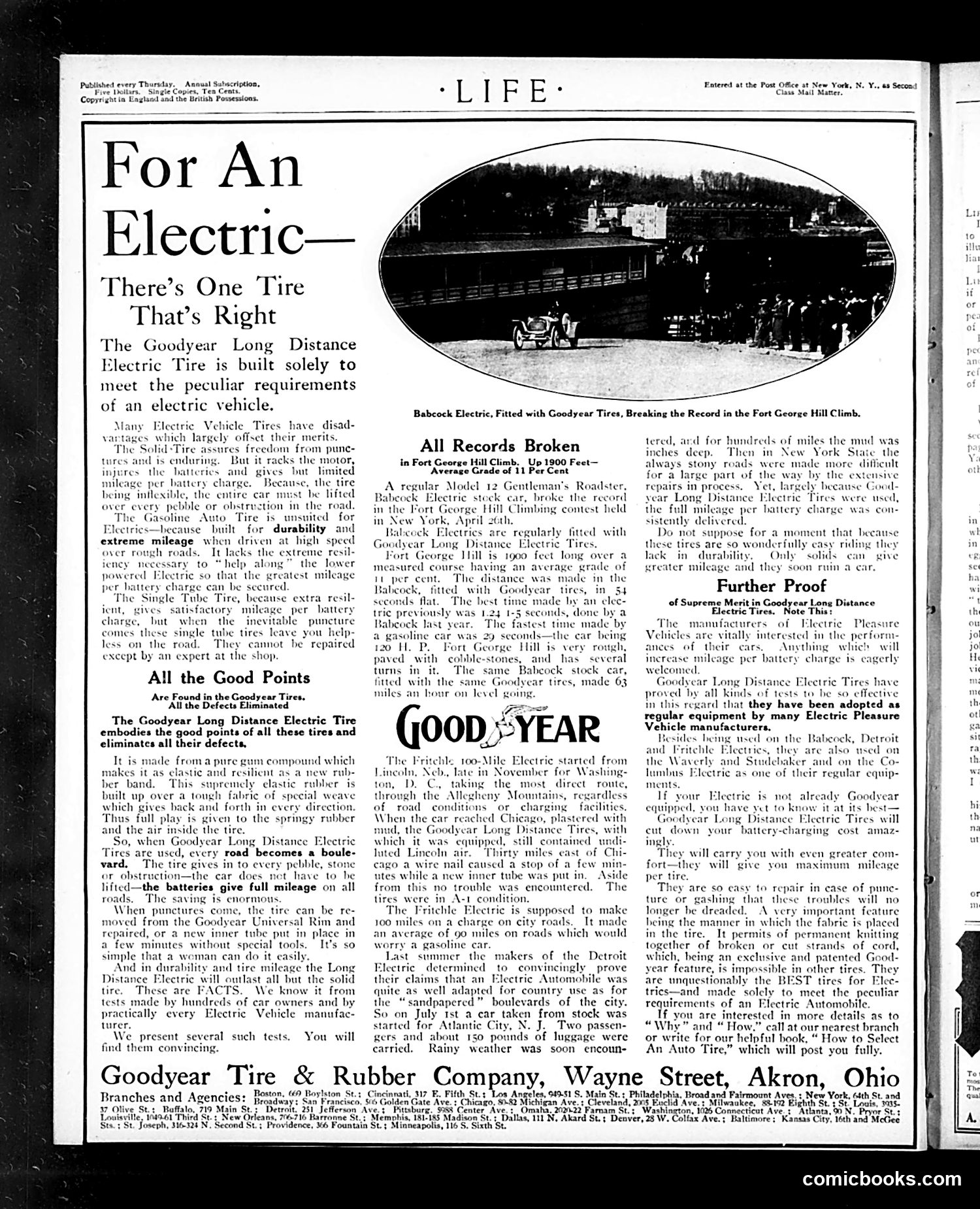
This page is primarily **advertising, not satire or political commentary**. It's a Goodyear Tire & Rubber Company advertisement for their "Long Distance Electric Tire," designed specifically for electric vehicles. The ad highlights a record-breaking climb of Fort George Hill by a Babcock Electric car fitted with Goodyear tires. The image shows the vehicle on an inclined road with spectators watching. The marketing emphasizes practical benefits: durability, extended mileage per battery charge, and reliability on poor roads. This reflects the early 1900s context when electric vehicles were a serious transportation alternative to gasoline cars, and tire quality directly impacted vehicle performance and range. The ad contains no political satire—it's straightforward commercial promotion.
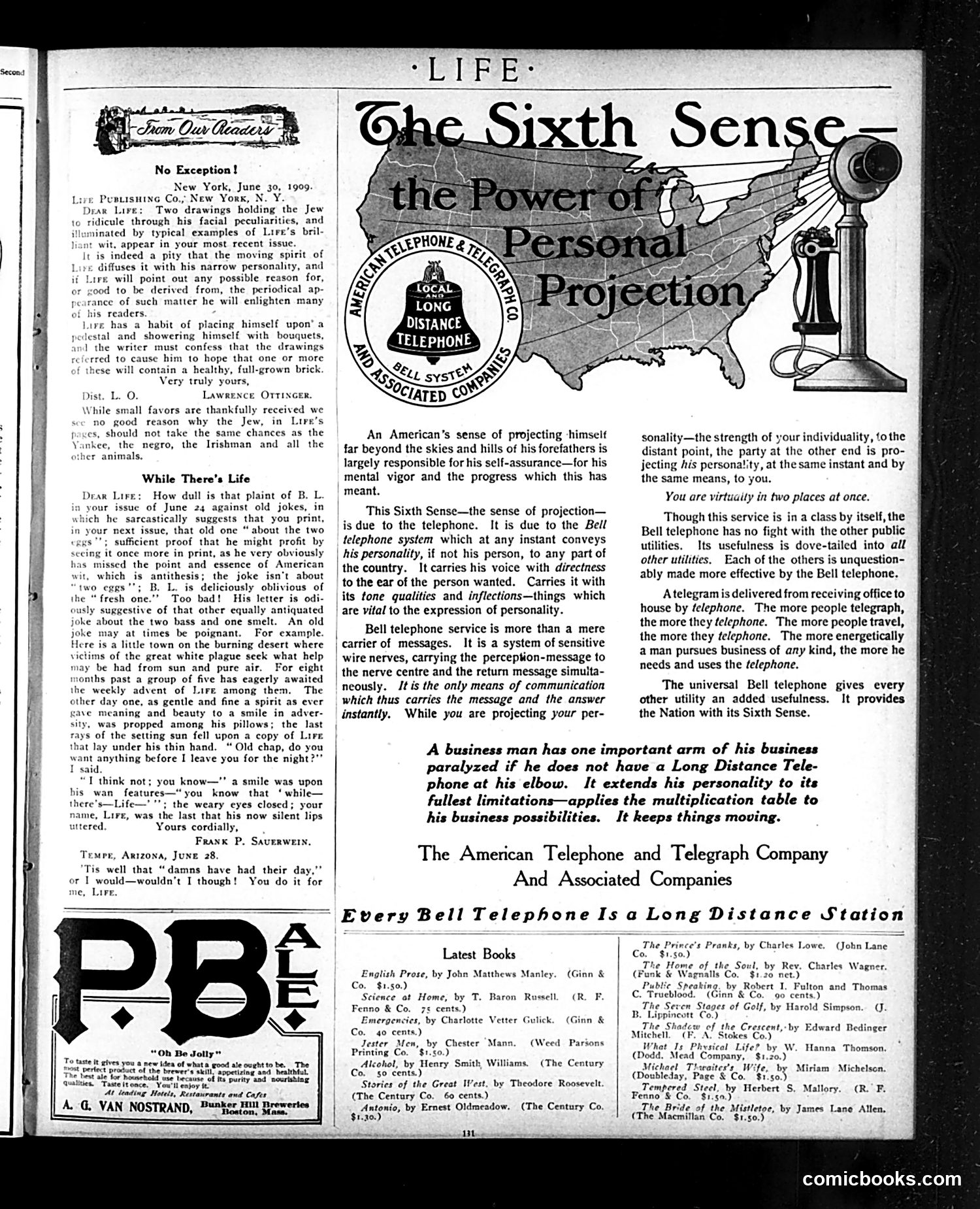
This page contains **no political cartoons**. Instead, it features: 1. **"From Our Readers"** section with humorous reader letters about Life's recent Jewish-themed drawings and Irish humor 2. **A Bell Telephone advertisement** titled "The Sixth Sense—the Power of Projection," arguing that long-distance telephone service extends a person's influence and business reach across the country. The ad emphasizes that telephone communication carries personality and individuality instantly. 3. **Book reviews** and a **PBA (Poor But Ambitious) comic strip** advertisement at the bottom The page is primarily **commercial/editorial content** rather than satirical commentary. The telephone ad is notable as early corporate marketing emphasizing technology's social utility.
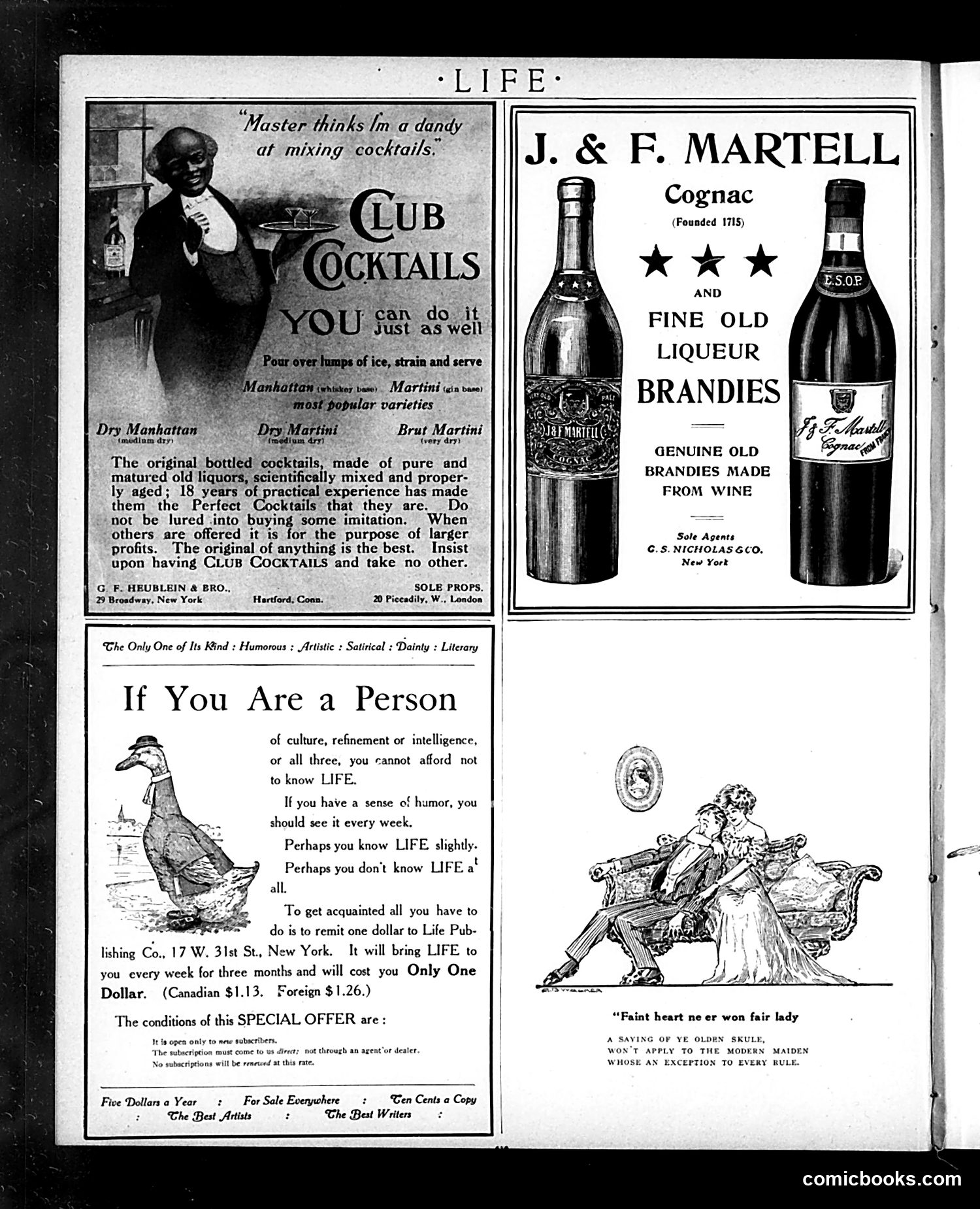
This page is primarily **advertising**, not satirical content. The top-left ad promotes "Club Cocktails"—pre-mixed bottled cocktails marketed as convenient alternatives to bartender-made drinks. The illustration shows a well-dressed man claiming the master bartender need not feel superior when mixing them at home. The right side advertises **J. & F. Martell Cognac and Fine Old Brandies**, emphasizing authenticity ("genuine old brandies made from wine"). The bottom section is a subscription pitch for *Life* magazine itself, targeting educated readers ("culture, refinement or intelligence"). It uses humor (an illustrated duck and a romantic couple) to encourage a one-dollar subscription. This reflects early 20th-century advertising strategies: positioning products and publications as markers of sophistication and good taste.
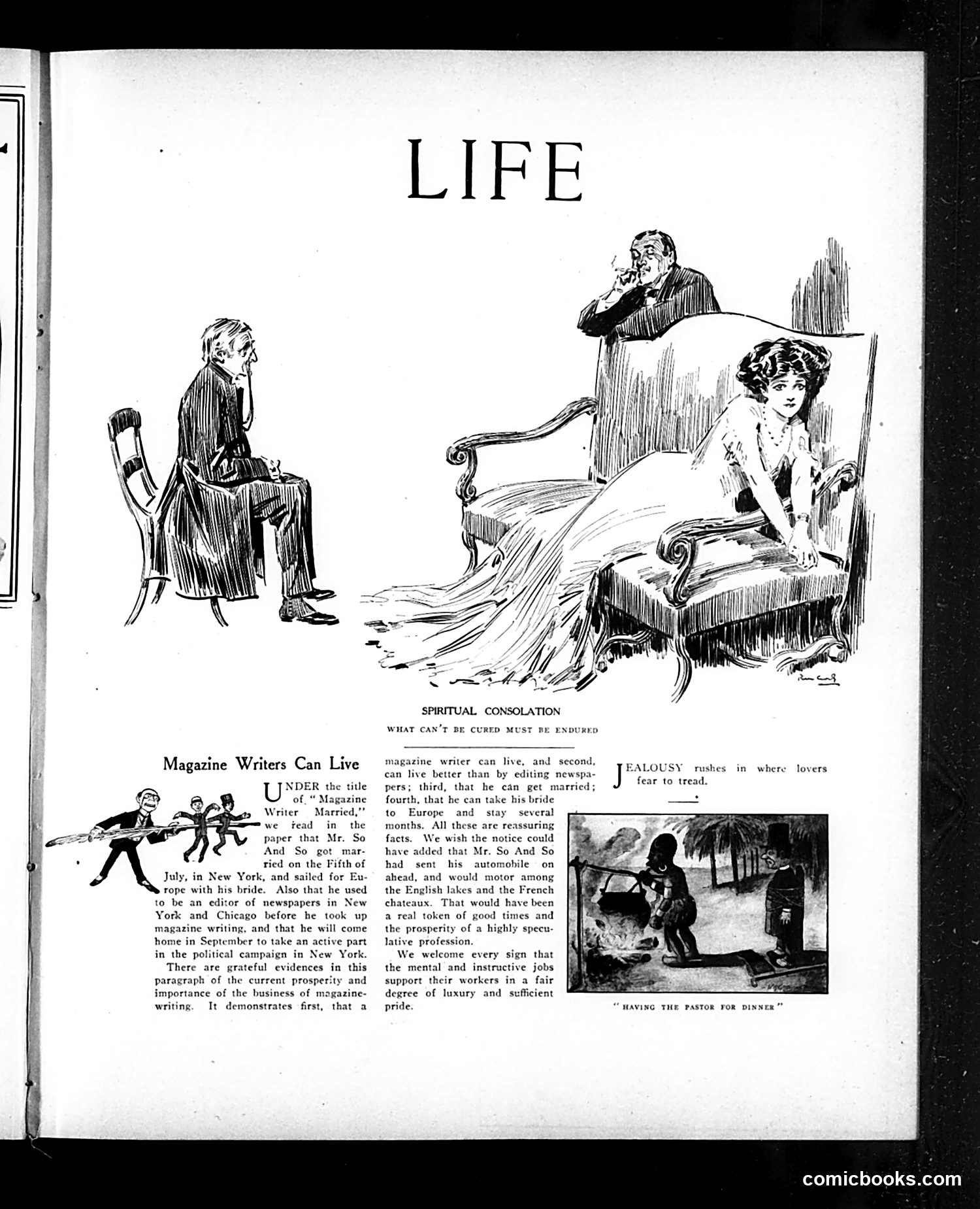
This page contains two separate satirical pieces. The top illustration, titled "Spiritual Consolation: What Can't Be Cured Must Be Endured," depicts a domestic drama—a woman sits on a couch while a man stands nearby looking distressed, and another man observes from behind furniture. The scene appears to satirize marital infidelity or romantic jealousy. Below, "Magazine Writers Can Live" discusses a magazine writer's prospects, mentioning his recent marriage and European travel. The text humorously lists optimistic life improvements (better income, marriage eligibility, European vacations) available to magazine writers. The accompanying small illustration shows figures in exaggerated poses, likely emphasizing the satirical tone about writers' actual circumstances versus claimed benefits. The page overall mocks both domestic romantic complications and inflated claims about writers' prosperity.
The page contains no prominent political cartoon. Instead, it's primarily text-based editorial content discussing fashion and divorce law. The main article criticizes high-waisted gowns and rapid fashion changes as frivolous and morally dangerous. It then pivots to a serious discussion of divorce, referencing **Judge Brown** and **Cardinal Gibbons**, who apparently disagreed on whether divorce should be legally permitted. The text favors Cardinal Gibbons's position that divorce laws should be based on Christian principles. The piece concludes by listing **ten Republican Senators** opposing the Aldrich bill, praising them as representing "the most attractive line of politics that is on exhibition in this country." These senators apparently resisted party pressure on tariff legislation. The decorative illustrations are generic vignettes unrelated to the political content.
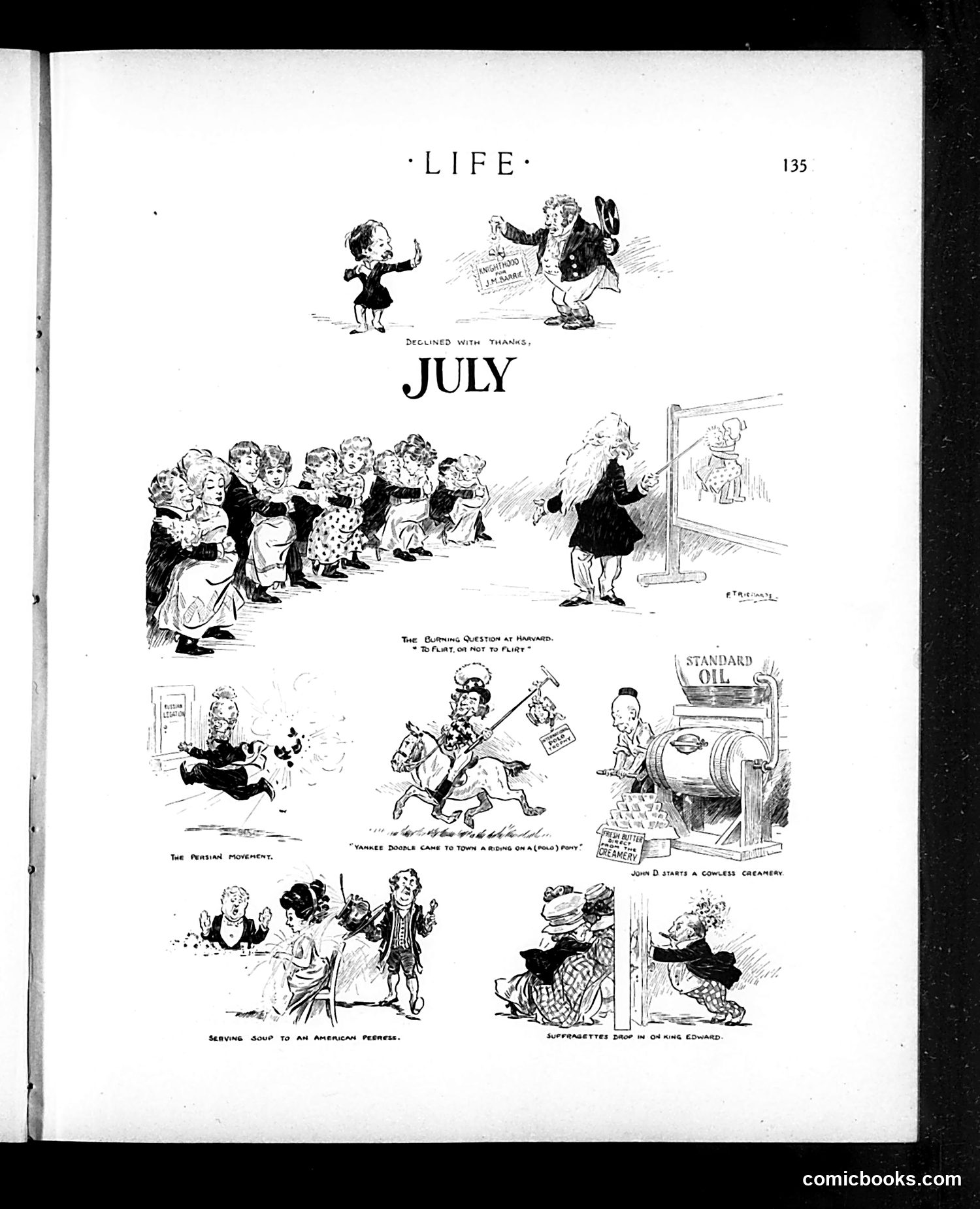
This page of *Life* magazine presents satirical cartoons mocking July events and social issues. The top panel shows someone "Declined with Thanks" to an invitation, likely political commentary on a Harvard event. "The Burning Question at Harvard" depicts the debate "To Flirt or Not to Flirt"—satirizing campus social attitudes. Other cartoons reference contemporary issues: "Yankee Doodle Came to Town Riding on a (Mule) Pony" appears to mock American pretension; "Soap Starts a Codless Creamery" satirizes a dairy industry development; "Serving Soup to an American Express" and "Suffragettes Ring in King Edward" reference women's suffrage activism and the British monarchy. The cartoons use exaggerated caricatures and absurdist scenarios typical of *Life*'s satirical approach to social and political topics of the era.
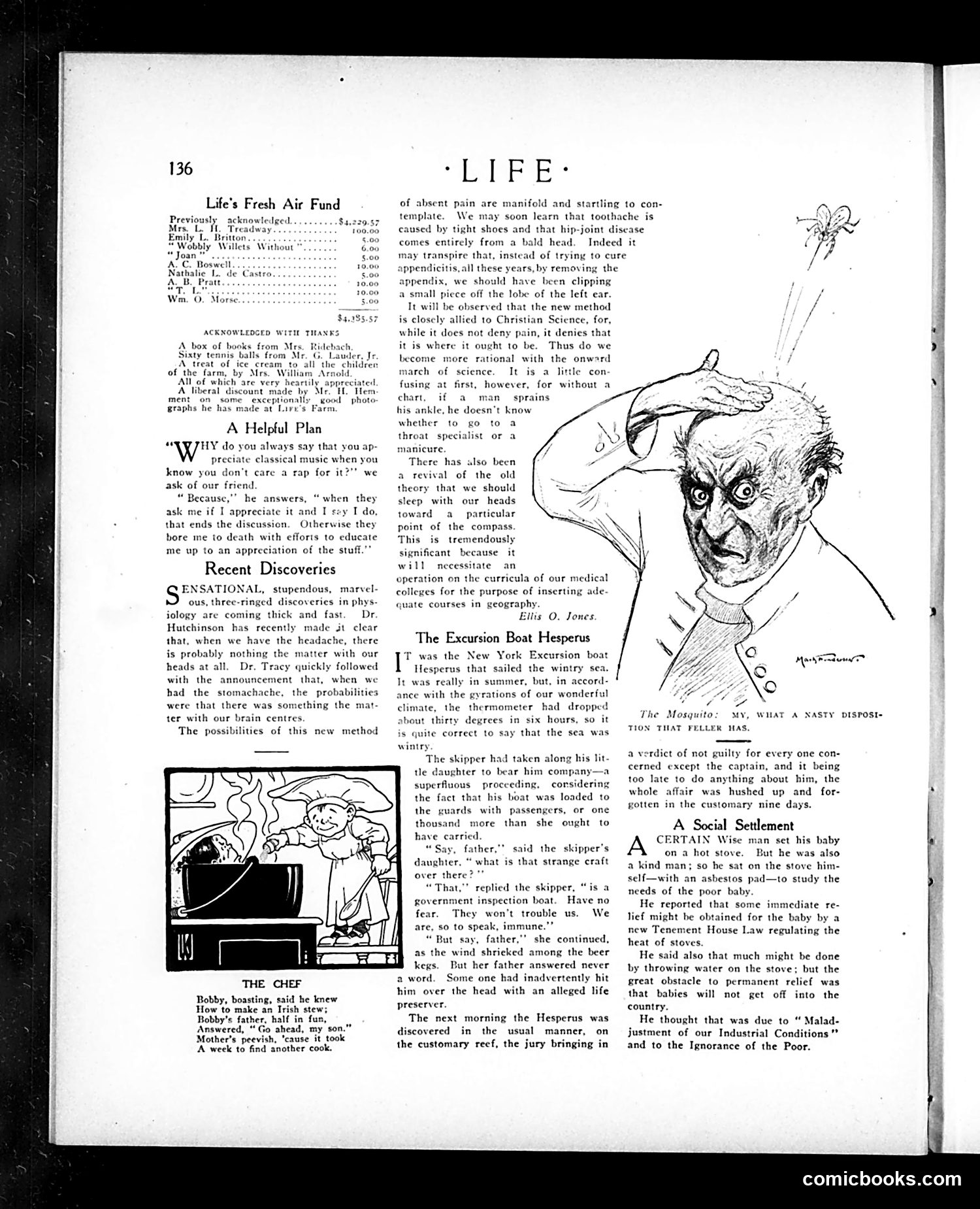
This page contains several brief satirical pieces rather than a single major cartoon. The main illustration shows a grotesque caricatured face labeled "The Mosquito," captioned "MY, WHAT A NASTY DISPOSITION THAT FELLER HAS." This appears to be a humorous commentary on mosquitoes as a pest or nuisance. Below that is a small cartoon titled "THE CHEF" depicting someone in a kitchen, accompanied by a rhyming joke about cooking. The page also includes short prose sections on topics like music appreciation, scientific discoveries, and a social settlement house helping impoverished families. The overall tone is lighthearted domestic humor mixed with progressive social commentary typical of Life magazine's satirical approach to American life.
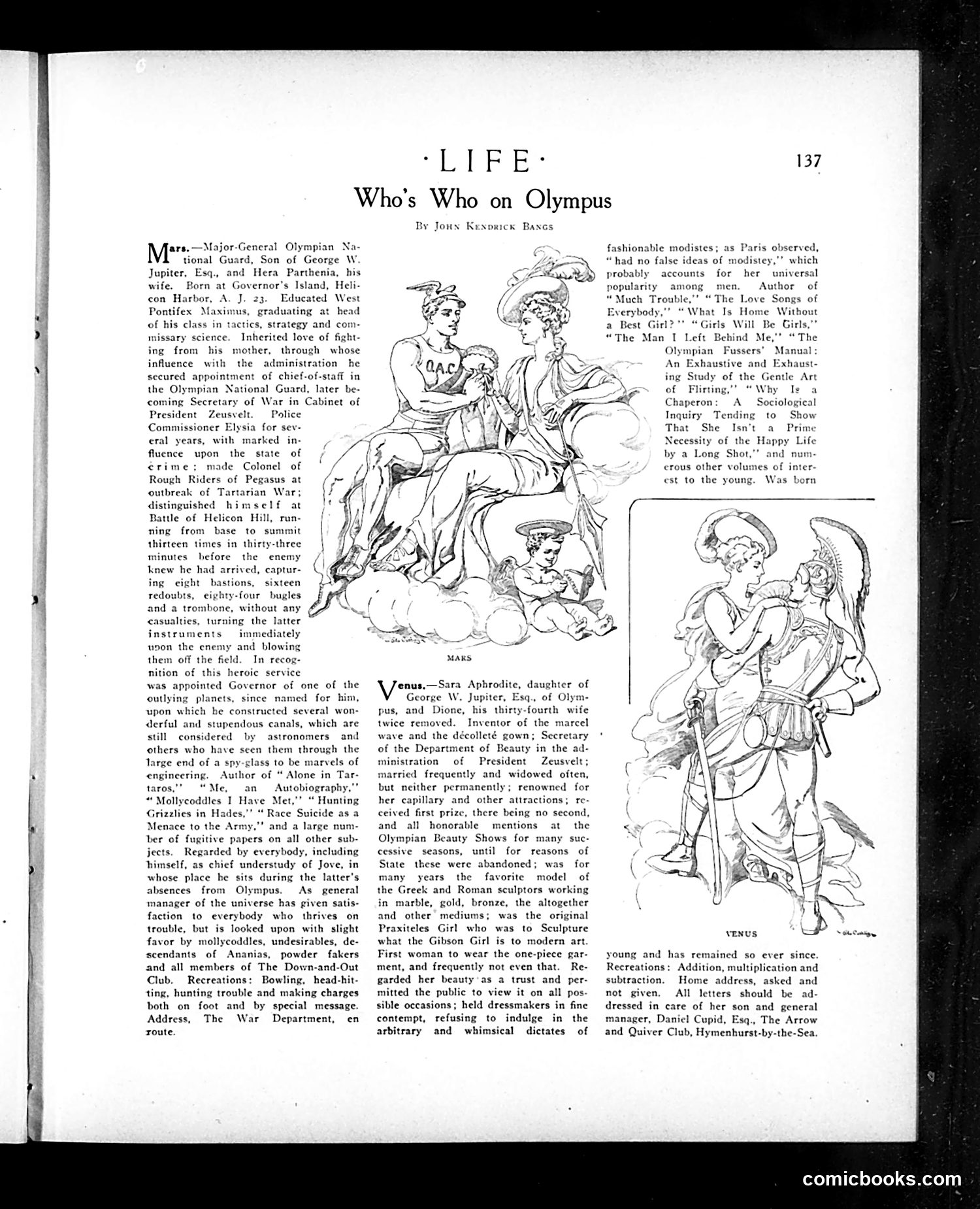
This page presents satirical character sketches of prominent early 20th-century figures, using classical mythology as a framing device. The illustrations depict figures from high society and government as Greek gods and goddesses. The entry for "Mars" describes Major-General Olympian (son of George W. Jupiter), presenting him as a military figure with exaggerated accomplishments, satirizing his prominence and self-importance. "Venus" appears to be Sara Aphrodite, daughter of Jupiter, characterized humorously as a socialite known for beauty and modeling, mocking high-society women and their pursuit of fame through appearance. The satirical approach—naming real people after classical deities—mocks the pretensions of the wealthy and powerful, suggesting they regard themselves as godlike while the magazine treats them with irreverent humor.
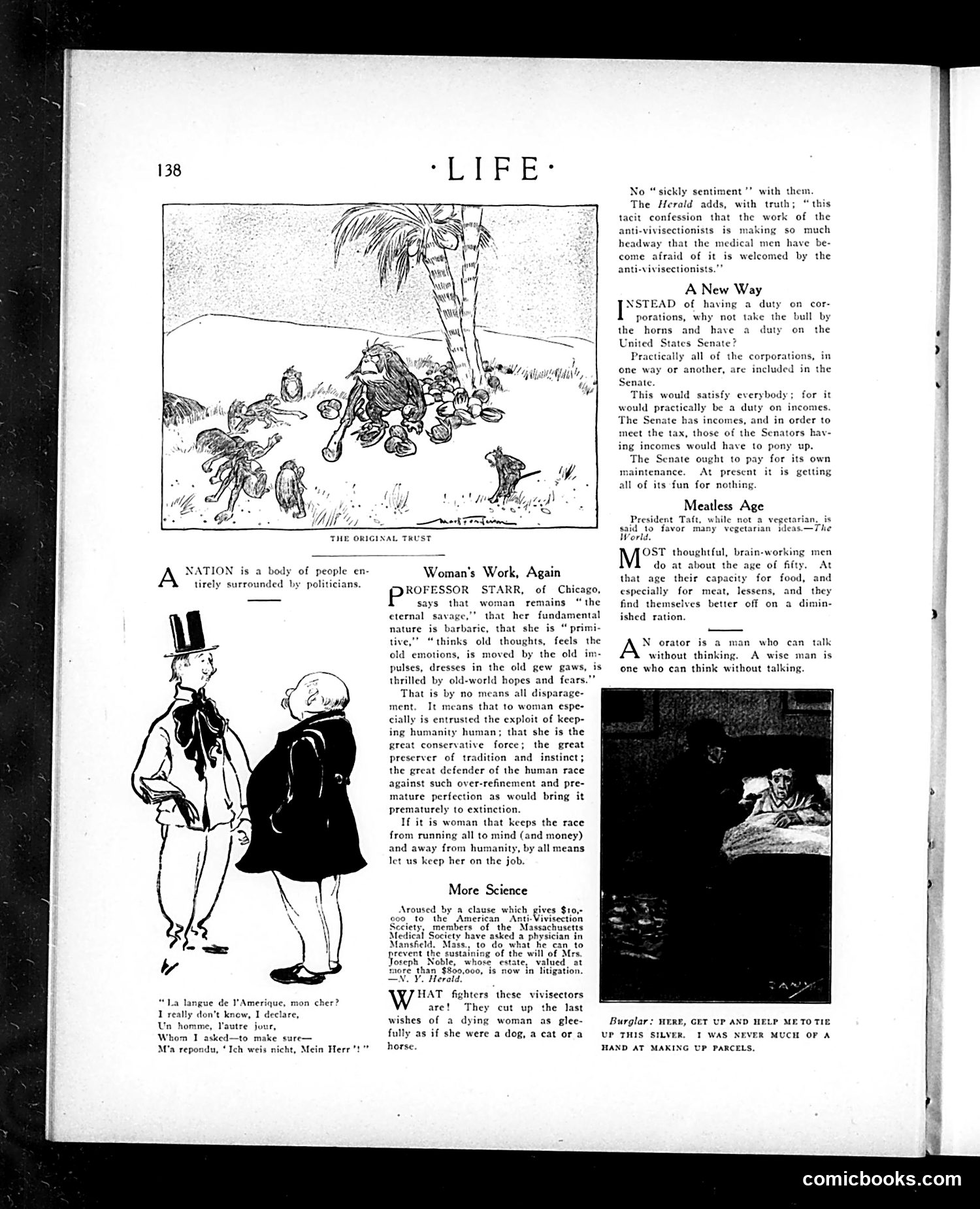
**The Main Cartoon (top):** This depicts politicians as monkeys lounging beneath a palm tree—a visual metaphor equating elected officials with primates. The caption "THE ORIGINAL TRUST" satirizes how politicians function as a self-serving monopoly, lounging idly while supposedly governing the nation. The opening text states: "A NATION is a body of people entirely surrounded by politicians," establishing the cartoon's cynical premise that politicians form a separate, parasitic class. **Supporting Content:** The page critiques anti-vivivisectionists (animal-testing opponents), proposes taxing corporations through the Senate, and mocks President Taft's vegetarianism. A small dialogue cartoon mocks French language/customs. **Overall Tone:** Sharp political satire attacking institutional corruption and the perceived laziness of elected officials during the Progressive Era.
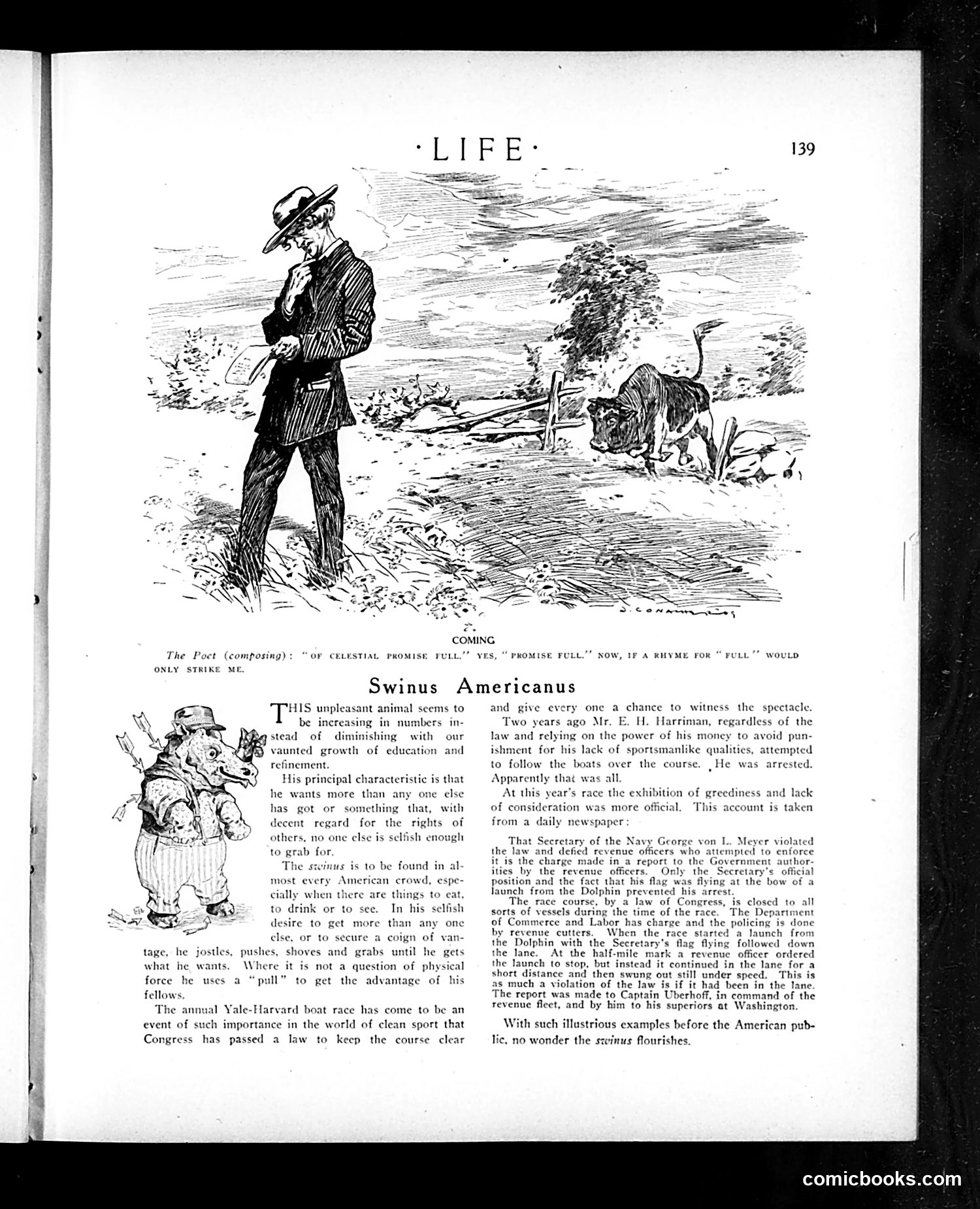
This page satirizes American greed and unsportsmanlike conduct, specifically regarding the Yale-Harvard boat race. The main illustration shows a well-dressed man in a top hat standing over what appears to be an ostrich or similar bird—representing "Swinus Americanus" (the American pig). The text criticizes an unnamed wealthy individual (likely a wealthy patron or official) who used his money to avoid punishment for unsportsmanlike conduct during a boat race. A Secretary violated race rules by ordering a revenue officer to stop a competing boat mid-race. The incident was allegedly hushed up through influence. The satire mocks American greed and the wealthy's ability to escape consequences, suggesting that such behavior—prioritizing money and advantage over sporting integrity—is quintessentially American.
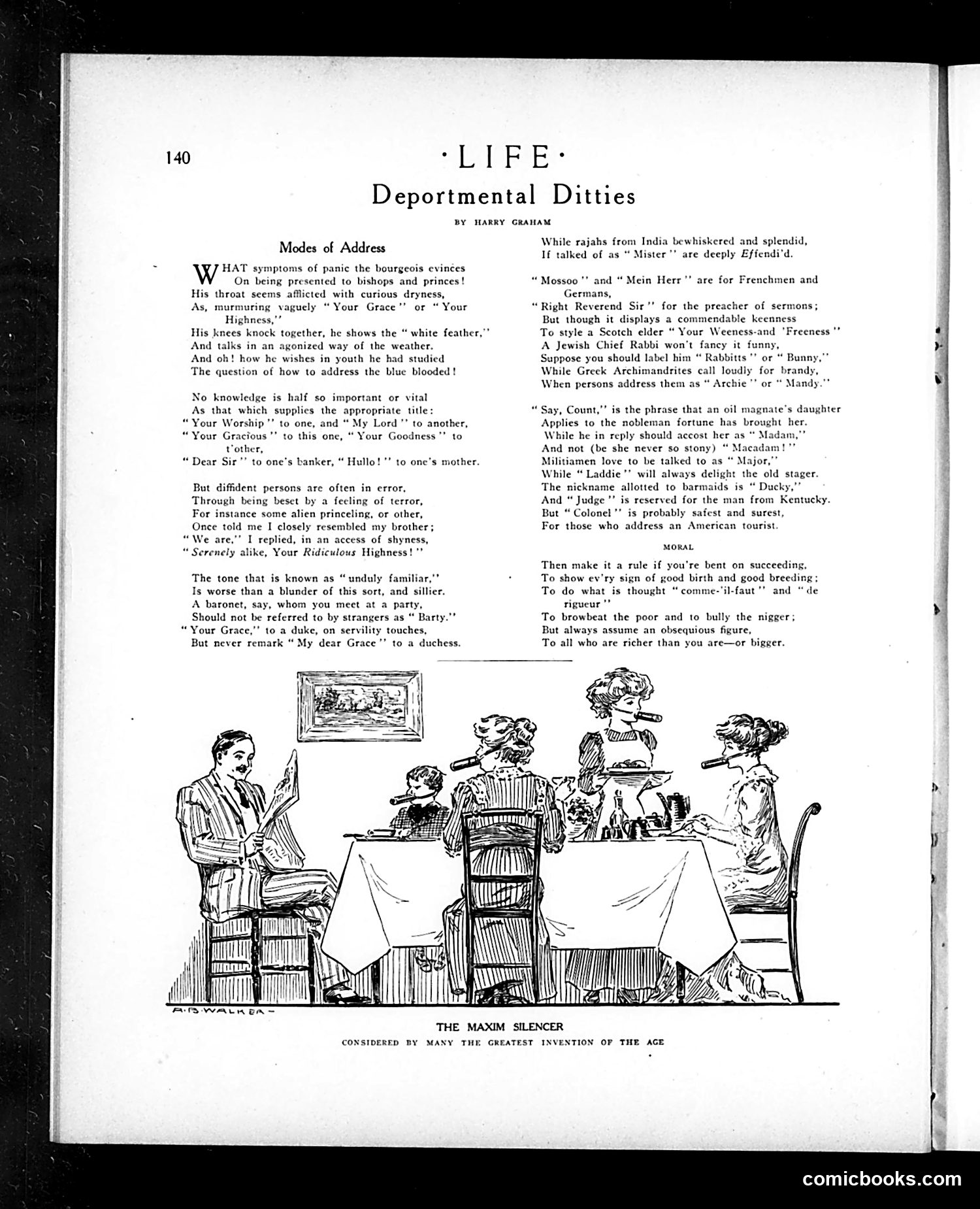
This satirical piece by Harry Graham critiques the confusion of proper forms of address across social classes and nationalities. The text mocks how bourgeois people struggle with correct titles for bishops, princes, and other dignitaries—whether to say "Your Grace," "Your Worship," or "Your Lordship." The accompanying illustration, titled "The Maxim Silencer," shows diners at a table equipped with what appear to be silencers (possibly mufflers or noise-suppression devices) protruding from their mouths. This is likely satirizing the social awkwardness of dinner conversation and the desire to suppress embarrassing verbal mistakes about proper forms of address—treating courtesy as a mechanical problem requiring technological "invention." The humor targets Victorian-era social anxiety about class etiquette.
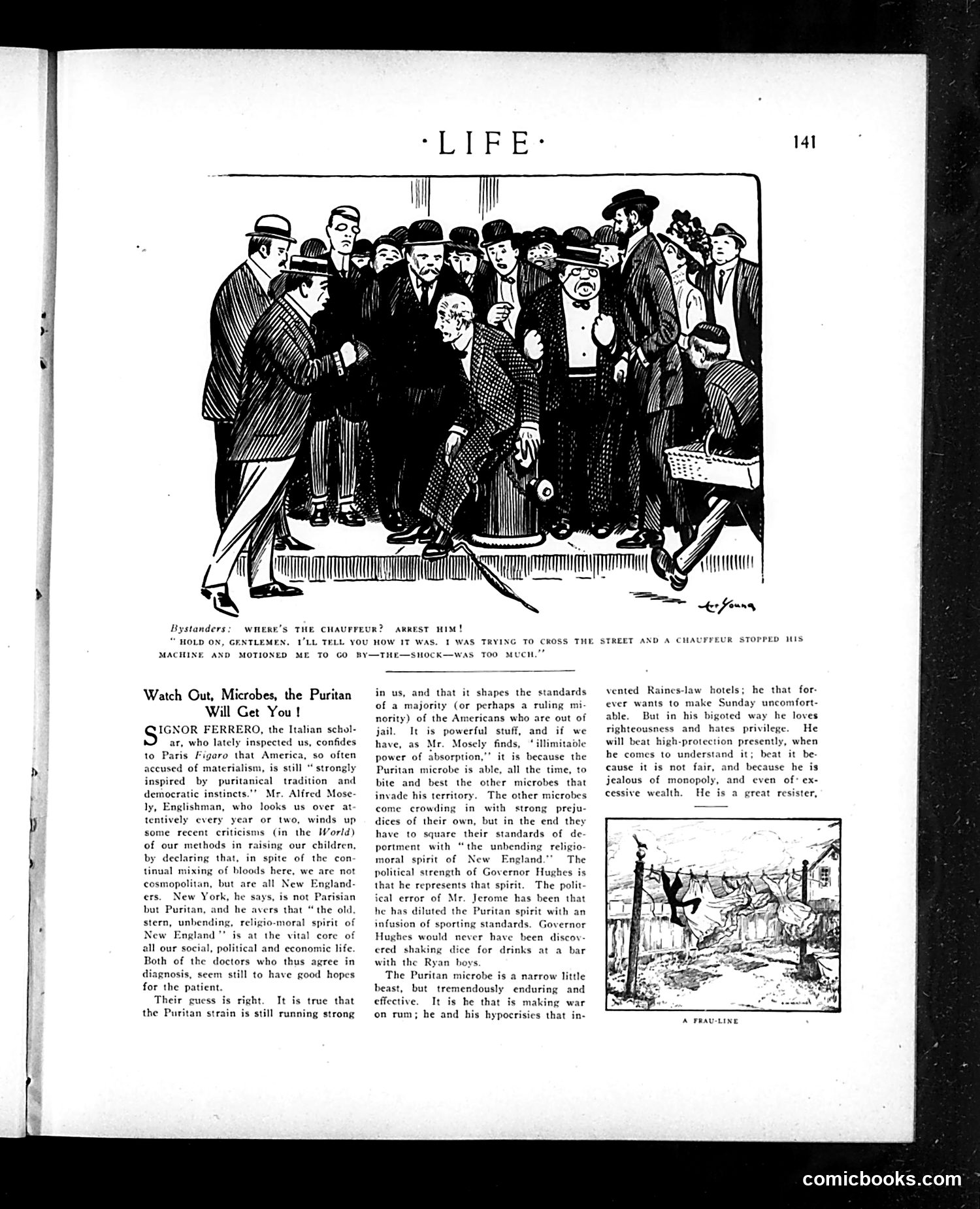
This page from *Life* magazine features a satirical article titled "Watch Out, Microbe, the Puritan Will Get You!" The main cartoon depicts a crowd confronting what appears to be a chauffeur, illustrating a story about attempting to cross a street. The article discusses **Sigyor Ferrero**, an Italian scholar who criticized American moral standards, and references **Governor Hughes** and **Mr. Jerome** as representatives of "Puritan" values in New York. The satire attacks the "Puritan microbe"—narrow-minded moralism—as both ineffective and hypocritical. The text argues this Puritanical strain remains powerful in American life, opposing boxing, drinking, and other activities, while the author questions whether such rigid moral policing actually improves society.
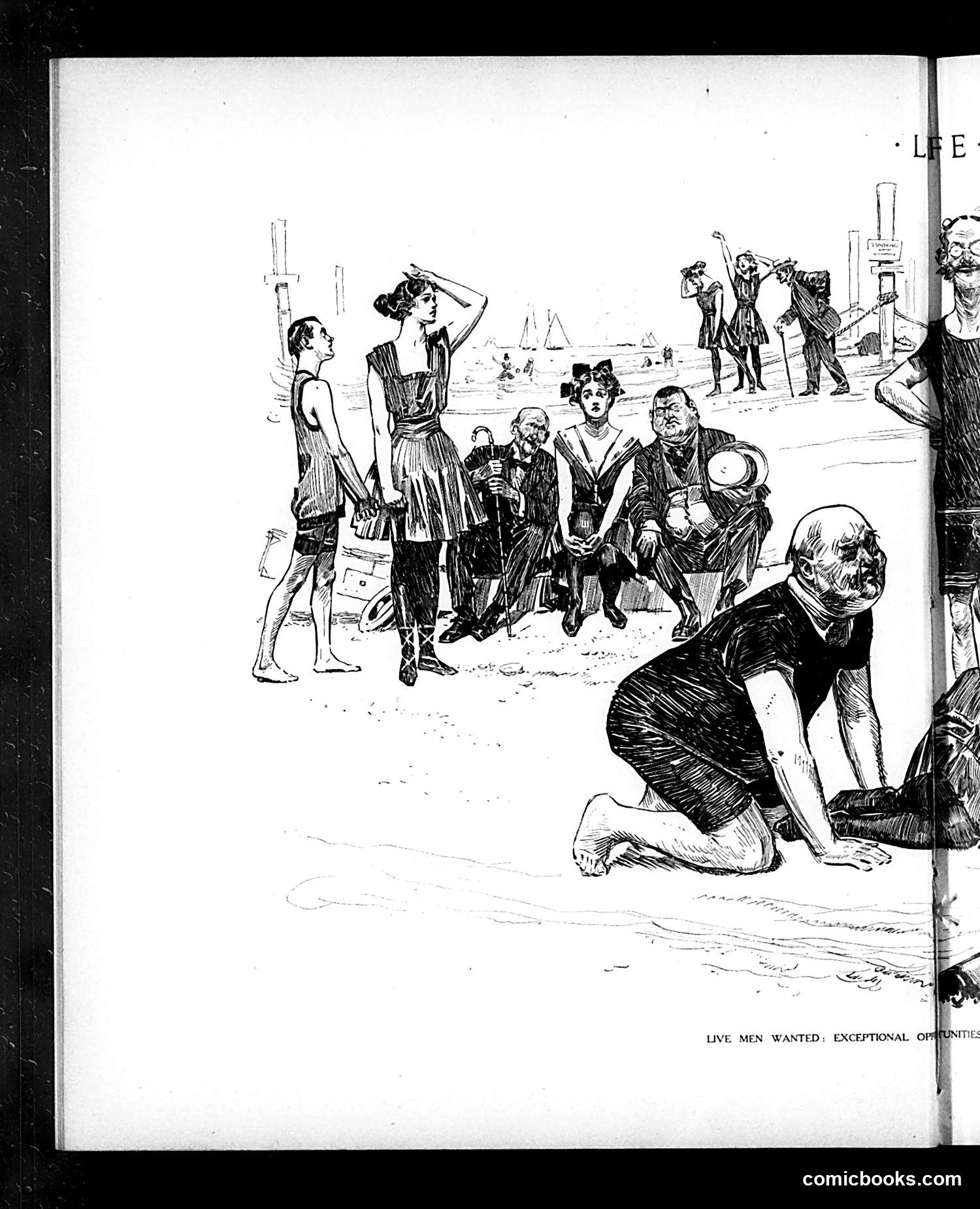
This satirical illustration depicts a beach recruiting scene with the caption "Live Men Wanted: Exceptional Opportunities" (text appears cut off). The cartoon shows a bald, heavyset man kneeling in a submissive posture before a gathered crowd of well-dressed figures on a beach, with sailing vessels visible in the background. The image appears to be social satire about employment recruitment or exploitation. The contrast between the desperate, physically vulnerable man and the composed, fashionably-dressed group suggests mockery of either labor recruitment practices or class disparities. The man's exaggerated facial features and posture emphasize his degradation, while "exceptional opportunities" in the caption suggests ironic commentary on false or exploitative job promises. Without additional context about the specific Life magazine issue, the precise target of satire remains unclear.
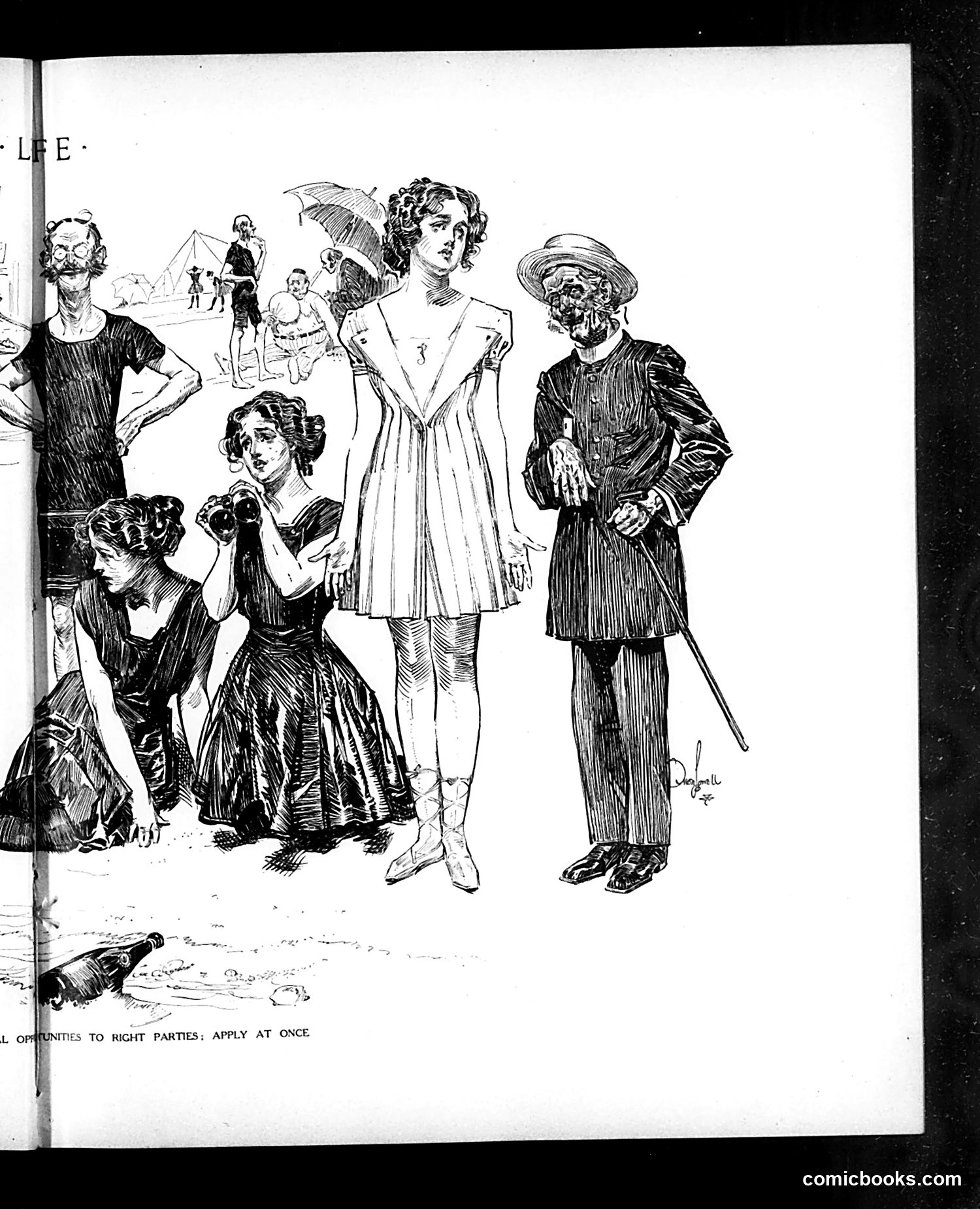
This is a satirical illustration from *Life* magazine depicting social types at what appears to be a beach or seaside resort. The central figure is an attractive woman in a light dress holding a parasol, positioned as the focal point. She's surrounded by various characters representing different social classes and types: working-class men in darker clothing, a seated woman, and other beachgoers in the background. The caption reads "L OPPORTUNITIES TO RIGHT PARTIES; APPLY AT ONCE" (partially visible), suggesting this is social satire about romantic or matrimonial prospects. The composition satirizes class distinctions and the marriage market, with the well-dressed central woman presented as desirable while the surrounding figures represent various social positions. The style and subject matter are typical of early-to-mid 20th century American satirical commentary on class and courtship.
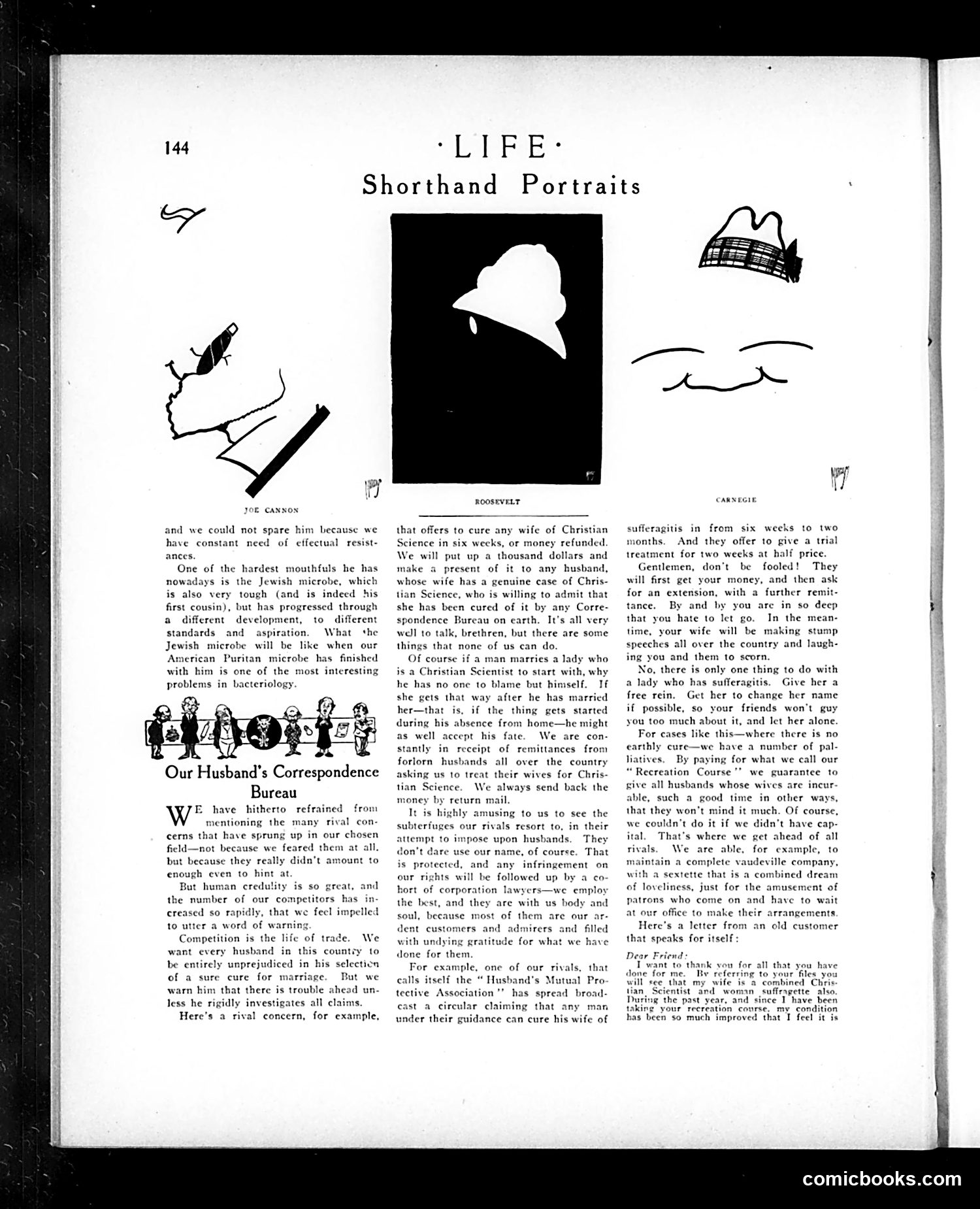
This page satirizes two contemporary concerns through caricature and mock-advice. **The Portraits:** Joseph Cannon (Speaker of the House) and Theodore Roosevelt are depicted as silhouettes—a visual technique suggesting they are types or representations rather than individuals. The text uses medical metaphors ("Jewish microbe," "American Puritan microbe") that reflect early 20th-century anxieties about immigration and assimilation, presented here as pseudo-scientific bacteriology. **The Main Satire:** "Our Husband's Correspondence Bureau" mocks mail-order cure schemes by presenting a fake business claiming to treat "sufferagitis"—women's suffrage activism portrayed as a disease. The joke targets both the ridiculousness of viewing women's political participation as pathological and the proliferation of fraudulent self-help businesses. Competitors are criticized for false claims; the narrator's "cure" is simply to let women do as they please while husbands seek entertainment elsewhere—a backhanded commentary on both suffragism and masculine escapism.
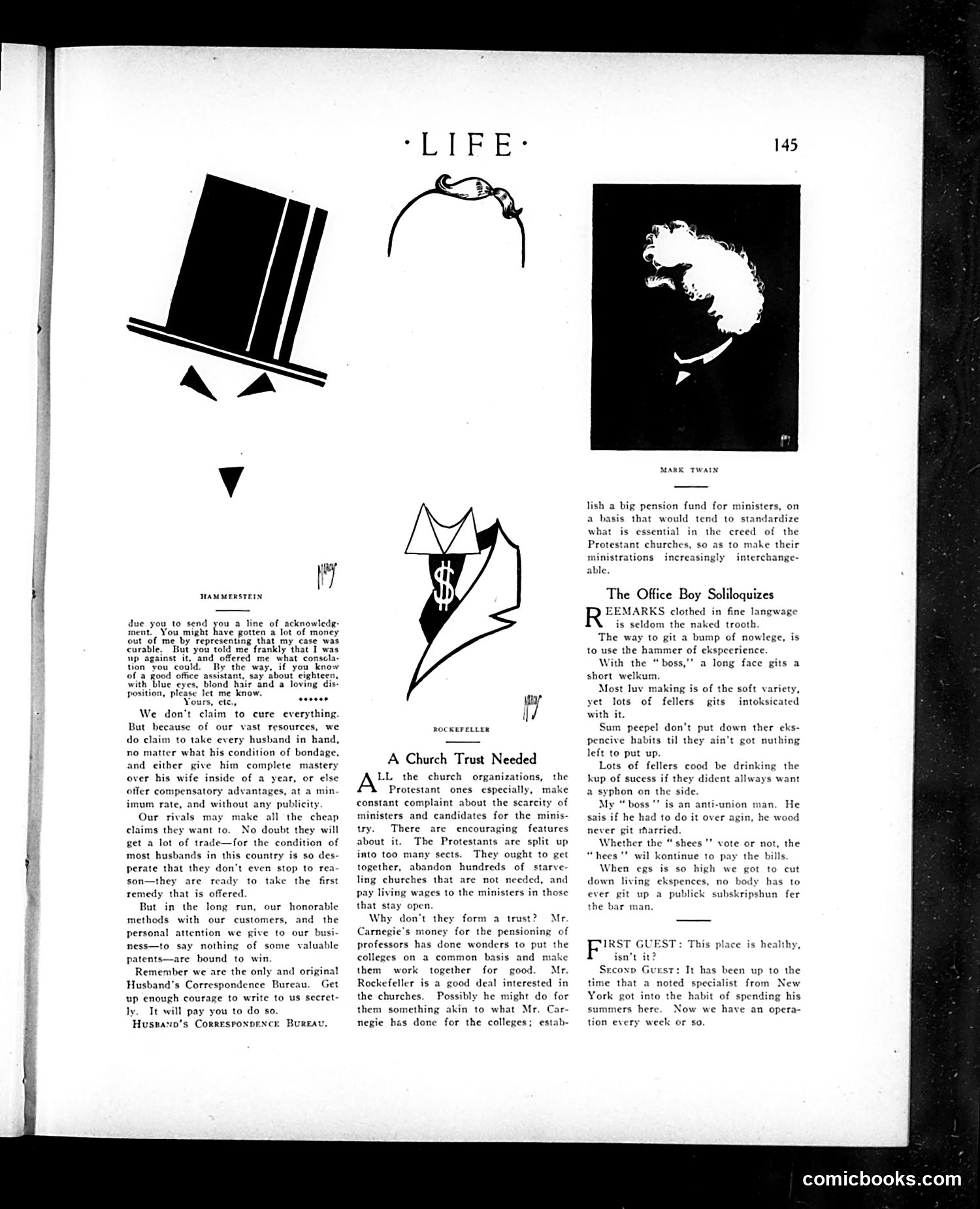
This *Life* magazine page contains several satirical pieces mocking contemporary American institutions: **"Hammersteinʻs" Letter**: A humorous complaint to a fake "Husband's Correspondence Bureau" advertising marital reform services—satirizing both the desperation of unhappy husbands and dubious self-help businesses. **"The Office Boy Soliloquizes"**: Intentionally misspelled wisdom from a young office worker, mocking earnest but clichéd business advice and workplace hierarchy. **"A Church Trust Needed"**: The substantive piece, attributed to Mark Twain. It critiques Protestant Christianity's fragmentation into too many competing denominations and underfunded churches. Twain suggests wealthy industrialists like Carnegie and Rockefeller should create a "trust" (monopoly) consolidating churches, standardizing ministers' pay, and making denominations interchangeable—satirizing both religious division and the era's trust-building by billionaires. All pieces ridicule American social pretensions and institutional inefficiency through exaggeration and dark humor.
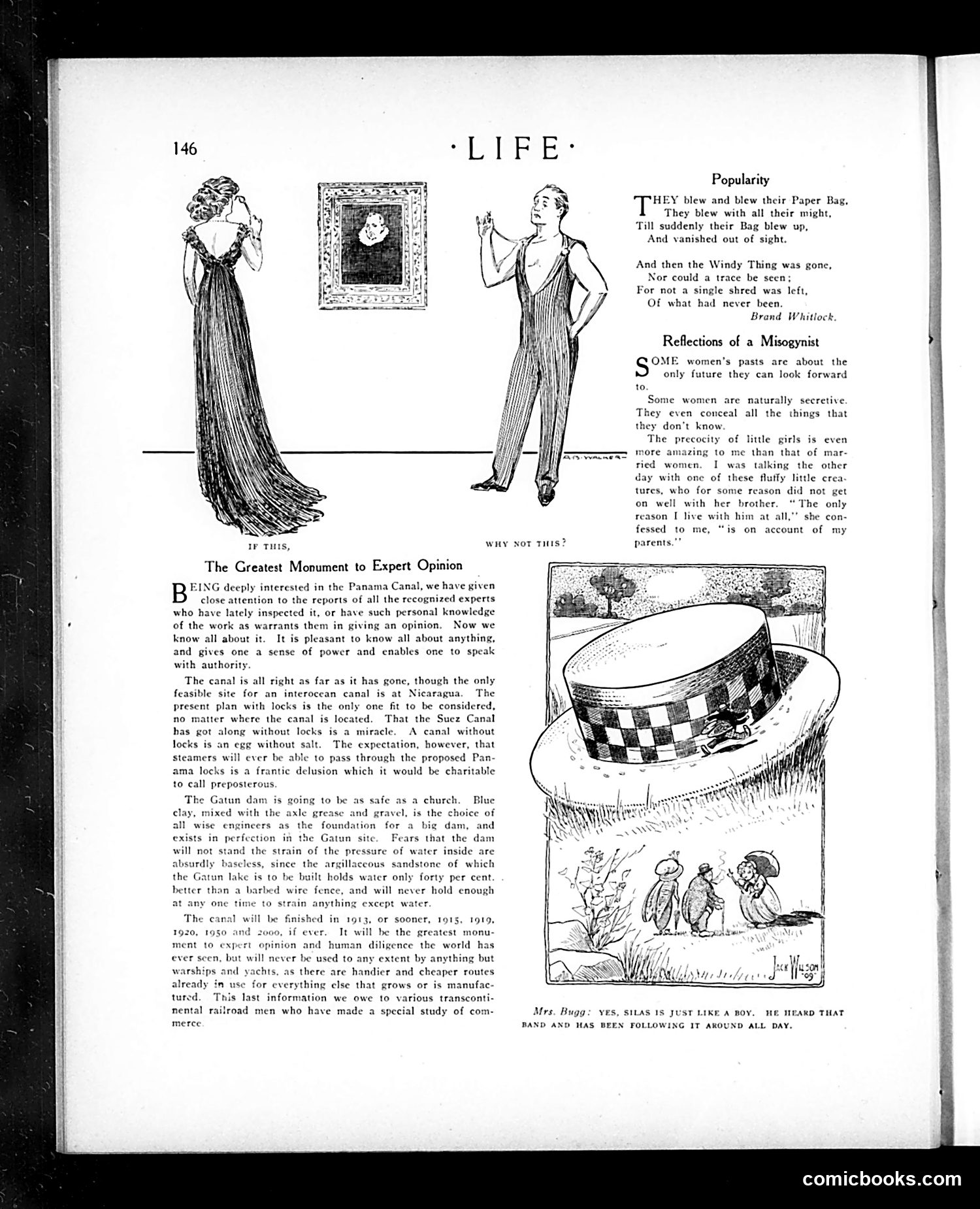
This page contains three satirical pieces typical of early 20th-century American humor: **"Popularity"** (top): A whimsical poem about a "Paper Bag" and "Windy Thing" that inflates and disappears. This appears to be abstract satire on fads or fleeting trends—things that blow up suddenly in public interest, then vanish without substance. **"Reflections of a Misogynist"** (right): Sardonic one-liners mocking women's intelligence, secrecy, and precocity. The final anecdote portrays a young girl as superficial. This represents period misogyny presented as clever wit—humor that's now recognized as simply hostile toward women. **"The Greatest Monument to Expert Opinion"** (center-left): Satire on the Panama Canal project, mocking conflicting expert predictions. Experts contradict each other on every detail—location, design, completion date (listed as "1913, or sooner, 1915, 1919, 1920, 1950 and if ever"). The satire attacks expert pomposity and the impossibility of reconciling contradictory professional opinions.
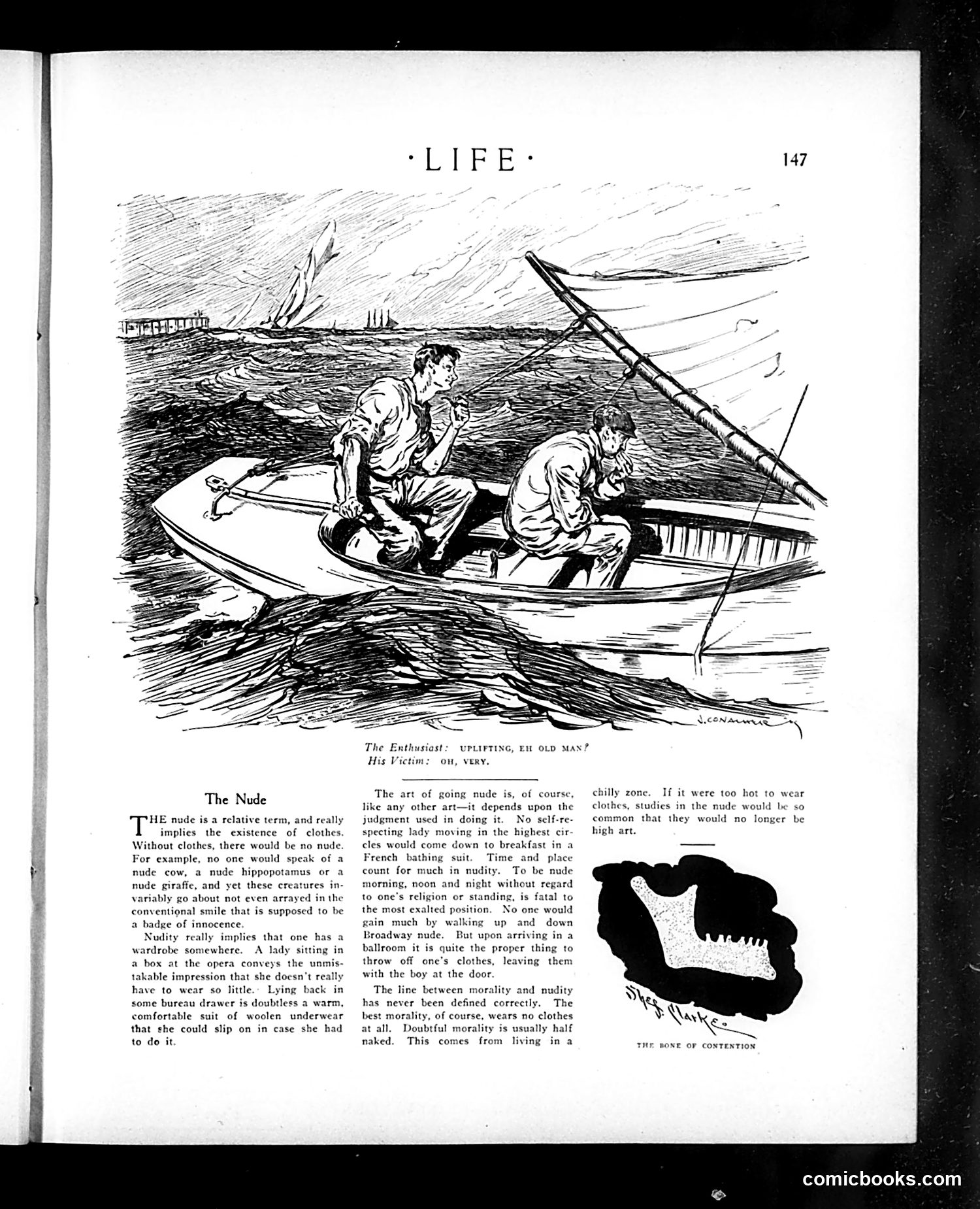
This page satirizes pretentious attitudes about nudity and social propriety in early 20th-century high society. The essay mocks the hypocrisy of the wealthy elite, who consider nudity acceptable in formal settings (opera boxes, ballrooms) while condemning it elsewhere. The argument is deliberately absurd: nudity is only "nude" if one *owns* clothes but chooses not to wear them—suggesting morality is merely about *performing* respectability through wardrobe choices. The cartoon at top shows two men in a rowboat, captioned "The Enthusiast: UPLIFTING, EH OLD MAN? His Victim: OH, VERY." This appears to satirize self-righteous social reformers who impose their moral judgments on others, treating nudity as something requiring "uplifting" or moral correction. The bottom cartoon, "The Bone of Contention," visually summarizes the essay's central joke: society's obsession with defining and regulating nudity.
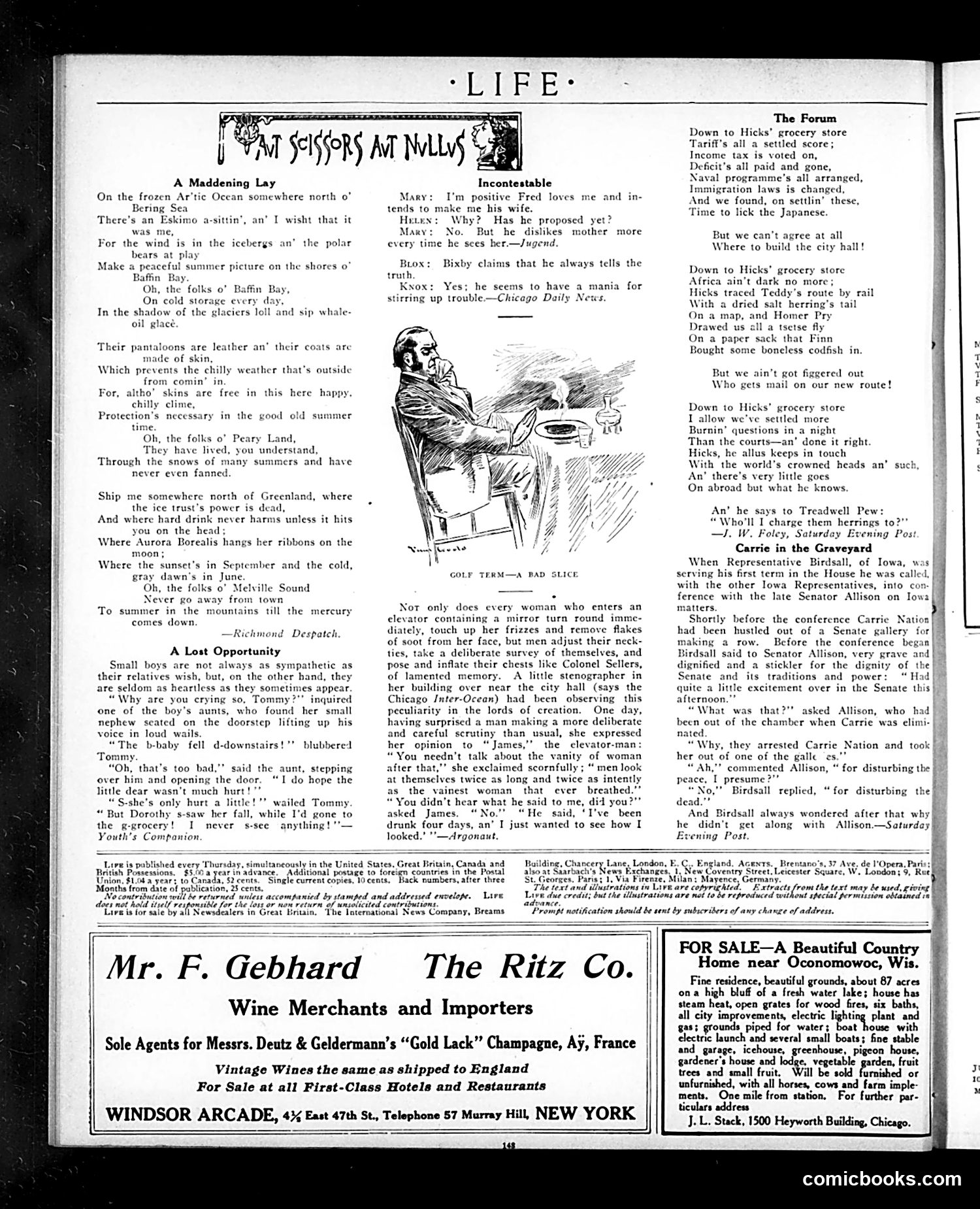
This page contains several satirical pieces typical of early-20th-century Life magazine: **"A Maddening Lay"** is a humorous poem expressing longing to escape to the Arctic, where Eskimos live contentedly without modern anxieties—satirizing urban American stress. **"A Lost Opportunity"** is a brief joke about a boy crying because his sister fell downstairs while he was away, so he missed witnessing the accident—mocking childhood self-centeredness masquerading as sympathy. **"Incontestable"** offers quick joke items about relationship dishonesty and social hypocrisy. **"Golf Term—A Bad Slice"** describes office workers obsessively checking mirrors in elevators, with a stenographer's anecdote revealing that men's vanity equals women's—undercutting contemporary assumptions about female superficiality. **"The Forum"** is verse satirizing small-town gossip at a general store, where citizens solve grand national issues (tariffs, naval programs) but cannot agree on building a city hall—lampooning parochial priorities and political gridlock. The advertisements promote champagne and country real estate.
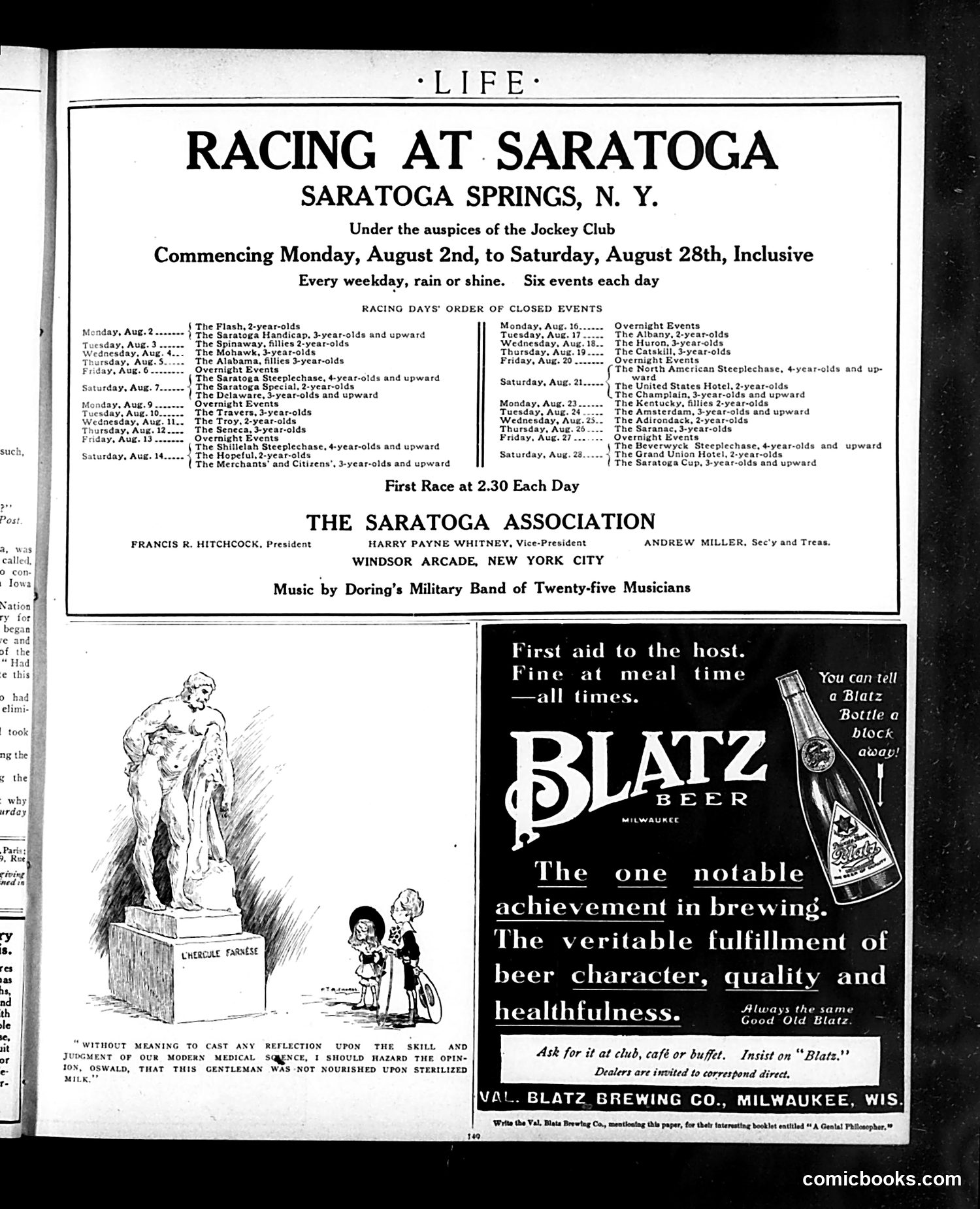
This page is primarily **advertising and event announcement**, not political satire. The top half announces Saratoga Springs horse racing (August 2-28), listing races and organizers under the Jockey Club. The cartoon below depicts a classical statue labeled "Hercule Farnese" with two figures examining it. The caption—a quote from "Oswald"—jokes that this muscular classical figure couldn't have been built on "sterilized milk," implying modern pasteurized milk produces weaker physiques than whatever nourished ancient strongmen. This reflects early 20th-century debates about **milk pasteurization**: some opponents claimed sterilization reduced nutritional value, while advocates touted safety benefits. The joke satirizes these concerns by suggesting pasteurized milk makes you weak compared to historical figures. The Blatz Beer advertisement below commercializes similar messaging, positioning beer as health-promoting and character-building—ironic given Prohibition was imminent (1920).
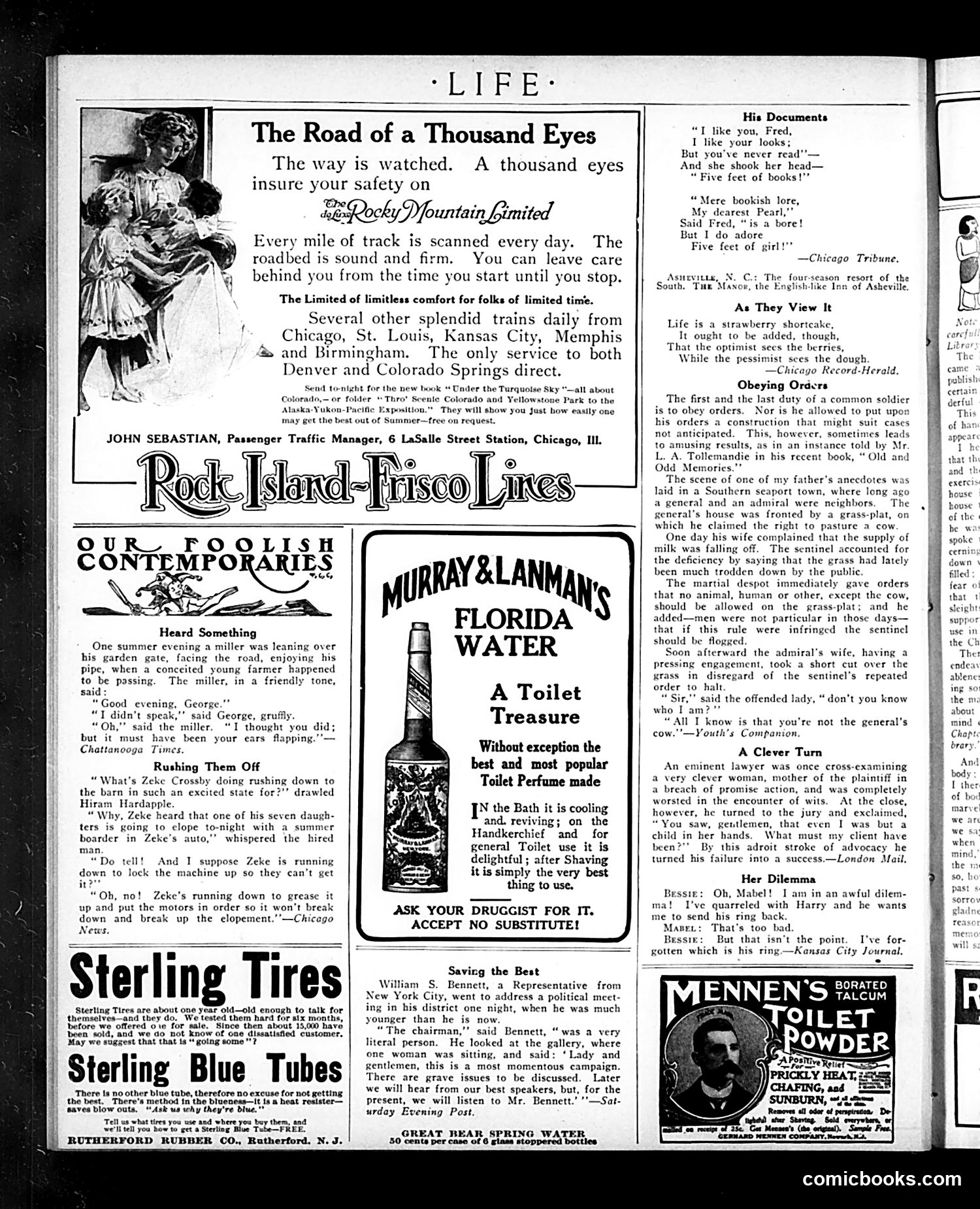
This page is primarily **advertising and humor content** rather than political satire. It contains: **Main Advertisement**: The Rocky Mountain Limited railroad, emphasizing safety ("a thousand eyes insure your safety"), reliability, and comfortable travel between major cities. **Humorous Anecdotes**: Three brief jokes occupying the left column: - A miller's witty comeback to a rude farmer - A father hastily preparing his daughter's car for her elopement (the humor being he helps rather than prevents it) - A politician's backhanded compliment when introduced last at a rally **Product Advertisements**: Murray & Lanman's Florida Water (toilet perfume), Sterling Tires and Blue Tubes (automotive), and Mennen's Borated Talcum Powder dominate the right side. The page reflects early-20th-century advertising priorities—railroads, automobiles, and personal grooming products—with light, family-friendly humor. No political cartoons or caricatures appear; this is primarily a commercial publication page with amusing filler content.
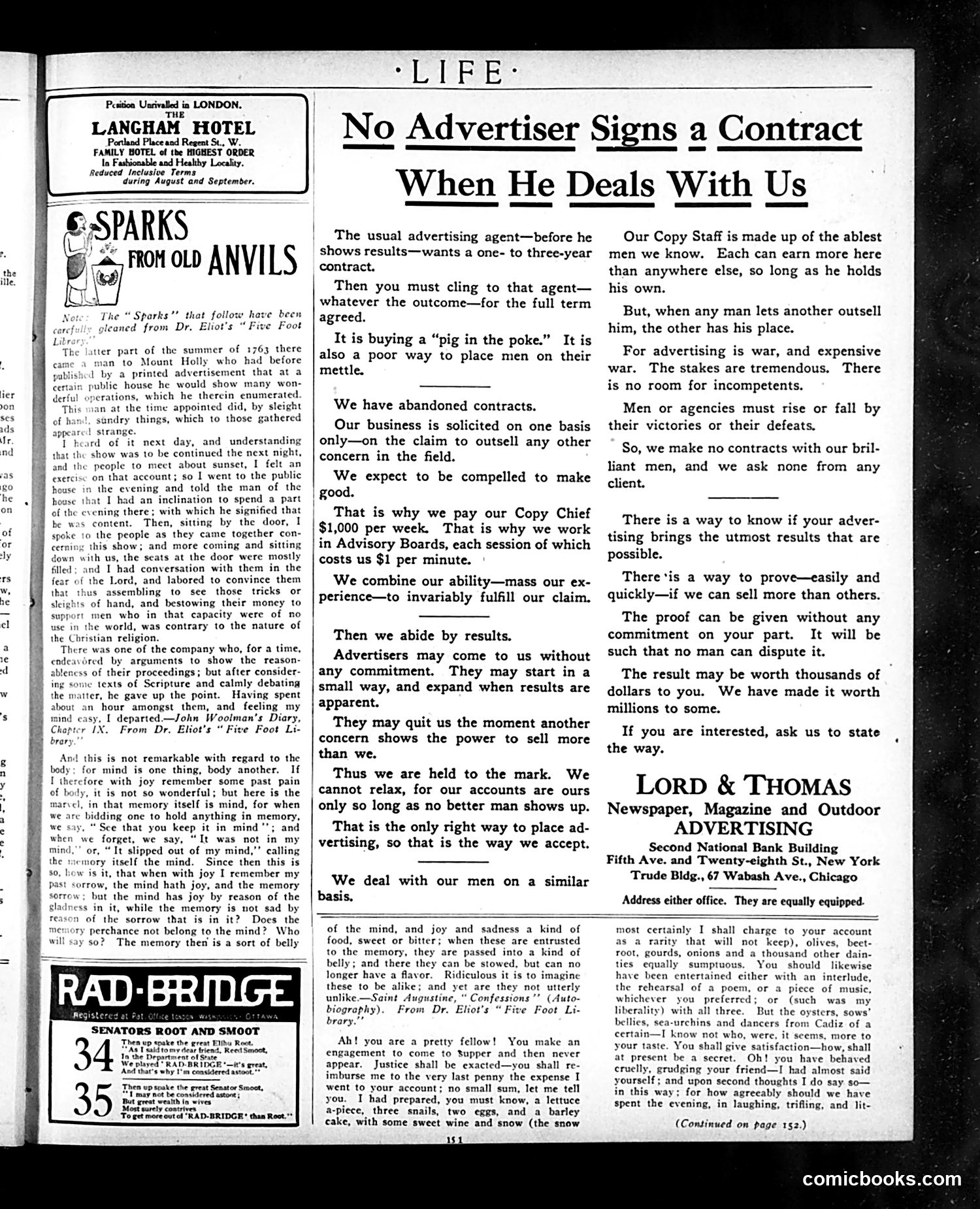
This page primarily features **advertising and business-related content** rather than political satire or comics in the traditional sense. The main article, "No Advertiser Signs a Contract When He Deals With Us," is a **Lord & Thomas advertising agency advertisement**. It argues against traditional long-term advertising contracts, claiming their agency operates on results alone—no commitment required. They justify this by highlighting their expensive investments (a $1,000/week copy chief, advisory boards costing $1 per minute), positioning themselves as confident enough to compete continuously rather than lock clients into agreements. The page also includes literary excerpts (Woolman's Diary, Dr. Eliot's writings) and hotel/product advertisements typical of the era. A reference to "Senators Root and Smoot" appears in fragmentary form, likely a satirical poem, though the context is unclear from this excerpt. **For modern readers**: This reflects early 20th-century advertising evolution—the shift from commission-based agent relationships toward performance-based partnerships.
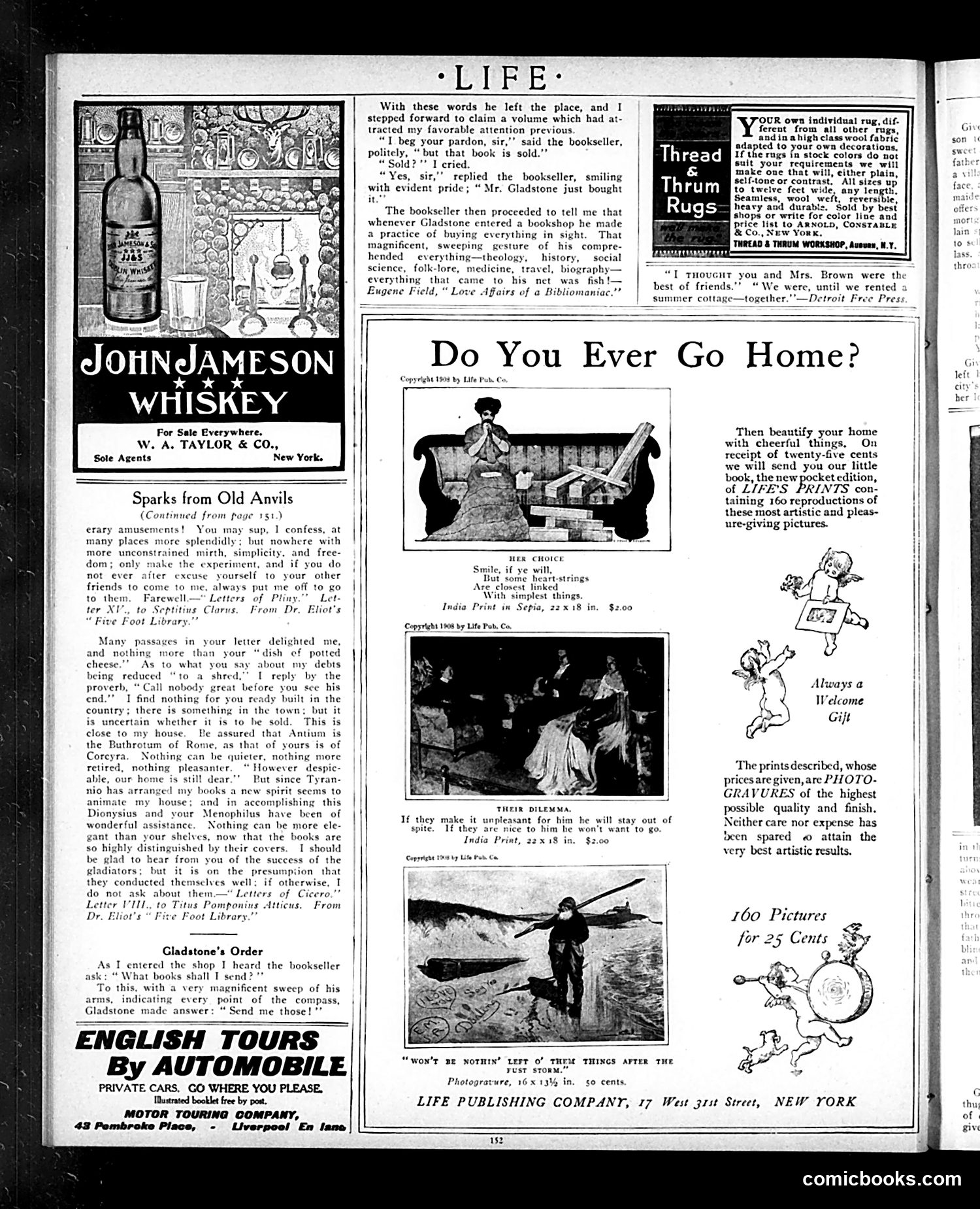
This page combines literary excerpts, advertisements, and light humor typical of early 1900s *Life* magazine. **Main Content:** The "Sparks from Old Anvils" section reproduces classical letters (Pliny, Gladstone anecdotes) celebrating intellectual life and book collecting. The Gladstone anecdote humorously portrays the former British Prime Minister as a compulsive book buyer who sweeps his arm across entire shop inventories and purchases everything indiscriminately—satirizing obsessive bibliomania. **Humor/Social Commentary:** A brief joke contrasts marital harmony with practical reality: friends remain close until they share a summer cottage, suggesting close quarters expose relationship friction. **Advertisements:** The page heavily features product ads: John Jameson Whiskey, Thread & Thrum Rugs, Arnold Constable textiles, Motor Touring Company automobiles, and Life Publishing's decorative prints—all targeting affluent readers. The content reflects *Life's* educated, wealthy audience interested in classical literature, collecting, and consumer goods.
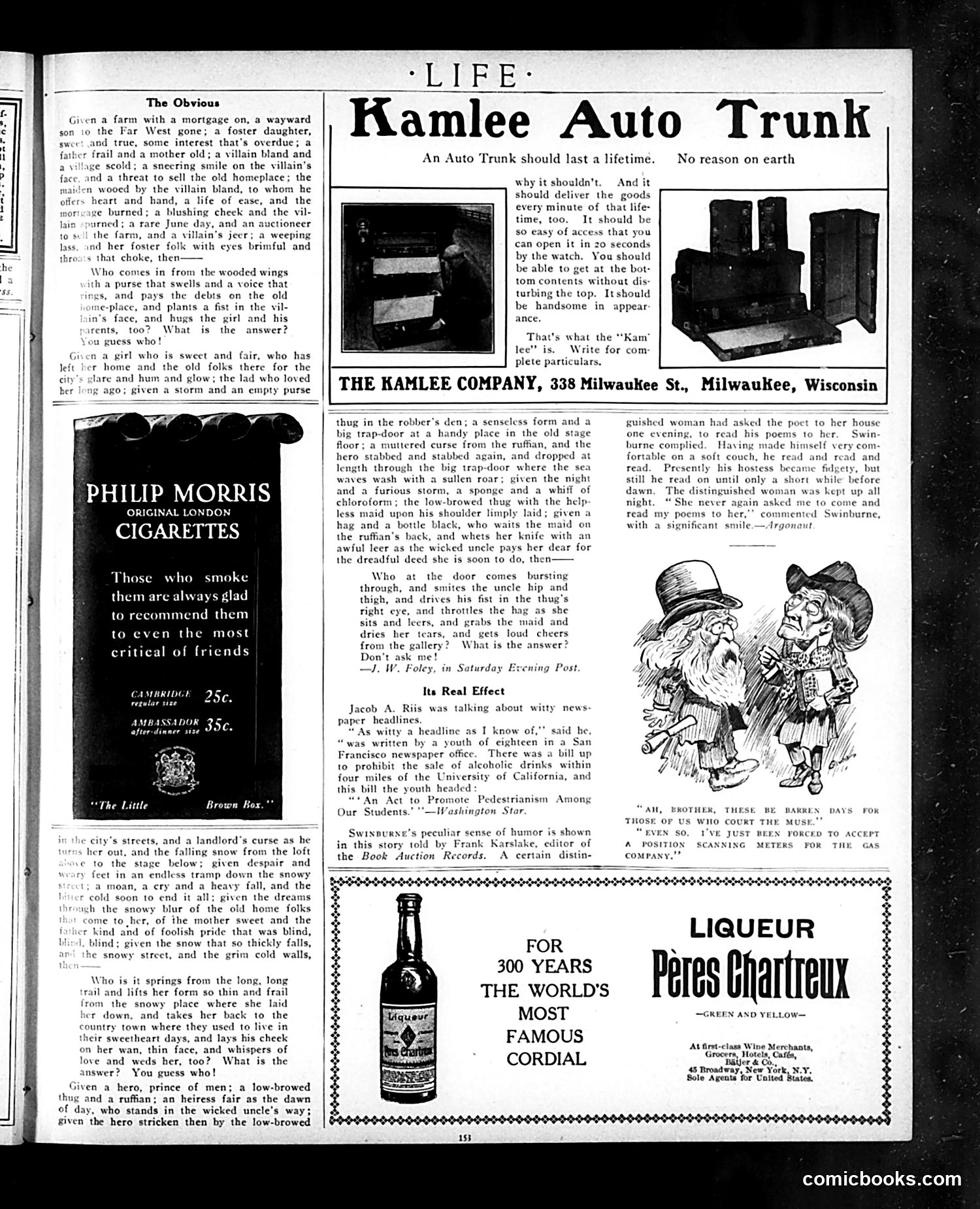
This page contains **mostly advertisements and fiction excerpts**, not political satire requiring historical context. **"The Obvious"** section is a serialized melodrama excerpt—likely from a dime novel or theater script—cataloging predictable plot devices: wayward sons, mortgage foreclosures, villains threatening homesteads, and mysterious rescuers. It's self-aware satire of *itself*, asking readers to guess the stock character who'll inevitably save the day. The joke is that these narrative formulas are so worn that the outcome is utterly predictable. The page also features: - **Philip Morris Cigarettes** advertisement - **Kamlee Auto Trunk** advertisement - **Peres Chartreux Liqueur** advertisement - A brief anecdote by Jacob A. Riis about newspaper headlines The single **cartoon illustration** (two caricatured figures, lower right) appears unrelated to the main text and lacks sufficient context in the visible portion to interpret meaningfully. This is primarily an **advertising-heavy page** with period fiction, not political commentary.
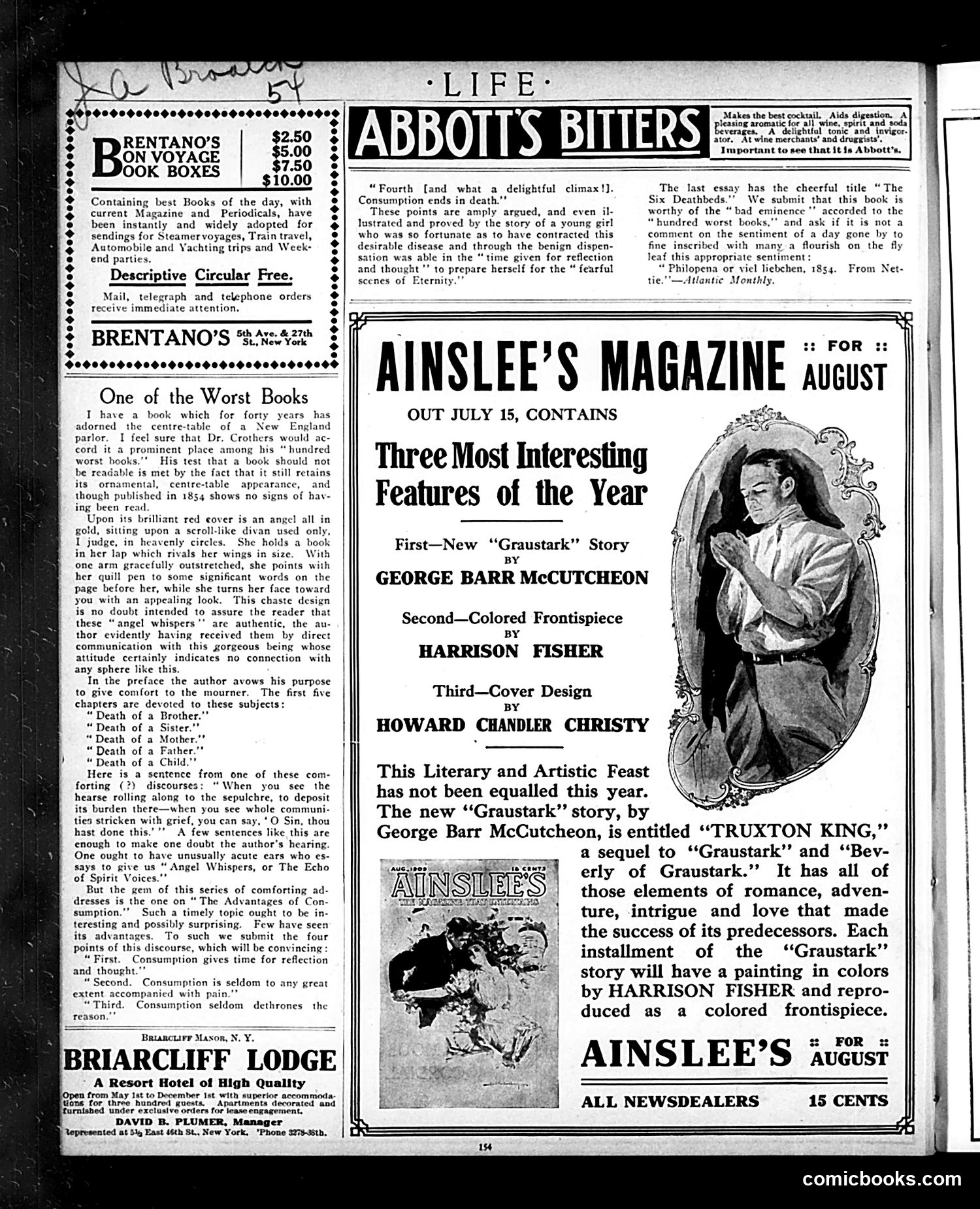
This is primarily a **advertisements and book review page** from Life magazine, not political satire. The main content critiques **"Angel Whispers, or The Echo of Spirit Voices,"** an 1854 book of consolation essays about death. The reviewer mocks its morbid subjects (deaths of siblings, parents, children) and especially ridicules an essay titled "The Advantages of Consumption" — arguing that tuberculosis provides "time for reflection" before death. The reviewer's sarcasm is biting: such comfort seems cruel rather than helpful. The page also advertises **Ainslee's Magazine** (featuring stories by George Barr McCutcheon), **Abbott's Bitters** (a patent medicine), **Brentano's book boxes** for travelers, and **Briarcliff Lodge** hotel. The satire here targets **Victorian-era sentimentality about death** — the tendency to find spiritual comfort in mortality itself — rather than any political figure or movement.
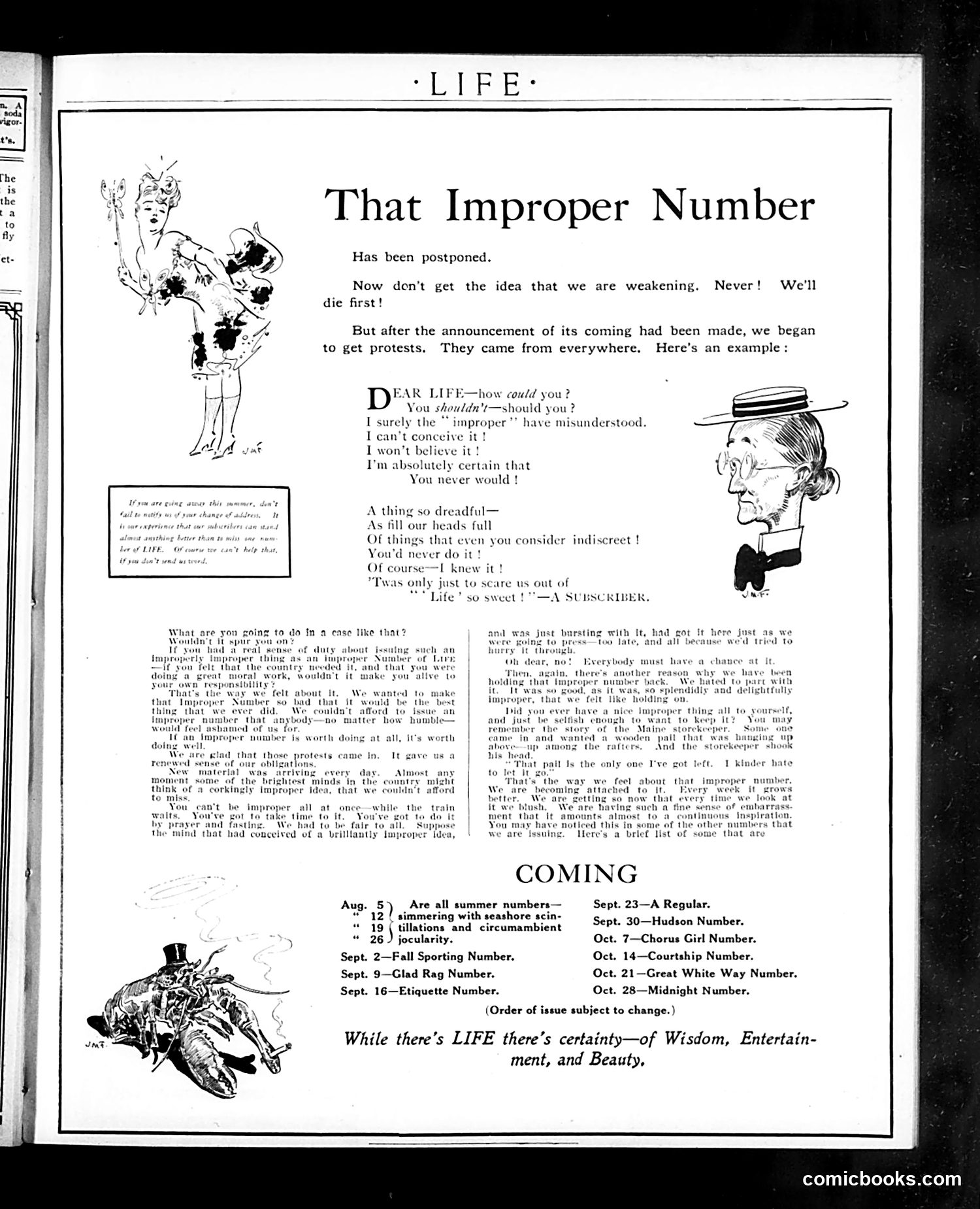
This page addresses the postponement of a planned issue with a risqué or sexually suggestive theme (the "Improper Number"). Life magazine had announced it but faced public protests, which the editors sarcastically claim won't deter them ("We'll die first!"). The letter from "A Subscriber" humorously captures the outraged response—using exaggerated Victorian-style moral panic ("A thing so dreadful!") to mock prudish readers who find the magazine's content indiscreet, while simultaneously admitting they're curious ("Of course—I knew it!"). The cartoon illustrations show fashionable women in revealing or suggestive poses, embodying the "improper" content causing controversy. The joke satirizes both the magazine's provocative marketing and American sexual prudishness of the era—Life deliberately courted scandal to boost sales while feigning innocence, knowing readers would be simultaneously offended and intrigued.
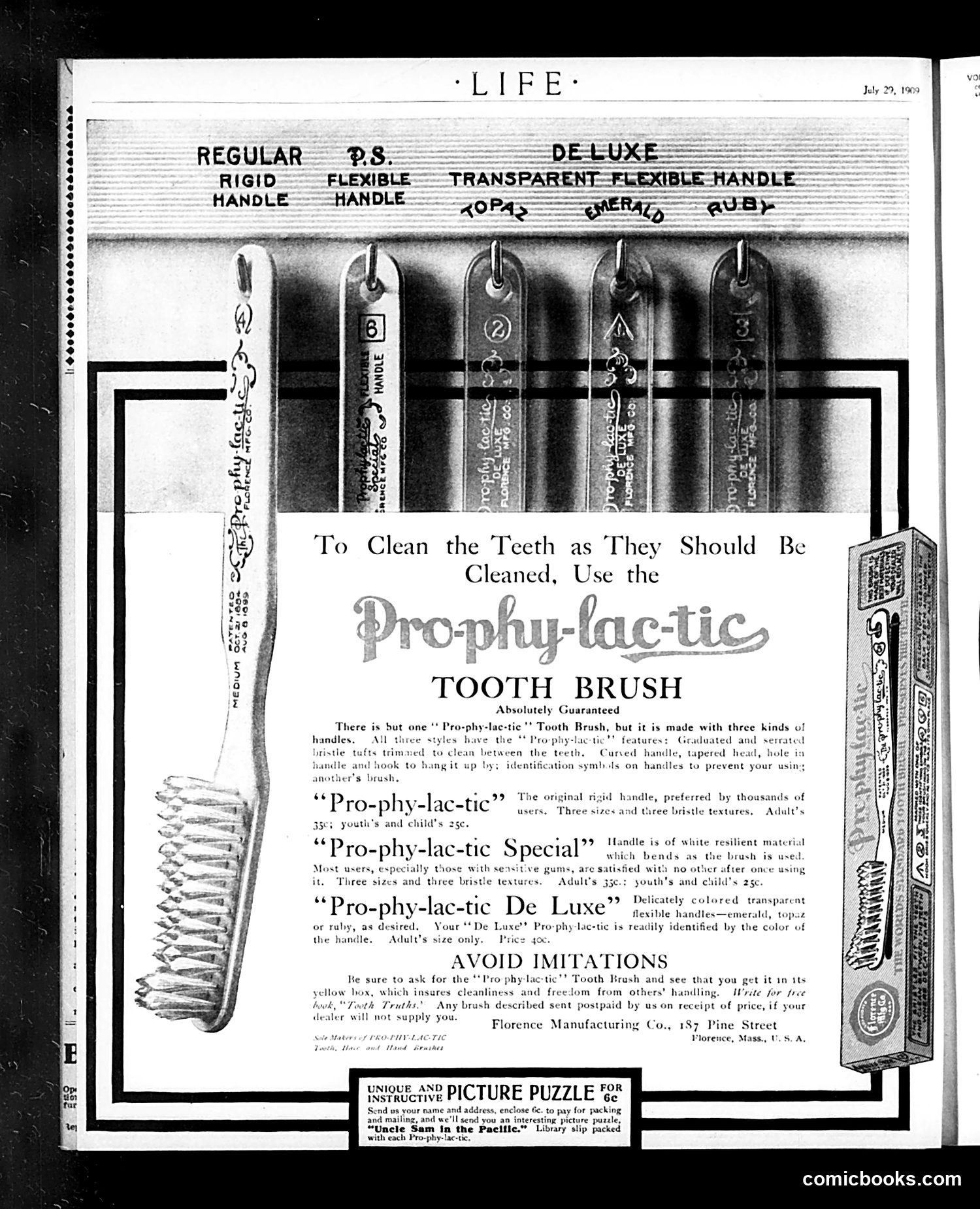
This page is **primarily a product advertisement**, not political satire or commentary. The advertisement promotes the "Pro-phy-lac-tic" tooth brush, manufactured by Florence Manufacturing Co. in Florence, Massachusetts. The page displays five different brush models with varying handle types (rigid, flexible, transparent flexible) and price points, ranging from 25¢ to 40¢. The marketing emphasizes three variants: the original rigid-handled version (preferred by "thousands"), a special model with white resilient material for sensitive gums, and a deluxe version in colored transparent handles (emerald, topaz, ruby). The ad warns consumers to "avoid imitations" and verify authenticity by the yellow packaging—a common early 1900s concern about counterfeit products. A small notice at bottom advertises an unrelated picture puzzle promotion. This represents typical early-20th-century magazine advertising rather than satirical content.