
Life, 1909-07-29 · page 6 of 28
Life — July 29, 1909 — page 6: what you’re looking at
What you’re looking at
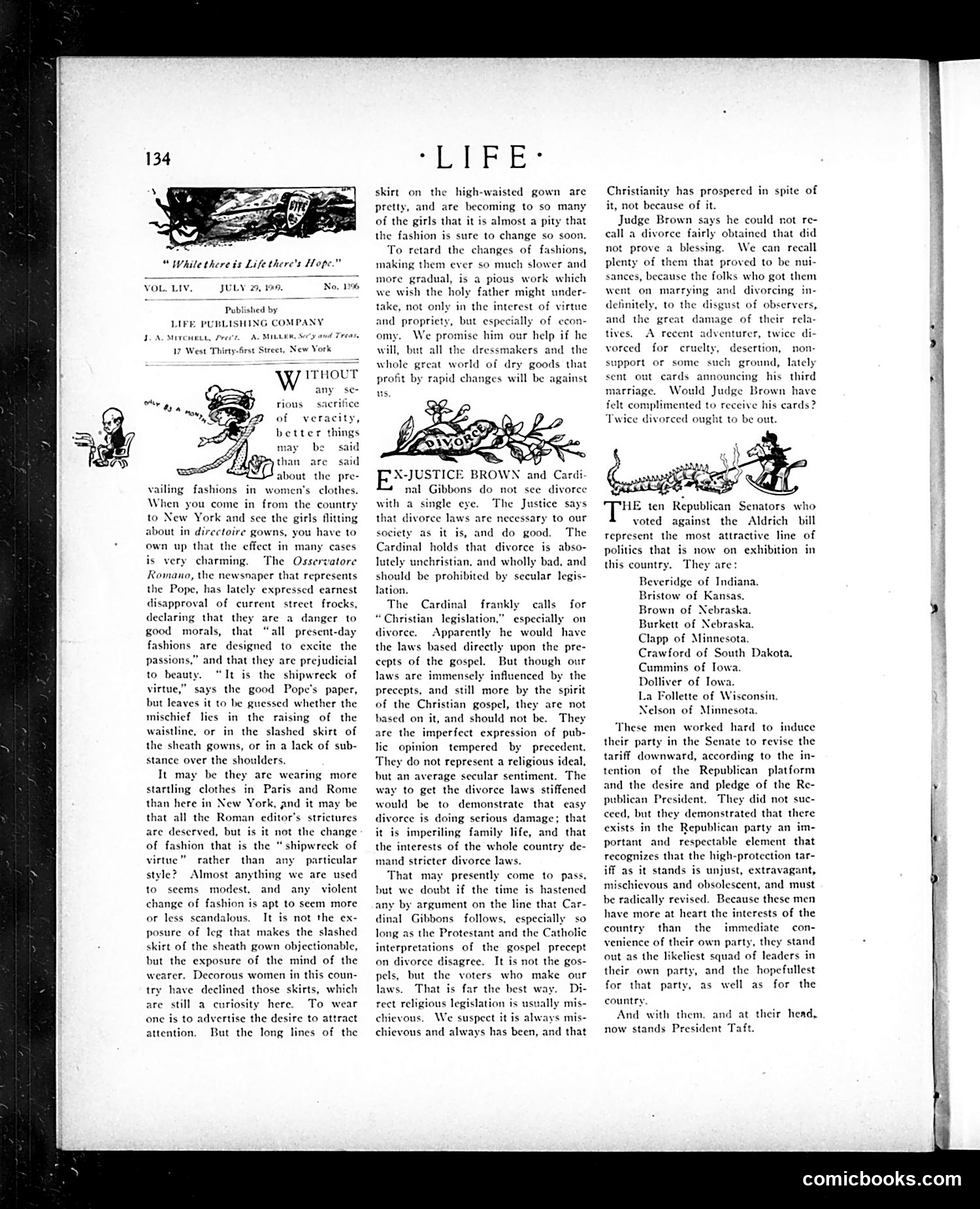
The page contains no prominent political cartoon. Instead, it's primarily text-based editorial content discussing fashion and divorce law. The main article criticizes high-waisted gowns and rapid fashion changes as frivolous and morally dangerous. It then pivots to a serious discussion of divorce, referencing **Judge Brown** and **Cardinal Gibbons**, who apparently disagreed on whether divorce should be legally permitted. The text favors Cardinal Gibbons's position that divorce laws should be based on Christian principles. The piece concludes by listing **ten Republican Senators** opposing the Aldrich bill, praising them as representing "the most attractive line of politics that is on exhibition in this country." These senators apparently resisted party pressure on tariff legislation. The decorative illustrations are generic vignettes unrelated to the political content.
📄 Transcribed text from this page (OCR, searchable)
Machine-transcribed from the original scan — historical spelling and the odd misread are preserved.
“ While there is Life there's Ho, 196 VOL. Liv. JULY 2, 1989, Published by LIFE. PUBLISHING COMPANY JOA Merenenn, Prert Ac MILLER, Sey and Trea 17 West Thirty-first Street, New York ITHOU any se- rious sacrifice of veracity, better things m: be said than are said about the pre- vailing fashions in women’s clothes. When you come in from the country to New York and sce the girls flitting about in directoire gowns, you have to own up that the effect in many cases is very charming. The Osservatore Romano, the newsnaper that represents the Pope, has lately expressed earnest disapproval of current street frocks, declaring that they are a danger to good morals, that “all present-day fashions are designed to excite the passions,” and that they are prejudicial to beauty. “It is the shipwreck of virtue,” says the good Pope's paper, but leaves it to be guessed whether the mischief lies in the raising of the waistline, or in the slashed skirt of the sheath gowns, or in a lack of sub- stance over the shoulders. It may be they are wearing more startling clothes in Paris and Rome than here in New York, and it may be that all the Roman editor's strictures are deserved, but is it not the change of fashion that is the “shipwreck of rather than any particular style? Almost anything we are used to seems modest, and any violent change of fashion is apt to seem more or less scandalous. It is not the es posure of leg that makes the slashed skirt of the sheath gown objectionable, but the exposure of the mind of the wearer. Decorous women in this coun- try have declined those skirts, which are still a curiosity here. To wear one is to advertise the desire to attract But the long lines of the virtue” attention, SES skirt on the high-waisted gown are pretty, and are becoming to so many of the girls that it is almost a pity that the fashion is sure to change so soon. To retard the changes of fashions, making them ever so much slower and more gradual, is a pious work which we wish the holy father might under- take, not only in the interest of virtue and propriety, but especially of ec omy. We promise him our help if he will, but all the dressmakers and the whole great world of dry goods that profit by rapid changes will be against us, JUSTICE BROWN and Ca nal Gibbons do not see divorce with a single eye. The Justice says that divorce laws are necessary to our as it is, and do good. The Cardinal holds that divorce is abso- lutely unchristian, and wholly bad, and should be prohibited by secular legis- lation. The Cardinal frankly calls for “Christian legislation,” especially on divorce. Apparently he would ha the laws based directly upon the pre- cepts of the gospel. But though our laws are immensely influenced by the precepts, and still more by the spirit of the Christian gospel, they are not based on it, and should not be. They are the imperfect expression of pub- lic opinion tempered by preced They do not represent a religious ideal, but an average secular sentiment. The way to get the divorce laws stiffened would be to demonstrate that easy divorce is doing serious damage; that it is imperiling family life, and that the interests of the whole country de- mand stricter divorce laws. That may presently come to pass. but we doubt if the time is hastened any by argument on the line that Car- dinal Gibbons follows, especially so long as the Protestant and the Catholic interpretations of the gospel precept on divorce disagree. It is not the gos- pels, but the voters who make our laws. That is far the best way. Di- rect religious legislation is usually mis- chievous. We suspect it is always mis- chievous and alw has been, and that spered in spite of Christianity has pr: it, not because of it. Judge Brown says he could not re- call a divorce fairly obtained that did not prove a blessing. We can recall plenty of them that proved to be nui- nces, because the folks who got them went on marrying and divorcing definitely, to the disgust « and the great damage of their rela- tives. A recent adventurer, twice di- vorced for cruelty, desertion, support or some such ground, lately sent out cards announcing his third marriage. Would Judge Brown have felt complimented to receive his cards? Twice divorced ought to be out. observers, non- ny y Ys opt As HE, ten Republican Senators. who voted against the Aldrich bill represent the most attractive line of politics that is now on exhibition in this country. Beveridge of Indiana. Bristow of Kansas. Brown of Nebraska. Burkett of Nebraska. Clapp of Minnesota. Crawford of South Dakota. Cummins of Towa. Dolliver of Towa. La Follette of Wisconsin. Nelson of Minnesota. These men worked hard to induce their party in the Senate to revise the tariff downward, according to the in- tention of the Republican platform and the desire and pledge of the Re- publican President. They did not suc- ceed, but they demonstrated that there exists in the Republican party an im- portant and respectable element that recognizes that the high-protection tar- iff as it stands is unjust, extravagant, mischievous and obsolescent, and must be radically revised. Because these men have more at heart the interests of the country than the immediate con- venience of their own party, they stand out as the likeliest squad of leaders in their own party, and the hopefullest for that party, as well as for the country And with them. now stands President and at their head, Taft. comicbooks.com